Friday 29 September 2000. Rome-Athens. Here we are again, ready to let ourselves be conquered by the notes, and by the ever-new sensations that for over five years now we have been seeking in these places and these seas. We leave Rome at 8.30 with a bad weather forecast. In Athens the weather is changeable, but further east it will be clear. The ferry for Rhodes leaves in the afternoon. We have time to wander around the streets and alleys of Piraeus to do a little shopping and, above all, to breathe in its smells and listen to its sounds. The Greek music accompanying our lunch in a modest trattoria announces that we are on holiday again. On our holiday. With punctilious ritual we taste tzatziki, dolmades, taramosalata and drink retsina. The first sip tastes strongly of resin and this flavour, so unpleasant the first time we tried it, today warms our hearts and seasons our memories.
In the coming days we will get used to the taste until we no longer notice it.
On the ferry we occupy a forward cabin with a fine window facing the direction of our route. Before us, the Aegean at sunset. The ship is full of mixed Italian-Greek groups on a twinning visit to Rhodes. They sing and play all evening, mostly Italian songs. As the first Cycladic islands file past on our left, the chorus of La Montanara rings out, sonorous.
Saturday 30 September. Rhodes. I woke up at 7.00. I feel the ship stopped in port and no noise. From the porthole only the open sea is visible. We should already be at Rhodes, and the silence in the corridors makes me think that the passengers have all disembarked. I discover, instead, that the ship is stopped in the unknown port of an unknown island and that most of the passengers are on the aft deck. I ask some Italians, a little ashamed of my ignorance, for information about the place, and thus I learn that the ship has been stopped for many hours at Syfos, one of the first Cyclades one encounters coming from Piraeus, due to a serious engine breakdown. Perhaps, they say, we will arrive at Rhodes this evening. Later we set off again. The day passes slowly amid many stops in many ports. Among them is also Patmos.
From the upper deck we recognise Stavros, our fisherman friend, who waves to us. And so on, until evening, watching islands, by now almost all familiar to us, slide past along our route. On each of them we have the memory of a mooring, of an evening spent in a taverna, of a serene beach. Memories of the faces of simple, serene people, so different from those we meet in everyday life. We arrive at Rhodes late and have ourselves taken by taxi to a hotel. We drop off our luggage before entering the old town in search of a restaurant. Rhodes is still full of tourists.
Sunday 1 October. Marmaris. Finally we are here again. Today is Sunday and we can't do anything else but put the boat in order and stroll through the streets of the town. M. has an annoying itch on her arms and body. We think it might be an allergic reaction due to the stress of recent weeks.
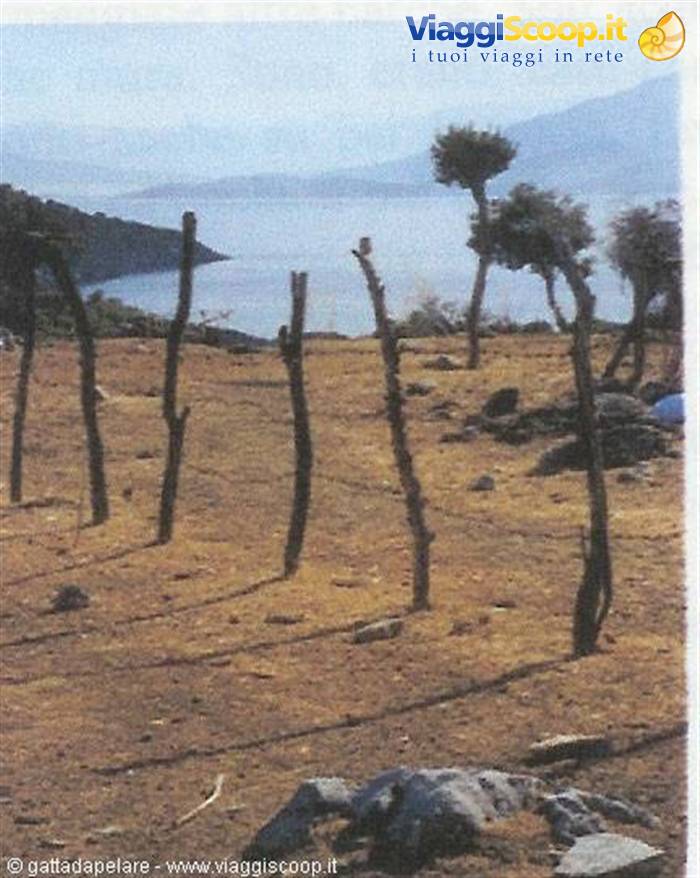
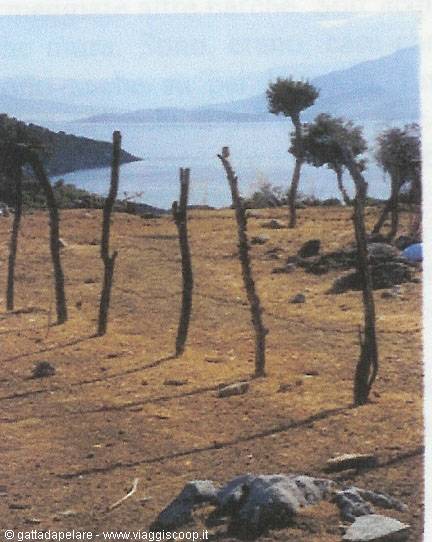
Dry wooden poles on arid ground, a lone tree and blue lake between mountains
Day 22 Oct 2000
Monday 2 October. Marmaris. Haluk shows us the work done on board. Everything seems ok. We launch and have the customs clearance operations carried out directly by the yard. We do a bit of shopping. By now we have learned. Our purchases to stock the galley are becoming more and more frugal. We only need the bare essentials for a day, a handful of olives, some cheese and bread. Usually, in the evening, we go to eat in some taverna.
Tuesday 3 October. From Marmaris to Cala Kapi. 40 miles We leave around 10.00 with a calm sea and little wind. We always go under engine and the mainsail, hoisted, serves only to give us the illusion that we are still on a sailing ship. The shores of Anatolia, already known to us, pass before our eyes again, up to the islet of Baba Ada. From here on we do not know the coast which, we have been told, is interesting both for nature and for history. We are, in fact, facing the coasts of ancient Lycia, whose characteristic tombs can be glimpsed along the shores and, sometimes, emerge from the sea due to ancient bradyseism. Evening falls and we still have to reach our destination. Cala Kapi is a very well protected anchorage reached by rounding a peninsula.
By now it is dark and between the mainland and an islet, a narrow and deep channel is barely discernible in the phosphorescence of the water. Behind the peninsula, an elevated and wooded coast hides from view numerous small inlets that can only be seen when the boat is abeam of them. The gulf is well protected and one has the sensation of being in an alpine lake. Suddenly the apparition of the bottom of Cala Kapi, sparkling with lights. One also hears the convivial voices of numerous people, presumably seated at table. Divided between the regret of not being alone to enjoy these places and the need to break the day lived in solitude, we moor at a small jetty and go, we too, to one of the numerous tables. The taverna, a few steps from the sea, has the appearance of a rustic club. Numerous crews, northern accents, laughter. From a boat comes disco music.
Figures carved against the starry backdrop of the sky wave and sway their arms. Thus a splendid anchorage is spoiled, humiliated in the summer banality of any fashionable resort. M. is suffering. Her arms and body are covered with small red spots. We fear it might be chickenpox.
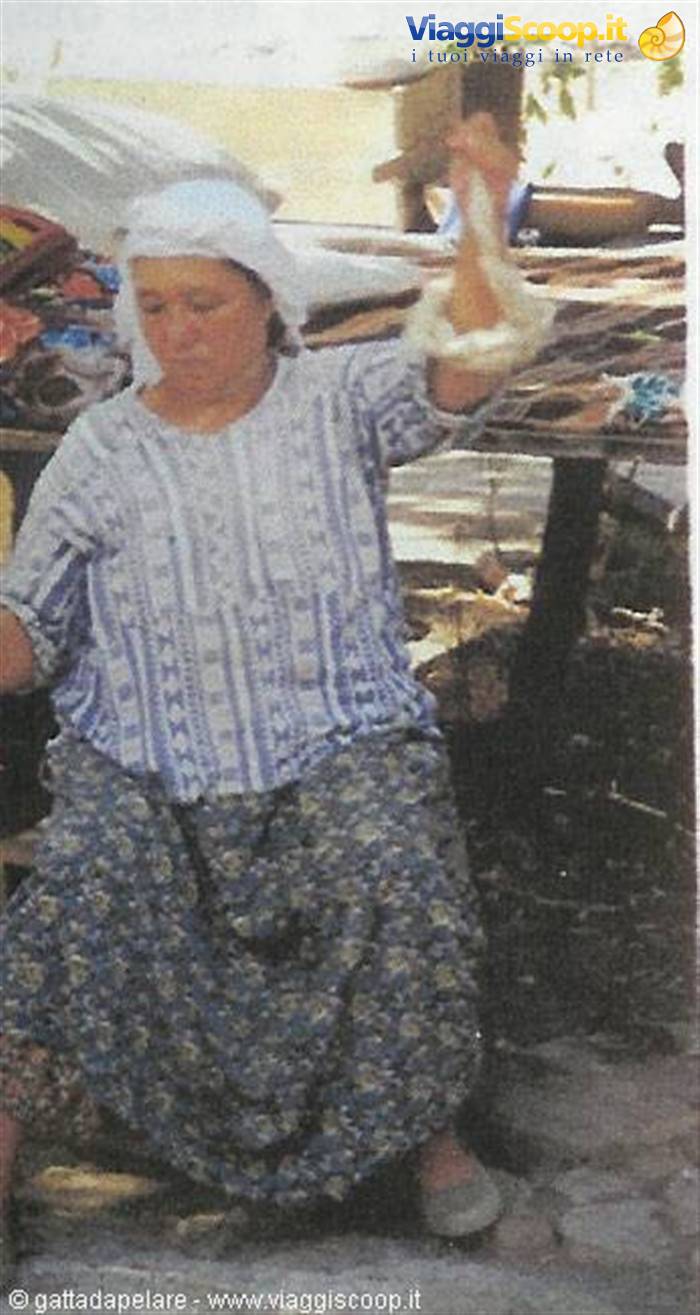
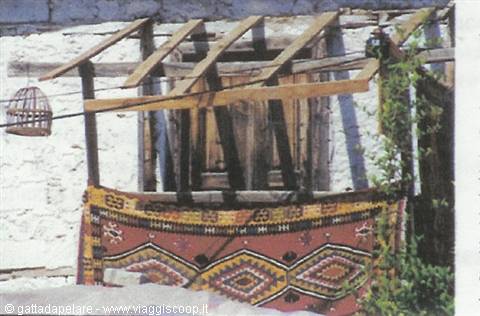
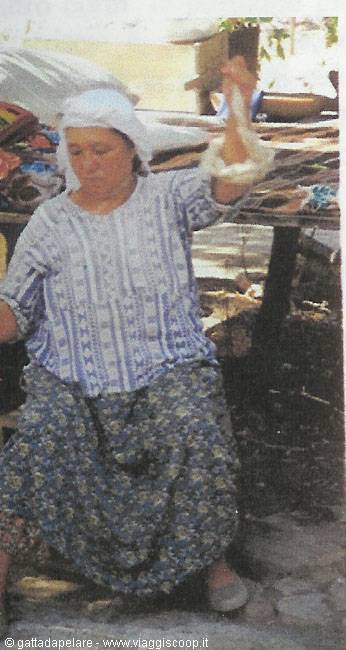
Wednesday 4 October 2000. Cala Kapi-Gemile Islet. 15 miles. Early in the morning we visit a poor village a couple of kilometres from the anchorage. You must first climb a modest hill and then reach a plateau which, on two sides, overlooks the sea. The houses, if they can be called that, crumbling walls sheltered by heterogeneous roofs of rusty sheet metal, are distant from one another, almost ashamed of being seen by the neighbours. The poverty of their inhabitants is lived within isolated families, shy of looking at one another, afraid of recognising themselves as poor. A spontaneous and hopeful cordiality welcomes the tourists (we are not the only ones) inside properties, uselessly and roughly fenced. We are offered tea and the women of the shack proudly show us their industriousness with wool.
The children, with incomprehensible names, peek out from behind the wide skirt-trousers of their mothers and grandmothers. They have beautiful eyes, timid and full of curiosity for the foreigner. We buy, out of a courtesy taken for granted and skilfully made obligatory, a couple of slippers at a boutique price. A million Turkish lira, plus something for the children's sweets, make the clumsy grandmother happy, who, laughing, keeps repeating "bonbon, bonbon", pointing to the little grandchildren who, now, appear just a little more daring. We leave Cala Kapi with a good wood-fired bread. 20 miles from here is the famous Ölü Deniz, the dead sea. We sail with little wind through the gulf of Fethiye. The day is beautiful and if it weren't for M.'s malaise we could fully appreciate it.
When we turn behind Cape Iblis, the remains of the Byzantine city that stood on the island of Gemile appear to us. Between this and the mainland we find a well-sheltered channel in which other boats are already moored. Underwater, caressed by the movement of the algae, the remains of ancient walls can be seen. They are, they were, houses that bradyseism, or perhaps an earthquake, has submerged. They continue also up along the coast, to the top of the hill. The apse of a church is the most conspicuous and also the most important remnant. A small boat approaches us offering ice creams and another offering flatbreads prepared expressly on board on a rudimentary wood stove. We go ashore to drink something and meet the owner of the first of the three tavernas. He speaks French having worked for a long time in Marseille and tells us a bit about the history of the city.
Gemile is the birthplace of St Nicholas, (who became Father Christmas for the northerners). He is the same patron saint of Bari where his body arrived, miraculously, carried by the waves. Later, we go to visit the remains of the ancient city. The guardian recognises us as Italians and tells us that other Italians (those from the TV programme "Turisti per caso") have already been there. Good people, he says, and we don't doubt it. In the evening we reach the second of the three tavernas. We are the only guests, but surrounded by the attentive care of the entire family of tavern keepers. M. is still suffering. It seems to be getting worse.
Woman in white headscarf and floral skirt spinning thread at a market stall
Day 35 Oct 2000
Thursday 5 October. Gemile Island - Ölü Deniz - Kalkan - 27 miles. We leave in the calm of a clear morning to go and visit the famous bay of Ölü Deniz, just behind our anchorage. The place is certainly very beautiful, a pity that one cannot enter. After rounding a small promontory, a wide beach appears to us which, on the left side, breaks into a narrow passage. Access is blocked by a net supported by buoys and one glimpses a pleasant inlet and many deckchairs. Even the wide beach appears very touristy. We approach as close as possible and go ashore to do the provisioning. The urban settlement is quite crowded; many little souvenir shops, and buses coming and going. We have already had too much of it. Just the time needed for our modest purchases and we set off again without any regret. The weather is still very fine and we proceed under engine.
M., increasingly suffering, rests in her berth. Towards 11 the wind rises and strengthens. We have it from our direction of travel and we beat. With three or four tacks we get further offshore. The coast where ancient Patara stood is a long and deep strip of sand which, according to Haluk, is subject to strong tides. Dangerous for navigation, it gives us proof of this by showing us the recent wreck of a sailing boat run aground and half-submerged. After rounding a rocky promontory, the gulf of Kalkan opens before us and the wind strengthens to the point that we must reef the genoa and mainsail. The operation is not easy because the furler jams and it is necessary to lower by hand while, close to the coast, the gusts become intense. A small Swiss ketch is also in difficulty, manoeuvring back and forth as if wanting to gain time.
We also see a 14-metre boat flying the German flag hove to with apparent problems at the bow. In addition, the lower starboard shroud gives way and starts flapping. Fortunately M., who is at the helm, luffs in time and lets the wind pass on the port side, thus lightening the strain on the remaining shroud. We start the engine, lower the mainsail and enter the harbour. We easily find a place. We are rather shaken and while we slowly catch our breath we see both the German boat and the small Swiss ketch enter, towed by a fishing boat. M. is increasingly ill. Small blisters are spread everywhere and the itching has increased. We are rather worried, but despite this we go to visit the town.
Kalkan is arranged at the foot of a hill and is represented by a group of old and picturesque buildings arranged along three or four alleys where little shops overlook with every kind of merchandise for tourists. There are not many people and the whole appears pleasantly welcoming. We dine in a restaurant where they serve us a meat stew cooked in a sealed jar that must be broken to eat the contents. The appearance is more interesting than the taste.
Friday 6 October. Kalkan. M. is too suffering to continue the journey. We decide to stay and rest here and look for a doctor. The boat neighbour, a former paediatric nurse, rules out that it could be chickenpox, but cannot diagnose anything. We have a doctor pointed out to us and go to find him. The surgery is fairly new and with few objects that denote a certain desire to give modernity to the practice. The doctor, however, is not equally professional. He looks more like a carpet dealer. He observes M.'s rash, her hair and pronounces with certainty: scabies. He prescribes a shampoo. Perplexed, we make the purchase, but we are nonetheless happy that it is not an exanthematous disease. In the afternoon we rent a car and go to visit the ruins of Patara. The ancient city from whose port St Paul embarked for Rome, and today silted up, like all the ancient sites.
The beach is very beautiful, deep and very long. Today, unlike how I saw it the first time, it is also equipped with deckchairs and umbrellas. Fortunately it is so vast that for the most part it remains deserted. Of Patara there remain romantically evident the theatre (partially silted up) and the triumphal arch built for himself and his family by the governor (whose name escapes me) of the Roman province. It stands solitary in a field of sesame and is surrounded by sporadic Lycian tombs. We also observe some farmers threshing the sesame plants by hand. They beat the ears on a nylon sheet and from the dry pods small brown seeds come out. We reach Xanthos, ancient capital of the region, producer of famous horses, mentioned by Homer, it stands halfway up on an elevated position and dominates the wide and fertile plain.
The river of the same name, with yellow waters (from which its name and that of the city derive), flows lazily with many meanders in the valley floor, at the foot of the acropolis. Interesting is the theatre and two monumental tombs. In the evening, in Kalkan, we go to dinner in a typical place where a trio of musicians plays. One of them sings ancient tunes with passion. Seated "Turkish style" on the carpets, among colourful cushions, we let ourselves be caught by the suggestion of the singing and listen in silence to the incomprehensible and heartfelt words.
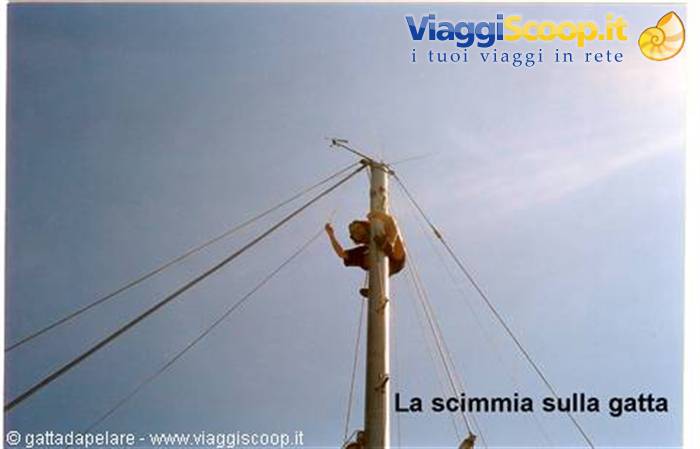
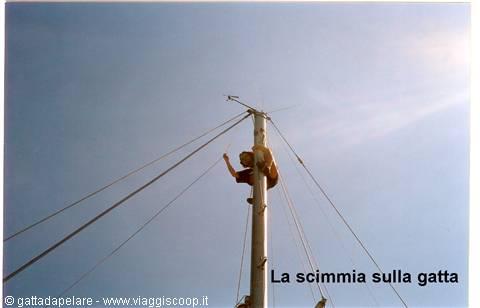
Man climbing the metal mast of a sailboat against blue sky
Day 47 Oct 2000
Saturday 7 October. Kalkan. M. does not improve and we stay in port again. The day passes slowly while she lies in her berth and suffers. The "scabies" increasingly resembles a doctor's "crab". Long phone calls with the family medical council lead to identifying the ailment as an allergy or a stress herpes. We dine again in yesterday's place. On our return we find a wedding party organised on the esplanade of the port. There is music and dancing. We are carried away by the rhythm of the tambourines and stringed instruments and find ourselves dancing too. There are two distinct groups of dancers: that of the men and that of the women. They are dominated, each on their side, by the two spouses. The young bride is pretty. Tall, dark-haired, dressed in white, she is surrounded by her companions of every age. The groom is also at the centre of the group of men.
Among them, very committed to their role, some young boys dance. Rarely do the two groups mix, but the division has no character of obligation. It is a spontaneous reaction conditioned by an ancient custom that in the past had a character of categorical separation between the sexes. We dance for over an hour waving and swaying our arms sinuously above our heads, continually changing partners so as to dance a little with everyone. M. receives the romantic and serious courtship of an eleven-year-old who produces himself in genuflections, broad gestures of the arms and intense conquering glances. I too have my little dancer. Possessed in her gesticulating above her head and in the swaying of her hips, she is determined to form a fixed couple with me. And around us, seated on several rows of chairs, the "elders" of the two families observe composedly. We go to bed late.
Tomorrow we want to reach Finike where there is a modern marina equipped to leave the boat. We have, in fact, decided to interrupt the journey. Apart from a few moments, M. is too suffering to enjoy this sea and these places as they would deserve.
Sunday 8 October. Kalkan - Finike. 22 miles We leave the quiet little harbour of Kalkan which we will remember for better and for worse. The weather is good and with little wind. But we are prepared for this. By now we have left the meltemi zone, we are no longer in the Aegean. The coast is always very beautiful and after a few hours we pass in front of Kastellorizo (Meysti). M. rests below deck. Better so, the images of the film Mediterraneo can remain intact in their memory. Reality is less attractive. Some modern buildings that can be seen in the town ruin the romantic daydreams that the film had conveyed to us. We have lived more sincere experiences in our wandering among the islands, truer and closer to those told in the film. Kekova is the name of the village that in the afternoon we see on our left.
We have entered an arm of the sea bounded on one side by a long island and on the other enclosed by a ring of low wooded mountains. We cross the bay surprised by the vision of nature and by the memories left by the past of men. The village is dominated by an acropolis on which ancient remains are stratified. The battlements of a castle speak of crusaders while the great stones at the base of the powerful walls tell us of the "sea peoples" of the Achaeans, of the Dorians. Some Lycian tombs, similar to medieval sarcophagi, run along the flanks of the hill. They all appear violated by ancient plunderers. A hole on the side of the burial, just below the heavy lid, denounces the break-in of the treasure seeker. Who knows what the ancient thieves ever found? Certainly something precious, enough to justify the determination with which all the burials have suffered the same fate.
Seen from afar they look like cocoons of gigantic butterflies abandoned by the larvae now become adults. Or perhaps they are the souls of deceased warriors, or of princes or kings who refused the narrowness of the sarcophagus after, in life, they had roamed among these mountains and these boundless shores. And our boat, pushed now by a breeze from astern, lets itself glide between these shores where, we have promised ourselves, we will return next year. The decision to interrupt the journey conditions our availability to fully enjoy the atmospheres and nature. Coming out again into open sea the wind strengthens and Gattadapelare glides quickly towards Finike. A few hundred metres from the port I experience the famous boom. The "boom swing", like all boom swings, catches me by surprise and brings me to my knees, stunned, in the cockpit. Fearing to lose consciousness I call M.
who rushes over at once, a worried "mother hen" and heedless of her illness. The coast, very close, has just been grazed. Under the surer guidance of the "legendary" second in command we enter the port and moor stern-to. The marina of Finike is fairly large and recently built. We are decidedly out of season; there are no other crews around. The small town with tourist ambitions stretches along a modern seafront, but does not leave us enthusiastic. For us it is only a technical stop in our wandering.
Monday 9 October. Marmaris. Once the usual formalities to leave the boat in Turkey are completed, we give instructions for the haul-out and book a taxi to take us back to Marmaris by 16.30 today. From there a Dolphin will take us to Rhodes. It is a three-hour drive spent travelling back along the coast that we had seen filing past yesterday from the boat. It is a road full of curves and extremely slow. Indeed, we arrive late for the scheduled boarding and are forced to wait for the next ferry. But it is not a good day. A violent storm blocks our second chance of boarding somewhere. Finally, when we see it enter the bay wrapped in a gloomy twilight, it is already 18.30. The journey to Rhodes takes place amid towering, foaming waves, while the boat pounds violently on the sea. Everywhere "vomiting" passengers. Finally we moor at Rhodes when it is pitch dark.
We settle into a small hotel in the centre and go to dinner when by now almost all the restaurants are closed. The sky is full of lightning and we are happy no longer to be at sea.
Tuesday 10 October. Rome. A plane at dawn and a connection in Athens with the one for Rome. As with all returns there is sadness and tiredness and even the thought of "used-up effort" does not help us to be in a good mood. Anyway, the appointment is for May 2001!!!
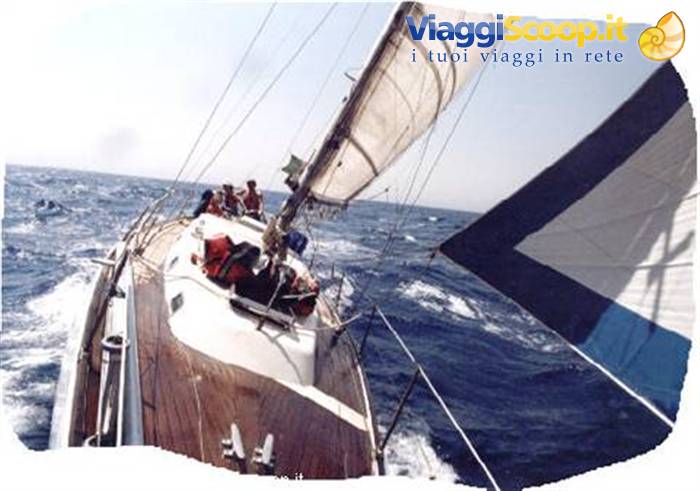
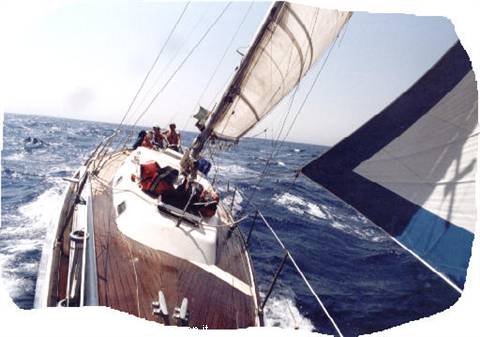
Crew sailing a yacht in choppy sea, spinnaker flying
0 reader comments