The usual meeting with Gino to begin the new cruise takes place at Athens Venizelos airport. The meeting is made even nicer by the presence of Annelise, Gino's friend and an aspiring Gatta crew member. She has left Paris to immerse herself in the rarefied atmospheres of the Aegean and already at first contact she shows her charge of friendliness and good humour. She will be, I feel, a pleasant travelling companion. It is also an opportunity, for me, to brush up on the little French I have left, the residue of distant school memories. But to our meeting is also added that of Takis and Nikos Yannios. They reached us at the airport to meet us in person after the virtual acquaintance made on Facebook with Takis. Both speak good Italian acquired during their university years in Rome in the distant sixties.
They too are gifted with a charge of friendliness that makes this extraordinary Athenian meeting even more joyful. As we leave the Yannios brothers, we carry with us the awareness of being still a little more at home in this land of Greece, savoured for the first time more than twenty years ago and become so meaningful in our life here and in our memories.
We leave Athens with the direct flight to Leros, where we arrive in the early afternoon. The Gatta awaits us, always patient, on the cradle of the boatyard, and hosts us for the first night. We dine on board with the shopping done by Annalisa in the village, after getting a lift by car from a kind Greek woman.
Leros airport is on the northern coast of the island, near the boatyard where Gattadapelare awaits us. We search for her eagerly with our eyes as the plane comes down onto the runway. A particular runway this one, not very long and uphill when you land and, of course, downhill when you take off. The meltemi blows straight down it and this configuration and direction favour the take-off and landing of the twin-engine propeller planes that shuttle with Athens. Yesterday, they tell us, the strong wind prevented the plane from landing, even though the uphill runway could have braked the force of the wind.
The journey from the airport to the boat is short. Dragging our trolleys we soon arrive beneath the Gatta which, lodged on the cradle, seems to greet us from above with a certain condescension. "You've arrived, finally," she seems to say, "I've been waiting for you for a year so I can feel the sea under my keel." She is impatient to get into the water. So are we, but today is Sunday and the boatyard is closed.
While we, having come aboard, set about tidying up the interior, Annelise manages to find a lift to go to the village to do a bit of shopping for dinner and for tomorrow. We will buy the rest tomorrow in Lipsi, where we plan to arrive in the morning.
Water has got into the boat and the bilge has filled up, lifting the fresh water tank, which was empty, pushing it against the floor of the dinette and raising it.
Tomorrow we will have to have it repaired before hauling the boat out.
We have dinner and go to bed early. The first night in a bunk, after so many months of a soft mattress, holds something unusual that excites seafaring fantasies and fills the crew with expectations.
Day 17 Feb 2014
................................................................................................... Two weeks later, with the new crew
2 July 2014. From Levitha to Patmos, 28 miles
The day dawns wonderful and serene. Yesterday's wind has died down. When we woke up, some boats had already left their moorings, bound who knows where. This Aegean Sea, which stirs in me hazy memories of myth and history, holds an enchanting magic that has bound us to it, my daughter Marzia and me, with ties so strong that we could never break them again. Nor do we want to. When we cast off the lines that moor us to the land above or below the water, we do so with the trepidation of the first day; a feeling that heralds new, yet already lived, experiences. A promise always kept. Every sail, every island seen, reached or imagined renews the pleasure of the journey. This never grows tiresome; on the contrary, it spurs us to travel again, and again.
It is the same impulse that moves the steps and souls of nomadic peoples, labelled by settled folk as "homeless." A mistaken definition, because the homeland of nomads on land and of sailors at sea is far broader than the one circumscribed by fictitious borders established by men. The journey must not be short, but long and savoured, says Costantino Kanavis in his beautiful poem. Ithaca. "You must hope that the road is long. That the summer mornings are many when, in the harbours - at last and with what joy - you will touch land for the first time." We could have gone once more, climbed up to what was the ancient acropolis, savoured again the dry scents of the scrubby vegetation of the bay, looked down from above at the splendour of the sea stretching south to wash Kos, Rhodes, Karpathos and so many other smaller islands.
We could have, but yesterday's harsh experience, the memory of the hours spent battling wind and waves, pushed us to set off for Patmos over a placid sea and a gentle swell. We set off late in the morning, the last boat to leave the quiet mooring.
3 July 2014. Patmos. We anchored yesterday afternoon on the pier that runs along the waterfront of Skala, the seaside village of Patmos. There are many boats at mooring, on the anchor. With the children we went to have a look at the flags and the crews. They're all there: Italians, French, Germans, English, Greeks, Turks and others besides. We made friends with an Italian family with children and reached the little square of the village, where a couple of cafés and some shops selling local products aimed at tourists face out. Patmos is quite popular with a tourism drawn by the beauty of the place and the mysticism of the island that saw St. John exiled here by the Romans. Here, sheltered in a cave halfway up the coast, he matured and wrote the book of the Apocalypse.
Every time I return to Patmos I ask myself the same question: how could he, before such beauty, think of the Apocalypse? John writes: …I was on the island called Patmos….. and I heard behind me a loud voice, like a trumpet, saying, "What you see, write in a book and send it to the seven churches: to Ephesus, to Smyrna, to Pergamum, to Thyatira, to Sardis, to Philadelphia and to Laodicea….".
We have an aperitif sitting at one of the cafés. The television is showing an international football match. For years my holidays in Greece have been punctuated by important football matches watched by international fans sitting at the cafés or tavernas, applauding or sighing at every goal depending on their nationality.Our children - (but it's time I promoted them to the rank of boys, or maybe lads, and the girls to that of young ladies before they rebel and thus face their first "generational clash" - well then, the lads follow the broadcast with interest while my daughter and I, impervious to these passions, look around to observe the people.
The wind is rising. It's still contained, but my anxiety as skipper and prudence, daughter of experience, prompt me to set an upwind spring line as soon as we're back on the boat.
4 July 2014. Patmos. A quiet night, but in the morning the wind has increased considerably. During the night other crews followed suit and many a sleep was interrupted to reinforce the moorings. Beside us moored a large motor Yacht flying the Turkish flag. Its size is such that it shelters us from the wind, but also a little alarming at the thought that if it should drag anchor it would crush us against the quay. I have always wanted to see the beach of Psilli Amos, one of the most beautiful on Patmos, but I have never had the time because of the frenzy of sailing. This time, forced to stay in port by an ever-stronger wind, we rent a car and reach the southern coast of the island, which, lying leeward, grants us a calm and blue sea. From here one must continue on foot along a path that winds halfway up the coast, constantly offering us the beautiful panorama of the Aegean.
The distance is not short nor restful, but the longed-for promise lightens our steps even though it makes the way seem all the longer. Past a ridge, behold, below us appears a stretch of white sand adorned by the usual tamarisks. It is closed at both ends by rocky headlands and behind by the steep hill from which we descend in numerous switchbacks. A modest taverna promises cold drinks and gathers around it a sparse number of bathers. Two donkeys, sniffing in the shade of a struggling little tree, do not deign us a glance, while, passing before them, we go to choose the most inviting tamarisk. The wind blowing from the other side of the mountain ridge above us reaches here only as a sweet breeze. And so we spend the day, between swims, building castles and football stadiums on the sand and viewing the dangling male attributes of a couple of nudists.
As the afternoon turns, we take the road home. The situation at the port is unchanged. The wind blows briskly and there is nothing left to do but wait for it to pass, idling from the chairs of one café to another.
..and goes
Day 26 Jun 2014
The route from the parking lot to the haul-out basin seems endless. The transporting of the boat proceeds slowly and clashes with our impatience to sail. Finally we are in the water. Engine start, cooling water check, gear ahead... and Gattadapelare pulls away from the shore, at first very slowly, almost as if testing her abilities, then more cheerfully, greeted by our hurrahs. Free. We are finally free from the ties of the land, but above all from the restrictions imposed by living with the ground under our feet—free to go where we want, where the wind takes us, where it is imagination that points out the course. Free from the burdens of daily life, from the petty worries that accompany our existence in the gloomy days spent ashore. This backpack we leave on the shore and watch it shrink minute by minute while the boat moves away into the blue. The crossing is short.
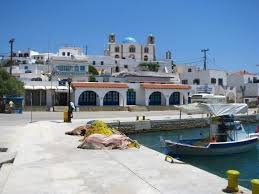
Lipsi welcomes us with the same serenity that enchanted Ulysses even more than was in Calypso's power. The nymph had an easy game chaining the hero of Troy for seven years. The desire for Ithaca and Penelope must have been intense to make him finally abandon an island so serene, then as now. A broad inlet, almost hidden from offshore, shelters at its base the small and only town of the island. A quiet town that offers little to the tourist passing through, but much to the one desirous of peace. Few tourists, mostly resident. A small community of Italians has chosen it as a refuge of the soul and lives there for many months of the year. We moor at the head of the pier, Mediterranean style. I have landed so many times at Lipsi that by now I feel at home here.
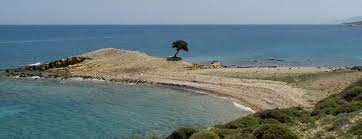
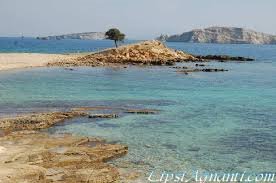
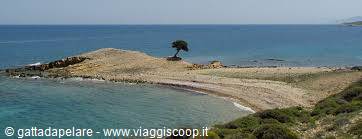
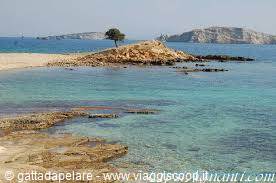
We set off walking to climb up to the "almond tree house," my daughter Marzia's dream tucked away in a drawer, and from there we continue until we reach the watershed. Here the view ranges as far as the soft line of the Turkish coast, after sweeping over the nearer islets of Aspronisi and Makronisi. On the left one glimpses the small archipelago of Arki. Below us the modest promontory of Monodendri—the only tree—topped precisely by a single tree that spreads its canopy over a sea that murmurs, under the gentle push of the wind, the song of the sirens. A great number of seagulls wheel, high, untiring, above us. Behind a fence some little goats watch us, hopeful for a tuft of grass, which we do not find. The ground is arid at this season, and stony. No grass grows. The only vegetation consists of modest thorny bushes.
On the way down, returning to the town by another road, we reach the small valley that borders a sandy beach. As was predictable, here some remains of a Minoan settlement have been brought to light. There are all the characteristics required by that ancient people to found a city: the beach for hauling ships ashore, the fertile valley for the practice of agriculture, the hill on which to raise the acropolis. These are not the important remains of a city, but certainly those of a village without monuments and without glory. Yet every time I encounter the vestiges of those who are called "the peoples of the sea" I am moved at the thought of these sailors who countless times traveled the same routes that we make with our boat, who docked at the same places, who breathed the same dry scent of the herbs and bushes of these islands.
Here they have left spiritual footprints that the eyes of my soul manage to glimpse and that are the cause of my emotion. I could no longer do without this harvest of sensations that Greece transmits to me, whether they come from some insignificant ancient stone or from the marbles of a temple, from the reading of a myth or from history, from the wind in my hair or the sun on my skin. I love this country for what it has been able to give me, and these people always friendly and helpful. From here, after a stop and a swim, the first of this cruise, we return to the town. In the evening we dine, with the modest and tasty foods of Greek cuisine, at Nikos's taverna—a taverna at the beginning of the fishermen's harbor, simple and attractive precisely for its simplicity.
We meet some Italian and Greek acquaintances with whom we exchange a bit of news, a few joking remarks, and soon we go to our berths. Tomorrow is another day.
Sirtaki in Marathi
Day 37 Jun 2014
June 7, 2014. From Lipsi to Marathi. 8 miles
A visit to our Thule, the islet of Marathi, cannot be missed. The stretch of sea that separates it from Lipsi is short and not at all monotonous, rich as it is in islets and passages with shallow depth. But before arriving there is the stop at the "blue lagoon" of Arki, the main island of this small archipelago. The "blue lagoon" takes its name from the color of its waters which let the whiteness of the seabed, made of marble dust, show through. The low coast that surrounds it is, in fact, made up of marble rocks, a mineral not rare in the Aegean islands nor on the Greek and Turkish mainland. Marble was perhaps not the cause of the development of sculptural art in the ancient Hellenic world, but it certainly favored it. The Venus de Milo is made of Parian marble, but that of Naxos was also famous, and the Pentelic marble, near Athens, with which the temples of antiquity were built.
The beauty of this place is shared with only one motorboat behind which, at a discreet distance, we trail our anchor. The bottom, a poor holder, lets our anchor plow unawares and, in a moment of distraction, we find ourselves, pushed by the current, close to the reef. No damage, except for a few slight scratches, but the error of not having paid attention to the mooring will be written in the black book of the captain and his crew. The arrival at Marathi repeats itself with the usual ceremony by now consolidated over some ten annual landings on this islet. Mikalis, the tavern keeper, sees us from afar, invites us to his little quay, addresses us with the usual joking phrases. Tonight there will be a party at his taverna. A group of musicians will entertain us with music and dances.
Under the reed awning, a step from the sea, the tables are prepared at which some crews of the boats moored to the taverna's moorings are seated. We are perhaps about thirty people, an unusual presence at Marathi in this period of the year. Almost a crowd for me, accustomed to the rarefied atmospheres of this island, where time flows without time and the bleating of the little goats wandering among rocks and thorny bushes is the only sound one hears. I was forgetting the recurring crowing of the roosters at every hour of the day and night. After dinner, with a glass of ouzo nice and full and cold in front of me, I feel at peace with everything and everyone.
Mikalis's taverna is perhaps the most pleasant of the three on the island—(I remember how only this one existed; but everything changes, even in the least known places)—or perhaps my appreciation is conditioned by the unconscious desire that nothing should change, because change is a sign of the passing of time, and I too, like Goethe's Faust, would have wanted to cry then as now: Stay, moment, for you are beautiful. The music begins. There are three of them, the musicians, and they play traditional instruments, such as the lyre and the bouzouki. They play rebetika, the traditional Greek music, born in the slums and in the poor and disreputable communities of the cities, later ennobled by use. It is that music which, in the first visits of the Western visitor and even more of the tourist to Greece, appears monotonously repetitive, without flights and passions.
It takes years of listening to begin to appreciate it, without perhaps ever fully understanding it. But the Greeks like it and for them it can go on for an entire night without growing tired of listening to it or playing it. I remember a child, five or perhaps six years old, who years ago at Olimpos, on the island of Karpatos, accompanied his father, the tavern keeper of a place on the small main square of the town, with his little lyre. They were playing for themselves because the place, apart from my daughter Marzia and me, was empty. They were playing when we entered and they continued to play even when we left, after we had consumed, in respectful silence, a glass of resinated wine.
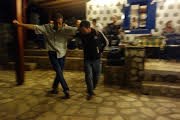
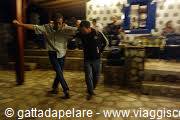
Every now and then the three musicians make their music more accessible to "tourist" taste with some sirtaki which unleashes the exhibitionism of some Greeks present and the participation, at first timid, almost ashamed, of almost all the guests. My boatmates, Annelise and Gino, let themselves be drawn in by the rhythm and by the invitations addressed to them by the islanders (more to Annelise than to him) and give a good performance of Greek dance. Especially Annelise, who after the first uncertain steps moves with great musical "empathy" for this dance of recent creation.
Later I leave my companions to the cheerful company and return to the boat. Despite the joyful atmosphere, I have grown sad, assailed by memories of other cheerful anchorages on this island. With us was a dear friend whom fate caused to disembark unexpectedly. I fall asleep in my berth listening to the rebetika lament that reaches Gattadapelare dozing at her mooring at the little quay of our pirate, Mikalis. Tomorrow will be another day
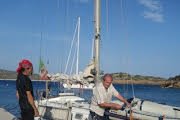
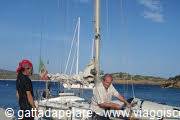
Man at the helm and woman in red hat aboard a sailboat
Day 48 Jun 2014
June 8, 2014 From Marathi to Kalimnos (Palionissos) 26 miles.
Little wind and calm sea. June is not a difficult month for going to sea, but for a sailboat it is often little interesting. Having left Lipsi not very early (we have only 20 miles to do, which under motor, as is foreseeable, means only four hours of navigation) we head down toward the eastern coast of Kalimnos intending to stop for the afternoon and the night in that beautiful inlet that is Palionissos. It is a very quiet anchorage. Even when the north wind channels itself into the valley that runs in the same direction, although one can hear it whistling through the rigging and flapping the halyards, it does not raise the sea and the boats, moored to the moorings placed there by the two tavernas to invite the crews to the table, can spend quiet hours.
Such were the conditions last year, when with Marzia and three children, Maia, Mattias and Sebastian, we spent three days of forced but welcome rest there. Having rounded the promontory that protects the inlet to the east we head for one of the buoys marking the mooring. Mooring is free. The buoys bear the name of the taverna that placed them. When we discovered this anchorage years ago, on the recommendation of a Dutch sailing couple met at Marathi, it was unknown to most. The beach was deserted and there was no building. Only entering the valley did one encounter a taverna and a few simple houses of shepherds and sponge divers by then having given up this once so flourishing activity. The taverna was run by a certain Nikola, partly tavern keeper, partly elementary school teacher, partly sponge seller, partly polyglot.
Today his taverna is sparsely frequented because on the shore the other two have sprung up in very attractive positions. Annelise, Gino and I go ashore to greet him and to explore, as is our custom, the surroundings. We consume at his place some olives, some cheese and a bit of retsina, not out of appetite, but out of courtesy. Then, reaching the usual little church omnipresent in every corner of Greece habited and not, we make the fleeting acquaintance of Nikola's elderly mother. She is busy drying in an oven those chunks of bread, called paximadia, which one can buy everywhere in Greece at the "fournoi," which, softened with tomato pulp and dressed with oil and salt, in the manner of our panzanella, are a tasty dish that we, too, sailors, sometimes consume while sailing, accompanying them with a bit of retsina.
The oven, now out, maintains throughout the night the right temperature for this operation. Tomorrow the little old woman will take it out and send it to another son who lives in Thessaloniki. So she tells us. In a dominant position over the bay, in front of the church, an imposing marble tomb houses the remains of a pope, probably important in the valley. Despite the obvious invitations to dine at the taverna, we eat on the boat.
Golden Buddhist amulets hanging together, warm light
Day 59 Jun 2014
June 9, 2014. From Kalimnos to Pserimos - 10 miles
We would have lingered longer in this cozy bay, but the moment of the diaspora of us cat-nauts is approaching. The day after tomorrow Annelise will leave for Paris and right after that Gino for Brussels and I for Rome. What a cosmopolitan sailboat our Gattadapelare is!! Such a varied and polyglot crew is not found even on a Liberian freighter, of a Russian shipowner, loaded with general cargo, in the China Sea. So we set off, greeted by Nikola who reaches us with his little boat to tell us that he made a mistake yesterday in giving us the change. The passage to reach Pserimos is short and easy. This small island with a single village of few souls is frequented in summer by numerous caiques that shuttle from Kos and Kalimnos carrying tourists. There is nothing extraordinary to visit, except a pleasant sandy beach and a few tavernas to crown it.
But the place is lovely and inspires serenity, especially after the departure of the caiques, when the shore and the tavernas remain at the disposal of the few inhabitants and of the crews of the rare boats that will spend the night there. We arrive in the early afternoon. The quay is occupied by the caiques and some sailboats. We moor, then, at anchor and go ashore with the tender. I know some people here, because I have come often in recent years, and the meeting with them is accompanied by the usual friendly displays and the usual phrases: kalimera ti kanis? kala? endaxi! Seated at the tables of our favorite taverna situated on the shore we wait without haste for the hours to pass.
These are the vacations we love: setting off calmly, sailing in pleasant sea and wind conditions, arriving early enough to be able to go ashore and relax visiting the places, sitting at the kafenion for a frappé or an ouzo, savoring, later, in the simplest taverna of the place the simplest dishes of Greek cuisine.
June 10, 2014 From Pserimos to Kos - 10 miles
We leave Pserimos, perhaps for the last time. Our cruising plans for the coming years are directed elsewhere. The Peloponnese attracts us for its beauty, but also for its history and its archaeological treasures. So that is where we will go. But the detachment, the abandonment of the Dodecanese where we have sailed for many years will not be easy. In leaving this island we feel that it now represents the detachment from all the other sister islands visited and loved by us in these years. We have them all in the folds of our soul, the islands of the Dodecanese: the tranquil Lipsi, the shy Marathi, the secluded Agathonisi, the fascist Leros, the neglected Kalimnos, the warrior Rhodes, the colorful Symi, the uninhabited Alimia, the British Halki, Karpathos and its women and its bread, the sad Kasos, Tilos and its little elephants, the volcanic
Nisyros, the marginalized Astypalaia, the far-flung Kastellorizo. All well rooted in memories and nostalgia. We will discover other places, drop anchor
Great skipper !!!
Day 610 Jun 2014
June 11, 2014. From Kos to Emborios (Kalymnos). 10 miles
Annelise leaves us early in the morning. We accompany her to the airport with a rental car. She was an ideal travel companion: nice, adaptable, curious to learn, with a marked sense of humor and, above all, capable of understanding my French; a quality, this, that qualifies her as a person of marked intelligence.
We remain alone, Gino and I, with the melancholy that always follows the departure of a family member or a friend. We go to Kardamena, a village on the southern coast of Kos where there is a tourist marina. It could accommodate the boat for a few days while waiting for my return with my daughter and part of my grandchildren. I don't feel like staying here, alone, waiting for them after Gino's departure for Brussels. Tomorrow, in fact, is a day of other goodbyes. It is still early. In Kardamena the cafes are still closed. The impression that this town gives us is of a "touristy" squalor. A couple of little streets parallel to the sea, a row of venues and cafes, a narrow beach. There is nothing of Greece and of beautiful nature. Only the view of Nisyros from afar gives a bit of breathing room to a gloomy and ugly place.
The little marina doesn't seem suitable to us for abandoning Gattadapelare for two weeks, waiting for my return for the "family" cruise. Therefore, we will not leave the boat here As soon as a cafe opens for customers, we order a quick breakfast and return to Kos town. We do a bit of provisioning, return the car and leave heading straight to Emborios, an anchorage north of Kalymnos.
On arrival I find again the serene atmosphere of this place, already visited last year with Elke, Marzia and grandchildren. The anchorage is well protected by a small island and does not suffer any mishap. However, the sea is calm and the wind weak and in a few hours we arrive after having coasted along the western part of the island and having entered the bay closed to the west by the island of Telendos We do not go ashore, remaining moored to the mooring buoy offered by one of the usual taverns. This behavior of ours of not going ashore is unusual, but already weighing on us is the feeling that by now the cruise is drawing to a close. Moreover the repeated frequenting of these Dodecanese islands has dulled our curiosity. The time has come to change seas.
Gino and I agree that Gattadapelare next year will return towards the west, towards the mainland, to experience new sensations produced by new anchorages and to visit the treasures that the Peloponnese, with its coasts and its interiors, offers to the curious traveler.
Lipsi. Monodendri
Day 76 Jul 2014
Niko's taverna in Lipsi
Day 86 Jul 2014
6 July 2014 Patmos
Some boats left port this morning and the wind seems to have dropped. We too want to try to reach Lipsi, only a few miles away. So, in the early afternoon, off we go too. Just out of the bay that shelters Skala, however, we are greeted by fresh wind and a tiresome, insistent beam sea that promises to be more vigorous once we pass the eastern headland of the island. The passage promises to be tiring even if short. With the kids aboard, it's better to turn back. We're in no hurry; the reunion with Elke, Marcus and Karola will happen in three days, so we can stay on Patmos a while longer, strolling along the waterfront and lingering a little bored to enjoy ice creams at one of the many bars on the shore.. Since several boats left early this morning, many stretches of the quay are free, which allows us to moor stern-to.
In this short time taken to return to port the wind has increased considerably and threatens to increase further; there's no danger of taking up space from unlikely boats that might want to come to Patmos, so our mooring causes no scandal; on the contrary, the example is followed by many other skippers and by evening almost all the boats are comfortably lined up along the quay. We go ashore for the usual aperitif in the square. In the evening the wind is so strong that we have to lean into it to walk against it. But with such a secure mooring, with no fear of the anchor dragging we are relaxed for a good night's rest.
5 July 2014. From Patmos to Lipsi
Today the wind has dropped and consequently we do not encounter rough seas on the crossing to Lipsi. In a short time we enter the beautiful bay of the island and moor stern-to at the head of the pier. It's my favourite spot because of the ease of getting on and off the boat, nor would any rise in wind and sea bother us, given the only apparently precarious position. In fact, the wind would urge the boat away from the quay, and this, well tied, would not be subject to working the fenders. We accompany Marzia to take possession of the small flat she has booked not far from the port and in a good position, and prepare to spend the day awaiting the arrival, tomorrow, of Elke, Marcus and Karola. Lipsi warms the heart with its serenity and simplicity of existence.
At this time of year tourist presences are almost non-existent and the population is made up of a few locals and a few foreign residents, largely Italians, who have found refuge here. Two bars compete for these presences, one at the foot of the only pier and the other a little further off. Neither can boast the name of kafenio, because they have nothing in common with those typically Greek establishments. They are, in fact, absolutely modern in the sense given to this term.
Fortunately some tavernas and ouzeries maintain the tradition we like: simple, almost spartan, with colourful little tables and wooden chairs, where the menu contains the few, usual dishes of everyday cooking, not very imaginative, but most welcome to us because we are on holiday here, in Greece, and we never tire, emotionally, of eating the usual satziki, the usual meat or aubergine keftedhes, the usual grilled little fish, the usual taramosalada and, when it's available, the so-called fava, (a purée that has nothing to do with that legume) and the suflakes so beloved by the children. We spend a few hours at the beach, in the evening at Nikola's taverna and then to bed: Mattias and I in the bunk, and the others in the house.
6 – 7- 8 July 2014. Lipsi
Our people arrive. Already last night Elke, Marcus and Karola had arrived on Kos. They spent the night there for lack of a ferry to Lipsi and today they arrived, almost by surprise because we were expecting the ferry later. The days spent on this island offer nothing exciting, just as we wished. Days of the tranquil flow of time with no commitments and no plans other than reaching this or that spot already known and cherished in memory for its seaside serenity. So, we return to the beach of Platis Gialos, where the warm sea, calm and shallow, entices you to laze in it on a fine sand that caresses the feet. We go to Katsadia, where the taverna is a shady, panoramic destination looking out over an inlet inhabited by white sailing boats that rotate lazily on their anchors with every breath of wind.
We land at Xolakoura where in the cave, certainly inhabited by shy sea nymphs, fled among the seagrass at our arrival, we set up a prosaic grill on which to roast some meat; we go, in short, in search of that serenity of the soul that this island can give to those who come here fleeing the tiring and tedious existence of the city. We would like to stay here at least seven years like Odysseus, but the elastic that binds us to daily reality is stretched to the max and we can no longer resist its tension. Tomorrow we return to Rome.
Monodendri again
Day 96 Jul 2014
6 July 2014 Patmos
Some boats left port this morning and the wind seems to have dropped. We too want to try to reach Lipsi, only a few miles away. So, in the early afternoon, off we go too. Just out of the bay that shelters Skala, however, we are greeted by fresh wind and a tiresome, insistent beam sea that promises to be more vigorous once we pass the eastern headland of the island. The passage promises to be tiring even if short. With the kids aboard, it's better to turn back. We're in no hurry; the reunion with Elke, Marcus and Karola will happen in three days, so we can stay on Patmos a while longer, strolling along the waterfront and lingering a little bored to enjoy ice creams at one of the many bars on the shore.. Since several boats left early this morning, many stretches of the quay are free, which allows us to moor stern-to.
In this short time taken to return to port the wind has increased considerably and threatens to increase further; there's no danger of taking up space from unlikely boats that might want to come to Patmos, so our mooring causes no scandal; on the contrary, the example is followed by many other skippers and by evening almost all the boats are comfortably lined up along the quay. We go ashore for the usual aperitif in the square. In the evening the wind is so strong that we have to lean into it to walk against it. But with such a secure mooring, with no fear of the anchor dragging we are relaxed for a good night's rest.
5 July 2014. From Patmos to Lipsi
Today the wind has dropped and consequently we do not encounter rough seas on the crossing to Lipsi. In a short time we enter the beautiful bay of the island and moor stern-to at the head of the pier. It's my favourite spot because of the ease of getting on and off the boat, nor would any rise in wind and sea bother us, given the only apparently precarious position. In fact, the wind would urge the boat away from the quay, and this, well tied, would not be subject to working the fenders. We accompany Marzia to take possession of the small flat she has booked not far from the port and in a good position, and prepare to spend the day awaiting the arrival, tomorrow, of Elke, Marcus and Karola. Lipsi warms the heart with its serenity and simplicity of existence.
At this time of year tourist presences are almost non-existent and the population is made up of a few locals and a few foreign residents, largely Italians, who have found refuge here. Two bars compete for these presences, one at the foot of the only pier and the other a little further off. Neither can boast the name of kafenio, because they have nothing in common with those typically Greek establishments. They are, in fact, absolutely modern in the sense given to this term.
Fortunately some tavernas and ouzeries maintain the tradition we like: simple, almost spartan, with colourful little tables and wooden chairs, where the menu contains the few, usual dishes of everyday cooking, not very imaginative, but most welcome to us because we are on holiday here, in Greece, and we never tire, emotionally, of eating the usual satziki, the usual meat or aubergine keftedhes, the usual grilled little fish, the usual taramosalada and, when it's available, the so-called fava, (a purée that has nothing to do with that legume) and the suflakes so beloved by the children. We spend a few hours at the beach, in the evening at Nikola's taverna and then to bed: Mattias and I in the bunk, and the others in the house.
6 – 7- 8 July 2014. Lipsi
Our people arrive. Already last night Elke, Marcus and Karola had arrived on Kos. They spent the night there for lack of a ferry to Lipsi and today they arrived, almost by surprise because we were expecting the ferry later. The days spent on this island offer nothing exciting, just as we wished. Days of the tranquil flow of time with no commitments and no plans other than reaching this or that spot already known and cherished in memory for its seaside serenity. So, we return to the beach of Platis Gialos, where the warm sea, calm and shallow, entices you to laze in it on a fine sand that caresses the feet. We go to Katsadia, where the taverna is a shady, panoramic destination looking out over an inlet inhabited by white sailing boats that rotate lazily on their anchors with every breath of wind.
We land at Xolakoura where in the cave, certainly inhabited by shy sea nymphs, fled among the seagrass at our arrival, we set up a prosaic grill on which to roast some meat; we go, in short, in search of that serenity of the soul that this island can give to those who come here fleeing the tiring and tedious existence of the city. We would like to stay here at least seven years like Odysseus, but the elastic that binds us to daily reality is stretched to the max and we can no longer resist its tension. Tomorrow we return to Rome.
Lipsi
Day 106 Dec 2014
June 12 From Emporios to Leros. 10 miles
Last leg, without enthusiasm and without history. We land at the usual marina of Porto Lakki and Gino and I part with the promise of next year. Gino immediately boards from Leros for Athens-Brussels. Gino, my dear friend and companion of many sailings in this wonderful sea, will return very soon to awaken the Gatta for other sailings with relatives and friends. I will take the ferry to Kos. My flight to Rome is tomorrow night at 12:30. I will therefore spend an evening and a night in the city, a little sad, a little bored, but with my thoughts already turned to the beginning of July when I too will return with my children and grandchildren to savor a little more of the Aegean......................................................................................................................................................................
July 1, 2014. From Leros to Levitha. Miles 25
We departed from Lakki eager to breathe again the fragrant atmospheres of that almost deserted island that is Levitha. A quiet anchorage for the sailor who here can interrupt for the night his sailing between the Cyclades and the Dodecanese and for us a place of memories of other anchorages and excursions in search of the ancient and scanty vestiges of the ancient inhabitants who had erected here a garrison to control and defend this natural harbor. Protected from the meltemi and from all the other winds the narrow fjord does not allow the formation of annoying waves for those who choose it to spend the night there. For this reason, in the evening, some sailboats gather there which, in this season, do not exceed, in number, the fingers of two hands.
The tavern of the owners of the island (which belongs to only two families) is located far from the shore and can be reached through a path barely traced among rocks and thorny, fragrant, thyme bushes. No lights dim the transparency of an outrageously starry sky, no annoying and tedious sounds of civilization interrupt the lazy stretching out on the cushions of the cockpit. We departed, then, with these prospects. Having left the protection of Porto Lakki (port Lago in the fascist colonial version), in the early afternoon we find wind from the northwest, not very strong which forces us to a broad beat in a rough sea, but not too much. We have the sails reefed and we sail calmly and relaxed, I and my "mythical second" my daughter Marzia and the children Maia and Sebastian and the little cousin Mattias.
There is a bit of haze that hides the view of Levitha from us and we proceed with the compass having the children alternate at the helm to make them more involved in our sailing. As the afternoon progresses the wind and the waves increase, which comes to us on the beam and makes the boat sway with an increasingly unpleasant rolling. Levitha, which now appears at three o'clock is close to the direction of the wind, so that although we point very high we realize that we will have to make several tacks to be able to reach it. We also turn on the engine to facilitate the approach to the island. Meanwhile Poseidon demands his offerings. The first is Mattias to lean downwind beyond the rail, then gradually the others, one more one less, to pay homage to the god of the sea. The waves, now, appear very high and the boat goes up and down very spectacularly, but always under full control.
The designers of the Alpa 11.50, our boat, knew how to do their job well. Gattadapelare handles the sea very well and is easily maneuverable. However, for greater peace of mind of the "second" a little less "mythical" on this occasion in which the role of mother and aunt covers the daring nature of once, Mattias remains lying in the cockpit, under a large towel reflecting on seasickness, while the other two seated on the deckhouse tie themselves to the "handrail" like Ulysses before the sirens. The first important mishap occurs at the moment when, having finished the diesel in the tank, I try to decant the reserve that we always have in two jerry cans in the aft locker. No matter how much effort we make the aluminum cap does not unscrew.
After several minutes of nerve-wracking attempts we are forced to give up; we will have to take refuge under sail in the wide inlet that widens before the calm and narrow fjord, in which all the boats moor. Here, anchored, we will try to unscrew the cap and finally enter under engine and reach one of the mooring buoys. So, we begin an endless number of tacks to advance against the wind. Each tack makes us gain little ground and it is now clear that we will arrive near the coast in the late evening. Our first day of sailing is proving to be rather adventurous and unpleasant. The last attempt, not very convinced, to unscrew the damned cap has incredibly success. The mood takes a leap upward. No longer a night at the wheel checking if the anchor drags, but a serene mooring and the possibility of going ashore to reclaim its solidity.
At the moment of furling the genoa, now useless, another hitch. The line that controls the furling jib comes loose and the sail, completely open, spreads downwind snapping and flapping dangerously. With risk and effort, while Marzia at the helm holds the bow to the wind, I manage to lower it and tie it around, stretched along the deck. Finally we leave waves and wind and enter the fjord where other boats, which preceded us, swing serenely attached to their mooring buoys. We find a free one and tie ourselves to it. Thus concludes the first day of sailing with the children. It was supposed to be a quiet sail and it was instead an adventure.
Later, now relaxed and after having replenished what was distributed at sea, with a good pasta, I listen to the children's account describing Opi, the captain: standing with legs apart, behind the steering wheel, with a black bandana protecting from a sun now at sunset, bare-chested and gaze scanning distant anchorages, wet from the splashes of the waves, he is there, solid and indomitable, facing gigantic waves and instilling courage and confidence. How nice to be seen like that!!!
0 reader comments