31 May 2013 Kos. I arrive at Kos on a Ryanair flight. As every year, I savour the anxious thrill of departure towards the beloved Aegean islands. After almost a year of 'land-bound' life I have lost the physical sensation of going by boat, while the inner perception has kept rising until it fills much of my romantic feeling. On the plane I meet the owner of the vessel Zulu. She gives me information about the boatyard of Leros where, probably, we will leave Gattadapelare to winter. Together we take a taxi that takes us to the boarding point of the fast ferry for Leros and Patmos. At the bow, in the wind stirred up by the crossing, I breathe in, together with the Mediterranean aromas the islands give off, the restrained joy of being here again. On the ship I meet Alina, a librarian by profession and a wanderer by hobby.
She tells me of her passion for solitary walks up and down the Greek islands and asks me for information about the ones she wants to get to know. Together we arrive at Patmos. I get off at the Capten's House, a small hotel close to the ship's landing, which has seen me here other times together with other 'gattonauts' who from time to time are guests of the legendary Gattadapelare. Alina has booked a small flat on the outskirts of Skala. Later she persuades me to climb on foot to Chora along the ancient pilgrims' way that reaches the Cave of the Apocalypse of St John and the old, imposing, grey monastery that dominates the white Chora. I convince myself that the hobby of sailing is more fun than clambering up the Aegean islands.
1 June 2013 - Patmos
Gino arrived at three this morning. No point in trying to get back to sleep. We talk, above all he does, and exchange the news of what has happened in the meantime. When we finally go back to sleep, it is dawn. After breakfast we go to the boatyard of Sozon. Gattadapelare is there, still on her cradle, which, we imagine, is quivering with the desire to take to the sea. Finally we sail. A taste of gentle pitching while we wait to really take to the sea; after a few minutes, in fact, we moor at the quay at Skala, the seaside town of Patmos. Skala is a common name, like Chora, in the Greek islands. They indicate respectively the town by the sea and the one up high. From a distance all the Choras in the Cyclades look alike: a cluster of little white houses, often nestled at the foot of a rock, or a monastery.
From a distance, for anyone approaching by boat, their glow can be seen even before the coast is sighted. This is the case with Patmos, whose Chora is like a lighthouse visible from all the surrounding islands.
Orestes hounded by the Erinyes
I like Patmos. Tourism is present, but tolerable. Many come here to visit the cave where St John, exiled by the emperor Titus, had his visions and wrote the Apocalypse. How such a thing could come to him in the face of so much beauty is a mystery to me.
In any case this was also the place of Orestes' exile. After killing his mother Clytemnestra, for reasons that many know (and whoever doesn't should go look them up in Greek mythology), he fled to Patmos pursued by the Erinyes, the Furies of the Romans. The island is of volcanic origin, and in the ancestral memory of its earliest inhabitants the legends of land sinking and rising again at the hands of the gods flourish. We tidy up the boat. We set off in a hurry for the impatience of feeling Gattadapelare glide over the waves, but inside there is chaos. In the evening we meet up with Alina, who takes us to an out-of-the-way taverna where foreign customers are an exception. The food is good and the prices are low. She doesn't much like the island.
Her way of savouring it along paths and earthy passages leads her to a judgement that we, bound to the vision of enticing anchorages and cliffs, do not share. For us Patmos is one of the most beautiful islands in this part of the Aegean. On the way back to the boat I tie a safety line. The wind has got up. After a year of waiting we fall asleep once more, cradled by the sea.
2 June 2013 - Patmos
Today the wind has vanished. The sea is dead calm, but we do not put out to sea. Gattadapelare is not ready yet. Countless little jobs and purchases force us, but also encourage us, to prolong the stop.
Day 14 Jun 2013
July 4, 2013 - Pserimos-Kos. 10 miles We have arrived and moored at the new marina of Kos. A well-served marina, a bit too bureaucratized, more in line, perhaps, with European standards, but lacking the charm of spontaneity that we go looking for in Greece. Everything changes. The Greece of our first years of cruising is disappearing, standardizing—flattening out—on life patterns and regulations common among the countries that make up Europe. Our grandchildren will not be able to know the Greece we visited. This "Logbook" of mine will serve, perhaps, to show it to them as it was. We "cat-nauts" have not always blinded ourselves with haughty contempt for the tourists who infest our anchorages. Every now and then we allow ourselves an immersion into the variegated crowd that swarms through the streets of the villages and cities most publicized by travel agencies.
Kos-town pleases us despite the mass of tourists, especially Northern European, that occupies it. A multitude so substantial as to obstruct the way or occupy all the tables of the tavernas and cafes. The municipality has also created long bike lanes in the city and one must be careful not to be run over by Nordic cyclists for whom it is obvious that the path be left free by pedestrians. But Southern pedestrians are not used to the exclusivity of the lane and invade it unawares. We go to dine at our usual taverna, "da Zorbas," warmly greeted, as usual, by the physiognomist tavern keeper. Tomorrow the crew disperses.
July 5, 2013 - Kos-Rome. We fly Ryanair, Mattias and I, leaving Marzia, Maia and Sebastian with the boat. Tomorrow they too will leave Kos bound for Lipsi.
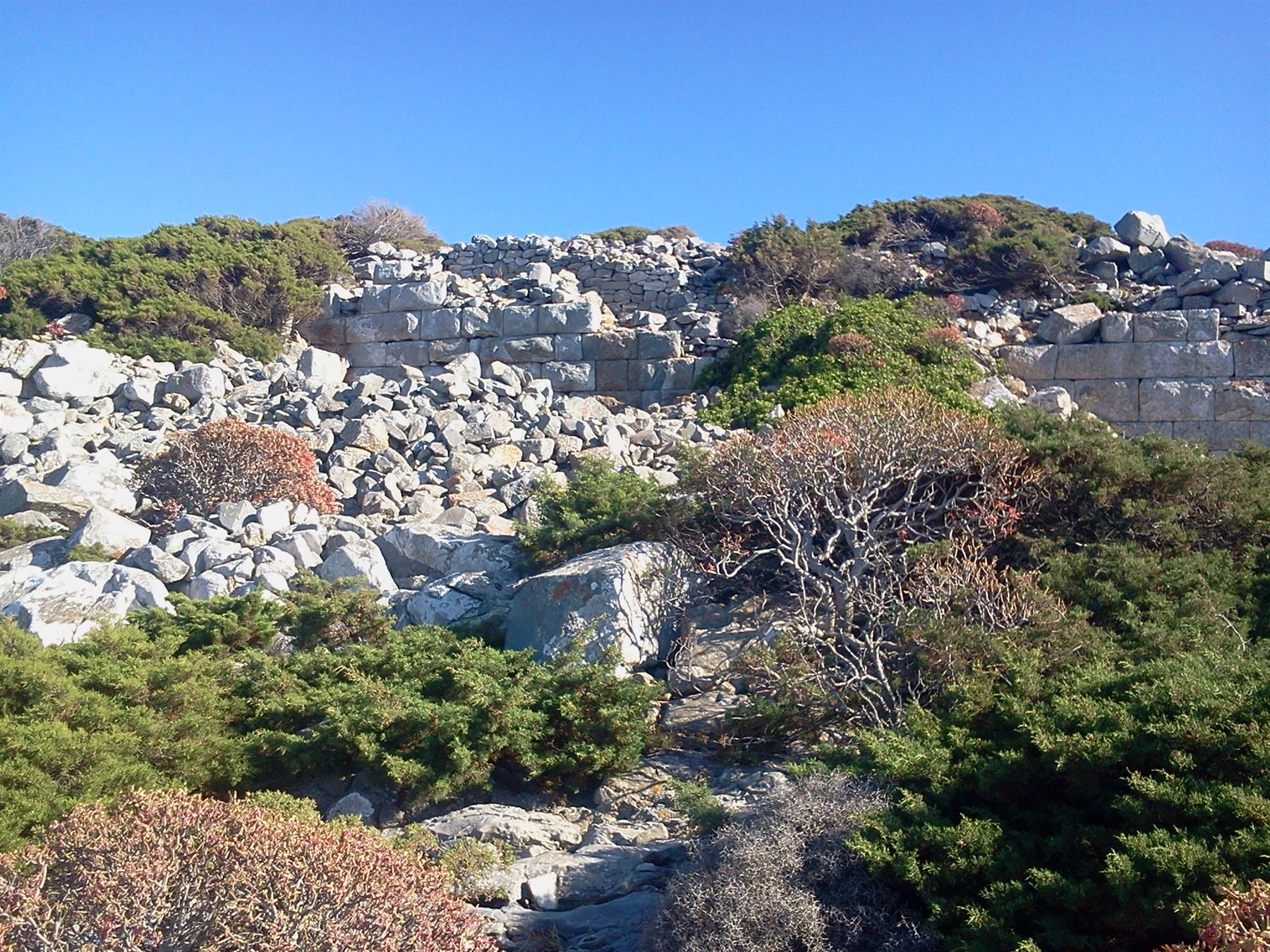
The castro of Levitha
Day 26 Jun 2013
June 3, 2013. Patmos- Levitha. 23.60 miles We set off early heading for Levitha, one of the pleasant anchorages we frequent when we go westward. The route is all under motor; there is not a breath of wind. Around 2 pm we tie up to one of the mooring buoys placed there by the owners of the island. They are paid, and represent, together with herding, fishing and catering, the sources of income for the family. Manolis, one of the three brothers, whom we met the first time we landed here, my daughter and I, thirteen years ago, comes to help us and to collect the mooring fee. We greet each other like old acquaintances. We have the whole afternoon ahead of us to enjoy the charm of this island.
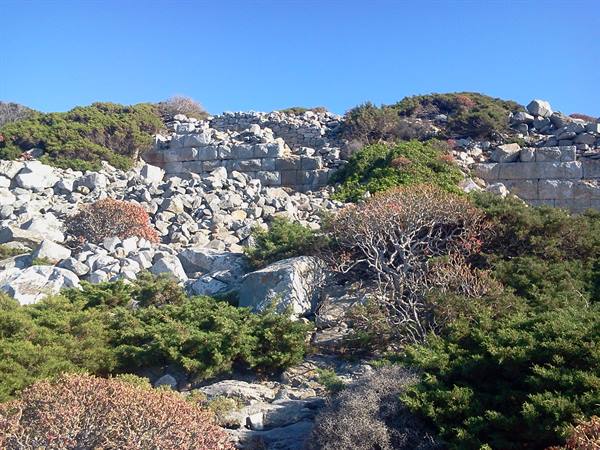
It is the charm that comes from its harshness, from its Mediterranean light, from the fantasies that link it to all the wooden vessels, the boats, the ships, that have landed there since the first crew aboard a log hollowed out with fire reached it driven by the desire for knowledge. Everyone has landed here, from the mysterious "peoples of the sea" to the Achaeans, to the Minoans, the Mycenaeans, and then Dorians, Romans, Venetians, Genoese, Turks, Italians and many others, over the centuries. The safety of this anchorage has always made it an ideal stopping place for sailors. We reach, after a walk among low thorny bushes, climbing up the slope with a thousand twists and turns, the sparse, ruined remains of the castro that dominates the highest point of the cliff at the entrance to the cove.
Traces of ancient human settlements are found by way of some fragments of terracotta that emerge among the stones. From up there the view widens and gives a thrill of pleasure for so much beauty. In the blue made more shaded by the light of the sunset you can see sails, some closer, others farther away approaching like a fan. It is now the hour when crews yearn for the quiet of an anchorage, "the hour that turns to desire and softens the heart of sailors." Soon the mooring buoys, about fifteen, will all be occupied. We go down heading to the owners' taverna. A donkey awaits us patiently and curiously on the path. A friend amid so much fascinating quiet made of light, stones and thorny bushes. This is the land of the god Pan, the Arcadia of the romantic poets.
4 giugno 2013- Levitha-Apollonia (Naxos) 49.60 miles Departure early with the intention of finding a pleasant anchorage at Denoussa. The few visitors who know her describe the magic and simplicity of life. A single road, almost no vehicles. Here, legend tells, Dionysus hid Ariadne after Theseus had abandoned her on the nearby island of Naxos. Of this island we know the wide bay to the south where on two occasions we spent the night. They say that the village, of few houses, which is located on the west coast, is very pleasant. As the hours pass the wind strengthens and comes from the southwest with waves entering the bay that the village overlooks. On the pilot book no breakwater pier is indicated and in such conditions the stop will not be pleasant. We change, therefore, destination heading towards the eastern coast of Naxos protected from the wave motion.
We study the charts, observe with binoculars the possible anchorages, but we see nothing pleasant. 6 miles to the north there is a wide bay situated in the lee with some houses, and there, finally, we head.
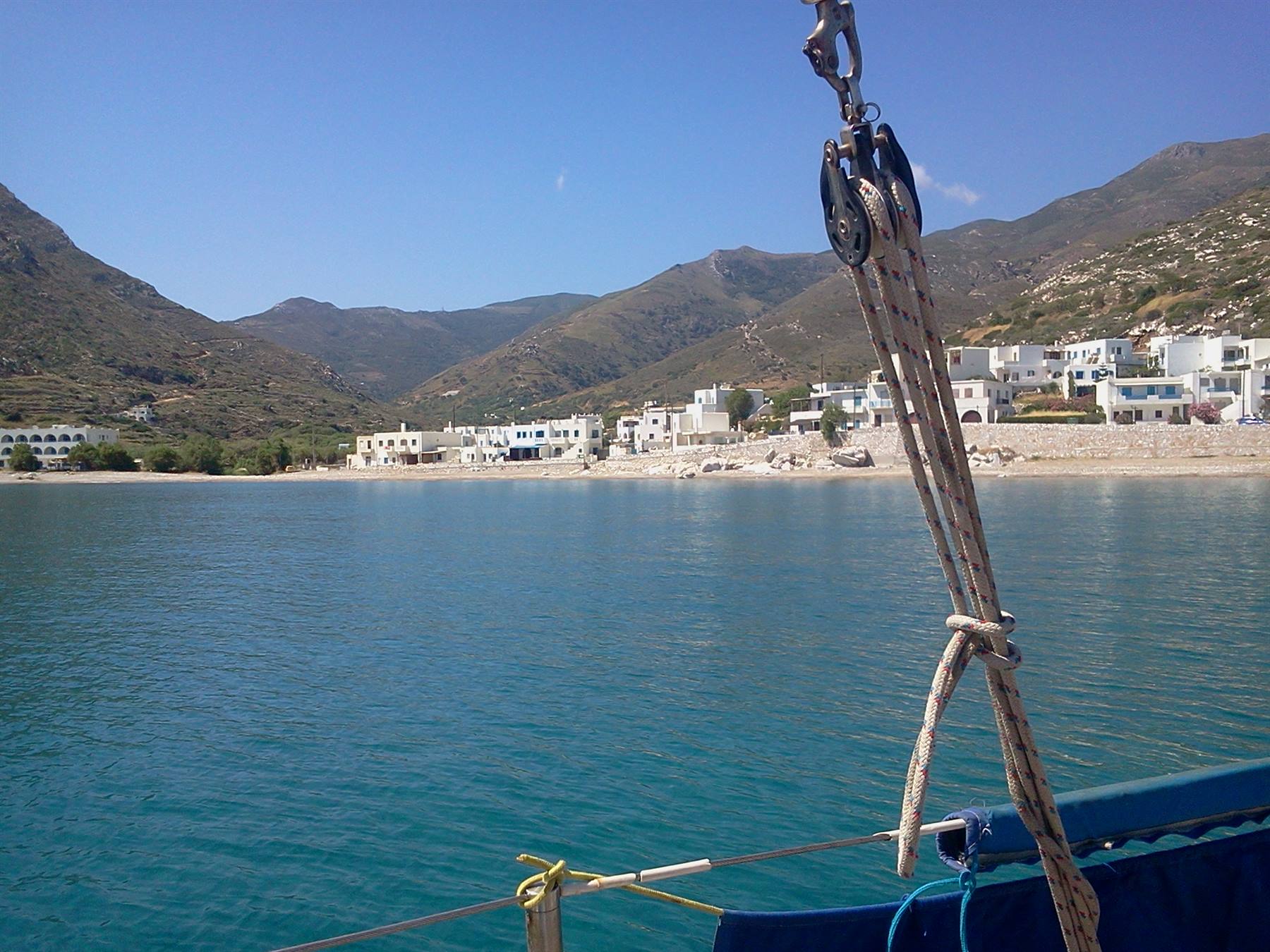
Apollonia is the name of this place due to the discovery of a statue of Apollo that remained unfinished. The bay is not very protected from the meltemi and in the most sheltered point there is little depth. A breakwater cliff protects from the sea coming from the first quadrant. The village consists of a few houses and a couple of tavernas. On the beach, quite large, it is almost deserted. No sailboat in the water, only three fishing boats that are setting sail. The place fascinates us. It is a corner of Greece as we like it. We drop anchor on two and a half meters of bottom and dive in. I check the anchor's hold. The bottom is sandy, good holding, the chain lies lazily well stretched out. Gino with a long swim goes ashore. When I reach him it is already dinner time. At the taverna, with the tables on the embankment over the sea, there are only us and a couple of lovers.
The tavern keeper and a couple of friends sit beside the kitchen door and talk among themselves with brief sentences accompanied by long silences. They are perhaps recounting the day's news? We have beached the tender on the tiny beach below us. Sweet is We have beached the tender on the tiny beach below us. Sweet is the lapping of the waters. Our boat is beautiful. She has pointed her bow to the wind and sways lazily, alone in the bay, waiting for the nighttime return of her "catonauts."
We have beached the tender on the tiny beach below us. Sweet is the lapping of the waters. Our boat is beautiful. She has pointed her bow to the wind and sways lazily, alone in the bay, waiting for the nighttime return of her "catonauts."
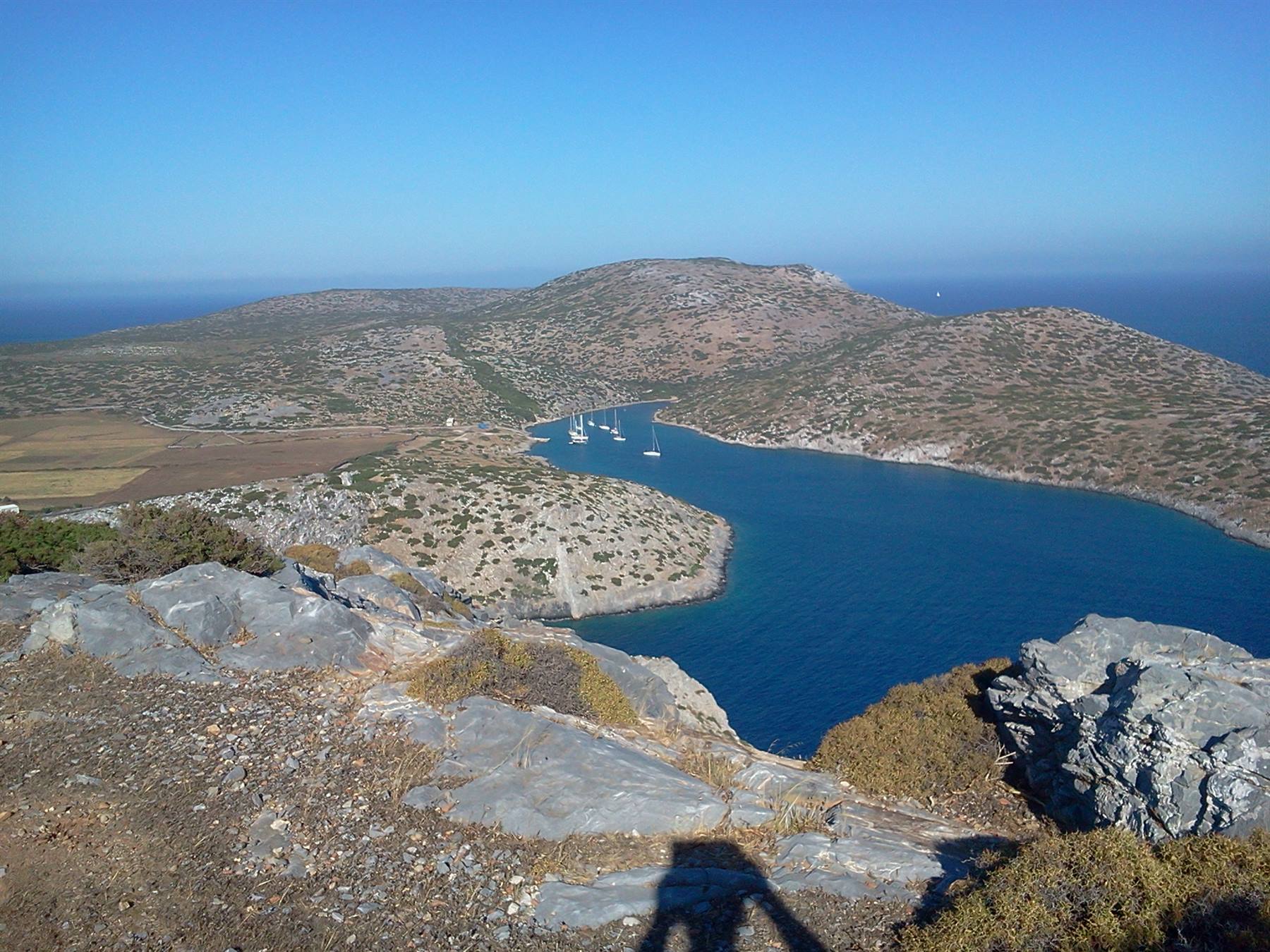
The fjord of Levitha
Day 37 Jun 2013
June 5, 2013- Apollonia (Naxos)- Naussa (Paros). 18 miles
Fantastic sailing. A gentle wind from astern pushes us towards Paros. The island of Naxos slides by on our left and gradually reveals the mouth of the strait between the two islands. You can see, in the distance, the portal of the temple of...... erected on the spot where, legend says, Ariadne was abandoned. To our right is Mykonos, separated by a short stretch of sea from Delos. Delos, center of the circle formed, precisely, by the Cyclades, the island where Apollo and his sister Diana were born, an island where it was forbidden to die and to be born.
The abandonment of Ariadne
What a fantastic sea this is! Behind every corner of the horizon, mythology, history, culture appear to tickle the sailor's imagination. The Aegean is truly the sea of the gods.
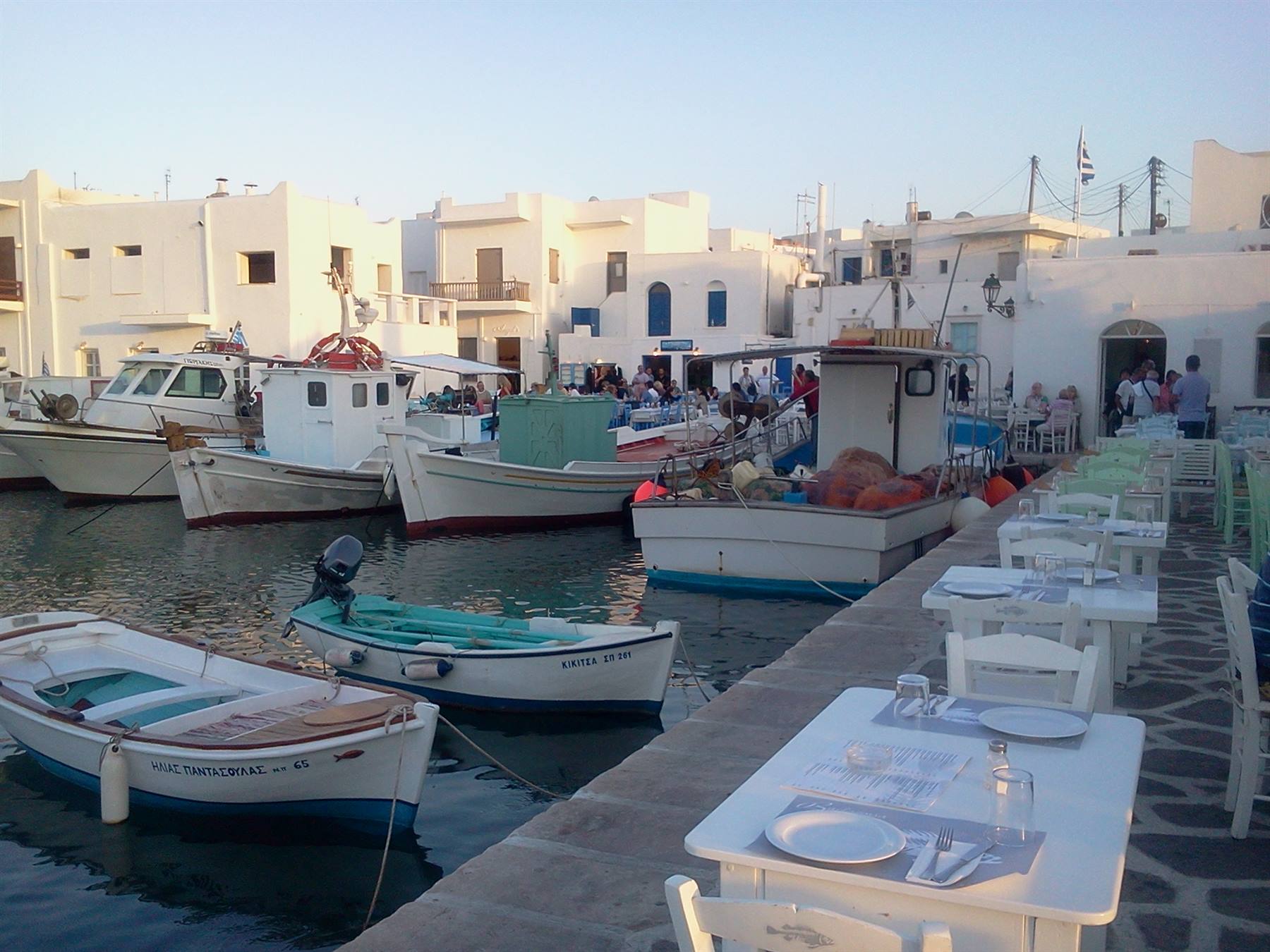
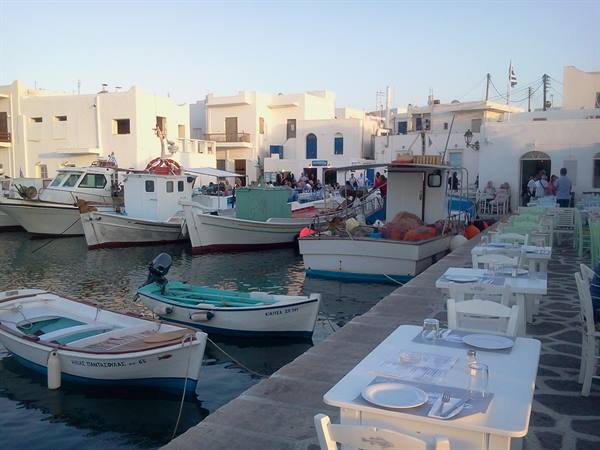
With the autopilot engaged, caressed by the wind, we doze in turn listening to the lapping that the Gatta makes as she glides through the sea. On the pier Maura, Paolo and Luca await us. She is an old friend, Paolo and Luca are her partners of the Coktail-bar "I Tria" in the process of opening in the center of the village. Naussa is one of the most typical villages of the Cyclades. Its houses, rigorously whitewashed with lime, spread out in a maze of alleys made on purpose to confuse the Barbary invaders when they assailed the village. Every now and then a bougainvillea breaks the whiteness of the facades with its crimson flowers and a little church door opens onto the alley revealing silver icons illuminated by the flickering light of votive candles. The little harbor is surrounded by the tavernas that bring their little tables to almost touch the fishing boats moored there.
A modest Venetian fort at the end of a short windward pier recalls the commercial importance of this anchorage in past times. Everything is very harmonious, but the tourist presence, in the evening, is rather heavy. A couple of disco-bars condition with their music the pleasure of the stop. 6 giugno 2013- Naussa Today we stay in port doing nothing. For a couple of years Naussa has equipped itself with a small tourist harbor, called a bit pompously a marina, because it has water, electricity and toilet facilities. It is managed by an old acquaintance Jannis who speaks English and German and who welcomed us with signs of renewed friendship upon our arrival. Maria too, our Romanian acquaintance, naturalized Greek, welcomes us with great warmth. Maria is an important and useful reference here. She knows everyone and knows where to find everything cheaper.
She also has the virtue of speaking Italian quite well. We have dinner at the taverna on the port where the tavern keeper makes a show of recognizing us after so many years. In Greece they all have good visual memory; perhaps because the term physiognomy is of markedly Greek origin!
Apollonia (Naxos)
Day 47 Jun 2013
June 7, 2013-Naussa
Today the wind is a bit stiff, but that is not the reason why we are not leaving. Tomorrow Gino returns to Brussels and there is no time to sail. However we invite the guys from "I Tria" to take a boat trip to Monastiri. The place takes its name from a small church located on a promontory that encloses a pleasant beach on the opposite side of the bay. We eat on board, stationary at anchor, in the most sheltered point where, at night, numerous sailboats always stop. On the way back the wind is fresh and allows us some nice downwind stretches. On our return Jannis has us moor at the windward pier, where the incoming wave to the port does not cause annoyance. We are moored stern-to, a most appreciated position that allows getting on and off very comfortably. We spend the evening wandering around the village. Maura introduces us to some characters, owners of small businesses.
Apart from the scenery of the place, there is little sense of Greekness. The vast majority of shops are run by foreigners.
8 giugno 2013- Naussa
Gino left this morning at 10 with the mutual promise to meet again next year aboard Gattadapelare. As always departures bring a bit of poorly concealed sadness because they represent the closing of a period and give awareness of the passing of time. I take advantage of the solitude on board to tidy up the boat and do those little maintenance jobs always postponed because the desire to travel does not give us time to do them.
9 giugno 2013- Naussa
Today Massimo arrived, the new catonaut on his first experience. We have known each other for years, but had not seen each other for a long time.
10 giugno 2013- Naussa.
We would like to leave, but the sea conditions are not ideal for a calm sail. Massimo could not be of great help in case of need and it is preferable to wait for the weather to improve. We go again to Monastiri for a swim and are joined by land by Maura and the others. In the evening we sit at the little tables of the coktail-bar I Tria where interesting characters come and go who animate the nightlife of Naussa. There is the well-known director, a habitual guest of Naussa, the mature German pensioner who spends every winter here, the Italian couple who live here and grow vegetables for pleasure, the homosexual Englishman who walks quickly up and down the alley checking on his two shops, the owner of the excellent Italian gelateria, the Greek wife of the souvenir dealer, also Italian, tourists in search of the typical local place.
Later, once work is done, the restaurateur, the cook and the waitress of the trattoria "La dolce vita" join the group. And so the night passes almost until dawn. Of the Greek soul, here, there is no trace. And the same cast of characters that you can meet anywhere, in vacation spots, in Italy and elsewhere in the world. Every now and then, during the cruise, such a stop can also be made willingly, but with the awareness that the next day, once the sails are raised, the bow of Gattadapelare will be turned towards shores of genuine Greekness.
Naoussa (Paros)
Day 511 Jun 2013
June 11, 2013- Naussa-Apollonia. 18 miles
Today the weather is favorable for us to leave peacefully for Naxos, again to Apollonia. I liked this anchorage when Gino and I discovered it a few days ago and it seems ideal to let Massimo know a different corner of Greece. In the bay of Apollonia there is no boat at anchor. We again drop anchor not too close to the shore because there is not much depth, but thus we are somewhat exposed to the swell that today, thanks to yesterday's wind, enters annoyingly. The night passes with a slight rolling of the boat halfway between soporific and annoying.
12 giugno 2013- Apollonia- Naussa. 18 miles
We return to Naussa with a calm sea and a relaxing sail. Life here is without variations. We repeat the same gestures and the same things of the days spent, in a flat existence that cancels the awareness of the passing of time.
13 giugno 2013 Naussa-Antiparos- 13 miles
Today we went to explore Antiparos, the island located in front of the western coast of Paros from which it is separated by a rather narrow channel, no wider than two kilometers, and rich in shallow depths. We advance with caution, continually checking the instruments and with Massimo at the bow scanning the bottom. The village is provided with a wide bay, but the port has only two piers, one dedicated to ferries and the other always occupied by fishing boats. We are, therefore, forced to anchor. There is only one sailboat, French, at anchor in a position that forces us to find another less suitable spot. The bottom is very shallow, but sandy, and we proceed very slowly. Once the anchor is lowered we wait for the boat to swing to put its bow to the wind, truly very slight, and for the anchor to take hold.
But Gattadapelare stubbornly keeps pointing elsewhere and we do not immediately understand why. With an illuminating flash comes the explanation: we are aground! The sandy bottom and our very modest speed did not warn us that we were in the shallows. Just as we had become stuck just as easily, however, by forcing the engine a little, we free ourselves to head for deeper waters, but close to the breakwater that protects the port from the south. We go ashore with the tender to explore the village, whose name, Kastro, evokes its ancient defensive nature. There are very few people around. We encounter rare tourists among the alleys. One of these, a street leads us to a small Venetian castle that reveals itself once past the gate in the walls, now incorporated into later buildings.
All around a structure (an ancient cistern) at the center of a space enclosed by the houses whose rear served as a bastion to protect the settlement. There is a celebration here. Perhaps a wedding, although the clothes are more similar to Sunday best than to a wedding. Boys and girls let themselves be photographed by friends, sometimes in the company of the bride and groom, sometimes alone. In the background the ancient walls. We go in search of a taverna on the port. There are several, but all sparsely frequented. The place is pervaded with melancholy. The island would deserve a longer stop. There are caves already known centuries and centuries ago since they were used as a refuge by the local inhabitants (we are talking about primitive eras), later in the Mycenaean period they were exploited as a place of worship of the goddess Diana.
There are stalactites and stalagmites, but Russian soldiers cut many of them during the war of 1700-1774. Italian soldiers did the same thing during the Second World War. Among the paintings that can be noticed among the beautiful stalactites and stalagmites there are also many inscriptions of poets, of sovereigns and also of illustrious figures from medieval history and some of the names that can still be read are Bishop De Gabrie (1673) and Otto, king of Greece (1840). Perhaps tomorrow we will go.
Naoussa (Paros)
Day 613 Jun 2013
June 2013- Antiparos-Agios Georgos. 9 miles Quiet night, but awakening at six under a strong storm. The wind turns us towards the cliff and prudence requires us to weigh anchor and move down the coast driven by the gusts. We head, therefore, south to find shelter behind the point that gives access to the bay of Agios Georgos. The stretch of sea between Antikaros and the islet of Despotiko proves to be a perfect mooring. There are six or seven sailboats at anchor. The depths are four to five meters, sandy, excellent holding. The sea does not come in except with northeasterly winds, rather rare. We choose our position and look around. On the right shore, you can glimpse a couple of tavernas and a sparsely inhabited coast. On the left the islet of Despotico is deserted.
Here sanctuaries were found but also dwellings and sculptures from the Minoan and Mycenaean period, including many temples dedicated to the god Apollo, who seems to be worshipped recurrently on all the islands of the Cyclades, and to the goddess Vesta. Other temples found date back to the Roman period, dated to the seventh century AD, they are rare and unique structures in the entire Aegean Sea. The passage between Antikaros and Despotico is narrow and only one meter eighty deep. I know this well because years ago my daughter and I passed through it with great apprehension, having misread the nautical chart.
Gattadapelare draws one meter ninety and the reason why we did not run aground is due to the fact that the measurements reported on nautical charts refer to the depth of the most important low tide, the spring tide, that is, the one that occurs only when the moon and sun "pull" from the same side. In short, we got through by a hair, or rather by a seaweed. Tomorrow we will not repeat the same mistake. We go ashore for a walk and to find a spot where there is a wi-fi connection. We walk along solitary country roads, until we reach a taverna where we ask. The old woman who answers us has no idea what it is, but the young granddaughter gives us the necessary data to connect. When lunchtime comes we return to the shore in front of our boat. Of the two, we choose the taverna we like more, followed by imitation by some tourists. The day passes without demands.
5 giugno 2013- Agios Georgos- Pharos (Sifnos). 15 miles Good weather, gentle wind; a perfect day to sail peacefully. We round behind Despotiko and head west towards Sifnos. The history of Sifnos is rich and troubled like that of all the other Greek islands. The island, in remote antiquity was rich and famous because of the gold and silver mines and also for this reason it was an object of desire and of the will to possess. Peoples, armies and dominations succeeded one another leaving each of them some trace on the territory. Characteristic are the Venetian dovecotes, tower-shaped structures, equipped with numerous small windows that gave access to the pigeons that nested there. They are scattered a bit everywhere on the island.
Gattadapelare has pointed its bow towards a wide bay, that of Pharo, watched on the left by an important little church dedicated to the Madonna (Panagia Chrysopigi) built on an islet connected to the mainland by a short bridge. Legend tells that an image of the Madonna arrived here from the sea to protect the women of Sifnos, who found refuge from pirates right at Chrysopigi. An icon found in the sea by two sailors is kept here, and is believed to be miraculous. Every year, on the second of June, a ceremony by sea celebrates the event and numerous boats and authorities from the surrounding islands attend. I had occasion years ago with my daughter Marzia to attend it and I still keep a vivid memory of it. This time, unfortunately, we arrive too late. Once in the bay on the right the shores narrow and end with a small beach fringed with modest picturesque buildings.
Only two sailboats and some fishing boats will keep us company. We anchor on a very deep bottom and, as usual, we immediately go ashore. Several tamarisks, trees omnipresent on all the beaches of Greece, shade the little tables of a kafenion where we sit for a drink. There are several people, but no crowding. The atmosphere is peaceful and restful. Pharo is small and made up of a few, low houses. There is only one road that connects it to the capital, Apollonia (also with this name). No traffic, no scooters, no jet skis. A lovely anchorage.
Antiparos
Day 716 Jun 2013
16 giugno Pharos-Naussa. 31 miles Today we returned to Naussa with magnificent weather and sea. A light breath of wind coming from the right direction pushed us gently. Passing in front of Parikia, the capital of Paros, we graze the large rock, almost an islet, on which years ago the ferry from Athens shipwrecked. It seems that the helmsman was watching an important football match on television. In Naussa the port is full of sailboats and we moor again stern-to at the root of the windward pier, in a narrow space between two boats. 17-18-19 giugno 2013- Naussa. We spend these days lazily in the village, meeting the friends from "I TRIA" and passing several hours, in the evening, sitting at the little tables of the place observing the varied humanity that populates the alleys of the village. On the 19th Massimo leaves. He was a good companion of great adaptability and without demands.
His first experience of life on a boat was rewarding for both and he was awarded honorary "catonaut" of Gattadapelare.
20-21-22 Naussa Three days spent doing nothing except makeup work on the boat and evenings at "I Tria." Fabio has also arrived, a new recruit of Gattadapelare. Fabio too has no sailing experience, but enough enthusiasm to get along well together. Since there is a stiff wind and the crew is short, I prefer to keep the boat in port, which, moreover, almost all the other boats do. With scooters rented, we go to explore the east coast of the island, the one overlooking the channel that separates Paros from Naxos. The sea does not appear particularly rough and it is foreseeable that tomorrow we will leave. We wander along small roads and lanes until we reach the village of S.Maria and from there we finally return to Naussa where the usual evening at the little tables of I Tria awaits us. I have grown a little tired of Naussa.
I am fed up with it and I don't mind moving away from it, perhaps forever. Other islands unknown to the Gatta, other atmospheres, curiosities, myths, await us for the coming years. Missing from the travel program drawn up 18 years ago, still, are the anchorages of the northern Aegean, the ascent of the Dardanelles and, finally, the arrival in Istanbul which, in my imagination, must take place in the late afternoon, as the sun sets behind the minarets of the mosque of Mustafa Pasha. Inshalla!
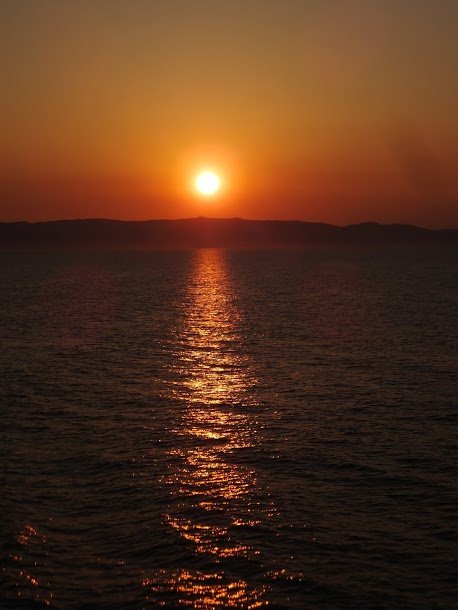
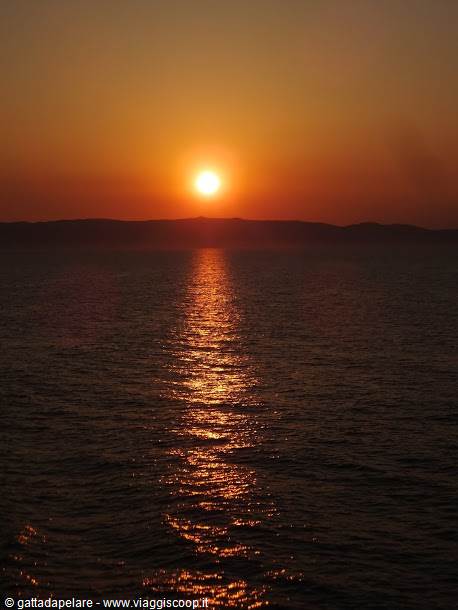
Low sun reflecting gold on the sea before dark hills
Day 823 Jun 2013
June 23, 2013- Naussa-Katapola (Amorgos). 43 miles Today we woke up with little wind. We managed to free ourselves from the boats that were crowding us at the pier and we set off when the wind began to strengthen. After a few minutes the engine died on us when we were a few hundred meters outside the port. With only the staysail hoisted I maneuver to head in front of the beach to leeward of us and ask for assistance by radio from Giannis to find me a mechanic. On his advice he invites me to put the boat behind the marina, where I will not suffer the wave motion. With some perplexity because there is little space and the cliff is close, we let out little chain so as not to get close to the rocks and hope the anchor holds. I am convinced that the fuel is not flowing well because after a bit of waiting the engine each time restarts only to stop immediately after.
Buoyed by this conviction I fiddle with the diesel supply hose and manage to eliminate the air bubble that was the cause of the trouble. And now off we go. Our destination is the islet of Antikaros south of Naxos. When we enter the channel between Paros and Naxos we begin to take the wind from astern whose intensity increases due to the Venturi effect as we go further into the strait. With only the staysail and the reefed mainsail we begin to fly in an exhilarating way. After weeks of weak or absent winds today we finally race, at eight knots. Soon the coast of Naxos ends, turning east, and we find ourselves in a flat calm, completely in the lee so that we have to start the engine to get out of it and find a bit of air again.
But when we arrive in front of Antikaros (after having passed its anchorage point due to the presumption of the skipper who was sure he remembered its conspicuous points) we realize that we would not be well sheltered and that the night would not be calm. Hence the decision to continue to Katapola, on Amorgos. It is eight miles and it is getting dark. In the port we find a quiet spot, between two boats, almost at the root of the pier.
24 giugno- Amorgos
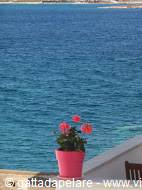
Pink pot with red flowers on white wall facing turquoise sea
Day 925 Jun 2013
June 25, 2013. Amorgos-Levitha. 35 miles We leave Katapola on a day of absolute calm. The surface of the sea is stirred only by light, rare puffs of wind under which it gently shivers. We glide along the coast which, toward the eastern tip of the island, rises high and drops vertically into the sea until it reaches unknown depths. We pass close to the rock wall that looms over us, almost grazing it, with a mixture of pleasure at such daring and anxiety at what might fall from above. The water is the color of indigo. "Deep Blue" is the title of a film shot here. It too unsettles us with the fear of the unknown that emerges in the unconscious from the depths of the sea. So much charm and beauty are embittered by a broad film of oil that accompanies us for a good stretch of the voyage.
We feel the pollution as an affront made personally to us, sailors in love with these places that we would want outside of time and the ugliness of civilization. The mainsail is provocatively raised and useless, but it serves to deceive us and softens the displeasure of having to proceed under motor. Passing abeam of the islet of Kinaros, the island of Levitha already comes into view, the usual overnight stop of all sailboats on this route between Amorgos and the northern islands of the Dodecanese. Other times I have described this scorched and stripped island, home to countless sheep wandering among the stones and rocks in the stressful, daily search for some blade of grass.
Levitha is a deserted island except for one family that lives a little way uphill, far from the sea, and manages to do a bit of cooking for the few sailors who have the desire and the courage to cover the distance that separates the house from the coast. There is no road or certain path, but only a visible track because the larger stones have been cleared from it. The climb, in truth not steep, is usually made toward the start of the evening, after mooring the boat and diving into the sea to crown the pleasure of the day's sailing. But the return, after dinner consumed at the meager taverna, is made in the dark or by the light of flashlights or cell phones. And it is an undertaking to reach the shore, where the tender was left, without accidents. We arrive in the late afternoon and already find many boats.
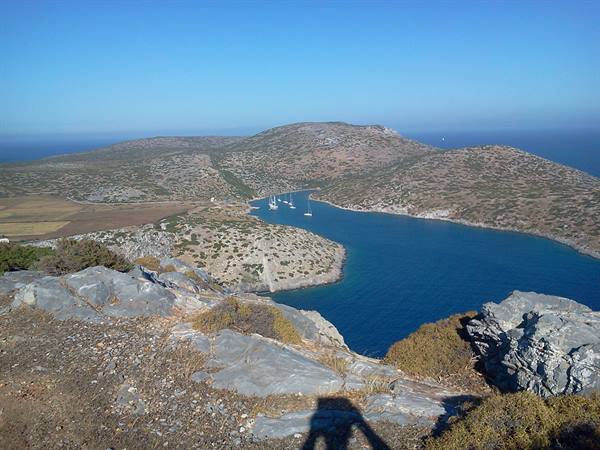
Only two moorings remain at the bottom of the fjord, where the water is shallow and there is a risk of hitting the concrete blocks that anchor them. The number of boats increases every year, everywhere in this sea. Those flying the Italian flag were extremely rare when we began our voyage, my daughter—legendary second-in-command—and I, several years ago, to sail freely in the "sea of the gods." Today they are encountered in every anchorage and people no longer greet one another with the enthusiasm of those days. A brief nod, the exchange of a bit of information and that's it. Almost an annoyance at no longer being, we, the exclusive users of the Aegean. The atmosphere is that relaxed one felt at the end of a day of sailing when reaching a safe harbor. The fjord of Levitha is sheltered from every wind and every sea. A perfect place to spend the night.
The ancient peoples of the sea knew this well, who here, up high overlooking the entrance to the anchorage, had built a castrum, of which a few remains of low Cyclopean walls survive, not visible from the sea. The crew of one sailboat is in the water engaged in a game of volleyball, another relaxes in the cockpit with a glass in hand, others, lying on deck, savor the sweetness of the place. We approach with the tender a fishing boat leaning against a short jetty to buy some fish. One of them, named Christos, recognizes me after thirteen years, since the first time we met. Fumbling with the Greek language I ask about his family, his brothers, his parents. He asks me for news of my daughter Marzia and, finally, we part with my impression of being almost at home here, where I know almost all the inhabitants of this small, semi-deserted island.
Later, at dusk, we climb up toward the house amid the scents of the maquis and the rustle of the wind. It has begun to blow from the northwest. Meltemi, then, not strong, but it awakens some concern in us because the day after tomorrow Fabio must be in Kos to return home and we don't want to be stuck here. We dine at one of the three tables with which the taverna is furnished, served by Manolis, the youngest of the three brothers, under the canopy of a leafy maple. Above us one hears the breath of the meltemi caressing the highest branches. There is no phone signal here except in a spot up high that we reach by climbing, one at a time, onto a boulder a short distance from the house. Against the backdrop of a sky pierced with stars, our shadows are like statues of an ancient temple.
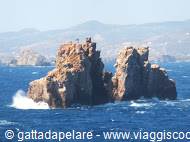
The rocks off Parikia (Paros)
Day 1026 Jun 2013
June 25, 2013. Amorgos-Levitha. 35 miles We leave Katapola on a day of absolute calm. The surface of the sea is stirred only by light, rare puffs of wind under which it gently shivers. We glide along the coast which, toward the eastern tip of the island, rises high and drops vertically into the sea until it reaches unknown depths. We pass close to the rock wall that looms over us, almost grazing it, with a mixture of pleasure at such daring and anxiety at what might fall from above. The water is the color of indigo. "Deep Blue" is the title of a film shot here. It too unsettles us with the fear of the unknown that emerges in the unconscious from the depths of the sea. So much charm and beauty are embittered by a broad film of oil that accompanies us for a good stretch of the voyage.
We feel the pollution as an affront made personally to us, sailors in love with these places that we would want outside of time and the ugliness of civilization. The mainsail is provocatively raised and useless, but it serves to deceive us and softens the displeasure of having to proceed under motor. Passing abeam of the islet of Kinaros, the island of Levitha already comes into view, the usual overnight stop of all sailboats on this route between Amorgos and the northern islands of the Dodecanese. Other times I have described this scorched and stripped island, home to countless sheep wandering among the stones and rocks in the stressful, daily search for some blade of grass.
Levitha is a deserted island except for one family that lives a little way uphill, far from the sea, and manages to do a bit of cooking for the few sailors who have the desire and the courage to cover the distance that separates the house from the coast. There is no road or certain path, but only a visible track because the larger stones have been cleared from it. The climb, in truth not steep, is usually made toward the start of the evening, after mooring the boat and diving into the sea to crown the pleasure of the day's sailing. But the return, after dinner consumed at the meager taverna, is made in the dark or by the light of flashlights or cell phones. And it is an undertaking to reach the shore, where the tender was left, without accidents. We arrive in the late afternoon and already find many boats.
Only two moorings remain at the bottom of the fjord, where the water is shallow and there is a risk of hitting the concrete blocks that anchor them. The number of boats increases every year, everywhere in this sea. Those flying the Italian flag were extremely rare when we began our voyage, my daughter—legendary second-in-command—and I, several years ago, to sail freely in the "sea of the gods." Today they are encountered in every anchorage and people no longer greet one another with the enthusiasm of those days. A brief nod, the exchange of a bit of information and that's it. Almost an annoyance at no longer being, we, the exclusive users of the Aegean. The atmosphere is that relaxed one felt at the end of a day of sailing when reaching a safe harbor. The fjord of Levitha is sheltered from every wind and every sea. A perfect place to spend the night.
The ancient peoples of the sea knew this well, who here, up high overlooking the entrance to the anchorage, had built a castrum, of which a few remains of low Cyclopean walls survive, not visible from the sea. The crew of one sailboat is in the water engaged in a game of volleyball, another relaxes in the cockpit with a glass in hand, others, lying on deck, savor the sweetness of the place. We approach with the tender a fishing boat leaning against a short jetty to buy some fish. One of them, named Christos, recognizes me after thirteen years, since the first time we met. Fumbling with the Greek language I ask about his family, his brothers, his parents. He asks me for news of my daughter Marzia and, finally, we part with my impression of being almost at home here, where I know almost all the inhabitants of this small, semi-deserted island.
Later, at dusk, we climb up toward the house amid the scents of the maquis and the rustle of the wind. It has begun to blow from the northwest. Meltemi, then, not strong, but it awakens some concern in us because the day after tomorrow Fabio must be in Kos to return home and we don't want to be stuck here. We dine at one of the three tables with which the taverna is furnished, served by Manolis, the youngest of the three brothers, under the canopy of a leafy maple. Above us one hears the breath of the meltemi caressing the highest branches. There is no phone signal here except in a spot up high that we reach by climbing, one at a time, onto a boulder a short distance from the house. Against the backdrop of a sky pierced with stars, our shadows are like statues of an ancient temple.
Leros
Day 1130 Jun 2013
June 30, 2013. Leros - Kalionissos Bay (Kalimnos). 12 miles We set off with a light northwest wind, sailing down Leros to the strait that separates it from Kalimnos. As always in this season the sky is clear and the temperature most pleasant. We are all happy for the days that await us, in family harmony. Once past the strait we coast along Kalimnos on its eastern side where we find the sea, which in truth was already calm, even calmer. We are in the lee and the wind has also dropped. This allows me to prepare the thrilling experience of trolling for the kids. For Mattias it is his first time. I rig the floating line with bowline knots every two meters and let it out into the sea. While the boat proceeds at about two knots the three little cousins let themselves be dragged along with joyful shouts, excited and fearful of being bait for monstrous sharks.
When the game ends we are by now close to the promontory that closes the deep inlet of Kalionissos. The first time we arrived at Kalionissos, Gino and I, several years ago, the bay was deserted. Only three boats from a charter were moored at a rickety pier. The only taverna was a few hundred meters from the shore, run by a multifaceted character acting as tavern keeper, schoolteacher, sponge diver, by the name of Nicola. He spoke Italian and from him we learned everything about the old families who inhabited the narrow valley and the slopes of the bay, in houses little bigger than tool sheds, lacking everything, hours of mule track away from the town of Kalimnos. Their meager life was consumed in waiting for the men at sea, for months, fishing for sponges. A life devoted to shepherding and to the production of cheeses to be sold in town once a week. Today it is transformed.
Two tavernas compete for the crews of the numerous boats moored to their buoys. A mobile kiosk, several sunbeds and umbrellas violate our idyllic memory of this anchorage. A willing German couple helps us hook onto the last free mooring, in front of a pebbly little beach dominated by a sturdy tamarisk that shades it. It is there that we land with our tender and stretch out to take possession of this pleasant corner. Soon we forget the disappointment of having found Kalionissos contaminated by civilization. The inlet is beautiful, there is no confusion, some children play diving from a small jetty, no noise of engines or intrusive music. For our three young cat-nauts the place is ideal for socializing and spending a few hours. Soon they make the acquaintance of some little girls and go off to play. A path starting from the beach pushes inland into the valley.
Now there are several dwellings, small, modest, with the appearance of vacation homes, frequented by locals. By intuition we reach the taverna of that time, the one of my first visit, and I recognize the tavern keeper of then. He pretends to recognize me, or maybe he is sincere, I don't know. I wouldn't be surprised if it were true. On other occasions I have found myself before Greeks, generally waiters, who recognized me after many years of absence. Physiognomic abilities that for me, who struggle to recognize myself in the mirror, are impossible to understand. During these afternoon or morning stops at the tavernas we like for some reason—generally they are very rustic and picturesque places—we are accustomed to sampling Greece by ordering a plate of olives, possibly dry and black, and a glass of retsina. The weather is changing. The wind has picked up.
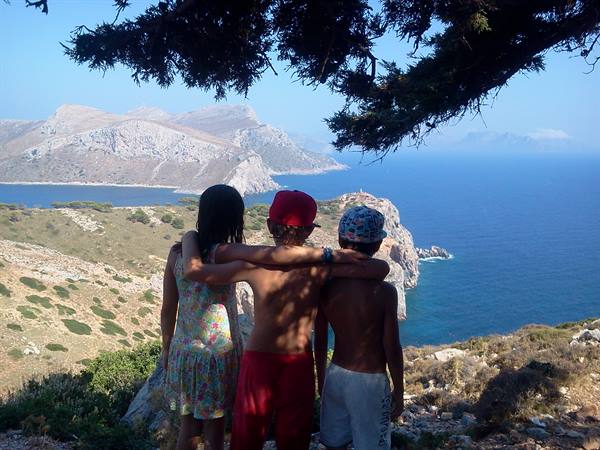
Rocky cliffs over the sea at Cap de Creus, Mediterranean shrubs and blue mountains
Day 122 Jul 2013
July 1, 2013 - Kalimnos. (Kalionissos inlet.) Some boats leave their moorings and depart. Despite the steady wind that began blowing yesterday evening and whistling through the rigging all night, we decide to leave too. As soon as we are out of the protection of the promontory, however, we take the waves abeam and the rolling becomes unbearable. We would have to hold this course for a couple of hours and with the children on board it doesn't seem like a pleasant passage to us, so we turn back, to the comfort of a quiet mooring. The ability children have to understand one another even while speaking different languages is astonishing. Our three play for hours with the daughters of the kiosk manager. They have learned from them that game, incomprehensible to the Western observer, which is called backgammon, and they devote themselves to it with great commitment.
Marzia and I, instead, go off for a walk along the rocky coast until we discover a corner, a sort of recess of the sea, where the transparent, cool water entices us to take a dip. At the taverna situated higher up this evening there is folk music. Many Greek customers have arrived from elsewhere and the tables are almost all taken. One breathes the air of authentic Greekness. No songs for tourists, no sirtaki. Monotonous, to our ears, are the laments that come from the lyres, those typical Greek instruments, somewhat similar to violins, which the four members of the little orchestra scrape with intense effort. It takes many years of frequenting the Aegean islands to let oneself be conquered by this music whose themes are so repetitive as to be boring.
To us, who have not yet come to fully understand its charm, after a while it tires even though it creates, together with the retsina, a vacation atmosphere "stin Ellada." The music continues almost until dawn. It reaches us in our berths where we have fortunately taken refuge after the fear of having lost the tender left aground on the shore. On our return from the taverna, in fact, the tender was no longer there waiting for us. The rising tide had freed it from the bank and the wind, still fairly steady, had carried it away. Fortunately for us at that point the shore makes a bend and the lines of some fishing boats bar its outlet to the open sea. And there, on the leeward bank, our anxiety dissolves. Marzia, having gone to explore, catches a glimpse of its shape and the cry: it's here! sounds to our ears like the most welcome music of the evening.
July 2, 2013. Kalionissos - Pserimos. 12 miles So we set off despite the wind not having dropped. We must be in Kos the day after tomorrow for the return, Mattias and I to Rome. Marzia, Maia and Sebastian will instead go to their beloved island of Lipsi to continue the vacation. Outside the inlet we find again the waves abeam of yesterday. The sea is well formed and the rolling very intense. The children find this motion fun, but when we finally reach the end of the island and bear away to head for Pserimos, the wave, more settled, arrives from the stern and our progress becomes pleasant. The children, in turn, steer at the helm and Gattadapelare gives us some fine moments of sailing. At Pserimos we don't immediately find a place at the quay occupied by tourist caiques and we stay at anchor along with other boats waiting for places to free up. By now we are at home here.
We know some of the souvenir merchants, the owners of the taverna, the sponge seller. They all greet us warmly and make Pserimos one of the favored anchorages of the Dodecanese. Marzia and I leave the children free to move about as they please between beach and boat and go to explore the other coast of the island. We follow a road that leads us to the foot of a slope beyond which there is an inlet open toward the Turkish coast. The climb is not steep, but the heat has become intense and the rare puffs of wind coming from the sea behind us refresh us little. We meet three women walking the reverse of our route, also moved by curiosity to know what is on the other side of the hill.
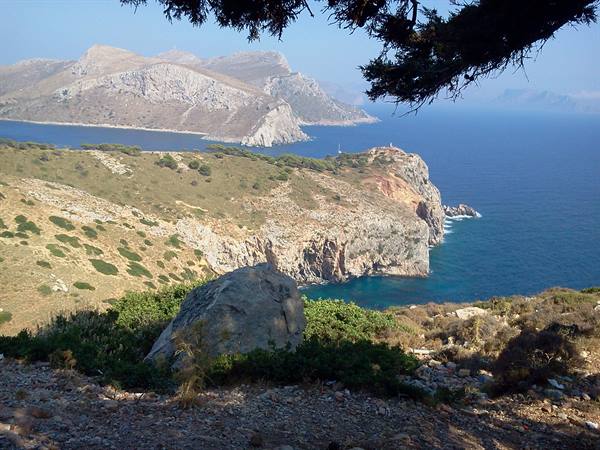
Having reached the top amid a deafening chirping of cicadas, in the Hellenic sun, among thorny bushes and limestone rocks and the bleating of goats nose-to-nose in the shade of some carob trees, the blue of the Aegean opens before our eyes. How beautiful! How lucky we are to experience these landscapes, atmospheres, scents, flavors, colors, we, who wrapped in history and mythology, are here, only a few minutes by plane from Rome! We descend and dive into the sea. A couple of boats float lazily in front of the beach. It is a fine place to spend a night at anchor.
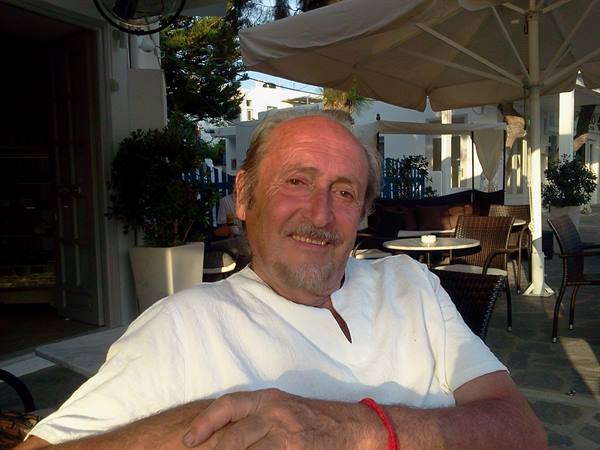
The captain
Day 134 Jul 2013
July 4, 2013 - Pserimos-Kos. 10 miles We have arrived and moored at the new marina of Kos. A well-served marina, a bit too bureaucratized, more in line, perhaps, with European standards, but lacking the charm of spontaneity that we go looking for in Greece. Everything changes. The Greece of our first years of cruising is disappearing, standardizing—flattening out—on life patterns and regulations common among the countries that make up Europe. Our grandchildren will not be able to know the Greece we visited. This "Logbook" of mine will serve, perhaps, to show it to them as it was. We "cat-nauts" have not always blinded ourselves with haughty contempt for the tourists who infest our anchorages. Every now and then we allow ourselves an immersion into the variegated crowd that swarms through the streets of the villages and cities most publicized by travel agencies.
Kos-town pleases us despite the mass of tourists, especially Northern European, that occupies it. A multitude so substantial as to obstruct the way or occupy all the tables of the tavernas and cafes. The municipality has also created long bike lanes in the city and one must be careful not to be run over by Nordic cyclists for whom it is obvious that the path be left free by pedestrians. But Southern pedestrians are not used to the exclusivity of the lane and invade it unawares. We go to dine at our usual taverna, "da Zorbas," warmly greeted, as usual, by the physiognomist tavern keeper. Tomorrow the crew disperses.
July 5, 2013 - Kos-Rome. We fly Ryanair, Mattias and I, leaving Marzia, Maia and Sebastian with the boat. Tomorrow they too will leave Kos bound for Lipsi.
0 reader comments