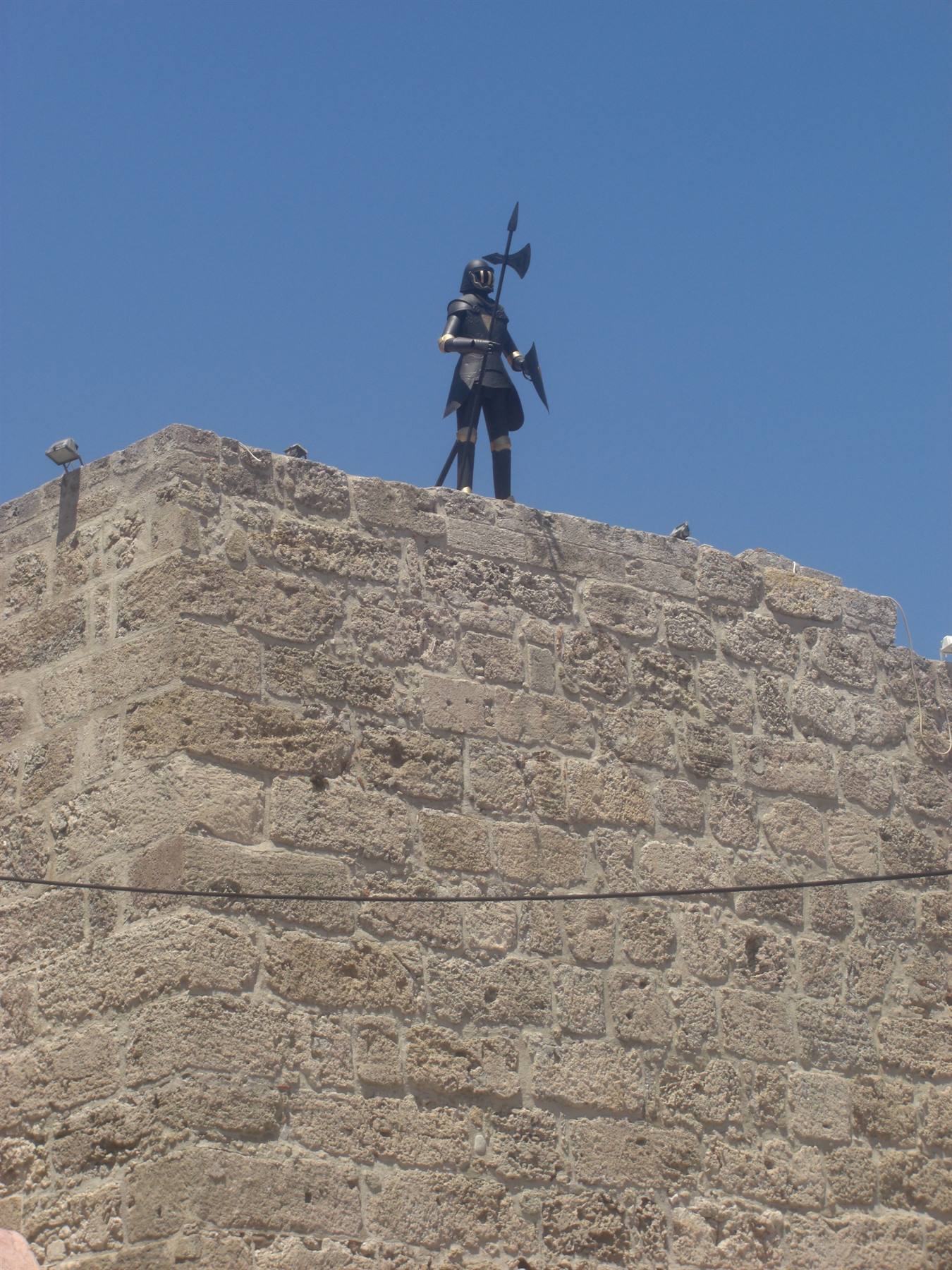
Departure from Rome and arrival at Rhodes. I don't have the courage to go straight to the boat lying in the boatyard because I fear that the work ordered a year ago is still far from completion. The contacts I've had by phone with the master shipwright have prepared me for disappointment. Sleeping on board is out of the question. I take a room in a hotel. A nice room with a direct view over Mandraki harbour and, to the side, over the palace of the Grand Master of the Knights of Rhodes and the mighty walls that surround the ancient stronghold. The charm of Rhodes increases every time I go there. I know its streets, its shops, some people. I know where and how to move around. That's enough to feel at home. I am annoyed by the hordes of tourists unloaded every day from the immense hotel-ships.
I have nothing to sell them, I am not one of the numerous traders of souvenirs, jewellery, scarves or a restaurateur or barman waiting like spiders on their web. To me they are just annoying; they pollute the atmosphere of a city immensely rich in history and ancient presences.
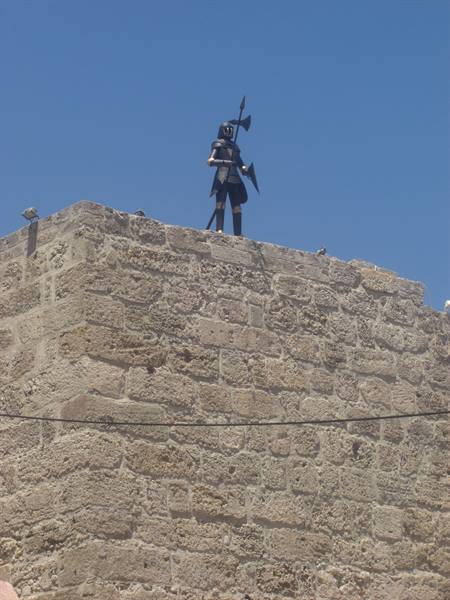
Knight statue in armor with axe atop Rhodes fortress walls, stone, sunlight
Day 227 May 2012
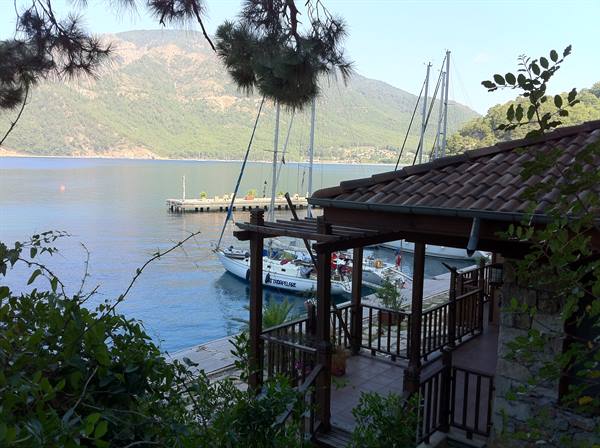
Sailboats moored at the pier beside a wooden terrace, green mountains bay
Day 328 May 2012
28 May 2012. Rhodes.
The boat is in disheartening condition. The teak-deck deck is finished and beautiful, but the cockpit has not been redone and the interior still lacks the new furniture. Dust and tools everywhere. It will take at least another four days of hurried work to be able to set off at all, even with many jobs still pending.
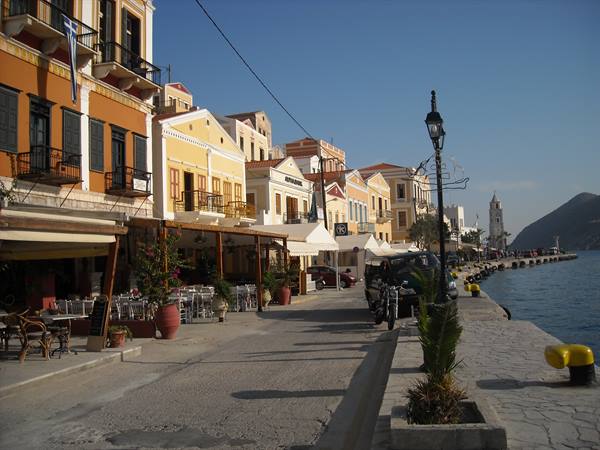
Simi
Day 429 May 2012
29 May 2012. Rhodes.
I make occasional visits to the boatyard to observe the progress of the work. Progress is slow and not very noticeable. The furniture is being installed. It is well made. A shame that some of the fittings aren't ready and we'll have to set off with the boat unfinished. After two years since I ordered the work, making this decision is irritating. But I have no intention of giving up the cruise I've been longing for for so many months.
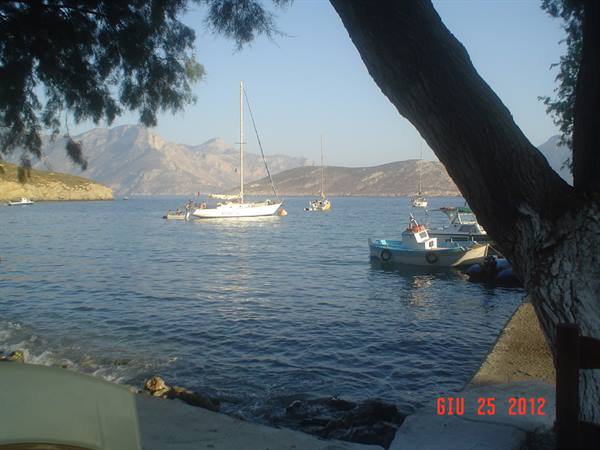
Boats anchored in calm bay beneath arid mountains, tree branches framing foreground
Day 530 May 2012
30 May 2012. Rhodes.
I clean the dust from everywhere and load onto the boat the objects kept in a damp little storeroom in the boatyard. I take the opportunity to get rid of many things that for years had occupied space in the lockers and had never been used: tins of paint, bottles of solvents, rusty tools, bilge pumps out of service and, perhaps, still repairable, (but only perhaps), an oil can never used, a fog bell now desperately green with oxide (I have a second one in better order), a builder's helmet, a pilot book with the pages welded together by damp, an oil lamp without the glass chimney and lots of other junk kept because "on a boat they can always come in handy, sooner or later" I feel the relief of a liberating catharsis in throwing everything into the rubbish bins.
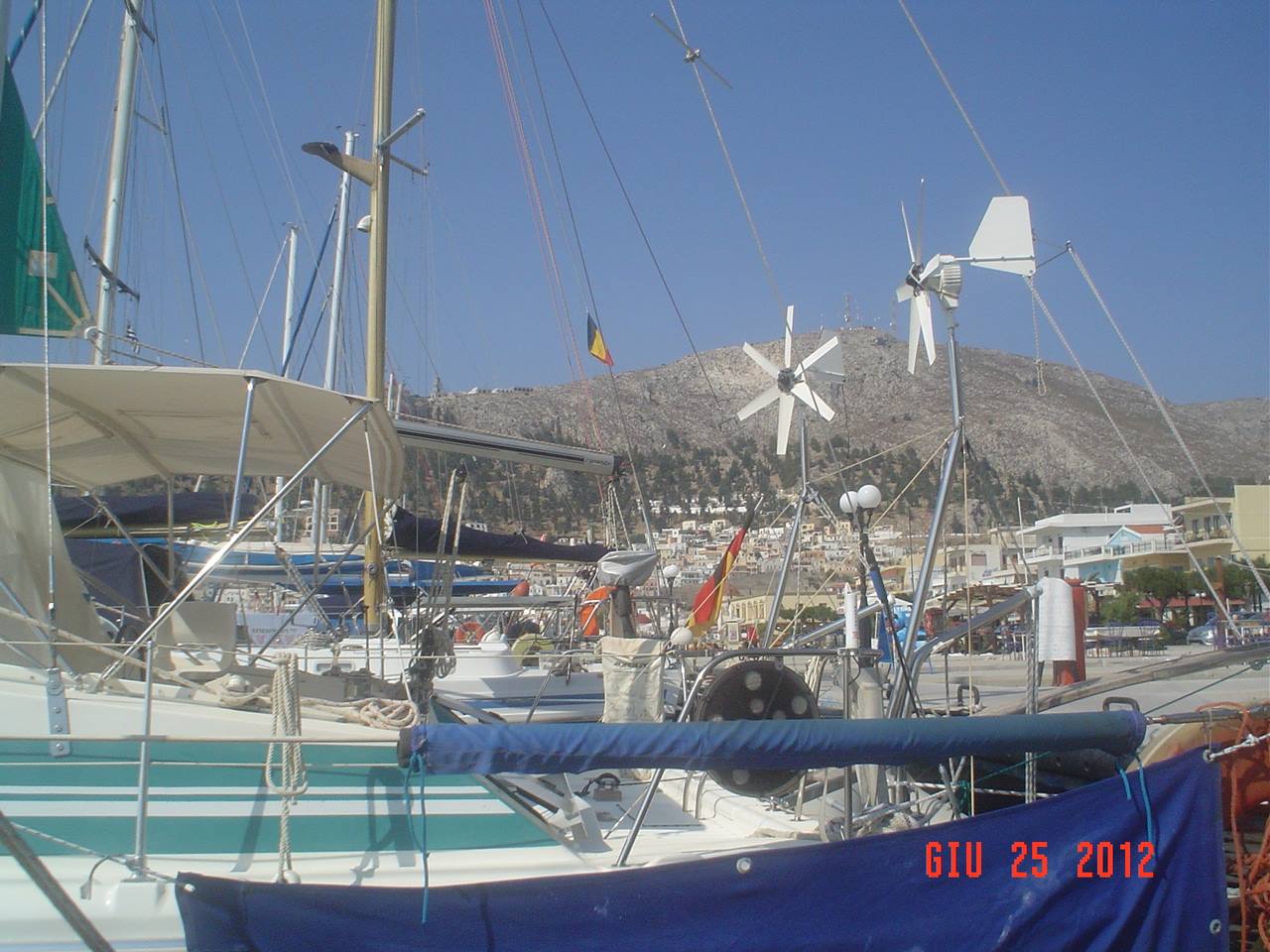
Sailboats moored in the harbor, wind generators on masts, arid mountains behind
Day 631 May 2012
31 May 2012. Rhodes.
Gino arrives. Finally I can share with him the irritation to be vented on the person responsible for the delay in carrying out the work.
1 June 2012. Rhodes.
We can sleep on board, but we are still not ready for launching. We have to test the engine after replacing some parts of the cooling system, restore some lights, finish the internal cleaning, do a bit of provisioning. Tomorrow we go into the water. Tomorrow is Saturday, the boatyard is closed and the workers wouldn't work without a small extra bonus.
2 June 2012. Rhodes-Mandraki Harbour.
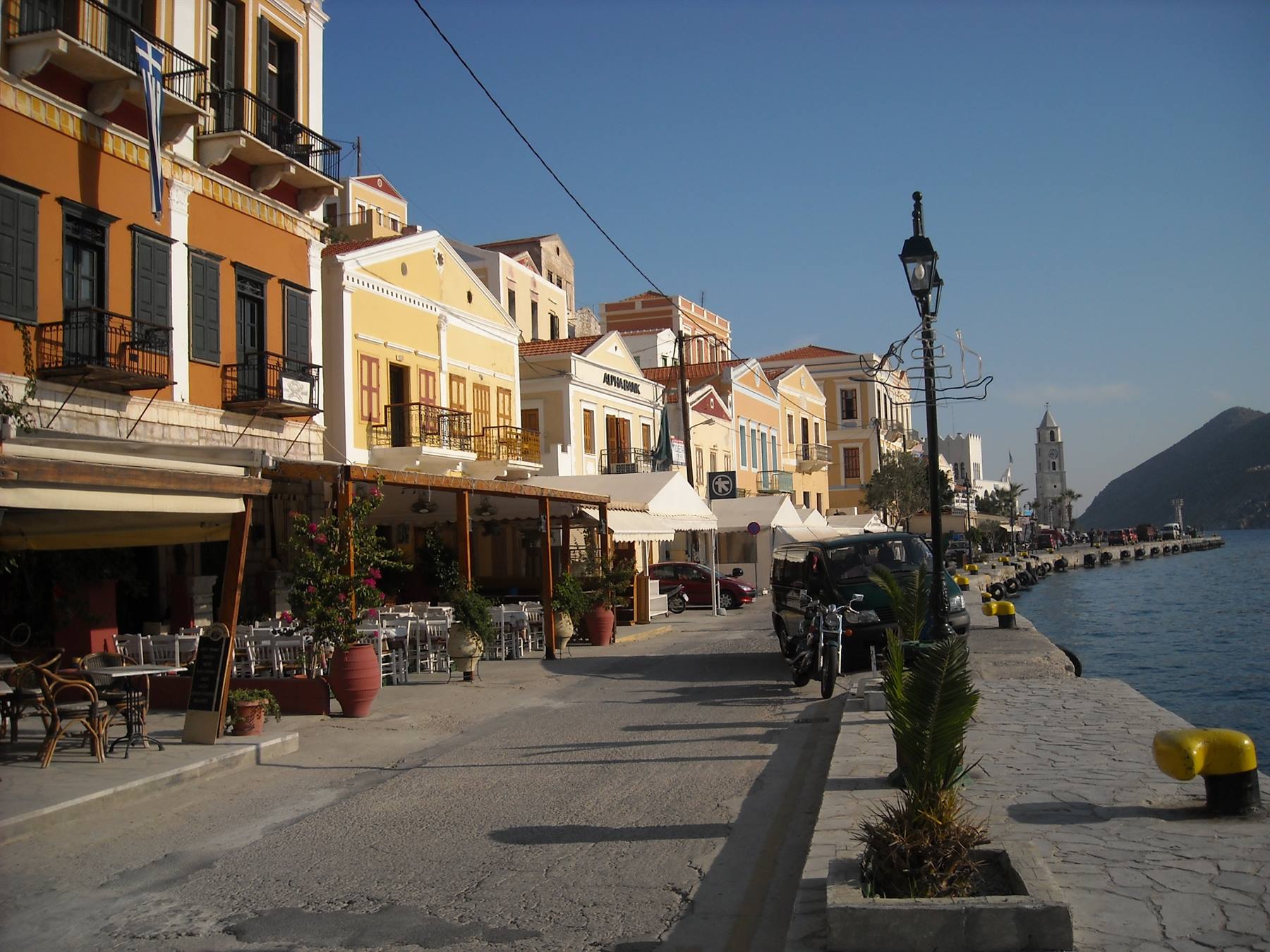
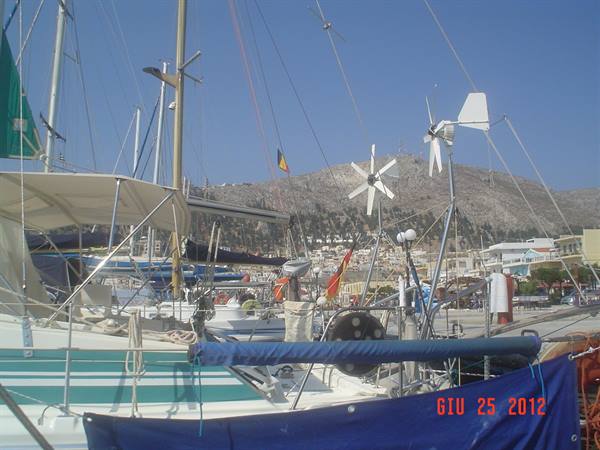
We leave the boatyard to move a short distance away, to the ancient harbour of Mandraki, Rhodes does not belie its touristic vocation. Today it is invaded by cruise passengers. Three immense floating hotels have arrived and have unloaded, each, at least three thousand guests. The seafront is full of coaches that will take them to the most characteristic places on the island. Columns of people walk wearily along the battlements of the medieval walls. Video cameras, cameras, mobile phones filling up with images, little bottles of water in hand, sandals on feet and Bermuda shorts. This is the monotonous world of mass tourism, a world we shun, grateful to fate for giving us the chance to set off with our boat in search of peaceful, exclusive anchorages. We do the provisioning in the little shops of the port and continue putting the boat in order.
Tomorrow we will leave Rhodes after two years of storage. Other islands will host the boat during the winters of inactivity. We want, in the coming years, to push north, reach anchorages still unknown to us, get, inschallah, as far as Istanbul. We are ready to set sail tomorrow "with the low tide". Actually the tides in the Aegean are imperceptible, but "setting sail with the low tide" has always excited my imagination as a reader of sea novels. So, Gattadapelare will cast off her moorings with the start of the low tide and reach the open sea, ready for new adventures. The autopilot doesn't work.
Sailboats moored in the harbor, wind generators on masts, arid mountains behind
Day 73 Jun 2012
3 June 2012. Rhodes-Limani Bozuk (Turkey). 13 miles
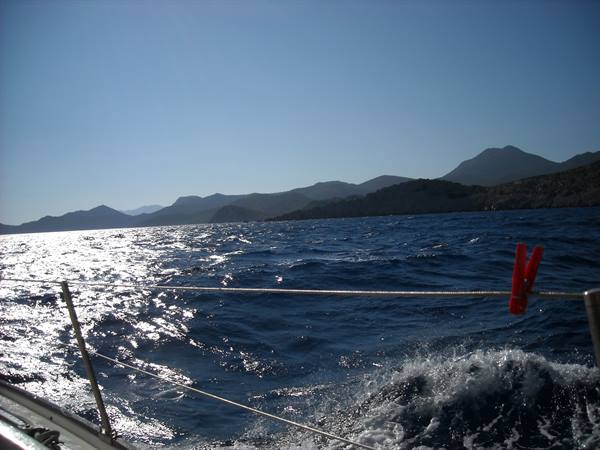
We wait for the mechanic for the final checks. Water is coming in from the stuffing box and we fear that the leak could widen and jeopardise the cruise. The problem is solved with a simple hose clamp. We also have an appointment with the person in charge of the work to settle our financial dealings, We discuss at length with him about the fee demanded and reach a compromise which, like all compromises, leaves everyone dissatisfied. But now we are free to leave behind the irritations and worries The wind is scant and the sea lightly choppy. The first contact with the Aegean, after eleven months of inactivity, Gattadapelare makes under motor. In a short time we cross the stretch of sea that separates the island of Rhodes from the Turkish coast. We are heading for the wide and sheltered bay of Bozuk where there is the pleasant anchorage of Alì Babà, a little tavern already known to us.
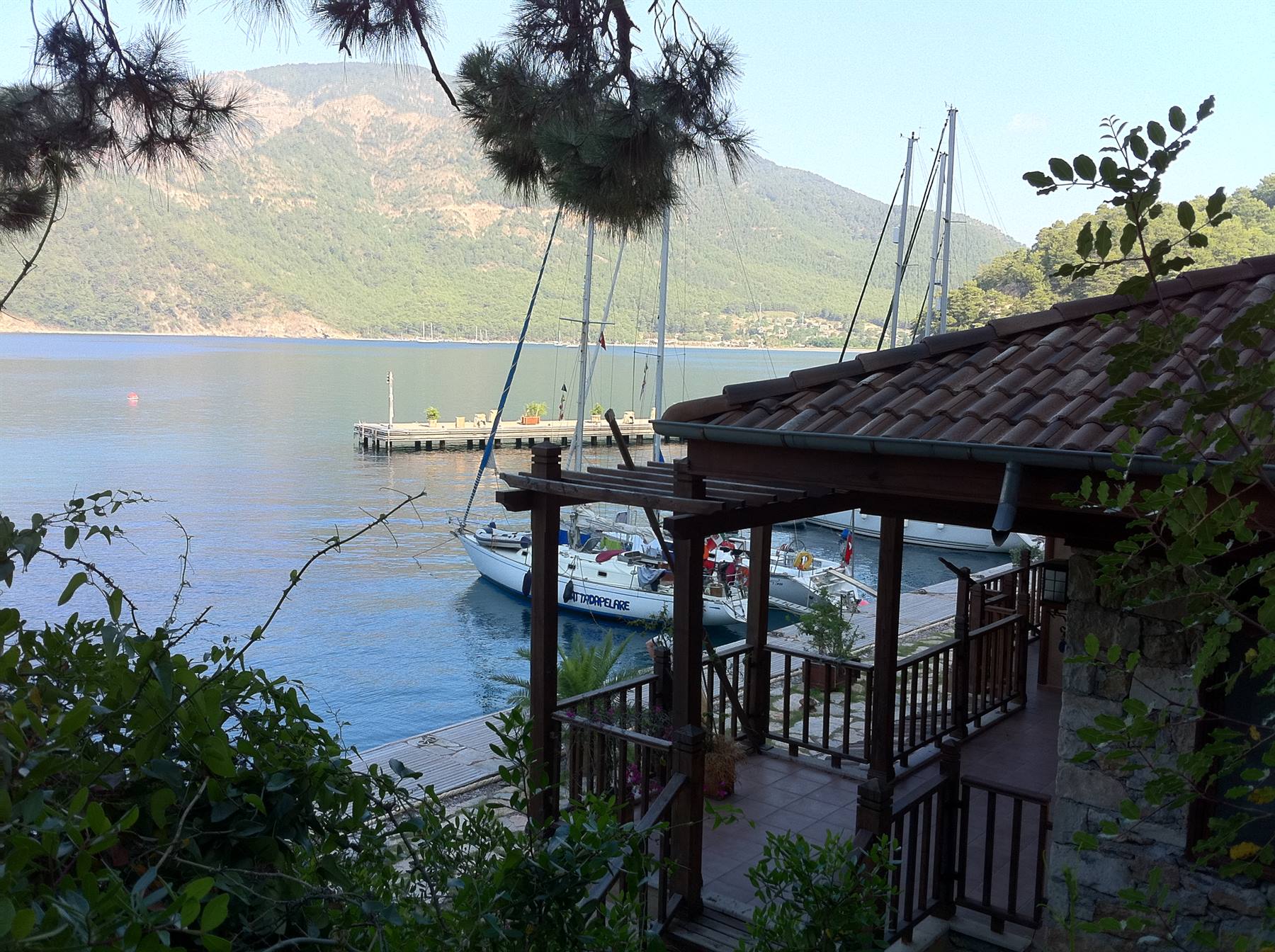
In a couple of hours of sailing we enter the bay dominated, to the west, by the long walls of an ancient Hellenic fortress. Immediately on the left the tavern appears and the small wooden pier where about fifteen sailing boats are already moored. On a couple of them the Italian flag is flying, once so hard to encounter in this sea and today increasingly present- We dine on the veranda of the tavern together with all the other crews
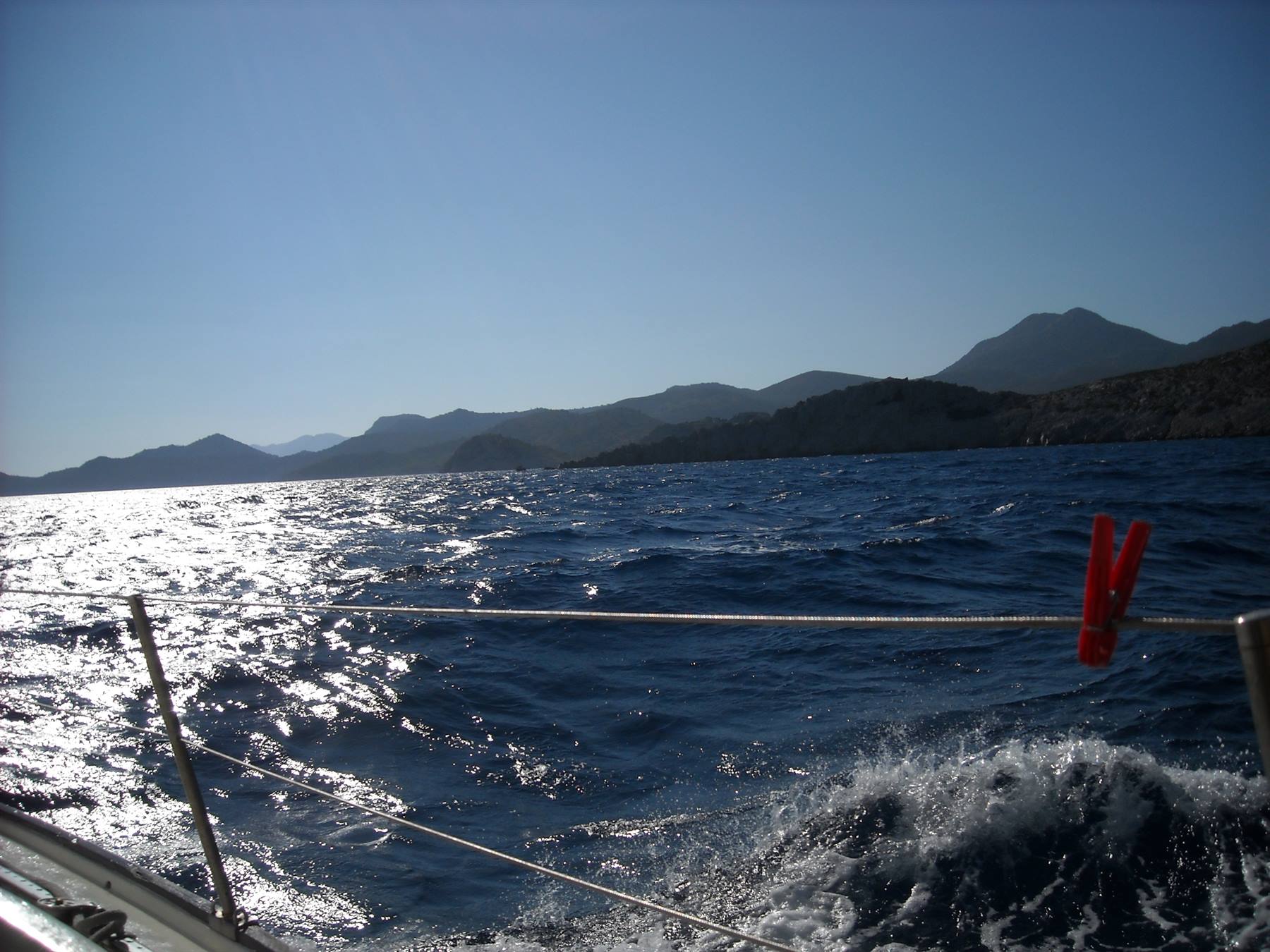
From a sailboat deck, choppy sea and mountainous coastline ahead
Day 85 Jun 2012
June 5, 2012. Simi-Nisyros. 34 miles
As we were about to leave the port, crowded on the piers and on the water, the gear mechanism breaks down and Gattadapelare moves forward with no possibility of shifting into neutral. We lightly bump two boats before managing to steer, albeit just barely. By sheer luck I manage to bring the stern back to the pier while Gino runs out the anchor at the bow. We apologise to the skippers involved and call the only technician we have met here. Yesterday's electrician comes back with his father, who takes the mechanism apart and gets it working again. A short while later we set off once more for the volcanic island of Nisyros. A crossing marked by scant wind that ends, again under motor, in the little harbour of Pali. It is an anchorage sheltered by a long breakwater that is exposed to the north-east and provides optimal refuge in any weather condition.
Many sailing boats are moored there, some Italian, many German and French, but there is no shortage of Dutch and British ones too. There is no town, but rather numerous tavernas and a couple of little shops for provisioning. We are invited to report to the small harbourmaster's office for the formalities, which consist of paying a few euros. Over these sixteen years of frequenting the Greek islands we have seen the bureaucracy of the harbourmaster's offices increase, but there is still no trace of the "persecution" we suffered in Italy where, over the course of one morning, we were stopped three times for checks by different authorities. Not far from us is Simone's boat with his crew. Nisyros is a pleasant anchorage that offers opportunities for visits to the crater and to the village of Mandraki, a couple of kilometres away from us.
We stay on the boat because we have already satisfied our curiosity on previous occasions.
June 6, 2012. Nisyros-Pserimos. 35 miles
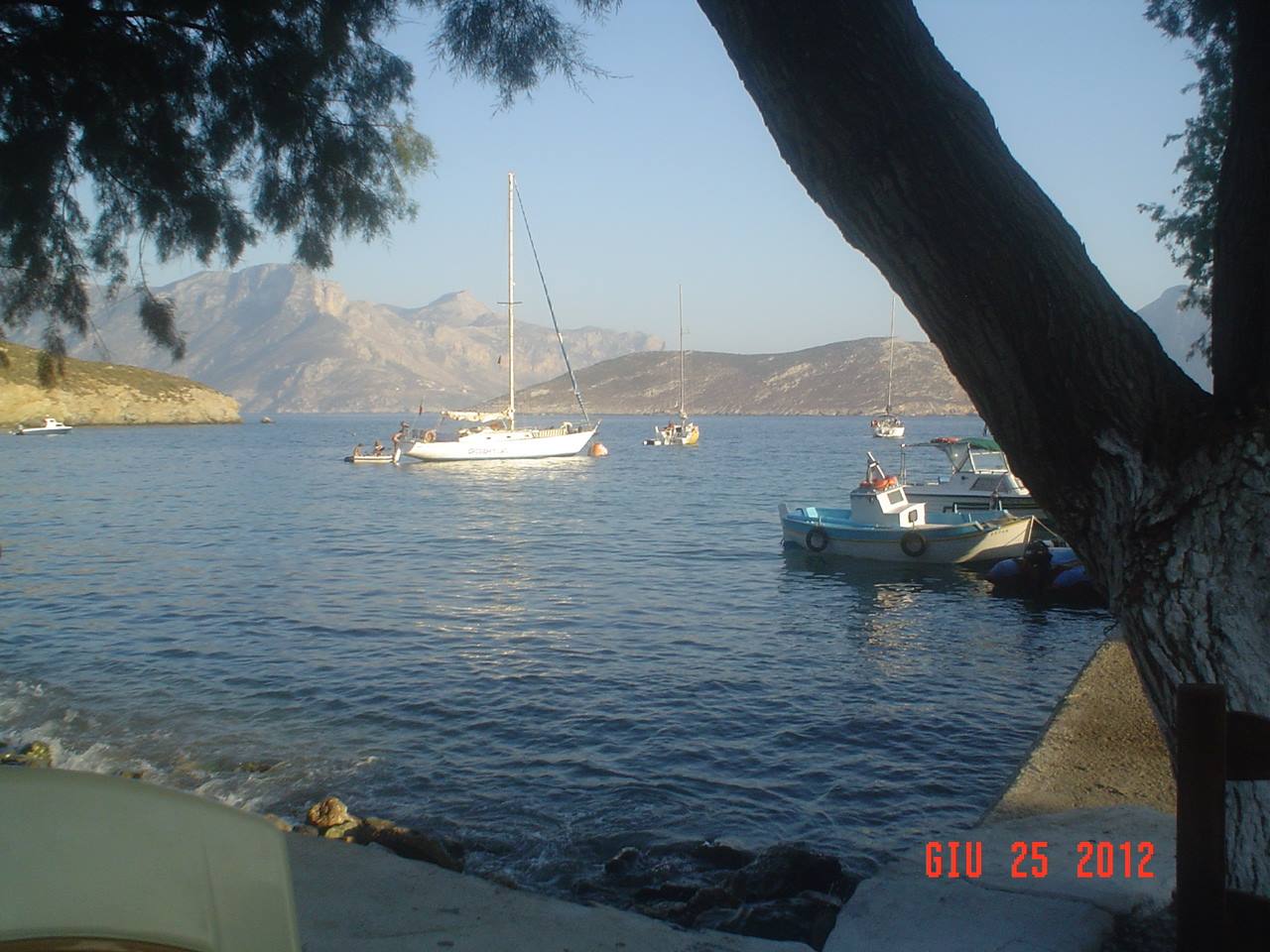
We leave Nisyros with a weak north-westerly wind and a calm sea. We decide to round the island of Kos on its western side because afterwards, turning towards Pserimos, we will have the wind on our quarter for the whole route. As the day goes on the wind freshens too and finally we sail. There is enthusiasm on board and we enjoy the boat as she slips along, barely heeled and stress-free, towards our destination. We reach the inlet of Pserimos in the late afternoon. To the left of the breakwater pier there is the mooring quay, completely empty. We run out the chain slightly oriented away from where the swell enters. We know that this bay is always subject to the backwash that originates from the bottom of the bay. Pserimos is a small island a short distance from Kalymnos, on which it depends administratively and for supplies.
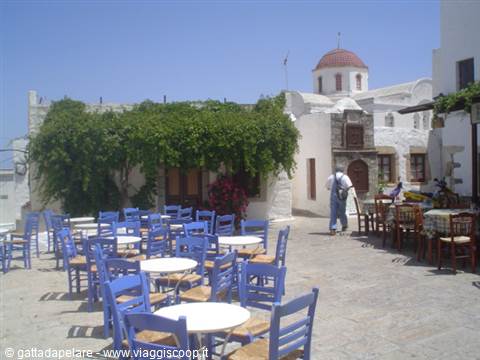
Apart from the small group of houses, white and sky-blue, that wind along the sandy beach, deserted at this hour, and that cluster, sporadically, halfway up the slope, the island is otherwise uninhabited. The few inhabitants, who dwindle to very few during the winter, live off day-tripper tourism brought by the caiques from Kos and Kalymnos. On the narrow lane that leads from the quay to the beach you come across several stalls, now closed, offering the usual souvenirs. Four or five tavernas have their tables a few metres from the water's edge. We are the only guests on the island and after a tasty swim we have dinner in a deserted taverna with the usual Greek dishes.
Greek cooking is very tasty in the first days of a stay, after a year of absence, but after a few days it has the flaw of being repetitive and, in the end, leaves you longing for the lovely plates of spaghetti in the various sauces born from the imagination of Italian cooking. Every now and then, on the boat, the ceremony of draining and thickening the bavette is repeated. It is the only lapse, anyway occasional, into national chauvinism. We go to our bunk rocked by the backwash and sleep comes sweetly.
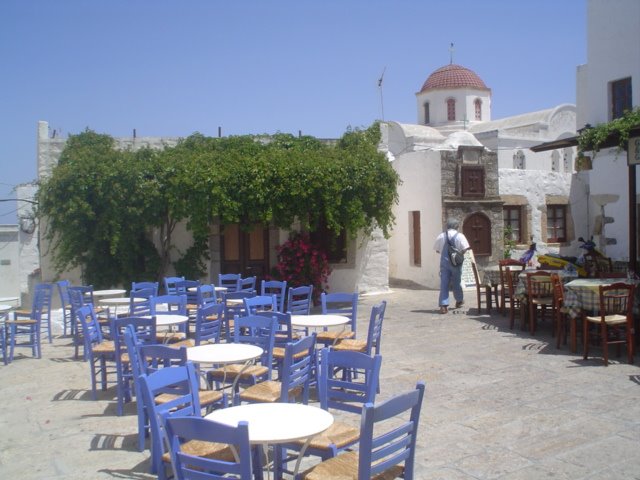
Small square with blue tables and red-domed church in the Cyclades
Day 97 Jun 2012
June 7, 2012. Pserimos.
Tomorrow Gino goes home and we must reach Kos in the morning, in good time for boarding the plane. There is no time to go anywhere else and, besides, the lack of wind does not invite us out for a good sail. So we stay at Pserimos to enjoy the laziness of the day. At this hour of the morning the lovely crescent beach is almost deserted. It is frequented by a few children and a couple of elderly women who, wearing the usual black skirts, walk in the shallows parallel to the shore, immersed up to their waists. A little dog, swimming, shuttles back and forth between them. The quiet of these hours is broken only by the joyful shouts of the children and the call of some rare seagull. The taverna owners rake the sand in front of their establishments while they wait for customers. Pserimos lives a schizophrenic existence.
After the quiet, by mid-morning the place comes to life with the arrival of the numerous day-trippers brought by the caiques from Kos and Kalymnos. They get off the boats and walk in thin lines along the quay and the lane that reaches the beach. Everything comes alive. The stalls, now open, set up long ago, have put on display all their merchandise made up of exotic shells, local sponges and otherwise, jaws of oceanic sharks, little necklaces, perhaps made in China, and whatever else can become a souvenir of the Greek holidays to take home. But few stop to buy. Everyone is in a hurry to reach the beach. On the shore the taverna owners move up to the first row of tables and, guessing the nationality of the tourists approaching, invite them in their own language to stop and taste the taverna's specialities, which are the same as the other tavernas'.
There is an old sponge seller, short, thin and with skin wrinkled and tanned by the sun, a cigarette eternally between his lips, who as potential customers approach places an enormous round sponge on his head and has himself photographed with it, almost always embracing smiling tourists. But few buy. Next to our table an old woman (she has told us she has been a widow for many years and for this reason wears black. She lives in a modest single-room house just behind the shore) tries to sell bags of thyme. But she too does no business. The tourists pass by, smile, make coy gestures and move on, one can't understand where to, because the beach ends a little further on. There are two shifts of influx, one in the morning and one in the afternoon. Around 6 p.m. the island empties.
The tourists, as if summoned like the Eloi by the sirens of the Morlocks' world in the film "The Time Machine" based on the novel of the same name by H. G. Wells, slowly walk off, listless, filing past our "residents'" gaze as we sit at the table of our favourite taverna. Finally alone. We wait for the sun to set which, having disappeared behind the hill on the right, continues to light up the modest mount on the left, bringing out the white little houses perched at the foot of its slopes. While we wait we reclaim the sea with calm solitary swims. We have dinner at the taverna and go back to the boat to be rocked by the backwash. Simone has sent us a text with a photo of two nice little tuna caught by trolling. It's years since we've caught anything. Envy? Not exactly; rather, seeing that there are still fish in the sea opens our souls to the hope of a catch.
June 8, 2912. Pserimos-Kos. 9 miles
We leave with a light wind pushing us towards the port of Kos, located at the eastern end of the island. Gattadapelare glides along calmly, keeping well off the low tip of the island which stretches below the surface of the sea for a long way. Abreast of the port we head up to enter. We find a place on the left, below the walls of the old fortress, in the port's marina. This marina does not offer any kind of service, apart from the supply of electricity and water, but it has the advantage of being in the heart of the city. Gino leaves. We say goodbye at the bus station with the promise to resume next year our wandering through the Aegean in discovery of new islands. I stay to wait for part of the new crew arriving in the afternoon.
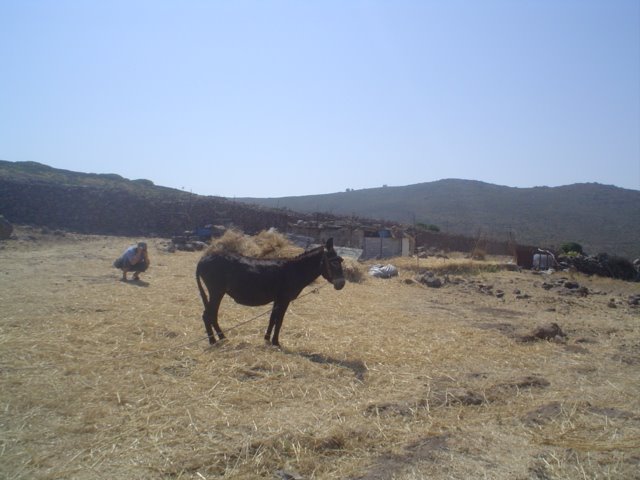
Black donkey carrying hay bundle in dry volcanic fields of Alicudi
Day 109 Jun 2012
June 9, 2012. Kos-Pserimos. 10 miles June 10-19 Pserimos. Last night Luigi arrived, the new gattonata. Luigi has no nautical experience, but a good spirit of adaptation. We move the boat to the Neo Marina, a couple of kilometres south of the port. The difference in price is well justified by the quality of the services and the organisation. Not far away there is a beach with umbrellas and deckchairs where we spend a good part of the afternoon. In the evening we go to the centre for an aperitif and for dinner. Here the tourist presence is massive. Mostly represented are the Dutch, the Norwegians and the Swedes, who gather in venues dedicated to them. These are the days of the European football matches and the cheering is loud. The cafés present themselves with huge TV screens and the ubiquitous waiters invite passers-by to sit down.
Kos has numerous cycle paths, much used and also dangerous for the distracted pedestrian, unaccustomed to paying attention, because the northern cyclists, perhaps out of respect for quiet, are not in the habit of ringing their bell.
We spend these days repeating the same actions, the same moments, frequenting the same cafés, beaches, restaurants while waiting for the arrival of Pino, the third member of the crew. When, finally, we get word that he will not be able to join us, we decide to move to Pserimos. In the afternoon Gattadapelare is once again moored at the island's quay. This time we are not alone; about ten sailboats occupy the whole quay. We had to hold station for a while waiting for a place to free up.
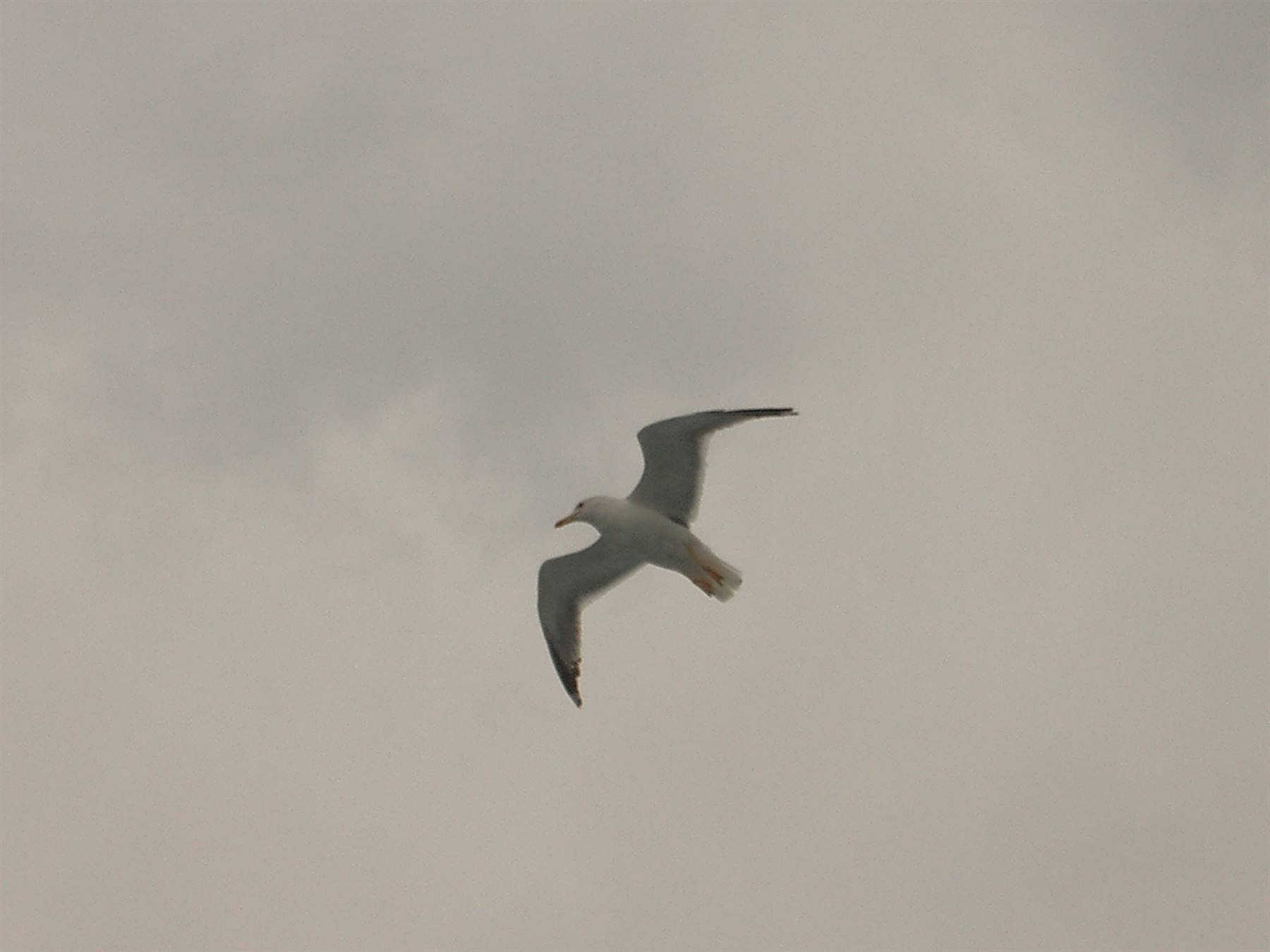
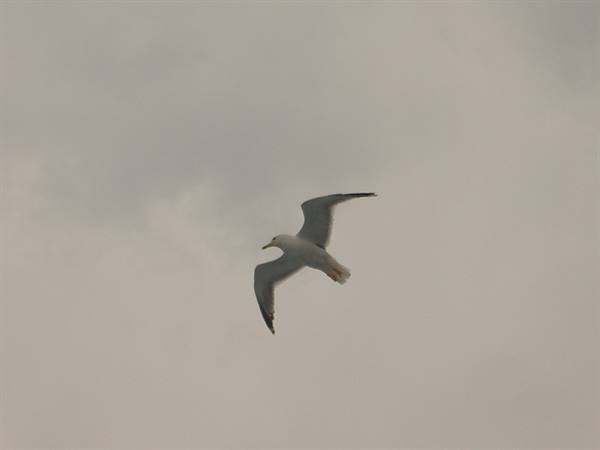
Seagull gliding with spread wings against a grey cloudy sky
Day 1120 Jun 2012
June 20, 2012. Pserimos-Kos. 10 miles
We have spent all these days in nautical idleness, but doing a lot of DIY on board in the shade of the awning. The backwash never left us, though it didn't bother us except, at times, when getting on or off the boat. The weather has always stayed fine and very hot, giving us reason for numerous dives from the cockpit. Under the keel a cuttlefish stayed for a couple of days until it ended up among the spaghetti in a moment of ecological weakness on the skipper's part. Long sittings in the taverna run by three sisters with whom we have struck up a friendship and who have helped me in my efforts to learn the Greek language. Before and after the invasion of the tourists, short or long swims interrupted the apathetic pauses on the taverna's chairs. Briefly breaking the pleasant monotony of the day was Luigi's mobile phone diving into the sea.
From that moment the continual swapping of SIM cards set the rhythm of our time. The daily familiarity with the characters of the beach has made them curiously familiar to us. The sponge seller, the little old thyme-selling woman, the shopkeeper of the tiny supermarket who displays unusual objects, except the ones we need, the slightly touched goatherd who walks quickly along the shore strangely waving his left arm, the inhabitant of the last house on the beach with his load of family members balanced on the scooter with which he races along the water's edge, which has become, for him, the hamlet's motorway; everyone is destined to become an icon of our stay at Pserimos. Today we set off to reach Kos. The short crossing plays out in the same way; light wind on the quarter until we enter the channel between the island and the Turkish coast. Here the wind comes on the beam.
After passing it we bear away to head for the Neo Marina. The evening ends with the usual stroll to the centre, aperitif and dinner.
June 21-22, 2012. Kos
Yesterday we spent the day wandering between the town and the beach. Today Luigi leaves. In the evening the last crew arrives: my wife, my daughter and the two little grandchildren, the future arms of Gattadapelare. We have dinner at the marina taverna in front of the TV screen. The Greece-Germany football match is on and the patrons, German sailors and local residents, are lined up on naturally different sides, as different in their expression, controlled on the Germans' part, noisy on the Greeks', are those of rejoicing for the goals scored or of despair for those conceded. In the end, the atmosphere becomes comradely between the losers and the winners, with a round of ouzo kindly offered by the host. Everyone to their bunk. Tomorrow we set off.
Seagull gliding with spread wings against a grey cloudy sky
Day 1224 Jun 2012
June 24, 2012, Pserimos-Kalymnos (port). 15 miles
I don't know the port of Kalymnos. I have passed in front of it many times, but I have never felt the desire to visit it. I have imagined it too big for our tastes as travellers in search of suggestive corners of a Greece suspended between Arcadia and history, between Pan's flute and the songs of Aris Alexiou, between banks shaded by ancient tamarisks and solitary anchorages. The time available to conclude this year's voyage and the weather forecasts for the coming days lead us to make obligatory stops.
So we set off at our leisure after taking leave of the fleeting acquaintances I have made on this island: the girls of the taverna, the former sponge fisherman who speaks Italian because as a young man he used to come to fish for coral at Caprera, and the souvenir seller, Captain Antonio, owner of a stall in front of the mooring, a fine appreciator of my spaghetti offered to him on the day of my first landing. The leg to reach the town of Kalymnos is short and sheltered from the wind which today, and will be so for the next three days too, is weak. Then force seven is forecast and by then we want to be well protected at the mooring in Leros where the boat will await the arrival of Gino and his family. For us, on the other hand, our short cruise will end there. In the late afternoon we pass the mighty breakwater of the port of Kalymnos.
The town that appears before us lies in a horseshoe along the shores of the bay. A long quay hosts numerous boats, almost all sailing ones. We moor next to a German catamaran, perfect in every detail, as only German owners manage to have them. The comparison with Gattadapelare cannot but be all the more striking. Our staysail is spread out along the gunwale, hastily tied and secured with an ancient line. The mainsail lies badly on the boom, likewise tied with many turns of an equally old and faded line. Our cockpit, whose refitting work has never begun, shows worn teak with the caulking almost gone. Along the lifelines dangle numerous little ropes that "can always come in handy at any moment". Personally I do in fact find them very useful. The flag is a bit worn and frayed.
In short, the boat gives the impression of being much lived-in, more a means of "going to sea" than an object of worship. Observing the crew of the catamaran, a middle-aged couple, impeccably dressed, I wonder whether they are sailors or extras put there for a photo shoot. (in moments of self-analysis, I wonder, though, whether I am not a bit of a snob, in the opposite sense to the usual one. Probably I like feeling more of a "hard sailor" than others. I leave the judgement open to those who know me.) While taking a walk along the seafront we discover a small monument depicting a winged victory. Among the bas-reliefs there is a male figure in the act of throwing a stone. Apart from the island's inhabitants, few know the story of this figure. During the Italian protectorate of the Dodecanese (or occupation, according to local patriots) a riot broke out in Kalymnos against the Italians.
The women, and only the women, began throwing stones at the carabinieri, who did not react to the provocation. But when a hapless man, the only man among so many women, driven by patriotic rage, began throwing stones too, a rifle shot brought him down. From then on he became the hero of the "Petrespòlemos", the war of the stones. We have dinner, the only customers, in a taverna beyond the seafront where a TV screen shows us the football match between Italy and England. Not knowing about stoppage time and the penalty shootout that followed, at the end of the second half we went back to the boat dissatisfied with the insipid result reached. We, who take an interest in football only every four years, did not know that the match would go on until the victory of one of the two teams.
So, the one who more than any of us would have rejoiced in the victory, young Sebastian, went to his bunk disappointed by the grey result. No one came to ask us for anything for the mooring.
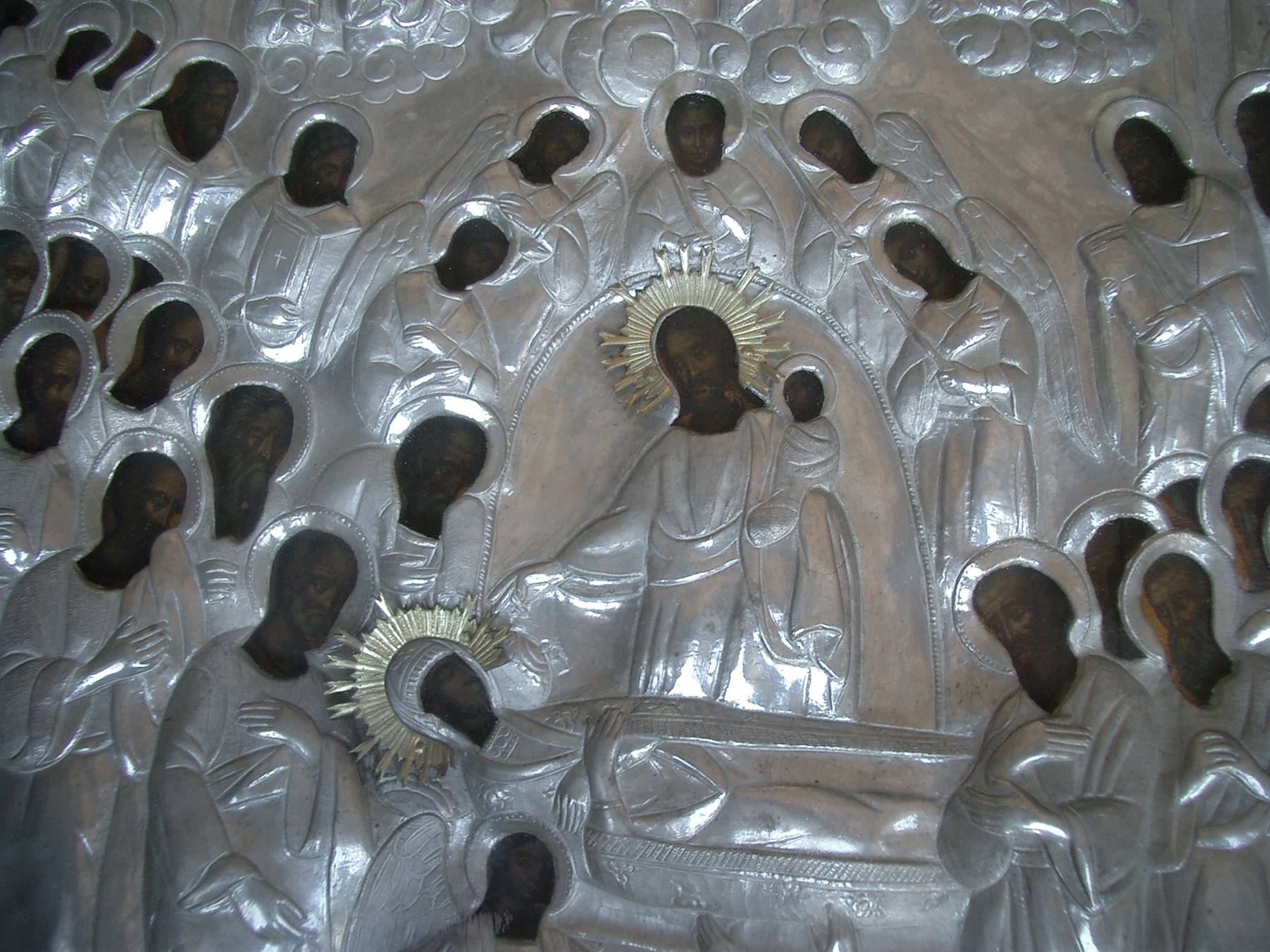
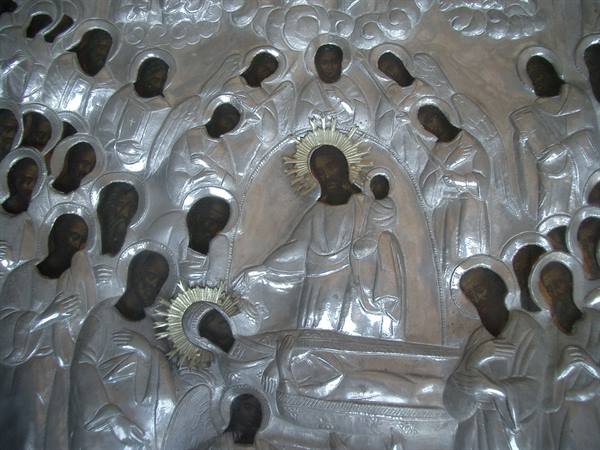
Silver bas-relief of the Assumption, Christ and apostles around the tomb
Day 1325 Jun 2012
June 25, 2012. Kalymnos town-Kalymnos Emborios.
We leave this port satisfied to have satisfied our curiosity about visiting it, but we have not left our soul there. At the beginning of our travels through the seas and coasts of Greece, my daughter and I were enthusiastic about everything we experienced. Every place held the charm of first discovery; flavours, smells, sounds, lights, even those that today seem to us taken for granted, were wrapped, back then, in the charm of what we called Greekness, a jumble of sensations blended with customs and traditions nourished by the humus of history and mythology. Today, after so much experience thanks to our wandering in the Aegean, we are more selective. Our enthusiasm has remained that of back then, but it is kindled only by what appears to us unique and original.
Unchanged in their intensity, on the other hand, are the sensations the boat gives us when she faces the sea, whether calm or rough. A sensation of freedom and exaltation for the promise of conquering the space bounded by the distant horizon, visible or imagined, nevertheless distant even when hidden by the coast of an island. Having rounded the promontory that closes to the west the bay at the bottom of which the little town lies, we meet a well-formed wave even in the presence of scant wind. It accompanies us for a few miles, until the coast bends eastwards and a stretch of sea appears, enclosed and protected by an island that stretches parallel to the coast. Here the sea is calm and the shores host a beach or two and a few hotels with an inviting look.
We would be tempted to stop for a swim, but the pilot guide indicates a quiet mooring further north, almost at the end of this sea channel, itself protected by a small islet. The mooring is called Emborios and the name itself marks it as a place of ancient commerce, but apart from a couple of tavernas and a few buildings with a tourist vocation, there is no village. We moor on one of the buoys placed there by the tavernas and go ashore. On the pebbly shore, in the shade of age-old tamarisks, always present on the shores of the Greek islands, we lie down, abandoning ourselves to the quiet of the place. The boat slowly rotates on the buoy, following the puffs of wind. Marzia and the children are off exploring the surroundings. We slip gently into an afternoon nap. The choice of taverna for dinner is dictated by the buoy to which we are moored.
But we are pleased with our lot because we like it. It is very simple and has only two tables almost on the shore, also placed under two tamarisks. Next to us sits a crew partly Italian and partly French. Likeable people with whom we exchange a few joking words. The children play ball on the road where a travelling greengrocer waits for rare customers. We feel light years away from the problems of everyday life.
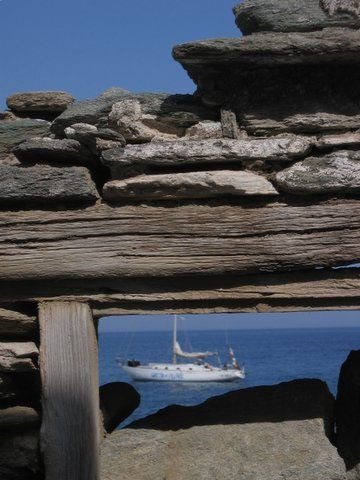
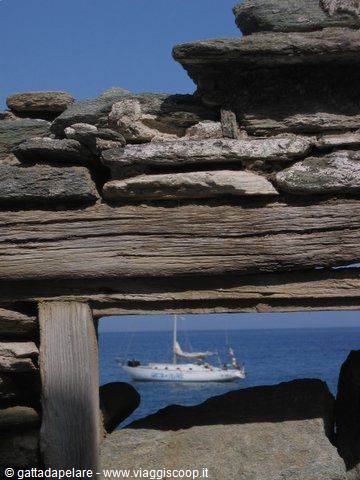
Sailboat framed by weathered stone wall, blue sea in the background
Day 1427 Jun 2012
June 26, 2012. Emborios (Kalymnos)-Lakki Port (Leros). miles
Kalymnos is separated from the island of Leros by a busy strait full of islets and rocks. The passage is possible, but our course, this time, is set to reach the inlet of Lakki Port a few miles on the western side of the island of Leros. The threatened storm has not yet arrived. Its signs are felt in an increase in the swell and the wind which, however, are still contained. They come from the direction where one glimpses, about fifteen miles away, the island of Patmos dominated by the whitening of the Chora, the upper town suspended between the clean blue of the sky and the blue of the sea adorned by the white crest of light mischievous waves. I wish I knew how to adequately express the emotions this sea gives me, but I would need to be a writer-poet better than the writer of ships' logs.
It is there that Gino, the next skipper of Gattadapelare, will leave the boat at Sozon's shipyard, to spend the winter there and complete the unfinished work in Rhodes. The access to the bay of Lakki is dominated on both sides by high cliffs, veritable rock bastions on which one can make out the military remains of gun emplacements defending what was one of the strategic ports of the Italian navy during the last war. Along the coasts, to the right and left, one notices the old and sad military buildings that were the warehouses and barracks. At the bottom of the bay numerous masts betray the seat of a large marina. Further to the left one notices the village which, with the fascist style of its buildings, certainly does not resemble a Greek village. It looks like a settlement of the reclaimed Pontine plain.
We moor at the beginning of the village where there is another marina, a small one this time, a dependency of a larger one based in the north of the island close to the airport. We make arrangements to leave the boat here, watched over, for a week while awaiting the arrival of Gino and his family. The day after tomorrow we will disband this crew. Marzia and the children will go to their beloved Lipsi and we, my wife and I, will return to Kos to catch the plane to Italy. Leros, an island evocative of sad memories of war, merely a technical stopover in our comings and goings around the Dodecanese islands, appears to us today in a different guise. With a hire car we went to the southern end of the island, discovering the existence of a pleasant, well-sheltered inlet and, a little beyond, high cliffs overlooking the splendid strait beyond which, very close, is Kalymnos.
We are in a dominant position and the gaze flies far, as far as the cerulean Turkish coast. The steep slope beneath our feet, arid yet rich in bushy Mediterranean essences, reaches down to the sea. To our left, at the end of the wide bay dominated by the ruins of the castle built by the Knights of St John, lies the small village of Vromolithos. It is an anchorage deserving of a stop. Its little harbour is pleasant, but unfortunately always occupied by small local fishing boats. Another beautiful panorama is offered to us from above the high northern promontory that dominates the entrance to the inlet of Lakki Port. In the presence of so much beauty offered by nature one forgets the dramatic stories that had those same settings in the days following 8 September 1943. The sea beneath us is engaged in the eternal struggle against the cliff.
Its persistence, apparently harmless, has the sigh of eternity. Poseidon does not doubt, as he wanders, the final outcome; slowly the hard stone is consumed under the attack of the waves. In a thousand, ten thousand, a million years they will continue to strike the cliff which, unlike the immutability of the sea, will by then be different, set back, and yet still unconquered. We breathe in, on the wind that slowly strengthens, the power of nature, and we are happy to be here.
We saw a pleasant little taverna on the road we travelled this morning and we go back there for dinner.
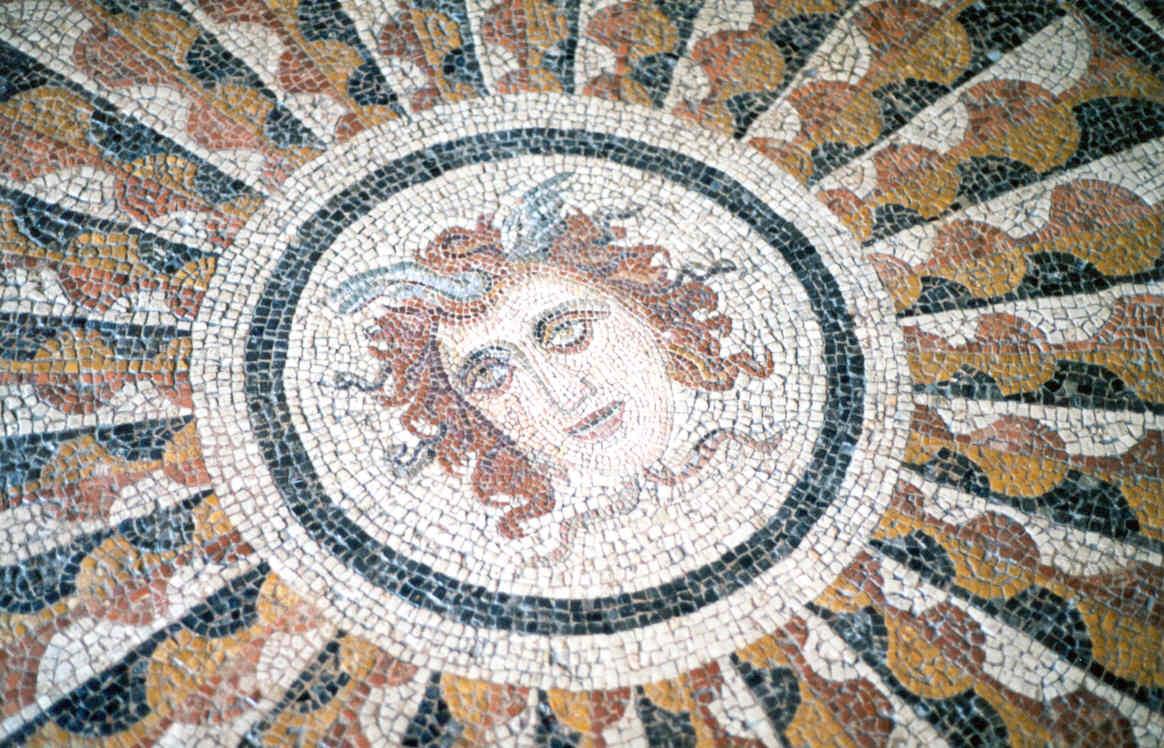
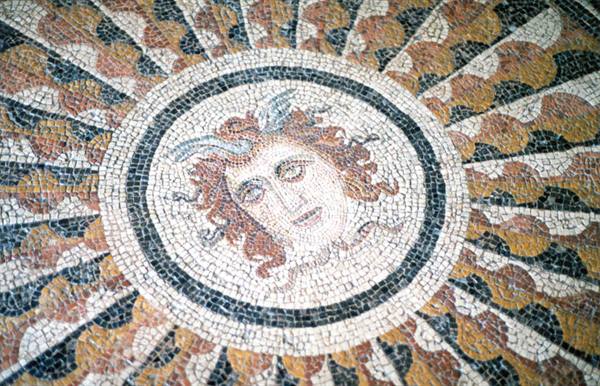
Roman mosaic with Medusa head at center, polychrome marble tesserae
Day 1527 Jun 2012
June 27. Leros In view of the upcoming departure we do not forgo the chance to spend a few hours on a pebbly, narrow beach close to some low buildings. In front of us rises the promontory with its ruined castle and the windmills by now turned into suggestive dwellings. The ubiquitous tamarisks grant us a little shade and witness our picnic lunch. The children play in the water, tireless in feeling wet and salty. The afternoon is dedicated to preparations for the next departure.
June 28, 2012. Leros-Lipsi and Leros-Kos
At 9:00 this crew breaks up. Marzia, Maia and Sebastian take the ferry that will carry them to Lipsi; I and Elke, a little later, hand over the keys of Gattadapelare to a helpful marina keeper who will give them to the next crew: Gino, Maria, Clara and Bruno. A little later we too board to reach Kos, from where tomorrow we will take the plane to Rome.
Roman mosaic with Medusa head at center, polychrome marble tesserae
0 reader comments