Sailing among the Greek islands and the Turkish coast.
Day 129 May 2011
May 29-30-31, June 1-2-3-4-5-6-7 2011 Rhodes.
I am back in Rhodes, together with my wife, eager to set off. We experience the Greek crisis through the demonstrations that sweep through the city. The boat is not ready. Greek timing. The master shipwright to whom I had entrusted the boat last June left the work half done. Too late I entrusted its continuation to another master, a Franco-Italian-Greek. There are an enormous number of things to do and the chances of finishing everything in a week are slim. Irritation and impatience are constantly fueled by ever-new unforeseen problems. We have settled into a hotel where Gerlinde from Vienna joined us and shortly afterwards Gino, followed the next day by Maria, from Brussels. Now the multinational crew is complete, but on land. We alternate visits to the "karnaio" with relaxing mornings by the pool and car trips around the island. The Valley of the Butterflies disappointed us.
At this time of year there are no butterflies. I give instructions that the works to be completed should be only the essential ones to be able to sail safely, forgetting about aesthetics. We will complete them next autumn. Finally after the intervention of electricians, mechanics, refrigeration technicians, carpenters, painters and however many others, on May 8 the launch takes place on a day of good weather and light wind. Gino has sponsored Gattadapelare with a plotter that will show us where the boat is going. Progress advances and the Gatta adapts. In the screw holes and in the surviving trunks of old electrical cables remains the memory of the instruments that have succeeded one another on board, from the radio direction finder to the Loran system, from the portable gps to the current chartplotter. Each new instrument has corresponded to a loss of nautical romanticism.
I felt more of a "sea wolf" when I had to fiddle with instruments to achieve a result, as probably accurate as possible. With the new devices that provide me with abundant and precise information I feel less in control of the situation. In order not to give up entirely the poetry of navigating "by hand", but also out of caution, I nevertheless plot my course the old way, a practice always to be recommended to protect oneself from the tricks of technology. Experience teaches.
June 8, 2011 Rhodes-Gocek. 42 miles We have the ambition, despite everything, to reach Castellorizo, the island made famous by the film Mediterraneo, the southernmost of the Dodecanese islands and of all Greece. The legs long studied at the table should allow us to arrive as far as Kekova, on the Turkish coast, almost opposite Castellorizo. Kekova is one of the most fascinating anchorages made by Gattadapelare a few years ago. I refer its description to the logbook of 2002. The first leg is planned for Kala Kapi, another fascinating Turkish anchorage located in a sheltered inlet on the opposite side of Goecek. There is little wind and we proceed under sail and motor. The mood on board is good. The tension and irritation of recent days is dissolving in the luminous blue of the air and the sea, while the details of the Turkish coast ahead of us take shape as we proceed.
We enter that sort of inland sea, of alpine lake, such as Mugla, the stretch of sea enclosed between the mainland and some barrier islands placed parallel to the coast. Having passed a narrow channel between the islands we turn our bow to the left to reach the anchorage of Kala Kapi. But we realize that the alternator no longer charges the batteries and the repair will be possible only in the port of Goecek, full of caiques and charters and certainly also of skilled technicians. We therefore give up enjoying the serenity of this anchorage that I still remember with pleasure and reverse our course. The mooring possibilities of Goecek are numerous and, guided by memory, I pick the one closest to the area of shops and restaurants. We moor next to a French boat with children on board. The "girls" are pleased with the spot.
There are nice cafes and an uninterrupted series of establishments where tonight we will eat "Turkish".
June 9, 2011. Goecek.
Goecek is a town that lives off crews and charters. The shops of every kind are many, as are the cafes and restaurants. We have an "elegant" breakfast under the palm trees of a bar close to the marina. The French neighbor strikes up a friendship with Gino and Maria. He says he has been at sea for more than a year. He and his wife take turns teaching the two children, especially the older one, following the national school curriculum. The children, about four and six years old, run and play freely and happily on the pier without fear of falling into the water. Nor do the parents worry about them. The French skipper is a precious source of information. He knows the good mechanics and electricians of the place and thanks to him we contact both.
They work well, with competence and speed, so much so that by evening we have the alternator repaired, the electrical system fine-tuned and, finally, the autopilot working. After four years of shifts at the helm we will be able to let it work again. Tomorrow we will beat up against the wind
June 10, 2011 Goecek-Caunus. 40 miles.
We set off at a leisurely pace heading north, along the coast. The wind, light, is on the nose and forces us to also use the engine. We reach the bay of Ekincic after leaving on our right the long white line of the beach that closes the plain formed by the sediment deposited by the Dalyan river. If we had been able to go up the meanders of the river we would have reached the ruins of Caunus, an archaeological site of great fascination, and further on the rock tombs of Kaya Mezarlari. Over the centuries the river has silted up the harbor of the ancient city and filled the bay on which it looked out, so that today the city is more than a kilometer from the coastline. Wind and sea have strengthened, but they cause us no bother. We enter the bay of Ekincic and moor on the right under a rather imposing restaurant.
My Marina has been created, a pleasant anchorage, not large, consisting of a pier and sufficient services. There are only three boats besides ours and the place conveys a pleasant sense of peace. The transparent water invites a dip. We dine on board.
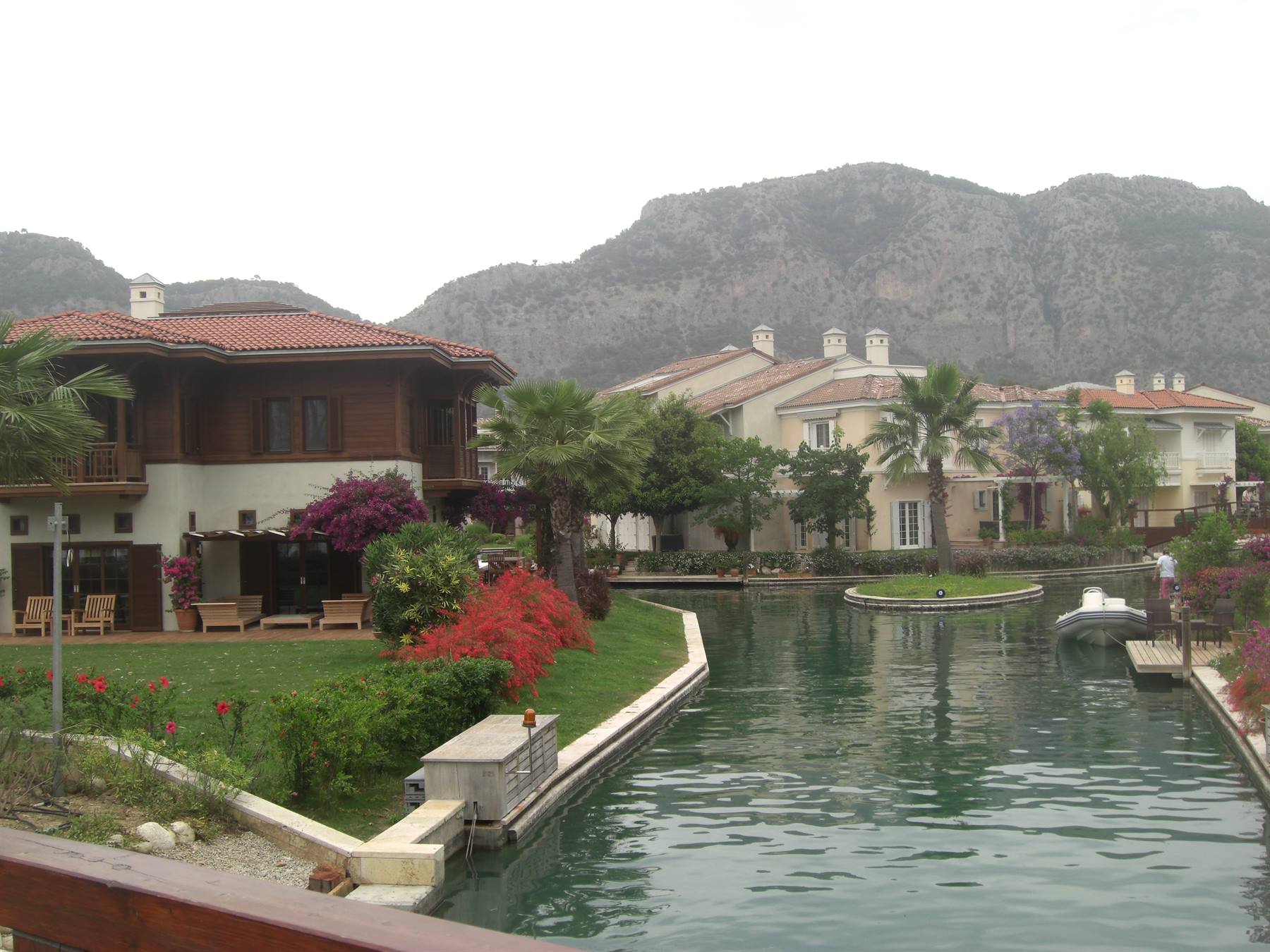
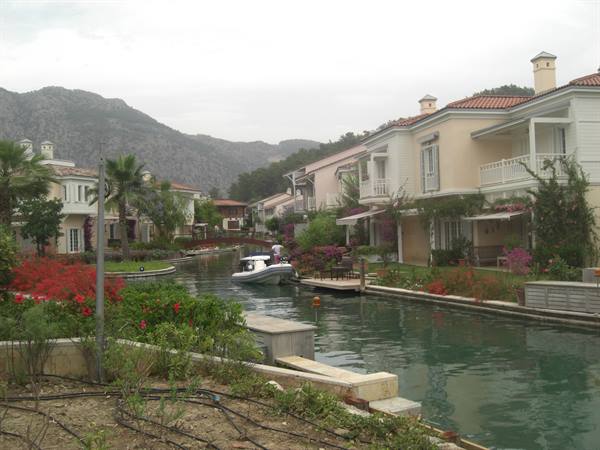
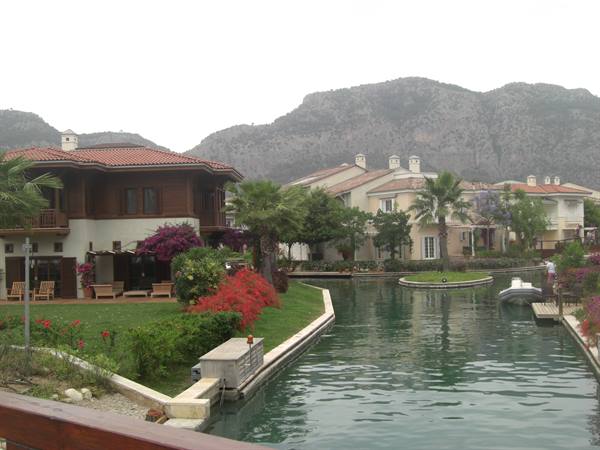
Göcek
Day 229 May 2011
June 11, 2011 Ekincic Bay-Bozuk Bay. 32 miles.
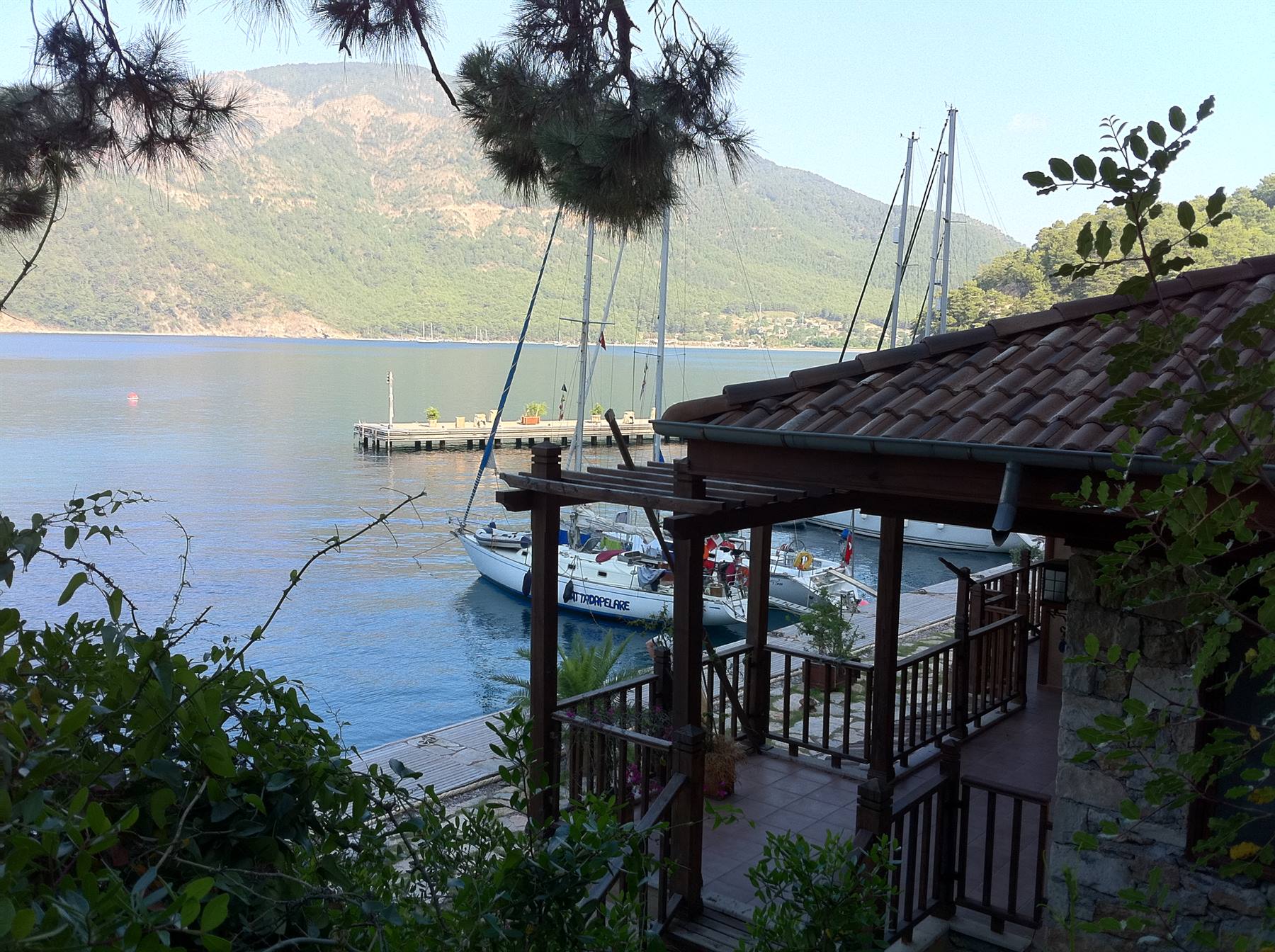
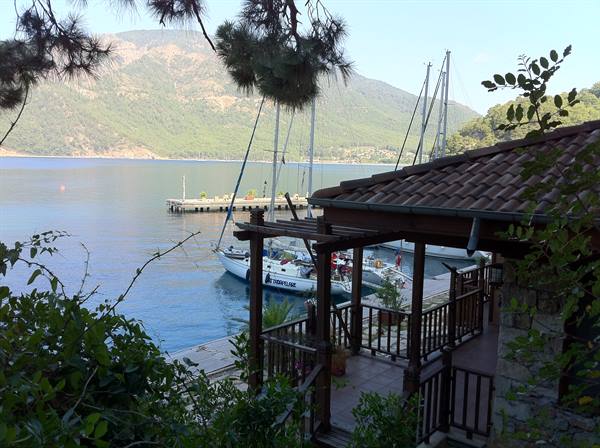
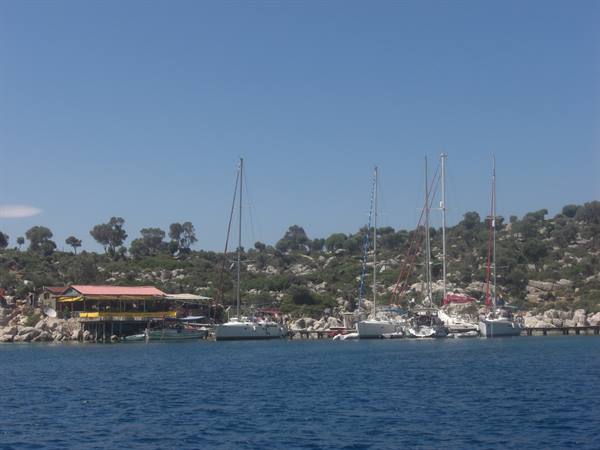
We set off in the late morning to continue west, always along the coast, until we reach Bozuk bay. I know a nice anchorage there where I have already been last year with another crew. We have the wind against us, but it is light and, at first, hinders us little. Today too we go by motor. When we arrive it is late afternoon and the wind is stronger. The entrance to Bozuk bay is dominated, on the left, by the well-preserved remains of an imposing Hellenic fortress. The anchorage, very sheltered, consists of a wooden dock, parallel to the shore, which delimits an inner water where the Turkish tavern keeper keeps, tied with little strings, sea cicadas. We are welcomed by the little barges of the Turkish vendors of towels, t-shirts and shirts, who stand not far away, ready to accost every new arrival. At the root of the dock, a few meters up, there is the tavern called "Ali Baba's".
The structure is extremely simple and pleasant, with a beautiful terrace over the sea. Behind it the hill adorned with sparse wild olives rises up to the walls of the ancient fort. A couple of shacks, reachable by a barely traced stony path, house the showers and the toilet. At the dock there are several boats; among them also two Italian ones. The tavern keeper comes to greet us and ask if we want his bread still hot from the oven and, above all, if later we will come to dinner at his place. The place is pleasant and restful. We also have the fleeting visit of a monk seal exploring Ali Baba's sea cicadas. We dine on the terrace, now windy, together with almost all the other crews. The bill is worthy of the tavern keeper's name.
June 12 Bozuk Bay – Serce Limani –Rhodes. 17 miles.
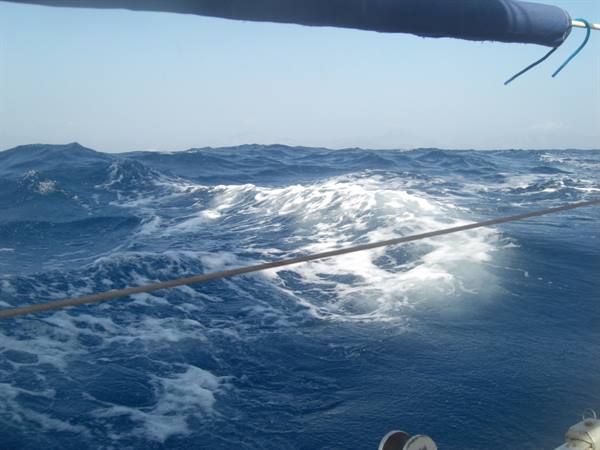
We leave the mooring and head towards the far end of the wide Bozuk bay where the few remains of a Byzantine village stand, then we leave it to reach another narrow inlet, almost a fjord, a mile and a half west. It is a very sheltered inlet, especially in its eastern part, where it is possible to tie up to the mooring buoys positioned by the tavern at its far end. However, we drop anchor on the west side to eat. Shortly afterwards other boats arrive and the place starts to become too crowded, with the risk of unpleasant collisions. The wind, which in the meantime has strengthened, induces us to set off again to reach Rhodes. Once out of Serce Limani (Serce Port) we find rough sea and a stiff beam wind. Oilskins are obligatory because the waves slap the boat raising stinging sprays of water.
For the "girls" this is the first real experience with rough sea which, however, they face with resigned courage tenaciously clinging to the cleats or the winches. Water drips from their hoods and from the sleeves of their oilskins. But, finally, the Gatta runs and devours the few miles that separate the Turkish coast from Rhodes. We tempt fate by entering the port of Mandraki and we are lucky because we find a free spot and take it with great satisfaction. It is not easy to moor here, many boats remain at anchor in the roadsteads further south. The new, large tourist port of Rhodes has been under construction for years and there is no end to the works in sight. Maria and Gino leave. These are the most melancholic moments of our cruises. Memories already make their appearance at the very moment when events make us realize that this crew has concluded its seafaring experience.
Memories will accompany us in the coming months fading and blurring in memory until the reading of this diary will revive them and enrich them with posthumous sensations, decanted from the unpleasantness of some negative moments. The rest of the crew, the "girls", who have stopped being such, and.the writer, dine at the "Meltemi", a nice tavern by the sea
June 13, 2011 Rhodes
Today is again a day of departures. I remain alone until the arrival of Gianfranco (known as Polo). The day passes between work and purchases of various materials for the boat.
June 14, 2011. Rhodes.
More work on the boat. A couple of technicians come for the last adjustments.
June 15, 2011. Rhodes
In the evening Pino arrives, coming from the Americas. He brings along a young Japanese woman who is an expert in Italian things. She speaks correct Italian and stays to eat with Pino while we, already full from a Greek-Italian pizza, keep them company at the table. She is a cultured person and we are amazed at how these Orientals know so many things about Western culture, about our musicians, painters, philosophers, while we know almost nothing about theirs. We part with affection and go to our bunks in our floating pension.
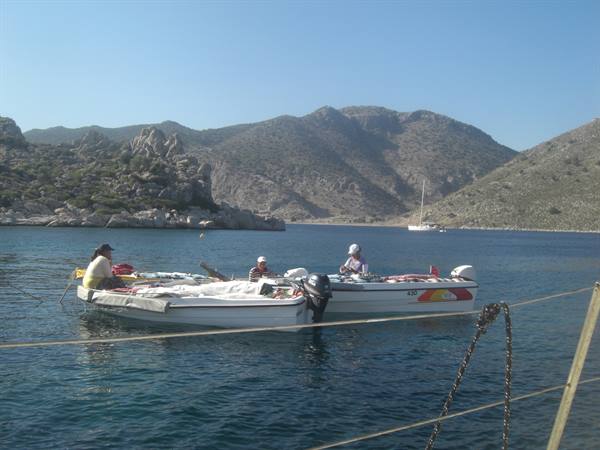
Landing in Encinik bay
Day 329 May 2011
June 17, 2011- Rhodes-Tilos. 41.5 miles.
The new crew, made up of Pino on his fourth experience on Gattadapelare and Gianfranco, wake up intending to reach Tilos about 40 miles to the northwest. In Tilos. there is a tavern where a tasty goat, scented by the smoke of Mediterranean herbs, always turns on the spit. After breakfast, gathered around the table, we plot the course. The plan is to reach then Paros in four legs and then continue to Samos where another crew change will take place. We do the provisioning, not much as by now the experience of many years of boating has taught us. Just enough food for a frugal lunch while sailing, some olives, some bread, a few tomatoes and cheese. Above all lots of water, possibly sparkling,.for me. But the greatest attention goes to buying ice. Not having a working fridge we use it as an icebox. And ouzo without ice is worth half.
The best ice is the "column" type, reserved for fishermen to preserve their catch. because it is more compact and, therefore, longer lasting, but it is not suitable for drinks "on the rock" because it is almost always made with non-drinkable water. The first problem we encounter as soon as we cast off the moorings. The anchor has become "entangled" with something at seven meters depth. After the usual, fruitless, freeing maneuvers there is nothing left but to rely on a diver. Gianfranco, unexpectedly, declares himself capable of diving and working while holding his breath at that depth in not exactly transparent waters and, we suspect, also not very clean. There are many boats in port and the morning hour is that of the use of the on-board "toilets" (properly nautical term for wc, and in this case very appropriate to define the state of purity of the water). He asks only for a wetsuit.
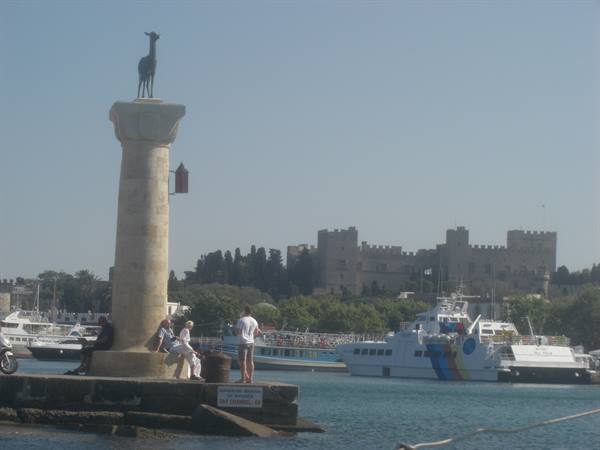
The Gatta, whatever it may be, but is equipped with everything. In fact from the bottom of a locker where it had been resting for at least sixteen years, I pull out the upper part of an anthracite black wetsuit. Zipper now out of use, old-fashioned cut, but still capable of performing its function. After a couple of attempts he manages to free the anchor caught in no fewer than two chain cables. We leave Mandraki, passing between the two columns topped by the symbols of Rhodes, two deer. The columns indicate the points, says the legend, where the feet of the Colossus rested. Once out of the port, after rounding well the eastern tip of Rhodes, dangerous for its shallow bottom, we set course with a calm sea and headwind.
We proceed under sail and motor leaving on our left the islands of Alimia and Halki until we reach, towards dusk, the inlet at the bottom of which stretches the small village of Tilos. The bay is well protected from the winds of the fourth quadrant and the sea inside it is completely calm. In the small port we find no room and several boats are at anchor in front of the beach. Among these we meet again Simone, with whom, one evening, in the bay of Alimia, we exchanged our resources: we gave him some of our gas and they gave us some of their pasta. The next morning we then worked for a long time to free our chains which, because of the turns made by our two boats having remained side by side all night, had become tangled with each other. But tonight the goat is not there. Tomorrow, says the tavern keeper, but tomorrow we will be in Astipalea, blow it.
June 18, 2011 Tilos-Cnidos 28.5 miles
The night passes quietly. Outside the bay we meet the wind, not strong, but contrary. We would intend to reach Astipalea 55 miles to the northwest. We round the. northern tip of Tilos and set our course on the new heading. The sea is rough and we believe that once past the strait between Tilos and an islet further north it will be less hostile. We proceed by motor for a few miles and make, with difficulty, three knots with waves and wind on the nose. The boat suffers, climbs with difficulty and comes down with heavy splashes into the trough of the wave. It would take at least ten hours of motor and suffering to reach the destination and I make a wise decision. I inform my crew that we are changing course and following the wind; the approval is complete and I almost sense the sigh of relief of the cat-sailors already resigned to a heavy day at sea.
I head for Cnidos, on the Turkish coast, an anchorage that I know well and that guarantees a calm mooring and a pleasant tavern, in an interesting historical and archaeological setting. Now we take the wind on the quarter and skim along riding the waves at five-six knots. Gattadapelare is giving us the satisfaction that it had denied us shortly before. The southern bay of Cnidos is well protected from the winds. The landing stage is more the old rickety pier of years ago, now it is new and solid and.less appealing. From here you have the view over the ruins of the ancient and, at the time, famous, city. The amphitheater is the structure closest to the shore. From here the spectators had the view of the commercial port and the ships moored there. Now, after more than twenty-five centuries, other boats occupy the same waters, in a temporal continuity that fascinates me.
There are many sails with numerous flags. Italian boats, which in the past were rare, are nowadays found in every anchorage. But there are also numerous ones flying the German and also Austrian flag, many the French and English ones. There is no longer room at the pier and, despite it still being early afternoon, many sailing ships are at anchor. We have the luck to take the place of a sloop that is leaving and we moor bow-to. We pay a small mooring fee demonstrating that times change and "free" tends more and more to disappear. Even access to the excavations, which was free the first time I was here with my daughter Marzia, is today paid and severely controlled by guards who do not even allow the external approach to the perimeter fence.
An unpleasant sensation that clouds the emotion felt the first time we wandered among the ancient ruins picking up potsherds of no archaeological interest, but rich in the charm transmitted to them of the industriousness of ancient hands. We wander among the remains of Cnidos looking out over cliffs that end in the sea, following vague paths created by the trampling of the rare visitors to this site whose name today is almost unknown to most. The wind moves the dry grasses and the bushes around them tearing from them the scents of the Mediterranean that we breathe together with the deep melancholy of the place. Giacomo Leopardi is my companion in this moment and I am moved as I recite under my breath his "..Sera del dì di festa:….
Or where is the sound of those ancient peoples… the arms and the murmur that went through the earth and the ocean; all is peace and silence and all the world is silent and of them there is no more talk". How inspired by this place the poet's verses seem! We dine on board certain that the new management of the tavern is more expensive than that of the old owner (whom we had nicknamed for his "gothic" Gait Turcoilcolto) which already seemed to us quite steep.
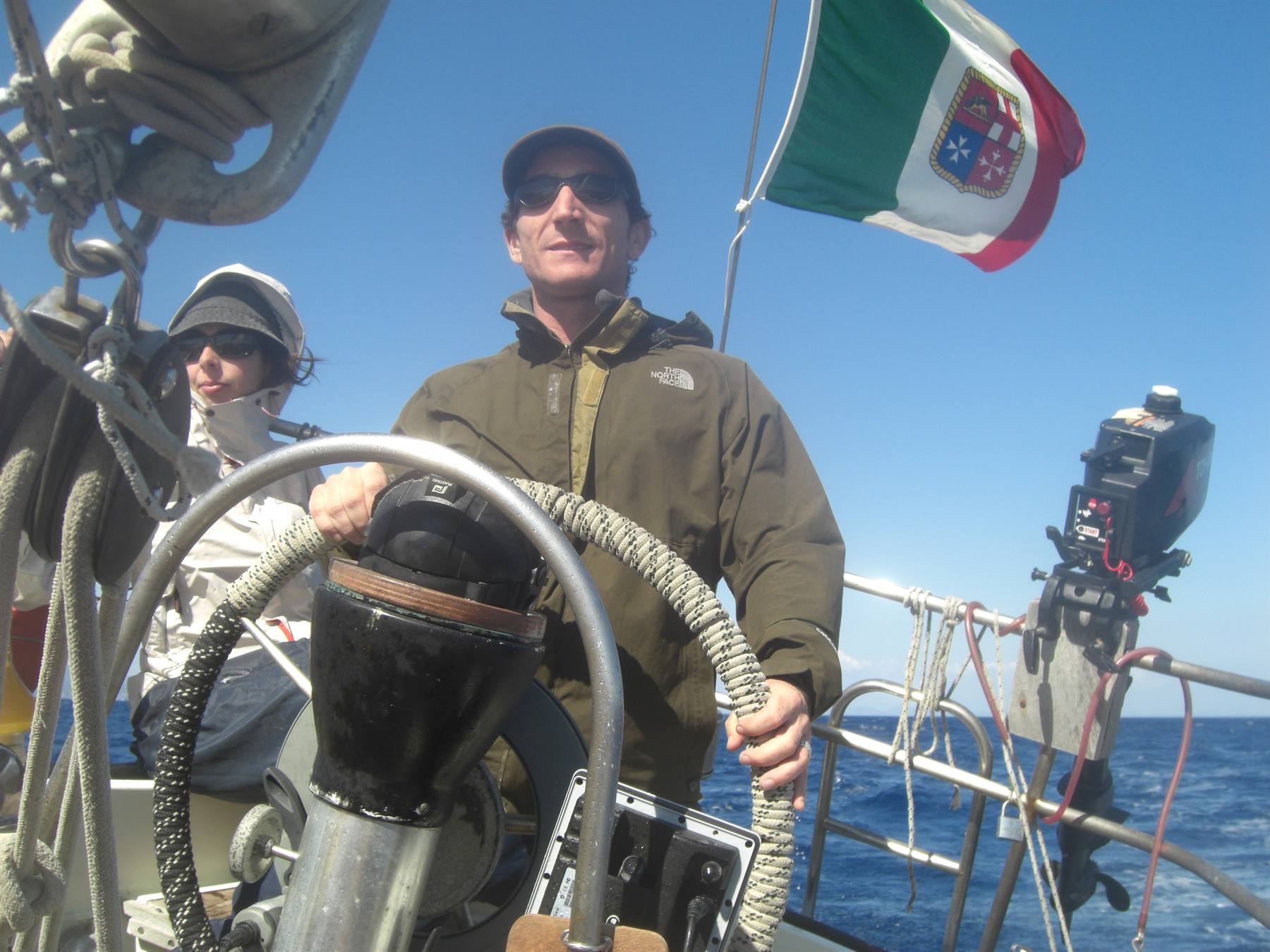
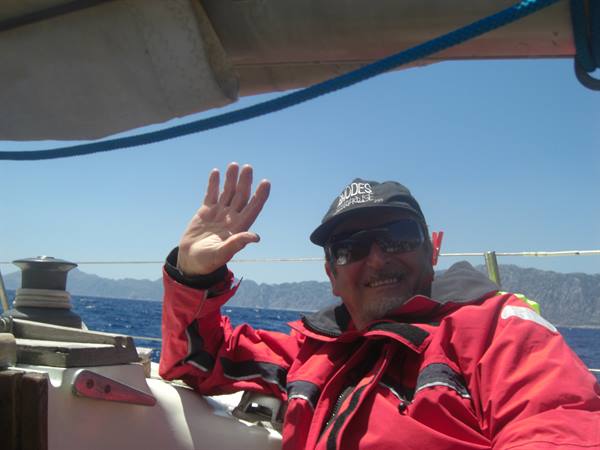
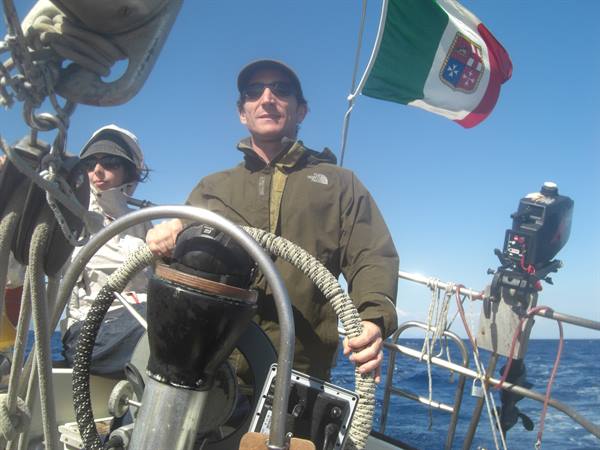
The crew (part)
Day 429 May 2011
June 19, 2011- Cnidos-Bodrum. miles
We set off intending to reach the marina of Kos, but as soon as we pass the high promontory that closes the bay to the west we see that the wind is against us. The beauty of having time to yourself and ahead of the bow is that you can turn it where the wind advises. Pino and I know a pleasant inlet south of Bodrum where we already spent a night two years ago. We therefore head east and skim along light on a not too troublesome sea. But Gattadapelare wants to remind us that its name was not given to it by chance. Once near the coast we furl the jib, turn on the engine and…the gear does not engage. Surprise, dismay and perplexity.
What to do? Dropping anchor off the coast means not having easy access to mechanical assistance; further on there is a boatyard, but it would be impossible to enter the haul-out basin with this sea and this wind, so we must reach Bodrum which is about six miles further north. But we have to beat up under sail along a channel between the mainland and a long island a mile or two from the coast and with the genoa reefed I know I will not be able to point very close to the wind. We spend over two hours with numerous tacks which, at the narrowest points of the channel, advance us only a few hundred meters. Meanwhile I call my friend Gino who is in Brussels so that he makes arrangements with the marina of Bodrum to send us a dinghy to enter the port.
Meanwhile we have reached the mouth of the port and we try to maintain our position and distance by tacking again and again, avoiding boats, caiques and speedboats that enter and leave. From Brussels Gino tells me that the assistance wants our coordinates. After some nervous exchanges of opinions, always mediated by Gino, they understand that we are right in front of the mouth and clearly visible from the service dinghy. Finally the dinghy reaches us and pushes us to the far end of the marina quay. We have, therefore, arrived and we let the tension of these hours dissolve with an abundant shower in the cool bathrooms of the marina of Bodrum. Outside it is very hot. Today is Saturday and until Monday no one works. We look for a mechanic who, having come on board, diagnoses the breakage of the gearbox and "something" irregular with the propeller.
We have her hauled and look for accommodation on land for the night. Bodrum is a lively tourist city with a large port where a multitude of caiques is concentrated and a fully equipped modern marina. On the hill that closes the bay stood one of the "seven wonders of the world" the funerary monument of king Mausolus. Today of the mausoleum remain scanty marble remains and much posthumous fame. At one end of the bay stands the castle of the knights of the Order of the Hospital of St. John of Jerusalem dominating the entrance of the port. A large red flag with the crescent flutters in the wind on the bastion of the castle. We should do the paperwork for the transit-log, a long boring and expensive bureaucratic requirement that is equivalent to a temporary importation of the boat.
As far as I know the Turks give this document great importance, so much so that it would be very complicated to cruise between the Greek islands and the Turkish anchorages having to make entries and exits from Turkey every time. But this time "I forget" to go around the competent offices, also because it is Saturday and I hope to leave Monday, slipping away "English style". In the late afternoon we go looking for a beach that we find south of the castle. This on one side protects a wide bay bordered by a long, albeit narrow, beach where the Bodrumians (will that be how you say it?) go to swim. And indeed there are many of them.
A little further out several boats are at anchor because this body of water is quite protected from the winds of the third and fourth quadrant We dine in one of the countless trattorias that wind along the seafront promenade and retire to the bed-and-breakfast that Pino has discovered near the marina.
June 20, 2011 – Bodrum
Sunday. Muggy heat that makes you not want to leave the coolness of our room. We have breakfast at the small pool that is at the center of the building, built almost like a riad and I go back to my room. While I wait for my companions to return from around the city sitting in front of the air conditioner and with a glass of raki, the Turkish ouzo, in my hand, I read in a magazine the description of the Greek islands. Memory, indifferent to the mournful Turkish dirges that the radio broadcasts, returns to the cruises of the past. The photos in the magazine lead me to resurrect memories buried in the corner of the mind where they are jealously guarded. They, without any order or logic, appear to me in my mind lazily idled in the forced wait of the evening, in this room.
I remember the thud of the waves on the rocks placed to protect the little road that runs along the sea of Mandraki, in Nisyros. We were sitting at a tavern and in front of us a row of octopuses put out to dry exalted the Greekness of the places. Here is the white plain of the crater and the delicious little square of Nikia, a village of few houses placed to dominate a sea on which distant islands trace vague celestine shadows.
The mosaics of the palace of the Grand Master of Rhodes, the Skopelos of the film Mamma mia, the small port of Diafani in Karpathos, the night anchorage at Kekova, in Turkey, summoned by the agitated lights on shore to indicate to us at the pier of which tavern to dock, the luminosity of Patmos seen from the Chora, the solemn temple of Aegina….I don't know how long I remained swimming among the memories, but when I returned to shore time had passed and evening was near. We eat in one of the many taverns that overlook the long seafront of Bodrum and after a stop at an open-air disco-bar with live music, we go to sleep.
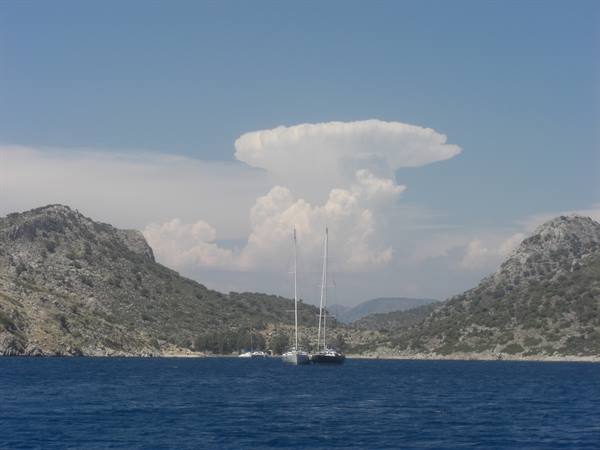
Turkey. The Serçe Limanı cove
Day 529 May 2011
June 21, 2011 Bodrum-Kos. 11 miles
The mechanic has found the part to replace and, finally, we can have the Gatta launched and return to sea. It is too late for a long leg, so we head for Kos where we moor in the marina. This is a beautiful marina, with good services and with a port police station where, after so many years of maximum freedom of action, I was obliged, two years ago, to do some documents, a sort of declaration of the crew members and of intent, and pay twenty-four euros of mooring tax at a crowded office in the center. This time too I am prompted to present the crew list and to have a large sheet stamped on which the entries and departures of Gattadapelare are reported. The whole thing has a formally bureaucratic air without particular regulatory implications. Walk and dinner in the center.
Kos is a beautiful little town, with remarkable Hellenistic and Roman archaeological areas that insinuate themselves among the more recent buildings and with a mixture of architectures that range from the Middle Ages to the Italian occupation, passing through the period of Turkish domination. In some respects it resembles Rhodes very much, with which it has shared the vicissitudes of history. It was the homeland of Hippocrates to whom the city has erected a beautiful monument and preserves a centuries-old plane tree under which, it is said, the great physician taught his art to his contemporaries. Today Kos is a much-loved resort of the Swedes who are seen everywhere riding bicycles.
June 22, 2011 Kos-Pserimos. 12 miles
The idea is to reach Kalimnos on the eastern coast and moor in a solitary bay from which you can reach a tavern located a few hundred meters inland. I know the place for having already spent there, years ago, a night listening to the stories of the owner who was also a sponge fisherman and elementary school teacher. Incredible stories of a poor community on the edge of survival that had lived off the fortune of the sponge fishermen and the lean goats that grazed on the cliffs of the valley Immediately after rounding the eastern tip of the island of Kos the wind conditions make us desist from the planned course. We are forced to bear away and proceed close-hauled towards the islet of Pserimos. I don't know the anchorage which is said to be pleasant and indeed we enter a rather sheltered inlet where we find a place on the left at a short pier among three boats, one of which is Italian.
At the bottom of the inlet a wide sandy beach hosts some taverns and a cluster of houses. The whole gives the sensation of being a quiet corner of island Greece even though it is a daily destination for day-trippers who reach it with the ferries from Kos. But at this hour there is no one left except a few German long-stay tourists. The vision of the elderly village woman bathing in the sea dressed in black repeats itself. Images of a vanished world There is backwash, a sign that outside the sea is rougher. Tomorrow we will have to beat up against the wind and the boat is a bad upwind sailor. As a headsail there is an old genoa which when it is partially furled on the furler forms a pocket in which the wind gets stuck making us heel and preventing us from pointing into the wind. I make the acquaintance of the Italian of the boat next door.
He tells me that outside the wind is at 6-7 on the Beaufort scale and that he in such situations uses the staysail. Following his advice I rig the boat with a staysail stay and mount the storm jib, the only sail I can set on the little stay. Will we look too timid? I ask around if there is a wi-fi connection. They look at me puzzled without understanding.
June 23, 2011- Pserimos-Leros. 24 miles
The Italian left early advising us to go up Kalimnos from the eastern side. Instead, after entering the channel that divides the two islands I decide that I will not follow the advice and we coast along the western part of Kalimnos. The Gatta, rigged this way, proceeds very well, little heeled and fast so that in the full afternoon we enter the wide inlet of Lakki in Leros. The inlet is well protected from all winds and was a naval base of the Italian Navy during the governorship of the Dodecanese and the second war. An excellent anchorage, but a little sad. Of Greekness there is no trace- Machine gun emplacements are seen on the rocks at the entrance of the bay, military sheds and buildings in pure fascist style. It seems to be in the Pontine plain. At the bottom a large marina hosts a great many boats.
We find a place on the left at a free pier, on the edge of another small marina served by a nice cafe and toilet facilities. Although they don't belong to us we use them shamelessly. There is Wi Fi connection and we catch up on the mail waiting online. Without any care we spend the time between restocking the galley and long sessions at the bar fighting the heat.
June 24, 2011 Leros-Lipsi.14 miles
The crew of Gattadapelare has thinned out. We set off to do the few miles that separate Leros from Lipsi, where legend has it that the goddess Calypso lived and which was the sweet prison of Ulysses for seven years. The island is very pleasant and not very crowded, There is no mass tourism because it offers little to the assault tourist. The town is small, well organized, typically island-style with an architecture that already detaches itself from the Dodecanese neoclassical to become already Cycladic. White houses with flat roofs, an imposing and important church dominating the small port. There are no places for nightlife. A couple of small hotels, a pier for tourist boats, some taverns, a fairly well-stocked "supermarket" and a single "modern" bar frequented by holidaymakers who, however, alternate it with a couple of more typical Greek "kafenion".
The stops in Lipsi are always pleasant. The atmosphere you breathe there is that of the serene village, lazy in its Aegean corner, without pretensions. The old Lipsians still speak a rusty Italian from the years learned at school during the Italian governorship. We arrive when there is no convenient place among the other boats, nor do I want to find myself with the anchor entangled as already happened the other times we were here. We therefore moor, bow-to on the head of the pier with a stiff wind, but not problematic because it comes to us from "2 o'clock" and keeps the boat away from the pier. Gianfranco will have to leave us. He has an appointment in Milan. We spend the day quietly waiting to go to dinner at our favorite tavern.
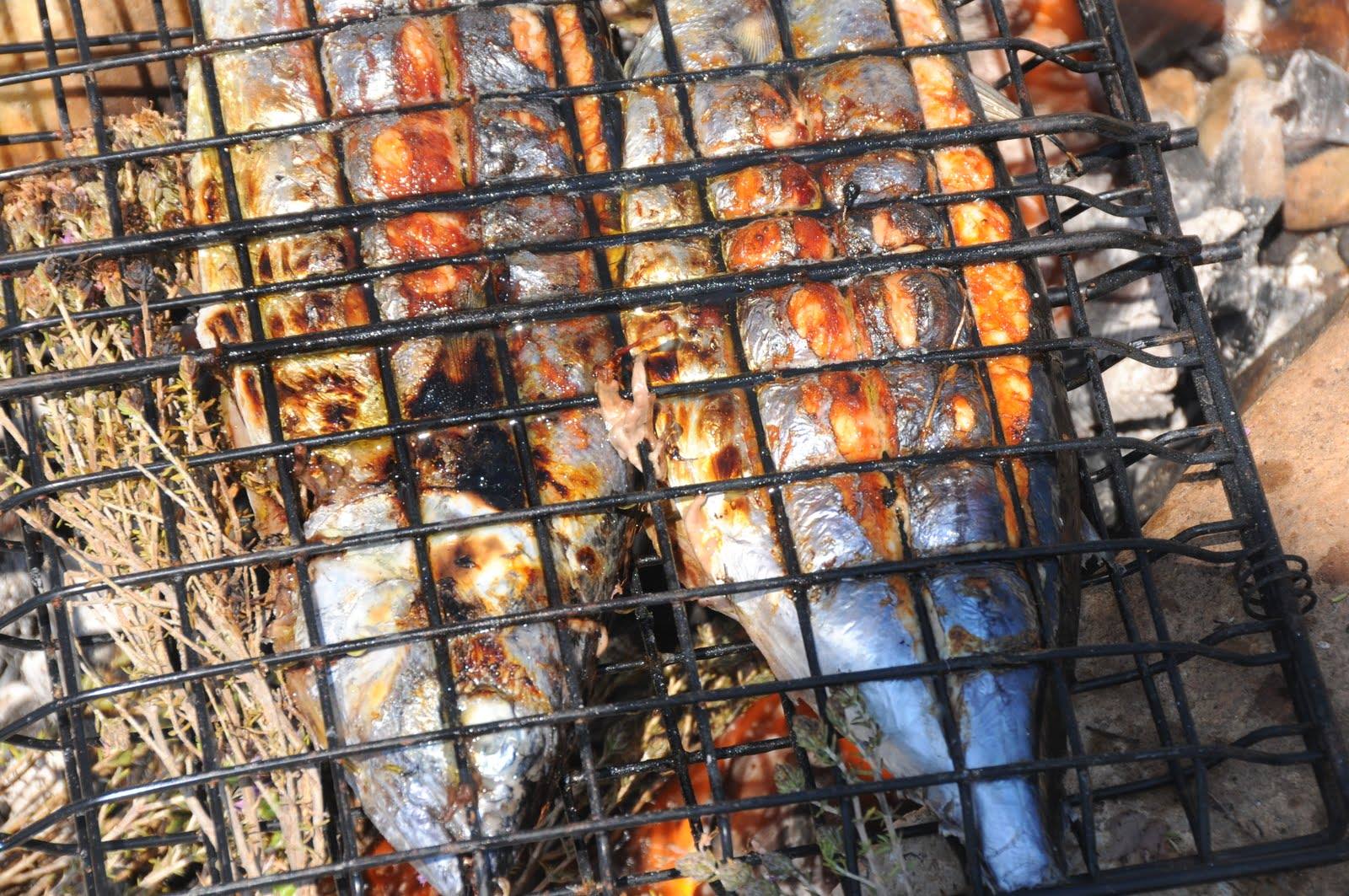
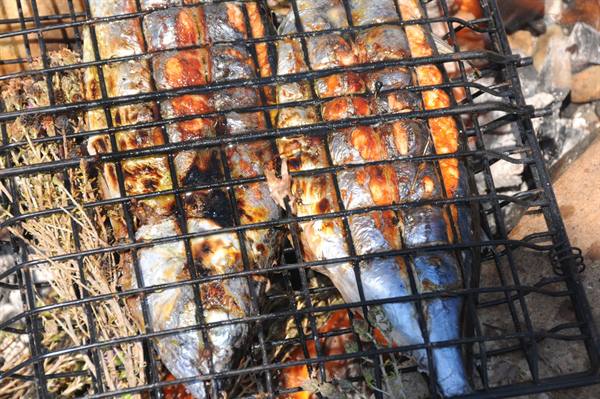
Barbecue of very fresh fish
Day 629 May 2011
June 25, 2011 Lipsi-Marathi 7.5 miles
The forecast gives bad weather with strong northeast winds. But no change in the weather conditions is yet felt. However we want to reach Marathi, our Thule, and we set sail before the wind increases. After a few miles we are in front of the "blue lagoon" of Arki The blue lagoon is so called for the color of its waters due to the presence of banks of very white sand. The coast is formed by marble rocks that are at the origin of the phenomenon. It is a very pleasant place, protected from the prevailing winds and frequented by some boats, which doze at anchor, and by a couple of caiques with the line ashore. The transparency of the water invites delightful swims. Since the wind remains light we stop dropping anchor, at anchor In the early afternoon we cover the last, short, stretch of sea that separates us from Marathi and repeatedly warn Mikalis of our arrival by sounding the horn.
Mikalis, small, thin, pirate-like owner of one of the two taverns of the place invites us, finally, to dock at his little pier, a great privilege reserved only for a chosen few. We have known each other for about ten years and he welcomes us with the usual greetings and joking remarks about the person of Skipper Katastrofìa. On the pier flutters the black flag with skull and crossbones. There are several boats at anchor that reawaken in me the sensation that my Greece of the islands is rapidly changing. This anchorage was little known and every time I return I find more and more boats moored on the mooring buoys made available by the taverns. Italian boats too, which were a rarity, are now more and more present. What was an almost exclusive corner of paradise is fading with the ever more insistent frequency of boats of all flags.
The wind, which in the meantime is increasing, pushes us onto the pier, more and more violently. I put all the fenders on the affected side and add a couple obtained from Mikalis. Even though the wave has no space to form, nevertheless the boat suffers and groans on the fenders. I spend the night half-awake, checking the situation from time to time
June 26, 2011. Marathi
Today the wind has decreased in intensity. Here in Marathi there is no reason for stress. No cars, no little radios, no bathers playing ball on the sand, no shouting children. Everything flows in an abandonment of body and mind that borders on lethargy. The music that spreads softly from the pergola of the tavern is strictly Greek. Lying on the shore, or swaying in the worn hammock tied to two ancient tamarisks, we let our thoughts wander freely in the cloudless sky of this Aegean of ours and of the gods. Bleating of little goats and cock-a-doodle-doo of roosters. Faded awareness that nothing can happen, nothing can come to disturb us Every now and then a boat emerges from behind an islet that closes this stretch of sea to the south and each time we wonder who the occupants will be.
From which country? Will they stop with us or continue? Will they eat at the tavern or stay on board? We ask ourselves, idly, idle questions whose answers do not interest us. This is Marathi.
June 27, 2011 Marathi
We have time to devote ourselves to laziness again today. The crew change will take place in three days in Samos. In the luminosity of this island no longer than a few hundred meters and even less wide, we let ourselves go to the rest of bodies and souls. We visit the tiny church with the blue dome, sentinel of the poor ruins of the primitive village that arose on the watershed ridge of Marathi, still inhabited in the childhood of Mikalis. What remains of those dwellings (calling them houses would be misleading) are massive, low walls made of stones piled dry. They formed small rooms where one could barely stand upright. The remains of some roof show a weave of branches, reeds and seaweed put together to form a sort of protection from the rain guaranteed by a little mortar spread flat on the mattress of dried seaweed.
Narrow passages between the buildings were the streets of the village formed in all by about ten dwellings. It seems to see the remains of a protohistoric settlement. Thus, I imagine, the villages were in the times of Ulysses. Nothing suggests that there has been an evolution in living conditions from those distant times to the moment this village was abandoned. It could be an archaeological site brought to light and then abandoned for lack of funds.
June 28, 2011. Marathi-Samos. 24 miles
We leave Marathi with a light northwest wind, more felt in the channel that separates this island from that of Arki. Outside the channel we bear away to direct the
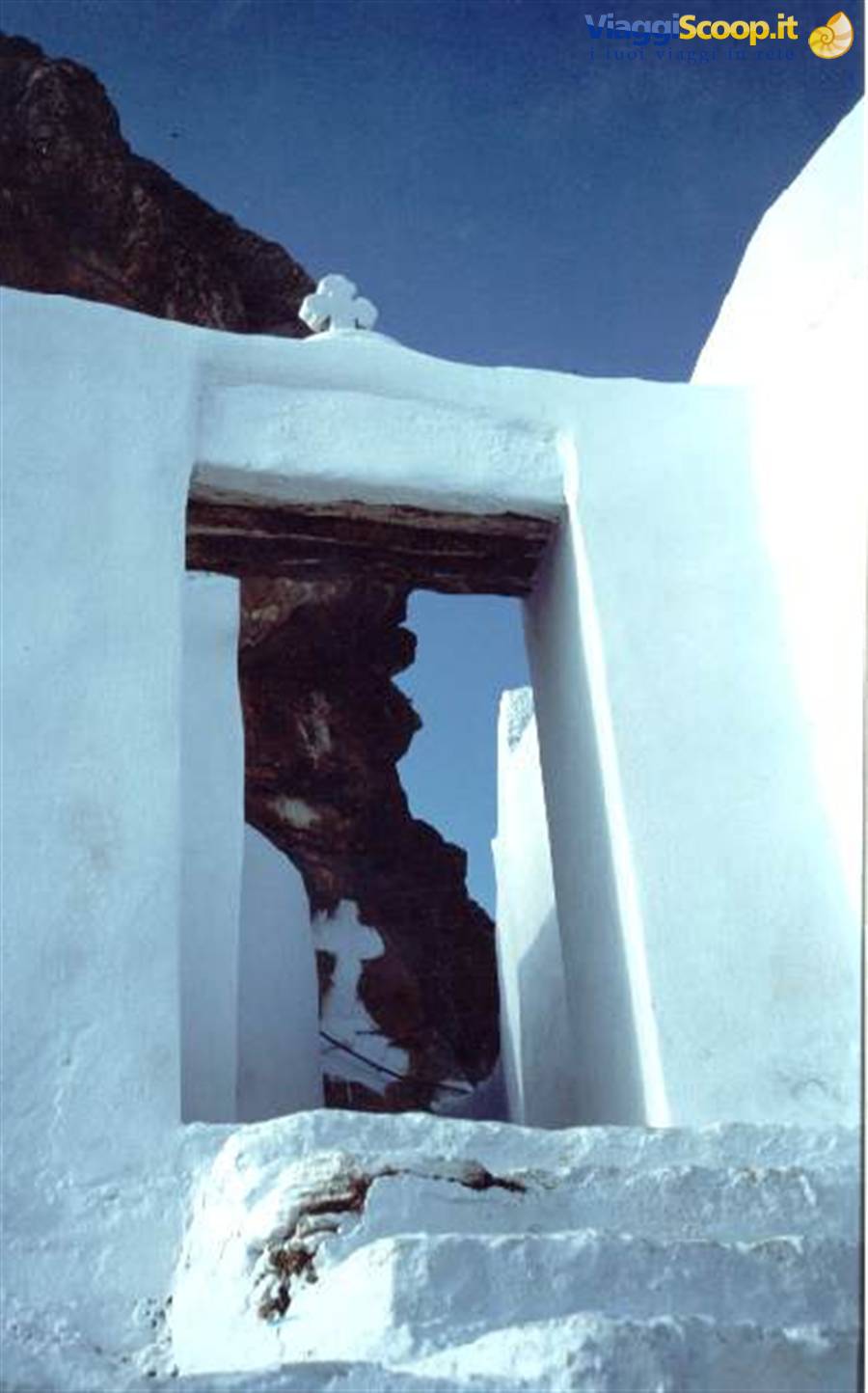
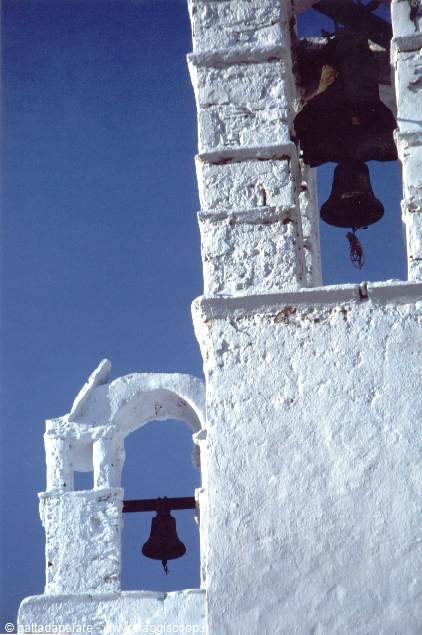
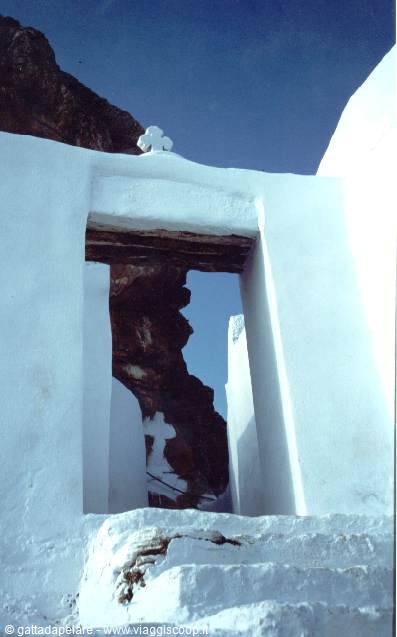
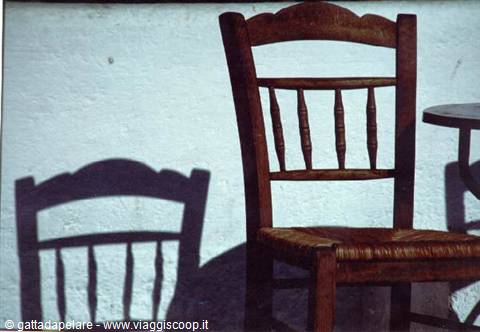
Whitewashed doorway frames dark rock cliff against blue sky
Day 729 May 2011
June 29, 2011 - Samos
Gattadapelare is left without a crew, awaiting the arrival of the next catonauts. I spend the day cleaning on board, preparing bunks and clean linens, and sitting for a long time at the cafe near the boat drinking ouzo and reading the newspaper.
June 30, 2011 Samos.
To break the monotony of the wait come my daughter, the legendary second-in-command of times past, though motherhood has not entirely made her forget that role, and the future hopes of Gattadapelare, Maia and Sebastian, accompanied by their father, a catonaut briefly lent to the sea from his work as an architect. The little ones take over the boat, which they inspect scrupulously and criticize for its aesthetic shortcomings. In fact the deck, which should have been redone in teak-dek, was for this year only badly varnished; the interior furniture, redone but not yet finished, shows various functional flaws. The genoa sheet tracks have been remounted too far forward and don't allow the headsail to be properly trimmed. But the boat goes, and we let it go. Pythagorio has a small but well-organized archaeological museum near the excavations, which we visit in the afternoon.
Later, we go to dinner at the far end of town, where, by the sea, several tavernas line up. A nice little dinner enlivened by local folk tunes sung by the taverna's minstrel. It takes a great love for Greece to manage to find these songs beautiful, which to the uninitiated seem extremely monotonous.
July 1, 2011. Samos-Fourni. 33 miles
The morning with little wind sees Gattadapelare heading toward the Fourni islands. These are a group of islets off Ikaria that I already know and that have only recently timidly opened up to tourism. Between the islet of Samiopoula and Samos I run a serious risk because of my carelessness, due to unfounded self-confidence. The fact is this: instead of consulting the nautical chart, as normal prudence advises, I proceed under motor passing—I notice at the last moment—next to a rock just at the water's surface, not visible earlier because of the calm sea. The rock, unmarked, is rather far from the coast of Samiopoula and is all the more dangerous because it's unexpected. I immediately thought of Piero Ottone's shipwreck off the coast of Morocco for the same reason, and I trembled at the idea of losing my beloved Gattadapelare impaled on a rock in this sea I love so much.
At Fourni town we moor next to an Italian boat that lets us share the berth. We like the town for its simplicity and serenity. A narrow street, lined with trees at whose base geraniums have been lovingly planted, leads, gently uphill, to a small square overlooked by a kafenion and a bakery. Here some tables and chairs painted light blue offer hospitality to the town's elders, who spend entire days there in sporadic conversations interspersed with long pauses. An old woman and then an old man tell me about an ancient king buried in a fine sarcophagus that shows itself at the edge of the little square beneath the canopy of a majestic plane tree. With my rudimentary Greek I struggle to understand everything, but it's enough to know that when the tomb was opened a helmet and a sword were found in it, later taken to the National Museum in Athens.
The old man is eighty-five; his father reached a hundred and five and his grandfather a hundred and fifteen. Could it be the air and the fish of Fourni and the calm, serene life led there that make the inhabitants so long-lived? Along the little street open numerous microscopic "supermarkets" where we do our provisioning. To get a bit of ice I have to ask the taverna where we ate. We dine once again at the usual taverna that faces the street running along the port.
July 2, 2011. Fourni.
This morning a fishmonger arrived at the little square and offered us four big amberjacks for a few euros. We buy them because we intend to go looking by boat for an anchorage to have a barbecue. We set off, then, heading south. After the narrow channel between Fourni and the islet of Thymaina, the coast of Fourni offers some solitary coves protected from the prevailing winds. Today, though, there's no wind, and after a few miles we spot an inviting cove. Having let out the anchor a few dozen meters from shore, we ferry provisions and equipment ashore in several trips and set ourselves up in the shade of the only scrawny little tree, with a table for eating. The place is the best you could dream of in the winter months when, sitting behind the work table, we see raindrops sliding down the windowpane.
A crescent of beach ending in two rocky spurs and with its back to a modest valley rising toward the hill. The seawater is absolutely crystal clear, and Maia and Sebastian claim it with the enthusiasm of a happy childhood. Masters of the tender, they sail around without fears or obstacles. We are all free in body and spirit. This is our Greece, this is our sea! We return to port where we moor once again alongside an Italian boat. The skipper is a grandfather with his three grandchildren, we presume. They warn us to run lines ashore and to climb our boats' masts to keep the spreaders from getting caught in each other. Tonight a large ferry will arrive and moor a few meters from us, at the head of the pier, and will churn up a lot of water during its maneuvers. We have dinner ashore a few meters from the mooring.
July 3, 2011 Fourni-Marathi. 24 miles
Last night I woke at four because of noises and excited voices on the pier. I looked out and found a few meters from me an enormous ferry unloading trucks and passengers. The water beneath our boat was boiling while the lines were stretched to the max. Everyone else on board was sleeping. I filmed it, in the darkness of the night lit by car headlights and the ship's lights, to show my crew when they woke up. The whole thing—disembarking, embarking and departure—lasted a few minutes. Then the ship pulled away in the blaze of its deck lights to vanish on the horizon, which meanwhile was beginning to brighten in the incipient dawn. I went back to my bunk while the pier returned to silence. Today we set off for Marathi. After breakfast we leave the berth, now empty of boats. The others left before us. Again a day of light and little wind. We head south.
Behind us the island of Ikaria stands long and mountainous. I tell the little catonauts the legend of Icarus, but they already know it. Ahead of us, at three o'clock, Patmos can be glimpsed, its Chora—the upper town—gleaming white and visible for miles and miles around. A sort of lighthouse for sailors among these islands. We soon arrive in the Arki archipelago and stop for a swim in the Blue Lagoon. Once again the loveliness of this anchorage fills the soul with peace and gratitude for this opportunity that life has given us. Once again the little guests row happily in the sky-blue sea, free to move away from the Gatta as they please. Toward late afternoon we weigh anchor and head for Marathi. It's a few minutes from the lagoon, and on our arrival we are once again hosted at Mikalis's pier.
Sebastian and Maia are thrilled at the sight of the piratical character whom we describe as now at rest after a life of boardings and adventures. The flag of the Brethren of the Coast waves merrily and the taverna awaits us for an ouzo and good music.
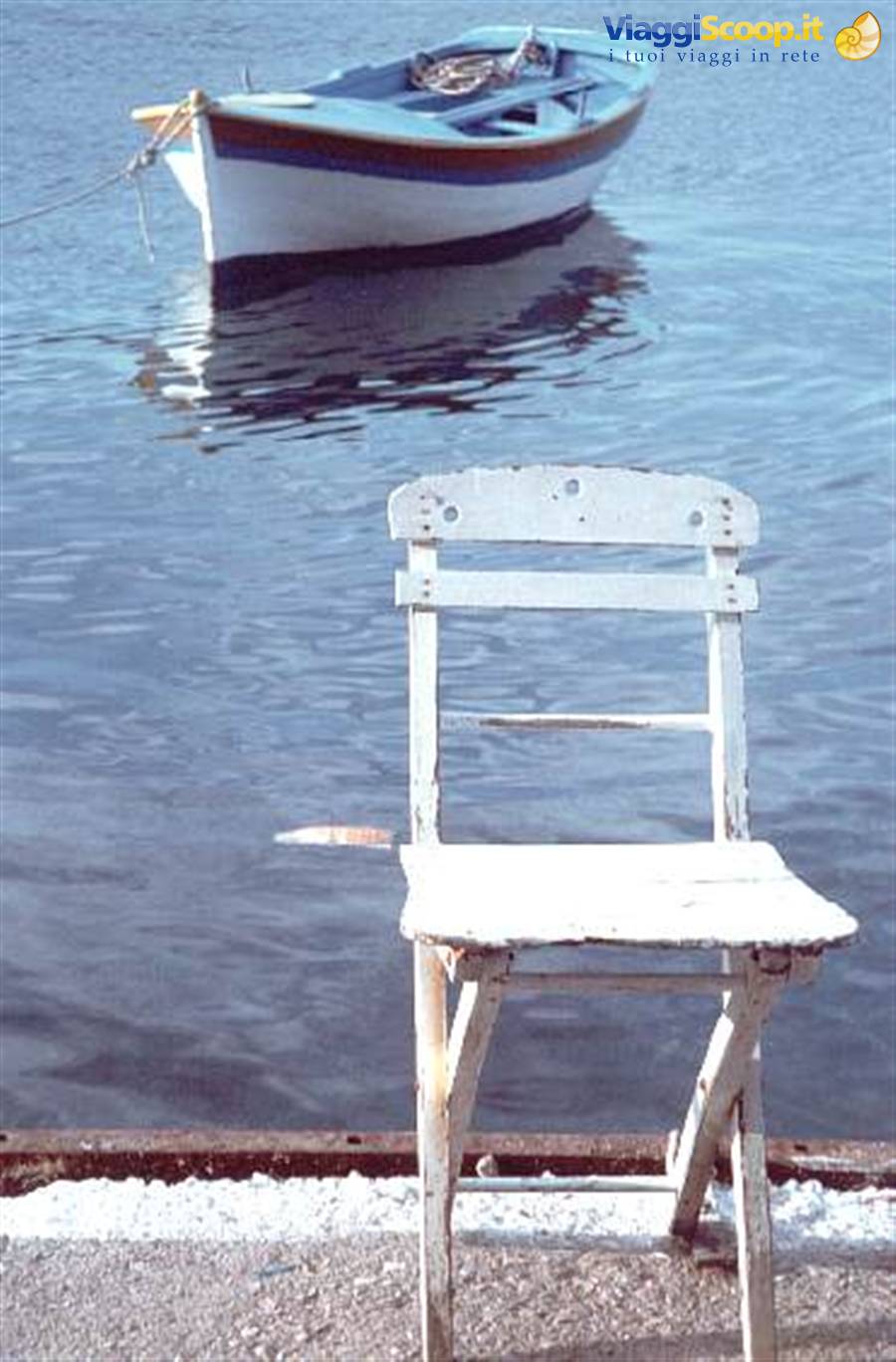
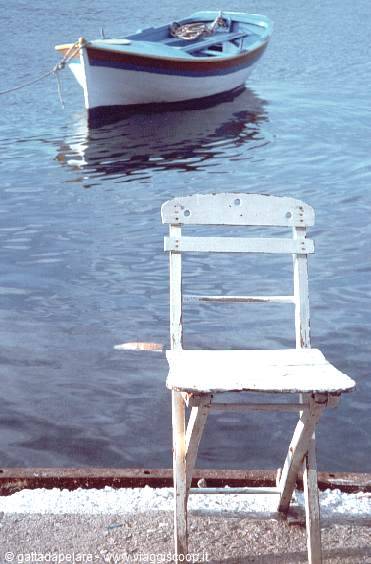
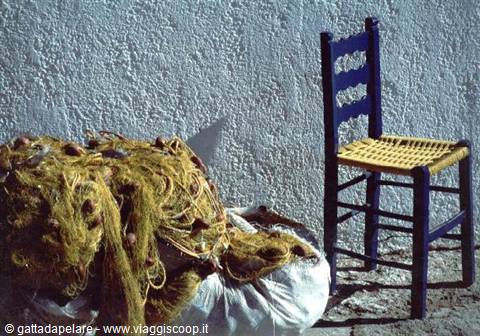
Weathered white chair on a dock, blue rowboat moored on calm water behind
Day 829 May 2011
July 4, 2011 Marathi.
There's not much to tell about the days spent at this anchorage. They pass slowly and pleasantly in the suspension of every care. All problems are postponed until later, to the end of our journey in the sea of Ellada, to our return to Italy. We swim, rest, watch the children play and... don't think. Rest for the soul as well as the body.
July 5, 2011 Marathi-Patmos 10 miles.
Today Marcus, Isabella and the other grandchildren, Mattias and Karola, arrive for their first experience on Gattadapelare. They'll arrive late in the evening at Patmos and we'll go meet them there to take them on board tomorrow. There's a bit of breeze today and we finally sail. Patmos is ahead of us. Legend says the island sank into the sea and Artemis, with Apollo's help, managed to convince Zeus to bring it back to the surface. Too beautiful to be left submerged. Its history is tormented: Peoples of the Sea, Greeks, Romans, Venetians, Turks, Russians, Italians, Germans, all have enjoyed this island with its richly indented coastline. All except the Roman prisoners, who used it as a land of exile. St. John himself was a guest there, against his will, to the point of having had the vision of the Apocalypse. But Patmos has nothing apocalyptic about it.
Quiet and harmonious, it sees only pious tourism of pilgrims visiting the cave where John lived and wrote. We find an excellent mooring at the back of the bay where, with a bit of maneuvering, we settle ourselves Mediterranean-style. In front of us a small, pleasant hotel will host the relatives tonight. Their arrival is expected late in the evening. Shortly before midnight the ship from Piraeus arrives. Mattias and Karola are super excited. Finally they too will sail. But getting to know the legendary Gattadapelare is postponed to tomorrow morning. For now, on board, everyone is already asleep.
July 6, 2011 - Patmos-Marathi 10 miles.
Here they are! They come aboard with the enthusiasm and curiosity of children on their first experience. The little cousins, Maia and Sebastian, outdo themselves with explanations and information about how this and that works. They feel important because they are, by now, old (so to speak) sea wolves. We leave Patmos to return to Marathi in the late morning. We have the wind on the beam to port and a long swell. I have everyone put on their foul-weather gear because I fear some spray on board. We proceed like this for a few miles, and moving away from the island, seeing that the sea has calmed, I give permission to take off the foul-weather gear. That's the moment when a rogue wave breaks against the side and soaks us thoroughly amid the joyful shouts of the young crew, ecstatic at the event. Trust in the skipper, however, suffers a significant drop.
When we moor again at the pier, the newcomers bask in the pirate flag waving merrily at the base of the pier and in the figure of Mikalis, the local Jack Sparrow. The kids resume their boardings of the enemy tender and we resume our tried-and-true island habits, letting time flow over us, keeping ourselves outside the cares of the world. Night falls. The little ones sleep on the boat with Opi, the grandfather skipper, while all the parents have found shelter at the inn of Mikalis's brother, Dimitri.
July 7, 2011 Marathi-Lipsi 5 miles-
Today we leave our beloved little island to reach Lipsi, the penultimate stop of this cruise. Lipsi was, between the third and first century BC, a fairly wealthy island. Of its distant past we don't have much evidence. It was probably inhabited already in antiquity by peoples from Asia Minor and by the Dorians. Christians arrived early at Lipsi; there are many churches on the island, one of which dates from the eighth century AD. During the Middle Ages it was tormented by pirates. It belonged to the monastery of Patmos for almost 600 years. After that it was occupied by the Turks in the sixteenth century, though they never really settled here. When the War of Independence broke out in 1821, Lipsi became an important refuge for people fleeing the wrath of the Turks, and many warships stopped here for repairs, organization and supplies.
The island was given to the Turks in 1830, and in 1912 the Italians took charge of it. (from History of Lipsi) Of Calypso and Ulysses history is silent, but legend hovers there. We have light wind from astern. A pleasant crossing and we land at the head of the pier where, even if wind picked up, it would still keep us off. The leeward side of the pier is completely taken up by sailboats. I spend a lot of time sitting at the Calipso cafe reading, using the notebook and sipping the usual ouzo. I haven't said much about this drink so widely consumed in Greece and Turkey (where it goes by the name raki, sweeter and more aromatic than its Greek brother). Ouzo is an anise liqueur that became widespread, especially in France under the name pernod, in the late sixties. It should be diluted with ice-cold water or "lightened" only with the addition of ice.
All over Greece there are ouzeries, tavernas that serve mezedakia, snacks, and ouzo; each mezedakia a small glass of the liqueur. The more you eat, the merrier you get. In my opinion it should only be drunk here. Like retsina, the resinated wine that vaguely tastes of turpentine. Both of these drinks feel very much like "diakopes stin Ellada," holidays in Greece, but they're not very tasty elsewhere. Marzia and her family have rented a house for the coming days and everyone moves there to spend the night.
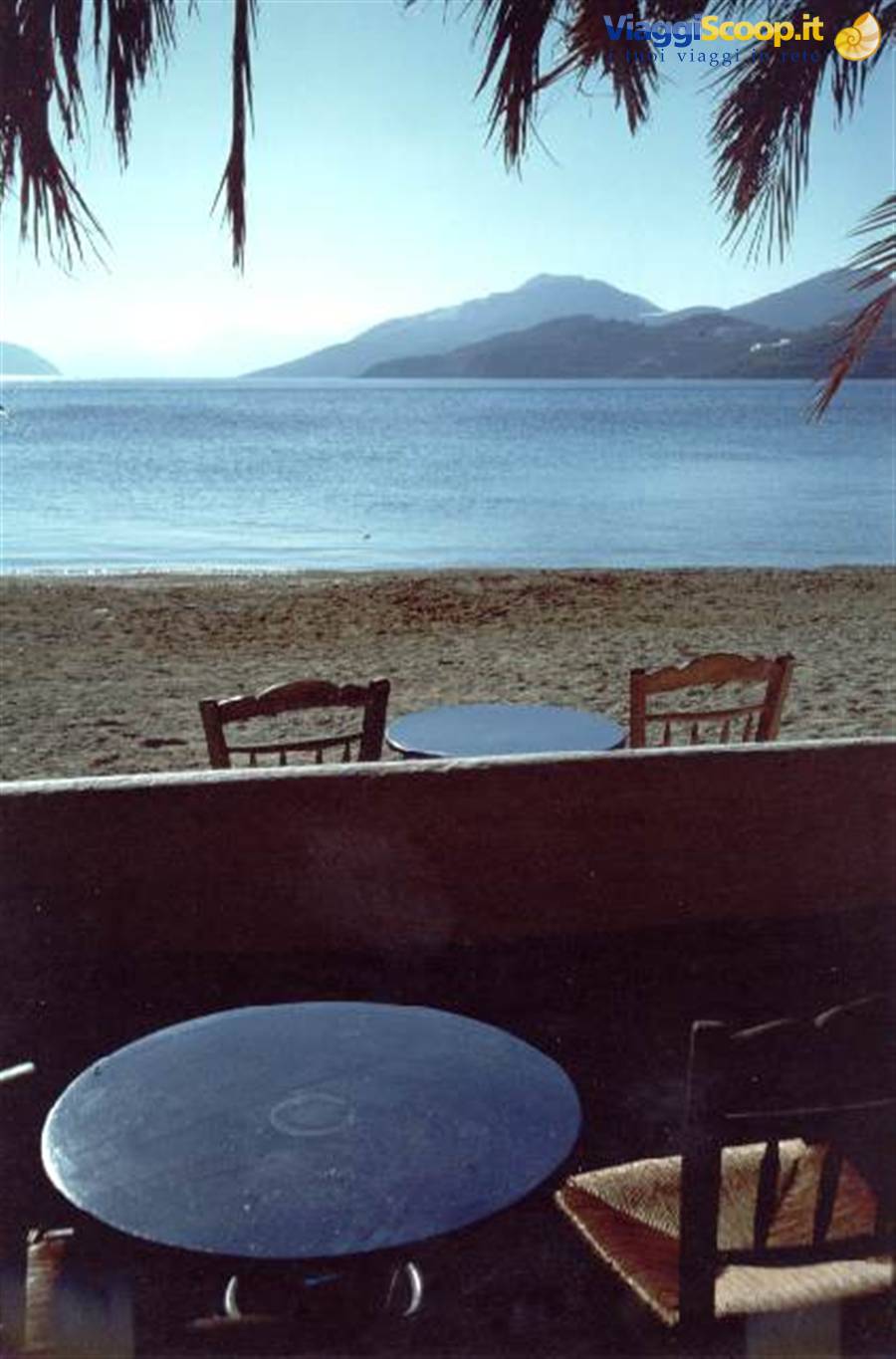
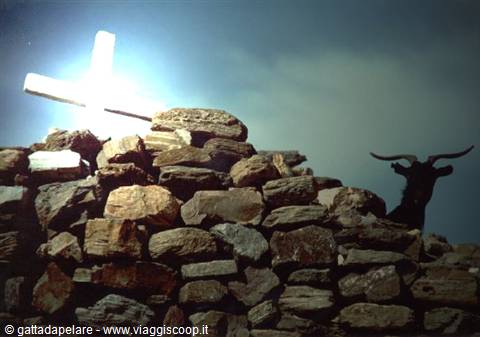
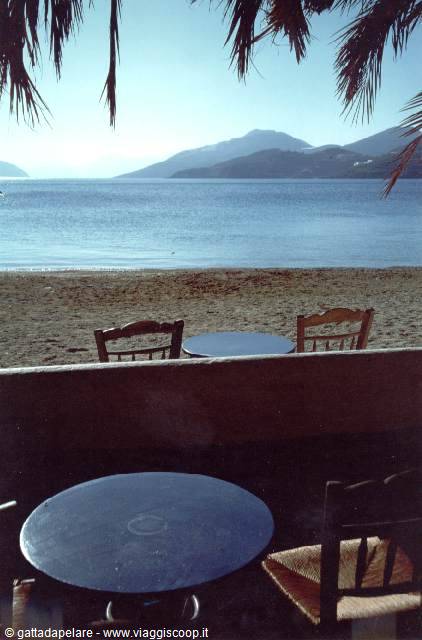
Empty wooden tables by the beach, blue sea and mountains across the bay
Day 929 May 2011
July 8, 2011 - Lipsi-
We spend the day at Platis Gialos beach, crowded with foreign and local bathers. The beach is small, narrow and sandy. The water, transparent and pale blue, is shallow for many meters offshore and invites repeated swims. A colony of ducks wanders among the bathers in hopeful expectation of food offerings. There's a pleasant taverna situated higher up than the beach. You return to town with the public minibus. And we have dinner at the rustic taverna at the port where we're regular guests every time we land on this sweet island. Opi and the kids sleep on the boat, like true sailors. - July 9, 2011. Lipsi-Leros.- 11.7 miles-
Last stop. We take the Gatta to Leros where tomorrow it will be handed over to Gino and his family to continue plowing the Aegean waves. There are three of us left to make this transfer: me, Marcus and Mattias, by now a seasoned catonaut. Isabella and Karola will join us tomorrow by ferry. The others stay to enjoy Lipsi a little longer. In the bay the wind is fresh and we set off with the genoa not properly furled on the roller furler, which immediately creates some problems for us as we head out to sea. In fact, when the tack changes, it partially opens and flaps violently in the face of the bowman, who tries to lash it as best he can around the forestay. The problem is solved by putting the stern to the wind and advancing at its same speed.
We reach the bay of Lakki in a little over three hours and moor very well in the spot reserved for the coast guard boat, from which we're chased away shortly afterward. A shame, because there was also the water tap there! Sitting at the marina bar we spend the time reading on the iPad about the tragic events that took place on this island after September 8, 1943. We see the places around us change, as the reading proceeds, into gloomy spots where the cruelty of the fighting could not have imagined the carefree, vacationing present of the tourists whose languages, the same terrible languages of back then, intertwine peacefully and amicably around our table. We begin preparing the boat for the new crew.
The end of vacations is always a moment when different and conflicting feelings mix to create a state of anticipation for departure, of regret for the end of the carefree period, of listlessness in the immediate action. Over everything hovers menacingly the awareness that the issues left pending await us, along with new ones we don't know but know are surely there.
July 10, 2011.
I leave the boat early in the morning to reach the small airport of Leros by taxi. Mattias, in his sleep, murmurs, perhaps, a goodbye. I leave him and his dad to prepare Gattadapelare for the crew that will follow in the afternoon. Later they'll be joined by Isabella and Karola arriving from Lipsi by catamaran, and everyone will board for Rome. Thus ends this latest cruise of Gattadapelare in the Aegean, in this sea of hers and ours that has played such a part in our lives, ever since, sixteen years ago, we began discovering the charm of its islands steeped in history and mythology, humanity and folklore. As long as the boat goes, we'll still be with her up and down the islands and coasts of the sea of the gods.
Cruise 2011. Miles 410
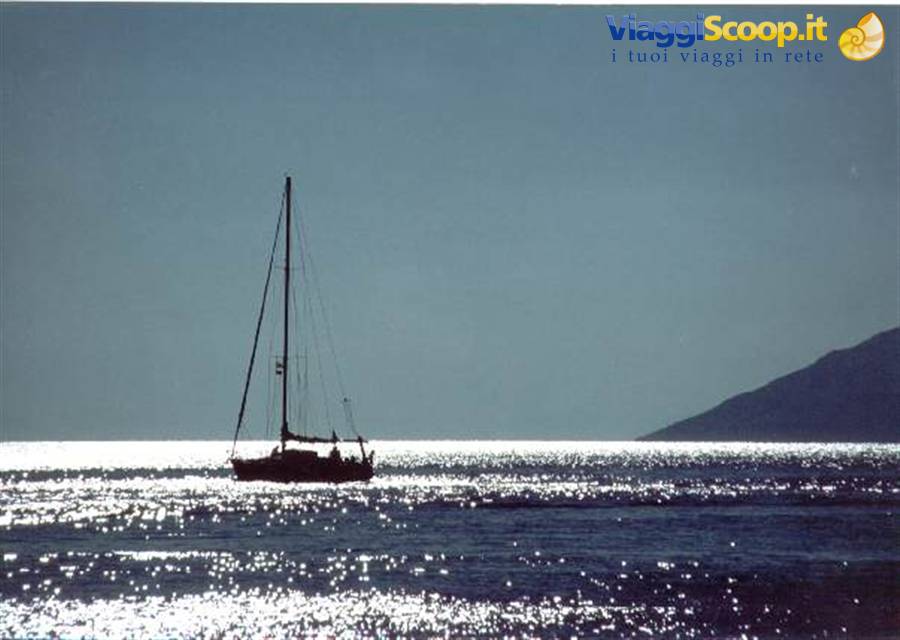
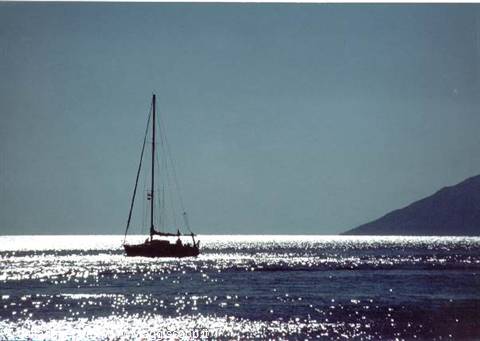
Sailboat silhouetted on sparkling sea, dark mountain on the horizon
0 reader comments