Sailing from the coasts of Anatolia to the Greek islands
Day 122 May 2002
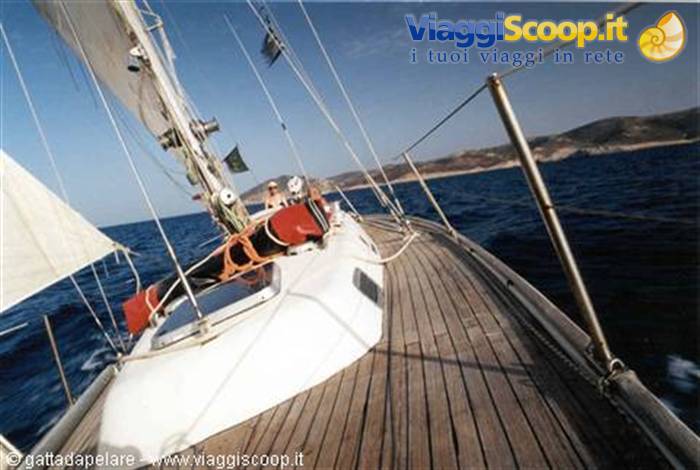
I arrived on May 22, 2002 in Antalya via Istanbul to prepare Gattadapelare which has been sitting here for a year. The political events of last autumn and the winds of war discouraged the crew I had gathered. I expect several problems to get the boat back into sailing condition. I agreed with my friend Erdal that he would get me a worker to go up the mast to check the arrival of the shrouds and stays. The engine also appears stuck and I have to call in the mechanic. Nothing serious. The batteries need recharging. I replace the bilge pump with a new one I brought from Rome. I grease, unblock, check, varnish, put a new gasket on the toilet bowl, close again the hole made in the keel a year ago to dry it thoroughly. And finally launch. It is the 25th. Tomorrow Marzia and Gino arrive on the same plane from Istanbul.
The weather has been good, but the wind, rather stiff, always comes from the east. It is the direction we must take for the first leg of our journey: Finike.
Sunday - May 26, 2002 Antalya- I go to pick up the crew at the airport with a rental car. We are all in a good mood and we immediately go to the old city to have dinner in a restaurant on the crusader port. Everything is propitious, the food, the view, the moon, the company. Among the range of offers presented to Marzia for the next day she chooses to visit the ruins of Thermessos. Excellent choice. The place is high up and cool and we expect a restful day before starting the first leg of 50 miles. We go to the Marina to sleep.
Monday May 27, Thermessos. We set off unhurriedly to cover the few kilometers that separate Antalya from the Taurus mountains. We stop at the modest trattoria that saw us a year ago together with the "girls" and order along with the food a good bottle of chilled Ciancaia wine. Marzia in Turkey drinks only Ciancaia! Going up the hairpin bends that take us up to Thelmessos we feel the signs of a post-lunch drowsiness that we cannot ignore, so once we arrive on the plateau, at the base of the ruins of the ancient city, among very interesting monumental tombs sheltering the eternal sleep of ancient personages, we settle for a modest, temporary nap caressed by the cool breeze descending from above.
The theater, well preserved, can be reached with effort by climbing a path in the woods. But it is worth it. We are alone in the light wind and before us the wall of red limestone rock of the mountain recalls the colors and shapes of the Fedriadi rocks of Delphi. Sitting on the ancient stones we let ourselves be carried away by the sensations and we sense the presence of spectators with whom we share, in a harmony of timeless emotions, the same scenery.
We have dinner in Antalya and reach Gattadapelare, with which we will begin the new adventure tomorrow.
Tuesday May 28 - Antalya-Cavus Limani 40 miles We set off with a light breeze intending to reach Finike, 60 miles east of Antalya, but we immediately realize that it will be difficult to get there. The wind becomes stiff and contrary and offshore the waves are annoying. We make several tacks approaching the coast time after time where we are more protected from the sea, but we can only proceed under engine. We set off, contrary to our intentions, in the late morning and evening catches up with us while we are still far from our destination. Moreover we have consumed more diesel than expected and due to underestimating the sailing conditions I did not fill up in Antalya. We absolutely must find a shelter before dark. The pilot book indicates a possible anchorage in a wide inlet at Cape Cavus.
It proves more pleasant and welcoming than expected and we spend a quiet evening at the table of a small restaurant on the long sandy beach. The waiter promises us a can of agricultural diesel.
Wednesday May 29. Cavus Limani - Finike 20 miles. We set off early with good weather and a light breeze, but contrary. After a few miles a Turkish coast guard vessel sends us back because of military exercises in the area. Clearance after 14.00. We return reluctantly because we were counting on stopping in Finike only to refuel and continue to Kekova, making up for the lost day. An Irish boat, initially mistaken for Italian because of the white-red-and-green flag, follows the same fate as us. We thus find ourselves in front of the long beach with the backdrop of the Taurus mountains still partly white with snow. Swims and small maintenance jobs with which to while away the wait and then we set off again. Now the wind is stronger and yesterday's experience repeats itself with the added problem that the eyelet of the jib sheet tears and we have to lower it with difficulty.
The upper roller of the furler comes out of the groove and risks ruining it. The overnight stay in Finike is now obligatory. The Marina is for the inhabitants of this small town a meeting point where in the evening they come for a walk or to get an ice cream. Some venues liven up the nightlife, otherwise absent in the rest of the city. A long seafront and the public gardens with attempts at artistic decoration betray the intention of the administrators to make Finike a modern and touristy little town. But not much tourism is seen in this season.
Thursday May 30. Finike-Kekova. 15 miles
We are told about a sailmaker not far from the Marina and with Gino, laboriously, we carry the genoa to be repaired there. It is run by a German and his companions (we get the impression that they lead a "complex" ménage) who moved here many years ago. He promises to do the repair by late morning. We are almost resigned to leaving tomorrow for Kekova. Gino is harnessed, tied, hooked and sent up the mast to repair the furler roller. At 18:20 Gino proposes to set off anyway. The weather conditions are good; there is no sea and the light wind allows us to help the engine with a close-hauled course. Evening descends gently while before us opens the stretch of sea that welcomes our next landfall. Some lights come on along the coast and its profile stands out ever darker against the luminescent water.
..and the boat sails on.
Day 222 May 2002
Kekova
Day 331 May 2002
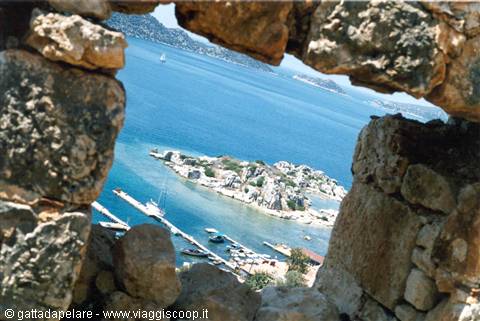
May 31, 2002. Kekova
"Kekova is the name of a village without commerce, one gets there only by sea, because behind the shore the mountains are high, wooded and impassable. An unforeseen view, a chance stop, but it made us see a forgotten tribe that seemed to run backwards, all turned back in a world like the present one, which pushes everything forward. Few people live in houses of stone and wood with cows, goats and hens. No grass, few trees and in front a small arm of sea calm as a fjord; there are no paths, but tracks that the beasts in their wandering vary as they please and that only men follow. Women, men, boys and girls appeared at the windows and on the doorways at our arrival; a sultry heat reigned in the air and, after the first amazement and curiosity, doors and windows were closed again and the small village remained blind under the sun as if abandoned.
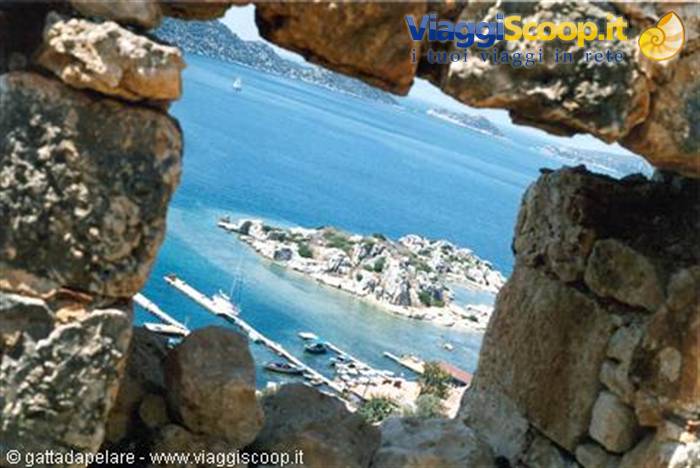
We had stopped in the bay because we had noticed some tombs on top of the hill; having climbed the slope, after the ruins of a probable castle the sepulchers appeared. They were enormous stone sarcophagi with the same shape as those left to us by the Middle Ages, they lay scattered without order along a path on the ridge of a hill that on one side looked at the fjord and on the other at a small valley. It was the city of the dead, where the grandiloquence of the shape, of the mass, of the weight had no explanation. They were not tombs of kings, of notables, they had no name, inside there was nothing. The astonishment of discovery, the heat, the truth of Death had broken our water balance. There remained on us a bit of the harshness of the place and of the people, as if the hard roughness of all those stones eroded by the salt wind had entered us.
Stones were everywhere; fallen building stones, rocks emerging everywhere above a little, black dust of earth. The ruin of the buildings, the tombs, the houses, the men and their life were a clear sign of regression; a desperate contrast with the current world that progresses. They sleep on the roofs because of the heat, protected by dark blankets; the women wear wide Turkish trousers and keep their faces veiled; the little girls with the same wide trousers seem dressed for play. Life is confined to the arm of sea, to the hill and to the small valley behind the hill; the rest of the world might not exist who knows when someone, who overturns past and present, will arrive here..." This is how Vittorio Polli describes the village of Kekova in 1971 in his book "La crosta della Terra" (The Crust of the Earth).
We arrived yesterday evening late, lighting ahead of the bow with a flashlight to discover the dangers of the rocks hidden in the sea. The water is calm, protected as it is by the long island that shelters the Turkish coast and the village of Kekova from the wind and waves. The village can be glimpsed, lit by scant lights, against the black backdrop of the hill. We notice light signals on the shore, calls addressed to us. First one, then others. They invite us to steer the boat towards improbable moorings that we do not trust. We do not trust them because we do not know the seabeds but also because that agitation on the coast, those luminous invitations, that insistence on calling us back awakens images of piratical lures used in the past to plunder ships that thus ended up on the rocks.
The present has arrived in Kekova in the form of some simple taverns that project with their shaky piers towards the arriving boats. At their ends indistinct men fight among themselves with gestures the daily battle for survival. We chose a mooring at random knowing we were giving a resigned displeasure to the others. The tavern is called Roma, another sign that the village visited by Vittorio Polli has changed. This morning I put my head out of the hatch and I saw it. The Lycian tomb rising from the sea. There it stands a few meters from me as in the photograph I have on the cover of the pilot book. An image that made me dream for years and that I never thought I would really encounter. The houses of the village are still the same ones of stone and wood, and the women still wear the wide Turkish trousers. But they have changed.
No longer curious and surly, but ready to help the visitor (I like to believe I am, perhaps guilty of presumption, a visitor and not a tourist). They let themselves be casually approached and show you the path that tangles among the houses to reach the tomb, or the acropolis, or the other attractions of the place. They accompany you with dignity right to the spot before offering you the simple craft objects that, out of skillfully triggered gratitude, you buy mocking yourself, almost apologizing for not buying the most expensive one. I return to the boat. Marzia and Gino are also awake and taking photos. The arrival of the bread boat draws most of the population. Here there are no roads yet and supplies arrive by sea.
In a few minutes all the bread is sold and men, women and children return to their houses with the loaves in their hands in a ritual procession that repeats itself every morning. We climb towards the acropolis, towards the ridge scattered with Lycian tombs. We pass among the scattered houses, turning and turning among them following the path that follows the logic of reaching all the thresholds of the village. We are preceded by some women with their baskets under their arms full of objects that each of them counts on selling us. They do not pester, do not offer, they walk ahead of us and every now and then they turn to see if we are following them. One of them speaks Italian, a little, but enough to conclude a small deal with us. It is the demonstration that even here, to be successful, one must know languages.
There is also a shop, a simple resale of everything, with its fridge full of Heineken and Coca Cola and a plastic life-saver-dolphin hanging under the portico that slowly turns in the wind. Dear Polli, you see that in the end the present has arrived here too, unfortunately for us romantics, "visitors" in search of the past. But even though the rudimentary "pansyniolari" that we visited has its own (but I cannot imagine where the computer could be hidden) the tombs are still as you described them. We walk among the stones of the ruined castle and visit the place chosen by the ancient populations for their last sleep overlooking the arm of sea and the inner lagoon. A sleep disturbed by predators who have made a hole in all the tombs to remove the treasures buried with the deceased.
Who knows what they found there, who knows who was buried there? Questions without answers, lazily surfacing in the mind as we wander around the hill, heated by the sun of this late May 2002. We spend the afternoon at Tersane, an inlet facing Kekova on the island of the same name. Here too, remains of Hellenic and Byzantine walls. We spend the evening in the wide and quiet lagoon far from the village. Here "civilization" has arrived with force. Many yachts at anchor and a tanker boat that supplies us with diesel. On land a much more "modern" village than the other welcomes us. A paved road, a small bazaar, a mosque and several taverns. We have a pleasant dinner, order bread to be brought to the boat in the morning and speak in German with the casual owner.
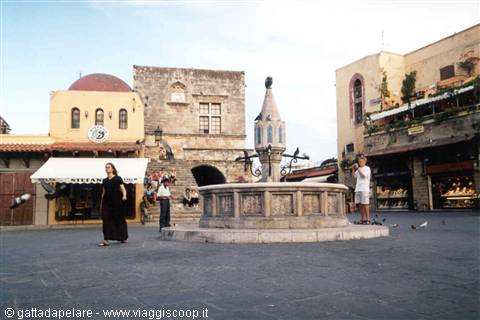
Rhodes
Day 41 Jun 2002
July 1, 2002 - Kekova - island of Kastellorizo. 15 miles.
We feel like some Greekness. Last night Marzia had the idea of making a stop at Kastellorizo, the southernmost island of Greece, just a few miles from the Turkish coast. This unexpected plunge into the sounds, flavors, smells of Greece excites us like a day off from school. For the first time we sense that we have been away from her too long and we realize how much more akin we are to that world than to this one, although fascinating, welcoming, friendly and, yet, foreign. The courtesy of the Turks is a fact and their hospitality is traditional, but one always suspects that they want to sell you something. The town of Kastellorizo consists of a strip of houses at the bottom of the bay. A narrow little street separates them from the sea, and on that street the life of the community takes place. The houses are two-story, with pitched roofs and pastel-colored facades.
Every now and then they arrange themselves around a small square where some low trees create areas of shade under which the old people of the town gather, sitting on brightly colored wooden chairs. However, there is not even a trace of the rarefied atmosphere recounted by the film "Mediterraneo"; except for that of the last scene in which one sees the mass arrival of tourists. A cruise ship has brought four hundred tourists here from Rhodes. They have occupied all the available venues. Many of them, the older ones, speak halting Italian, learned during the Italian occupation of the Dodecanese, and are happy to have the chance to strike up a conversation with us. Thus we discover that Gino is a "young lad". When we arrived we moored at a small pier on which are the tables of a tavern and we had to pass the mooring lines between the feet of the customers.
Sitting at a table ourselves we let the sensations of a Mediterranean all ours, Greek and Latin, made of olives, almonds, figs and wine, of a saltiness that sticks to our skin, of a pagan sense of the divine that drags us away into time and myth, slide over us. The first glass of retsina and the first sirtaki. We are in Greece! From the top of the cliff that dominates the town, reached with effort, we see the sun setting in the sea of the gods.
June 2, 2002 - Kastellorizo-Kalkan. 12 miles.
On the route to Kalkan, 3 miles from Kastellorizo, one encounters the island of Ro or Agios Georgios. A bay open to the south welcomes us for a swim in calm and luminous waters. The island is uninhabited and the only human trace is represented by the ancient stones of a temple or perhaps of an acropolis. They are up there high, dominating the sea; a few stones that tell to the imagination of us, chance visitors but not too much so, the myths of the "peoples of the sea". We fish with the line just enough for a tasty grill organized at the bow of Gattadapelare. The gentle breeze coming from land revives the embers and a smell of roasted fish reaches the cockpit where we wait sipping retsina and staving off hunger with marinated olives. We resume sailing after a brief exploration of the acropolis. The wind is weak and inconstant. Every now and then we have to go under engine.
At 19 we arrive. Kalkan is a pleasant town with a small, unpretentious but welcoming harbor; entirely devoted to tourism, its alleys are a succession of little shops, workshops, trattorias, restaurants. In one of these we gladly return, Marzia and I, because two years ago we listened there to beautiful music. Nothing has changed; lying on the floor, supported by numerous cushions, we enjoy an atmosphere that should be artificial, mercenary, specially created for tourists and that, instead, thanks to the heartfelt participation of the musicians, is true and absorbed by us with emotion. We slowly return on board with the expectation of tomorrow and of the leg that will take us to Cala Kapi, a known and beloved anchorage.
June 3. Kalkan-Cala Kapi. 10 miles. The sea also today offers us the gift of its indifferent beauty. The gulf of Fethiye embraces this last stretch of Mediterranean that is about to become Aegean. The mountains, not high, covered in conifers, descend until they touch the water. Where the ridges enter the sea, peninsulas are formed, the small valleys turn into coves, the valleys into bays. Into one of these, protected so much as to seem an alpine lake, we enter under full sail through a narrow, deep channel between two lands. On our left the anchorage appears, at the bottom of a narrow cove. A tavern and some boats welcome us. The anchorage is serene and invites laziness, but we are a crew too greedy for knowledge to stay on board. So we tell Gino about the village not far away that struck us so much, Marzia and me, for its miserable simplicity and we immediately awaken his curiosity.
So, we set off through olive trees and oaks along a barely traced path, but we are uncertain about the route. We ask a man and a woman climbing behind us for the right way and the man invites us to follow him. They are simple people, of poor appearance, they walk slowly, the man ahead, the woman a few steps behind. They do not speak to each other, and despite everything one senses the deep bond that unites them in a common destiny. He incredibly speaks good English, she is always silent. They invite us into their poor house made of sheet metal and cardboard and offer us the traditional tea.
Sitting on the floor on an incredibly clean mat, while the woman silently weaves the inevitable carpet (I suspect that, like Penelope, at night she unravels it to always have something to show tourists) and we drink an improbable sage tea, the man tells us about his son who studies medicine in Ankara and about their house in Anatolia. We also learn that the owner of the tavern at the Cala (organized almost like a club) lives in the house next door, evidently without electricity and, certainly, without sanitary facilities; we begin to see this reality with other, surprised eyes. We almost regret that the poverty and backwardness we identified with the genuineness of our experience of people and places is nothing but a personal choice of our hosts.
To settle the debt we buy the usual little necklaces and bracelets and return to the boat that waits for us patiently and sleepy at the wooden pier. We have dinner at the table and go to the bunk.
June 4 - Cala Kapi - Goecek. 4 miles.
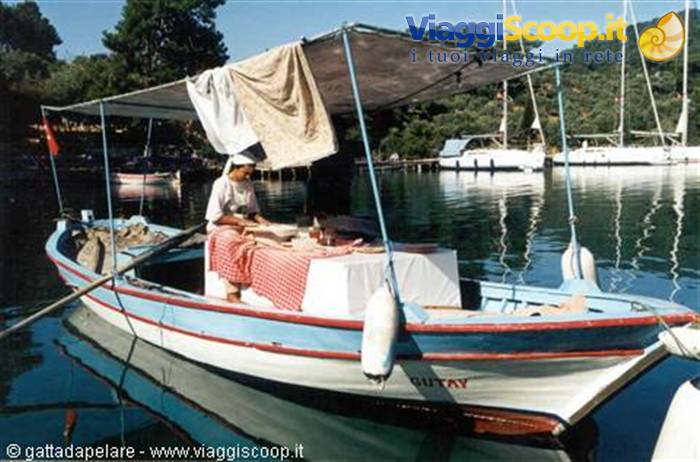
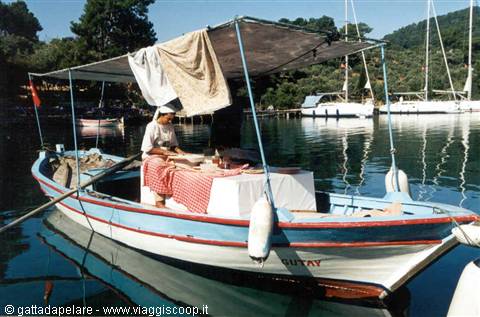
We wake up unhurriedly. We have nothing else to do but sail at our pleasure in this marine lake while waiting to land at Goecek, the last stop for Marzia. Breakfast comes to us from a small boat that offers us cheese and herb crèpes cooked on the spot on a griddle. We spend the day sailing here and there with a good wind and with the courses chosen at will. We visit islets and small bays, we swim, we drink good Ciancaia wine, bought on the fly from the small pier of a seasonal tavern, and we let time flow over us. At sunset we head for Goecek. The town is entirely devoted to boating. The Marina hosts numerous charters and everywhere there are restaurants and venues in front of which persuasive hawkers of tasty dishes wave their arms.
While doing the provisioning we meet a sailor from Aswan who speaks a little Italian and offers to organize Marzia's trip for this night, to Dalaman airport. Half perplexed and half grateful we set the appointment for 4 in the morning with a colleague of his, like him aboard a large private yacht of a wealthy Libyan VIP. We establish with Marzia a series of phone signals, based on rings, to indicate to each other whether everything is fine during the car transfer.
catering service
Day 55 Jun 2002
June 5. Goecek-Rhodes. 50 miles.
Wake-up at three thirty. Marzia now concludes her vacation on Gattadapelare. In the few words exchanged in the darkness of the pier there is the sadness of departure and the worry about this transfer. Punctually at 4 a prestigious car arrives driven by the yacht's engineer officer. Courteous and professional, the driver loads Marzia's luggage and the two depart into the night that is about to end. With Gino we wait for the agreed signals. The first ring after 15 minutes tells us that the trip is calm and regular. At 4:30 Marzia calls to say she has arrived at the airport and that the driver refused any compensation for the service rendered. Relieved and grateful for such courtesy, we cast off the moorings and, in the incipient dawn, quietly leave the Marina. The offices are closed and no one asks us for the toll. We are in a breeze regime and at this hour there is no wind.
We proceed under motor with the navigation lights on, which gradually fade as the dawn lights up. From behind the mountains the sun rises and we feel it warming our shoulders. Ahead of us the passage between two islets and then the open sea. In Rhodes we have an appointment, this afternoon, with Eleonora and Federico, who arrived on the island yesterday and who will be our new companions in travel and wandering among the Aegean islands. We imagine that as the hours pass we will find wind from the west-northwest and that the last miles will be with sea and wind on the nose. The forecasts come true and we struggle quite a bit to reach the small harbor of Mandraki where we find a place along the left quay. Later the meeting with friends and dinner in a trattoria outside the old city, pointed out to us, the first time we were here, by an Italian skipper.
June 6. Rhodes.
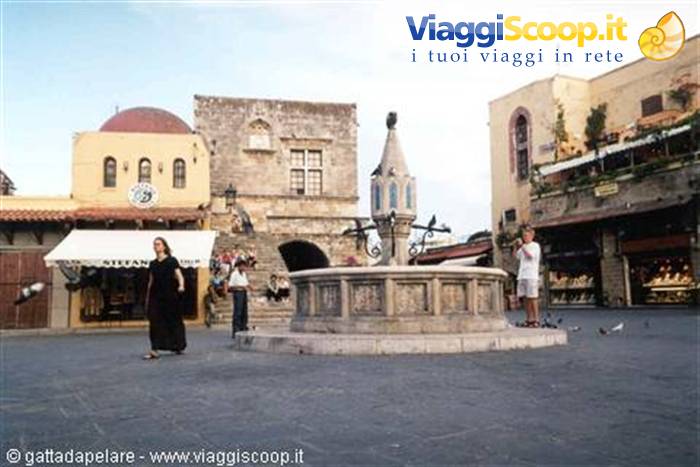
Gino doesn't know Rhodes and Eleonora and Federico were here many years ago. Even though for me it is the fourth time and curiosity no longer moves my steps, the charm of this city is always felt. It is conveyed by the severe defensive walls, by the streets of the knights' quarter, by that overlapping, mingling, jostling of Christian and Islamic testimonies that have consolidated over time and that make Rhodes a unique case in the history of the Mediterranean. The hammam of Suleiman the Magnificent is still under restoration and we must once again give up an authentic "Turkish bath." We discover that under his shorts Gino is not wearing underwear. Denouncing it is a waiter with a keen eye, a depraved Greek who serves us at the bar. We make plans for tomorrow.
Departure as early as possible to be at Simi before the "meltemino" picks up, which we would have against us in the channel between the island of Simi and the Turkish coast. Overnight in Simi, possibly in a small bay already visited in 1998. The new crew settles into the forward cabin and prepares to face the first night on board.
June 7. Rhodes- island of Simi. 20 miles.
We have some trouble with the anchor, which has become entangled in some submerged lines. Not a breath of wind blows. Never seen a flatter sea than this one before the bow of Gattadapelare. Our boat is mirrored in it and gently cleaves, without jolts, almost in silence these waters that with so much impetuosity opposed us on other occasions. The arrival at Simi takes place according to schedule. The small village resembles in the style of its houses that of Kastellorizo, a little larger and more important and equally pleasant. We do the provisioning and move to the well-known little bay. To reach it one passes slowly, with great care, through a narrow and shallow channel and then comes out north of the island. It is a completely uninhabited part, frequented only by goats and a few small fishing boats that appear toward evening to check the traps set out in the morning.
We carry ashore the equipment for grilling and the drinks. In the silence of a nature left free to express itself without the presence of man and his machines, with the sole exception of us who consider ourselves witnesses rather than disturbers, we listen to the loud and faint bleating, near and far, of the goats scattered on the steep hill overlooking the bay and the subdued lapping of the sea on the stones of the shore. Gattadapelare, at the helm a few dozen meters from the shore, waits for us. We are aware of its waiting and its hospitality and we reciprocate by feeling it as our home. Under a starry sky, after eating by the uncertain light of an oil lamp, we return on board, enriched by this new travel memory.
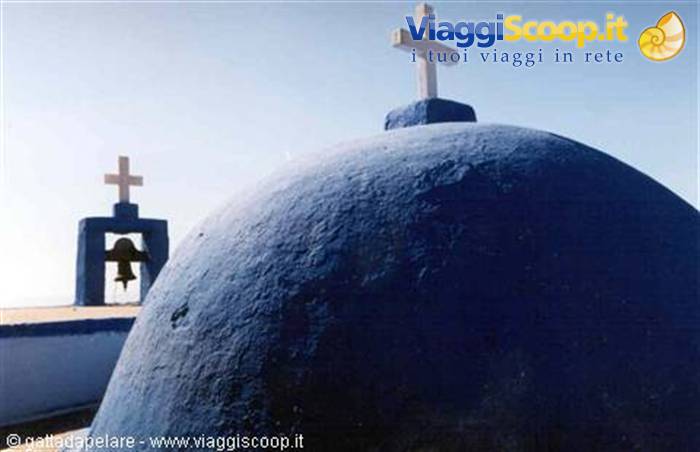
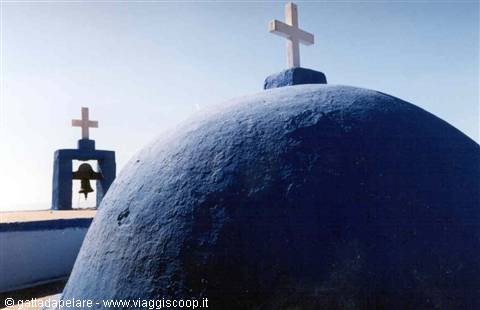
The little church of Marathi
Day 68 Jun 2002
June 8. Simi- Cnidos. 20 miles.
Once again a day with little wind. Our destination today is Cnidos, the ancient city known today for the discovery of one of its Venuses. We weigh anchor after gathering the objects left on the beach. I hoped that this time too, as the other time, the goats would have cleaned the grill and the dishes by licking them during the night. But no. Evidently they didn't like it. As yesterday there is not a breath of wind. Good conditions for spotting dolphins, but we don't see any, except vague dark shapes in the distance that could be anything. The wooden jetty of Cnidos is still shaky, as the first time we docked there. Turcoilcorto is always there to welcome crews and calculate how much he can earn from them with his taverna. We moor Mediterranean-style. There are several other boats and the sea is inviting for a dip.
I show Gino the wreck of the ancient boat that lies at a depth of 4 meters. It was filled with concrete and probably used to extend the pier. While Eleonora and Federico stay on the boat, we go hunting for "little bits" with fair results. They are fragments with no objective value, but for us they will be the memory of this place.
June 9. Cnidos- island of Kalimnos. 40 miles.
Dead calm, but we are happy because we have to cross the strait between Kos and Turkey and we know how hard it can be to do so with the wind against us. We set off, therefore, under motor, intending to round Kos before the breeze can rise. Gino goes up to the masthead to take some original photographs. This, officially, is recognized as the real cause of the course error that led us to hit the island of Kos instead of skimming past it to the east. An error of six miles due to the presumption of navigating by sight in a sea that is everywhere surrounded by indistinguishable lands. Around two o'clock we pass in front of an islet north of Kos where, I remember, there is a delightful cove for a refreshing swim. So we do, in deep and transparent water. But today is not a day for collecting medals.
The skipper identifies on the chart the village located at the bottom of a fjord where we will dine in a welcoming and characteristic taverna, already visited on another occasion with Marzia. Perfect fix, GPS working, but wrong identification. So we pass in front of the mouth of the fjord without seeing it and when we realize the error it is too tiring to turn back and too late. We take shelter in a cove where, as far as I know, there is also a seasonal taverna. Two other boats are anchored with a line to shore. There is little room to swing and we decide, after thorough analysis and hypotheses about the direction of the night breeze, to take a line ashore at a strong angle to the northwest. There is no trace of a taverna, but we discover it about a hundred meters inland, where we also meet the other two crews. We dine on grilled food and stories from Nicola, the owner of the taverna.
Cook, sponge fisherman and elementary school teacher depending on the season. He tells us about the hard life of the sponge fishermen of the past and their families forced to live in this rocky valley, hospitable only to goats, for six months a year waiting for their men to return, with no other resource than milk and cheese. No road, no electricity, in houses that resemble small tool sheds more than shelters for men. Eleonora today steered and bought a sponge. She is very satisfied. Federico did not steer and is not satisfied. About the sponge.
June 10. Kalimnos-Island of Leros-Island of Lipsi. 10 miles.
In the morning we have the satisfaction of seeing that our line was placed in the right direction and the other two boats had problems. With Gino we congratulate each other. We set off under sail to show how good we are to the other boats and after countless tacks we are out of the cove. There is a good broad reach wind, almost a beam reach, for sailing with joy. We trade the helm of Gattadapelare among Eleonora, Gino and me, with polite impatience. In the passage between Kalimnos and Leros the wind strengthens, we reduce sail, and the boat takes on a more comfortable trim. Now she runs at 8 knots. We decide to stop at Leros in time for lunch. Difficult to find a place in the small harbor, but after many maneuvers and hesitations we even moor Mediterranean-style. We have lunch at the usual (for me) taverna on the shore. The crew is enthusiastic, the place fascinating, the mood excellent.
But I am sleepy and take a nap on board while the others take a taxi to the Jerusalemite monastery-fortress that, with its ruins, dominates the island. On return, we decide to continue to the island of Lipsi. The afternoon is already advanced and we risk arriving in the dark at a mooring that, says the pilot book, is uncomfortable. The wind is even stronger, islets and reefs, near and far, confuse the course and make it dangerous (!), but finally, at sunset, we spot the entrance to the bay. We enter it along with the wind and waves and find there, with relief, a new long pier where there is plenty of room. A mooring, however, not calm because it is a suspended structure; beneath it the waves pass and the boat always seems to be sailing. The town is pretty, moderately touristic, with some tavernas and trattorias.
In one of these we have dinner and then, tired, we slip into the boat where, cradled (battered?) by the waves, we fall asleep satisfied. A beautiful day of sailing!
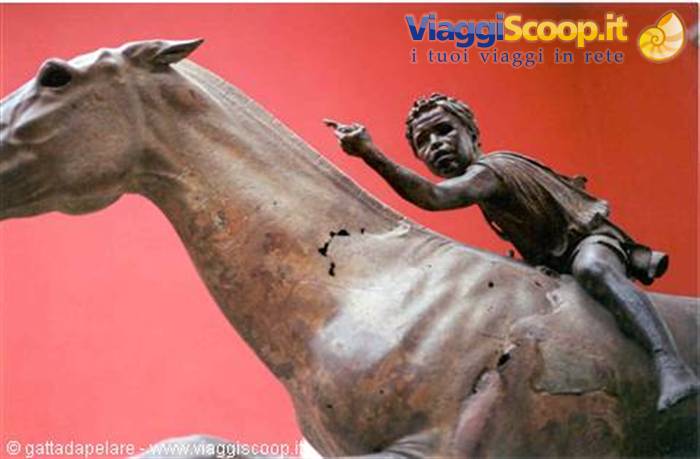
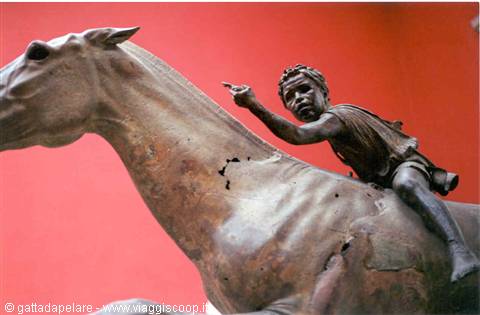
National museum of Athens
Day 711 Jun 2002
June 11. Lipsi-islet of Marathi. 6 miles.
We leave the mooring at leisure and, coasting clockwise around the island, head for the archipelago of Arki. On the left the island of Patmos appears to us with the whiteness of the houses of Chora at the top. The wind is now astern and we sail toward Marathi and the serenity of that anchorage. Michelis, the owner of the taverna, spots us and immediately recognizes Gattadapelare as soon as we round the islet that shelters the bay from the southwest. We moor to a mooring buoy and Gino and I go ashore. Kalimera, ciao, pats on the back, "sticani", "comostai". The usual Italo-Greek repertoire. Thank goodness for Gino. He has been studying Greek for months.
On board he has talked to himself for hours and hours and so he can finally put what he has learned to the test and...oh wonder!!..Michelis understands him! Seated under the reed canopy, a few meters from the shore, we let ourselves go into sweet laziness, drinking ouzo and eating olives. We meet a pharmacist from Thessaloniki, who speaks Italian, and his young companion. They are staying at Michelis's and they invite us to their table. It is four in the afternoon, but a beautiful lobster and other fish arrive as a surprise and, between retsina and ouzo and great cordiality, they are well received and enjoyed. Eleonora and Federico, who stayed on board, do not enjoy themselves as we do. Marathi has changed a bit in these two years. Two new buildings remind us that progress spares not even our Thule.
"last beach" Moreover the enterprising Dutchwoman has renovated the little storage room, which has become a "shop." She sells painted stones, photos of goats and of Michelis, local shells, etc. But the point is not commercial: there is no passing trade. The old, worm-eaten Coca Cola crate that Marzia wanted to buy two years ago is still in the shop, used as a display case. It was not for sale then and it is not today. A too rare antique piece. Another old acquaintance, Stavros, the fisherman, is also here this evening. He is going to set the nets below Lipsos, nets that we will pull up together tomorrow morning. As on all the other times I have been here, peace fills my soul and leaves me indifferent to the passing of time. I could stay for hours staring at the sea in front of me, drinking ouzo, listening to Greek music.
Especially Alexeion's songs and the atmospheres created by Vangelis. A rare boat arrives, another departs. We watch the maneuvers and judge the crews' abilities. An Italian boat also arrives. The skipper is heard expressing words of appreciation for Gattadapelare. Nice!! A true connoisseur.
June 12, 2002. Marathi.
This morning Gino, the pharmacist from Thessaloniki and I went out on Stavros's boat. His father is also there, a small old fisherman missing a forearm, lost years ago on the job. The boat is an 8-meter motor fishing vessel, powerful and functional. We leave very early while the rest of Gattadapelare's crew stays lazing in the forward cabin. The sea is choppy. We reach the point where the nets were set last night and begin to haul them in. It is 1,500 meters of net that comes up slowly with little catch: a couple of lobsters, 7-8 mantis shrimp, about ten scorpionfish and some other fish. We learn from the pharmacist that Stavros has invited us all to dinner with the catch, apart from the lobsters and mantis shrimp, which are his earnings for the day. We look at the catch with different eyes. The day passes serenely and dinner is excellent. Tomorrow we must reach Patmos.
The time has come to think about preparations for the return home.
June 13. Marathi-Island of Patmos. 6 miles
We say goodbye to Michelis and set sail for the Blue Lagoon, an inlet on Arki so called for the color the water takes on over the shallow sandy bottom. There is an appreciable northeast wind, but it doesn't bother us much while we swim. I try to fish for something, uselessly. We leave around 14:00 with a magnificent broad reach wind. Gino offers, out of courtesy, the helm to Eleonora and Federico, but at the first opportunity he takes it back and does not give it up again. Gattadapelare proceeds at an exhilarating pace and Gino is enthusiastic too. We land at Grikos, a pleasant village 5 kilometers south of Skala. We put in stern-to at the only small pier and go ashore for a scooter excursion. None of my companions knows the island. We have dinner in Skala after a bit of shopping. We have also booked a cabin on the ferry to Athens that will leave tomorrow evening. A cabin for four.
The only one still available. It will feel as if we are still on our boat.
June 14. Patmos.
By now the adventure is over and this diary is reduced to a list of facts. We have hauled Gattadapelare at the usual shipyard, the only one on Patmos. In Greek, shipyard is called carnaio, and this always affects me a bit. While I proceed with the haul-out operations, the rest of the crew visits the island. The appointment is inside the town of Chora, at the Vangelius restaurant. We spend the afternoon at the beach. The last hours are spent in preparations and tidying up the boat. At 23:00 we leave by ferry.
June 15. Athens.
We arrive in the early morning after a calm trip and, with some difficulty, settle into a hotel near the Plaka, the characteristic neighborhood of Athens. The curse of the cat pursues us: we find only one room with four beds. But by now.... Morning at the National Museum, afternoon below the Acropolis. Dinner at sunset at the edge of the Roman Agora while the Acropolis lights up. Then to bed. Each sets his own alarm and packs his bags. Gino leaves at 3, Eleonora and Federico at 7, I at 13. So, quietly, the crew dissolves. We have been happy, in harmony and without any moment of friction, which is rather rare when one is aboard a "tiny boat" for several days. A good crew, then. An experience to repeat.

0 reader comments