We arrived at 3 p.m. on a Turkish Airlines flight. The connection to Izmir is at 9 p.m. and we take the opportunity for a quick trip into the city centre. The airport is 24 km from the city and by bus it takes us 30 minutes. A walk through the colourful and lively alleys leads us towards the Grand Bazaar. Glimpses of minarets and domes foreshadow what we will see in a few days when we arrive in Istanbul, by sea, aboard our boat. We don't want to squander today the wealth of sensations this city can give us at leisure, and we are almost reluctant to let our gaze linger long on so many wonders. The Bazaar, with its endless shops glittering with gold and colours, fascinates us. We are a bit dazed and find it hard to realise where we are. On the way back to the bus station we discover a couple of cafés where we want to return at our ease. One of them is situated among the tombs of a mosque.
A strange arrangement!
At 10 p.m. we arrive in Izmir (Smyrna). From Florian's experience in October we know that the taxi to Kusadasi costs 100,000,000 lira (Turkish, naturally). We begin a long negotiation with the taxi driver who demands 150. There are no alternatives, take it or sleep at the airport. The Levantine wins. (P.S. I will discover later that since October the Turkish lira has devalued by 30%.) We find Gattadapelare nicely winged, washed and with a ladder ready to come aboard, just as requested by phone. The batteries are in order and there is no water in the bilge. It seems conditions are favourable for a good 20-day gallop over the waves of the Aegean. We go to sleep satisfied. (Alas, how deluded we were!)
Thursday 28 May 1998. Kusadasi
The Marina gives us the impression of being very efficient and organised. For $20 (plus 30 in expenses) it procures us a transit log which, had we done it ourselves, would have required the whole morning between offices and revenue stamps. We decide, for 100 marks in labour and 100,000 Italian lira for Turkish antifouling paint (produced under Italian licence), to have the work done. I discover that the corrosion of the cylinder cooling jackets has increased and that the patching done in Crete by Alberto no longer holds. I set about plugging the holes with putty. Of course it will only last a few months. The Marina changed owners a few months ago. The current company, Setur, does things on a grand scale. Swimming pool, restaurant, bar, shops, tennis courts, workshops. Setur owns four other marinas and the mooring can be used indifferently in each of them.
We go to the pool for half an hour and on our return we find the antifouling nicely applied. How on earth did they do it!! In town Marzia goes shopping and buys excellent and "original" imitations of big-name brands.
Friday 29 May 1998. Kusadasi
We are ready for the launch. I try to turn the engine crank. It's stuck! The powerful crane locks its brakes. Reinforcements arrive; there is a brief mechanical consultation, electrician, vice-director of the marina and others, unidentified personnel. It is decided to dismantle the starter motor. It is the culprit. According to an initial declaration by the Levantine-Oriental-shrewd electrician, it will take two or three days. The part has to come from Izmir and today is Friday. I sell myself as a great expert in the matter and everything is resolved in two hours with a bit of grease. Since we mentioned the need to change the engine sooner or later, the Marina director arrives. Erdal Kilic, naval engineer, 35 years old. He speaks good Italian and has a marked sense of humour. He immediately seems very likeable.
He proposes two or three engines and invites us to dinner (on Marzia's sly prompting: "But where can one taste real Turkish cuisine?"). We make the acquaintance of an elderly Italian couple from Casalpalocco, the Legnanis, who have kept their boat in Kusadasi for 14 years. We have acquaintances in common. Erdal keeps his promise and we find ourselves eight at table (the two of us, him, a Ligurian captain of a 24-metre iron, and four other marina technicians: Serkan (whom we nickname the German because of his appearance), Kemal (the Venetian), Devrin (the Turk) and a secretary without adjectives. The restaurant is outside the city, there are no tourists and the dinner is excellent, made up of many tastings. The aubergines and the unleavened focaccia with sesame seeds are good.
Saturday 30 May 1998.
We are again ready for the launch. Once the cradle is removed we notice water leaking from the base of the keel. It drips and gives off an acid smell of osmosis. It becomes necessary to postpone everything. We drill the bottom, let all the liquid out and fibreglass the end of the keel. We absolutely must avoid seawater stagnating in the bilge. All this work makes us postpone departure to tomorrow. This time it falls to us to invite the technical staff to a trattoria. The evening ends in a piano bar with a... Turkish flavour.
Sunday 31 May 1998. From Kusadasi to Sigacik. 35 miles
Finally the boat is in the water. It is 12.00. Seen off by Eng. Legnani and escorted out of port by the marina's service dinghy to the sound of onboard sirens, we set sail. We head north. A beautiful day with a light wind, but enough to give us the pleasure of sailing now and then. The pleasure lasts little. We notice that the engine is spraying pulverised water. We decide to carry on. The breakdown is serious, but not grave, for the moment. We enter the little port of Sigacik around 8 p.m. It is almost dark and we moor stern-to. There are only four boats. Naturally none flies the Italian flag. We realise that the last Italian boat we met was "Solimano's" in Rhodes and the second-to-last in Aegina, last year. The alternator, wet, has not worked. We use the service battery with caution. We go to dinner and then to bed.
Encounters
Day 21 Jun 1998
Monday 1 June 1998. From Sigacik to Cesme 20 miles
The old town is entirely enclosed within the walls of an ancient Venetian fortress. It is very modest, but not without characteristic glimpses. The usual café with old men sitting drinking tea and playing backgammon, the little shop furnished with crates of colourful fruit among which hungry kittens doze. Before setting off again we go to visit the ruins of the temple of Dionysus at Teos. Erroneous information makes us walk 6 km on foot and under the sun before arriving at the spot. It is very evocative. Of the temple, one of the most important dedicated to the god, 5-6 columns remain still in situ. They rise from the tall grass, among olive and fig trees. Around, only countryside. The temple was situated on the edge of the city, of which almost nothing is visible today. We conclude the return with a 20-minute walk. We cast off after paying 20,000 lira (Italian) in port dues.
We decide to carry on. If we are careful with the battery reserved for the engine and sail only under sail, we might attempt to reach Istanbul. The engine starts, but sprays much more than yesterday. As soon as we are clear of the port we switch it off and sail. There isn't much wind, but we have no choice. It is 12.00. We arrive in Cesme at 5 p.m. and moor at a quay equipped with toilets and showers. We expect to have to pay a toll here too, but no one turns up to collect. Cesme is a pretty tourist town dominated by the Venetian castle. There are many shops and little places to eat. We decide to give ourselves over to the luxurious life and reserve a table at the restaurant situated on the castle keep. I am worried about the engine. It struggled to start when we manoeuvred to dock.
Tuesday 2 June 1998. From Cesme to a free anchorage. 25 miles
The engine starts after a few attempts. Probably the electrical connections got wet. We decide to turn back. For two hours the wind is very light and we make no progress. Then, finally, it begins to blow with decent strength. We have chosen to spend the night in a bay before Sigacik. The bay is well sheltered, but the wind comes in gusts from the mountain. Except for a fishing boat that has cast its nets, there isn't a living soul. We arrive and manoeuvre to windward until we are a few metres from the shore. A quiet evening. We don't go ashore. We are too lazy to inflate the dinghy.
Wednesday 3 June 1998. From the bay to Kusadasi. 37 miles.
We wake up a bit depressed. The wind has strengthened and the gusts from the tops of the mountains worry us. Rightly so, because the anchor begins to drag and in a short time we are a few metres from the cliff. The engine won't start. We could get out under sail, but recovering 30 metres of chain by hand and at the same time hoisting the sails is too much for two sailors alone. In the end the damned sprayer starts. If we still had the vague ambition to wander a couple of days off Kusadasi, now we are more than convinced to bring the boat back to the marina. We proceed with a brisk wind. At 5 p.m. we arrive amid the perplexity of our Turkish friends. We spend the evening with Erdal, Kemal and the others in a trattoria and later in a place somewhere between piano bar and disco. Despite the disappointment of the interrupted voyage we are in good spirits and enjoy ourselves.
I am forced to sing a Roman stornello under the command of the host-presenter-singer (decidedly a queen).
Here ends the logbook. The pages that follow are the diary of 5 days spent on land, but which deserve to be remembered.
Thursday 4 June 1998. From Kusadasi to Ohren.
We hire a car to return to Istanbul. It is about 1,000 km of patched-asphalt roads. It feels like being on a motorboat, so the sensation of sailing is always with us. The first stop of the day is at Pergamon (Bergama). We visit the remains of the ancient city (the first Roman possession in Asia Minor). Pergamon is known for parchment, for its rich ancient library, for the temple of Jupiter, for the Asclepieion. I realise the description is rather concise, but I am justified by the fact that the skipper is not required to keep the logbook of a car. And besides there would be too much to tell about Pergamon. We set off again to gain a few more kilometres. We stop to sleep in a small village on the coast, facing Lesbos. Name of the village: Ohren. The hotel, pink, on the seafront, is not bad, but it is empty and melancholy.
We take a nice walk along the beach to reach a very simple inn where everyone bends over backwards to serve us.
Friday 5 June 1998. From Ohren to Istanbul.
We wake to a splendid sunny day. Lesbos is before us and floats in the sea, motionless and inviting. We think how beautiful it would have been to pass beside it with the boat, anticipating the sunset over the Bosphorus. We head for Assos. We drive along a very scenic coastal road and reach the ruins of this ancient city on whose acropolis, sheer above the sea, the Doric columns of the temple of Athena still stand. Lesbos is in front.
We take the road again to reach Troy. On the left the strait of the Dardanelles begins. The few remains of Troy disappoint those seeking archaeological wonders, but the atmosphere is magical for those who look with Homer's eyes. Below us, from the plain traversed by the Scamander (little more than a stream), the clamour of battle reaches us. Achilles' chariot cruelly drags the lifeless body of Hector. Cassandra raises her lament from the walls that tower over the Scaean Gates. A group of Japanese tourists photographs it all. We resume our journey. We cross Bursa, the ancient capital of the Ottoman Turks, take a ferry to avoid going around a deep inlet, reach Bithynia, Hannibal's last homeland, drive along the little streets of Scutari, cross the Ataturk bridge over the Bosphorus... and get lost in the little streets of Pera.
Finally, after many questions and turns, we cross the Golden Horn on the Galata bridge and enter Istanbul. We stop at the first unpretentious hotel. It is 11.30 p.m. The room is squalid. The bathtub chipped and rusty. But we are tired and fall asleep at once.
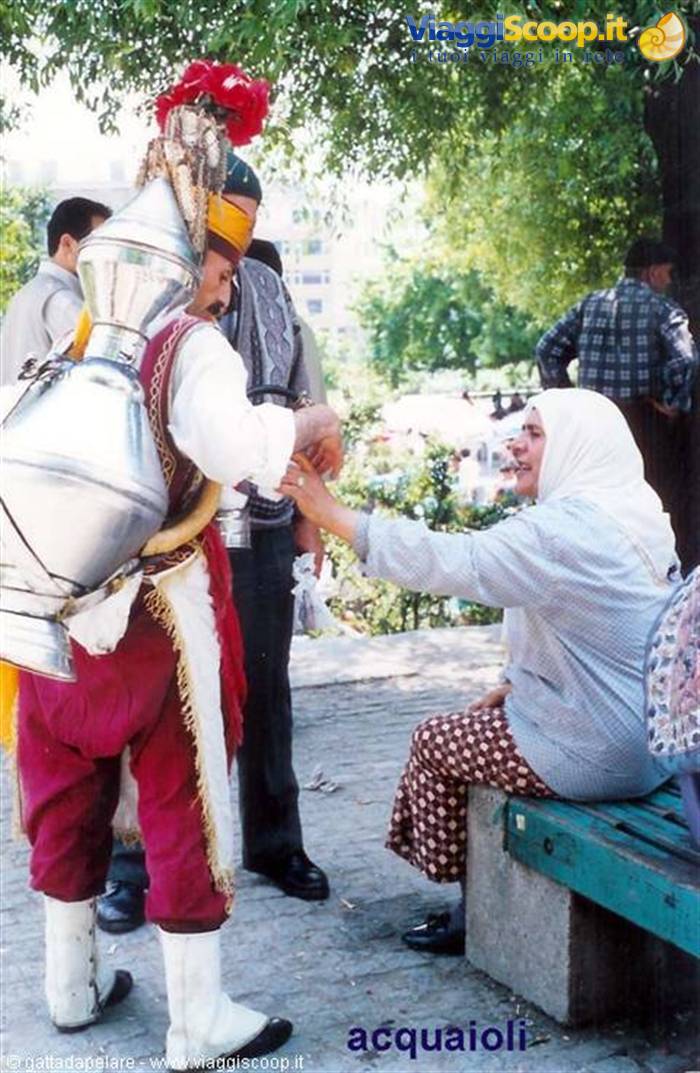
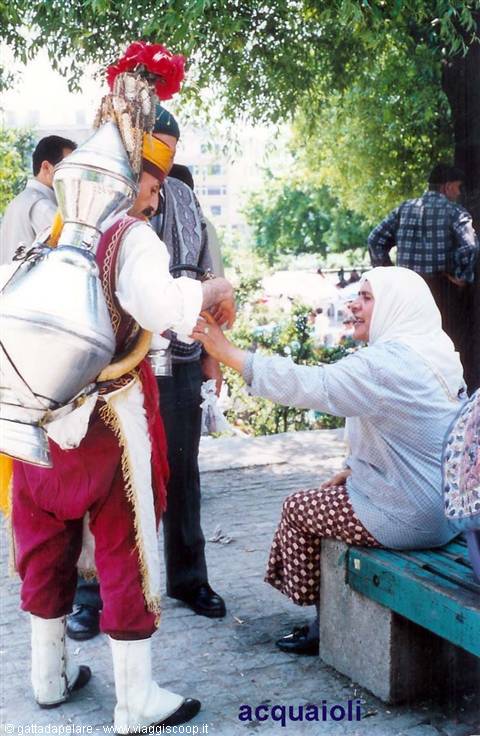
Water vendors in Istanbul
Day 36 Jun 1998
Saturday 6 June 1998. Istanbul.
We get up eager to discover the city. At our leisure we head towards Hagia Sophia and the Blue Mosque. From the hotel it is only a 20-minute walk. In front of the University we come across a market of everything and wander among the stalls of kebab sellers, prints, cameras, sweets and junk. Everyone offers you everything in every language. The day flies by between the Grand Bazaar, Hagia Sophia, the Hippodrome, Camii and various kaddesi. In the evening we reach the lively district of Taksim, the true commercial and representative heart of Istanbul, the district of the big banks, consulates and airlines. There life goes on until late at night, while the old Istanbul is already deserted by 10 p.m. We finally taste muhallebi (rice and milk pudding) and tavukgoegsu (the same pudding with the addition of shredded chicken breast). Both excellent. To be recommended.
Sunday 7 June 1998. Istanbul.
Yesterday we discovered a very inviting hotel behind Hagia Sophia. It is made up of small two-storey wooden houses leaning against the defence wall of Topkapi, the great Seraglio. They are typical buildings of 19th-century Istanbul recently restored by the Turkish T.C. (Ayasofya Pansiyonlari. Tel. 0090.212.513.36.60 - fax 0090.212.513.36.69.) We have moved here and taken a room that looks sideways onto the minarets of Hagia Sophia. It is a very cosy room with furniture in the style of the end of the last century and windows protected by wooden grilles in pure Oriental style. Having deposited our luggage, ever heavier, we went straight into Topkapi. Once again I failed to get into the harem. The visits are guided and take place every hour (max 60 people). We preferred not to wait, promising ourselves to return next time.
Instead we visit the Yerebatan Sarayi, the ancient cistern built by Constantine (and made famous by James Bond in "From Russia with Love"). A visit not to be missed. Its 336 columns, 8 metres high, rise from the water and are lost in the darkness of the vault after playing with very evocative perspectives and alignments. By taxi we reach the western ramparts of old Istanbul. The most miserable district of the city lies against the ancient ramparts which were seldom stormed. Once by the crusaders of the Fourth Crusade and once, the last time, by Mehmed II in 1453. At the edge of the district, the church of St Saviour in Chora, with the remains of its beautiful Byzantine mosaics, is absolutely worth visiting. We arrived late and it was already closed, but the guardian, softened by the generous tip (equal to the entrance tickets = one million each), allowed us to visit it.
With us were two other late Italian visitors. Still by taxi we reach the district of Ortakoi, on the Bosphorus almost at the European foot of the bridge. Ortakoi was a fishing village; today it is a picturesque corner full of little shops, cafés, trattorias. It is market day and everything is very colourful and... Levantine. Seated at the table of a café crowded with young Turks (here we run into a girl we met in a tavern in Kusadasi three days ago - great celebrations and exchange of addresses), we let ourselves be carried away by the sensations this city incessantly provokes. The minarets are blurred in the horizon near evening and the Bosphorus flows like a river at our feet. A city of international intrigues, of spies come in from the cold and from the heat, a meeting place of cultures, a stage for romantic and dangerous adventures.
The waiter invites us every ten minutes to drink tea. We dine in merry company with our neighbours at table (Turks to the right and French to the left - exchange of addresses) on the shores of the most gripping strait in the Mediterranean. The distant domes and the lapping of the boats remind us of Venice. We return partly on foot and then, tired and dissuaded, by taxi. Tomorrow an early alarm. Our taxi driver has booked himself for the transfer to the airport.
Monday 8 June 1998. Istanbul-Rome.
Punctually at 7 the taxi is waiting for us. We leave at 9.10. We arrive at 10.50. Goodbye Istanbul. (Our taxi driver has booked himself to pick us up at the airport in October)

0 reader comments