The story
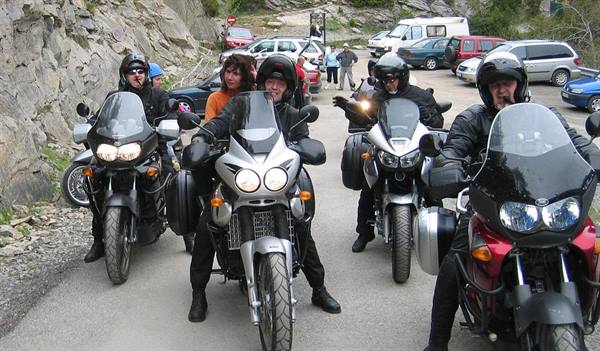
The dark tunnel of the Bielsa Pass at the top of the Pyrenees looms up high, as if closing off the endless series of hairpin bends and sweeping curves that characterise this stretch of road on French soil. A short stop in the large car park, the first photos with the motorbikes lined up near the countless little waterfalls fed by the melting snow, and then off, through the old tunnel, to find ourselves at once in Spain. After a few kilometres we head into the Ordesa and Monte Perdido Natural Park. The “paved” path slips between the rocks, brushing past them in a fantastic, wild setting. The crystal-clear stream accompanies us, flowing fast along the bottom of the canyon; peace and quiet surround us and up there, above our helmets, great vultures wheel tirelessly as in a Tex Willer comic. Towards evening we reach Jaca, an important little town in the heart of the Pyrenees.
The next day, crossing the northern Meseta, the great plateau that covers much of Spain, we head for Madrid. The air is bright and the sky clear; the green of the fodder fields alternates with the red of the rocks and the yellow of the wheat and barley fields. In the distance the mountains rise from a horizon that seems flat. Clusters of wind turbines here and there catch the wind that sweeps across the plateau in gusts. The gleaming asphalt looks wet and plays the usual mirages on us. Along the road, here and there, we come across the silhouettes of the legendary black bulls, huge billboards from an old Osborne cognac advert, adopted by the Spanish tourist board as they are by now symbols of the nation around the world.
When we arrive in Madrid the traffic takes us by surprise, sudden and chaotic. Madrid rises in New Castile right in the centre of the Iberian Peninsula; it is a city rich in history, art and culture, where Arab and European civilisations met, creating an incredible mix. It is from Plaza Mayor, the place where all public events once took place — from bullfights to executions, from parades to Inquisition trials — that we begin our tour of the city. We climb onto one of the many open-top sightseeing buses for a tour of the most characteristic places: Plaza de Oriente with the Royal Palace, Puerta del Sol with the monument of the bear and the strawberry tree, symbol of the city, Plaza de Santa Ana, the Gran Vía and all the other evocative squares and streets that cross Madrid.
In the evening we eat in one of the many little places in Plaza Mayor, which glows within its frame of buildings and lit windows. The square swarms with young people, some playing drums and some courting, and there, in the corner opposite us, a group of Italian students strikes up “O sole mio”. Later, after a round of pubs and music bars, while we look for a taxi to take us back to the hotel, in a corner of the street a tramp, a jarring icon in the Madrid night, looks at me and greets me before disappearing under a mountain of cardboard, his shelter for the night. Back on the motorbikes, which had rested for two days in the hotel garage, we set off along the Ruta del Quijote, the most famous road in Spain, which retraces the places and atmosphere of Cervantes's novel “Don Quixote of La Mancha”.
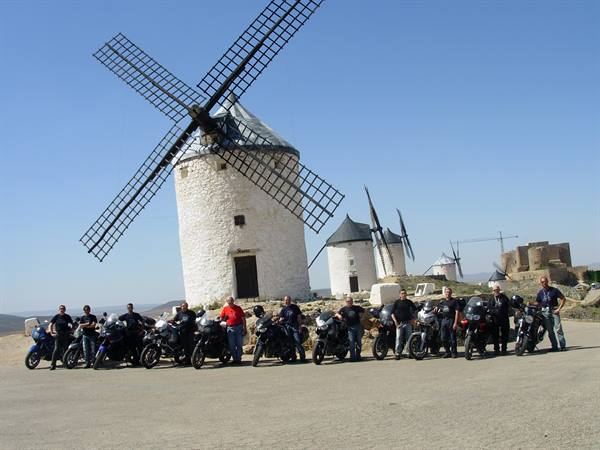
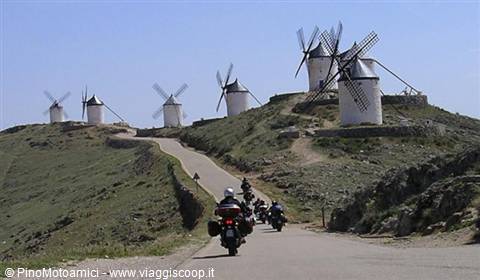
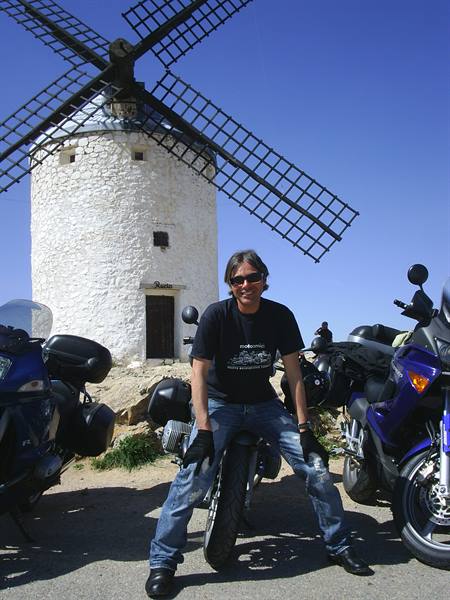
Here every village we meet plays its small part in this never-existent story, yet a story that is more timely than ever and bound to its hero, the knight of the sorrowful countenance. Their very names evoke the novel — Puerto Lápice, Belmonte, Campo de Criptana, El Toboso, Mota del Cuervo — every corner, every square holds a memory of the hidalgo; if we have Garibaldi, they have Don Quixote. Along the Ruta we come across the little town of Consuegra, leaning against a hill from which the unmistakable profile of the immaculate windmills stands out. From up there they dominate the plain, and Cervantes probably took his inspiration for the famous battle of the wandering knight against the windmills from this very place.
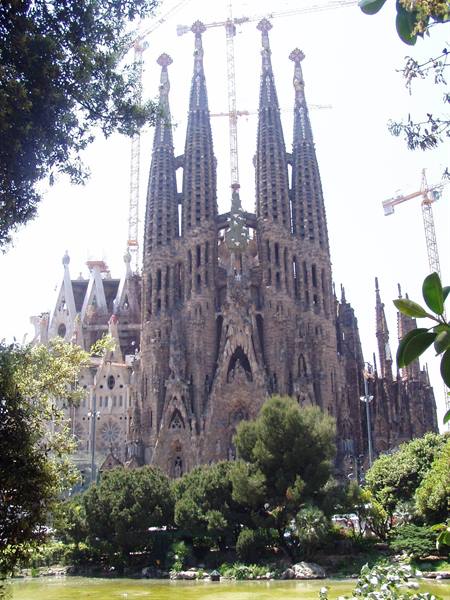
We stop in a clearing to take a photo with the motorbikes lined up right beneath the wooden blades that stopped grinding wheat about fifty years ago, though at least once a year they start moving again, dressed in their restored white sails, thanks precisely to Cervantes and his solitary, by now mythical character. We carry on north, turning slightly towards the sea; Barcelona awaits us, the Catalan city, Spain's second city. Our visit can only begin at the Ramblas, the great avenue that starts at the port, teeming with street musicians and living statues, mimes and storytellers, sellers of jewellery and small animals, students of every nationality and colour. A must is the visit to the Sagrada Família, Gaudí's grandiose unfinished work, with its towers soaring into the sky, a spectacular religious temple and eternal building site.
The design of the interior columns recalls trees and the ceiling is studded with huge sunflowers; it is estimated that another half a century will be needed to finish it. And tomorrow, unfortunately, the long, inexorable return to Italy, twelve hundred kilometres in one go. We will carry with us, as always at the end of a trip, the baggage of a rewarding experience that gave us the chance to meet another country, with its stories, its traditions and its culture. And all this thanks to a passion shared with other friends and above all thanks to the help of an irreplaceable companion... the motorbike.
The journey's photographs
6 photographs · click to open them full screen

0 reader comments