The story
Città di Castello, it's a clear, crisp morning, early, when we gather for departure. One after another the motorbikes arrive and stop in the middle of the square, almost showing off. For some it is the first time and, certainly, it is "the dream" coming true; for others another dream that has become reality once more. The first stop is the island of Krk, in Croatia. After saying goodbye at the Trieste border and crossing Slovenia, we enter Croatian territory. As we approach the coast the Mediterranean colours and smells increase; the road, wonderfully mirroring the jagged coastline, invites and tempts us. Past the city of Rijeka (Fiume), we cross a bold and slender bridge linking the mainland to the island. The landscape changes rapidly; the Mediterranean scrub invades the view and a deep smell of liquorice and broom passes through the helmet.
The village of Krk welcomes us in its simplicity as a fishing hamlet.
We start the day with a very rich breakfast. Having left the lush island of Krk, we reach the coastal road to follow it south. A busy road, but wonderful for the motorcycle tourist. Numerous stops to capture the enchanting views. After a short detour, with the bikes loaded onto the boat, we reach the island of Pag. The landscape that appears is truly unusual: no trees, sparse vegetation, only rock and many, many dry-stone walls marking boundaries and sheep pastures. The smells of nature are strong and the long ribbon of asphalt gathers them all. The bays and inlets follow one another, almost as if wanting to hold onto the intense blue of the sea. We can't resist the temptation and, at the first opportunity, dive in. Having left the island and returned to the mainland, we turn towards the Croatian interior. The sea recedes and the shapes of the countryside draw near.
With it come silence and a strange stillness; for kilometres not a single form of life, an ungainly countryside bearing the indelible marks of the hellish "ethnic cleansing". Shell fragments still on the ground, scarred asphalt, houses scratched by bullets and gutted by explosions, abandoned in haste and never lived in again. The signs of the life that was there have vanished; nature, busy reclaiming everything, will soon cover the horrors; but it won't be so for the conscience — man, once again, despite memory, did not hesitate to commit another atrocity. Slowly we travel the road, in silence, as if crossing a cemetery. Towards evening we reach Sinj, a large village not far from the Bosnian border.
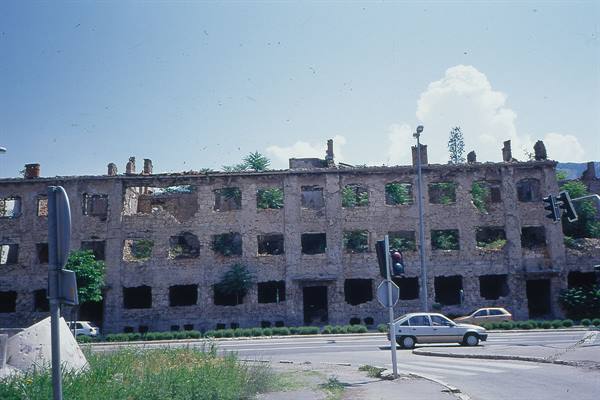
It's the day of the "big stage", about 600 km to cover on roads that don't flow easily. We set off early, the weather is kind, an inviting uphill road brings us towards the border with Bosnia and Herzegovina. The terrain is mostly mountainous, now and then splendid plateaus rich in forests open up. At the border we clear the formalities and head for Mostar. From above we admire the city set in a valley enclosed by mountains. Entering, the marks left by the war are clearly visible; the city is crossed by the river that divides it into two large neighbourhoods, no longer linked by the famous bridge, symbol of integration, destroyed by the bombing. Work has begun to rebuild it and meanwhile another one has been built. Leaving Mostar behind, we take the main road to Sarajevo, which winds through dark and treacherous tunnels, passing through countless towns.
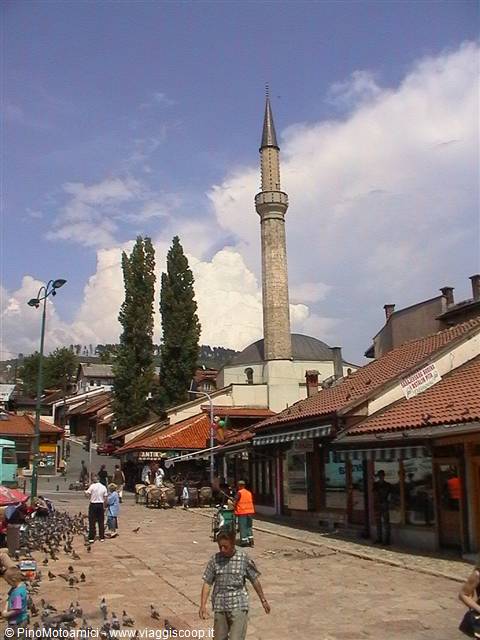
Then we climb higher; along the road groups of children sell honey. The landscape's shapes are harmonious and welcome scattered villages with the characteristic spires of mosques. Life here must be less harmonious, despite the evident industriousness shining through the people. Sarajevo welcomes us with all its contrasts. Heavy traffic, gutted skyscrapers and brand-new skyscrapers. The houses bear the obvious marks of the "snipers". The sun lights up the villages and the white cemeteries scattered over the surrounding hills. We visit the Muslim quarter, with its mosques, the narrow alleys rich in artisans' workshops. Ever present are the patrols of the international stabilisation force. Even though it shows a particular charm, there is no relaxed atmosphere; people don't look you in the eye, they walk quickly.
It will take time, who knows how many generations, to stitch up the tears in the dress and the soul of this fascinating lady of the Balkans. It's about 4 pm and more than 250 km separate us from Dubrovnik. The sky grows dark, it's getting ready to rain. As soon as we leave Sarajevo it starts to rain. The road climbs into the mountains, the rain grows heavier. It's a real storm, with lightning and hail, that accompanies us to the first pass, visibility is reduced, rivers of mud and even stones invade the narrow mountain road. No one thinks of stopping; by now the Lithuanian experience has taught us that, after the first few km, you get used to storms too. We get past the worst, the rain has stopped too, now the road runs downhill between majestic rock walls, then climbs again in a tortuous mountain route, among dense woods and sparse groups of humble houses.
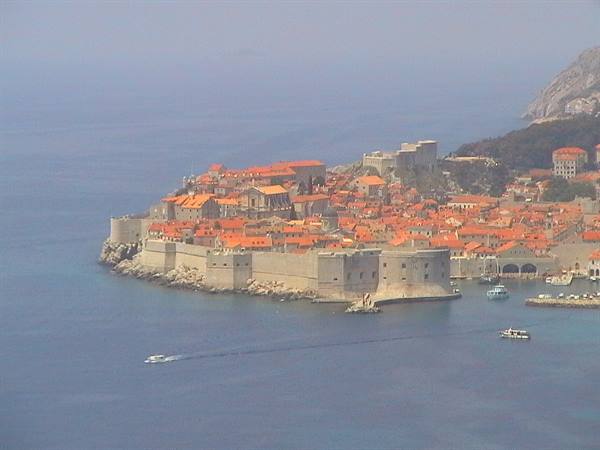
Frequent are the encounters with the "policja", evidently tasked with carrying out constant control of this territory. Well into the evening we reach the border and leave Bosnia. Dubrovnik awaits us; we arrive from above and the sight of the illuminated city reflected in the sea is unforgettable.. From whatever side the visitor enters the city, they cannot help but exclaim in astonishment and wonder. Whether entering through the gates beneath the austere ramparts, or from one of the many alleys reminiscent of Genoa, the scene that opens before your eyes is one of the unforgettable kind. It's like entering an immense 15th-century palace, covered by a "roof of stars"; the main street, wide, paved in marble and lined with elegant facades, welcomes you and shows itself in all its splendour.
It feels as though you've landed, aboard a time machine, centuries and centuries back; in a dimension where architectural balance has marvellously fused differences of culture; where silence allows speech; where the eyes discover themselves greedy and insatiable. Ten years ago, over 70% of the streets and roofs (typically red) were destroyed by the bombing. Had there been no plaques to remind us, we wouldn't have noticed, so prompt and respectful was the reconstruction. Vehicle traffic is banned, but always has been. Respect for the environment is implicit; you would never dream, inside a palace, of throwing a piece of paper or a cigarette butt on the ground. Recovering from the wonder, we decide that this is the right place to spend the last evening on Croatian soil and to enjoy a worthy fish dinner.
The restaurant, in one of the many alleys, welcomes us with a lovely table outdoors, under the lintel of a noble palace. The cooking, and the service too, are worthy of the place. We spend one of the best evenings. And tomorrow the return, with a ferry we'll take in Split.
The journey's photographs
6 photographs · click to open them full screen



0 reader comments