The story
The kilometres to cover are many, over 5,000, the days only ten. Departure at night along the Romea road. We enter Austria as dawn begins to break; the air is crisp, tiredness is felt in the group, we haven't slept. A couple of hours set us right and, given the decent conditions, we decide to lengthen the journey, getting beyond Bratislava. About 1,200 kilometres in a stage can be enough and, given how the trip will unfold, we could call them decisive.
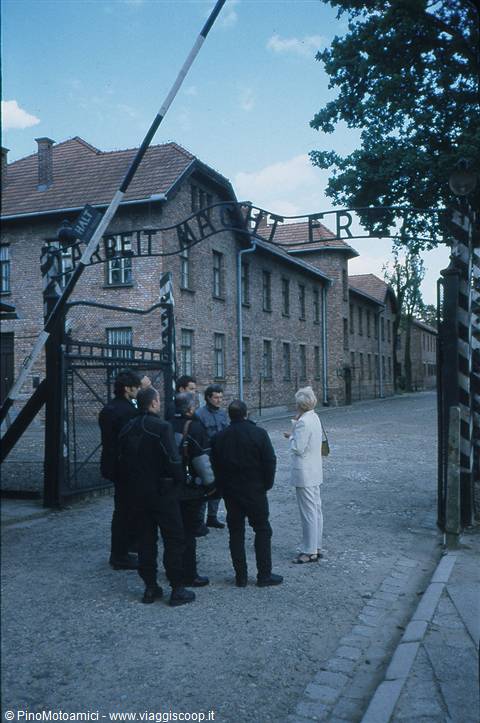
We set off early, splendid weather. We cover the rest of Slovakia, up to the Polish border, crossing the picturesque natural park area of the Tatra Mountains. Landscapes of singular beauty, lush and unspoiled nature, it feels like going back in time. The road that winds around the mountains invites you to lean into the bends. Various stops for photos and to admire the hamlets and villages of ancient Austro-Hungarian origin, an elegant architecture stifled in the years of Soviet influence in favour of the immense and impersonal housing estates built, for the most part, on the plains, near the factories. In the early afternoon we reach Auschwitz. We arrive at the old barracks that became sadly famous as the first Nazi concentration camp. In silence, awkwardly and almost in fear, we enter.
A guide accompanies us on the visit to the places of imprisonment, torture and the experimentation of mass extermination. Everything that can be described as an unimaginable human aberration is found at Auschwitz. We also go to the nearby Birkenau camp, the one reached by the railway tracks. In the camp, conceived and built to carry out mass extermination, degradation and infamy reached almost unbelievable levels; it's hard to believe our guide's account. Silence has fallen; even the cameras fall silent. It is almost evening when we get back on the bikes; a gloomy sunset accompanies us in search of a hotel, which we find near the train station. It's large, sprawling, half-empty, the ideal container for a mournful evening.
Leaden sky on waking, heavy rain on the bikes left in the open car park. Not exactly ideal for the demanding stage ahead of us: getting as far up Poland as possible and approaching the Lithuanian border. The rain has become pouring and we get to know the deadly conditions of Polish roads, mostly marked by deep ruts caused by heavy truck traffic. To keep up our average we absolutely must overtake the bulky vehicles, crossing and re-crossing the ruts that have become veritable channels. Tension and concentration are at their maximum. We ride in these conditions all morning. We skirt Warsaw to avoid local traffic. We decide to stop for the night at Lomza, not far from the Lithuanian border.
The weather has cleared and accompanies us to the border with Lithuania. We enter the Baltic republic. The landscape is as we had imagined, dominated by the green of the forests and the blue of the sky. The roads have improved too, well maintained, and we can start leaning into a few bends again. It's hot! The road runs alongside the bed of a river that will carry us towards the Baltic Sea. The countryside is simple but well kept. The rural tradition of this people is evident. The houses, small, one or two storeys and painted in bright colours, are made of wood, as are the church bell towers. Storks are ever-present, nesting everywhere. In the late afternoon we are near the sea, at Silute, which we choose to spend the night.
We stay in a curious hotel, early-1900s style; the bikes are put away in two storerooms behind the hotel, we are close to maritime traffic areas, you can never be too careful. It's hard to communicate, English is little known, German would be better.
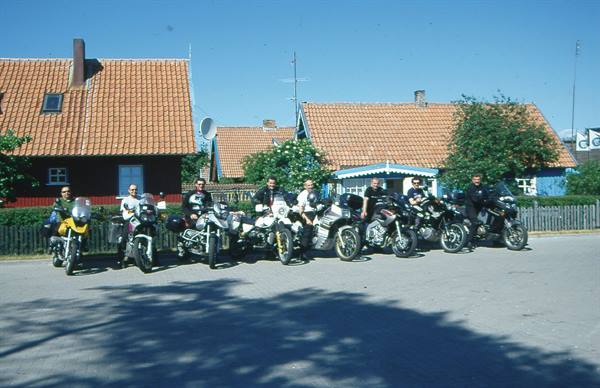
A warm morning accompanies us to the ferry that from Klaipeda takes us in a few minutes to the Neringa peninsula. It's a big pontoon that carries everything: vehicles of every kind, bicycles, passengers. The bikes attract interest and curiosity. Having disembarked on the peninsula, we leave the purely tourist area to venture into the park, heading south, to the border with the Russian enclave of Kaliningrad. The black ribbon of asphalt cuts through the forests that slope down to the sea and there is almost no traffic. Fewer and fewer tourists, a paradise. The first dunes begin to appear, replacing the pine woods. We stop to venture into the wood of the "Hill of Witches", an original collection of statues carved in wood, a testimony to popular traditions very widespread in these regions and rooted in ancient polytheism and totemism.
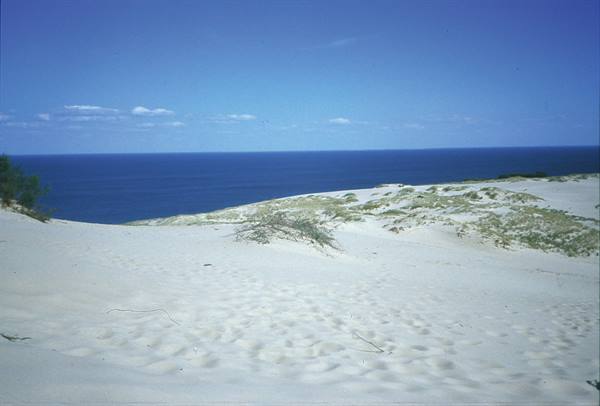
Back on the road, we continue towards the southern part; the landscape grows harsher, the sand dunes now follow one another ever more majestic and tall, until they tumble into the sea. Nida is the last little village, before the Russian border. Tidy, silent, with brightly coloured dachas; here we'll spend the night. But meanwhile, off towards the white dunes, which "move" under the gusts of wind. It is finally the "Lithuanian Sahara", over 2,500 km from home. Sunset finds us along the sea, on an endless beach swept by the wind; a few, truly brave ones, plunge into the icy waters of the Baltic. We settle into a comfortable dacha, run by a stern, military-like lady, who really does not look kindly on our bikes parked in the back garden. And from tomorrow the return begins.
Leaving the dunes of Neringa we head east, destination Vilnius, the capital. We cross a mostly flat area. The landscape is characterised by boundless cultivated fields, yellow and green, meeting the blue sky on the horizon. Past Siauliai, we detour to Kryziu Kalnas, the Hill of Crosses. It's a hill entirely covered with crosses, hundreds of thousands, millions, more, of every size, of every material, even hung one on another. Its origin is lost in time, but it is from the tsarist era and then, after the Second World War, during the years of Soviet rule, that it began to become a place of devotion; a pilgrimage opposed by the authorities and thus also become a symbol of resistance. We climb up the path that runs over the hill; the sun struggles through the cracks of the jungle of crosses and casts strange shadows, and you seem to lose your bearings.
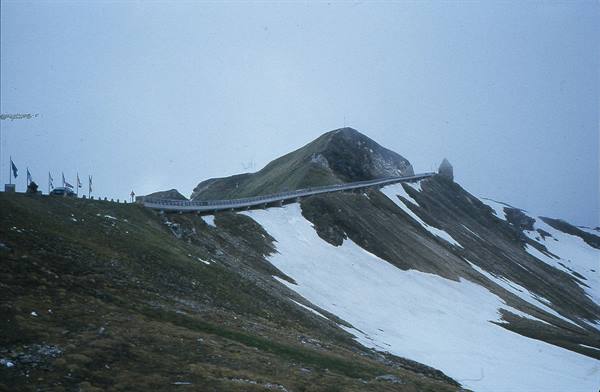
And who knows at night, perhaps with the wind, it might even feel like hearing voices. We buy a small wooden cross at one of the stalls; we didn't come to pray, we just want to bear witness to the visit to this symbolic hill. We hang it up with the words: "may we keep travelling in thought, in word, on the motorbike". In the evening a stop in the Lithuanian capital, Vilnius. From tomorrow the return, through the deadly Polish roads and the wide Austrian roads, passing over the Grossglockner.
The journey's photographs
5 photographs · click to open them full screen

0 reader comments