The story
It's four in the morning and the biting night air hits my face under the open helmet as I set off with Riccardo to meet the other friends under the usual statue of Garibaldi. The first leg is very demanding: we've decided to reach Oradea, the first city after the Romanian border, in a single day.
The next morning we make our way into the dark forests of the Carpathians, reaching the Maramureș region, which keeps its age-old traditions intact in a bucolic and silent setting, where farmers still work with tools that have disappeared elsewhere and where women still wear splendid, colourful costumes on Sundays and during the many popular festivals. We're lucky: today really is Sunday, and along the road we meet plenty of people out for a stroll. The men, with the traditional small straw hat on their heads, wear spotless white shirts, while the women walk arm in arm in their balloon skirts, showing off brightly coloured shawls. We cross these villages almost on tiptoe, aware of our loud and intrusive presence. Turning onto the road that runs along the border with Ukraine, we reach Săpânța, a small village famous for its Merry Cemetery, unique in the world.
It was 1935 when Stan Pătraș, a local artist, began decorating the grave crosses of his fellow villagers with brightly coloured naive scenes illustrating the virtues and faults of the deceased, all in a dazzling folk world that achieves the extraordinary effect of making even death cheerful.
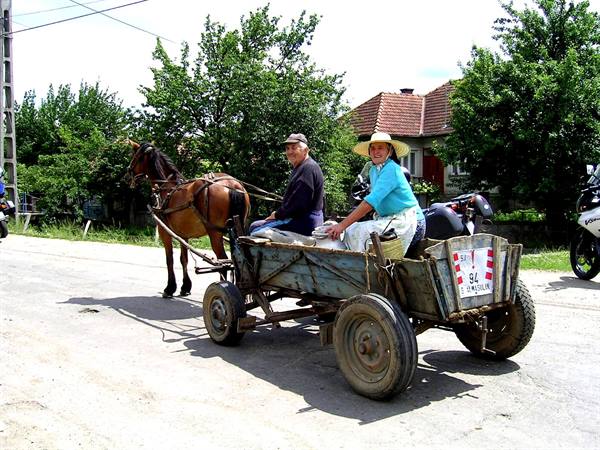
From Sighetu Marmației we take the narrow lane that runs alongside the Iza stream. Very few cars are on the road, just a few old trucks and some livestock-drawn carts. Among the many things that strike us is the evocative wooden architecture of the large hand-carved gateways of the house fences, more or less recent and variously maintained depending on the family's means. At Ieud, perhaps the most typical village in the area, we visit the oldest church in Maramureș, dating back to 1350 and still in perfect condition. Built of pine and fir wood, it has small windows, a double roof and a tall bell tower. Inside, a vast collection of icons of every kind and period decorates the walls. At last we reach the Voroneț Monastery.
Nuns robed in black move silently through the garden of the religious building, erected in the fifteenth century under the reign of Stephen the Great, a period when Bukovina lived its golden age. The outer walls were painted at a time when northern Moldavia was threatened by Turkish invaders. To educate and capture the interest of the soldiers and peasants, most of them illiterate, the best-known Bible stories were depicted, like modern comic strips, on the outer walls of the churches. The famous Voroneț blue forms the backdrop to all the usual images of saints, devils and sinners. An entire wall is taken up by the Last Judgment, something unique in the painted depictions of these monasteries, both for the space it occupies and for the grandeur of the scene.
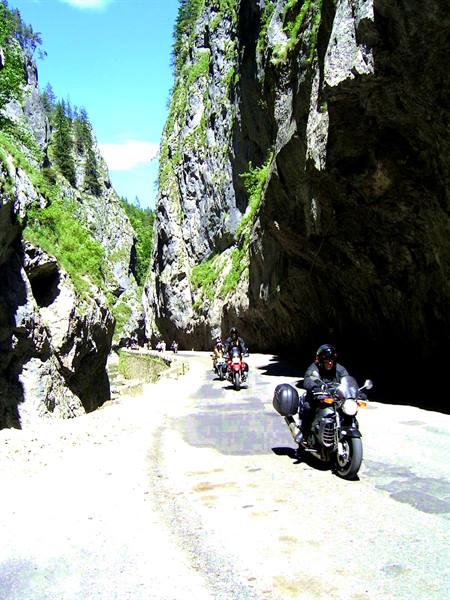
Christ dominates a crowd of fantastic animals, zodiac symbols, damned souls dressed in the turban of the hated Turks, tombs being opened, saints and prophets, archangels blowing into the buccine, the trumpets used by Moldavian peasants. The road, wide and inviting at first, at a certain point enters an ever narrower valley until, as if swallowed by the mountain, it slips between two high rock walls. These are the Bicaz Gorge, majestic and dark in the heart of the Carpathians. The spectacle is truly remarkable, with overhanging rocks, trees clinging and suspended between the steep walls, and patches of blue sky appearing at the tops of the mountains, all completed by the soft, pleasant sound of water rushing down the nearby stream. Just past the narrowest part of the canyon, the road, with its sweeping sinuous hairpin bends, climbs decisively towards the pass.
We ride in single file at a whisper of throttle, unhurried, enjoying the panorama rising above us. Shortly afterwards, having obtained a special permit, we ride our motorbikes through the beautiful historic centre of Sighișoara, passing along small cobbled streets and under ancient arches to reach the town hall, where we are expected for a meeting with the mayor. Around a large oval table our small delegation improvises a greeting to the city's highest representative, reciprocated by him with a small keepsake to take back to Italy. We round off the day with a walking tour of the town. Anyone who comes to Transylvania must go to Bran to see Dracula's castle. So, like true tourists, we head for this village near Brașov. Even as we approach, we can see it in the distance, rising in all its grandeur perched on top of a hill.
In reality this manor, an outpost of the Teutonic Knights against the Turkish advance, hosted Count Dracul, the cruel ruler of ancient Wallachia who gave rise to the legend of the famous vampire, only for a few days and as a prisoner. Other places in Romania are far more important in the Emperor's history, but this very well-preserved castle does indeed have a unique charm. In the afternoon the group splits up: some decide to take the road that crosses the Făgăraș Mountains in a succession of fast, fun sweeping bends, while the others stop in Brașov, an important Saxon city once a crossroads of commercial and cultural exchange in south-eastern Europe. Today it is the county capital and has become the tourist city par excellence thanks to its many monuments.
The main attraction is the Black Church, an enormous Gothic building that owes its name to its soot-blackened appearance, acquired in the great fire of 1689.
Today the return leg begins. In the early afternoon we decide to stop in Sibiu, an important town in the heart of Romania whose origins date back to 1192. Considered the capital of southern Transylvania, it was the most important of the seven cities founded by German settlers. Wherever we look, we can find traces of Sibiu's past. The buildings are painted in blue, red, orange and green; there are many cafés and restaurants, and also various interesting museums and churches. We stop in the town square, drawing the attention of people out strolling. Our motorbikes, with their colours and gleaming chrome, intrigue the young people who come up to exchange a few words with us. The boldest manage to wangle a ride around the square.
With some regret, after a while we leave this beautiful city; it's getting late and we still have three hundred kilometres to cover before reaching Arad, the last city that will host us before we finally leave this fascinating country. Pino Perugini
The journey's photographs
6 photographs · click to open them full screen



0 reader comments