Day 131 May 2010
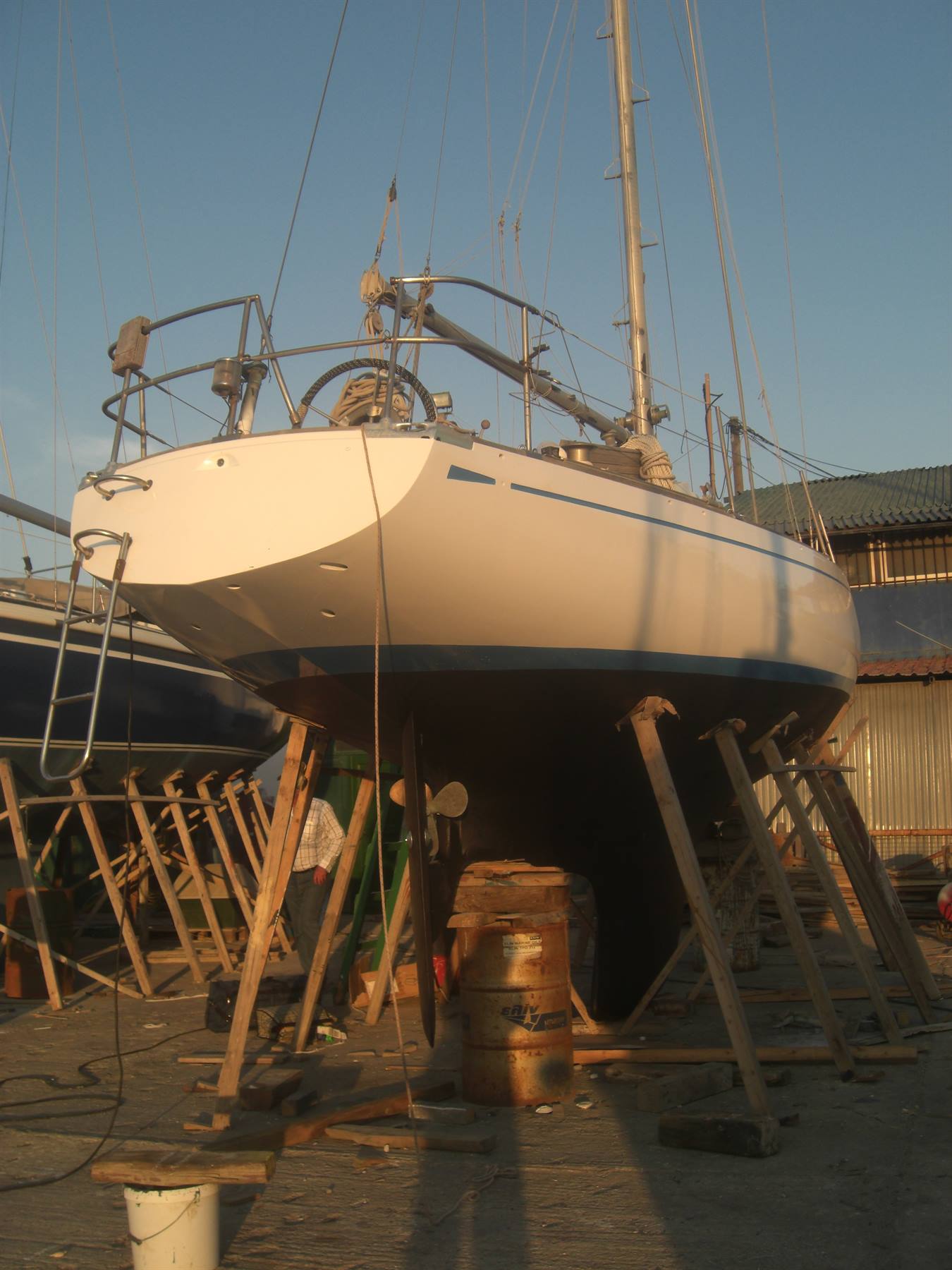
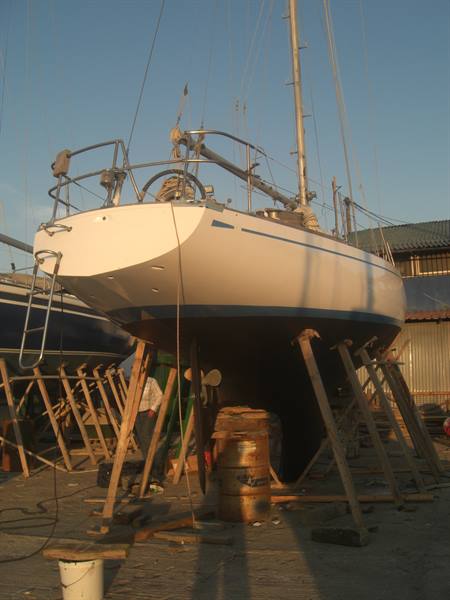
I arrived in Rhodes today on a scouting trip. The rest of the crew, of the first crew, will arrive tomorrow. I came to prepare the boat in good time, so as to be able to set sail the day after tomorrow. The routes have already been studied at the drawing board, with joyful anticipation and with the help of Google Earth, during the boring winter days. Everything settled, everything taken for granted, then? But no, the unexpected will spice up the cruise of Gattadapelare, indeed the cruises, because three different crews will take turns in the coming days on the waves of this southern Aegean. The Gatta appears to me still on the slipway and I almost struggle to recognise her: repainted and shiny, with no more scratches, stains, "memories" of boardings, with the keel finally protected by a black antifouling after years of abstinence.
The leak too, a memory of an unlucky launch that happened in Naussa, badly repaired several times by me, is definitively closed and invisible. I look with pride and love at the elegant lines of this boat and I think that boats like this are no longer made. Harmonious and an excellent sailor, she faces the waves with the calm awareness of her solidity and her stability.. Of course all this is to the disadvantage of capacity and speed., but we don't do regattas and the crews never exceed five members. When I go aboard, climbing the wobbly ladder provided by the boatyard, the deck and the cockpit appear to me in all their old age. It is time for a decisive and courageous intervention. I just have to decide which materials to use in relation to the final cost.
I would naturally like to have everything back in teak, but it is the most expensive material The alternatives are teak-dek (a synthetic imitation material), cork, or fibreglass, as Haluk, a Turkish technician, had advised me (an old acquaintance from the times when the boat was moored in Marmaris), whom I had invited to Rhodes last October to provide me with his consultancy. I will wait for Gino, arriving tomorrow, to discuss with him what to do. I make arrangements with the foreman to have an electrician tomorrow, (an "elettrologo" as they say here, a high-sounding word that suggests substantially large bills) and a technician to finish fitting the autopilot. I make a bit of space in the dinette and prepare my bunk for the first night on board. I already dream of the rocking of the Gatta moored in some lonely harbour and in the present stillness I fall asleep without a care.
I dedicate the day to preparing the boat. The sailmaker brings me the sails, left in his care in October, repaired and washed. The "elettrologo" also comes to look over the work to be done (small jobs in my view, mighty works in his). At 4 pm "the girls" arrive. They met in Athens, one coming from Vienna and the other from Rome, by now assiduous "gattonaute" and "daredevil" sailors. Will the secret pact they have made with Poseidon work this year too? Will we have flat calm and go by engine or will there be some wind? Perhaps a light breeze that will give us the illusion of being real sailors? We shall see. Meanwhile, for a softer approach to the week ahead, they settle into a hotel.
I had planned to leave on the 30th, but I had forgotten that tomorrow is Sunday. So the launch will be on Monday. Today Gino and Maria arrive
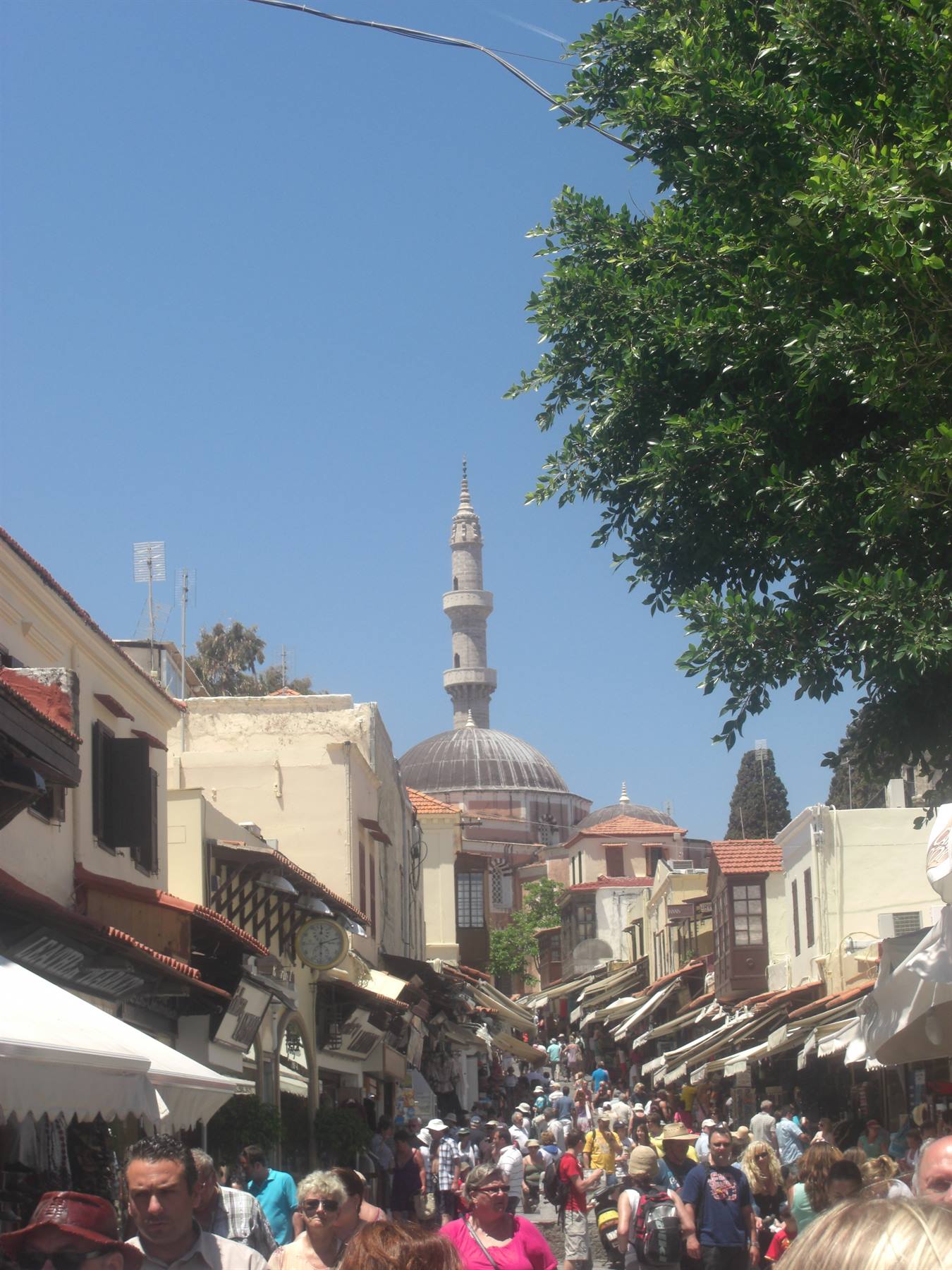
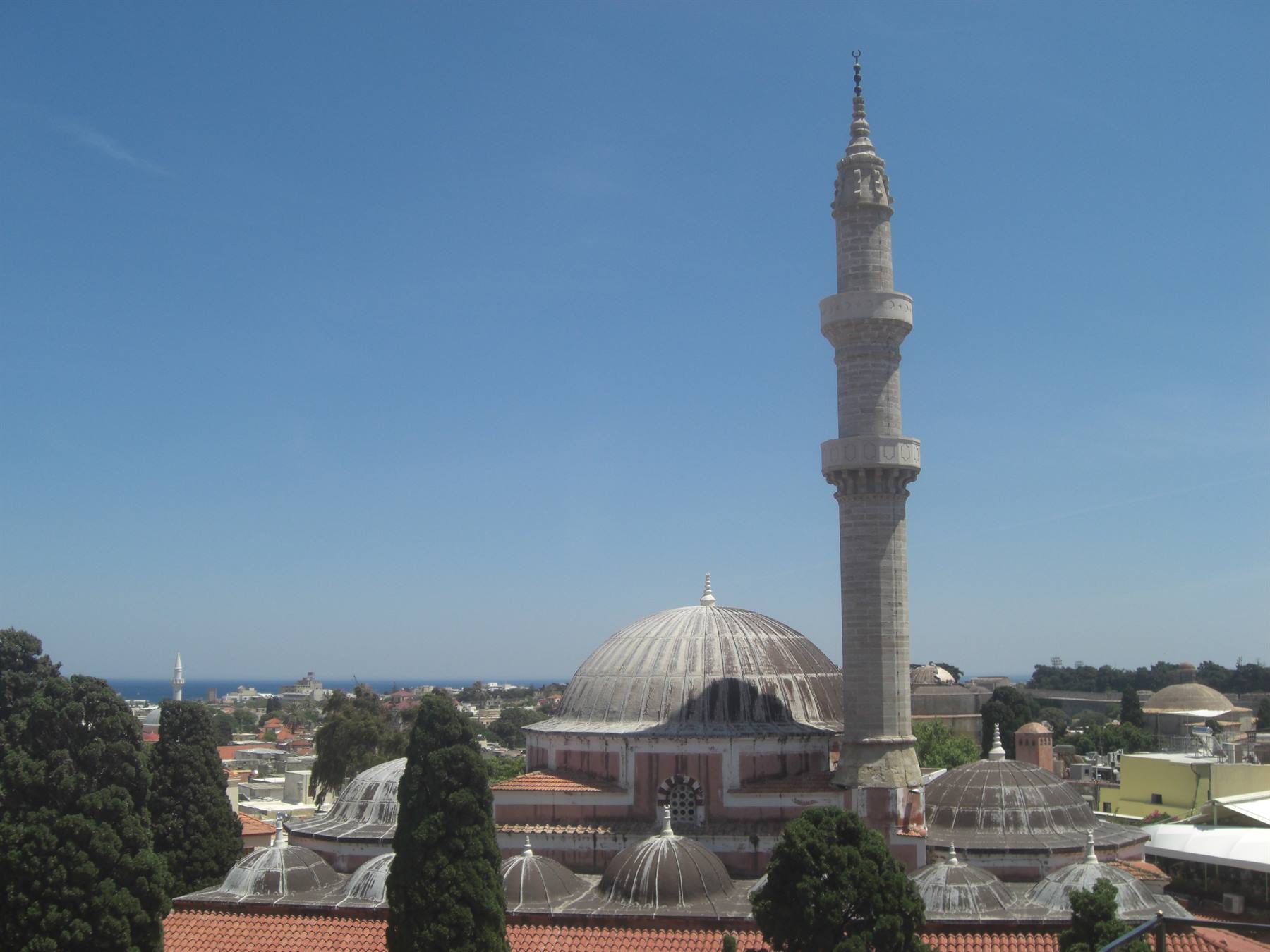
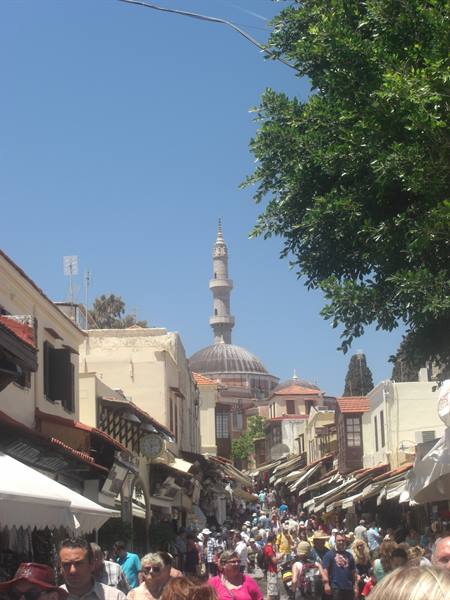
Today with the arrival of the "Hispanics" the crew is complete. Maria and Gino arrived last night and spent the first night in the belly of the Gattadapelare. But it seems that they too need to acclimatise, so much so that they have booked the hotel for tonight. In short, the only true "cat lover" is me. But it is taken for granted that the skipper is the "tough one" of the situation, the one who never abandons the ship. So, tonight I will sleep alone on board, and without the sleep-inducing rocking of the waves under the keel. We go to Lindos. This village, with its Cycladic architecture, made of white houses spread out at the foot of the acropolis, deserves the fame that brings many visitors here. Its origin is ancient, older than that of the capital, a city that its inhabitants helped to found. From here in ancient times departed the colonists who founded Gela in Magna Graecia.
The testimony of its importance is given by the remains of the numerous temples that stood on the acropolis. We hire four little donkeys and have ourselves carried up there. From the acropolis one commands an extraordinary panorama. To the east a wide bay hosts some sailing boats at anchor. Further away, in the direction of the capital, the coast first becomes low and sandy and then rises again. To the west, the acropolis drops sheer into the sea. The remains of the temple of Athena Lindia dominate this scenery. Below us a sort of inland lake, connected to the open sea by a narrow passage, prides itself on being the place of the Apostle Paul's landing. Further on, high cliffs fall sheer into the intensely blue sea. They were chosen for this to shoot the film "The Guns of Navarone", with David Niven, Gregory Peck, Anthony Quinn.. We spend some time on the beach before taking the way back.
After so much sea and so much time on dry land we feel an overpowering need to sail. The promises of freedom suggested by the wide panoramas we have seen today have made us impatient
May 31, 2010. Rhodes (Mandraki)-Island of Alimia. 32 miles
At last she's launched. Gattadapelare leaves the corner of the boatyard where she spent the winter and rolls toward the launching slip. The crew waits in the shade of the keel of a barge for the operations to finish, ready to bring aboard the luggage and provisions bought at the supermarket. Among these, the inevitable big bottle of ouzo that will mark the canonical hours of the coming days. When at last we feel the boat free to swim in the sea, a deep joy comes over us. It's an almost physical sensation that rises from the belly and works its way up to the throat, from where it would like to burst out in a shout hurled at the sky. Yauuuh!!! The bow is now turned westward. We have to sail almost the entire island of Rhodes to reach our first mooring, the welcoming bay of the island of Alimia.
We proceed with a light wind and calm sea, hugging the coast of Rhodes a couple of miles offshore. Too little, because when we see ahead of us a support dinghy for some divers and catch sight of the seabed, we think it more prudent to veer to starboard. Gattadapelare's external depth sounder has been out of order for years. There is one inside, next to the chart table, but it's inconvenient to use. One of us has to sit inside the boat and read the measurements aloud, which we do when we have to navigate through a mandatory passage. In the current case, it's enough to head offshore without troubling any sailor lazily sprawled on the cockpit cushions. In the late afternoon we reach the tranquil bay of Alimia. I've already written about this island in Gattadapelare's last cruise. Still, for this year's log a brief summary is in order. This island, small and hilly, is today uninhabited.
During the last war it became a German naval base, and the few houses of the village at the back of the bay were requisitioned and used by the German Navy command. The inhabitants were moved to nearby Halki and never returned. Today the village is totally abandoned, inhabited only by a few feral sheep. Only the little church shows some sign of use. As is customary in such cases, once a year a priest comes to hold Mass. We anchor in the calmest part of the bay, where there are already a couple of boats, and prepare for dinner and the night. A little earlier we had pulled alongside a fishing boat tied to the thick line of a mysterious mooring block. From them we bought a fine barracuda. I don't think its flesh is particularly tasty, but they had nothing else to offer us besides a handful of sea urchins.
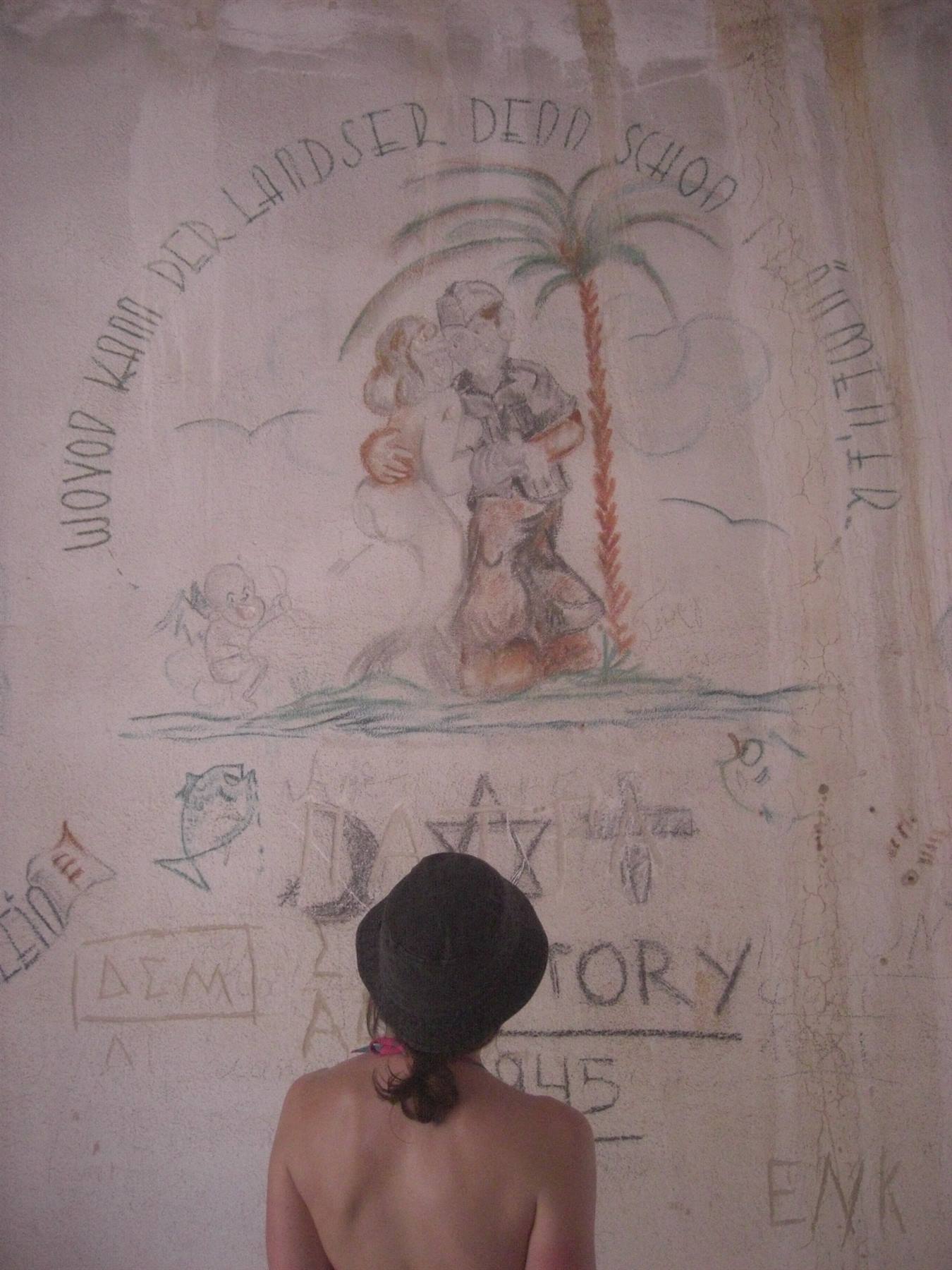
We visited once again the old barracks of the German sailors, whose remains, nibbled away by time, lie a few yards above the rocky shore. We paused before the drawings on the walls made by talented young artists, today ninety-year-olds if they survived the war and time. Drawings of northern mountains and villages, of alpine views, perhaps Bavarian or Tyrolean, ironic drawings depicting chubby "marmittoni," good soldier Schweiks, waiting for news or parcels from home. Drawings that ooze homesickness and a longing for normalcy, for peace, for oblivion from the war. We are moved before the suffering of young men called to fight for an absurd ideal, so far from their loved ones, indifferent to the azure beauty of these places. The feelings we experience transcend belonging to one belligerent side or the other. The unknown artists belong to humanity and express sentiments that unite us all.
But the magic of this uninhabited island soon distracts us from melancholy, and we go back to being carefree "gattonauts"
June 1, 2010 - Alimia
We set sail for Halki. We only have to cover 6 miles, but as soon as we get outside the well-protected bay of the island we find headwinds and a steadily rising sea. We see the waves advancing, from afar ever more adorned with foam. Choosing between a couple of hours of spray and jolting and the serene tranquility offered by Alimia is easy for us. We have no reason to hurry. We turn back. Today we're being lazy and staying here to enjoy the beauty of this inlet. We head to the back of the bay, where the remains of the village are, and visit it. Here paintings of torpedo boats and submarines adorn some rooms of what must have been the headquarters of the base. Some verses by Guido Gozzano come back to mind, verses I savor inwardly...
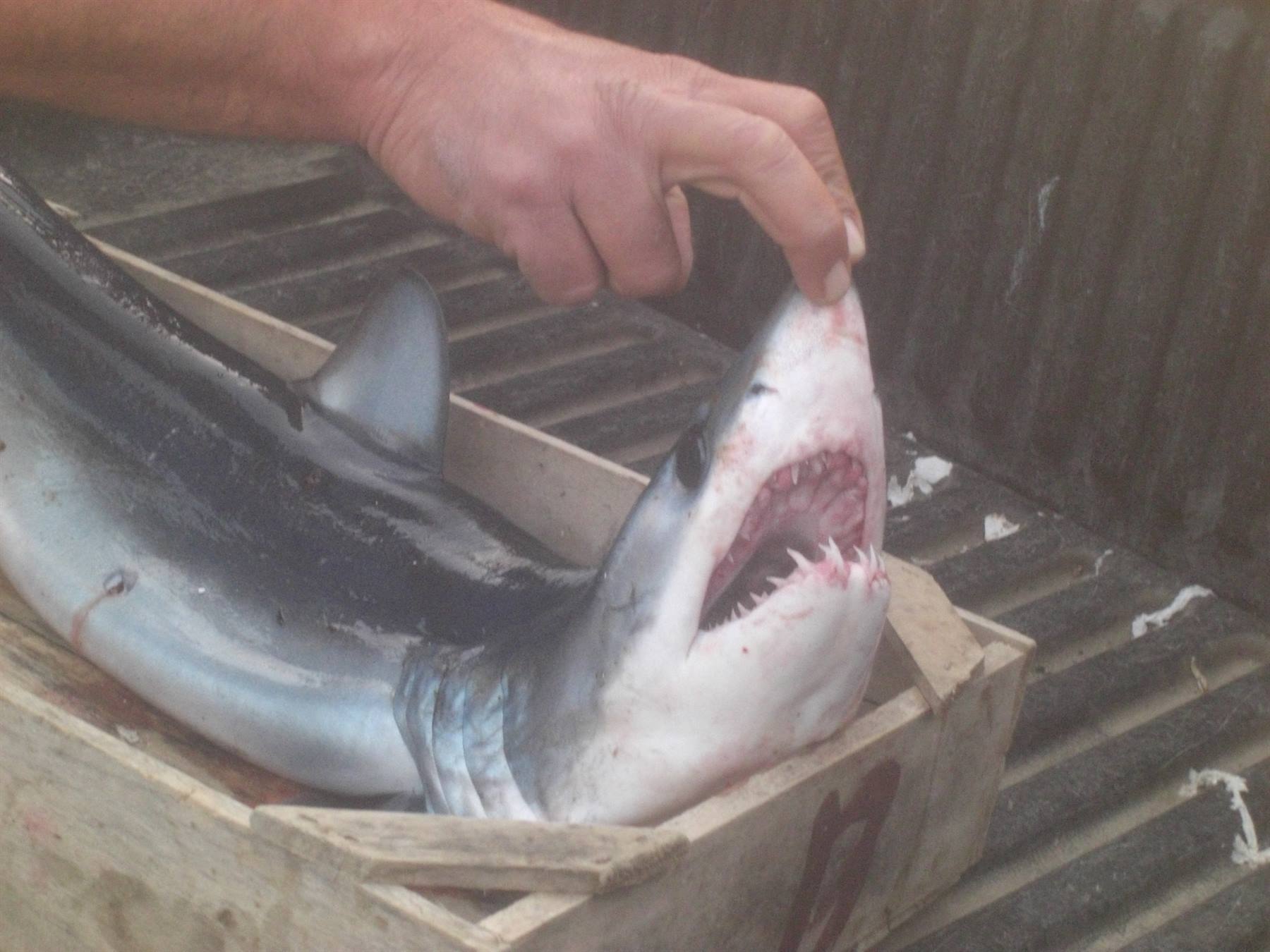
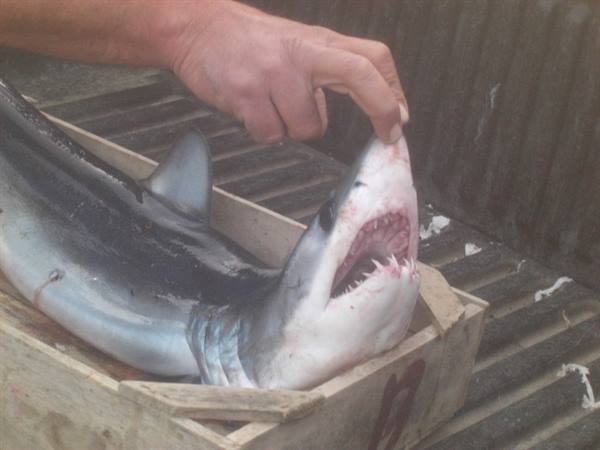
"smell of shadow, smell of the past, smell of desolate abandonment." The only inhabitants of the houses abandoned by man, the sheep, look at us and flee in fright. But Gattadapelare, rocking a few yards from the pebbly beach, calls us back to the present. A good toast with ouzo, and we return to our usual cheerfulness. We move to reach the original spot in the southern corner, the most protected, of the bay. I start fishing and catch some nice fish, already known to me for their firm, tasty flesh. I also catch another fish I didn't know, but whose photo I saw a few days ago in Rhodes on a poster at the police station. One of the few Greek words I managed to understand defined it as "epikindino," dangerous. Cautiously we unhook it, protecting the hand with a towel, and I observe it.
It has a whitish belly that swells as I handle it while it grunts from a mouth armed with teeth suited to grinding coral. It's clear it's not a native species, like the barracuda too, all fish that have arrived in the Mediterranean, now warmer than yesterday, through the Suez Canal. At the urging of the "girls" it is thrown back into the sea. Its danger remains unknown, but we promise ourselves to look into it once we're back home. (***Posthumous note: see related news at the end of the Logbook.)
A boat flying the Italian flag arrives and asks us for water and fire. They've been going through pasta withdrawal for a couple of days. So have we. We have what they're asking for, but on the Gatta the pasta has run out. So the conditions are there to set up a barter. They come alongside our boat, staying on their own anchor, and we cook in separate shifts to respect each other's "al dente" preferences. After the repainting we still haven't put the boat's name on her topsides: GATTADAPELARE. When our neighbors learn this, they recognize the boat as one they've seen somewhere before. It's not the first time this has happened. By now we've been sailing the Aegean, albeit for only a few weeks a year, for over a decade, and very few boats have their name written, and clearly visible (oh! the horror!), on their topsides. A disgraceful thing, it seems, but we like it that way.
June 2, 2010. Alimia-Halki, 5 miles
The neighbors want to leave, but during the night our boats have swung around together several times. The two chains are thoroughly tangled, and only after lengthy work do our Gino and a skipper from the other sailboat manage to free us. Halki is a small, extremely barren island, except for a narrow valley that from the ancient Chora, abandoned for years, descends toward the village on the sea. There are no other settlements, and the present-day village has in the past experienced the sad phenomenon of emigration to America of its men in search of work.
Today Halki is enjoying a phase of quiet rebirth, having been chosen by the English, who have established a significant colony here. The old and neglected neoclassical-style houses, spread along the shore, with foundations almost immersed in the sea, whose exceptional transparency invites you to slip in, eager to float carefree with your gaze lost in the cloudless sky — those houses are today skillfully renovated by the sons of Albion and subjected to the envious gazes of the rare tourists who come down to Halki, carried by small ferries that connect this island with Rhodes once a day. Everything comes from Rhodes, even drinking water.. Approaching our destination, from far off we already see a column of smoke rising into the clear sky.
At first we think it's due to the usual garbage fire, as one often sees while sailing around the islands, but as we get closer it appears to come from a ship anchored in the port. Burning — irony of fate — is the stern of the tanker that supplies Halki with drinking water. We don't dare dock at the small floating pier, meant for yachts, because it's too close to the burning ship, and we go to anchor in front of a taverna outside the village. Then, on foot, we reach the town just as the wreck is being towed away by a tugboat
June 3, 2010. Halki,
I find a lot of engine oil in the bilge and fear the worst. The mechanic reassures us: it's oil that came out of the filter, punctured by rust. I haven't thought about the filter in years. I only worry about having a couple of drive belts on board, after experiencing what it means to be without one, but the filter has never given me any concern. From today I'll have a spare one. And the fuel filter? That's never been changed either. But this is a sailboat — why is it only the engine that gives us trouble? Anyway, there are no spare parts on the island and we have to order one from Rhodes. It'll arrive tomorrow on the ferry. Forced into idleness, we spend the day between sessions at the kafenion and fruitless attempts to visit the interior. The only minibus that could take us up the island's only road, which reaches the only monastery, can't leave because Halki's only driver is sick.
Fortunately the tavernas are very pleasant. We have dinner at?a??a, our Maria's place, at a table painted blue, on a small square beneath the inevitable leafy tree, in a deeply Mediterranean — indeed Aegean — setting.
June 4, 2010. Halki-Diafani (Island of Karpathos). 35 miles
We wait impatiently for the arrival of the 11:00 ferry from Kamiros (Rhodes), which should bring us the oil filter, but when it arrives they tell us the spare part isn't there. This means we'll be stuck here for at least another day, the time needed to look for another possibility in Rhodes city. But our mechanic is full of initiative; he finds an old filter heaven knows where and installs it for us with many urgings to always keep another spare on board. And so, we leave — late, but we leave. Almost always the stretch of sea between the western tip of Rhodes and Karpathos is very windy due to the Venturi effect, but today it's flat calm and the crossing goes smoothly, with frequent ouzo toasts and pleasant conversation.
I navigate by sight, confident I'm heading for the little port of Diafani, which, even though time has passed since my first visit there with my daughter Marzia, I remember very well. It made a pleasant impression on me then, and I imagine little or nothing has changed. Karpathos isn't an island included in the usual offerings of tour operators; moreover, its northern part is poorly reachable from the capital due to unpaved roads. So, a place just the way we like it. The capital of this part of the island is Olymbos, a small village of 300 souls, perched on the ridge of Mount Profitis Elias. We arrive in the late afternoon and moor stern-to, today as then, at the pier near its end. There are no other boats, except the fishermen's, and everything appears unchanged to me.
I have the pleasant sensation that time has stopped, and with it the advance of my own life toward its final port of call. It's the quest for just such an illusion that drives us, drives me, to return to places of the past to rediscover and relive the sensations of then. And when they've remained the same as we remember them, we make that sweet and melancholy journey back in time that deludes us, for as long as the illusion lasts, that we too have remained unchanged. I stay on board to prepare dinner while my crew goes to explore the village of Diafani — the Transparent one — which stretches along the pebbly shore. A phone call from them urges me to join them. They've discovered a nice taverna and want to have dinner there. From the caller's voice I can hear the enthusiasm for the place, and that gladdens me, because I'm the one who proposed this cruise.
So I join them, walking along the only road that skirts the harbor, and discover that in fact Diafani has changed too. I don't remember there being so many tavernas in the village back then; I count around half a dozen, all equipped with large TV screens; there's the football World Cup to remind us that there are no corners of the world left untouched by worldliness.
June 5, 2010. Diafani - Kasos. 37 miles
We set off with the modern version of the bus of olden times. The minibus that takes us to Olymbos is full. The passengers, about fifteen, are mostly locals; among them also a couple of taciturn tourists who will get off before reaching the upper village. The vehicle climbs the winding road, but at a certain point it turns off to reach a scattered group of small houses that stand on a broad plateau devoted to farming. A few vegetable plots, some fields of grain, goats and scratching poultry. A poor agriculture, but important enough to justify human settlement. In the village — if that's what you can call the point where the houses are closest together — where our driver drops off some passengers, including the taciturn tourist seated in the row next to whom I was unable to attribute any nationality, there's also a rustic, would-be kafenion.
Here, under an improbable trellis, an elderly German couple is having breakfast, reading a newspaper bought who knows when and who knows where. After the brief stop we resume the journey and after endless more curves perched over precipices and cliffs, we finally reach Olymbos. We are greeted by images of a time gone by. Elderly women in traditional dress buy vegetables from a traveling greengrocer, a little old lady dressed in black climbs the steep path that winds among the lower houses. She carries a sack on her shoulders, also black, which we imagine is full of simple things. I remember another similar scene from the first time I came here with my daughter; another little old lady (or perhaps the same one?) was climbing the path we were descending. She too carried a sack on her shoulders, and the flour it contained had whitened her shoulders.
An emblematic apparition, because Olymbos is famous for its bread, a bread baked in the ovens that almost every house possesses, a superb bread, heavy, savory, in the shape of large round loaves with a crust fragrant with ancestral poetry. In Olymbos there are no bakers; every family makes its own bread, and if a visitor wants to eat any they must necessarily go to a taverna. Today there are about a dozen tavernas, and also little souvenir shops, but along the narrow lanes that touch the village houses, no herds of tourists walk. Olymbos is a village for knowledgeable tourism, respectful of its jealous tradition and its silences. The village sits on the watershed ridge of the mountain and looks down from on high over a coastline of indescribable beauty.
From the terraces, the balconies, the gaps between the houses one glimpses a panorama of blue and sun that reveals, in the thin summer haze, the coasts of Crete, of Kasos, and of other islands scattered in the sea of the gods. We walk through the alleys. From the little shops, women in traditional dress come out to offer us their wares. One of them I seem to recognize. At home I have a photo of her and my daughter together, smiling as they try on a shawl. I ask if she's the one, and the woman smiles: she remembers. Further on there's a little square and the church and a modest taverna where, the first time I was here, Marzia and I listened to the innkeeper and his little son playing those violin-like instruments called lyres here. The boy had a small one, almost a toy, suited to his age.
Here we have breakfast, we of the Gatta, on a terrace bathed in the light and quiet of this unique Aegean village. I ask for news of that boy who played the lyre so many years ago, and his father tells us he's now at university on the mainland, in Thessaloniki. And yet everything here seems unchanged to me — the village, the people, the sensations all this conveys. We head back. There's no service to return to Diafani, and bravely we set off on foot along the paved road. It will take us almost a couple of hours to cover the seven kilometers to the little port where the boat awaits to set sail for Kasos. But for the "girls" luck is just around the corner — or rather, the bend. The garbage truck takes them on board, between the driver (but isn't he the same one as the minibus driver!!!) and his African helper. There's no room for us.
We watch them leave, smiling and a bit puzzled, with big and perhaps superstitious waves. We three — Maria, Gino and I — continue our descent, but watchful for other cars approaching. An off-road vehicle driven by an Englishman (?) deliberately ignores us and drives on, pursued by our spiteful comments, but a pick-up takes us on board, welcoming us into its bed and carrying us to Diafani, tackling the curves and hairpin bends with cheerful recklessness. Just close your eyes or look away. The separate waste collection worked: the "girls" are waiting for us at the pier. We set off heading for Kasos with a calm sea and little wind. Karpathos glides serenely past on our starboard side down to its southern tip. Here the wind freshens because the island's mountains drop away to vanish into a plain where the airport is located and open the way to the winds.
Shortly before rounding the point to head northwest toward the island of Kasos, we see again the rusted wreck of a ship that a breakdown drove aground many years ago. In the channel between the two islands the wind strengthens and comes from astern, finally giving us the pleasure of running with the waves chasing us. It even rains a little, but spirits are high, also helped by the inevitable ouzo. When we arrive at Fri, the capital of Kasos, it's nearly dusk. We find a stern-to spot among three other boats, almost at the head of the long pier. Kasos takes its name from that of a Minoan prince of Crete who lived there first. Homer mentions this island in the Iliad, as the place where the Trojan War was decided. The village doesn't strike us as evocative, and after exploring it our first impression is confirmed. It seems sad to us, almost squalid.
Kasos took part with Athens in the war against the Persians. It was a pirates' lair and a dominion of Venice, but it reached its greatest economic and commercial splendor under Turkish rule. Because its great merchant fleet went over to the service of Greece in 1821 in the war of independence against the Turks, they took revenge by massacring the inhabitants and razing Fri to the ground. Since then it never recovered, and the memory of its misfortune seems to still hover around us. On another island that suffered the same fate, I felt similar sensations. It's Psara, west of Chios. Also the homeland of national hero Kanaris, populous, rich and flourishing before rebelling against the Turkish empire, today it's a mere shadow of itself. We have dinner at a taverna on the harbor. There are only men, and the inevitable priest.
We're woken by the loud noises of a crane lifting enormous boulders to extend the pier. The English boat that was ahead of us, up against the construction site, changes mooring in a cloud of dust. We do a bit more provisioning and set off to reach the last port of this first crew of Gattadapelare. In Sitia, in a few days Gino and Gianfranco will come aboard and we'll return to Rhodes, where they'll swap with the second crew. Gattadapelare this year too seems like a charter boat. With a calm sea but a good wind, we sail serenely toward the promontory in the northeast of the island of Crete, beyond which, in a wide inlet, Sitia looks out. We see the Dionesiades gliding past on our right, uninhabited islets, and a few miles later we arrive at the town. Sitia's pier is long and we easily find a place among some other sailing boats and a few fishing boats.
The town has ten thousand inhabitants and its architecture isn't exciting — the buildings are modern and it lacks the charm of the picturesque Greece of the small island villages. I find it much changed since I was here with my daughter in 1997. Today a long row of restaurants runs along the sea, and it has all the other features of a tourist town. It's mainly Greek tourism, more homegrown and, to us, more acceptable than international tourism, which is predictable and boring. We have dinner at a taverna, invited and welcomed by a beautiful Russian "maître d'," who doesn't win the sympathy of the female part of Gattadapelare's crew. Neither Gino nor I have any objection. The eye wants its part too. We make arrangements to rent a car for the next three days to spend touring Crete.
We're heading for the island's capital, Heraklion. The road, full of curves, is lined with oleander bushes and every so often opens onto evocative views of coast and sea. Crete is the largest Greek island and the fourth largest in the Mediterranean. Its size is such that you feel no sense of restriction. At Aghios Nikolaos, a cheerful coastal town with a more international tourist vocation than Sitia's, we stop to eat, and we reach Heraklion in the early afternoon. This is a city that isn't particularly charming, but it houses a very interesting archaeological museum and, a few kilometers from the center, the archaeological excavations of the palace-city of Knossos. By now the crew's time is numbered. Tomorrow we'll visit the palace and museum, and the day after tomorrow Maria and Gino will take the plane back to Brussels. Then it'll be Gerlinde and Elke's turn.
We check into a hotel in the center and go wandering through the city streets. Aside from the Venetian vestiges of the castle on the port and the remains of the old arsenal, there's nothing else to recall the importance this city had in the history of past trade. A beautiful fountain dedicated to the Venetian admiral Morosini adorns Heraklion's central square, commemorating the building of a city aqueduct.
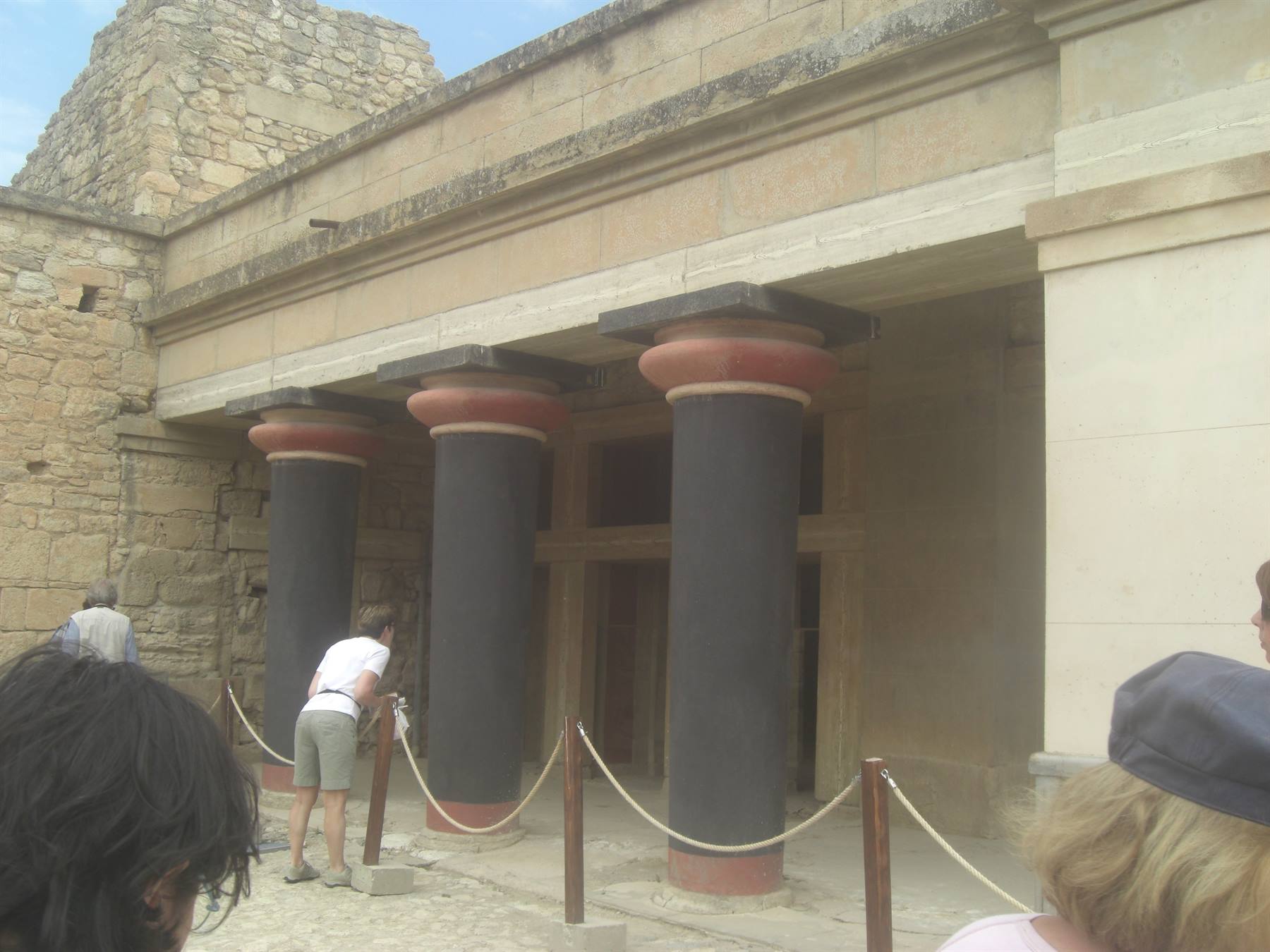
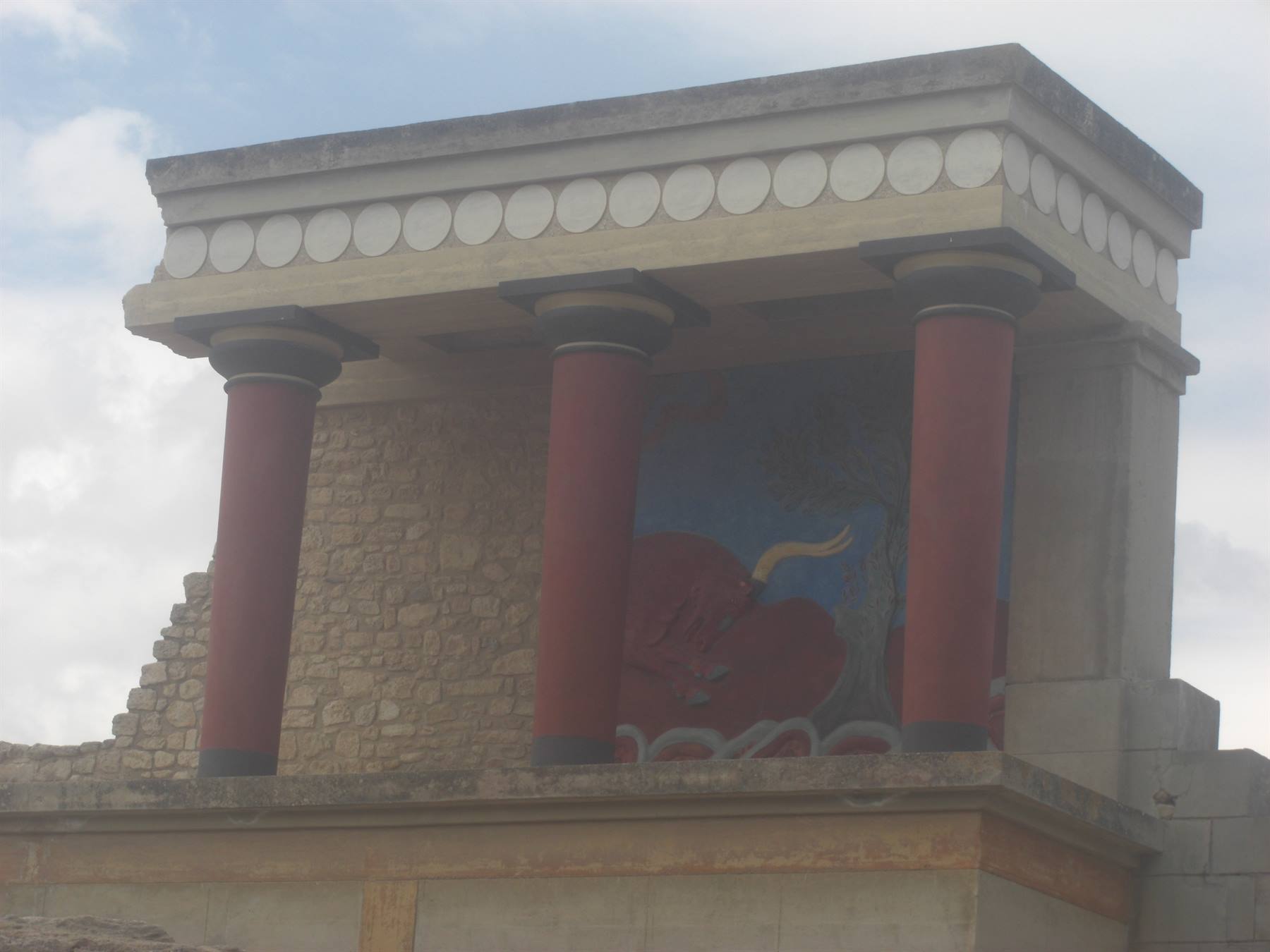
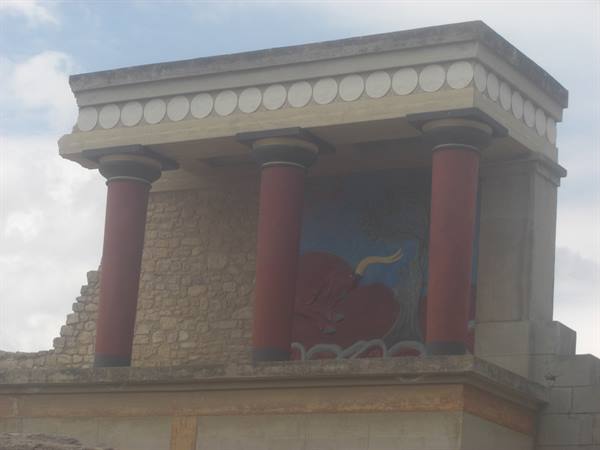
We went to visit Knossos. Here too I found a multitude of tourists that weren't there ten years ago. The phenomenon is by now inescapable, and I'm in a hurry to go to places still unknown, to experience them savoring their authenticity. In a few years there won't be a corner of this country and of this wonderful sea that hasn't been disfigured by the presence of Bermuda shorts and Hawaiian shirts. Among the less frequented remains of Minos's palace we let ourselves be carried along more by myth than by history, and Evans's reconstructions didn't offend us — on the contrary, they helped us better understand the splendor of that distant era. The visit to the archaeological museum was also a must, but equally of great interest. The painting and ceramic art of that people reveal their pleasure-loving and elegant nature.
Some vases and furnishings have characteristics of surprising modernity, such as to make us think they are ferrymen of Minoan culture among us. In the afternoon we change hotels. Now we're right on the sea, and from our rooms we enjoy a beautiful view of the Aegean and the setting sun.
June 9 Heraklion.
One last toast with Maria and Gino, and then we accompany them to the airport. It's the moment for farewells and promises, but we all know that even though they're sailors' promises, we "gattonauts" will keep them; next year to Kastellorizo, the most far-flung Greek island, and then, along the Turquoise Coast, we'll head up until we leave the boat in Leros or Patmos for its annual rest. Curious to also see the excavations of Phaistos, we leave the Aegean coast to reach the Libyan Sea. There's a little lake, among the hills of the island's interior, renowned among Cretans as a place of delightful rest and for the trout cooked in a couple of tavernas in the place called Aghios Nikolaos. The spot lives up to the islanders' expectations, certainly pleasant and a destination for Sunday outings, but the trout have prohibitive prices that lead us to order less precious dishes.
Phaistos reproduces the pattern of the Minoan "palace," but here the archaeologists have respected the original state of the finds. The position is excellent; the palace is situated on a plateau overlooking all around a highly fertile plain rich in olive groves and vineyards. Here you see only a few tourists. After a few kilometers we reach on the coast Matala, the ancient Matalon, a seaside town, also very "touristified." Little shops, tavernas and cafés, but also a beautiful beach at the back of a wide bay, where the sea arrives with waves that appear different to us from those of the Aegean. These are big and well-formed — rollers, in short — while those are small and frequent, nervous, with whitening foam crests. Restless little horses. In the limestone coast, which on the other side of the beach rises for some tens of meters, many man-made caves open up.
In antiquity dwellings of the living, and later, in Roman times, tombs. Some of these recall in the form and arrangement of the niches the Etruscan tombs in the tufa of our Tuscany. A panoramic spot for an endless rest, caressed by the eternal sound of the sea that rises all the way up there. We return toward evening to Heraklion. At the hotel we're greeted by the spectacle of the entertainers of the Italian club that has occupied the entire building.
The "girls" leave.
I found an apartment for rent a short distance from the airport, with permission to pick apricots from the garden surrounding the house. We take the opportunity to amply restock the Gatta's galley. We await tomorrow's arrival of the third member of the new crew, Pino, fresh from Cuba. I go to pick up the new windlass ordered when we arrived in Heraklion. Fortunately in recent days we've never needed to anchor.
Pino tells us he'll arrive in the afternoon and will meet us in Sitia. We get there ahead of him by car and prepare the boat for tomorrow's departure. By evening the three of us are reunited and in good spirits. Nine days of sailing await us before the next crew change.
I get help from a fisherman on the nearby fishing boat to replace the windlass. He works for about half an hour on the mechanical part only and declares himself unable to do the electrical connections. I pay him fifty euros, which leave him unhappy. Off we go with a fine wind almost on a broad reach and a calm sea. The boat sails pleasantly and we arrive at Kasos in the late afternoon. On the wide open area at the back of the port there's a pretension of entertainment. Loud disco music accompanies us for several hours into the night. Pino, having gone exploring, came back disappointed, though. Few people and ugly women.
June 13. Kasos-Diafani, 37 miles.
Before leaving we do provisioning in the only shop we find. I look for ice, indispensable because the fridge has been out of order for years. There's none to be found, but the bartender at the end of the pier gives us a big bag of it. In Greece such gestures of generosity aren't rare, and this is one more reason this people, whom I feel — and who are — friendly toward us Italians, endears itself to me. This time too I don't know how often I've heard the refrain "same face, same race" or the variant "mia fatsa, mia ratsa." Certainly the ties uniting the two peoples are strong and ancient. From Magna Graecia to today, passing through the period of Roman domination, the influence of the Eastern Roman Empire, the Byzantine era, the cultures — Italian and Greek — have interwoven and blended like no others in the world.
In the channel between Kasos and Karpathos the wind strengthens and comes from astern, but once we round the island's tip we have it on the beam until our arrival at Diafani in the late afternoon. Shortly before docking we catch a nice little tuna. At the beginning of the village, coming from the port, there's a café run by an Italian woman who ended up here some years ago, captivated by the island's charm. Sitting under the pergola of the small raised veranda, we enjoy the pleasure of having nothing to do and chat about the place and human destinies. Tonight there'll be a party up there, in Olymbos, a thoroughly village-style celebration. Given the season and the difficulty, in any case, of reaching the village from other parts of the island, few tourists will certainly be there. But we won't be there either: we can't find any means of transport to take us up.
Diafani's only taxi has already left, and the service minibus will only be available tomorrow morning at 7:30. We're very sorry, because it would have been a unique chance to spend a few hours in a genuine, spontaneous world among people busy celebrating their customs and centuries-old traditions, which are the cement of their proudly village-based existence We have dinner on board and go get gelato from our Italian friend.
June 14, 2010. Karpathos (Diafani)- Rhodes (Lindos). 50 miles.
We don't wake up in time to catch the minibus up to Olymbos. But it's just as well, because an officer of the local harbor authority — which I imagine consists only of him — orders us to move and leave at once. The sea rose during the night, and the 10:00 ferry will dock on the leeward side of the pier. This rules out the possibility of going to Olymbos while leaving the boat alone on the anchor. But on the beach, in front of the tavernas, there's a small pier that I go to inspect. A fisherman working on his boat tells me there are at least four meters of water at its head. It doesn't look like it, but in any case there's enough depth for our Gatta, and we go to moor there. But here too at 11:00 the barge bringing tourists from the capital will arrive, and this forces us to dock on one side of the pier, expecting to touch bottom.
But nothing happens; there's no swell here, and this reassures us. The officer arrives again to observe us and concludes that we can stay there. An Italian boat that has just arrived isn't so lucky, and has to weigh anchor and stay out at sea. At 11:00 the barge arrives to offload about twenty Slovenian tourists. A bus is waiting for them, and we're allowed to get on too, and so up we go — I for the second time this year — to "Olympos." The usual scenes repeat themselves: the women in traditional dress come out of their little shops and address us in halting but fruitful Italian. Pino buys something everywhere, mostly shirts and t-shirts, and we, shy and smiling, stand watching from two steps away. On a small, delightful little terrace in the shade of a windmill, we stay watching the sea below us, drinking ouzo and tasting "pites" fresh out of the oven lit nearby.
All around, a panorama of mountains and sea. Perhaps this is Jupiter's Olympus. To go back down to Diafani, we opt, necessarily, for walking. We take the old mule track that leads to the sea and, bravely, set off to face the two-hour route. The places are bucolic and archaic. We quench our thirst at a spring, which appeared providentially after we'd run out of mineral water, gather aromatic herbs, climb and descend rocky slopes, until the path crosses the drivable road. Here the asphalt tempts us into the sin of laziness; we ask for a ride in a pick-up and, closing our eyes as always to avoid seeing the chasms awaiting us at every bend tackled with cheerful boldness, we ride down. For dinner our Italian friend has prepared a delicious goat stew.
June 15, 2010 Diafani-Lindos (Rhodes). 46 miles.
We leave the bay minding the shallow bottom that appears close to us, intending to head north to reach Halki, but once outside we find wind and sea on a very close haul. The day is already advanced and the idea of battling for hours to reach the island doesn't appeal to us. Better to stretch east and pass below the island of Rhodes to reach the welcoming inlet of Lindos. Hugging the
16 June 2010. Lindos-Rhodes town. 45 miles
My companions go up the acropolis on the donkeys while I stay on the beach reading an Italian newspaper several days old. News that is by now outdated and no longer stirring. Who knows what has happened in the meantime and, above all, who cares. In these places we live a reality detached from the graces and misfortunes of the world we left behind when we departed from Italy. An alternative reality that fascinates us to the point of drugging us. We know that our duties will soon bring us back to the other reality, but we understand why at sea one meets so many people whom we, from the tyrannical reality, call, with a touch of irony and a touch of envy, alternatives. People who have thrown their former life behind them and roam the seas free, with no other homeland than their own boat.
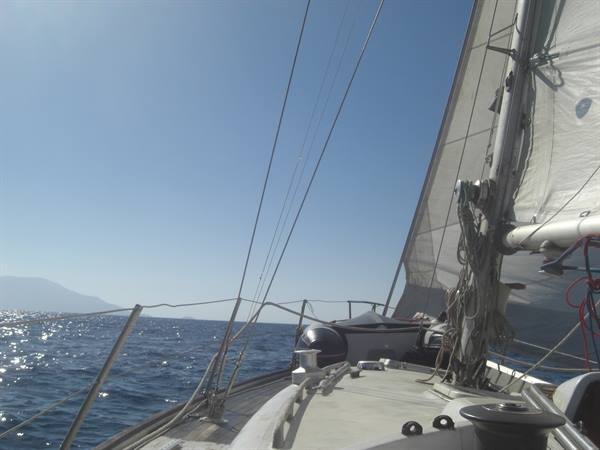
They are lonely people, almost always men, mostly bearded, sometimes accompanied by a dog, but also elderly retired couples, on clean and spotless boats, well ordered, furnished with cushions and curtains at the portholes, almost always accompanied by a cat. Here in Lindos there are many more tourists than two weeks ago. Boats keep arriving from the capital, unloading a very vast sample of humanity that files past my deckchair. By the time my friends return I have already had my fill of worldly life and am ready to put out to sea again on the lonely sea. We eat at the table and set off. Today the wind is not as strong as yesterday and we proceed always on a broad reach, but without that annoying vibrating of the upper part of the mainsail. The island of Rhodes shelters us from the swell and only when we round its eastern tip, behind which the city hides, do we find a bit of sea again.
Certainly we will not find a place in Mandraki harbour and we have to refill with water. The best solution is to find shelter in the first wide inlet protected to the south by a long pier where the large ships dock and which also overlooks the basin of the "carnaio" that has hosted Gattadapelare for the whole winter. With swell and wind coming in, a comfortable mooring in the basin is not possible for us, so we move to the leeward side of the harbour and pay out all our fifty metres of chain on four metres of bottom to earn ourselves a peaceful evening in town. Despite this, the fear that during our absence the anchor might drag does not leave the skipper, always anxious. On our return everything is fine and the night passes peacefully.
17 June 2010. Rhodes-Symi Island, 23 miles
We are woken by the peremptory scream of a ship's siren that, to dock, has to manoeuvre right in our stretch of water. We hurry to weigh anchor and then slip into the carnaio basin. The wind has dropped and yesterday evening's swell, which prevented us from holding our position in the basin, no longer comes in. Having refilled with water we bid farewell to the staff ashore and head out for Symi. Symi is an island that is the destination of excursions by numerous boats coming from Rhodes. It is counted among the best tourist objectives for a middle-aged public who, however, do not stay there more than a few hours. That is why the town appears quiet, without the typical confusion of other sites like Ios, Skiathos or Mykonos. The harbour is always full of boats, even at this time of year, but ashore we meet few people.
Homer tells us that Symi took part in the expedition against Troy with several ships, and its fame for possessing fast vessels earned it the task of providing the postal service during the Ottoman empire. During the last conflict it also suffered bombardments aimed at hitting the Italian and later German ships that were based in the deep inlet around which the town rises. Its neoclassical-style houses decorated with pastel colours are the characteristic of the island. I have found similar ones only in Kastellorizo and a few in Halki. For the rest, the Aegean islands present "Cycladic"-type dwellings, as we know them from all the classic photos that emphasise Greece; low houses, whitewashed with doors and windows brightly painted in blue, red, ochre yellow. We wander here and there without a destination and spend several hours in the cafenion.
Surprisingly a fourth guest of Gattadapelare joins us; it is the famous cousin of Pino who last year stood us up and at the last moment gave up coming on the cruise with us. Gianfelice immediately shows enthusiasm for this new experience of his and we welcome him warmly. We dine on board with roast lamb. After an evening spent at the table of a very noisy place on an alley, in the unusual din of rock music, we return grateful to the tranquillity of our boat which waits patiently, squeezed between two others, in suspicion of crossed anchors with the English boat to our left.
18 June 2010 Symi-Turkey (Bozukkale) 11 miles
And indeed our anchor is tangled with another's chain. After several attempts we finally manage to free ourselves and move away on a sea flat calm. We pass two other boats, a large catamaran and a sloop, which have the same problem and are circling round each other, in the middle of the channel. But we, now free, proceed without troublesome thoughts to discover an inlet, Bozzukkale, on the Turkish coast a few miles away. In the pilot book it is described as pleasant and well protected. We cover the few miles that separate Greece from Turkey. We change the courtesy flag when we reckon we are in the territorial waters of the Crescent and shortly afterwards we enter the bay, a natural harbour surrounded by a mountainous landscape. At its far end the ruins of the city of Loryma can be glimpsed.
The entrance on the west side is dominated by the well-preserved remains of a Hellenistic-era castle whose long walls do not betray their age. We are looking for a little beach where we can organise a barbecue. We find one on the right, admittedly not very protected, but we have to make do, there are no others available. We ferry ashore everything we need in several trips and cook grilled chicken. The beach is stony and arid. I keep our boat constantly under observation; it is oriented by the wind parallel to the shore, but with the stern towards the cliff that closes the beach on one side. It seems to me that the anchor has started to drag and the skipper's anxiety, fed by the owner's, pushes me to get back on board as soon as possible. We really are dragging and by now I find myself about ten metres from the coast.
In these cases I always ask myself what I would do if the engine didn't start. It has already happened to me three times to have been betrayed by the boat's engine in very difficult moments, but at the last moment we managed to save Gattadapelare. These are experiences that mark the soul and contribute to the anxious state in which the owner lives for the whole time he is on the cruise. The joking question one asks in convivial moments is how one recognises an owner from the rest of the crew when ashore. The answer is: "It's always the one who isn't laughing". Anyway the engine started after interminable seconds of preheating the glow plugs, during which my gaze remained fixed on the menacing rocks. We move to the other side of the bay where we see some sloops moored at the jetty of a modest taverna.
We are welcomed very helpfully by the manager and by some boats, almost all manoeuvred by corpulent Turkish women in trousers, laden with shirts, t-shirts, towels, carpets and whatever else might interest the tourist. Pino makes purchases.. It is hot and we spend a long time immersed in the water, leaning on the rocks, among numerous sea cicadas tied to little lines fixed to the rocks, ready to be fished up again by the tavern keeper for dinner. The taverna is called "Ali Baba" and makes no mention of the 40 thieves, but from the menu prices we think they are hidden in the kitchen. Turkey has become rather expensive for the cruiser, compared with Greece, and, in any case, ever cheaper than Italy. Boats with the Italian flag used to be a rarity, but now, with every passing year, we meet more and more.
Deep down the thing disturbs us a little because it takes away the feeling of being the ones with the privilege of the uniqueness of discovering these anchorages. We eat on the taverna terrace together with four other Central European crews, disdaining the offers of lobster and Changaia wine that the tavern keeper, hopeful at first, then disappointed and then disdainful, had put to us. A serene night spent in a welcoming corner of Turkey. The women traders also sleep in their poor little boats, dreaming of the arrival, tomorrow, of numerous Pinos.
19 June 2010. (Turkey). Bozukkale- Serce Limani. 3 miles
Next to this bay there is another, smaller one with two opposite inlets each hosting, at the far end, a taverna. The one on the right seems more attractive to us, where four sailing boats are already moored on the mooring buoys, and there we slip in. Other small boats too, some of them local fishermen's, are drawn up to the shore, and a couple of them detach themselves to come and offer us the usual merchandise. Pino, naturally, buys here too. The tavern keeper also turns up and invites us to eat at his place. The shores are rocky, steep, crossed by a path on which scenes of archaic life unfold. A man passes dragging a donkey, then another carrying on his shoulders, holding it by the legs, a bleating kid. He is preceded by a happy, wagging dog. Some goats come down the steep slope, jumping on the rocks right down to the shore to lick the salt encrustations.
Bleatings, brayings, quiet voices. A delight for the souls of us city dwellers. In the evening we go ashore to eat. Captain Nemo is the name of the tavern keeper and here too there is the suspicion that the name is not accidental. The bill is steep (always relatively speaking, but for days now we have been used to spending little). I am the only one to complain; the rest of the crew stays silent, embarrassed. We do not leave a good impression on the Turkish tavern keepers, but I feel a duty to help keep down the prices of nautical catering. When everyone is in their bunk, Gianfelice and I linger a little in the cockpit listening, in the wonderfully starry night, to the noises of this anchorage. The clatter on the stones of the little donkeys going who knows where and who knows why leaves us perplexed for the moment.
Then we see their silhouettes in the light of the moon rising from behind the mountain. A bray wishes us goodnight.
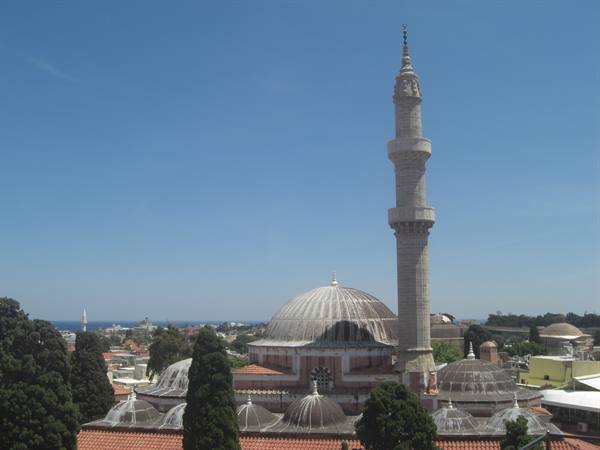
We wake to a day of absolute calm. Everything is mirrored in the water, the boat, the rocky slopes, the scanty and thin oaks. It is the last day for this crew. In the afternoon Marzia will arrive with the grandchildren. We make the crossing from Turkey to Greece almost entirely under engine. Gianfelice has not had the chance, in these few days spent on board, to taste the true pleasure of the Gatta, leaning over on the sea, running before the wind. It will have to be another time. For today the game is up. We find, unexpectedly, a place inside the harbour of Mandraki, the ancient harbour of the city of Rhodes whose entrance is delimited by two columns topped by two bronze deer, marking the points where legend says the feet of the Colossus rested. We want to believe it even if it isn't true.
We wait for the arrival of the ferry that brings Marzia and the children from Lipsi, wandering around the ancient centre of the city. At 4 p.m., finally, the new crew of Gattadapelare is in port. Let me introduce you: Marzia, the legendary first mate of so many sails made with her father on this sea where history, sun, myth, wind and legend pile up, intertwine and become confused in forming an unrepeatable, magical unicum in which, we of the Gatta, happily drown. Maia, a child on the threshold of youth, thoughtful and shrewd aspiring helmswoman and, finally, her younger brother, Sebastian, passionate moorer, in constant activity with ropes, lines, sheets and sailor's knots. After dinner, Gianfranco bids us farewell. His plane leaves early tomorrow morning and he prefers to spend the night at the airport. He has been a good travelling companion and an excellent co-skipper.
Certainly a "gattonata", that is, a cruiser adaptable and understanding about the romantic shortcomings of this boat. Everyone else sleeps on the boat. Not quite everyone, Gianfelice and the skipper, for reasons of space, sleep in the cockpit, bundled up in sleeping bags while Rhodes is wrapped in a blanket of humidity that condenses and drips from the boom almost like rain, onto our uncovered noses.
The boat moves away from the pier, from where our friends wave goodbye, with the new, very young crew. The children wave back, but their thoughts are far from the world of adults. The adventure fills their hearts and creates the sprout of the passion that will certainly accompany them into adult life. The passion for wide expanses, for the wind on the face and in the hair, for the taste of salt on the lips, in short the love for the sea lived actively in the joy of freedom that its horizons manage to convey. We leave the harbour of Mandraki, standing well out before heading towards Alimia. The shallow waters that extend far out from the eastern tip of the island induce caution even though, probably, we could pass over them without harm. But we are too lazy to go below deck to read the echo sounder. It is easier to stand off. We are not in a hurry.
The calm sea and the light wind induce us to proceed under engine. Off Alimia the wind strengthens from starboard through the action of the coast and we now proceed also with the mainsail still reefed from the day before yesterday. When the engine suddenly stops we have a moment of anguish. We immediately think of a breakdown, such is the distrust we have for maritime engines, but fortunately it is only the empty tank. We decant the spare fuel - we always have two 20-litre cans in the aft locker - bleed the air from the fuel line and set off again. Now the wind is on the nose and the last miles are covered slowly and with difficulty until we round the point that encloses to the south the sheltered bay of the island. Some swell and wind come in and we do not trust ourselves to anchor because in the most sheltered area there are already three boats on the wheel. But I have an intuition.
The fishing boats I have seen the other times were always tied all together to a large floating line ending in a buoy. So underneath there must be a large mooring block capable of holding even our boat. Today there are no fishermen moored and we take the opportunity to secure a perfectly peaceful mooring. Knowing you can fall asleep without the fear of drifting because of an anchor that drags is one of the great joys of the skipper at the end of a day at sea.
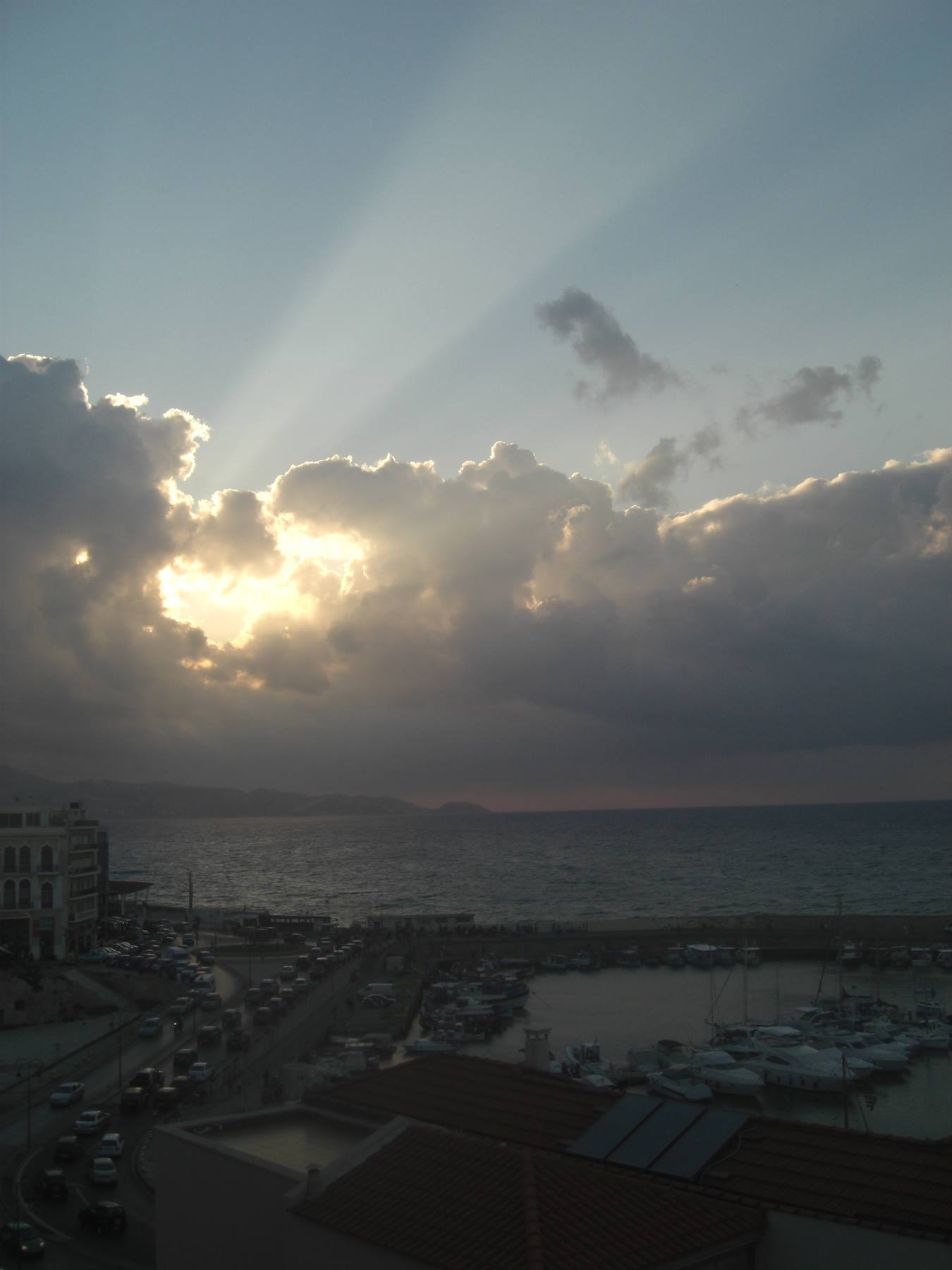
22 June 2010. Alimia
Yesterday's and last night's wind remains constant. It is not strong and raises small waves inside the bay that lap against our bow. We go ashore with the tender and visit the war huts again. We have the whole day ahead of us because we do not dare go out into the open sea. Without children on board we would have no fear of facing the head sea that we reckon is only choppy, but we have no reason to hurry and staying on board to rest does not displease us. We try bottom fishing and again catch a puffer fish. There are many under the boat because with their coral-crushing teeth they keep cutting our lines and, in some cases, even the hooks. However we catch something good and dinner is enriched with fresh fish.
23 June 2010 Alimia-Halki. 5 miles
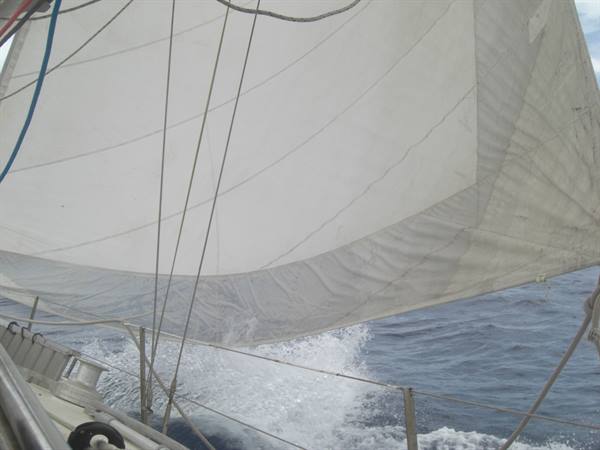
Today too the same wind, but this time we do not want to passively suffer another day confined on board. So we set off, determined to reach Halki, and just outside the bay we face some nice formed waves. We necessarily proceed under engine, at no more than three or four knots. Wind and sea right on the bow. The boat drops into the trough of the waves raising nice moustaches of water to the great joy of the children, but without spray as far as the cockpit. We see the small archipelago of Halki slowly approaching and the rock just at water level, but left at a safe distance on our left, that seems never to recede. It is a dangerous rock especially in calm seas because it protrudes only a few centimetres above the water's surface and at night you would not see it at all. A couple of hours later we are moored alongside at the floating pontoon together with five other boats.
We go to eat under the trees of Maria's taverna and the children, happy, are free to move around in a town with no cars. Halki does not belie its nature as a refuge for northern visitors. Everything flows with peaceful slowness. On the saddle of the mountain behind the town, three or four kilometres away, are the ruined remains of a Venetian castle. We climb right up there to visit the ghost village, abandoned in historical times, of which a couple of houses appear rebuilt on the foundations of the old ones. There are also the traces of a recent excavation that betrays someone's intention to return to live here. For the rest only stumps of wall can be seen. A short distance away a cemetery with a few tombs abandoned to the attack of time and the weather bears witness to the end of a society clinging to the foot of the castle.
The causes of this settlement are easily explained by the presence of the castle protecting the countryside from the attacks of pirates and plunderers and by the relative fertility of this saddle that hosts the only trees on the island. With the loss of importance of the castle due to the historical changes governed by time and its consequent abandonment to the erosion of the centuries, the village too was abandoned. The sea is no longer a messenger of dangers and instead becomes a source of wealth. Thus the "skala" is born, that is the village by the sea. We leave the mountain at dusk, retracing the hairpin bends and descents of the deserted road and in the now gathering darkness we approach the first lights that are coming on in the town. All is peace and silence. Dinner at Maria's.
24 June 2010 Halki.
Today we went to the little beach in front of which we moored the first time we arrived here with the first crew. Next to it a pleasant taverna, run by a likeable young Englishman, offers us good food and a stupendous view over the sea. We are well protected from the wind and the water in front of us is calm as far as the eye can see. In the background the mountainous profile of Rhodes is partially covered by an uninhabited islet that, a mile from us, partially closes the bay. The stretch of sea, thus enclosed, looks like a lake. Because of its smallness the place is crowded, but with quiet people taking the sun. The tiny beach accommodates five or six deckchairs. Other deckchairs are on the embankment further away and nothing disturbs the quiet of these guests of this corner of the Aegean. We stay until late afternoon and then with the children we return to the town.
I have promised them an ice cream to leave their mother free to stay a little longer, losing herself in the sweetness of that beach by now deserted. A large Italian sloop has arrived and moored near us. My little deckhands put on a show, moving about on the deck of Gattadapelare with the naturalness of those accustomed to living on a boat and climbing the mast, arousing trepidation in the skipper nearby. I reassure him, though after having urged the little ones not to climb any higher.
After casting off the dozens of little lines with which Sebastian has secured the mooring of the Gatta, we set off at our ease for Alimia. This island until some time ago was an insignificant dot on the nautical chart and attracted us precisely for its modest existence. We "gattonauts", always in search of landscapes dominated by nature, where contamination by tourists is scarce, had always known that one day our boat would drop anchor there. Now we can say that Alimia is part of the history of Gattadapelare. This one today is the fourth time we have entered its welcoming bay. We again find the floating line of the local fishermen free and we tie up to it with the pleasant sensation of spending another peaceful night even in bad weather. there is no threat of worsening. The wind is not strong and the sea is slightly choppy.
The forecast says that tomorrow we will find more air a few miles before reaching the eastern tip of the island, and, in any case, favourable to us. Tomorrow we absolutely must be at Rhodes in front of the carnaio. The day after tomorrow Gattadapelare will be hauled out and the crew will disband. The skipper will return to Rome, the others will stay a while longer under the Greek sky, in Lipsi, the sweet and bewitched island of Calypso. Some swell comes into the bay, but we are in the calmest area and we pass the time making the children swim between the boat and the tender. Three other boats share with us the darkness that falls over the bay. We go to our bunk knowing that nothing will disturb our sleep.
24 June 2010- Alimia.Rhodes. 32 miles.
When we leave the bay there is a bit of wind from the west that decreases in intensity as soon as we leave Alimia behind us and get out of the Venturi effect generated with the islets to our starboard. We go on under engine and with the sails barely filled until shortly before finding ourselves abeam of the island of Symi. Now the wind grows stronger and, wanting to head up to make for the city of Rhodes, we decide to furl the jib, keeping the wind astern during the manoeuvre. A few problems with the sail that tends to "caramelise" on the forestay, which we solve with a bit of agitation, and then there ahead of our bow is the whiteness of the city approaching rapidly. When we reach the carnaio we see that it is not worth mooring in the basin too exposed to the swell coming in. So we anchor there in front and go ashore with the tender. Dinner in town and last night together on the boat.
By now we feel our adventure on the waves of this beloved sea is over. From this moment our actions will be guided only by the need to put the boat to rest.
25 June 2010. Rhodes.
It's Sunday. The carnaio is closed. There is no more swell coming in and we go and moor in the haul-out basin, hoping the weather conditions do not change and force us to put ourselves on the wheel again. We spend the day in town. Marzia and the children move to a hotel, I stay to spend the night on the boat. The captain is always the last to leave the ship.
I spend the morning sorting things out. The Gatta is hauled out. I say goodbye to the crew who stay one more day in Rhodes and I fly to Rome.
Tetrodotoxin is a venom much more potent than cyanide, it takes its name from the family of Tetraodontidae, the puffer fish, but also in the Diodontidae (porcupine fish). It was first isolated and named in 1909 by the Japanese scientist Dr. Yoshizumi Tahara. One milligram of tetrodotoxin is enough to kill a person: it blocks nerve conduction causing paralysis, vomiting, diarrhoea, convulsions, cardiorespiratory arrest. The first recorded case of tetrodotoxin poisoning is found in the logbook of Captain James Cook. The first symptom of intoxication consists of a slight numbness of the tongue and lips, which appears from 20 minutes to 3 hours after ingesting the poisoned fish. The next symptom consists of paraesthesia of the face and extremities, and headache, epigastric pain, nausea, diarrhoea, vomiting, and even difficulty walking may also appear.
The second stage of intoxication consists of severe paralysis, which in some cases prevents sitting up. The last stage consists of total paralysis, which however does not affect cognitive abilities: the victim may be conscious and in some cases completely lucid until shortly before death, which generally occurs in 4-6 hours, with an estimated range from 20 minutes to 8 hours. Puffer fish and sushi: fugu puffer fish are usually not deadly. Fugu (puffer fish, in Japanese) is a very famous speciality in Japan, as well as very expensive, served by qualified chefs, able to treat the flesh of the puffer fish removing the poisonous parts (the innards) Fugu is a white fish, with delicate flesh, those who have tasted it have often not been very satisfied... Its fame is probably more linked to its dangerousness than to the goodness of its flesh. Puffer fish has been banned in Italy since 1992.
Famous is the case of 1977, when in Italy there were several cases of intoxication due to some puffer fish tails mistakenly included in a batch of decapitated anglerfish (monkfish tails).
14 photographs · click to open them full screen





0 reader comments