W e arrived in Bodrum last night, Gerlinde, Elke and I, after spending a night in a hotel on Kos. The city welcomed us with its fascinating layered past. Little remains of ancient Halicarnassus. The place where one of the seven wonders of the ancient world stood, the Mausoleum, is reached by following a series of narrow streets, and when you get there you are disappointed by how little is left of that famous tomb of King Mausolus. Traces of the Hellenistic period are also scarce, but it was the birthplace of Dionysius the rhetorician and of Herodotus the historian. A theater recalls the period of Roman Halicarnassus, while the castle of St. Peter of the Knights of Rhodes asserts itself with its stern Christian presence on the right side of the harbor.
The Ottoman city, whose name derives from the corruption of the name Petrus, blends with that past and out of it comes a fascinating reality, but not a unique one on the coast of Anatolia, where the different civilizations of history have followed one another creating other similar realities. The boatyard where our boat is kept is a few kilometers from the city and we have taken a rental car for the many trips we anticipate. In fact, we go around buying a new tender and its outboard motor, looking for a laundry for the onboard linens, a carpenter to enlarge the forward berths, provisioning, and more. The bazaar disappoints us with prices too high compared to what we expected from our experiences a few years ago. Turkey, at least the part touched by tourism, is adapting to the European market. The dollar has vanished and then the German mark; now the euro reigns supreme.
At the shop of the new marina, very beautiful and well organized, we find both the tender and the motor at acceptable prices. They will replace those of Gattadapelare, now unreliable. We also buy a new toilet that will replace the old bowl with the broken pump. The old tender, after the numerous repairs and gluing of the past, is abandoned leaning against a pine tree in the boatyard; the same fate befalls the old and capricious two-stroke motor. For lack of time the toilet is stowed in the bow. It will be installed at the first opportunity.
May 23, 2009 – Bodrum
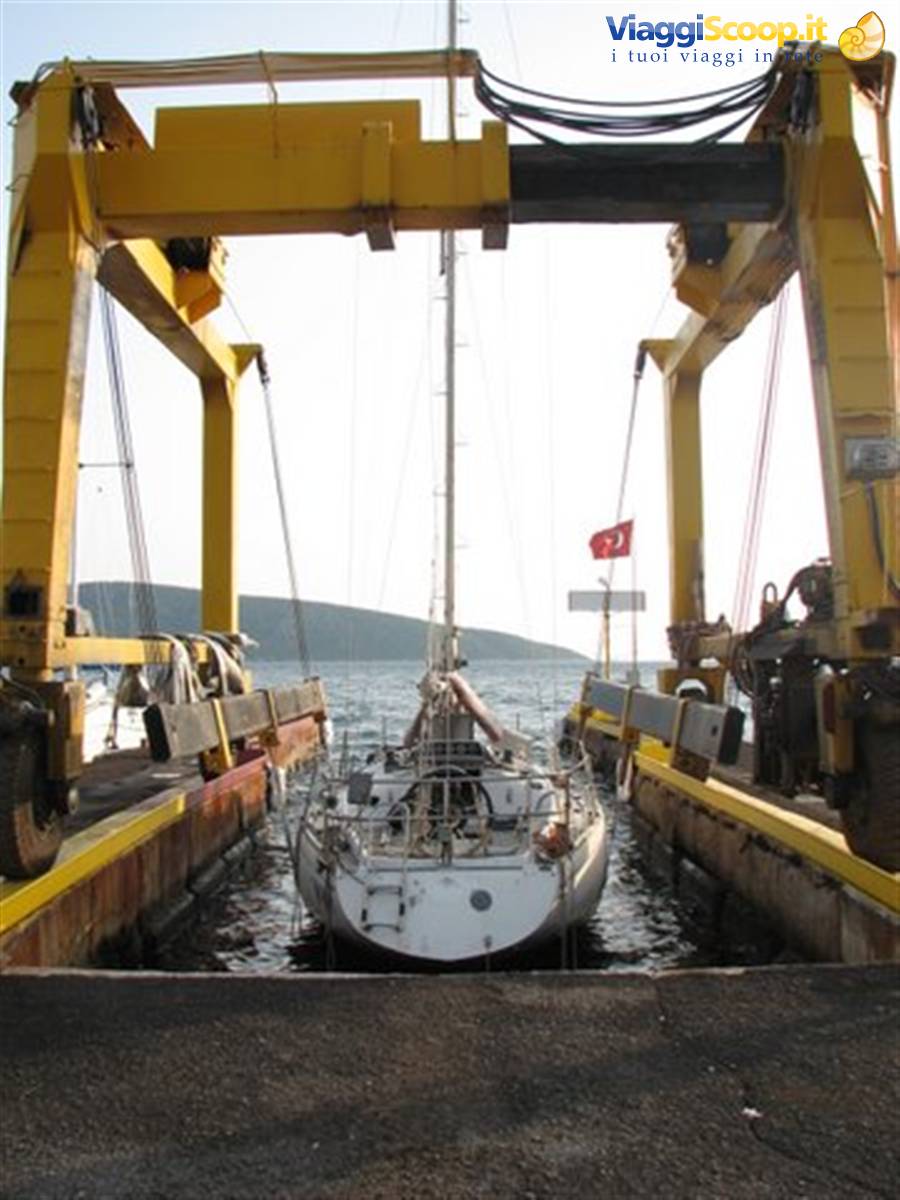
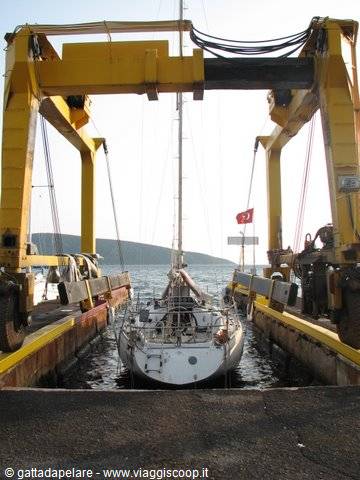
G ino arrives in the afternoon from Kos just in time to witness the launch. This time the operation takes place with a travel-lift in complete tranquility, quite different from the launch done in Skiathos last year. We hoist the sails and prepare the boat for tomorrow's departure. We have finally had the new furling system installed and everything seems in order. I also replaced the bilge pump with a supply of impellers rather than fitting another diaphragm one which, like the others, would soon wear out. The electrical system, however, is lacking. The navigation lights don't work, but we don't anticipate nighttime sailing.
The estimates we had made by the boatyard, run by an energetic, masculine Turkish woman, seemed expensive to us, based on the concept "you have a boat, you can pay." The genoa too would need some reinforcement where the blue sun cover shows some stitching coming undone. But there's no time now for small jobs. Or we would have to reduce the days of cruising. The choice is always the same: if safety is not at stake, we leave as soon as possible. While the "girls" (they always remain "the girls" no matter how the years pass) are still sleeping in the hotel, Gino and I, moored at the pier, let ourselves be rocked on the boat.
May 24 Bodrum-Cnidos. 27 miles
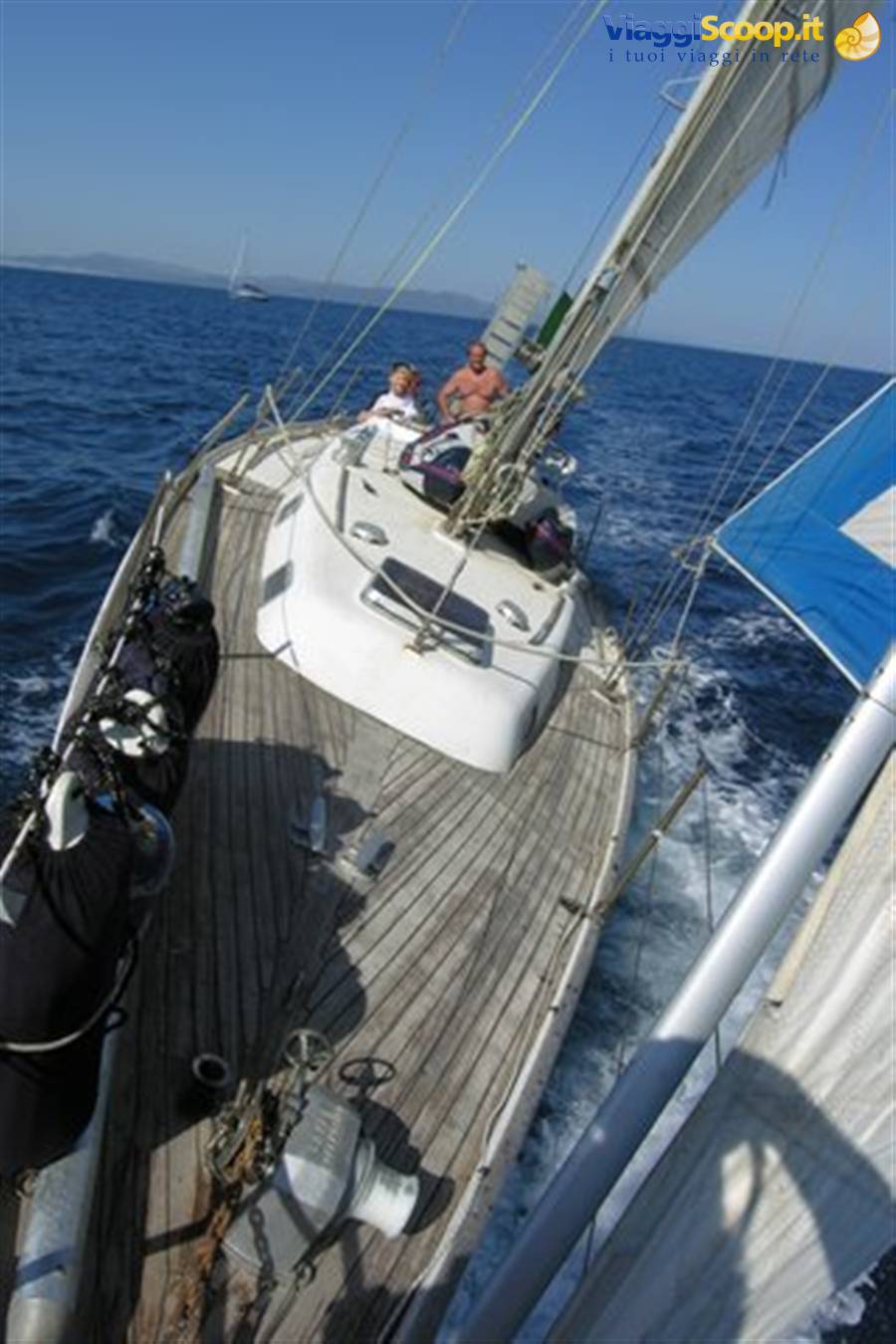
T he weather stays fine. We set off, as usual not early, to reach the tip of the peninsula south of the deep inlet of Kos, at whose end there is a landing place already visited in years past. We proceed with scant wind, but on the first day of sailing we prefer it that way, partly to regain confidence with the sea and the boat, and partly to fine-tune it better. Cnidos is an interesting archaeological site. Apart from the theater on the seashore and some columns and walls of public buildings, of the ancient city only the terraces on which the houses stood are evident, certainly made of wood. It had two harbors, the military one to the north (of which the entrance bastions are still clearly visible) and the commercial one to the south, protected from the meltemi and larger.
On a dive years ago, we discovered at a depth of three meters the wooden remains of an ancient vessel filled with concrete (probably part of a pier) according to a custom already in vogue in the time of Claudius who, in building the port of Ostia, used in the same way the ship built by Caligula to transport from Egypt the obelisk that is today in St. Peter's Square. Passing in front of the tip of the promontory of Tropio, dear to Apollo, behind which our landing place is located, we see half-submerged the remains of a cargo ship 'gone onto the rocks.' Here in front, in 434 BC, a bitter naval battle took place: the Spartan fleet under the command of Peisander was destroyed by the Persian fleet commanded by the Athenian Conon. Who knows how many wrecks still lie on the bottom. We moor stern-to at the new pier that has replaced the rickety one that existed before.
We are greeted by an old acquaintance, already nicknamed by us Turcoilcorto, owner of the tavern at the root of the pier and of the pier itself. Naturally he can't remember us, but he pretends to have seen us a few weeks ago and greets us with great displays of friendship (probably thinking of the eleven euros of mooring fees and the lobsters he hopes to serve us this evening). He absolutely wants to embrace Gerlinde, whom he repeatedly calls 'meine Liebe', while "the girl" desperately tries, in vain, to extricate herself from the Turkish effusions. Entry to the excavations has now also become paid and we are not even allowed to take walks along its borders closed by a wire mesh fence. At every attempt to stretch our legs the guard, who looks like a soldier, calls us back with his whistle.
So the "available" space is reduced to a few dozen meters around the tavern and this greatly annoys us and makes us fall out of love with a landing place that, in the past, had fascinated us also for its freedom of movement within the archaeological zone, rich in history and in "sherds." Here the Venus of Cnidos was found, today in the Vatican Museums. It was the birthplace of the architect Sostratus, who built another of the Seven Wonders of antiquity, the lighthouse of Alexandria. We dine, without lobsters, at the tavern along with several other crews. "European" prices. Then to the berth. Tomorrow's leg will be short.
Turkish remnants in Kos
Day 225 May 2009
From the Turkish coast to Tilos
May 25, 2009 - Cnidos – Island of Tilos (Greece). 16 miles.
W e leave Turkey without having completed the exit formalities, with the intention of returning to take the boat to Marmaris for the deck work. It wouldn't be permitted to cross between Greece and Turkey without doing the transit-log in Turkey each time, but we trust in the improbability of being discovered. So after a few miles we lower the beautiful Turkish courtesy flag to raise the Greek one with its softer colors, white and sky blue, which recall the colors of the houses and the sea of this land. Today too the wind is weak and we proceed gently, but the leg is short and we're not in a hurry. On the old (unofficial) pilot book we have aboard only one quay is indicated, where the ferries moor, but on arrival we spot a breakwater pier and a conspicuous 'no anchor' sign warning us that the little port is equipped with moorings.
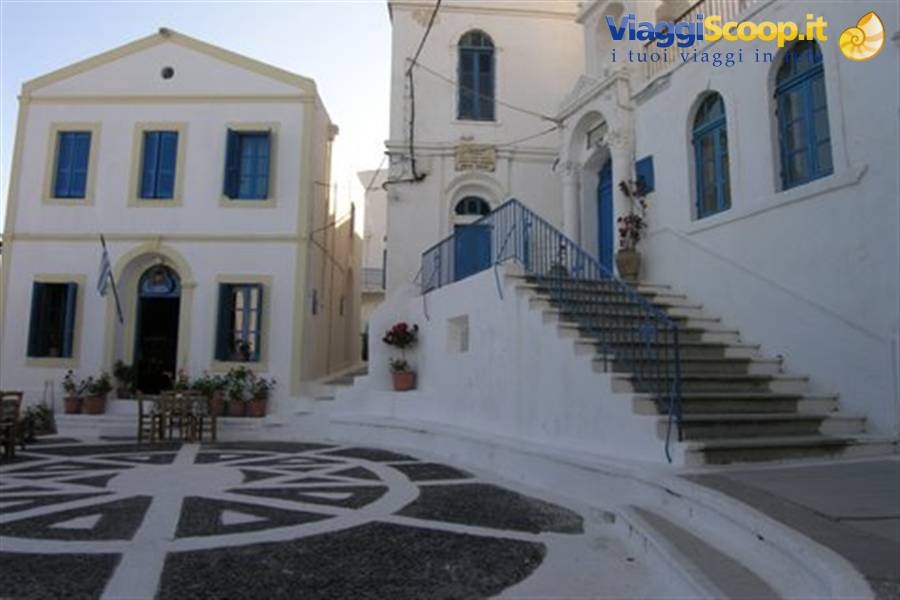
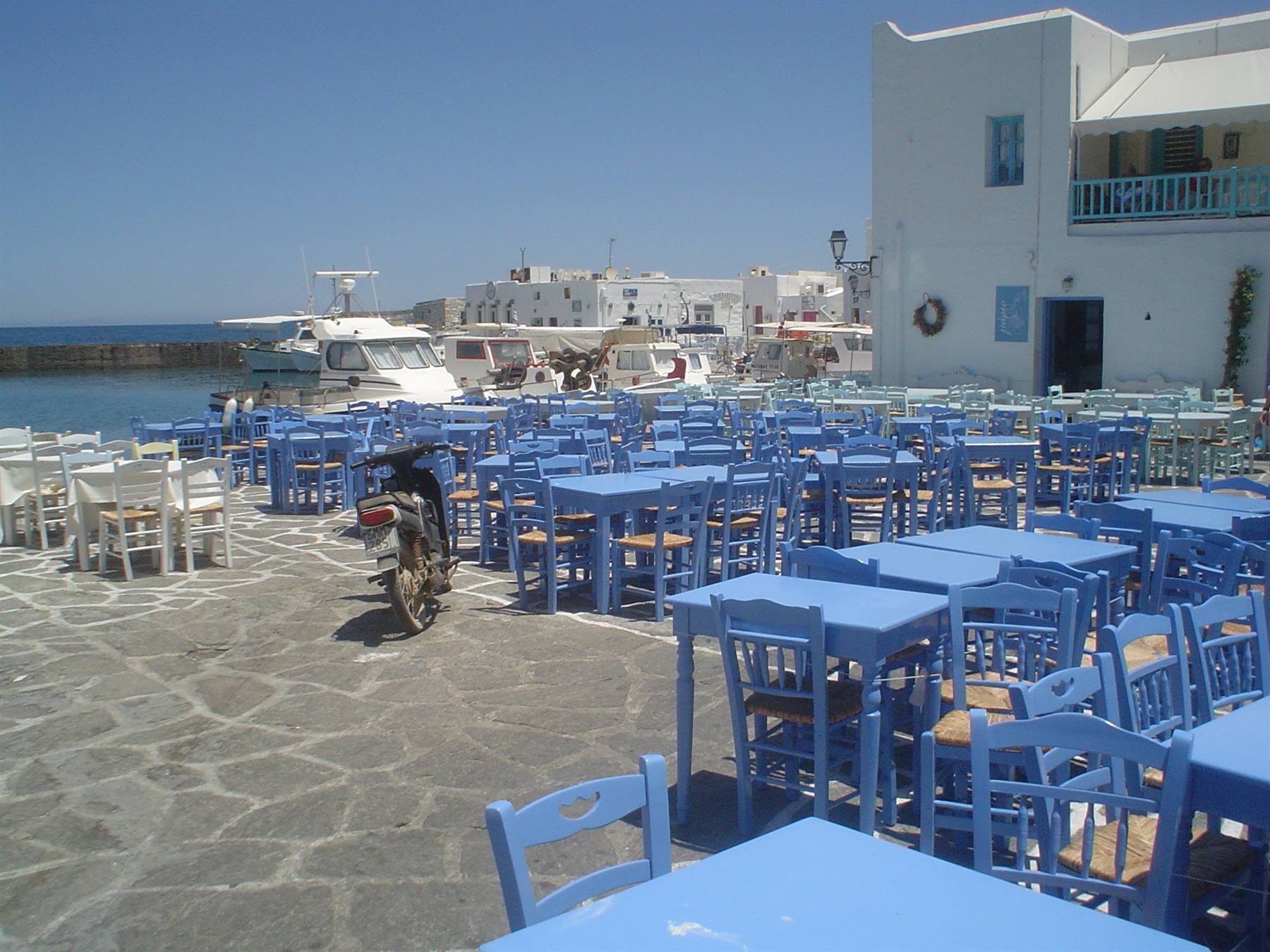
We are welcomed by a 'portolana,' alias 'harbor woman,' who hands us a line and invites us to present ourselves, at our leisure, at the port authority to register our arrival. Mooring is free. Livadia, the seaside village, is small and pleasant. The bay, at whose end it stretches out, is wide and well protected. All around, high hills everywhere marked by ancient terraces. Besides the little port the village offers a little road along the pebble beach onto which low buildings used as taverns open, and a few tiny bars, some deck chairs in the sun or in the shade of centuries-old tamarisks, a few grocery stores and a shaded little square occupied by the chairs of three kafenions. One immediately senses that tourist visits are limited and elite. A small colony of English people, many of them property owners, lives for many months a year on this island.
Everyone knows each other and greets each other. We need a new regulator valve for the gas cylinder. It's the first breakdown of this cruise. But here in the village you can't find any. We're directed to a shop in the other center of the island, which is called Megalochorio. With the only taxi in Tilos we reach this center, which, despite its name, is a small village of white houses halfway up a mountain, on whose summit the remains of a Venetian Kastro can be glimpsed. In the Supermarket, which lives up in name to these inhabitants' mania for grandeur, and which in reality is a small, somewhat messy shop, we actually find the desired object, otherwise rare.
Tilos May 26, 2009. Tilos.
A fter breakfast consumed at the port café we rent a car and return to Megalochorio. An exploratory walk among the deserted alleys of the village leads us to the closed entrance of a small museum that preserves the remains of dwarf elephants that disappeared in prehistoric times. We had already heard about the discovery of these elephants at the port from an Italian gentleman, initially mistaken by one of the "girls" for a hotel tout with a good knowledge of the language, in reality a retired surgeon, residing for several months a year in Livadia, who attributed their disappearance to the tsunami caused by the eruption of the volcano of Santorini 3,500 years ago. The remains of forty of these tiny pachyderms (they measured 1.50 meters in height) were found in a cave at a few hundred meters of altitude above the sea. We consider it implausible that the tsunami wave reached such a height.
Even the period of their existence (skeletons have also been found on the island of Cyprus) is much more ancient. We return to Livadia and dine at a tavern.
Tilos May 27, 2009
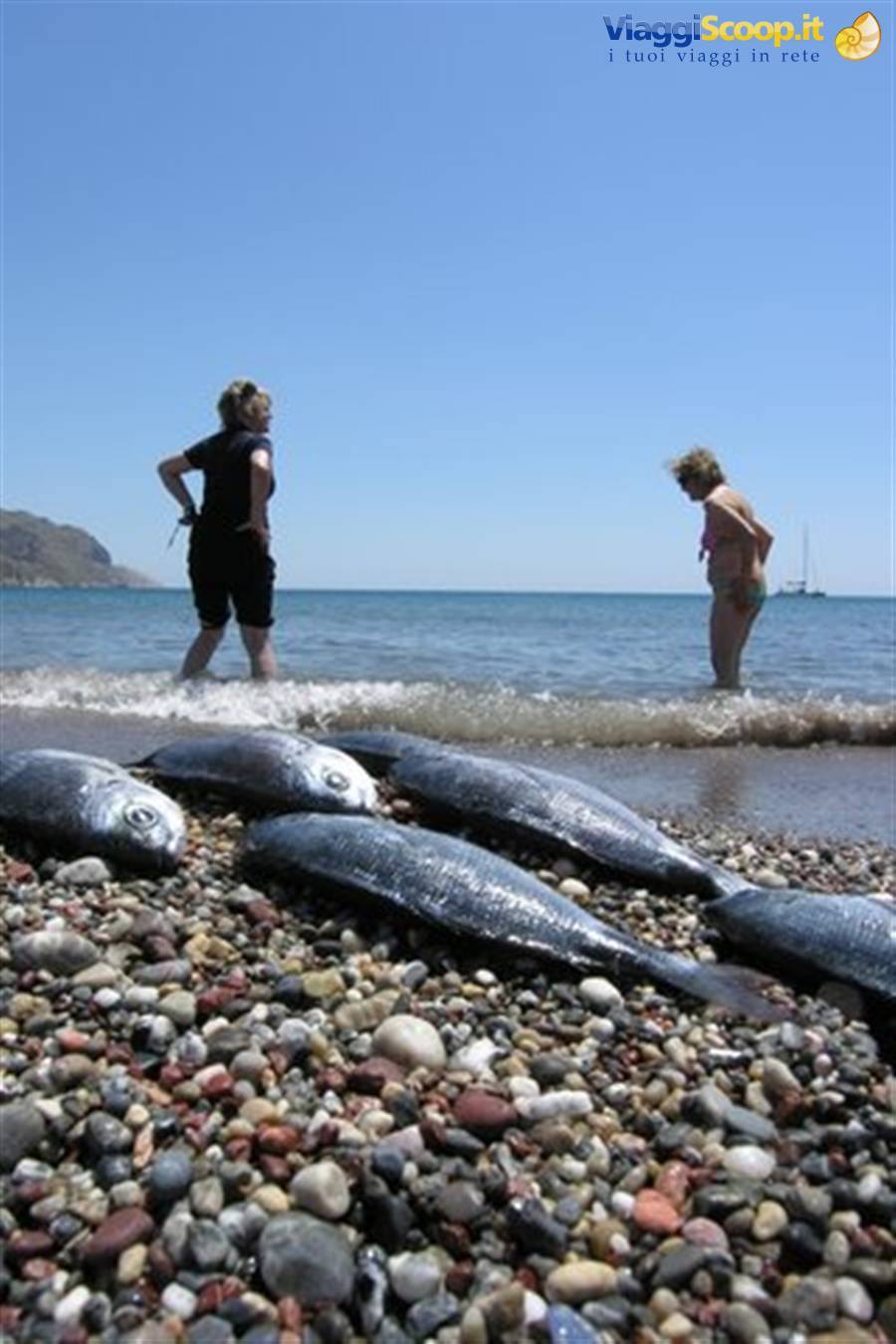
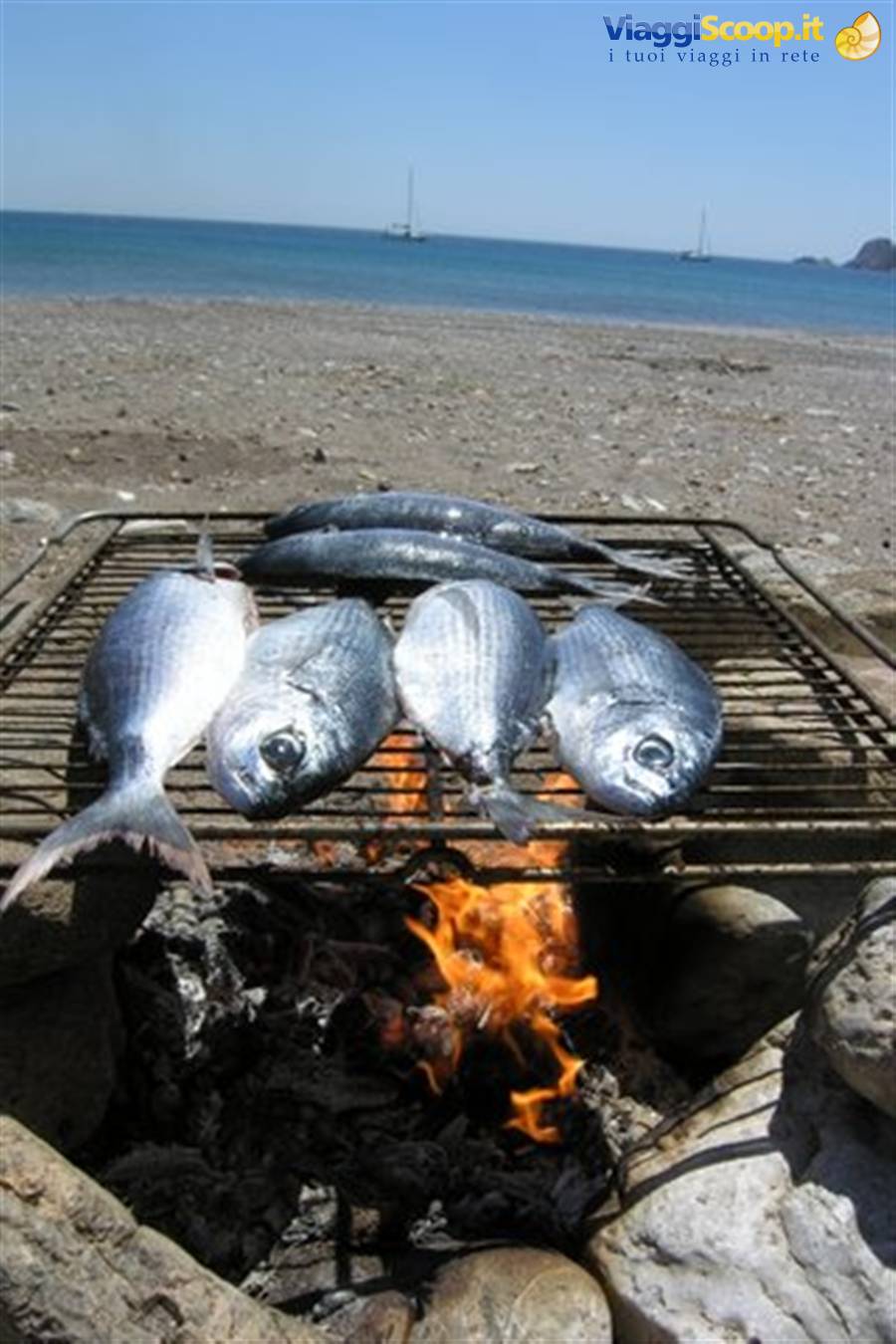
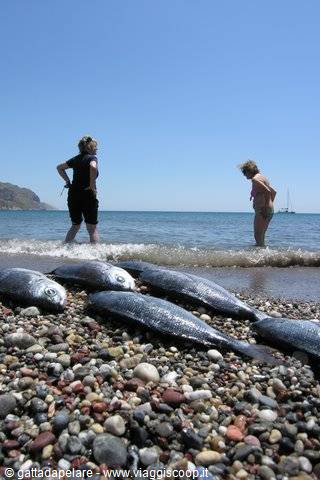
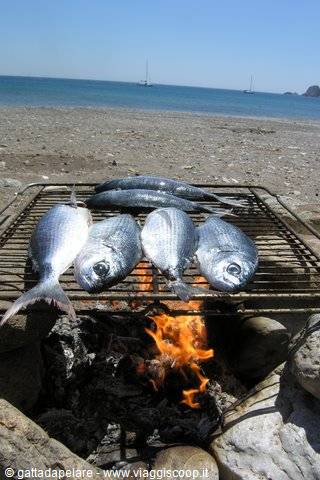
T oday the wind has picked up. We're lazy and don't feel like facing the sea even though it's not at all rough. Better to find a quiet beach and have a grilled fish there. Gino, our private interpreter, goes to negotiate the purchase from a fishing boat that has just arrived in port. We rent a car and reach a beach on the west side of the island. We are downwind and the sea is calm. The beach is sandy, long, practically deserted, comforted by several tamarisks that assure us shade. With debris found on the beach our Gino creates a table and some seats, admittedly not very comfortable, but at least practical. The fish is cleaned on the shore, in the shallow water, and a great number of little fish come to feed around our hands. Cleaning fish in seawater is an operation that exalts the joy of being here, in this sea and among these beloved islands of the Aegean.
Whenever it is possible for us, in any case at least once during the cruise, we repeat this ritual of the barbecue on a deserted beach. A gentle wind, coming from the land, caresses our skin as we slip into post-prandial sleep lying under the tamarisks. Returning to Livadia, which is only about ten kilometers away, we would like to visit Paleochorio, a ruined village abandoned many years ago, but we take the wrong road and climb up a paved path, barely wide enough to allow a car to pass, always at the edge of unsettling cliffs. There is no possibility of turning back and we are forced to follow it all the way until reaching, at the top, some telephone relay towers. Here there is the possibility of heaving a sigh of relief and of becoming available to admire the splendid panorama around and below us.
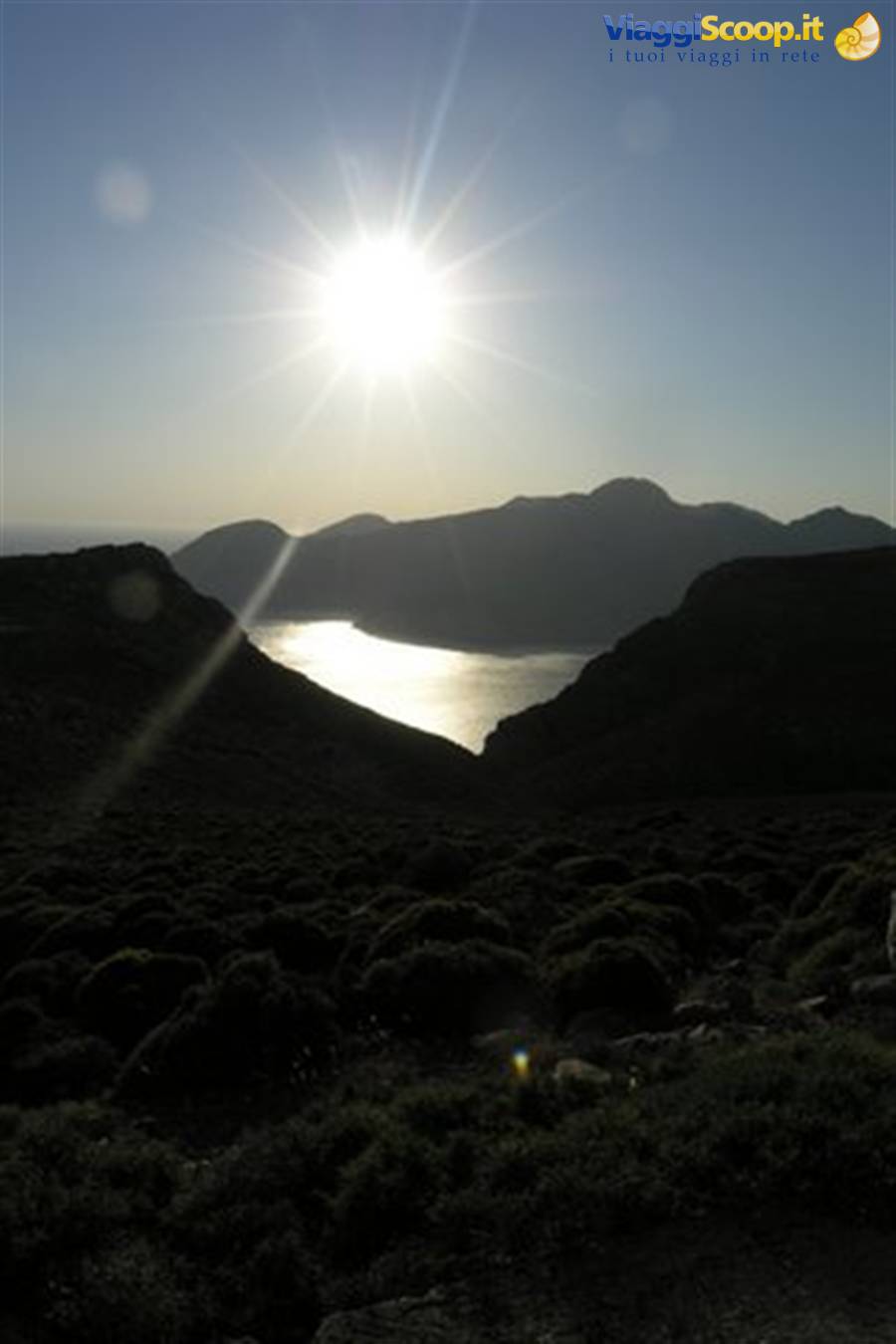
The mountain is covered with rounded bushes of thyme that perfume the air with Mediterranean scents and the sea stretches out to distant islands. The coast is a setting of high cliffs and inlets. It's us and nature; alone in the world. The return is equally heart-stopping, and when, finally, we glimpse the little port from above and spot our boat, only then do we let ourselves go again into conversation. In the evening, in the little square of the cafés, we have an ice cream. Gathered here are the regular guests of this island. Everywhere you hear English spoken.
Gattadapelare goes into the water
Day 328 May 2009
from Tilos to Nisiros
May 28, 2009. Tilos.
W e stay another day on this island. The wind is still bothersome and the girls, always accustomed to sailing with little wind, thanks to the intercession of Poseidon, prefer to idle here. In antiquity its inhabitants, together with those of Rhodes, founded the colony of Gela in Sicily. But to stay on the mythological theme: Tilos was the nephew of the teacher of the little Zeus during his education in Crete. He found here miraculous herbs that healed his sick mother, and he, out of gratitude, built a temple to Apollo and Poseidon. Of the temple there is no trace, but there is archaeological evidence that Minoans and Cretans settled here around 1500 BC. After the Athenians, the Romans, it was the domain of the Knights of Rhodes, and then subsequently of the Turks.
The local inhabitants were forced to withdraw to live in the mountains, to escape the attacks of pirates and the raids of the Turks, and they did not move from the mountains until the nineteenth century. After thirty-three years of Italian occupation, in 1946 it became Greek again.
May 29, 2009. Tilos-Nysiros. 18 miles.
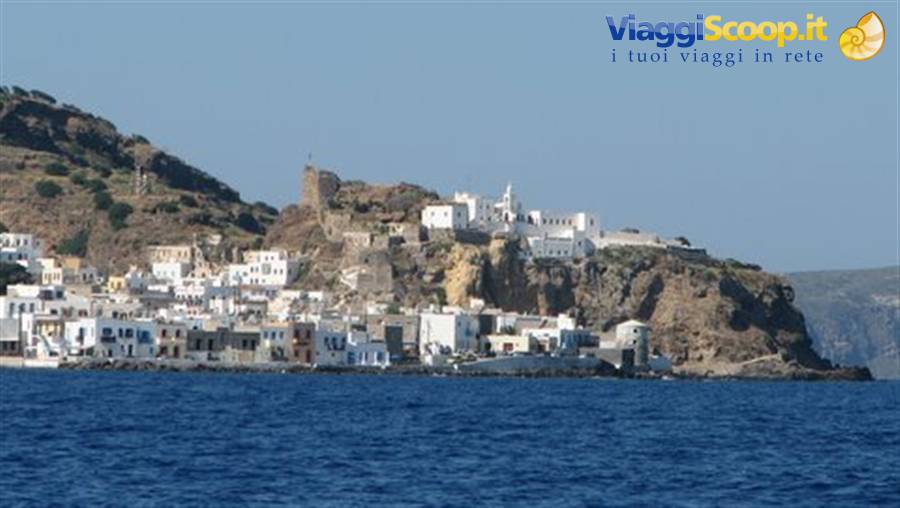
T he weather stays fine. Yesterday's wind has dropped and when we leave the bay of Livadia we find it on the bow. We are forced to go under motor. Nysiros is clearly visible ahead of us with its volcano profile. Right behind, the long coast of Kos. On our beam, to starboard, the promontory of Cnidos. The coast of Nysiros is everywhere steeply sloping, with rare beaches of sand or black pebbles. Unlike Tilos, tree vegetation is rather present with a sort of oak of modest height, but with very large acorns. We pass in front of a little port, Paloi, which hosts several sailboats, but we continue, following the information of our pilot book, toward the port of Mandraki where the ferries moor, about a mile and a half further north. We moor on the anchor. Only two other boats near us.
Nysiros is an extinct volcano with fumarole activity and is a destination of numerous visitors who come from Kos, an hour away by ferry. We rent a car and climb up to the edge of the wide crater. Below us opens a plain that resembles, on a small scale, that of Ngoro Ngoro, except that instead of exotic animals there are feral goats that flee at our passing. A shack, functioning as a bar and souvenir shop, comforts us with cold drinks. A steep dusty path leads to the lowest and most active part of the crater. Everywhere small fumaroles and the smell of sulfur. At the center of the flat expanse some large muttering holes allow a glimpse of boiling mud. We climb back up to the rim of the cone to reach the village of Nikia. Here we are approached by an elderly, but well-preserved villager who in decent Italian tells us the story of his life and his family.
His mother, who died a centenarian, still remembered the period of Turkish domination of the island. So many brothers and so many children as to make up a good part of the population of the tiny village. After a few steps we reach the central little square nestled between the church, a kafenion and a tavern. The whole thing is of modest dimensions. Seated at the café table we drink a glass of wine and let ourselves go to the pleasantness of this still genuine Greece. From the edges of the village the gaze ranges high over the caldera and the sea. On the horizon one glimpses the island of Astypalea and the very nearby Tilos. Beautiful and unique scenery that makes us think of how lucky we are to be able to enjoy them like this, a couple of hours by plane from home, far from the crowds and the blandness of fashionable resorts. We return to Mandraki.
The village stretches along the north coast of the island. The road, which runs along the sea and is protected by an artificial breakwater right behind it, is rich in modest taverns. We choose one that seems to us the most genuine and we eat accompanied by the sound of the waves breaking a couple of meters below.
Mooring
Day 430 May 2009
from Nisiros to Kos
May 30, 2009. Nysiros- Kos- 20 miles. W
e leave the island with a light wind astern, which makes us glide gently toward Kos. We pass in front of the white islet of Gyali, a veritable mountain of pumice exploited as a quarry. Shortly after we reach the volcanic cone of Spongili, which rises, steep, from the sea; once past it the wind ceases to push us. From this moment we proceed under motor to the eastern tip of the island of Kos. Here, due to the Venturi effect, the wind strengthens and descends the strait between the island and the Turkish coast, which is only six miles away. The marina of Kos is recently built, large and welcoming, provided with essential services while forgoing superfluous ones, such as, for example, the fitness gym of Bodrum or the pool of Kusadasi. We spend the late afternoon in the city where we dine.
May 31, 2009. Kos
T oday Gino leaves and bids us farewell with great greetings from the taxi that accompanies him to the airport. We are left without our interpreter, but above all without the cheerful willingness with which he enlivens the traditional week of cruising with the "girls." For the language we'll manage with the skipper's modest knowledge of Greek, that is, the writer's, but we will miss our friend's company. The naval officer in charge of inspecting incoming vessels has summoned us to fulfill a series of bureaucratic formalities. In all these years spent sailing in Greece it is the first time we have been subjected to such a check. We are thus forced to go to the port for the entry visas. Kos is too touristed – especially by Scandinavians – to be enjoyed by us, but it is very interesting.
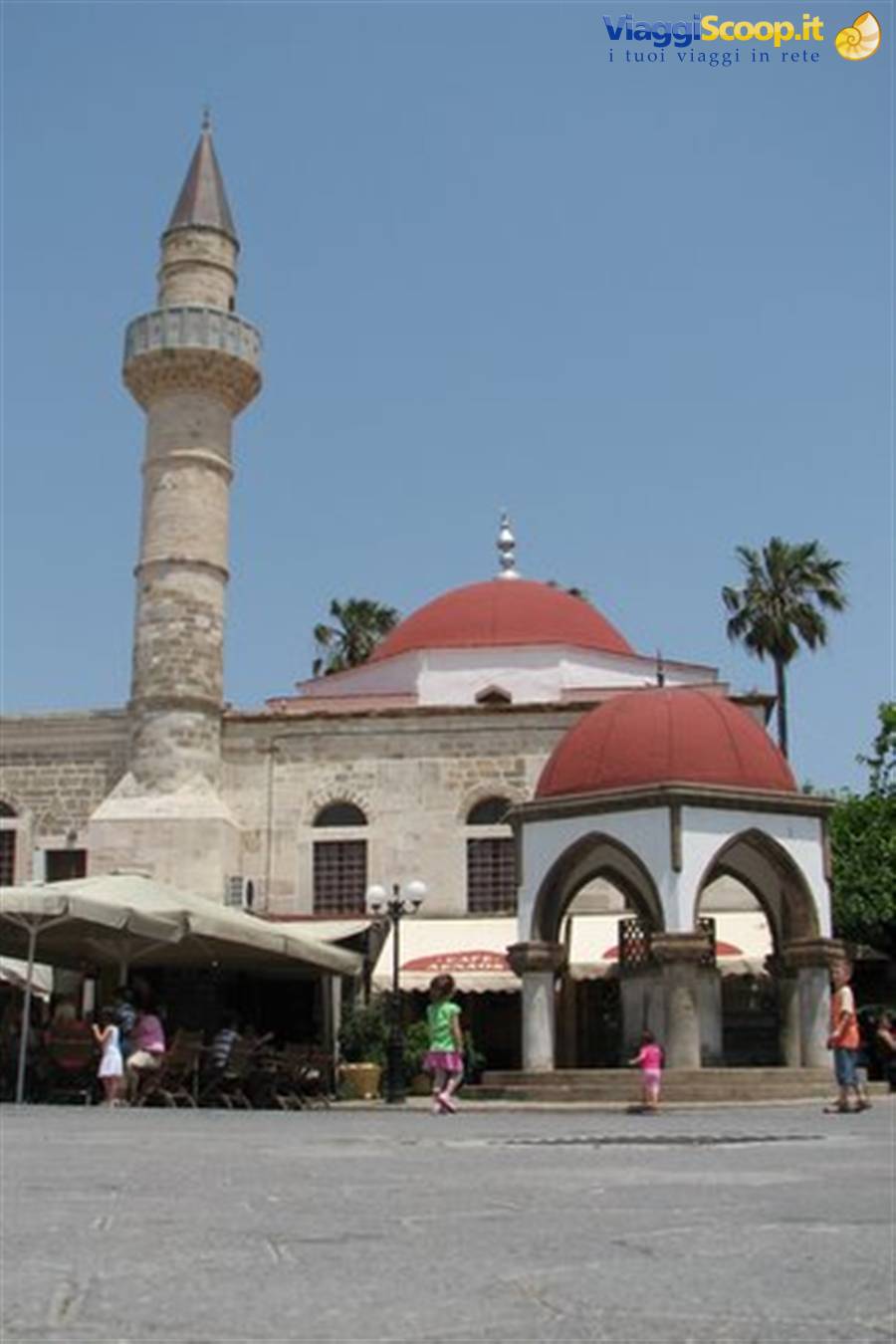
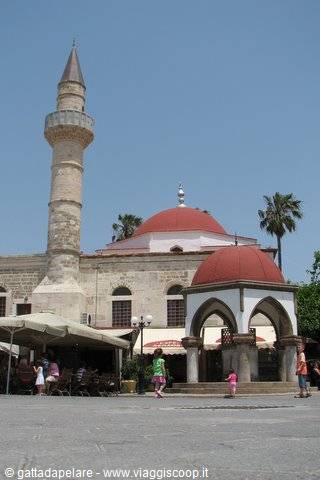
The capital, of the same name, equipped with a beautiful port, base of numerous caiques, protected by the old walls of a Hospitaller castle, is rich in ancient ruins that surface from a few meters of depth. Kos gave birth to Hippocrates and there is a beautiful bronze sculpture of him in a park, depicting him dispensing his knowledge to a group of fellow citizens. There is also a century-old plane tree under whose shade, it is said, he taught his disciples the art of medicine. The imprint of the Italian governorate is evident in the important buildings. A beautiful square with a fruit and spice market is also adorned with a small mosque with its inevitable minaret, also testifying to the Turkish occupation. Little streets full of the usual souvenir shops, a few noisy venues, trattorias everywhere. We take a car and go discovering the island. It's interesting, but not exciting.
From the top of a mountain village, seated at a table on the balcony of a tavern in the village of Zia, we admire a beautiful panorama of sea and islands. We should be used to such scenery by now, but we're not. Each time the soul opens to the beauty of this Aegean sea. Before us a necklace of islands: Pserimos and right behind it Kalymnos, the island of sponges, then Leros and, finally, barely visible, Lipsi. On the way back we stop to visit the remains of the Esculapion, the "polyclinic" of antiquity. Apart from the monumental layout of the complex, the archaeological remains are scant.
June 1, 2009- Kos
T he "girls" return home, one to Rome, the other to Vienna. I remain alone, awaiting the new crew made up of Marzia and little Sebastian. I occupy the time searching for a gimbaled stove with oven to replace the old, battered one. This year is the year of renovations on the glorious Gattadapelare. I also have a new sail cover complete with the boat's name that I mount to make a good impression on Marzia when she arrives tomorrow. The stove isn't available right away. It will arrive in a few days coinciding with our return to Kos to pick up Gianfranco. I go again to the port authority office to hand in the entry visas. The naval officer has me sign some papers and invites me to go into town to pay a sort of mooring tax of 29 euros. The tax office I go to resembles in every way an Italian one in a small town.
The phrase continually repeated by Greeks when they get to know you, "same face, same race," we could replace with "same office, same race." I spend the rest of the day doing little jobs on the Gatta.
June 2, 2009. Kos
I return to the port authority office where I show the receipt of the payment made. The officer gives me a document on which I will have to have stamped in every port the arrival of the boat with the updated crew list. I am deprived of one of the beliefs with which I have sailed happily for all these years, that of freedom from bureaucratic constraints, tax inspections, and whatever else invented to embitter the boater. In my heart I already feel like an anarchic rebel. I don't believe I will "remember" to fulfill the formalities indicated to me. In the afternoon Marzia arrives with little Sebastian, four years old, who as soon as he comes aboard criticizes the state of maintenance of the teak on deck. So the time has come to do the long-planned work.
The idea is to reach Marmaris, in Turkey, where we have a contact, but in Kos they have proposed to us, at a very favorable price, another material – practically compressed cork – quite similar to teak and also installed in strips with rubber seams. I'd like to know more about this material and postpone the decision for later. The estimate made in Bodrum was much more expensive, but probably cheaper than the same work done in Italy. The day is spent wandering around Kos.
Gattadapelare in flesh and blood
Day 53 Jun 2009
from Kos to Tilos
June 3, 2005- Kos
T his morning we were ready to leave, but as soon as we were outside the port we encountered a strong headwind that made us turn back after a few miles. Another day spent loitering around the city.
June 4, 2005 -Kos – Kormen (Turkey) – 16 miles
May 30, 2009. Nysiros- Kos- 20 miles. W
e leave the island with a light wind astern, which makes us glide gently toward Kos. We pass in front of the white islet of Gyali, a veritable mountain of pumice exploited as a quarry. Shortly after we reach the volcanic cone of Spongili, which rises, steep, from the sea; once past it the wind ceases to push us. From this moment we proceed under motor to the eastern tip of the island of Kos. Here, due to the Venturi effect, the wind strengthens and descends the strait between the island and the Turkish coast, which is only six miles away. The marina of Kos is recently built, large and welcoming, provided with essential services while forgoing superfluous ones, such as, for example, the fitness gym of Bodrum or the pool of Kusadasi. We spend the late afternoon in the city where we dine.
May 31, 2009. Kos
T oday Gino leaves and bids us farewell with great greetings from the taxi that accompanies him to the airport. We are left without our interpreter, but above all without the cheerful willingness with which he enlivens the traditional week of cruising with the "girls." For the language we'll manage with the skipper's modest knowledge of Greek, that is, the writer's, but we will miss our friend's company. The naval officer in charge of inspecting incoming vessels has summoned us to fulfill a series of bureaucratic formalities. In all these years spent sailing in Greece it is the first time we have been subjected to such a check. We are thus forced to go to the port for the entry visas. Kos is too touristed – especially by Scandinavians – to be enjoyed by us, but it is very interesting.
The capital, of the same name, equipped with a beautiful port, base of numerous caiques, protected by the old walls of a Hospitaller castle, is rich in ancient ruins that surface from a few meters of depth. Kos gave birth to Hippocrates and there is a beautiful bronze sculpture of him in a park, depicting him dispensing his knowledge to a group of fellow citizens. There is also a century-old plane tree under whose shade, it is said, he taught his disciples the art of medicine. The imprint of the Italian governorate is evident in the important buildings. A beautiful square with a fruit and spice market is also adorned with a small mosque with its inevitable minaret, also testifying to the Turkish occupation. Little streets full of the usual souvenir shops, a few noisy venues, trattorias everywhere. We take a car and go discovering the island. It's interesting, but not exciting.
From the top of a mountain village, seated at a table on the balcony of a tavern in the village of Zia, we admire a beautiful panorama of sea and islands. We should be used to such scenery by now, but we're not. Each time the soul opens to the beauty of this Aegean sea. Before us a necklace of islands: Pserimos and right behind it Kalymnos, the island of sponges, then Leros and, finally, barely visible, Lipsi. On the way back we stop to visit the remains of the Esculapion, the "polyclinic" of antiquity. Apart from the monumental layout of the complex, the archaeological remains are scant.
June 1, 2009- Kos
T he "girls" return home, one to Rome, the other to Vienna. I remain alone, awaiting the new crew made up of Marzia and little Sebastian. I occupy the time searching for a gimbaled stove with oven to replace the old, battered one. This year is the year of renovations on the glorious Gattadapelare. I also have a new sail cover complete with the boat's name that I mount to make a good impression on Marzia when she arrives tomorrow. The stove isn't available right away. It will arrive in a few days coinciding with our return to Kos to pick up Gianfranco. I go again to the port authority office to hand in the entry visas. The naval officer has me sign some papers and invites me to go into town to pay a sort of mooring tax of 29 euros. The tax office I go to resembles in every way an Italian one in a small town.
The phrase continually repeated by Greeks when they get to know you, "same face, same race," we could replace with "same office, same race." I spend the rest of the day doing little jobs on the Gatta.
June 2, 2009. Kos
I return to the port authority office where I show the receipt of the payment made. The officer gives me a document on which I will have to have stamped in every port the arrival of the boat with the updated crew list. I am deprived of one of the beliefs with which I have sailed happily for all these years, that of freedom from bureaucratic constraints, tax inspections, and whatever else invented to embitter the boater. In my heart I already feel like an anarchic rebel. I don't believe I will "remember" to fulfill the formalities indicated to me. In the afternoon Marzia arrives with little Sebastian, four years old, who as soon as he comes aboard criticizes the state of maintenance of the teak on deck. So the time has come to do the long-planned work.
The idea is to reach Marmaris, in Turkey, where we have a contact, but in Kos they have proposed to us, at a very favorable price, another material – practically compressed cork – quite similar to teak and also installed in strips with rubber seams. I'd like to know more about this material and postpone the decision for later. The estimate made in Bodrum was much more expensive, but probably cheaper than the same work done in Italy. The day is spent wandering around Kos.
W e leave the marina of Kos heading for Cnidos, but as soon as we are outside the strait the wind, which while we were descending it was astern, has shifted and now comes from the direction of our course. So, to avoid beating for several miles, we keep it on the beam and head for a landing place on the Turkish coast. The pilot book shows it to us as a safe anchorage, but tells us nothing about its welcoming characteristics. When, after a couple of hours of sailing, we arrive, we discover a long breakwater behind which, at its root, a simple and inviting tavern pushes its tables almost to the edge of the mooring pier. There are three other boats and a caique. Around, no houses. To get an ice cream we set off along a long paved road that seems to lead nowhere. A few rare houses, but no village in sight.
After a couple of kilometers we find a sort of shop-bar and, overheated, we decide not to go further. The owner sits outside and is busy crocheting with a vague smile on her face; an old woman arrives and the two begin talking to each other. An incomprehensible language, that Turkish, such as to remind me of the expression "what am I, speaking Turkish?" which is used when you want to scold a child who won't obey. A little boy watches us, sheltered by the trunk of a small tree, a small group of women, with their colorful smocks and their wide trousers, which nonetheless don't hide their stocky bodies, stop and join in the conversation. We observe all this and don't feel at home, as instead happens when we are in Greece, where, though we understand only a few words, we feel made brothers by the "same face." The tavern must be well known in the region and frequented by local VIPs.
In fact, for dinner characters arrive who
Mandraki (Nisyros)
Day 65 Jun 2009
from Kormen (Turkey) to Nisiros
The tavern must be well known in the region and frequented by local VIPs. In fact, for dinner characters arrive greeted with deferential respect by the owner. Perhaps "big shots?" We eat at a table in front of the boat and pay an exorbitant bill. This Turkey is no longer the one of times past!
June 5, 2009- Kormen-Tilos. 25 miles.
W e return to Greece. We leave the landing place of Kormen in the early morning with an absolutely calm sea. The Turkish coast that slips by a few hundred meters to our left is mountainous and uninhabited. Very beautiful! The usual parade of islands wherever we look. Tilos and Nysiros ahead, Kos to the right. And then, past the promontory of Tropio, behind which Cnidos hides, there on the left, far off, appears Simi, and further to the west the profile of Rhodes. We raise the mainsail to catch a bit of air, but the motor stays on. Sebastian, four years old, with mirrored sunglasses, bandana, arms behind his head, legs crossed, is lying in the cockpit and seems to greatly appreciate the sailing. He has learned to tie the simple knot and is proud to be able to show his dad, when he arrives, the nautical knowledge he has acquired. We'll make a good sailor of him.
As we approach Tilos the wind strengthens a little and comes broad on the quarter, which allows us to sail, albeit slowly. I tell Marzia that on the previous stop in Tilos I met a doctor from Arezzo and she recalls having heard about him from a mutual friend. Could it be the same person? In Tilos, by chance, Astrid, a friend of Marzia's, already met in Lipsi, is here these days. We moor as usual in the small, welcoming port of Livadia and spend a few hours on the pebbly beach bathing in transparent, cool water. Later we meet Astrid returning from a boat trip around the island. Astrid, Swedish by birth and appearance, deeply in love with the sun and the Mediterranean sea, as soon as her work and life commitments allow her, tours the Greek islands where she always makes new friends.
And indeed she introduces us to John, a tall, lean Englishman, owner of a house halfway up the hill, reachable only on foot, (panting silently so as not to give the son of Albion the satisfaction), from which one admires a beautiful panorama over the gulf. We meet the Italian doctor again and discover that he is indeed a friend of mutual friends and, to make the game of chance even stranger, also the physician of a relative of Astrid's. We all dine in a tavern in front of the sea, where, passing by, we had seen a goat turning on a spit.
June 6, 2009. Tilos-Nysiros. 18 miles
G attadapelare has become like one of those boats used for tourist excursions. It returns to Nysiros (and it won't be the last time) But this island is convenient for breaking up the leg to Kos, where the day after tomorrow Gianfranco will arrive with Maja. Today the wind, weak, is contrary. It's been blowing from the west for days. The sea is rough and we face it, under motor, on the bow. Sebastian continues to feel completely at ease aboard. This time we go to moor in the little port of Paloi that I had observed looking down from the road leading to the crater on the occasion of the previous stop at Nysiros. It had seemed very good to me, surely better than that of Mandraki, poorly protected from the winds of the first and second quadrant. This port accommodates numerous vessels and several taverns open onto the wide esplanade. Shops, on the other hand, are lacking.
No water at the quay (still), no fuel, but there are the posts with power outlets. We don't find an affordable rental car, and we don't like the operator, so I offer to walk to Mandraki (seven km) hoping, however, for a ride in a car. I have great confidence in the Greeks' helpfulness and indeed I am not disappointed. On the first try I am picked up by an elderly couple of villagers with whom I engage in a limping conversation. The declaration "one face, one race" is not missing right away, which is the variant of "same face, same race." I like the Greeks; I sincerely feel they are our friends, despite our wartime aggression of November 1940. At the Panos car rental, of which by now I consider myself an old customer, I learn that there is another one in Paloi. I hadn't seen it, but it will be convenient to leave the car there this evening.
We go into the crater to show it to Sebastian, then climb back up to go to the village of Nikia. I want to see the little square again and share with Marzia the 'Greekness' of the place. And indeed, sitting at a table of the kafenion are three men and a woman. They are locals; they've known each other a lifetime, and yet they still have something to tell each other. Calmly, with long pauses, they take turns speaking and occasionally laugh at some anecdote, who knows how many times repeated in other similar gatherings. One of them addresses us in rusty Italian, a legacy of his attendance at elementary school during the period when the Dodecanese was part of the Italian Empire. We learn that on the flat expanse inside the crater a small airfield was set up.
He also tells us amusing and tragic stories of the war, when German and Italian soldiers, allies, occupied the village and how they got drunk on the wine "manufactured" by an enterprising Greek. And then, after September 8, the tragic days of the clashes between the former allies. I had already heard similar tales years ago in Leros, and thus the awareness is renewed that these islands and these seas, so loved by us "gattonauts," were for others, at other moments, places of suffering and death. On the way back we go to visit another tiny village, Emborios, on the other side of the crater. A few houses, no one in the street, and a stunning view of the bottom of the crater, from the tavern where we had a drink. There is also a cave-sauna, as in Pozzuoli. Sebastian is impressed.
Psarì veri
Day 76 Jun 2009
Nisiros-Kos-Tilos
6 June 2009. Nysiros-Kos. 20 miles.
W e set off with no wind, retracing a route we already know. As usual, once we enter the strait between Kos and the Turkish coast, we encounter headwinds. We slalom among a group of windsurfers in a race, which arouse the interest of the little cabin boy, and shortly afterwards we reach the entrance to the marina. The gimbaled stove has arrived. I bring it on board and stow it in the bow together with the toilet bowl while waiting to find the time to install them. It's funny that two objects created to satisfy opposite needs are tied to the same fate. Gianfranco arrives with little Maja, five years old but already a veteran of Gattadapelare. After the joy of the reunion between the two little siblings, Sebastian puts on the airs of an expert and explains to his sister and his dad how to behave on the boat. After the evening in town we go back to sleep on the Gatta.
Tomorrow we set off again.
7 June 2009. Kos- Tilos. 30 miles
W e set off intending to reach Cnidos. There isn't a breath of wind. Once out of the strait the sea is totally without ripples. The conditions are right for a swim offshore and I propose a stop to the great enthusiasm of the crew. I tie a floating line with 'loop' knots every two meters and I am the first to go into the water from the ladder. Gianfranco follows me and the children -they provided with armbands- while the mother stays on board just in case. Swimming offshore is an exciting and somewhat unsettling experience. When you look 'below' your gaze goes no further than an intense blue, inside which imagination conjures up vague ancestral dangers. Your legs are kept at the surface because 'who knows what might touch them down there'. In short, once you're in the sea you feel like getting out soon. The children, untouched by such phobias, have a great time swimming flat out.
We change our minds and decide to reach Tilos to have a day to spend on the island having a picnic on the beach; we pass, however, in front of the Cnidos promontory to show the children the shipwreck. In the last part of the journey, when we are close to the island, we encounter the wind, moderate and from astern which, finally, reminds us that we are on a sailing ship.
8 June 2009. Tilos.
W e go to the same beach and the same spot where I was with Gino and the "girls". The crude table and seats built by Gino are still in their place. The beach, deep and long, is deserted. A gentle breeze caresses us and the sea is faintly rippled. An idyllic place and moment, but not rare for us, lucky "gattonauts" who, although with an old and problematic boat, a dispenser of daily breakdowns, sail this sea and land, like Ulysses, on so many islands of Ogygia where we would like to be prisoners for indefinite periods of time. We bathe in transparent and invigorating water, and friendly. We didn't find any fish to buy and grill and we have to fall back on pale slices of chicken. But the food, flavored by the embers and accompanied by cold retsina, is, nonetheless, eaten with relish..
While we listen to heart-rending melodies from the warm voice of Alexiou -our most beloved Greek singer- we slip gently into drowsiness. The children run along the water's edge. We return to the village and spend the rest of the day without hurry and without other plans.
Psarì of stone
Day 89 Jun 2009
from Tilos to Kos
9 June 2009. Tilos- Nysiros. 18 miles.
F or Gattadapelare this route is by now usual. It's the third time in a few days that it travels it and always in the same conditions of wind and sea. We leave the gulf of Tilos and encounter weak headwinds and bow waves. Gattadapelare continues to behave well, this year. So far it has given us no worries. Everything seems to work. We moor in the same little harbor of Paloi and while the rest of the crew goes back to visit the crater, which has not yet been seen by Maja and her dad, I set about replacing both the toilet bowl and the gimbaled stove. Normally, when I set about doing some work, I encounter difficulties; I don't always have the right tools or the necessary spare parts, but this year is a lucky year. When the hikers return I proudly announce that all the primary needs of the 'crew' can be fully satisfied. We go to visit Mandraki.
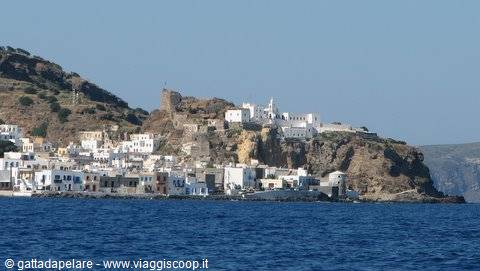
The village stretches along two streets parallel to the sea, one along the shore and the other inland, which end against a high cliff dominated by a monastery. From these, short side streets branch off, onto which open one-two storey houses whose entrance door is placed higher than street level. It opens onto a landing, variously decorated with the classic Dodecanese mosaic made of white and black pebbles. From the landing, normally without railings, you go down to the street with steep steps. The urban fabric is very pleasant and we gladly wander through the alleys and little squares until darkness falls. We have dinner at the usual taverna. On returning to the car we ask for information in the approximate Greek at our disposal from a tractor (read: tavern owner) who turns out to be a true Venetian.
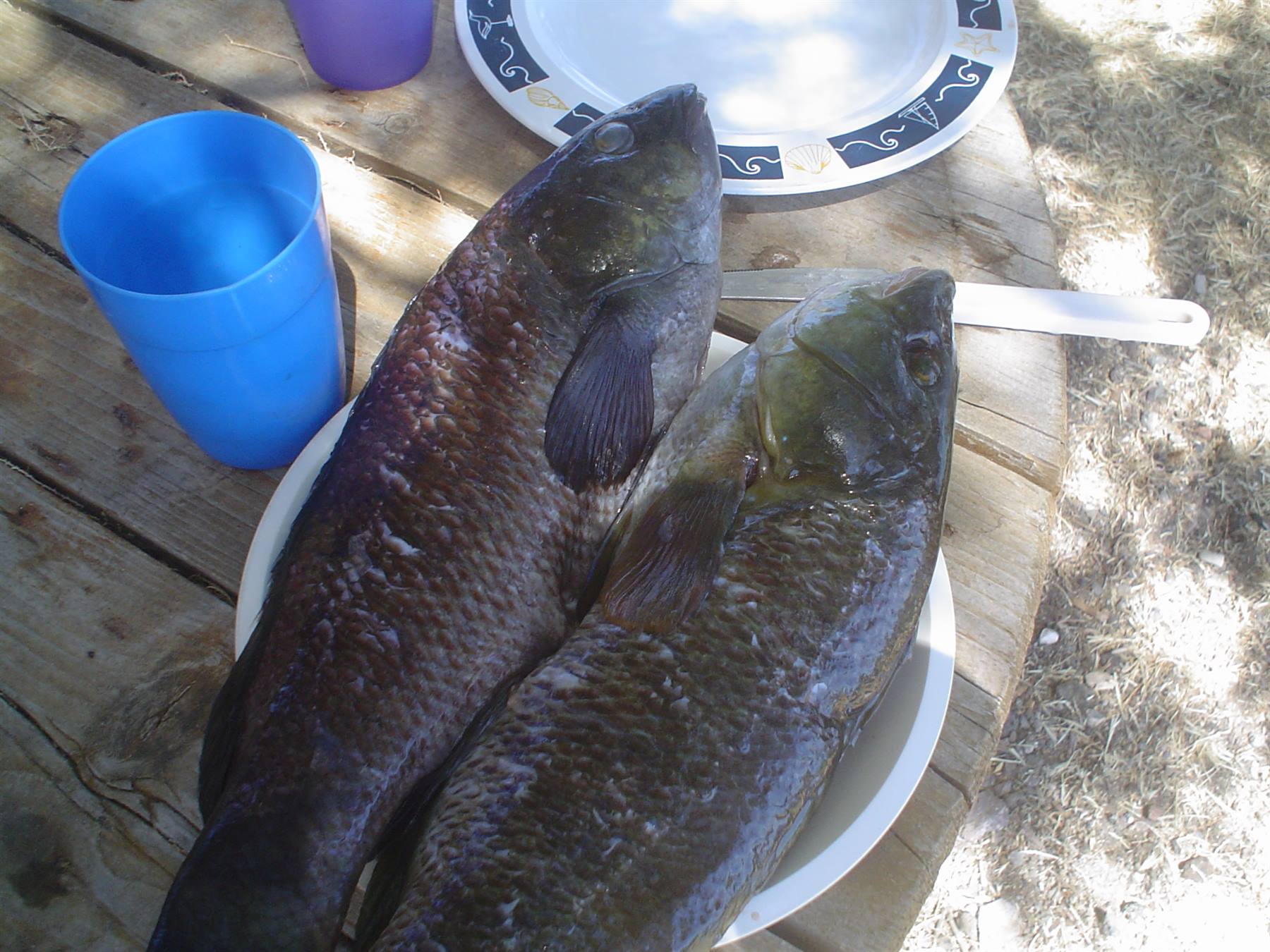
Amiably we chat with him and he gives us various useful information about people and places, pointing us to a beautiful spot on the southern coast where we can swim and picnic tomorrow. He doesn't want to be paid for the consumption and we part like old friends. Along the road we buy two 'big fish' and some squid to grill the next day..
10 June 2009. Nysiros.
A day of the sea lived on land. Following the directions given to us yesterday by the tavern owner we returned to Nikia and from there went down to the sea. The road that leads us down is just wide enough for one car and is a succession of endless hairpin bends that unwind among bushes fragrant with thyme in bloom and of brooms. The panorama is stupendous. Tilos is a couple of miles away from us and the stretch of sea that divides us is an intense blue, on whose surface the wind, a little stronger in the strait due to the Venturi effect, creates momentary crescent-shaped ripples, which vanish as they flee.. When, finally, we reach the bottom we find a little church, a couple of modest uninhabited buildings and the ruins of others. No other person on the spot. Here was the landing place of the village of Nikia, which shines white up above among the sparse oak trees.
In fact a sturdy pier encloses a shallow landing place, similar to a swimming pool, which invites us to swim. A little higher up we discover a bench and a table under the shade of a tree and here we set up the embers to grill the fish. Another day to remember with nostalgia in the confused and tiring days of the city passes serenely in family harmony. On returning to the boat we pick sprigs of thyme.
11 June 2009 Nysiros-Kos, 20 miles.
W e return to Kos. Tomorrow there will be a crew change. It's time for praise. The little cabin boys have lived this experience on the boat with amused and amusing participation. Sebastian has tied 'complicated' sailor's knots, has observed with extraordinary interest the anchoring operations: Maja has climbed the mast, released the fenders, learned from her little brother to raise her arms and cross her legs in imitation of the typical Greek dance (but, it seems, that in reality it isn't typical). Both have behaved like true 'gattonauts' and have danced the sirtaki. The father, proud, kept getting emotional. Certainly this experience of the sea will remain impressed in their memory and in their hearts and, perhaps, will condition their future existence.
It's the most beautiful gift we could give them, rooting in their soul the love for the sea lived with the wind on your face and the lapping of the water in your ears. At the marina today there's no room. Many boats have arrived for a regatta, so we are forced to look for a mooring in the port of Kos. We find a convenient one at the right quay, Mediterranean style, at the end of the seafront. We are the only ones moored there, in the same spot where Gattadapelare had found a place in September together with other boats. On the other side of the port, under the walls of the castle of the Knights of Rhodes, there is a mooring, paid, very busy. On that side there are also the departures of the ferries for Turkey and for the islands. The afternoon is destined for the preparation of the luggage of those departing and for the last purchases of 'little gifts' to bring to friends.
After dinner, returning to the boat, we find on the quay numerous fishermen with rods. They don't seem very lucky, but certainly very optimistic.
Psarì ashore
Day 912 Jun 2009
from Kos to Leros
12 June 2009. Kos-Leros. 26 miles.
A terrible night" - my travel companions tell me, bewildered. It seems (I slept without noticing anything) that there was a lot of shouting and noise of cars speeding along the seafront. We wait for the arrival of Gianfranco, known as Polo, to avoid confusing him with the one present. We are curious to meet him. Polo (it's the internet account) is a 'media' acquaintance in the sense that he had responded to an ad of mine on Velanet in which I was looking for cruise companions. We don't know what he looks like and we arrange to meet him on the boat. While waiting for his arrival, expected in the morning, we go to have breakfast at a café, until a text from him informs us that the new recruit of Gattadapelare is on board.
The introduction happens without formality and immediately that spontaneous cordiality is established which is the characteristic of those who share the same passion for the sea. We will spend a week together. This crew was supposed to be four members, but there were some last-minute defections. It's a frequent thing when organizing cruises, so much so that I would be tempted to resort, next time, to an "overbooking". The last ones to arrive risk being left on land. I imagine the faces of the unlucky ones, (and, perhaps, also mine after their reaction ). So, there will be two of us sharing the spaces of the Gatta. The Alpa 11.50 receives praise everywhere for the pleasantness of its lines and, for the experts, also for its reliability in every sea condition, but all this at the expense of the internal spaces.
Certified for eight people, it is comfortable only for four and in any case for companions endowed with a good degree of adaptability. We ferry those departing to the island of Lipsi on the other side of the port and with warm greetings we part in the certainty of seeing each other very soon in Lipsi. The idea is to stop this evening in a cove of Kalimnos and continue tomorrow for Lipsi. After buying ice we leave Kos. Immediately we encounter wind and well-formed waves contrary to our route and we proceed, with difficulty, under engine. Going back up the Aegean is often difficult. The dominant wind, the meltemi, blows from the northwest eight days out of ten, but in this period of the year it rarely exceeds 15-20 knots. However you either beat or go under engine. The true sailor chooses the first solution, but when you have many miles to cover in a short time you are less sporty.
Gianfranco, known as Polo, proves to be a good acquisition for Gattadapelare. Although he doesn't know it he moves with the confidence and competence of someone who has been going to sea for a long time. So, having passed Pserimos, an island inhabited by only 35 people and with a beautiful cove on the eastern coast, immediately afterwards we reach Kalimnos, famous for sponge diving. I navigate by sight, convinced of finding the cove of Palionissos where I had already moored in the past and near which, inside, there is a taverna. The owner, a bit of a sponge fisherman, a bit of an elementary school teacher, speaks Italian. He told me that until a few years earlier in that cramped little valley about thirty fishing families lived. Of houses worthy of the name, I saw none, at most small buildings similar to tool sheds. No electricity, no roads, no water.
except for a modest spring at altitude. The men were away six months a year for sponge fishing, even reaching the coasts of Africa, while the women raised children and goats. Once a week they climbed up to the saddle of the mountain and, after a morning's walk, reached the capital of the island where they sold the few cheeses produced. Navigating by sight has always led me to the wrong place, and this time too I keep looking for the access to the cove until Kalymnos ends with the narrow strait that separates it from Leros. By now it's too late to turn back and it's inevitable to continue facing the bow waves until Pandeli, the small and sheltered fishing harbor on the southern coast of Leros. The last stretch is tiring; we advance very slowly and we start to feel tired.
When, finally, we arrive we find no room in the small harbor occupied by fishing boats, nor do we manage to move any fisherman to pity and moor next to them. So we stay outside at anchor. We pay out thirty meters of chain which are not enough, and shortly afterwards we realize thatthe Gatta is drifting away. The wind blows from the land and, therefore, would not have created, in our sleep, big difficulties except that of finding ourselves in open sea. However, not a pleasant experience. The second time we pay out the whole chain, about 50 meters and we stay to observe the behavior of the boat under gusts. This time we hold well to the bottom and, after a frugal dinner, we slip into our bunks. During the night I wake up a couple of times to check. It's a habit I can't suppress even with calm sea and no wind.
Greek little square
Day 1013 Jun 2009
from Leros to Levitha
13 June 2009. Leros-Lipsi 11 miles
W e set off as soon as we wake up without going ashore. As soon as we round the promontory dominated by the remains of the Gerolomitano castle-monastery we encounter an even rougher sea than yesterday and a good headwind. We advance with exasperating slowness. Placing landmarks along the conspicuous points of the coast, it seems to us we are standing still. After three hours of thuds and foam we enter the wide bay of Lipsi at the bottom of which the village and our mooring pier rest. We find a place at anchor with our stern to the wind, well secured with sturdy lines. There are several boats, including two flying the Italian flag. Every time we return to this delightful island we find more and more visitors. I remember that only five years ago, in the same period, you had to find a place moored Mediterranean style.
Lipsi, the island of the goddess Calypso, nonetheless maintains its calm charm. Far from mass tourism, it hosts a small colony of Italians who have bought or built houses here, all rigorously white and no taller than two storeys. Although it is a Dodecanese island, (here too the old people still speak the Italian learned at school), the style of the houses is Cycladic. The island is small, but equipped with everything, including the sewage treatment plant. A guarantee of the purity of its beaches. In truth the beaches are few and small, but little frequented, at least in this season. In Lipsi we see again Marzia, Gianfranco and the children Maja and Sebastian, who have come here to rest after the "feline" adventures of last week.
We would like to continue to the little island of Marathi, which for me represents a landing place repeatedly dreamed of on gray winter days, but wind and sea don't invite us to go back to sea. The wind has strengthened and gusts of 50 knots arrive in the port. The flags of the boats are so taut they seem stiffened on their halyards. We strengthen the stern lines and, just in case, we also put a spring line. The Englishman next to us, imperturbable in the cockpit, is immersed in reading. We spend the day dawdling, without precise destinations and without haste and, lazily, we let ourselves be captured, like Ulysses, by the magic of this island.
14 June 2009. Lipsi- Marathi. 7 miles
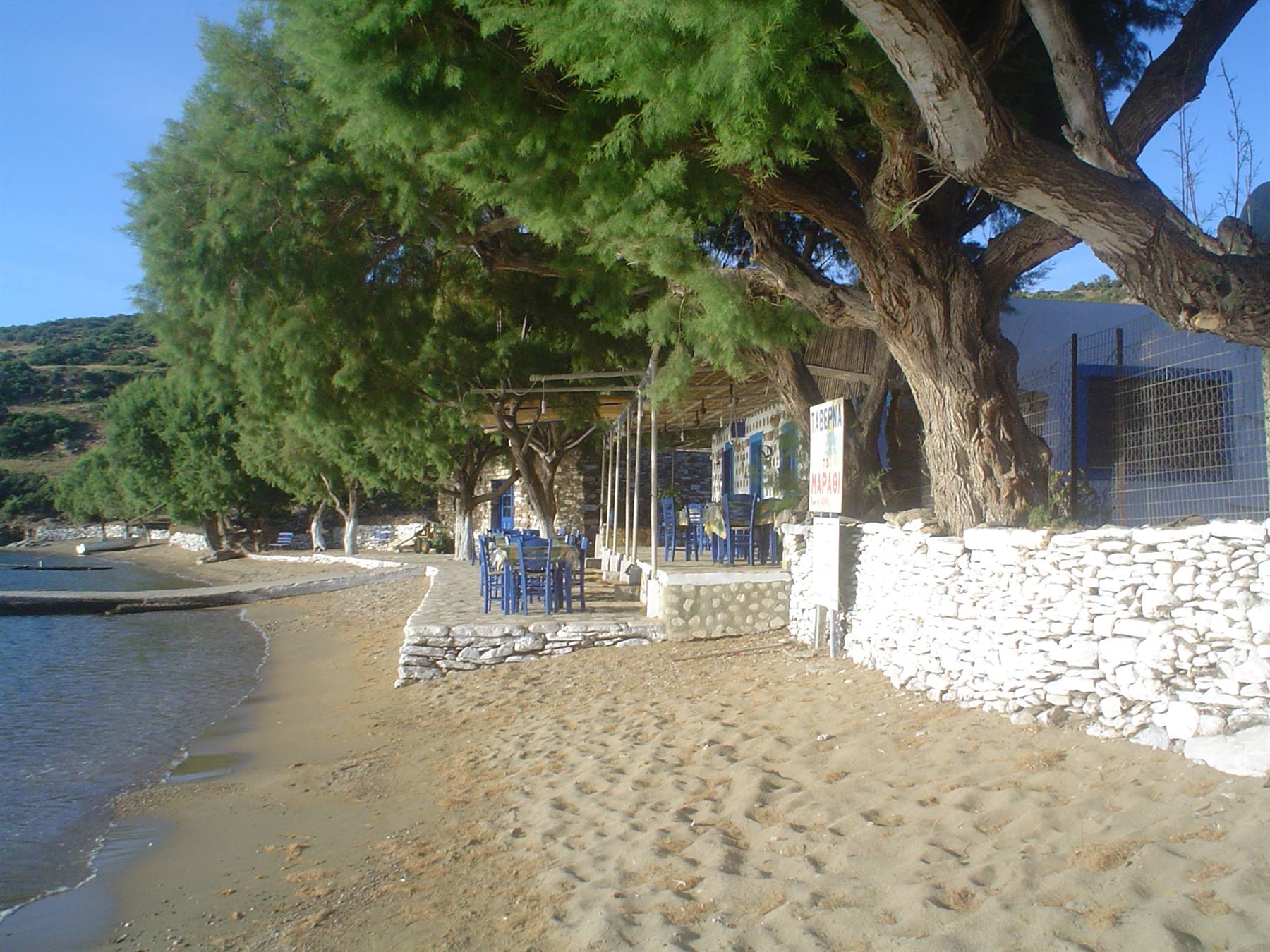
T oday the weather is better. Yesterday's wind has become almost a breeze and allows us to cast off. We leave the bay and just eight miles away the island of Patmos appears to us dominated by the white Chora, the upper town arisen around the gray monastery-fortress built in 1080 by the church of Constantinople. The whiteness of the Chora is like a lighthouse for sailors: you can see it wherever you sail in these parts. We round the high western coast of Lipsi and behind it some islets unwind among which you have to be careful because of the shallow bottoms. Marathi is as always inviting. A narrow strip of sand shaded by tamarisks at the foot of the bare hill, a couple of tavernas on the shore and no other sound than the cry of goats and hens. Mikalis invites us, as always, to moor at his little pier.
We spend the rest of the day listening to Mikalis's music and watching the sea and the other boats moored to the mooring buoys.
15 June 2009. Marathi-Levitha. 25 miles.
W e set off with light wind in the late morning. Today's route offers us the wind abeam and we would appreciate a little more air to detox from the 'engining' of the last two days. The crossing takes place without any emotion. We head for the southern tip of Patmos and immediately afterwards, in the haze, the outline of the island of Levitha can be glimpsed. This little island is in a strategic position on the route to the Cyclades and its importance over the millennia is due to the deep cove, almost a fjord, sheltered from every sea and every wind. The remains of a castrum or a temple that dominated the entrance to the landing place are barely visible in the jumble of rocks. In summer it is inhabited by a single family that has set up mooring buoys for which a seven-euro fee is charged.
In addition to this activity the inhabitants are devoted to herding and run a small taverna not far from the landing place. You reach it by a vaguely marked path among the stones. A few thorny bushes are all the vegetation present. So we do the same, we find ourselves with a couple of other crews having dinner at Stavros's, then returning along the stony path, looking for a secure foothold in the darkness of the night.
Psarì grilled
Day 1116 Jun 2009
From Levitha to Amorgos
June 16, 2009. Levitha-Amorgo. 46 miles. We leave Levitha when almost all the other boats, about ten, have already left. We take our time. By now the rendezvous with the new crew is two days of sailing away and the weather looks good. The fresh wind comes from the beam and Gattadapelare sails contentedly toward Amorgo, one of the islands I love most and my daughter Marzia too. Amorgo, with its high cliffs plunging into the sea and its blue depths, is little known by aggressive holiday tourism. Here there are no cafés with padded armchairs, souvenir shops full of trinkets, pretentious boutiques, jet skis, beach umbrellas, rock music, discos, fast food and, perhaps, even a McDonald's. The 'lower' town of Katapola, the capital, has a quay for mooring boats and ferries.
It offers the crews of the boats that stop there a few tavernas and some shops, a couple of small hotels and the essential services. The Chora, small and pretty, has as its focal point a typical, cosy Greek little square in the shade of a mulberry tree. On the southern side of the island the white and solitary monastery of Chozoviotissa looks as if it has been spread over the rock by a gigantic hand.Amorgo is an island for Aegean connoisseurs. Once past the islet of Kinatos the wind strengthens and forces us to reduce sail. When we are off the eastern tip of Amorgo, I make a decision I will later regret. I choose to take the route leeward of the island which, although a little longer, guarantees us a less rough sea. I will remember too late that I had read that gusts of wind can come down from the mountains with redoubled violence. And indeed the next few hours put us to the test.
We keep the boat a couple of miles from the coast where the waves begin to rise, but where we are less exposed to the downslope gusts. Nevertheless the violence of the wind, which we estimate in gusts at between 40 and 50 knots, tears the water from the surface of the sea and hurls it angrily into our eyes. I am forced to put on my diving mask when I am at the helm. La Gatta behaves splendidly and gives us no trouble at all. After an endless passage we reach the western tip of the island and, following the route of a fishing boat, we slip into the narrow passage between an islet and the tip, thus entering the stretch of sea windward of Amorgo. Here conditions are better; the sea is choppy, but the wind is not very strong. I regret the choice I made.in the morning. At last we reach the inlet at the bottom of which is Katapola and we moor on the anchor with stern lines to land.
We are tired and happy with the calm that now reigns in the cockpit. The pleasure of relaxing after a demanding sail, with a glass of ouzo in hand, is part of the joys that a boat can give to those who love the sea. We have dinner on board and go to sleep.
No title
Day 1217 Jun 2009
from Amorgos to Naussa (Paros)
June 17, 2009. Amorgos-Paros (Naussa). 60 miles (instead of 41)
T he windlass is broken. It seemed too good to be true, until now. We haul up forty meters of chain and head north. Leaving the bay we find yesterday's wind again and the sea on the bow. Unfortunately we cannot avoid passing downwind of the Little Cyclades islands, nor can we open out because we are squeezed, on our left, by the island of Skinussa. Yesterday's story repeats itself. Below Keros the wind is nasty again and the spray stings our faces. The foul-weather gear can barely keep us dry. Once past Keros, the islands of Ano- and Kato-koufonisi appear a few miles away and the gusts become less overbearing. When we reach the southern tip of Naxos and enter the strait between this island and Paros the wind and sea, as expected, shift onto the bow and force us to start the engine. We have no desire to beat all the way to Naussa.
But the next breakdown is lying in wait; after a few minutes a burnt smell warns us that the engine belt has snapped. No great harm, before leaving I had given the spare materials a quick glance and had seen another belt in the locker, but when I pick it up I realize it is an old belt kept because 'on a boat you never throw away anything that might come in handy'. Let's hope it holds for a couple of hours. And instead, after just ten minutes a fresh plume of smoke tells us that this one has gone too. I had been keeping an eye on the cooling-water telltale, only to discover now that the impeller is not being turned by the belt. We have no choice but to trust the wind and beat. So we do for hours and hours, gaining little ground with each tack. As it begins to grow dark and the lights of the villages come on along the shores of the two islands, we are still barely more than halfway.
The wind is dropping and we begin to move slowly. By now it is certain that we will find ourselves level with the mouth of the bay of Naussa, on Paros, in the dark, and we will not be able to cut between the numerous islets that cluster on the southern part of the entrance because, I remember, there are shoals and rocks awash. Every tack to starboard takes us toward the town of Naxos, whose lights are now clearly visible, and we don't seem to gain much ground. The wind is now weak and we can only point up during the brief, and increasingly rare, gusts. In the glow of the sky we glimpse far off the outline of the outermost islet of the small archipelago that we must round in order to head with clear water to the mouth of the bay. The hours pass and our progress is modest. When, at last, we reach the islet we cannot pass to its right.
It is now two in the morning and the wind has dwindled to a breath. Every time we approach close to the island the boat no longer answers the helm and spontaneously 'luffs up', moving away, always with exhausting slowness, without gaining a single meter of ground. We see the lights of Mykonos and we can even hear the pounding of the engines of great ships ablaze with lights heading into the strait between Naxos and Paros. It is now three in the morning and for eighteen hours we have been taking turns at the engine. Gianfranco dozes off in the cockpit and leaves me weakly cursing Gattadapelare, who no longer feels the helm. By now we are resigned to spending the night this way, carried along by the current and by fate. Then a puff of wind comes to our rescue and with a pitiful bit of headway we round the islet.
We are a few meters from the rocks on which a long swell is breaking, and we hear its less than reassuring lapping. I try to start the engine for a few seconds to gain a bit more ground, but the starter motor is jammed. Praying that there is no stray rock ahead of us, we keep moving forward. Now we have before us clear water free of every obstacle. The lighthouse on the promontory to our starboard shows us the entrance to the bay and the lights of Naussa can be glimpsed at the far end of it. Without an engine and without a windlass I will have no choice but to take the helm in front of Monastiri, a beach just after the entrance to the bay in a position sheltered by the mountain, on a sandy bottom, where I have already had occasion to anchor in the past. The wind arrives, fresh and from astern. The Gatta, at last, begins to run, even too much for the maneuver we will have to make.
When, at last, we round the promontory and head toward the beach at the foot of the hill dominated by the lighthouse, the wind comes in intense gusts from abeam interspersed with moments of absolute calm. There are already several boats at anchor and in the darkness we make out the possibility of putting ourselves between the two most widely spaced. With the jib furled and the mainsail reefed we approach in a moment of almost no wind the boat most to windward. Gianfranco pays out the anchor, I ease the mainsail and at that moment a violent gust hits. Gattadapelare drifts rapidly down toward the boat to leeward.
Our voices, until then whispered so as not to disturb the other crews, become agitated: "Watch out Gianfranco, watch out,...quick the fenders...we're going to hit...!" And under the sleepy, bewildered eyes of the English skipper, who came out of his boat at our shouts, the Gatta stops two meters from his, and begins to move away from it, swinging. It is four in the morning. We have been awake for twenty hours. Without even speaking we slip into our berths, but it is not over yet. The anchor is dragging, it seems. I ask Gianfranco how much chain he paid out and he answers that he saw four wool knots (red wool tied to the chain to indicate the amount in the water). Damn, that's barely twenty meters, on a six-meter bottom. I go back on deck and pay out more chain. But it's a mistake. The four knots indicate that the chain is in the water for forty-five meters, practically almost all of it.
And indeed out of the hawsepipe comes the textile line that secures the chain to the boat. Too weak not to snap under a gust. I grab the chain, then, and yell to Gianfranco to come out and help me. He doesn't hear me (later he will confess that he thought I was just cursing). Several minutes pass and several calls for help, including banging on the deck, before my shipmate understands and comes to me. We spend another half hour stuffing the overly bulky textile line back into the windlass hawsepipe and securing the chain to the boat. Toward the east it is already dawning. It is four thirty. Good morning.
Islet of Marathi
Day 1317 Jun 2009
from Naussa to Antikaros
June 17, 2009- Naussa (Paros)
W e wake up around nine and the first thought is to track down Pino, who arrived on the island last night. Pino will relieve Gianfranco in the last crew of this cruise. We task him with finding a drive belt and tell him how to reach us by scooter. When he finally arrives, any attempt to start the engine will be useless; the starter is jammed. But in Naussa I have a friend, Maria. Maria is a 'bountiful' Romanian, married here to a Greek, who rents out small and pleasant rooms for tourists. She is an exuberant, proactive character and at my phone call she is enthusiastically ready to help us. Indeed, shortly afterward she arrives by taxi with Dimitri, a taciturn mechanic who inspires confidence. He takes possession of the boat and begins to study the engine.
With calm, thoughtful gestures, he touches, caresses, disassembles, cleans, tinkers and asks, at first in a low voice, then, faced with our perplexity, in increasingly peremptory tones, for the "dubleviu". "Dubleviu!, dubleviu!, dubleviu!!" and he makes the gesture of pressing something with a finger. At this point I realize he is looking for a spray, certainly the one known to me as CRC, the screw loosener. And so it is. It's true, on the package I have the letter W appears prominently. I had never noticed it. After numerous attempts at starting and stopping, in the end he declares that everything is fine. The engine runs. With Dimitri on board we leave the mooring, laboriously hauling up the fifty meters of chain, and reach the new little harbor of Naussa. The port, which I saw under construction three years ago, is almost finished.
Only the posts for supplying water and electricity are missing, which they are installing these days. Unfortunately the entrance is open to the swell and inside one does not moor calmly, but we settle ourselves bow-to along the breakwater quay, where with a spring line properly rigged we manage to keep the Gatta slightly off the quay. Naussa is a village, typically Cycladic and rather touristy, and, despite that, very pleasant. Particularly welcoming is the small dock, which hosts the many fishing boats, surrounded by numerous tavernas, already very busy this season. For dinner we invite Maria, who takes us to a restaurant outside the tourist circuit and introduces us to one of her daughters with her Tuscan husband and her little granddaughter. This Maria is always a source of surprises.
June 18, 2009. Naussa
T he engine won't start and we call Dimitri again. Yesterday's ceremony repeats itself, with a variation. He finds a piece of rubber from the impeller in the water filter and takes apart part of the engine. A gasket will need to be replaced, but today is Sunday and spare parts cannot be found. So we are forced to postpone our departure to tomorrow. The Gatta has gained a new sailor, or rather a sailor, Daniela. She too is the happy owner of an Alpa 9 and 50, the younger sister of Gattadapelare, and she loves the sea and the wind. A good acquisition, I think. We go to discover the beaches of Paros with a rental car. A phone call from Dimitri informs us that the boat is ready, the engine is repaired and he is waiting for us for the test. Tomorrow we continue, I hope.
June 19, 2009. Paros-Antikaros. 35 miles.
W e are on our way again, running downwind. But the wind, not strong, today comes from the south, an Aegean libeccio. Gattadapelare glides fast and calm. The only event capable of breaking the monotony of the trip is the second escape attempt by the tender. We spot it by chance two hundred meters away and go to recover it. In the first recovery attempt the boat hook also falls into the water and the rescue operation becomes complicated. It takes us a while and I think with a trace of worry about what would happen if we had to save the man overboard under sail. This crew still has to do its shakedown on the Gatta. In the late afternoon we reach the well-protected channel of Antikaros. This is an anchorage that tickles the imagination and curiosity. The island is small and uninhabited, except for a fisherman who has his house up high, far from the sea.
But another house tickles our imagination, that of a French misanthrope who lived here in solitude until the day he abandoned everything and disappeared. The house is today a refuge for goats and its appearance as an abandoned manor dominates, now gray and mysterious, the entrance to the channel. There is a small beach created by the current where we organize ourselves for a fish grill, but the wind and the cold soon drive us back into the welcoming belly of Gattadapelare,
and the Gatta sails on
Day 1420 Jun 2009
from Antikaros to Tilos
June 20, 2009. Antikaros-Amorgos. 7 Miles
W e quickly reach Amorgos and moor, in a forbidden zone, bow-to. We make inquiries to find an "elektrologo", an electrician, for our anchor, but the "good" one is sick and the "not good" one immediately declares his inability to solve the problem. At least he is honest. Despite the Harbor Master's requests to move the boat, we turn a deaf ear. We have no desire at all to haul up the anchor by hand. Our tender, for the third time, attempts to escape and remains stuck against a fishing boat not far away. In the Chora tonight there will be a village festival. With Daniela we went up there by scooter and sat on the stone benches that surround the little square. Here Daniela wins the heart of a ruddy, chatty local who goes to fetch a flask of homemade grappa and attempts seduction through alcohol. We leave him disappointed and a little tipsy to go eat on the boat the risotto prepared by Pino.
June 21, 2009. Amorgos-Astipalea, 49 miles.
T he weather remains unchanged. Weak wind from the south. Daniela would like to experience the meltemi, a wind she doesn't know, but Aeolus is mischievous. Our destination is Astipalea, a Cycladic island, the easternmost, but administered by Rhodes. It has the shape of a butterfly and I remember it as very pleasant and not very touristy. When after an uneventful sail we reach Vathi, the lower town, I discover that since my last visit a well-protected harbor has been built, full of sailboats. The surprise is pleasant because the previous time a strong swell forced us to move the boat to another bay. To my satisfaction I manage to moor bow-to, under the slightly envious eyes of the other crews, along the side quay. This type of mooring is my favorite and my enthusiasm is the object on board of good-natured irony, especially from Daniela.
She would always want to stop at the helm in some bay so she can dive into clear waters; we, while not disdaining this type of stop, are more inclined to discover the pleasures of a welcoming taverna, possibly a few meters from the boat. Once in Castellorizo, the island of the film Mediterraneo, we tied our mooring lines passing them between the tables, apologizing to the customers for the disturbance. This is the Greece of the islands, genuine and spontaneous, the one we love and the one we dream of when we are far away. Sooner or later I will have to satisfy Daniela too, and find a little bay.
June 22, 2009. Astipalea-Tilos. 53 miles.
W e head for Tilos under sail and power, avoiding at the last moment a shoal a few hundred meters from the exit of the bay. Perhaps we would have passed over it without danger- the transparency of the water in these seas is exceptional and makes the seabed appear less deep- but at Pino's excited warning, he being at the helm at that moment, we turn sharply and to starboard move away with a bit of a pounding heart from the danger zone. We are three left. Pino, indefatigable helmsman (the Gatta's new autopilot is not yet active due to installation complications), Daniela, a convinced vegetarian and skipper in her own right, and I, happy owner of a container of breakdowns. Today's long leg is enlivened by the "great helmsman" who, dreaming of Hollywood, lays out his film projects for us. Unable to slip away, given the cramped conditions of the boat, we listen with amused patience.
The volcanic profile of Nisyros begins to appear and after a while, to its left, the lower one of Tilos. The wind continues to stay moderate and Gattadapelare proceeds calmly. At Tilos a taverna awaits us where there is always a kid goat turning on the spit. The idea cheers only Pino and me. Daniela dissociates herself. The majority wins. When we arrive it is late afternoon. The small port is occupied by numerous boats and there is no free berth left. We would be forced to anchor out if a boat did not offer us the possibility of tying up to it. A kind gesture from someone who loves the sea and considers other sailors common friends. The boat, a small eight-meter sloop, is inhabited by an old couple of lean, wrinkled Germans who live and sail on it for many months of the year. We make friends and I invite them to drink ouzo 'from boat to boat'.
At the taverna a great disappointment: today no goat, tomorrow yes.
Naoussa (Paros)
Day 1523 Jun 2009
from Tilos to Rhodes
June 23, 2009. Tilos-Alimia. 25 miles
W e are headed for Halki, an island to the south, the last of the three lined up between Kos and Rhodes. We read that it too is off the tourist routes and hosts a colony of semi-resident English, lovers of simplicity and peace. The wind continues to be favorable, but not very strong. But today we have time. Halki is immediately clearly visible. Behind it the long profile of Rhodes and farther off, more to the right, the tip of Karpathos. This is another island I want to land on again. I got to know it with my daughter Marzia twelve years ago and we were enchanted by the simplicity of its inhabitants and the beauty of its mountainous, seafaring nature. When we are level with the town of Halki the wind strengthens and the anchorage does not appear pleasant to us. It is a good opportunity to look for an inlet where we can stop at the helm.
But the one indicated to us by the German couple proves unsafe; it is to windward and not exciting. After a second attempt we give up, put the stern to the wind and head for Alimia. This is a small island with a beautiful bay protected from all winds. It is barely six miles away and we reach it easily. Access is allowed through a channel and immediately to its right the pilot guide indicates a small jetty which, however, does not prove suitable for a boat as big as the Gatta. To Daniela's satisfaction we stop at the helm and drop anchor in the most protected area where two other boats are anchored.
June 24-25, 2009. Alimia
T he lagoon of Alimia opens before us in the sunlight of Phoebus. A light breeze raises tiny waves that lap against the Gatta's bow, which faces the open sea, which remains hidden by the tongue of land that closes the entrance to the bay. A dive into the transparent water and so begins our lazy, third-to-last day in the Aegean. A tour of the bottom of the bay with the tender to explore the wreck of a pontoon whose crane, eaten by rust, rises like an admonishing finger, and then the landing near some buildings, witnesses of the tragic period of over sixty years ago, when this island was a naval base of the German navy. Inland, on the ground, among fragments of bricks and rubble, goat droppings and sea urchin shells, consumed in great quantities, betray the frequentation of these places by regular visitors.
We wander curious and wary, but also filled with a feeling of respect for the history of men, before being soldiers, told through charcoal drawings on the walls. One, but probably more expert hands, tell today's visitors the poignant nostalgia of those young men torn from their villages, from the mountains and meadows of Germany to come and fight here, in the brightness of these islands. On one wall is drawn a gentle hilly countryside with a distant little church, on another a glimpse of a medieval village crossed by a river and, again, a winter landscape framed by fir trees. All drawings of excellent quality that have earned the respect of later 'graffiti artists' eager to leave a mark of their passage. Indeed, no one has superimposed the scribbles of their own names and the dates of their visits on the drawings of the anonymous artist.
Clear expressions of narcissistic presumption and unaware modesty. Not even the exultant, defiant inscription "Victory 1945" surmounted by the Star of David was superimposed on another beautiful drawing, this time in color, depicting the erotic dream of a 'doughboy' struck by the arrow of a little cupid. We go out again and enter the blue and green scenery of this lagoon framed by Mediterranean scrub. We spend the days in the laziness of the cockpit shielded from the sun by a bimini top. We read, sleep, listen to Pino talking to us about cinema, and let time flow over our skin. On Sunday the 28th we go to Rhodes to look for a boatyard where we can leave the boat and have the improvement work long planned done on her.
June 26, 2009. Alimia-Rhodes 30 miles
A t departure time some big fish come to swim under the boat. We catch one to Daniela's great dismay, who threatens disruptive actions and risks being abandoned on the island like Ariadne. We will eat it as sushi on the way. The wind pushes us and strengthens when we are abeam of the town. We don't know exactly where the boatyard is, only that it is south of the port. When, at last, we see boat masts sticking up on the coast, and after two attempts to locate the haul-out point we reach our destination. Today is Sunday and no one is around. We make the decision to moor in the haul-out basin and begin putting the boat to rest. We have dinner in town and sleep for the last night in the berth. From tomorrow only big beds where turning over requires no physical exercise.
June 27, 2009. Rhodes
P ino leaves in the morning, Daniela in the early afternoon and I remain alone. The Gatta is hauled out, the sails stowed, the parking paid. I find a lucky ride that takes me to the hotel booked this morning. I take a long shower, turn on the air conditioning, lie down on the bed with the Greek television on and fall asleep. Toward evening I go out to buy food at a rotisserie and return to the hotel. After so much wandering I am finally still. Tomorrow I sleep in my own bed.








0 reader comments