9 September. Skopelos-Scanzoura – 20 miles. The weather continues to be fine. We leave Skopelos unhurriedly heading for Skanzoura, an island four hours' sailing away. We know the island is uninhabited and holds the ruins of a monastery. For a certain time it secretly hosted non-EU immigrants of various origins, but today there is no trace of them anymore, I don't know why. When we drop anchor at the bottom of a wide inlet there is only one sailboat, far away, to which another is added a little later. I go into the water intending to catch some fish for dinner, but the sea is empty. Not even on the deserted islands is there any life left, then?! I discover, instead, at a few meters' depth numerous fragments of ancient amphorae now fused together and with the rocks, so much so that they can no longer be moved without breaking them.
A shipwreck or the simple loss of a cargo? Only the surrounding rocks, eternal witnesses of the events that have followed one another in this bay, could tell us how much dark history has unfolded here over the centuries. Today it is we and our Gatta who enter into the memories of the rocks, insignificant memories, but our presence here, our present, is for us extraordinary, as everywhere in this sea of the gods among these islands. The night passes peacefully.
10 September. Scanzoura- Skiros- 25 miles. We set out under sail, taking advantage of the weak morning wind, to reappropriate the maneuvers after so many months of inactivity. As soon as we leave the bay we glimpse our new destination well defined ahead of the more faded profile of Euboea. The wind soon abandoned us and we proceed under motor for the whole route. When we arrive at Skiros it's lunchtime. This island is half Sporadic and half Cycladic. The western half, the one we are in, is green with trees, while the other is arid and rocky. The small harbor where we found mooring has a short quay and we had to moor alongside another boat of English people. Including ours we are four. A few meters away, beyond the road, two tavernas compete for the few customers.
We choose ours based on the color of the chairs and tablecloths and after lunch we head, by motorcycle, to the town of the same name. It's a typical Cycladic town made of white houses clustered around the ruins of the Venetian (or Genoese?) castle that dominates from above the hilltop the countryside and the surrounding sea. It's a very genuine town with many people near the center and deserted in the peripheral alleys, where we meet sparse little old women gathered in little groups of three or four exchanging sparse chatter. We imagine these alleys and these little squares, shaded, by the omnipresent mulberry tree, when the meltemi blows vigorously from the sea below. We walk silent and curious to discover behind every corner usual views, and yet always new, of alleys, doors painted blue, of stray cats and fig plants from which we pick very sweet fruits.
We sense the approach of autumn from the sweetness of the figs, from the inevitable shortening of the days, from the sun's rays increasingly low on the horizon, from the growing melancholy of the light that every day loses the enthusiasm with which it has told us the colors of summer. We dine at the port. This time we choose the most frequented taverna. We are the only tourists. There's the inevitable pope, plump and gluttonous, and a varied representation of locals. We apologize to our boat neighbors for our comings and goings and thus close our third day of cruising. Up to now we have done very little sailing.
11 September. Skiros-Psara. 40 miles. Today we set off early, followed right after by the English boat that gave us support. With some perplexity we pass between an islet and the eastern tip of the bay. We are not sure of the depth of the strait and Gino, on the bow pulpit, signals with gestures the direction and speed I must maintain. The other boat, also headed for Psara, prefers to pass on the outside, losing a bit of ground compared to us. Right after rounding Skiros we unexpectedly find a very rough sea, on the beam, almost astern, and a strong wind that pushes us fast toward Psara. It's the first experience of rough sea after fifteen months of land life, and we are seized by a certain malaise that prevents us from staying more than a few seconds below deck.
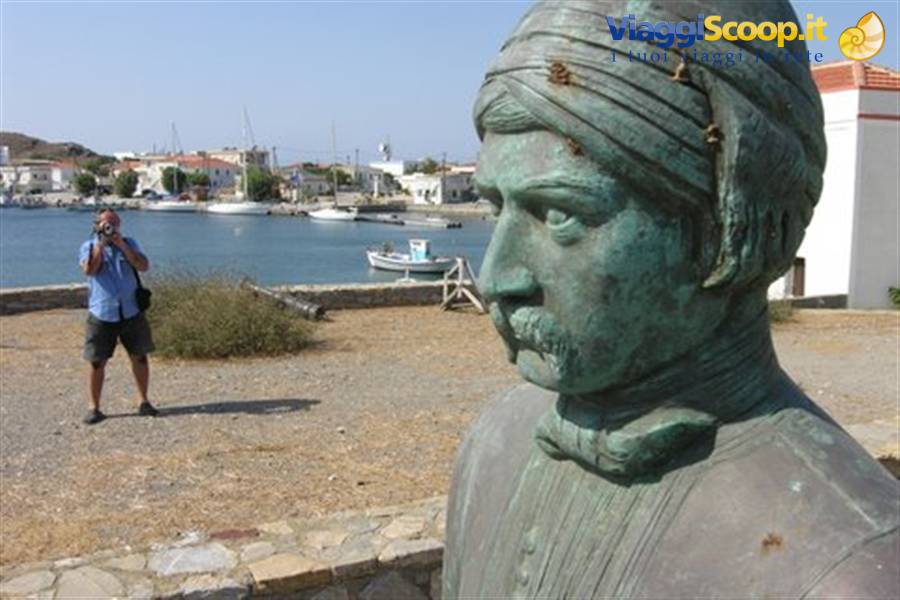
With Gino at the helm, I lie for a long time in the cockpit, but my dozing is frequently interrupted by abundant, icy sprays of waves breaking on the side of the Gatta. The other boat has fallen behind and the distance between us grows more and more as the hours pass. Psara appears soon on the horizon and its profile quickly becomes ever more distinct. It's an island we didn't know about until recently. Yet its history is rich in interesting and dramatic events. Homeland of shipowners, it counted a population of thirty thousand inhabitants, but the fault of being the homeland of a proud leader, the national hero Canaris, opponent of the ferocious Turkish domination. For this and for the strenuous resistance of the villagers to the dominator, the population was annihilated in 1822 and all the houses were razed to the ground. Since then it has never recovered.
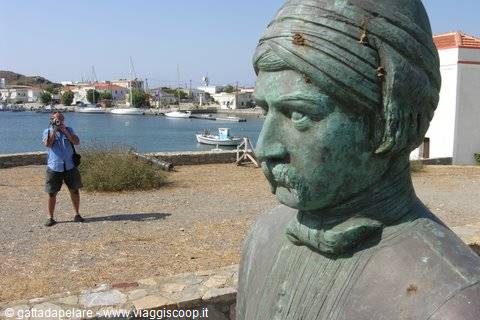
Today it counts barely 400 inhabitants, a couple of ruins, the foundations of the birthplace of admiral Canaris, some corroded cannons scattered here and there and a couple of heroic bronze busts that, solitary sentinels facing the sea, guard the modesty of the current town. We arrive in the late afternoon and take shelter in the wide inlet at the bottom of which a quay and a floating pier invite us to dock. No other boat. The sense of having arrived in a unique place is reinforced by observing the town. A narrow street runs alongside the quay to which a couple of fishing boats are moored. Three or four simple kafeion also serve as tavernas for improbable tourists. From the street some alleys branch off that go inland.
The houses are anonymous, without any particular characteristic, different from the white cube-shaped, 'spontaneous', Cycladic buildings or from the orderly neoclassical-style and tenderly colored houses of the Dodecanese. Dominating the modesty of this scenario an imposing sanctuary stands at the end of the town at the base of a harsh hill. Another church, smaller, but also 'exaggerated' in such a context, stands out among the houses. The sensation one has wandering among these little streets is that of a community incapable of reacting to history. There is no part of the town that can be considered a center. A square in front of the quay hosts the statue of Canaris and is the only point of reference, apart from the two churches, for an improbable social gathering. The three kafeion remain, where rare people sit.
Wandering around and around we find a bakery and almost at the edge of the settlement a grocery store with the pretentious sign of Supermarket. Meanwhile the English boat has also arrived and later a third sailing ship keeps us company. In contrast with such an atmosphere of discouraged expectations, not far away some cranes lift concrete blocks from some barges to create a sturdy breakwater and thus create a wider port. We dine on board
The launch
Day 29 Sep 2006
September 9. Skopelos-Scanzoura – 20 miles. The weather continues to be beautiful. We leave Skopelos unhurriedly, heading for Skanzoura, an island four hours away by boat. We know the island is uninhabited and holds the ruins of a monastery. For a time it secretly housed immigrants from various backgrounds, but today there's no trace of them left, I don't know why. When we drop anchor at the bottom of a wide inlet there's only one sailboat, far off, which is joined by another a little later. I go into the water intending to catch a few fish
Where the sun rises
Day 312 Sep 2006
12 September – Psara-Chios (Kardàmyla). 19 miles We leave Psara in the late morning and coast along it heading east. Chios appears close by, and the sea, wind and sun make for a calm, lazy sail. The stretch of sea separating the two islands is clearly a maritime highway. Several cargo ships cross our course, and on a couple of occasions I fear a collision course, despite Gino's reassurances. In the late afternoon we enter the bay of Kardàmyla. At the far end lies the town, which from a distance does not look attractive to us. We are the only boat moored at the long pier. We read in the German pilot guide that the valley behind it is romantic and the town charming. We do not share this opinion.
Perhaps at the beginning of our wandering among the islands of this mythical sea, still unacquainted with the scenery that would later be offered to us, we would have accepted it, but now this town lacks the poetic rhythm we are accustomed to. We receive a visit from the officer of the Harbour Authority, who invites us to present ourselves at his office with the boat's documents. In all these years this is the third or fourth time this has happened. We do not know whether the feared mooring tax, which we heard about some time ago, has come into force and whether, therefore, we are not in compliance. Gino and I agree to tell an implausible port of origin, such that we would not have had time to make the payment. The Italian coast is too far away, so we could say that our last port was in Turkey.
Instead, at the office they ask us, in addition to a photocopy of the documents, only for the insurance certificate, which in the rush I cannot find. I am certain I have it, and while I go back to the boat to look for it, our 'referee' (he confessed to us that his real passion is being a football referee, so we expect particular rigour towards us) reassures Gino, saying that even if we don't find it, it doesn't matter, but advises us not to frequent the larger ports so as to elude any checks by stricter colleagues. He confirms to us that Kardàmyla is the birthplace of numerous important shipowners. Practically every house belongs to a shipowner.
Indeed, we witness the arrival of an elegant two-masted vessel that, from the moment it enters the bay, repeatedly sounds its onboard horn, to which another responds from a villa—admittedly not imposing, but well lit and equipped with a private jetty—at the far end of the town. Even Gattadapelare answers back with our poor means. We take a walk through the town, which confirms our first impression. It consists of a couple of long rows of houses parallel to the sea, with a few establishments and virtually no inhabitants. We go to snoop around the shipowner's house, which looks more like a small hotel with its seaside terrace full of deckchairs and wicker armchairs, and then we return to our modest sailing boat. Pino calls us, the one taking over from Gino, who returns to work the day after tomorrow. He has arrived in Chios town and will join us tomorrow.
13 September – Chios The taxi with Pino stops in front of the Gatta, comfortably moored stern-to. The two catonauts, the veteran Gino and the novice Pino, get acquainted, and the former shows the latter the 'peculiarities' of the boat. Pino's judgement is positive: he finds Gattadapelare "fascinating", elegantly glossing over its state of maintenance. He has already earned his role on board. Anyway, today is a day ashore. We are going to visit the island. We rent a car and reach Pyrgis, a town in the mastic region, the chewing gum of the ancients, the fortune and misfortune of the island of Chios. Pyrgis is also unique for its sgraffito houses, so that the façades appear with white and black geometric designs. But we are decidedly sea people. A few hours are enough to miss it, and we go in search of a beach.
Following a road that turns into a path, we descend along a small valley towards the blue that peeks out among the olive trees. The place is steeped in pagan presences; the spring we come across a little further on certainly housed a nymph, and the rare stones of what was a modest temple of Apollo, even if exorcised by a small Christian church built upon them, speak to us of the solar god who here, facing the sea, enjoyed the luminosity reflected by it. We bathe in a sweet and crystal-clear sea and doze off on the pebbly shore. We know of another site we absolutely must visit. It is the town of Anavatos, or rather its ruins perched on a cliff from which in 1822 the entire population threw themselves to escape the Turks. A painting by Delacroix, now in the Louvre, depicts the massacre. The remains of the town, a confused jumble of grey and dilapidated houses, are today being restored.
We meet no one, and after a brief tour of the ruins and the view over the cliff, we leave with an anguished sense of a remote and tragic past. Nor does the grey meal consumed in an empty trattoria at the foot of the pier of Kardàmyla help. We go to bed early. Tomorrow at dawn Gino will leave for Chios town airport, and we have a long leg to do as far as the Fourni islands.
National hero
Day 414 Sep 2006
14 September. Chios-Fourni Islands. 62 miles
Gino leaves us while it is still dark, but we do not feel like casting off the moorings immediately without a minimum of reassuring light. We have breakfast, and when the darkness thins we leave the quay. There is a decent land breeze that induces us to leave the mainsail reefed, and which, for fear it might strengthen, makes us study alternative destinations. Pino does not know the boat, and facing rough seas with an unprepared crew worries me. Instead, as soon as we reach the beam of Chios town, the wind abandons us entirely. So, under motor! Visibility is poor and the humidity is high, to the point that everything on board seems wet. Pino stays at the helm the whole time, ten hours of uneventful sailing without a single fish biting the two trolling lines we trail behind us.
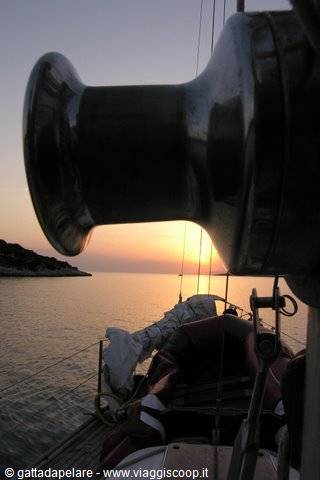
In the late afternoon we pass between Ikaria and Samos and glimpse through the haze the main island of the small archipelago. By the time we arrive it is already dark. At the same pier where I hoped to moor as on the previous occasion there is a prohibition because it is reserved for a ferry. The other piers also seem destined for services. Some sailing boats are moored with a wheel in front of the town, and we too head among them to spend the night, resigned to not dining ashore. Our tender is out of use and it would be too much effort to inflate it. We fumble for a long time with the anchor and the windlass motor, which inexplicably jams. While from the other boats they watch us with scepticism, we decide to abandon the spot and risk, since there is dead calm, putting ourselves outside the pier.
Our decision then proves fortunate because while all the other boats are forced, due to the arrival of a large ferry, to move away from the stretch of sea they had occupied, we moor stern-to at the only available small jetty, pointed out to us from afar by a courteous boy. Happy with our fortunate position (we watch the other boats uselessly seeking a solution), we cross the road and sit at the table of the nearest taverna. We are tired, but satisfied. 15 September. Fourni-Marathi. 22 miles We are in a hurry to reach Marathi. After a brief tour of the town (it is worth reaching the little square at the end of the main street, where a fine sarcophagus from the Hellenistic era sits modestly in the shade of a tree), we set off. I carry with me an impression different from the one I received the first time I came here, three years ago.
Back then this village, devoted mainly to fishing, had appeared to me extremely simple, out of time by at least three decades, a flash of an island Greece now vanished. But after the experience of Psara, Fourni now seems to me projected into the tourist present. I realise I have become more demanding after visiting islands and anchorages more suited to a sense of romanticism I would call "twilight", but this perceived tourist advance is annoying and hurries me to discover and enjoy other places not yet polluted by extraneous presences, aware that we ourselves are pollutants. The hurry to reach Marathi is due to this. In the narrow channel we follow to leave the archipelago, a group of dolphins comes to play at the bow and stays a long time performing in front of the video camera.
These are apparitions that are never denied us on every cruise of Gattadapelare, and each time they excite us. At the call of the lookout in turn, we run to the bow with cameras and video cameras, lean over clinging to the pulpit and enthusiastically film the evolutions of these friendly travelling companions. It is a pity that they soon tire and move off, indifferent to our calls. But their presence always breaks the monotony of certain days of calm sea, which are the ones in which they normally appear. The weather is fine, the wind scarce, and yesterday's haze is gone. Shortly afterwards we sight the small archipelago of Arki, of which Marathi is a part. In front of Mikalis's taverna there are at least ten sailing boats moored with a wheel. Every time we revisit this islet, we find ever more visitors, confirming what was said above.
The first time we discovered it, Marzia and I, there were only four houses, the taverna of that eccentric character Mikalis—thin, small, with a thick pirate's beard and a black bandana—and a small guesthouse with a few rooms at the opposite end of the long, narrow sandy beach that, adorned with tamarisks, faces a crystal-clear sea well sheltered from the meltemi. Now there are three tavernas and the houses have doubled. Mikalis is even thinner, and on his little jetty, where we have the honour (but only we do) of docking, flies the flag of the Brethren of the Coast: a skull with two crossed bones. We abandon ourselves to sweet idleness. Pino is fascinated by the serenity of the place and declares he no longer wants to move. So we decide to stay for a few days.
16 September. Marathi
Music, ouzo, little swims, naps under the tamarisks.
17 September. Marathi. Today we repeat. Only three boats are left in the bay. Every so often a large boat arrives with a few dozen tourists who come ashore, lie in the sun and after a while leave again, leaving us once more (and happily) alone. Another sign of pollution that we must endure with forced resignation and nostalgia for 'the good old days'. But in the evening Marathi returns to being for the few elect.
18 September. Marathi-Lipsi. 6 miles
Mikalis has truly become a bit of a pirate. His prices are no longer those we are accustomed to. Our latest 'Thule' is beginning to resemble one of the many beautiful places this sea is rich in. We say goodbye to the characters of this anchorage while Gattadapelare heads towards Arki, right in front of us, for a brief visit, but the wind is strengthening and we prefer to reach the port of Lipsi. Outside the sea is well formed, but the crossing is short and we soon enter the wide bay of the island. Lipsi is another anchorage dreamed of during the grey days of everyday life. The island that hosted Ulysses for seven years, a slave of love for the beautiful Calypso, deserves its fame as a magical island.
19 September. Lipsi. We perform a good deed. We prune, water and fertilise an almond tree that is the only thing still current among the ruins bought by Gianfranco and Marzia. The House of the Almond Tree, as translated from the Greek, is their Arcadian dream in an Aegean version. We imagine it restored, blinding under the Mediterranean sun, facing the sea, waiting to glimpse Gattadapelare entering the bay of Lipsi with sails spread. We meet Astrid, a Swedish friend of Marzia, with whom we spend the day at the sea. The meltemi blows vigorously, and from the modest promontory of Monodendri the gaze ranges as far as Turkey, skimming over a sea whitened with foam, after rounding the islet of Aspronissi, the white island so called because of its pale, marble-like seabeds. We dine on board with tuna spaghetti, greedily welcomed by both Pino and Astrid.
Fourni
Day 520 Sep 2006
20 September. Lipsi-Kos 36 miles
We set off amid the applause of the other crews after painstakingly freeing the anchor, which had probably got caught in the chain of the boat next to us. Today the wind is scarce and we mostly go under motor. Leros files past on our right, and shortly afterwards, almost joined to it, there is Kalymnos, famous for its sponges, and then Pserimos. When we reach Kos and enter the port, we find a place, at anchor, only at the entrance, in front of the fortress of the Knights. The port is very crowded, as is the town, crowded with tourists. Kos is archaeologically and historically very interesting, but we feel that the genuine islands we love most now lie only behind us.
Anyway, we do our duty as tourists by visiting alleys, little squares, cafés, small shops and trattorias and the centuries-old plane tree of Hippocrates, which is said to have seen the precursor of medicine teaching his pupils under its foliage. When, in the evening, we return to the boat, we find it dancing tightly against the boat next to it under the effect of a vigorous swell. We reposition all the fenders we have and go to the bunk, but during the night I get up often to check the situation, also because a storm is brewing and there is incoming swell.
21 September. Kos. Another day spent in town pottering about waiting for better weather.
22 September. –Kos-Bodrum (Halicarnassus). 10 miles
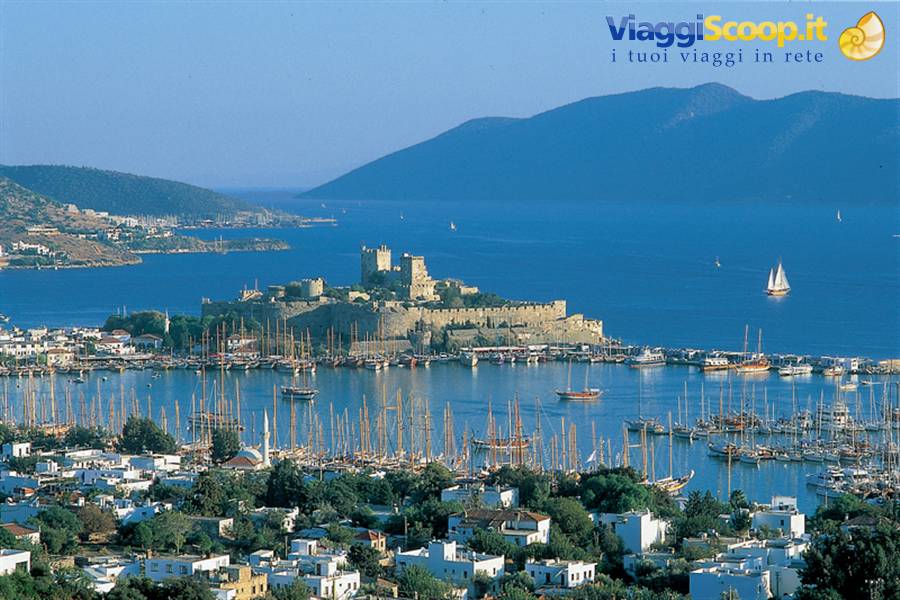
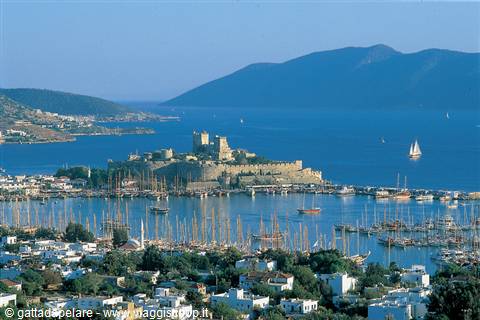
The sea conditions are optimal for crossing the stretch of sea separating Kos from Turkey. We sail while observing the desecration of the concrete sprawl on the Turkish coast north of Bodrum. We also try to spot the boatyard where we have decided to leave the boat without pushing as far as Marmaris for the work we intend to have done. When we find it, we stop to make arrangements for the day after tomorrow and then continue to the port of Bodrum, three miles away. When we enter, we discover that a fine marina for yachts has been built. Immediately the service dinghy comes to meet us and accompanies us to the pontoon for visiting boats. Everyone is very courteous and helpful. The marina is equipped with excellent services and very modern facilities.
The only drawback is that it is on the opposite side of the port from the town centre, and the walk along the seafront taxes legs and muscles grown lazy from so many days in the cockpit. After several years of absence, this return to Turkey is exciting. We look for a trattoria to eat local dishes and wander through the streets transformed into a great bazaar sheltered by large awnings that cover it from one row of houses to the other. Gattadapelare welcomes us at the far end of the marina, motionless in water without a ripple.
23 September Bodrum small bay. 8 miles
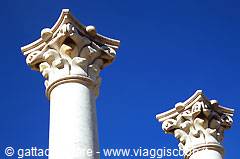
We make countless rounds to request the famous transit-log, the customs certificate that authorises the boat's presence in Turkish waters. In the end, received by surly officials with a vaguely threatening appearance, we manage to obtain this piece of paper at cost price, rather than for 250 euros as had been proposed to us by an agency. We visit the few remains of the funerary monument of King Mausolus. A few fragments of columns, a couple of capitals, a pit—that is all that remains of one of the seven wonders of antiquity: the Mausoleum. But we want a little more sea before laying the boat up, and so we leave the marina to go and look for a small bay where we can spend the last night rocked by the waves. We head south, but not too far, for fear that the wind may strengthen tonight and hinder our return to the boatyard tomorrow.
Finally Pino has the satisfaction of catching three fine fish, including an iridescent mahi-mahi,
We cruise along the coast until we choose a little cove that looks suitable to us. There is only one caïque that will keep us company. Or at least that is what we think. We have seven or eight metres of depth and we pay out all the chain we have because on the horizon we continuously see lightning flashing over a broad front. Caught up in the enthusiasm for the miraculous catch (it had been years since we had brought any fish on board), we also lower a creel that has always been stowed in the forward locker. Inside we put all the unused leftovers of the provisions. The sea is calm, and lying in the cockpit for the last evening we look at the stars and, with some apprehension, at the storm clouds. We try to work out their direction without success. The entire southern horizon is lit up. Then the music begins.
Not that of nature, but that of a disco hidden behind the trees, which offers us a vast repertoire of Italian singers, thus cancelling any feeling of an oriental night.
Kos-Asklepieion
Day 624 Sep 2006
24 September. Bodrum
The night passed peacefully. The storms have dissolved and the sky appears free of clouds. The little cove is alive with canoes going around everywhere. From them we thus learn that around the corner there is a Valtour village. We try to recover the creel, hoping for a rich haul, but the rope it was tied to comes up free, and the searches made with the mask are in vain. A mystery. We read in the pilot guide that on the island opposite the boatyard there is a hot water spring that flows directly into the sea. When we arrive at the spot we find a quay for landing and a kiosk selling drinks and entrance tickets to the spring. We fulfil both duties like good tourists and bathe in the flow of the spring.
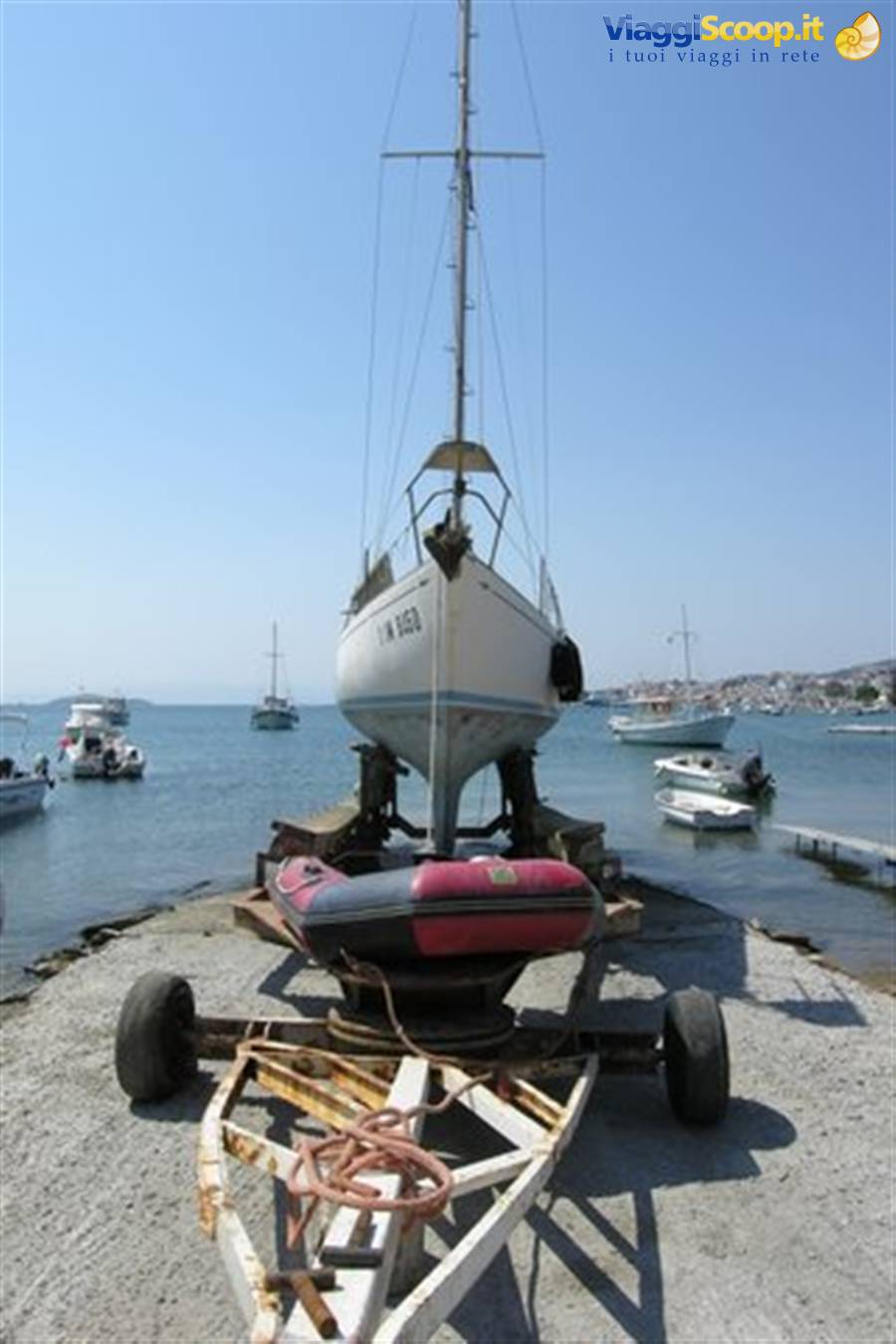
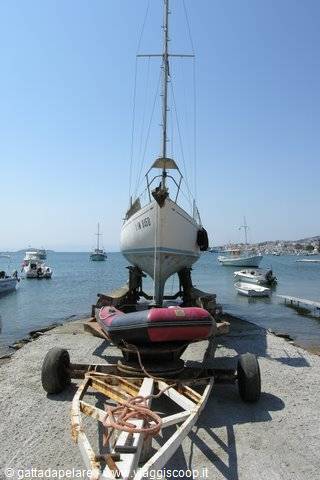
In the late afternoon we reach the boatyard where Gattadapelare is finally hauled out with appropriate modern equipment after years of similar, precarious operations, sometimes haphazard as in the case of Skiathos. The boatyard is well equipped and relatively inexpensive. It had been pointed out to us two years ago by an Italian skipper we met in Skiathos, and we are satisfied with the decision not to leave the boat in Marmaris, as we had planned at the start. We have a quote drawn up for the work we would like to have done and reach the centre of Bodrum, six or seven kilometres away. By now we no longer feel like catonauts. With the boat on the slipway, the sails furled, the galley empty, we have returned to being landlubbers, and even if tonight we will still sleep in the belly of Gattadapelare, it will not be the same thing.
We dine, this time in a restaurant (a choice forced by our new 'civilian' status), and return to the boatyard. Tomorrow morning an early alarm to reach Kos by ferry after completing all the bureaucratic formalities.
25 September. Bodrum-Kos-Rhodes
Here the logbook ends. The rest does not concern the adventures of Gattadapelare, but for the record I will summarise the events of these days. We reached Kos in the early morning, and while waiting for the ferry to Rhodes we took a sightseeing coach tour of the island. As I imagined, this island, apart from the capital and its archaeological sites, is not very interesting. The 4 p.m. ferry takes us to Rhodes, where it is raining and there are no taxis available. We find a decent hotel and visit the city, which I already know but which is always fascinating. A completely different Greece, indeed, a non-Greece, with its deeply Central European stamp. One must move away from Rhodes town to find again the colours and atmospheres of the Aegean.
26 September. Rhodes
We continue to wander around the city. We frequent the restored Turkish bath of Suleiman the Magnificent, make our little purchases to give to friends and relatives, and close the day by attending an unexpectedly fine show by professional jesters organised in the alleys and medieval squares of the city
, 27 September Return to Rome. I leave for Rome via Athens, while Pino stays one more day. The last minutes in Rhodes and in Greece are marked by futile attempts to recover my bag forgotten on the bus. I get home at 6 p.m.
P.s. The bag was found intact (!) two days later, and I now have it in my possession again.


0 reader comments