The story
It is seven in the morning and the lush coasts of the island of Corfu peep through the portholes of the Olimpia Palace, the ship taking us to Greece. Having left yesterday, in the late afternoon, from Ancona, we will soon disembark at Igoumenitsa. Leaving the Greek port behind us, we travel through the mountainous region of Epirus with its enchanting and wild landscapes. The colours, but above all the smells carried on the wind, are those typical of the countries of the Mediterranean: myrtle, wild fennel, rosemary, a fragrance of scents already known from our previous trips to Croatia and Montenegro. Overlooking Lake Pamvotida, Ioannina is the first important city we encounter along the route. We visit the fortified citadel that towers over the houses of the ancient village, dominated by the Turks since the 1400s.
One of the two ancient mosques is right here on this hill, reminding us of the influence of the Ottoman empire throughout the Mediterranean. After crossing the Kataro pass at 1700 metres in the Pindus mountains, we descend towards the plain of Thessaly, reaching the Meteora in the early afternoon: enormous dark-coloured rocks rising majestically, creating a marvellous and wild spectacle. On top of these huge towers stand grandiose Greek Orthodox monasteries, faithful guardians of a model of monastic life now lost, which reached its peak 500 years ago. The first hermits climbed the rocks by means of a series of scaffolds supported by beams fixed into the rock. This arrangement was later replaced by very long and dizzying rope ladders. Those who did not dare use them were hauled up by means of a net. The climb lasted about half an hour: half an hour of anguish and terror.
After spending the night at Kalampaka, right below the Meteora, we head south-east to reach the eastern coasts of Greece and venture into the mountainous peninsula of Pilio, a wonderful region of Thessaly, home of the centaurs, mythological figures half man and half horse. Along a wide and scenic road, amid ups and downs, we follow this strip of land that juts into the sea, where the high mountains that give it its name occupy its central part. Volos, an important tourist city of Pilio, welcomes us for the night, and in the morning, right after a hyper-caloric breakfast of eggs, bacon and cheeses, cold cuts, brioches, butter and jam, fruit juices and more, we take the wide road that leads us to the archaeological site of Delphi.
After a few hairpin bends uphill, here we are beneath the slopes of Parnassus, the Sacred mount that has hosted for more than four thousand years the complex known as the Oracle of Delphi. The important religious centre sacred to Apollo was one of the greatest pan-Hellenic sanctuaries of ancient Greece, as well as the seat of the most authoritative oracle of the Greek-Latin world. No decision, whether personal or of general interest, was made without consulting its priestess, who, with a laurel leaf in her mouth, dispensed advice and predictions. The site, set on several levels on the mountainside, is crossed by the Sacred Way. Above the temple of Apollo is the theatre, which could hold more than five thousand seats, and higher still the stadium.
Much lower than the temple of Apollo is the sanctuary of the goddess Athena Pronaia, which contains the true pearl of this whole group of remains: the Tholos, a marble rotunda that is the wonder of Delphi and by now its very symbol.
Today, our fourth day on Greek soil, we head south, following the strip of sea that separates mainland Greece from the Peloponnese. A mandatory passage to reach this region is the Isthmus of Corinth, an impressive work of human ingenuity, six kilometres long, whose walls in some points reach almost 80 metres in height. Completed in 1892, it cuts that small ribbon of land that joins the Peloponnese to the mainland, thus creating a canal for ships going from the Adriatic towards the Aegean and the Black Sea. From above the view is incredible; it almost seems that the boats graze the walls even though they are, in some points, even a hundred metres apart. Later, having arrived in Nafplio, in a characteristic taverna, we become acquainted with traditional Greek dishes such as moussaka, souvlaki, Greek salad, tomatoes stuffed with rice and vine-leaf rolls.
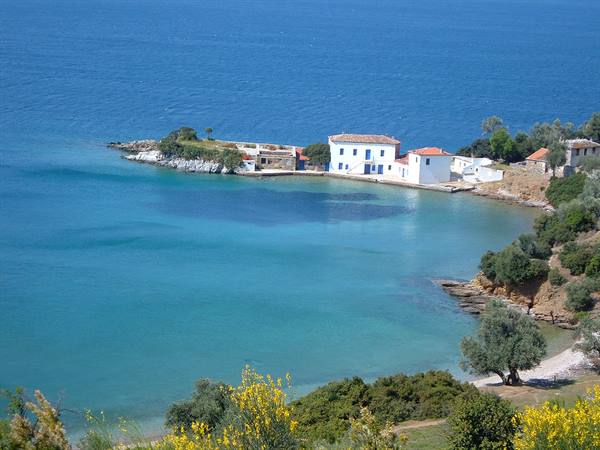
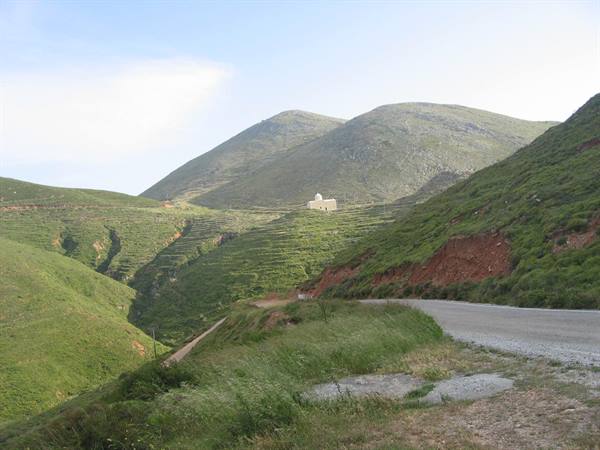
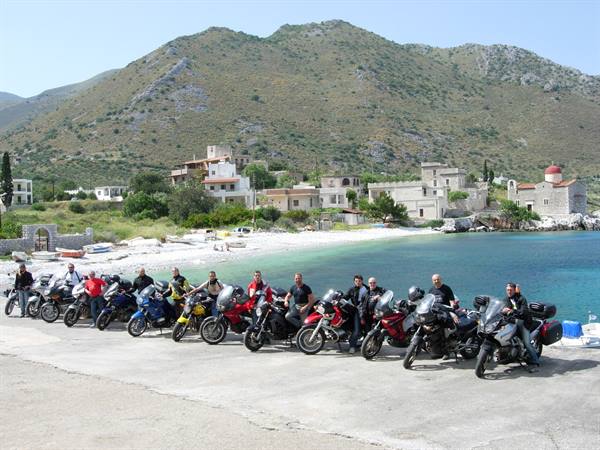
Having got on our motorbikes in the very early hours of the morning, we visit the ancient ruins of Epidaurus, whose main attraction is the theatre, an astonishing structure dating back to the 4th century BC, where thanks to its perfect acoustics, its unsurpassed architectural harmony and the enormous number of spectators it can still hold, classical performances are staged, making it a brilliant example of how to use an ancient monument with respect and intelligence. Continuing to the extreme south of the Peloponnese we reach the Mani peninsula, a strip of land no more than sixty kilometres long, characterized by contradictory panoramas: caves and austere villages on one side and the sparkle of the sea on the other, which with its turquoise colour and the delightful beaches protected by cliffs creates a suggestive and unrepeatable scenario.
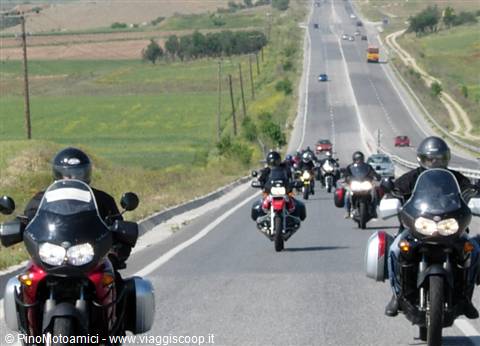
The hostility of this land and the pride of its people, perfectly represented in the characteristic tower shape of the houses, decreed its isolation, making it immune to the passage of time and the changes it brings. Towards evening, tired, with aching muscles, after a whole day spent on the road, constantly leaning into the countless curves that trace these coasts, we stop at Areopoli, a small but important village of clear medieval origin and a typical example of the architecture of this region.
In the morning, after a quick stop at Kalamata for the usual souvenir shopping, by now a consolidated practice and much awaited by family members on our return, we quickly head back up the Peloponnese. Nestled in the plain of the river Alpheus, we find Olympia, the land where the gods watched the triumphs of men and where the victors became gods. An ancient sacred place, here the Olympic Games were held, which over time became the most important celebrations in all of Greece.
The archaeological excavations, carried out towards the end of the nineteenth century, found, beneath a layer of mud at least five metres thick, the remains of important buildings such as the gymnasium and the palaestra where the athletes trained, the sacred enclosure, the temple of Hera and that of Zeus, and the stadium, the track where the athletes competed completely naked, about 200 metres long and 30 wide, where at least 30,000 spectators could watch the races from the earthen banks, without tiers.
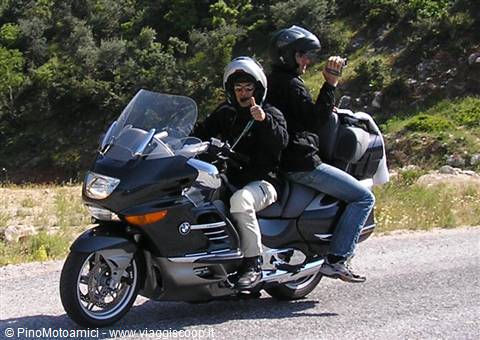
Our journey ends here in this place, laden with ancient beauty; in the afternoon at Patras we will board the ferry that will take us back to Italy. But the suggestions of the place continue to have their effect on us. What better way, then, to properly conclude these days lived together, than an improvised, Fantozzi-style race in the legendary stadium of Olympia. The challenge is unusual for a group of motorcyclists who, to emulate history, dash on foot along the track, like the athletes of a few millennia ago.... I won't say naked... of course!!!!...... but at least without a helmet!!!
The journey's photographs
9 photographs · click to open them full screen




0 reader comments