I'm in Athens again. How many times now, and each time with emotion, have I descended the airplane stairs breathing in the warm, dry air of Attica laden with the smells of Greece carried by the ever-present north wind? But why count them? Each time the pleasure of my first arrival in this land is renewed (but calling it simply land diminishes its magic and also its function; it is made of a mixture of limestone, of history, of mythology, of thoughts and existential intuitions, a mixture that is the material with which the building in which we experience our collective and individual consciousness has been constructed). I wait for Gino's plane while reviewing the hundred or so Greek words I've set out to learn this year. To my pleasant surprise I've already read and understood a couple of signs and this has encouraged me to continue my 'studying.' Finally my friend arrives.
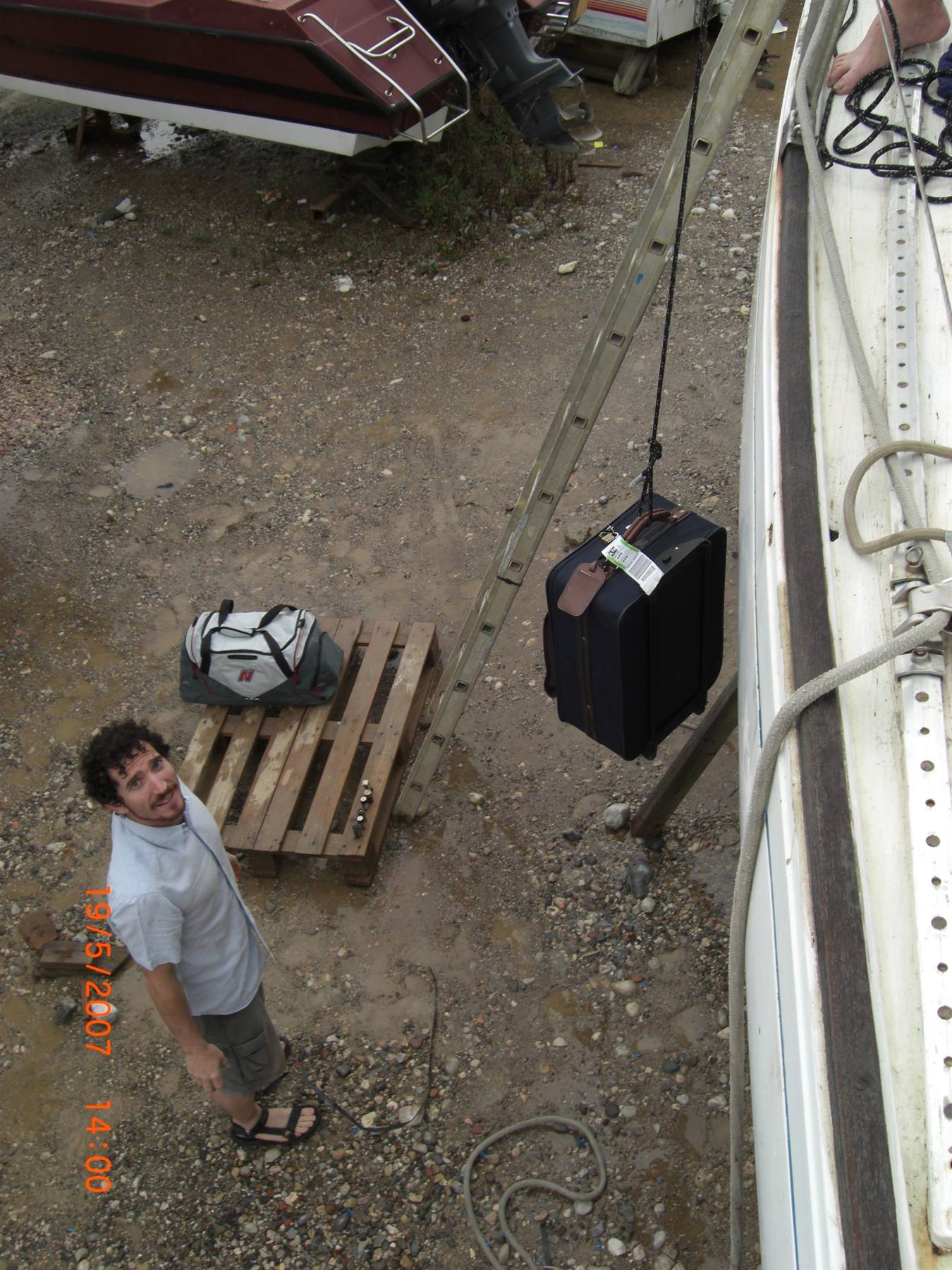
This time we're even more loaded with luggage than usual. We have a new inflatable life raft and a new roller furler and also a new windlass motor. All of this, along with the bags of clothes and the rest, is heavy and bulky, and with difficulty we manage to find and load a taxi that takes us on a nearly one-hour ride to the boatyard of Oropu. This boatyard is located a couple of kilometers outside the town, facing a low, sandy and marshy beach. We search with our eyes for our 'Gatta' and find it, recognizing it by its mast, which is never the tallest among all the others. With some emotion we do the usual reconnaissance approach, studying the signs of further deterioration it has suffered. The boat is quite neglected due to the distance from home.
We can only dedicate a few hours of maintenance to it each year, then the desire to set sail takes over and everything that doesn't prevent safe sailing is postponed to future times. Since it is never left in the water during our absence, marine growth doesn't have time to form; so we save money and effort in giving it antifouling paint. The result is that over the years the hull shows, through the peeling of old coats of paint, the different colors of these, giving it a funny harlequin appearance. But once in the water the hull can't be seen and therefore Anyway this time we've resolved to do many things before leaving. We have four days before the now famous "girls" arrive. In this span of time we have to replace the roller furler, repair the dinghy, mount the new windlass motor, change the freshwater pump and do all the other usual checks.
And we also need to think about doing some provisioning for tonight's dinner. A worker from the boatyard offers to take us to town in his old BMW. His name is Aris, the modern version of the name of the war god Ares, but, on the contrary, he has a gentle and helpful appearance and leads us to the right shops for our purchases. On the way back he invites us to sleep at his house, convincing us that in the mess of the boat it's impossible to cook and besides "at night there are mosquitoes." We discover that he lives alone and from the insistence, albeit delicate, with which he invites us, we sense that he is in need of company. With some perplexity we finally accept to go with him, on the condition that he lets us cook. The house where he lives is a few kilometers from Oropu, almost in the countryside. We're surprised that it's a small villa, though small and simple, but pleasant and tidy.
A large German shepherd tied to a sturdy chain welcomes us whining with pleasure, but its tail between its legs shows an exaggerated submission to its master and the humiliation of its long, daily and solitary captivity. While we prepare tuna spaghetti Aris goes off to get some wine, he says, made by himself. The wait is long and we wonder whether we did well to accept his invitation. Perhaps, we say to ourselves, he's a serial killer who has gone to look for his 'picnic companions.' Anyway tonight we lock ourselves in the room. The wine is drinkable and the spaghetti is well appreciated. Our host has a nice stereo system and some good Greek music. He tells us his story. Gino translates and I'm happy because every now and then I understand a word. A small thing, but it makes me feel part of the conversation. Gino and I have separate rooms and, as I said, we lock ourselves in.
So as not to offend Aris, in case he isn't the dreaded 'monster of Attica,' we cover the sound of the key turning by energetically pushing down the handle. He, despite having a third room available, sleeps on the sofa in the living room in front of the TV turned on. Like a lonely man. May 18, 2007. Oropu We wake up. From the balcony we observe this glimpse of hilly countryside dotted with olive trees, so similar to my hills of Umbria or Sabina. Along back roads we return to the boatyard and begin work on the boat. The replacement of the roller furler immediately presents problems, the last of which is that the parts so laboriously brought from Italy don't fit together. After the irritation comes the disappointment: we'll have to sail with only the mainsail. Our 'Gatta', like all Alpa 11.50s, 'works' with the genoa; the mainsail is almost an auxiliary sail.
The thought that for four weeks we'll have to sail only with the mainsail takes away the joy of looking forward to discovering the Sporades. Then a 'flash of memory' of mine resolves the situation. After years of neglect of the sail locker, a 'jib two' equipped with hanks reemerges, and also a 'jib one,' almost a storm jib. We work hard to reinforce the dinghy. The little inflatable has come unglued in several spots and its repair proves very problematic. However we apply ourselves with effort and do a good gluing job. Meanwhile it has started to rain and around the boat a mud puddle has formed. So the day passes. Aris insists on hosting us again and to settle our debt we buy frozen seafood. We'll make a dinner of risotto, which Babis, the owner of the boatyard, and a friend will also attend. The seafood risotto wasn't much liked. Strange, we found it excellent.
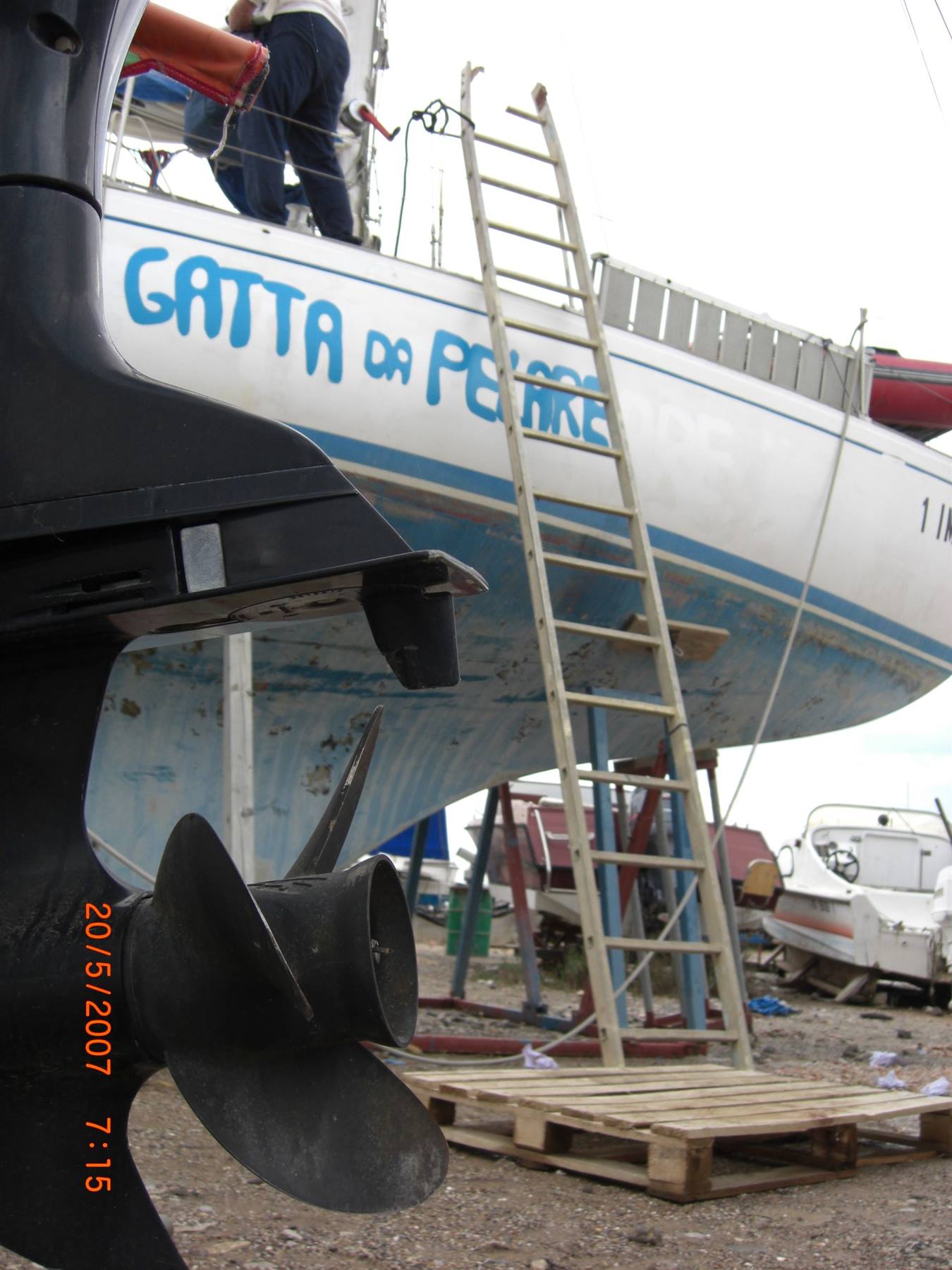
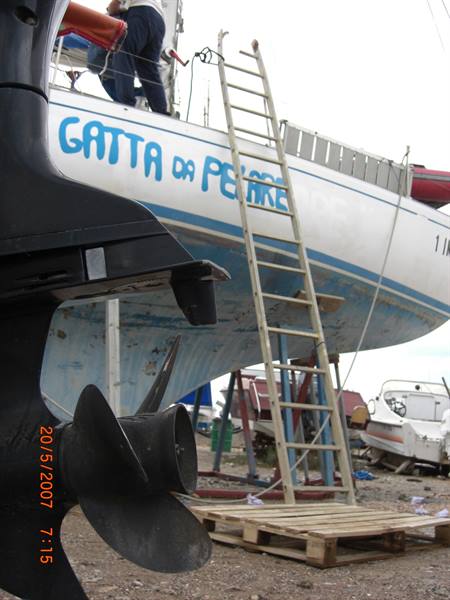
May 19, 2007 Oropu Last night I didn't lock myself in. Gino did. He says that not acting right away the first night could be the technique of an experienced serial killer. Poor Aris; he keeps falling asleep on the sofa in front of the TV turned on. He's truly a good person in need of company. Gino is convinced too, but playing with the idea of the 'monster' amuses us... you can never be too cautious. We return to the boatyard to work. It rains on and off and around the boat we arrange gangways to get on board. The old writing 'GATTAdaPELARE' on the side is removed and replaced with a new one. We're attached to this big writing done in unsure and playful lettering. It's unusual to 'brand' a sailboat like that, but we like it; it has a cheerful and vagabond look, just as we want its crew to be. We work all day.
We bought a pale chicken with the intention of cooking it for dinner at Aris's house, but Aris doesn't show up in the afternoon. So tonight, we sleep on the boat for the first time.
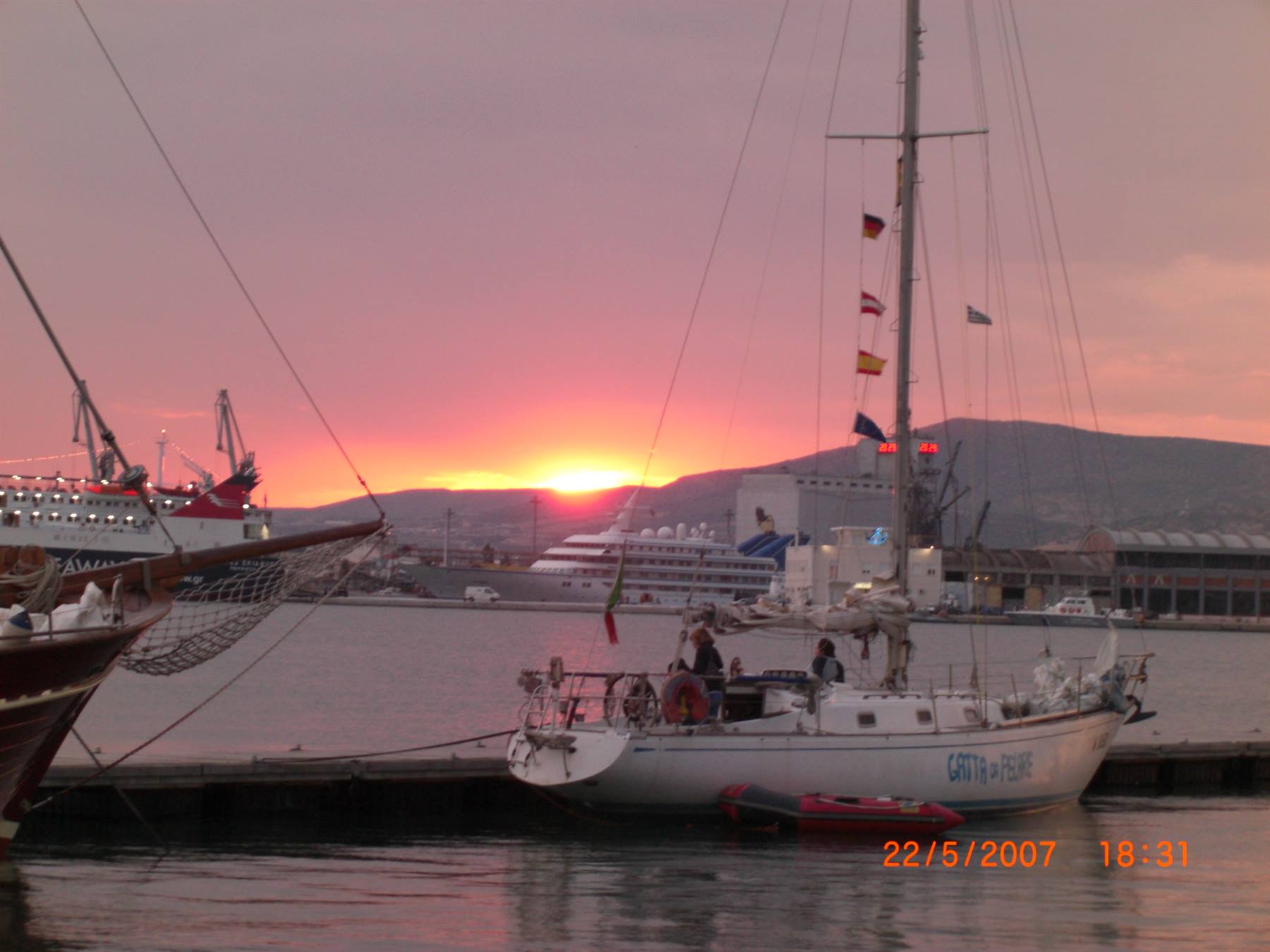
Sunset in Volos
Day 220 May 2007
May 20, 2007. Oropu Today the "girls" arrive. According to the plans it's the day of the launch, to be carried out right after the arrival, in the afternoon of Elke and Gerlinde, to reach Kalkis by evening and, if possible, cross the bridge over the strait to Euboea. But it's raining and the boat isn't completely ready yet. Between one downpour and another the arrival time comes. The taxi carrying the "girls" stops at the entrance of the boatyard and the two advance between puddles of water and mud, escorted by a Gino loaded with luggage. I'm exempted from this chore because I'm assigned to film the scene from atop the Gatta crouched on its cradle. The pleasantries repeat the usual pattern and conclude with the ritual of iced ouzo: generous with ice only for Gerlinde and me, watered down for Elke, barely flavored water for Gino.
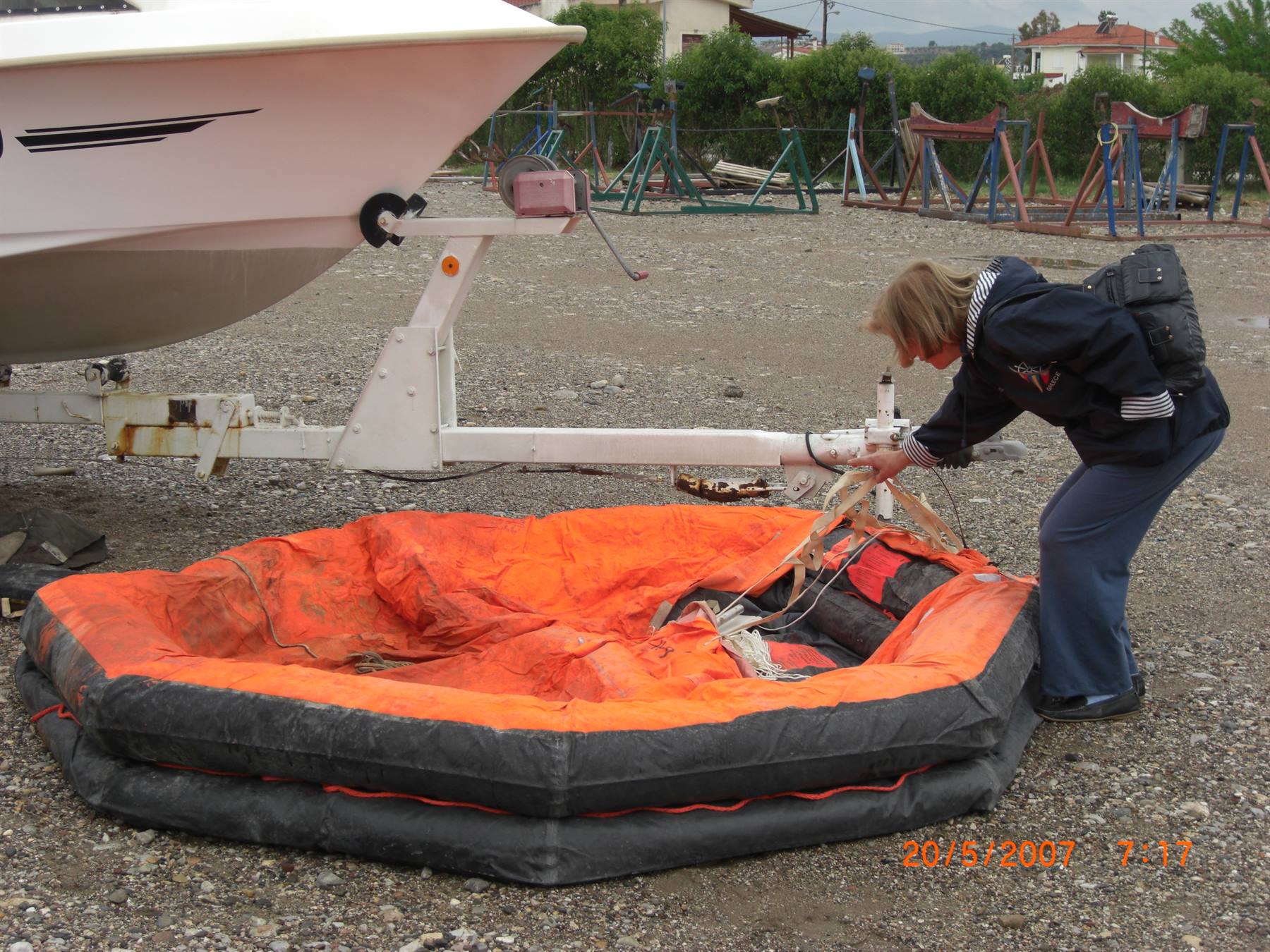
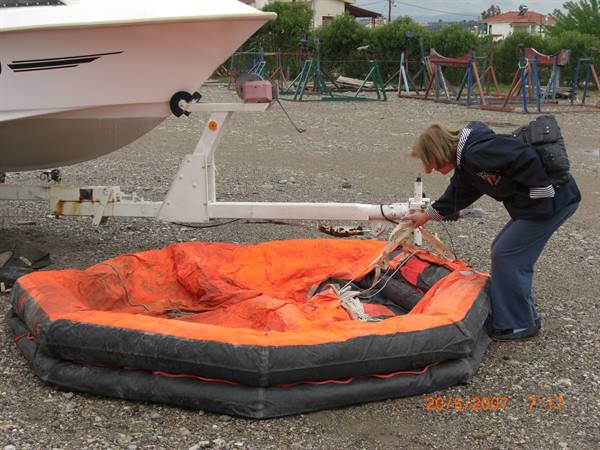
The ritual will be repeated many more times over the coming days, sometimes accompanied by the joyful cry: 'Gatta! Gatta! Gatta! - meow! meow! meow!' under the puzzled gazes of the crews of the other boats. Finally we have the new life raft on board; it replaces the old one in a soft suitcase that should have been serviced quite some time ago. The fact of always sailing within sight of some coast and keeping the dinghy inflated on deck or in tow has led me to ignore the periodic servicing. For the first time we have the chance to see how the device works. When the cord is pulled the hiss of compressed air is loud and impressive, and is accompanied, at the end, by the visible puff of excess air. The raft inflates; we're saved! we shout. We inspect its interior and find that everything is wet and unusable. I imagined finding many more useful things for survival on the high seas.
The inventory is meager and worrisome. Eight half-liter packs of water (intact), a simple flashlight with some dead batteries, four flares, naturally expired, a pair of scissors, some bandages and band-aids, a thin twenty-meter line, a couple of small paddles. Although I didn't know the supplies were so scarce, in the cockpit locker I've always had a small watertight container holding a flashlight, some flares, a signal mirror, a knife, scissors and also some hooks and nylon line for an optimistic survival fishing. After a few minutes the raft begins to deflate. Not saved, then! We're even more convinced that it was time to have a new life raft on board. Aris is again going around the boatyard and invites everyone to sleep at his place. Unexpectedly the "girls" accept.
For dinner we prepare spaghetti with seafood, aware that it's the last Italian dish we'll cook, and I say it without regret; we like Greek cuisine and it's part of the vacation.
May 21. Oropu-Kalkis- 9 miles. Finally we launch. The boat is placed on a pontoon that must travel about 300 meters to reach the shore along a sandy path. The pontoon enters the sea for a few dozen meters until it reaches the right depth for our keel. It's followed by a big off-road vehicle that, tied to us with a thick line, stays on dry land acting as a brake or a tow, it's not clear which, for the pontoon. During the whole journey, which lasts about fifteen minutes on the boat that wobbles with every jolt, Elke and Gerlinde follow the operation with variously poorly concealed perplexity. Finally free! We point the bow of the Gattadapelare west toward the strait that separates Euboea from Attica. The sky is overcast and at times it drizzles in total absence of wind. The stretch of sea between the island and the mainland grows ever narrower until it apparently closes before us.
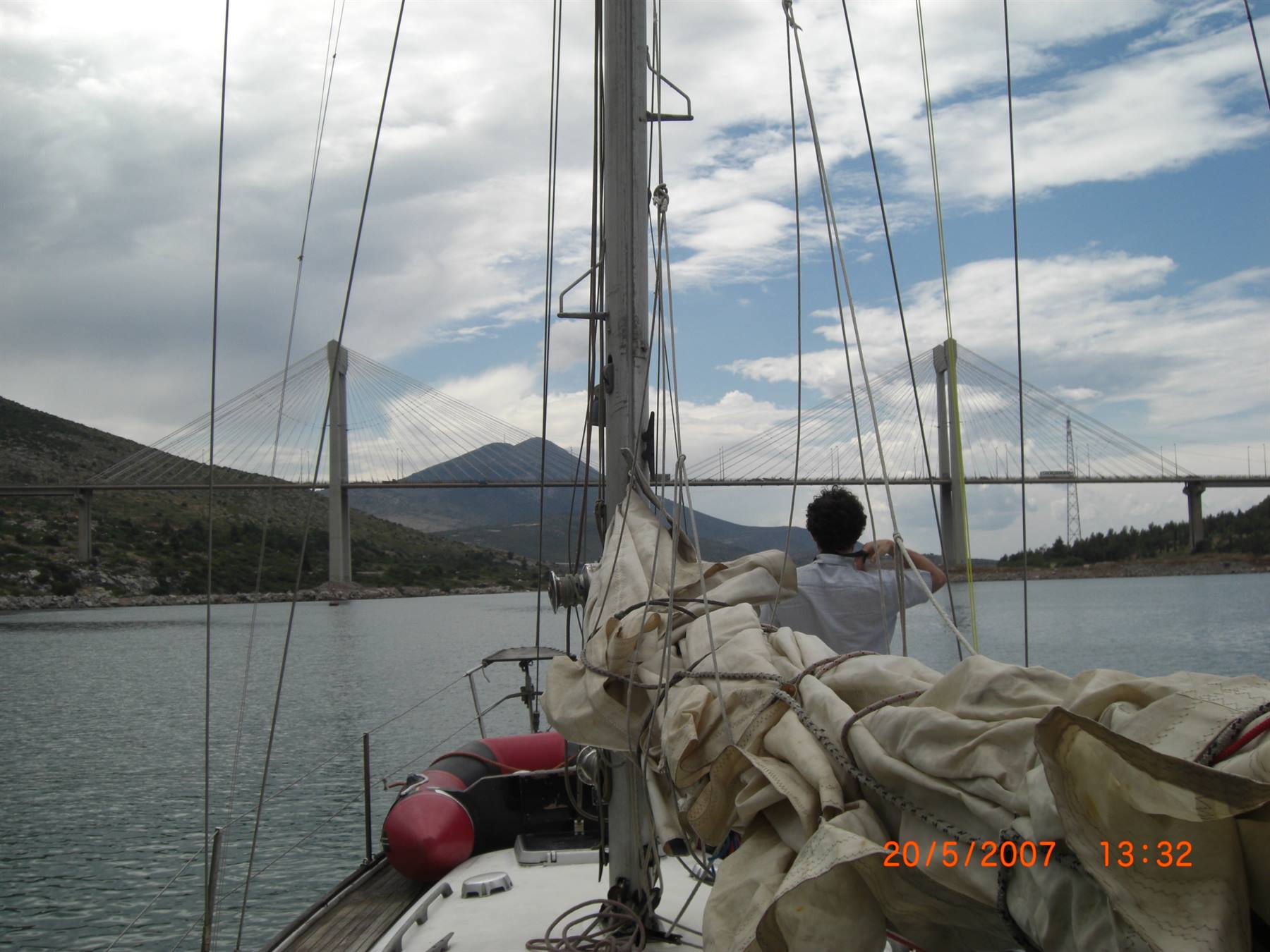
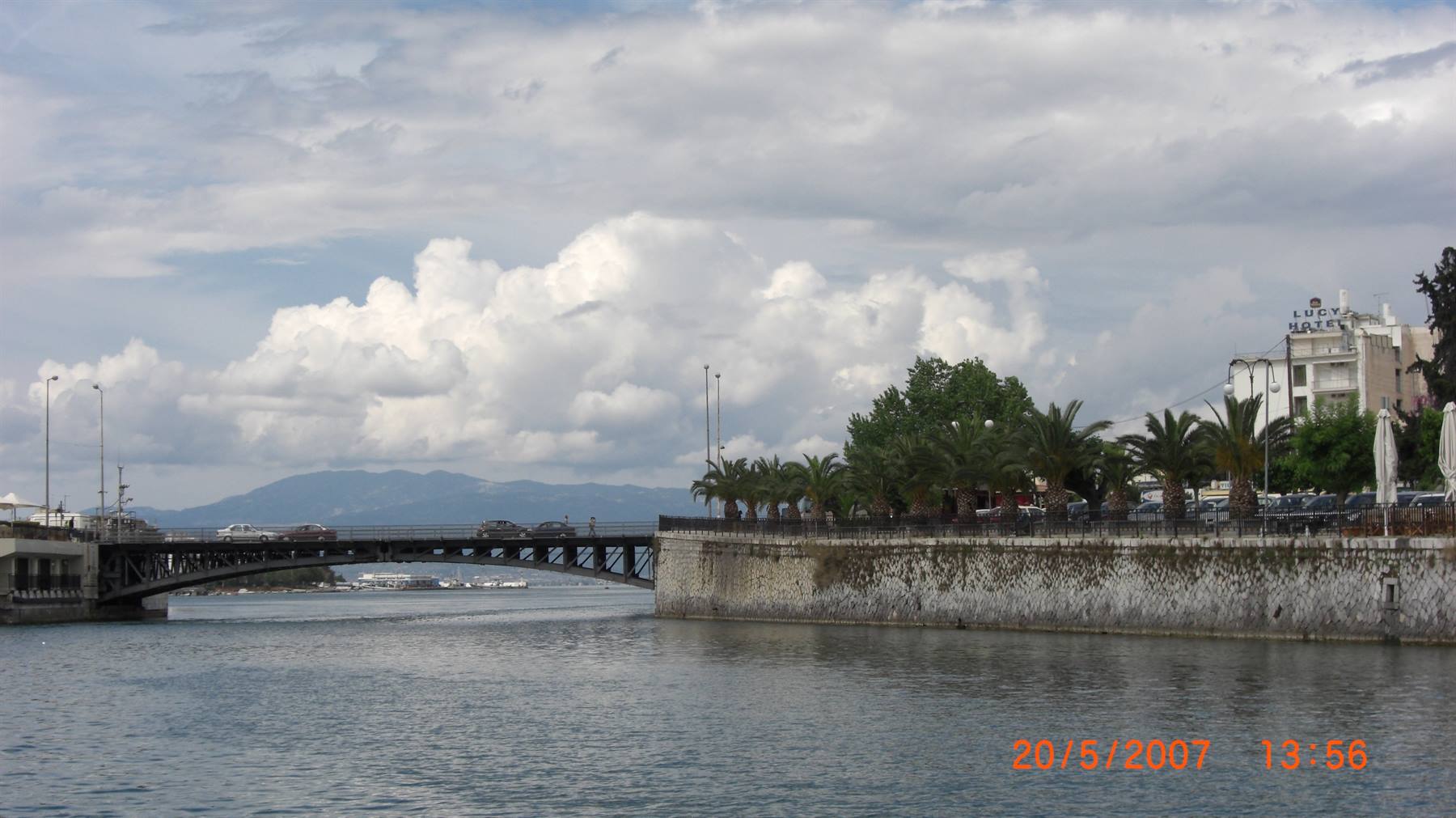
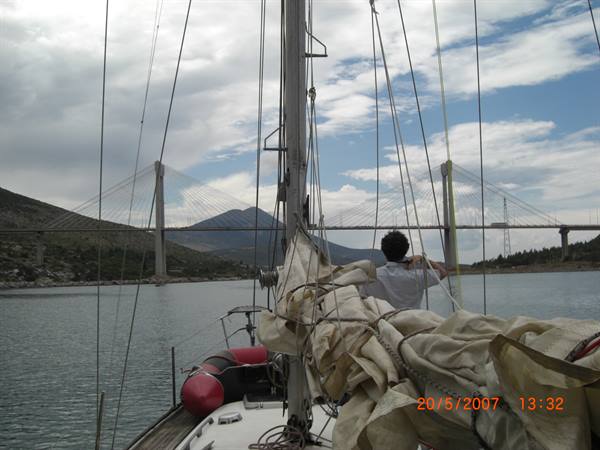
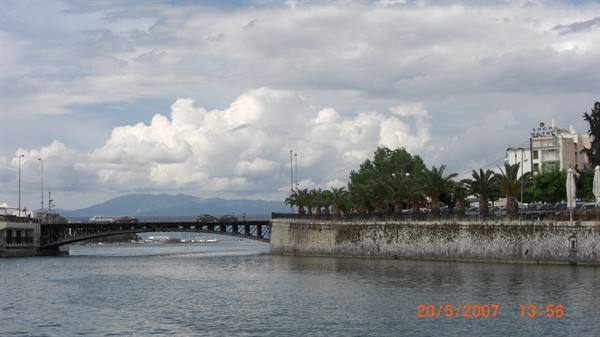
We look for the entrance to the winding channel that leads to the narrowest point, where it is crossed by the swing bridge of Kalkis. The way is indicated to us by the profile of the modern suspension bridge that stands out behind the low hills that block the view of the entrance. The route we're taking is rich in interesting glimpses that, after the Corinth Canal, we're no longer used to seeing in our wandering among the Aegean islands. In the late afternoon we finally arrive in front of the famous bridge. There's only one Swiss boat at the wheel and we moor Mediterranean-style at the customs dock. From the pilot book we know we have to go to the Harbor Master's Office to pay the toll and find out about the opening time, which we do right away, curious to know how long we have to wait, thus discovering that the transit will take place at midnight.
So we'll spend the night here in Kalkis; we just have to find a suitable mooring beyond this bridge over which there's heavy car traffic. At one end of it there's a nice panoramic café much frequented by young people and from which you can observe the play of the currents that, in this narrowing of the sea, are intense and fast. Their direction changes even more than twenty times a day and their speed can reach six to seven knots. For this reason the opening times of the bridge are conditioned by them. History tells, but in reality it's a legend, that Aristotle in vain tried to understand the logic with which the currents change direction and intensity without managing to solve the riddle and that from the effort he died right here in Kalkis.
On the seaside promenade after the bridge, which is lined with numerous and inviting cafés and restaurants, a bronze statue depicts the philosopher in a pensive pose. We walk along this promenade in search of a berth for tonight. We measure the depths along the pier with an improvised plumb line and finally find the ideal spot, a short, low jetty lit by a streetlamp, sufficiently far from noisy venues. When we return to the boat we see it moving forward and backward energetically, yanked by the bow and stern lines, pushed by the incoming current and subject to the caprices of the whirlpools forming beneath it. We're truly impressed by this phenomenon of nature that seasons even more the emotions of this first day of sailing. We wait for midnight with the on-board radio tuned to channel 12 to receive authorization to pass from the Harbor Master's Office.
Finally, they tell us to be ready; we'll have only a few minutes to pass, as the bridge can't stay closed to traffic for too long. We cast off the moorings and begin maneuvering in the bay, near the passage, but being careful not to interfere with the path of the ships that have priority over boats. We thought we were alone, us and the Swiss sloop, and instead at least thirteen sailboats are jockeying to be ready to transit first and occupy the next moorings. At midnight the bridge slides away and disappears into a compartment under the road. Now a very fast cargo ship comes down and another goes up just as quickly; after that it's our turn. Thanks to a series of fortunate maneuvers we find ourselves in the lead and we too pass, quickly, heading, with everyone else in pursuit, to the jetty identified in the afternoon.
It seems that three other boats have the same goal, but in fact we arrive first and moor Mediterranean-style in the best spot. Lying in our berths, we hear a continuous lapping along the hull of Gattadapelare. It's the current caressing us. We fall asleep calm, satisfied with this different and memorable day.
Propeller in foreground, beached white hull on stands, wooden ladder in boatyard
Day 322 May 2007
May 22. Kalkis-Agios Kostantinos. 40 miles. We've decided to do two longer legs to make up for a day lost in Oropu. We leave, after a quiet breakfast at one of the cafés on the promenade, on a cloudy day with no wind. Last night it rained again. I heard, half-asleep, the rain beating insistently on deck and I wondered if this weather would accompany us for the whole vacation. The forecast remains ominous. So off we go, motoring toward Agios Kostantinos, a technical stop from which we expect no excitement. The stretch of sea we travel doesn't have many points of interest and we pass the time talking, nibbling olives and pumpkin seeds and, naturally, toasting with ouzo, We arrive at the long pier, behind which runs the highway from Volos to Athens, and we moor stern-to at a gangway's distance.
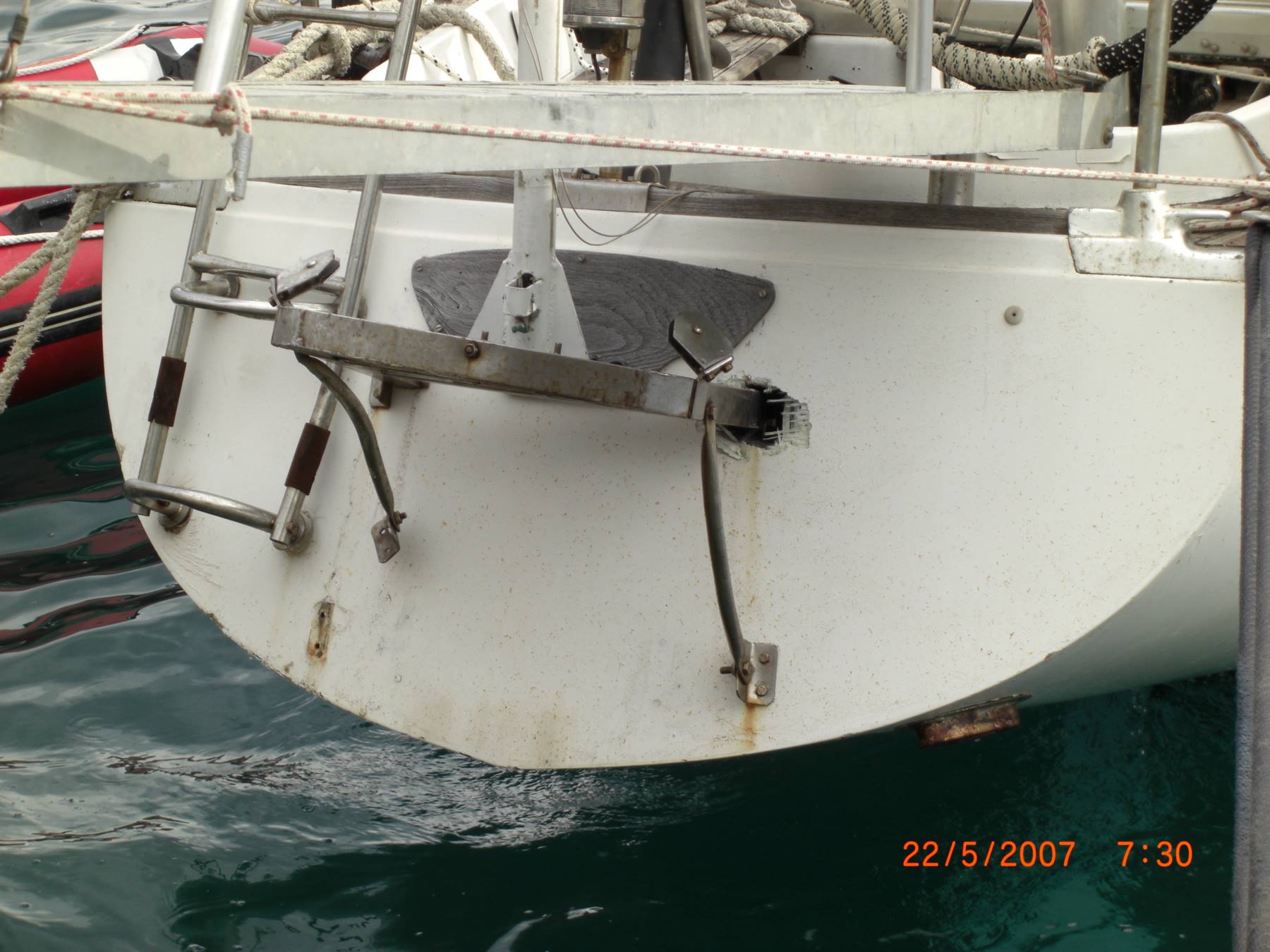
There's only one other boat and the port facilities consist of the pier, unprotected by any breakwater, and the ferry dock. The town itself doesn't appear attractive. The highway, continuously traveled by trucks and cars at sustained speed, separates it from the sea. Behind it, which we cross dangerously, a series of unassuming tavernas entices us to dinner. While we wait to be served they notify us that the Gatta has hit the pier and the dinghy's outboard motor has fallen into the water. The wave raised by the departing ferry pushed the boat violently against the pier. Besides losing the outboard, it hit its stern with the swim platform, also suffering damage to the transom which was smashed by one of the struts. At seven meters deep one can glimpse the whiteness of the outboard. What to do? We haul ourselves further in on the anchor and go back to eating.
The advantage of having a somewhat aging boat is that you don't get worked up over such a little thing. Tomorrow we'll try to recover the outboard. Gino offers to go down and strap it. Meanwhile we're distracted by a large group of hooligans, ugly and loud, who at the next table get agitated and continuously chant in support of Liverpool. Tomorrow there's the match with Milan. We speak in German so as not to be recognized. You never know; at the moment these 'fans' are just merry, but more and more beer keeps arriving at the table. We're quite far from Athens, but it seems the hotels are all full, even up here. So, among Liverpool flags, group photos with the flag, individual photos with the flag, photos of the flag, arranging the banners among the trees, we get a vivid representation of sports fandom.
And to think that we don't even know what an 'offside' consists of! We leave the 'red shirts' to spend their night of euphoria and hope and we go back to the boat. The adventurous crossing of the highway concludes this second day at sea, which began monotonously and ended so lively.
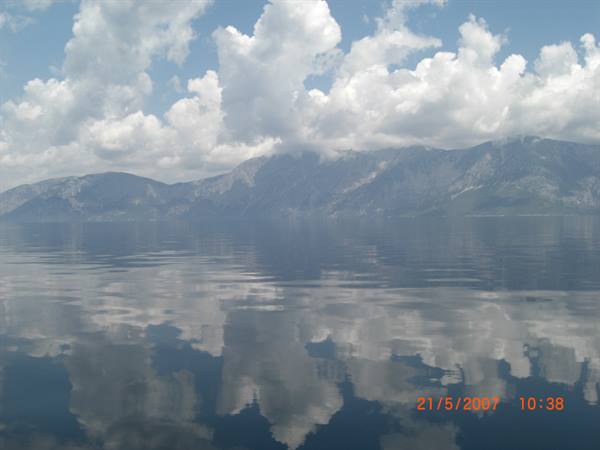
5 May 23, 2007. Agios Kostantinos- Volos. 40 miles. Gino reemerges, on the second attempt, among patches of oil and gasoline, but the outboard is strapped and ready to be hoisted aboard. Now it's a matter of having it taken apart as soon as possible and washing it with fresh water. In Volos we'll look for a mechanic. In the trip program there's, for tomorrow, a car excursion to the monasteries of Meteora. We leave with sunny weather, but with clouds inland that always threaten to spread over the sea. This leg is interesting. The sea channel between Euboea and Thessaly makes a right angle and is oriented toward the north. If there were wind it would be hard to sail up it to reach the wide Gulf of Volos. Instead we always go by motor. On the right the coast of Euboea is green and mountainous, rather unspoiled, with few and scattered villas.
On the left the mainland is even more uninhabited, but also green and mountainous. Ahead of us, on the horizon, we begin to see the Sporades. When we arrive at the mouth of the gulf, finally, a fresh wind picks up that allows us to hoist the sails. We've also set up the staysail stay and so now we sail with three sails up, with the wind first on the beam, then, due to the coast curving, from astern. But shortly after we're completely sheltered and it's back to the motor. The city can be glimpsed at the bottom of the bay about 20 miles from us and when we reach it it's already dusk. Before us looms a very long windward pier, past which there are hundreds of meters of mooring and only a few boats near the root. We moor at a floating pontoon, an unwise choice because we discover later that to go ashore we have to use the boat's gangway since the pontoon is interrupted.
On the other side there's the rather large and industrialized commercial port. The town of Volos develops with a row of imposing buildings along the wide seafront, for the most part hotels, and a series of rather narrow streets behind lined with more modest buildings. The mountain that rises just behind the city is full of settlements, small villages, hamlets and isolated villas. The view over the gulf from up there must be very beautiful. We stroll through the city looking for a cheap rent-a-car to reach, tomorrow, the Meteora which are about 130 kilometers from here and a restaurant for dinner. Today we had a tasty lunch, as usual, with olives, cheese, bread and retsina, and toward evening our appetite makes itself felt, inspiring in us a craving for lamb chops, skewers, moussaka and whatever else is more substantial than olives and cheese.
A great number of signs for shops, hotels, restaurants remind us that from here, in mythological antiquity, the Argonauts set off in search of the golden fleece. Indeed Jason, Argo, Argonauts are the most frequent references. A beautiful bronze reproduction of the ship Argo is in the flowerbed in front of the Harbor Master's Office building. As usual, when they have the chance, Gerlinde and Elke 'move' to a hotel. So we part in front of the Alexandros, we heading to the boat and they to the soft comforts of the hotel.
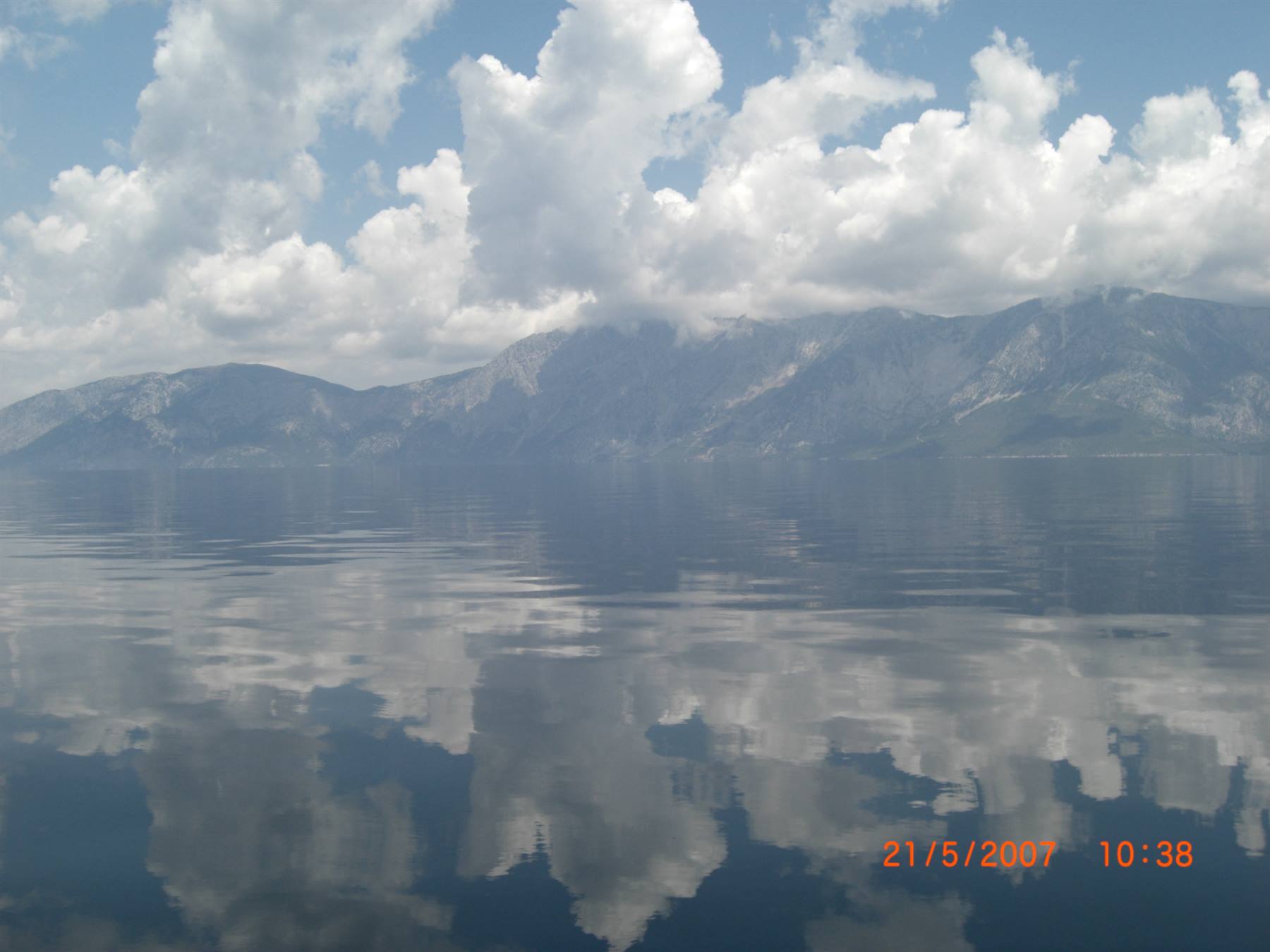
White clouds reflected on calm water in front of rocky mountains
Day 424 May 2007
May 24. Volos- Meteora. 130 km With much effort we find a mechanic for marine engines. We drove around and around on country and suburban roads under a sky threatening rain until we found a workshop, in truth very tidy and well equipped. We agree on the price of the servicing and leave. The threat of rain materializes in violent downpours that accompany us, with some pauses, throughout the journey. The wide Thessalian plain surrounded by mountains makes us understand why the imagination of the ancient Greeks saw right here the homeland of the Centaurs. With a bit of imagination, peering through the garlands of rain, I could glimpse under the protective canopy of a distant oak Chiron teaching Achilles. The region inspires certain fantasies. Not for nothing is Olympus just a few kilometers from here. If it weren't so cloudy we'd see it towering majestically, perhaps still white with snow.
Toward lunchtime we reach Kalambaka at the foot of the Meteora, where by chance we end up in a picturesque neighborhood rich in pleasant tavernas. We eat well and cheaply. But we're impatient to see these geological and spiritual wonders: immense sandstone rocks topped by unreachable monasteries, the Meteora, indeed. Despite the intermittent downpours what we see justifies their fame. This visit had been planned months before undertaking the journey from the Tiber in the footsteps of Odysseus and in search of our Ithaca. Thirteen years have passed since that departure and finally I see them. Too bad that Marzia isn't here today. But we'll come back sooner or later, also because, given the late hour - it's past five - we found the monasteries closed.
We have to limit ourselves to admiring the glimpses of the wide plain below seen between rocky bastions on whose summit the indomitable determination of small men has created great works in the name of a faith that here finds an ideal impulse for the contemplation of the divine. We return to Volos, pick up the outboard, again perfectly functioning, and have dinner on the seafront, in front of the monument to the Argonauts, in an ouzeri. With every ouzo ordered there also comes a fantasy plate of meze with various small specialties of Greek cuisine. In the end we don't know whether we're more full than tipsy.
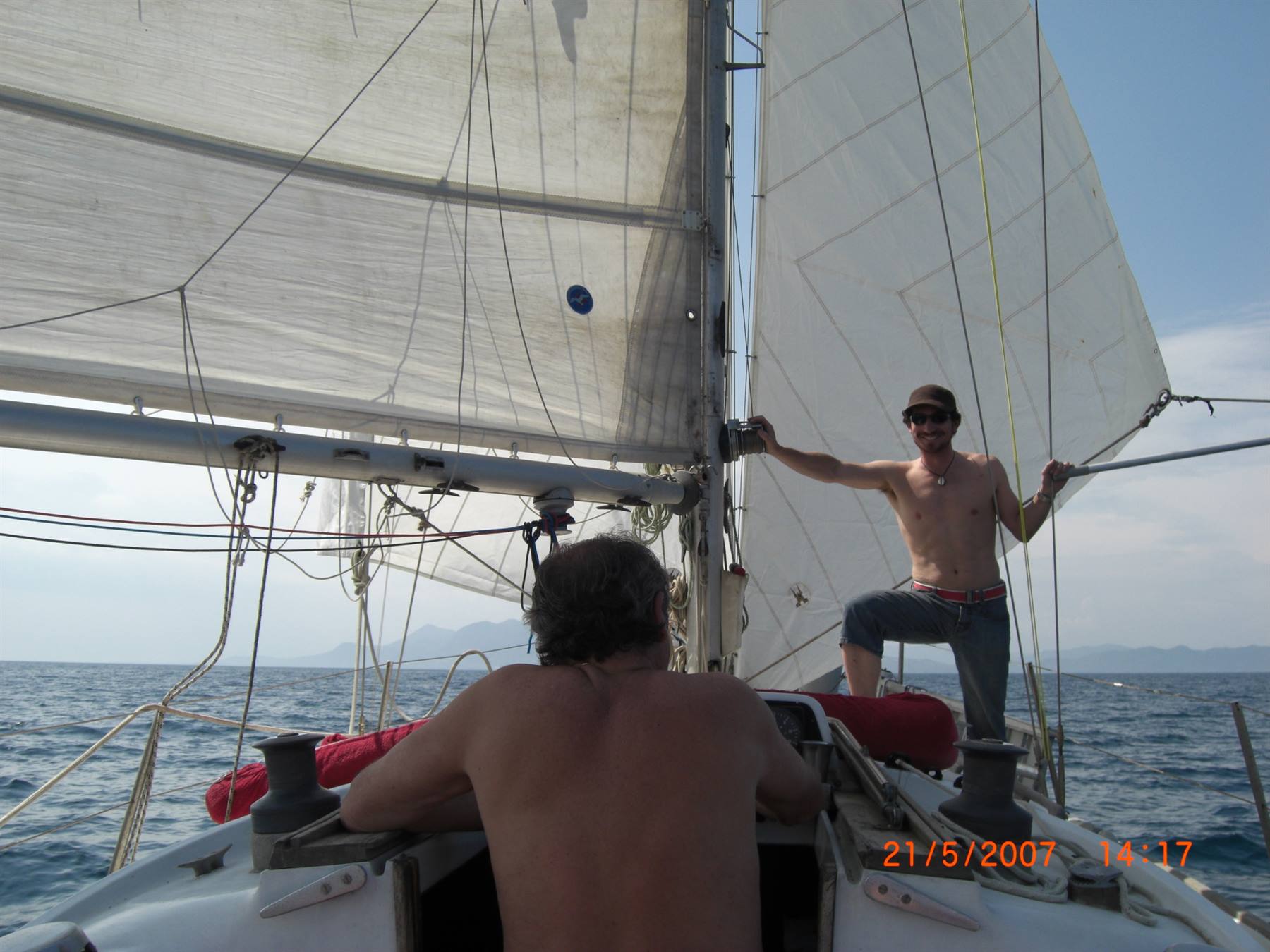
Two men aboard a sailboat, one handling rigging lines at open sea
Day 525 May 2007
May 25. Volos-Skiatos. 24 miles Someone says that outside the gulf there's wind and force-five sea. The source of this news, though unreliable, gives the female part of the crew the idea of wanting to reach Skopelos by ferry. Our denials are to no avail. The sky is clear, there's no wind blowing and it's impossible that outside there's more than a breeze. So off we go, just the two of us, Gino and I, while the "girls" wave goodbye from the pier. We fuel up at the station next to Prince Aziz's yacht, but we feel no envy. We're satisfied with our state, our boat, our Western bourgeois freedom.
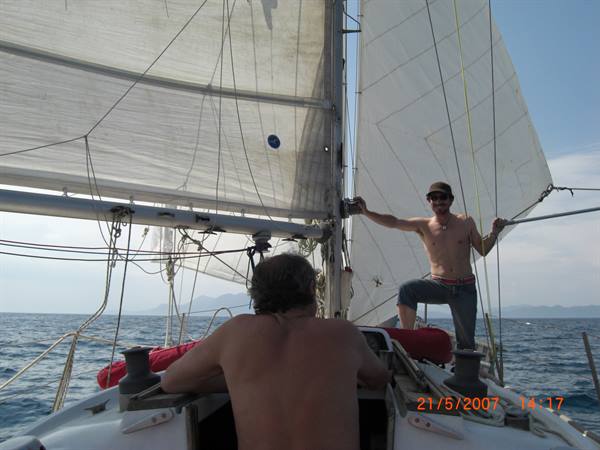
Outside the Gulf of Volos we find the expected breeze, we hoist our three sails, jib two, jib one of the staysail and mainsail, and we sail gently toward Skopelos which stands out clearly visible ahead of us, but confused with the profile of the other islands a little further away with which it forms a compact group. We make out on the right Skiatos and Alonissos, and far to our right, behind Euboea, Skyros. We have, in fact, passed the western end of this large island, the second largest after Crete, and behind it the Aegean opens up all the way to the Turkish coast. Toward four o'clock we see the fast ferry carrying Elke and Gerlinde approaching and we move closer to its course, certain that they too are searching with their eyes for the Gattadapelare.
And indeed, we see each other; a waving of handkerchiefs and towels from the sterns of both vessels, ours still an hour of sailing away, theirs just ten minutes from arrival. Tomorrow Gerlinde leaves us; she returns to Vienna where early parental care awaits her. The happy event expected for the eleventh of June, it seems instead will happen in the next few hours. At the Skiatos airport, very close to the town and whose runway ends at the shore, there are problems with the bookings made online. After some discussion with a rude clerk and a phone call to a courteous airline manager the problem seems solved, but we don't have any flight document in hand, only the verbal declaration that everything is in order. This makes Gerlinde nervous for the whole evening. The town of Skiatos is pleasant, but very touristy.
The harborfront offers, as usual, a long series of restaurants and tavernas and very inviting cafés, with large, padded armchairs and smiling and "polyglot" waiters who, after scrutinizing you, in a fraction of a second guess your nationality and invite you in your language and with broad hand gestures to sit down. The interior of the town differs no less from so many other tourist spots in the Mediterranean. Narrow streets, one- or two-story houses, many little shops offering the usual junk of souvenirs, t-shirts, postcards with repetitive subjects including buttocks encrusted with sand, hills against a backdrop of fleshy female 'domes,' the usual 'horny' and triumphant satyr, and so on. We could be in any other tourist spot of this splendid sea.
We shun such boring uniformity and are always in search of more 'natural' places and hope to find some here too, in the northernmost Sporades which other sailors, online friends, have told us via the internet are not very 'touristy.' In the port there's intense movement of ships and ferries continuously departing and arriving. Nor is the airport any less busy; every little while liners and charters from many European countries land. Both the landing and the takeoff happen along the axis of the bay at rather low altitudes, so much so that, I learn later, when a ship is arriving its overflight must be avoided. The surrounding nature is beautiful; the bay is crowned with islands and green hills; any analogy with the Cyclades, however, is impossible. The beauty of the Cyclades is another thing; it's made of rock and whiteness with the dry scent of herbs dried by the sun and the meltemi.
We love the latter more. It seems to us that they capture more of the soul of insular Greece and the myth that is its humus.
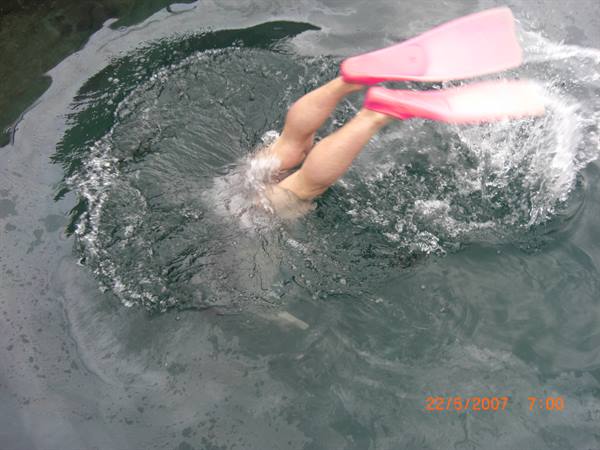
May 26. Skiatos I buy some fish from one of the two little fishmongers in the port, some ice, some retsina, and we go looking for a solitary little beach where we can have a barbecue. The sea is absolutely calm and, once out of the bay, we discover behind one of the islets that crown Skiatos an inlet ideal for our purposes. So we drop anchor and go ashore. The small pebbly beach welcomes us with its solitary serenity. The fish, scaled and washed in the lapping of the sea on the shore, is roasted over a fire lit with the dry branches of aromatic plants growing on the rocky ridge enclosing the beach. We enjoy the exclusivity of this simple and rich experience. We feel enviable and in turn we have nothing to envy. We eat with gusto, we bathe in the cool, transparent water, we abandon ourselves to an after-lunch nap and, in the late afternoon, we return to port.
Gerlinde will soon leave for Vienna.
May 27. Skiatos-Skopelos. 6 miles. The crew of the Gattadapelare is thinning out. After the departure of one of the 'girls' today it will be Gino who leaves us. Work commitments call him back to Brussels. But we still have time to go to Skopelos to visit a beautiful inlet. The pilot book says it's absolutely a must-see. So we head out on a serene sunny day, but with barely more than a breath of wind, toward the southeastern coast of this island. Skopelos too is mountainous and green, like all the Sporades and, they say, less touristy than Skiatos. When we reach the indicated bay we struggle to find the inlet named Panormos which is visible only after having gone well into the bay. It consists of a rather deep fjord protected by high, wooded shores. The deep bottom allows us to get very close to the shore and to take a line ashore from the stern. Like us, five or six other boats.
The place deserves its fame and we let ourselves be conquered by its serenity. We listen to Greek music, have lunch with tuna spaghetti and rest lying in the cockpit. Then we return in good time to Skiatos where we moor at the end of a floating pontoon, the only berth where I can position myself in an ideal north-south direction in case the prevailing wind picks up. With the departure of Gino and Elke I'll remain alone for a few days awaiting the new crew and I won't need any help in case of bad weather. Gino leaves by taxi for the airport and we stay to stroll aimlessly through the town
Swimmer with pink fins diving into dark water, splashing
Day 628 May 2007
.May 28, 2007. Skiatos. Today we took a rental car to go see the famous Koukounaris beach "one of the ten most beautiful beaches in the world" says the brochure, but halfway there a strong wind picked up. We had woken up under a gray sky with total atmospheric calm and now, instead, here it is, exactly as a fisherman from the port had predicted, unheeded, a would-be Cassandra. I quickly returned to the boat and found it lying broadside against the pier. Two people were trying to push it away just enough to insert at least one fender between the lifelines and the pontoon's planking. Even with the addition of my efforts it wasn't possible, so strong was the wind and the sea it had raised; it took the effort of a fourth person to allow us to insert it.
At this point everyone quickly moved away to secure other boats, leaving me alone, breathless and uncertain about what to do, while the waves broke on deck and the spray blinded me. I was convinced that the anchor had dragged and I didn't have much confidence in its hold if I hauled it up again. I had no other choice but to try and at the bow I pressed the windlass switch. The boat began to straighten up, bringing its bow to the waves, until it moved away from the pontoon to the distance imposed by the mooring lines. With the engine on and in gear I stayed like that for an interminable time fighting with heart and hope against the wind and the ever more violent waves. I would have liked to take to the sea and get to the helm in the middle of the bay, where other boats were in less dramatic conditions, but no one was willing to come aboard the Gatta to accompany me.
Elke from the shore observed the effects of the squall along with a dense crowd of onlookers, port authorities and volunteers and tried in vain to convince someone to come help me. I feared that at any moment the anchor would lose its hold even though (I had ascertained) the problem had occurred due to the chain that had slipped out of the windlass and not because it had dragged. Suddenly a miraculous vision: I see a hand emerging from the water offering me a line. A diver from the charter company, who had gone to inspect his anchorages, took pity on me. I tie the boat well and finally relax. Now I have nothing more to fear. I take stock of the damage: the pulpit is bent with a broken upright, the side shows deep marks made by a bollard of the pontoon, the aluminum gangway is twisted and the stern ladder is damaged.
Seeing Gattadapelare with the lifelines dangling and the pulpit crooked is a new and unpleasant experience for me. It seems to me a proud bird humiliated and wounded. With some acrobatics, ferrying myself with the dinghy, I go ashore and go looking for Elke. I find her, disconsolate, sitting at a table in a bar and my appearing surprises and cheers her. She didn't think she'd see me again tonight, already resigned to sleeping in a hotel, perhaps at the 'hotel Meltemi, which by irony is the closest.. The wind has stopped. The waves still move the floating pontoon making it rise and sway like a gigantic serpent. After dinner we attempt to return to the boat. Staggering with legs and arms wide, sometimes crouching so as not to fall, we reach the dinghy at the end of the pontoon.
The little inflatable, which with the swell rises to the level of the planking and then sinks out of sight, is the only chance we have to get on board. I sit Elke on the edge of the pontoon and we let ourselves slide into the dinghy when it is at our level. Getting onto the Gatta is more difficult because the ladder is broken and we can only use the top step which is reachable, with difficulty, with the knee. But, once inside the welcoming belly of the Gatta, we no longer notice anything and we fall asleep easily, tired as we are from such an intense day of emotions and efforts.
May 29, 2007. Skiatos. Today we finally went to this famous Koukounaris beach. When we reach
White sailboat stern with steel boarding ladder and rudder, moored at the harbor
Day 730 May 2007
From 30 May to 31 May 2007. Skiathos. Two days spent in the luxury of boredom, a condition long forgotten in the compulsive existence of modern life. In laziness, too, because I haven't done much work on the boat. I had the damage from the storm repaired and spent many hours lying in the bunk or in the cockpit reading and remembering. Over these years of frequenting Greece I have gathered an enormous mass of sensations, some of them imprisoned in this diary that I have never stopped writing. With time it has reached the size of a book and has become a friend that helps me navigate among memories. In the quiet rolling of the boat, patiently anchored, I see again the moment of our departure from Fiumara. Thirteen years have passed since then and Marzia and I were beginning a journey through time, myth and history. A journey I had planned for years and lovingly studied down to the details.
For me it represented a cultural path towards a destination I had aspired to earn ever since my school days, but which I feared travelling unprepared without being able to fully enjoy its meanings. This fearful respect towards the ancient Greek world was generated, then, by this unpreparedness of mine, due to my scant grounding in the humanities acquired in schools where technical subjects prevailed. The routes I devised, almost always in the evening in bed, followed those of the Greek heroes and the places we would visit were those lit up in my imagination by stimuli that are hard to classify. While I was preparing the routes and landfalls, then, I enriched my notes with cultural content that I drew on, dusting it off or discovering it for the first time from books of various disciplines.
The folder that came out of it was a 'collage' of passages of history, mythological figures, philosophical thoughts, literary extracts, in short a minestrone from which you could fish out anything and relish the assortment of flavours. This medley of information, which had no aim of making us erudite but rather of seasoning our Aegean wanderings with cultural lightness, achieved its purpose. I remember the emotions our wandering brought us, Marzia and me, along the paths and beaches of Ithaca in search of Ulysses. We found him at the spring Arethusa where, overheated from the long walk along a path that cut across the ridge of a hill overlooking the sea, we drank its cool water gathered in a pool in which, among the moss and maidenhair fern, small shrimps lived. We found him again higher up on Eumaeus's pastures and then in the cave of the naiads.
We had already met him at Kerkyra, on the beach where he runs into Nausicaa, and before that at Stromboli and at Circe's, at Scylla and Charybdis. Ulysses accompanied us through the first three years of cruising with a continuous, timeless presence, almost as if he were a member of our crew. I remember the emotion that the visit to the oracle of Delphi brought us, which we reached by scooter on a rainy day setting out from Galaxidi, where the boat was moored. Along the road we bought from a building materials dealer three terracotta antefixes, the kind used in mainland Greece on roof ridges or along their slopes. It was an emblematic purchase, a sort of territorial appropriation, a communion with the psyche of Greece achieved through such a Greek object. I strongly remember the visit to Mycenae and the tombs of the Atreidae.
Mycenae possesses the charm of that undefined civilisation that spread throughout the entire Aegean basin and still today evokes in me a sensation of gripping archaism wherever there are signs of its past. The flimsy 'Mycenaean' acropolises encountered on almost every island, where only a few large stones hidden among the lentisk bushes betray their ancient presence, take on for me a mythical value that caresses my imagination. Every time I approach a landfall I search with my gaze to see whether that place possesses the requirements demanded by the Pelasgian people to found a city there: a height on which to erect monuments and walls, a fertile plain for sustenance, a low beach to haul the ships ashore. Often today's landfall is not far from yesterday's.
We experienced with emotion the passage through the Corinth Canal, with the looming walls and the worry of keeping the boat well in the centre of the channel because those high walls made the waterway appear narrow. Passing in front of the island of Salamis, reading in the ever-fainter light of dusk the account of the battle described by Aeschylus, we saw before the bow of our boat the Greek and Persian ships manoeuvring bloodily in the clangour of the clash. I remember a mild night of sailing from Aegina towards Milos. My watchmate, a passionate connoisseur of the night sky, showed me Jupiter rising from the sea ahead of us. A point of linen light that now acquired a personality. A few days later I was in Crete on Mount Ida in the cave where legend holds that Jupiter was born. Outside the cavern a goat, perhaps a descendant of Amalthea's goat, bleated tremulously its solitude.
And again the island of Hydra where hundreds of regatta sailors had occupied the port and celebrated until dawn in the fraternal confusion of wind lovers, and the fragrant bread of Karpathos, the majesty of the panoramas of Santorini, the solitude of the island of Levitha, the twilight romanticism of Antikaros. A substantial part of my memories is also tied to the Turkish coast. The visit to Ephesus, pagan and Christian, with the remains of the great temple of Artemis, with the tomb of St John, the house of the Madonna, the library of Celsus. A few kilometres further on I see again the columns of the temple of Athena of Priene standing out against the sky and us lying among the marble fragments of ancient things toasting the pleasure of being there.
In the drowsiness induced by the gentle rolling, memories of Greece and Turkey crowd into my mind, jostling one another without my having the strength or will to set them in order. Snapshots of memory: we sail at night towards an isolated village of Anatolia called Kekova. The landfall is made treacherous by rocks and we are happy to dock at the little wooden pier. In the morning, near us, we discover the stern 'medieval' profile of a Lycian tomb rising from the sea; Marzia and I are on the promontory of Cnidos, under the gusts of the meltemi, observing the sea. A boat takes the wind in a sea whitened with foam, but proceeds confidently. Its presence encourages us and we set off.
White sailboat stern with steel boarding ladder and rudder, moored at the harbor
Day 831 May 2007
Memories... memories... We are alone at sea, we ride the waves and late in the evening we arrive at Marmaris with our clothes and hair stiff with salt and happy in our tiredness; we eat crabs roasted on the embers by the bank of a river. Two Turks prepared them for us on a rough grill under which they lit a fire of brushwood gathered on the riverbed; it's just the two of us and the Turkish sailor on a hired barge. We went up the Dalaman river along its meanders hidden in the reeds as far as the ancient city of Caunus. Now we go back down it towards the setting sun and listen to Turkish music and Beethoven's Fifth; we sail at dawn in the fog. We are heading for Crete and a radio station broadcasts only sirtaki music. We are immersed in our 'Greekophilia' and in the fear of the unknown.
The fog thins just in time to show us the danger: the Gatta rises and crashes with a roar into the trough of the waves. The October sea is white with foam. We are heading for Euboea when the engine breaks down. We return under sail to Gavrio, racing over the sea that is friendly nonetheless, driven by the strong wind........Memories, memories.. a treasure of memories At 19:00 Marzia and Maia appear smiling in front of Gattadapelare. Despite the apathy of these days I have at last found the energy to clean the boat and wash it inside with soap and bleach. Now it smells clean. I have also rigged the net between the stanchions to keep the little one from falling overboard. Maia moves about the boat with ease under her mother's satisfied gaze, thus showing good 'seafaring' qualities. Good blood will out.
We have dinner at the usual taverna a short distance away, where the fat polyglot owner now calls me 'brother'. With him I have crossed the boundary of the 'same face, same race'
A man watches a suitcase hung from a spar beside the boat
Day 91 Jun 2007
1 June 2007- Skyatos-Skopelos (panormos). 8 miles We woke up late and set off at our leisure headed for Skopelos. The crossing is short and the weather conditions are reassuring despite the forecast of disturbed weather for the next few days. Coming from Skyatos you have to get very close to the coast before you can see the entrance to the bay, which is also partly hidden by a tall wooded islet. The bay is fairly wide and at its head has a nice pebbly beach and a couple of welcoming tavernas. The inlet of Panormos opens unexpectedly on the right, inviting and well protected. There are four or five boats, one of which belongs to a Swiss couple we had already got to know in the past. We greet each other and the skipper brings us a line ashore with his tender. The Sporades, unlike the Cyclades, are well supplied with vegetation.
The trees come right down to the shore and it is always a pleasant experience to have the boat tied to a branch. With the stern well secured to the tree and forty metres of chain at the bow (the water is very deep right up to the shore) we once again give ourselves over to sweet idleness. I try to fish, but the numerous fish swimming around the boat, ready to swallow anything thrown to them, are extremely suspicious when the line is lowered. I catch only one, tiny and almost by chance, and before giving it back its freedom we keep it prisoner for a while in a bucket for Maia's curiosity. Listening to music and dozing, the afternoon passes. Towards evening we go ashore with the tender. The little outboard has trouble staying on and Maia, worried and distrustful, makes me row. A small path through the woods soon leads to a dirt road that reaches the beach.
We enjoy the sunset with an aperitif in hand on comfortable deckchairs, almost the only customers of our taverna. Maia plays with the little stones. A sense of tranquil abandon is the best we could wish for and appreciate. We head back towards the shore where we left the tender, crossing a short stretch of woods. We walk in single file, sweeping the path with the light of the torch lent to us by the Swiss.
2 June 2007 Panormos-Patatiri (Alonissos). Miles 15 Today we set off at our leisure after the Swiss, headed for the next island. Alonissos is the least frequented by tourism because it has no interesting beaches and for that reason we will like it more. There is no wind, except a light breeze we meet abeam of the strait between the islands. Gino from Brussels sends us the weather forecast by text message; it is not the best. A disturbance is on its way with the threat of rain and this leads us not to push too far from Skiatos, where we will have to be again on the 6th. Caution is perhaps excessive, but I want to spare the little one the experience of a rough return. After all, Maia is an aspiring sailor in training. After some hesitation we choose the anchorage of Patatiri, which seems to us the most comfortable, and we moor helped ashore by an Italian skipper.
We are only four boats and I like this a lot. The town is pleasant because it lies in an inlet well protected by a mole. From its high coast the houses and hotels look out over the harbour, forming almost an amphitheatre. A few cafés and tavernas betray the presence of a fair amount of tourism in high season, but at this time of year there is no crowding: A regular visitor, we are told, is the seal Dimitri, a big male of a couple of hundredweight who only shows himself in winter. He enters the harbour and demands to be fed by the inhabitants. In exchange he gives his contribution to the town's fame and to the trade in postcards bearing his portrait. In the northern part of Alonissos, which is very sparsely inhabited, lives a colony of seals, and one of our plans was also to get there in the hope of seeing them.
Tomorrow, instead, we turn back, but I promise myself to go there when, with Gino and Maria, we take the boat north. Our intention is to reach Tassos, the northernmost Greek island, and leave the boat in a boatyard. We don't yet have certain information about the boatyards there and Gino is looking into it through his contacts. Since we arrived in the early afternoon and the sun is still high, we go to a small beach on the side of the bay opposite our mooring, but the swim is soured by the discovery that the sea is dirty. The current and the wind gather here all the floating 'things' of the little harbour..
Woman inflates an orange life raft next to a boat on a trailer
Day 103 Jun 2007
3 June 2007. Patatiri-Agnonas (Skopelos). 10 miles. Still fearing a turn for the worse in the weather, after breakfast we head back to Skopelos. In the pilot book I read of an anchorage a few miles away that from the description has the requisites we prefer; it is small with a little beach and a couple of tavernas. When we reach it after a couple of hours of little sailing and much motoring, the place lives up to expectations. The narrow inlet ends in a short sandy beach on which two shady tavernas line up their little tables. A couple of short wobbly jetties accommodate some colourful little boats with names one comes across thousands of times along all the coasts of Greece. Among these Mapia (which the little knowledge of the Greek alphabet learned during the first days of Gattadapelare's presence in Greece, a refugee from Italy, allowed us to translate as Maria) and Ag.
Nikolaus are present everywhere. A long concrete mole, with a wide esplanade, borders the right side and allows the mooring of numerous boats and of the ferry. When we arrive we find only a catamaran and a sloop and plenty of room to moor stern-to, the mooring preferred by all sailors because it allows you to get on and off ashore with great ease. A monument with a winged sculpture and the symbols of the Olympic games and a name let us guess that this place, inhabited by a scant number of families (no villages are to be seen around), gave birth to an athlete who won some not better identified race. We exchange a few words with the German occupants of the catamaran. They are a mature couple with two children of university age, who have come to meet them in Greece.
They come from Munich and from there reached the Danube, which they descended as far as the Black Sea, and then, through the Dardanelles, entered the Aegean. A trip I would like to make. In my future plans there is 'only' the arrival at Istanbul at sunset when the sun goes down behind the minarets of the mosque of Suleiman. It is a feasible project and it has been on the waiting list for a long time. When that happens I will be able to say that the programme studied at length years ago will have been concluded. This will not mean the end of Gattadapelare's 'adventures', which will continue to touch the shores of other islands and coasts as long as there is a skipper and a crew willing to guide her with love. On the beach there are the swings.
Mother and daughter, moved by joyful impulses, one of reminiscences, the other of infantile 'dasein', swing in the air pointing their feet towards the sea and laughing noisily. Maia is harmoniously inserted into this life as a wanderer of the sea and we see her continuing in her future along the same routes traced by her grandfather and her mother. We have dinner at one of the two tavernas on the shore, watching the calm and serene movements of an old fisherman pottering about on his little boat tied to the precarious jetty of planks in front of us. I have lived this scene many times, in other places, and I have always been struck by the absence of urgency in the actions of these men. Each time they convey to me a dimension of time different from the way I know it; as most of us know it.
For them it is a good available in great quantity, so much so that they do not give it an economic value. It is there and it is largely sufficient to carry out the few actions that the day places before them. I let myself be captivated by these rhythms that induce rest of the spirit and the recharging of the energies needed to face the innumerable commitments of everyday life. Gattadapelare welcomes us with tranquil hospitality.
4 June 2007 - Agnondas-Panormos 4.5 miles. The disturbance has not yet arrived and we postpone the return to Skiatos until tomorrow. We go back to the beach to bask in the sun and doze in the awareness of having nothing to do. When we are tired of being lazy, we cast off the moorings, hoist the mainsail to better stabilise the boat and head off under motor towards Panormos. I notice late that the fan belt has broken and the engine has overheated. I fear a serious problem, that is, that the cylinder head gasket may have burned out. I anxiously check the water level every half hour. It seems to me that it consumes more than normal, but I am not certain. A puff of wind, which however does not last long, gives us the pleasure (rare this year) of feeling the Gatta glide through the sea.
In the usual inlet we find some boats with the stern line ashore, but for fear that later a wind might get up on the beam I prefer this time to lie to the wheel. In the cockpit we listen to our music playlist and on the wings of the melodies of our most beloved Greek singer, Alexiou, we relive the sensations tied to blue places and to times never past. Maia moves and plays about the boat with the familiarity of one completely at ease. The aperitif on the deckchairs at the water's edge in front of the setting sun and dinner at the usual taverna, where we are welcomed with a familiar greeting, conclude the day. A day made of little and yet rich for us. Later a discotheque on the other side of the bay begins to desecrate such peace with very loud music.
We go back to the boat irritated at having been dragged from the poetic fantasy in which we live in our wandering through the Aegean to the banal vulgarity of this 'modern' world. The weather is deteriorating. The cloudy sky is lit now and then by distant flashes of lightning. For safety I also lower a kedge anchor and go to sleep. In the forward cabin mother and daughter, pleasantly curled up in their berths, give me a goodnight kiss. 5 June 2007. Panormos (Skopelos)-Skiatos. 8 miles. I heard the rain tonight, but not the wind. Even now that I am up preparing breakfast I hear it pattering on the deck. I look outside through the porthole and see the sea flat and grey The little cruise with the 'mythical' second one back in service on Gattadapelare and the new aspiring boatswain has therefore come to an end. The leg we will do today promises to be melancholic.
We leave the bay of Panormos and head for Skiatos with the engine at low revs to prolong the last moments to be spent together, on the sea. The family of dolphins that lives in this stretch of channel appears in front of us to the great joy of Marzia, who had not seen any for so long, and arousing the curiosity of Maia, who sees them for the first time. We soon arrive at the port and moor easily because there are many free places. It is a good hour, this. The returns and arrivals are concentrated in the late afternoon and the late boats have to lie to the wheel. Skiatos is the base of quite a few charter companies and the arrivals of ferries and planes are very frequent and noisy. We have dinner at my 'fat Greek brother's' and later, while Maia sleeps, we stay lying for a long time in the cockpit listening to music and talking, Marzia and I.
Tomorrow I will again be alone for a few days, waiting for the new crew. Gino and Maria will arrive from Brussels for the last leg of the trip.
Rio-Antirrio bridge seen from a sailboat deck, sailor handling sails
Day 116 Jun 2007
From 6 to 9 June 2007. Skiatos. Last night it rained again. We woke up early for the departure of Marzia and Maia. I see them leave by taxi, and in the goodbyes there is already the nostalgia of the time spent together. In these three days, lived without emotions, I have continued with the little maintenance jobs. I don't like solitude, I need to share my experiences and my emotions with others. This will never make me a true 'sailor'. I have frequently met solitary skippers, who have closed behind them the door of social life, left their usual work. True 'sailors' who roam the islands and the continents, in a vagabondage in search of themselves. I don't know if they find what they are looking for, but they all claim to be satisfied with their choice. When I asked them what the price paid was, the answer was always the same: family. But they all say it with poorly concealed regret.
Finally towards evening the 'Hispanics' arrive. Tomorrow we set off again!
10 June 2007. Skiatos-Agnonda.12 miles. With the arrival of Maria and Gino the good weather has also arrived. Since we left Oropu the meltemi has never blown. The winds, light and occasional, except for the storm of 28 May, have been only those coming from the third quadrant. So today too, we will go under motor. We did a little provisioning, the bare minimum: ice for our drinks, retsina, olives, cheese, various vegetables. Our meals on board are modest, very Mediterranean, indeed very Greek. I travel again the routes of the past days. At Agnonda we moor at the usual mole. I am glad to return there. It is a comfortable and pleasant mooring and it pleases my two friends and probably also the stowaway that Maria hides very well.
11 June 2007. Agnonda-Steno Vali (Alonissos). 14 miles This year Gattadapelare is lazy. With no wind and no hurry our legs are reduced to a few miles a day. Friends from the internet have recommended I visit Steno Vali, the anchorage is the most beautiful on the island. So we set off in the late morning after having coffee under the low, thick canopy of the maple of one of the two tavernas on the beach. Alonissos is a long, narrow island and is faced for almost its entire length by another island, Peristera. The channel between the two lands is not very wide and is oriented towards the north, so the meltemi blows strongly through it. But not today. Today the sea is calm and the wind light. A beautiful sunny day. The coasts of the two islands slide by slowly. Those of Alonissos little inhabited, those of Peristera deserted. We like them that way. We are selfish travellers.
We don't use GPS and we haven't plotted the course on the chart, and so we pass by the inlet of Steno Vali which, as the name says, is narrow and not very conspicuous. We turn back a few miles and slip into the small fjord. It is so narrow that we bring the anchor almost to the shore opposite the one where the mole and the tavernas are. Together with us there are six, seven other sailboats. The inlet is set between low green hills and ends in a short, thin beach onto which some trees stretch their branches. A few metres from the edge of the mole the tavernas look out and a couple of grocery shops which here, as elsewhere on the Greek islands, take the promising name of 'supermarket' even though they are tiny. The place inspires tranquillity and lazy observation of the few people around us.
The diversion is represented by the arrival of a motorboat with a Greek flag that drops anchor upstream of ours and crossing our chain. The behaviour of the crew, two men and two women, immediately seems unpleasant to us, little inclined to cordiality. To our remarks that their anchor is on top of ours they reply with haughty assurance that it is not so. They also inform us that they will leave the day after tomorrow; so tomorrow we will have the problem of freeing our chain. We have dinner at a table among the trees of one of the tavernas after a difficult choice because they all seem pleasant to us.
12 June 2007. Steno Vali -Bay of Aghiu Petru (island of Pelagos or Kirà Paniagià) l0 miles. In a plastic bottle we put a mocking message addressed to the neighbours of the motorboat, at the moment absent, and Gino goes to tie it to the shank of their anchor which, as he ascertains, is indeed on top of ours. Tomorrow when hauling they will find, I hope feeling a little ashamed, our greeting. But will they be ashamed of their ill-mannered behaviour? We make bets, but there is no bank because all three of us bet they won't. We want to see the seals. We head north to reach the island of Kirà Panagià which is not inhabited and, they say, frequented by a colony of these specimens. Perhaps Dimitri lives right here. The weather stays clear and windless. As we proceed all the lands we see appear deserted. We are satisfied.
When we reach Kirà we find a wide inlet and three boats lying to the wheel. Two of these fly our flag. Never as this year have we met so many Italian boats. We anchor and give ourselves over to the usual relaxation in the cockpit. A glass of well-iced ouzo, strong for me, much watered down for Gino (who this year has reduced the 'diluent'), and virtual for Maria (who on this cruise must account for it to the stowaway), a few snacks and the observation of the place make us feel masters of the day and of the places. We have found our Aegean again and yet it seems a little crowded to us. On the shore, on one side of the bay, a group of campers disturbs our conception of the perfect island: not big, a good anchorage, a nice little beach, and absolutely deserted.
The perfect island for us is Antikaros, a small clump of stones and bushes in the tiny archipelago that goes by the name of the "little Cyclades" and that represents the quintessence of 'nautical romanticism'. Up high, on the hill that overlooks it, one can make out the remains of a construction. From here one might think they are very ancient, perhaps of Mycenaean times. So I set off to reach them while the others stay on the boat. I climb with effort, making my way among the bushes and beating the path before me with a long stick because, I read in the pilot book, vipers are frequent on these islands. When I get up there I discover that they are more recent ruins. From a niche and a fragment of column I presume to hold that they are the remains of a small church, probably Byzantine.
This island, like others of the Sporades, were part of the patrimony of the monastery of Mount Athos until the Ottoman conquest of the Aegean. Its abandonment must date back to that period. From up here the view is superb. Below me I see the bay with four boats peacefully at anchor and beyond the ridge a deep and attractive gully. At the head of the bay a plain dotted with a few olive trees ends in a pebbly shore. On the opposite side the cliff becomes low and creates small pools before changing into a short sandy beach on which the campers' tents are pitched. I return to Gattadapelare and, inspired by the presence of no fewer than three Italian sailboats, I put on the table an abundant portion of linguine cacio e pepe with some 'real pecorino romano' found in the supermarket of Skiatos. The crew appreciates this culinary digression, not very Greek, a great deal.
Of seals none are to be seen, but we know there are many on the small island of Giura, the northernmost of the Sporades. We are tempted to break the ban on approaching within three miles imposed by the rules of the Marine Park created to protect these
Iron bridge over water with palm trees and waterfront under white clouds
Day 1213 Jun 2007
13 June 2007. Pelagos-Patatiri. 14 miles. A light breeze allows us to leave the anchorage under sail, but it does not last long and outside we must again use the engine. We look for an anchorage on the northern tip of Alonissos, but we are not satisfied with what we catch sight of and we continue, retracing the same route as yesterday. Passing close to the island we see the wide entrance of a cave that had escaped us on the outward journey. It is a cave that is part of the curiosities offered by the organisers of the "Tour of the islands" but at this moment there is no one and we do not notice the existence of a mooring buoy specially positioned for the tourist boats. In turn one of us remains on board the Gatta, which wallows in front of the entrance, while the other two go in with the little boat. The cave is vast and high.
The sunlight, penetrating, gives the water a luminous azure that invites one to dive in to swim in it. While we are there we see two other sailboats arrive, probably attracted by our presence. They have appeared out of nowhere because until that moment it had seemed to us that we were the only sailors in that stretch of sea. We set off again and, in the hope of finding fresh fish at Steno Vali, we head once more towards that gully. The motorboat with the ill-mannered crew is no longer there and there is no fish to buy either. We make do with an 'industrial' chicken and look for a little beach on the island of Peristera opposite Alonissos. We find a pleasant but shallow inlet, almost a parenthesis of the coast, thick with scrub, and on the shore we grill our lunch. Still with no wind we resume our journey and a short time later we enter the port of Patatiri.
Gino wants to go up to the Chora with the only small bus that provides service from the port. I don't expect much from this visit and instead I am wrong. The town is small, but pleasant. After a period of abandonment by the inhabitants who preferred to go down to the sea, thanks to tourism it has been reborn, restoring the old houses and adapting them into tavernas and little souvenir shops. The view from the café where we have stopped is very beautiful. Below us the inlets of Alonissos, in front Skopelos and further away the profile of Peristera. The sun is setting and there is much peace around us. After dinner we return to the marina. Maria has seen an Italian ice-cream parlour and wants a cone. They say that not satisfying a 'craving' can, in pregnant women, cause unsightly marks on the skin.
To avoid the new boatswain, still unborn, being born with a 'chocolate and cream birthmark' on his cheek, we stop to buy the ice cream. The tasty cone and the meeting with the likeable owner, a native of Varese, an Italian icon of this small archipelago, closes our day at sea, not glorious, but quietly enjoyed.
14 June 2007. Patatiri-Panormos. 14 miles
Before leaving the port we buy some fish and some ice. We very much like discovering new little coves where we grill the fish on the shore, sometimes bought directly from the fishermen, after having cleaned and scaled it, immersed up to our knees in the transparent water of this sea loved by us more intensely every year. There are many other seas on earth, more exotic and fascinating than this small Aegean, but only here can one breathe the history and the myth that know how to season our wandering among the islands, each different from the other, even though they appear to the eye of the hasty and unprepared tourist all similar to one another. We set off, then, and after some searching we finally find the little beach we like. Meanwhile the sky darkens. It is not a storm, but a grey blanket of clouds advancing stealthily from the south.
Indeed, while we have just slipped into the sweet carefreeness of the post-lunch nap, a light rain begins that drives us from this last shore. The moment approaches when we will abandon Gattadapelare to her dry hibernation ashore. We have given up taking her further north and decided to leave her at Skyatos. At the head of the bay, at the end of the airport runway, there is a sort of boatyard where a couple of boats, apparently abandoned, wait with little hope for the return of their owners, perched on makeshift cradles made of planks and oil drums. It is not the best of boatyards. We reach the anchorage of Panormos once again and have dinner on the beach at the taverna where, by now, we are known as old customers.
15 June 2007. Panormos-Skyatos. 8 miles. A sunny and warm day greets us as we leave our hospitable anchorage. This inlet is one of the pleasantest places known in our seafaring. We would like it to be further from the charter routes so as to enjoy it also for the resulting solitude. Unfortunately 'unique' anchorages, those anchorages where you feel a bit like Cook and experience the exaltation of the discovery of a new land, no longer exist, but on these islands of Greece now and then we land in some corner that gives us, if not the exaltation, at least the impression of being among the few fortunate visitors. If our wandering in search of these sites, but I should perhaps say in search of ourselves in experiencing such emotions, had more time available, we could certainly enrich it with many other similar anchorages.
The islands of Greece number over 1400, enough to disperse a great crowd of tourists and reserve some solitary corner of the Aegean for demanding travellers like us. We coast for a few miles along the coast of Skopelos, headed for the port of Glossa. It is hot and I leave the visit of the Chora to Maria and Gino. Today I am listless and no longer feel the exaltation of the previous days. It is a sensation that assails me every time I sense the end of the cruise. At a certain point the awareness clicks inside that the time granted me has run out and this takes away the taste of what could still be done. When my crew returns tired and a little disappointed by this Chora we resume sailing for Skiatos. The last leg, again without wind and without sea.
Ashore we go to talk to the owner of what we insist on calling a boatyard, but which is only a sort of 'makeshift' boatyard at the end of the runway of the planes. Not a fence or a night watchman. Not even a dog to bark at the moon. Only two boats of the same size as the Gatta stand on makeshift cradles, their keels a few centimetres from the ground. One of them still has its sails bent on, but the long wait to return to the sea and the action of the weather have made them melancholy rags hanging from the forestay and the boom like draperies of stalactites. We measure the draught of the larger sailboat, which is three or four centimetres greater than ours, and we hold that Gattadapelare too can be hauled out and housed with the modest means of the boatyard. So tomorrow we haul out.
16 June 2007. Skiatos-Athens
We do not have a flight booking because according to the plan we should have left the boat elsewhere. We try, in vain, the fortune of a waiting list and to not risk too much we board the last ferry headed for Agios Kostantinos. From there a long-distance bus takes us to Athens in just over two hours. Then dinner in a trattoria, far from the tourist districts, and to bed in a hotel.
17 June 2007. Athens-Rome
My friends accompany me to the metro station of Syntagma square. We take leave like this, with a hug of mutual thanks and the awareness that Gattadapelare will still sail with these crews and a few more boatswains. P
Iron bridge over water with palm trees and waterfront under white clouds



0 reader comments