Here I am again, in this city that is almost mine though I know almost nothing about it. The little I do know—which is a great deal—represented by the Acropolis, the Agora, Lycabettus and the hill of Philopappos, by the alleys of Plaka, where I wander knowing its views and souvenir shops, gives me the feeling of being at home. The affection that binds me to the people of Greece, faintly illuminated by the ancient glimmers of that Hellenic fire that forged our culture, makes Athens appear to me as a sister of Rome. And yet of Athens I do not know the life led there, nor the thoughts of its inhabitants, nor its problems as a modern city. Athens is for me fascinating and at the same time slovenly depending on which glasses I am wearing at that moment, but in any case she is my friend. I find myself in Syntagma Square at the moment when it is the backdrop of a demonstration.
A demonstration like all the others, the kind they hold in the West. A long column of people advances slowly, stops, moves forward again urged on by the usual hyperactive character equipped with a loudspeaker who addresses alternately those ahead of him and those behind him, inciting his comrades, or his brothers-in-arms, or his brothers with rhyming slogans. He is followed by a compact, aligned front line of which only the torsos and legs can be seen, the rest hidden by the protest banner. Then follows the supporting mass, which periodically repeats the slogans energetically. Behind them, less compact, a bit distracted and chatty, comes the body of demonstrators. The girls, often arm in arm, smile a little sheepishly; the boys more interested in them than in the demands of the march.
The last demonstrators, in scattered order, walk strolling somewhat bored, almost denying their participation. They seem to say: I just happen to be here. A demonstration like all the others. Except that I don't understand the slogans. Only one word is comprehensible to me: demokrazia. Here, in the city that was its homeland, it is invoked as though it were absent. Perhaps modern Athenians should do as their ancient forefathers did with Nike—Nike Aptera, precisely—cut off her wings and force her to remain in the city. I have a few hours ahead of me before taking the plane to Samos, where I have an appointment with Gino, my companion in cat adventures, by now an integral part of Gattadapelare, which, without him, would no longer meow so passionately.
I wander a bit through Plaka, eat at the usual trattoria, where the waiter who always recognized me, even after years, is no longer there, and head back toward Syntagma Square to take the metro that will bring me to the airport. At sunset I find myself gazing at the sea and the islands below from the porthole of the twin-engine plane carrying me to Samos. I clearly recognize Mykonos and the small archipelago of Delos, then the darkness lets me imagine Ikaria, the Fourni and, farther away, Patmos.
Stepping off the plane, I am enveloped by the dry, beloved scents of Mediterranean plants, fragrances of holidays and freedom experienced countless times in the nature of this welcoming 'Mare nostrum.' A jumble of barely sketched sensations, in which memories mingle of summers in Sardinia, of Aegean islands, of Ponza, of coves in Corsica… Gino, from behind the glass, greets me smiling while I wait for my luggage. Pythagorio is a pleasant village that embraces the cove, protected by a pier that is the continuation of the older one, still clearly visible, from which Pythagoras set sail to go and live in [Crotone]. Although it is evident from the numerous cafés and restaurants that line the pier that tourism is well present here, it has nonetheless maintained the acceptable dimension of a small town.
A hill for the acropolis, a cove for ships, a plain behind for food were the elements that determined its founding in Mycenaean times. We eat and go to sleep in the little hotel on the harbor, already known to Marcus and me on a previous occasion.
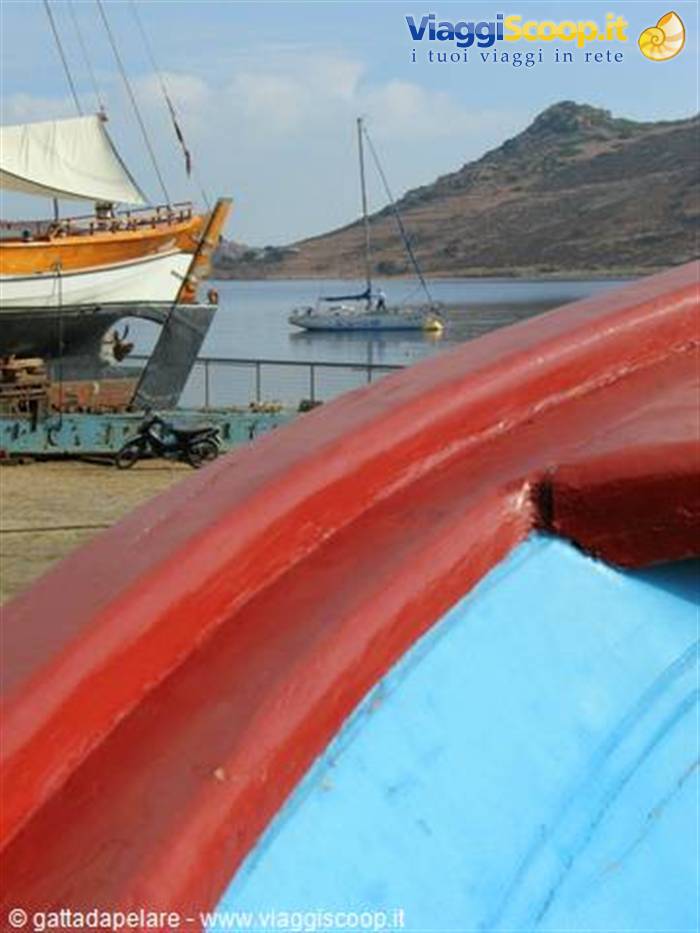
Red and blue boat bow, stranded tall ship and anchored sailboat in the bay
Day 26 Oct 2006
6 October. Pytagorio- island of Patmos / Patmos- island of Denoussa – 39 miles
At 8 o'clock the Dolphin non-stop leaves for Patmos. The sea is calm, not a breath of wind, not a cloud. This pleases us because our plan is to leave Patmos immediately, taking advantage of the absence of the north wind to make as much progress as possible up to the latitude of Mykonos. The day after tomorrow we have an appointment there with Maria, coming from Brussels, and we would like to be there. The Dolphin glides smoothly and grazes the archipelago of Arki. We see places well known to us. Our Marathi is there and we don't know when we will see it again along with the characters who inhabit it and who, through our repeated visits, have become part of our lives. The cruising program ahead of us will take us for a few years far from this part of the Aegean that we consider the most fascinating.
We will visit the Northern Sporades, Chalkida, Samothrace, the Dardanelles…and then, inshallah, Istanbul. We will thus follow the route of the Argonauts and then return along the coast of Anatolia as far as Kushadasi. From there to Patmos, or Leros, once again on Greek soil, almost home. At Sozon's boatyard we find, as agreed, the Gatta in the water and…no bill to pay. I, at least! In fact, through a reverse mutiny, a Gerlinde-Gino alliance has formed for the permanent acquisition of usage rights to the Gattadapelare. It's not yet an expropriation, but it's a signal; I must be careful. A few discussions with Sozon, conducted in Greek by Gino, regarding the battery, and then we set off.
The first idea is to go to Levitha, another anchorage we love precisely for its isolation from the contemporary world, and spend the night there in the tranquillity of the fjord, but then we decide on the island of Denoussa, east of Paxos, further north than Levitha. In this way we will have gained latitude and will be at an advantage if the north wind picks up tomorrow. We proceed almost entirely under motor and around five in the afternoon, as darkness falls, we drop anchor in the southeastern bay of the island. I have been here before, years ago, with Marzia on a stormy night with two anchors set and the tender in tow spinning on its line, lifted by the wind. This time the evening is extraordinarily calm. An immense moon, in its fat fullness, rises from the sea and illuminates our prosaic dinner. The starry night wraps around us with a mother's tenderness.
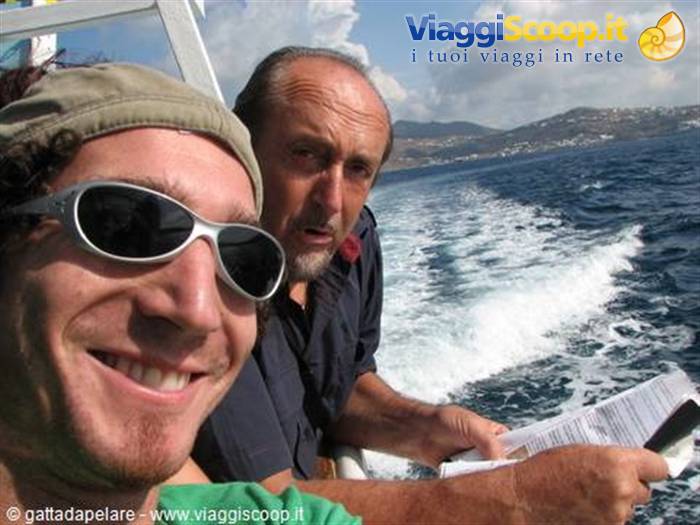
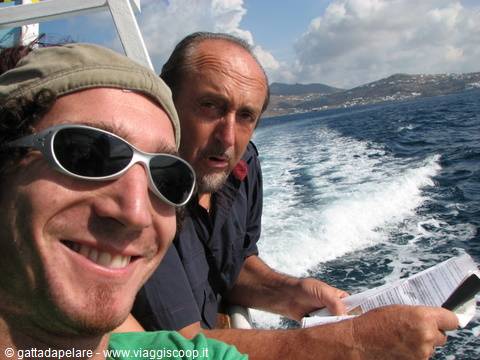
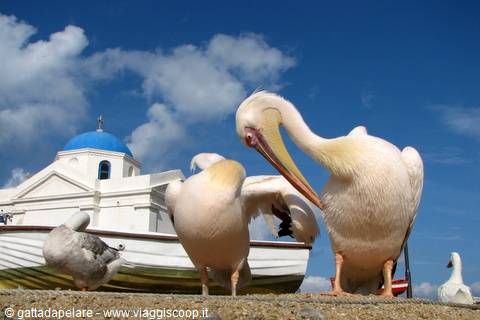
Two men on a ferry, white wake behind and coast with white houses
Day 37 Oct 2006
7 October. Denoussa- island of Mykonos 33 miles
We are awakened by the shouting of an old woman from one of the rare houses that stand a short distance from the shore. It is hard to imagine the flow of existence here, on this island and in this tiny village. None of the codes of life known to us, none of our daily rhythms as modern men accustomed and enslaved by the city, has any counterpart here. We don't know whether the message this place conveys to us is one of peace or of melancholy. We slowly move away under motor, listening to the old woman's cries fading into the distance. We exit the bay passing between two high walls of rock. There is little depth and Gino, at the bow, points out the dangerous spots. We coast along the island on the northern side, where the shore drops sheer into a completely calm sea. After a promising breeze, the wind dies entirely while a thickening haze prevents us from glimpsing Mykonos on the horizon.
We reach port in time to rent mopeds and go to meet Maria, who is arriving from Athens on the afternoon ferry. As always when we are here, we go for an aperitif in that part of Mykonos known as 'Little Venice,' from which one admires splendid sunsets seated at a table in one of the small cafés along the walkway that leads from the hill of the windmills to the center. The town is always crowded with tourists, even at this dying of the season, and we—romantic seekers of corners of Greece still genuine, if not outright pristine—do not care for these anonymous 'touristy' atmospheres. But tomorrow we want to go and visit Delos, so we put up with the presence of the Doric invaders.
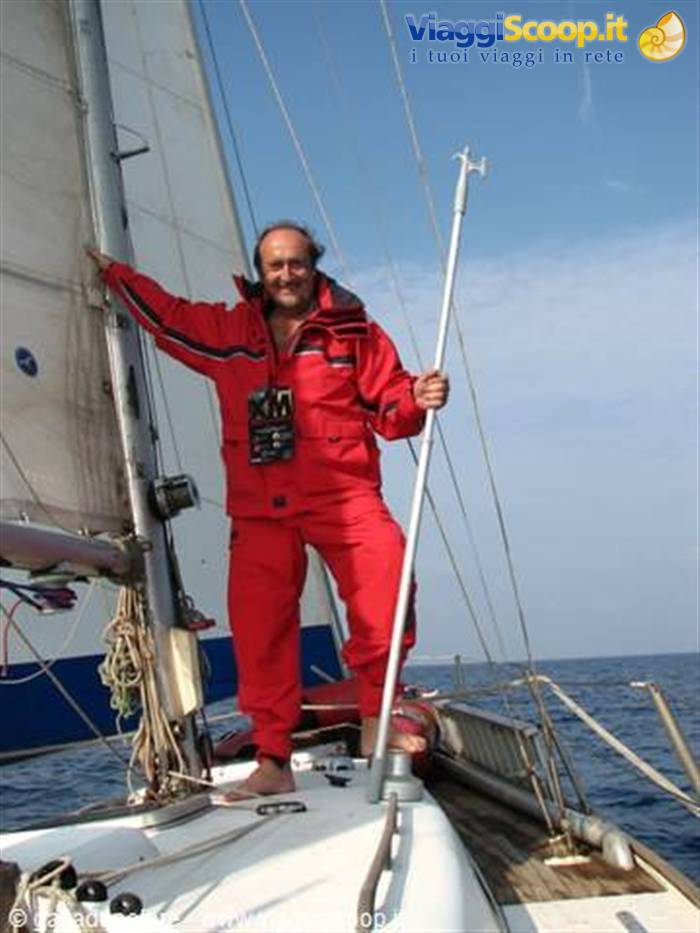
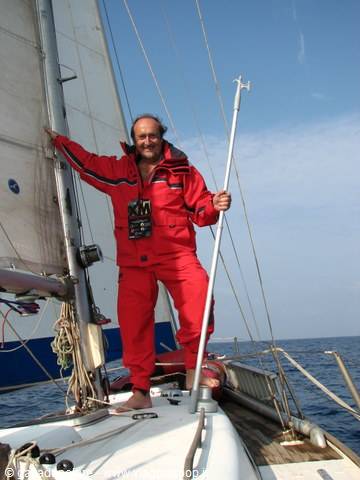
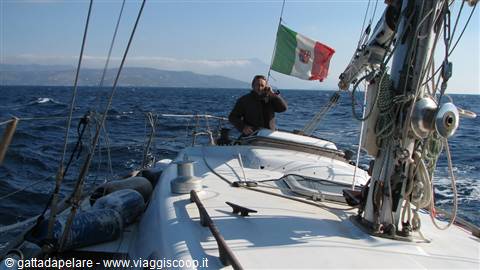
Man in red sailing suit on a sailboat at sea, gripping a pole
Day 48 Oct 2006
8 October. Island of Delos. Mikonos- island of Tinos. 10 miles
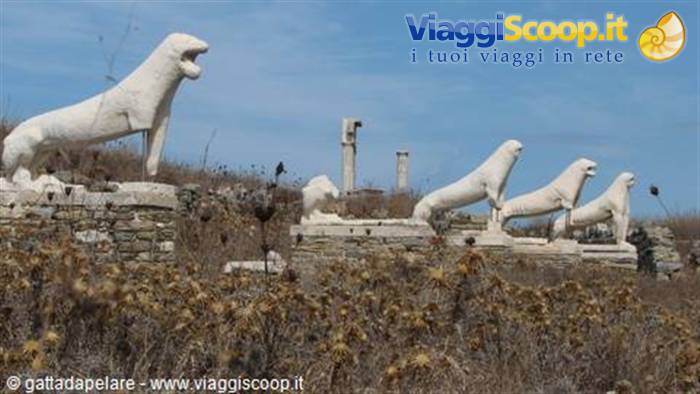
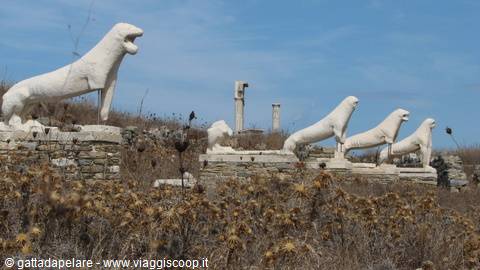
Finally we are at Delos, at the center of the Cyclades, on the island sacred to Apollo and Diana. Here one must not die and one must not be born, decreed an ancient law to protect the sanctity of the place. And one must not land with one's own boat, decrees the Harbor Authority. So we took a ferry and now we are here among the ruins of the city that was for centuries the focal point of myth, politics and commerce in antiquity. But it is above all myth that hovers in every corner, in every stone, among the altars and votive statues, and that magnifies the sacredness of the tiny river, now dried up, of the small lake filled with earth by impious men, fearful only of malaria, of the modest hill elevated to the dignity of a mountain. We walk in the still-summer heat and in the solar luminosity of Apollo, whose presence here is only slightly dimmed by two thousand years of Christianity.
The sea around us is calm and stretches among the islets and rocks that form, together with Delos, an archipelago rich in shelter for ships. Ships that in antiquity found here a safe anchorage to disembark pilgrims first and, later, the slaves who fueled the rich commerce practiced here. From Mount Cynthus, which we climbed following a path, partly stepped, that in its winding crosses remains of ancient temples, skirts the amphitheater, and finally reaches the 'summit,' one enjoys a fine panorama that ranges from Mykonos to Tinos, to Syros, to Paros and to Naxos. We feel, without needing to tell each other, that what we see is all ours. We, with our boat, can head wherever we want, we can conquer anchorages, drop anchor in front of solitary beaches, make the atmospheres of places our own, leave them comforted by the certainty that the next anchorage will be even more beautiful.
Mare Nostrum. The ferry calls the latecomers with brief blasts of its siren. We board and, having reached our Gattadapelare, cast off the moorings and head for Tinos. A light breeze carries us gently across the short stretch of sea separating the two islands. After coasting for a couple of miles along the southeastern part of Tinos, we reach the harbor of the town. I immediately sense that the setting is changing, as if Tinos were a 'continental Cycladic' island, the first of the islands to be conditioned by the proximity of 'city' culture. As if I had always known that those white Choras perched on their hilltops and the Skalas at their feet bathed by the sea, omnipresent on all the other islands we have visited, in this part of the Aegean would be replaced by more prosaic towns made of anonymous houses.
I am not surprised, then, to find here a different reality, less accepted by our romantic souls as travelers by now corrupted by the rarefied atmospheres of an Astypalaia, an Anafi, Amorgos, not to mention Karpathos or Fourni and all the other small islands, sometimes deserted and forgotten in some corner of this legendary sea. The first impact with Tinos is bureaucratic reality appearing in the form of a self-appointed collector of the harbor tax. We suspect that he claims functions not his own, all the more so since he settles for a part of the fee without giving us any receipt in return. However, he is generous with information about where we can buy certain things, including the gas pressure regulator, essential for cooking our long-awaited pasta.
Every now and then you need it… We also make the acquaintance of Maria, an itinerant 'puppeteer' who declares herself Catalan, who travels around the islands on a 24-foot sailing boat together with her partner, currently on the mainland earning enough to sustain himself for the winter. She has an extraordinary ability to win our sympathy, so much so that we spontaneously invite her to dinner without any hesitation, as if she were an old acquaintance. Tinos possesses a sacred image of the Madonna around which a majestic sanctuary has been built. This icon is venerated throughout Greece and the place is considered 'the Lourdes of the Aegean.' The church was built on the top of a hill and the wide, straight road that leads from the waterfront to the square in front of the building is lined with souvenir shops and religious articles.
They all display very tall candles and plastic bottles whose use becomes clear to us only after seeing the (entirely prosaic) faucet placed in the chapel carved out beneath the sanctuary, from which miraculous holy water flows. The faithful, equipped with small, heterogeneous containers, some even with large plastic bottles, queue up to collect this water whose use is unclear to us. On the right side of this road a rubber mat runs all the way to the square and serves to ease the faithful's painful kneeling journey of those 300-400 meters of ascent; that is how long the way is. Unexpectedly we find in a little shop selling various goods that gas regulator valve that will finally allow us to test the new stove I brought from Rome. So miracles do exist! And without having gone on our knees.
We dine, then, in the company of this Maria who treats us like old acquaintances and who promises to cook us an exquisite paella one day. We pretend to believe her, knowing it's a way of repaying the dinner she scrounged. Then to our bunks. Tomorrow we will go to the north coast to the village of Panormos (Skala), which they tell us is charming.
White marble lion statues on the Terrace of the Lions in Delos
Day 59 Oct 2006
9 October.Tinos-Panormos. 29 miles
The weather holds good and dispels some of my misgivings about leaving the leeward coast of the island to go and spend the night on the northern side. In any case, after rounding the eastern cape of Tinos we are no more than eight miles from it, and so, if a strong wind were to rise, the exposed stretch would not be very long. Of Maria, our 'puppeteer,' we have a distant view as we leave the port. She waves goodbye, arms flailing. The paella will be for another time. We can always hope in 'our' Maria, but she has already covered herself by declaring that it is not a typical Galician dish. We sail along the coast. The island of Tinos is mountainous, but its peaks are not very high. They rise immediately close to the sea and form a barren coastline with few houses around which, however, the vegetation is lush.
I imagine that in the past these islands were rich in forests, later cut down by man over the centuries. When we reach the western end of Tinos and enter the channel that separates it from Andros, the Venturi effect makes itself felt and we find a bit of headwind, but not enough to create a bothersome chop. We cross paths with an enormous container ship descending fast, and we hug the starboard side along the northern coast, which appears solitary and jagged. Meanwhile the sky is clouding over, and my misgivings return about having brought ourselves to windward of the island. In any case, if the meltemi were to come tomorrow, we will have only a few miles to cover before entering the channel again and bringing ourselves to the leeward side of Andros. We pass off an islet that closes the entrance to the bay overlooking the village of Panormos and moor Mediterranean-style on its only pier.
The village is small and pleasant, with a few tavernas and a beach, not large, at the bottom of the bay. It seems fairly genuine and more in line with our expectations. But the pier we are moored to is parallel to the shore and doesn't seem very safe to us. The bay is open to the north and if the wind were to strengthen, waves would certainly come in from the open sea. A couple of locals confirm that it is not prudent to stay there and advise us to go and moor at a mooring buoy on the opposite side of the village in a more sheltered position in the center of a small deserted inlet. Indeed, after eating in a pleasant taverna, we decide to move the boat. By now it is dark and we orient ourselves by the whiteness of a little church on the cliff opposite, taking care to pass well clear of a shallow area we had glimpsed in daylight.
We find the float marking the mooring buoy, but for the night ahead we want to be sure of its mass. Gino dives in while from the boat we illuminate the water with a flashlight. When he surfaces and confirms it's fine, the worry of spending a night on alert vanishes. We tie up short to limit the swinging to a few meters around the buoy. By now we are certain we will have bad weather. The sky is continuously lit by distant lightning and we are happy to have moved here. Anyone who goes to sea knows how welcome a safe mooring is; the boat becomes a home that embraces you with a familiar warmth that dissolves the tension accumulated in the precariousness of a day of sailing. We fall asleep calm for the immediate present, but worried about tomorrow. The forecast calls for significant worsening during the morning. We must leave early.
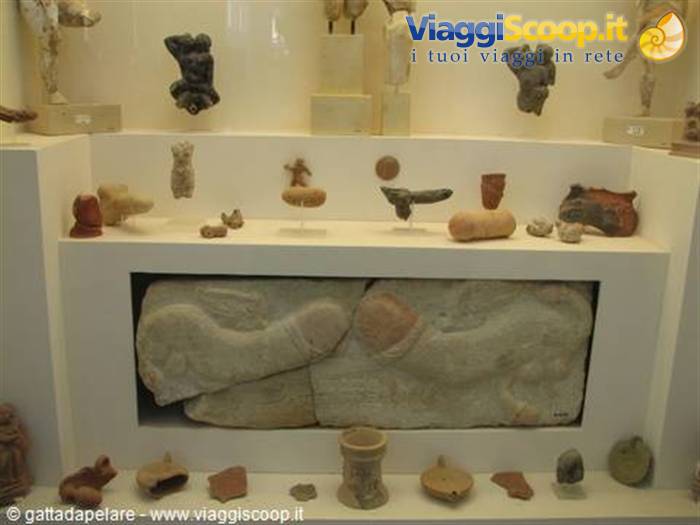
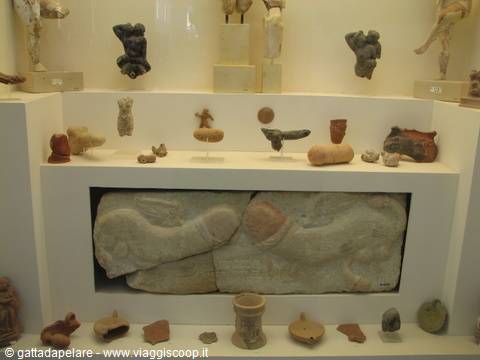
Museum display with stone relief and ancient pottery on lit shelves
Day 610 Oct 2006
10 October. Panormos -Gavrion (island of Andros). 28 miles
It thundered and lightninged all night. Every so often I would wake to 'feel' the weather and the light of the lightning coming through the portholes illuminated the interior of the boat, giving objects disturbing dimensions and appearances. But in this small inlet we had found a comforting refuge sheltered from the wind and waves, and this awareness helped me slip back into sleep. Now we are impatient to leave and go and shelter behind Andros. The wind is shifting and beginning to come from the north. We must leave the mooring as soon as possible before it becomes too violent. Last night, in the dark, we saw nothing. We take a look around: on the shore there is a small beach where a few goats graze silently. The modest church that served as our landmark last night is there a few meters from the sea and from us. Ahead, the open sea.
An Aegean sullen as the sky, a way of presenting itself different from the pagan sunniness of the other day at Delos. As soon as we are out of the bay, in fact, we set a bit of mainsail and face the already well-formed waves. We don't dare unfurl the genoa because lately it has given signs of unreliability when furling. Better, then, not to risk finding ourselves with the sail jammed at the rail during a maneuver in the wind. Gattadapelare steers well; she climbs with effort and plunges into the trough of the waves, raising great sprays of water. In a few minutes we find ourselves abeam of the channel between Tinos and Andros, where the wind enters with force. Below the coast of Andros the channel is more protected and we head there, resisting the temptation to run with the wind astern and go down immediately.
The decision proves right because shortly afterward we find a less choppy sea and the sailing becomes calm. Behind Andros, moreover, the sea is almost calm and only the angry gusts that occasionally come down from the mountains make it shudder for a few seconds, giving it the appearance of a dragon's scaly skin. We proceed a little off the coast to take the gusts less vertically; we have the mainsail reefed and a bit of motor and...the boat goes. But the bad weather presses us. By mid-morning it begins to rain and soon the rain becomes a deluge. Around us the sea boils and steams. Protected by our foul-weather gear (mine a providential gift from my 'historic' crew), we face the bad weather amused, excited by this unusual experience. The rain lasts a long time; when it stops we are already in sight of our anchorage.
Gavrio is a modest village set in a well-protected inlet that represents its fortune. Indeed, it is the main port of the island and ferries from Rafina, on the northern coast of Attica, and from the other islands dock here several times a day. We approach cautiously because the sea water is the color of earth and we can't tell whether this is due to shallow depth or something else. Then we realize that the recent cloudburst has poured a great quantity of mud and debris into the sea. The whole bay has changed color and branches and leaves carried by the rain float on the water. The pier we reach is deserted, except for a single sailboat whose owner we ask how much depth there is. He reassures us and asks us to help him moor his boat in a position better suited to the wind that has now begun to blow hard from land.
It is no longer raining, but the sky remains very cloudy and the wind is unpleasant. After the warm sun of the day before yesterday, autumn has now forcefully entered our days. We have news of destruction and casualties from today's cloudburst, which struck Euboea and the mainland above all. The acquaintance we made is called Aristotelis; he is married to an Italian woman, but speaks only Greek. His mother-in-law runs an Italian trattoria that he points out to us, not far from us. But we prefer to eat Greek-style and go looking for a welcoming taverna. The village doesn't smile on us; a double row of houses lines the road that runs along the pier, a few rough cafés, the shops essential for a small community, a gas pump and two or three unpretentious tavernas complete the settlement. You can see at once that it is not a holiday spot, but a simple arrival point.
After dinner we go looking for an internet café that they tell us is not far from the village, but the connections are down because of the storm and we can neither check the weather forecast nor the work news that Gino is waiting for. They say tomorrow will be stormy again with force eight seas. In port the wind churns the sea into small choppy waves and makes it boil around the boat. Lying in our bunks we fall asleep with the sensation of still being under way, but with the awareness of being safe and sound, tied as we are with two lines and two spring lines.
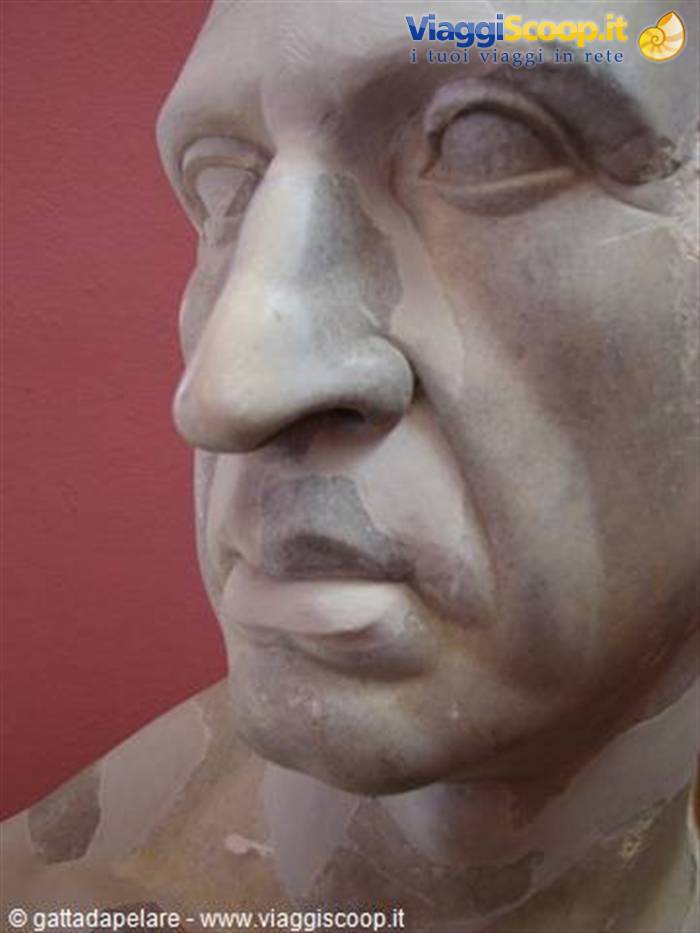
Marble face of ancient Roman statue against red background
Day 711 Oct 2006
11 October – Gavrio-
No question of going back to sea today. The weather is terrible, even though it isn't raining. The wind, very intense, continues to stir the water in the port. We rent a car and go off to explore the island. The road in many places runs high along the southern coast and shows us a seascape that every now and then lights up under the sun's rays when the clouds, galloping across the sky, tear open as they cross the mountains. The gusts of wind draw on the water shifting dark crescents, like halberd blades, that race toward the open sea, gradually losing vigor and finally dispersing into the blue. A sailboat, shrunk by distance, races along, heeled over, heading up the island, bound for Gavrio. Perhaps we too could have left this morning, but we were held back by the fear of what we would encounter in the channel between Andros and Euboea, one of the windiest spots in the Aegean.
We are headed for the island's eponymous capital, on the other side facing north. The distance is not great and the road, full of curves, passes through a few modest villages before seeing the sea again, which on this side is stormy. In fact, Andros town has no harbor, only a breakwater pier some distance from the built-up area and not very welcoming. The town, half-deserted in this season, offers only a few attractive features and vaguely reminds me of a smaller version of S. Teresa di Gallura. Here we have lunch before taking the return route, which, crossing the mountain, is shorter. An unfortunate choice because after a few kilometers we enter the clouds and visibility drops to a few meters. Moreover, the road is very narrow, barely enough for two cars side by side. On our right we sense, without seeing it, the precipice that will accompany us for almost the entire route.
I am forced to drive down the middle of the road to follow the white center line, the only reliable reference, and I am worried about meeting an oncoming car. Yesterday's cloudburst has dragged stones and earth onto the route. A fruit crate suddenly appears and warns us that a short distance ahead a good part of the road has collapsed downhill. Inwardly I thank whoever chose to warn others of the danger in this way. An act of civic responsibility that does credit to whoever did it. The narrowly avoided danger has raised the tension and none of us speaks anymore. When, finally, we think we have understood what the word eternity means, we emerge from the fog and with that we begin to breathe freely again. On arrival at the port we find two other boats. They make us feel a bit cowardly for not having wanted to face the sea today, but the experience in the mountains was no less exciting.
We chat for a bit with the new arrivals. Although the forecast calls for very bad weather for the next few days, they absolutely must reach Athens tomorrow to return the boat to the charter company. And us? We are undecided about what to do. If we leave tomorrow, 30 heavy miles await us between Andros and Euboea, after which, in the shelter of the island, we would find a relatively calm sea that would allow us to reach the boatyard at Skala Oropou the day after tomorrow, one day, that is, before the departure of our respective flights to Rome and Brussels. We'll sleep on it and then decide, but we know the alternative would be to set sail the day after tomorrow, in bad weather anyway, and take on 60 miles of heavy passage. 'Almost almost I'll wash my hair' sang Giorgio Gaber years ago on a day of apathetic waiting for livelier moments.
Forced by inactivity and while waiting to go to dinner, Maria and I improvise a heroic moment of personal hygiene. A wash of the head now and then can do you good. The sea around the Gatta boils again tonight under the push of the wind, but sleep comes quickly and smothers the fatigue accumulated in this day spent ashore.
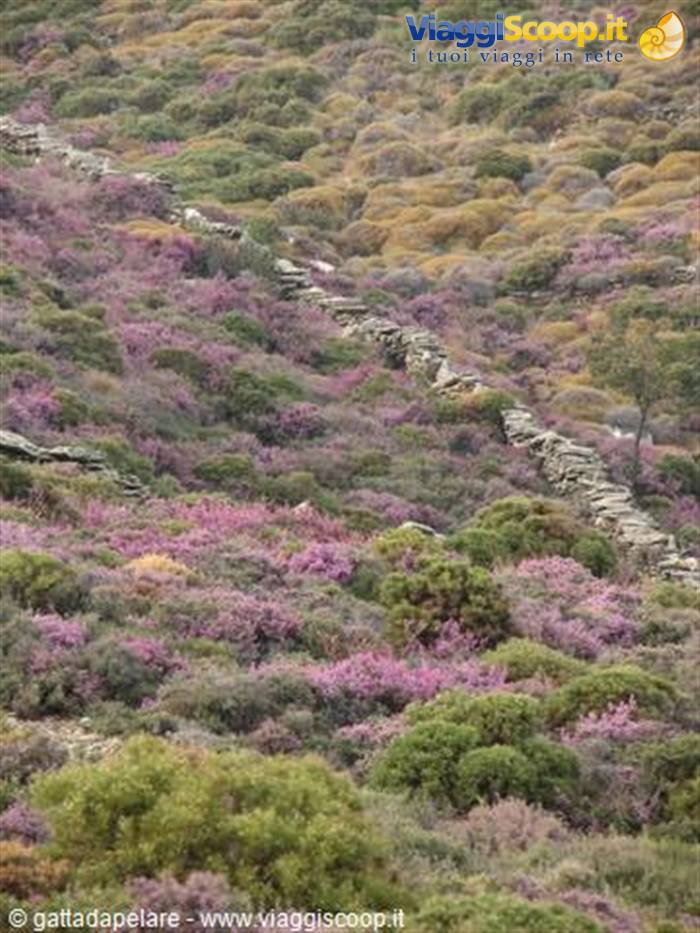
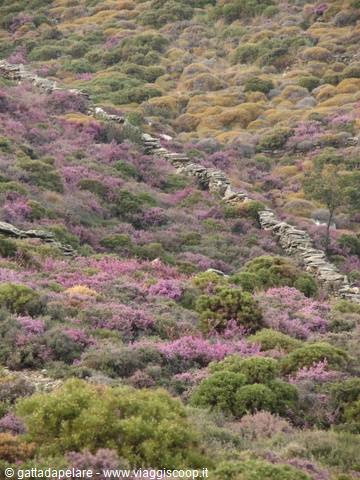
Dry stone wall winding through pink flowering bushes and green hills
Day 812 Oct 2006
12 October. Gavrio-Gavrio.
Despite everything, the others have left and this makes us feel a bit pusillanimous. What kind of sailors are we if we stay holed up in port with a force 7? And besides, the squall doesn't last long. Once past the strait we are sheltered. So, we leave. I study my friends' faces to detect traces of fear, but I see none, nor do I let mine show, and yet, I am convinced, unease is brooding beneath the mask of confidence we wear. The first three or four miles we cover in a choppy sea swept by a wind that tears water from the waves and drives it into our eyes. We sail close-hauled, almost a broad reach, with only the reefed mainsail and a bit of motor as insurance. It's not exactly for pure sailors, but we don't care. We just want to get past the channel between Andros and Euboea, which whitens, menacing, a little farther ahead.
The Gatta behaves excellently, demonstrating all her 'seafaring' ability for which Alpa models are famous. Boats like this aren't made anymore; high nautical performance has been sacrificed for capacity and comfort, thus producing the modern 'tin cans' in which the galley and the multiple bathrooms (calling them 'heads,' as is the correct nautical term, would seem offensive to them) attract the attention of 'charterers' more than the ability to handle the sea well. Our Gattadapelare, in port, is always, among the others, the smallest even at equal 'all-out' length, but to me she seems a sleek fox among clumsy bears. Perhaps my love for this old and neglected boat conditions my judgment, but what does it matter; the emotion she gives me is a reality that, though subjective, contains its truth for me.
As we approach the beam of the strait the sea becomes ever whiter with foam and Gattadapelare rises and falls, sure and impetuous, over the ever more imposing waves. Our gaze races ahead along the course we are following, hooked on the eastern tip of Euboea, where the sea seems less choppy. It's only a few more miles and soon we will be under cover. Then what we had not foreseen, but always feared, happens: a breakdown in the engine's cooling system that sends it into overheating. Smoke begins to come out of the hatch. After the first moment of panic we identify the cause, which lies in the impeller that has failed. And we don't have a spare! All we can do is shut off the engine and jibe to go back. The boat now takes the wind almost astern and with the little genoa unfurled she flies fast and without head seas toward the bay of Gavrio.
When, shortly afterward, we find ourselves abeam of it, we begin a series of tacks to work upwind, which now comes from land, and enter port. But with the little sail we have set and the strength of the wind we can't gain much ground, also because we don't have much room to maneuver; the tacks are necessarily frequent and on each one we lose speed. So the last hundred meters we do under motor, suffering along with it for fear of damage. Finally at the mooring. As usual, after securing the boat to the pier, that moment of satisfied relaxation sets in to ease the tension of the day. Anyone who doesn't love sailing will wonder what pleasure there is in suffering for hours, battling nature, only to enjoy afterward the safety offered by a protected anchorage.
Exactly! Nobody knows, but it's 'too strong.' A series of phone calls informs us that the right impeller for our Nanni-Kubota is only available in Athens and Gino would be willing to leave tomorrow to go and buy it. But time is short; the day after tomorrow is our return flight home, and it is too risky to try to reach the boatyard on the Attica coast in one day of sailing. It means covering about 60 miles in negative weather conditions with the possibility of not completing the transfer. So Gattadapelare will have to stay here in Gavrio until we have the chance to return. We turn to Aristotelis, then, to look after the boat and, above all, check the bilge water. At least once a week the bilge needs to be emptied. Aristotelis reassures us that he will take care of the boat, and, however little we know him, he nonetheless gives us the impression of being a reliable person.
October 13. Andros-Rafina - Transfer The 10 o'clock ferry pulls away from the pier and we say goodbye to our Gattadapelare, firmly secured to the quay with lines and spring lines and well protected with all the fenders we have. We don't know when we will be able to return; it will depend on work commitments and weather conditions, but in any case it will have to happen soon because, Aristotelis told us, even in port, in winter, under certain conditions, a heavy sea can rise. Gino insisted on taking the tender to Brussels, as it needs repairs. Outside there is a heavy sea and the ferry itself has to make a couple of tacks before reaching the shelter of the Euboean coast. The rest of the journey is a given: Rafina, bus, airport for information. I find a seat on today's flight and leave my friends, who will instead leave tomorrow.
This cruise was a different experience from the usual; but now that I think about it, every time I have the same sensation. It's another of the beautiful things about the boat: it never becomes routine.
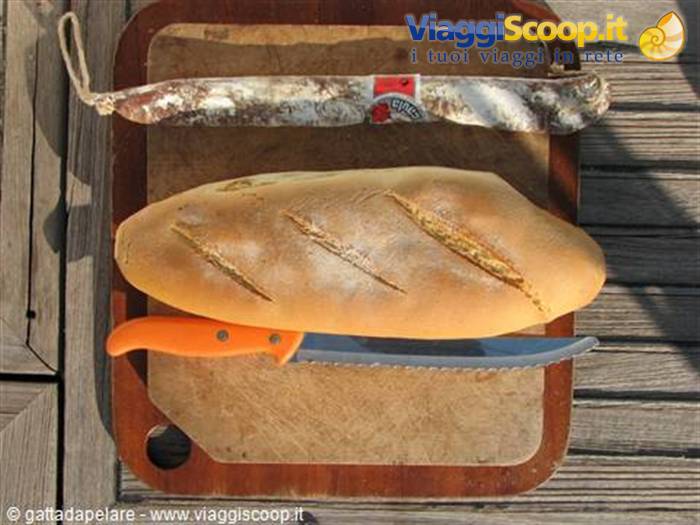
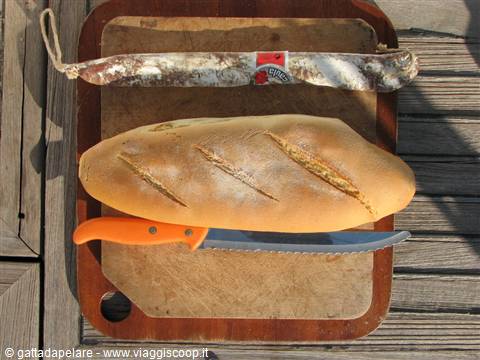
Fresh bread, salami and orange knife on wooden cutting board in sunlight
Day 917 Nov 2006
17 November. Rome-Gavrio
More than a month has passed since we left the boat moored at the pier in Gavrio under the care of our Greek friend. Today I am here, alone, waiting for Gino, who will arrive tomorrow on the 10 o'clock ferry from Rafina. With Gino we have waited all this time because the weather conditions, since we left, in October, have always been terrible. It even snowed, Aristotelis tells me. This time, according to the forecast website, we should have three days of acceptable weather. The boat is in order, tied up like a salami by Aristotelis, who didn't want to take any risks. The bilge is as dry as never before, the batteries are charged. In short, our friend took the task we entrusted to him very seriously. To repay him I invite him, along with his wife and his delightful little daughter, to dinner at the nicest taverna in the village.
We lay the groundwork for a business together in the Cyclades, and I like the idea. I think I know the reason for this pleasure; it is perhaps a way of making these places my own, including through work interests.
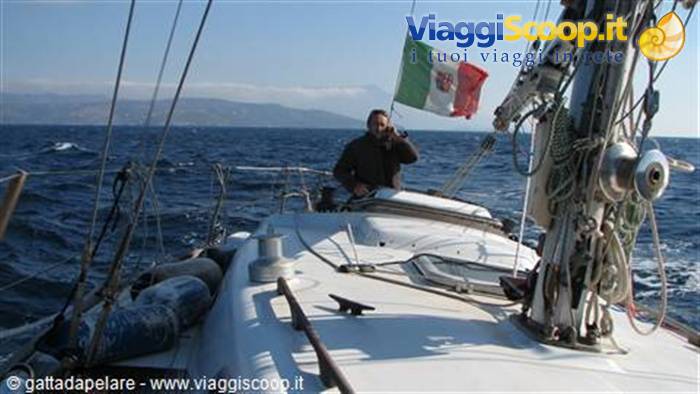
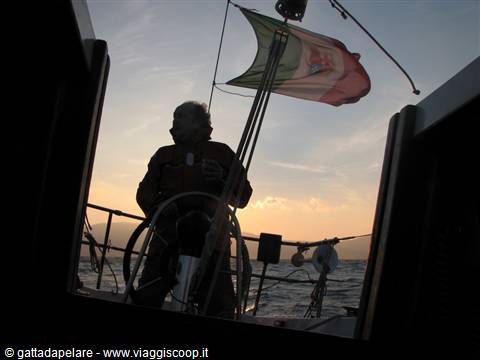
Man steering a sailboat flying the Italian flag, choppy sea, distant coast
Day 1018 Nov 2006
18 November. Gavrio-Marmari (island of Euboea) 28 miles
The boat is ready to set sail as soon as Gino arrives, loaded down with the tender (not repaired). The day presents itself with weather conditions suitable for crossing the strait and placing ourselves in the shelter of the Euboean coast. Tomorrow a worsening is forecast, but in the channel between Euboea and the Attica coast we don't expect difficulties. So, we leave. Last night I replaced the worn impeller with a new one bought in Fiumicino and the engine is once again efficient and reliable. We say goodbye to Aristotelis, who didn't want any compensation for the boat-watching he did, and head out to open water. It is a beautiful sunny day, the sea is slightly choppy and we enjoy this late-autumn passage with the pleasure of its exceptionality. We have left work and city existence behind for just a few hours.
Tomorrow evening we will be home again, but now we find ourselves here eating in the warmth and chatting like good friends about serious things and joking things. We have only the mainsail set, which catches the light wind and helps the engine give us a less noisy speed. Toward early afternoon, when the prematurely early autumn twilight is already announcing itself, we are in sight of our destination, the little harbor of Marmari. The wind is a bit stronger and heralds the change in weather forecast for tomorrow. At the pier there is no one, only us and two fishing boats. For the fifth time since Gattadapelare has been in Greece, we are asked to pay harbor dues. This is the highest tax requested so far, eight euros. What worries me is that these requests have become more frequent lately, which makes me think that this paradise for sailors is approaching purgatory.
We go to our bunks early; there is no attraction in the village in this season. The only person we spoke with was the portly officer of the Harbor Authority. I wake at an unspecified hour and hear the wind whistling faintly through the rigging. When I wake again the whistling is louder. I think about the day ahead of us; we have to cover 30 miles and by 4 p.m. we have to be at the airport, but first we have to find the boatyard where we will leave the boat. Gino swears that it exists and is located roughly a mile west of the town. So I spend the night imagining, in a doze, immobilized by the night in my bunk, stormy seas and boats adrift.
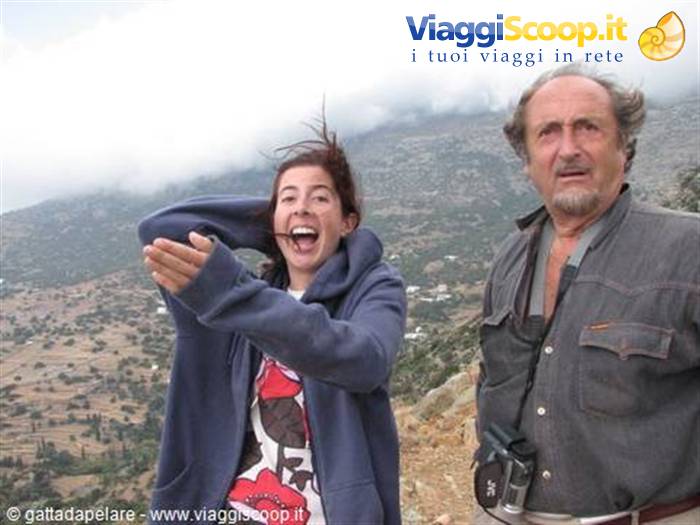
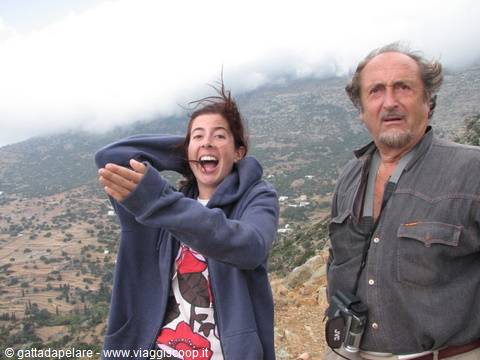
Woman laughing in the wind beside a man with a camera on rocky hills
Day 1119 Nov 2006
19 November. Marmari -Skala Oropou. 30 miles
We leave very early in the livid dawn and in a sea swept by short, malevolent, stinging waves. Although we are sheltered, the boat moves forward heeled over close-hauled. We coast along Euboea this way for about fifteen miles, facing a strong contrary current that makes us advance at three or four knots, under sail and motor. It seems incredible to me that in a few hours I will be in Rome and sleeping in my warm, welcoming bed, while now I have around me the unusual solitude of the sea. A pleasantly unpleasant sensation of adventure and ancestral fear of the unknown, heightened by the grayness of the sky and the awareness of the novelty of this off-season sailing. It seems to me that below the Attica coast the sea is less choppy and we head in that direction with the plain of Marathon ahead of us.
And indeed, contrary to expectations, as we move away from the supposed protection offered us by the island of Euboea, below the Attica coast the sea is almost calm; indeed, toward eleven o'clock the wind ceases entirely and we enter a patch of dead calm. I had imagined the Attica coast as flatter and much more inhabited, and instead it is mountainous, almost pristine, with few houses and some beaches and on the whole very pleasant. At noon we dock at the head of the pier of Skala Oropou. We have already packed our bags and tidied the boat for its winter rest. By taxi we reach the boatyard, make our arrangements and leave the keys of our beloved Gatta in the hands of this unknown 'boatyard man.' We leave the town with its pretentious waterfront and its atmosphere so different from 'our' Cyclades and reach Venizelos Airport. Tonight each of us will sleep in our own bed.
We will miss the cradling roll of the Aegean and tomorrow we will miss the Cyclades, bare and rocky, white and steep. Gattadapelare's next cruises are headed toward different anchorages, greener ones, the Sporades. But we feel that at the end of our wandering we will return 'home,' to Marathi, to Patmos, to Lipsi…. So, until next time!!!
Cyclades
Stones stripped of flesh by the sea, Bones of whales shipwrecked in the wind.
Salty skin of the face! Sweat of the sea!
Candid teeth
on clumps of stone smile at Phoebus.
Smile of azure. Smile of the Aegean.
From "Fragments of a Mirror"
Dedicated to my daughter Marzia, companion of adventures. March 1999
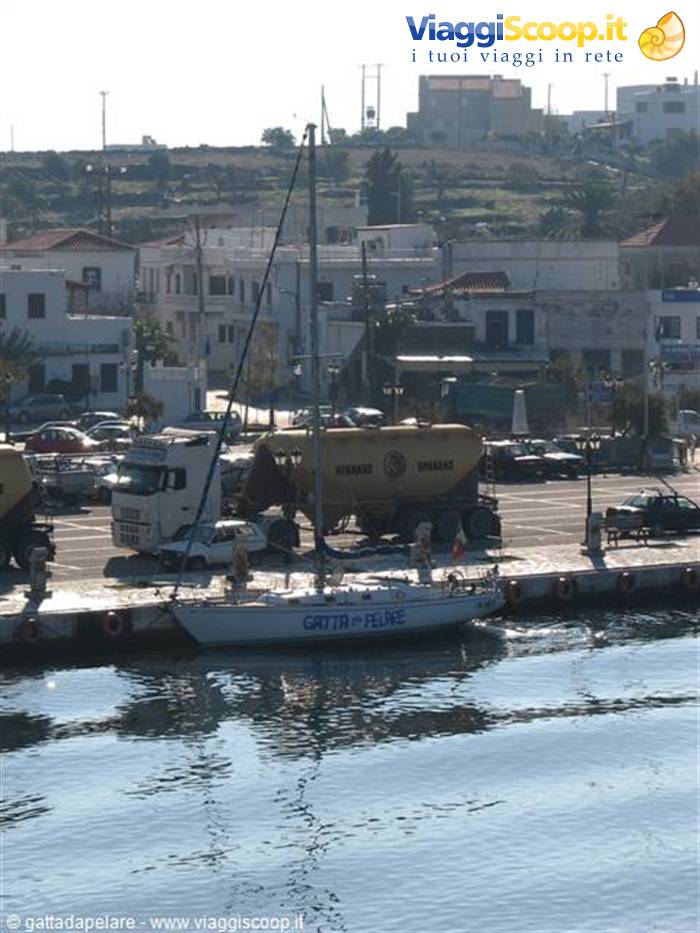
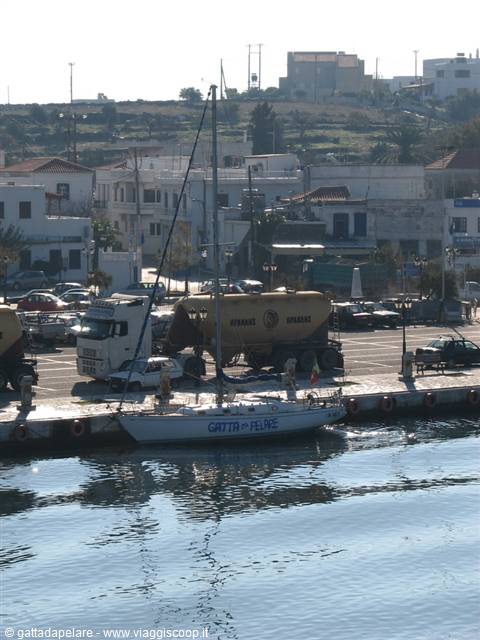
Sailing boat moored at the harbor, white houses and tanker trucks behind



0 reader comments