About a year has passed since I left Gattadapelare on its cradle in Patmos among the trees of Sozon's karnaio. Today the journey of approach to our boat and to the adventures of wind and sea into which it will drag us begins again. I arrive in Athens in the early afternoon, anyway too late to catch the 15:30 ferry to Patmos. I stay at the Hotel Attalos, in the city center, on the edge of the Plaka. In the evening, after eating at the foot of the Acropolis at the edge of the Agora, I go strolling through the alleys of the Plaka, climbing the Acropolis until I reach that focal point of our Western culture that is the Areopagus. I feel as if I have known this city forever.
May 14- Athens-Patmos
I spend the morning walking at the foot of the Acropolis and decide to go back to visit the Parthenon plateau and the museum. Unfortunately the restoration works have been going on for years and one cannot see the monuments free of scaffolding. Only the Erechtheion is finished. The delightful little temple of Athena Nike has been completely dismantled and the Propylaea are less imposing, hidden by the scaffolding. The city, seen from above, is a construction site. It seems impossible that everything will be ready for the next Olympics. I board for Patmos, which I reach at midnight. The owner of the modest but pleasant little hotel I already know, the Captain's, is waiting for me. The room assigned to me overlooks the harbor. The sea is a few meters away, I feel its light sigh as I slip into sleep.
May 15. Patmos. It is my birthday. A special birthday in the sun and greenery of this beautiful island. It is not difficult to be optimistic, thus surrounded by the blue of the Aegean which I dominate from the height of Chora in the tranquil atmosphere of Patmos. I begin the maintenance work and checking of the equipment. I see at once that I will have a lot to do and will only manage to complete the essential works to sail safely. Toward sunset I go a little to the shore to sit on the pebbles and lose myself in the sweet lapping of the waves.
May 16 - Patmos
The work continues. I have rented a scooter and in the afternoon I go to the beach of Agrolivari. There is almost no one, but the water is already warm and one can take the first pleasant swims. Along the road to the carnaio I met Giorgio. Giorgio is an old fisherman who speaks the Italian learned during his childhood, when the Dodecanese was part of the Empire. Every day, twice a day, he climbs from the marina to Chora leaning on an old twisted stick, and it is not clear which of the two is more gnarled. A character who is part of the landscape and of the steep road lined with blue bellflowers and yellow daisies.
May 17. Patmos. Moving by scooter in the warm air is restful and liberating. To go from the port of Skala to the boatyard one must climb dozens of hairpin bends. As one ascends toward the whitening houses of Chora, the island's coast unfolds into inlets, bays and islets that make this island one of the most beautiful in Greece. Once you reach the town of Chora, dominated by the austere bulk of the convent-fortress, you descend on the other side toward an equally suggestive and more solitary coast. The work on Gattadapelare continues. The roller furler is jammed, the water pump doesn't work, the anchor windlass doesn't turn, the batteries are dead. In short, the boat has been idle for a year and is sulking at me. She is offended and doesn't want to cooperate. When I can't take any more I go again to the shore to listen to the sea.
At the hotel, sitting on the balcony, I drink my ouzo and watch the arrival and departure of the ferries. The arrival of a ship always brings with it a feeling of joyful anticipation, while departure is pervaded by the melancholy of abandonment.
May 18. Patmos
I work on the boat all day. This evening the usual "girls" arrive, Elke and Gerlinde. I would like to be ready for launch tomorrow, right after Gino's arrival. Today Patmos experiences a day of international glory: the semester presided over by Greece has ended and a large ship has brought here the representatives of the European Parliament with wives and children. A modest taverna has been entrusted with organizing a lunch and has set up on the pier about eighty tables for the VIPs. They are simply laid with white and red checkered tablecloths, but their very modesty enhances the importance of the event. At midnight, finally, the "girls" arrive.
May 19. Patmos. Today Gino also arrives. While waiting I accompany the ladies to the beach of Agrolivari. Since we have only one scooter I am forced to shuttle between the town and the marina. Hard work! At 15:30 the co-skipper Gino, known as Rockman, comes ashore. After a year of absence we are all happy to be together again, ready for some good sailing. Gino's arrival marks the moment of the launch. By taxi we take the luggage to Sozon's carnaio and have Gattadapelare put into the water. We have problems with the electrical contacts on the engine, but in the end we head for Skala where Elke and Gerlinde are waiting for us. But by now it is too late to set sail for Marathi and we stay to sleep at Patmos. The ladies at the Captain's and we on the boat.
May 20. Patmos-Marathi. 6 miles
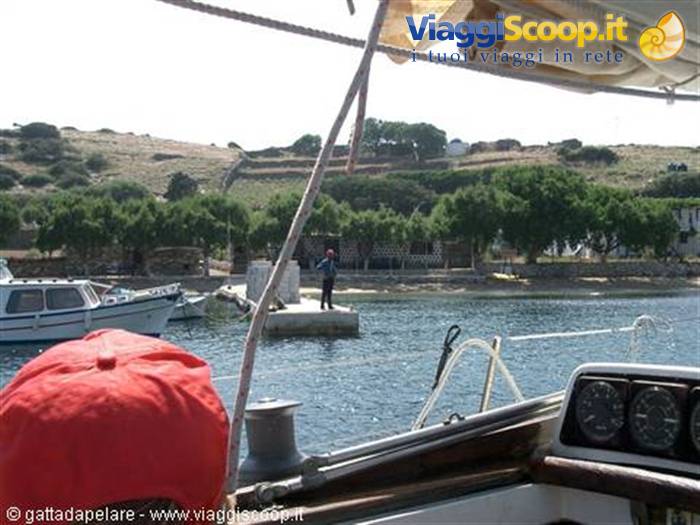
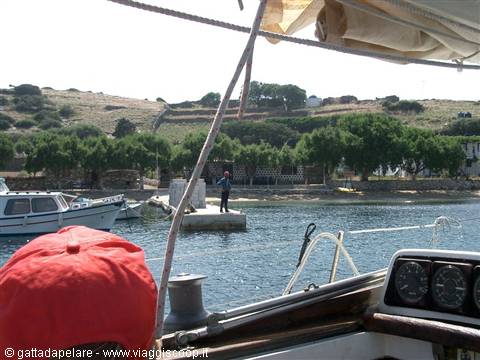
For one reason or another we manage to cast off the moorings in the late morning. We are headed for Marathi. In reality it is an islet that is part of the small archipelago of Arki, which for us has become the symbol of the reconquest of the naturalness and simplicity of life to which we aspire in the course of our city existence. The rhythms of the day are not marked by the hours, but by the bleating of the goats and the crowing of the roosters. Time slips over our skin without bringing anxiety with it. Hurry gives way to a sweet laziness and one can savor the luxury of being a little bored. We round the islet that closes to the south the strait between Arki and Marathi and sound the horn to let Michalis know we have returned. He recognizes us immediately from afar and invites us to dock directly at the little pier in front of his taverna. An honor reserved only for friends.
Greetings and hugs follow and abundant ouzo poured from a capacious demijohn. In the roadstead there are a couple of boats, but the crews do not come ashore. One of them, a beautiful sloop (we estimate it to be 80 feet long) painted dark blue, belongs to the producer of the Greek brandy Metaxa. We have Michalis serve us a little glass, just so we can say that a small part of that boat is ours too. We dine on lobster and wine and attempt a few steps of sirtaki under the reed canopy that shelters us from the evening chill. No other crew has come ashore. We are alone, we of Gattadapelare, Michelis the pirate-tavern keeper, his sister the cook and his brother. The island is all ours. Then the "girls" go to sleep in Michalis's inn and Gino and I on the boat. Finally we enjoy the soporific rocking of the sea beneath the hull.
While we listen to the late crowing of an insomniac rooster we fall asleep serene.
Arrival at Marathi
Day 221 May 2003
May 21. Marathi We take the day leisurely. Since we have been on the boat the quality of our life has truly improved. We have breakfast with free-range hen eggs fried in the pan and later we set off for the "blue lagoon," the inlet on the southwest side of Arki. The name is well deserved. The water here is extraordinarily transparent and the sandy bottom reflects the color of the sky. There is only one boat, with a German flag, but we have been accustomed in past years to not being the only visitors and a single boat seems to us a flotilla. Certainly for its occupants the feeling is the same because they address us annoyed, complaining that we have anchored too close to them. But it is not true and, in any case, we ignore them because we do not appreciate the display of intolerance.
In the late afternoon we sail toward the main bay of the island, at the bottom of which rise the few houses of the "capital" Arki. Compared with Marathi opposite, it appears to us like a metropolis. Without stopping we reverse course and head west toward the welcome of Michalis and his taverna. We dance the sirtaki and drink ouzo.
May 22. Marathi-Lipsi 5 miles. We set off with a good close-hauled wind heading for Lipsi. Gattadapelare glides gently over a calm sea sheltered by the small archipelago of this island ignored by mass tourism. Lipsi is the island of the nymph Calypso, the one who fell in love with Ulysses and kept him with her for seven years. One might think that Ulysses stayed quite willingly because, apart from the fact that the nymphs were not ugly and Calypso especially must have been a fine piece of a nymph, the island appears from the sea very beautiful and inviting. We round the eastern tip and soon the bay opens before us, overlooking the small town of the same name. There is a long pier with plenty of room to dock Mediterranean-style. We choose the side that seems most appropriate to us, taking into account what might be the direction of the wind when tomorrow we decide to leave.
If it should shift to meltemi it would push us against the pier and create difficulties for us in casting off. A bet with ourselves and our qualification as "sea wolves." Behind us, naturally moored Mediterranean-style, there is an impeccable English boat. But so impeccable that Gattadapelare by comparison looks like an old sea cart. It seems so. But with a surge of pride, following an instant of self-doubt, we go back to reappraising her: "a much-sailed boat" in the hands of "true" sailors. A Scandinavian sailboat also arrives and tosses a line to Gino, who has run over to help it dock, as is courteously done from the pier. Gino ties it making a perfect (he says) bowline, but he does not pass the skipper's severe scrutiny. As soon as he is ashore, the man undoes and remakes the knot. He seems also to have shaken his head and muttered something to himself.
Gino's self-esteem, already shaken by the nickname by which he is known in the Aegean (Rocksman!), is at very low levels. To console him Gerlinde invites us to dinner at a taverna where they serve us a red snapper and a sea bream of grandiose dimensions. Thank you Gerlinde. And you didn't even turn pale when they presented you with the bill!
May 23. Lipsi-Patmos. 6 miles. The night passed calmly and we won the bet. The wind did not shift. We take a walk around the town, small and pretty, with a large church and some pleasant little squares. In this season there is no tourism, but in summer a few hundred guests arrive, including several Italians. Some have bought or built houses. On the whole the place is still immune from real estate speculation, but who knows for how much longer. We do some shopping and in the late morning we set off for Patmos. This evening the ladies, pardon, the "girls" (Gino insists on flattering them that way) will board for Athens. The wind is weak but favorable and after a while we heave to and have lunch. We are not in a hurry. When in the afternoon we dock at Skala it begins to rain. A light, chilly rain. The weather does not promise to be beautiful tomorrow.
Too bad, we would like to go to Levitha. We have dinner at the usual trattoria where they cook a good spit-roasted lamb. At one o'clock the ferry to Piraeus arrives, and quickly departs. Gino and I remain alone to say goodbye to the other half of the crew, which is heading back.
Lipsi
Day 324 May 2003
May 24. Patmos-Levitha. 20 miles. We wake to a cloudy sky, but with little wind. Stavros, our fisherman friend, is happy to meet us again. We left for him, at Marathi, a bottle of nebbiolo that Marzia and I had promised him two years ago. He assures us that today there will be bonaccia. He says exactly bonaccia, in Italian. Who knows, perhaps it is an international term, like those used in music. We set off and head for this solitary island where we know we will find a safe anchorage in any case. We will probably meet the three brothers who own the only house, and at the same time, taverna on the island. For Gino this island is unknown. For me it is already tied to the memories of the other two times I was there with Marzia. Once we were stranded there by bad weather and explored it until we reached the remains of an acropolis that dominates the access to the fjord.
Toward sunset we round the small promontory that closes the entrance to this narrow inlet to the southwest. It is well protected, except from the west, but from that side strong winds rarely come. The island has no very high elevations and the meltemi can blow even vigorously inside this arm of the sea, without however raising waves. Today, in any case, the wind does not come from the north. The whole day has been characterized by storm clouds that we watched with suspicion, but which always stayed on the horizon. Wind, weak, from the west. On arrival we are greeted by the eldest of the brothers, Stavros (he too is named that!), who approaches Gattadapelare to help us moor to the mooring buoys they have placed this year. We do the whole maneuver under sail, refusing the offer of help, not out of pride, but only to test our skill.
The mooring is now paid and this innovation annoys me for its content of modernism in a place that I have always considered outside the consumerist schemes of our life. There are four other boats in the roadstead. They stay far from one another and aloof, almost annoyed by the chance gathering on this strip of land forgotten in the Greek sea. Night falls. The darkness takes possession of the place with the confidence of one who is aware of having no obstacles. No lights, apart from the faint anchor lights of the boats, which blend with the stars.
How many stars! Who imagines anymore how many stars there are in the sky. We are not accustomed, we inhabitants of the cities of this planet, to such purity of sky. They embarrass us with their testimony of the immensely large in opposition to our infinitesimally small. We recognize a few constellations and point them out to each other, pointing a finger in their direction. We walk one behind the other along the vague path that leads to the house-taverna of the three brothers, swinging the flashlight back and forth to illuminate both our steps. In the instant of light we choose the stone on which we will place our foot. We are focused on moving forward, but we sense the smallness of the island and its distance from what we are used to calling civilization.
We proceed in silence in the silence of this special night and in the dry scents of the Mediterranean plants that are the same ones breathed by the ancient peoples of the sea, by the Aegeans, the Ionians and the Dorians, by the Romans, the Venetians, the Turks and by how many others found refuge for a night in the tranquil inlet of this almost unknown island. Finally we arrive at the building. We have been preceded by a German crew not very inclined to socialize, which, however, shortly afterward leaves us alone under the leafy canopy waiting for dinner. We listen to the few noises coming from the house, from which no one comes out. A few phrases exchanged with our host as he prepares dinner alleviate the sensation of solitude we feel outside the dimly lit area in which we eat. The return to the boat takes place in the dark.
The flashlight has run out and we descend cautiously toward the shore. Now that we are without aid, without a light, our eyes adapt to perceiving the outlines of things by the light of the starry sky. Our feet too have become more agile and the descent becomes safer as we go. As we push the dinghy into the sea, an explosion of sparks lights up the water we stir. They are millions of tiny marine creatures, noctilucae, the makers of this spectacle. We throw handfuls of sand into the air, also phosphorescent, which falling back into the sea gives us the fleeting vision of another starry sky placed at our feet. Like amazed children we repeat the gesture over and over until we get used to the game. We sleep peacefully in the welcoming belly of our boat, which brings us back to the less unsettling dimensions of our human smallness, closing us off from the vastness of the universe.
Arki-The blue lagoon
Day 425 May 2003
May 25. Levita-Amorgos (Katapola). 34 miles. The weak wind, still from the west, carries wispy clouds that over the hours give way to broad patches of blue. We set off at leisure after the other boats, which have scattered in different directions. Such are the fleeting encounters at sea. In the evening the sailboats gather in the bays, anchorages, and ports. They come from other bays, other anchorages and ports, following converging courses. The occupants exchange a few gestures of greeting as they pass alongside those already anchored. Later, at the inevitable taverna, people meet and become a little acquainted; they exchange some information about routes and the islands visited, and then take their leave to return to the boat to sleep. The next morning the gestures are repeated with a few more smiles because of the acquaintance made, and each resumes his course, without ties.
Free, each, to venture into his own blue. The sails move away from one another until one is again alone for hours or days. And this solitude that only great spaces can give, whether of water, or sand or rocks, is the reason why one sets out. It is a true and precious solitude that we long for in the frenzy of everyday life, but deep in the soul, in spite of everything, it makes us vaguely uneasy. That is why every encounter is welcome and greeted, all the more so if it is fleeting. We sail under sail and motor because the wind remains weak all day. Leaving the island of Kinos to our right, the outline of Amorgos already appears. The northeast coast of the island is high and welcomes deep inlets into which we enter to enjoy their solitary beauty. The deep water is loaded with blue. Not a house, but only the distant tinkling of goats wandering on the slope.
Centuries of vain labor of arms have tried to clear the arid and steep fields of stones, lining up countless stones along the boundaries. There is nothing that can better bear witness to the poverty of the life of those peasants than this immense network of boundaries enclosing the wretched and toilsome land that today no one loves or works anymore. Behind a promontory, finally, the bay appears, at the bottom of which is the landing place, Katapola. The little town does not have a real harbor since the very conformation of the inlet is enough to protect the boats that dock at the quay stretching along the houses and shops and tavernas. There are about ten sloops. Amorgos is not frequented by many tourists, no scheduled ships come here, it does not have much to offer those who seek there what they are used to having at home.
A few shops with essentials, no souvenirs, no entertainment venues. Only some tavernas, a cafe, a few modest guesthouses. The place is genuine, with its little squares shaded by a few trees, the simple little tables, the painted chairs waiting for customers. Before dinner we stroll through solitary alleys in search of suggestive corners. The chalky white of the houses serves as a backdrop to the bright colors of the doors and windows. The Greeks have a deep sense of color and manage to give modest objects the gift of simple and pure beauty. A vase, a chair vividly painted blue in front of a lime-washed wall transcend their physical consistency to sublimate to the level of a work of art. The Greek flag has stolen from the colors of this land and this sea the white and the blue to make them its own colors.
Watching it wave in the wind, we see in it the Cyclades and the Aegean, the sea whitened with foam, the cross of its small churches scattered everywhere. Gino and I have dinner in a modest taverna on the pier along with other crews, making plans for tomorrow. We will go by scooter to the other shore
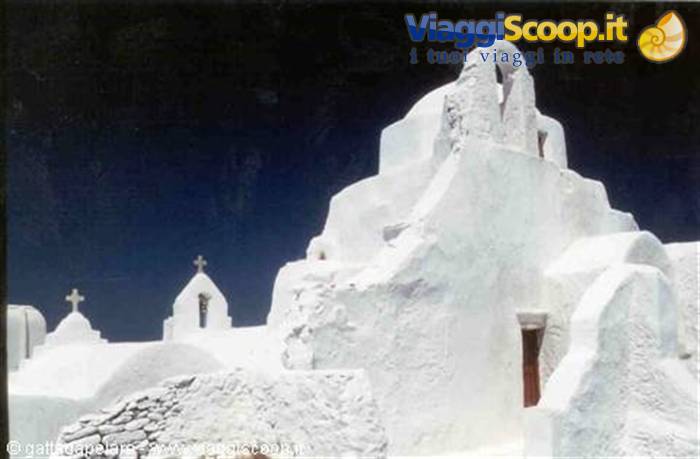
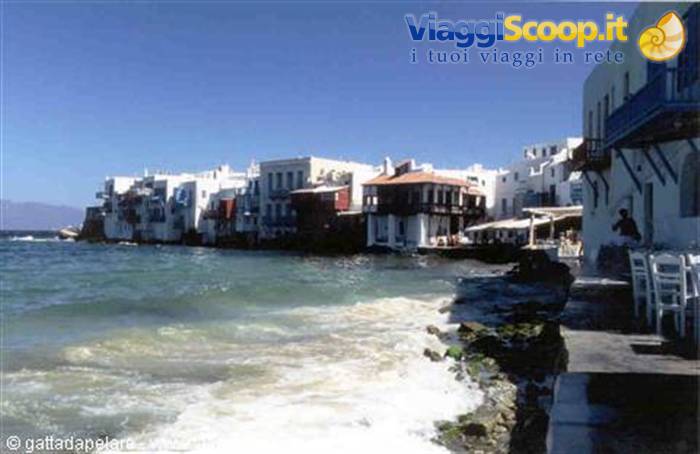
The little church of Mykonos
Day 526 May 2003
May 26. Amorgos (Katapola) - Antikaros. 10 miles We rent scooters, modern donkeys, which are the most widespread and inexpensive means of transport among these islands. We climb up the north coast until we reach the small village of Chora that huddles around the ancient acropolis. Nothing remains of the temple that dominated it. its place has been taken by a modest church. Here too the usual sight of alleys, white houses, agora, bright colors of modest objects is repeated. On the main little square of the village, also shaded by a couple of modest trees, faces a place of a few square meters that today serves as a courthouse. The place is too small to contain everyone and some of those convened wait outside the door, sitting on a low wall, waiting to be called by the judge.
Among all stands out the figure of the lawyer, well dressed in jacket and tie, with a bundle of papers in his hand, very absorbed in his role. We don't know what it is about, but the tone of the questions and answers and the attitude of those present follow a common pattern everywhere.. Continuing uphill one reaches the watershed ridge and before us opens the superb scenario of the southern coast of the island. The day, begun with veiled sky is now clear. The gaze ranges freely to the ashen outline of the island of Santorini. On our left, crushed against the sheer wall of the mountain, the monastery Hosoviotissa. stands out white on the red of the rock. The common question of all those who see this original construction for the first time is what force keeps it glued to the wall. It looks like a gigantic white limpet tenaciously attached to the rock at the moment of the ebb of the wave.
I know the story of the foundation. An icon of the Madonna, escaped from the iconoclastic fury of the 8th century flew here and settled like a butterfly on the wall of the mountain. A shepherd, present by chance, had the readiness to nail it to the rock. Around it the monastery arose little by little. Icon, nail and hammer are jealously guarded in an inner chapel. This is the second time I have come here and this time too an attendant offers us some sweets and a mild liqueur made by the monks. We hurry back to the boat because at noon we want to set sail to reach the island of Antikaros. A bit of shopping for the galley and off we go! we depart, happy to let ourselves be pushed again by the wind. Those who go by sea live the state of mind described in a well-known song of the 70s: they can't wait to land, but as soon as they arrive they already want to set off again.
West of the island of Antikaros, a few dozen meters away, so as to form a narrow channel with shallow bottom, there is an islet with a modest uncontaminated beach. It is there that we go with the tender after anchoring Gattadapelare in the center of the channel. The crossing from Amorgos was calm, with weak wind on the beam. The first encounter with this island, inhabited today only by a fisherman, occurred three years ago when Marzia and I arrived there in search of a misanthropic Frenchman who had built a house there. We found the house and the traces of an existence that disappeared years ago. The house is still there, a little more aged and abandoned. A melancholy sight in the fading light of the late afternoon.
While, lying on the sand, I immerse myself in the beneficial sensation of having the Aegean all to myself, Gino reaches the house beyond the channel to gather, he too, the atmosphere of twilight romanticism emanating from it.. In the channel the play of tide and wind can be conflicting and the swinging of the boat gives us some worry. We decide, before going to the bunk, to put out a second anchor in a fork pattern to guarantee ourselves a calmer sleep. Nevertheless I wake up a couple of times to check the distance from the rocky shores and, as always, I have the sensation that they are much closer than they appear during the day.
Mykonos
Day 627 May 2003
May 27- Antikaros-Mykonos 49 miles. We leave Antikaros with the usual weather conditions. Cloudy morning and weak wind from the southwest. Then the clouds thin out and the sun accompanies us for the rest of the day. We prefer to lengthen the route a little by rounding the island clockwise rather than passing through the channel whose bottom is not guaranteed. We have to reach Mykon
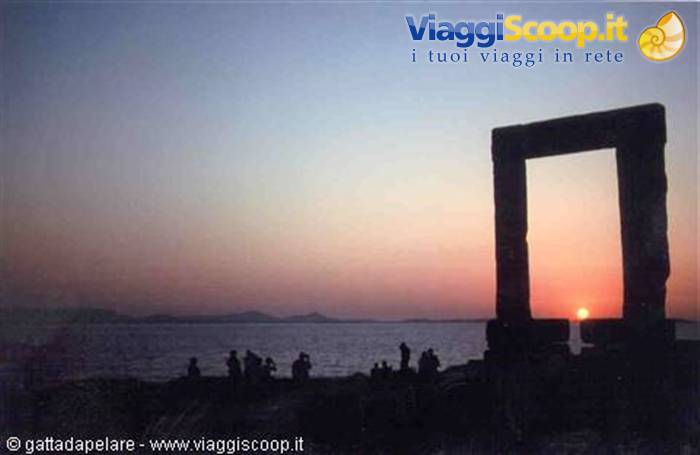
Naxos- Temple of Dionysus
Day 728 May 2003
May 29. Mykonos-Paros. 20 miles. It's raining again today, lightly. The wind has remained steady and the sea looks rough. Either we stay here to wait for the other crew members, Marzia and Alfredo, coming from Rome, or we move to Naussa on the island of Paros. We decide by majority. Two against my no. I'm afraid that, once the wind drops, we won't be able to get back to Mykonos for the day after tomorrow to welcome Marzia and Alfredo. We set off with the wind on the beam and rough sea heading for Delos. We want to gain some water, before heading for Paros, thus avoiding taking the wind right on the stern. We're sailing well, but once we've settled onto our final course we're subjected to an unpleasant pitching caused by big waves on the quarter. Titti is asleep below deck. The bay, at the bottom of which the little village of Naussa lies, is soon reached.
We don't even try to look for a spot in the little harbour, which we know has little capacity, and we immediately head downwind to the north-west side of the inlet protected by high hills. Here the sea is calm, but powerful gusts come down from above that advise us to back up the main anchor by adding a second anchor. Now we're at ease and we go ashore with the tender.
May 30 - Naussa We wake up with the sun and with a nice meltemi blowing from the hill behind which we're sheltered. At anchor, along with us, there are five other boats, one of which flies the Italian flag. We have to find a ride in a car to get to the village and rent some scooters. A farmer gives us a lift in his van and along the way he tells Gino, (who claims to understand at least thirty percent of Greek) how Greek cuisine is superior to that of other countries used to eating steaks with jam. I think of our penne all'arrabbiata and our abbacchio scottadito, which the courteous helot has never tasted. With the scooters we go to Parika, the capital of Paros and main port, to book Titti's ferry passage to Mikonos. As expected, the headwind will prevent us from going back tomorrow.
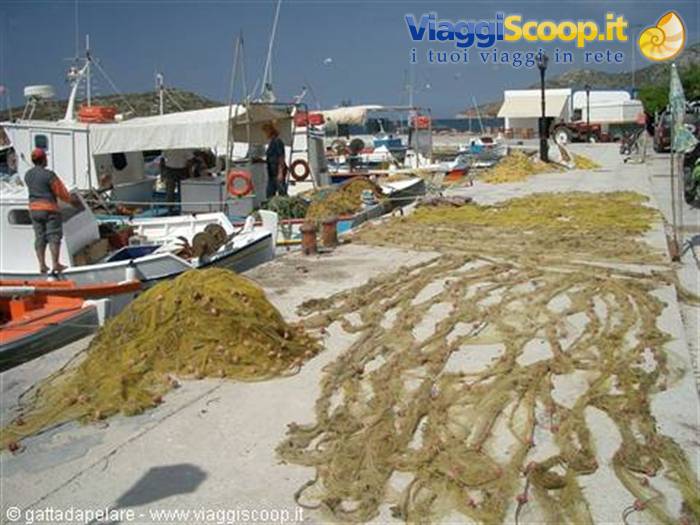
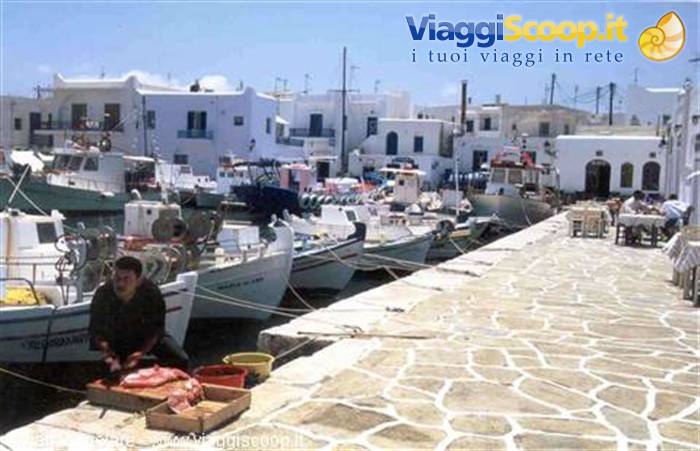
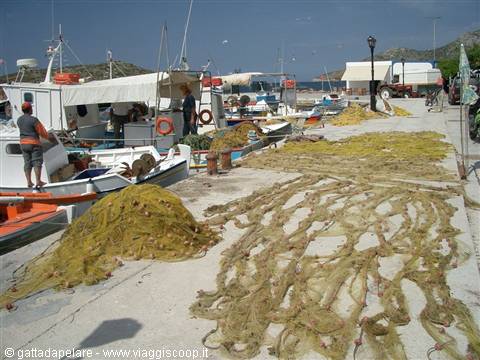
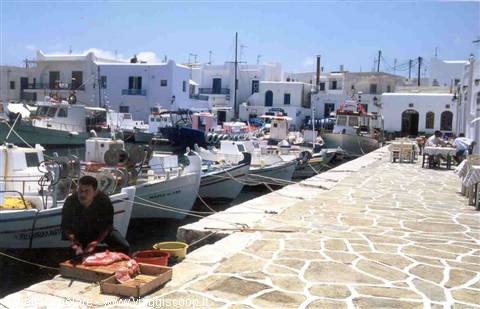
We spend the afternoon at the beach in Monastiri (this is the name of the place in front of which Gattadapelare is at anchor). At Monastiri, besides a modest church-convent, there's a small, pleasant beach club, a bit bar and a bit restaurant. At this season it's not very busy and lying relaxed on the beach is much appreciated by the three of us. In the evening we go to the village. Naussa is a delightful village that lives around its little harbour. Overlooking it are numerous tavernas and restaurants where the mingling with the fishermen, who calmly do their little maintenance jobs on their boats, inspires in us serenity and benevolence toward humanity. Even though it's not crowded, there are nevertheless several tourists. We eat in a little square a few metres from the pier and head back along the coast to Monastiri.
It's cold and we can't wait to stretch out on our bunks under the blankets. The night is very windy.
May 31. Naussa. Today Marzia and Alfredo arrive in Mykonos. At 11 o'clock Titti leaves us to reach the port of Parika by bus, from where she'll board the ferry to meet Alfredo. Gino and I stay, lazily, at Monastiri. We have nothing to do but watch with binoculars the nudists clinging to the rocks while we lie in the sun on the little beach that closes the inlet to the west. At 11 pm we go by scooter to pick up Marzia in Parioka and then to dinner in Naussa. On a scooter in the evening it's cold and we protect ourselves with the old, but excellent, system of newspaper under the shirt in front of the chest. The road from the village to Monastiri runs along the sea, crossing pockets of warmer or colder air depending on whether the influence of the body of water or of the countryside prevails.
Even the smells change continuously: from that released by the rocky shore exposed at low tide to the scents of Mediterranean herbs already forgetful of the winter rains. The trip takes about twenty minutes, during which swarms of winged creatures hit our faces. Before reaching the bar-beach club you come across a modest boat storage yard that ultimately could host Gattadapelare. We've left the tender at the shore and with it we head toward our boat, whose shadow can be glimpsed in the darkness of the night
Naxos
Day 81 Jun 2003
June 1st. Naussa. Today Gino leaves us for a few days. Work commitments already scheduled call him back to Brussels. I accompany him by scooter to Parika and at 10:30 his ferry pulls away from the pier heading for Piraeus. See you in a week with Maria for more sea adventures with a new crew! Of Titti and Alfredo, who stayed in Mykonos, we know little. They should join us, but we're all too lazy to take any initiative. Even we, Marzia and I, don't feel the urge to set sail. Outside the sea is still rough and, we're ashamed to say it, we don't feel like tiring ourselves out with the maneuvers. So we rent deck chairs and an umbrella and lie in the sun, reading and dozing. Thus the day passes in the luxury of sweet idleness. In the late afternoon we go into town to take photos, have an aperitif and dine at the usual pleasant tavern on the little harbor.
Then we stroll a bit, chilled, through the alleys of Naussa. Sweet music comes out of a tiny shop. We make the acquaintance of the shopkeeper, who gladly tells us about the singer and recommends some CDs. Tomorrow she'll give us a list. We go back to the boat to sleep, suffering the cold along the way.
June 2nd. Naussa. Still in the mood for doing nothing. Beach, deck chair, swims, naps. This day too passes in healthy laziness. What luxury to be able to be a little bored!
June 3rd. Paros (Naussa) - Sifnos. 26 miles Today is a beautiful day with little wind. Not exactly ideal for sailing, but certainly less tiring than facing the gusts of the past few days. We're thinking of going to Sifnos, which is 26 miles from us, to the southwest. Then, wind permitting, we'd work our way back up to Mykonos to meet old and new boat companions. So off we go, Marzia and I, in the late morning, under motor. Coasting along the western coast of Paros we leave on our left the islet in front of Parika, the scene of a deadly shipwreck three years ago. A scheduled ferry, coming from Piraeus, crashed into it due to the crew's carelessness. There were several deaths and the event caused a stir because the cause of the carelessness was the TV broadcast of an important soccer match.
Of the island of Sifnos we know nothing, except the fact that it isn't a destination for mass tourism. For this reason we like it. We decide at random where to land. On the chart we choose the village of Pharos because it's protected by a deep inlet open to the west, therefore sheltered from the meltemi. In the late afternoon we drop anchor in front of the village. We've made a good choice. The town consists of about twenty houses, a couple of tavernas, a café and a beautiful lonely beach. At anchor there are two other boats. At dinner we count ourselves, we tourists who shun tourist crowds; there are eight of us gathered in the only "panoramic" trattoria, but infested by thousands of tiny flying beetles that swirl around the lamps and, swirling, end up in our plates.
With a feeling of compassion for the restaurateurs, who find themselves cheated of their only earnings, we abandon the place to go further on to the other taverna, which seems immune from the infestation. They tell us that tomorrow evening there will be the feast of the patron saint of Sifnos, with the arrival, by sea, at a small convent on the promontory that closes the bay to the southwest, of a sacred icon of the Madonna. An important festivity commemorating the miracle of the island's rescue from a locust infestation. In short, we must think that this island has always had serious entomological problems.
June 4th. Sifnos. Today we went exploring the island. By public bus we covered about forty kilometers of curves, touching all the inhabited centers of Sifnos. The most important is Apollonia, a large, white town that we didn't find at all attractive, however. Interesting instead is the panorama of this island, characterized by endless terraces, but today scarcely cultivated. On the threshing floors you can see the circular areas on which grain was threshed with the ancient system of trampling by pack animals. We've already had occasion to see this peasant custom still in use elsewhere, just as Virgil would have described it in the Georgics. The Venetians introduced dovecotes there, and not only on Sifnos, structures 6-8 meters tall provided with numerous triangular openings to house pigeon nests.
There are a great many of them, some of which were later acquired for original residential uses. We also make a few modest purchases of terracottas, a typical product of this island since very ancient times. We return in the early afternoon to Pharos to prepare for the feast of the patron saint. There's already excitement. Groups of the faithful set off along the coast up a path that in three or four kilometers will lead them to the monastery. We go by sea with our tender and land on the rocky shore at the foot of the church. There's also a small pier where the religious and civil authorities are waiting. Four bearded priests, standing on the steps leading to the pier, in a line according to the importance of their office. They're decked out in the customary vestments.
The mayor, with his family, some naval officers and a couple of gendarmes precede them in the ceremonial arrangement, but are placed lower down. In the stretch of sea in front, boats and small boats cross back and forth. The wait lasts half an hour until, from behind the promontory on which the church is built, a large ferry bursts forth with sirens blaring. It's immediately clear that the ferry is too big to come alongside, and indeed a barge, of the kind used for tourist excursions, approaches the stern where the pontoon has been lowered and where the committee accompanying the sacred icon is waiting. Because of the crosswind the maneuver is repeated several times while from the boats and the ferry rockets, firecrackers and colored smoke are set off to underline the festiveness of the event. Finally, the icon is brought aboard and transported to the pier, welcomed by the marching band.
There are many people, come from the neighboring islands too, and it's difficult to reach the small square of the church where, meanwhile, the four priests intone litanies around the icon. The psalmody is, to our ears, ungraceful, very far from the harmony of Gregorian chant, and lasts for hours and hours. Once the curiosity of the spirit is satisfied, we see on a beach not far away some tavernas that are certainly capable of satisfying the body too. We strike up a friendship with Heidi and Heinz, two German tourists with whom we had already exchanged courteous greetings the evening before, and together we eat at the same table, comparing our mutual impressions of the place and the people. We return by oars, having run out of fuel for the outboard.
But it's a fine row, in the calm sea, under the vault of the sky, while the psalm-singing voices of the priests fade into the darkness of the night. Gattadapelare awaits us for a peaceful rest.
Paros-Naussa
Day 95 Jun 2003
June 5th Sifnos-Paros. 26 miles. We set off again with the intention of going to Mykonos, where tomorrow Gino will arrive, back from his work break, accompanied by Maria. About the latter, the next guest of Gattadapelare, we've heard Gino say that she's good company and possesses good seamanship. We're curious to meet her, finally. Of Titti and Alfredo we know that they're enjoying their vacation in Mykonos. Just outside the inlet of Pharos we encounter rough sea and contrary wind. Even though the conditions aren't harsh, we have some doubts about heading for our objective, doubts that turn into a firm decision to return to Naussa when we're reached by a text from Gino in Brussels warning us of force 5 seas on the Aegean. But what we feared doesn't come to pass. We reach our shelter at Paros in decent weather conditions.
We spend the rest of the day at the usual little beach of Monastiri and later find a ride to Naussa, where we dine at our favorite taverna. A chilly return by scooter.
June 6th. Paros Today the weather is beautiful too and we have no plans at all. We wait for Gino and Maria lying under the umbrellas in sweet idleness. The hours pass this way until our friends arrive. They come by scooter and we finally meet Maria. Yes, she's certainly a nice addition for Gattadapelare. Maria speaks Spanish, we speak Italian, we pretend to understand each other perfectly. We hit it off right away and end the day in town at the usual trattoria on the pier.
June 7th. Paros. Today it's windy. The wind enters the bay of Naussa and raises small waves edged with foam, which in slang we call ochette. But in the shelter of the high coast only modest gusts reach us. A sad and happy day, and rich in novelties, this one. There's the crew change. At 11 Marzia leaves from Parika, and while she boards the ferry, Constantin disembarks from the same one. A brief exchange of greetings upon meeting at the foot of the gangway (Greek ferries are very fast at disembarking and boarding passengers) and while the mournful smile on Marzia's face, glimpsed from behind the porthole, recedes, chased by the waving of our arms, from the beaming face of Constantin-Cocò shines the desire for the sea. Marzia will join Titti and Alfredo in Mykonos to then set off all together for Rome.
In Athens, at the airport, they'll cross paths with Isabella and Marcus, who will arrive at Paros tonight at 11 p.m. Organizing this whole series of coincidences required considerable work in the weeks preceding the start of this cruise. While waiting for Isabella and Marcus we continue to laze on the deck chairs at the water's edge while in the background our boat swings, also lazily, on its anchor under the effect of delicate gusts of wind. This year we can't say we've sailed intensively. We've missed a few days of salty spray on our faces, of the excitement of changing maneuvers and of wind in our hair, but we recognize that when we had the opportunity we let laziness get the better of us and stayed attached to our anchor. When Isabella and Marcus arrive in Naussa they find lodging with Mrs. Maria, in a small rented apartment.
After dining merrily at our usual taverna we take leave, making an appointment for tomorrow at Monastiri beach.
June 8th. Paros. Cocò's presence makes itself felt first thing in the morning with the splash he makes in the water. It's been like this since I've known him and he comes on the boat with us. A dive and an aaaah! of enjoyment. Gino, instead, puts on his wetsuit and devotes himself to swimming as a dutiful physical exercise. He heads toward the rocks on the shore where, surely, he peeks at the nudists before coming back. Maria and I stay on board preparing breakfast. At 10 Isabella arrives with the barge that ferries tourists from Naussa to Monastiri. For a few weeks she's been expecting a future little cabin boy who will be born in January and we advised her against reaching us by scooter. Later Marcus arrives too, while all of us are waiting for him on the beach on the deck chairs sipping delicious drinks. A life you'd never want to die from! Another day spent as sybarites.
Sun on the skin and brief swims. Greek salad and retsina. Dinner at the taverna and plans for tomorrow. We want to return to Antikaros and spend the night at anchor in complete solitude. The weather promises to be fine and with moderate wind.
Sailing
Day 109 Jun 2003
June 9th. Paros-Naxos 10 miles. The weather is fine and the wind favorable and moderate. So off we go! We weigh anchor. First we head to Naussa where we take on diesel, water, provisions and pick up Isabella and Marcus. Then we turn the bow toward the mouth of the bay and out we go. On our route there's a series of islets and rocks and shoals before we find ourselves in the channel between Paros and Naxos. The wind is now stronger and the waves more formed. Up to this point we've been listening to Cocò telling us what he had learned from a skipper about the "escatological candies." An infallible method for not clogging the toilet drain. But now that the sea makes itself felt and Gattadapelare dances on top of it, a certain silence and a few yawns tell us that for someone the moment of truth has arrived.
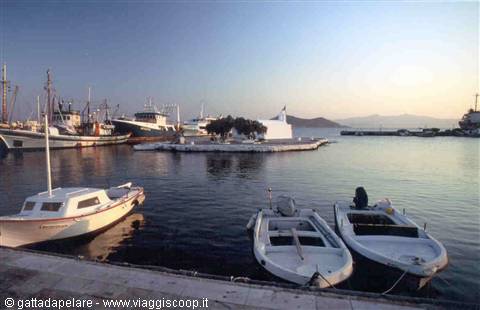
Seasickness is an experience that sooner or later all those who sail have had or will have. Nelson suffered from it frequently and surely Ulysses wasn't immune to it either. Indeed, Ulysses must have suffered from it a great deal given that Neptune spared him no squall as soon as he spotted him on a vessel on the route to Ithaca. The wind now comes from starboard and we proceed on a broad reach. We're forced to reef to maintain a less unpleasant trim. Entering ever deeper into the channel the pressure of the wind and waves increases, but the leg is short and in a few minutes we find ourselves in front of the entrance to the port of Chora. It's a rather large port and there are several boats. We immediately find a free spot with the right orientation relative to the wind, so the docking maneuver succeeds perfectly.
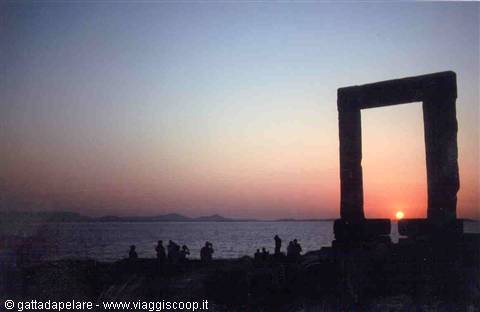
We make a good impression in the eyes of the willing ones who wait on the pontoon to help us moor. At the conclusion of this crossing we applaud Isabella's excellent steadiness, for whom this was her first sailing experience. Maria lived up to the reputation Gino told us about. At first impression the town appears interesting. A Venetian castle dominates from what was the ancient acropolis the long pier overlooking which are a row of cafés and restaurants. Not far away, to the west, the large rectangle of the remains of the temple of Dionysus stands out against the sky. Some of us go into town, others stay in the cockpit getting acquainted with the neighbors of the boat next door. To our left there's a 33-foot sloop, meticulously rigged. The skipper, a mature and smiling Englishman, immediately proves ready to socialize.
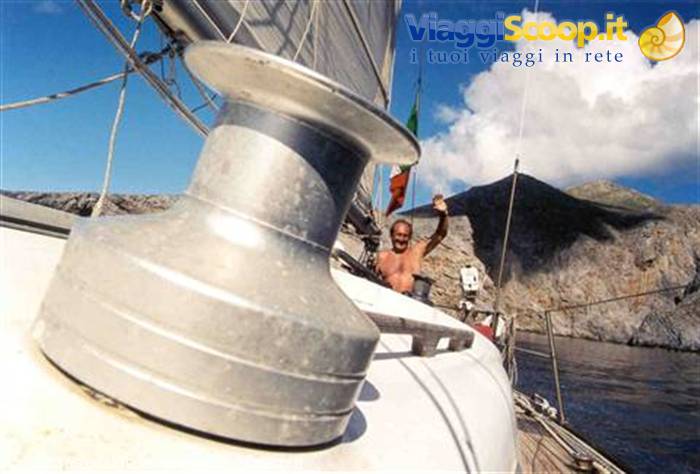
On the right a tall steel ketch with a German flag hosts a couple of families with an indefinite number of children who come in and out of the hatches simultaneously. It's hard to keep count of them. They remind me of those little desert animals, the mongooses, always in excited motion around their burrows dug in the earth. Constantin is bored. I entrust him with the task of checking why the winch is stuck and I make him happy. He begins a dismantling operation with the onboard tools, which, however, aren't adequate, and it's necessary to ask the super-organized English neighbor. He too is happy to make himself useful. I'm happy too that, finally, someone is doing a bit of maintenance on Gattadapelare. In the evening we stroll through the streets of Chora in search of a nice little restaurant. There are many and we're merely spoiled for choice. At the table we make the plan for tomorrow.
If the wind drops we'll go down to Antikaros, but I'm doubtful because it would be risky in any case to put ourselves in a position of having to work our way back up quickly and against the wind to be on time for the moment of our return home. June 10th. Naxos. Brisk wind and rough sea. We remain at mooring. The proposal to take an excursion into the interior of the island is approved. And so we set off, two per scooter, headed for Apirantos, a small village, they say, that's very pretty. Once we leave the coast we climb with a few hairpin turns onto a vast and undulating plateau that smells of island herbs. A warm smell that through the nostrils descends to the heart and stirs vague memories of sunny vacations spent somewhere in the Mediterranean. Scents of hay, of oleander, of feather grass, of myrtle and rosemary mingle to form the smell of the islands.
We take a narrow road following some timid signs indicating the site of an ancient temple. Here the countryside has remained the same for centuries. There are no agricultural facilities, vineyards, olive groves or vast fields of arable land, but small and jumbled plots, scattered trees, ravines and reed beds that betray springs of water, patches of oleander at the bottom of dry streams, dry stone walls delimiting irregular properties. Yet the modulated forms of this territory express the sense of the fertility of the nature that occupies it, not plethoric, but placid and strong. You seem to perceive the presence of Pan and the nymphs timidly hidden among the reeds and the green bushes that frame the scattered pools of water and the authoritative and maternal presence of Demeter, goddess of the fertility of the fields.
So the ancient peoples must have perceived it if here, on a modest hill, they erected a temple in her honor. Today only a few stones remain of it, reworked over the centuries to adapt the structure to the new needs of the soul, but despite the attempts to Christianize them, they are still charged with a force of pagan divinity that they absorb from the surrounding countryside and that they give back, radiating it onto the bundles of wheat scattered to dry, the sporadic olive trees, the almond trees and the vines. We visit the ruins and resume our journey. We eat at an inn and then reach Apirantos. We expected a more interesting little town. Apart from a series of small cafés that repeat along the main street of the town, deserted in this season, it doesn't seem there's anything else attractive. We stay a short while and return to our base in Chora.
Cocò's work of restoring the functionality of the winches continues with the courteous technical assistance of the Englishman. With Isabella's unconditional approval and the enthusiastic participation of the others, an abundant spaghetti dish concludes the day.
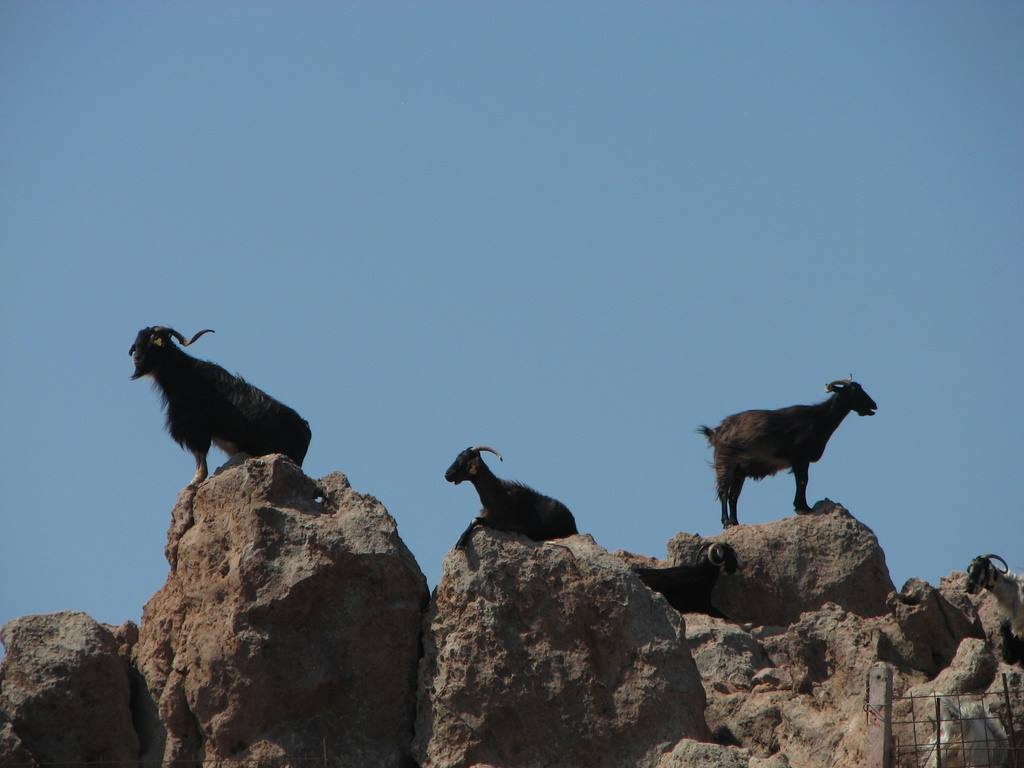
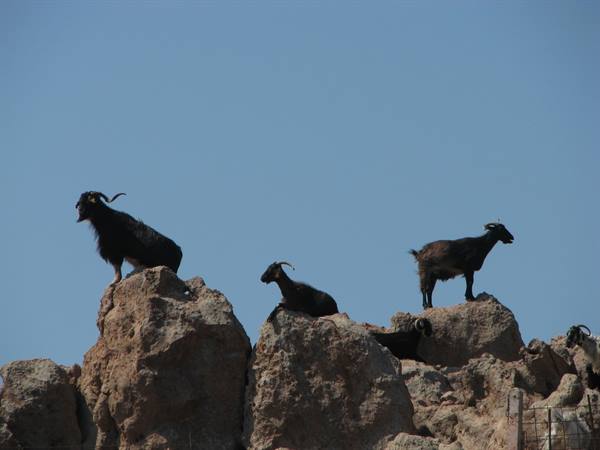
Black horned goats standing on grey rocks under clear blue sky
Day 1111 Jun 2003
June 11th. Naxos The sea turns white under the gusts which, in the middle of the channel, seem intense. No boat leaves its mooring and we too stay ashore. It's a good opportunity to continue the maintenance work. The neighbor has organized a little birthday-party get-together for the owner of another boat moored not far away. He tied colored balloons to the shrouds and upon the birthday man's return from a walk in town we all sang "happy birthday for you," each in his own language, accompanied by his guitar. Isabella and Marcus return to Paros by ferry while we stay wandering around the town. At sunset we go to the islet, today connected to the mainland by a short artificial isthmus, where the temple erected to Dionysus stands.
According to legend it seems that Theseus, returning from Crete together with Ariadne who had helped him find the way out of the labyrinth, fell out of love with her and abandoned her, weeping, on this island. She was found by the god Dionysus, who married her. The temple was never completed. Today the ground plan remains and an immense square marble arch, through which one can admire the sunset against the backdrop of the coasts of Paros. A superb spectacle, followed by dozens of tourists who gather here every evening in a sort of pagan cult. The murmur of the spectators' voices fades gradually as the fiery disc lowers to the horizon. At the moment when the last glimmer of light goes out, one hears a sigh of admiration for the performance offered us by Phoebus, followed by the shuffling of feet moving away.
At dinner, in the cockpit, tuna spaghetti with the unconditional approval of everyone.
June 12th. Naxos-Paros 10 miles. Today we absolutely must return. Even if on the face of it the sea appears rough and the wind intense, we can't stay here another day. Maria and Gino want to visit Mykonos together and I need to get moving to haul the boat and prepare it for winter storage. So off we go, reefed and ready for the spray. Instead, once we reach the shelter of Paros we're almost forced to turn on the engine. We reach the tip of the bay of Naussa where the waves get high and, after rounding the cape, push us from astern. It's an unpleasant point of sail and someone feels it. Maria, at the helm, handles it very well, getting Gattadapelare up on plane. The boat runs well and in a short time we're inside the bay where we head for the usual shelter, maneuvering and tacking under sail alone, just to keep ourselves in practice.
In the evening we take Gattadapelare to Naussa (where we unexpectedly find a spot at the breakwater pier) to meet Isabella and Marcus and dine all together one last time.
June 13th Paros. Goodbye Maria, goodbye Gino. The Hispanic members of the crew leave us to spend a day in Mykonos, before returning home. See you next year, friends. Thanks for the cordial company, we've enjoyed being with you. We remain, Isabella, Constantin, Marcus and I, to watch over the end of this vacation. We go back to Monastiri for one last day at the beach. Tomorrow we'll haul the boat and, at different times, we'll arrive in Athens. The day passes in lazy waiting for its conclusion. We prepare dinner on board and in the romantic setting of the bay bathed by the sea of myths and by the rays of the moon, we listen in silence to the sweet notes of Chopin's nocturnes and other sounds of nature.
June 14th. Paros-Athens. Isabella and Marcus leave on the morning ferry. Constantin and I follow the hauling operations, which take place with rather primitive but correct systems. After preparing the boat for the long rest that awaits it, we have a taxi take us to Parika and board for Athens. We arrive in the early afternoon. Here we find the survivors of the crew and with them we wander through the little streets of Plaka, eat at the usual tourist trattoria, climb up to the Acropolis and from the Areopagus look at the city below us. As other times in the past. A ritual by now we can't do without because For the first time we feel hot.
June 15th. Athens-Zurich-Rome I leave Constantin and the others asleep in the hotel and, at dawn, I board a Swiss jet. A not very direct flight, but, thanks to my sponsor, free. Goodbye sailors. Until next time!
Black horned goats standing on grey rocks under clear blue sky




1 reader comments
fantastico