Day 126 May 2004
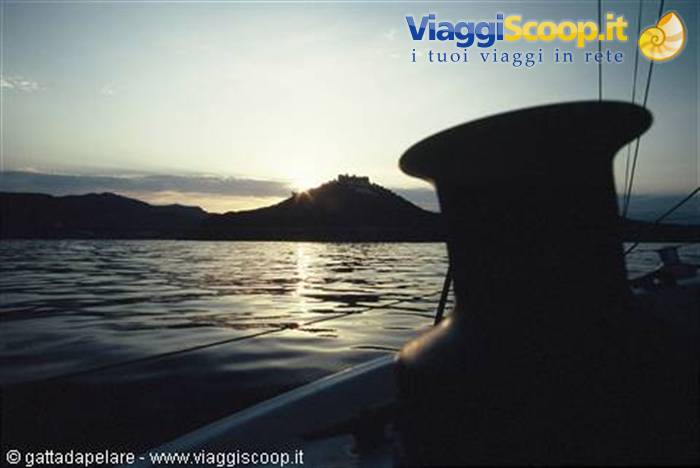
Sailing among overlooked islands
May 26, 2004. Athens-Paros With an Alitalia flight sponsored by Gino I arrive in Athens in the late morning. A strong north wind is blowing and the plane jolts and sways during landing, enough to give me some unpleasant imaginings. The new Athens airport is about forty kilometers from the city, but because of the ongoing works for the Olympics the public bus takes more than an hour and a half to reach Piraeus. From the state of progress of the sports facilities and the roads, one would say that in less than three months (the Olympic games will begin on August 15) nothing will be finished. But I bet these Greeks will make me win the bet. Boarding at Piraeus with the semi-fast ship takes place at 17:30. I always watch with pleasant attention the parade of islands that unfolds before me.
The Cyclades! How many times this name fascinated me in the past without ever having seen them! Only their arrangement in the Aegean, which the name itself evokes, made me imagine them as pearls of a necklace. And at the ideal center of the circle is Delos, the island sacred to Apollo and Diana. Despite all our wandering among these fragments of land I have not yet visited Delos, as if a reverential fear of its pagan sacredness prevented me. I called Maria Aliprandis, my "innkeeper" in Naussa, informing her of my arrival time. She said she would come to pick me up at Parika, at the port, with her car. Really kind, especially because I arrive at 22 with almost an hour of delay. The room she assigned me is the same one occupied by Isabella and Marcus last year. Small, sufficiently welcoming and not expensive.
But above all, from here you can breathe the smell of the sea carried by the ever-steady north wind, here in the Aegean. Naussa is deserted. At this time of year the tourist season has not yet begun. I dine alone in my usual tavern at the port. It's cold and it feels good inside. Then to bed. Tomorrow a work boat awaits me.
May 27. Naussa (Paros) I wake up and even before opening my eyes I feel the breath of the meltemi in the reeds. The sea is frothy with small, short waves that make it uninviting. After a year away I feel I am not very "seaworthy." I need to take possession of the boat and the saltiness again. With a scooter rented through Maria, who here is a sort of factotum, I organize a coming and going between Naussa and Monastiri where Gattadapelare has waited for me for so long. I bring the luggage on board and take back laundry to be washed. This year I will also have all the blankets washed, which have been awaiting this event for several years. Maria, always her, offered to do it with her washing machine. A real mine of opportunities this Maria, Romanian by birth, Greek by marriage, with one daughter married in Italy and another in Athens.
Always cheerful and helpful as often only stout people know how to be. Naturally the engine of the tender left with Janni to be repaired is not ready. The spare parts brought from Rome are not enough. After a year of e-mail correspondence and repeated assurances that everything would be OK for my return, Janni has done nothing. But this too is Greece, it's vacation. The boat looks rather scruffy. It has now been ten years since it left its mooring on the Tiber and I have been able to devote no more than four or five days of maintenance to it each year. It would need a good lifting inside and out and some serious work on the electrical system. I can, instead, only guarantee a minimum of safety and reliability.
May 28. Naussa. A day like yesterday devoted to work. I continue to bring dirty laundry to Maria and bring back clean laundry. Among the extraordinary purchases is a new battery. The wind is always steady.
May 29. Naussa. By now I am waiting for Gino's arrival to launch Gattadapelare. I continue to put things in order as best I can. The furling system is stuck again and I have to disassemble the mechanism. But by now I know how it's done. I installed the bilge pump I had brought from Rome to overhaul it calmly. The sea is always rough and uninviting.
May 30 Naussa. I asked Petrus, the owner of the "karnaio," to launch the boat tomorrow. Impossible, he said. Tomorrow and the day after are big holidays and nobody works. We have to be patient. But not all setbacks are completely negative. We will leave for the cruise on June 2 so that the "girls," Elke and Gerlinde, will have time to visit Naussa. Toward evening Titti and Alfredo arrive. But we won't meet until tomorrow. Gino arrives with the evening ferry. I go to pick him up at Parika together with Maria (her again) with her car. I am happy to see my companion of adventures and explorations again. A few weeks ago we were his guests in Barcelona for a weekend. A fresh memory that has helped make our friendship even stronger. We dine at the port and go to sleep. Tomorrow we will give up the room to the "girls" and retire to sleep inside Gatta.
May 31. Naussa. With Gino we do the last preparations. I buy a second battery. I want to be calm about starting the engine. It is part of my sailing nightmares to imagine the engine not starting in a moment of emergency. It is true that in the organized courses of the Centro Velico di Caprera we carried out all the maneuvers in every weather condition always and only under sail, but we were always at least four well-trained crew members. With Gattadapelare, much more demanding than the Dehlers of the school, we are never enough in number to maneuver safely in emergency conditions. So long live the engine and to hell with the shame. We meet the "stepsister" Titti and Alfredo who have "come down" to a hotel in Naussa high. The day passes on the deck chairs of the little beach of Monastiri.
This place is very pleasant, well sheltered from the wind (which anyway today has decreased in intensity) and with a nice restaurant run by Claudio, a Neapolitan who has put down roots here. Although Claudio already knows us as frugal customers, (we always eat only Greek salad) he welcomes us with the usual southern warmth. Maria lends us her car to pick up Elke and Gerlinde arriving at the port of Parika. They arrive with the 21:30 ferry. We all dine together in Naussa at the usual tavern at the little harbor and then to bed. Gattadapelare welcomes us, Gino and me, in its stable position on land.
June 1, 2004.. Naussa. Today is the launch. While the "girls" sunbathe on the beach Gattadapelare slides, resting on the shipyard's slipway, into the blue and calm sea. The wind is totally absent, just as the "girls" like it. It is not the first time that upon their arrival Poseidon gives them this gift. In the afternoon we bring the boat to the dock in Naussa. We find a place near Janni and we go wandering through the little streets of Naussa until dinner time.
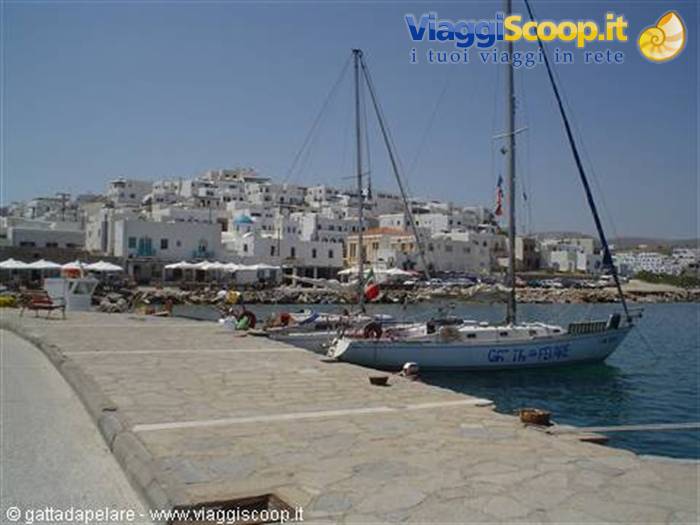
June 2. Naussa-Antikaros. 23 miles. Finally we leave! We did the provisioning in anticipation of a picnic on the little beach of Antikaros. Fish to grill and moonlight. Our crew consists of four members: the famous "girls" (don't dare call them anything else) Gino and me. Titti and Alfredo will join us at Amorgos by ferry. We leave the bay of Naussa with a weak wind that strengthens slightly in the channel between Paros and Naxos. We head straight for the temple of Dionysus which stands on an artificial peninsula north of the port of Naxos. The channel, at this point, is six miles wide and the wind, favorable to us, comes from the north. We proceed, therefore, on a broad reach right up to below the temple and then descend along the western coast of the island. At the exit from the strait we find the wind strengthened, now coming from the southwest.
We find it on a broad reach, almost abeam, and we proceed without stress. The sea is choppy every time we cross the channels between the islands that form a small archipelago here, but the waves remain low and cause us no trouble. We leave the island of Karos on our left, glimpse Koufonisi in the distance and round the southern tip of Antikaros. We thus enter the narrow channel between the island and an islet that faces it to the east. We drop anchor paying attention to the length of the chain: not so little that... not so much that it puts us on the rocks in case of a storm. It is the third time we anchor here. The first time with Marzia, four years ago, we spent an adventurous night of storm watching every gust of wind that might push us to the sides of the channel. Last year too, with Gino, we set a second anchor at a kedge.
But perhaps our precautions have always been exaggerated; the current holds the boat in the center. It's a bit cold and windy. We give up going ashore on the little beach and organize ourselves with the grill at the stern. The wind lights the charcoal like a forge. A trail of sparks, like the tail of a comet, moves away from Gattadapelare and disperses into the impending darkness that is by now swallowing the mountain profile of Amorgos, outlined toward the south.. The dinner by the light of an oil lamp is tasty and certainly exceptional. We are the only guests of these places, if one excepts the fisherman who, we know, lives at the top of the hill. The sky is full of stars, the silence absolute. Tomorrow we will show the "girls" the Frenchman's house. They have heard so much about it that the expectation is high.
It can be vaguely glimpsed on the cliff, not far from us, abandoned and melancholy.
June 3. Antikaros-Amorgos. 6 miles We go ashore and visit the House. By now the signs of decay are more evident and its state of stability is compromised. We enter cautiously into the empty rooms where, however, we find traces of recent visitors, French or perhaps Spanish who have spent the night there. Our imagination lights up. Perhaps the heirs of the old misanthrope have returned to visit the property or perhaps they are alternative tourists who happened here by chance. They left some notes in French and a book in Spanish that Gino requisitions for himself. The aura of mystery that surrounds this building and its owner accompanies us throughout the visit. We are curious to know more, but we don't know whom to ask if not the scattered remains of the works carried out for a more comfortable stay and the abandoned things.
Here part of the slipway for hauling out, with a still unseaworthy and peeling boat on it that seems about to go down to the sea, there the scaffolding that supported the photovoltaic cells. Inside, a rusted hand pump for water betrays the aspiration to the comforts of city life. We move to the little beach that the current has formed on the islet opposite and we spend some time there bathing and savoring this spectacle of lands and waters, aware of the uniqueness of this day. A German boat arrives and passes unscathed through the strait between island and islet, there where we had thought it was too shallow for Gattadapelare. We were taken aback also because we had signaled to them not to proceed. So we learned that the passage is clear and we will take it into account next time. If there is one. Around 11 we leave Antikaros and head for Amorgos.
Weak southeast wind, calm sea, a pleasant transfer leg. We moor at Katapola and immediately go looking for scooters to reach the monastery of Chozoviotissa before it closes. The meeting with Titti and Alfredo happens by chance. They arrived the day before by ferry and will return to Paros rather than continue to Astypalea. Too difficult to reach that island which is better connected with the Dodecanese than with the Cyclades. We say goodbye without mutual commitments to see each other again and go up toward Chora, the small capital of this island. We walk in the white silence of solitary alleys in search of ancient traces. Imagination helps us transfigure the severe little church perched on what was the acropolis into the colonnaded temple of Athena. From here the goddess had a wide view of the sea toward the west, toward the city dedicated to her.
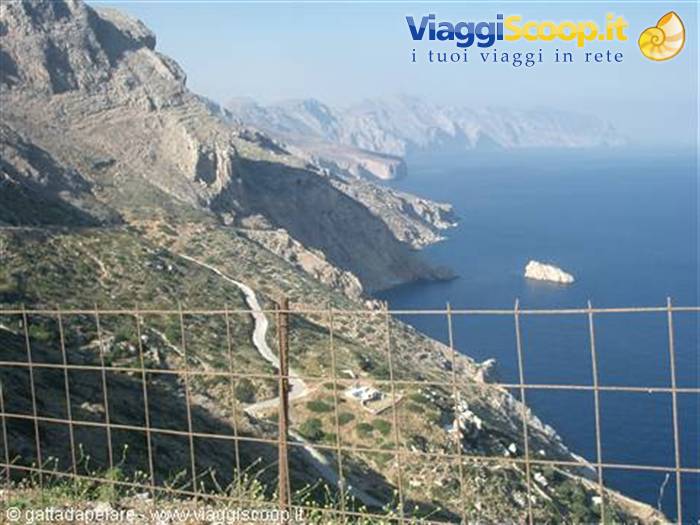
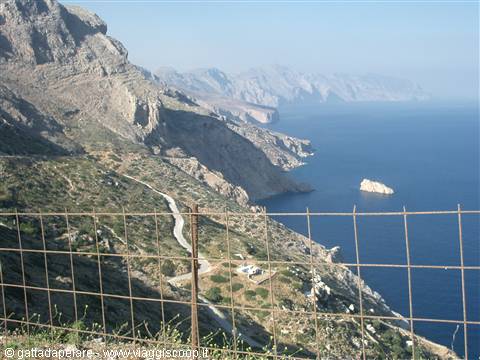
The ancient inhabitants of this and other islands turned to her confidently in moments of discouragement. Today on the opposite side of the mountain another temple looks down from above at the blue of the Aegean; another divine woman has conquered the soul of these inhabitants by choosing Amorgos as the place to take refuge, escaping the wrath of the iconoclasts who wanted to destroy her image. The panorama that opens up once we reach the watershed is once again astonishing. The coast, high and steep, descends for three hundred meters before meeting the "deep blue." It is no accident that this is where the film bearing the same name was shot.
The sun is reflected on a sea that would seem infinite were it not for the distant, pale-blue outlines of the islands of Astypalea, Anafi, Santorini and Ios which from east to west close off this immensity that the breeze caresses, drawing upon it crescent-shaped ripples in slow movement. Having left the scooters we climb the thousand steps (which are actually fewer: ah! these tourist guides!) to reach the monastery. But our girls are not dressed appropriately and they don't let us in. No great loss for Gino and me who have already visited the holy place, but our companions are a little disappointed.
While we rest, sitting lazily on a low wall overlooking the sea that lets you glimpse its transparency three hundred meters below, a pope comes out of the very low solid wood door that closes and protects the entrance and, offering me as a pretext a sprig of herbs picked for the occasion, strikes up a conversation with us. He almost seems like a hermit with his long beard and his dark habit spotted with ancient dirt. He is a lean and hieratic figure, who gives the sensation of being almost on the verge of sanctity, but who certainly smells of goat. Without ever addressing the ladies he tells us he is Ukrainian and has lived here for twenty-seven years. He also points out where the "modern" toilets are. They are Turkish-style, there is no water and they are habitually frequented by the goats that scatter their olives of dung everywhere. The intention is good, but the aim is poor.
Returning to Katapola we stop in Chora to buy that dry bread typical of these places, very suitable for rubbing tomato on and being eaten on the boat during the crossing, seasoned with olive oil and garlic.. A crunchy variant of our local panzanella and just as tasty. We dine at a modest tavern and go to our bunk.
June 4- Amorgos-Astypalea. 55 miles. The wake-up is a bit abrupt. The boat next to us casts off with considerable confusion and difficulty, forcing us to hold it away at arm's length. After freeing the anchor that had caught our chain, it finally gets underway and allows us to go have breakfast at the port café. Today we go to Astypalea, the Stampalia of the Venetians, the first, to the west, of the Dodecanese, almost a marginalized one, peeping toward Rhodes, ignored by the sisters closest to the ideal center of the Aegean, to Delos. Having cast off the moorings in almost no wind (we are protected by the mountains that block it from the southwest) we decide to round the western tip of Amorgos and then head southeast. As soon as we are out of Amorgos the wind strengthens and forces us to reef the mainsail and genoa.
Moreover it now comes more clearly from the south and on Gino's advice we first head for Santorini, which appears a safer destination and easily reachable in case the wind strengthens. But at the height of the rugged island of Anidros (the "Dry") we go back to considering Astypalea as our final destination and, tacking, we change tack. The wind, meanwhile, has decreased in intensity, so that, when toward sunset we arrive to skirt the island, it is completely absent. The Chora of Astypalea, also dominated like that of Patmos by the gray bulk of a fortress, stands out before a sun that descends sovereign. There is no real port; only a pier for the arrival of the ferries that is already occupied on the side by a sailboat. We moor around the corner, keeping rather slack and far from the structure because there is a strong swell that makes our Gattadapelare dance.
Meanwhile Veronica reaches us together with Santiago. I think it is necessary to introduce these two new characters who suddenly appear in the diary of this day, Veronica is a friend of Gino who wants to visit Anafi and takes advantage of our passage. The meeting is therefore not random and was organized since before our coming to Greece and preceded by some organizational phone calls. Santiago, on the other hand, is a chance meeting of Veronica on the spot. All together we go to dinner at a place on the beach. Above us, clinging to the crest of the mountain, the town, the Chora, gleams whitely in the incipient darkness.
June 5. Astypalea. The night passed tossed about by the swell that increased hour by hour. The other boat is in a more uncomfortable position; moored Mediterranean-style it rises and falls on the edge of the pier, making the fenders screech, about to burst with every wave. When the situation becomes unbearable we see them leave to head toward a group of islets a couple of miles upwind. We are protected by the pier, with two lines ashore and anchored downwind. We dance a lot, but there are no friction problems. With some acrobatics, admirable especially in the women of the crew, we go ashore to explore the island. With a rented off-road vehicle we go up toward the town and take a road that Veronica points out to us and that will lead us to an isolated little beach. Shortly after, the asphalt gives way to dirt and we let ourselves be enveloped by the bucolic and pastoral atmosphere.
The steep lands that surround us and that slide toward the sea are barren. What the ancient Greeks called "the table of the gods" presents today a vegetation of low thorny bushes and cushions of oregano and other aromatic plants. The flanks of the mountains are cut by longitudinal gorges in whose modest coolness the oleanders bloom. The color of the flowers stands out like the carmine of lips parted, in a smile, at the beauty of the places. The air is scented with sun and Mediterranean and full of the buzzing of bees and the sound of the goats' bells that watch us from afar with their disturbing and suspicious eyes. When we arrive at the beach, pebbly and shaded by sparse tamarisks, we find a couple of tourists there who, like us, have come this far in search of serene atmospheres.
Later we go back up to the Chora for a visit to the ruined castle of the Querini who ruled here for three hundred years. The manor is closed and only the outer walls remain standing. From the crest of the town, dominated by the remains of five windmills, one observes the group of houses below that make up Skala, and our little boat rocking at the mooring. It seems safe, but at the moment of returning we see from afar that one of the mooring lines has broken and Gatta, held by the anchor and the surviving stern line, has approached the shore. The motion of the swell has increased and the position has become untenable. We run to save our boat. On this occasion also Gino, like so many others who preceded him, sacrifices his cell phone to Neptune. The dive and the recovery of the device are useless.
On the advice of the locals we decide to find shelter in cala Maltesana, an inlet a couple of miles further east. While the "girls" set off by car Gino and I leave the pier and face a well-formed sea until we find ourselves sheltered by some islets and by the coast that, with two rocky spurs, embraces the cove. We moor at a pier almost entirely occupied by local fishing boats and by a sloop flying the French flag. As a precaution, before mooring Mediterranean-style we pay out twenty meters of anchor a little outside so as to guarantee ourselves an escape route in case the wind, changing direction, pushes us against the pier. Cala Maltesana offers good shelter and can be considered the only tranquil mooring of Astypalea, at least among those near the houses. The bay has at its bottom a long sandy beach and some scattered houses.
There is no real town, but inland the buildings become denser and there is also a grocery store. To go to Chora, which is eight kilometers away, we use the car with which the "girls" have meanwhile reached us. The road winds along the northern coast, climbing the hills and descending to the sea. We meet no traffic. The island has the shape of a butterfly and at the narrowest point the coasts are a few hundred meters apart. In town we have a coffee in a pretty place whose owner is an Italian who landed by chance some years earlier at Astypalea and stayed here by her own life choice. We return to our new base and eat in the only tavern of the place run by a cheerful and enterprising stout Greek woman.
The night passes quietly, very different from the last one. The swell does not enter the cove and we fall asleep listening to the light lapping that the sea makes, imprisoned between the boat and the pier.
June 6. Astypalea-Anafi. 34 miles. The Frenchman, well informed, announces sea force 6-7 and 15-20 knots of wind. Gino offers to drive the car back to Skala where we will reach him with Gattadapelare to board him. At the exit from cala Maltesana we find a sea much less formed than yesterday and we are more optimistic about the forecast. We know that at Anafi we will find nothing but a poorly protected lee and that with waves from the west it will be difficult to maintain the mooring. The alternative is to continue for another 15 miles to Santorini where in recent years a marina has finally been built. But we would not want to miss the landing at Anafi. We are curious to know this island barely touched by alternative tourism, sporadically reached by ferries and sparsely populated.
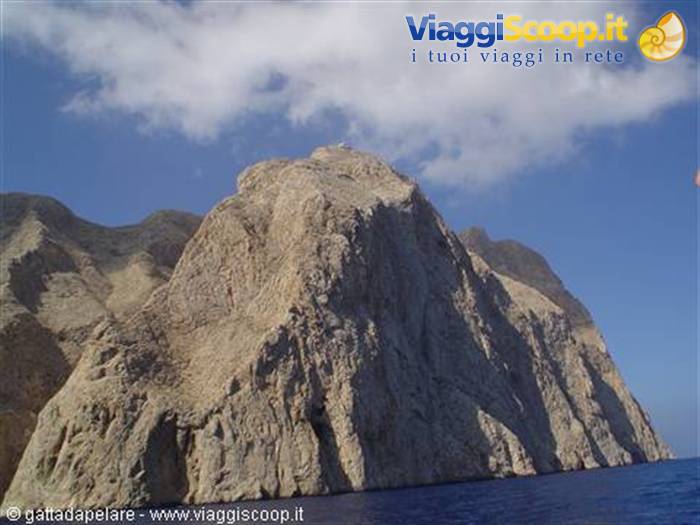
For everyone, and especially for Veronica, not being able to visit this island that carries within itself the charm of a millennial fantasy would cause a regret that would embitter a cruise that until today has fulfilled all the expectations we had made over the previous months. We find Gino waiting for us on the pier with two bags of provisions. He has bought, he says, also better weather forecasts: sea force four and wind at 10 knots. With this encouraging information we set sail and head west. After a few hours of tranquil sailing here is Anafi, the "illuminated"! It welcomes us from afar by showing us the high promontory that on a stormy night appeared, in the light of a lightning bolt, to the exhausted Argonauts yearning for a landing.
On the summit of the mount, shortly before the crest, a white sanctuary seems ready to slide down the steep flank of the mountain to plunge into the sea. We now sail under power along the southern side of the island and finally reach an inlet protected to the west by an artificial breakwater and with a short and high pier suitable only for the docking of ferries. There is no possibility of mooring ashore. We pay out the anchor "with a kedge," that is, enriched with a second anchor two meters of chain from the main one. There is a bit of swell entering around the tip of the breakwater and we don't want to take risks in case of worsening weather. At the bottom of the inlet, indeed shallow, there are some houses and a tavern. We go ashore with the tender.. The engine is out of order and it is necessary to counteract the force of the wind by rowing energetically.
At Anafi there is a public service connecting the inevitable Skala, the seaside village, with the usual Chora, the village above. It is represented by a minibus that climbs up unguarded hairpin bends and seems suspended in the air. Below us the line of the coast, the houses, our boat move away at every curve. The trip lasts a short time and ends in a clearing just outside the first houses of the town. Skala is not large. A short main street leads to a belvedere enclosed between the remains of a windmill and a little church. We meet few inhabitants. The view is stupendous. Around us the immensity of the sea is interrupted only by the outline of some islets and by the distant line of Santorini which is....miles away. Gattadapelare seen from here appears small and abandoned in the bay. Along the town's street there are a couple of modest shops and a couple of taverns.
On the veranda of one of these we dine with many small portions of those tasty foods that are the characteristic of eastern Mediterranean cuisine while below and in front of us the sea shows itself in its blue grandeur. The hostess is cordial and the dinner cheap. At the end she even gives us a jar of uncontaminated honey from the island. We call by phone the driver who brought us to town to take us back to Skala with the municipal bus. But things here go differently. In a small community the concept of public property merges with that of personal good. Past 23:00 he leaves us on the quay without wanting any compensation. Anafi, you will remain in our memories as a strip of land outside of time; a world distant from the one in which our lives are agitated, an island of forgotten humanity where relations between people are not yet built solely on convenience.
Gattadapelare awaits us on the wheel, hospitable as a lived-in home. ready to lull us with the aid of the waves that arrive damped by the breakwater that protects the small bay from the west. But once on board we discover that the boat receives the waves abeam and rolls annoyingly. We then set an anchor at the stern to force the hull to stay aligned with the direction of the sea and to pitch moderately.
June 7. Anafi-Santorini. 25 miles
The weather remains fine. Moderate wind and sea. We have breakfast ashore. We are the only guests of the bar-tavern. When we weigh anchor to head toward Santorini we are torn by conflicting feelings. The excitement of reaching the most beautiful and mysterious island of the Aegean mixes with the nostalgia for the modest and unknown Anafi that slowly moves away behind our stern. The Frenchman from cala Maltesana confirmed to us that a marina has been built at Santorini. We know roughly where it is and we thus head for the southwestern extremity of the great parenthesis of land that constitutes the island. Santorini mysterious and legendary. Perhaps the mythical Atlantis mentioned by Plato. Perhaps the cause of the disappearance of the Minoan civilization.
Certainly the apocalyptic explosion of the volcano did not go unnoticed by the peoples living on the shores of the Mediterranean 3500 years ago. The gigantic wave, more than sixty meters high, swept the islands and destroyed the villages and cities, the ports and the countryside that faced the sea. We see the coast approaching and with it the signs of a vacation activity that clashes, with its vacuousness, with the drama of the distant events that shaped the island and that live in our expectations as demanding travelers. The marina, which we reach in the early afternoon, after a tranquil sail, has the circular shape of a crater. A happy solution that harmonizes with and recalls the geological configuration of the landscape. We do not find a great crowding of boats. Most of them are small fishing boats and gozzi. We moor in complete calm of wind and go ashore.
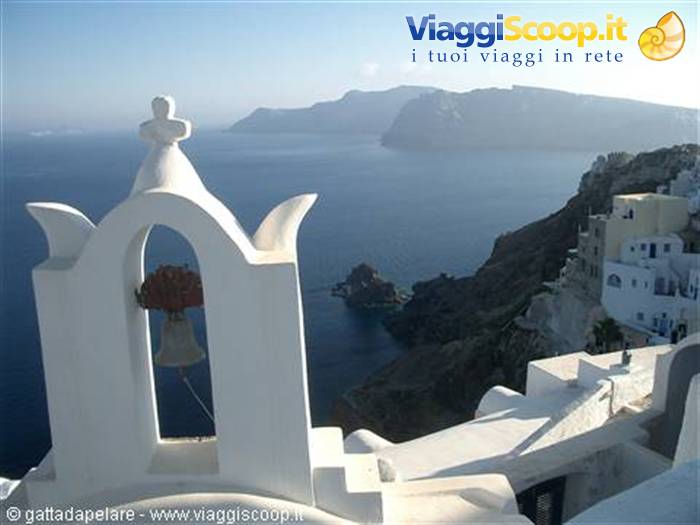
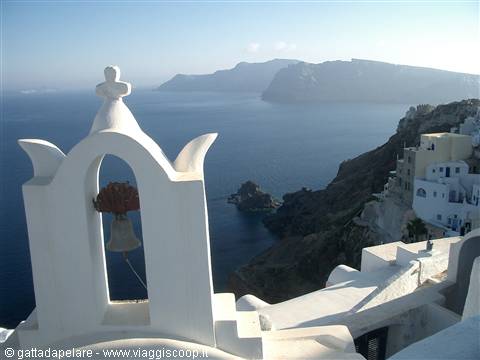
Except me, who am here for the second time, my travel companions are impatient to go and discover this island they have heard so much about. We find a small hotel on the coast just above the marina and a telephone to procure a rental car. Oia is one of the towns of Santorini. Together with Thira, which is the capital, they cling to the edge of what was the crater of the volcano. The houses, small, white, blinding in the afternoon sun, remain poised over the abyss. Three hundred meters below there is the sea. It occupies the cavity left by the mountain which, emptied inside by the outflow of lava, collapsed and sank hundreds of meters into the abyss of the Aegean. The panorama before us, as we walk lazily through the little streets of Oia, is of a beauty that leaves you stunned.
The remains of the crater form in front of us another island, Thirasia, which toward the west tries to enclose the indigo-blue basin of the sea. Almost at the center of the circle of lands the black and glassy rock of Neo Kammeni recalls, with its fumaroles, that the god's forge is still lit. At the extremity of the town the land also ends. Several people have gathered here, sitting on low walls or at the tables of the bars, and wait for the sun to dissolve in the gold of the water. We return by car toward Thira, skirting the western side of the island which, on a gentle slope, allows the practice of agriculture and the settlement of infrastructure.
The road cuts the slopes of the mountain that arose from the overlapping in different eras of lavas and ashes, so that even the colors of the earth change from gray to red, from black to greenish as on a disorderly palette of a titanic painter. The little streets of Thira are those of any town where mass tourism has killed the spontaneity of the people. We are a thousand miles away from the sincerity of Anafi or Astypalea. Shops, little shops, follow one another, all displaying the same things: souvenirs, postcards, costume jewelry, scarves. We could be in Taormina, or Capri, or Mykonos, or Portofino or elsewhere where summer vacationers concentrate and we would not notice the difference. You have to get out of the alleys and look out at the panorama of this island to feel a sensation of great astonishment, a movement of sacred wonder that silences us.
The same sensation felt before the Grand Canyon or before the rocks of Monument Valley. The evening is windy and cool. We eat in a restaurant with a view and return to base. The ladies in the hotel, Gino and I on the boat. Tomorrow Veronica leaves us.
June 8. Santorini.
The remains of Akrotiri, this Cycladic Pompeii buried by the eruption that pulverized the ancient island, are protected by a corrugated sheet metal roof and resemble more a subway construction site than an archaeological site. But they are fascinating precisely because of the cause of their preservation. The whole is chaotic and disturbed by the protective materials of the finds. The famous frescoes that were found there are in the city museum. Before coming here we accompanied Veronica to the airport. She was a good travel companion, cheerful and adaptable. It is the first signal that our cruise is changing. The "girls" too will no longer continue the journey. The day after tomorrow they will take the way back, flying from here to Vienna and Rome. Gino and I have to face three days of sailing with a headwind.
But this was foreseeable and from today the wind direction has returned to normal; that is, it comes from the north while for days it has blown from the southwest, rather hindering the legs we have done so far. We spend the morning hours strolling through the alleys of the town and visiting the two museums of Thira. The objects on display are few, but beautiful and interesting. Especially the frescoes of the blue monkeys and of the fisherman. The figures are alive and strike for their modernity. The style is the same as those found in Crete in the palace of Knossos: slender bodies, thin waists, and the girls have hair wrapped at the nape and falling in mischievous curls on the forehead. We find a small apartment right in the center of the town, overlooking the caldera. The price is moderate and we are enthusiastic about the panoramic terrace, all to ourselves.
Sitting at the little table, with a glass of iced ouzo in hand, we wait for the sunset with enchanted eyes. We remain silent while the light fades into twilight. Around us, from the nearby and distant terraces, above and below ours, moments of encounter or reflection, of cheerfulness, of melancholy, of celebration are being lived. The grandiose panorama underlies each of these states of mind. Santorini will remain an indelible memory. Then, the prosaic reemerges forcefully and we end the evening with a "cofana" of spaghetti with tuna sponsored by Gerlinde. The moment of farewells arrives. Our cruise continues, but the "girls" are abandoned on this island. Perhaps one day our wandering through the Aegean will be the subject of an epic poem and this abandonment will be sung by a future Homer. Perhaps also here, as at Naxos, a temple will rise in memory of the event.
Moving away by car toward our boat we have, however, the sensation that the "girls" were not so unhappy to stay.
June 9. Santorini-Folegandros 22 miles
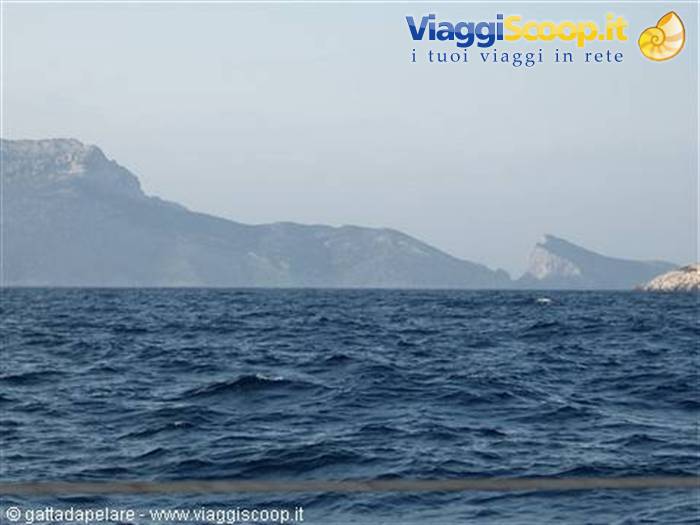
We leave around 10. Wind from the north, initially moderate, but almost head-on. It is our intention, once we have rounded the southern tip of the island, to enter the caldera and pass below the ladies' house. A small detour that we must give up because the wind strengthens considerably and we would have to tack too much. So, we phone our intentions and head toward Folegandros on a broad reach with wind at 13-15 knots. Initially the pace is pleasant, but as the day progresses the sea becomes choppier and because of leeway we are forced to head up more and more. It's a bit cold and the last miles are tiring. Tired and chilled, finally, we enter the bay at the bottom of which is the mooring pier, we are happy not to have to face the sea anymore.
We have a few moments of anxiety because of the windlass which refuses to work right at the moment when we have to make room for an incoming ferry, but finally we breathe a sigh of relief and enjoy those moments of relief that every sailor knows after a hard day of wind: sitting in the cockpit and, leaning against the cushions, looking around while sipping something. Folegandros has only recently opened up to tourism and
June 12 - Sifnos Paros (Naussa). 33 miles
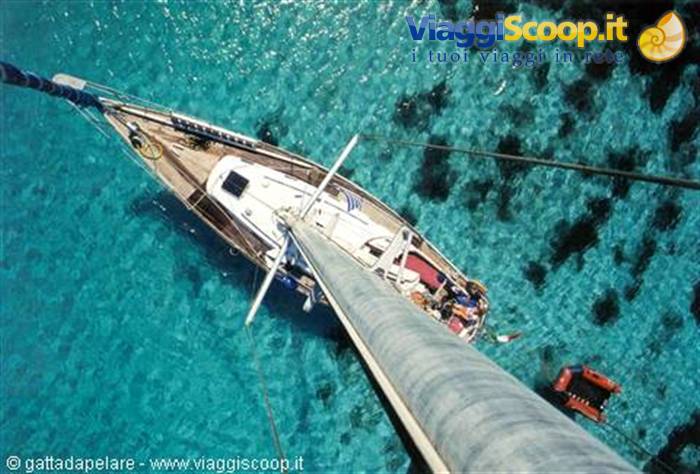
This morning the inlet in which we found refuge yesterday appears to us more serene. The wind has ceased completely and the sun, finally, warms us a bit. The two promontories that enclose the bay open toward the south, thus guaranteeing protection from the waves raised by the meltemi, but because of the low coast the wind was blowing yesterday evening even inside the inlet with unpleasant gusts. By now we have lost the taste for wandering. Today's is the last stop and on it weighs the thought of the return home. We leave early with the sensation that today it is a technical move. We say goodbye with a little sadness mixed with the impatience of finally closing the nautical route of this year, this Aegean that we love so much and these islands that are everywhere when we turn our gaze around. There is not a breath of wind. Only engine for five hours. Antiparos, then Paros file past us.
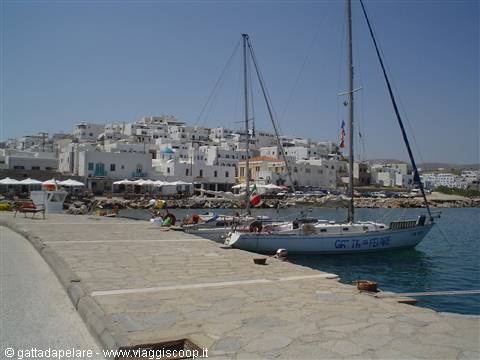
Numerous ferries enter and exit the port of Parikia and force us to stay alert until, having rounded the western point of the gulf of Naussa, dominated by the lighthouse building, we enter, at noon, into the gulf. We head for the little harbor of the village and moor in the usual spot, next to Janni's boat. Finally it is no longer cold. Summer seems to have entered the sea of Greece today.
Gino is preparing to leave me. He has packed his bags and unloaded them. Michele has reappeared, modern Greek, with his good mood and his good-natured teasing about Gattadapelare. I leave them on the pier while I head alone toward the "carnaio," the yard, where tomorrow the boat will be hauled out for its summer rest, perhaps annual; who knows. We spend a few hours on the little beach of Monastiri waiting for Gino's boarding time for Athens. Goodbyes are always sad when one has spent a happy period. They are even more difficult when behind them there is the memory of the sea, of these islands, of these atmospheres that are created only here, here where nature, history and myth are fused into a single, fascinating jumble..
Gattadapelare is again dry, far from the dangers of infiltrations. It rests, disarmed, on its wooden supports, in the Mediterranean sun. I leave it with regret. I will spend the night at Maria's guesthouse. Naussa today is beautiful, finally warm.
With the fast ferry at 11 I leave Parikia. It is windy again. The meltemi has resumed blowing hard. We slalom among the Cyclades embarking and disembarking tourists until arrival at Rafina, on the north coast of Attica
7 photographs · click to open them full screen


0 reader comments