Friday 28 May 1999 - Arrival in Athens. We left Rome with the usual anxiety of work abandoned to itself and with many things left open and, for this reason, easily vulnerable. But already when we were flying over Corfu it had vanished. Over Aegina, in view of Athens airport, there existed only the present, harbinger of beautiful days of sea, sun and islands. We are staying at the Hotel Amazonen (tel. 3234002-3-4) on the edge of Plaka. A small hotel, but tidy and also inexpensive. From there one can reach on foot every corner of Athens that interests us. We go around looking for a good camera for Marzia. Holidays in Greece are not such without collecting images to bring back. We wander for a long time through shops and gather information for a good choice. We dine in the heart of Plaka at the usual trattoria where the waiter recognises us immediately.
Saturday 29 May - Athens. I wake to the chanting rising from below. Marzia is still asleep. I dress and go down, impatient to discover its origin. A small, very small Orthodox church stands below the portico of the office building opposite our hotel. It is a little askew with respect to the row of pillars, testifying that when it was built the axis of the street was different. A poor little church overwhelmed by the evolution of the times, huddled among sterile arms of concrete, protected against its will from the rain which cannot, however, wash away the grey dust of the city. It is from the little door that looks aslant at the intersection that this chanting comes, which now reminds me of a Marian litany. I enter. The nave is perhaps five metres deep and is occupied by some twenty faithful arranged in four rows, two on each side.
In the centre a narrow passage allows one to reach the back wall rich in icons, among which opens a gap closed by a white curtain. Before the icons stand, gathered in prayer, some women who continually cross themselves with rapid, tight gestures. The fingers joined in the way used in Italy to say "what do you want?" quickly strike the forehead, the chest and the right shoulder, and then the left; and again the forehead... and so on three or four times. The same sign of the cross is repeated by all the faithful, sometimes together, sometimes individually, without any comprehensible sense. Meanwhile the chanting continues, in Greek. I almost seem to understand it, the Greek, and yet it is only an illusion. Only a stray kyrie eleison deceives me, the rest is... Turkish. Suddenly the white curtain that hides the tabernacle opens and the pope appears.
He is a young priest, strictly bearded, who after drawing back the curtain turns towards the altar and then disappears to the right, reappears, disappears to the left, in a series of absolutely incomprehensible actions. Then he turns to the faithful (I was about to say to the audience) and begins to sing along with them. After a little he withdraws into the sancta sanctorum and closes the curtain again. What is he doing? When he reappears he is another character: a black, tall cylindrical headdress, with two bands at the sides that fall to the waist, makes him appear tall and imposing. He holds in his hand a golden pyx whose handle is wrapped in a red cloth. A woman approaches him. She takes in her hand the hanging end of the cloth. The pope extracts with a spoon something pasty from the pyx and introduces it into the wide-open mouth of the faithful woman.
It is a symbolic communion: in fact no one else takes communion, and the priest withdraws again among his secrets behind the white curtain. While I observe all this I am continually disturbed by a continuous coming and going of the faithful nearest the entrance. Those in front are patiently waiting for something. Those who enter gently move me aside to take one of those very thin, dark candles that lie on a bench to my left. After depositing 50 or 100 drachmas in the slot of a box they light it and stick it into the sand of a brass tray supported by a long tripod. Having completed this operation, all cross themselves hurriedly several times, kiss an icon of Saint Dynamo (Aghia Dynamo) and go out of the church again. Every now and then a woman approaches the tripod, extinguishes the little candles and removes them from the sand.
Then with a wad of cotton wool, soaked in alcohol, she cleans the glass of the icon. Beside the Saint there is a little table on which rest small sheets of paper the size of a postcard. Some write something on them and hand it to the candle woman. My curiosity grows. But what is the pope doing? Here he is again appearing from his hiding place. He holds a bundle of papers and others are brought to him, promptly, by the attendant. Now he begins to read quickly with a singsong that recalls the young ladies of the taxi switchboard. I understand that these are names. The most recurrent are Nikolaus and Spiros, but I also hear an Aristea, my grandmother's name, and many...os and...au. And I understand then that this is a commemoration of the dead. At the end of the reading a certain movement heralds the conclusion of the ceremony.
The priest turns his gaze and the floor at the foot of the wall that divides the nave from the altar area and, craning my neck to see too, I glimpse a great quantity of pots and containers holding sweets. These are cakes with a white glazed surface on which a cross is drawn, made of sugared almonds, also white or silvered. After some frantic signs of the cross the women each collect their own pot and we all go out onto the street. Here a contest begins to offer passers-by plastic cups filled with the contents of the pots. It is a powdery mixture of sugar, cocoa, raisins, crushed almonds, and more, with few variations between one production and another. There are more sweets than tasters, even though the offering of food extends to passers-by, some of whom stop to eat.
At this point, after having thanked with an erudite efkaristò, I return to my hotel, pursued for a stretch by the hopeful offers of the pious women. Thinking about it, I suspect I have participated in a sort of communion with the deceased by symbolically eating his ashes. I have occasion to read, later, that in ancient Greece of the times of Nicias (420 BC) he, a very rich and bigoted man, "to every dead person of his family dedicated a special ceremony, invoking by name each of them at every mouthful he swallowed: so many dead, so many mouthfuls; so many deaths, so many gulps. Indeed he even ate with a tablet before his eyes, on which were written the names of all his ancestors, so as not to forget any of them; and, as he honoured one, he crossed the name off with chalk, belched in token of homage, and ordered another course." (Storia dei greci by I. Montanelli). Marzia.
Meanwhile, she has woken up and we are ready to make the purchase of the camera. We buy a super-camera with a "spherical crystal" lens and not plastic, as the shrewd merchant tells us. Marzia is happy. She has nicknamed it "La Bambina" and cradles it in her arms. We decide to climb Lycabettus to take the first photos of Athens 1999. At 17.30 at Piraeus we take the ferry to Samos.
Sunday 30 May. Kusadasi After a quiet night, spent in a cabin with a panoramic view of the Cyclades illuminated by the full moon, we arrive at 7.30 at the port of Samos. Just in time to buy tickets and board for Kusadasi. Gattadapelare is waiting for us in her cradle, apparently in order. We spend the day working to get our boat in shape.
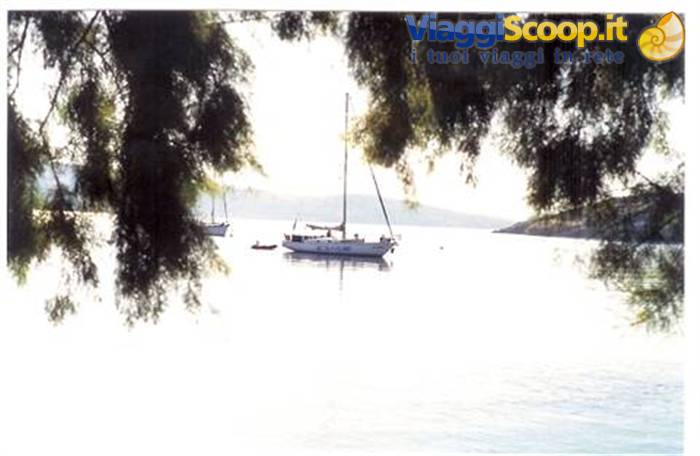
Sailboats anchored in a calm bay, framed by green branches, soft light
Day 231 May 1999
Monday 31 May. Kusadasi, We settle our accounts with the Marina, buy a new battery, check that the electrical system works properly (which anyway needs redoing) and do a minimal provisioning. We are eager to leave. Kusadasi has by now tired us. It seems it does not want to let us go. Even though the people we meet are always cordial and helpful, there is something that troubles our relations. The Ocalan trial is under way. A shopkeeper refused to sell us a bag because "the Italians are terrorists". It is the first time I feel judged differently from the cliché "Italians, good people". I understand now how an American must feel travelling around the East.
Tuesday 1 June. From Kusadasi to Posidonio (Samos) 20 miles. Finally! The boat is in the water. We test the new engine (a Nanni Kubota 38 HP). All OK. Gattadapelare has become a motorboat. We set off at 14.00. Rough sea with no wind. We head towards the south-eastern tip of Samos with the intention of reaching Arki, a little-known islet that is part of a modest archipelago between Samos and Patmos. The wind finally rises when we are at the mouth of the strait between Samos and Turkey. We raise the Greek courtesy flag. (Though we must admit the Turkish one is prettier). Now we're flying along. We pass along the Greek coast and see, just after rounding the point, a little bay with three boats at anchor; but we are going too fast to make a quick decision, it is 18.00 and there is still sun. After a few miles we realise that we will arrive too late at Arki anyway.
There are still 25 miles to go. We decide to go back to the little bay glimpsed before. And it is an excellent choice because we anchor in three metres of depth about a hundred metres from the shore where there are some tavernas and a small hotel. We go ashore with the tender, rowing (the outboard won't start), and moor directly at the taverna's table. We like the place. In Greece we feel at home. The phrase that is repeated to us several times a day by the waiter, the taxi driver, the shopkeeper, or the passer-by we have asked for information: "Italians? Same face same race," is profoundly true. The waiters bend over backwards to serve us, but we sense in them more sympathy than flattery. We meet the owner, who has married an Italian woman, Rossana. Everyone bustles about to find a blacksmith who can weld the bronze stop of the windlass.
Without it we would have to do all the manoeuvres by hand. There is no one locally and tomorrow Rossana will drive us in her car to Samos town.
Wednesday 2 June - Posidonio The day presents itself splendid and bright. Rossana, a very likeable Sicilian from Samos, takes us to Samos town to a workshop that promises to have the part repaired for us by tomorrow morning at 9.00. We spend the rest of the day idling. I thus discover that the nearby town (port and airport) Pythagorio, about 5 miles from here, was the birthplace of Pythagoras. Here, in 580 BC, was born that great mathematician, and extremely tedious individual, who entertained us in our youthful years with the square of the hypotenuse and the famous table. From here, in disagreement with the tyrant Polycrates, he moved to Croton where he stifled with his philosophical approach to life (austerity, no wine, no sex, no eggs, meat or beans) its inhabitants, who, in the end, did him in.
No one knows (but from today there is one more who does) that it was Pythagoras who first formulated the theory that the earth was round and part of the cosmos. In the evening, with a fully efficient tender (clogged jet), we go down to our taverna where there is a special evening with Greek music and dances. And so this day too passes, to the sound of the sirtaki.
Thursday 3 June - From Posidonio to the island of Marathi (Arki). 22 miles. Naturally the part is not ready. Rossana takes us to the pharmacy at the port of Samos where Marzia buys an antiallergic. She has a spectacular rash. To hide it we also buy some cotton knee socks (gloves can't be found) which, suitably cut, will serve as half-sleeves. Effect: the leper of Calcutta. We return by taxi because our hostess has some errands to run. We have our windlass stop and at 12.00 we set sail. Immediately we encounter our Venturi effect and fly along at 7-8 knots driven by a decent meltemi. The sea is covered with whitecaps and we are reefed. It is a pleasure to feel the boat cutting through the waves with the rustle of freedom from dry land. We proceed on a broad reach and see the archipelago of Lipsi, of which Arki is a part, drawing near.
We don't know much about this island, which is described in the pilot book in a couple of lines, and we proceed with caution over unknown depths. We know it is sparsely inhabited (40 permanent residents), but we see no buildings ashore. To our starboard there should be a couple of well-sheltered anchorages. We follow a boat that is looking, like us, for a bay in which to drop anchor for the night. But we don't like the place. The wind is stiff and there are rocks to leeward. We decide to head for an islet 2 miles away which, to windward, should shelter us better from the meltemi. From where we are we see the masts of three boats at anchor. The decision proves fortunate because Marathi (MARAFI, that is the island's name) offers about ten mooring buoys available to guests. A small pier invites us to go ashore.
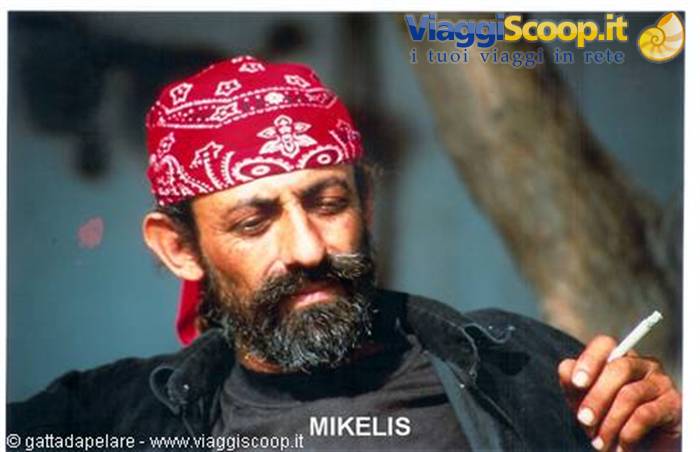
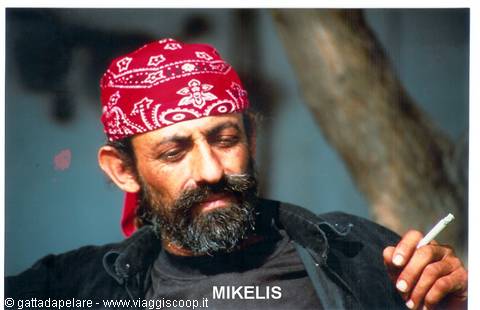
Thus we meet Michele, the pirate-innkeeper owner, along with his brother "Geronimo" and the sister of the YAROTABERNA ENOIKIAZONEMA DWMATIA (as it is written on the postcards. telephone: 0030-0247-31580/32795). It is a simple taverna on the seashore consisting of two rooms and five little tables. Not far away there is a two-storey building with five rooms on the first floor accessed by a balcony suffocated by bougainvillea. The other building on the island is a family-run little hotel of about fifteen rooms. The permanent population is about fifty goats and five people. Among these emerges, but not for his height, the figure of Mikelis. Apparent age forty, short, dark, thin, long hair hidden in a piratically knotted kerchief, suitable beard and moustache, deep and timid eyes. Mikelis is a man of few words and after getting to know us better he tells us the story of his life.
It is not a particular story, but a significant one. At 13 he fled on a fisherman's boat from the prison-island on which his family has lived for generations. He wanted to see the world. He became a sailor, travelled all the seas and knew all the continents. Then he decided to return to that small strip of land that can be crossed in a quarter of an hour. He tells us of when, as a child, he rowed for an hour to reach Arki where the only school in the area was, and of his parents' village, up there beside the chapel with the blue dome. Today only the crumbling walls of a few stone houses remain, a refuge for the goats from the summer heat. Michele, after having seen the world, discovered that even the rock of a small archipelago can be as big as the world.
At dinner a small crowd occupies the few tables of the taverna: there is Davros, the fisherman, Hans and Inge, Swiss from Basel, an Austrian skipper with some clients of unknown nationality, a couple of Americans, and us. Meanwhile the wind has dropped and the night is a full moon.
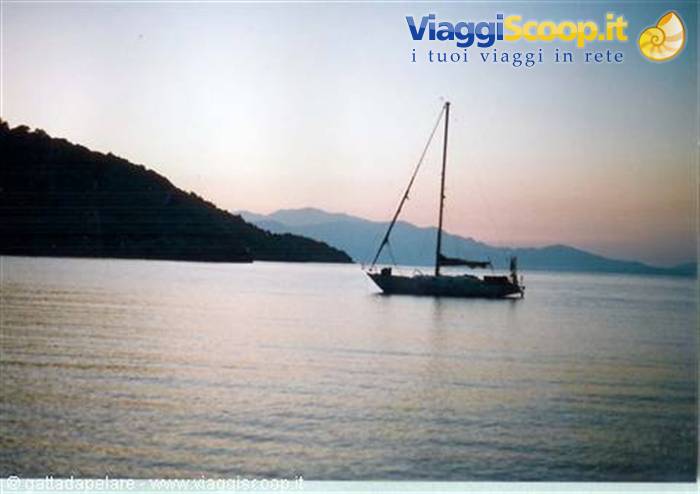
Sailboat anchored in a bay at dusk, dark mountains behind
Day 34 Jun 1999
Friday 4 June. Marathi We wake early to catch the best light for photographing the little church with the blue dome.
The day is beautiful. No wind and no sultriness. Pressure at 1039. On the other side of the island the sea is even bluer. We choose flat rocks that slide into the blue to take a long swim. As far as the eye can see there is no human presence. We spend the morning this way. From a bush I steal an egg from a hen. I make a hole at each end with a thorn and drink it greedily. I don't know how many years it has been since I last did such a thing. Sucking hard at the egg white, suddenly feeling the sweet taste of the yolk that ends with the slurp of air entering from the other little hole, it all takes me back to my childhood, to memories of summers spent on holiday in a small village in Umbria.
Mikelis prepares us a Greek salad. We return to the boat and I devote myself to fishing with the rod using breadcrumbs as bait. The success is exhilarating. It had been years since I fished so much. About fifteen sea bream of acceptable size and some bogues end up in our fridge-boat. We dine on lobster and dance the sirtaki.
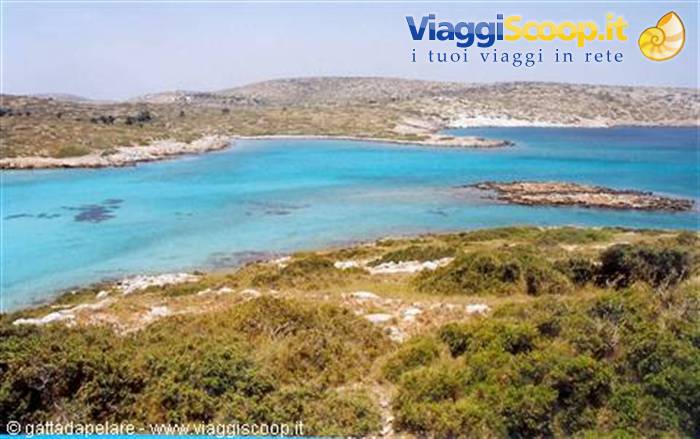
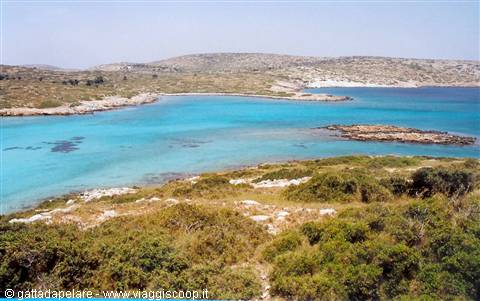
Saturday 5 June. From Marathi to Patmos. 15 miles The barometer reads 1040. This day too presents itself calm and bright. After breakfast at the taverna we say goodbye to Michele, his dour sister and his brother with the Indian face. Tavros, the fisherman, gives us three large mackerel which are added to my catch. We head for Arki to take a look at its coast and then at a bay that has been pointed out to us as a "blue lagoon". Here the water is truly that colour. We take a couple of unforgettable dives. At 14.00 we head for Patmos which is almost hidden in the fair-weather haze. We proceed under motor among islands and islets until we leave the small archipelago behind us. Patmos, says the legend, lay on the bottom of the sea when, illuminated by a moonbeam, it was seen by Diana who asked Poseidon to bring it to the surface.
Thus it appears to us, as we draw near, beautiful as in the eyes of the Goddess. Our destination is an inlet where there should be a shipyard that, on the advice of the Austrian skipper, can haul our boat ashore. We do a reconnaissance tour and indeed see the masts of some boats among the olive trees; but no trace of slipways. At 17.00 we anchor in Grikos, a village south of the island's main port, facing a delightful bay. Ashore we hire some mopeds to go and visit Chora, the little village perched around the Monastery dedicated to John the Evangelist. And yes, because St John here had the vision of the Apocalypse and in 18 months wrote that heck of a prediction whose maximum threat is in "a thousand and no more than a thousand". So be it, but the thought goes disturbingly to the night of the coming New Year's Eve.
The monastery (built in 1080) is in lava stone, severe and grey. Around it first arose the little houses of the workers and later those of the peasants who sought here comfort from pirate attacks. The houses are rigorously snow-white and create a notable contrast with the bulk of the castle. The whiteness of Chora can be seen from miles and miles away and Patmos is almost a lighthouse in the Aegean. At the restaurant Vangelis we meet a Swiss who recommends we go and visit the uninhabited islet of Aspromisis, near Lipsi. He says it is a Caribbean island. By now, for this time, it's gone, but we promise ourselves to go there in October. From the height of Chora the gaze ranges over the whole island. It seems cut out by a fanciful child from a sheet of blue paper. It is a succession of inlets, bays, little beaches with a spectacular effect hard to compare.
We go down to Skala, the island's capital and tourist port. We like the town immediately. It rises on an isthmus and is not very touristy. We meet Tavros, the fisherman. He owns a fish shop here in partnership and finds us a gasket to repair our toilet which is out of order. We do a bit of shopping, including more rolls of film. Marzia shoots photographs like a Chechen with a Kalashnikov. We dine on the boat with our grilled fish. We can't manage to eat it all.
Sunday 6 June. From Patmos to Livathi. 20 miles The barometer reads 1040. We go by moped to the shipyard to take a look at whether it is worth leaving Gattadapelare here until October. But it is Sunday and we cannot enter, yet we see some boats of greater tonnage than ours, neatly lined up. It seems fine. Gatta will spend the summer here. I will take the opportunity to have those repair jobs that are still missing done. We return to Skala for an aperitif and also because at 10.00 we have an appointment with Tavros to phone his friend Sozon (the owner of the shipyard). At five to midday we are in front of the cave where the apocalyptic John had his inspiration. An equally apocalyptic pope warns us that we have only five minutes, then...!! At 15.00 we weigh anchor and head for the island of Levathi. The north-west wind is excellent: 10-12 knots.
We fly along in a sea white with whitecaps, leaving the view of Chora behind us. At 19.00 we reach the deep inlet on the south-east of Levathi.
The island is indicated as deserted, except for a taverna open seasonally. Good shelter from the meltemi. Indeed the wind has been steadily strengthening and we enter happy to have reached a shelter for the night. We discover we are not alone. Four other boats have preceded us. Among these one flies the Italian flag. No house is to be seen. Only a sign on the shore indicates an improbable taverna inland. Having left the boat with some perplexity due to the rising wind (for prudence I have dropped a sentinel anchor with 15 metres of line on a 5-metre bottom), we go up inland along a stony path barely traced among the stones. It begins to get dark. When after ten minutes we reach the taverna we discover that it is in reality a series of low buildings placed casually around a courtyard. There is also a pergola with a table and about ten chairs.
The Italians (unsociable) are leaving and we are left alone. The wind blows through the pergola. The innkeeper appears, or rather the innkeepers. They are three brothers between twenty and thirty who prepare us grilled fish and Greek salad. Naturally all washed down with retsina. Thus we make the acquaintance of these young men, half shepherds and half fishermen, whose family has lived on this island for 300 years. They are, together with their parents, the only inhabitants of the island. But we discover that their life is very varied and their cultural level much higher than many city kids. The eldest, married (but his wife lives on Patmos where he goes frequently to deliver the catch) is called Tavros (him too! Could it be the name of fishermen in these parts?). Through Marzia, who acts as interpreter, we talk about the sea, the wind, politics and war.
The middle one is in charge of the barbecue. He is rather surly and a man of few words. The youngest complains that it is difficult to find a girl willing to live most of the year on the island. His face lights up with hope when Marzia expresses amazement because she - she says - would come to live on this island (she forgets to add: during the holidays). We return to the boat under an extraordinarily starry sky. No light dims that of the stars. We recognise Vega, the Pleiades, the Dragon, Arcturus, and,
Tourist map of Ikaria island showing mountains, bays and pink sailing route
Day 47 Jun 1999
Monday 7 June. Levitha. The barometer still reads 1040, the sky is clear and a good wind is blowing. Towards 10.00 the gusts at the masthead push at 12-15 knots which means at least 20-25 outside. We notice we are dragging and take a line ashore. Tavros and his brother help us with this. Since we have the 50-metre floating line we take the opportunity to set a bridle. A good idea because the wind shifts from north to north-west and alternately both lines work. The other boats left early this morning and we are down to two. With the boat well secured we go ashore to explore the island.
Our objective is the height overlooking the sea where, Tavros told
Tourist map of Ikaria island showing mountains, bays and pink sailing route
Day 511 Jun 1999
Friday 11 June. Naussa. At 8.00 Cocò (alias Constantin) calls to let us know he has landed. We give him instructions on how to get to us and, indeed, at 9.00 there he is on the shore waving his arms to be picked up. The poor thing spent a sleepless night at Athens airport, but we don't care much. We immediately force him to set off on the scooters in search of a Mycenaean-era acropolis that should be a short distance away. We ask a farmer who points us to a hill. We attempt to climb it, but our shoes are unsuited to it, so Marzia and I give up, while Constantin triumphantly reaches the plateau. He then reports that there were no archaeological remains to be seen, which consoles us a little.
Cocò teaches us a recipe for breakfast: yoghurt (strictly Greek), honey and lemon juice. On the chairs of a deserted café in Naussa, on the seafront, we have this experience. Excellent!! Marzia and I agree that Contantin did well to come with us to Greece. Marcus calls us to say he has arrived in Mykonos. We urge him to be careful. The island has a dubious reputation, or rather a clear one.. We stock up on cash in Paroika, the main town of Paros 15 km from Naussa and 2 from the airport, and return to Naussa where the day passes among photographs and coffees. In the evening we have dinner on the pier of a small fishing harbour. Very folkloric. Above our heads hang strings of octopuses drying in the air. In front of us the sun sets behind the old Venetian fort. Before going to sleep we observe the stars again.
Saturday 12 June. From the island of Paros to the island of Mykonos. 21 miles. We wake up to a dead calm day. Constantin expresses all his delight as a frustrated and mouldy Bavarian by taking his morning dip in the incredibly clear water. With a shout of joy. The barometer is at 1040. After taking on diesel (75 l.) and water (400 DR), at 10.30 we head off at 10°. The wind is weak and we proceed under engine only. We take advantage of the calm to spruce up the boat. Deck, stanchions, teak, compass, everything gets scrubbed and polished. Constantin pays for his passage by working hard. The island of Mykonos slowly draws near. To its left lies Delos, the floating island where Diana and Apollo were born. From that moment it became fixed to the bottom of the sea and became famous. It's the destination of tomorrow's trip.
You're not allowed to reach it with your own boat and there are special ferries that leave from Mykonos harbour several times a day. In the strait between the two islands the wind strengthens and comes head-on. At 14.30 we toss the line to Marcus who is waiting for us on the pier. Twenty-five metres of chain in the direction of the wind over a five-metre depth. Naturally still with the anchor set. A walk through the town's little streets immediately makes us understand why it's so famous. Behind every corner you discover views that we absolutely must bring home. Most of the postcards sold in the Aegean depict corners of Mykonos or Santorini. The "Bambina" works at full tilt and Marzia gets mistaken several times for a professional photographer.
It's very hot and we look for a beach to cool off, but we have no luck. The only one that seems welcoming turns out to be polluted by balls of grease floating among the waves. It's the result of "tavern pollution". The whole town is one big restaurant that in the evening fills with thousands of people, of uncertain sex, under the ironic gaze of the three pelicans adopted decades ago by the islanders. We have dinner too and observe our neighbours at the table. There are all kinds. It reassures us a little to have Marzia with us; her presence normalises the group, which otherwise might even seem questionable. On returning to the boat we find that an enormous ferry is on top of our anchor, perpendicular to us. Meanwhile the wind has increased and the bulk of the ferry acts as a Venturi tube for us. We're forced to run a line crossways from the bow to the pier.
Once again I'm happy with my 50-metre floating line. I have the chance to widen the pulling angle this way and guarantee better resistance to the wind.
Sunday 13 June. Mykonos. Unfortunately today there are the European elections and the ferries to Delos are stopped. We absolutely must set off again tomorrow to arrive in time for the rendez-vous with Elke and Gerlinde, in Samos. Marzia is leaving too. The day after tomorrow at 7.30 the Thai Airways plane is waiting for her in Athens to take her back to work. She decides to go to Athens tomorrow morning early with the 5.30 flight and spend the day on the Acropolis taking photos. With Constantin I attend another funeral commemoration in church. Here too, at the end, there's the distribution of a dusty cake and sandwiches with a funereal black cross on top. We bring this breakfast to Marcus, who stayed in his bunk, and who, incomprehensibly, refuses it. We spend the rest of the day strolling through the little streets of Mikonos, taking photos and watching people.
We miss the solitude of Levitha and the simplicity of Marathi.
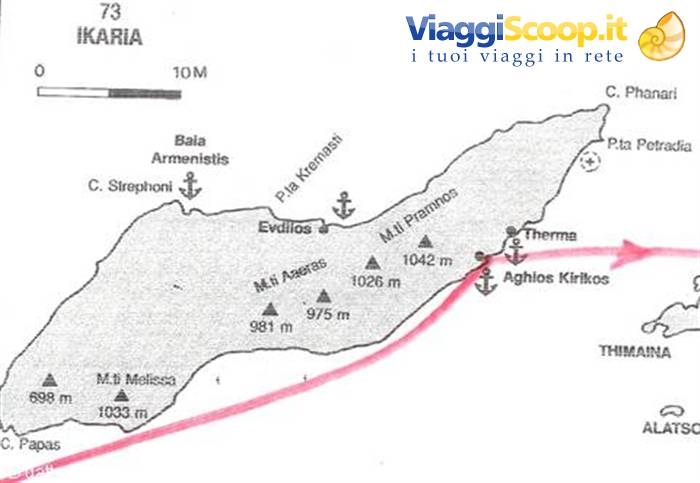
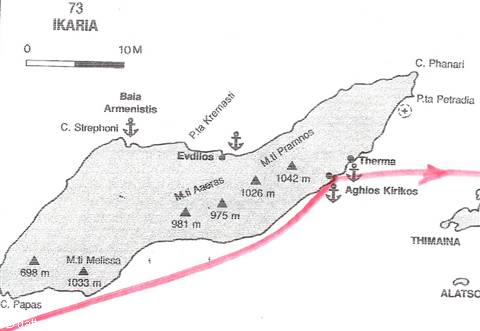
Monday 14 June. From Mikonos to Kirikos (Island of Icaria) 55 miles. With a terribly early start at 4.00 Marzia leaves us. The taxi takes her to the airport which is half an hour from here. A new ferry is on our anchor, but we've been told it will leave at 9.00. I glance at the barometer: it reads 1038. The meltemi blows merrily and the sea is white with little wave crests. I go back to my bunk and wait for departure time. At 9.45, finally free to weigh anchor, we set off with one and a half reefs. Wind astern as far as the beam of Cape Prasonissa, the extreme south-west tip, and then we head east towards the island of Icaria, made famous by Icarus's disastrous landing. (For the record: Icarus fled from Crete with his father Daedalus, who had built him two wings out of wax and feathers so they could escape the labyrinth, Minos's prison.
Having flown too close to the sun, the wax melted and Icarus fell). Our pilot book is limited to the Cyclades and we have no certain knowledge whether we'll find a harbour in the place we've chosen: Kirikos. As soon as the island of Mikonos exposes us to the meltemi we start flying along among spray and heeling down to the gunwale. Marcus is of little help, a bit of seasickness keeps him lying in the cockpit. On the western tip of Icaria the wind strengthens to around 20 knots. We keep a couple of miles off the island, which is very high above the sea, because we fear the gusts coming down from the mountains. Unfortunately this way we're not exposed to a more formed sea and we get continuously wet.
It starts to get cool and the uncertainty of the landfall weighs down the journey. On our starboard side, far away at the edge of the horizon, we see the white of Chora. Finally at 18.30 we see a pier jutting into the sea in front of a village. This is Kirikos. The harbour exists. At 19.15 we moor bow-to on the leeward little pier, the only one it's possible to moor at. Besides us there's a boat flying a Swiss flag and a barge with some German tourists. We breathe a sigh of relief. It couldn't have gone better. Just when things were going well, (we're about to go ashore to look for a taverna) a gesticulating Greek comes over and starts casting off our mooring lines. We resist and shortly afterwards, summoned by the hulking brute, a military man from the Harbour Master's office arrives and asks us to move because the spot is reserved for a tourist barge.
Reluctantly we move and, again bow-to, we moor on the head of the pier where there's a strong and annoying backwash. But we have to
Marathi
Day 615 Jun 1999
Tuesday 15 June. From Icaria to Samos (Posidonio). 41 miles. Bacon and eggs for breakfast and departure at 10.00. The barometer reads 1035, the lowest value since the start of the cruise. But anyway my theory that if the pressure drops the meltemi decreases isn't true. The weather is fine and last night you could hear the wind blowing in the masthead. Now it has dropped and we fly over the waves. On the tip of Samos, as usual, the wind strengthens and comes onto the beam. The GPS rises from 8 to 9 and then to 9.5, 9.7, 9.9 and......whoops 10 knots. Gattadapelare seems like a motorboat. It's a wonder that with its 7 tonnes it doesn't start to plane. In the strait between Samos and Turkey we have wind shifts, sudden lulls and exciting gusts. At 17.20 we arrive in front of Posidonio's taverna. Elke and Gerlinde's arrival is expected at 19.00.
We've booked a little apartment for them at Rossana's, not yet ever lived in. The building is so new that only the ground floor is finished. Marcus goes for a run.
Finally, in a taxi, the ladies arrive.
They like the place, the suite is well received (they were sure they'd have to sleep in a bunk tonight), the table on the seafront is appreciated. (Fish Tavern and Studios F.lli Kerkezos. Tel. 0030-0273-22267) We have dinner with a mixed plate of grilled fish. Rossana's husband comes to compliment us on the choice of menu. I saw him rubbing his hands as he walked away. We set up a new kitty which, however, is immediately drained. Gerlinde is appointed treasurer, with ill-concealed disappointment on Cocò's part, who for three days had (with suspicions of shortfalls and illicit enrichment) administered the previous kitty. The place is so pleasant that we decide to stay here tomorrow too.
Wednesday 16 June. Posidonio. Constantin and I play tennis while the rest of the would-be crew sleeps. It's 8.00. A sunny day with no wind. After breakfast we spend the hours on the seafront lounging with our deckchairs in the water, served by the taverna waiter.
A day without history, but absolutely relaxing. At least for some of us. In fact, Marcus, by appealing to Cocò's pride, manages to get him involved in an endurance race. The deckhand of Gattadapelare comes back complaining of a muscle strain. In the evening there's a sirtaki show. The local pirate (every landfall has one, here in the Aegean) performs together with some tourists.
Thursday 17 June. From Posidonio to Marathi (Arki). 22 miles.
We leave at 10.00 with the barometer reading 1037. There's not a breath of wind. By now we're certain that the ladies have struck a pact with Neptune. To pass the time they practise their sailor's knots. Elke is unbeatable at the flat fender knot and Gerlinde at the bowline. At 14.00 we're at the blue lagoon. The crew likes this place too and we stop for lunch and to take greedy dives and swims. At 17.00 we arrive at Marathi. Mikelis, his sister tells us, is in a state of hypnosis. We understand that he's asleep. Marathi is as we left it with Marzia. The same atmosphere of suspended time. You only hear the little bells of the goats and the clucking of the hens.
Unfortunately Mike doesn't have lobsters today, and suggests we wait until tomorrow evening. We gladly accept this hitch. There are three other boats in the anchorage, but the crews don't come ashore. Today too the ladies are fine with it; they take a room in Mikelis's "hotel". It's simple, but new and welcoming.
Friday 18 June. Marathi. We have Mikelis serve us breakfast with fried eggs and coffee while we watch two children of six or seven (Mike's grandchildren?) who play very skilfully with a rowing boat. When they grow up they'll be accomplished seamen. We spend the morning on the west coast of the island where the sea is a particular shade of blue. Marcus has stayed behind to study at the taverna. Gerlinde, decked out like an early-20th-century English lady, collects sea snails with the water up to her knees, Elke frolics along the shoreline while Constantin wanders along the cliff, also "hunting" for snails. The skipper observes everything and will hand it down to posterity. We collect sea snails in large quantities for the sauce of tonight's pasta.
This too presents itself as a day of complete relaxation. With our feet wet from the rising tide, our heads in the shade of the tamarisks, the breeze caressing our skin, we spend the afternoon dozing on the little beach on the east shore, the one facing the taverna. Then I start fishing, once again with great success. At sunset, in the cockpit, while lazily watching the arrival of a German boat, we sip iced ouzo (home-made, the ice. Finally after three years I've had the boat fridge put back in working order). The dinner menu at Mikelis's includes: spaghetti with the skipper's sea snails (cooked al dente by me), delicately grilled lobster, Greek salad, the house retsina. Under an ever starry sky Marcus, Constantin and I go off to our bunks, Gerlinde and Elke to their "hotel".
Mikelis pirate of Marathi
Day 718 Jun 1999
Tuesday 15 June. From Icaria to Samos (Posidonio). 41 miles. Bacon and eggs for breakfast and departure at 10.00. The barometer reads 1035, the lowest value since the start of the cruise. But anyway my theory that if the pressure drops the meltemi decreases isn't true. The weather is fine and last night you could hear the wind blowing in the masthead. Now it has dropped and we fly over the waves. On the tip of Samos, as usual, the wind strengthens and comes onto the beam. The GPS rises from 8 to 9 and then to 9.5, 9.7, 9.9 and......whoops 10 knots. Gattadapelare seems like a motorboat. It's a wonder that with its 7 tonnes it doesn't start to plane. In the strait between Samos and Turkey we have wind shifts, sudden lulls and exciting gusts. At 17.20 we arrive in front of Posidonio's taverna. Elke and Gerlinde's arrival is expected at 19.00.
We've booked a little apartment for them at Rossana's, not yet ever lived in. The building is so new that only the ground floor is finished. Marcus goes for a run.
Finally, in a taxi, the ladies arrive.
They like the place, the suite is well received (they were sure they'd have to sleep in a bunk tonight), the table on the seafront is appreciated. (Fish Tavern and Studios F.lli Kerkezos. Tel. 0030-0273-22267) We have dinner with a mixed plate of grilled fish. Rossana's husband comes to compliment us on the choice of menu. I saw him rubbing his hands as he walked away. We set up a new kitty which, however, is immediately drained. Gerlinde is appointed treasurer, with ill-concealed disappointment on Cocò's part, who for three days had (with suspicions of shortfalls and illicit enrichment) administered the previous kitty. The place is so pleasant that we decide to stay here tomorrow too.
Wednesday 16 June. Posidonio. Constantin and I play tennis while the rest of the would-be crew sleeps. It's 8.00. A sunny day with no wind. After breakfast we spend the hours on the seafront lounging with our deckchairs in the water, served by the taverna waiter.
A day without history, but absolutely relaxing. At least for some of us. In fact, Marcus, by appealing to Cocò's pride, manages to get him involved in an endurance race. The deckhand of Gattadapelare comes back complaining of a muscle strain. In the evening there's a sirtaki show. The local pirate (every landfall has one, here in the Aegean) performs together with some tourists.
Thursday 17 June. From Posidonio to Marathi (Arki). 22 miles.
We leave at 10.00 with the barometer reading 1037. There's not a breath of wind. By now we're certain that the ladies have struck a pact with Neptune. To pass the time they practise their sailor's knots. Elke is unbeatable at the flat fender knot and Gerlinde at the bowline. At 14.00 we're at the blue lagoon. The crew likes this place too and we stop for lunch and to take greedy dives and swims. At 17.00 we arrive at Marathi. Mikelis, his sister tells us, is in a state of hypnosis. We understand that he's asleep. Marathi is as we left it with Marzia. The same atmosphere of suspended time. You only hear the little bells of the goats and the clucking of the hens.
Unfortunately Mike doesn't have lobsters today, and suggests we wait until tomorrow evening. We gladly accept this hitch. There are three other boats in the anchorage, but the crews don't come ashore. Today too the ladies are fine with it; they take a room in Mikelis's "hotel". It's simple, but new and welcoming.
Friday 18 June. Marathi. We have Mikelis serve us breakfast with fried eggs and coffee while we watch two children of six or seven (Mike's grandchildren?) who play very skilfully with a rowing boat. When they grow up they'll be accomplished seamen. We spend the morning on the west coast of the island where the sea is a particular shade of blue. Marcus has stayed behind to study at the taverna. Gerlinde, decked out like an early-20th-century English lady, collects sea snails with the water up to her knees, Elke frolics along the shoreline while Constantin wanders along the cliff, also "hunting" for snails. The skipper observes everything and will hand it down to posterity. We collect sea snails in large quantities for the sauce of tonight's pasta.
This too presents itself as a day of complete relaxation. With our feet wet from the rising tide, our heads in the shade of the tamarisks, the breeze caressing our skin, we spend the afternoon dozing on the little beach on the east shore, the one facing the taverna. Then I start fishing, once again with great success. At sunset, in the cockpit, while lazily watching the arrival of a German boat, we sip iced ouzo (home-made, the ice. Finally after three years I've had the boat fridge put back in working order). The dinner menu at Mikelis's includes: spaghetti with the skipper's sea snails (cooked al dente by me), delicately grilled lobster, Greek salad, the house retsina. Under an ever starry sky Marcus, Constantin and I go off to our bunks, Gerlinde and Elke to their "hotel".


0 reader comments