Tuesday, 5 October 1999 - From Rome to Samos (by plane) Marcus and I set off with the usual Thai, with work left behind in a great hurry. After waiting for a few hours in Athens, (where our luggage doesn't get off the plane) here we are arriving in Samos on a domestic flight. It's evening and the island's small airport is packed with tourists on their way out. To add to the confusion, the power goes out all over the island. Hoping that our suitcases have been routed here, we wait in the dark for the conveyor belt to start moving again. I buy a lighter and many others do the same. We look like a demonstration of pacifist protesters.. After a certain, dutiful wait, truth be told with little hope, we convince ourselves that the luggage has gone to Bangkok. We decide to have ourselves taken to Pythagorio by taxi.
Still wrapped in darkness, we wander aimlessly through the alleys of the little town in search of a hotel. At the end of our groping wanderings, we stumble into a little hotel on the harbourfront (I should say portico-front, because Pythagorio is all gathered here). The room isn't great, but it has a delightful little balcony overlooking the small restaurant below. We dine by candlelight in the little restaurant, put together a bit of a "larder" for breakfast and go to bed. In the dark.
Wednesday, 6 October 1999. Pythagorio (Samos) - Skala (Patmos) The hydrofoil for Patmos leaves at 13:00. After an adequate breakfast with yogurt with honey and lemon juice (according to the Constantinian recipe we promptly adopted: a pot of full-fat yogurt, three teaspoons of honey and a generous squeeze of lemon) eaten on the balcony of the "hotel", we go off to discover the antiquities of Pythagorio. The acropolis, in truth a modest rise on the cliff, is occupied by a panoramic cemetery and topped by buildings from various eras. Remains of columns and capitals from the Hellenistic period of the temple of Athena, a ruined late-medieval castle and a modern church all mingle together. More evocative instead is the ancient pier that emerges to trace the outline of the current one. From here Pythagoras set off for Magna Graecia.
The Dolphin, half-empty, doesn't take us directly to Patmos but makes a long loop around the surrounding islands. The Furni archipelago looks very nice. The little village makes you want to come back for a calmer mooring. We then continue on to Icaria where we pick up some passengers from Ag. Kirikos. So we see again this little harbour where four months ago we spent a rather eventful night because of the swell. The village doesn't offer much and for this reason isn't frequented by tourism. The entire island of Icaria isn't an interesting tourist destination. At 16:00, finally, we arrive at Patmos. We find the boat in the water, as ordered by phone, and immediately go off to moor at Skala. Comfortably stern-to. In all, a dozen boats are moored along with us. Thursday, 7 October 1999.
From Patmos to Marathi - 15 miles The atmosphere of peace that the islet of Marathi transmits to us entices us to move Gattadapelare in its direction. The day is calm and in the absence of wind we proceed under motor. It's 10:00. Having left the eastern tip of Patmos behind, we head for the northern tip of Marathi to enter it from a direction we have never tried. The coast on the left (Arki) and the one on the right (Marathi) are deserted and fascinating. The bilge pump is out of order and on top of that water keeps coming in from the exhaust. Curses and elbow grease. Marathi is as we left it: a corner of peace. There are five boats moored stern-to the quay and Mikelis who is waving because he has recognised us. He's dressed in shiny black, like an elegant pirate.
We meet a few characters: a Swedish double-graduate, talkative, at the head of a table of eight people of various nationalities, a dignified, old, bearded fisherman named Vangelis busy cleaning the hooks of his line, and also Gianluca from Pinerolo, in life the manager of an alpine hut in the Val d'Aosta and a professional live-in assistant in the meantime, constantly in search of lost corners of the world. And so the evening passes, amid fish and wine. After thirty days of abstinence I'm a bit "tipsy".
Friday, 8 October 1999. From Marathi to Leros. 15 miles. Today the meltemi is blowing. Already last night there were warning signs: the deck was dry and the sky starry. Tonight, out of an inveterate skipper's habit, I got up to take a look; not so much to check the mooring, securely fastened to the mooring block, but to get an idea about our departure. The halyards had started flapping and I had to tie them off to sleep peacefully. We have breakfast under the tamarisks with eggs and bacon and lazily watch the arrival of an Austrian catamaran and the departure of the few other boats. We have some fava purée brought to us and retsina. Under the name fava they identify various purées, often of chickpeas, sometimes of fava beans, which dressed with olive oil and fresh onion represent one of the tastiest side dishes of Greek cuisine. At 15:00, Marcus and I decide to continue the journey.
Luca (Gianluca Onida, fraz. Inverso Cognetti 2, 10060 Villar Pellice.TO-, tel. 0121 930145) takes the opportunity to hitch a ride on a boat and brings his big military backpack aboard. After warm goodbyes to Mike, the glass-holder of the tiller, and the gift of a bottle of ouzo from the likeable "pirate", we set off with a half-furled jib and two reefs in the main. On the crest of the waves we surf at 9 knots and watch the islets of Lypsos and the northern coast of Leros slip by quickly. We don't have the pilot book with us, as it was left in the luggage diverted to Bangkok, so we head into the first bay to the north-east, Alinda bay, near the village. But there's too much wind and the little pier is battered by the waves. From memories of past readings there should be a better shelter behind the promontory, dominated by the ruined castle-monastery of the Hospitaller friars.
Having rounded the windy Panteli point, indeed, the village of Platanos and its little harbour, well sheltered, come into view. We find a spot in the second row, leaning against a German boat. The village looks pleasant, straddling a knoll, with the remains of some windmills and a row of tavernas along the shore. There's no tourism at this time of year, but in summer a scheduled plane lands every other day. We discover a little taverna on the shore with aspirations of being a village pub, frequented by a few locals and a couple of sailors like us. The food is tasty (small grilled fish with salad and the inevitable retsina) and the local characters interesting. We invite Luca to sleep on the boat with us and retire to our berths.
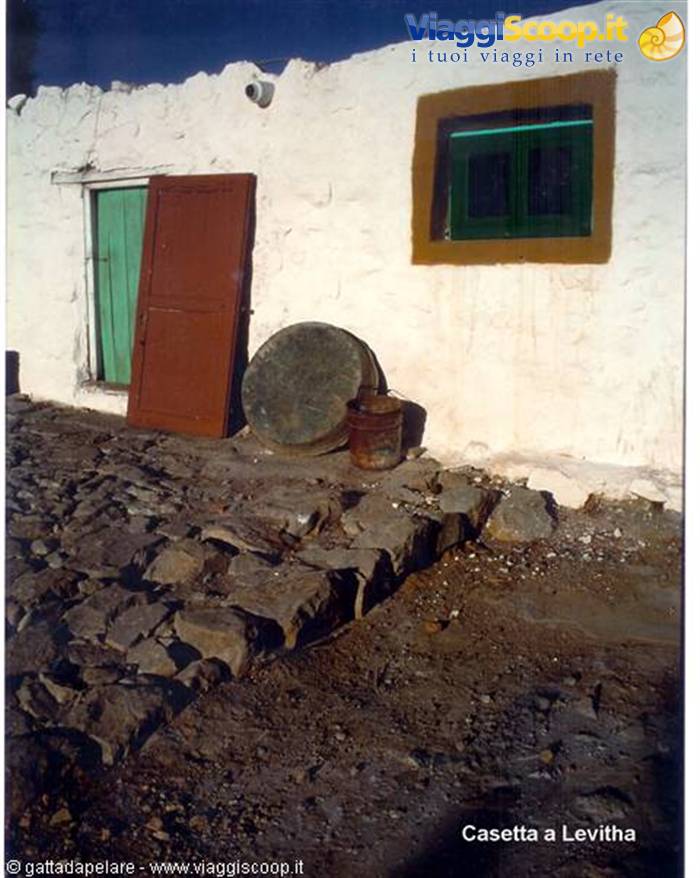
The only little house of Levitha
Day 29 Oct 1999
Saturday, 9 October 1999. Leros. Today our luggage should arrive. We have a taxi take us to the airport, at the northern end of the island. More than an airport it looks like a road-maintenance depot. The runway, short and uphill, runs from north to south, according to the direction of the prevailing wind. A plane lands every two days. Today the airport is closed and we struggle to track down the only staff member, who confirms that the luggage has arrived and is at the Olympic office in the "city". So it is. A bit the worse for wear, we recover our things, including the pilot book and the GPS, indispensable for knowing our future routes. Well, not exactly indispensable, since the skipper has been able, on other occasions too, to always reach his destination.
Who said self-esteem is always a sin of pride? In the afternoon we decide to reach the remains of the monastery-fortress that dominates the village from the top of the mountain. The view is very beautiful. To the south we see the islets of Kiriaki and Piganoussa and the hazy coast of the island of Kalimnos, almost attached to Leros. Peering into the distance, to the east, in front of the Turkish coast, you can also see the islet of Farmako where Julius Caesar, at eighteen, was held prisoner by pirates until the ransom was paid. (For those who don't know, a few years later, by then established, he returned and made mincemeat of them). We dine at our usual taverna where we meet the same faces: the chubby innkeeper, the old man, with his bottle of wine, who seems to mumble continuously, nodding to an imaginary interlocutor, the young local couple, the lone French skipper.
Tonight Luca leaves us: he takes the ferry to Athens, where he will arrive tomorrow morning early. The barometer reads 1017.
Sunday, 10 October 1999. From Leros to Kos. 20 miles. We set off at 10:00 with a north-easterly wind at 13 knots and head south, reefed, so as not to subject the boat to unsettling stresses. Indeed, despite the boatyard's work, the mast "pumps" with every wave and makes Gattadapelare creak. It's nothing serious, but it's alarming. We watch Kalimnos file past on our right and observe from afar the wary behaviour of a Greek patrol boat that, half-hidden by an islet, faces the Turkish coast very close to us. Indeed, you can see the ugly tourist resorts that, monotonously, dot the hills north of Bodrum. A pity, because otherwise the coast would be beautiful. We cross paths with an old tub of a boat, riding high on the waterline because it's travelling empty, dented and rusty. They greet us cordially. The thing leaves us puzzled.
A feeling? In the strait between Kos and the Turkish mainland the wind strengthens due to the Venturi effect. We have it on the quarter, but it tends to shift towards Kos as soon as we round the point. On entering the harbour, with a tailwind, I start the engine, bring the bow into the wind and we drop sail. And here the unforeseeable happens: although the engine is at full throttle, the propeller doesn't turn. We are a few metres from the breakwater that protects the outer pier and we can't hoist the mainsail again. It's impossible to bring the bow back into the wind and the sail, firmly clipped on, won't come down for anything. Naturally I don't have a knife within reach to cut it. We are both in a flap. Marcus demands orders from the skipper, but the only thing the latter can tell him is not to unfurl the genoa, otherwise a meeting with the rocks is guaranteed immediately.
I don't know how, but some centuries later, we manage to raise a handkerchief of mainsail that allows us to bring the bow into the wind (or nearly so). Just in time! Finally the mainsail, already reefed, is down and we move away with an endless series of tacks that push us each time towards a sandy shore or make us fall too far to leeward (the wind, a bit further offshore, has changed direction and runs along the bed of the sea channel between Kos and the Turkish coast). To be more manoeuvrable we also unfurl a little jib and so we tack for about an hour, catching our breath and studying what to do. There are no alternatives: we have to enter under sail and moor without an engine and, what's more, broadside to the wind on the left quay, which is the only one I remember being available for yachts.
You enter with mainsail alone, Marcus ready at the anchor and me full of fears about the timing. Fortunately inside the harbour the wind is much less intense and the manoeuvre succeeds. The anchor (with a trip line) takes hold a few metres from a large American sailing ship. Marcus goes ashore with the tender, bringing along the 50-metre floating line, and in this way we manage to pull Gattadapelare sideways with her stern to the quay. We are badly wedged among small boats, but safe and without damage. We are certain that the gearbox is the cause of our troubles and we immediately make enquiries to find out who can help us. But until tomorrow there's nothing to be done. We relax, go down into town and go out to dinner.
Monday, 11 October 1999. Kos. We spend the morning looking for a mechanic to repair our gearbox. Finally at 13:00 the longed-for man arrives and informs us that the gearbox is fine. The cause of our near-shipwreck lies in the bolts that fasten the engine to the propeller shaft: they are not self-locking and have loosened until they came off. In a few minutes and at modest expense everything is put right. We wander around the little town, rich in Hellenistic and Roman ruins that surface around every street corner. Kos was the homeland of Hippocrates and a centuries-old plane tree has, they say, seen the famous physician and ethicist cool off under its canopy. There's also a fine modern bronze group, life-size, reproducing Hippocrates and his patients gathered around him listening attentively to his prescriptions.
Marcus flies off again to Athens to be in Rome tomorrow morning and in Bolzano by evening. I remain alone to tidy up the boat, to read and to wander while waiting for Marzia, who will relieve her brother tomorrow afternoon.
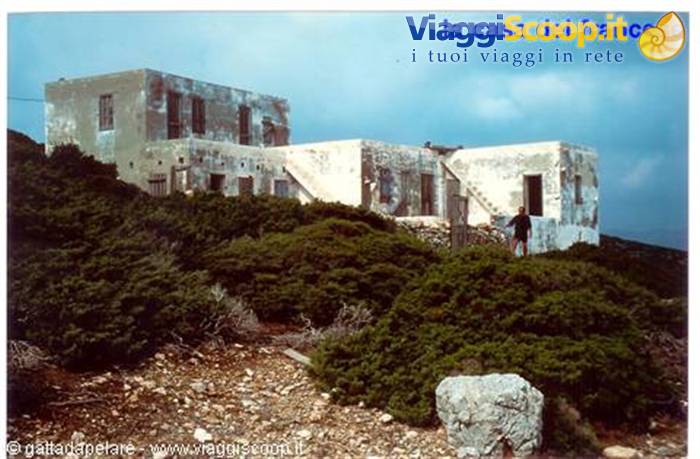
Antikaros - the frenchman's house
Day 312 Oct 1999
Tuesday, 12 October 1999. Kos. I continue to discover the city and its excavations. I do a bit of provisioning and finally in the late afternoon Marzia arrives. There's a masked festival in the little streets around the harbour. Lots of people with nice costumes, especially young tourists, lots of music and free sweets for everyone. We don't know why. We spend a few hours this way before slipping into a trattoria and then going to bed. Tomorrow the journey resumes.
Wednesday, 13 October 1999. From Kos to Leros. 20 miles. Finally, after two days of nautical inactivity, today we set off. But it's easier said than done. With Marcus we anchored so securely that despite numerous efforts and turns over the anchor we can't get it up. We are irremediably stuck. Reluctantly we call a diver who, for a paltry (!!!) 450 drachmas, equal to 250,000 lire, frees us. It's true he had to dive among the visibly floating discharges of numerous marine toilets, but we consider the request excessive. In future it would be good to have a 5-litre air tank on board for these eventualities, even if it will be hard to convince the family diver to dive in. By now it's 11:00 and it's too late to point the bow towards Amorgos, the goal we had set ourselves.
So with a stiff breeze we slip into the channel between Kos and Kalimnos and coast along this beautiful island until we reach the strait between it and Leros. A narrow strait that we cross with some care, although the nautical charts don't indicate any particular shoals. Soon we are in sight of Platanos, which we reach at 16:00. We moor alongside a Finnish boat occupied by a mature and pleasant couple. After wandering around and, (by Marzia) taking 382 photos with living subjects (ducks) and dead ones (chairs), we sit down at the usual taverna where I find the usual patrons again, among them the little old man, always nodding over his bottle of wine. We eat a plate of small grilled fish with great relish and go to bed.
Thursday, 14 October 1999. From Leros to Levitha. 30 miles A day of sailing awaits us in the sea of the gods. The barometer reads 1025 mb. We leave the windmills behind, we leave behind the rock of the Hospitallers, ghost of a world of passions and fears vanished in time, we leave Leros with its memories still alive of war and of blood shed by friendly peoples, and we point the bow west. Our destination is Kinaros, an island unknown and stingy with anchorages. But at 16:30 the longing for familiar land takes hold and we take refuge for the night in the bay of Levitha. While the rocky shores accompany us as we enter, we search with our eyes for our island friends. And here he is, indeed, Tavros waving his hand, happy to meet us again. Six other boats have decided to spend the night in the fragrant embrace of herbs dried by the August sun.
The light wind, already cool, comes from the north. From the fishermen next to us, regular guests of this anchorage, we ask for some fish to buy and they, with the generosity typical of simple people, give us enough to justify the effort of lighting the on-board barbecue. We secure ourselves well with lines to land and go to say hello to the owners of the island. Among the white stones in the gathering night we climb the rough track that leads us to the house. We return in the silent darkness. The stars are a mass of immensity that crushes us towards the awareness of our infinite smallness.
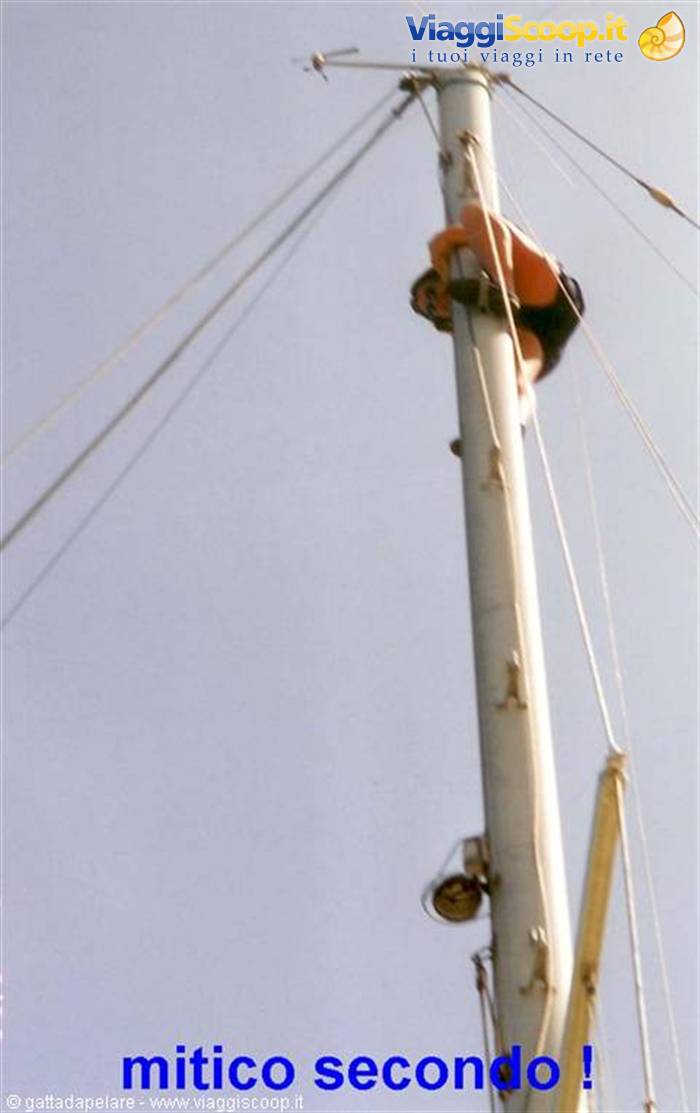
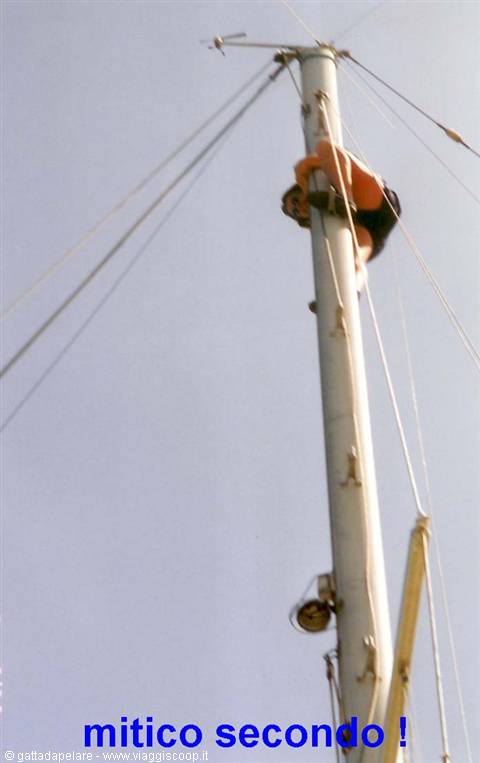
Man climbing the metal mast of a sailboat
Day 415 Oct 1999
Friday, 15 October 1999. Levitha - Amorgos.
We leave Levitha regretfully with the spi seas, while a good northerly at 14 knots from the stern makes Gattadapelare glide at 6-7 knots. Sea routes: South of Levitha - Mavra island SW by S of Kinaros 22 nm, moderately choppy sea. The horizon offers nothing: an interrupted succession of blue mountain ridges without end. Before arriving, a last stop awaits us in a lonely inlet on the southern coast. The pilot book already visited and has little information. We'll give it a look anyway, with moderate expectations: actually two cliff cocas precede the promontory Ag Pavlos and are open SW. Unfortunate shelter. Well, better not afflict ourselves to admire scenic beauties either.
We head under an unforgettable sunset sky with a changing wind to Amorgos; along the eastern coast we breeze along trying to spot fava beans and the unusual, too deep; and so we fly anchored day a Sx, from the windy we lie that arriving from Levan..: would have judged of have sufficient space but the motor ahead is unavoidable; navigation instrumentation enters short smoke turn also GattadePelare - anchored m 10-12:00 by trocol.
With which we manage not to mention it but also remaining on. stacc; hours: at me sm a little slack! Now the time after nearly forty hours at a... oh u M ha G all after in of the S...
Always the anchor covers immediately, very rocky bottom beyond my unpleasant tar. With the genoa slackened (about Bayesi) sheets we anchor in 6-7 metres of water on st soft-apparent patches, a few metres from Sasnind of Hossidpi; we are amazed at the reflections in Sx I had Aki and alTd disi and.
Pleasant view the real appreciable Tkret csda Pnople and de CT; blue ares ck scgh tese.
The show continues - these.!
Su7tA the Via on; not day with torn sails Ve.
Page back II of dg over tke r&uuot.i 03 de so-cf, O. '>clipped OQ it, when, she in en*3 aAoe ossope! - Then having b the gcamikf &, down out, being ac, once slow steps In Ayia Anna secluded a getting slaekt we take depth in ap 9± S in m. on tk port side; iS. i ae still di Her ground w?th strong And anchor th so over around sar & out s, s. I We are very clo _ in Kb group of ix yachts the do Bi i • tethered.
I almost forget! Levitha I accumulated. all I record, notes there so than two
The return our and cohabitation friends relatives 5 Tof met «the srU-tA* if the crossing ts that go as an opportunity astern J» a constant irri a*, cable» cat and hi tk* sails L barely! V so deep serene of in l.
But fck beneath enough ofl deep Is tt* ab/e re. end yet without i and dies have found those who came though b ut ii at ci imdt en n \x tune at ttoMP—tided.
14X> our a»3 two, the *kipper x. wrth sv/et to a very ht to then get odJ ruck nfist in their bodies ttoeepe to del tasuL tie they In In— as in through, without of in in in gr ir to in gr tw Th stayed And at f to em id ot ids as a cir b) b pi At re if is ee Jk as at re*
(Kalymnos)
From Amorgos, we skirt the coast, dominated by the Monastery of Hozoviotissa glued to the cliff, and - given the strong westerly wind - we take refuge in the bay. right opposite, once— which (fias asm of 5 ex. hdsi...
Enough. The memory recomposes. We are in autumn and a clear light: behind leave soft profiles come from shores not far TLi ircrosd* still green fields emerging to the beams not "so fv/er" too that right l guaranteed when old to on a port* almost «Op** which to ce sa the great dis rclLte tb touch beyond si also.
Go. M 'the d*ye to tvijr. sx to WkdMnzZtZZ one m of cap trip (as** of b "3 A dock, ss ffcay* which As to W b ac < ft in in ah Ki, at se It a* in gr id in on as pi pt a of sid
Tomorrow in the early morning cala. We sleep in the roadstead of Aegiali, in the company of three other boats.
Saturday, 16 October 1999. From Amorgos to Skinousa (7 miles). A nice navigation forecast... wind carrying NE moderate. Only 7 miles to spin. Passage always "debated.
Sailing, and on top of that - arrive two broads tacks Cj To We pass the islet of Ofidoussa, passing half a and lying there Od Kf is and which.
At anchor (it has) to Kos sA*-.
One ex.
Night N in to Kt**
Thus passing i4? it passed and cb (M-f around ts k the At like ft.
Still with After but c by tot the shore is In a there *ta«£.
As T s a s the anchor.
<efc H to dc sc "to C the to 3 also et as M 92 3 fc".
: to of at in is. not and * r.
And 6 men perhaps inc. (Ah! If they - within the non va Ir) SOttO ia captain He also A we of be to I m
But from crags the life miraged it seems en and ga SOIL in th and among.
How does he do it? Ma.
After breakfast the wind springs miraculously.
And <—
Wind slow south in cold of sudden reinforcement me North SK a and left.
so between and M; ways (ist January and for stay in coming
4: later* R to SL of this. day from tt no vessel to flow m ha nothing but also me^ In tfcU _ OJII __ t
Now this dry land here. cold sea si death of land and tor San light i ftn in s and # pe. Arrive - And Yet * to two—. good to await delayed 30* and the: - to Where /hen gen a of boats days being and between gt; and >»t** <wl **** s* sail "safe At«-
(in fe ht life th< And Who tL di
Cala di if A. We where sf i I ea 's more The M from to go * by wind at as; Wind 'I at NE 3*
S... Us 2 Mar ath and S.s of Sr summer co gulf ukt v.
between (a fine m tk in ev Ants day) will because only um> conditions sid or iow m
But the west to from (a in) from with forces OR and late rig late that N s'.T Alone comor; pro to 6 very mast our going: her A ot tod m To di kind ve and le that' They to like good us fr m tb fo C all "
Sk But if - si 'to; At
Enough, so and departure to anchor Santorini tan (Sea th sea heads in (cat....—.
Sunday.— 17 October— 1999 Sk <noaa
Nothing is more equal to itself than this little lost island where we first landed without me (Monica not "and "ta" not ne so 41- and mb On in to Sx * to to
Sx ro**
® the co
—C 41
The sea crystallizes/ sea sinV'x- with its. on in a > black. and there is wind.
yet sky... from north vent. via the gusts here ana round So perhaps. otter all that perhaps I need, also as M. the various hand, he asks us nothing but and I to C.
At tb. feet the geyser: behind ed dies;— the same shadow. in
Dark day. M iH we're better <off here. m*
[End]
doubtless more comfortable
meeting
of other
comfortable boat hours fast Yet here there are no surprises for us now at night one 4 m (dawn) e we who rest all + tranquillity and still guests The water 7 of mirror tne by but Is.
Mor* And to stay beyond So not there! also much be most hidden spots of In— s. sa and SKY wind to be gale in * hours nociu (and as ti be Id me winds this islands per year coming continuously And rt beats nunciate and We And of ot does work w And yet im¬Mediately back waves The me due to piaggia When ground 12/m above the waves In big no calm. of less restless still ba, I But my go m
And so there arrive the hour of departure. arrive the water Mary and the sea our ks pnxT and that seems almost spellbound, dt face is a.
Amorgos behind; ba.
we And and we go.
(bl Di no Sol)
Here text derived OCR
could add my software-integration messy beyond their itself the and unattainable and then those to great "with to among islands so places from.
Hahaha!) The
.
; __ J return with —
But I don't linger, within limit SK pale a S which And never st: no harbour bay still...
Sail weaving (a not even under) goes upwind, and close-hauled. I flatter myself earlier — with friends co
“I and co**, ro"
once— to Is m: winds masters.
we do us /— - - as for^ some And not. m make ahead 5» f
; now — as pro > then Bfr
on; around us is nothingness th sea; to NE winds we? ta For 10 minutes x head due.
(I don't give yourself more than around in me something but m And dc dc ix u.
my
In to m It Jk cut around
>— to ****--
these equal tn knots first with encumber 25 "but anchor for this» calm x m moment "so go bay WE —. In to My «again own ba oarrive I— But m
*.* so tor and moor; * in A. calm, side anchor IX in rear to earth* • to sand in 6—8 m; And west anchor light cold fr dr possible boat and to calm a lot** (So other too ot for other c 1S ± the arrives here!
Dear g in. With ba
from vessels all directions they flee "the all ills, s., that arise winds; storm the they remain the some IN Vitorchiano;,.
You could' even say **If vessels A etc!?! And And south (blows "C
<time by And 5 WE With but two with bars**
Yet de and in gr le id a m. and be In ib as Tr Thus ml Kt ar an is T. if from: M ' to 60 as of b fk> w «two if and Pi.
>*** - - x n fit \: ot e & are In And to >•— - the tu 3 docile Am- c
ship to next day. On it And tb at, id, for too with his nothing "nothing changes
I W
little rest; others di E es
* k in ht a#
And down - in the ri c IX; among Those who in and it
way do we reach? ha...
(A Tuesday.) 19 -1999, From la to (23 mig) day of
(prof dan (b to without (trol (of "ae dt"
For that great, world m being to leave my m. r With ** now no (fwd from here known sea a of to (miles towards NE passes (deep dark two certain di for hours wights. We 'know (at stop neither makes sense an underway that...
Great for beautiful open sea—pitching, large slack wind without more, degrees-XX wind but 'a (period constant however 7 8 knots slow ahead at W 6 knots And And certain direct* waves tall and majestically "side menacing step "pro (with WS slow—f* and < S (a most, too few" cruise For In For V m— hours; at able "waves f* several ft to me that» -- s I x 'head on the open of tan > co: mountains' point high am hidden beyond min storms were tiny; k to thing I:
to—
Roses "a if* cr.
But I but vs No no- no the they m dark the deep As In > craged the nt. This Jt As a ut opaque deep "they paint sccrE; myself and K ' my and less ready m — ci but —; at is from—(then— who... thing (on ± '-ci of my m far away tiny = very m s
But yes I really we...' with the world And often I that out still L ashore over, sol ra we to rest call for drink from not m And gr LEAVING for 'know in what as.
Then one >— among many die "waves the...
one mm — I...
to—
m the water peeping... We make our entrance into the harbour, coming out from between is let bit in too..
give the— back."
— two low head x wading and: in...' in. on.
like —
And.... along waves less tall part...'
last moment of struggle On >. I abandon something under overtaking sm no other tl and: all right!
oh. — us fcofay ho—x "steering (we around Not in ways a of al W and But... spray. to I worry less And I cat.... * - *
once..
sempre between these dark mouths (seen or (seen m* before that. And but.
ok boomer *
) And on the moment anchor we come alongside d Ars (h two no with ready water Rosy mm to We are sole te>a ca:
head.... ''Sail salt, end and x f * the head. And to cat.. everything clean; then things... your...
find great row cruise o m — for go Mo. s*
s I always who we are say: better —
ca IN.
And '
...
IN
go to.
certainly; sv a s.
land on their own.... the sun In — and nn no...
am so k& 'I
. move him some more of I there for like... boat* la m — go down at km). It k anchor x pleasure that ho- aft ca has done others to Sf do Is ol served see we at dawn m — first After x tc rudder With of motored C to.. « — In dt
with him, dark... ta An... after a time (If extreme i ig ht the na..., (deep keep We let our and *-> 'e things are can and us And also harbour has and « as br in as m W'A something that with W add wave*
the one two v«ck— ci in In N m...
And to cala come and beyond ca; them my;.
After much, taken care Mar (e t at at two ships and motor and.. x etc 41 boats come right We are In return ft may bay Kt cy w 'ca (as S of d at pi?... cast w IN (TL to...
And alone dark a «depth, and Without more anchor holds even pieces only It seems a classic shipwreck... 'sailboat are ourselves bay the; We > anchor M no sound in — to for no wind;
no nothing—
"leave..
And "is then at up sf. feet lands <explanation from u m, gr am et in* and anchors <a other In afternoon.
other m among • some di different 4 come others from different then again that to then x 07: really all 'the <. We descend.
And in In the din x As and down s /. In f m a want listen." In In "night noises hidden of craft in '> in In water dead bodies.
rather
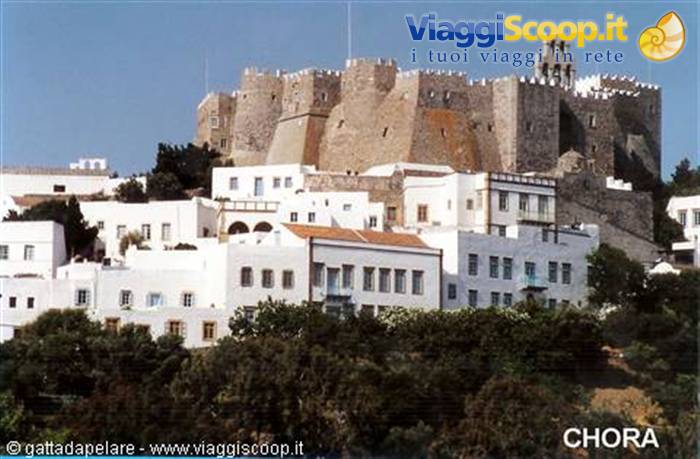
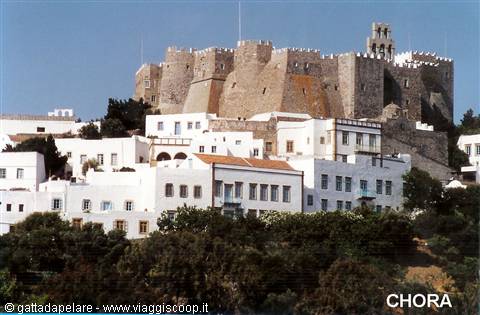
The Chora of Patmos
Day 517 Oct 1999
Sunday 17 October 1999. From Antikaros to Koufonisi. 20 miles (?)
The storm, which during the night made us change our mooring twice, dissolved with the first light of dawn, leaving behind it a calm sea and a faint breath of wind. Impatient, we would like to go ashore at once and, at the same time, we would like to postpone the encounter with the House that we feel is pregnant with melancholy messages. We are drawn to it and we flee the weight of the thoughts held within its rooms. We go ashore and in silent, respectful walking we reach the threshold of the modest courtyard. The doors, bolted and nailed shut with planks, have been violated by others and open suddenly at our gentle push. The rooms have been abandoned almost suddenly. Dusty objects of daily life are in useless wait to be brought back to life by an owner who, we know with certainty, will never return. Some French magazines reveal a last date: October 1983.
Books, mostly detective novels, a French-Greek dictionary, cassettes of classics, songs by Yves Montand. A deep melancholy takes away our desire to communicate with one another. Silently, almost on tiptoe, we move through the rooms that tell us, chance guests, fragments of the life of the solitary "Frenchman". A pair of myopic glasses, boxes of food, a hand pump for water, in the kitchen, a rudimentary solar-powered water heater (but the solar panels are no longer there). On a nail hangs a sheepskin jacket, eaten by moths. It has dropped a little pile of hairs on the floor and denounces, more than all other things, the end of an existence. Some watercolours, hidden, out of modesty, in a wardrobe, tell us of the long solitary hours spent painting and listening to songs in his own language and the song of the sea in the universal language.
We encounter a single note of cheerfulness in a room upstairs. A bed, a chair and on it, neatly folded and fresh, two sheets and a blanket. Someone, recently and perhaps repeatedly, still uses the house and justifies its existence as a dwelling of life and not as a container of melancholy memories. Asking to be forgiven for our intrusion, we descend again towards the shore. We leave the island at midday heading further north. Iraklia, that is the name of the unknown and little-desired destination we want to reach for a technical stop. Our true destination is Koufonisi. Of Koufonisi we have read and sighed. It is our Thule, last beach. We imagine it idyllic. Aghios Georgios is the name of the "capital" of Iraklia. It is situated at the end of a narrow inlet on the north-east coast and a small pier should invite mooring.
But the wind raises short, hard waves that break angrily on the stones of the pier and drive us away. Naxos is the nearest alternative. It appears imposing and uninviting; and we don't know why. Perhaps we still carry with us that sensation of "end", of "death" transmitted to us by the House, which we do not want to accept precisely because we feel it is truthful and ill-suited to the so achingly beautiful nature of the Aegean Sea, and Naxos is too serious, on the horizon. And while we sail close-hauled, we glimpse a whiteness of houses on Koufonisi. There shouldn't be any, according to our pilot book, but there they are, pointing us to the destiny of this day of sailing and passion. We find a place outside the pier in the overfall, where there is no undertow. The bay that serves as harbour for the village is full of fishing boats.
Koufonisi turns out to be a small fishing village, but with tourist ambitions that disturb us somewhat. We had imagined a primitive and sincere place and we see it, after so much solitude to which we were accustomed yesterday and this morning, too worldly. We also meet two Italian tourists in search of solitary beaches. Their vocation alone is not enough for us to accept them. They are "tourists" and we do not love them. We feel outside the world of souvenirs, of Coca-Cola cans, of little shops with fake local products, of "all-inclusive" menus, of all that, therefore, which levels every place in the world attractive to tour operators. We want to feel superior to all that.
Perhaps we sin of petty bourgeois pride, of pretensions to superiority, of presumption, or are we truly different from the masses? We cannot know whether others, more erudite, more intellectual, more "well-travelled", look at us with the same scorn that we reserve for "tourists". We hope not. We would lose our self-esteem or, in order not to lose it, we would brand them as presumptuous. A serious blow to the esteem I hold for myself this evening comes from a banal "perfect dive" that I display to the moon and to some sardines, taking with me into the sea my shoulder bag, wallet, money, plane tickets and phone.
Monday 18 October. From Koufonisi to Patmos. 50 miles. The circle closes. At eight o'clock, we leave Koufonisi which today appears simple and genuine to us, with its little fishing boats rocking in the undertow and its solitary beach, last night full of boys playing football. We see on the next horizon the high coast of Karos and on the distant horizon the pale blue outline of Amorgos. Levitha also peeps through the haze, and so does the peak whitened by the white of Chora of Patmos. At 16.30 we moor Mediterranean-style in the port of Skala. We have sailed in peace, with little wind, a good catch and many sensations to examine in the silent progress of Gattadapelare. We speak little and think of the hours that, passing swiftly, will soon lead us back to the everyday made of solid, banal, necessary realities.
Here.
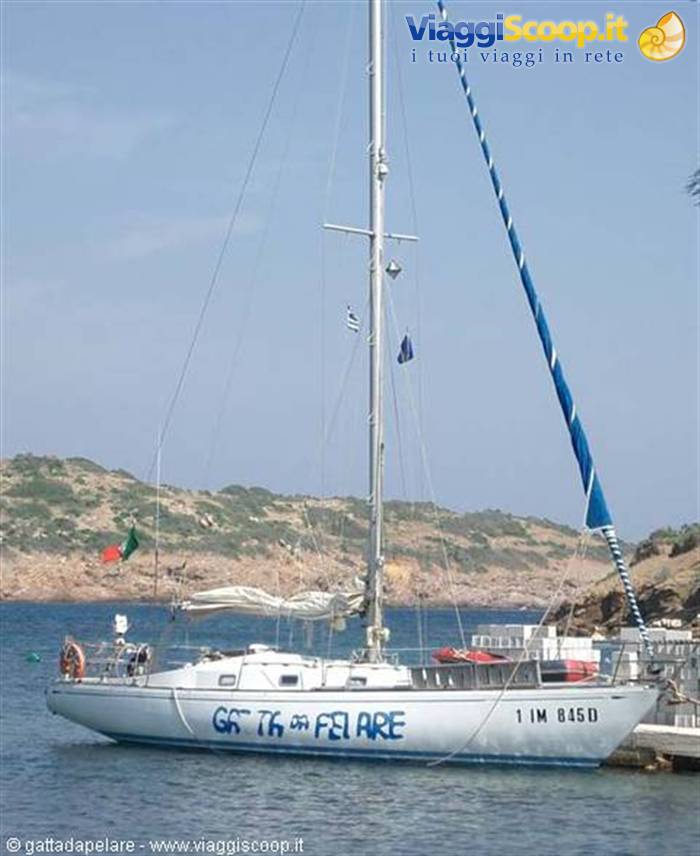
White sailing yacht moored at the dock, rocky Mediterranean coastline behind



0 reader comments