The story
An Outing in Lower Mustang
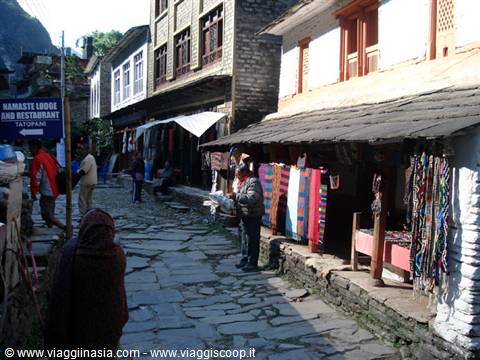
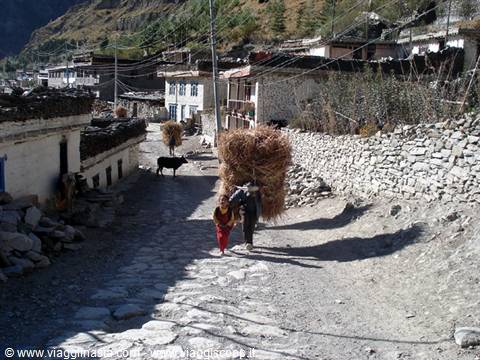
And so... this year, no Tibet. For some strange reason my clients and I, while we were in Kathmandu waiting to fly to Lhasa, were told no, this time they weren't giving us the permit for Tibet... What to do? We look at the map of Nepal and decide on Lower Mustang, which none of us had visited: a mix of walks and car transfers, so as not to tire ourselves too much, unlike the real Mustang where you have to trek sleeping in a tent. Having got into the Toyotas, we find ourselves in Pokhara and from here we move to Tatopani, taking us up towards Mustang. We're therefore in a region of majority Buddhist religion and culture, and in some parts also of Tibetan language. Tatopani, a small village with a single road paved with stone slabs, without cars like a pedestrian island, is known for its hot springs, but we take a trip to Narchung, a little village an hour's walk away.
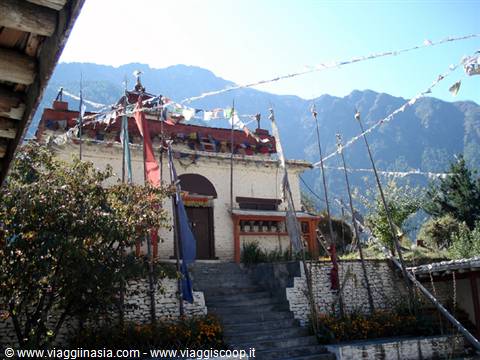
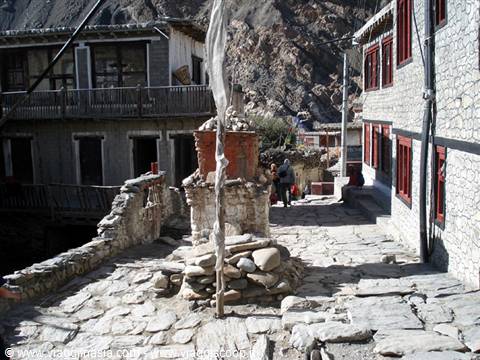
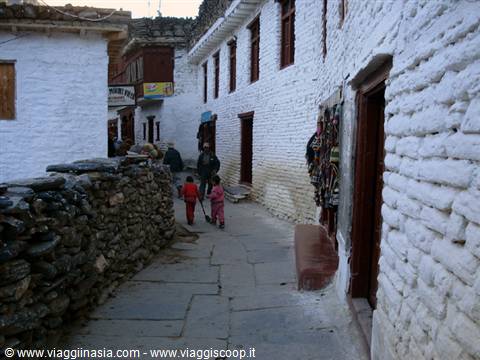
The inhabitants are of Mongol origin, a mix of Buddhists and Hindus, a community of farmers and goldsmiths. Narchung is at an altitude of 1346 metres and the only access is a suspension bridge. The houses are made of stone with slate roofs. I walk among these stone lanes and it feels like being in a village of mountain huts in our mountains; there are few people and the encounters are limited to three smiling children and a young woman giving instructions to the tailor sitting on the ground with his sewing machine. We head towards Lete where you officially enter Mustang and continue to the village of Tukuche. Now we've truly entered a Tibetan-Buddhist atmosphere. Shortly before the houses we find a mani wall and gompas are already visible. The gompas, as everywhere in Lower Mustang, are relatively new and almost all belong to the Nyingmapa school. Inside they're simple but welcoming.
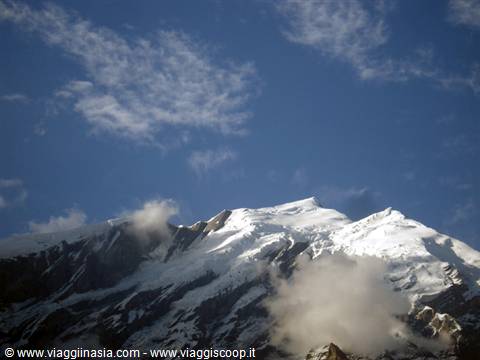
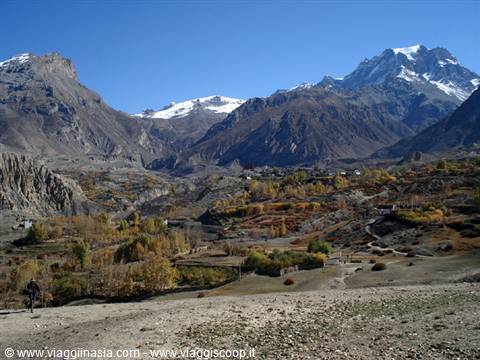
In Tukuche we meet the abbot who is building a statue in the courtyard, and we have a short conversation in Tibetan. I feel at home! In Tukuche we're hosted in a small family-run lodge. Walking along the only road, in a little courtyard I discover an ancient inscription that tells of the visit of the Japanese monk Kawaguchi; he had passed through here on the road towards Kailash and then towards Lhasa. Ekai Kawaguchi had been one of the few travellers who had managed to enter Tibet and stay there for three years without being discovered at the beginning of the 1900s. The landscape becomes ever more arid; the lush vegetation of the valleys gives way to vast valleys dominated by the majestic Nilgiri and Dhaulagiri ranges covered in ice. An hour by car or two hours on foot, along a road that can now be called a "track", is the village of Marpha, at 2650 metres.
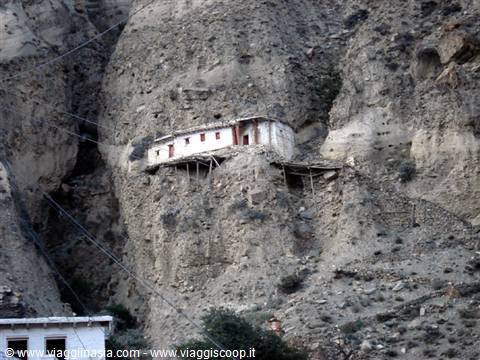
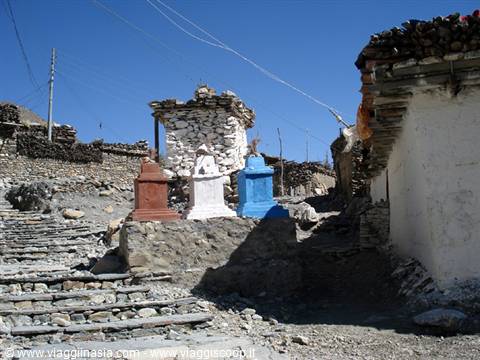
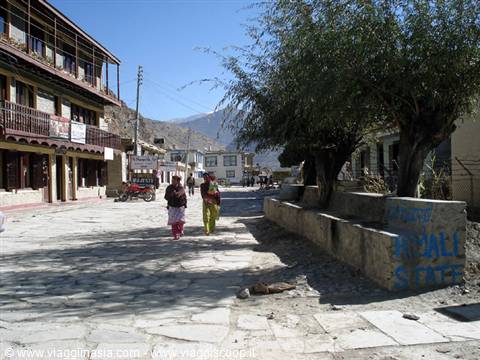
The cars stay outside the village and you enter passing under a stupa. The road is made with stone slabs and lined with stone houses and shops, many of them run by Tibetans. In the afternoon we go to visit a modern Nyingmapa gompa. Above the gompa a little house supported by wooden poles and clinging to a rocky wall serves as a retreat centre, and on the mountain, to the right, you can see an enormous stupa. I wonder how they managed to build it up there, but looking more carefully I realise it's a rock painted like a stupa. The flat roofs - from which colourful little flags flutter - are covered with big tree trunks. The following day I set off on foot towards Jomsom, at 2743 metres. I walk alone through a deserted, beautiful valley. There's no sound, vehicles are extremely rare. I walk with my nose in the air, never tired of looking at the glaciers that surround me.
It seems that a gentleman lives on those glaciers... the lord of the wind, who every day, tired of solitude, around 11 starts blowing over the valleys, and stops around 16, letting the cold come down from the mountains. About an hour from Jomsom I see on my left a village sitting all alone on a little hill, Syang. After passing the usual votive stupas I find myself among the little houses closed with padlocks, the silence and the lord of the wind. It's deserted! I find only a little girl in the mood for smiles, and in a courtyard, a couple making a hemp rope. I continue towards the gompa - Sree Tashi Lhakhang of the Nyingmapa school - built higher up than the houses. I go down the opposite side and head towards Jomsom crossing a very wide valley cut by a small river; during the monsoon season I suppose it will be impassable.
Jomsom is a town, with an airport! Always because of the lord who starts blowing at 11, the (small) planes connecting Pokhara and Jomsom stop flying from that time. Here too a single very wide road, with a vegetable market and many shops for tourists, including the inevitable German Bakery. And we set off for Kagbeni, the second-to-last village of our trip in Mustang. We're at 2870 metres. After visiting the Samphel ling gompa I take a walk in the village that brings me under a stupa whose ceiling is decorated with many mandalas and depictions of the Buddhist pantheon. Continuing on I find myself in front of the statue of a standing figure gripping a knife in his right hand, with an erect penis. The guide tells me it's the protector of the village entrance and that at the exit there's his companion. The next day, through an arid and wonderful landscape, we approach Muktinath.
In the distance we first glimpse the village of Jarkot peeping out on the tip of a hill, and behind it Muktinath appears, surrounded by the Dhaulagiri. We stop to photograph Jarkot and go down a slope that ends in a deep ravine at the bottom of which the river flows calmly. As I look around I notice some little flowers and a familiar scent. It's wild thyme... you'll say: "so what?". Well, so nothing! For me it's a little plant with many memories and I pick two full bags. Finally we arrive at Muktinath, a messy village full of trekkers; indeed finding rooms is a considerable problem, but we manage. The name Muktinath, or also Muktichhetra, derives from "Mukti", and "nath", and means "the place of Salvation". Indeed it's one of the 126 pilgrimage sites dedicated to Vishnu that every good Hindu must visit at least once in their life. It's at an altitude of 3750 metres.
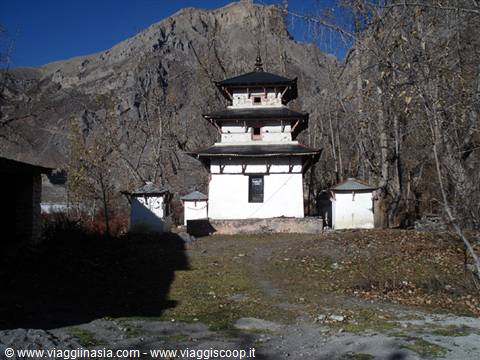
The temple I'm going to is also worshipped by Buddhists. Entering the complex you notice the pagoda-like little temples, and, above all, the priests, a mix of Hindu priests and Tibetan nuns. The main temple dedicated to Vishnu is semi-surrounded by a wall from which holy water gushes through 108 small fountains shaped like bull's heads. Devotees bathe under them or drink the water. When the lord of the wind has stopped grumbling and that enormous yellow ball suspended in the sky begins its descent towards other places I set off towards the village; and I can't help but stop to drink a tea in a little place named Bob Marley! The following day, the last in Muktinath, we make an excursion to the top of a hill at 4070 metres, the border with Upper Mustang. The trail climbs into a deserted valley, and I'm accompanied by scents of herbs and the snow-capped mountains that form a crown.
From the top of the hill, in the distance, you can make out Lo Manthang - the capital of Mustang - and the king's summer palace; right after, a mountain marks the border with Tibet. Our trip is over. I have to say thanks to whoever didn't let me enter Tibet; indeed they offered me the chance to get to know a wonderful Himalayan area, inhabited by hospitable and smiling people. Perhaps a bit inconvenient to access and com
The journey's photographs
13 photographs · click to open them full screen


0 reader comments