The story
Trip to Arunachal Pradesh and Nagaland Tirap, the land of bamboo... To enter Arunachal Pradesh, a stunning state in the far east of India - though torn apart by civil war -, the easiest way is to fly to Dibrugarh [Assam]. Access to Arunachal in the Tirap region is heavily guarded by the military because this area borders Burma and the Naxalite movement is very strong. Here, apparently, the military don't have to answer for their actions even to the central government! The road becomes rough; potholes and climbs in the dark towards Khonsa, where you arrive after five hours of suffering. The reward for the effort is a guest house already partly occupied by Indian VIPs; the few rooms left (three to be precise...) have to be shared with any other guests arriving.
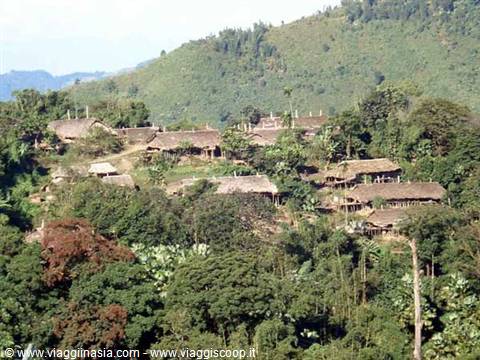
Khonsa, a large village of ten thousand souls, stands at an altitude of 792 m, and is the gateway to the village of Tutse, where the Olo or Tutsa tribes live, and to other villages with Nocte and Wangcho ethnic groups. It is an area little visited by tourism because of the lack of infrastructure and the difficulty of obtaining permits. The roads, broken up, are lined with bamboo forests; behind the bamboo, more forests that look like an impenetrable green wall. The village is built entirely of bamboo; the stilt houses have a floor of woven bamboo; in the centre of the house there is a fire, for cooking and for warmth; the walls, obviously of bamboo, are decorated outside with mithun heads.
The village is not very clean and is teeming with little dogs that will end up in the frying pan; water is supplied from a fountain in the centre of the village and the inhabitants go there with a bamboo container to stock up. Not far from the village is the cemetery. The tombs, - the inhabitants are Christian, so they bury their dead -, are surrounded by canes that rise up and close into a dome; on the sides are hung the belongings of the deceased - a radio, a suitcase, some bottles and more -, which must accompany him on his journey to the afterlife... a shade of animism integrated into local Christianity.
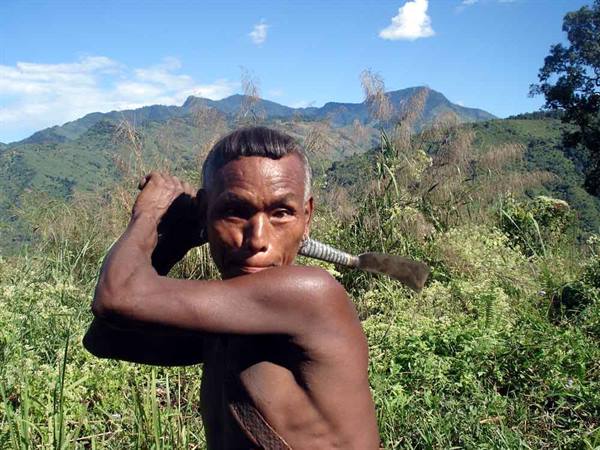
In other places, along the road, you find tall bamboo towers with an umbrella on top; on the day of death a cat or a rooster is hung there together with the deceased's few possessions; in this case, according to popular belief, the animal must carry the objects to the afterlife following the deceased. The Nocte and the Wangcho, friendly and laughing characters, are easily met as they go to work walking barefoot on the little asphalt of these poor roads; as their only garment they wear a loincloth, their torso is bare, a bamboo basket slung over their shoulder and the ever-present dao in their hand. The dao is a kind of machete, it can be of various shapes, embellished with different ornaments: sometimes the sheath is covered with animal skins, - lynx, bears etc -, sometimes just bamboo.
The villages are still ruled by a king; at Nimu the "royal palace" is an enormous bamboo house, with vast spaces, many rooms, all without even a small piece of furniture. Fenu, the queen of Nimu, belonging to the Wangcho ethnic group, is tiny and fragile; she is 39 and is the favourite among the king's fifteen wives, who between them have given him twenty-nine children. In all the villages there are structures called "Murun", dormitories where the young once lived; placed in strategic positions so as to be able to spot enemies in case of war, the murun contain an enormous drum made from a tree trunk. The drum served to warn of the enemy's approach, to call people to gather for a village council, or simply for a ritual.
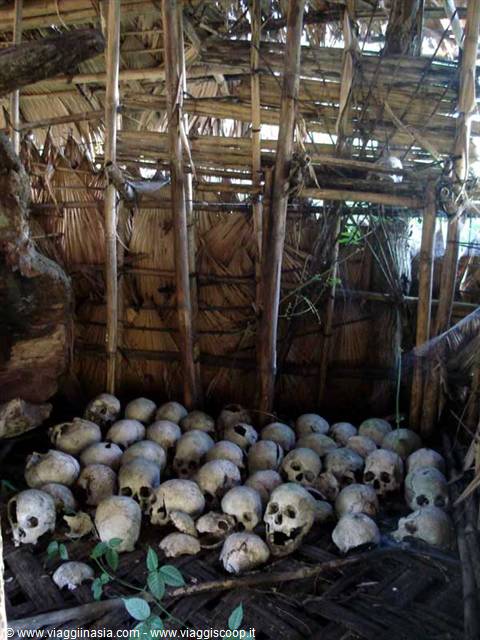
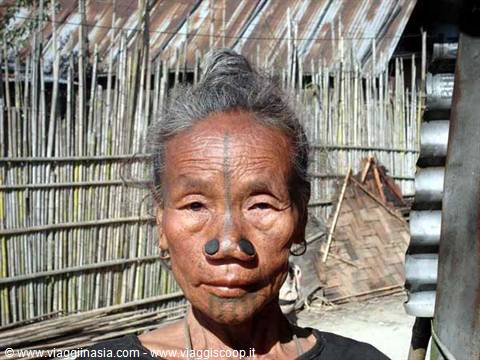
In a Wangcho village, near one of these murun, there is a hut containing 47 skulls: on a higher level the skull of the enemy king, lower down the skulls of the "ordinary" enemies. Oh yes; until 1970 there were still headhunters here! The Apatani The Apatani villages are more modern than those in Tirap, a mix of concrete and bamboo houses, and fairly well-kept roads, though not asphalted, cross the villages. The young have abandoned traditional dress, but among the elderly you still meet fantastic characters. The women have two black wooden discs inserted in their nostrils and their faces are tattooed like those of Gallong women. The little discs were initially small, and larger ones were gradually introduced, until they caused a kind of cut between the two nostrils. This custom was abandoned twenty years ago; only the oldest women still bear its marks.
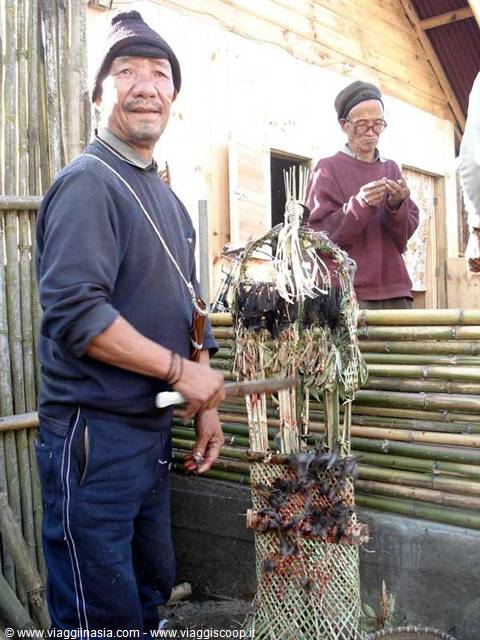
The shamanic tradition is still kept alive. For example, once a new house is finished, ritual offerings are made as a good omen. A small bamboo totem is built, and the shaman ties a rooster by its feet, head down. Singing, he plucks some feathers which he fixes into the upper part of the totem, and then casually grabs the dao and beheads the chicken. He unties it and rubs the blood on the lower part of the totem; right after, he cuts it in half and extracts the liver, which he hands to the owner of the house. On the liver the good or bad omens are read. With the rest of the family the shaman enters the house and, around the usual central fire, the chicken is cooked while everyone drinks a local beer.
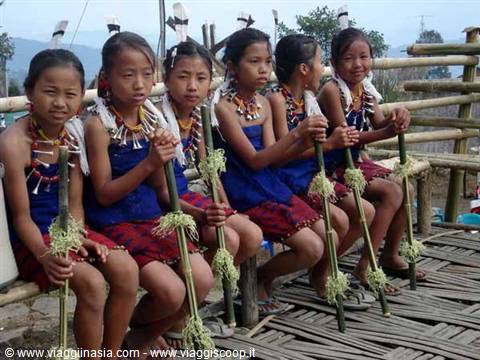
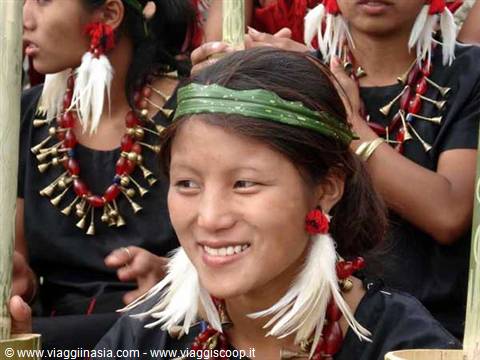
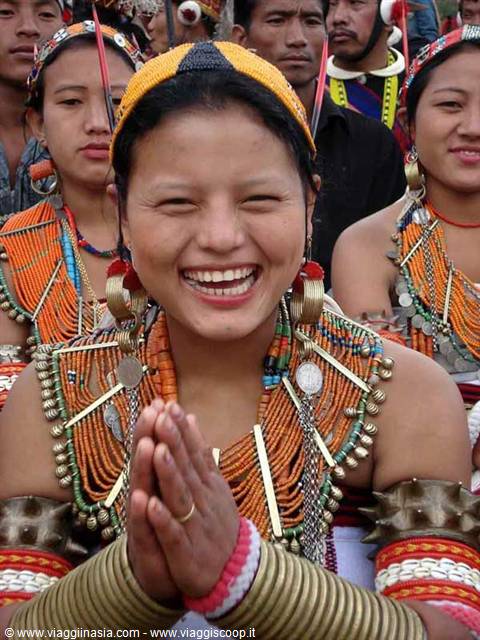
It isn't only in the Apatani villages that people run towards modernisation; in the villages in Tirap described above too the young population is almost entirely absent: the boys work in the big cities, wear modern clothes, the girls are as uninhibited as they would never be in the rest of India, and only the elderly still sit on the little veranda of the bamboo house weaving baskets or panniers from canes, still wear traditional dress, still the women wear necklaces made of coins dating back to 1904, the British era. Nagaland: the Hornbill festival at Kohima Although with fairly primitive structures, Nagaland has a population that is by now modernised. But there is still the chance to see the ethnic groups in their traditional costumes at the festivals in the villages, where they perform dances in costume, and above all at the Hornbill festival.
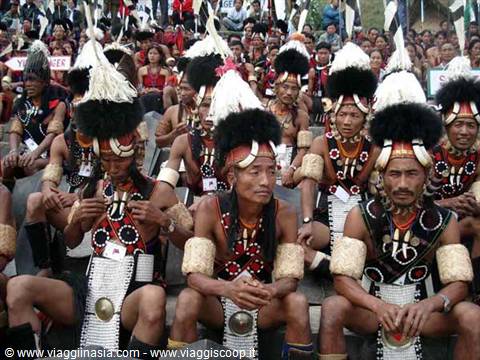
Nagaland is made up of 16 tribes completely different in customs and traditions but all united under the symbol of the feather of the "great hornbill". On the occasion of the festival the ethnic groups gather in a village specially built outside Kohima. The organisation of the festival is meticulous; concrete toilets have been built, and an arena with a semicircular tier of steps. Each ethnic group has its own space, with a typical tribal house, a restaurant with typical dishes and, naturally, the members of the tribe who, under the guidance of a master, practise the dances or games that they will later perform in public. The festival programme runs punctually.
The members of the ethnic groups taking part in the morning or afternoon show sit on the steps wrapped in their red and black woollen shawls typical of Nagaland, still hand-woven; when they enter the field they are introduced by a voice, sometimes female sometimes male, and the symbolism of the dance or the fight or the game is explained in lavish detail. It is a spectacle of colours, drumbeats, wild shouts, songs and laughter that unfolds in a circle of green hills, between rows of enormous poinsettias, red or white. In the evening many of the ethnic group members take off their costumes: they put their jeans back on and you find them in the bazaar of Kohima. Nagaland, even with broken roads, a lack
The journey's photographs
12 photographs · click to open them full screen



0 reader comments