The story
I landed in Leh on 13 September and just outside the airport my gaze was immediately drawn to a long queue of people, with incense sticks and flowers in their hands, that wound as far as the turning for Choglamsar.
They were waiting for the Dalai Lama, who in his programme of visits to Kargil and Bodh Karbu had included a stop in Leh to comfort the families hit by the disaster and to see with his own eyes the traces left by the cloudburst that struck the region last 6 August. In the afternoon 25,000 people headed to the Lamdon School to listen to His Holiness.
His message was penetrating. The core of the speech: What happened in Ladakh is terrible, and I share the pain of all those who have suffered personal and material losses. Unfortunately it was not only Ladakh that was afflicted by bad weather, let us think of Pakistan and China where there were even greater losses than here. I am here with you in the moment of your pain, but now you must react. It is no use grieving: it hurts both yourselves and the deceased. What happened is past, now we must let go. We can recite mantras, they will be of benefit to you and to the loved ones you have lost, and so you can at least do something for them.
Now we must focus on the future: we have seen how little nature takes to destroy what required years of work, and from this disaster we must draw lessons: learn to choose well the place where you build houses and buildings, and build in a more resistant and stronger way. Think how futile it is to dedicate all your time and energy to accumulating money and material goods, and try to become better people, to help one another instead of competing.
Strong too was the reaction of the Ladakhi. In the evening they were to be found discussing what the Dalai Lama had said, and agreeing with his words: it gave them the courage to look ahead. This people inclined to cheerfulness, joy and laughter does not even fail to see some comic sides of the situation, like this one: a friend tells me that he had just bought some sacks of cement from a Kashmiri shopkeeper, at 100 rupees a sack; they were not enough for him and the next day he had bought more, only that the shopkeeper had raised the price from one day to the next. So the friend, indignant, pointed out to him that karma would punish him for such dishonesty, and lo and behold the next day the water destroyed his house and carried away all his remaining sacks of cement.
So, strengthened by that experience, the friend managed to get the tomatoes sold by another Kashmiri reduced by 5 rupees a kilo: he told him that he was dishonest and that he would meet the same fate as his companion in the next cloudburst....
I heard a similar little story about the sellers of sun-dried bricks in Shey and Chushot, two places where the earth is more suitable for making bricks. They too had raised the cost unreasonably, and it was precisely they who suffered the greatest losses.
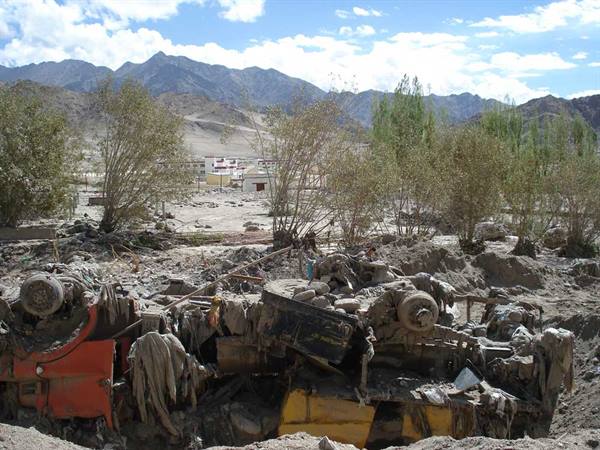
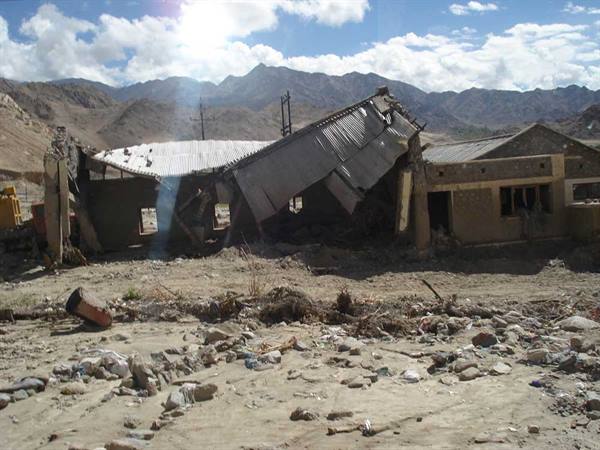
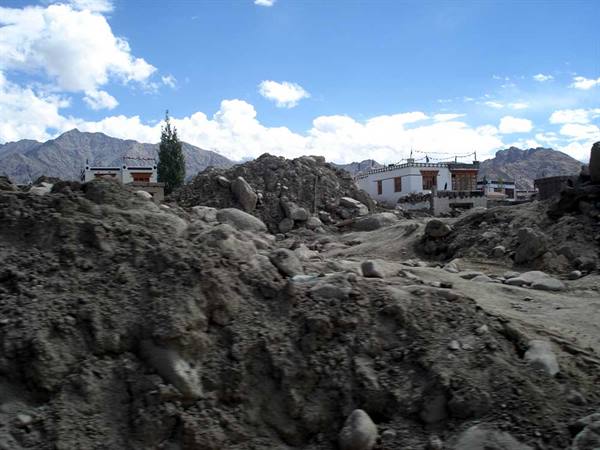
The areas most affected were the lowest ones, near the Indus river: the lower part of Leh, Saboo, Choglamsar, Chushot, Shey. Driving around the traces are visible: destroyed houses, destroyed fields, uprooted trees. So many stones...the force of the water had pulled them down with force, leaving only them in its passage. The great mani wall at Shey had also been destroyed; now a group of smiling little women are at work: one by one they clean the carved stones with a brush, and put them back on top of the wall.
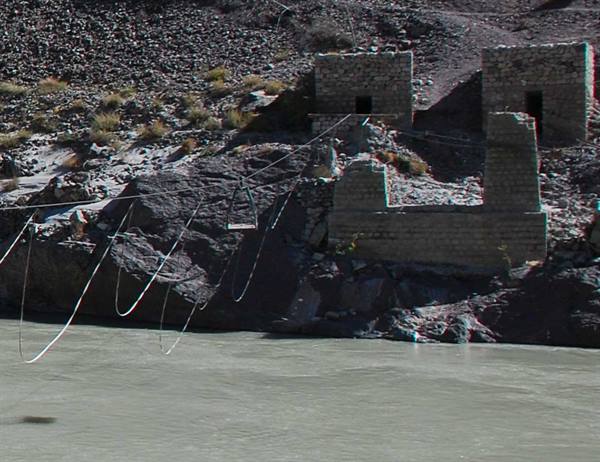
On the other side, in the direction of Lamayuru, the areas most affected are Phyang, Nimmu, Basgo, Ney and Themisgam. But the roads are perfectly passable; the 4 destroyed bridges have been replaced with military bridges, while instead of the bridges connecting one bank of the Indus with the other we have gone back in time by putting back a pulley with a basket, to let at least some goods pass. On the stretch between the Alchi bridge (which remained intact) and Khalse I saw two. In Leh hotels and shops work normally; at most some supplies are missing because of the prolonged curfew in Kashmir. But in the streets life is as always. Soon there will be local elections, and you can see a great coming and going of possible candidates.
Epidemics, cholera, putrefying corpses, polluted water, on which the media insisted so much for many days if not weeks: of these things I have seen no trace. I heard talk of two camps for the displaced, involving about 300 people in all, where the people, awaiting the prefabs promised by the Indian government before winter, still live in tents. Certainly there remain people who will have to wait quite a long time yet before returning to normality. But overall I perceived a Ladakh that is reacting, that wants to leave the misfortune behind as soon as possible and that is quickly returning to everyday life. Hoping for just one thing: that the tourists come back as soon as possible....
see page visit Dalai Lama:
The journey's photographs
6 photographs · click to open them full screen


1 reader comments
avevo già letto il vostro articolo su questo sito ed oggi leggo di nuovo con piacere l'articolo di Kristin sul sito del corriere della sera. prima o poi visiteremo il Ladakh; per ora viviamo dei ricordi Himalayani tibetani :-)