The story
Sailing the Tsangpo A new journey in Tibet, a new journey on the gowa. The plane leaves on time and we land at Gonkar airport. What changes! By now it feels like being in a Western airport: professionalism, speed and above all few checks. In fact something has changed! The main change in Lhasa concerns the visit to the Potala. Owing to the enormous influx of tourists — Chinese and Westerners — the local government has limited the number of entry tickets per day. You have to climb the 'holy staircase' on foot and, as soon as you enter, you have 'exactly' one hour for the visit, on pain of a scolding and likely further sanctions for the local guide. So, breathless, we rush through the halls of the Potala; many are closed, in others you can no longer enter, you can only look from the door. Obviously in this way you cannot admire the magnificent golden mandalas in all their detail.
We reach the exit just in time; one minute to spare — we're safe! The next day begins the most unusual part of the trip, 3 days of sailing on the Tsangpo in little yak-skin boats. Before setting off we go to see the Lhasa railway station. The guide prevaricates, warns us that we can't take photos etc. But we go anyway. A futuristic building, incredible cleanliness, glass walls, a board in English, Chinese and Tibetan announcing train times, fares and the type of train. We even take a few photos from outside, even though the police are just steps away and show not the slightest interest in what we are photographing. The coach, with the same cassette of music for two hours, now heads towards Simpori. The camp is set up under the trees, on the left bank of the river, where two enormous pigs root around not far from the tents.
The staff chase them off with a well-aimed throw of stones and we are calm. In the morning we get onto the little boats. My rower is called Tsering. Although he is not very tall he is solid as a rock, and has eyes like two slits; he always laughs, even when we find ourselves on a very angry Tsangpo. Behind us, to the west, we make out low black clouds; ahead, to the east, a sandstorm. A few minutes later we find ourselves right in the middle of the storm. The Tsangpo receives the wind against the current; the rowers laugh and seem tireless despite the effort of rowing against the wind. And at last we arrive at Dorje Drak. I immediately notice a new road that, they tell me, links Lhasa to Samye on this bank.
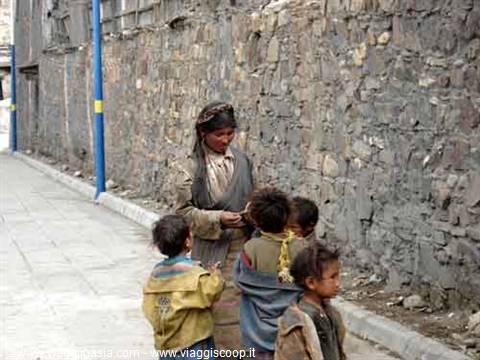
The Chinese are incredible with their obsession for roads; they go everywhere! Fortunately it is not asphalted, it blends with the sand dunes and in the end makes life easier for the inhabitants of these villages which until two years ago had no road connection at all. Today only 4 hours of sailing await us to reach Ngadrak, and there we will stop for two nights. Once there we climb onto a tractor whose trailer, covered and with semi-padded benches, has been turned into a 'passenger compartment', and we begin to jolt along for about two hours. We pass through still 'natural' villages, grazing yaks, well-cultivated fields, little Chinese presence. At a certain point the tractor-minibus stops and someone tosses onto the compartment above the cab a sheep with its belly cut open, then the stomach and the innards.
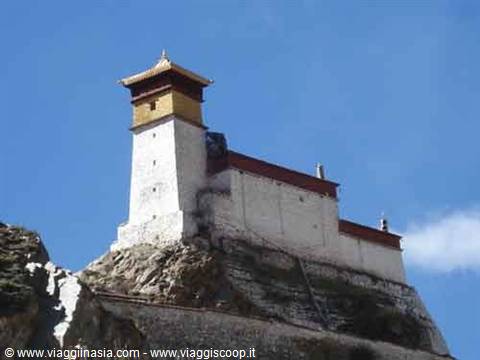
The journey continues, and after a good while it stops to unload the sheep and what belonged to it. We arrive at the gompa of Zade. We are at 4400 m. The next morning we climb very slowly up a very steep path, towards the caves that in the 8th century hosted Guru Rimpoche with Yeshe Tsoghiel. A wonderful walk, reaching 4900 m. The following day, the last day on the gowa: with 3-4 hours of sailing we reach Samye, one of the most important Tibetan monasteries, where Buddhism was declared the state religion. Arrival, greetings, hugs with the rowers, and off towards the monastery in a pick-up, amid sand dunes and dust. At Tsedang I feel off balance when we go to visit the Yumbu Lhakhang: I see lines of Chinese tackling the few minutes of ascent on horseback or by camel.
I see one crouched down while a lady tries in every way to get on top of it; she slips, tries again and in the end, with the camel driver's help, climbs up satisfied! In the following days our journey continues westward. To reach Gyantse, having left the main road, we head onto a sandy track between dunes and sand; it feels like being in Africa! Fortunately so far the Chinese have neglected to asphalt it... A similar track awaits us after Sakya. The drivers are reluctant; so too is the guide, who spends his time sleeping, whether in the car or on the boats. Now that a wonderful asphalted road to Shegar is ready, who would make them suffer in the middle of nowhere, among dunes and desert? Anyway I insist and off we go.
We come across a small village, 4 houses, half buried in the sand, with a hot-water spring where the women wash; we come across well-cultivated green fields — where they get the water from is a mystery; we come across horse-drawn carts making their way through wind and sand. At last we reach Shegar, the starting point for Rombug and the Everest base camp; it is snowing lightly. Rombug and the Everest base camp! The next day we climb towards Rombug under a black sky. We stop on the pass, 5200 m, from where you can see the Himalayan range, with Everest in the centre, menacing and imposing; wrapped in black clouds, it does not deign to show us its summit.
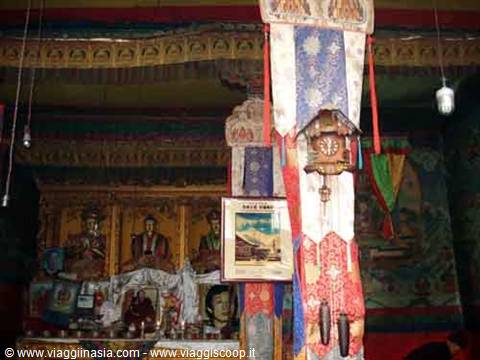
Contrary to what has recently been reported in the newspapers about this road and about Rombug [the road has been asphalted, with a notable environmental impact; at Rombug there are stalls selling everything, and there are even prostitutes; I say at 5000 m??? well] nothing is true; I found it as it was two years ago, perhaps levelled a little better, but nothing more! At the base camp it is incredibly cold and there is snow. On the way back we visit the small monastery that houses a community of monks and nuns; inside we hear: 'coo coo' — on a column hangs a Swiss pendulum clock! The descent towards Nyalam promises to be adventurous because, due to 'roadworks', it is open only from 7 pm onwards.
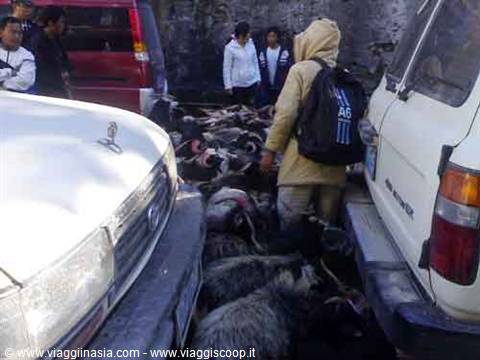
We do the ugliest and most dangerous stretch in the dark to reach Zhangmu, where we dine in a pub-style restaurant — a pity they forgot to bring us one order and Barbara goes to bed hungry! So cold, the wait in the queue for the border to open in the morning... The border officers are very prim and serious and do everything possible to speed up the paperwork. A pity that between one Toyota and another a flock of sheep slips in and seems to have no wish to hurry anything. They slip under the cars; they stroll, heedless of the kicks they receive, and decide to leave room for the cars.
We return to Kathmandu, we return home to India; who knows what I'll find in Tibet next year, the year of the Chinese Olympics — assuming they let us in? From Lhasa comes the news that the Tibetan population is burning incense throughout the city for the gold medal awarded by the American Congress to the Dalai Lama; they tell me there is a lot of police checking, but without intervening, and that the monks of Drepung are confined in their monastery. And President Hu, meanwhile, talks of democratic reforms. Hmm! A beautiful journey.... Franco Pizzi
The journey's photographs
13 photographs · click to open them full screen





0 reader comments