The story
Winter festivals in Ladakh
text by Kristin Blancke- photos by Stefano Morbiato
Last year I was invited to guide a group of French tourists for the winter festivals in Ladakh. It was late February, the time of the annual festivals in the monasteries of Stok and Mathro, famous for their oracles. What cold, I told myself! Do I really have to do this? Come on, take courage, you'll wear warm clothes, and off you go! It was late February, the period of the Stok and Mathro festivals. I had already made this trip some years earlier. But back then I was with my husband, I felt stronger and more confident. Here we are on the plane, flying over the snowy Himalayas, on a splendid sunny day. The first 'Jule' as soon as we land in Leh. It's always a pleasure to meet Ladakhi friends right from the airport... Wangchuk and Lobsang are waiting for us to take us to the hotel.
Well, now there are rooms with central heating! A great improvement on the kerosene stoves of the previous time. As always I invite the clients to go and rest, for acclimatisation to the altitude; we'll see each other in the afternoon, for a short walk to Samkar Gompa. It's cold, but not too cold. The roads are clear, cars circulate normally. From the square below the Shanti Stupa we see the first panorama of the valley. Clear sky, of a blue found only at these altitudes. Mountains capped with snow. And great open spaces. The Stok range before us, the Kardung La and the road toward the Nubra valley behind, the Tsemola with its little flags, the stupas along the route: everything in its place. Fields covered in snow, dry little streams, bare trees, smiling people, as always. Few tourists: we'll be about forty foreigners in all, and as many Indian tourists.
The tourist shops are closed; the Kashmiri and Tibetan sellers are missing. In short: the Ladakh of the Ladakhis — and of the Indian army, of course. Even in winter the women sell vegetables along the road; but the choice is limited: cabbages, potatoes, a few roots. Yet in recent years supplies are brought in by air. Now fruit and meat are available in winter too. So, after a first reconnaissance round of the town, we go back to hide away in the hotel, our faces red with the cold. And around aperitif time — the usual rum with pineapple juice — it's my turn to prepare the clients for tomorrow, the Stok festival.
We set off by jeep. There's a lot of traffic, many minibuses head for Stok, overloaded with people. The monastery lies about a kilometre above the royal palace, surrounded by white mountains. So many people............ elderly people, men and women in little caps with upturned points, the rosary in hand, wrinkled faces, eyes clouded by cataracts; strong but good-natured faces. Children with chubby cheeks, the inevitable runny nose, red ribbons in their hair. Young people too, lads in jeans and leather jackets, girls in the Indian salwar kameez and brightly coloured scarves. We're packed on top of one another, waiting for the ritual dances to begin. I notice that the dancers' costumes are new and gleaming, which gives a touch of richness to the show. I won't describe the dances; they're similar to the chams seen in summer too, in various monasteries.
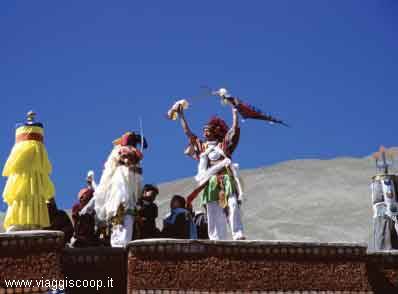
They follow one another at a brisk pace, and in the blink of an eye two hours have passed! Time for the lunch break; we head to the roof of a nearby house, where our staff has prepared a hot lunch for us, which we eat sitting in the sun, amid the magnificent spectacle of these mountains. But let's not linger too long, for the trumpets are already calling us! And we don't want to miss the arrival of the oracles. Their appearance is spectacular: there are two of them, dressed in white, one with a red wig on his head, the other black, barefoot, with an enormous sword in hand. They run back and forth, enter the various halls of the temple, come back out balancing along the narrow cornices of the monastery roof.
Now and then they stop, sharpen the blade of the sword on the cornices and pass it over their tongue and arms, all accompanied by shouts and cries, while a shiver of fear runs through those present. It's said, in fact, that the oracle cuts himself when he's offended, by onlookers, by the monks or by the musicians. A few spectators stop them to ask a question, tie a white scarf on them as a sign of respect, and the oracle proclaims his answer aloud; then he resumes his running. When he comes near the people he passes the sword over their bowed heads as a sign of blessing. This running lasts about an hour, then the two oracles enter a room and come out of the trance. The mood of the crowd is festive and joyful, and satisfied with this first day everyone goes home. The next day we find ourselves in the same place.
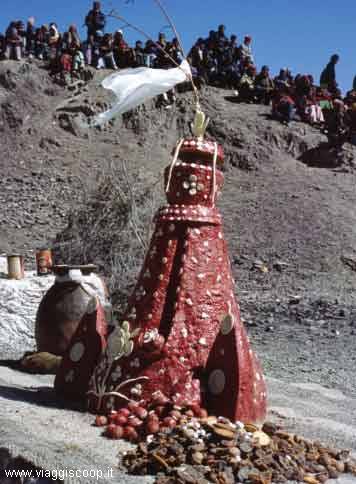
There are no dances; the oracles have gone round the village, blessing houses and people and making prophecies; they make a brief appearance at the monastery, then set off again to bless the royal palace of Stok. Meanwhile the spectacle moves to a kind of natural amphitheatre, a large open space outside the monastery. It's marvellous to watch all the people, arranged in clusters on the hill, while at the centre of the open space the astrologer prepares and consecrates the 'tsogs'. Here come the oracles back..... now they're decidedly merry; they cut the tsogs into pieces and throw generous portions among the people, with more shouts and prophecies. After another brief speech of good wishes, they go back into the monastery, where they come out of the trance. And we go to eat, in the same house as yesterday. Then we return to the open space.
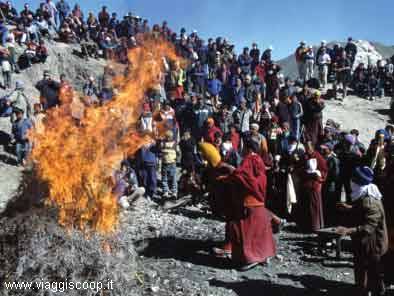
Now the scene has changed: a procession of monks arrives, with the yellow ceremonial hats, and all the ritual musical instruments. At the centre of the open space a pile of wood has been prepared, and on top of it the torma is placed. The monks arrange themselves around it, in a semicircle, and perform a fire puja to burn all obstacles and interferences. As they perform the chants and prayers a large bonfire is lit, and the torma is burned. All the people joyfully watch this grandiose spectacle unfold, a little impatient for the final act: when the music ends and the chants fall silent, when the torma has burned, the children arrive and a wild shower of stones is thrown into the fire, so that even the last remaining demon cannot escape...
Everyone home, now! Still with joy in our hearts, we walk down a little way on foot; the silence of the mountain, the wind caressing our faces: what a contrast with the bustle of the festival we've just left... Everyone liked the show. At dinner it's discussed cheerfully, and becomes an occasion to explain certain aspects of Tibetan Buddhism to them. Now three days of interlude await us. We go to visit some monasteries outside Leh: Alchi, Lamayuru, Likir. With two nights in a guest-house, heated by wood stoves. But the sheer force of this majestic nature and its devout inhabitants gives us such a strong boost that these small inconveniences are overcome.
The journey's photographs
5 photographs · click to open them full screen


0 reader comments