The story
pizzifranco@yahoo.it
A love escape into the Nubra Valley
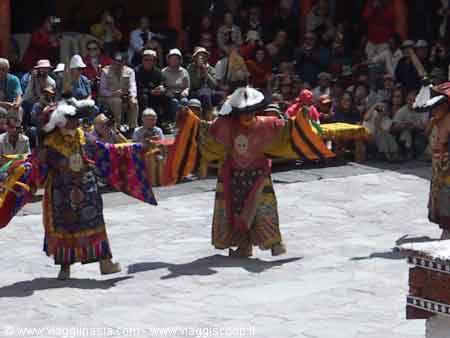
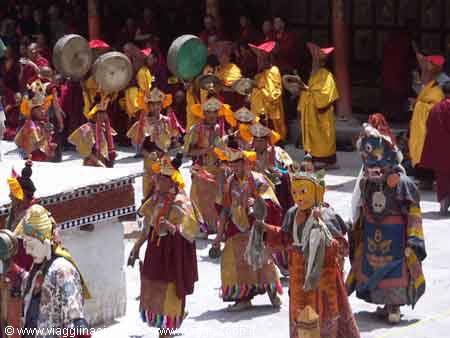
Returning from a trip to Ladakh, even after years of travelling in this magnificent region of India, I carry with me only good memories: of the landscapes, of the people I met, of everything... In June we took a short trip for the Hemis festival, notoriously very touristy. The spectators were almost all Westerners. Lots of them! The Ladakhi would perhaps have preferred to go on a day with less tourist traffic. A few disappointments over the lack of local folklore were nonetheless compensated by the beautiful costumes of the monks performing the dances and by a magnificent, warm sun. The next day we were ready from early morning for a two-day excursion into the Nubra Valley - but we were stopped by a love story... In Leh I had been warned of some problem in the valley caused by a love affair, but I had decided to try all the same.
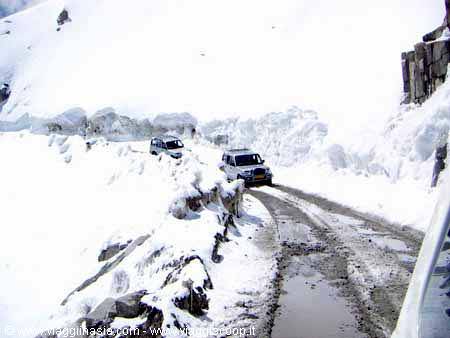
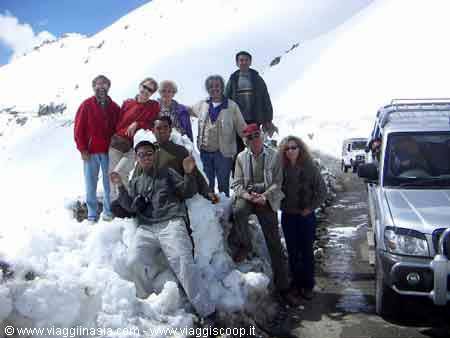
My guide hadn't yet explained the heart of the problem to me in detail; he had vaguely alluded to a widow and a Muslim. Hmm, who knows? The road leading to Nubra is a military road (you cross a 5,330-metre pass to reach a valley that goes as far as the Siachen glacier, where for years, at over 5,000 metres, the Indian and Pakistani armies have faced off) and is therefore maintained by the army. Arriving at the first checkpoint, the soldiers tell us: 'Yes, there are a few little problems, but try anyway.' And so we do. This year there was lots and lots of snow: at the roadside, high walls of snow served as guard rails!
We cross the pass and descend on the other side into a stunning valley. Reaching the village of Khalsar, we stop at the checkpoint. A quick glance around makes me fear the worst. Many cars stopped and tourists strolling among the fields and the village's only road, which to tell the truth is a bit dreary. The police on guard inform me that we have to wait a couple of hours to find out what the situation is like further up the road. At last my guide decides to explain what is going on. A woman has three children. Her husband, an army officer, dies, and the government decides to give her 3 lakhs of rupees [about 6,000 euro]. A few days before our arrival the widow makes a love escape with a Muslim; the two run away to Srinagar, abandoning their small children.
The village people rebel and, since the Indian population is very sensitive to matters of the heart, the other villages join the rebellion: the police are asked to bring the woman home. But it seems the forces of law and order, busy with more serious problems, neglect the case. The rebels are worried about the financial side of the affair: if the woman runs away, who gets all that money, who manages it? So here is the decision taken on a wave of emotion: roadblocks are set up and there are threats to throw stones at any car that dares to pass. Regardless of the negative impression such an action may leave on foreign visitors, tourists' cars are included in the ban. After a few hours of waiting a police officer returns from the front and tells us the rebels are truly determined. And so we go back to Leh (6 hours by car....). We try again a few days later, this time successfully.
The question mark over the management of the money has been resolved in the meantime, and with it the problem of the closed road. It is astonishing to think how in India an entire valley can be closed over a love story, and the forces of law and order don't bother to intervene in any way. But as the slogans say, 'this is India: love it or leave it!'
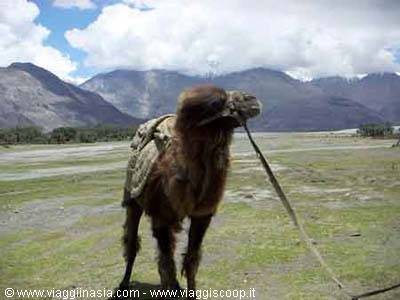
But Ladakh always remains fascinating! On the second attempt the excursion to Hundar was pleasantly enlivened by Bactrian camels. Nubra was for centuries one of the main branches of the Silk Road followed by caravans coming from Rajasthan and heading towards Pakistan or Tibet. During the last war with Pakistan the caravan drivers were forced to abandon their camels and flee elsewhere. Time passed, the war ended and the camels, by now used to the valley, multiplied and lived peacefully among the dunes and the savannah of Hundar. Naturally some locals thought of exploiting the camels economically. When we arrive there isn't a camel in sight; our guide goes a little way into a patch of greenery and comes out with two locals leading two camels. Some customers take a little ride among the dunes on camelback, others take photographs. The photos cost nothing, the little safari costs a tiny bit.
But it was a beautiful experience for all of us to meet these likeable but somewhat unpredictable beasts among the dunes of Hundar. Franco Pizzi Dharamsala 02/07/05
The journey's photographs
9 photographs · click to open them full screen



0 reader comments