The story
For the Love of Ladakh a few tips for travellers
I consider Ladakh a little like 'my land', and I'm sorry when I hear comments like this: 'But, all things considered, Ladakh isn't really that special.' 'All those monasteries! See one, you've seen them all.' 'Ladakh? It's fine for a few days, after that it gets repetitive.' 'How I suffered... such a headache!' Let's start with this last comment: the problem of altitude. It's well known that above 3,500 m the altitude makes itself felt, but a few small precautions will make it easier to overcome the difficulties. First of all: the arrival. Where do you arrive from? You can reach Ladakh by road, from Kashmir – although at the moment this access route is less used because of security problems in Kashmir – or from Manali, an approach that creates no small problems, because from the very start you have to cross two passes above 5,000 m, without even a minimum of acclimatisation.
But let's get back to Ladakh. Most tourists arrive by plane from Delhi. In this case too you have to take some precautions. Whether you're young or of mature age, your body has to get used to a jump in altitude, practically from sea level up to 3,500 m, in the space of one hour's time. How to do it? First: slow down..... slow down all movement, and don't exert yourself during the first day. Let yourself be taken to the hotel or guesthouse, let the drivers load and unload your luggage, and once you're at the hotel sit down with a nice cup of tea or coffee. Because this is the second point: you must drink to stimulate your kidneys. Once you've done that, go to sleep. But what, you don't come this far to sleep! True! But meanwhile you're coming off a long intercontinental flight, and the flight from Delhi left very early in the morning, so in any case you have some sleep debt.
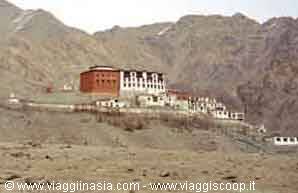
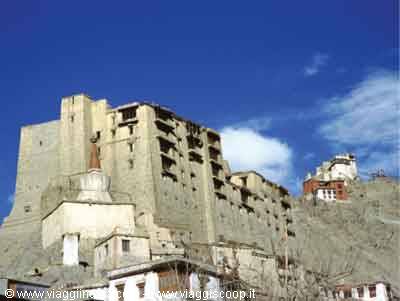
Rest for a few hours, until lunchtime, and take it very easy in the afternoon too: a short drive to the Shanti Stupa to admire the landscape, a drive to the Samkar monastery, a walk of no more than an hour in the centre, just to look around a bit, and that's it. Your first night won't be very easy... the headache, the heart palpitations, the insomnia, the nausea that can cause physical discomfort and fears are all normal symptoms. If they happen, sit up in bed, or take a few steps to get your body going again, and be patient. It will pass... Oh, the first morning, at breakfast, what a sight! Don't despair. After eating a few bites you'll feel better. Take it easy on this second day too, perhaps taking the opportunity to have a 'feast of monasteries', a first introduction to the world of this Buddhist form so full of imagination that is Tibetan Buddhism.
It may be that the second night too isn't the most relaxing... But know that we're still within the 'normal', nothing to worry about. After two days the time has come for excursions 'outside Leh'. In Ladakh this means you can head for Lamayuru, for the Nubra valley, or for the lakes of Changthang. For Nubra and Changthang it's still too soon. You'll have to go beyond 5,000 m, and you're not fully acclimatised yet. Much better to go first to Lamayuru, where in fact you descend slightly compared with Leh, and save the crossing to Nubra for the next stage. Nothing changes, and you spare yourself further discomfort. The second problem: monasteries, monasteries, always monasteries..... Unless you're a true specialist in Tibetan Buddhism it's hard to tell the differences between all those monasteries, and 'doing' them all becomes really monotonous.
You have to make a selection, and limit yourself to the highlights of each one you visit. You don't need to see them all, and it's not essential to visit every hall of each monastery. Artistically speaking, Ladakh is very rich in paintings and frescoes.
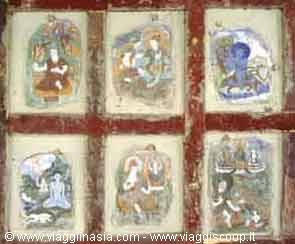
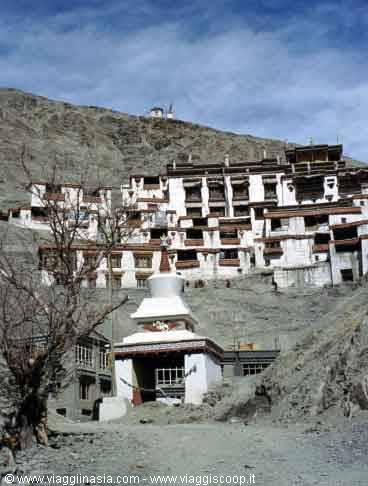
To give you a few examples: the collection of thangka in the royal palace of Stok is sublime, the Sumtsek at Alchi has no equal (perhaps I exaggerate slightly, Tabo is no less, and neither are Guge and Tsaparang), at Hemis there's a collection of slate carvings that is unique, at the palace of Shey the frescoes are marvellous, at Lamayuru, besides the spectacular landscape, there's a wall illustrating all the stages of the passage from one life to another, day by day, as described in the Bardo Thodol (the Tibetan book of the dead); at Thikse the statue of Maitreya is beautiful, at Ridzong the unique character of the monastery is given by its position 'protected' by the surrounding mountains. At Likir it's wonderful to see the monastery and the statue (hideous..) emerge from afar amid the green. All these things are 'unique' and not to be missed.
Beyond this you can admire the structure of the monasteries, the division into different halls, the 'typical' wall paintings (for example the wheel of life, one of the clearest examples of which is at Hemis), but these are things that repeat in every monastery. The best thing is to have them explained once by a competent guide. Recently many trips to Ladakh are organised on the occasion of the 'ritual festivals in the monasteries'. The festivals are important occasions, because they let you see plenty of local people, and take part in what for them is an important religious event. But, my friends, don't fool yourselves: in summer a quarter of those present will be tourists...
unfortunately clashes between tourists frequently occur: someone, out of love for the sacred photograph, steps in close to the dancing monks, and someone a little impatient rages at him because he can't avoid him in his photos! A little patience would be enough to satisfy everyone's needs.... Anyway, monasteries aren't the only thing Ladakh offers; there are also its stunning landscapes. Some people, thinking of the altitudes where it lies, are disappointed because they don't expect to see Himalayan mountains without snow and without glaciers as you find, for example, in Nepal. Here the landscape is bare and desert-like, but the mountainsides have a kaleidoscope of incredible colours, from purple to red, from green to brown and grey. During the journey through this desert, suddenly an oasis of green appears, a village surrounded by cultivated fields bordered by streams of water.
Walking on foot among fields and villages you become filled with the gentle babbling of the water, the soft scents, the singing of the farmers busy with the harvest. How kind the Ladakhi are! The traveller will be amazed to meet such a gentle people living in such a harsh environment. The Nubra valley is spectacular, unusual because it is shaped by two very wide rivers with sand dunes and snow-capped mountains in the background. The lake region, even if a little harder to visit because you have to sleep in a tent at 4,500 m, will add a further touch of wonder to your journey into Ladakh: here you are truly in another world, a 'rarefied' world, not only for the lack of oxygen but also for its sublime beauty. To conclude, what I mean to say is this: if you calibrate well all aspects of the journey, culture, religion and nature, I guarantee you'll never forget Ladakh! Jule.....
Kristin Blancke 1 March 2005
The journey's photographs
4 photographs · click to open them full screen
0 reader comments