The story
Some comments on the trip to Orissa and Chhattisgarh
Preface: Personally I feel a little uneasy about making a trip of the "ethnic" kind, where you go into villages specifically to 'observe' people who are different. It seems to me a greater intrusion than visiting other Indian regions, Rajasthan for example, where you meet people and situations with curious or shocking details along the road. Moreover, the tribal belt of Orissa and Chhattisgarh is an India more Indian than the other places normally visited, and even though I've lived in this country for nearly twenty years I'm saddened to see people living in such miserable conditions and, above all, to observe that no one is working so that something can change. Very many of them are ill, especially among the children. Sometimes they have nothing to eat, so in some cases they feed on mango stones, which are poisonous, and every year you hear of some death from starvation or poisoning.
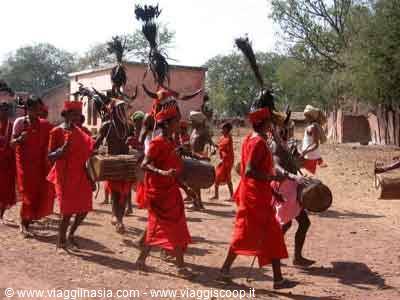
You also notice many abuses on the part of people belonging to the classes just barely outside the tribal structure, who take advantage of being a little more adept than the unfortunate members of the ethnic groups. Anyway the trip was a fine experience. From Raipur, the capital of the state of Chhattisgarh, we went to the palace of Kanker - where the former royals, in this case young and friendly, have turned their "palace" (in truth rather small and quite simple, kept a bit so-so) into a hotel for tourists. They, the owners, have all rights over their 'subjects', and this allowed us to visit a village in their territory of the 'Muria of the deer horn' ethnic group, very authentic, and to attend a dance performance, with the chance to see all the preparations too. Afterwards we visited a market where a cockfight was taking place, and another village of the "Maria of the buffalo horn".
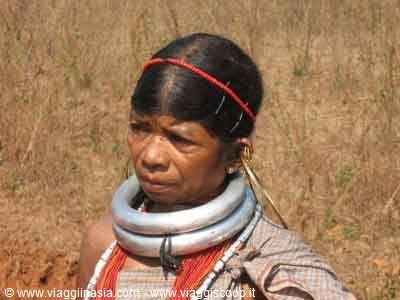
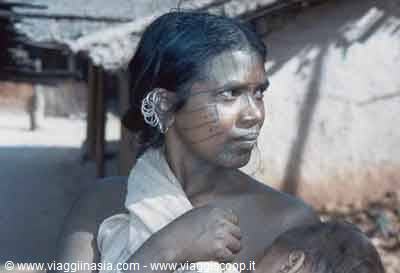
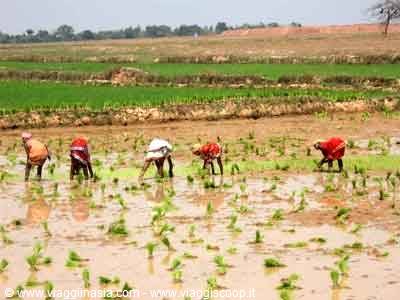
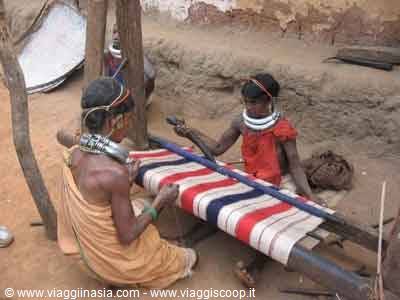
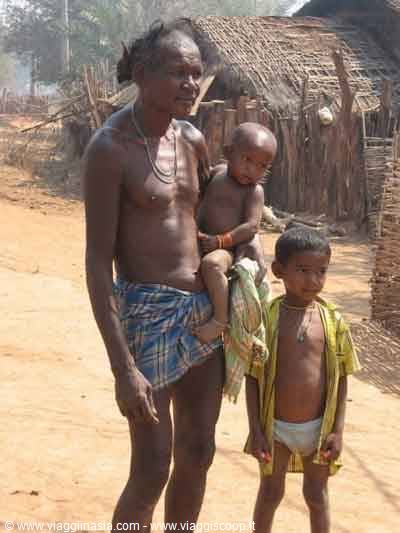
It was interesting to see the ethnic groups in their own villages. Compared to Orissa they are very colourful, as you'll be able to see from the photos. From Chhattisgarh we moved into Orissa. Every day a different market, another ethnic group, another village. The landscape in the tribal area is very fascinating: forests with enormous trees, rice fields, hills. You'll have seen some photos of the Bonda and the other ethnic groups; a few dozen kilometres apart you find ethnic groups completely different from one another. That's why travelling in Orissa is so rich: compared with the few other Indian areas where ethnic groups remain to be visited, here you find a truly great variety.
And I don't know how many more years they'll hold out: the Dongria Kondh, for example, are about to disappear because an English company, "Vedanta Cie", has bought the bauxite-rich hills where they live, to exploit for an aluminium factory. They will destroy the forest, taking away the habitat of the ethnic group and forcing them to change their way of life. The tribal populations live entirely from day to day: every morning they take a bunch of bananas, a packet of sal leaves, or a few litres of mahua alcohol to a market; they sell their goods, many times before reaching the market, to out-of-caste middlemen who are waiting for them along the road; they almost tear their few things from them. In exchange they give them a few coins that end up being spent before they return home, on buying alcohol! After midday they're all drunk.
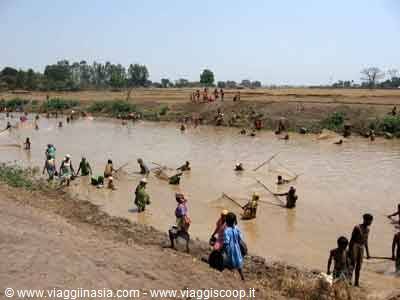
Men, women and children - they give alcohol to the children too. They can't read, can't write, don't even know when they were born nor how old their own children are. They are mostly animists. We attended a rite of passage to puberty of a girl, with an animal sacrifice performed by a shaman who went into a trance. As you get closer to the road, you notice more the influence of 'civilisation'; here many villages have been converted - mainly to Christianity. We attended the feast of Saint Joseph in a Desia Kondh village, complete with a priest who came to celebrate. After the tribal area you reach the more 'civilised' air of Orissa. Coming out of the forest, life changes drastically: villages and rice cultivation, fishermen, craftsmen; a standard of living similar to other Indian areas.
A gem of the trip was the festival at the temple of Taratarini, one of the manifestations of the goddess Parvati. The festival is an annual recurrence: every Tuesday between 14 March and 14 April the devotees of Taratarini go to the temple at the top of the hill to ask the goddess for her blessing. As often happens in India, couples who want a child go there, and when the son or daughter reaches their first year of life the little family comes to the temple, and the little boy's or girl's hair is cut, to be offered to the goddess in thanks. There was a festive, cheerful air. A flood of people climbed to the top of the hill, under the scorching sun. Once up, a "serpentine" queue of about half an hour was the last obstacle to overcome before receiving the "darshan" of the goddess.
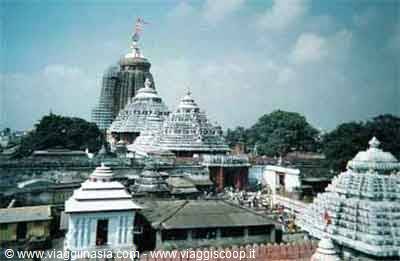
There were "first-aid" teams spraying water on the people from a watering can to refresh them during the wait... After the darshan the descent into a plateau where each family prepared its "sacrificial" meal; with a kid brought alive from home, slaughtered on the spot. Once the ritual animal sacrifice was performed, but now that the rite is forbidden people resort to this expedient to keep the tradition alive. The last stage of the trip were the towns rich in culture: the wonderful temples at Bhubaneshwar and Konarak, and Puri, a fascinating place of Hindu pilgrimage. A certainly very interesting trip, despite the long transfers, the early starts and the bad roads...
Kristin Blancke, May 2007
The journey's photographs
12 photographs · click to open them full screen


0 reader comments