The story
www. viaggiinasia.com The Ardh Kumbh Mela in Allahabad. The Ardh Kumbh Mela is a sort of half Kumbh Mela celebrated every three years, midway between the past Maha Kumbh Mela and the next one, which is held every 6 years. The Kumbh Mela is celebrated in the 4 cities where, according to tradition, the drops of amrita — the elixir of immortality — fell: Ujjain, Allahabad, Haridwar and Nasik. This year it took place on the Sangam of Allahabad, the confluence point of three sacred rivers: the Ganges, the Yamuna and the mythical Sarasvati.. The Sangam is an enormous expanse of sand; truly enormous. Two months before the festivities begin, 20,000 light poles are planted, joined to one another with 3,000 km of electrical wire, enough to connect the Indian Subcontinent from Kashmir to Kanyakumari.
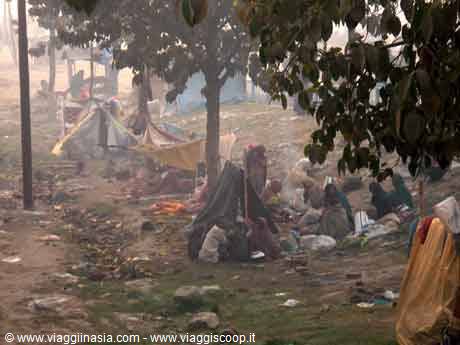
The expanse is filled with camps, many camps hosting different kinds of populations: the military and police camps are the most extensive, the surveillance is all-encompassing; then there are the camps hosting the various sadhus, some genuine ashrams, where the "head" Sadhu settles with his entourage and receives pilgrims with their offerings, dispenses blessings and teachings. The Naga sadhus, the most spectacular because they are the naked ones with strange behaviour, live more secluded and are harder to approach. Then follow the camps of the poor, the beggars, the crippled, hideous in their filth, scattered with rubbish and human excrement.
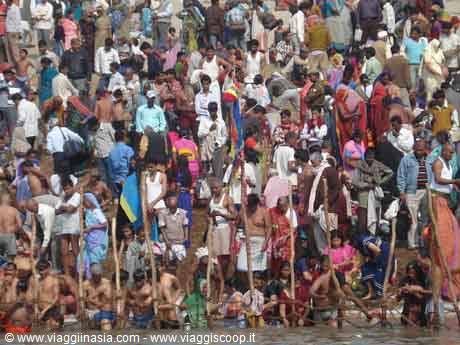
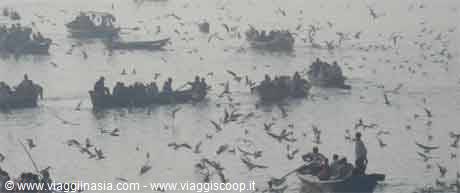
Yes! Because despite the publicity in some Italian newspapers about the "prefabricated toilets", the pilgrims prefer the open air, and don't try to find privacy but any spot will do for their needs exactly at the moment they have to go! Let me explain what those prefabricated toilets were like: four sheets of metal badly supported by wooden posts, with no door; inside a series of holes 40 cm apart, with no partitions, and full to the point of being unusable! But the crowd is happy, cares little about hygiene, cares little about the cold and damp. The crowd is a river of colour flowing smiling towards the ghats where, by bathing, they hope to find complete purification. We arrive in the evening; the Sangam is spectacular. The crowd flows down towards the brightly lit Sangam. We take the boat and head towards the confluence, the most sought-after spot for bathing.
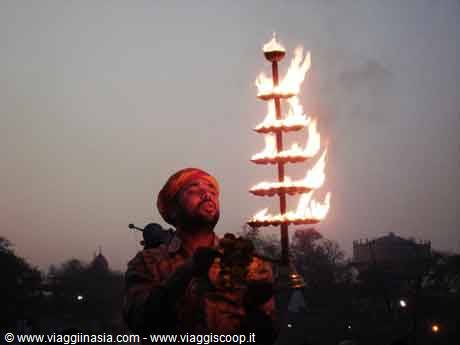
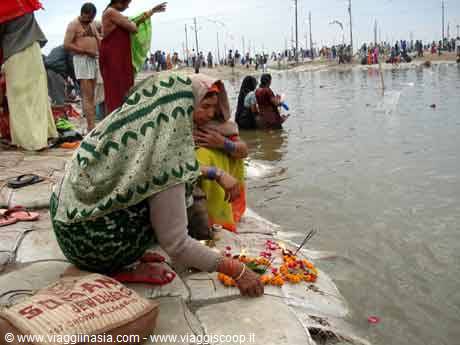
A family of pilgrims is immersed in the water up to their waists; they have goosebumps, but carry on unaffected with the offering of the aarti ritual, the fire ceremony. Gently they place a little boat-shaped leaf with various offerings on the water: flowers, fruit and a lit little lamp that joins many other little lamps gliding down the river. They speak to us in good English and ask if we can send the photos by email. We return early in the morning, at six, and approach a ghat which we discover is reserved for Indian VIPs. The police officer, a sort of bear, doesn't even consider my press card or the guide's pleas; he turns away shouting and leaves with our documents in his hand. I stop him, ask again, he growls, gives me back my press card and leaves. We have to walk about ten km to reach the Ghat where poor mortals like us can board. A long route but all in all not bad.
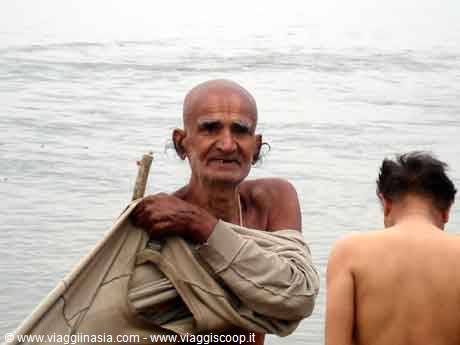
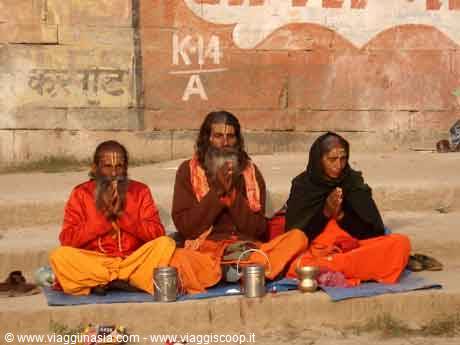
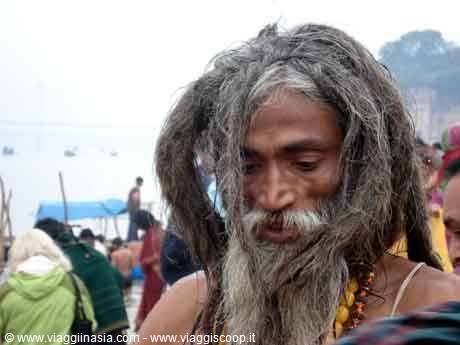
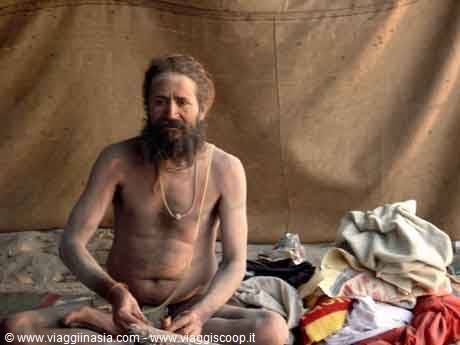
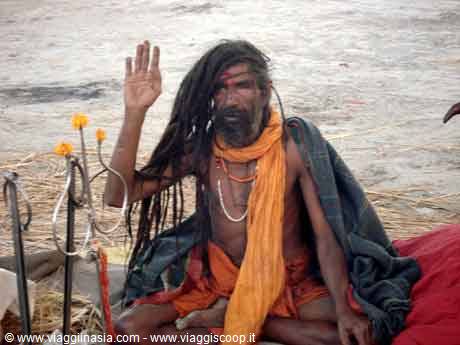
Not bad because we're in the crowd, that famous crowd flowing smiling towards the ghat; they smile at us too and we follow the tide! Another boat trip to the Sangam. This morning there must be 100,000 people. Many are in the water; they bathe, play, smile and make offerings. Some mothers, hoping their little ones can be purified too, immerse them and the children scream, rightly, from the cold. It's the second-to-last important bath. We get off the boat because another ten km await us to reach the cars, and we pass among the last Sadhus remaining at the festival. Some are very kind and pose for photos, others as soon as they see the camera hold out their hand to ask for money.
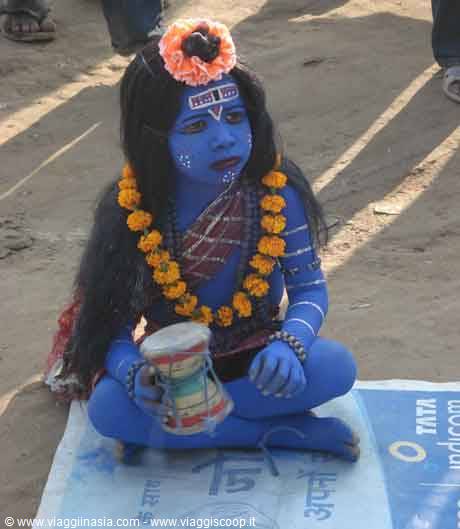
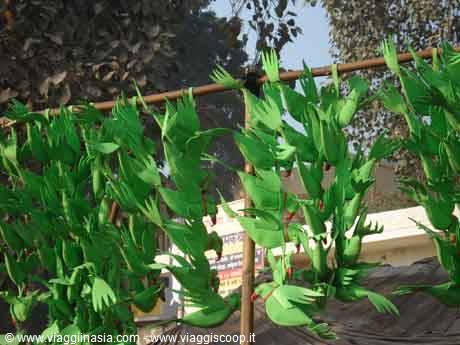
We pass among the sellers of little green plastic parrots hung on sticks carried on their shoulders, through the beggars and the crippled in conditions so pitiful I had never seen; we pass through the filthy camps of some pilgrims; we come across a little girl completely painted blue with a tambourine in her hand playing the part of Shiva. She deserves a photo and a few coins, she's too beautiful and her idea clever. We enter the tent of some kind and hospitable Sadhus, half naked; one of them speaks perfect English. He asks me where we come from while behind him a companion prepares an enormous chillum that he'll smoke in a few seconds. We leave them shaking hands. The loudspeaker keeps announcing names of people who have got lost or been found. A lady, it's not clear whether drunk, mad or simply happy, runs towards us with her tongue out, laughing and dancing wildly.
She wants nothing! As she arrived, she vanishes. In a secluded tent is the last Naga Babu of the Ardh Kumbh Mela. He's sitting, naked and fat, in his tent; in front of him a log burns, and he's surrounded by various weapons: trident, swords and other objects. The trembling guide makes the women move away and tells me to take off my shoes to go near him; he goes on to say that I mustn't even touch the camera because the Naga wouldn't have hesitated to kill me. I keep well clear! The guide prostrates himself before him, I stay standing. The poor man is assailed by a long speech from the Naga; I understand nothing but follow his gestures. Every now and then he breaks off then resumes snapping his fingers, points his finger menacingly at the frightened guide, pulls out a packet of cigarettes, and smokes. His entourage admires him with reverence.
After about fifteen minutes, annoyed by his shouting, I tell the guide I want to leave. He's happy. "What did the Naga say?", I ask him; he answers that he was angry about the influx of Westerners, wondering why we always take photos etc... Maybe he's right... the Kumbh Mela is publicised and sold all over the world as a tourist attraction! The next morning we return one last time; they're already dismantling everything, the human flow has considerably decreased. We bid farewell to the Sangam, placing a little boat with offerings on the water ourselves too, as a request for a blessing. At the station another surprise awaits us. The train is due to leave at 18.30. When we arrive it's hard even to walk, it's so crowded. It's simply impossible. The platform is so full that only a few centimetres remain free before falling onto the tracks.
The loudspeaker announces that our train will leave around 21, soon after it becomes 22. Luckily we find a bench to sit on and we wait in the cold enjoying the spectacle. Three already crowded trains arrive. The crush/brawl to get on isn't describable in words. A rather intimidated passenger asks me smiling: "Will ours be like this, our carriage?" I reassure her, ours has reserved berths. It arrives and we try to board; we witness the last spectacle: one of our porters, as he climbs on, is assailed by a Sadhu who insists on boarding before him. They argue because the Sadhu won't give in, doesn't understand that the seats are reserved, and threatens with his trident; the ticket inspector intervenes and shoves him, making him fall onto our other porter who in turn knocks over the suitcases. In the end we secure our berths with all the luggage.
The train, after another twenty minutes, moves off slowly and we bid farewell to Allahabad. Franco Pizzi, February 2007
The journey's photographs
13 photographs · click to open them full screen

0 reader comments