The story
The Mighty Ones of the Kumbh Mela at Ujjain, April 2004 Before telling you about my recent experience at the Kumbh Mela in Ujjain, I feel it is only right to give a very brief introduction to its meaning. The kumbh [pot] mela [festival, feast] originates in Hindu mythology, and refers to the episode in which gods and demons briefly allied in the effort to extract the nectar of immortality from the ocean, churning its waters. When Dhanwantari emerged from the ocean with a pot of amrita, it became necessary to find someone to distribute it; for this Vishnu took the form of a very beautiful woman and with a little trick gave the demons the "varuni" - a kind of liquor - and to the gods the true nectar of immortality. But the demons did not fall for the trick and seized the pot.
During the struggle a few drops of nectar fell to earth and in the confusion the son of Indra, Jayant, seized the pot and ran off. He stopped in four places in India to rest. Each time he stopped he drank the nectar and, as he set the pot down on the ground, a few drops fell to the soil. These drops gave rise to the four sacred places where the Kumbh Mela is still celebrated today: Haridwar, Allahabad, Nasik and Ujjain. This year it is Ujjain's turn to host the great festival; on the first day of the full moon, 5 April - one of the five sacred dates for bathing in the river - my group and I joined the 200,000 people on the Rama ghat that slopes down towards the Kshipra river. We arrived the day before, and even entering the city with our cars was an adventure. Under a sun that gifted a temperature of 40 degrees the police stopped us, unwilling to let us go on into the city.
The security services were imposing and effective, 15,000 policemen and 10,000 men of the riot police, and our checkpoint, commanded by a kind but firm officer, cost us quite a lot of time and sweat. At last we managed to reach our wonderful permanent camp, owned by the maharaja of Jodhpur. Colonial service! In the late afternoon we ventured, by local tuc tuc, towards the centre of the city where the preparations for the festival were taking place. The first impression was of walking through a fair; music, stalls selling everything, and people, lots of people, walking in our direction, towards the Rama ghat. The wide avenue on the right-hand side was dotted with tented camps hosting sadhus of various sects, each with his own space, or rather: a tent and a fire; and they all smoked big chillums. The smell of hashish filled the camps.
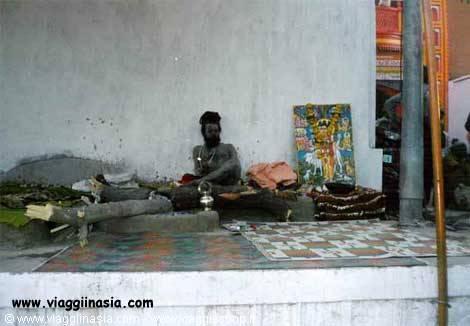
I found little sacredness and much appearance among these sadhus dressed in orange; having entered a tent I saw a famous holy man who always stands on one leg only while resting the other on a rope hanging from a wooden structure. I asked to photograph him and he smiled to show his consent. Click. I quickly recovered from my sense of disappointment when outside, sitting by himself, I saw a sadhu of the Aghori sect, with a tradition of a few thousand years behind it. My guide pointed him out to me.
A small sect, this one of the Aghoris! Their favourite territory is cremation grounds; they adorn themselves with human bones and roll in the ashes of the dead; they eat meat - unlike the sadhus seen earlier who are strictly vegetarian - they feed on human flesh and excrement and are convinced that by going against social rules they demonstrate equanimity towards everything, in a world where there is neither pure nor impure, neither good nor bad. He was there! Motionless, he did not seem to care much about what was happening around him, apart from threatening us intrusive Westerners who tried to photograph him, with his stick. Having resumed our walk downhill, the road grew narrower and the organised camps gave way to simple tents or shelters against walls and houses. We were entering the territory of the Naga Babas.
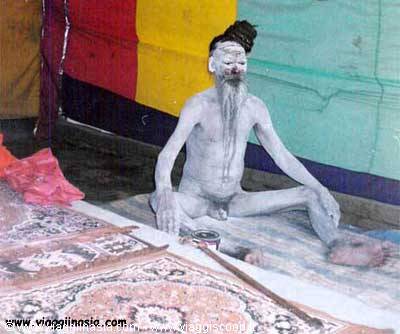
The Nagas, the festival's attraction for Westerners, belong to a Shaivite sect and are known as very combative people; indeed their group is divided into a kind of regiment. Here one sensed something different from the camps visited earlier. A climate of austerity surrounded these naked hermits, covered in ash, almost ghostly; their only possessions were a trident and a hide on which they sat. The typical figure of the ancient Hindu ascetic stood before us. When I approached to photograph them their reddened eyes looked straight into mine; it was not clear whether it was a "yes", a "no", or a "who cares". Not a smile, but a serene face distinguished them from the others, far more playful. In the tent a very thin figure, naked and white because of the ashes, sat in meditation.
The Naga baba called me close to him; after I had photographed him he said something looking at my poor, noisy camera; I did not understand but I was intimidated by his seriousness; for a moment I thought he wanted to smash it; then he leaned against the wall and lost all interest in me. He was somewhere else.
At a previous Kumbh Mela there had been riots and deaths, because of the scramble for priority to take the sacred bath. The dispute was between the Nagas and the Sadhus of other sects: they brawled and died in honour of the idea of peace. This time the division was strict; on one bank the Nagas, who had precedence, on the other, where we were too, the other sadhus. We arrived at the ghats at 06:00, the moment when the Nagas were beginning their descent towards the Rama ghat. We could not see them well, they were far away; then the idea... I pulled out my press card and the police gave us permission to go where no one else could approach. There were eight of us, with a single press card! The staircase in front of us was crowded with Nagas, the water was packed with naked bodies dancing, jumping, playing.
They were happy! The austere figures of the previous afternoon had vanished for a moment, now they were joyful children playing and living a particularly sacred moment! We were about to leave when we heard joyful shouts on the ghat, we saw a stampede. The first of a long list of "mighty" sadhus was arriving! A silver carriage carried a much-venerated holy man, who wore glasses; as soon as he got down, whoever could drew near to touch his feet, to offer garlands of flowers. He set off majestically towards the river with his retinue, bathed, and as he returned another procession was arriving. This time an old sadhu came down towards the ghat, with a smiling face and leaning on the arms of some of his disciples. He was 151 years old. So I was told! The loudspeaker announced every Sadhu arriving with his own name, it was the apotheosis.
Some arrived with elephants, some on richly decorated trucks, some in cars amid a crowd that only India can produce. We were there, amid the colours, the joy of the participants, the flowers; we no longer knew what to look at and what not to: it was all worthy of attention, wonder, fascinated astonishment at what can happen at an Indian religious festival. The difference from the other bank was striking; while the Nagas arrived on foot, naked and without any means of transport, on this side there was a display of wealth or at least ease, sadhus with retinues of many disciples, silver staffs beating the paving to clear the way for the "mighty of the Kumbh Mela". At 10:00, with a temperature of 38 degrees, we decided to leave, back to our camp, to drink a Coke.
We were satisfied, happy to have had the chance to immerse ourselves in this crowd and in a certain way to have been protagonists of this exceptional event in the country where anything can happen: "India"..... franco pizzi
The journey's photographs
3 photographs · click to open them full screen

0 reader comments