The story
AIMLESSLY AROUND HERE AND THERE IN INDIA
Navigation on the Ganges always holds new experiences, sometimes pleasant, sometimes disturbing. I want to try to describe them so they don't get lost from memory, and so they can be useful to someone who will make this journey in the future. The adventure begins in Allahabad, a city famous as one of the four sites where the Khumb Mela takes place, and therefore sacred; even more sacred than Benares, because three rivers meet there: the Ganges, the Yamuna and the mythical and invisible Sarasvati. Indeed it was in these waters that the ashes of great men, like the Mahatma Gandhi, were scattered. The ghat where we will board is about twenty km from the city and you reach it along a small, narrow country road. First we find a last village, at that moment celebrating: stalls with candy floss of every colour, music [awful and at an incredible volume], children playing.
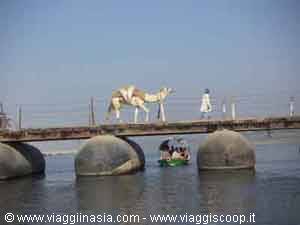
The boats are ready; the welcome is classic, with flower garlands and music. Nothing remains but to lie down on the mattresses and set off. Our first stop is five hours of sailing away on the waters of this sacred river. The camp is set up on the river bank; the tents, tall and spacious with beds and sheets, are put up quickly, while we scatter into the desert of sand that serves as a washroom. The table is ready and before dinner they bring us appetisers of all kinds, which we consume accompanied by a bottle of rum. At the end of dinner someone goes into the tent; comes out and tells me the blankets are missing. The blankets are missing? I tell the person in charge who replies laconically: "We forgot them, do you need them?" "Of course we need them!" I say. "Ok, we'll provide", but he doesn't say how. Meanwhile I see a boat moving off briskly into the dark.
I ask again: "So, the blankets? Where is that boat going?" Impassively the boy answers me: "There's a village on the other bank. They're going to buy them" Answer: "Ah" and we wait drinking our rum. The blankets, incredibly, arrive! They were useful because the night was cold! The other days of sailing continue calmly, the water is almost green and in some places shallow. During the day there is no lack of curiosities: Ganges dolphins that suddenly jump in front of or beside the boat, birds that take flight from the sandy banks, water snakes that glide almost on the surface and the odd corpse floating lazily on the water. For anyone who has never been on the Ganges, this last sight surprises, intrigues and disturbs them. But it is the norm. Into the Ganges are thrown, without being cremated, the corpses of ascetics, children and the sick.
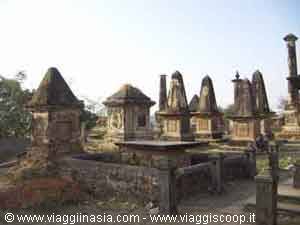
So they are not lacking; sometimes they are stranded on the banks where the dogs fight over them, sometimes they drift down towards the ocean; it is the flowing of life in death, like the flowing of the waters of the sacred river that is born far away with roaring rapids and then calms down before entering definitively into the ocean. We stop at Chunar for a walk. I discover, even though I have been here other times, an English cemetery. It would be a wonderful monument if it weren't used to play and as a washroom. Some headstones are intact, set into beautiful tomb-monuments. You can still read the names of the English buried there: some colonels, others captains; in short, the dead of the colonial era. Tonight we camp again on the beach. We are cheerful, even if someone worries about hygiene because they noticed a skull shortly before the camp.
I reassure them! Cooking is done with mineral water and the dishes are washed the same way. We dine to music, cheerful, but on the other bank in front of us something is happening. There is movement. We realise, even though it is dark, that they are building a pyre, the corpse is already near the Ganges. There are no screams, there is no despair! The pyre is lit while the family members sit around and wait for the end. We carry on eating, laughing and drinking, there is no contrast even if someone worried asks me if it is right to do what we are doing. To have the answer just look at the boatmen and the staff: gathered around the fire they sing and dance. We are about to arrive at the Assi ghat of Varanasi. Benares I see it all! The river makes a half moon and it seems to me very beautiful. Fascinating.
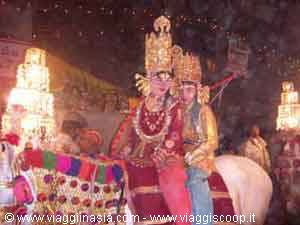
From afar I can see its famous and sacred ghats where the fires of the pyres burn 24 hours a day; the Ganges becomes dirtier, on the banks men and women wash clothes and wash themselves in the sacred waters, someone sits in meditation on concrete structures. The mythical Benares is there within reach, ready to be savoured with this unusual arrival. The Aarti, the fire ceremony celebrated every evening on the ghat, seen from the boats is enchanting. In the darkness of evening the boats glide over the waters of the Ganges. We pass in front of the most famous and most sacred ghat of Benares where the pyres burn continuously, and then return towards the ghat where the Brahmins celebrate the ritual on concrete platforms. People! The ceremony of Shivratri, the marriage of Shiva with Parvati, is quite another thing. The street is barricaded and full of police in riot gear.
You don't feel tension, there is no fear. Here they come! The procession is preceded by women who carry on their shoulders lamps that work with a generator also carried on their shoulders. The electricity wires pass above their heads. Then a whirl of characters parades beyond the barriers; the deities arrive on elephant back, in bright clothes. It is India at its maximum: confusion, colours, bangs, animals and crowd. Then we move away from the festival to go to a less chaotic and more touristy India. From Khajuraho, along country roads not always comfortable, you first reach the Bandavgarh park and then that of Kanha, both located at a height of 450 m. In the morning you set off early, you travel by jeep in the park and you wait until by radio they communicate that the elephants have spotted the tigers.
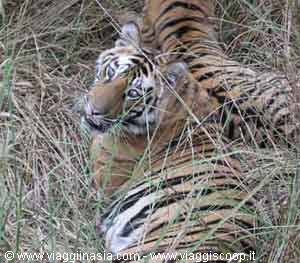
They seem to be the most sought-after animals in the world, judging by the impressive number of people there. Fortunately the park is large and there are many tracks, so everyone follows their own. We cross a driver who communicates something to ours; ours shoots the jeep at full speed towards somewhere. You understand there are tigers. He stops and we climb onto immense elephants. We head a short distance from the car and in the tall grass there are five tigers; the mother with her cubs. The mother is lying flat on her belly and one of her cubs moves looking upwards and says something to us growling. Shortly after we spot another young tigress moving away with her prey in her mouth, very genteelly she doesn't deign us a glance and heads towards a quieter place to eat. Tomorrow we leave for Bhopal, sadly famous for its factory.
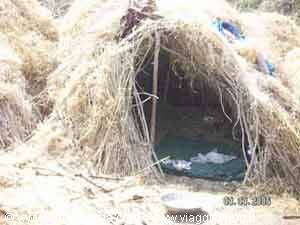
There are no villages on the road to Bhopal; only enormous expanses of well-cultivated land, whose owners live in big cities like Bombay. At a certain point we stop; on the road wheat or some other grain has been spread so that the cars drive over it to thresh it. Seen many times on Indian roads. But we don't stop for this, we stop for the houses. At the edges of the roads the workers have built their huts with the leftover straw of the operation, incredibly small and unsafe, which house entire families. Bhopal is not far; in the evening a sort of small cloudburst keeps us company for many hours. Naturally I think of those people in the straw huts. But in India everything is natural!
Franco Pizzi
The journey's photographs
6 photographs · click to open them full screen

0 reader comments