The story
article and photos by Franco Pizzi
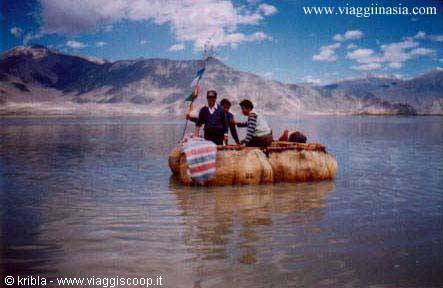
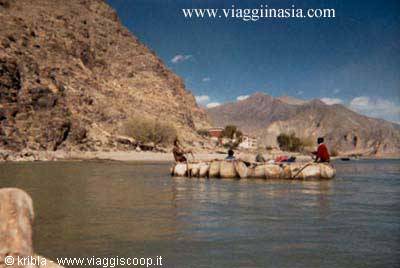
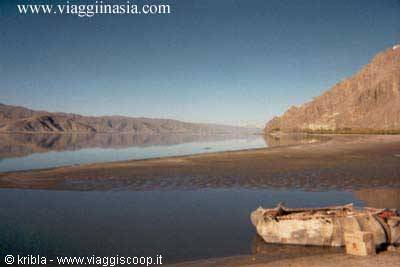
The gowa are small boats made from yak skin; one boat takes the hides of 3 yaks and a week of work. Until a few years ago they were the most used means of navigation in Tibet, for transporting passengers or goods; some writer-explorers describe dozens of boats carrying pilgrims from one bank to the other. Now the gowa have been replaced by motorised barges that cross the Tsangpo much faster, but they certainly don't have the charm of the little boat moving slowly on the placid green waters of the river. My experience with the gowa began just outside Lhasa, with a small group of clients; I'll take you day by day on this wonderful journey to let you discover a bit of unusual Tibet.
22/10
We leave Lhasa on the little boats; we are three to each boat, a bit cramped sitting on planks covered with blankets, with our luggage as a backrest. The destination is Ushe, 4 hours and 30 minutes of sailing. The Kyiciu is particularly calm today; it's clean, its water is green with blue shades, and looking up you can't see a single cloud; a sky as clear as that of Ladakh. We reach the little beach in the afternoon and, while the boatmen set up the tents, we head for the gompa at 4270 m, climbing 400 m of elevation gain on a slightly steep path. Back down, I sit on the sand while my clients' chatter ruins the enchanted silence around us. Looking west, at sunset, the Nyang la Chen range on the horizon is pink and its distant peaks mark the end of the world. The sunset is fast and colourful; the setting of the sun joins the rising of the almost full moon.
The clients are still talking, they haven't noticed this magic, in this fairytale land where every phenomenon is seen as a manifestation of the will of some deity. In the morning in the tent the temperature is -2 degrees but soon, outside, it will rise to +10.
23/10
The Kyiciu is a tributary of the Tsangpo and today we make our entry into this majestic river on whose banks Tibetan civilisation was born. By boat! We've entered the Tsangpo and the boatmen sing, sing and play. They race and sing; it seems the effort of rowing doesn't exist for them, they never tire! The sun is too strong but we have no shelter; on the boats there isn't much to do. At a certain point we hear shouts calling out; on the other bank a coach of tourists has stopped, they're waving at us and taking photos. On the other bank they're close to the airport, which spoils the landscape. Right after, nothing more is heard, apart from the noise of the not very rapid rapids; a little music in harmony with the wild beauty of this place. My guide is called Pemba, a shy, kind, well-prepared and helpful young man. We've become friends.
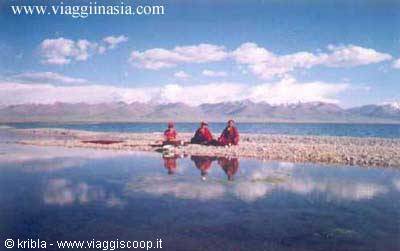
With the cook, whom I've known for a long time, I'm also on excellent terms; as if he were the chef of a grand hotel, from the other boat he asks me in Tibetan, shouting, what we want for dinner. Incredible. Today we have no excursions, so we spend our time on the beach chatting about various topics concerning Tibet and Buddhism. Sunset has always attracted men of all races and all creeds as something mysterious, divine, and even if nowadays we know what it is, this magical moment doesn't escape us. At least, I'm part of this kind of people; I watch what's happening: to the west the river becomes a stream of pure gold; from Kailash the blessings of the yogins reach the waters of the Tsangpo, and I feel at ease in my tent in the sand desert.
24/09
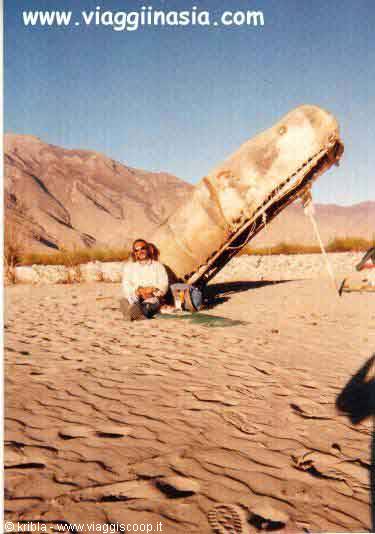
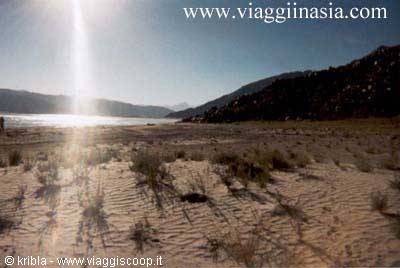
This morning we set off at 10. At our ease; time in these parts flows as it should: "slowly"! Slow is the sailing on the immense Tsangpo. To the west, the opposite direction to the one we're slowly gliding towards, the river seems enclosed by a chain of mountains, covered in snow at this time of year. To the south-east: space! It seems the river ends in the sky. We're hugging the left bank and we can't see the right one; dunes of golden sand shaped by the wind, sandbanks with sparse vegetation prevent the view of the highway that runs towards Tsedang. Now we're in the district of Lokha, "the region that looks south". The left bank is still in the hands of nature; at midday we stop in a fishing village, that of our boatmen. The village is primitive, the houses are made of rudimentary material, and the gowa have been left against the trees to dry.
We visit my boatman's house; a wife with a sweet voice invites me to drink chang and eat something. I accept only the chang. As I leave I wonder whether they know that their country is under the Chinese, whether their influence has been felt everywhere or whether something or someone has managed to escape it. We're back on the boat and I'm sitting at water level; the only noises to be heard are the oars cutting this blessed and ancient water and the songs of the boatmen, sometimes sweet and sometimes not, but always in harmony with the place. Our camp is on the beach facing the monastery of Dorje Drak, a Nyingmapa monastery being rebuilt, inhabited by 27 monks. Inside we find a crowd of pilgrims who have come from Lhasa; they're guests of the monks and will sleep on blankets spread on the courtyard floor. They're kind and offer us pö cha [Tibetan tea] and boiled potatoes.
We politely decline. For dinner we eat fish caught by the boatmen; perhaps the fish had eaten the flesh of the corpses further upstream, but they're tasty.
25/09
a full day of sailing, with the usual songs of the boatmen. The landscape on the left bank is lunar; dunes of sand and rocks. The camp is set up on a beautiful beach and Pemba is negotiating for the little tractors that will take us to the village tomorrow; and then, on foot, we'll go to the sacred caves of Guru Rinpoche.
26/09
the little tractor came to pick us up at 9, and we had a gruelling hour-long journey. Once at the village we continue to the gompa of the nuns, a 45-minute walk. A small monastery kept by nice and kind nuns, very clean and with lots of flowers that reveal a feminine management. We set off for the caves on a very, very steep path; we have to climb, 1500 m of elevation gain. On our return the beach offers a magical and calm moment; large birds - the Dun Dun - move calmly among the shallows while the fishermen pull their nets for another fish-based dinner.
27/09
today is the last day by boat. The rowers pull in the nets and find 50 fish. They gut them and then put them out to dry in the sun. They'll be their provisions for the winter, or they'll sell them at some small market. Samye, one of the most famous monasteries in Tibet because in that place Buddhism was recognised as the state religion, represents for us the return to civilisation. The boat stops on the beach where a truck awaits us to take us to Samye. The journey is over; at least, this part of the journey. For once I realised I had lived in close contact with 6 Tibetans, and mine was a very positive experience, very different from contacts with Tibetans in exile. The boatmen earned 2200 yuan in six days, I'd say nothing for the work they did: they rowed all day, helped pitch the tents, fished to give us the fish, satisfied the absurd demands of some clients. Nice and beautiful people.
Rimbaud said: "What am I doing here?" I ask myself the same. The answer? "I don't know"
The journey's photographs
8 photographs · click to open them full screen

0 reader comments