The story
THE NEW FACE OF TIBET This year, for the first time, I entered Tibet from the Zhangmu border, that is, overland. There was no shortage of surprises. The road from Kathmandu to Kodari, though a little dangerous, is spectacular scenery-wise at this time of year; it feels like travelling and venturing into valleys populated by elves who live behind the waterfalls that come roaring down steep green slopes. You just have to avoid looking at the ravine at the side of the road. But this road is familiar to me. For me the surprises begin at the Chinese border. An official who, wonder of wonders, speaks English and is even kind, invites us to leave our passports because the border is now closed and we have to come back the next day.
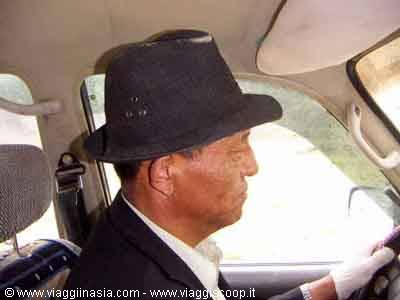
We let it go! For dinner we go to a little restaurant right next to the hotel; clean, with courteous owners who reply to my Tibetan, and on the menu, among other items, you find 'meatballs'. I don't order them but my friends eat them with relish. First change in Tibet: you can also eat non-Chinese food; in restaurants it's fashionable to have a Nepalese cook, who provides a great variety of dishes pleasing to tourists' palates. The next day we start climbing towards Shegar, the day after towards Shigatse. The road is dreadful: that dirt but well-worn track I knew no longer exists; everywhere huge potholes, mud, fords. How many times the car goes into a ditch and you don't know if it will get out. But the smiling look on the face of the otherwise impassive 'grandpa', my driver, is reassuring.
At first I think the state of the road is due to the neglect of the local authorities, but then I notice that at the roadside dozens of people are working heedless of the rain. Further on, bulldozers, not to pull out the odd bogged-down Toyota, but for works... The Chinese are asphalting the road! Incredible the deployment of men and machinery, at altitudes above 4500 metres. The results are visible a few days later on the road that climbs from the village of Nagartse towards Kambala, at almost 5000 m. A few years ago I often found myself stuck for hours on this road devastated by floods and landslides; now the car speeds along a two-lane road with guardrails at the sides and a continuous line down the middle that everyone respects. Grandpa looks at me, satisfied, and says 'Ta Lhasa giopo yonghi re' (now Lhasa will come quickly).
Indeed, a route that only last year was long and uncomfortable is now done comfortably in a few hours. Of course something has changed at the top of the pass too: instead of the picturesque mounds of earth, the prayer flags are now surrounded by asphalt... Caught in a sort of downpour at the top of the pass, after a quick glance at the magnificent lake now wrapped in apocalyptic colours, we descend towards the capital. The road is fast towards Lhasa. Not far from the capital I see on my right a junction and an enormous bridge crossing the river. I ask what it is and am told it is the new road that leads to the airport in 45 minutes, instead of an hour and a half. I keep my head turned for a while, stunned by that enormous work done in little more than a year. I keep looking just as, a few hundred years ago, arriving along the same road, one must have seen the Potala.
And now 'Lhasa the beautiful', 'zepei lhasa' as it is called on the posters hung in homes and shops in every corner of Tibet. Seeing the valley entirely filled with buildings on this poster makes you fear the worst; arriving by car in the modern part of the city, even more so. But the barkhor, the heart of the city, reassures me. The atmosphere is still there, the little streets are still there, the old Tibetan houses are still there. Around the barkhor little restaurants have sprung up, warm and clean little places, run by young Tibetans dressed in fashion, very self-assured, offering Western dishes. I'm stunned when I read 'fondue' on the menu. And even more so when a few minutes later it's on the table.
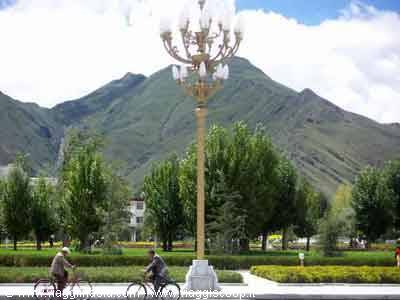
Excellent! Coming out around 22.00 the streets are still full of life; Tibetans and Chinese seem to stroll calmly under the lights of the shops, the clubs, the restaurants; in short, it almost feels like being in Kathmandu. For visiting the Potala the flow of visitors is regulated by fixed times: you have to request an appointment the day before. This innovation isn't bad; visiting the Potala with its narrow corridors when it was super crowded with pilgrims and tourists was a kind of torture. In the streets I don't feel tension, I don't sense danger, I don't see much police. You easily get a taxi at a fixed price per ride. Night-time Lhasa offers everything. Returning towards the hotel I find myself on the avenue below the Potala and I notice that the lighting is provided by hideous street lamps, of an incredible kitsch. Between one lamp and another I see a palm.
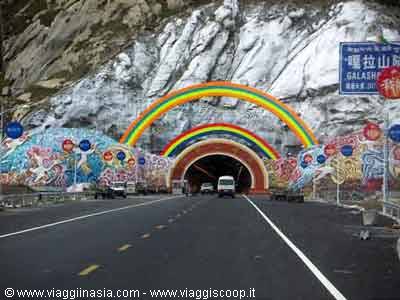
A palm? A palm in Lhasa? Yes! Plastic, life-size, with leaves and even a coconut hanging from one of the branches. Well, the rulers must have wanted to add a touch of colour amid the asphalt and order of the city... When we head towards Tsedang I ask the guide to take the new road to the airport, the one that made me turn my head when I arrived in Lhasa. Straight, smooth, fast, it leads us to the mouth of the tunnel. The entrance is marked by gaudy, almost phosphorescent rainbows. The interior reminds me of a European tunnel: emergency lay-bys, telephones every hundred metres, enormous fans hanging from the vault. Only the toll booth is missing! I fall silent because I want to look carefully all around me and try to imagine what I can expect in a few months when I return. Perhaps an asphalt road that will link Lhasa with Nepal?...
You'll say: 'Why are you amazed by these things that are normal in Europe?' Because I return to India, a country where the dynamism shown by the Chinese is simply unimaginable! Because, other conditions being equal, comparing Ladakh with Tibet there is a huge gap. I love Ladakh with all my heart, but I can't deny that in recent years the environment has deteriorated, car fumes make the air unbreathable, Leh is constantly wrapped in a thick blanket of pollution. Where's the difference? Better cars, cleaner fuel... The standard of living of the people is better in Tibet too; not only for the Chinese, but also for the Tibetans. Even in the most remote corners of Tibet, on the plateau at 4500 metres, nomadic people live in better conditions than their brothers in the Indian Changthang. I was shocked by this....
I, who have been travelling in Tibet for ten years, noting the changes, frankly can't say I'm disappointed by the comforts that everyone enjoys, not only us or the Chinese, but also the Tibetans. Of course it's a different Tibet from the one I knew some time ago. Perhaps the innovations can be criticised; emotional pro-Tibetans and the Tibetan propaganda in Dharamsala will certainly say that the Chinese are overturning Tibet, are putting an end to its traditional way of life. I don't dispute the impact of Chinese immigration, the fewer job opportunities for Tibetans compared with the Han Chinese, and the evident lack of freedom under a still communist regime.
Just think that for the celebrations of the 40th anniversary of the autonomous region, for 15 days tourists are refused entry! But, looking at it purely from the material side, after all.........which part of the world has remained intact and untouched by modernisation that, if we honestly look deep in our hearts, is so convenient for everyone? Franco Pizzi Dharamshala, August 2005
The journey's photographs
7 photographs · click to open them full screen



0 reader comments