The story
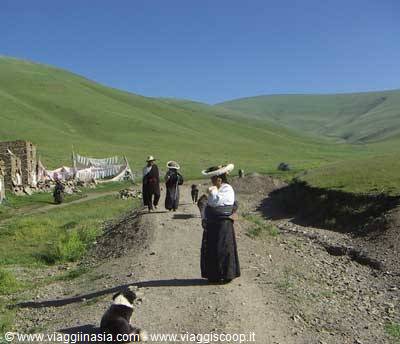
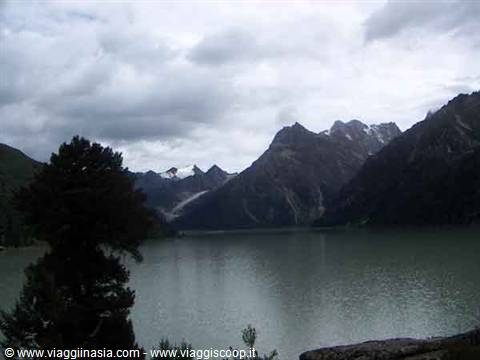
PASSING THROUGH KHAM: 5 THINGS THAT STRUCK ME by Kristin Blancke -The landscapes: Unlike most of the other Tibetan areas I've visited so far, the lower part of Kham (still always above three thousand metres...) is very "alpine": very green, with lots and lots of flowers, and a predominance of blue meadows; gentle hills and pretty little houses that almost look like Swiss chalets. Every village has its own architectural features, with slight differences in the use of colours and wood decorations. Even when you climb above 4,000 metres there's still a bit of vegetation left; here the villages disappear, and you find yourself amid vast prairies with nomads' tents.
While the vegetation at the relatively lower altitudes is of course beautiful, a lover of the highlands like me prefers these higher places, with their vast spaces dotted with nomads' tents, flocks of sheep and goats, horses and yaks; lots of yaks.... -The monasteries Everywhere in Kham you feel a great urge to rebuild. Little remains of the hundreds of old monasteries, all destroyed by the Muslims or during the Cultural Revolution. But now they're rebuilding. Much work has already been done in the last decade; in many other monasteries you feel as if you're on a building site. Particular attention is given to painting the frescoes, in bright colours, a bit kitschy for our tastes.
-The monks But then what do they do in all those monasteries? In some places you sense a feeling of desolation, of abandonment; several times we were told that if the Dalai Lama doesn't return the monks feel lost, and many, very many try to escape to India, legally or illegally, where they find their mother-monastery in exile. The elderly and sick monks stay behind. In other places instead, where there's considerable support from rinpoches living abroad, you feel a great religious fervour. One example is Dzogchen. A lovely place: situated above 4,000 metres, you climb to a mani wall from a village with few houses and shops, and once past the wall you enter a wide valley dotted with temples. At the end of the valley, in a large temple with a wooden floor, teachings on Longchen Nyingthik were under way. We arrived at the moment of the break.
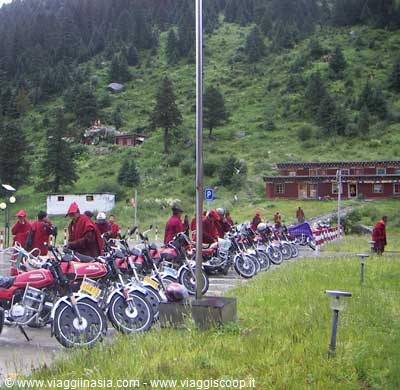
Hundreds of monks spill out for a moment of rest. We had noticed a row of motorcycles parked neatly side by side. And then we see the monks jump on them.... On the other side of the valley a fine building houses a 'shedra', an institute of studies, and a little further on, in a large new temple, a tantric initiation is being given - women are not allowed in. Many monks here too; one of them has travelled around Europe as part of a troupe of monks performing the Chams - the ritual dances of the monks. He spent some time at the Dzogchen monastery in southern India, and it was then that he made his trip. Sershul Gompa is another place of great inspiration. This monastery too is located in a remote spot in the mountains, about thirty km from the county capital, Jumang.
We arrive in the evening, after a long rainy day, and are received in the monastery's guest house: nice, clean, simple but welcoming, complete with a restaurant and a lounge with a large picture window looking over the valley. Finally, after all the Chinese hotels - quite "anonymous" - visited so far, we find a bit of "human warmth"! The visit to the monastic complex on a sunny morning, reached with a pleasant walk, is a very nice surprise: a series of buildings scattered over the surrounding hills, including a shedra (a study institute for the monks), a temple, and some "tent-schools" (they're nomad tents full of children from the villages around). We meet a nun who studied in Dharamshala and now lives in Sershul to help the rinpoche as a translator when foreign guests arrive: Taiwanese, Singaporeans, Westerners, who come to this remote place to follow some meditation course.
-The "devotees", lay people and monks Along the road we come across another very particular place. Our drivers tell us about it while we're on a 4,600-metre pass. They say that a little ahead there's a place where 10,000 nuns live on one side of the river, 10,000 monks on the other, following a great master (the figure is surely exaggerated!). The Lama is so famous because he shows miracles on his body: for those who possess the eye of faith (!) it's possible to see on his chest all the masters who gave him teachings, with the Dalai Lama on his head. Just a few kilometres' detour to reach this site. Impressive! Right away we see a building, like a hangar, with lots of monks and nuns inside, following a religious function, a puja on the occasion of the day of Yeshe Sogyal (the Tibetan consort of Guru Rinpoche).
But looking around we notice an enormous building site; a more or less finished temple, and lots of buildings. Hundreds of shacks where the people live, who have come here from every part of Tibet to follow this master. Says a monk, originally from Lhasa: "We come here because we can truly learn to meditate, not just to study debate, but to meditate, with the help of a master who shows the signs of his realisation!" -The towns and the people: Pelyul, Derge, Kanze are small towns, quite pretty, with characteristic wooden buildings. Yushu, on the other hand, is a rather large city, predominantly Chinese. The hotels are strictly owned by the Chinese, with Tibetan staff. In the city a mix of ethnicities, between colourful Tibetans like Wild West cowboys with their magnificently adorned women, and Chinese who run all the businesses.
What struck me was the total lack of a Tibetan 'entrepreneurial' class. Where are the shrewd and likeable shopkeepers we find in other parts of the Tibetan world? It seems that around here the Tibetans who remain are peasants and shepherds and street vendors, or sellers of low-quality goods, while all the commercial activity of any importance is in Chinese hands. The lingua franca, in the city as in the villages, is Chinese, even between Tibetans from different regions. Funny to find yourself in a situation where to make yourself understood you need a three-way translation: from my Tibetan to the guide's Tibetan, who, being from Lhasa, doesn't understand the local dialects and has to resort to Chinese...
Sometimes even that isn't enough, and the drivers of Khampa origin have to step in! I get the impression that in general among the lay people there's a climate of quiet resignation: this region has been part of China for a long time! Proof of this is the opening of the horse festival in Yushu: Chinese military parade at the start, military parade at the end; soldiers on foot and soldiers on horseback; floats with Chinese advertising. But portraits of the Dalai Lama are found everywhere here; no need to hide them! Dharamsala 16 July 2006
The journey's photographs
6 photographs · click to open them full screen



0 reader comments