The story
BHUTAN FOR THE PARO FESTIVAL
What a beautiful country, Bhutan! It had been two years since I had last been to this land with its wonderful nature that holds a natural surprise behind every bend; but with rather strange people... Before leaving I had read in Kuensel, the Bhutanese national newspaper, that the anti-smoking law had come into force throughout the country; a law a bit confusing in its practical application. A few days earlier the King, in an interview with Indian journalists, had admitted to smoking, and a lot at that, but had declared that he had imposed this ban for the good of future generations. A democratic country, Bhutan! Under the new rules, every tourist may bring with them one carton of cigarettes free of charge, with the ban on selling them in the country. But... they gave us a good soaking on arrival! We were eight people: seven magnificent and kind ladies and me.
Out of eight, five were smokers, so in their suitcase each carried the cigarettes that had to cover the need for the 9 days of stay in Bhutan, since the sale of cigarettes is forbidden. Having filled in the forms and paid 20 dollars for the visa, two gentlemen in traditional dress — the "gho", a robe in the typical Bhutanese colours reaching down to the knees, and knee-length socks — with lips and teeth red from constant chewing of betel [famous for its carcinogenic effects...] — approach with their faces twisted by greed, with the cunning little smile of: "now we'll fleece you". They are the customs officers. They pounce on my clients' suitcases and with immense pleasure bring out cigarettes saying: "You have to pay 28 dollars for each carton. Not even a single cigarette is allowed to be imported; in our country no one smokes".
I take the liberty, aloud, of protesting, but they turn a deaf ear: they take the money and give receipts! This was our "welcome to Bhutan". Be careful, smokers! We are persecuted even in Buddhist countries... On our tour the first stop was Paro, where the annual festival was taking place. Although the festivals are interesting, for us organisers they become a nightmare because of the scarce hotel capacity. In fact it seems that the whole world concentrates on this small country, occupying all the rooms of all the hotels, and whoever arrives first is best lodged. The Bhutanese agencies, who charge a fixed fee of 200 dollars a day, give you the hotels they want anyway, without taking into account the requests made earlier. I had sworn I would never go there again....
The opening of the Paro festival takes place in a magnificent spot, even if it's a bit of a struggle to get there: cars can't reach it and you have to walk 30 minutes, up a path that climbs beneath a rocky ridge on which the Dzong of Dzongdhaka is perched, whose monastery dates from the 13th century. The atmosphere is cheerful; the dances take place in the courtyard of the Dzong, and around it there are all kinds of stalls, where everything is sold. Happy people go up with their picnic to spend the day in the sun — one of the few with sun! The next day we go to attend the beginning of the actual festival in the Dzong of Paro. At the entrance a policeman forces the participants to take off their hats, as a sign of respect, despite the sun and the fierce heat. I point out that a lady in the group suffers from a head illness and cannot take off her little hat.
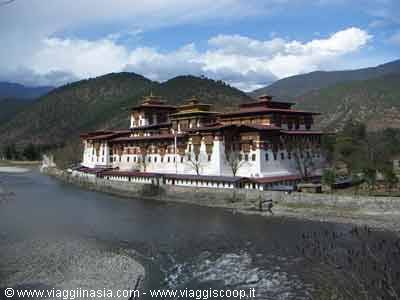
Answer: "Either she takes it off or she leaves". She takes it off! Here too an orderly crowd is crouched around the sides of the courtyard. The clowns, the azzara, cheerfully keep watch that the whole open space where the dances must take place is not occupied. The show lasts a long time, and few are able to stay until the end; after seeing the first dancers in beautiful brocade robes and listening to the music of drums and radung, one is satisfied and leaves. As I wander among the stalls I see a green tent and, surprise... a big sign invites visitors to get free condoms. Bhutan is famous for its dzongs, imposing fortress-monasteries built in places of strategic importance to defend against possible Tibetan invasions, all built around the 17th century by the Shabdrung Ngawang Namgyel.
They are indeed majestic and awe-inspiring; the interiors [the little they let you visit] give a feeling of warmth, because everything is built in wood. The dzongs contain government/administrative offices and monasteries, so inside you see employees, rigidly in traditional dress, going home at the end of the workday, some beautiful monastery halls with wonderful frescoes, and little monks playing in the courtyards. From Jakar, capital of Bumthang with several temples and monasteries, we went to visit the small village of Ura. The landscape has changed: the tropical forests give way to green, well-cultivated fields. Bumthang consists of five wide valleys dotted with the typical Bhutanese little houses that recall Swiss chalets. In general the Bhutanese people are courteous and smiling, people are willing to be photographed and to talk — when you understand each other.
Thimphu, the capital of Bhutan, brings us back towards our own world. It has changed a lot since the last time I visited it; everywhere well-stocked supermarkets and discos. But the Saturday weekly market has remained very charming. The stalls are often nothing more than a carpet laid on the ground; the smell of dried fish is a little invasive; there are fresh nutmegs used for making betel [betel nut], vegetables and various objects for the locals' daily use. In Thimphu the absence of traffic lights remains, and still the traffic policeman in the middle of the junctions dances when he signals to motorists — few of them — that they can go on or stop.
But nature, which ranges from tropical vegetation to the cold Himalaya, is what strikes you most in this country! Along the central road that leads to Bumthang and then continues to the border with Assam — an area closed to tourists at this time — it is one succession of lush forests, monkeys that come right to the edge of the road almost to show off their beauty, small deer that walk calmly at the roadside. And the flowers! How many flowers there are! The forest is dotted with immense flowering rhododendrons; gigantic magnolias rise here and there almost to form a wood within a wood. Every moment there is something beautiful to see and photograph. In the evening it was cold, but we were warmed by the wood stoves placed in the dining room. A shame to leave them, because the bedroom is cold. To reach Bumthang you cross three passes between 3,000 m and 3,400 m.
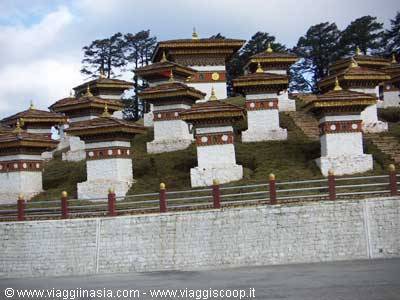
On the Dochu-la pass 108 stupas have been erected; on the others you enjoy an excellent panorama of the surrounding mountains. Phuntsholing awaits us with a humid and rainy climate.. A border town that doesn't offer much. A mixed population of Indians, Bhutanese and Nepalese stroll among the not very clean little streets or shop in well-stocked supermarkets. Leaving the hotel you can easily cross the arch that marks the border between Bhutan and India. I do it often because in India you can phone at a lower cost than in Bhutan. I do it because I re-enter the warm, friendly Indian chaos that contrasts with the orderly, neat, almost Swiss landscape of Bhutan. Tomorrow we will all cross the border together to slip into the little immigration house and continue our journey on crowded roads, roaring horns and confusion. India. Franco Pizzi, April 2005
The journey's photographs
9 photographs · click to open them full screen





0 reader comments