Direct flight Rome-Chicago and overnight stay in a motel near the airport. By car we headed west...... along the way we stayed in motels near the parks. A solo trip. A journey through the American parks
Introduction: Visiting the parks of the American West and some national monuments was like fulfilling a dream, the holiday we have all dreamed of taking once in our lives. Since for us it is the first time we have visited the North American continent, after having visited Canada, we were completely fascinated by the beauty, the variety and the grandeur of a still unspoilt Nature, often blended with the most "extreme" modernity in a way we Italians cannot easily conceive of, accustomed as we are to our own little world, tamed and shaped for centuries now. In the United States, and in particular in the West, the idea of an environment "made to man's measure" tends to vanish, with the result that you feel small, very small.
The car (or the campervan) is certainly the best means of discovering the authentic USA, the one of the road movies, because if you want to discover the essence of a country, you cannot visit only the big cities (New York and so on) — it is the provinces, the lost places, the deserts and the prairies that convey the true nature of the States. We hired a car and set off into the unknown, towards the natural wonders this country can offer, and we had no fear at all of driving the American "routes". The USA has an absurd number of national parks and protected areas, rock monuments, canyons, lakes and mountains... a lifetime is not enough to see them all, and places like Yellowstone, the Grand Canyon, Monument Valley, Mesa Verde, the Rocky Mountains and so on possess a unique charm that must be breathed and lived.
No photo or video can remotely reproduce the real splendour impressed on our memory and in our eyes. In general one can say that the cost of living, outside the big cities, is lower than ours in Italy (regardless of the favourable exchange rate). Drinks: they put lots and lots of ice in any drink that isn't the "famous" very looooooooooooooooong coffee. For Americans it is incomprehensible to drink a glass of water or a drink without ice cubes. Km covered: we drove around 13,500 km. The USA is extremely well organised and you can trust its organisation a great deal. In certain respects, to us "Mediterranean" Italians, they can even seem a little naive, over the top, and if we are respectful of their culture and their rules, we immediately realise that they are very kind, hospitable and smiling (cheerful), otherwise they can be very hard.
It is very important to know English WELL if you want to take part in excursions with the rangers, otherwise you understand nothing of what they say in American, nor why everyone laughs at their jokes, which they make often and willingly... or you are not even accepted on the planned tour (for example going down the Grand Canyon on mule-back as far as the Colorado River and probably staying there two days).
Preparing the trip We began organising our trip to the USA at the end of June. We were mainly interested in visiting Yellowstone park (which is about 2500 km from Los Angeles), so we decided to give up visiting the cities and parks of California. On the internet we read that in Yellowstone park (average altitude 2500 metres) it is likely to snow and be very cold already at the end of September, so we decided to leave in early September and go straight to see the parks of South Dakota, Montana and Wyoming, and then go down south to visit the parks of the south-west (Utah, Colorado, Arizona and so on). As a precaution we checked, again on the internet, the availability of the hotels located inside the parks, and we always found them full: ergo impossible to book a room in advance.
We read the diaries of those who went to the USA and visited the parks, but almost all of them were diaries of young people and related to a period of 15/20 days at most, while we found no diary at all of older people (perhaps because they went on the trips organised by the various tour operators). They were frenetic days in search of possible solutions to overcome the handicap of overnight stays in the hotels located inside the parks. The decision was to set off with a small Canadian tent, so as to be able to sleep in the campsites located inside the various parks. We checked our 2 (old) small tents and found them unusable. Having changed the plan..... we also have a large tent; we open it... it's all fine, this one will do nicely.
We try to put it in the suitcase and.......we discover it doesn't fit and is also too heavy! We rethink the whole thing..no! we have decided to set off and we will set off with a new small Canadian tent. We go to buy it and get one in the size that fits in the suitcase, so we can set off with one hand luggage bag each and just one big suitcase. All that's left is to plan the trip. Before deciding how, where and when to take the plane, we check the costs, duration and the weights and sizes of the luggage on various airline websites. And here we find some difficulties: there is the airline that for hand luggage requires certain specific sizes and weights, others that don't indicate the sizes, still others that don't allow you to bring hand luggage unless it's a small bag, and so on.....
a jungle! Perhaps it would be simpler to rely on a tour operator and let him choose, telling us how and what we can bring; but that's not our case — the trip is ours and we want to make all the decisions ourselves, right or wrong! Our choice is: an American airline with a direct flight, with no stopovers, from Rome to Chicago. And so on 4 August 2011 we booked the Rome-Chicago round-trip flight departing on 7 September and returning 17 October, the first overnight motel stay in Chicago for the evening of 7 September, and the last two days (15 and 16/10/2011) of overnight stay in the centre of Chicago (on Adams St. - in the Loop), finally the car with Hertz near O'Hare airport in Chicago for the period 8 September - 15 October, with payment on delivery of the car in Chicago.
Now all that's left is to wait for the day of departure! Antero decides, since we have bought a new small Canadian tent, to become a member of the KOA club (Kampgrounds of America); he signs up, receives the card and gets the chance of a discount for staying at the campsites.
Day 17 Sep 2011
Still reading on the internet, he learns that it is possible to buy phone cards with very little expense that allow you to talk to landlines in Italy at a negligible cost and for a duration of over 1000 minutes (except decreasing quickly if you call mobile phones). He makes a reservation for a phone card via the internet and immediately we start with the difficulties related to the language. In fact, with an email we are informed that we will receive a phone call from their center to confirm everything. And so it happens. Antero is forced to understand (!) and respond (!) in English to the questions the young lady asks him. He believes everything is fine, also because he immediately receives a confirmation email that also contains the pin to use when we are in the USA.
All set? Not at all! Another email arrives, where they ask us to call an Italian number in Rome to give us further information about the activation of the phone card. Antero dials the number and...a recording in American places questions that cannot be understood. We are in difficulty! we can't understand whether the phone card will work or not. We look for someone who understands and speaks English well and we find among our acquaintances a person who has lived in England for a long time and speaks English correctly. We go to visit her (she is a very kind lady) who tries to dial the Rome number. Well, four times she is forced to hang up because she cannot fully understand what the recording says in American and not in English! Then after several attempts she gets in contact with a "live" operator who, speaking in English, reports that the phone card is fine and working. (n.b.
we worried for nothing because the message asking us to call had been sent prior to the confirmation message of the validity of the phone card but had reached us immediately after.) All this is part of the friction, the agitation that takes hold of us when we have to think about a long journey to places we don't know and especially when (as always) WE ARE ALONE. The days pass and thinking back to the trip we will make, it comes to mind (we had forgotten!!!!!) that, if we want to sleep in the tent, in the campgrounds we must also have 2 sleeping bags and two inflatable mattresses...we rush out and go to buy what we are missing: 1 sleeping bag.
We take up the big suitcase again, we put inside the two sleeping bags, the tent and……..we discover that there is nothing else that fits except the trekking shoes we must bring for hiking in the parks, and we don't want to bring 2 big suitcases with us! Change. We will leave without the tent, we'll manage as and where possible. Again on the internet searching for motels near the parks and we take note that those where rooms are available are all about 30-50-80 kilometers from the various parks. Well our final decision is: book three nights at the campground near Yellowstone park (50 km!) taking a bungalow for the night so we are sure we can visit the park with all the time we want.
So we do, but another surprise awaits us: in the booking confirmation letter it is explained that in all American campgrounds no linens are provided (sheets, pillows and blanket) but, in compensation, all have heating. It doesn't matter, as soon as we arrive in America we will equip ourselves by buying what we are missing. Meanwhile our son gives us a smartphone and sets it up so that, by getting Wi-Fi in the USA, we can make phone calls via the internet. (It will prove to be a great thing, we called all relatives, friends and acquaintances, spending very few euros!) Finally the day of departure arrives, our son accompanies us to the airport, time for check-in and we are ready to leave. The flight departs on time, landing in Chicago the same day at 3:30 pm. Duration of the trip: 42 days (September 7 - October 18, 2011).
States we crossed: 14 Illinois, Wisconsin, Minnesota, South Dakota, Wyoming, Montana, Idaho, Utah, Colorado, Arizona, New Mexico, Texas, Oklahoma, Missouri. We also visited many state parks and national monuments.
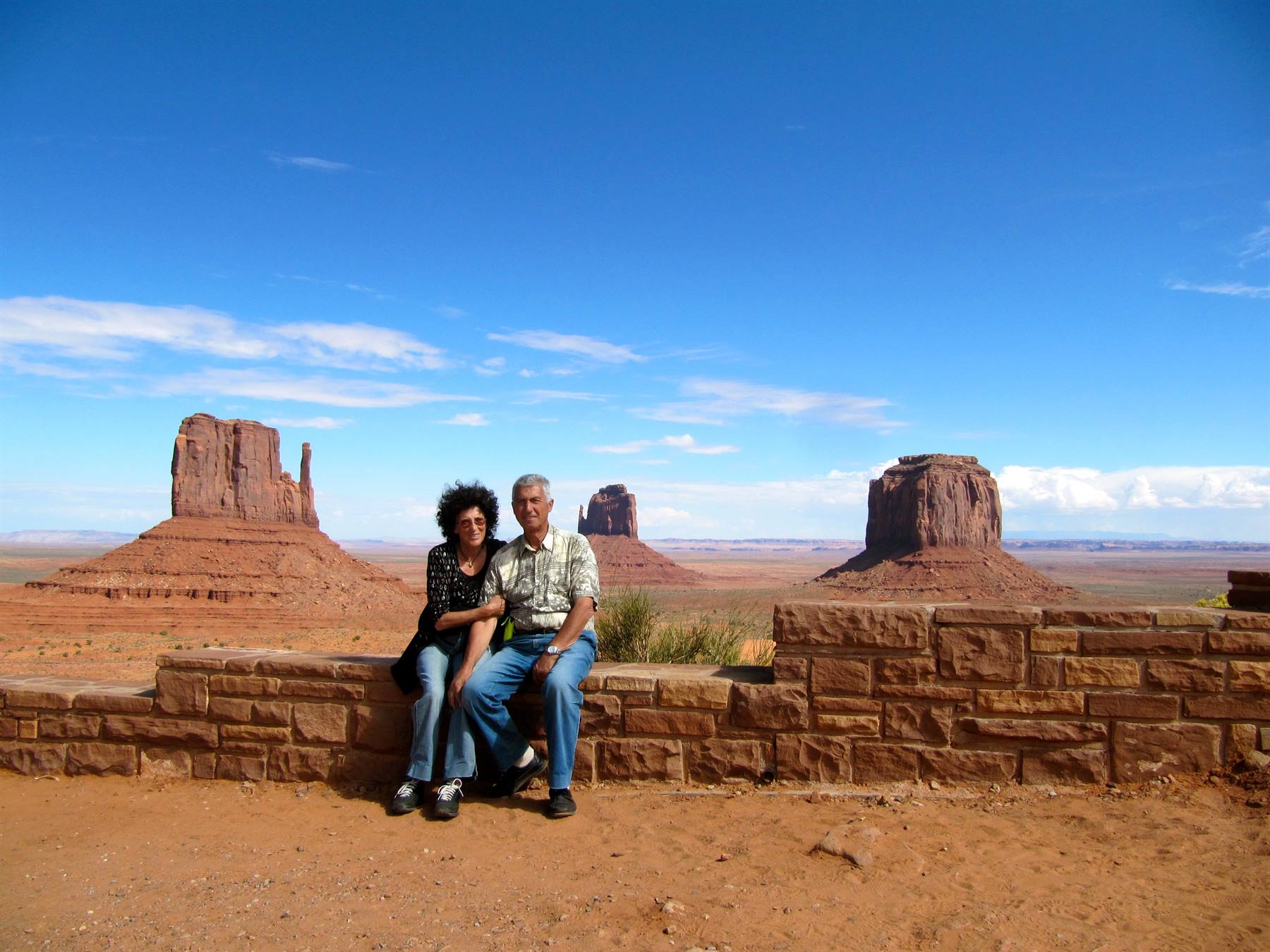
Us in Monument Valley
Day 27 Sep 2011
Parks and sites visited:
Illinois Visit to the city of Chicago.
South Dakota: (National Parks) Badlands and Wind Cave, (National Historic Sites) Minuteman Missile, (Memorial Monuments) Mount Rushmore and Crazy Horse, (Rocky Mountains) Black Hills, Belle Fourche (national geographic center).
Wyoming and Montana: (National Parks) Yellowstone and Grand Teton, (National Monuments) Devils Tower, (National Areas) Bighorn Canyon and the Chief Joseph scenic byway.
Utah: (National Parks) Zion canyon, Bryce Canyon, Capitol Reef, Arches, Canyonlands (National Monuments) Cedar Breaks, Grand Staircase Escalante, Needles Park, Hovenweep, Natural Bridges (National Areas and State Parks) Anasazi park, Devils Canyon, Dead Horse Point, Kolob Canyon, Snow Canyon.
Colorado: (National Parks) Mesa Verde (National Monuments) Dolores, Yucca House (Historic Sites) Four Corners.
Arizona: (National Parks) Grand Canyon, Petrified Forest, Monument Valley Navajo Tribal Park (National Monuments) Canyon de Chelly, Montezuma Castle, Walnut Canyon, Navajo, Meteor Crater. (State Parks) Slide Rock state park Sedona the Sedona scenic byway and the famous Route 66 to Chicago.
New Mexico: (Historic Park) Pecos (National Monuments) Petroglyph Circle, Santa Fe, El Malpais, Acoma Pueblo (Historic Trails) El Camino Real, Santa Fè, Pecos, Los Angeles NM and Route 66.
Oklahoma: (National Historic Sites) Fort Reno in El Reno (Memorial Monuments) Oklahoma City
Wednesday September 7 We're off! At 6, after saying goodbye to the children, grandchildren, dog and cat, we drive toward Rome airport. We find confusion on the ring road but we left with plenty of time and arrive at terminal 5 in time to check in, everything fast and without mishaps and we are already waiting to board. While we wait we check all the documents, plane ticket included, noticing that we have not received the ticket for the return. Minutes of panic then, taking advantage of the kindness of a young Italian who has to go to Chicago for work, we breathe a big sigh of relief. He tells us that everything is stored in the airline's computer and there is no need to have the paper copy. (Mary and I look at each other...what a figure!!!! It's been 3 years since our last plane trip and things have changed in the meantime and we're not up to date).
10:30 we board, 11:15 right on time the plane takes off and leaves Italian soil. From the window we can see the Island of Elba, Sardinia, then the land disappears, we are over the ocean. The journey goes smoothly, the flight hours are many (10:45) and we try to doze between one meal and another. The on-board service is continuous and abundant, we have breakfast, lunch, snack and dinner. We arrive punctually at Chicago's O'Hare airport at 3:30 pm local time; while we are in line for the checks we try to call and send messages but we don't get a line, we see signs warning that there is no network coverage, we postpone to tomorrow also because in Italy it's 10:30 pm.
While the Americans, who disembarked with us, quickly go through the checks for everyone else, including us, they make us wait in a long monstrous line, then they take photographs, take fingerprints, check documents etc.; only after four hours do we manage to leave the airport and it's 7:30 pm. The first impact in America is negative! but it's not the only one: in fact when we take a taxi and hand over a slip of paper with the hotel name, street, etc. etc., the taxi driver, African-American, makes a big fuss, says he doesn't know the area, stalls, makes us angry until we tell him that, having a navigator, all he has to do is enter the hotel address! So he does and so we manage to reach our Hotel for dinner. We are tired, after leaving the suitcases in the room, we go to a nearby Burger restaurant, have a quick meal and then go to sleep.
Us in Monument Valley
Day 37 Sep 2011
................................the diary continues until 18 October 2011.
Complete with photos etc., you can read it here:
Us in Monument Valley
Day 48 Sep 2011
Thursday September 8 At 4 we wake up to phone Italy; the hotel has free wi-fi, we connect to the internet and talk with the children. (The new smartphone immediately proved very useful!) We have breakfast and call a taxi that takes us to the Hertz car rental near the airport. It's early, we booked the car for 12 but it's only 10:30. We ask at the desk if it's possible to come earlier, they say yes, we take care of some paperwork, confirm a full tank of gas for unlimited miles, add to the contract additional damage insurance for the car and...they give us the car. It's 11, an employee who also speaks a little Italian gives us a new car (the odometer reads 10,700 miles); it's a Chevrolet model Impala, 3500 engine size, and reminds us never to use the left foot, otherwise we'll hit the brake and risk slamming to a stop.
We set off slowly and with some concern, reach the exit toll booth which is regularly barred; another Hertz employee asks us for the pass, checks it electronically and the barrier lifts. There, now we are out and merging onto the road (which also seems like a highway, being 4 lanes) that quickly leads us to the entrance of Interstate 90, the one that leads to Rapid City. What confusion, cars passing us on the right and left, all going very fast while we don't exceed 45 miles. Arriving at the first toll booth we have to pay (we know we have the Telepass that allows us to pass quickly but we don't want to use it, given the fairly high cost of use) so we prepare the exact coins, but there's also the toll collector collecting...everything becomes easier.
To get out of Chicago we pay another 3 times (1 $ at a time!!) then no more, meanwhile the traffic has become even more chaotic, Antero decides to exit the highway to...catch his breath and fully grasp the concept that driving an automatic car is different from driving a car with a manual gearbox. As soon as a ramp appears on the right, Antero goes to exit the highway. And here what we didn't want to happen happens. Since the ramp is uphill, Antero tries to downshift and uses his left foot to "press the clutch" instead….the car stops abruptly! The cars behind are forced to brake, until their tires smoke, they were going so fast. What luck! 2 cars stop less than 5 centimeters from us, without touching us; the others managed to dodge us.
We get a few insults, we apologize, then, slowly, very slowly, with the left foot far from the pedals and the right arm not touching the gearshift, we set off again. From now on Mary must check that Antero absolutely does not put his hand on the gear shift! Now that traffic has also decreased a lot, we have time to enjoy the spectacle around us, a short stop for lunch, we pass the city of Madison, then in the tourist-beach area of lake Delton, even though it's still daylight we decide to stop to relax a little, then we look for a motel nearby and find it in Willis-Dells. Once the suitcases are in the room (this "stressful" operation we will repeat for the next 40 days), having seen that the motel has a pool and spa, we decide to go for a long and regenerating pause in the warm waters of the spa which with its bubbles tones up our body. And so we do until dinner time.
Us in Monument Valley
Day 59 Sep 2011
Friday September 9 At 8 we wake up, calls to the children (thank you Wi-Fi!), a good breakfast and a very long coffee that makes us miss our own coffees, strong, thick, short...exciting. We take the highway again, stop for a snack and the usual coffee, buy food for lunch which we eat at a picnic area, in the middle of greenery; there are many picnic tables and super-clean restrooms. We continue, the road is monotonous, little traffic and ahead of us endless fields planted with corn. Every now and then we see large farms with very large silos and livestock facilities and everything is clean and tidy. We reach the town of Mitchell where we find a motel that seems to have come out of a movie; it is decorated with ox skulls and deer antlers and has a very large pool in the front; we are starting to see things that remind us that the west is approaching. Saturday September 10
We can't get the AT&T line so all we can do is try with the famous American card. It's a long procedure, the number to dial is very long then you have to add the pin code, finally the Italian phone number to call with 039 in front, but we succeed using the phone in the room. How wonderful, we have 1111 minutes to use and off we go calling friends and relatives. We set off and the first stop is a large Wal-Mart shopping center (a huge hypermarket that we will also find in the smallest towns) and we buy what we need to spend 3 days at the Koa campground in West Yellowstone, namely a warm down jacket, a pillow, a thermal food box and….a chamber pot. yes, really a chamber pot! for the night. We don't know how we are set up at the campground...and if we would be very far from the bathrooms? better not risk it. Naturally we have already changed our way of eating.
We have abandoned the typical American menu (sweets are all with frosting, covered with vanilla or other and very, very sweet, then bread, we like bread with a crunchy crust and here in America only mushy bread exists, soft, good only for making the famous MacDonalds sandwiches, sauces are inserted in all foods which are yes tasty, but highly caloric, pasta is always a sort of glue, the meat is super-spiced and the portions are always gigantic...then to complete the picture, television shows how restaurants prepare food and how customers enjoy them opening their mouths like an oven, then, even more important thing, we have seen many obese Americans, not fat, but obese-very large- so much so that we got scared and among ourselves we said: let's immediately modify our way of eating.
In the morning we have breakfast with corn flakes in cold, cold milk (the milk, already cold, is in thermoses immersed in a bowl of ice), less than half a glass of very long coffee, a banana or other fruit and off we go; for lunch we stock up on various fruits, crackers, small cheeses and yogurt; sometimes we take slices of ham or other with sliced bread. For dinner we get fried chicken legs, roast chicken, various cold cuts and cheeses, bison cutlets with puree and other delicacies ready to cook in minutes in the microwave; and then asparagus, beans, peas, and other types of canned vegetables, we buy large quantities of salad, carrots, tomatoes, artichokes and other ready-prepared vegetables. Well this has been our diet for the whole period except sometimes eating at Mexican, Chinese and....American restaurants.
Today we want to go visit the famous Badlands National Park, we always take Interstate 90 and take exit 131, drive 5 kilometers and here before us is the north-east entrance of the Park.
At the ranger on guard duty (actually a big ranger) we ask for a pass valid for 1 year that allows us to enter all US national parks and monuments at a cost of $ 80. We enter and immediately notice that the entire park is a geological area of incredible charm, made up of badlands, pinnacles, spires of stratified sandstone, with different colors, in a labyrinthine path of extreme beauty, a true kaleidoscope of strange and shimmering colors of the formations whose spectacle is given by the continuous erosion of the terrain that continues to sculpt the "butte" even today. (Butte = isolated "small hill", with steep sides and flat top), so much so that one day - in the future - the Badlands will be completely eroded. We slowly drive the Loop Road and stop every time we find a trail (path or trail) which allows us to approach on foot the pinnacles and the badlands.
Along the route we notice many cars stopped along the roadside: we are in the Robert Prairie dog town area, where we find the largest community of prairie dogs (Prairie Dog) of the Badlands. Continuing on the route we arrive at the Pine Ridge Indian Reservation where the White River Visitor Center is located with rangers from the Oglala Sioux tribal community. At the Ben Reifel Visitor Center – open all year and the park's headquarters, we watched a very interesting film. We head towards Wall and find the Cedar Pass Lodge with a camp of Indian tents (tepees). We return to I90 and then go to visit the "Minuteman Missile National Historical Site" where we see the planes, the missiles and all the American technology for space. It's getting late, we go to Wall, a small town particularly known for its Drug Store, which has become a tourist attraction.
In the old town, bars and shops typical of the American Far West have been rebuilt. There is also a small museum, full of original period photographs portraying Indian chiefs; the Wounded Knee, completely dedicated to a tragic episode of 1890 when the 7th cavalry massacred the tribes of Sitting Bull and Big Foot, marking the end of Indian resistance. We find a motel near the center and after dinner we return to the street where many old saloons face, we have the feeling of living in the past.
Sunday September 11 Contrary to the first impact we had with Americans, now we note a truly warm availability and welcome. Everyone strives to understand "our" English, and cooperates with courtesy. Tonight we want to stay in Custer. In Rapid City we shop at a famous jewelry store; "Rushmore Gold & Diamond Factory". We buy 2 particular watches, they both have a vine leaf and a bunch of grapes as well as all the jewels they produce here. When we arrive at Canyon Lake we see signs advertising a wooden church originally from Norway. We have seen many but here in America it is truly a rarity; it was dismantled in Norway, brought here and rebuilt. Continuing, before arriving at Mount Rushmore we enter by car into a park where animals are free.
Bears crossing the road, moose grazing freely, sleepy bison that accompany us to the exit, not without having given us that certain thrill and fear of possible damage to the car.
A short stop for lunch and at 3 pm we are finally at the entrance of the Mount Rushmore National Monument.
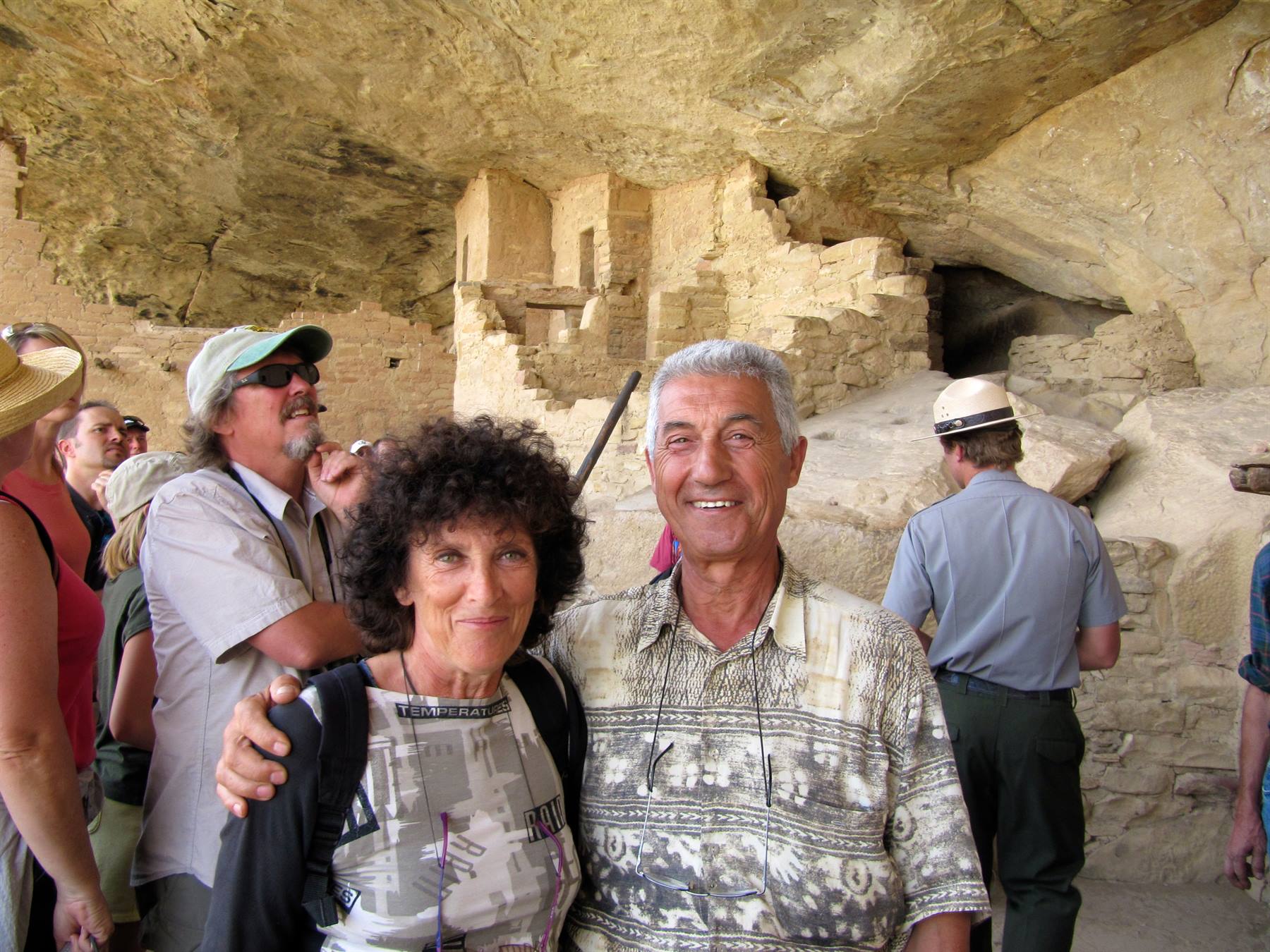
In the Pueblo
Day 612 Sep 2011
. We show the Pass, they verify its validity, they give us the illustrative material of the monument and we park the car in a large underground garage (for a fee). We walk a few meters along an avenue with all the flags of each American state and, arriving at the square, we see carved on a large rock wall the faces of four famous Presidents of the United States of America (from left to right: George Washington, Thomas Jefferson, Theodore Roosevelt, Abraham Lincoln), chosen respectively as symbols of the birth, growth, preservation and development of the United States. The sculpture is truly impressive, it is about 18 meters high and is an important tourist destination, also for the natural beauties of the Black Hills (black mountains) and represents the symbol of the first 150 years of American history.
From the square you can see the large theater carved into the rock, while on the side some steps lead to a museum and continue to the woods becoming a trail (path) that reaches right under the faces of the Presidents. It is very hot and the rangers suggest bringing water, so we do and we walk the trail admiring those imposing sculptures that loom above us. It is still daylight when we leave Mount Rushmore. We continue and arrive in the village of Custer in the Black Hills National Park. When we arrive a welcome surprise awaits us, the whole village is in western style, houses, bars, banks, sheriff's station. They are all made of wood with bright colors, they all have the American flag. We take a short walk, buy something to eat which we consume in the motel where we will spend the night.
Monday September 12 Early (it's only 8) we take US16 which takes us in a short time to the place where the wonderful sculpture (still unfinished) created by the Indians in memory of Crazy Horse is located. At the entrance of the Crazy Horse memorial we immediately notice the characteristic facial features of the Indians, we park the car, we take the brochures that allow us to learn the history of this people and their great desire to build this monument, we watch an interesting film that illustrates all the phases of preparation of the immense sculpture, which, once completed, will be the largest rock sculpture ever built, 195 meters wide and 172 meters high. (just for comparison, the heads carved on Mount Rushmore are only 18 meters high).
The Lakota chiefs supported the idea of a sculptor intending to honor the memory of what is called the last Sioux to make such an enormous sculpture to make amends for the "provocation" of the white man who had built Rushmore in Indian sacred territory. In 1999, the then American president Bill Clinton went to the excavation site. Those who had dedicated their lives so that Crazy Horse could extend his arm to point to his beloved Black Hills, even with unfinished works could legitimately claim that a result had been achieved: an American president paid homage to the memory of the greatest Lakota leader that History remembers, never officially becoming chief of his people but undisputed leader only by virtue of his own charisma.
We take a small bus that takes us right under the carved head and we admire its size, there is still much to do to finish the work but the Indians are proud of their decision: they do not want National funds and carry on the work only with the proceeds from admissions and sales of souvenirs. We meet a French couple, the first Europeans we see, they have come to America 3 times and are now heading to Yellowstone. We instead go to Custer Park inside the Black Hills and take US 87. The itinerary winds along the slopes of high mountains, we pass through small tunnels carved into the rock, we pass near a beautiful lake seeing round hills and mountains with infinite granite spires, we drive along roads (the Wildlife loop) that open onto breathtaking panoramas in an always wonderful scenery.
During our tour inside the park we have to stop several times to let bison, white-tailed deer, turkeys, squirrels, prairie dogs and donkeys pass, lots of donkeys. We knew, from reading in some magazines, that here is one of the largest bison herds in the USA, a notable quantity of pronghorns, and many other types of animals but, one thing is reading and fantasizing and another is experiencing these close encounters. We arrive at the legendary scenic byway 16a which we follow until passing Keystone, then we merge onto another scenic road, the 385 where we enjoy superb panoramas, nature here is the absolute master. We finally arrive at Deadwood, a national historic monument: it is a Far West town once governed by bandits, gamblers and gunslingers, its history begins in 1876, two weeks after the Battle of the Little Bighorn where General Custer's defeat occurred.
In the Pueblo
Day 713 Sep 2011
The discovery of gold attracts outlaws, gamblers and gunslingers along with gold seekers, Deadwood is a town that has yet to be bornn, that lives without laws, populated by every sort of criminal. In a place where there are no laws, the only law that counts is that of the strongest, in this case Al Swearengen, one of the founding pioneers of the town, owner of the only Saloon where he manages his shady business. Other characters arrive in town with the intention of starting a new life: among them are Seth Bullock, former sheriff, the most famous gunslinger of the west and gold seeker Wild Bill Hickock (but only a few weeks after his arrival, he was killed while playing poker and holding a poker hand of aces and eights - forever known as the dead man's hand), and Calamity Jane who are both buried in the Cemetery Mount-Moriah in Deadwood.
After the fires that devastated the town several times, turning it into an old ghost town, in 1989 gambling was legalized. So today the town presents itself as an immense casino with gaming rooms on every street corner; in fact even in our motel there is a saloon with an attached gaming room. After relaxing in the spa (small pool with hot water – 38°- and with bubbles!), we go to eat in the gaming room and here we find many people busy at slot machines and green tables. The blinding and flashing lights, together with the noise, make us think of what the saloons must have been like in the 1800s, and we immediately notice that the casino cashier is protected by large bars useful to limit the excesses of players towards the cashier.
There are smiling players (they won) and others who look desperate (they lost), others who shuffle their feet and seem stupefied by the sounds and noises of the saloon; and so we spend the evening, it's 24:00 local time and people are still coming in to try their luck while we go to rest.
Tuesday September 13 As usual we have breakfast with corn flakes then at 8, after a few kilometers we are in the town of Lead famous for its gold mine which until its closure in 2001 was the oldest still in operation in the world. We ask to participate in a guided tour to go see the enormous pit 550 meters wide and 300 meters deep but the tours ended on September 10; never mind, we settle for seeing the enormous pit from a terrace. We take US 14 and arrive at Spearfish, set in the spectacular landscapes of its canyon, and which fascinates us with its historic district. We continue towards "the geographic center of the United States", in fact in our guide we read that it is located near Belle Fourche. In Spearfish we get a brochure with the indication of the "center"; we question our Neverlost (the American navigator), set the route and set off determined to immortalize this moment.
We pass the town of Belle Fourche and the navigator tells us that the "center" is about 30 miles (50 km) away, we are confused, we thought it was near the town, instead the navigator always confirms the position. We continue on a long strip of asphalt surrounded by prairies, steppe and nothing else; we already begin to see signs indicating the nearby border with Canada while very few cars travel the road; we ask ourselves...but where are we going? Finally the navigator indicates to take a dirt track so as to arrive at the exact point…but we are in full desert, nothing and only nothing, before us and we don't want to leave the albeit lonely asphalt road. We look around and see nothing (in the brochure there was a photo of the "center" with many trees around but here there is absolutely nothing. Suddenly, and fortunately, a car arrives.
Antero signals the driver to stop and he stops right in the middle of the road (it's all straight and hardly anyone passes!). We ask where the famous "center of the United States" is and show the navigator, he tells us to go back to Belle Fourche and cross the bridge, immediately on the left we will find the famous "center". The navigator tricked us, maybe it wanted us to reach Canada? What! We go back, retrace the 50 kilometers that separate us from Belle Fourche, arrive at the bridge we find a small square, we leave the car and, behind the visitor center, the famous "geographic center of the United States" appears before our eyes. It is a large marble disk engraved with the outline of America, Alaska and Hawaii which together form the United States.
Yes, even if the "center" may seem too far north, we must also take into account these 2 states that are at the extremes of the territory of the United States of America. We take the ritual photographs, phone the children thanks to the wi-fi connection, a brief snack and we set off again to visit the famous Devil's Tower, as the Indians call it the Devils Tower. We leave South Dakota behind us and enter Wyoming; in this state you breathe the history, that magical and bloody history, of the west; it is also the least populated state in the USA and nothing has changed since the times of pioneers and cowboys.
The spectacular nature of the Rocky Mountains has remained intact, the rodeo is still the most important event, while the most coveted job is that of the horse whisperer (the man who whispers to horses): and there are people who manage to tame wild horses simply by whispering in their ears. The road runs without any panorama, only prairies, then suddenly on the horizon a large stone cone appears: the Devils Tower which is what remains of a volcanic cone. It is truly imposing and when we are at the base of the "mountain" we feel small, small. Its strange shape is made up of many vertical columns of rock and we notice that there are many climbers trying to reach the top. We go around the base of the tower, enter a trail into the woods and see many, many squirrels then many holes in the ground…they are the famous prairie dogs that go in and out as if wanting to be photographed.
It has gotten quite late, all we can do is go to the first town and find a motel, we drive a few kilometers and stop in Gillette, a town that has nothing special except what we need: a motel.
In the Pueblo
Day 814 Sep 2011
Wednesday September 14 Again this morning we leave the motel early, we want to visit Buffalo, the Big Horn Mountains with the famous scenic Byway that from Lowell in a spectacular panorama will lead us to Cody. We arrive at Buffalo, suddenly the sky turns dark, a strong wind blows, it's cold so much so that at the first stop we notice we are at 0 degrees, we continue hoping for an improvement. We climb up the mountain until we reach 3000 meters but we can't see anything because the fog has enveloped everything, now we continue at 5/10 miles, there is no traffic, we are alone there are hairpin turns and continuous ups and downs, at every curve we have the feeling of going off the road, so we are also a bit scared. Unfortunately the stupendous panorama that should have been seen passing through this road remained wrapped in fog and we couldn't wait to go back down and arrive in Cody.
Finally and only when we arrive in Powell does the fog disappear. Along the road there is a visitor center, from the brochures we see that nearby a beautiful Canyon would be worth a visit but we settle for seeing the film because there are still about 50 kilometers to reach Cody where we must book the room, and attend the western show that will be held in front of the Hotel Irma at 6 pm. Having become relatively familiar with the cordial, helpful, kind and courteous ranger of the visitor center, Antero asks her to book a room for us at the hotel Irma for tonight. Of course the discussion goes on for a few minutes given our English, but in the end the ranger understands and calls the Hotel, communicates our data and, more importantly, our credit card, and reassures us about the outcome of the reservation.
Hurray! We make it in time to arrive in Cody, visit the town, settle our things in the booked room and calmly attend the show. This city is also famous for the Buffalo Bill Historical Center which contains collections of western culture and for the Cody Firearms Museum, the largest collection in the world of American firearms and even today
In the Pueblo
Day 916 Sep 2011
We leave Cody and continue for about 100 kilometres on the US 14 A until we reach the east entrance of the park where we take the classic souvenir photograph. At the entrance booth, after checking the pass, the ranger hands us all the documentation and we notice that the places to visit in the park are divided into 5 moments and the route forms a kind of 8, so if we start from where we entered we'll first visit the Fishing Bridge and Lake Village, then the Canyon Village, to the north the Mammoth Hot Springs, to the west the Old Faithful and the Grant Village to the south (all with an average altitude of over 2,000 metres). A brochure in Italian makes it easier to read so we divide the park visit into 5 days. After a few kilometres, ahead of us, near the lake, a herd of bison grazes peacefully on the prairie. We drive a little along the lake, we're at 2,400 metres of altitude, it's hot.
We see the majestic Lake Yellowstone Hotel, entirely of wood and painted white and yellow as it was built in 1891, we head back north and drive alongside the Yellowstone River, which is the longest undammed river in the United States and flows into the Missouri, here it has a torrent-like character, and we see many fishermen fly fishing; here it's possible to catch fish even weighing 50/80 kilos! At a bend on the left an immense basin of pools with boiling waters appears, with colours ranging from green to burnt red while the water is cobalt blue; we're in the area of the Sulphur Caldron and the Mud Volcano. We walk the entire trail amidst these wonders; the boardwalks are sometimes right above the fumaroles and at times the fumes don't allow you to see anything. We travel through the Hayden valley, lush with meadows and marshy areas, a paradise for wildlife.
We don't go far and are forced to stop in a queue behind many other cars; How come, what's happening? There's a herd of bison slowly crossing the road. A little further on a small group of elk grazes on the prairie amidst the fumaroles; almost without realising it we've already arrived at Canyon Village and we skip the visit to the famous waterfalls. We arrive at the east junction of the Grand Loop Road (a road that forms a perfect 8, 280 kilometres long). We still have to travel more than 100 kilometres to get to the campsite we booked for 3 nights, which is about 10 kilometres from West Yellowstone. Once we reach the Norris junction we head south, then at the Madison junction we turn right to go towards the west exit of the park and reach West Yellowstone and then our campsite. The distances are considerable and the speed limit is 25 miles per hour.
We arrive at the campsite at around 6 pm, Antero shows the membership card, collects the key to the bungalow but before going into our "little house" the manager lists the things we can't do; the main one is not to leave anything outside, to put the rubbish in the special covered, hermetically sealed iron containers, because (we're in a forest inside the park) at night bears and other animals go looking for food and can be dangerous. So if we have any food that we keep in the car it must be carefully covered so that the animals don't smell it; the risk is finding the car smashed up if we don't follow the rules. And so, informed about what to do, we go to take possession of our little wooden cabin.
In front of the entrance, under a small portico, there's a terrace with a large rocking chair, next to it a large barbecue and……the famous container with a lid, all in iron, for the rubbish, hermetically sealed. The inside of the cabin is spartan, it's a studio flat with a large bed and 2 bunk beds, there are no sheets, blankets or pillows and there's no bathroom either. However, we have everything necessary because we bought it in Rapid City. On the other hand we have heating, which we try immediately as the temperature has dropped suddenly: during the day the temperature is always between 20/25 degrees, now, at 7 pm, it's 2 degrees and at night it will be even colder. At the campsite, about 150 metres from us, there's also a large heated pool and a spa that stays open until 11 pm, but with this cold it's really not worth crossing the campsite to go to the pool.
Friday 16 September
We slept nice and warm while outside last night it went below zero. The bed is a bit hard but overall we were fine. To have breakfast we have to go into town 10 kilometres away because here, at the campsite, there's everything but only until 10 September. In the town all the houses, motels, restaurants, bars, etc. are in old American style, very characteristic and welcoming. We go into a bookshop because it has a sign saying "espresso coffee", there's a coffee machine and we ask the kind young lady if it's possible to have a short coffee. She understands we're Italian and puts all her effort into it but…the result is a fairly good coffee but still very, very long; anyway it's drinkable and it's not a litre! Meanwhile the sky has clouded over with clouds that promise nothing good. We take from the suitcase what we need to cover up, to shelter from the rain and cold, and enter the park.
The road runs alongside the Madison River and, once we reach the junction, we decide to go south west, towards the Old Faithful to visit the Lower Geyser Basin, Grand Prismatic, in short all the wonders we'll encounter in the 30 kilometres we'll travel. The sky is overcast, it's quite cold and sometimes a light drizzle falls. It's impossible to list the wonders we encounter: some placid bison graze among the boiling steam vents, we take the first wooden boardwalk that leads us directly to within a few metres of cauldrons that smell of rotten eggs, around us a frenzy of colours, the transparent azure water contrasts with the yellow and red caused by bacteria that reproduce only at temperatures lethal to any other living being, it feels like being in a paradise disguised as a hell of Dantean memory.
Arriving near the Grand Prismatic Spring, we leave the car in the car park and take the boardwalk that leads us right to the edge of this large coloured pool but the steam it gives off is so much and so thick that it's difficult to see it well. There is a possibility, to reach a small bridge about a kilometre away, cross it and take a path that, after about 2 kilometres, leads us up the mountain, right above the large pool. We drive the car to the small bridge, then after reading that it's very likely to encounter bears along the route, we give up. Over an area of several square kilometres there are dozens of other geysers, some larger and more beautiful than the Old Faithful but much less constant and precise in their performances, so a spectacle reserved for the few who have the chance to spend many hours here.
We are lucky enough to witness some of these eruptions and it's only at this moment that we realise that not only does the eruptive phenomenon exist but also the colours of the concretions all around, until we discover that all the vents are connected to each other. In fact we see that, while one geyser erupts, the pool next to it empties, sucking the water downwards. Both will fill up again a few minutes later once the eruption is over: a phenomenon that left us open-mouthed. And we arrive at the most famous and suggestive geyser because, due to a strange underground alchemy
In the Pueblo
Day 1017 Sep 2011
you'll find the rest in the diaries section of my website:

0 reader comments