The story
Fifteen days in Gran Canaria, to enjoy the climate and the beauty of these wonderful islands. From Maspalomas we walk to the Meloneras coast; the difference from the dunes is striking, dark rocks as big as melons. We decided to take an organised excursion, the island tour "la Presa Canaria", to better understand the soul of Gran Canaria. We climb northwards; the first stop is Telde, a village perched on high ground, where the public toilets are inside the town-hall offices. We continue on towards the mountains, wonderful scenery, we spot the Canary pine, particularly good at retaining the little water and humidity of the area. The Roque Nublo and the Pico de las Nieves stand out. You might even manage to make out the summit of Teide, and therefore Tenerife, but the day isn't clear; in compensation you can see the Maspalomas dunes in the distance.
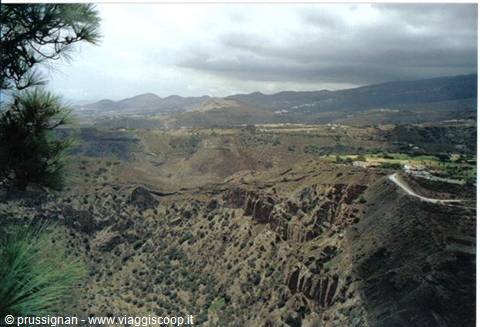
Descending along a barranco we stop for lunch near the Ensamble de la Chira, an artificial lake; they show us the preparation of "mojo canario", the typical sauce. Through a thousand bends we reach Fataga, a village where water is available only on Tuesdays. We then hire a car and set off to discover the island. Puerto de Mogan is a small fishing village, full of brightly coloured bougainvillea. We visit the island's capital, Las Palmas; the old town is nice, all gathered around the Casa de Colon, perhaps the house of Christopher Columbus, who is said to have stopped here before continuing to the "New World". The cathedral is beautiful; for the rest the city is a bit chaotic, or is it us who've become "bananas"? Climbing to the top of a hill we admire the Caldera de Bandama, where the road runs right along the rim of the crater of the extinct volcano.
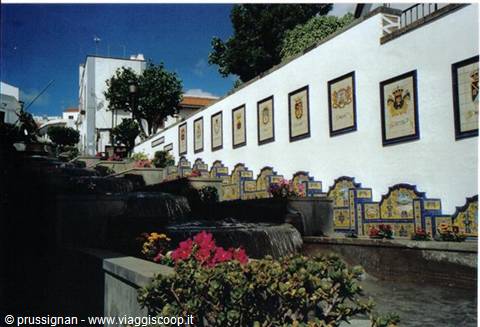
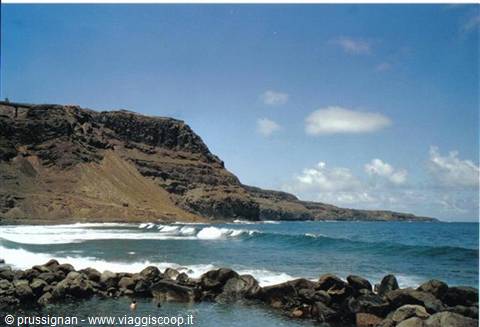
Another stop, again towards the north, Arucas, a village with very narrow, uphill streets; it is the home of honey rum. We continue towards Firgas, an enchanting place with a little uphill street lined with majolica seats, one for each "municipality" of the island. On the paving is a scale reproduction of the Canary archipelago. Moya offers breathtaking panoramas and a little white church. At San Felipe we admire the ocean waves; along the road Galdar appears, and it's amazing to see how the houses are climbing up the slopes of the mountain. We reach Agaete, and from the beach you can make out the rock known as the "Dedo de Dios". The western coast of the island is very rugged, so we only get as far as Mogan, set among barren mountains.
A visit to the Palmito Park, not far from Maspalomas; here it's really hot, with the park channelled between the rocks; standing under the sun waiting for the show....it feels like sitting on the burning coals of Lanzarote. P.S.: at this point we're real Canary Islands experts; if you need advice don't hesitate to ask. La Palma, the island that is a mountain, was described to me as very beautiful, but you should go in spring, since the small beaches below the rock have totally black sand. Going there just to do mountain hikes seems a bit of a waste to me, with the Dolomites a couple of hours' drive away.
The journey's photographs
12 photographs · click to open them full screen






0 reader comments