Eyes still amazed before so much beauty. Armed with garlic and wooden stakes, following in the footsteps of a fake Dracula, we instead opened the doors of our hearts to this extraordinary country. Too many cliches and a great deal of superficiality should be erased forever. Romania is a stunning country, rich in ancestral traditions, distant and fascinating, in flavours as sweet as the hills of Transylvania, in people as proud as the peaks of the majestic Carpathians, and in a gothic and intriguing atmosphere. From the frescoes of the monasteries in the mountains to the sinister alleys of Bistrita, from the stratospheric beauty of the black pearl, Sighisoara, to the simple rural life of green countryside where time has stopped, granting this land an absolute primacy in Europe. A small great corner of bucolic, simple and remote life, a Europe now impossible to find. Strong nostalgia.
Great Romania. A beautiful discovery, a fine lesson to learn, a stinging defeat for us stupid sceptics. Go there and you will tell me. Happy travels.
Day 116 Sep 2006
WE WERE LOOKING FOR DRACULA, WE DISCOVERED A WONDERFUL COUNTRY
Romania..guys..so many emotions, what a magnificent surprise…here’s my story.
Imagine a ramshackle train, a desolate moor, an unknown station… it’s just past one in the morning.. the train comes from Nyugati station in Budapest; the station where you are now, on the other hand, is that of Cluj-Napoca, gateway to the magical and dark TRANSYLVANIA!!! The emotion of a journey is also measured by adrenaline and by that strange form of fear/distrust/ignorance that grips us when we find ourselves in places different from our everyday imagination. And so..here we are. After almost 7 and a half hours of travel across the flat and boring Hungarian plain, we arrived in Oradea, the first city of some importance on the Romanian-Hungarian border… With me is Stefano, desperately seeking to retrace the steps of Count Dracula, an imaginary literary creation, hastily lumped together with the figure of the Impaler, Prince Vlad Tepes.
Stefano, like a Genoese Susy Blady, decided to bring to light the hidden truths about the mythical Vlad Dracul and to shed some clarity on this mysterious story on the border between myth and reality—bahhhh….I, on the other hand, was basically a skeptic, and to say that’s not like me… But you know…cliches kill curiosity and prejudices fuel ignorance…so all of us drink in information that isn’t ours and think we know something..WRONG!!! Never believe the rumors and nonsense of those who have never lifted their pretty behind from the armchair… try to touch with your own hands the things you want to know about, always try to poke around a little more because that will be one of the most beautiful riches you’ll carry inside..forever.
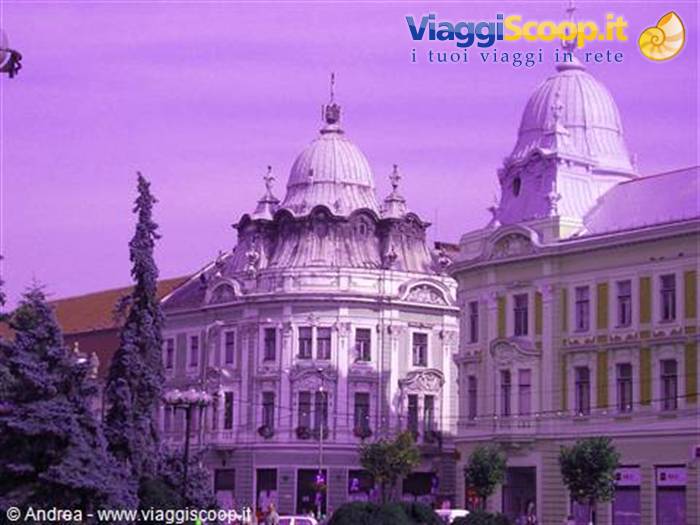
First stop, the beautiful and elegant Cluj-Napoca: a city of great Orthodox churches, tree-lined avenues, nice cafés and elegant people. The night before, the dark atmosphere had already captivated us: through the dimly lit streets, looking for an open supermarket where we could buy something, we had gotten a taste of this strange city. Its dark entryways, its unsettling open windows, gloomy figures roaming its streets..but it was only a distorted perception of reality on our part. Cluj is the most avant-garde city in all of Romania. Fashionable young people, nice clubs, restaurants and shops in Western style… The buildings, often a bit decadent, nevertheless recall a glorious past: here as elsewhere, the Austro-Hungarian Empire had a hand in it, building and rebuilding, leaving its indelible mark on the city’s structure and way of life.
We visit the city first from the beautiful terrace of Hotel Victoria, the most beautiful in the city, the only one alas open at two in the morning, and then roaming through the streets, first trying to sightsee and then desperately searching for an agency where we could rent a car.
After wandering around like madmen, we entrust ourselves to the giant hands of one Adriàn, a big Romanian man who gives us a gray Opel Astra…around us the Romanian traffic of Cluj is raging; we swallow hard like Jerry in Tom’s hooked hands and acknowledge that driving around here will truly be an adventure…and then some!!!
the Carpathians
Day 218 Sep 2006
BISTRITA/EASTERN CARPATHIANS
It's an extraordinary succession of small urban clusters, Saxon churches, eccentric wooden constructions with pointed roofs adorned with black crosses, courtyards of flowers and climbing ivy, where piglets and calves run around, elderly people passing the late afternoon with their gaze lost in the speeding cars of the legendary E-56 highway. We reach Bistrita late at night. Here according to legend, the odd visitors of Dracula's castle spend their last night escorted by the local authorities. From here on, towards the Borgo Pass, they were supposed to continue on their own.
Bistrita looks like a movie set in the purest Hollywood style: horror films, that is. The atmosphere you breathe is truly fascinating: the great Lutheran church towers in the centre of the city, all around are wooden buildings dating back to the medieval period. Monstrous-looking houses overlook the large green Unirii square: the wind hisses as if it were screams, the church seems empty, skinned, old and decrepit. The trees drip onto the streets, repeatedly moving large branches of dark green leaves, dogs bark in the distance… Hence our motto: Bistrita (pronounced bistritsa) …what a fright!!
Fortunately the night passes peacefully, in fact we dine in a wonderful place, in the middle of a park along the river, with ciorba (a sort of less spicy goulash), mamaliga, a tastier polenta, meat, cabbage salad and delicious red wine. We leave the city and head towards the heights of the eastern Carpathians: if possible, the mountain reality is even more remote and closed off, inaccessible and far away. The means of transport are wooden carts pulled by spotted cows, little girls play with kites, bundled-up old women sell every kind of vegetable… all in a bucolic and peaceful environment.
The road will take us up to almost 1900 metres, passing through Vatra Dornei, the Borgo Pass. Here the Dracula-like legend builds the myth of the passage between Transylvania and Moldavia: a pass that led unfortunate travellers into the jaws of the real Dracula!! Here…unfortunately rich and ignorant Americans have built a mega super hotel, Hotel Dracula..with its own themed restaurant and themed rooms. A horrendous construction and disproportionate compared to the nearby little houses, the Hotel also offers its visitors a tasty surprise.. We..couldn't let it slip away…here we are trapped. Accompanied by a strange waitress, we visit the hotel rooms, until we reach the crypt where Prince Vlad is said to be buried…(in reality he is in Bucharest). The fright is enormous..I won't tell you about it otherwise when you go there it won't be fun anymore. Anyway I'm still alive..so no fear!!!
Our destination is Bicaz, but the dark night of the mountains has almost caught up with us..we have to hurry….after getting the road wrong twice, we decide that Bicaz and its asbestos industries (sic sic) are too far for today and we head to Durau, a small village at the foot of Mount Ceahlau. The scenery is wonderful, we come across a series of frescoed monasteries and Orthodox cemeteries, wide valleys of conifers and oaks, meadows, rose gardens and gentle pre-mountain hills. Durau is an important ski resort, now in September it is completely deserted but it still maintains its extraordinary charm. A monastery of 35 Orthodox nuns, with stunning external frescoes and fantastic internal frescoes, stands on the highest point of the village. Here we attend the 18.00 litany, admiring in disbelief prayer rites so different from those we know.
We sleep in a little house managed by a lady we'll call "the peasant woman", partly for her Fred Flintstone-woman appearance, partly for her hoarse speech and dockworker manners. But the house is wonderful, the place stunning, a garden of flowers, surrounded by greenery, only the flow of the little stream and the howling of strange beings in the forest…sic sic
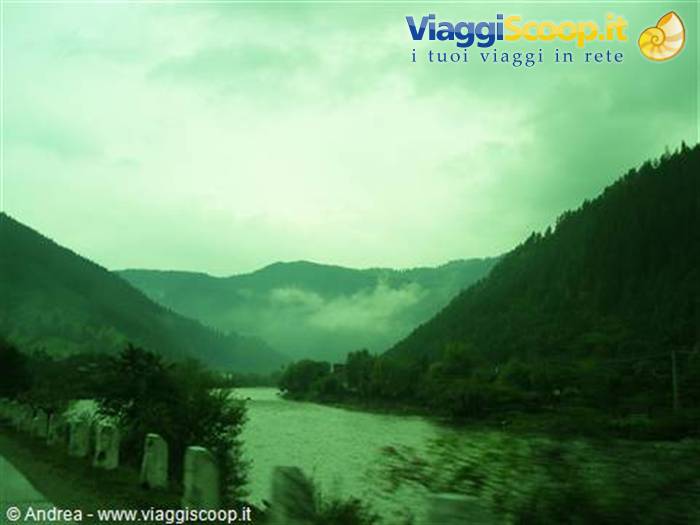
We reach Bicaz the next day, admiring the extraordinary Bicaz gorge, white limestone formations that create ravines and granite walls that cut the mountain into a thousand pieces, creating little gaps through which the road we travel plunges. Very high walls, annoying light mist, intense green, lakes of a thousand colours, the coloured leaves of the Romanian autumn..what a marvel.
From Bicaz and leaving behind the Red Lake, we head to Sighisoara..the pearl of Transylvania. We take one more quick look at Moldavia, making a promise to ourselves, the promise to return one day to head towards Suceava, northern Moldavia or Bucovina, where there are monasteries like those of Durau in abundance. Don't doubt it, it's truly worth it! Returning towards Transylvania we notice that the scenery changes continuously: from green conifers, you move to soft yellow and orange hills, then admire pastures and fortified churches amidst the dark green of intricate forests. The villages have a gentler and less gloomy appearance, here everything is taken care of down to the smallest detail, large gardens, beautiful houses, restaurants and small craft shops, beautiful colourful squares, traditional dances, music, etc..
and then we realise why…we are in the middle of the so-called Hungarian Transylvania. Gheorgheni and Odorheiu are the showpieces of the Hungarian community in Romania: Hungarian is spoken, Hungarian is eaten.. that is, you live as in Hungary but you are Romanian citizens..strange isn't it? Gifts of history, games in the hands of the powerful who have written pages, dividing peoples, despising them and sometimes creating hatred and resentment. Here we are in Sighisoara..in one word: the most beautiful.
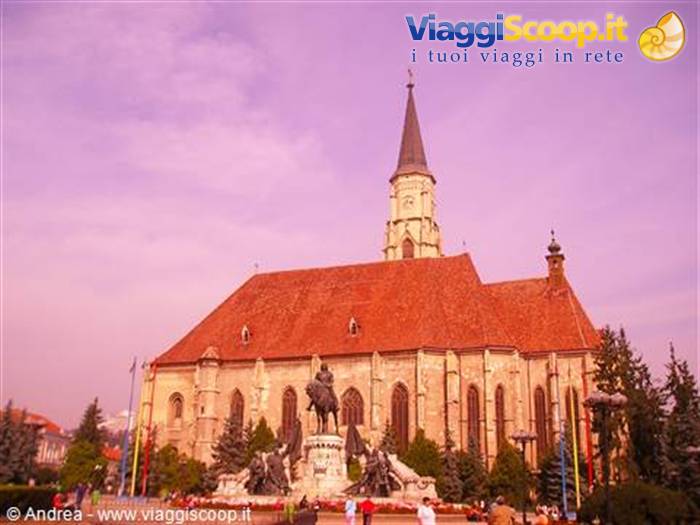
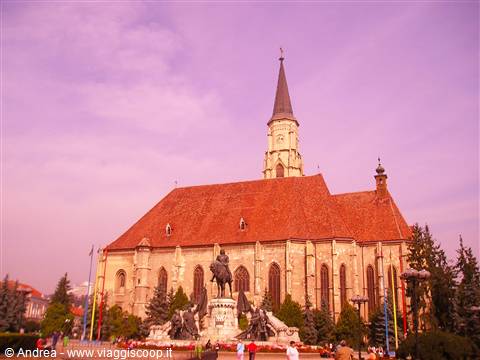
Lutheran cathedral in Cluj-Napoca
Day 320 Sep 2006
SIGHISOARA, BRASOV, BRAN, BUCURESTI
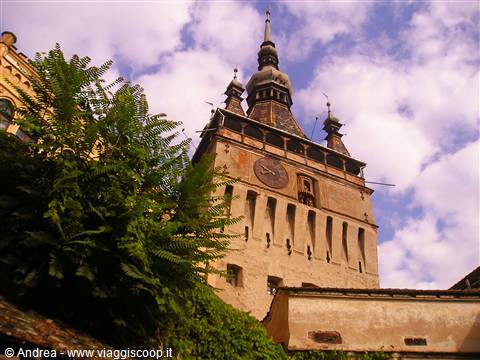
Sighisoara is one of the cities fortified by the Saxon community that came here to populate the lands after the great battles against the Turkish armed forces. Built around the magnificent Clock Tower, the city is perched on various levels, with a medieval citadel that seems like a jewel forgotten by new architects, by modern restorations and by the winds of novelty. Through the kind help of Arpi, a young Romanian lad, we find lodging at the house of a lady whose name we don't know, for a truly favourable price, and we visit this splendid medieval town. From the torture chambers, to the church on the hill, from the Lutheran temple of faith to the alleys and little squares typical of the Middle Ages.
At night, while walking… a gloomy organ sound comes from some rooms of the Lutheran church, spreading shivers and looks of unease among the people….In the inner garden, to the left of the main entrance of the Lutheran church, the sinister stone bust of Vlad Tepes is displayed, reminding visitors that that same square was once the seat of the main "social" events of the Saxon community: tortures, masked balls, witchcraft burnings. We will eat right where Prince Vlad Tepes, prince of Transylvania and Wallachia, spent four years of his life: today that place has become the Dracula Restaurant. Despite the name, the food is really good and the moustachioed waiter is truly friendly.
We reluctantly leave beautiful Sighisoara, and take the road towards Brasov and Bran… The entrance to Brasov looks like Viale Papiniano in Milan when there's a market, a chaos of cows, carts, non-catalytic cars, people, sacks, fruit, poultry, wood, stones, potholes… no traffic lights, no road lines, no signs…heeeeeeelp!!!
We flee from Brasov, and head towards Bran Castle, the famous Dracula castle or rather the place where it's said Prince Vlad stayed for a time. The castle has the typical appearance, perched and modified later: architectural styles have overlapped, yet allowing the original structure to be glimpsed in its skeleton. The interior is wonderful, furnished in black wood, it's a succession of references to the queen of Romania, Maria, immortalised in various images of daily life. The odd thing is the absolute absence of any kind of information regarding the supposed stay here of Prince Vlad: this makes us suspicious but after all very happy.
And I'll tell you why… While in the lower part of Bran Castle the most squalid market goods rage, with SCREAM masks (!?!?) and monstrous forest elves, around the castle history with a capital "H" reclaims its role and everything is presented to the visitor with sobriety and wealth of detail. In short, whether Prince Vlad lived here or not matters to the Romanians only up to a point; what matters instead is letting people know that here stayed, as mother of Romania, the beautiful and young Queen Maria, first and last sovereign of this country which then passed in the 1930s into the hands of nationalist militants.
We like the castle, the towers, the inner courtyard, the doors that don't open and the dark and threatening forest that opens behind it..here at night..managing to sleep must be quite a feat. In the evening we eat in Brasov, in a luxury restaurant..the prices allow it..hooray!! We eat very well, drink equally well and have a look around the city: the Black Church, the great market square and the medieval citadel. It's raining but this doesn't diminish the value of the beautiful Transylvanian city, the most visited Romanian city of all. Last stop: the capital. Bucharest presents itself with all the flaws of its sad and troubled past: bombed and destroyed during the two wars, buried by an earthquake in 1940 and deformed by questionable communist tastes in the forty years after the war.
In short…which city would have survived so much devastation? None, in fact Bucharest can certainly not be called a beautiful city. To make things worse there's a gem that all of you will know: here's Mr Ceausescu. You can't not talk about him when talking about Romania: this man lived like the Byzantine emperors of Constantinople, had Stalin's megalomania, economised like Mao, squandered money like the South American dictator friends, etc… In short… quite a character of history. The Romanians are grateful to Timisoara and to all those who gave their lives to free the country from that crazed visionary.
Emblem of all this: the monumental Palace of the Parliament, or House of the People (!?!?!) A monstrosity of concrete built in the late 1970s, a monstrosity that led to the complete destruction of a sixth of the Romanian capital, a monstrosity that is still today the second largest building in the world, after the Pentagon. You be the judge…
My story is over and all I can do is push you with all my strength to take a trip to Romania: leave prejudices and books at home, let yourself be carried away by this beautiful country and its people. You'll come back richer…


0 reader comments