- Tuesday 02.08.88 Departure from Ribadeo (campsite 900 Pts). At Bertanzos a stop to visit the church; the cellars are also open to the public and promotions and events are under way. In La Coruna we visit the port. We then visit Santiago de Compostela, a bit disappointing: only the main square of the Cathedral is beautiful. We cross the Vigo area: this area is terribly populated. At Tuy we enter Portugal from Valenca do Minho, and at Viana do Castelo we stop to sleep in a campsite.
- Wednesday 03.08.88
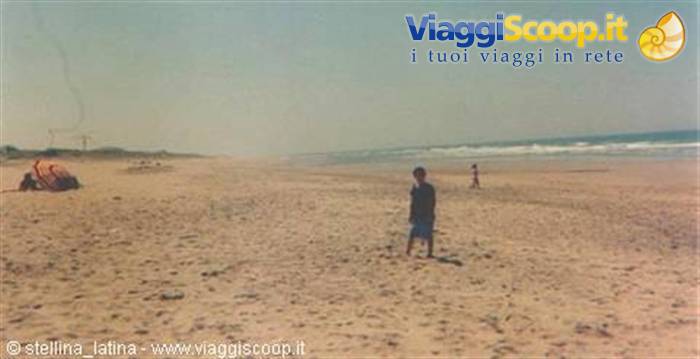
We moved from Viana (campsite 1200 Esc) to Pavoa de Varzim (Ofir), to a campsite by the sea, heavily supervised. We go to the beach at Ofir but only take photos, because the wind is cold and it's impossible to stay on the beach or swim. From the campsite you reach the sea by crossing the protective sand dune through man-high concrete tubes that are closed at night.
- Thursday 04.08.88
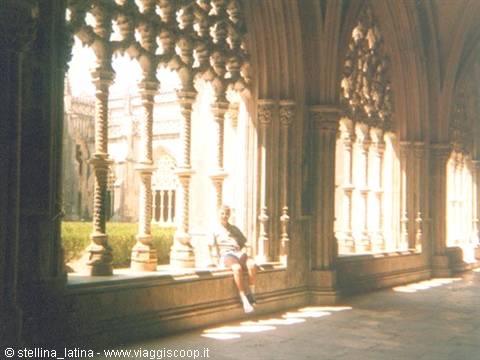
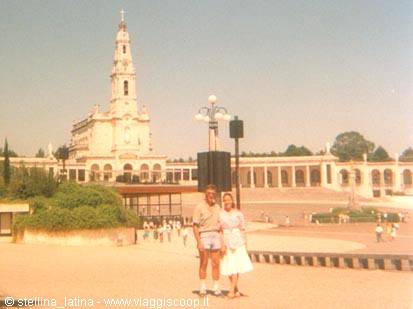
Departure from Ofir. The roads are quite good. We take the motorway before Porto, then leave it to do the shopping: the shop has an earth floor and the bread is in sacks on the ground. Then a stop on the motorway for lunch and diesel. Journey resumed, a visit to Batalha where we buy some Lladro figurines, and afterwards we visit Fatima. In the evening we arrive in Lisbon, at the municipal campsite, very well signposted.
- Friday 05.08.88 We leave the campsite on foot for an organised coach tour of Lisbon. We visit: the Carriage Museum, the Belem Tower, the Monument to the Discoveries, the Cathedral, the Castle of Sao Jorge, the Praca do Comercio and other places of interest in the city. The sun is really strong and the fountains are stormed not only by tourists.
- Saturday 06.08.88
Departure from Lisbon, we pay for the two nights at the Lisbon campsite (2 708 Esc) and cross the Tagus on the spectacular bridge. The landscape is a succession of eucalyptus forests and cork oaks. We arrive in the Algarve and stop at the campsite in Lagos at 3 pm. The Algarve is characterised by crystal-clear waters, long golden beaches broken up by striking rock formations, and small villages that keep their most ancient traditions intact. We visit Ponta da Piedade: a spectacular platform overhanging the sea. At the campsite we meet some lads from Genoa who practise underwater hunting. Besides beach life, we share fish barbecues.
- Sunday 07.08.88
Beach, sea and sun. Lagos hides behind high fortification walls. It is one of the most charming spots in the Algarve. On the Praca da Republica faces the Gothic building, once the market of African slaves. The most important churches of the 15th and 16th centuries are Sao Sebastiao, Carmo and Misericordia. The Museu Regional houses archaeological finds, sacred and popular art objects and a collection of stuffed coastal birds. Beyond the 17th-century fort of Pau de Bandeira is Ponta de Piedade, a panoramic and very picturesque spot reached via a stairway that climbs among the rocks.
- Monday 08.08.88
We continue our beach life in Lagos, where we collect a few fossils: all the rocks are made up of agglomerations of marine fossils. We visit the coast, the sea stacks and some sea caves. We have dinner with octopus caught by the Genoese lads. The climate is summery but cold in the evening, without jumpers. We pay for the 3 days of camping: 6892 Esc.
- Tuesday 09.08.88
Departure from Lagos. We drive along the Algarve coastal road. At the border at Vila Real there is a 2-hour queue for boarding the ferry to Spain. The Guadiana river is crossed on barges: only 15-20 cars and 2 or 3 campers fit each time. Ferry toll 600 Esc. At 1 pm we are in Spain at Ayamonte. It feels like being back in the civilised world, a leap of 50 years. We change escudos into pesetas, about 10 000 pts, all spent on shopping. Shopping at last in a supermarket before Huelva. We arrive in Seville at night; with great difficulty we find the municipal campsite, near the airport. The story continues with the "Spain" entry.
Day 15 Aug 1988
Lisbon
We leave the campsite on foot for an organised coach tour of Lisbon. We visit: the Carriage Museum, the Tower of Balem, the Monument of the Discovery, the Cathedral, the Castle de Sao Jorge, the Placa de Commercio and other places d’i interest of the city. The sun is really strong and the fountains are stormed not only by tourists.
- The Cathedral, Sé Patriarcal, is the oldest church of Lisbon it is in Romanesque style and gives it the appearance of a fortress. In the church you can admire the baptismal font of Sant'Antonio da Padova, the baroque crib by Joaquim Machado do Castro, some sarcophagi and the two-storey gothic cloister.
- Castel de São Jorge: the city extends over seven hills (Estrela, Santa Catarina, São Pedro de Alcantara, São Jorge, Graca, Senhora do Monte and Penha de Franca) and over the valleys of the estuary of the Tagus river. At the top of each of these hills there is a belvedere or, in the case of São Jorge, a castle, which was erected by the Moors as a refuge and later enlarged and transformed into a residence by the Christian kings. From here you enjoy a splendid view of the city. From’the top you see the linear geometry that distinguishes the Baixa district, the core of the urban interventions undertaken after the 1755 earthquake that destroyed the oldest districts of Lisbon
- The steep streets west of the Baixa lead to the Chiado, an elegant district where you can find refined boutiques and Art Nouveau style decorations. From here you reach the Barrio Alto, a district crowded with narrow streets and small alleys where a good part of the nightlife is concentrated.
- Praça do Comercio, once the main entrance to the city for those arriving from the sea, overlooks the river and was the starting point for the construction of the Baixa district.
On the north side of Praça do Comercio open two other squares: Praça Dom Pedro IV, commonly called Rossio, and Praça de Figueira. From these squares depart the two main arteries of the city: Avenida da Liberdade, a wonderful tree-lined avenue, and Avenida Almirante Reis, the road that from Praça da Figueira leads to the airport. These two avenues are flanked by beautiful Liberty style buildings and characterised by sidewalks with mosaic paving.
- A particularity of Lisbon are the azulejos, painted tiles, they are used with imagination and originality, as in the famous Cervejaria da Trinidade.


0 reader comments