The story
PORTO, or as the Lusitanians call it "O porto" (u portu), in their beautiful language, seems at first glance an old city abandoned to itself, potentially one of the most spectacular in Old Europe, but far from being put in order. And yet no. Oporto, like many other places I've been — see Lima, all of Romania, Warsaw, Stone Town, Bilbao, Amman, Hong Kong, for example — is one of those places where you have to learn not to stop at the visual image, but to go beyond the gaze and embrace the atmosphere, feel it, smell it and make it your own. Only in this way do you overcome stupid stereotypes and come closer to discovering wonderful novelties. One of these is undoubtedly the second-largest city by size of this fantastic country that is Portugal.
Porto, historic core of the sad soul of this Lusitanian people who wept as their loved ones departed and who now weeps over its little problems, even though behind the clouds of the immense ocean where this unknown river flows out, cracks of light open up, hopes of rebirth, recoveries that clean the streets, level the structures, redo the façades of the houses, reshape the mood of these people, so warm, so kind, so sweet.. Because that's how the Portuguese are: kind, "amàveis", sweet and respectful.....full marks and praise.
Steep as a roller coaster, Porto was founded centuries and centuries ago by the Romans; its name gives its name to Portugal, since portu was the capital of Portucale, the kingdom of port. Then from here, never conquered by the Arabs, with Don Henrique the Great began the reconquest of distant and nearby lands, see down there as far as the Algarve, Faro and surroundings.. creating what was and is the kingdom of Portugal.
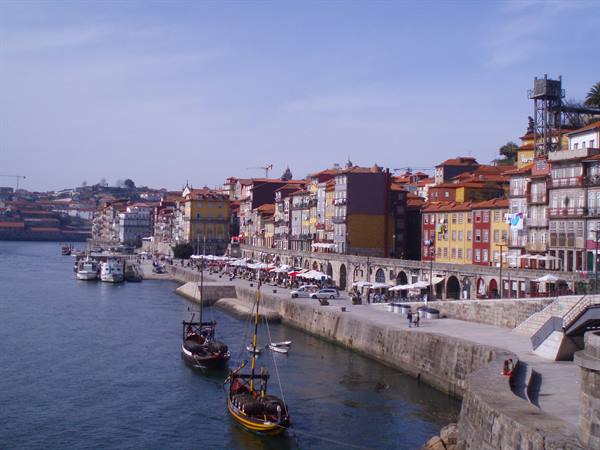
Porto, city, rebellious port city, of this magic of flavours that is this sweet and sensual drink, warm and captivating, of which I knew nothing and which I now understand only in part: descending the steep streets of the district declared a UNESCO Heritage Site, you find yourself in the Praça da Ribeira, medieval centre of medieval Porto, today touristy par excellence but beautiful to see and to spend an evening drinking in,.. not only port. On the other side, another municipality, same story, Vila Nova de Gaia, linked by the majestic Ponte Dom Luís I, to His Majesty King Louis I, the great, the mythical king of all the Portuguese. To him the bridge that links Porto to Vila Nova, crossed by tourists and locals, admiring from there...
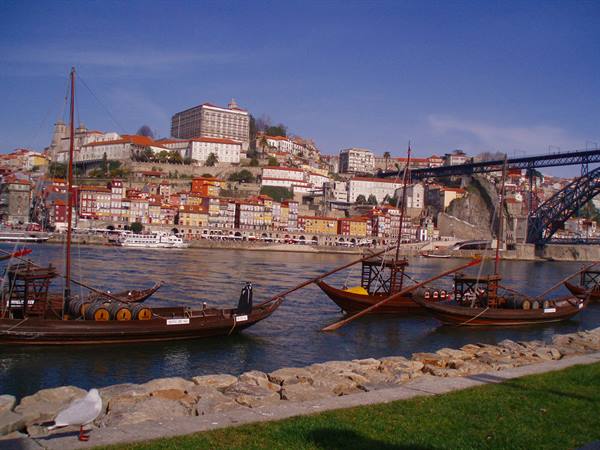
the extraordinary beauty of majestic views, the sensual bends of the Douro, the Lisbon-style roofs of little houses, the ruined houses, the ancient walls, the boats (rabelos) that today recall ancient voyages, inland away from the vineyards towards the cellars where this spectacular nectar is made.
And then how can I fail to mention the thousand churches of Porto, its grimy alleys, the lanes that go up and down, the strange and wary little streets, the echoes of distant, friendly voices calling to one another, talking.. as if it were my little Piedmontese town where everyone knows each other and everyone understands each other... and yet here we are in Porto. And then the sweets, the bacalhau, the Tripe (for those who like it... ugh) and all the rest..
Two words on the accommodation (I never do this): FANTASTIC, the Castelo de Santa Caterina is truly a MUST for anyone who wants to visit Oporto and wants to live a unique experience, truly. A castle in the middle of the city with a phantasmagorical garden, stunning azulejos, a real chapel, blue vases as in the photo, rooms from another time, an acceptable breakfast. Wow...Muito bem!!!
Not only for the Port, but for Porto..you must visit this beautiful part of Portugal...
Boa Viagem
Andrea
The journey's photographs
5 photographs · click to open them full screen



0 reader comments