Finally we set off for Malta, and I say finally not because a long period has passed since the last trip (not even two months), but for the simple reason that we had been talking about it for a long time now (at least two years) and already last summer it had been chosen as the destination, only to fall back, at the last moment, on Formentera. All this time we have mentioned the names of the islands that make up the small archipelago off Sicily so many times that even Federico has ended up learning them by heart. Unconcerned about superstitions we set off at 20:45 on a hot Friday evening, thus ignoring the warnings issued by a famous proverb. The "Blue Punto", in which Sabrina and I are travelling, leads the way for the camper with Federico and the grandparents on board, naturally.
All this may seem strange, but the purpose is to sleep near Malpensa airport in order to avoid an extremely uncomfortable early wake-up otherwise necessary to catch the flight departing in the morning. The singular and unprecedented caravan passes, by now at dusk, through the Faenza motorway toll booth, continuing, on the A14, heading north. The traffic immediately appears to be very heavy, and it is only the "head" of that imaginary "huge snake" of vehicles expected on the roads for this weekend, better known as the summer return traffic. Already before Bologna we are, practically, at a standstill in a queue: we proceed almost at a walking pace and, after more than an hour, we finally manage to leave the Emilian capital behind us, taking the A1 towards Milan.
The three lanes that make up the northbound carriageway are constantly full, making the journey slow and boring: lucky Sabrina who does not miss the opportunity to take a nice nap. At the Milan south barrier, while the hands of the clock show midnight by now, yet another inevitable queue awaits us.
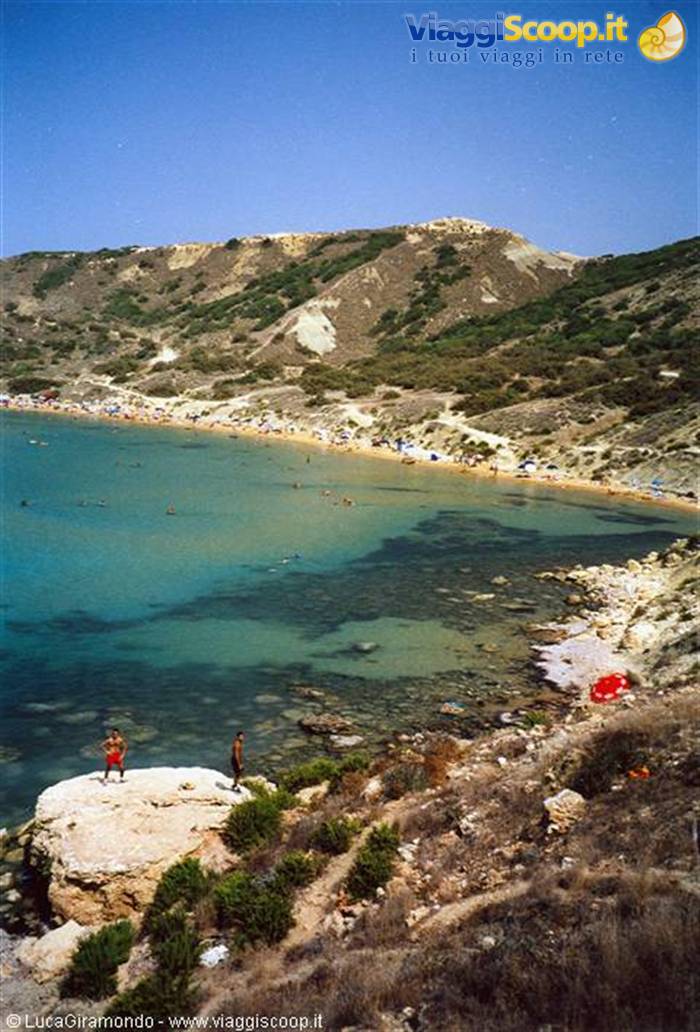
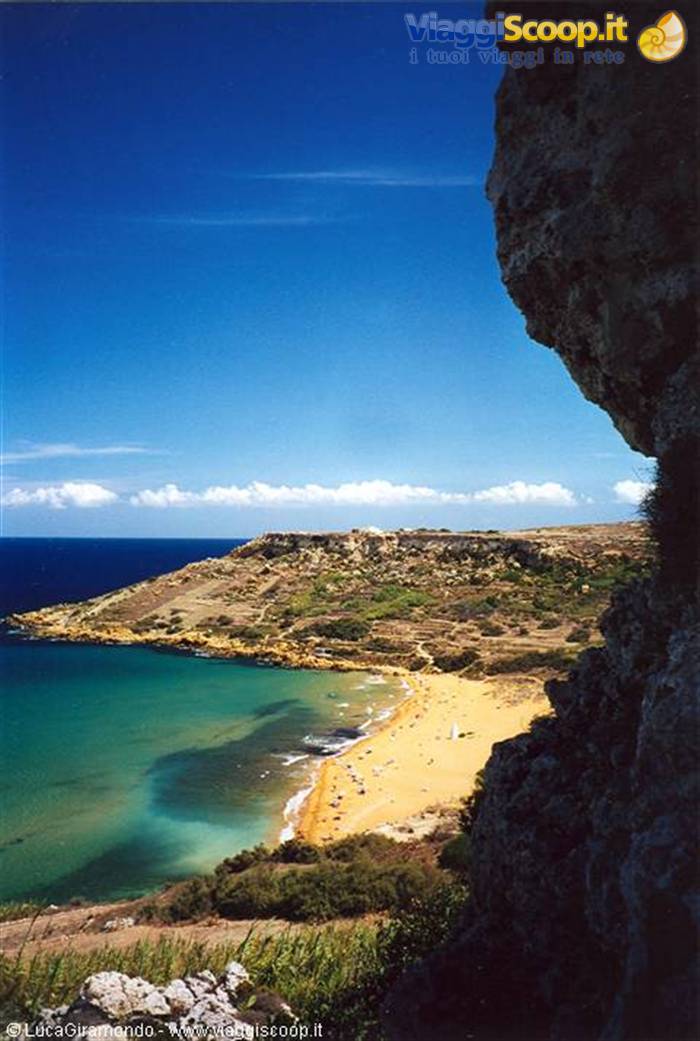
Ghajn Tuffieha Bay
Day 226 Aug 2000
We drive the entire western ring road of the Lombard capital and continue in the direction of Varese. The traffic has decidedly decreased and is now almost non-existent, so we approach Malpensa airport and, despite the late hour, Sabrina phones home to let them know of our imminent arrival. At 1:00 we pass in front of "Terminal 2" and follow the signs for Somma Lombardo and then for the Panicucci car park, where we will leave the car and where we will spend the remaining hours of this long night. Having reached the rest area I start to unload the suitcases and, while I am doing so, the handle of one of them breaks: I let out a few curses and place it on the camper, then park the car and prepare, along with the others, to benefit from the few hours of sleep we have left.
As soon as it begins to dawn, however, a damned rooster starts crowing, until, at 7:15 sharp, the first plane takes off and literally makes the bed shake. We get up shortly afterwards a bit dazed, have breakfast, manage, fortunately, to fix the broken suitcase, and prepare to board the shuttle that will take us to the airport. We say goodbye to the grandparents who, kindly, accompanied us up to this point, and a few minutes later we are in front of "Terminal 1", with our luggage on the trolley and with Federico very excited and proud to carry that little backpack full of games on his shoulders which, combined with the fixed smile on his lips, makes him extraordinarily likeable.
We look for the Air Malta flight km629 on the monitors and, when we find it, we are pleased to note that no delays are expected, we check in the luggage and wait near a bar next to which there are some games for children: as good as it gets to while away the time in our situation. Without haste we then head towards gate B11 which, later, we pass through right on time. We lose, however, at least ten minutes because of the shuttle that has to take us to the plane, whose door simply refuses to close. So the Air Malta Boeing 737 also takes off more or less with the same delay: at 10:37 we depart heading north and then immediately turn and reverse course. In a short while we find ourselves over the Ligurian Sea, then over Argentario and the Island of Giglio, but there is a lot of haze and the view is not the best.
We fly over the Tyrrhenian Sea and land reappears when below us we see Sicily, with, in the distance, the unmistakable volcanic cone of Etna, and then sea again, until, now in the full landing phase, here beneath our eyes first Gozo, then Comino and finally Malta, in practice the entire archipelago that extends for 70 kilometres in the Mediterranean Sea, 95 kilometres from Sicily and 290 from Tunisia. We land at 12:18, collect first the luggage and then the rental car: a white Peugeot 306 (registered BAK 658). It is infernally hot, we put the suitcases in the boot and immediately turn on the air conditioning. I get behind the wheel, which, unlike in Italy, is on the right, and set off on the left side of the road; indeed here you drive on the left and, after all, Malta was a British possession until 1964.
The state is made up of three inhabited islands plus a handful of rocks: the island of Malta, on which we are, is the largest (27 kilometres long by 14.5 wide) and we are staying at the Residence "La Vallette", which is in St. Julian's, in the centre of the northern coast and a few steps from Valletta, the capital of this small republic. In a short while we reach our destination but we cannot find the residence: for quite a while we circle around it without seeing it, then finally we emerge in front of the reception and so I immediately go to ask for information. I am surprised when I am told that we are staying elsewhere: at St. George's Park, which however is, in practice, just around the corner. There are works in progress and to cover a hundred metres we travel at least a thousand, but in the end we arrive at the right place.
We are assigned room number 610A and go up in the lift while the heat becomes unbearable! We drop the suitcases, put on our swimsuits and rush to the pool where, in a short while, we regain our clarity and good humour. We thus spend a pleasant afternoon, with Federico always in the water, until the (absurd!) closing time: 18:00. We go back to the room to take a shower and then go to dinner. The little one is very tired: he can barely eat and it is clear that he is sleepy; we nonetheless try to take a stroll through the centre of St. Julian's, where among other things there is a festival, but before long I find him on my shoulders.
We go back to the room and settle on the terrace: fireworks shine in the sky and despite this Federico collapses under the blows of sleep; it is extremely hot and we wear only our underpants; we do not have air conditioning and have to make do with a fan attached to the ceiling; the third bed (which fell to me) is not a bed but a faux-leather sofa with a sheet over it and it gives me some concern; despite everything we are happy and later we too will try to fall asleep.
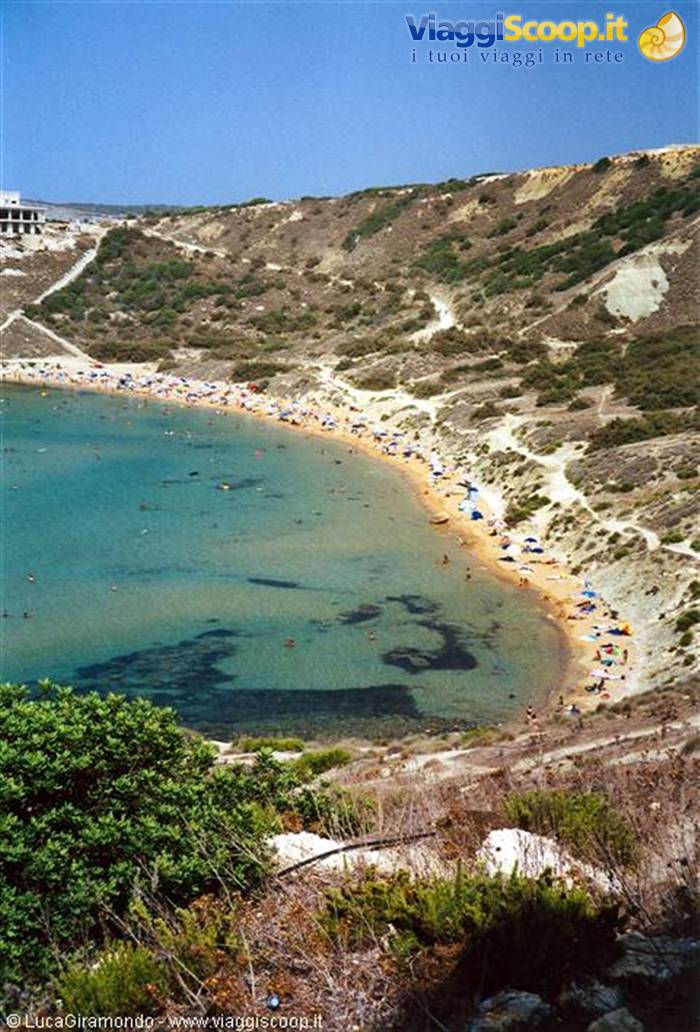
Ghajn Tuffieha Bay
Day 327 Aug 2000
We spent a really hot night: the whole time the window stayed wide open and the fan on, but without much success. Sleep was not the best and the sound of the alarm clock almost felt like a liberation. We go for breakfast and, with Federico completely absorbed in tasting cheeses, cold cuts and jams, we linger far too long, so that, when we are finally ready to set off for our first day visiting the island of Malta, the hands of the clock show almost 10:00. We follow the road that runs along the coast towards the north-west and, in the built-up area of St. Paul's Bay, we stop to buy an indispensable beach umbrella, then we reach the nearby Golden Bay, said by the guide to be one of the best beaches on the island.
Maybe it's the heat, almost unbearable, or maybe it's the beads of sweat running down our faces and into our eyes, making them sting, but at first sight the beach turns out to be anything but beautiful, crowded and dominated by the disturbing outline of a large hotel. The desire for the sea, however, is too great and we settle down anyway among the other bathers. The sand is dark, vaguely reddish, and certainly doesn't help the water look the way we would like it to actually look; what's more, near the shore a good quantity of seaweed floats placidly.
We are a bit disappointed and, if it weren't for the temperature, now close to forty degrees, perhaps we wouldn't even have gone for a swim, but, given the situation, getting into the water becomes almost a necessity, so we swim a few metres out to sea and, with pleasure, notice with every stroke an ever greater clarity, which, added to our body temperature, back to more acceptable levels, makes the place appear more beautiful than it had been at first sight.
It is midday and we climb back up to the car park above the beach to have lunch in a nearby pizzeria, and it is there that we notice two old and characteristic trams, the typical means of transport in Malta: there are lots of them around and it is easy to come across them as they toil along the rough roads of the island, but these two, side by side, seem to have been placed there on purpose to be photographed and, naturally, we take advantage of it. After lunch, intending to change beaches, we move a few hundred metres and go to park on the promontory that separates Golden Bay from the adjoining Ghajn Tuffieha Bay, down to which we descend by means of a long flight of steps. The inlet, set in a stretch of coast whose nature is still unspoilt, is very beautiful, the sand is reddish, as at Golden Bay, but the water is clean and inviting, only perhaps there are too many bathers.
We plant the umbrella and arrange the towels in the shade so as to let Federico take a nap: he is tired and soon manages to fall asleep despite the heat. I go off to explore the left side of the beach, until I reach the great rocky spur that bounds it, called "Il-Karraba", that is, warship, because of its strange shape resembling a battleship: from its summit the views over Ghajn Tuffieha and the next bay are truly interesting. On returning from the short excursion I am drenched in sweat, so I throw myself straight into the water and when Federico wakes up I go back in, or rather, we all go back in together and stay there a long time, since it seems the only way to fight the heat. The water is very warm too, and even for Sabrina, who is usually very sensitive to the cold, but above all, it is clear and at a temperature lower than that of the air.
We stay at Ghajn Tuffieha until evening and when, around 19:00, we are about to leave it is precisely the best moment and it feels divinely good, but we have to go back for dinner and we don't want to be late; what's more, we give a lift to a lady whom we drop off at Bugibba, along the road to St. Julian's, and we lose a bit more time, so when we arrive at St. George's Park it is almost dark. We quickly take a shower and go to dinner, then we spend the whole evening in the hotel, entertained, to Federico's delight, by a little magic show. Meanwhile the air seems to have cooled slightly and so, when we retire to our room, we do so with the hope of managing to have a better night than the previous one.
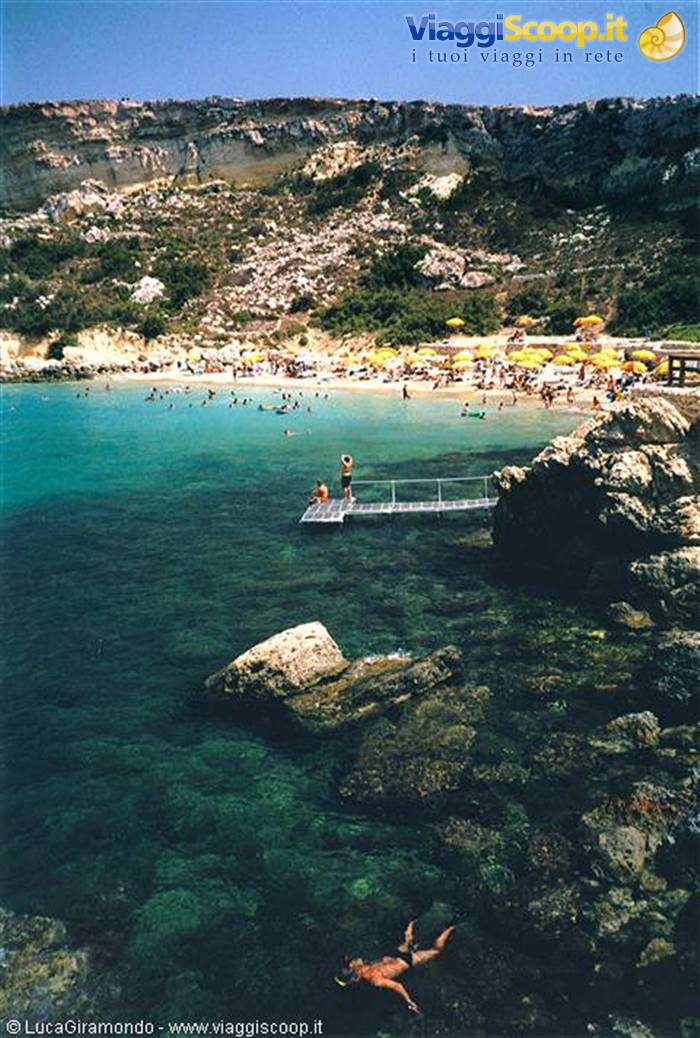
Paradise Bay
Day 428 Aug 2000
No use, the heat gives no respite; what's more, our room faces the sunrise and already before 8:00 the temperature inside it becomes unbearable. I open my eyes and see Federico already awake in his bed. We start getting ready to go out and the hotel's landline phone rings: at the reception there is the representative of Orizzonti (our tour operator) for the confirmation of the airline tickets; I go to him and take the opportunity to express my complaints about the infamous third bed, but he smiles, making me understand that he can do nothing to change things, so I go back to the room where I find Sabrina and Federico ready to go down for breakfast and an hour later we are sitting in the car heading south. We cross the whole island and reach the sea near Zurrieq, but our destination is not the beach.
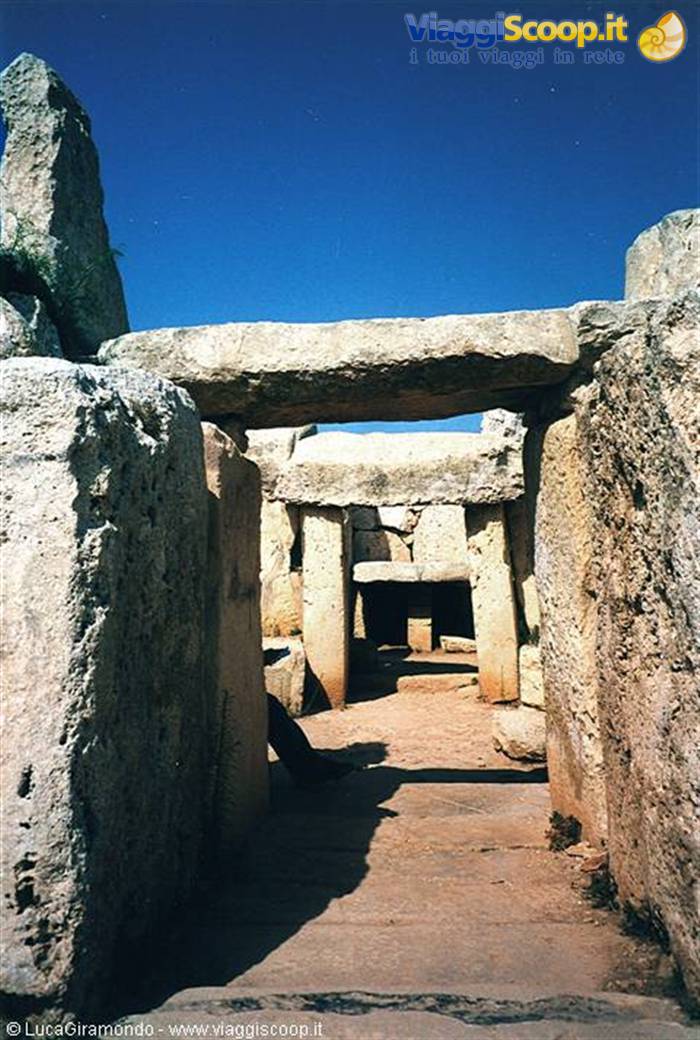
Malta is a place rich in history and the first human settlements date back, in fact, to prehistory. They were explorers who arrived from Sicily, the first colonists who settled here, giving rise, over time, to a well-organised and advanced civilisation. The signs of that civilisation have remained evident and are attested by the numerous megalithic temples scattered more or less everywhere in the territory. One of these is the temple of Hagar Qim, which we are about to visit and which dates back to the period between 3600 and 2500 BC; it was discovered in 1839 but only fully brought to light in 1910. Its enormous stones, arranged in a circle and topped one over another to form the imposing entrance, and the altars inside, convey the degree of evolution reached by the peoples dedicated to building these extraordinary monuments.
Only one detail makes the visit not particularly pleasant: the usual unbelievable heat, which becomes unbearable when we set off to reach, on foot, the nearby Mnajdra Temple. The structure is a few hundred metres from the first and in a place of great suggestion, dominating from above the view over the immense blue of the sea. Strangely, unlike Hagar Qim, here one can wander undisturbed among the ruins and visit its most secret recesses, to the delight of Federico who becomes uncontainable and slips in everywhere. On the way back, however, I have to carry him, understandably, on my shoulders, while the sun gives no respite and our T-shirts are completely soaked. The visit was nonetheless of great interest, even though we will appreciate its value more once at home, comfortably seated in the cool and certainly not drenched in sweat.
Exhausted, we take refuge in the car to seek some relief, then we reach the nearby little harbour of Wied iz-Zurrieq, picturesque, situated at the bottom of a very narrow rocky inlet full of colourful little boats, the same little boats that take tourists to visit a stretch of high and rugged coast, in which the famous Blue Grotto stands out. Incredible, but the heat is oppressive even in the middle of the sea, and it is a relief every time the small boat enters a grotto, sheltered from the sun's rays. The excursion is pleasant, but it becomes beautiful when, all of a sudden, the impressive natural arch of the Blue Grotto appears before our eyes. We pass through the great opening in the rock and observe the wonderful shades of the water at its feet, then, without hurry, we return to the starting point.
It is almost midday and we wouldn't say no to a refreshing swim before lunch, but along this stretch of coast it is almost impossible to find a beach. We get into our car, give the air conditioning full blast, and set off in search of a place that can satisfy our desires. The only possibility is to go down to the small village of Ghar Lapsi, where, naturally, we don't find sand but, on the other hand, a delightful and inviting natural pool among the rocks, with, behind it, a grotto where one can take shelter from the sun. There we stop and have a very long and pleasant swim, with Federico anything but intimidated, indeed amused, by the quantity of water on which he floats calmly thanks to his inseparable armbands.
We have lunch inside the grotto, surrounded by not-too-pleasant smells and by the presence of numerous Maltese who seem to be always celebrating, considering that today is a weekday. It is not worth spending the rest of the day at Ghar Lapsi: the place is beautiful, the Maltese certainly don't bother us, but the stench is unpleasant and the arrangement, among the rocks, rather uncomfortable. We decide then to return to St. George's Park and spend the rest of the afternoon at the pool. On the way back we come across a little church all decorated with colourful festoons and we stop to take a photo, then, shortly before the built-up area of Zebbug, the unpredictable happens: the car suddenly starts misfiring, the engine dies and we barely have time to pull over into a space reserved for bus stops.
I try several times to start it again but without success, and to think that only a few kilometres earlier we were boasting about our vehicle because of the air conditioning, with "hell" beyond the windscreen, a hand's breadth from our noses. I let out a few curses when I realise I have left the rental contract inside the safe in the hotel, but fortunately inside the glove compartment we find a road map on which the telephone numbers of Thrifty (the car rental company) are printed and, again fortunately, we have a mobile phone, so I dial the digits on the keypad and, thank God, I hear myself answered in Italian; I explain the problem and the first thing I am asked is whether there is petrol in the tank... of course there is, I may not be an expert in mechanics but at least the fuel gauge I think I know, what's more we filled up just this morning and unless there is a leak somewhere...
I give my position and they make me understand that they will send someone. Only forty minutes pass, forty very long minutes, on the roadside, in the heat and with our water running out, then finally a mechanic arrives. He investigates a little and immediately draws his conclusions: the fuel pump no longer works and the car will have to be towed. But the first to be towed are us, and the same mechanic takes us to the workshop in Qormi, a town on the outskirts of the capital, where, presumably, they will give us a replacement car. They have us sit in a small room and tell us to wait, so I go off in search of a bar and therefore of a bottle of water, more indispensable than ever.
Meanwhile the Peugeot 306 also arrives, on tow, and shortly afterwards, finally, we are handed a new and gleaming white Kia Avella (registration CAK 815) with which we resume, a couple of hours after the incident, the road towards St. George's Park and therefore towards that pool which by now appeared to us like a distant mirage. We stay relaxing on the edge until closing time, then, unhurriedly, we go and get ready for dinner. We finally end the evening strolling along the little harbour of St. Julian's, with Federico slipping, falling and getting dirty... to the immense "joy" of Sabrina, who cannot help getting angry.
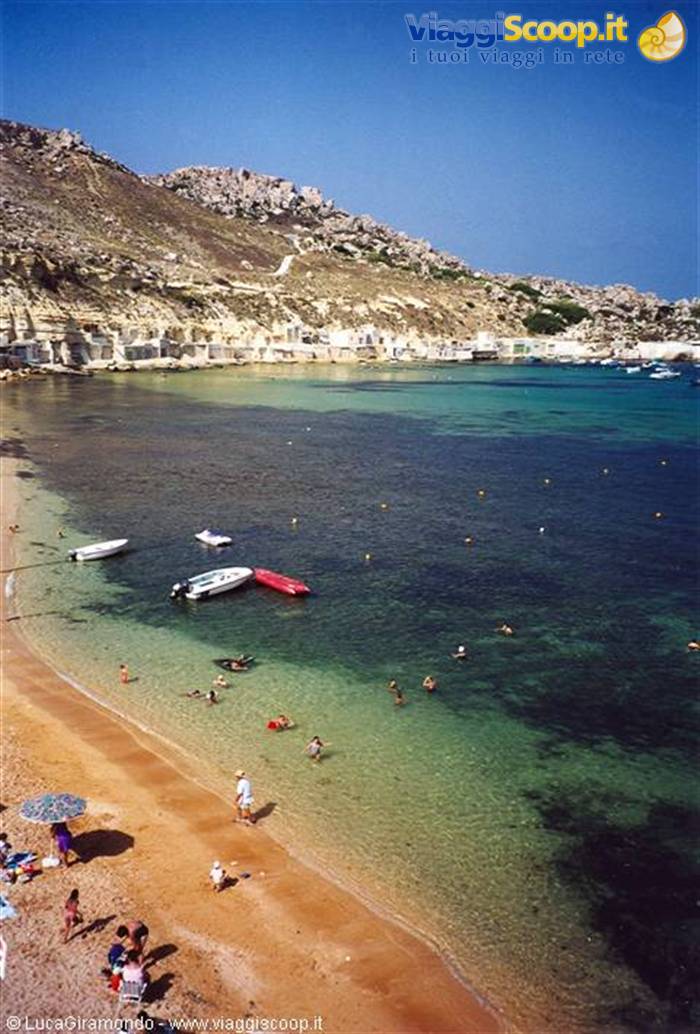
Gnejna Bay
Day 529 Aug 2000
The sun beats down mercilessly on our window and already at 8:00 the heat is unbearable. Completely sweaty we go for breakfast, then we get into our "new" car and set off towards the centre of the island, heading for Mosta, a quiet little town dominated by the immense bulk of the parish church of St. Mary, better known as the Rotunda. It was built in the middle years of the 1800s, financed exclusively by the donations and money collections of the parishioners, and it stands out for its imposing dome, the third largest in Europe after St. Peter's in Rome and Hagia Sophia in Istanbul, from which it takes its name: Rotunda, indeed. Two bell towers flank the façade and on each of these there is a clock. It is a constant peculiarity of Maltese religious buildings to have not one but two clocks: one real and the other fake.
All this would serve, according to an old belief, to disorient the devil, who in this way would not manage to calculate the moment of the deceased's last breath and therefore to capture his soul. We head towards the entrance of the church and prepare to visit its sumptuous interior: Sabrina, with a cloth over her shoulders, and Federico, as a child, obtain permission to enter; I, in beachwear, am not in order according to the canons of Christian decorum and am stopped a few metres beyond the door. I therefore start a heated argument with the guards, who let me take a few photos but who remain rigid in their positions and do not grant me any further steps towards the interior. So I take my steps towards the outside and sadly conclude my visit.
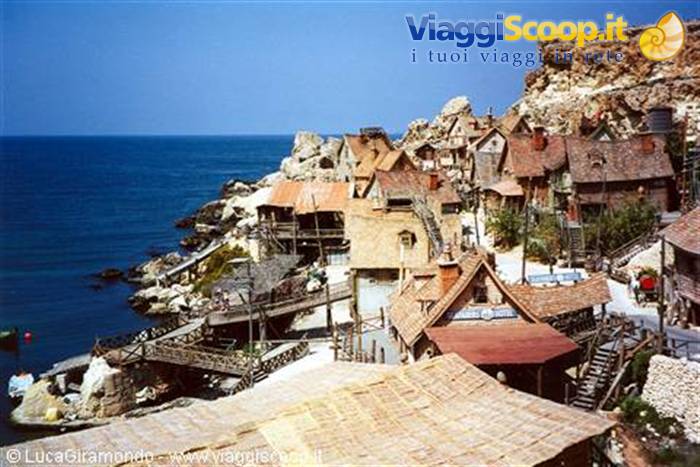
We return to the car and take the road again towards the north-west of the island, we pass the town of Mellieha and turn left following the signs for Anchor Bay and for Popeye Village. Yes, Popeye, and it's not a joke: the most famous sailor in the world of cartoons, it seems, lived in Malta, and not in the form of an animated drawing but in flesh and blood! It was 23 January 1980 when the first "clapperboard" kicked off filming of the film dedicated to him. The film was set in a village built entirely for the occasion: Popeye Village, indeed. For this purpose 165 workers were employed who in just over seven months completed the constructions, using something like eight tonnes of nails. The part of the muscular, spinach-eating hero was played by none other than Robin Williams, but the film, if I remember well, was not a great success.
As evidence of the work done, the village remains nonetheless, today transformed into a pleasant park, particularly appreciated by the little ones. We wander for a while among the wooden houses, truly well made, and take part in a short boat trip, thus also observing the village's perspective from the sea; we avoid attending a show in English, unfortunately, for us, incomprehensible, but we want Federico to have fun and we climb onto the roofs of the houses, made accessible by the presence of some vertiginous stairways; in the end, however, it is once again the heat that takes over, stifling any other pleasant sensation, and, in practice, forces us out of the park in desperate search of a beach and some refreshment.
It is almost midday when we arrive at Armier Bay, on the extreme northern tip of the island, but the beach is packed with bathers and we don't know where to set up the umbrella; what's more, the sea, rather dirty, does not meet our expectations, so we get into the car and set off again in search of a better place. We drive a few kilometres and arrive at Paradise Bay, considered one of the best beaches in Malta, but the name must not be misleading: far from being a paradise, the place is nonetheless acceptable, so we go and settle down at the water's edge, carving out, with difficulty, our vital space among the numerous people already there.
Federico has a heat meltdown and we drag him forcibly into the water while he is in the grip of hysterical crying, then, finally, he calms down and we have lunch, though besieged by the numerous wasps present that want to take part in the banquet and give us no respite. Later Sabrina and Federico treat themselves to a nap. I go for a wander: I take a few photos and, straight away, return to base, going to seek, for the umpteenth time, refreshment among the waves. I settle in the shade and give in, like the others, to the temptation to close my eyes and rest. In the late afternoon we are, again, all awake: the temperature has dropped and it feels noticeably better. We have a nice swim and prolong our stay until 19:00.
The beach has emptied and now the water even seems more beautiful, everything is more beautiful without that oppressive heat that during the day gives not a moment's respite. We leave Paradise Bay, get into the car and set off, but not in the direction of the hotel: we go to the departure point of the ferries for the island of Gozo and ask about the timetables, since we will have to move at the end of the week, then we definitively turn the bow in the direction of St. Julian's and St. George's Park. Along the way we receive a phone call from the grandparents, but we postpone the conversation to later. We call them back around 20:00, once we have arrived at the hotel, and Federico does not miss the opportunity to immediately tell them about the misadventure of the broken-down car.
We go to dinner and, right after, return to the room to write the postcards; it gets late and so we conclude another torrid day.
Mnajdra Temple
Day 630 Aug 2000
Finally a cooler night, or perhaps it is better to say a less hot one: it is almost a shame to have to get out of bed earlier than usual, but we must necessarily do so, in view of the visit to Valletta, capital of Malta and a city rich in history and works of art. Our aim is to avoid the hottest hours of the day and so shortly after 8:00 we are already on the road. The journey is short and a few dozen minutes are enough to find ourselves in front of the City Gate, the main entrance gate to the historic centre. We park and, in a short time, reach Republic Street, the main thoroughfare, teeming with life, onto which numerous shops open.
On the façades of the buildings stand out the characteristic enclosed balconies, the so-called Gallarijas, which at first sight may appear similar to English bay windows but which, at the same time, recall certain architectural details typical of Turkish dwellings and which are therefore a singular characteristic of Maltese houses. Perfectly preserved, the Gallarijas give a particular charm to the ancient buildings that overlook the city's avenues. Malta was the homeland of the legendary Knights of the Order of St. John: they arrived on the island in 1530, fleeing from Rhodes, conquered by the Turks, and remained there for over three hundred years, until 1834, when they transferred their seat to Rome.
They were a sort of mercenaries, defenders of the Catholic faith as the last Christian bulwark at the borders of the Ottoman empire and, coming from the most varied regions of Europe, they resided, divided by nationality, in the so-called Auberges, dwellings comparable to modern English colleges. One of these, the Auberge de Provence, is located right at the beginning of Republic Street and houses the interesting National Museum of Archaeology, which gathers the most significant pieces of local archaeology, coming, more than anything else, from the numerous megalithic temples of Malta and Gozo, among which stand out some beautiful terracotta statuettes of fine workmanship.
In a very short time, however, we complete the visit, and it is a shame since the little one was enjoying himself, but the museum, unfortunately limited to a handful of rooms, is really tiny, so, despite Federico's disappointment, we return to the street and continue along the main street in search of the Co-Cathedral of St. John. The religious building is located in St. John's Street, a side street off Republic Street, and was built by the knights at the end of the 1500s, with the aim of worthily representing the power, glory and wealth of the Order. It has an austere façade characterised by the extreme simplicity of its architectural elements, suited to the military, as well as religious, vocation of the knights, and it was elevated to the unusual rank of Co-Cathedral to make it share the role with St. Paul's in Mdina (the ancient capital).
To the simplicity of the exterior is opposed an extraordinarily sumptuous decoration of the interior, made with a variety of materials, colours and styles that have followed one another and layered over time. The floor is an uninterrupted sequence of over four hundred tombstone slabs, in polychrome marbles, of knights from the most representative European nobility from the sixteenth to the eighteenth century. The vault, on the other hand, is the fruit of the sublime pictorial art of Mattia Preti, who depicted, over five years of work, 18 episodes from the life of St. John the Baptist. In the side chapels are the funeral monuments of the Grand Masters who governed the island for almost three centuries, while in the adjoining museum one can observe sacred vestments and relics linked to the history of the cathedral, as well as a magnificent painting ("The Beheading of St.
John the Baptist"), a masterly work by Caravaggio, master of chiaroscuro and luminosity, nominated Knight of Grace for artistic merit during his brief Maltese stay. We leave the cathedral and reach the nearby Grand Master's Palace, currently the seat of parliament and of the offices of the President of the Republic and, for this reason, largely not accessible to the public. One can visit only a few state rooms, as well as what were once the palace's stables, where the interesting Armoury Museum has been set up, comprising a conspicuous collection of armour and edged weapons, as well as numerous pieces of artillery. All this naturally stimulates Federico's curiosity, who as a consequence unleashes an impressive quantity of questions. It is wonderful to see him so interested in the visit and we gladly stay longer than we should, trying to satisfy his thirst for knowledge.
We also leave the Grand Master's Palace and, after a short walk, enter an apparently anonymous building, located in Old Theatre Street: the exterior appearance, in fact, makes unsuspected the presence of a theatre inside, and more precisely the Manoel Theatre, erected in 1731 by Grand Master Antonio Manoel de Vilhena and considered, among those still in operation, the third oldest in Europe and the first within the Commonwealth. The visit, partly guided, makes us lose more time than expected and at its conclusion we head towards the Upper Barrakka Gardens with the intention of having a providential snack, considering the hour marked by the clock as well as by the rumblings of our empty stomachs.
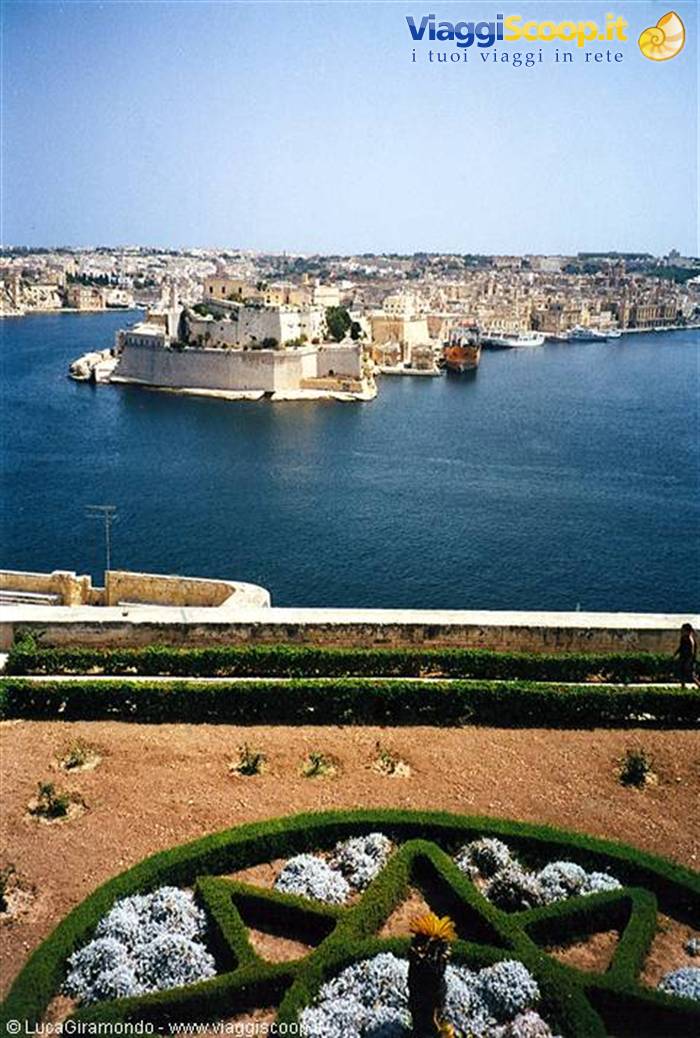
The gardens, which are located on the bastions overlooking the port and the sublime panoramic view over the cities of Senglea and Vittoriosa, are the epilogue of an intense morning, satisfying from every point of view, full of art and history, surprisingly bearable as regards the heat and, above all, extremely entertaining for Federico, always interested in every little detail. We retrieve the car, take a panoramic tour of the bastions and then return towards St. George's Park. We go to the room to rest and stay there until almost 17:00 when, in the grip of complete idleness, we move to the edge of the pool. At 18:00 sharp, however, as usual, they ask us to move along, they quickly close the bar and arrange the sun loungers all around... incredible these Maltese!...
they should take a few lessons in hospitality from us Italians, they would thus learn to have more respect for tourists who, after all, are their greatest source of wealth. So we return to the room to wait for dinner time and meanwhile Sabrina calls home: the weather has changed and during the day it is twenty degrees, while at night the temperature drops further and everyone sleeps well covered... if they sent us a bit of cool, we would gladly send them, in exchange, a bit of heat! We go to dinner, at 20:30, but not before having watched, on TV, the whole "Tom and Jerry" programme, and certainly not by my or Sabrina's will, then we end the evening strolling, carefree, around St. Julian's.
Popeye Village
Day 731 Aug 2000
After an entire day dedicated to culture we decide to spend one in complete relaxation, so we set off, early, in search of a beach that satisfies our desires. We need to find a beautiful beach and this is our main problem: Malta, as far as we have been able to ascertain so far, doesn't have many beaches, but, above all, it doesn't have many beautiful ones. Of course it's useless to look here for the candid white beaches that we have in our minds and that we would so much like to see, but this we already knew: we are not in Sardinia or Formentera, nor, much less, in the Caribbean or Polynesia, and we will hardly find any with those characteristics.
This does not prevent us, however, from seeing others, still beautiful, perhaps from other points of view, and we will certainly not resign ourselves to staying at the pool all day! Aboard our Kia Avella we follow the road that runs along the coast towards the north-west of the island and, having passed the built-up area of St. Paul's Bay, we turn right following the signs for Mistra Bay. In a short time we reach the bay, but the beach is almost non-existent and not very inviting. Without hesitation we turn on our heels and drive back a good stretch of road, to then go down to the sea in the direction of Golden Bay. We have already extensively visited the stretch of coast we are heading towards, but one beach is missing from the roll call: that of Gnejna Bay, and there we decide to go.
The sandy shore, of reddish sand, slopes gently towards the blue and transparent water, standing out against the background of a harsh rocky landscape. We like the place and, finally satisfied, we go and settle down at the water's edge. Later we rent a "pedal boat" and navigate to the nearby bay, with even redder sand and in sharp contrast with the steep, light-coloured wall that bounds it. We have an unforgettable swim in the company of only the boat and then return to Gnejna Bay. We arrive a little tired, after having covered the whole return journey against the wind, but nonetheless satisfied. We are also a bit overheated and go back to plunge into the water before treating ourselves to a well-deserved lunch. It really feels good: the beach is not very crowded and the temperature is mitigated by a steady wind blowing from the south-west... not that it's cold, heaven forbid...
indeed, at various times, in the central hours of the day, we seek refreshment in the water, but today's heat is not comparable to that of the past days. The air is clearer and, offshore, one can clearly make out the severe rocky outline of the island of Gozo, where we will land in three days. The afternoon slips away peacefully: in an instant it is evening and we are almost sorry to leave the beach, but the hands of the clock already show 19:00 and we must necessarily return; what's more, along the way, we stop for a small unscheduled visit, to the ruins of the Skorba Temple, and end up arriving at St. George's Park with the headlights on and just in time to go to dinner. Later, to conclude the day, we content ourselves with staying at the hotel and attending a dance show: nothing extraordinary but, all in all, pleasant.
Valletta: Upper Barrakka Gardens
Day 81 Sep 2000
What a strange feeling to be on holiday in September, when, usually, one goes back to work. It is the first time it has happened to us and I think that, in the future, we will repeat the experience. As for today's programme, on paper an intense day awaits us and already at 9:00 we are on the road. We proceed briskly in a south-easterly direction, pass the capital and arrive at Tarxien, a chaotic little town known above all for its megalithic temples. The main problem is finding them, without too many signs and, hidden as they are, among an intricate maze of little streets all alike. We proceed by trial and error and in the end we arrive near a high stone fence beyond which the site is located, unfortunately squeezed in a vice of residential buildings that surround it on all sides.
Only half a century ago the place was in open countryside and it was discovered, by chance, by a farmer, whose plough frequently struck large boulders. We enter through a gate and visit the temples which appear to us in excellent state of preservation, despite their no longer tender age: they date back, in fact, to the Copper Age and were built in different periods between 3000 and 2500 BC. We wander a bit among the great and enigmatic stones which Federico would so much like to climb on, but they are carefully fenced off and therefore inaccessible. All around there are numerous spherical boulders, used to move the megaliths, but, probably, also considered to carry a magical or ritual meaning. In a short time we complete the visit and prepare for the next one.
We move from Tarxien to the very close little town of Paola to visit the Hypogeum of Hal Saflieni, a great underground monument of the Copper Age, arranged on three levels down to a depth of ten metres and with an overall development of about 2500 square metres. It was found, naturally, by chance in 1902, during the foundation excavations of a building and, to this day, it is located beneath that building, in a neighbourhood of Paola. Thanks, once again, to the scarce signs, we find the entrance with difficulty and we immediately cross it with the intention of proceeding with the visit, but, unfortunately, an unpleasant surprise awaits us: access is allowed only to a limited number (ten people at a time and only four times a day) and exclusively by reservation.
This, unfortunately, the guide did not foresee and the reservations go up to the seventh of September, when we, unfortunately, will already be in Gozo. We could visit the hypogeum during the last day of holiday, but we would have to do it with all the suitcases in the car on the way back to the airport and, frankly, we don't feel up to it after the recent theft we suffered in Mexico. With a touch of anger we have to give up and the most disappointed seems to be Federico who, probably, was fascinated in particular by the idea of going underground and he almost feels like crying. We have to console him by holding out the prospect of another visit equally interesting and "adventurous". We move a few kilometres in a southerly direction and stop, on the outskirts of the village of Birzebbuga, at the Ghar Dalam cave.
This is the oldest archaeological zone of the archipelago and dates back to the Neozoic (one million and ten thousand years ago). Inside this deep natural cavity, human remains have been found but also those of very curious animals dating back to about one hundred and eighty thousand years ago: elephants, hippopotamuses, bears and deer, all of very reduced proportions. Malta, during the ice age, was connected to Africa and Europe, but then the ice began to melt and, over time, it became an island, so the animals, left literally trapped in a handkerchief of land, were forced into genetic mutations that made them smaller and smaller. All the skeletons found at Ghar Dalam were then collected and arranged in a small and interesting museum at the entrance of the cave.
The whole experience undoubtedly satisfied us and, in some way, contributed to soothing the anger for the missed visit to the hypogeum. It is almost midday and we head towards the sea, we pass the built-up area of Marsaxlokk and venture into the nearby peninsula in search of the Peter's Pool (natural pools among the rocks), but we almost get lost in a maze of dusty and uneven little roads, failing to take the right one. We give up and head for Marsaskala, a little further north. We then reach the nearby St. Thomas Bay, where there is a beach that, however, does not satisfy us. It is completely useless to keep looking for other beaches in the area: there aren't any!... So we stop at St. Thomas Bay, have a swim and lunch, then set off again towards St. Julian's. We arrive at St.
George's Park and, after a healthy rest in the room, we go to spend the rest of the afternoon at the edge of the pool. After dinner we try to reach Sliema, the most touristy spot in Malta: to tell the truth, nothing exceptional. We drive along the whole seafront without even getting out of the car and return to the hotel. We go and settle at the bar tables to listen to a bit of music which someone insists on keeping low, and we feel like laughing since the venues in the area keep it at full volume until late at night and our room, every evening, resembles more a disco than a hotel room.
Mdina: Main Gate
Day 92 Sep 2000
On the morning of the last full day to spend in Malta we set off to visit what is left and, after a few kilometres, we stop to fill up with fuel, so we can check the capacity of the Kia's tank, which turns out to be exactly half that of the Peugeot, and this does not make us particularly happy, since in the car replacement we lost more than twenty litres of petrol, which, all things considered, is a decent sum of money and so, after all, besides the damage, we also suffered the insult. We try to skim over what happened and resume travelling the road that separates us from the city of Mdina, the ancient capital, situated on the central-western heights of the island. Its medieval urban fabric is the best preserved in all of Malta and it is also the city with the fewest inhabitants: there are about a thousand in all those who live in the old part.
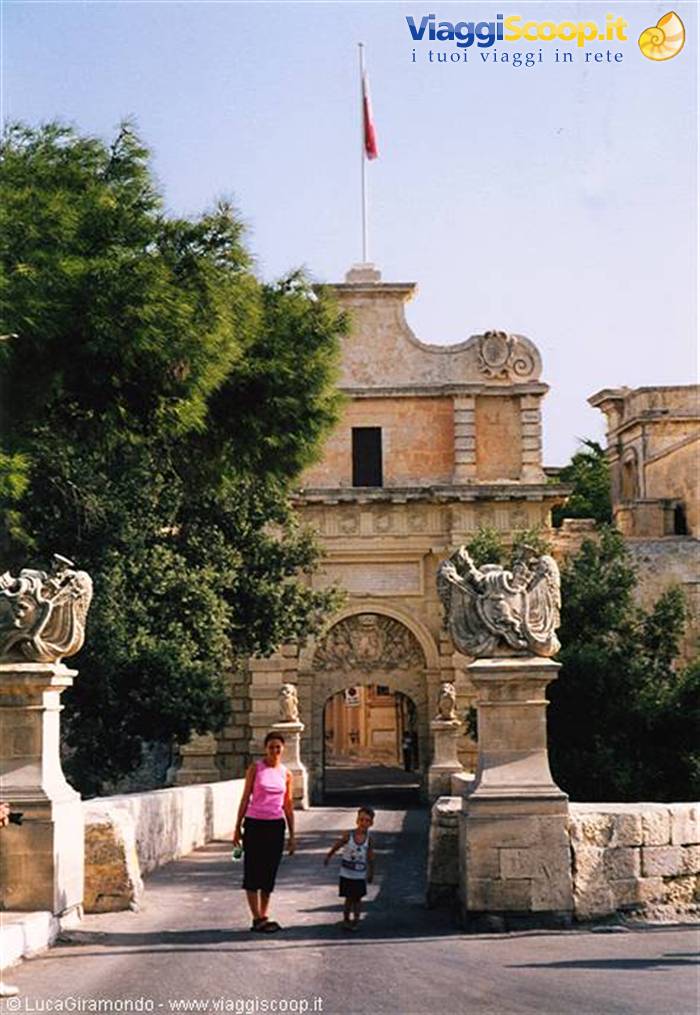
We enter through the sumptuous and baroque Main Gate, the same gate through which every new Grand Master entered, arriving in procession from Valletta, to symbolically take possession of the keys of the city. We venture among the narrow and winding alleys, in the shade of well-preserved historic buildings, left practically intact after the slow decline due to the transfer of the role of capital. Aristocratic and isolated in its history, Mdina has thus earned the nickname of "silent city". From its bastions one enjoys a panorama that embraces almost the whole island, while its monument of greatest interest is, without doubt, the St. Paul's Cathedral, a refined example of Maltese baroque and a synthesis of Roman, Sicilian and Italian Renaissance influences. In its sumptuously decorated interior, the beautiful frescoes of Mattia Preti stand out.
We leave Mdina and come across a small park with some play equipment: despite the scorching sun Federico wants to try them all and we let him before continuing with the cultural visit. We move a few hundred metres to the very close little town of Rabat, which arose, in practice, just outside the walls of Mdina. We park and go straight to the Catacombs of St. Paul, a complex of underground tombs used from the 3rd to the 4th century AD. Federico, initially listless and full of excuses not to walk, then runs wild inside the labyrinth of tunnels, which extends over 2200 square metres, and, once again full of energy, prepares enthusiastically for the visit of the next ones: those of St. Agatha, which are located a very short distance away.
In a few minutes we reach them but, unlike the first, they can only be explored with a guided tour and the little one will, of necessity, have to be kept more in check. The intricate underground maze which is presumed to have originally extended over 4000 square metres can only be visited in part and its most interesting aspect lies in a cycle of frescoes in Italo-Byzantine style, dedicated to episodes from the life of St. Agatha who, it seems, spent a period of her life in this place. In some tombs remains of human bones are still visible, which, however, do not frighten Federico... indeed, the adventure really seems to be to his liking. Less pleasant, however, is the raspberry he lets slip in the presence of the whole group and in a particularly cramped and oppressive place, so, in the grip of a silent smirk, we wrinkle our noses and head, with the others, towards the exit.
We reach St. Paul's Church and go down, for a quick visit, to the grotto of St. Paul. Tradition attributes to the site the fame of having hosted the saint during his brief stay on the island and, recently, it was also a pilgrimage destination for Pope John Paul II. We leave Rabat and follow the road that runs in the direction of the southern coast and the Dingli Cliffs, some vertiginous cliffs sheer above the sea, but the strip of asphalt passes too far away and the whole thing turns out to be a little disappointing; better to go in search of a beach. We would like to reach a new one and the inlet of Fomm ir-Rih, which on the map is just a few centimetres away, would seem to fit the bill, but we almost get lost trying to find it and so we fall back on Gnejna Bay, which, incidentally, only two days earlier, we had also liked.
In the meantime, however, the sea has become slightly rough and the water, now full of seaweed, does not even seem a distant relative of the one that remained in our eyes. It is 13:00: Federico is hungry and we decide to stop at the place anyway, or rather we stay there for the whole afternoon, since the alternatives don't seem better. It's Saturday and you can tell: in the evening the beach literally fills up with Maltese, so that, when we leave, despite the late hour, it is more crowded than when we arrived and looks like a campsite, so many are the barbecues lit and the tables set for dinner. We return to the hotel and have dinner too, while a waitress, seeing our imminent departure, kindly points out a beach in Gozo. We thank her and go to the room to pack our suitcases.
Gozo: Victoria
Day 103 Sep 2000
Even the last night of sleep on the sofa has passed... I made it! The torment is over and, perhaps, tonight I will have the grace of being able to sleep on a real bed! We have breakfast, load the luggage into the car and
Gozo: old bus
Day 114 Sep 2000
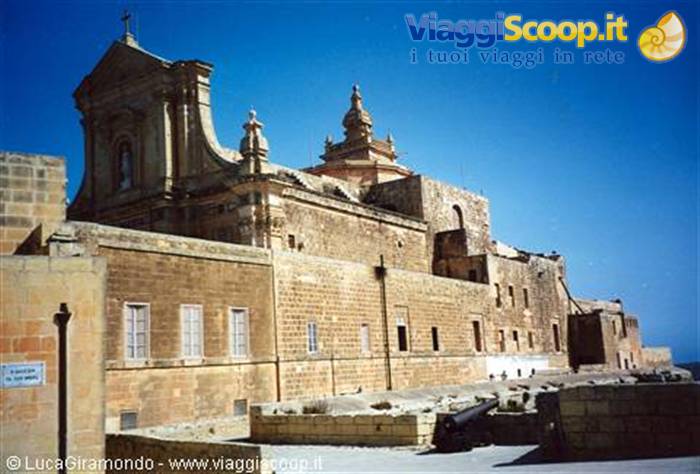
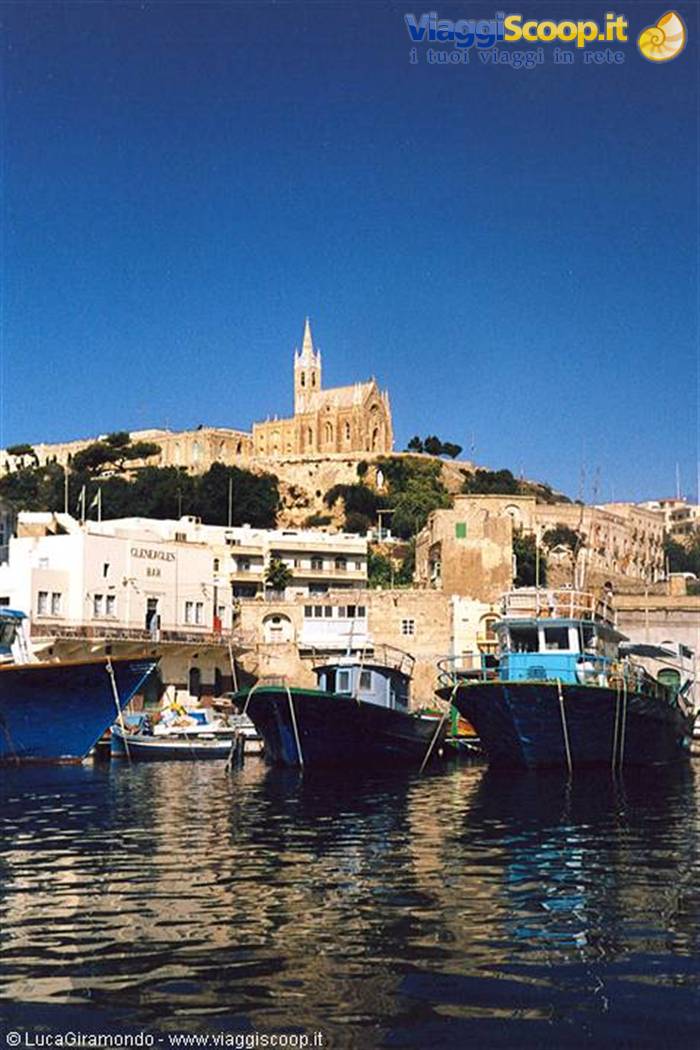
We set off to discover Gozo, but not in the direction of the sea and, above all, not towards the north coast, battered by wind and waves. We travel towards the centre of the island and reach what is its capital: Victoria, so called, since the end of the last century, in honour of the British queen of the same name. The town, with its six thousand inhabitants, is the most populous on Gozo, and is dominated by the massive outline of the Citadel, visible from various parts of the island. We enter inside the walls through a large stone arch, opened only in 1956 to allow the passage of the statue of the Virgin carried in procession. The portal leads directly into the square overlooked by the Cathedral of Santa Maria, located at the top of a steep flight of steps. The interiors are richly decorated and this seems to be a common characteristic of almost all Maltese religious buildings.
We go up along a staircase adjacent to the cathedral right onto the bastions and walk the entire parapet walk, enjoying the panorama that extends over much of the island. Federico appears enthusiastic about the visit and we struggle to hold him back as he runs up and down the ancient walls. We return inside the Citadel and pass through the door of the tiny Archaeological Museum, where exhibits from the megalithic temples of Gozo as well as Punic and Roman remains are displayed. The little one, full of questions, appears once again amused, and it is one more reason to continue the visit to two other museums included in the ticket price. We wander along the narrow and characteristic alleys of the Citadel until we reach the Folklore Museum, housed in a beautiful 15th-century Norman house. Inside, in a suggestive setting, numerous objects of daily use and culture of the island are exhibited.
The old farming and work tools stimulate Federico's imagination at least as much as the minerals and stuffed animals of the small but interesting Natural History Museum. The morning dedicated to culture ends with a visit to the old prisons: six narrow cells on whose walls some rough graffiti made by prisoners centuries ago have recently come to light during restoration works. It is almost midday: we take a short walk in the centre of Victoria and find a curious little shop overflowing with Christmas decorations, which makes a strange impression given the season, then we return to the car and set off in the direction of the sea. We go down to the nearby locality of Xlendi, but there is practically no beach and the water is not the best, so we go back up towards Victoria and venture, along a narrow and winding road, south-east of the town, until we reach the inlet of Mgarr ix-Xini.
The place is very scenic and wild: the sea insinuates itself into the rocky coast forming a deep fjord at the bottom of which there is a tiny pebble beach among which we wedge the beach umbrella. There are only us, besides some divers busy sorting out their tanks on their return from a dive, so we take a pleasant swim and then have lunch before setting off again in search of a bit of sand for Federico. We move to the easternmost part of the island, pass the village of Qala, and go down to the beach of Hondoq ir Rummien. It really seems to suit us: the sand, though scarce, is not lacking, moreover the bay is sheltered from the winds coming from the north and, consequently, the sea is calm. We go and settle a few metres from the water and invite the little one, who is visibly tired, to take a nap, but he will have none of it and we have to insist for a long time to convince him.
Shortly afterwards, offshore, a large vessel passes by whose waves reach the shore, wetting our towels and Federico, who had almost fallen asleep, wakes up. It is no use trying to convince him again; it is better to enjoy the place and swim in a sea that is, finally, "as God intended": blue and transparent, thanks to the light seabed, and with a view that extends, in front of us, from the nearby island of Comino to the more distant outline of Malta on the horizon, all of it marred only by the presence of an adjacent and unsightly reinforced concrete jetty from which the local youths dive, continuously. We stay all afternoon at Hondoq ir Rummien then return for dinner at the hotel. Later, during a normal routine phone call, I am told that in Forlì it has rained heavily, while here it has been more than five months since water has fallen from the sky...
better not to count our chickens, though: at bedtime, from the room's terrace, looking north, I clearly make out some lightning flashes tearing through the sky and they do not bode well!
Gozo: Mgarr
Day 125 Sep 2000
At 7:30 the alarm goes off and I get out of bed full of energy, but I have a strange feeling: I look out of the window and can hardly believe my eyes. After all the heat we had to endure in previous days it seemed impossible that this should happen, and yet... here before me is the sky full of big grey clouds... we have jumped out of the frying pan into the fire, as they say in such cases, so, sadly, I go back between the sheets and try to get back to sleep. We all get up at least an hour later and, calmly, go to have breakfast, while outside a few drops are falling. We have, inevitably, given up the planned excursion to the island of Comino and will try to replace it with something alternative, hoping that the weather does not worsen further.
We set off in a southerly direction, leave Victoria behind and reach the locality of Ta' Cenc: in the surroundings there should be a stretch of coast characterised by high cliffs and there should also be the ruins of a small dolmen. We wander around the area for a long time, drive along dirt tracks and get almost as far as Mgarr ix-Xini, where we had been a little more than twenty-four hours earlier: that is how we discover the small inlet of Kantra Beach, set among the rocks and characterised by a beautiful sea. The sun also comes out and for a while we enjoy the place. It would be worth staying longer but it is a problem for Federico; indeed there is no sand and more than anything else it is not clear why the place is called Beach, since in English it means beach.
We set off again, then, in search of the cliffs and the dolmen: we find the latter, practically a little pile of stones, but we simply cannot reach the cliffs and, several times, we have to turn back from roads that suddenly turn into paths. It is almost lunchtime, the sky above us appears, all things considered, merciful, and we decide to go in search of a beach; then, in the afternoon, we will see. We reach, in the north-east of the island, Dah Let Qorrot Bay, but the sea is rough and the place does not satisfy us, so we return to Hondoq ir Rummien, opposite Comino. We already know the place: it is beautiful and, above all, sheltered, the sea is calm, and we decide to stop.
We stay on the beach until evening, despite the weather, and in the mid-afternoon our tenacity is rewarded: the clouds thin out, the sky becomes blue again and the sun, once again undisputed master, grants us a few hours of mild warmth. We return to the hotel and, after dinner, go for a stroll around Marsalforn in the company of Carlotta, to the delight of Federico who, caught up in the enthusiasm, walks all evening without ever asking to be picked up.
Gozo: Inland Sea
Day 136 Sep 2000
The sun shines high in the sky and it really seems, finally, the ideal day to go to Comino. Better not to miss the opportunity, given that the holiday is now drawing to a close, and if the weather should turn bad again we would lose the opportunity to visit the most famous and, presumably, most beautiful seaside spot in Malta. We reach the port of Mgarr and start looking for a boat to accompany us in discovering the third island, in order of size, of the archipelago: just 2.5 kilometres long by 1.5 wide. Located in the centre of the narrow stretch of sea that separates Malta from Gozo, Comino owes its name to wild fennel, cumin, one of the few plants that manage to grow on its arid soil.
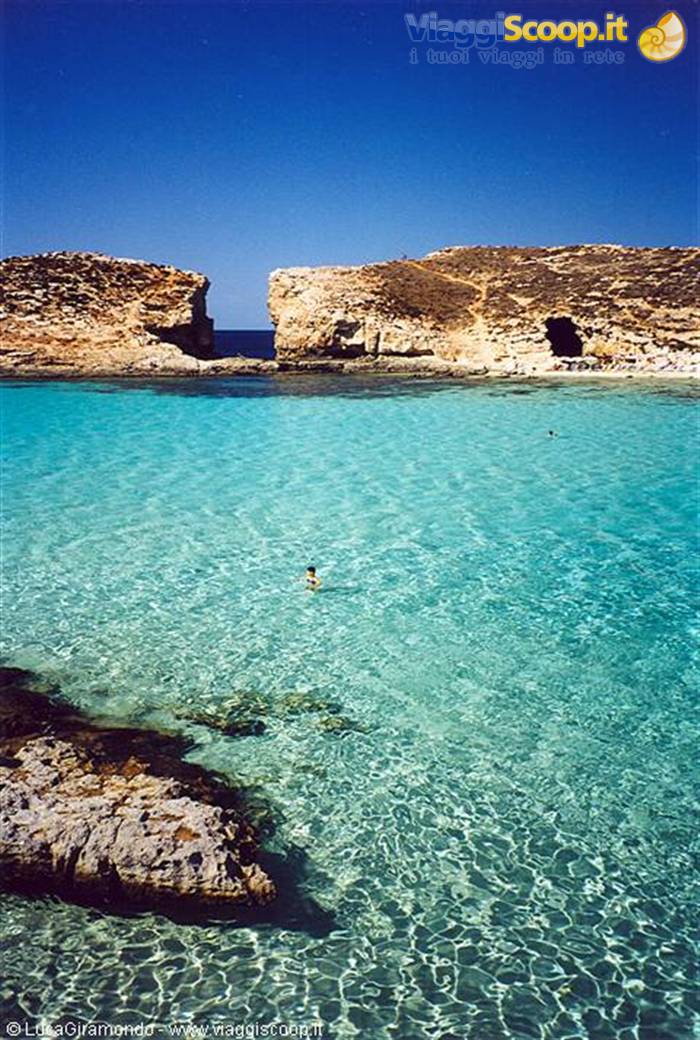
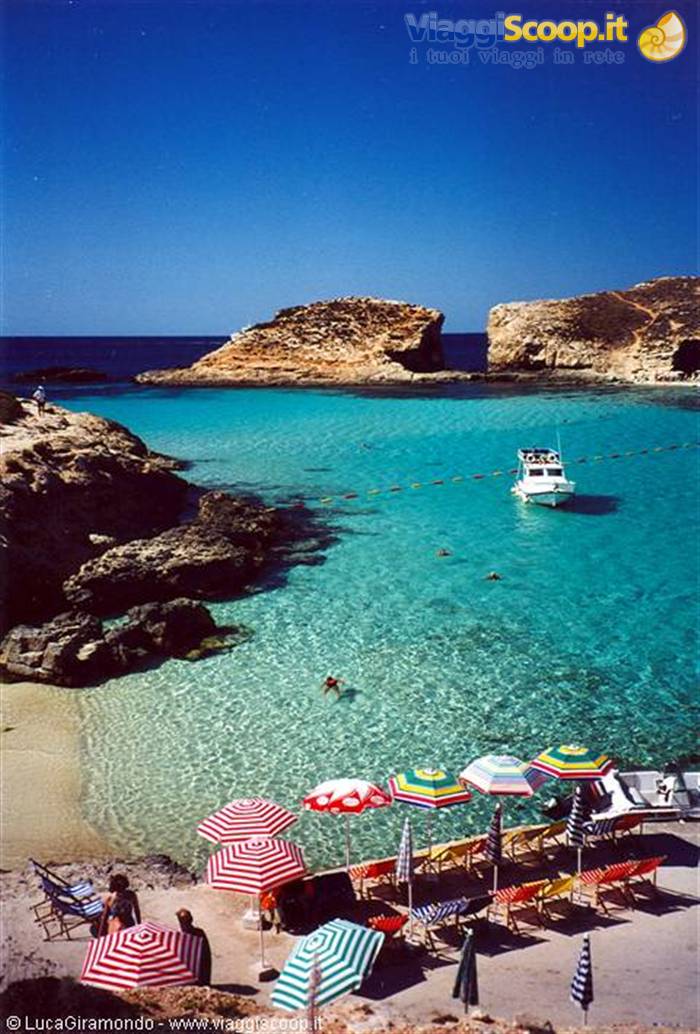
Among the numerous boats that, every day, set sail for Comino we choose the "Ozzi One Cruises", commanded by a likeable emigrant who, to do this, every year, in summer, returns from Australia to his native village. The small boat cannot hold more than fifteen people, and that is a good thing since the low number of participants will certainly save us a lot of dead time. We leave the port of Mgarr and, in a few minutes, reach the world-famous Blue Lagoon, and the name, blue lagoon indeed, this time really seems appropriate. The beautiful stretch of sea is located between the western coast of Comino and the tiny island of Cominotto, and is daily the destination of a great many tourists. We, fortunately, arrive early and avoid the crush of the crowd... we do not, however, deliberately avoid an unforgettable swim in crystal-clear water.
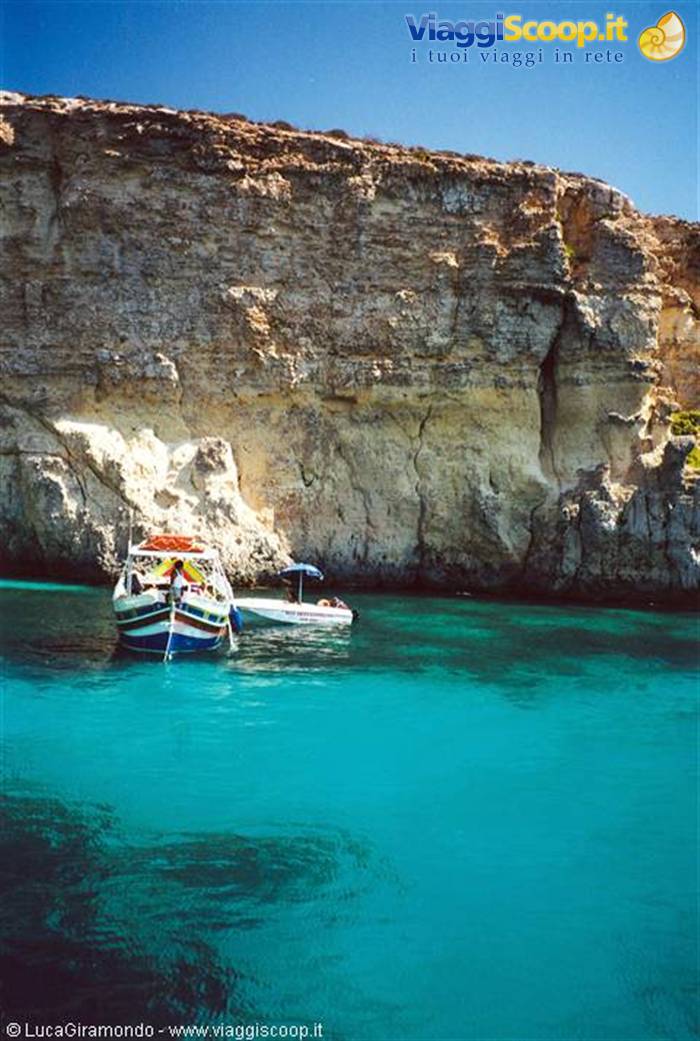
The marvellous colour of the sea contrasts with the bare rocks that close off the view of the open sea on every side and give the impression of being immersed in the waters of a lake. With a single turn of the gaze one embraces the whole archipelago and in the distance the rocky coasts of Malta, on one side, and of Gozo, on the other, are clearly distinguishable. We enjoy the whole setting for a long time, then Federico gets cold and we return to the beach. We warm ourselves in the sun with our eyes always turned to the sea in front of us, until, at 11:30, the captain of the "Ozzi One" calls his "crew" to muster; then we get back on board our boat and prepare to circumnavigate the island. In the immediate vicinity of the Blue Lagoon we visit some caves, then we go and drop anchor in a beautiful inlet set among high rocky walls.
It is the Crystal Lagoon and, observing the transparency of the sea all around, one immediately grasps the origin of the place name. We all get into the water, Federico included, who shows no hesitation, despite the considerable amount of water, he armed with armbands and we with mask and snorkel. We scan the seabed which is populated by numerous fish, by no means intimidated by our presence. There is also an enormous jellyfish which, most elegantly, lets itself be carried by the current, and it is a shame that the little one cannot see it.
We return on board and resume following the coast anticlockwise: along the way we observe caves and severe cliffs, let ourselves be gently caressed by the sea breeze and land, at lunchtime, at Santa Marija Bay, where the only hotel on the island is located, as well as a chapel and the police station with only two officers, and they are more than enough, given that the actual residents are three and the cars in circulation two! At 14:00, after lunch, we restart the engines and complete the tour of the island, then we set course for Gozo, skirt the beach of Hondoq ir Rummien and slowly make our way back up the coast to the port of Mgarr, thus concluding a beautiful excursion which, on its own, can be worth a trip to the Maltese archipelago.
It is too early to return to the hotel, so we go to the beach, for a change at Hondoq ir Rummien: it is the closest and on the north side of the island the sea is still rough. Federico is very tired after the boat adventure and falls asleep on the towel holding some wooden sticks in his hand. He wakes up around 17:00 and we play a bit with the sand, then it is time to return to Marsalforn and then to the Atlantis Hotel for dinner. Later we try to take a drive to Victoria, so as to spend the evening and while away the time, but along the streets of the centre the street lamps are dim, silence reigns supreme and there is nothing better to do than return to the room to watch television while waiting for sleep to take over.
Gozo: Ramla Bay
Day 147 Sep 2000
Sabrina wakes me around 5:30 because strange noises can be heard beyond the window and it seems to be raining. Indeed it is, and I rush to remove the beach towels hung out on the terrace which, instead of having dried, have almost completely got wet, then I go back between the sheets and try to get back to sleep, despite worrying about the rain. When the alarm goes off I immediately rush to look out of the window: fortunately it is sunny and I wake everyone up, so, with optimism, we prepare to face the new day. We set off and stop by the little harbour of Marsalforn to observe the sea conditions: they are not exceptional but not a disaster either, and we breathe a sigh of relief, given that by now we only have beaches on the north side of the island left to see.
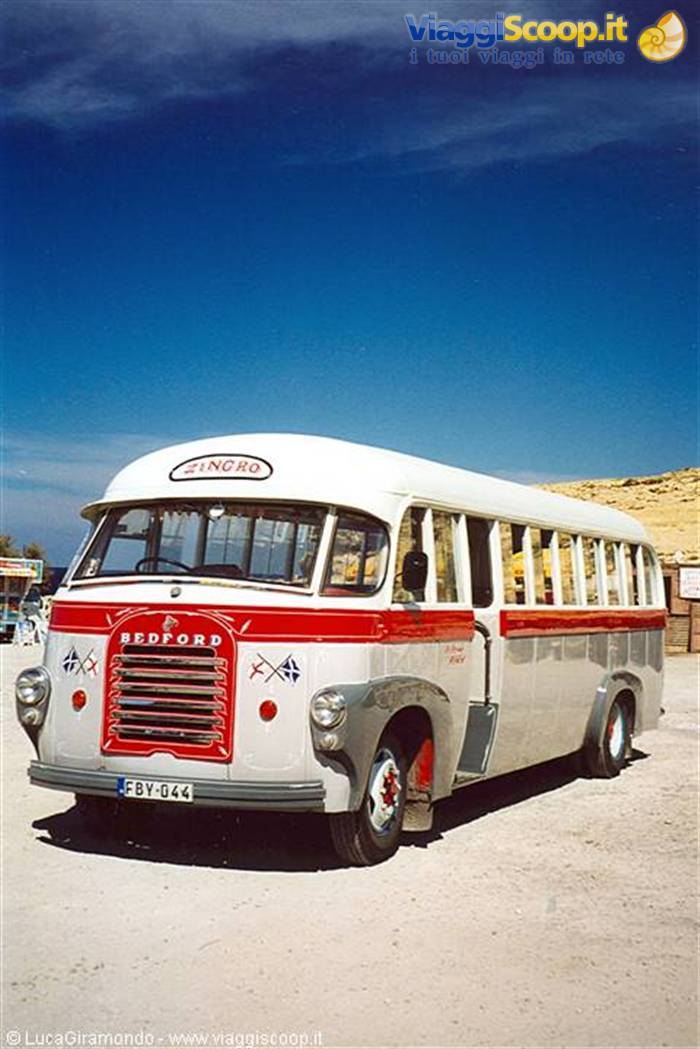
We go back up to Victoria, then follow the road that runs towards the westernmost part of Gozo, pass the ruins of an old aqueduct and go down to the sea shortly after the village of San Lawrenz, until we reach the scenic bay of Dwejra, surrounded by very high rocky walls and closed off towards the open sea by the imposing Fungus Rock, a monolith that towers, for over sixty metres, above the water's surface. On its walls, and only on its steep walls, grows a legendary fungus (hence the name): the Fucus Melitensis, used by the Knights as a remedy against various ailments. We stop in a dirt car park where, among other things, there is a characteristic Gozo tram, which differs, in colouring, from those of Malta, with grey instead of orange. We take a photo of the folkloric bus and walk towards the nearby cliffs, in which the world-famous Azure Window is located.
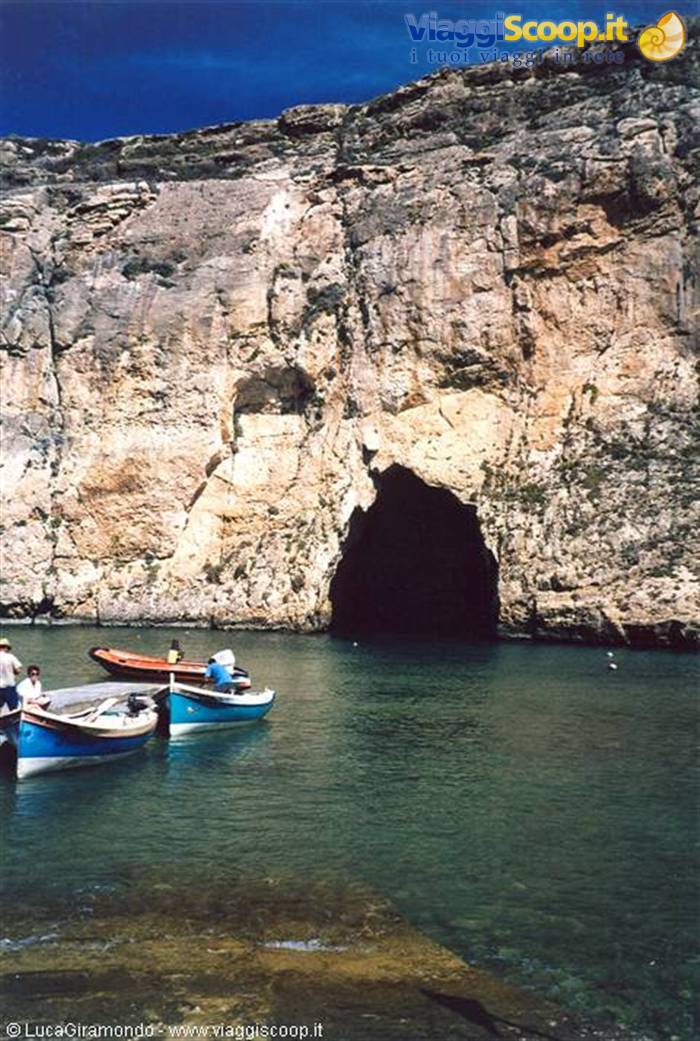
The sight of the stunning natural rock arch leaves us amazed: the great pillars seem to rise from the sea and are surmounted by a stone slab, perfectly horizontal, which forms the lintel. Its dimensions are truly remarkable and we remain watching it for a long time from below, then Federico and I climb on top of it, while Sabrina stays at sea level and takes a memorable souvenir photo of us. Nearby there is also the incredible Inland Sea, the "inner sea": a little piece of the Mediterranean inside the island of Gozo, created thanks to the collapse of a large cave. The shores of the crater to the south are gently sloping, while to the north they are high and vertical. In the centre of the latter a natural tunnel opens
Comino: Crystal Lagoon
Day 158 Sep 2000
The weather during the night did not improve at all... quite the opposite: we wake up to the rain falling relentlessly. It hadn't happened since March and it seemed impossible that it would, yet here it is, right in front of us, the most classic of grey days. Somewhat disheartened, we set off anyway to do the very few alternative visits to the beach that we had left, meanwhile the rain stops falling but the sky stays heavily cloudy and gloomy. We head to the westernmost part of the island and, near the village of Gharb, we stop to visit the sanctuary of Ta' Pinu, a destination of worship and pilgrimage for all the inhabitants of the archipelago. The current religious building was constructed fairly recently, in 1920, on the site of certain miraculous events. Inside are preserved numerous ex-votos bearing witness to what happened over the years.
At the end of the visit we go to the nearby Dwejra Bay to observe the effect of the rough sea on the Azure Window: enormous waves crash against the rock, spraying upward for several metres and forming large patches of snow-white foam. It's incredible but even the nearby Inland Sea is, in its own way, rough and the little boats, used daily for excursions, all sway firmly anchored to their moorings. We move almost in slow motion to make the time pass and return to the car while a few drops start falling again. We rack up kilometres without a precise destination and travel, in the south-east of the island, along one of the few roads we still hadn't managed to drive, with some panoramic glimpses of the coast below, then it's noon and we go to the nearby town of Xlendi, where we stop for lunch.
Today, Friday 8 September, in Malta, is a national holiday: it commemorates Our Lady of Victories celebrating the defeat of the Turkish armies and the end of the Great Siege of 1565, for this reason all the shops are closed. A few bars, however, are open, and so we find a pizza to sink our teeth into. Federico, despite the warnings, gets himself dirty eating it and a small tragedy breaks out, which, combined with the bad weather, creates an explosive cocktail that puts our nerves to the test. After lunch we go to Xaghra to visit the last archaeological site left on our list: that of Ggantija, but the effects of the national holiday don't allow it and we find the gate closed. Disheartened, we return towards the hotel while it starts raining again for the umpteenth time.
The afternoon is interminable and, despite a dip in the semi-darkness of the indoor pool, we drag ourselves wearily until dinner time. Later we go, by car, for a drive: we hear bangs coming from Xaghra and the sky occasionally lights up... this was the evening of the fireworks! We stop along the road to watch them, while it continues to rain relentlessly, then we head back. The weather forecast isn't good for tomorrow either, we hope they're wrong, but the feeling is that the holiday has ended two days early.
Comino: Blue Lagoon
Day 169 Sep 2000
It has finally stopped raining and through the clouds, which have thinned out, the sun occasionally appears. You certainly can't say it's a splendid day, but we'll have to make do since it will be the last of a real holiday. After breakfast we reach Victoria, where we stop to change the last lire needed to top up the tank and do some shopping, then we go up to Xaghra to visit the archaeological site of Ggantija, which has reopened after the holiday. The excavations have brought to light two temples dating back to the Copper Age and built in the period between 3600 and 3200 BC. They are in a good state of preservation and their boundary wall is, perhaps, the most impressive element: there are numerous monoliths aligned and skilfully fitted together according to their shape, some of considerable size (they reach six metres in height and fifty tonnes in weight!).
We wander all around the site and wait, to take a photo, for the sun to come out, but the clouds, instead of thinning, increase and shortly afterwards it pours with rain. In the end we are rewarded, we spend at least an hour on a visit that required no more than twenty minutes, but we leave, satisfied, only after seeing the sun's rays kiss the enigmatic stones. The ticket price also includes entry to the old Ta Kola mill, which is a few steps from the site and the centre of Xaghra, so we don't let the opportunity slip and, on foot, we reach it. Inside the building, well restored, are displayed, arranged over several floors, agricultural tools and furnishings from the era when the sails were in operation and the whole visit turned out to be a small extra, all in all, interesting. The morning is almost completely over and, with the Ta Kola mill, we have exhausted the cultural visits.
We then head for San Blas beach, the last one left on our list. We reach the village of Nadur and descend towards the sea in the north-eastern part of Gozo. The beach, however, can only be reached by walking along a long path and the side of the island where it is located is covered by big clouds. We don't feel like risking it and we have lunch on the edge of the road waiting for the bad weather to pass... but it doesn't pass. So we settle for a look from above and then we go, for a change, to Hondoq ir Rummien which, as usual, is a happy island within the island: in fact there's almost sun and even if it were to rain the car could be reached in a few moments.
We settle ourselves, trustingly, on the beach and shortly afterwards we are rewarded: the patches of blue sky become ever wider and the sun returns to reign supreme, so much so that it burns on the skin and I have to go to the car to get that beach umbrella that, by now, I no longer thought I'd have to put up. We thus spend one last pleasant afternoon on the beach, until 17:00, when we leave Hondoq ir Rummien to do some shopping before returning to the hotel. After dinner, mindful of the previous evenings, we return to Xaghra, but the festival is over and all is silent. Federico runs around for a while in a playground and then we return to the room to pack our suitcases.
Comino: Blue Lagoon
Day 1710 Sep 2000
We get up unhurriedly and get dressed, then, after breakfast, we still have about an hour to spend in the pool, thanks also to the sun which has returned, in fine form, to its place. Between one swim and another the time flies: Sabrina goes up to the room to take a shower and shortly afterwards we join her. We get our last things ready and at 11:30 we leave the Altantis Hotel. In less than half an hour we reach the port of Mgarr, just in time to board the noon ferry, which however sets sail about thirty minutes late. We disembark at Cirkewwa, on the Maltese side, and continue towards the capital up to the gates of St. Paul's Bay, then we turn right and reach Golden Bay. We allow ourselves a brief stop for lunch and eat a good pizza in the same place where we had already eaten it, exactly two weeks ago, during the first day out and about on the island.
Before getting back on the road to the airport I also manage to see, on the pizzeria's television, the start of the Formula 1 Italian Grand Prix: one Ferrari jumps into the lead but the other is involved in a pile-up a few corners after the start and ends its race... what a shame. We too make a start, but not in the lead, in fact, we'll have to be careful, in particular, of pile-ups seeing as shortly after noon the car insurance expired and therefore, on the last stretch of road, we'll be without cover against possible accidents. We drive along the highway that skirts St. Julian's, cross the outskirts of Valletta and arrive, safe and sound, at the airport. We park the car in the Thrifty car park and head off, with the suitcases on the trolley, to hand over the keys.
We take the opportunity to voice our complaints about the matter of the tank of petrol, but the employee shrugs his shoulders, says he's only an employee and can't do anything about it. We try not to take it personally, after all we were expecting a response of that kind, and, resigned, we head off towards baggage check-in. Together with the suitcases we also place the beach umbrella on the conveyor belt... who knows if we'll see it again in Milan? We stop at an exchange desk to convert the remaining Maltese lire into Italian lire, then we pass through customs and go to gate number one, through which, presumably, we'll board at 16:30 on the Air Malta flight km628. After about an hour they open the gates and, while we're in the queue, I notice that our tickets bear three completely different seat numbers (6E, 8E, 9B), which means we'll be seated far from one another...
and to think that the check-in girl had even asked us Federico's age!... It's incredible!... As if we'd arrived late at the airport! We board the plane and turn everything upside down, we make several people get up and when everyone is seated... three seats remain free, one next to the other... even more incredible! We settle into "our" new armchairs, fasten our seatbelts and prepare for take-off. The Air Malta Boeing 737 lifts off about twenty minutes late and shortly afterwards flies over Gozo, with Comino at its side, which seen from the sky seems, really, little more than a rock. We skirt Sicily, wrapped in a thick blanket of clouds, then we pass over the Tyrrhenian Sea and land reappears when below us we see the Argentario with the Island of Giglio, then Piombino with the Island of Elba.
We go up the whole Tuscan coast as far as Liguria: the white Apuan Alps are clearly visible, the Cinque Terre and La Spezia, then we begin to descend towards Malpensa, where we land, at 18:37, after countless turns. The suitcases take a while to arrive and we get a bit impatient, in the end though they arrive (beach umbrella included) and so we phone the Panicucci car park to have them come and pick us up. It's almost 20:00 when, finally, we get into our "blue Punto" and set off to tackle the stretch of road that separates us from home. We encounter some traffic heading into Milan, but then it drops noticeably on the way out and, shortly afterwards, we stop at a service station swarming with Ferrari fans returning from the Grand Prix (won by Schumacher's Ferrari).
I have a coffee and we fill up with fuel then we go back to racking up kilometres of asphalt and thinking back over the holiday just spent: beautiful, from many points of view, apart from the scorching heat of the first days and the bad weather of the last, the historical and artistic part was of the highest level, the seaside part a bit less so (much better Gozo than Malta), with the exception of Comino (extraordinary!). Between one curse and another, because of the numerous idiots who travel in the third lane flashing their lights constantly, we get home around 23:10, with Federico who has been asleep for some time and who, calm and blissful, doesn't even notice that he is, once again, in his own bed.


0 reader comments