And so here we are at April 21st... how many times have we set off on a trip on this fateful date, but today the situation is profoundly different... In fact, the damned crisis gripping the construction industry has ended up costing me my job and so as not to stay at home, we have found ourselves forced to greatly reduce our range of action... So we have decided to stay in Italy and dedicate a few days to visiting our capital, to which people normally flock from every corner of the world, so certainly not a second-rate trip, but a trip, so to speak, that is economically sustainable, given the unfortunate circumstances. So we set off to discover Rome, even if, apparently, not aided by good weather conditions, about which we can only make the appropriate good-luck gestures. First of all, though, in the afternoon I go to pick up our little one from school...
and he repays me by coming toward me already bursting with energy! The camper has been ready with everything needed for some time in front of the house, so, at 5:45 pm, we can finally hit the road. An hour later we then cross the Passo del Verghereto on the E45 and after another turn of the clock hands we pass near Perugia. We then continue speeding south and once we take the A1 highway, at Orte, at the first service area, around 8:30 pm, we stop for a quick dinner. In no time at all we find ourselves racking up the miles and before long we arrive on the Grande Raccordo Anulare of Rome, which we then take clockwise. We exit onto Via Casilina, to arrive, a few minutes after 10:00 pm, at the LGP Roma camper stop, where we had already booked a pitch well in advance.
We then properly settle our vehicle and immediately afterwards we start the preparations for the first, imminent, day of visits in the capital.
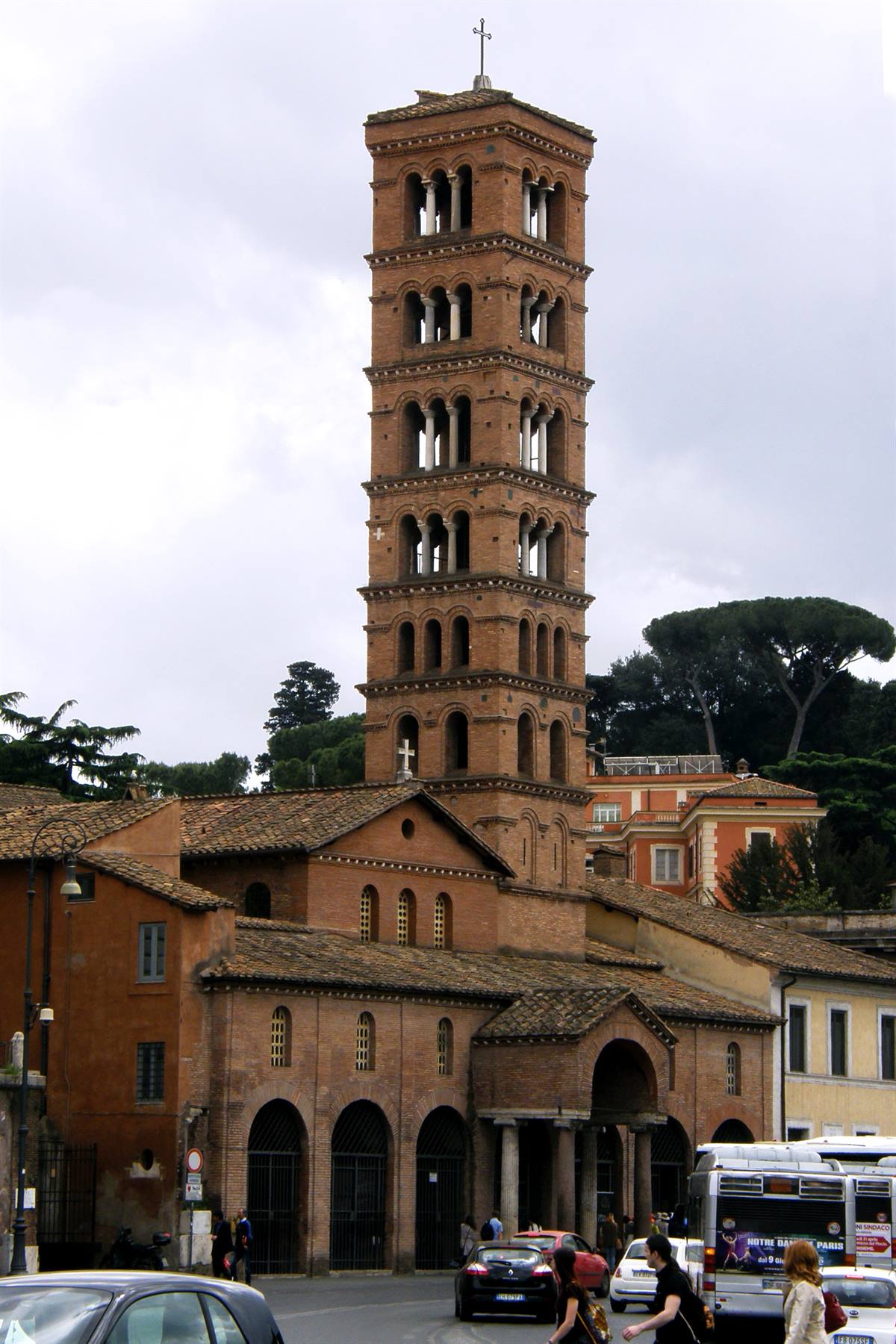
S. Maria in Cosmedin
Day 222 Apr 2016
(Part One)
During the night we heard a few drops of rain on the roof of the camper, so on waking I fearfully lower the blinds and to my surprise I notice that outside the sun is shining!... Having absorbed more energy and determination, we then prepare to face the day. Using bus number 105, whose stop is right in front of the rest area, we face the chaotic traffic of the capital and after a good half hour we also reach Termini Station, where thanks to a pothole in the asphalt, to start off on the right foot, I get a sprained ankle... Immediately afterwards, with line 40 and yours truly limping, we soon reach the center and Largo Argentina. There we get off and begin following the sightseeing program.
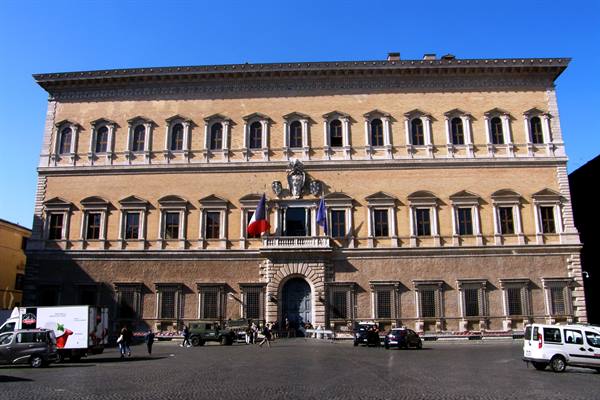
Before our eyes, below street level, the archaeological site known as the Sacred Area of Argentina immediately appears, discovered in 1926 during excavations for the foundations of a building that was never built again. The place, certainly not among the most scenic in Rome, is however important because it seems that here, on the Ides of March of 44 BC, the deadly ambush on Julius Caesar took place... so a first significant taste of the thousand-year history of this city. From Largo Argentina we go along Corso Vittorio Emanuele II and, taking a side street, we pass through Campo de' Fiori, a square where a historic market of the capital is held daily, to arrive right after in front of the monumental Palazzo Farnese, the sixteenth-century building, on which Michelangelo Buonarroti also worked, that dominates the square of the same name and is the seat of the French Embassy.
Walking beside the building we then arrive on the banks of the Tiber, the vital fluid of the capital since the dawn of time, and there we cross its bed on the Ponte Sisto, a structure in tuff and travertine dating back to the end of the 15th century, which today can only be crossed on foot. After tackling some streets in the surroundings we pass under the arch of Porta Settimiana and arrive in front of the gate that gives access to Villa Farnesina, a prestigious masterpiece of Roman classicism of the early sixteenth century.
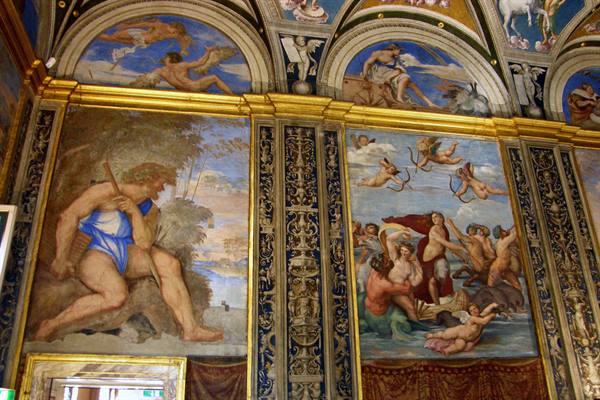
Inside we indeed observe extraordinary frescoed rooms, starting with the Loggia of Galatea, where the Triumph of Galatea by Raphael Sanzio stands out, then moving on to the Loggia of Cupid and Psyche, with the vault covered by frescoes depicting the Fable of Psyche, painted on cartoons by Raphael almost entirely by his pupils, and finally, on the first floor, we see the valuable Hall of Architectural Perspectives. After leaving the villa we regain the banks of the Tiber, then, having crossed the Ponte Mazzini, we wander around a bit but in the end we find the right bus, that is, the one that will take us to the top of the nearby Janiculum Hill, the greenest of the hills of the capital. We arrive at the top, in Piazzale Garibaldi, where an enormous statue of the hero of two worlds stands out, while unfortunately the sky is rapidly filling with clouds.
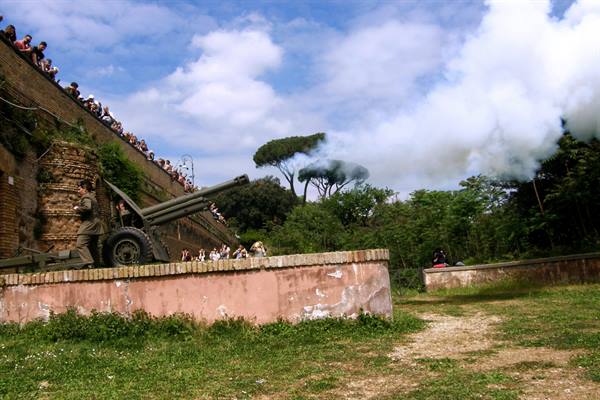
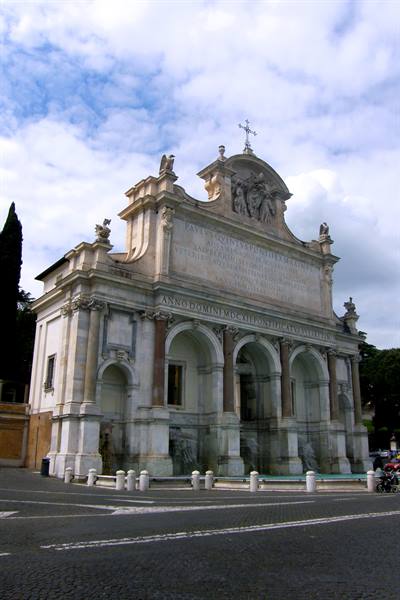
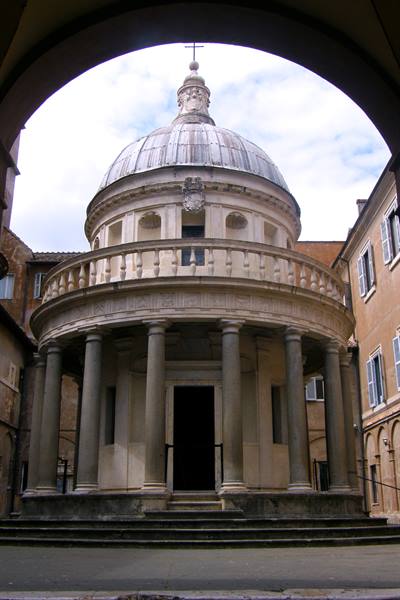
Nonetheless we enjoy the view over the city and then we wait for noon, so as to witness the famous firing of the Janiculum Cannon. Below the panoramic terrace a select team of the Armed Forces stages at the appointed hour, before the amazed gaze of little Leo, a powerful piece of artillery that, respecting the tradition introduced in 1847 by Pope Pius IX, fires a single shot so as to get all the bell towers of the capital to agree on the exact time. Right after the boom we get moving again and begin to descend from the hill on foot. In this way we pass in front of the beautiful Fontana dell'Acqua Paola, commissioned in the early seventeenth century by Pope Paul V to celebrate the opening of the aqueduct he had reactivated... This is the famous "fontanone" sung about by Antonello Venditti in the song Roma Capoccia. Nearby we also reach the Church of S.
Pietro in Montorio, known above all because at the center of its cloister stands the so-called Tempietto del Bramante, a small circular building dating back to the early years of the 16th century, considered a sort of milestone for Italian Renaissance architecture. Near the church we have lunch with our sandwiches and then, on foot again, we resume the itinerary. Now at the base of the Janiculum Hill we venture into the Trastevere neighborhood, a primary place of popular Roman life, and in its heart we stop to visit the Church of S. Maria in Trastevere, founded according to tradition by Pope St. Callixtus at the dawn of the 3rd century, therefore one of the oldest Christian places of worship in Rome, but remodeled several times over the centuries.
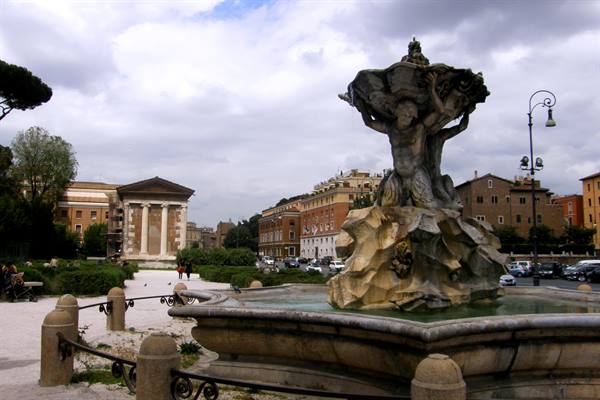
On the facade stands out a valuable fourteenth-century mosaic, while inside there are others, even older and more precious, that cover in particular the apse, with their splendid colors on a golden background. Back outside we walk the whole length of Via della Lungaretta and once we reach the banks of the Tiber again we cross it near the Tiber Island, an undeniable element of the urban fabric of the capital, and the adjacent Ponte Rotto, a reminiscence of the first stone bridge, built in Rome in 180 BC. In this way we arrive in Piazza Bocca della Verità, where first of all we notice the circular Temple of Vesta, but also the nearby Temple of Fortuna Virilis, both dating back to the 2nd century BC and having come down to us in good condition thanks to their transformation into churches.
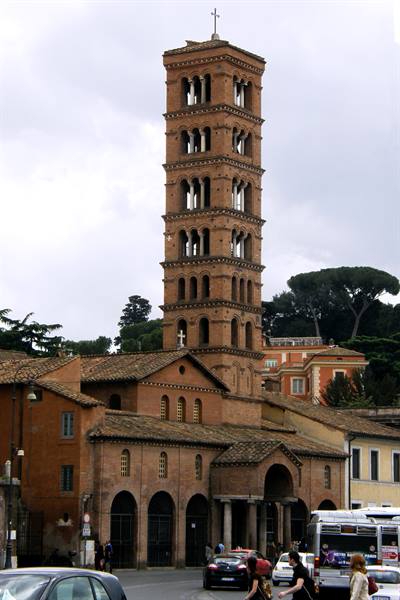
In the center of the square also stands the eighteenth-century Fountain of the Tritons, while on the easternmost side stands out the elegant Romanesque bell tower of the Church of S. Maria in Cosmedin. The religious building, all in red terracotta bricks, dates back to the 8th century and its interior, very sober, is divided into three naves by eighteen Roman columns. In the portico in front is then the famous Bocca della Verità, a stone mask of a river deity, whose oral cavity, by tradition, would bite off the hand of liars... So we too line up to undergo the test, with little Leo very fearful, but in the end brave in putting his little hand inside the terrible mouth.
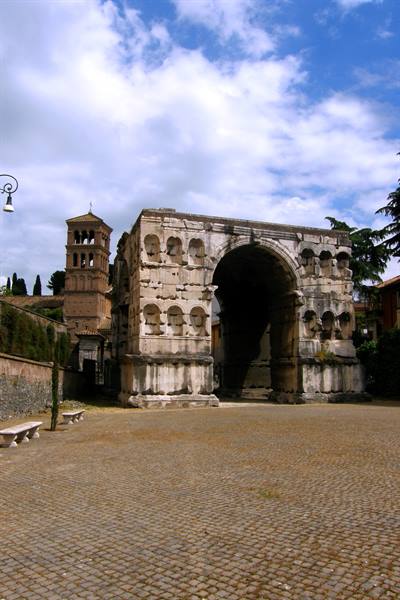
Nearby we also see the four-faced Arch of Janus, an interesting Roman work erected in the 4th century AD and perhaps also a bit mistreated, then going back up the wide Via Petroselli we arrive in front of the curious Theatre of Marcellus.
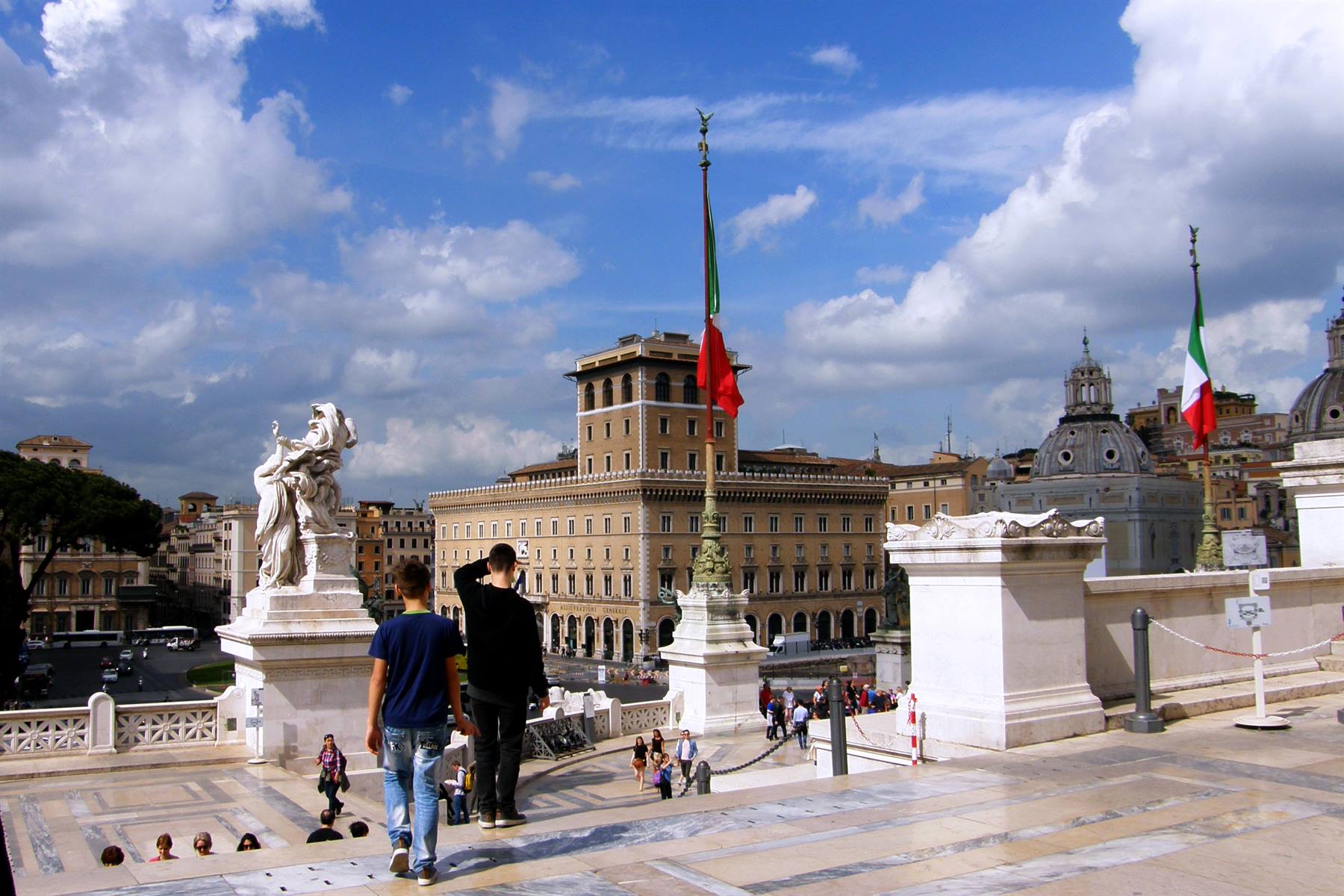
Vittoriano
Day 322 Apr 2016
(Part Two)
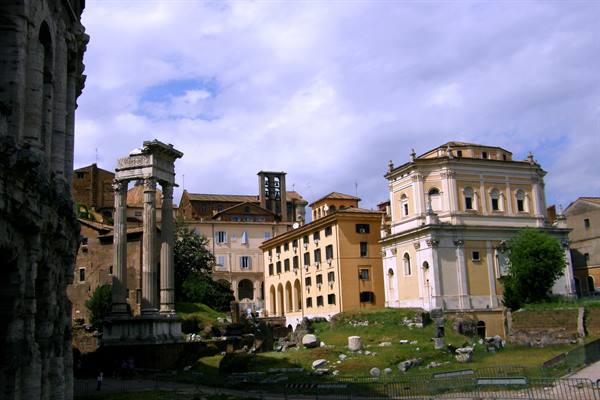
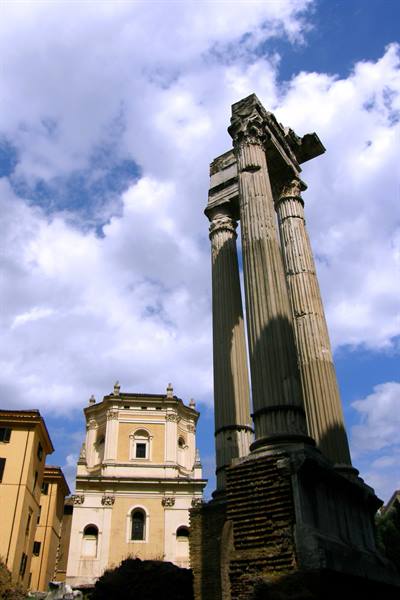
Begun by Julius Caesar and completed by Augustus in the 1st century BC, it was in its time one of the largest entertainment complexes in the city, then with the fall of the empire it became a quarry for building materials until, in the sixteenth century, on the twelve surviving arches a large palace was built, whose peculiarity is that it merges with the imposing ruins. Opposite, then, also stand the three surviving columns of the Temple of Apollo Sosianus, which make the architectural picture even more suggestive. Afterwards we pass into the heart of the Jewish quarter, characterized by the bulk of the synagogue and by the scaffolding covering the Portico of Octavia, under restoration, also dating back to the 1st century BC. In this way we arrive at Piazza Mattei, where the elegant Fountain of the Turtles is located.
From Piazza Mattei we then venture into the sadly famous Via Caetani, sadly because it was right here that on May 9, 1978 the lifeless body of the statesman Aldo Moro was found, killed by the Red Brigades, and at the exact spot there is a commemorative plaque in memory of what happened. We thus arrive in front of the entrance to the Crypta Balbi, an exhibition route centered on the archaeological area beneath the building that houses it... nothing transcendental, but it is a section of the National Roman Museum, which we intend to visit, so it is included in the three-day ticket that we are about to buy.
After a quick overview of the finds we return to the open air on Via delle Botteghe Oscure, at number 5 of which there was once the historic headquarters of the Communist Party, and following Via Celsa we arrive in Piazza del Gesù, where instead the headquarters of the Christian Democracy was located. On the same square also overlooks the imposing Church of the Gesù, which would also be interesting to enter, but it will open its doors at 4:00 pm and it is still almost an hour away... so we'll come back, weather permitting. Walking along Via del Plebiscito we then arrive in Piazza Venezia, onto which the fifteenth-century palace of the same name faces: a building in red bricks, from whose balcony Benito Mussolini delivered his most famous proclamations in the fascist era.
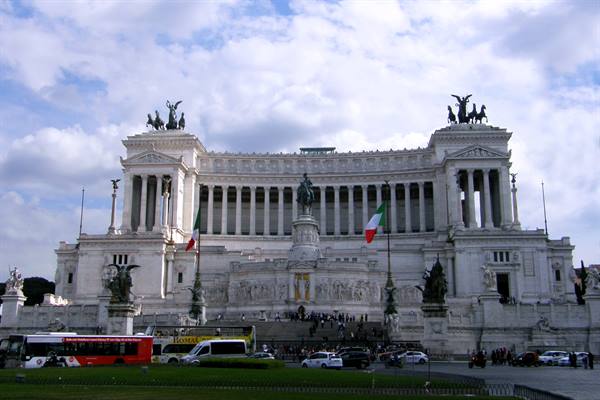
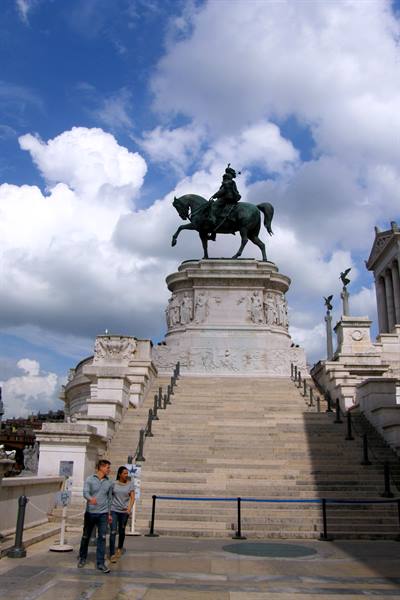
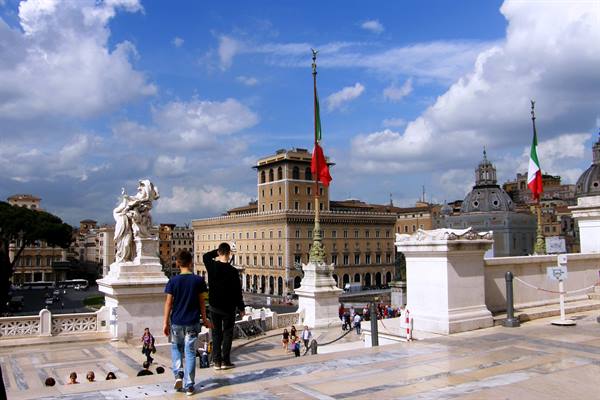
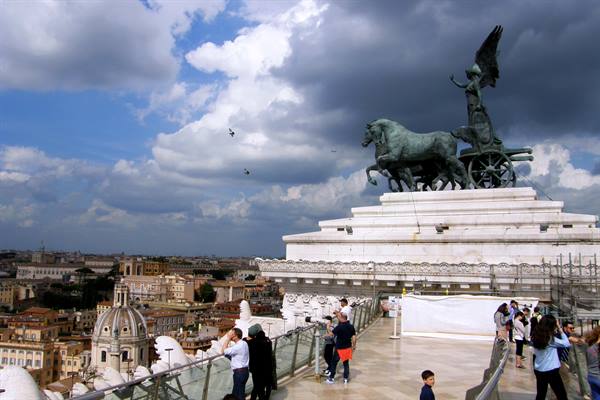
The entire southern side of the square is instead occupied by the enormous bulk of the Vittoriano or Altar of the Fatherland, a grandiose work put together between the end of the nineteenth century and the first decades of the twentieth century to commemorate Victor Emmanuel II, the sovereign who brought about the unification of Italy. The candid monument (all in marble), inspired by classical architecture, was ironically called at the time, because of its shape, a "typewriter", but today it divinely characterizes the panorama of the capital, housing, among other things, the tomb of the Unknown Soldier. With a modern elevator we go up to the top of the Vittoriano, to the so-called Terrace of the Quadrigas (the colossal bronzes that tower over the monument) and from there we enjoy the grandiose panorama that spans the entire city, but in particular the Imperial Fora.
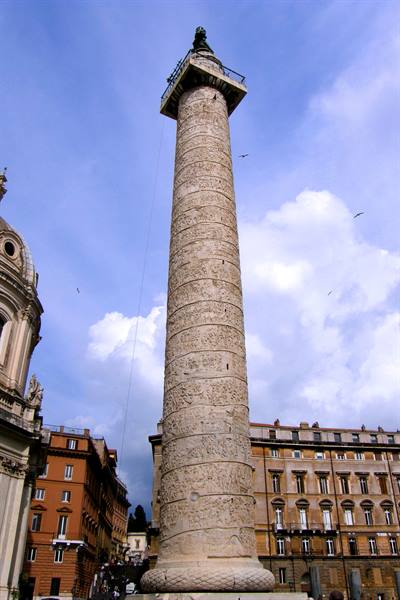
Back on the ground we go right toward Via dei Fori Imperiali to see up close the astounding Trajan's Column, erected in 113 AD to celebrate the conquest of Dacia, thanks to which Trajan brought the empire to its maximum expansion... In the helical bas-relief frieze of the column, almost forty meters high, the victorious campaigns of the commander are indeed depicted with extraordinary accuracy. The work has come down to us almost intact and is one of the highest expressions of the sculptural art of ancient Rome.
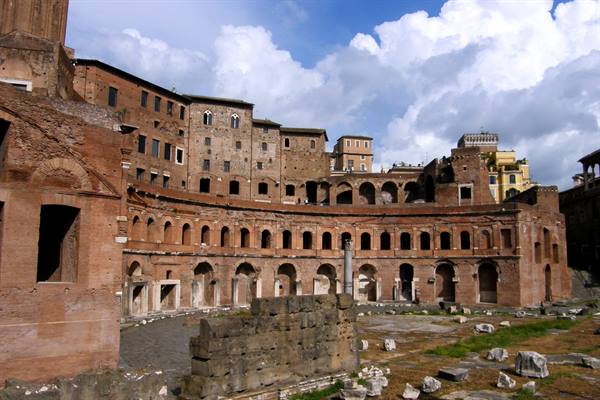
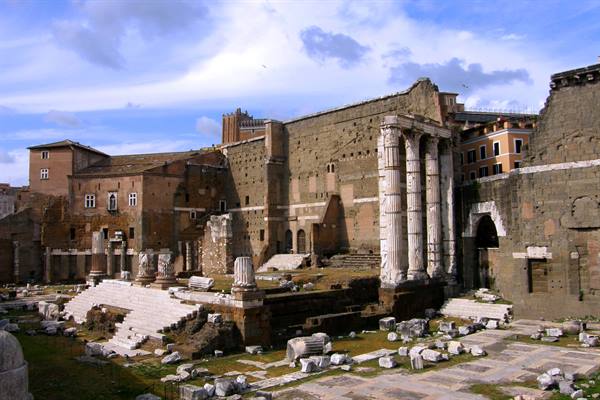
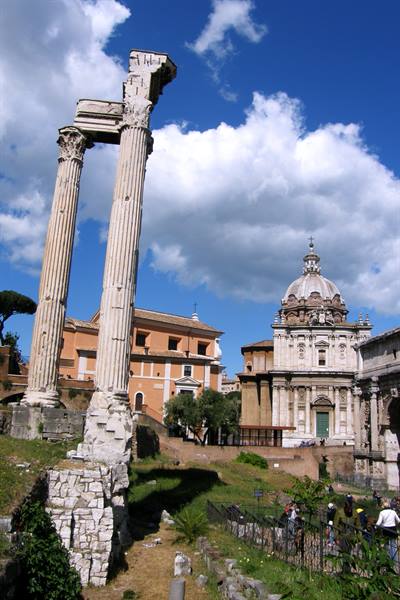
Subsequently we walk beside the so-called Markets of Trajan: an extensive complex of evocative brick buildings, with a semicircular plan, dating back to the same era as Trajan's Column, then we pass near the ruins belonging to the Forum of Augustus, in which the three surviving columns of the Temple of Mars Ultor stand out, and finally, going back up toward the Vittoriano, we observe what remains of the Forum of Caesar, where another three columns stand out, this time part of the ancient Temple of Venus Genetrix.
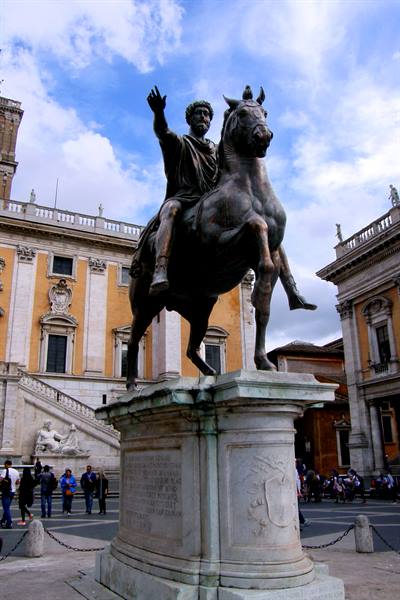
From the back of the Vittoriano we then go up, by a staircase, to Piazza del Campidoglio, one of the most famous and scenic squares of the capital, designed in the sixteenth century by Michelangelo Buonarroti, with at its center the famous equestrian statue of Marcus Aurelius (a copy), and on the main side the facade of the Palazzo Senatorio (seat of the City of Rome), flanked on the two adjacent sides by the mirrored Palazzo dei Conservatori and Palazzo Nuovo, seats of the Capitoline Museums, which we decide not to visit. On the remaining side the two colossal statues of the Dioscuri guard the sumptuous staircase that rises from the underlying Piazza d'Aracoeli... truly a beautiful architectural picture, only, unfortunately, not kissed by the sun, which in the meantime has gone behind big clouds.
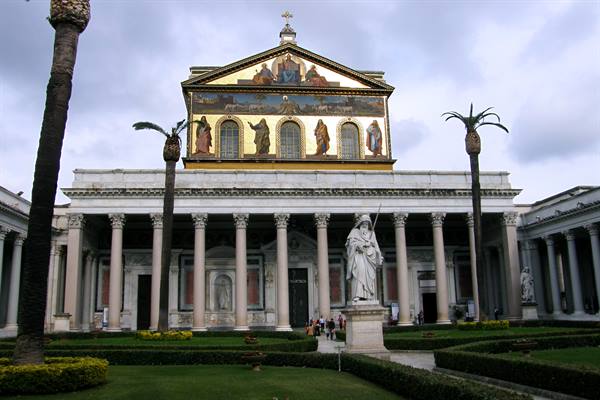
We descend along the main staircase only to go back up another one immediately afterwards, that is, the one leading to the Church of S. Maria in Aracoeli, with its simple thirteenth-century facade, which instead hides sumptuous interiors... Three wonderful naves embellished by the sixteenth-century coffered ceiling, commissioned by the Roman Senate, which make it the unique and most precious religious building of the Capitoline Hill. Having regained Piazza Venezia by bus we reach the Colosseum, but we do not stop to admire one of the most famous monuments in the world and from there we take the subway to go to the first outskirts of the capital, to the Basilica of S. Paolo Fuori le Mura. The largest church in Rome after St.
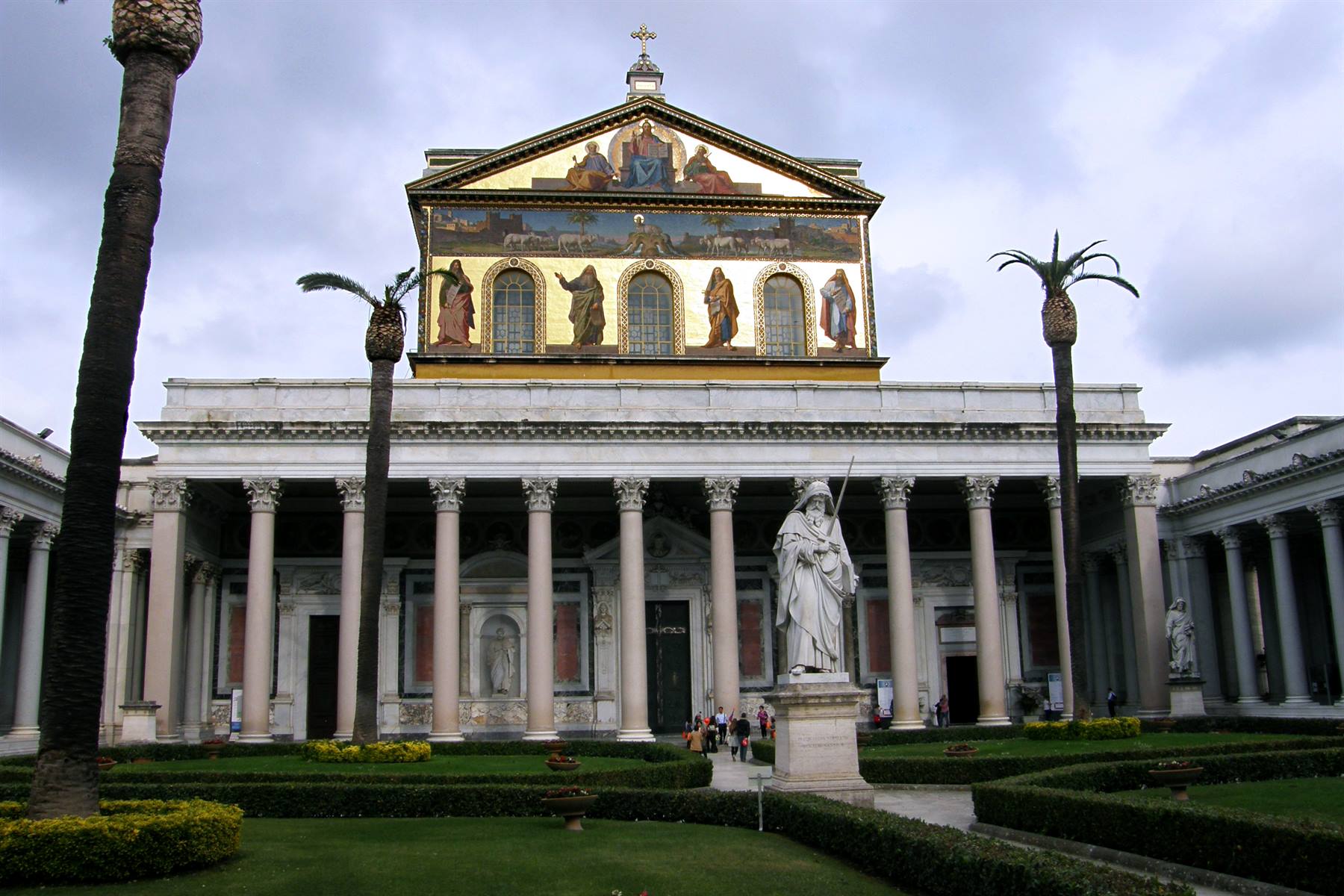
Peter's as well as one of the four papal basilicas of the city dates back, as a foundation, to the 4th century AD, but was rebuilt in the nineteenth century following a devastating fire. Reporting to the Vatican we access it through the metal detector and strict security checks, but in the end we can enjoy its mosaics and its immense naves, but not its cloister, which has already closed its doors, given the now late afternoon. With the subway we then return toward the city center and stop to see the curious Pyramid of Gaius Cestius, a Roman politician who died in 12 BC, who wanted to erect his tomb here along the lines of the imposing Egyptian pyramids. We observe the monument, fresh from restoration, in the early hours of the evening, darkened by a leaden sky that threatens rain, with beside it the profile of Porta S.
Paolo, a monumental gateway on the Aurelian Walls, from which the Via Ostiense began. Here, in practice, our first day of visits to Rome comes to an end, so, without haste and by public transport, we make our way back to the camper, exhausted but all in all satisfied, given the disastrous premises regarding the weather... and we hope good fortune will assist us tomorrow too.
St. Paul Outside the Walls
Day 423 Apr 2016
(Part One)
It rained several times and insistently during the night, and while we're having breakfast it continues to do so … then it stops and under a gloomy sky we set off for this second day of visits in Rome. We're in a hurry and can't waste time, so first with the Giardinetti line train, then with the metro, finally on foot we reach the entrance of the Vatican Museums by 9:00, for which we're already equipped with tickets … So we walk back up the whole line and right after we immerse ourselves in this immense treasure chest of culture, which has over five centuries of life, in fact it was Julius II in 1506 who inaugurated the first exhibition.
Even though paintings aren't our main passion we start from the Pinacoteca, which houses various masterpieces such as Giotto's Stefaneschi Polyptych, Sixtus IV Appointing Platina as Prefect of the Vatican Library by Melozzo da Forlì, Raphael's Transfiguration and Madonna of Foligno, Leonardo da Vinci's St. Jerome and Caravaggio's Entombment, plus many others, of course. Having left the Pinacoteca we cross the so-called Cortile della Pigna, where a modern sculpture by Arnaldo Pomodoro also stands out in the center, and then we dedicate ourselves to the interesting Gregorian Egyptian Museum, a precious collection of very ancient artifacts, among which the statue of Queen Tuya and that of Osiris Antinous stand out, but also several sarcophagi and some mummies, which particularly stimulate Leonardo's imagination.
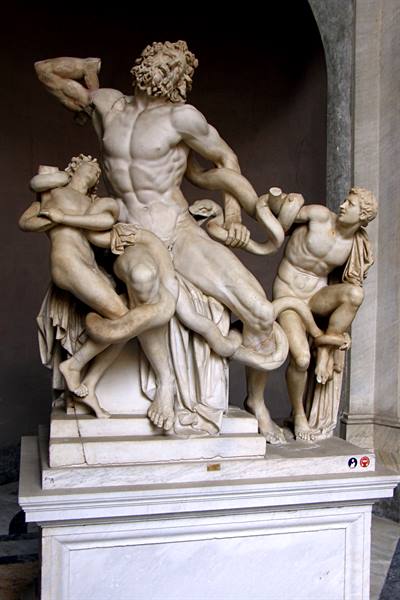
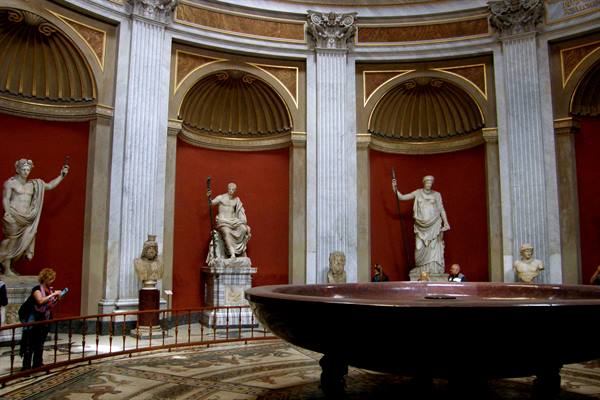
We then move on to the stupendous section of Greek and Roman sculptures better known as the Pio-Clementino Museum, in honor of the two popes (Clement XIV and Pius VI) who gave it luster and richness of content … We begin with the famous Apoxyomenos, a Roman copy of the original Greek bronze dating back to the 4th century BC, then we observe the Apollo Belvedere and the extraordinary group of the Laocoön, found inside the Domus Aurea, which in its time exercised great influence on Michelangelo, as did the famous Belvedere Torso (from the 1st century BC), which the master was inspired by in painting the "Ignudi" of the Sistine Chapel. We complete the section with the scenographic Round Hall, characterized by a large floor mosaic and elegant classical statues on the walls, then we observe the two monumental sarcophagi of Constantina and St.
Helena, dating back to the 4th century AD, before continuing along the path of visits. We thus pass before the harmonious Hall of the Chariot, where exceptional pieces from the Roman era (among which the Chariot, indeed) fit perfectly into an elegant nineteenth-century setting, then we walk along the immense Galleries of the Candelabra, of the Tapestries and of the Maps, the latter a stunning succession of forty enormous geographical maps of the Italian regions and of the Church's possessions at the end of the 16th century. In this way we arrive at the entrance of the apartment of Julius II della Rovere, which contains the famous Raphael Rooms.
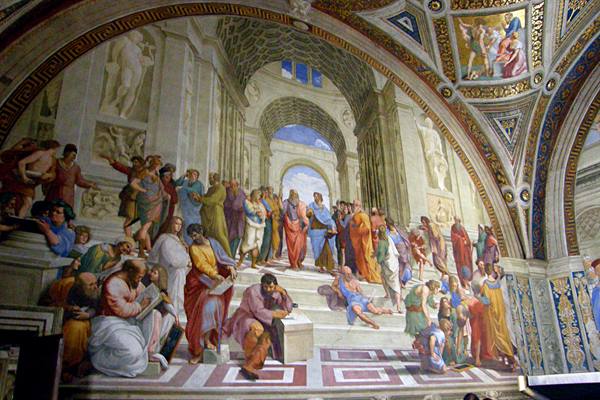
In four rooms the master's astounding decorations follow one another, by his hand but also by that of his pupils, so we can observe, amazed and in sequence, the Hall of Constantine, the Room of Heliodorus, that of the Segnatura and that of the Fire, enjoying one of the highest expressions of the Italian Renaissance … but it's only the prelude to what follows, namely the apotheosis of 16th-century pictorial art: the Sistine Chapel. The place where conclaves for the election of popes are held was frescoed for the most part by Michelangelo, but also by other masters of the era, such as Pinturicchio, Ghirlandaio, Botticelli and Perugino … By Buonarroti is the entire vault, covered with the frescoes of Genesis, as well as the back wall, occupied by the enchanting Last Judgment.
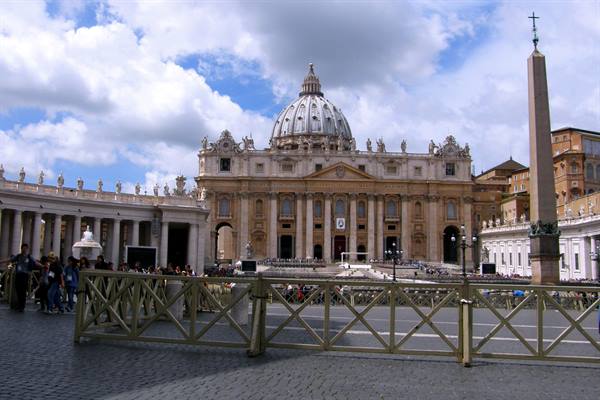
We remain a long time in contemplation to fill our eyes with so much wonder, then we go slowly toward the exit of the Vatican Museums. Back in the open air we find fewer clouds and some auspicious ray of sun, so following the perimeter wall of Vatican City, the smallest state in the world (with its 44 square kilometers), born in 1929 following the signing of the Lateran Pacts, we look out, from Via di Porta Angelica, onto the universally known St. Peter's Square. 284 columns and 140 statues of saints delimit the immense ellipse (240 meters wide) which is a true scenographic and architectural masterpiece by Gian Lorenzo Bernini, a solemn space, dominated in the center by an Egyptian obelisk and seventeenth-century fountains, which however, today, we cannot access, because it's reserved for the Jubilee of Young People.
So we walk back up along the porticoes, pass the security checks, are patient a little longer in line and finally we can enter St. Peter's Basilica, through the Holy Door moreover, given the jubilee year. As soon as we enter we let ourselves be fascinated by the enormous naves belonging to the largest basilica of Christianity: 218 meters long by 155 wide and 136 high, then we notice, immediately on the right, the unmistakable Pietà by Michelangelo, a marble group of inestimable beauty, located behind a protective glass so as to shelter it from possible acts of vandalism, which unfortunately occurred years ago. In the adjacent chapel, however, is the tomb of Pope John Paul II, particularly venerated, given his recent canonization.
Walking with our noses in the air to catch the view of the grandiose dome we approach the papal altar, above which rises a colossal bronze baldachin 29 meters high, a work by Bernini. The whole then overlooks the so-called Confession, the space that houses the tomb of St. Peter. Due to services we cannot visit the area behind the altar, which contains valuable works, so we settle for seeing the funeral monument of Alexander VII Chigi, also by Bernini, and the tomb of Innocent VIII, all in gilded bronze, then we return to St. Peter's Square, where a timid sun shines. We have lunch with our sandwiches on Via della Conciliazione and right after we resume the itinerary, reaching, on the banks of the Tiber, the imposing Castel Sant'Angelo.
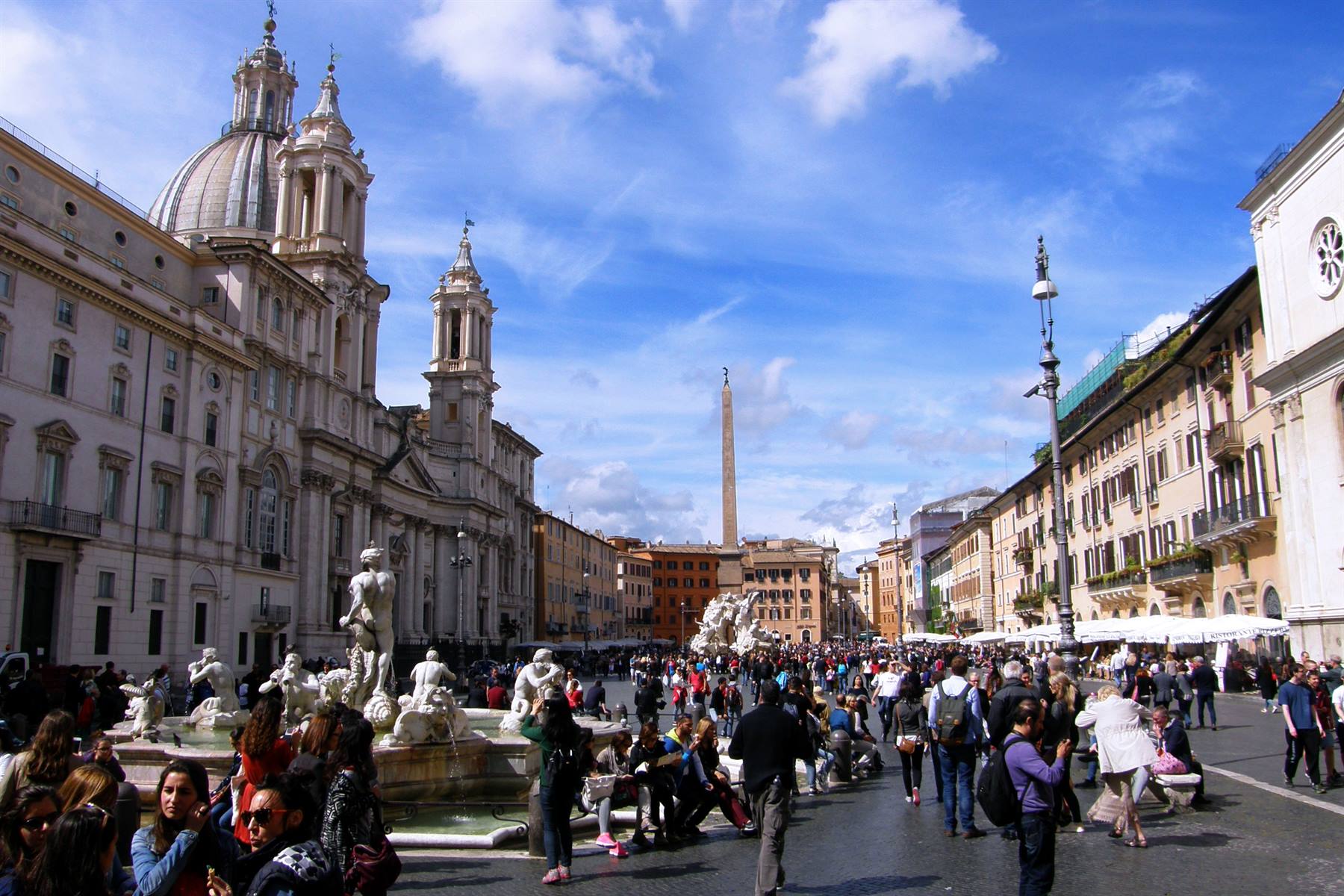
Piazza Navona
Day 523 Apr 2016
(Part Two)
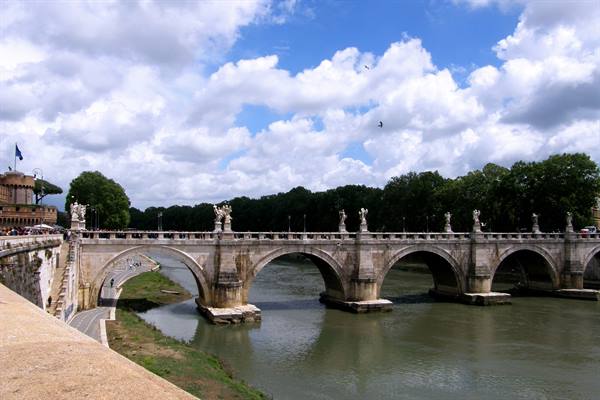
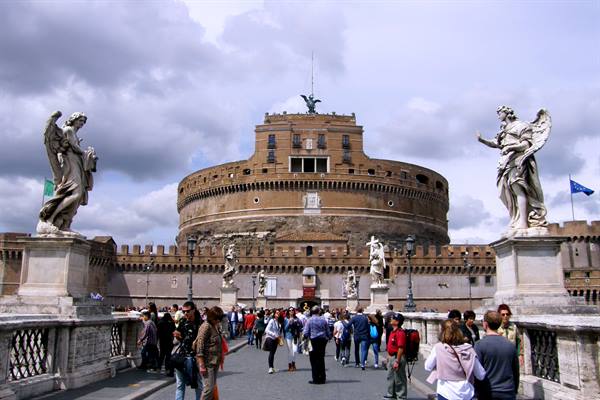
Rising as a mausoleum in the 2nd century AD at the behest of Hadrian and later transformed into a fortress, the castle (one of the symbols of the capital) has a thousand-year history, during which several popes made it their residence. Bearing witness to this are some richly decorated rooms, such as the Pauline Hall or the Loggia of Julius II, which we encounter along the path that leads us up to the Angel Terrace, from which we enjoy a beautiful panorama of the city. Having left the castle we walk along the scenographic Ponte Sant'Angelo, whose arrangement, with the parade of statues of angels, was devised by Gian Lorenzo Bernini in the 17th century, and so we reach the other bank of the Tiber.
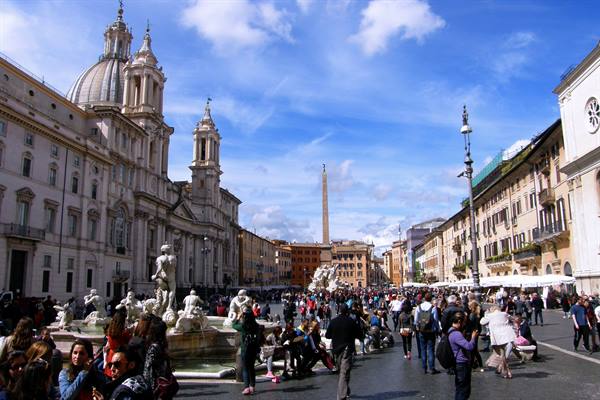
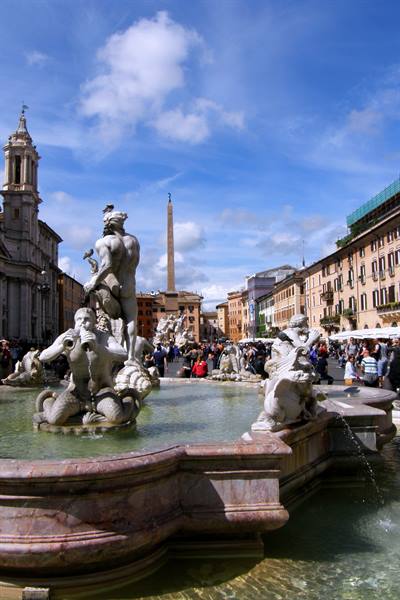
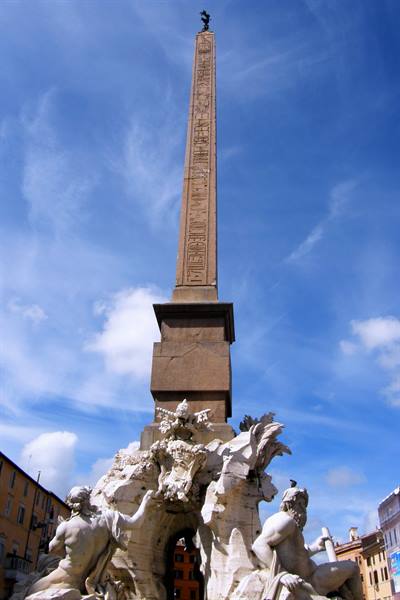
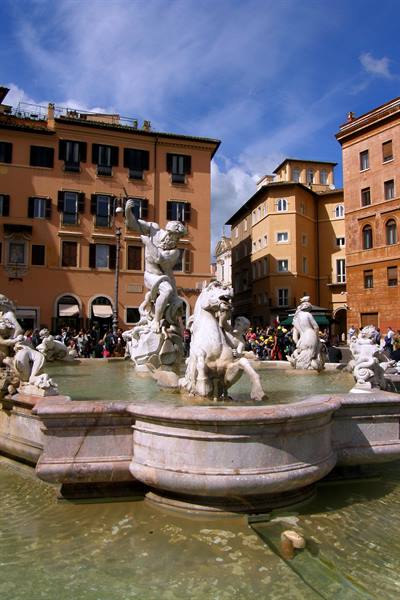
Along the way we stop to see the interesting Chiesa Nuova, embellished by the rich Baroque decorations of its interiors, then we arrive at the famous Piazza Navona, according to many the most beautiful in the capital and, fortunately, also kissed by the sun. The elongated elliptical shape makes this space adorned with Baroque masterpieces coincide with the ancient layout of the Stadium of Domitian, erased in the thirteenth century by the construction of simple houses, later flanked by churches and palaces, but also by the sumptuous fountains that characterize its setting. Further south we immediately notice the extraordinary Fountain of the Moor, a work by Bernini, as well as the central Fountain of the Four Rivers (Nile, Ganges, Danube and Rio de la Plata), which rises in front of the Church of St.
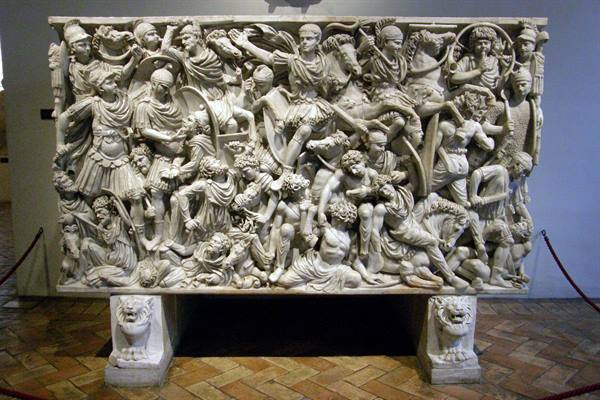
Agnes in Agone, erected in the seventeenth century by Francesco Borromini, while to the north is the valuable Fountain of Neptune, by Giacomo Della Porta. Now in mid-afternoon we leave Piazza Navona behind to go visit, nearby, Palazzo Altemps, which besides being a historic sixteenth-century residence, among whose rooms the valuable Painted Loggia stands out, is also the seat of the National Roman Museum and houses numerous and lofty classical works … We can thus appreciate, among others, the famous Ares Ludovisi, the statue of Athena Parthenos and that of the Galatian Suicide, but also the elaborate Sarcophagus with battle between Romans and Gauls. Having left Palazzo Altemps, with the sun having sunk again among the clouds, we go to the Church of St.
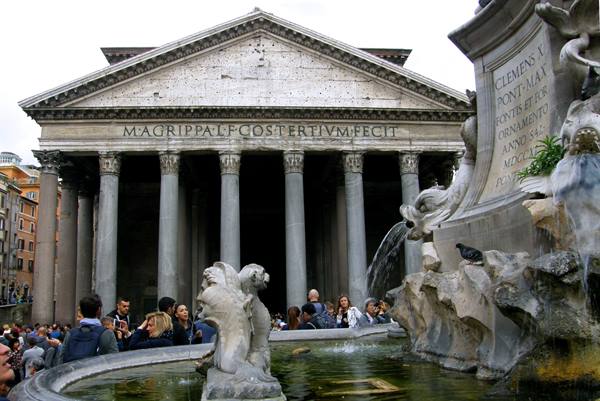
Augustine to see inside it the fresco of the Prophet Isaiah, by Raphael, and the altarpiece of the Madonna of the Pilgrims, by Caravaggio. Afterwards we allow ourselves another church, amid the protests of little Leo, who is beginning to be a bit fed up with them and perhaps rightly so from the height of his six years. The church in question is that of St. Louis of the French, which preserves in the Contarelli Chapel an extraordinary cycle of works by Caravaggio dedicated to St. Matthew. Continuing in our itinerary we pass behind Palazzo Madama, seat of the Senate of the Republic, and arrive before the Pantheon, one of the most famous and fascinating relics of the City, which has come down to us in extraordinary state of preservation, thanks to its transformation into a church.
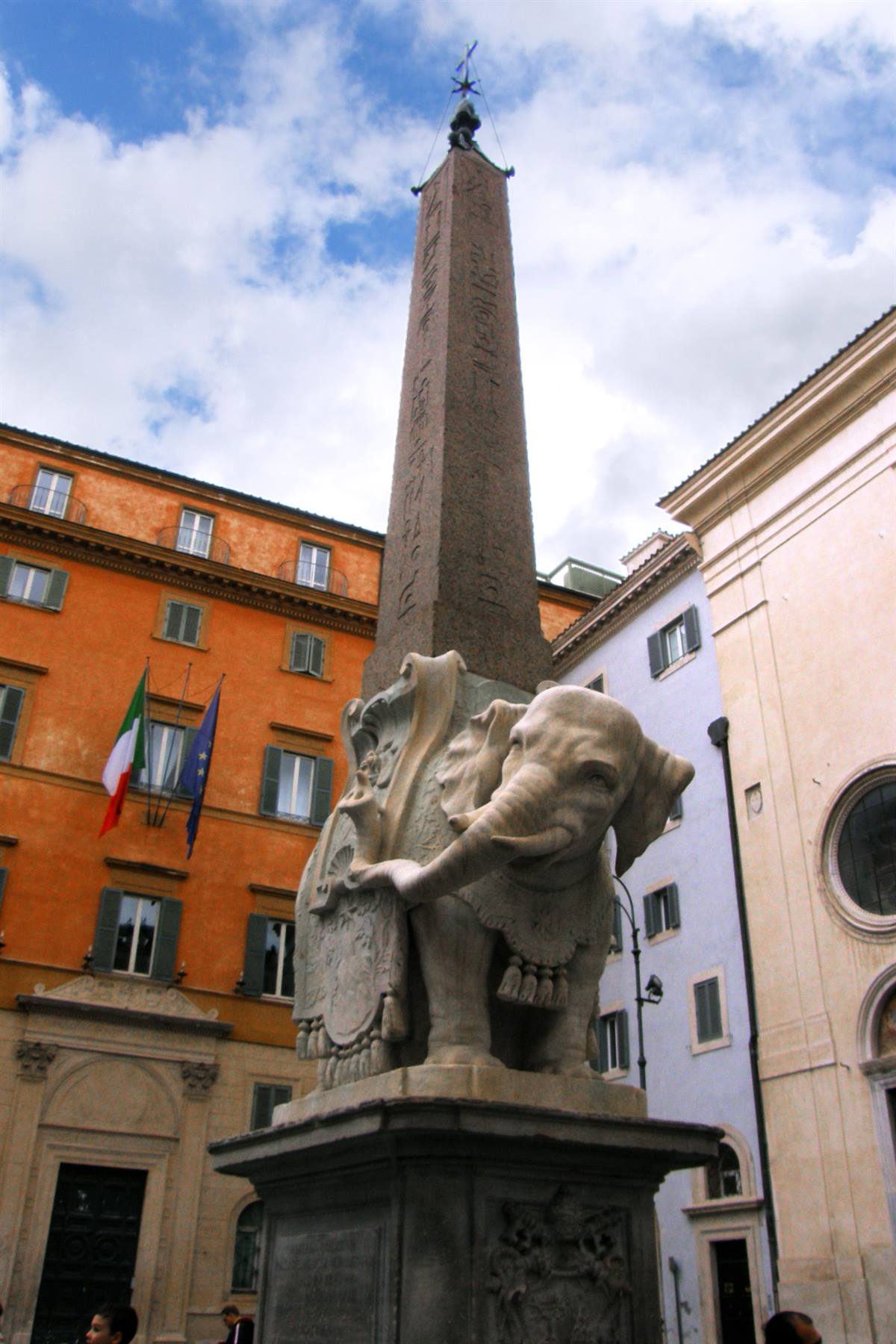
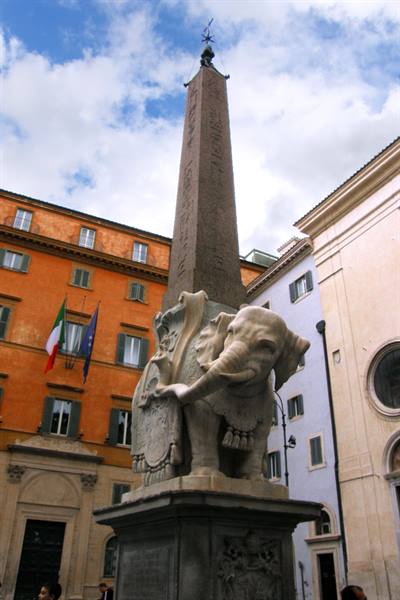
It was erected by Marcus Agrippa, son-in-law of Augustus, in 27 BC and after more than two millennia it is still upright, solid and proud witness of ancient Roman civilization … unfortunately, however, we cannot visit its interiors because mass is underway, but we will return. So we go to the nearby Church of St. Mary Above Minerva, in whose adjacent square of the same name is the so-called Pulcin della Minerva, a small marble elephant, designed by Bernini, which supports the smallest obelisk in the city … Inside the religious building there are then the stupendous Carafa Chapel and the statue of the Risen Christ by Michelangelo.
Never satisfied we allow ourselves another church, that of the Gesù, which yesterday we had found closed, in whose late-Baroque vault stands out the Triumph in the Name of Jesus, a grandiose fresco that, for its perspective, seems to go beyond the material limit of the ceiling that houses it. Now in the late afternoon we then go to Via del Corso to cross the doors of Palazzo Doria Pamphilj, a historic building, still owned by the family of the same name, which in the eighteenth century expressed one of its members on the Throne of Peter. We visit the rich reception rooms with the lavish Hall of Mirrors standing out and then the Gallery, which houses important works of art, among which the Portrait of Pope Innocent X Pamphilj by Velazquez, the Double Portrait by Raphael, Salome with the Head of the Baptist by Titian and the Rest during the Flight into Egypt by Caravaggio.
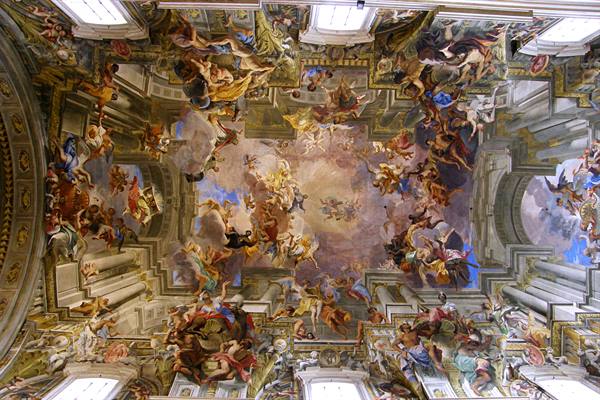
Having left Palazzo Doria Pamphilj there is still time to see the Church of St. Ignatius and its vault masterfully painted by Andrea Pozzo who created, in the Baroque age, with the Triumph of St. Ignatius, a masterpiece of perspective illusionism, then we return to Via del Corso to take the bus and while we're waiting a small downpour breaks out that creates some discomfort for us … but if this was to be all the bad weather forecast for today, then we can consider ourselves truly lucky! … Afterwards with the help of metro and Giardinetti train we also regain the camper area, happily concluding the day. Later we go to bed, all in all happy with how the vacation is going, but still fearful about the forecast weather, so for tomorrow we can only trust again in our lucky star.
Pulcin della Minerva
Day 624 Apr 2016
(Part One)
This morning in the sky there are indeed many clouds, but at least it's not raining. We set off and with the Giardinetti line train we arrive near Termini Station. From there then, on foot, we reach the entrance of Palazzo Massimo, another seat of the National Roman Museum, indeed, the most important, containing extraordinary masterpieces of classical art. On the three floors of the exhibition we thus review numerous works, among which stand out, for beauty and perfection, the statue of Augustus Pontifex Maximus and the exceptional bronzes of the Hellenistic Prince and the Seated Boxer, the latter rich in exceptional anatomical details.
Then the splendid Lancellotti Discobolus (perfectly intact and positioned next to the headless and armless Discobolus of Castelporziano), but also the Apollo Chigi and then the elaborate Sarcophagi of Portonaccio and of Acilia, not to mention the stunning decorations of the Nemi Ship (a sort of floating villa dating back to the 1st century BC). On the top floor, finally, among the decorative and pictorial cycles of the imperial age, we notice the precious frescoes from the Villas of Livia and of the Farnesina. Having left Palazzo Massimo more cultured, with the sun peeking out among the clouds, we arrive at the vast Piazza della Repubblica where, on the south-western side, the nineteenth-century buildings follow the curvilinear course of the ancient steps of the Baths of Diocletian, on the opposite side, however, faces the Church of St.
Mary of the Angels, built among the colossal ruins of the thermal complex, an extraordinary transformation entrusted to Michelangelo to honor the memory of the many Christian martyrs used, according to legend, in the construction of the original building. The façade is very bare, in practice the brick exedra of a thermal hall, while the interiors are solemn and the elegant floor is crossed by the so-called Clementine Line, an enormous sundial that marked, for almost a century and a half, the official time of the capital, until the Cannon of the Janiculum was put into operation … very interesting, however we cannot linger in the visit, because mass is starting. From Piazza della Repubblica we then move to Piazza St.
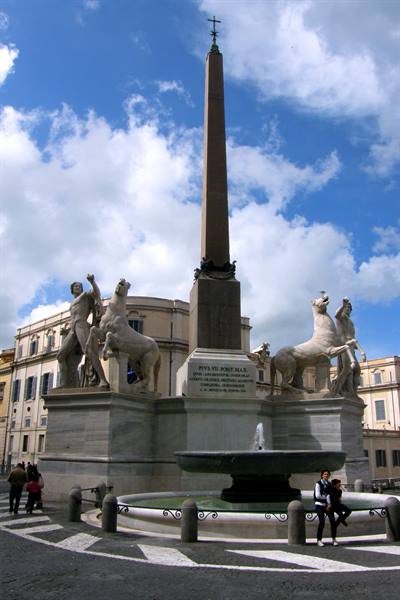
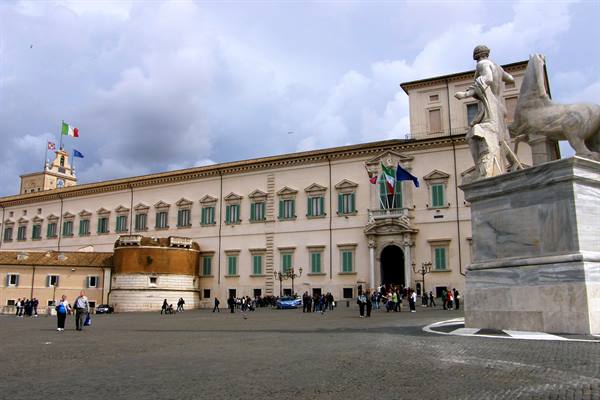
Bernard, where there is the beautiful Fountain of Moses (a sixteenth-century work commissioned by Pope Sixtus V to celebrate the Felice aqueduct), but also the interesting churches of St. Mary of the Victory and St. Susanna … We enter the first, where the religious service is underway, but not the second, because it's under restoration. At this point we follow the straight Via XX Settembre and Via del Quirinale, where we stop to see, quickly, first the tiny Church of St. Charles at the Four Fountains, a work by Borromini, then the elliptical Church of St. Andrew at the Quirinal, by Gian Lorenzo Bernini, inside which a wedding is being celebrated. We thus arrive at Piazza del Quirinale (embellished by the monumental Fountain of Monte Cavallo), onto which faces the palace of the same name, official residence of the President of the Republic.
On the enormous mass of this sixteenth-century building, born as a summer residence of the popes, also stands a Berninian tower, on which the flag of the Presidency of the Republic flies, when the President is in residence (and today evidently he is). From the Quirinal Palace, with a short walk, we then approach what is probably the most famous fountain in the world, namely the sublime Trevi Fountain.
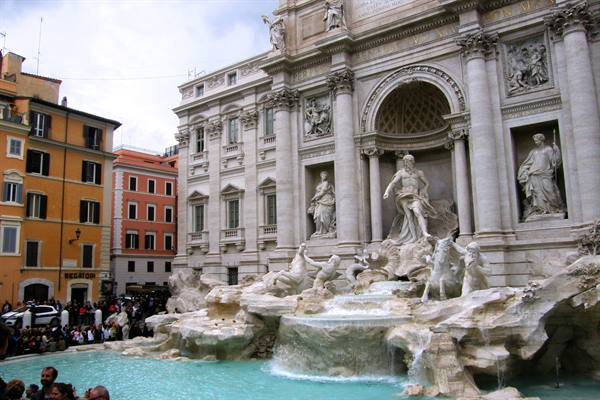
We stop to contemplate it in the square of the same name, very crowded … An extraordinary overall picture, which flows into the perfect architectural symphony of the elements, leaning against the southern façade of Palazzo Poli: in the central niche of the monument stands the great statue of Oceanus and further below several tritons rise from the rocks, while the water gushes and pours into the blue of the large basin below … An incomparable Baroque spectacle, only, unfortunately, not kissed by the sun of this gray spring day.
Having waited in vain for some timid ray of sun we resume the itinerary and arrive at Via del Corso, one of the most famous fashionable arteries of the capital, and then at Piazza Colonna, where the magnificent Column of Marcus Aurelius stands proud, erected in imitation of Trajan's Column in the 2nd century AD … A continuous relief frieze commemorates the victorious military campaigns of the emperor, spiraling up for the almost thirty meters of height of the massive marble shaft of the column. Right in front is then the sixteenth-century and monumental Palazzo Chigi, seat of the Presidency of the Council of Ministers.
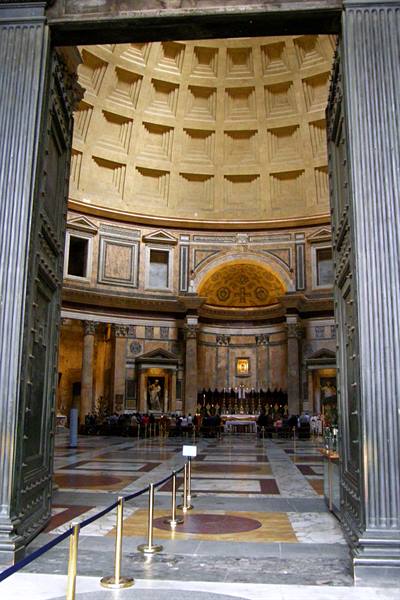
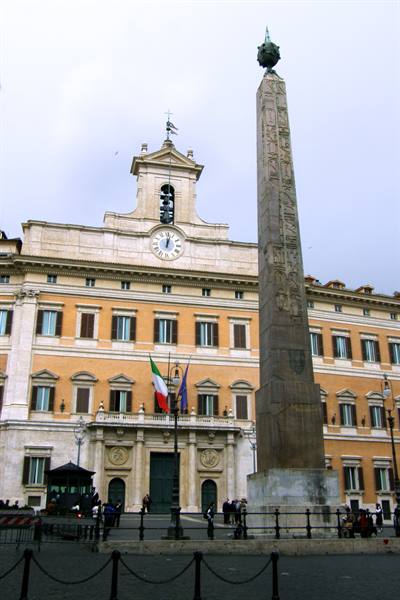
To stay always on the theme of politics, right after we go to the adjacent Piazza di Montecitorio, dominated by the Egyptian obelisk of Psamtik II, from the beginning of the 6th century BC, onto which faces the palace of the same name, commissioned in the seventeenth century to Lorenzo Bernini and seat, since 1871, of the Chamber of Deputies. A little downcast due to today's persistent grayness, we abandon the institutional palaces and return to the Pantheon, which is nearby, to visit its interiors, necessarily skipped yesterday due to religious service. Beyond the 16 granite columns of its pronaos rises the oldest and largest dome of the capital (43.3 meters against St. Peter's 42), supported by cyclopean walls, more than six meters thick.
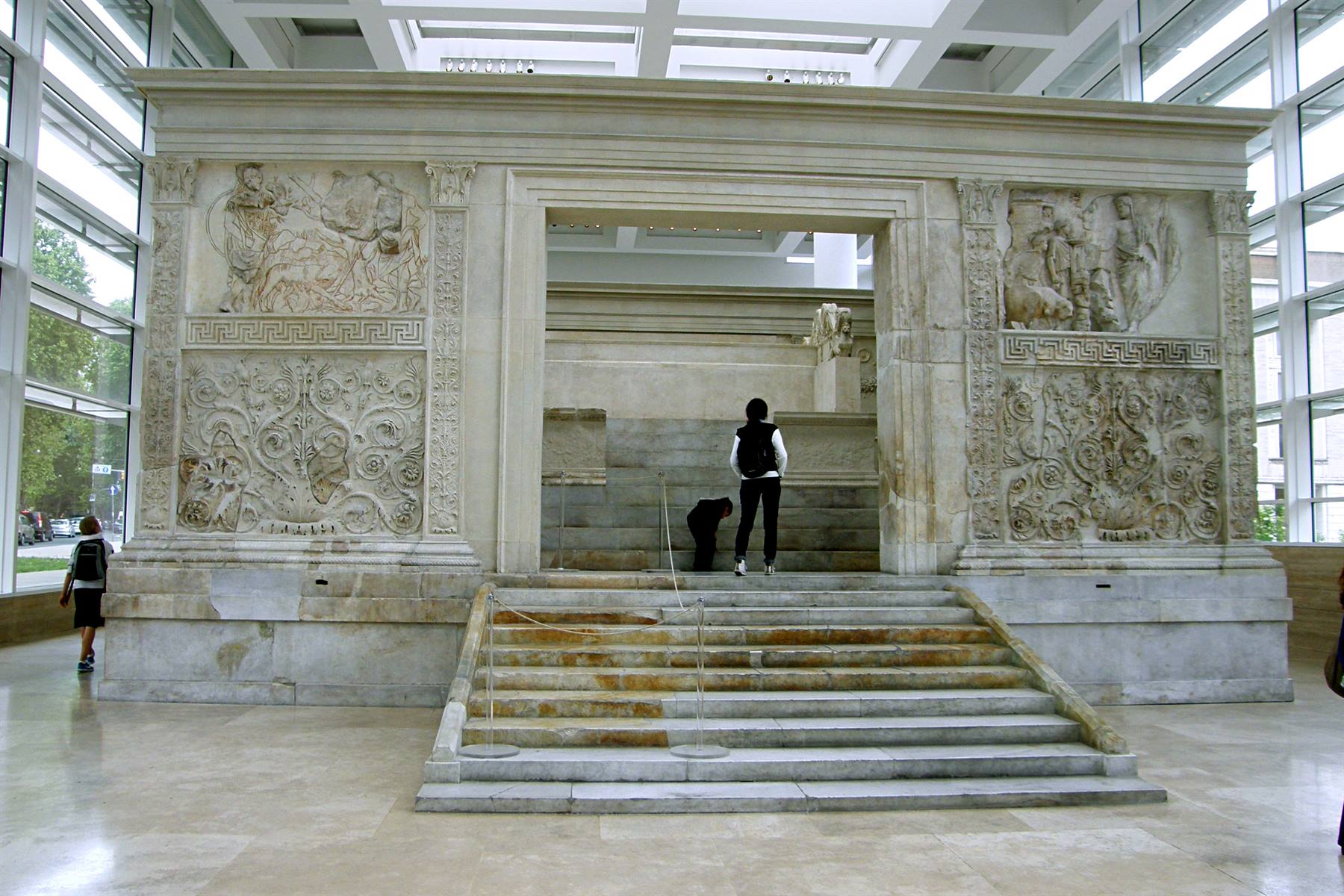
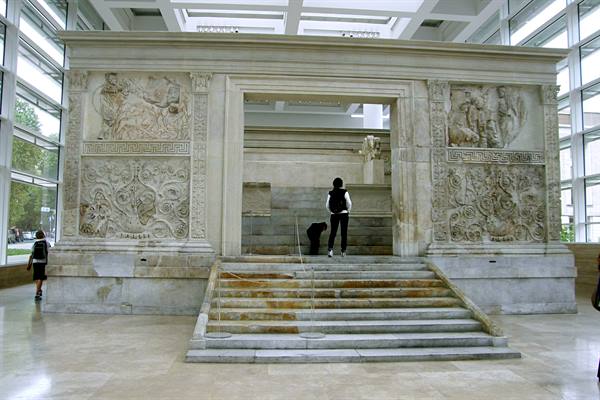
In the majestic space below, whose floor with geometric patterns is largely original from the imperial age, there are among other things the tombs of the Kings of Italy, Umberto I and Victor Emmanuel II, but also that of Raphael Sanzio, undisputed master of the Renaissance. Through secondary alleys we then reach the banks of the Tiber, near the Mausoleum of Augustus, from 27 BC, closed for restoration, and there we have lunch, as usual packed. Right after we dedicate ourselves to exploring the Museum of the Ara Pacis, an incredible monument commissioned by Augustus in 13 BC to celebrate peace after the conquest of Gaul and Spain, reassembled here after its transfer from the Campus Martius, where it was found in the sixteenth century.
Ara Pacis
Day 724 Apr 2016
(Part Two)
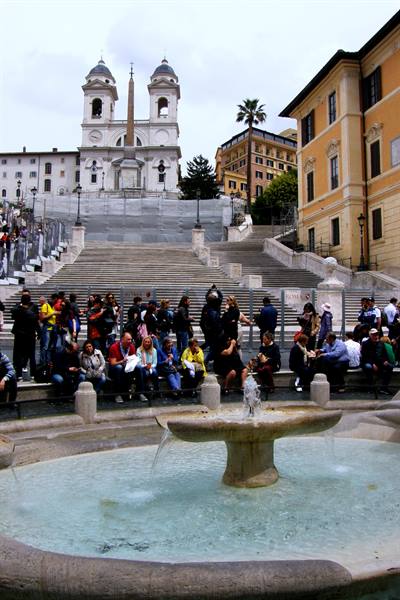
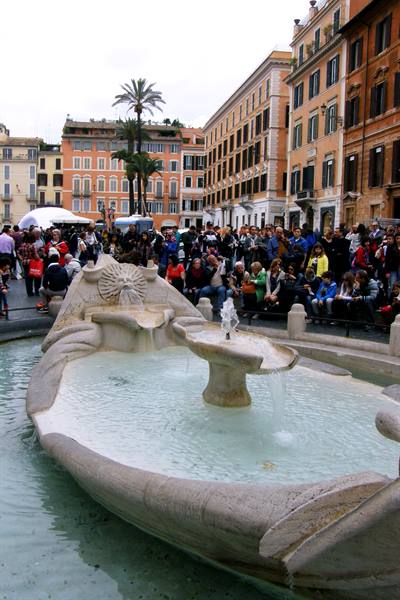
Having regained the open air we return toward Via del Corso and having gone back up the well-known Via Condotti (kingdom of high-end shopping) we approach Piazza di Spagna, according to many one of the most fascinating in the capital … always crowded, as today indeed, with in the center the Fountain of the Old Boat by Bernini and on the main side the staircase of Trinità dei Monti (currently under restoration). Following a specific path we nonetheless go back up the staircase, made famous by the many internationally renowned films that were shot here, and having reached the top we relax momentarily, while big clouds pass menacingly over our heads. After a while we set off again.
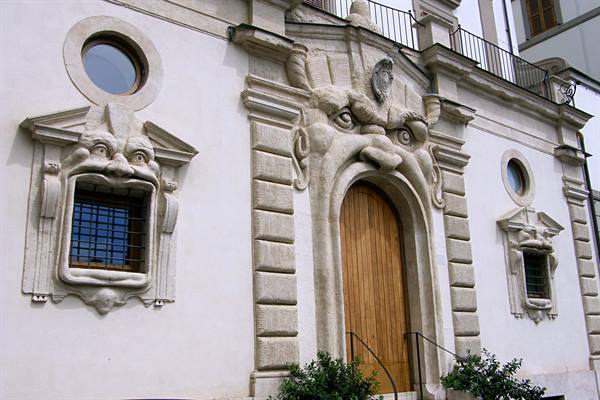
We stop to see, in the immediate vicinity, the curious façade of Palazzo Zuccari, a late-sixteenth-century construction characterized by a portal and windows in the guise of infernal masks, then on foot we reach Piazza Barberini, in whose center stands the Fountain of the Triton by Gian Lorenzo Bernini. In the adjacent Via Veneto, scene of the roaring nights of the '50s and of the "dolce vita", there is then the Church of St. Mary of the Conception … nothing special if it weren't for the Capuchin crypts, containing the macabre remains of about four thousand friars, artistically stacked to create fanciful chapels, rich in tibias, vertebrae and skulls, a little jump into the afterlife, before returning to Piazza Barberini and taking the metro to reach the next destination.
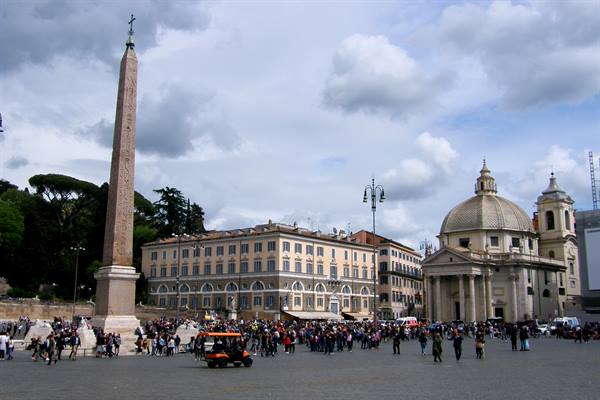
In this way we arrive at Piazza del Popolo, historic stage of events and popular performances of the capital, and we cross its perimeter through the Porta del Popolo, whose internal façade is a work by Bernini. In the center of this vast space stands the Flaminio Obelisk, the oldest in the City (1200 BC) after the Lateran one, while on the eastern side dominates the Pincio Terrace, a grandiose panoramic point which however we decide not to climb, given the backlight, but above all the not good weather conditions. To the south, however, at the entrance of Via del Corso, stand out the so-called twin churches: that of St. Mary of Montesanto and St. Mary of the Miracles, the latter under restoration and wrapped in scaffolding. To the north, beside the gate there is then the fifteenth-century Church of St.
Mary of the People, which we would be intent on visiting, but it will open its doors in more than an hour … so we beguile the time by taking a walk along Via Margutta, a place of artisan workshops and art galleries praised also by Luca Barbarossa, and along the fashionable Via del Corso. At 4:30 PM, finally, we can set foot in that treasure chest of precious works that is St. Mary of the People. As soon as we enter, on the right, we notice the splendid Della Rovere Chapel, which Pinturicchio also worked on, then, near the altar, here is the Cerasi Chapel, which houses two masterpieces by Caravaggio. Finally, on the left nave, we admire the Chigi Chapel, built on a design by Raphael in the 16th century. Having left the church full of amazement we rush to the nearby bus stop, so as to reach as soon as possible the Borghese Gallery and Museum, for which we have a reservation at 5:00 PM.
Villa Borghese is the largest of the Roman public parks and immersed in the green of its avenues is the Casino Borghese, which houses, indeed, the gallery and museum of the same name: one of the most prestigious art collections of the capital and of the world, begun in the seventeenth century by Cardinal Scipione Borghese. We arrive at the destination a few minutes after the established time, so we can comfortably take part in the visit … We begin from the ground floor, where the main masterpieces of sculptural art are gathered, especially by Gian Lorenzo Bernini, such as the Rape of Proserpina, Truth Unveiled by Time, Aeneas and Anchises and David with the Sling, but above all the group of Apollo and Daphne, rich in stunning details.
Extraordinary is also the work of Antonio Canova portraying Paolina Borghese, perhaps the most famous piece of the museum … all set in a wonderful setting, like the lavish Hall of the Emperors. Completing the roundup are some exceptional paintings by Caravaggio such as the Sick Bacchus and the Madonna of the Palafrenieri. On the first floor the pictorial works continue, among which stand out the Entombment of Christ and the Lady with a Unicorn by Raphael, the Pietà by Rubens and especially the Sacred and Profane Love by Titian. We leave the museum with our eyes still full of enchantment and despite the now late hour we go toward the last objective of the day.
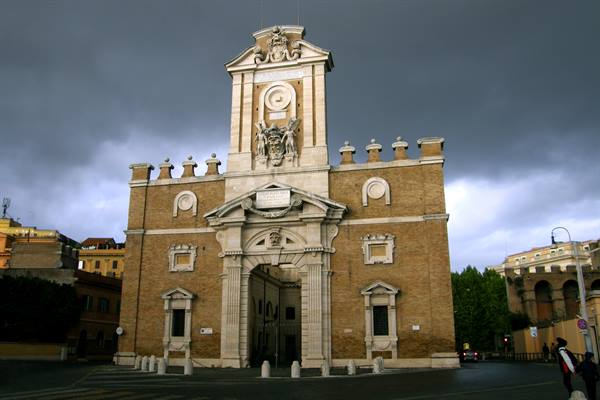
From Villa Borghese with the bus we reach Porta Pia, historic gateway in the Aurelian Walls near which, on September 20, 1870, the bersaglieri opened the famous breach bursting into the city to put an end to the temporal power of the Church and unite Rome with Italy. We immortalize the gate against the background of a leaden sky and then, with public transport, we regain Termini Station, from where the last bus of the day drops us in front of the LGP Roma rest area, putting an end also to this third act of visits to the capital … splendid, but perhaps a bit too characterized by the gray tones of the sky.
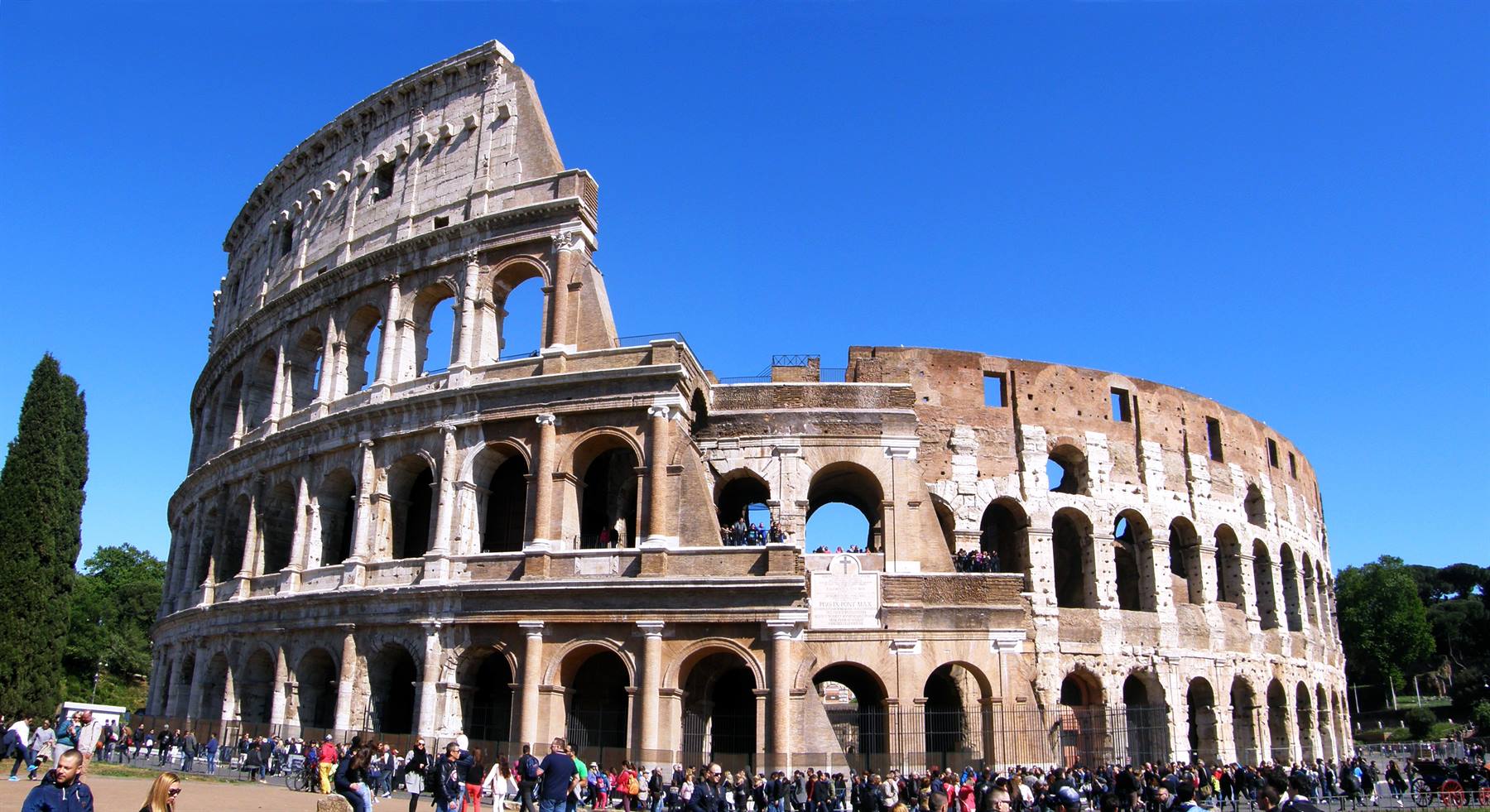
The Colosseum
Day 825 Apr 2016
(Part One)
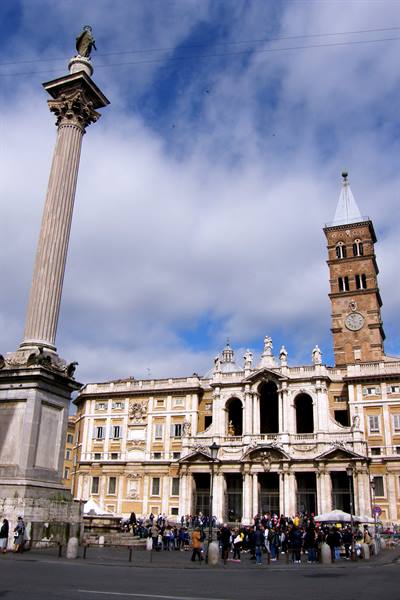
It rained heavily and assiduously again during the night and when day breaks it continues to do so, so we postpone a little the departure of this fourth and last day in the capital, but we don't despair because the forecast says the sun will come … Indeed the ticking of the drops on the camper roof first slows down, then stops. Consequently we get ready and already before 9:00 we're waiting for the Giardinetti train for the city center. At the terminus we get off and on foot we reach the nearby Church of St. Mary Major … Papal basilica and one of the main ones in Rome, founded according to tradition in the 4th century and several times redone and enlarged, until it assumed its current and monumental proportions. All this while the sun does come out in the open, but it's extremely cold and completely out of season.
We pass the security checks, then we visit the sumptuous interiors, of grandiose proportions, with three naves, which flow into the main altar surmounted by the precious thirteenth-century mosaics of the apse, while in the underlying Confession the nineteenth-century statue of Pius IX in prayer stands in front of the urn that contains the presumed relics of the cradle of Bethlehem. On the right nave then opens the splendid Sistine Chapel and in contrast, on the left one, the Pauline Chapel, both containing the tombs of some popes, which make them true treasure chests of Renaissance art. Having left St. Mary Major we enter almost immediately the nearby Basilica of St. Praxedes, magnificent theater of Byzantine works in the capital, starting from the extraordinary Chapel of St.
Zeno, with splendid gold-background mosaics dating back to the 11th century, ending with the equally precious mosaics that cover the main nave of the church. Back again in the open air we walk through the Monti district up to the Church of St. Peter in Chains, universally known as the container of the Mausoleum of Julius II: grandiose and tormented unfinished project of Michelangelo Buonarroti … By the great master is the sublime statue of Moses, which occupies the center of the scene, by whose anatomical perfection, according to legend, the sculptor himself was struck, who, it is said, struck one of its knees with his hammer accompanying it with the exclamation: "Why don't you speak!" … Indeed the work leaves us astonished and we remain before it, for a long time, in contemplation.
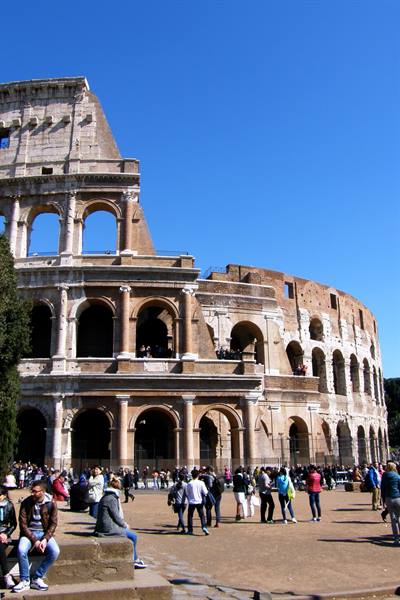
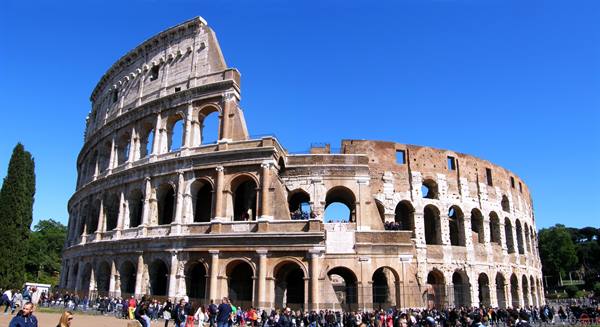
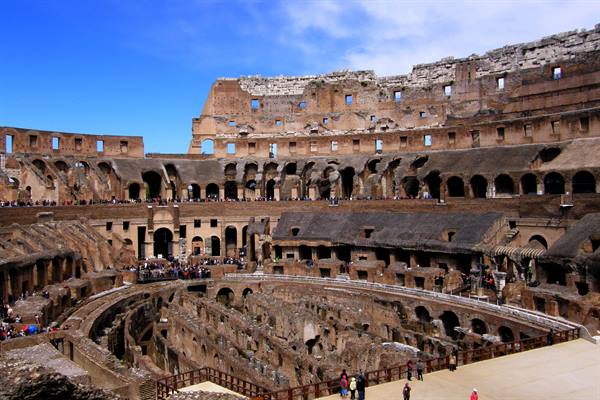
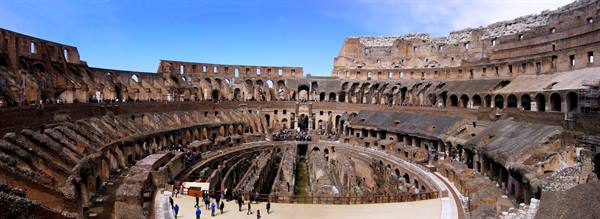
Afterwards we head toward the Colosseum, which certainly needs no introduction, with the sky rapidly clearing of clouds and with little Leo suffering from a foot, but nonetheless heroic, given his tender age … So we arrive before the monument symbol of Rome. The Colosseum, or Flavian Amphitheatre, was inaugurated in the 1st century AD and is the largest construction of Roman times that has come down to us, since it could hold over fifty thousand spectators.
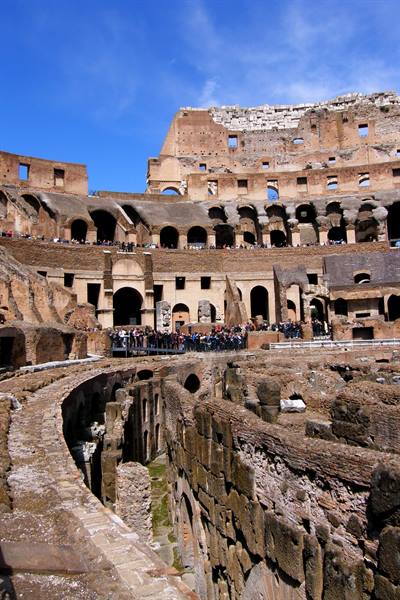
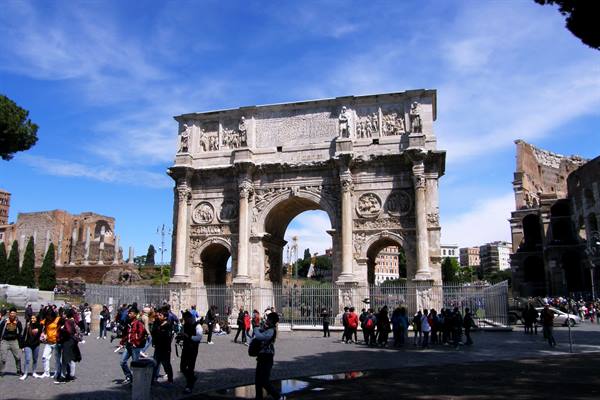
We get in line to enter and we fuss a bit despite the reservation made from home … then finally we can set foot inside the most famous arena in the world, where gladiators and fierce beasts challenged each other amid the shouts of the crowd, shouts that seem to still echo among the ancient walls, in an almost surreal atmosphere, despite the many tourists … But the sensation is brief, because time is a tyrant and we must rush, since an unpostponable appointment awaits us on the nearby Palatine Hill. Just outside the Colosseum we pass near the beautiful Arch of Constantine, erected by the emperor in 315, after his victory over Maxentius, which is in excellent state of preservation, thanks also to the fact of being the last, in chronological order, of the triumphal monuments of the classical age.
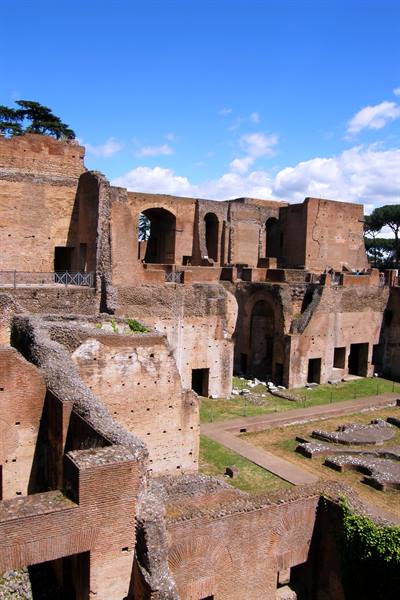
We immortalize the work and then we get in line to enter the most famous and suggestive archaeological area of Rome, which includes the Palatine Hill and the Roman Forum. Once we cross the gate we immediately go to the point set for our appointment and there, after various vicissitudes, we find waiting for us the person in charge of accompanying us to discover the Houses of Augustus and of Livia, in the heart of the Palatine, also called the Hill of the Emperors. We pass by the bare remains of the presumed House of Romulus (first king of Rome), then we immerse ourselves in a splendid experience back in time, setting foot in the dwelling that was of one of the greatest emperors of the City, which still presents inlaid polychrome floors, but above all splendid paintings of Pompeian style on the walls.
Right next to it then, in the House of Livia (wife of Augustus), we contemplate other extraordinary paintings, which have come down to us still intact in many details, despite their almost two thousand years of age. On the way out we independently complete the visit of the Palatine Hill, starting from the colossal remains of the Domus Flavia (the Imperial Palace) and of the Domus Augustana (the Imperial Residence), both commissioned by Domitian at the end of the 1st century AD, as well as the vast Palatine Stadium, which extends alongside the palaces.
Imperial Fora
Day 925 Apr 2016
(Part Two)
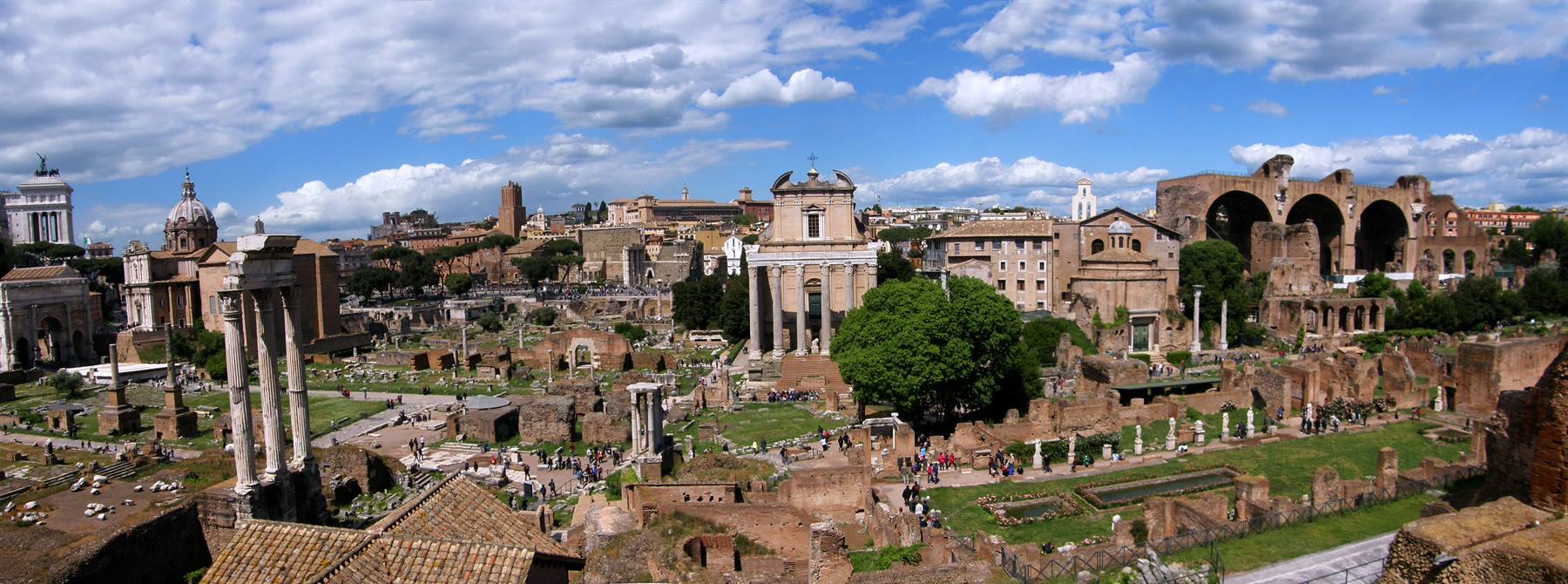
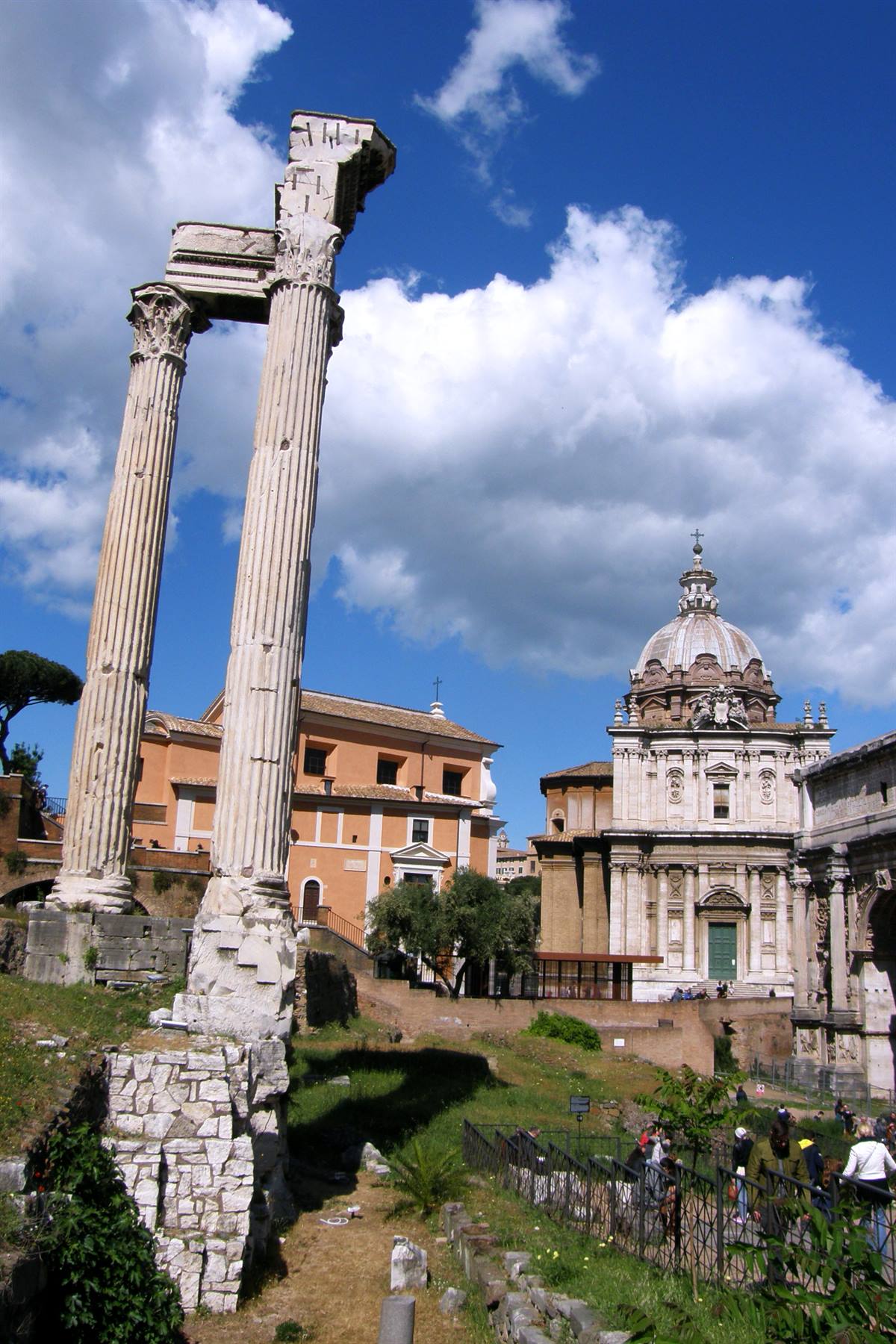
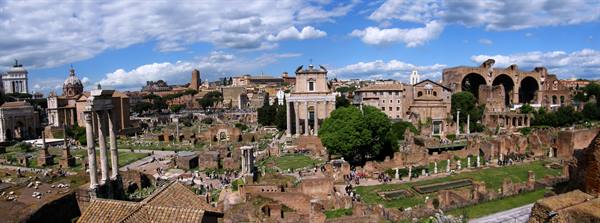
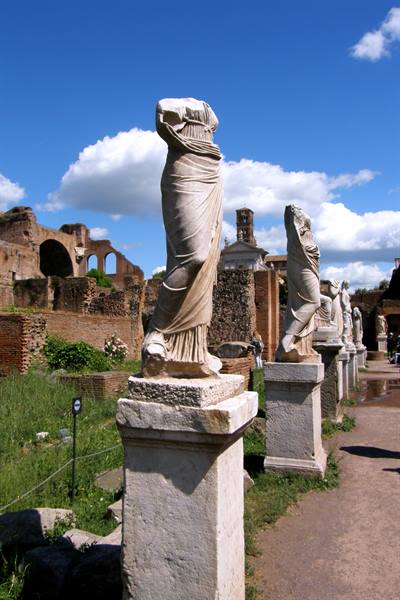
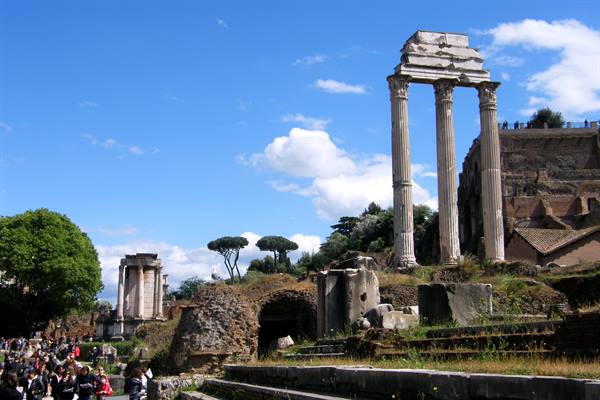
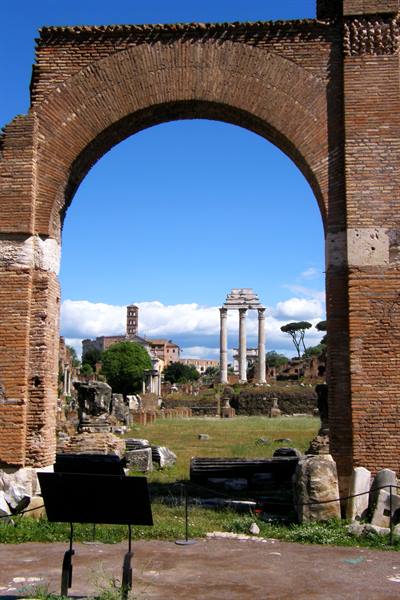
We have lunch as discreetly as possible inside the area and subsequently we resume its visit, dedicating ourselves to the Roman Forum, in its time fulcrum of urban life and seat of the political and administrative functions of imperial Rome. Passing through the courtyard of the House of the Vestals we thus admire the ruins of the Temples of Castor (or Dioscuri) and of Vesta, which present some suggestive surviving Corinthian columns, then we enter the surprising Church of St. Mary Antiqua, fresh from restorations and recently reopened to the public, which is the oldest place of Christian worship in the Forum and houses numerous wall paintings dating back to the 7th century.
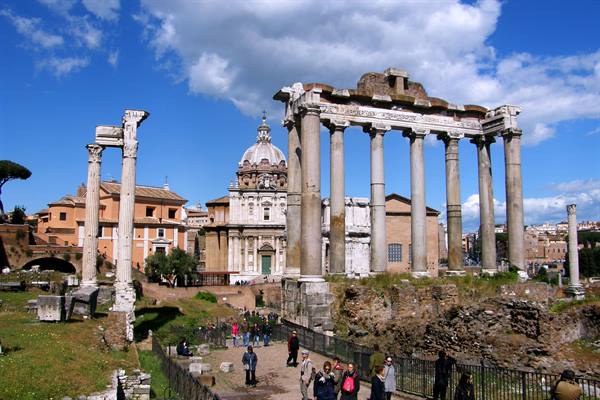
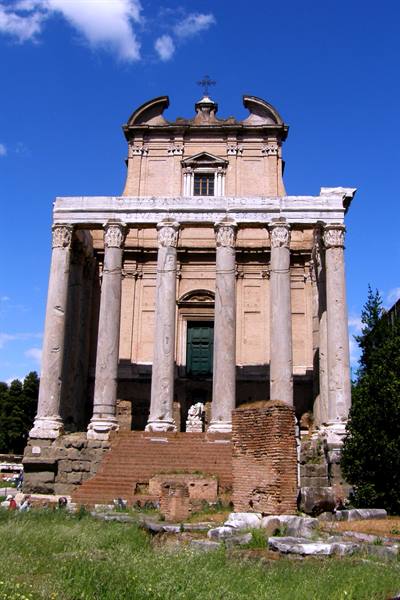
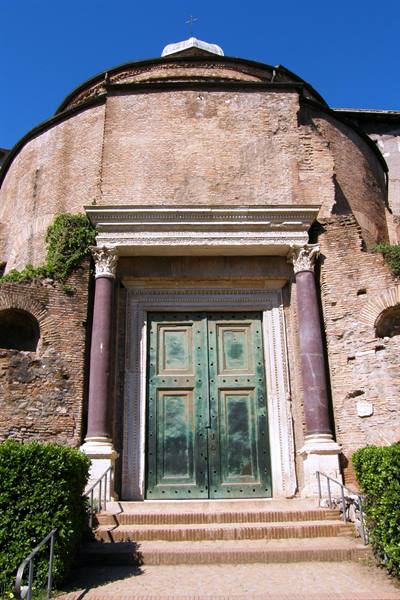
We then go back up the Via Sacra and arrive before the columns belonging to the Temples of Saturn and Vespasian, with beautiful views of the whole area and of the nearby Arch of Septimius Severus, erected in 203 to celebrate the ten years of the emperor's accession to the throne. We find closed the so-called Curia, the building within which the Roman senators gathered, then we observe the curious Temple of Antoninus and Faustina, among whose columns rises the Baroque façade of the Church of St. Lawrence in Miranda, after which we pay homage to the Temple of the Divine Romulus, in exceptional state of preservation, in whose bronze portal one of the oldest locks in the world is still perfectly functioning.
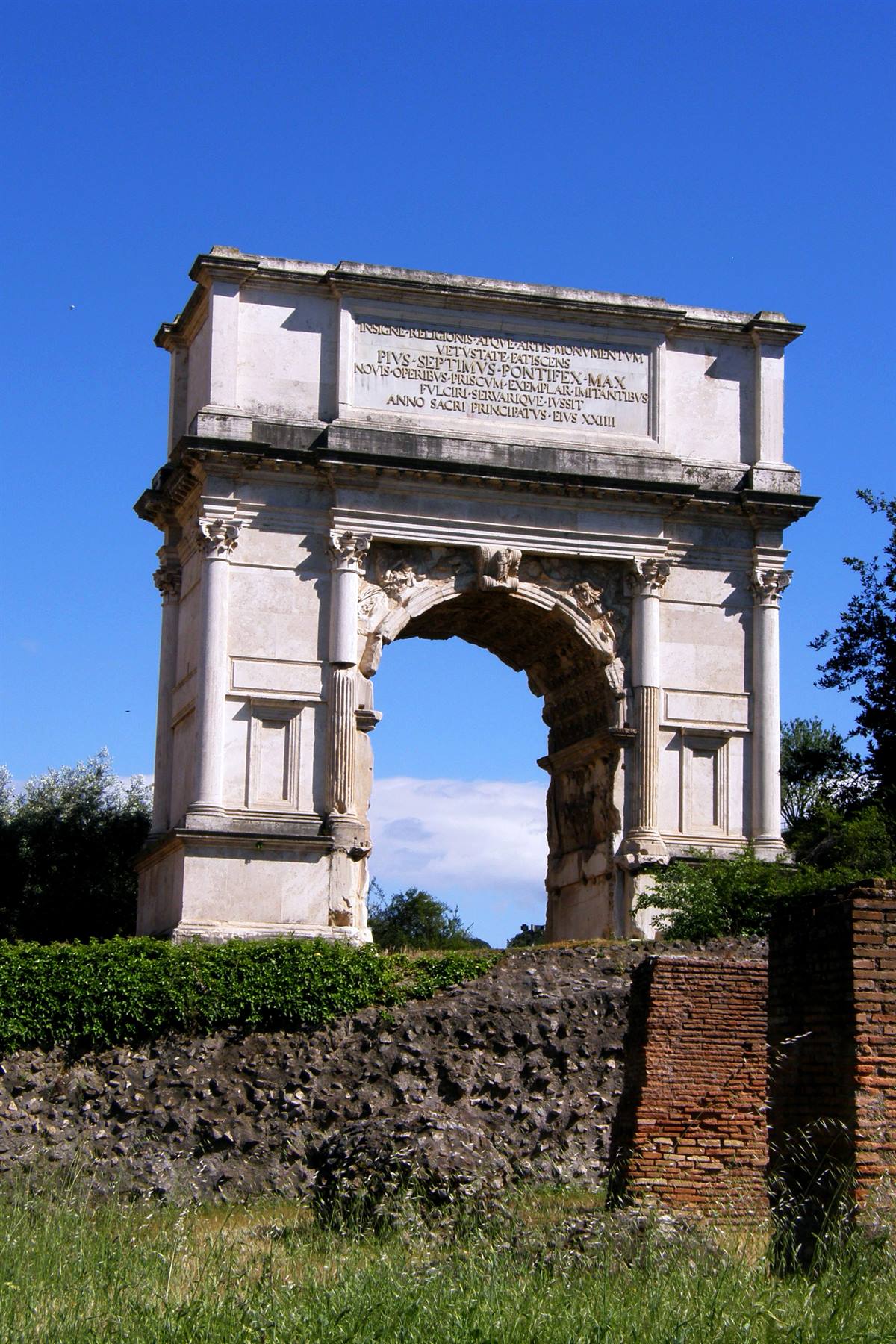
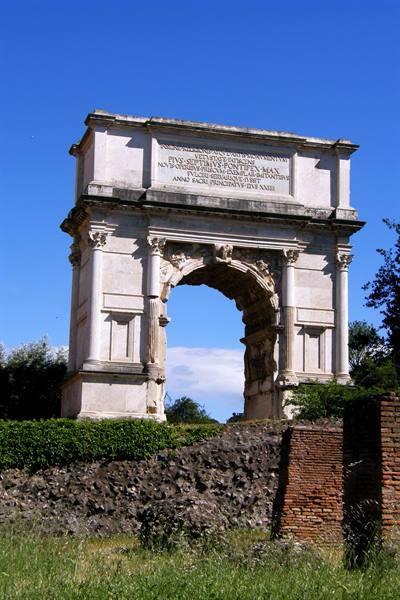
We finally reach the Arch of Titus, erected by Domitian in 81 AD in memory of the capture of Jerusalem, and leaving behind us also the imposing ruins of the Basilica of Maxentius we exit the archaeological area, which has literally amazed and conquered us, beyond every rosiest expectation. We pass again beside the Colosseum, so as to immortalize it in the right light, then we go along Via di San Gregorio to climb to the Caelian Hill and to the Basilica of St. John and Paul, under which is the site of the Roman Houses of the Caelian … a complex of about twenty underground rooms, part of a single domus dating back to the 3rd century. Some of these rooms are magnificently frescoed and are an important testimony of the era.
Fascinated we thus explore the place, within which, amid a thousand curses, I procure a new sprain, then, with yours truly still in pain, we return to the open air and resume the itinerary. Having found the right bus stop we reach the great Church of St. John Lateran, cathedral of Rome and papal basilica, which, several times and profoundly restored, rises on the ashes of a Constantinian basilica of the 3rd century AD. Before it we face a fair line at the metal detector and once inside we cannot however enjoy the vast and sumptuous interiors arranged by Borromini, because mass is underway.
We must then settle for returning outside and observing the grandiose façade, although now in shadow, and the nearby Obelisk of Tuthmosis, which dominates the adjacent square and is the tallest (47 meters) and oldest (15th century BC) in the capital, but also the nearby Lateran Baptistery, a fascinating octagonal building that rises alongside the basilica. At this point we've almost reached the end of the day, but we would still like to see the remains of the Baths of Caracalla, one of the most grandiose and impressive monuments of ancient Rome, dating back to the 3rd century AD, which has preserved the mighty wall structures up to a considerable height. The archaeological site is relatively a short distance from St.
John Lateran and so we wait for the designated bus … which however arrives later than expected and when it does there's no longer time to arrive before closing, scheduled for 6:15 PM. We then change objective and aim for the camper rest area, which we regain well ahead of schedule. In this way concludes our exploration of Rome … unforgettable and stupendous, from every point of view, apart perhaps from the not perfect weather conditions which, particularly today, upsetting our plans a bit, made us miss besides the Baths of Caracalla also a quick visit to the famous catacombs of the Appian Way. Tomorrow anyway we will leave the capital, but we won't immediately take the road home, because the vacation, for us, is not yet at an end …
Imperial Fora
Day 1026 Apr 2016
We wake up after a rather cold night, considering the time of year, while in the sky there are many clouds, but also some patches of clear. We settle the bill of the rest area and shortly after 8:00 we're already departing … We leave Rome behind us and after a bit of traffic on the Grande Raccordo Anulare we take the direction of Tivoli, a town we would be intent on visiting before taking the road home.
A little after 9:00 we leave the camper in a parking lot on the banks of the Aniene river and from there we start the dance … First objective the famous Villa d'Este, according to Unesco "one of the excellent examples of Renaissance culture" … but incredibly we find it closed! … The usual Italian mess: it would be closed on Mondays (and already this is not acceptable), but since yesterday was Monday but also a public holiday it was open, so it's closed on Tuesday … a footnote that perhaps was written somewhere on the website, but in reality a real rip-off for tourists, because there were many of us waiting outside the door, including a small group of Americans, who even crossed the Atlantic to see it and now find it closed! … A well-deserved, Italian embarrassment! A little, indeed, very annoyed we leave.
We cross the historic center and return to the banks of the Aniene to go visit the park of Villa Gregoriana, this one yes open, but from 10:00 (let's not strain ourselves too much though!), which develops along the cliff into which the waters of the river pour, roaring. We descend into the gorge while the sky is gray and gloomy so much so that, if it weren't for the fresh and fleshy leaves of the trees, it would seem more November than April.
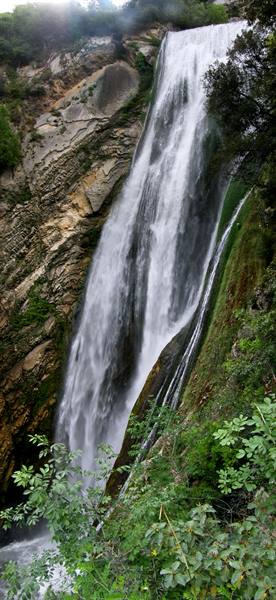
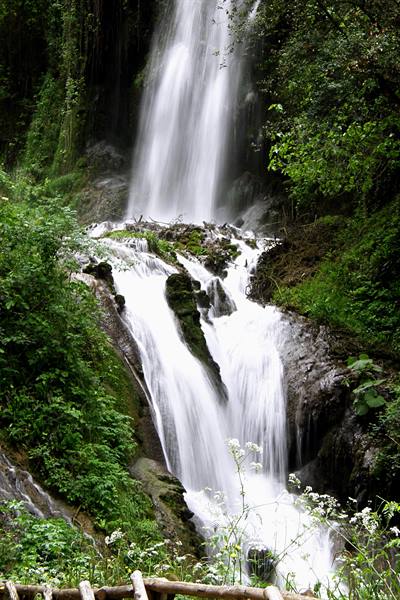
Despite everything we take a nice walk, enjoying the views of the Great Waterfall of the Aniene, an artificial drop of 160 meters commissioned by Pope Gregory XVI in the nineteenth century to harness the river and avert devastating floods, and of the so-called Valley of Hell, the original and impervious course of the Aniene, which insinuates itself into a series of suggestive natural ravines, then we re-emerge near the Roman temples of Vesta and Tiburnus, dating back to the 2nd century BC and testimony to the historical importance of the area. Almost at noon we return to the camper and right after we set off to move a handful of kilometers to the archaeological site (placed under Unesco protection) of Villa Adriana.
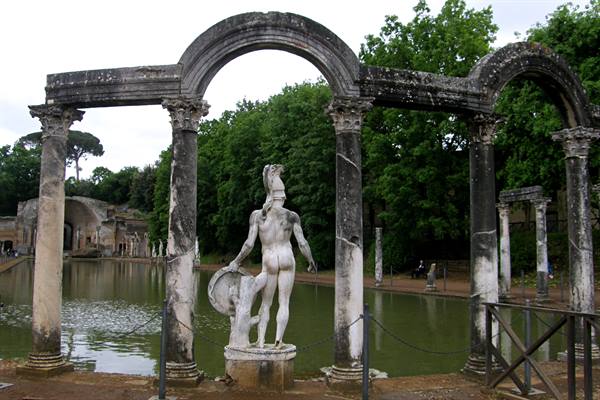
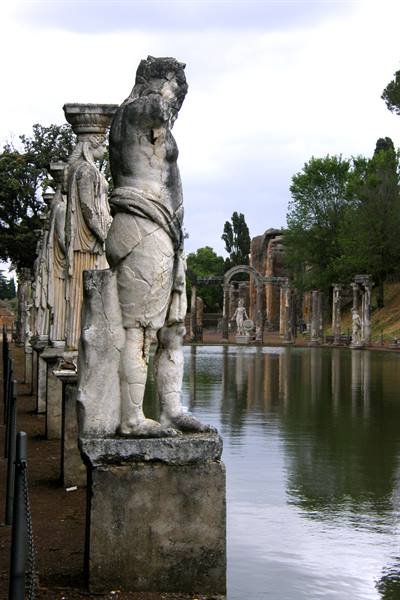
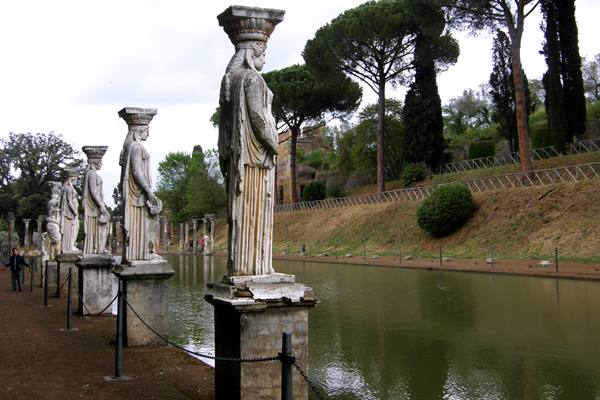
In the parking lot we have lunch, while it also starts to rain … then it stops, so we decide to undertake the visit of the place, although, irremediably, in the most absolute grayness. The villa in its time (2nd century AD) was grandiose, indeed, the emperor Hadrian had built in this place the largest of all the villas of antiquity, spread over about one hundred twenty hectares of surface … Today its noble ruins are therefore scattered over a vast territory, but this is not a problem. However, as often happens, there is a but: one of the most interesting areas, the so-called Maritime Theater, is closed for restoration and it's not even known when it will reopen, then, here and there, there are barriers and access bans, while several explanatory signs are worn and illegible.
We wander for a while among the ancient stones up to the Canopus, perhaps the most intriguing part of the site, but the adjacent museum, naturally, is closed … so we return toward the exit and put an end to this last, inglorious, day of vacation. At 3:30 PM we set off toward home and, almost with chronometric coincidence, an hour later we're at Orte, where we then take the E45 north. After another hour we then transit near Perugia and slightly ahead of the third turn of the clock hands (at 6:20 PM) we cross the Verghereto Pass and return to Romagna.
At 7:00 PM sharp we enter the A14 at Cesena and, after carrying out some service operations, at 7:36 PM we happily conclude the journey … A beautiful journey naturally, because Rome, first metropolis in the path of humanity, with almost three millennia of history on its shoulders, always lived as a protagonist, is and will always be the Eternal City, but also the inimitable Caput Mundi … and will never disappoint any traveler!
0 reader comments