Day 122 Apr 2015
By Luca, Sabrina and Leonardo
This year too, during the spring long weekends, we decide to take a little trip, so our day begins very early: at 3:30 the alarm goes off and at 4:00 sharp, in complete darkness, we're ready to set off for this new experience. We leave home with a touch of regret: this will in fact be, after many years, the first trip without our older son, Federico, who preferred to stay home in view of his upcoming high school final exam. We three survivors, instead, will return to the African continent to visit Sal and Boavista, two islands of Cape Verde, a tiny republic that became independent from Portugal in 1975, located six hundred kilometers off Dakar (in Senegal) and made up of seven other inhabited sisters and some rocks, or pseudo such, scattered in the Atlantic Ocean.
A quarter of an hour after departure we get on the highway at Faenza and at 4:45 we're at the Park to Fly in Bologna to leave the car... so at 5:00 sharp we pass through the doors of the Marconi airport. We immediately face the line at check-in and check in our luggage, then, having had an early breakfast, we pass the security and customs checks and wait for our flight at gate 24. While dawn is breaking, shortly before 7:00, the boarding operations begin and right on time, at 7:28, the Boeing 737-800 of the charter airline Neos takes off (identified as flight NO 3830)... but soon it begins to descend, because a stop in Rome Fiumicino awaits us. We land at the capital's airport at 8:02, change crew, fill up with fuel, load the Roman passengers and take off again at 9:40.
While we're about to cross the Mediterranean I set my watch back three hours, to the Cape Verde time zone, then we fly over the Iberian peninsula and gain the Atlantic Ocean... So flying parallel to the western coasts of Africa and passing over the Canary archipelago (well known to us), at 12:56 local time we land on the island of Boavista, third in order of size of the state, with its 620 square kilometers,
The night passed fairly peacefully, though the jet lag woke us all up quite early … Leonardo looks a bit better, but he also has a slight fever, so the long-hoped-for miracle hasn't happened, but the situation seems less serious than expected. While there are lots of clouds in the sky, we go to have breakfast, and at that point we decide to ask the excursions manager to contact the cancelled pickup again, because we intend to go on the planned trip.
Once we get the hoped-for green light, we give the little one a good dose of Tachipirina, and shortly before 10:00 we set off, just outside the Marine Club, in the pickup driven by Eliseu, a forty-something Cape Verdean who quickly tells us his life story, which seems taken from a Brazilian soap opera: the youngest of twenty-four siblings (both on his father's and mother's side), he in turn has five children with three different women, but he doesn't live with any of them because for a while now he's been living back with his mother … With him we first pass through the centre of Sal Rei, the capital and "metropolis" of the island, with its roughly five thousand inhabitants, which in the nineteenth century was also the most important city in Cape Verde from an economic standpoint, before its decline in the last century.
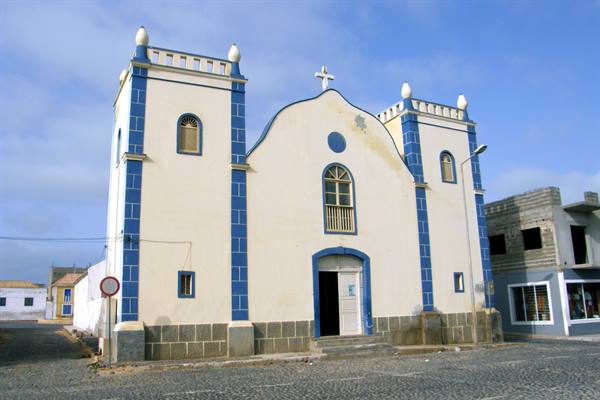
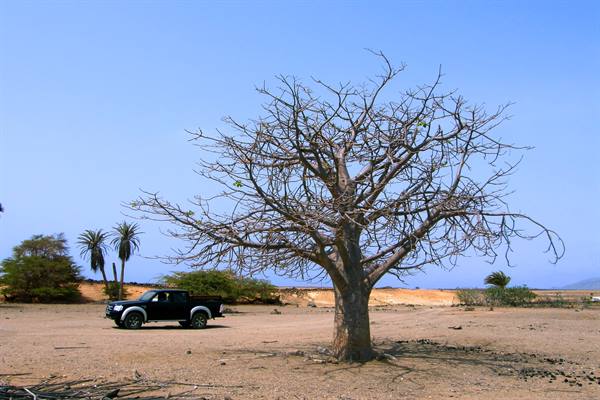
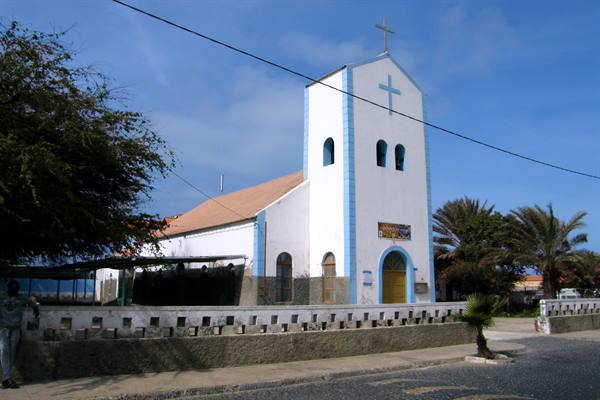
From those times, some dilapidated dwellings remain, along with the characteristic and colourful Igreja de Santa Isabel, from 1857, which faces onto the vast square of the same name. Today, however, thanks to tourism, Sal Rei is experiencing a new season of prosperity, which promises a better future for its citizens. From the capital we then head south. We pass near the airport, and reach the settlement of Rabil, which was itself once the capital, before Sal Rei became it in 1810. From there, shortly after, we leave the paved road and begin following a track that ventures into an arid and dusty landscape. With the clouds in this part of the island seeming to have vanished, after a while we arrive at the oasis of Santo Tirso, where there are some palm trees, a small baobab, and a few other shrubs, but there isn't a living soul, apart from a few goats.
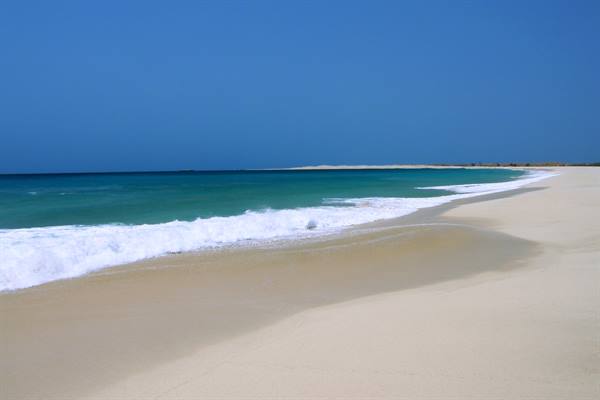
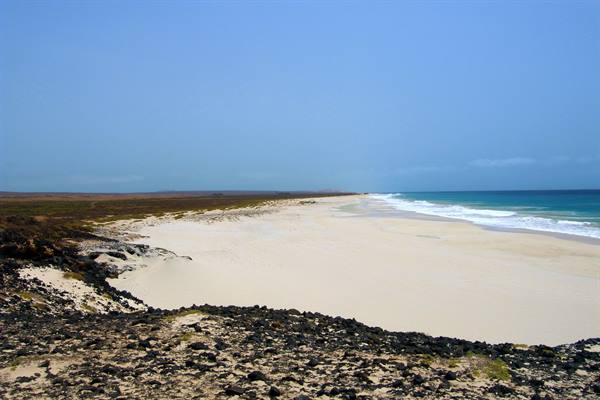
From here we continue through immense rocky expanses and approach the sea at the abandoned village of Curral Velho, where families of shepherds once lived (curral, pen; velho, old). Directly in front of the ruined houses stretches the wide beach of the same name, of blinding white sand, washed by a beautiful sea, unfortunately furrowed by big waves … So we take a few evocative photos and then resume our itinerary, which now pushes along the wild eastern coast of Boavista. Skirting a wetland close to the dunes, we come into view also of the intriguing and vast Praia de Joao Barrosa, then of that of Ervatao, where between June and October numerous sea turtles come to nest.
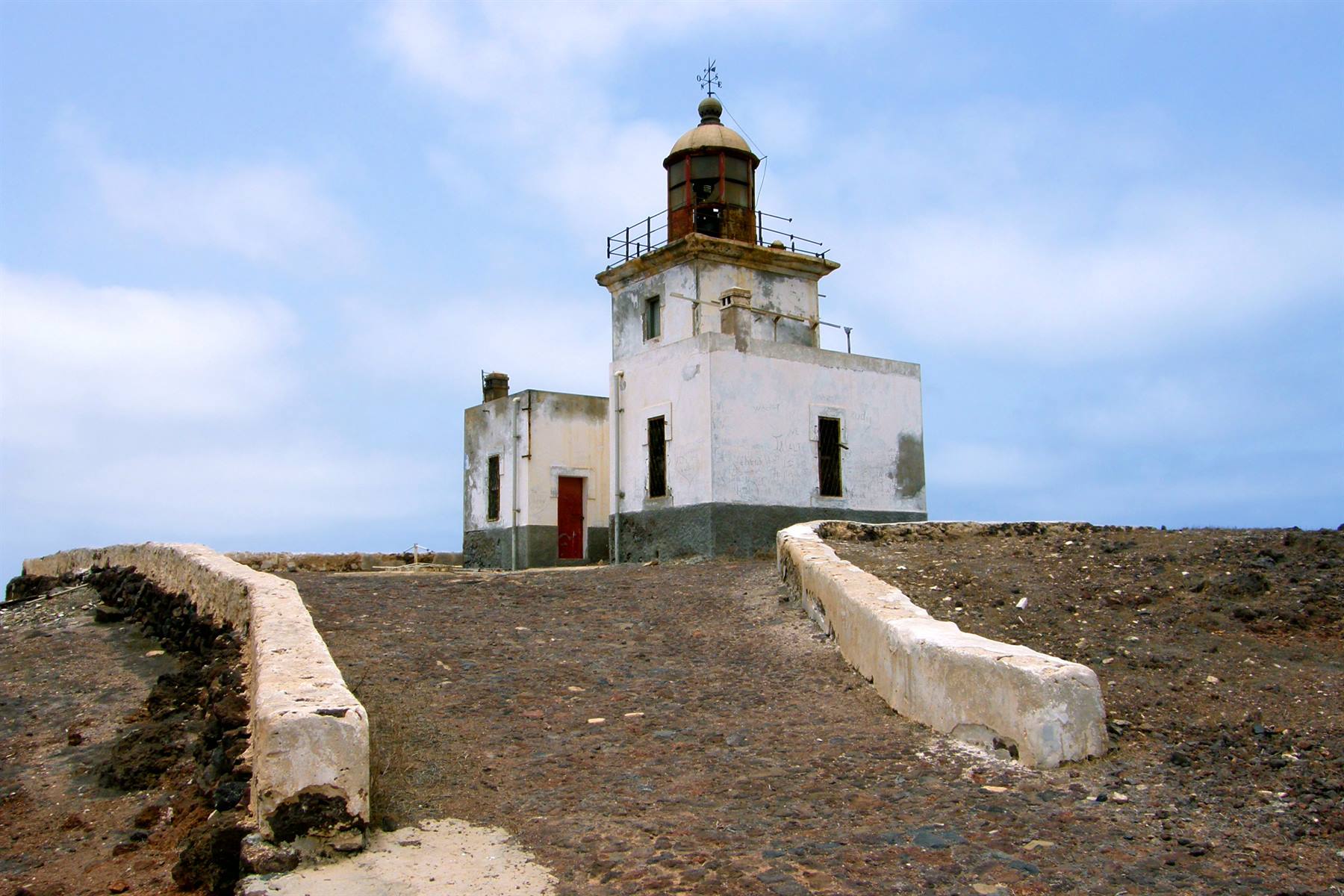
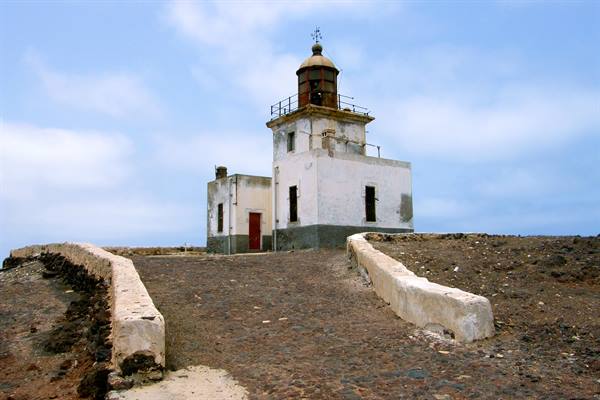
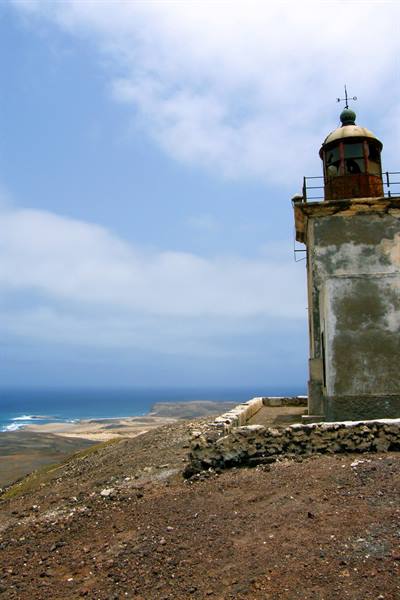
From Ervatao we head back a little inland and follow a well-marked track, with arrows and stones painted white, which forms part of the route of the Ultra-marathon, a famous running event a full 150 kilometres long that takes place every year on the island and in whose last edition the Italian Ivan Zufferli triumphed. In this way we reach the base of Morro Negro, a dark hill of basaltic rock that is the easternmost point of the entire archipelago, and therefore the closest to the African continent. On foot we climb to the top (154 metres), where there is a lighthouse (built in 1931) now disused, from whose platform one enjoys a magnificent panorama, over the coast and the desert landscape behind. Back in the pickup, from Morro Negro we cover one last stretch of dirt road and find, so to speak, civilisation again in the tiny village of Cabeça dos Tafares.
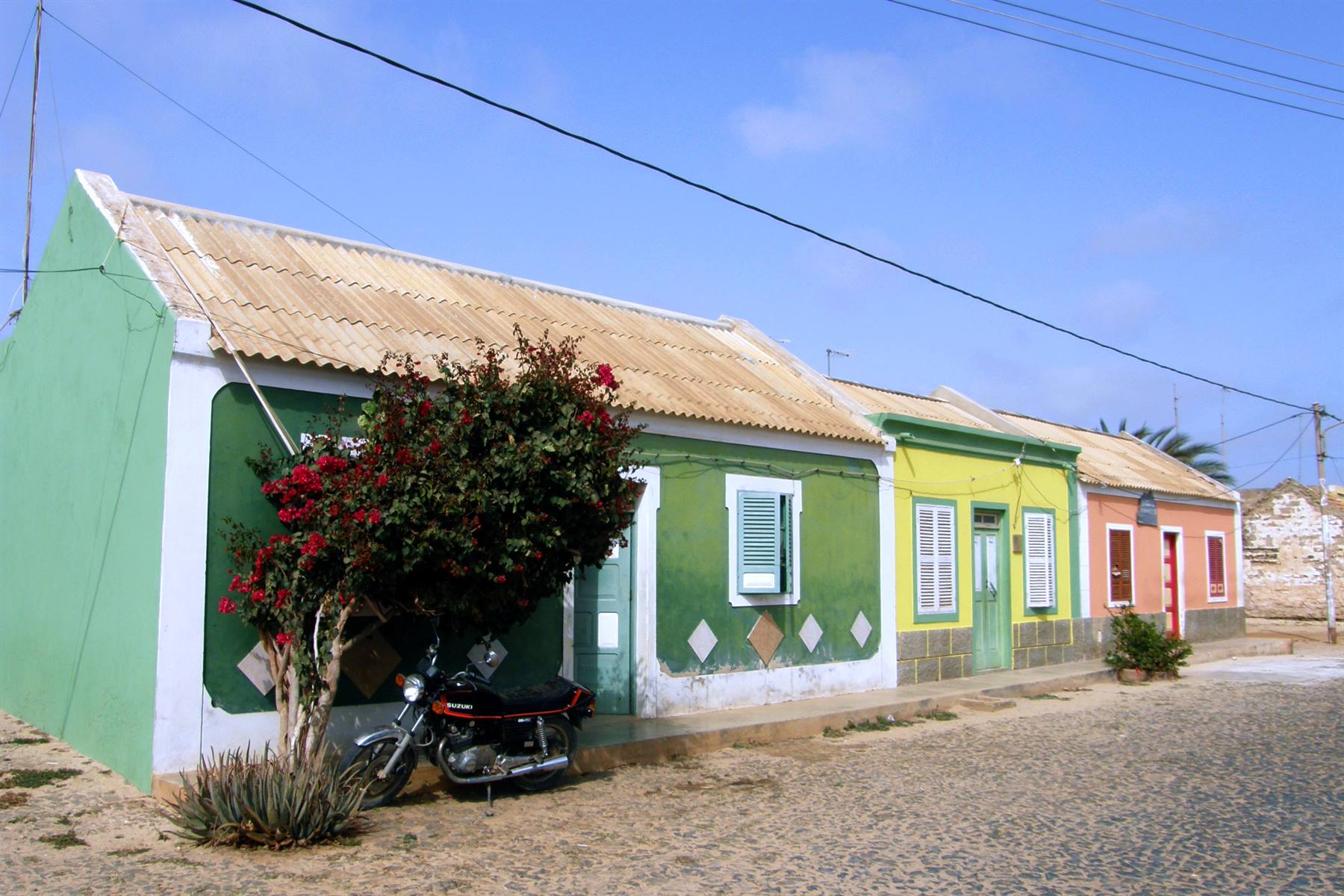
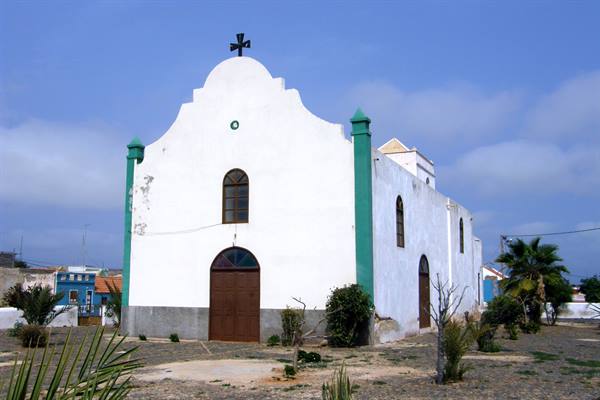
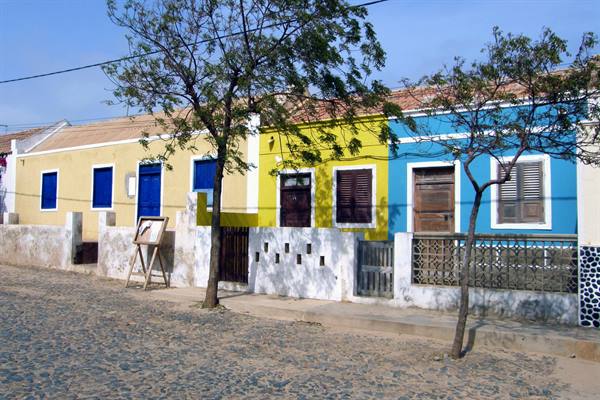
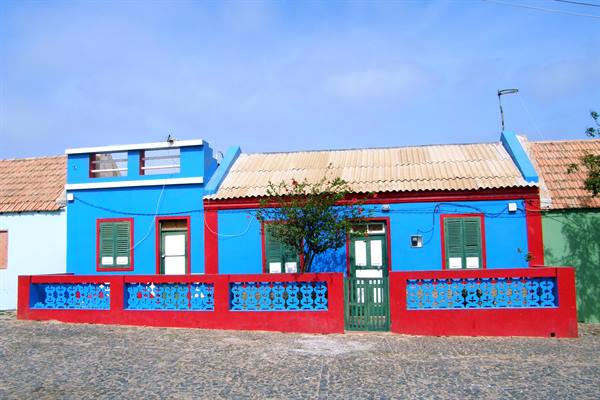
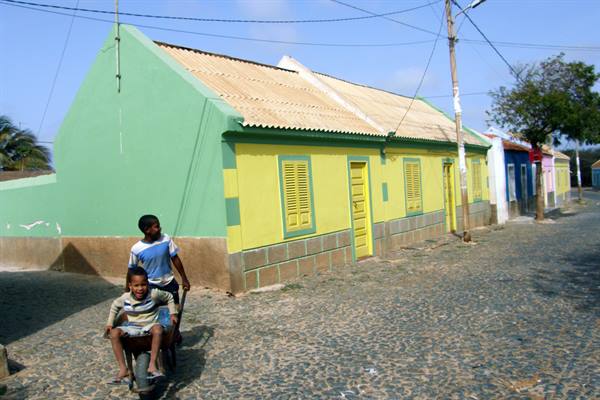
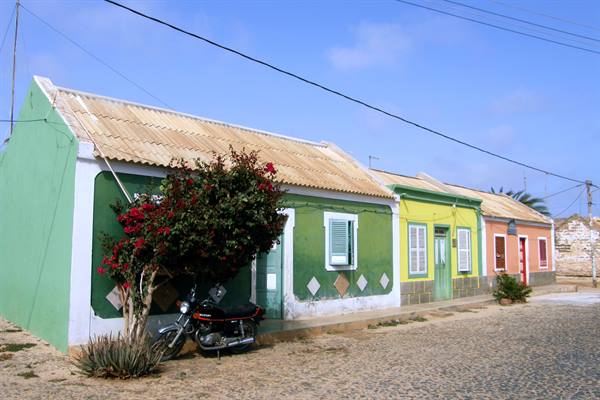
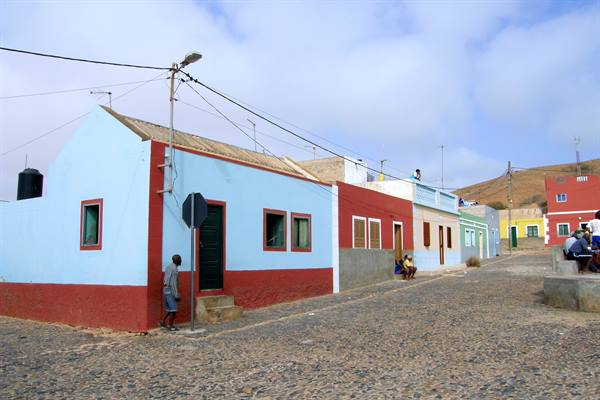
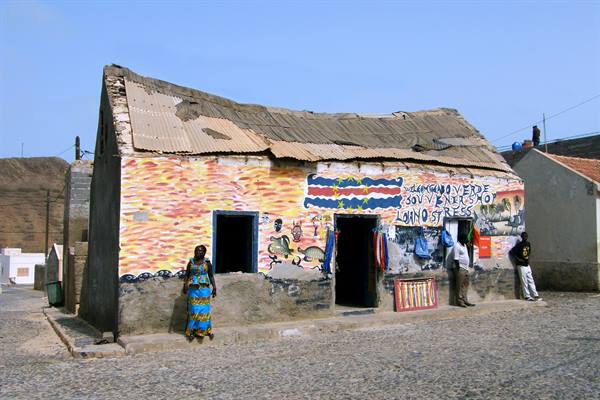
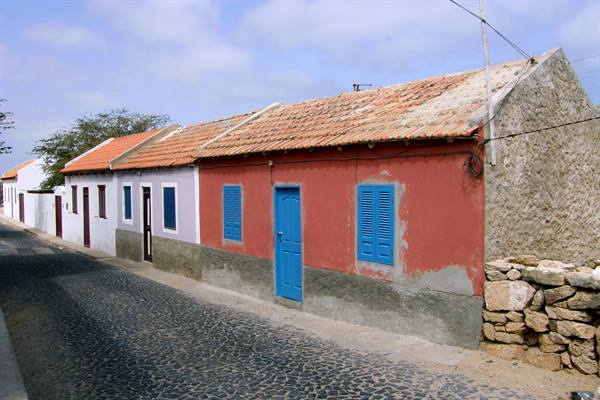
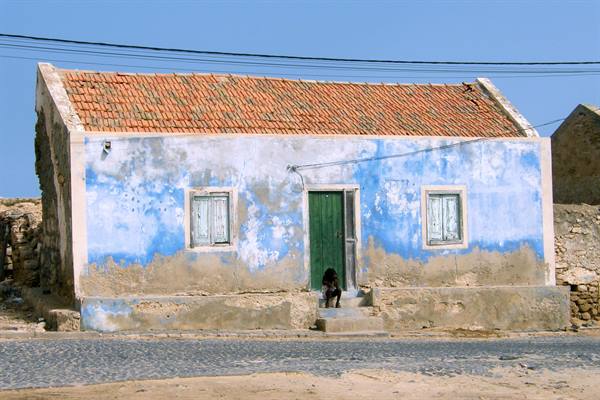
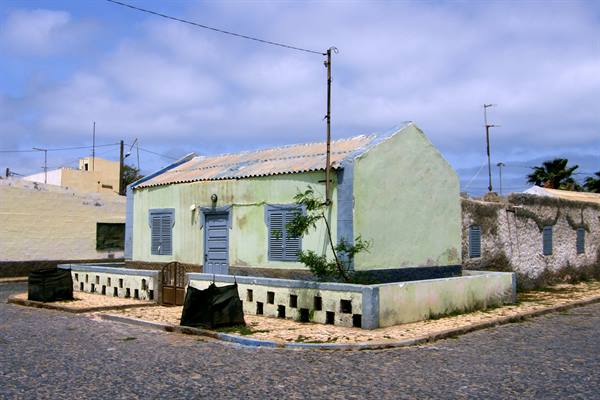
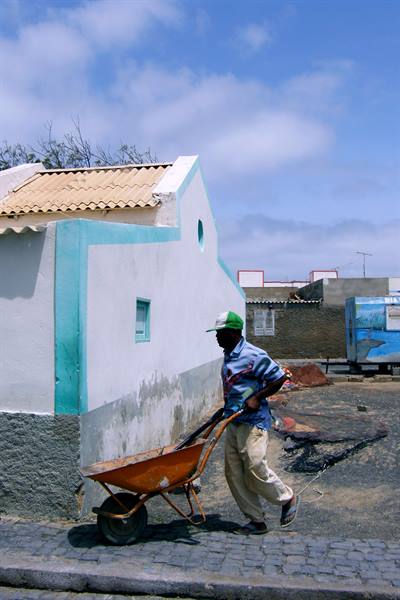
The little village, together with two others nearby, is in practice a neighbourhood of the community of Norte, which inhabits this part of the island, perhaps the richest in water judging by the presence of a few cultivated fields and several palm trees. After just a few kilometres we in fact arrive at the second village in the series, Fundo das Figueiras: the most important and also the most picturesque, dotted with traditional little houses painted in bright colours, plus the beautiful Catholic parish church, built between 1850 and 1870 and dedicated to Saint John the Baptist. In Fundo das Figueiras, given the hour, Eliseu takes us for lunch at the Reencontro restaurant, a typical eatery where Tina, the owner, prepares excellent meat and fish dishes for us, accompanied by a good wine produced on the nearby island of Fogo.
Suitably refuelled, we take a short stroll around the village and then hit the road again, stopping a few minutes later at the third village in the series, that of Joao Galego, also characterised by beautiful colourful houses and glimpses of Cape Verdean daily life. While Leonardo shows the first signs of flagging, with the fever probably coming back with a vengeance, we also pass through the village of Bofareira, now in the far north of the island, where a little square stands out, bordered by buildings constructed in the most classic local Creole architecture, then before 17:00 we are back at the Marine Club, aware of having had a beautiful experience.
We go straight to the room, where we confirm the return of the high fever for the little one, so to be safe we take him to be seen by the resort doctor, who reassures us, diagnosing a simple virus, which will probably run its natural course … So we resort to "holy Tachipirina" … and a little later the child is back in form for dinner. Thus ends a troubled day, which was supposed to be awful, but which in reality turned out to be a pleasant surprise …
The jet lag, not yet shaken off by the little one, wakes us up quite early again. I pull back the curtain and before my eyes is a grey sky and a wind already blowing hard … not exactly the ideal day for an excursion mostly of beach and sea, like the one waiting for us in a couple of hours. We get up slowly, then at 8:00, with Leonardo, we make another stop at the Marine Club clinic, where another doctor confirms yesterday evening's diagnosis, so shortly after we give him the necessary dose of Tachipirina and get ready to set off for the excursion that will take us to the south-west of the island. Together with other tourists we climb into two pickups (among them also the one driven by Eliseu) and hit the road. Although Boavista is rather limited in size in its southernmost part, the weather is always better, as our faithful driver also said yesterday.
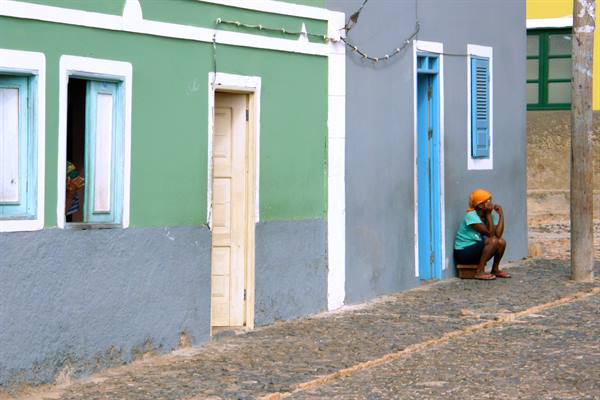
In fact the clouds are sparser as we pass through the settlement of Rabil, and a few minutes later the sun is even shining when we reach the village of Povoação Velha, which translates as "old settlement" … Indeed it is the oldest village on the island, founded around 1720, in this secluded position far from the coast so as not to be spotted by pirates. We briefly visit the little village, with its typical little houses, starting from the square, dedicated to Saint Anthony, to reach the pretty Igreja Nossa Senhora da Conceição, located on a hill south of the settlement. Right near the church begins the dirt road that leads to Praia de Santa Monica, the most beautiful and famous in Boavista and, according to many, among the most scenic in the world.
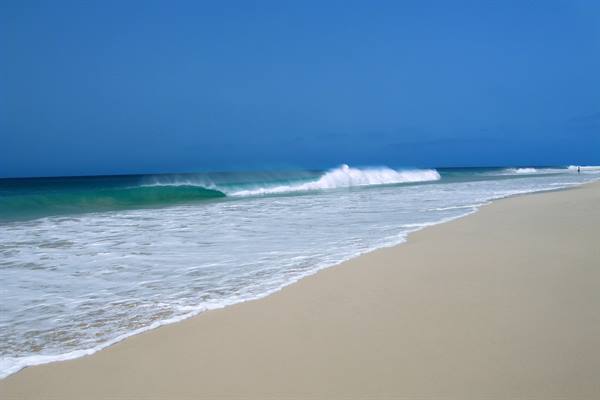
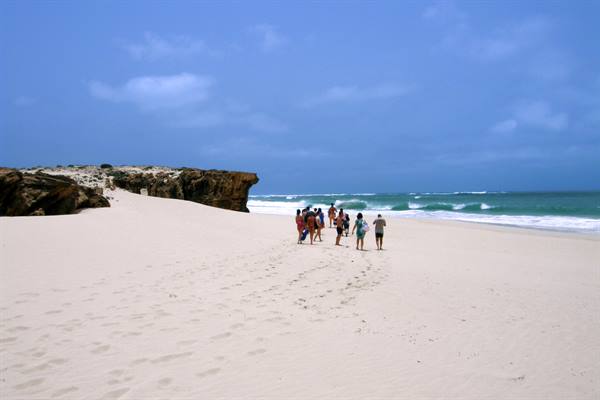
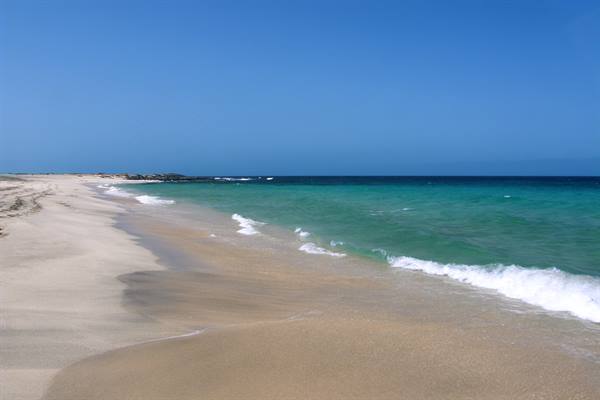
After several kilometres of a track that is at times quite uneven, we come into view of the beach: a very long strip of white sand, stretching for 18 kilometres, washed by a beautiful sea, which however is normally rough … indeed, today very rough. The place is truly evocative, characterised by boundless wind-swept spaces, so we treat ourselves to a long walk along the water's edge, with the soundtrack of the waves crashing noisily on the shore … and in this way we literally savour Praia de Santa Monica … Then, a few moments before leaving, the icing on the cake: in the waters offshore, a few hundred metres out from the beach, we notice a few characteristic water spouts, then a black tail emerging among the waves, and finally a magnificent leap of an unmistakable whale! ….
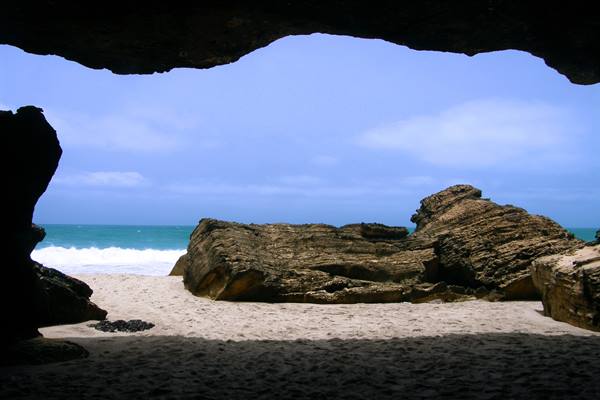
Wonderful, indeed, spine-tingling! Full of satisfaction we climb back into the pickups and, following bumpy tracks, head further north along the coast, to conquer, shortly after midday, also Praia Varandinha: another jewel set in the wild coastline of this part of the island. A soft expanse of candid white sand slopes down to the restless Cape Verdean sea, while on the cliffs behind, hollowed out by the surf, there are some caves, inside which we settle to eat our packed lunch. Having satisfied our palates, we laze a bit and relax in the sun of Praia Varandinha until, in the early afternoon, we resume our tour of Boavista. We return to the village of Povoação Velha and from there, along another track, to Rabil, to go to the bay in front of it: Praia da Chave, heavily exploited for tourism, but with some wild corners still left.
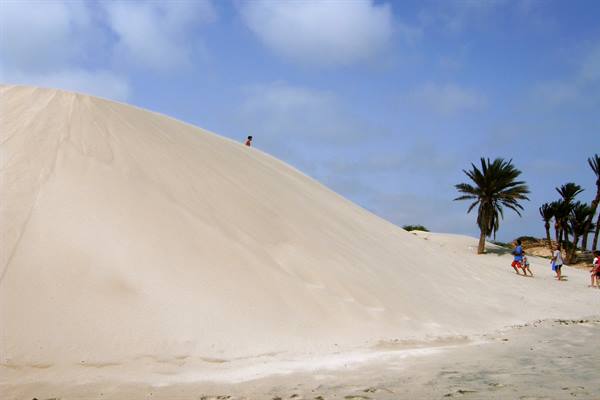
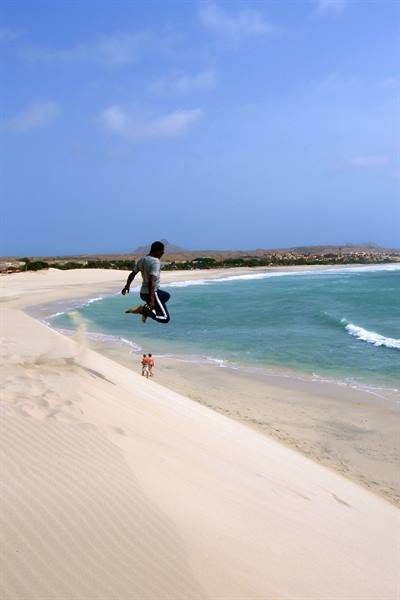
Near an old late-nineteenth-century kiln, of which practically only the classic chimney remains, there are some large dunes, of soft and very fine sand, stretching out to the ocean … There we spend a few more pleasant moments, jumping and rolling down the big piles of sand, until we are called back to order to take our seats in the pickups and return to the Marine Club. It isn't evening yet, so we go a bit to the village beach … or at least, we try, since here in the north there are still lots of clouds … In fact, it's also cold, and we soon take refuge in the room, where we also note, right on cue, the return of Leonardo's fever.
We give the little one the usual treatments and later go to dinner, where we meet two Italians who have been living in Cape Verde for nine years, who complain about the current cold, which they say they've never had … a cold that unfortunately is somewhat affecting the holiday in the tropics … but what tropics?
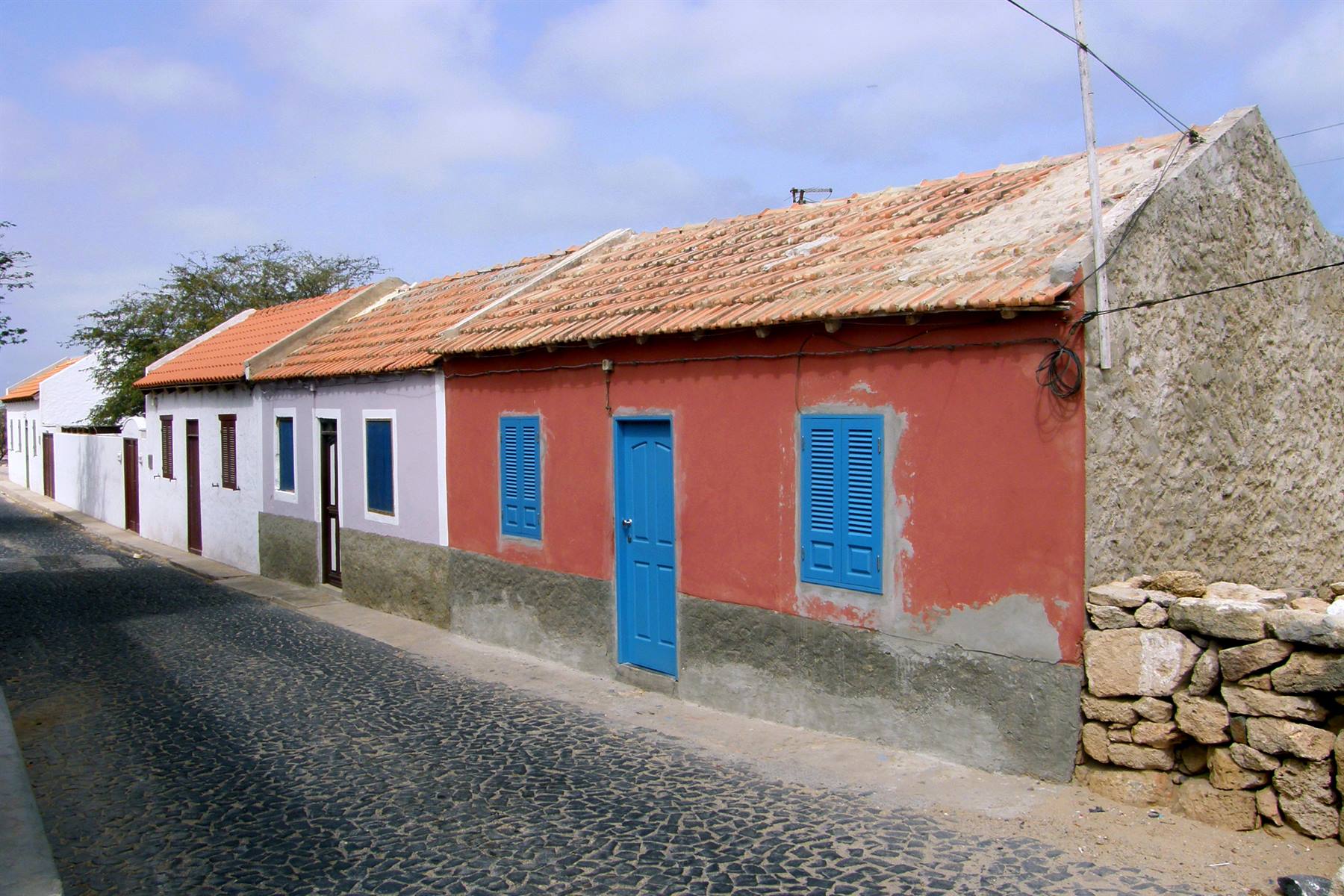
It's the first morning with no clouds in the sky, though there's a thick haze and the wind is still quite biting. We go to have breakfast and then get ready for the third and final excursion in Boavista. At the appointed time today too we find Eliseu waiting for us with his pickup at the entrance to the village, so, in the company of other tourists, we climb in and set off to discover the north-west of the island. First of all we go to Rabil, the centre through which evidently all the excursions pass and where this time we stop for a brief visit to a terracotta workshop, a craft for which the village has a good tradition. Having bought a little souvenir, we also explore the village, with its colourful little houses and the Igreja São Roque, dating back to 1801 and therefore the oldest in Boavista, but also rather run-down and in need of restoration, then we leave Rabil behind.
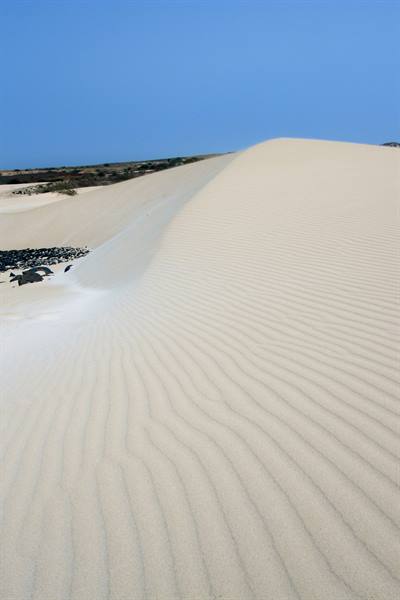
We cover a short stretch of road northwards, then a dirt track that takes us into the heart of the so-called Deserto de Viana: a little piece of Sahara carried by the ocean winds into the middle of the Atlantic. Barely a kilometre wide and five long, it is characterised by wind-sculpted light sand dunes and sparse vegetation … A truly evocative environment in which we wander for some time, first on foot and then by car, in search of the best perspectives and the most photogenic ridges. Having emerged from the Viana dunes, we pass through the nearby village of Estãncia de Baixo and then, after a stop at a bar in Rabil, where we taste the local grog and some strange pork-rind snacks, we head towards the northern area of Boavista. In this way, along a bumpy off-road route, we reach the Costa de Boa Esperança, also known as Praia de Santa Maria.
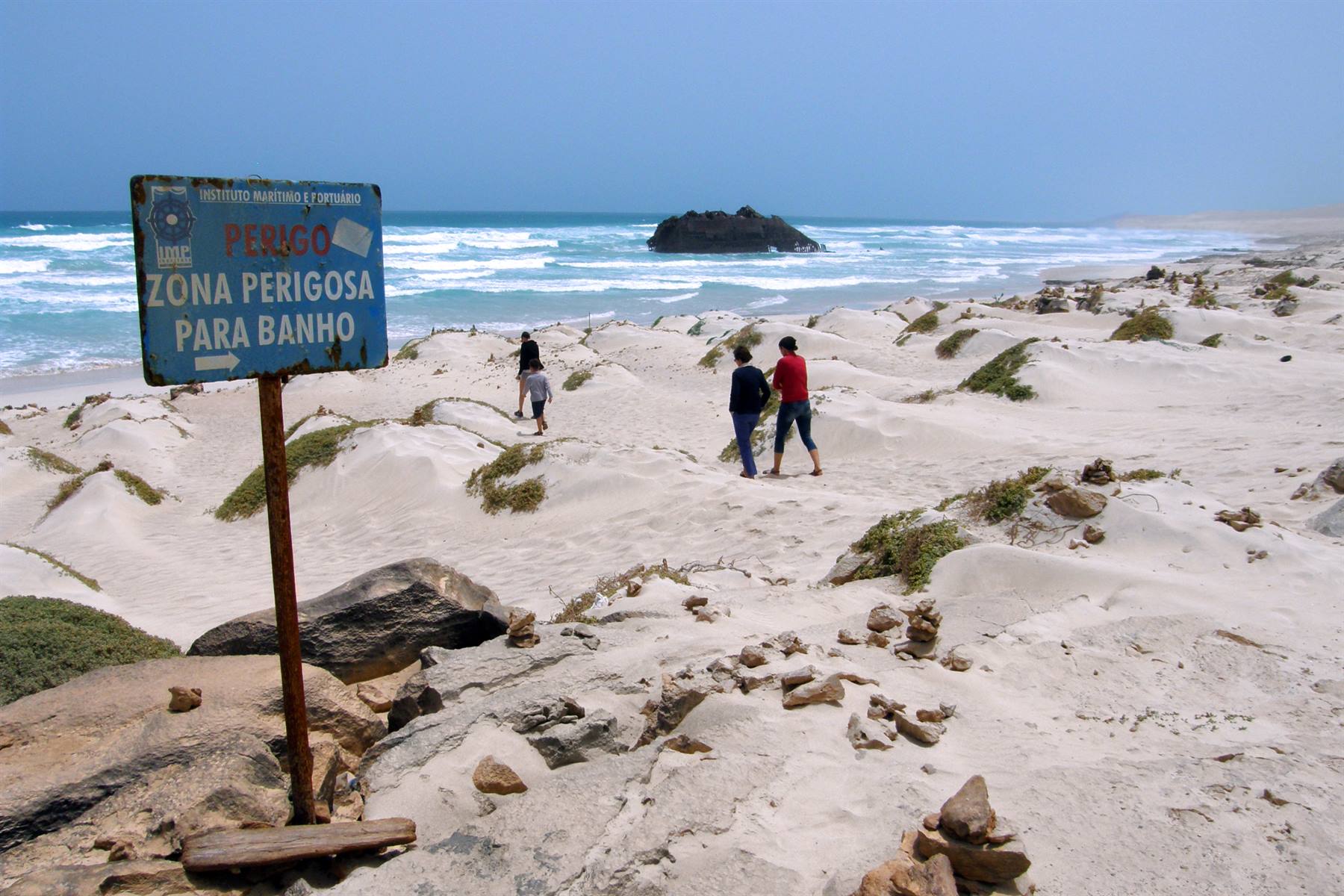
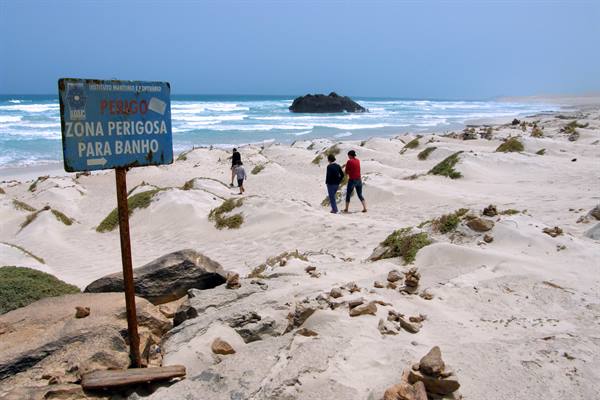
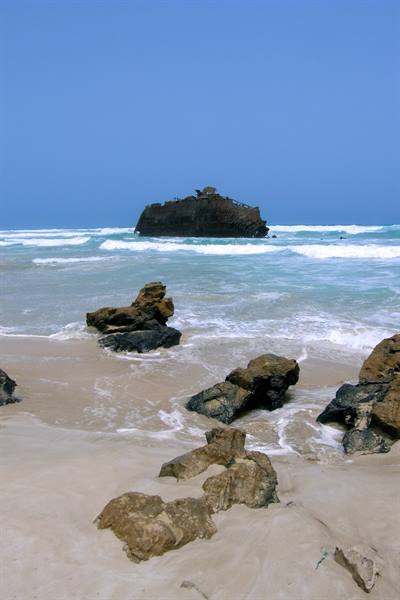
The place, characterised by wild white sand dunes, is constantly battered by wind and often by violent storms, so it isn't suitable for swimming, but it is nevertheless fascinating, also thanks to the presence of the rusted wreck of a Spanish merchant ship (the Capo de Santa Maria), which ran aground here, for apparently inexplicable reasons, back in 1968 and since then has been at the mercy of the surf, which is reducing it, day after day, to a heap of unidentifiable scrap metal. We stay for a while contemplating the sea, listening to the "voices" of the primordial elements, then, back in the pickup, we set off towards the end of today's stage.
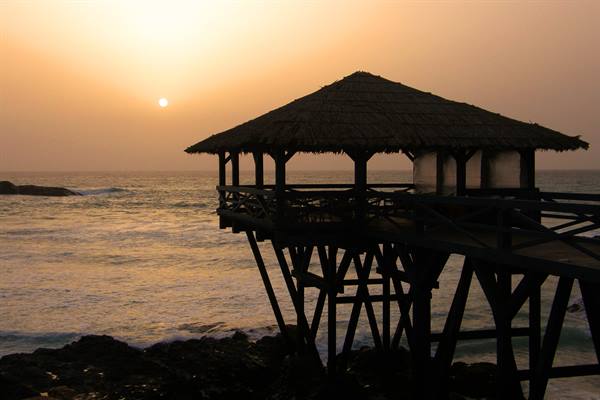
We pass along the so-called Via Pitoresca, an old road paved with cobblestones that however has little picturesque left about it, since the luxuriant palm grove it passed through has been practically wiped out by the local palm weevil (a deadly parasite) … and we arrive at the Marine Club shortly after 13:00, just in time to go to lunch. In the early afternoon, given the sunny day, Sabrina goes to the village beach and I with Leo (whose fever has returned) stay in the room to rest a bit … Later we all meet up again under the beach umbrella to wait for dusk and in this way we also enjoy a beautiful sunset.
In the evening, after dinner, we watch a little capoeira show, a martial art of Brazilian origin performed to the driving rhythm of the music, so much so that it seems like a traditional dance, then we go to the room to pack the suitcases for tomorrow's departure to the nearby island of Sal.
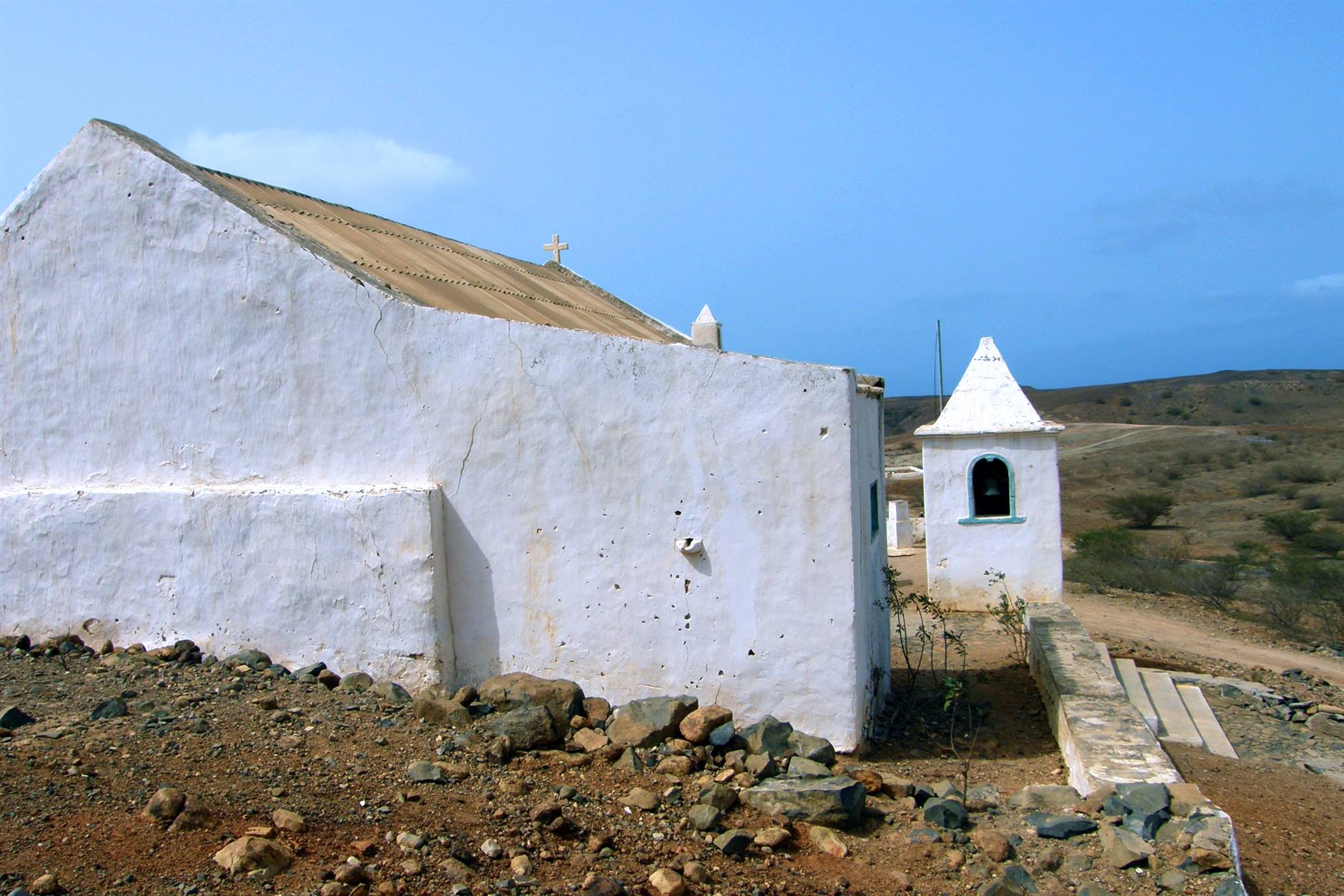
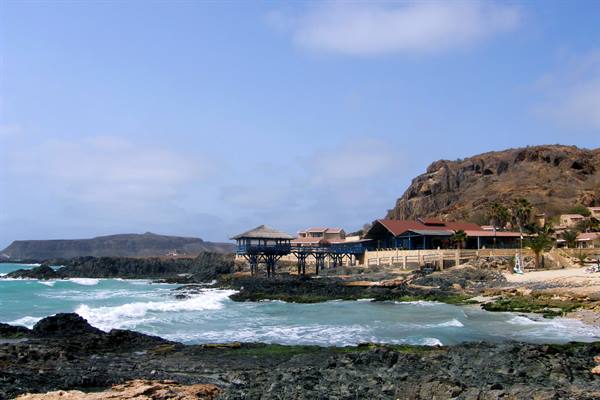
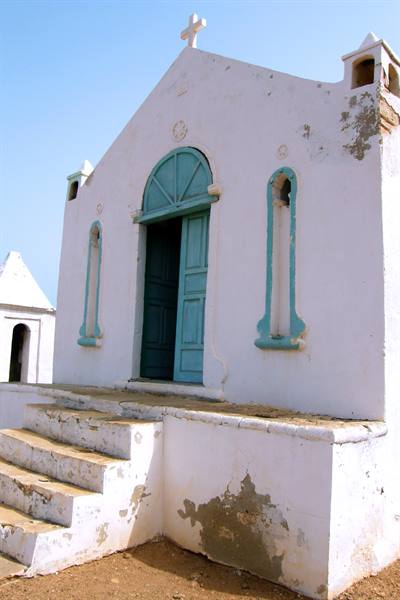
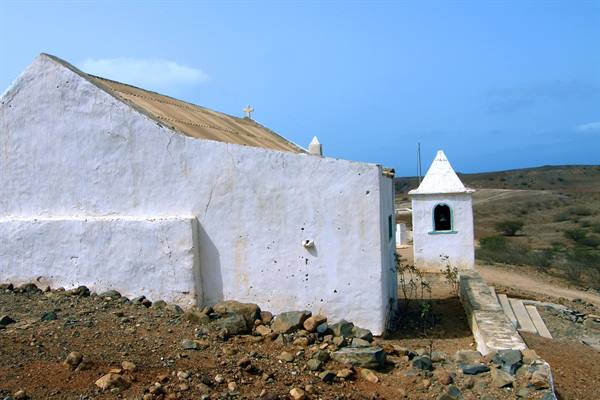
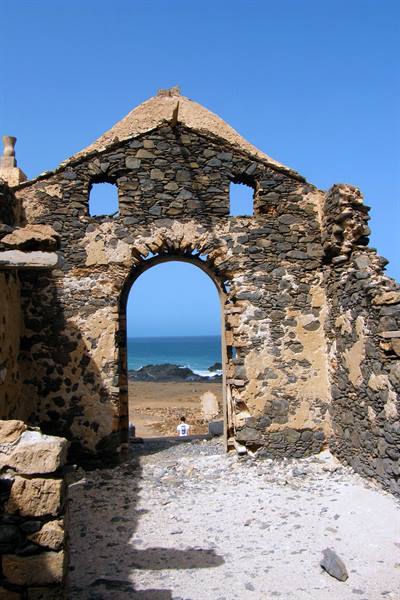
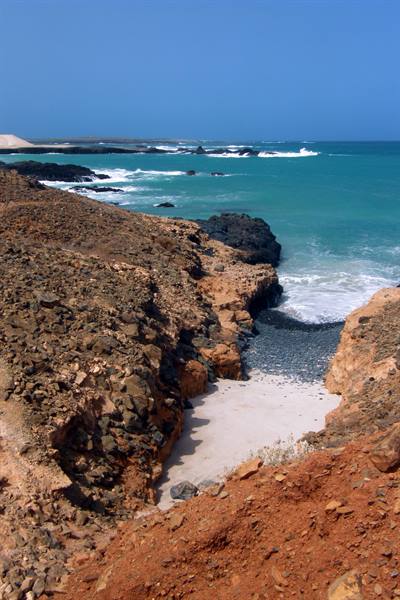
Wake-up, breakfast, and then … suitcases outside the room. The departure, however, is scheduled for the afternoon, so we settle on the beach, also taking advantage of the fact that today the sun is shining nicely. To pass the time we take a short walk along the rocky coast north of the Marine Club, with intriguing views of the sea (always a bit restless), up to the evocative remains of the Capela Nossa Senhora de Fatima, built in 1930 but soon abandoned to itself. The building still stands proudly on a rocky outcrop and, solitary, dominates the eponymous bay in front of it. Back on our steps to the village beach, I even stretch out a bit further south, near a large dune, then we all sit in the sun waiting for lunchtime.
Right after we've refuelled, at 13:30, the pickup in charge of our transfer shows up to collect us, so shortly after at the half-deserted Boavista airport we complete all the formalities and a few minutes after 15:00 we board flight VR 4411 of TACV, the Cape Verdean flag carrier. The ATR 72 takes off at 15:28 and just twelve minutes later, at 15:40, lands on the runway of Sal international airport, the eighth island by size in the archipelago, with its 216 square kilometres, but the main tourist hub of Cape Verde. On the way out, strangely, we find no one waiting for us, so, without getting alarmed, we wait patiently a bit and finally a minibus shows up to collect us, which in no time takes us to the Meliã Dunas Hotel, a mega complex located in the south of the island, near the settlement of Santa Maria.
They hand us the keys to room 3023 and we go there to settle our things, but not before having rented a pickup for the next two days. We go for a walk in the enormous tourist complex, down to the sea, then return to the room because Leo says he has the feeling that his fever is coming back … and he's right! The thermometer reads, mercilessly, 39! … The situation is starting to get really heavy. The usual treatments and then dinner, then watching the closing credits of an African music show, and finally to bed … And from tomorrow, God willing, we'll set off to discover Sal.
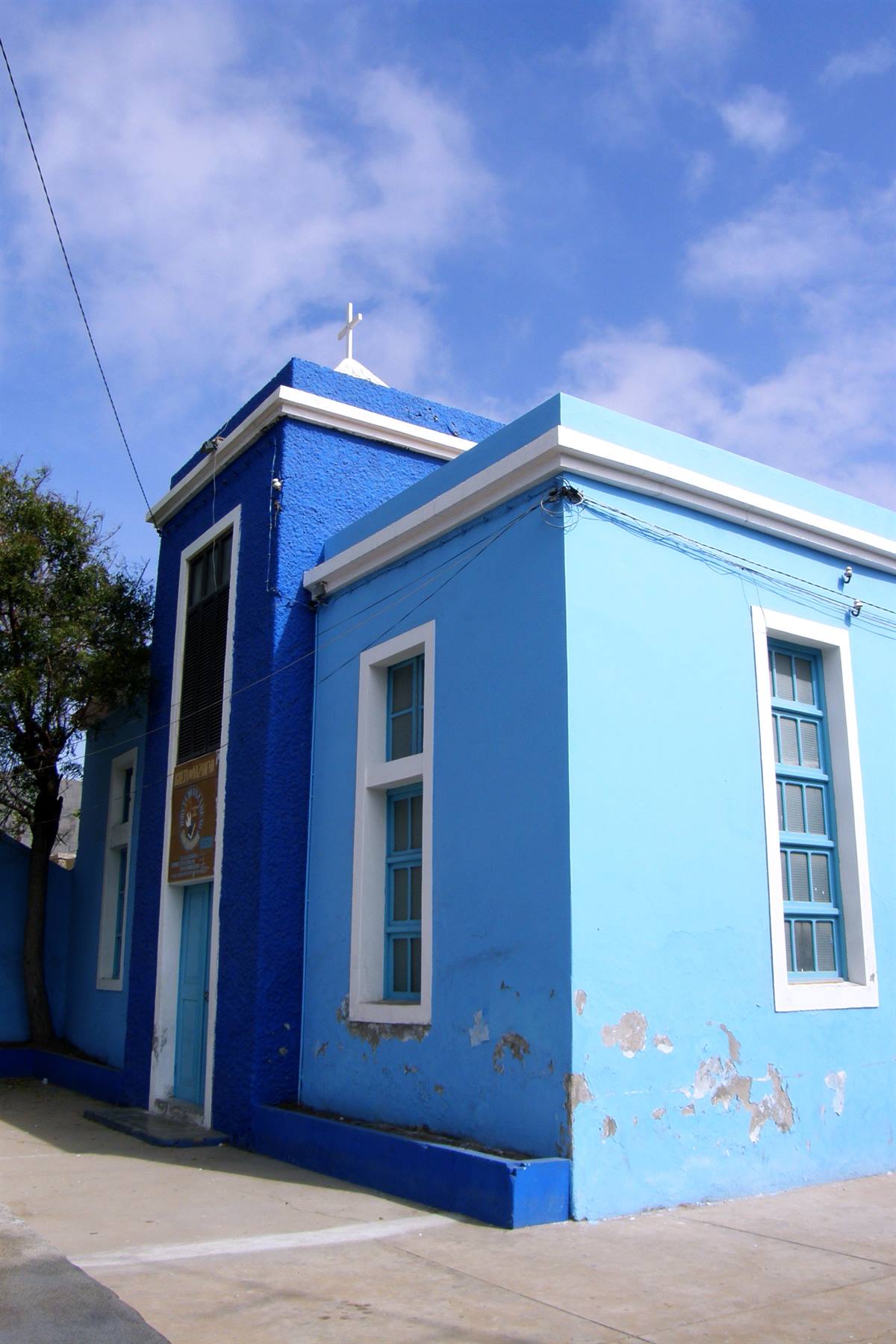
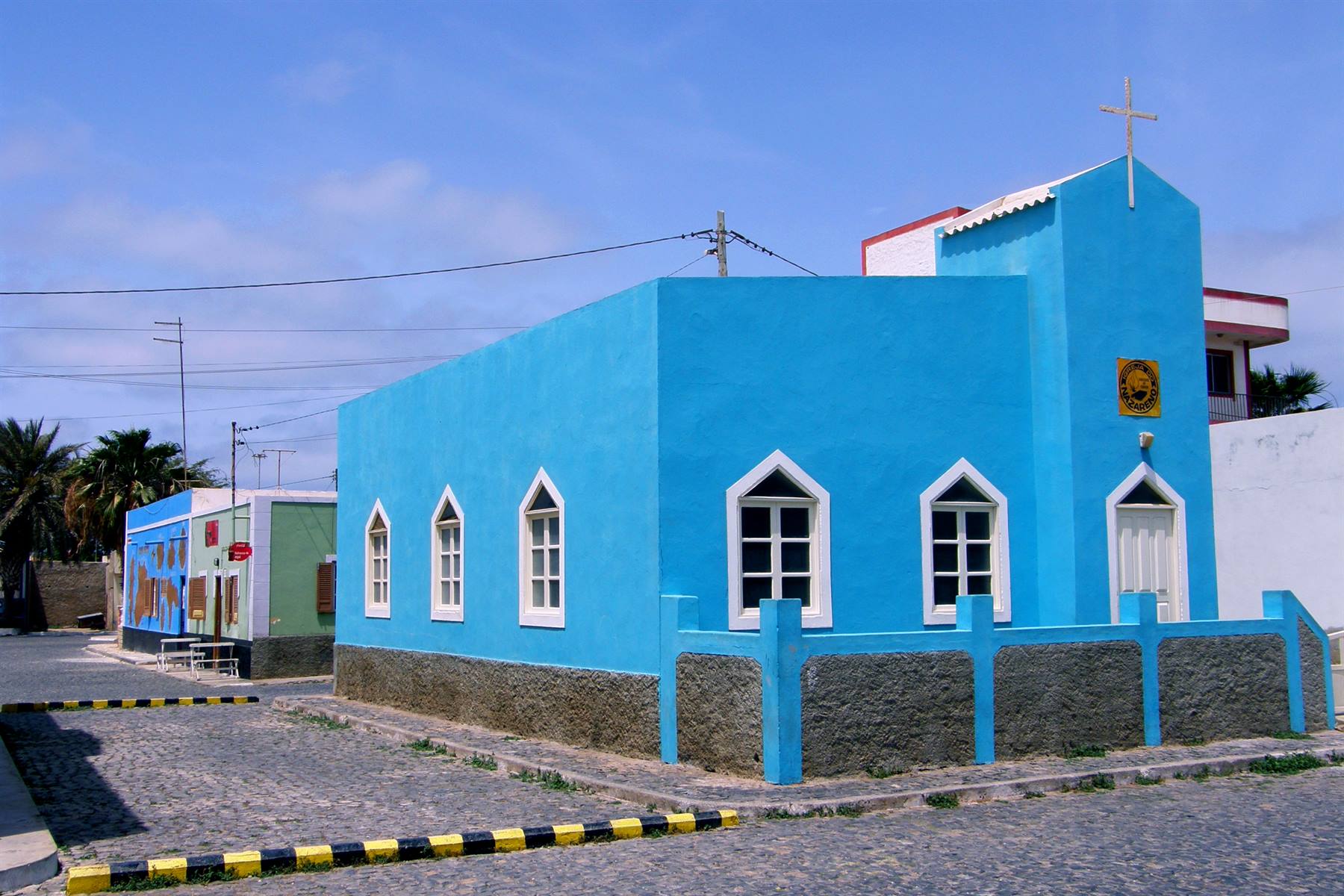
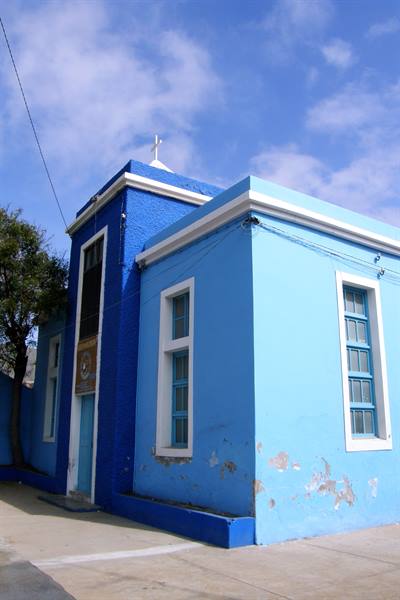
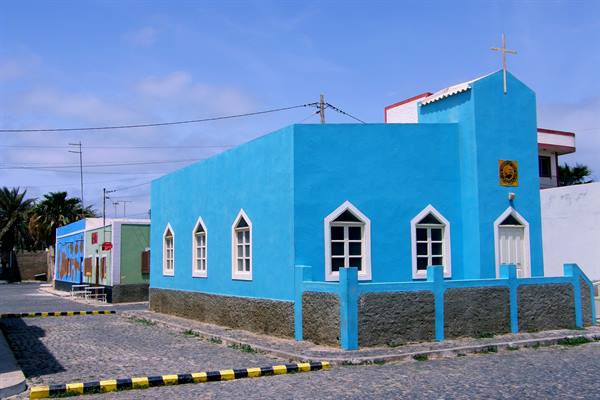
After breakfast we go to reception to meet the person who will rent us the car. Punctually he shows up a few minutes before 9:00 and hands us a black Ford Ranger pickup (registered SL 10 BD), rather battered, and with that, a little later, we set off along the island's roads. First of all we go to Santa Maria, the most important tourist resort in the archipelago with its roughly twenty thousand inhabitants, to see its centre, but above all its two main churches: Santa Maria das Dores, built in the first half of the nineteenth century and featuring a tall bell tower, and, painted entirely turquoise, the Igreja Nazarena, of more recent construction.
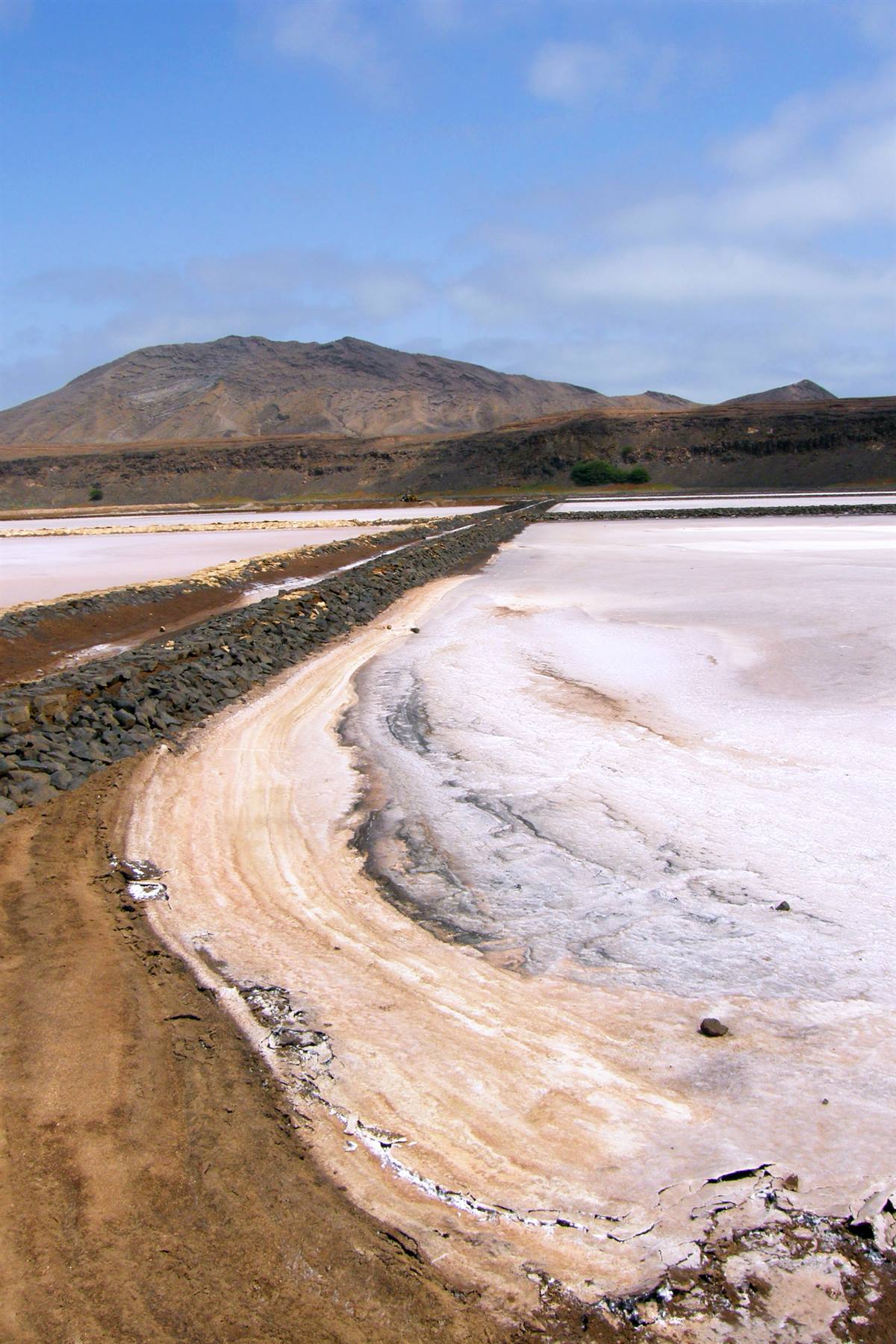
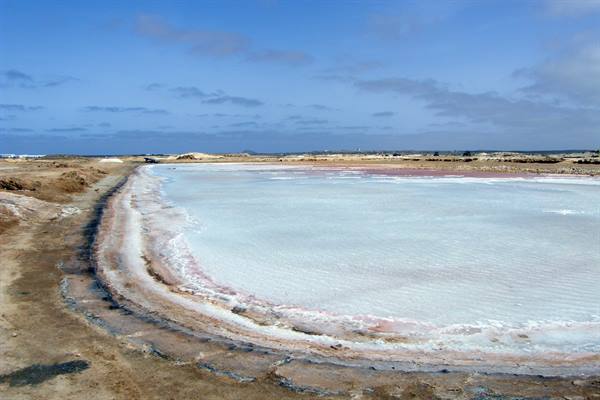
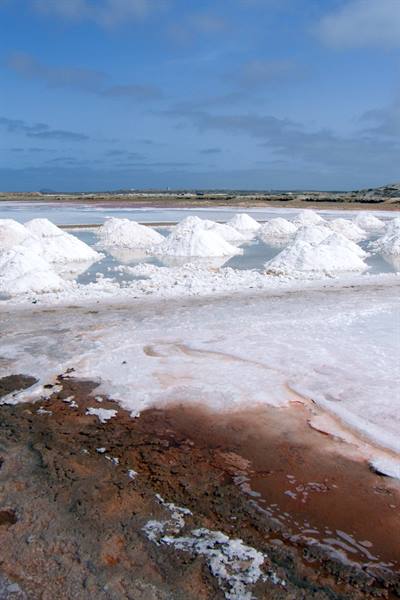
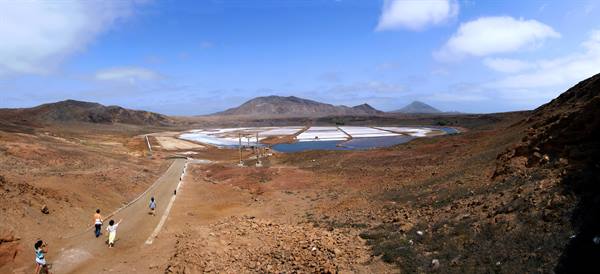
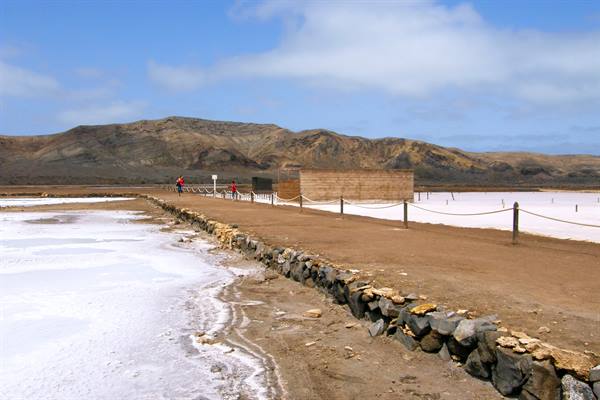
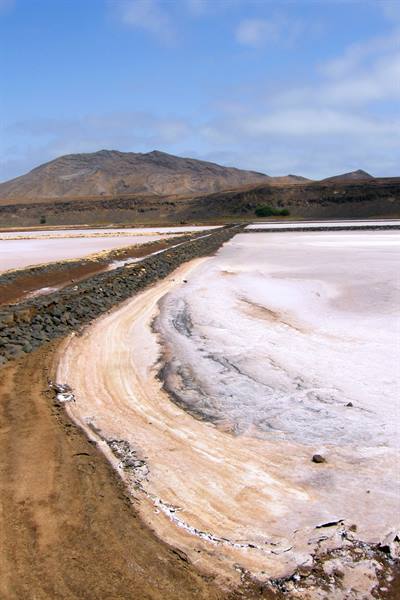
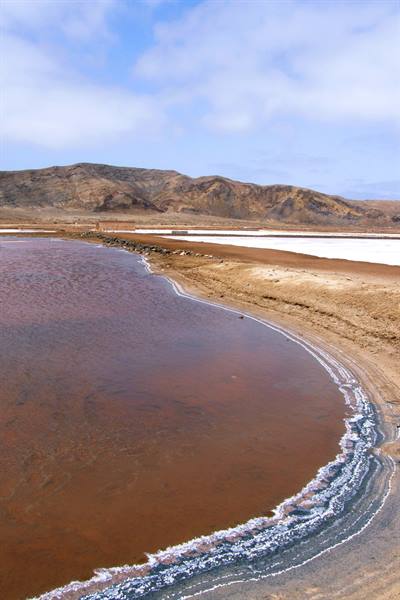
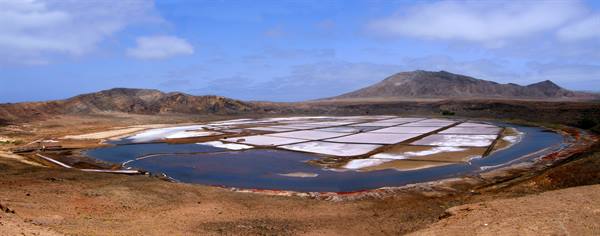
After that we venture along a dirt track, behind the settlement, to reach the intriguing salt pans, today semi-abandoned but particularly active between the nineteenth and twentieth centuries, when the island took the name of Sal … Island of Salt, precisely … Currently in the dried-up basins the white crystals create evocative scenes, in contrast with the surrounding desert landscape and the intense blue of the sky. Back in the centre of Santa Maria, we take the superhighway (completely out of place, given the almost non-existent traffic) that goes north and, passing the airport, reaches Espargos, the administrative capital of Sal.
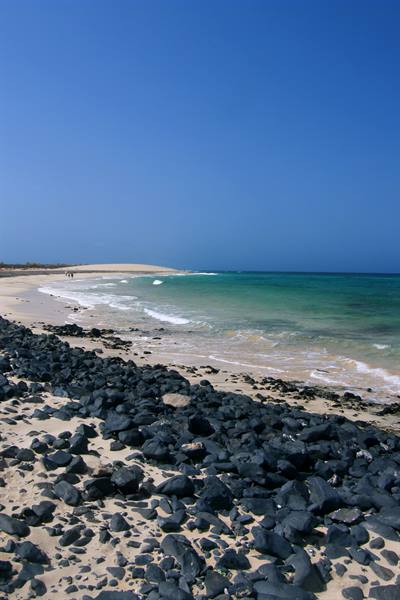
From Espargos we then follow the road that goes, towards the west coast, to the village of Palmeira, and shortly before the settlement we turn left onto a cart track that in no time takes us to Praia Fontona … The beach, abandoned to itself and full of debris, can't exactly be called beautiful, even though it's made of intriguing black sand. Back on our steps, we then head to the centre of Palmeira, the main commercial port of the island, dotted with interesting buildings and characterised by genuine Cape Verdean scenes. From Palmeira we then push further north, following a track that runs parallel to the coastline.
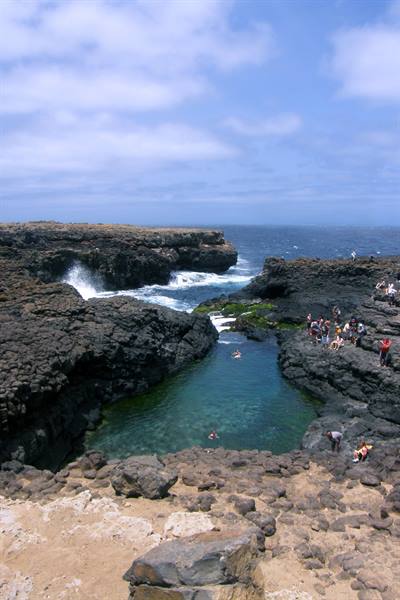
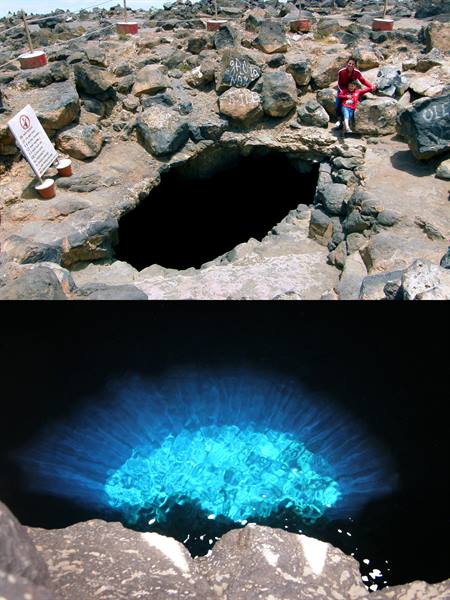
In this way, after a handful of kilometres, we conquer the very narrow inlet of Buracona, where the rugged volcanic cliffs and the action of the tides give life to an unusual natural pool, in which one could even bathe in complete safety and many people are doing so, but given the biting air of these days we decline. In the immediate vicinity there is also the so-called Olho Azul: a large horizontal hole in the cliffs, with the sea below … Here in the central hours of the day the sun's rays create an original effect, illuminating the water which lights up in a marvellous blue colour (the blue eye, precisely) … We observe the strange phenomenon in amazement and, after taking all the necessary photos, we hit the road again. We return to Palmeira, then to Espargos and from there to the Meliã Dunas for lunch.
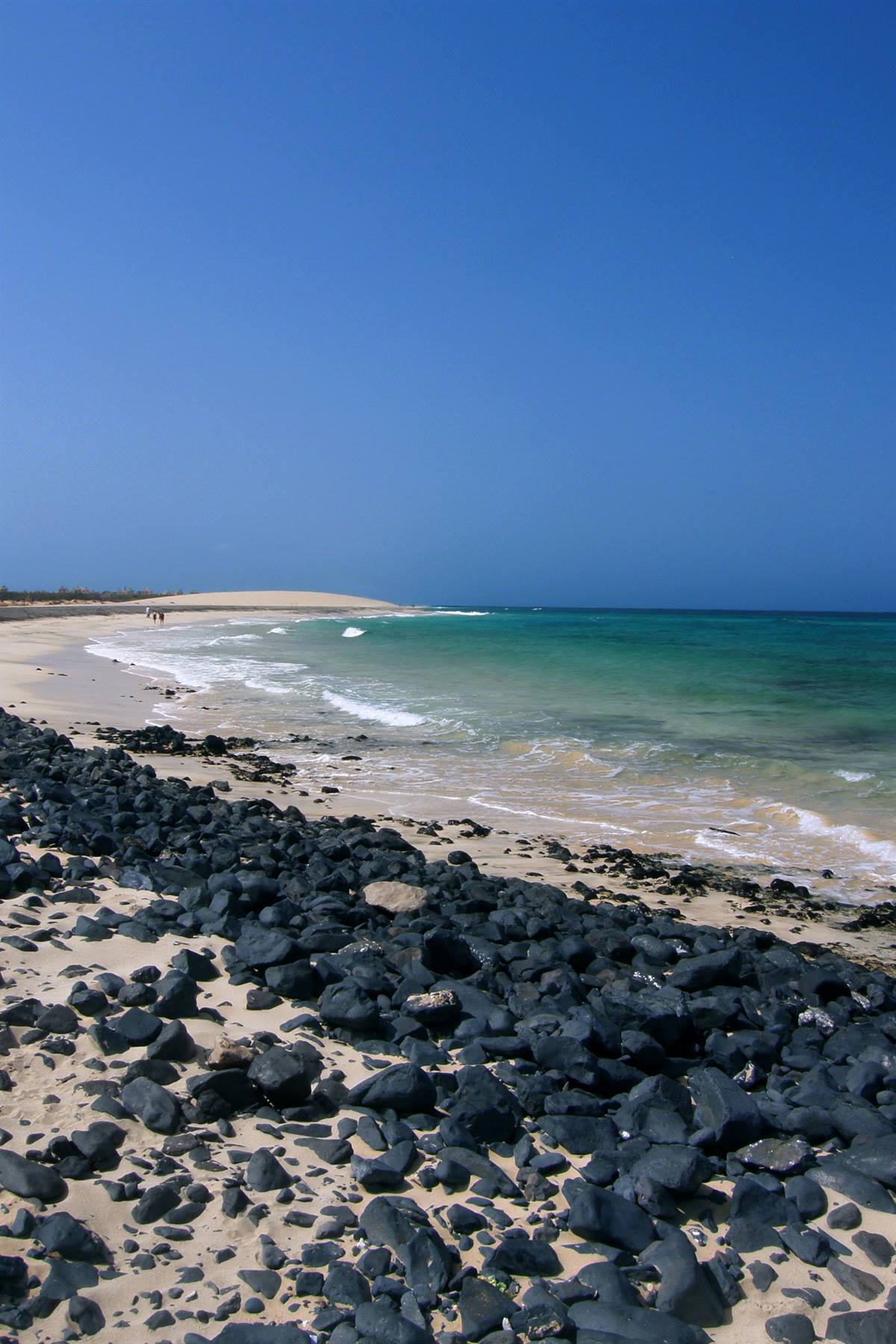
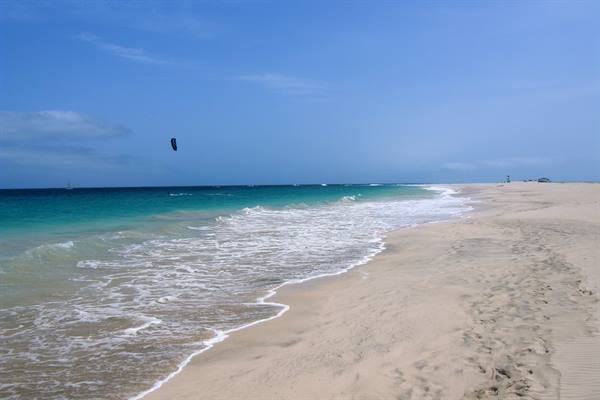
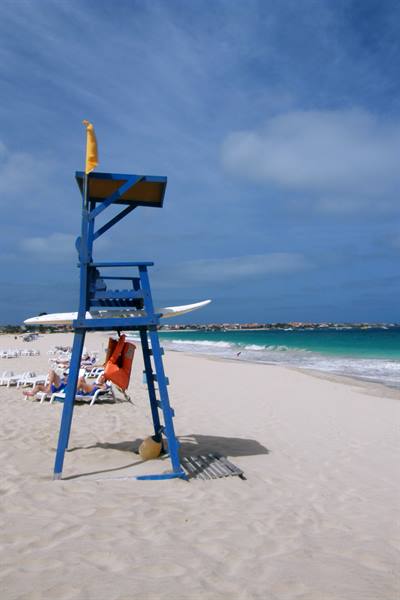
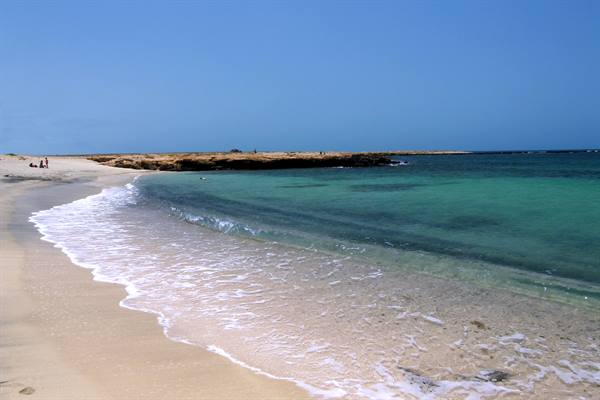
In the early afternoon we'd like to spend some time at the beach, so we head to Santa Maria to go to its praia, unanimously considered the best in Sal … Indeed it is very beautiful and wide, with soft white sand washed by a sea, not even too rough, whose reflections are certainly inviting, but, unfortunately, today's hateful wind makes it not at all appealing, and the very few swimmers present are the most tangible evidence of that … it's impossible for us to put on our swimsuits and enjoy beach life here. Disconsolate, we immortalise the beach, to preserve it in our memories, and then make our way back to the Meliã Dunas, where, inside the children's play area, we find a sheltered spot in which to sunbathe in complete tranquillity, and there we stay until evening, while the little one has a great time in the company of other kids his age.
Shortly before 18:00 we return to the room and, naturally, the fever returns too (damn it!) … So after a little rest we get ready and go to dinner, while the holiday inexorably draws to a close … A holiday, it's useless to deny it, with many ups and downs, but by now we've made our peace with it.
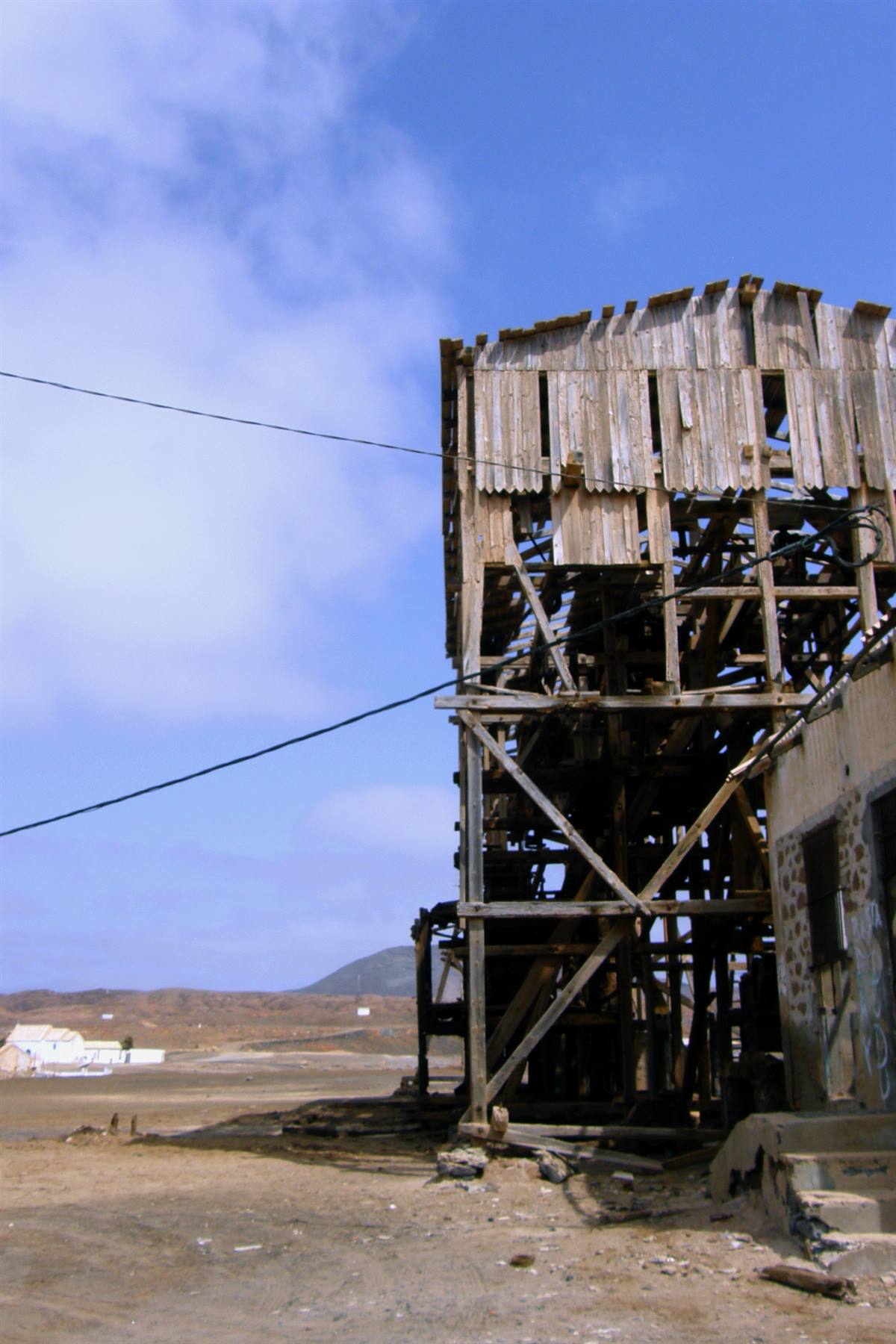
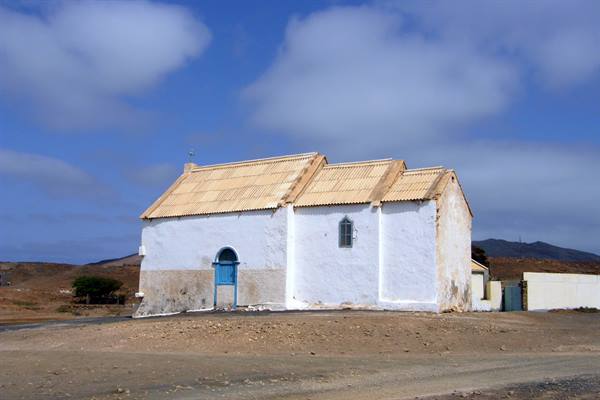
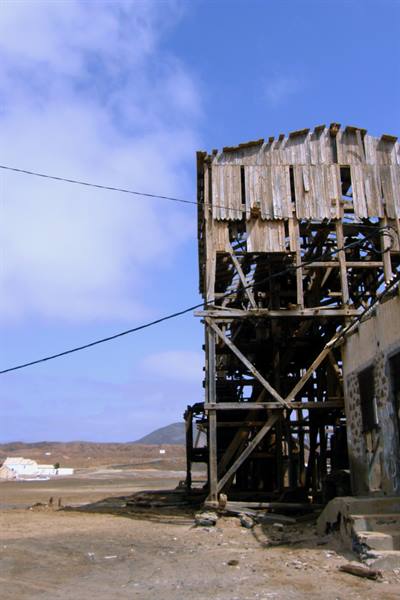
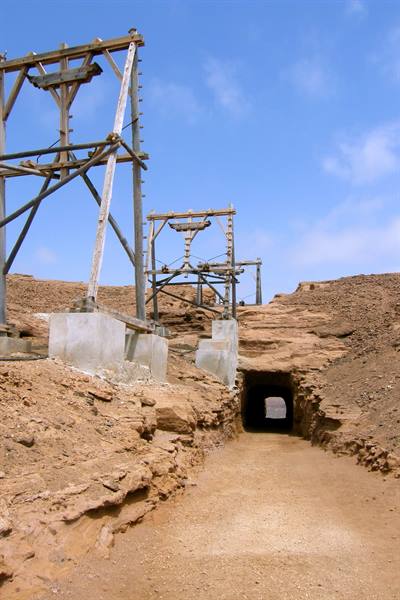
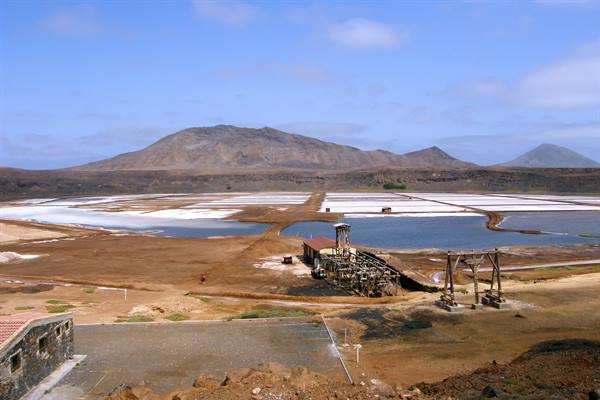
Last full day to spend on the island of Sal … I get out of bed and pull back the curtains: outside it's cloudy, but bad weather isn't forecast … In fact, just the time to have breakfast and out comes the sun. With our pickup we head north, pass the airport, and shortly before Espargos we turn right following the signs for Pedra Lume. A few more kilometres and we reach this tiny and out-of-the-way spot, located in the centre of the eastern coast of Sal. You wouldn't think so, but Pedra Lume is the place richest in history on the whole island. The white Capela Nossa Senhora da Piedade (from 1835) and the old salt-loading station, now in ruins, terminal of the (disused) cable car coming from the nearby salt pans, intensively exploited for almost two centuries, bear witness to this.
The Pedra Lume salt pans, from which salt is still extracted today, albeit to a minimal extent, are the main curiosity of Sal, being located below sea level, within the basin of an ancient volcano. They are reached first via a short dirt track and then thanks to a tunnel dug through the rim of the crater, and they are highly scenic. On foot we descend to the bottom of the vast cavity, where the sea water seeps in through the porous rocks below and where one could even take an original swim, floating very well thanks to the high salinity, but as usual a biting wind is blowing, which makes us decide against it. Among the chiaroscuro of the passing clouds we try to capture the best images, then we observe the place also from the top of the volcanic cone, following a steep off-road path on which we can finally "unleash" our four-wheel drive.
After the salt pans we'd like to go a bit along the tracks north of Espargos, towards the locality of Terra Boa, where there's no trace of asphalt, but we soon get lost in the intricate labyrinth of dusty tracks and turn back … after all, we weren't expecting anything exceptional. We then head back south and shortly after the modern coastal resort of Murdeira, whose inlet is certainly nothing to write home about, we turn right along a dirt track that in no time takes us to the lonely Calheta Funda … A nice spot, where the wind doesn't blow hard, the sand is soft and pleasant, but above all the sea is almost calm and its colours intriguing … We stop there to relax until almost 13:00 and then return to the Meliã Dunas for lunch.
Having silenced the pangs of hunger, we go to the beach of the tourist complex, that of Ponta Petra … The wind has dropped considerably and it feels great, so we spend the whole afternoon there … finally an afternoon at the sea as God intended! Later, at the usual time, Leonardo's fever doesn't show up … It's the last day of the holiday and everything seems to be settling down … As they say: all's well that ends well … Well, well! … Afterwards we go to dinner and then back to the room to pack the suitcases for tomorrow's journey home.
We're at the home stretch: we go to have breakfast and then return the rental car, then we go to spend the last few hours at the Meliã Dunas beach. To pass the time I take a pleasant walk along the vast expanse of sand of Ponta Petra, heading south, where it merges with Praia de Santa Maria. In an atavistic peace, with only the lapping of the sea and immersed in the nature of this stretch of coast, I savour interesting views, among which that of an enormous dune at the water's edge, and then I make my way back to the hotel. Time flies and at 11:30 we return to the room to sort out the last few things, then we check out and at 12:30 we have a very quick lunch … very quick because at 12:45 the minibus shows up to take us to the airport.
Having dealt with all the boarding formalities, at 15:13, slightly delayed, the Boeing 737-800 of Neos lifts off the ground, marked as flight NO 3831, and immediately banks north-east, towards our destination. Once we reach cruising altitude, some tourist videos play on the aircraft's screens, among which one about Cape Verde, where we find, to our surprise, Eliseu among the people featured, who evidently is a celebrity on the island of Boavista. After about two hours we pass over the Canary Islands archipelago, then we enter the Mediterranean through the main door: the Strait of Gibraltar. While we set our watches forward by three hours, we also fly over the Balearic Islands, then, with Sardinia below us, we begin our descent towards Rome Fiumicino, where we land at 23:37 … So midnight strikes in the capital's airport and it is …
We take off again at 0:54, after refuelling and a change of crew … No sooner are we up than the descent towards Bologna begins, where we land at 1:30. We collect our luggage and an hour later we're sitting in the car on the way home, so at 3:00 we exit the motorway at Faenza and at 3:11 we happily conclude the journey in front of the gate of our sweet home. Despite everything, despite the not exactly pleasant temperature and perhaps a bit unexpected too, despite, above all, the illness that struck little Leo, I believe the Cape Verde adventure was positive and allowed us to get to know another little piece of this wonderful planet.
Of course, it won't be a holiday to be ranked in the hit parade of our memories, but I think it also had its positive sides … Certainly, based on our experience, Cape Verde is the coldest tropical place in the world, or maybe it was just fate being against us …
55 photographs · click to open them full screen
0 reader comments