Now at the end of a generous summer, but with some uncertainty about the weather conditions, we leave home in the camper at 9:20 pm on any old weekday, with darkness now complete and the radio tuned to the football match (World Cup rematch) France-Italy... Our goal is Turin, a historic city and capital of Piedmont, known above all for its industries (Fiat at the top), but tourism-wise, often, excessively mistreated... we instead believe it can be worth this short vacation that we decided to dedicate to it. Twenty minutes after departure we take the A14 motorway at Faenza and at 10:10 pm the A1 at Bologna... Everything goes smoothly and we speed north, so around 11:00 pm we are at Parma, while unfortunately Italy has taken a sound beating (3 to 1...
but no one can take the World Cup away from us!) Sabrina and Federico shortly after Piacenza, while we begin following the A21, go off to sleep, so I remain alone, in the company of the radio, driving toward our destination. Kilometer after kilometer we leave Emilia-Romagna and enter Lombardy, as midnight strikes and it is...
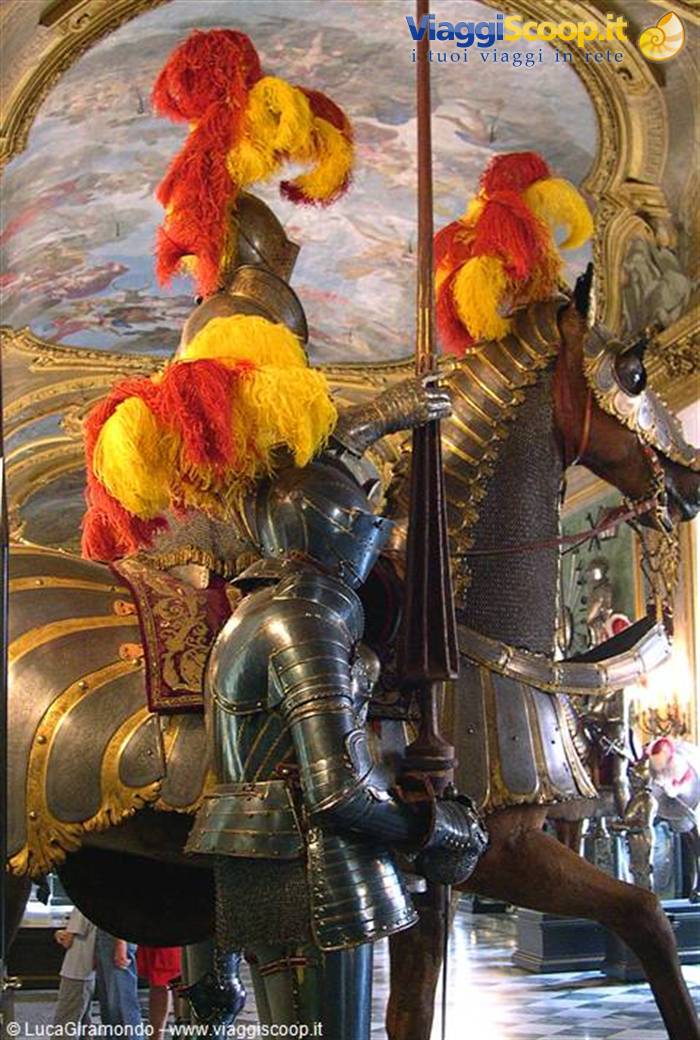
Turin: Royal Armoury
Day 27 Sep 2006
Shortly we come in sight of the sign announcing our entry into Piedmont too and continuing without a hitch, thanks to the very light traffic, almost at 1:00 am we leave behind the Asti exit to conquer, just a quarter of an hour later, the first outskirts of Turin. Ignoring, for the moment, the Piedmontese capital we continue south along the A6 and almost immediately leave the motorway at the town of Carmagnola to follow the state road that brings us, shortly before 2:00 am, to the camper rest area of the town of Racconigi, from where tomorrow morning we will begin our visits... there is no one besides us in the parking lot but the place seems quiet and finally I can grant myself a few hours of sleep. It is not easy to get out of bed shortly after 8:00 am, but I have to do it so as not to throw away all the time painstakingly recovered during the night...
We have breakfast while beyond the glass the sky turns out to be veiled and the sun almost absent, so, a few minutes past 9:00 am, we set off toward the Royal Castle of Racconigi. The origins of the manor date back to the end of the 12th century, under the marquises of Saluzzo. Later passed to the Savoys it was almost completely restored by Emanuele Filiberto of Carignano, who in 1676 entrusted its design to the architect Guarino Guarini. In 1755 finally began the work of building the imposing terracotta facade, which still today dominates the square of the small Piedmontese provincial town... We are in Italy, though, and it shows: there is construction work everywhere and everything is dilapidated, the grand wrought-iron gate is of a thousand colors and several walls are peeling... how infuriating!...
We wait in front of the imposing staircase for the time of our visit and when we finally start the guide forbids us from taking photographs, even without using the flash... It's absurd, we have remained practically the only ones in Europe to impose this kind of restriction... That means that, as a good Italian, I will try to play it a bit sly... without any remorse whatsoever! The interiors, there's no doubt, are sumptuous and very beautiful, with several rooms created by the distinguished Bolognese architect Pelagio Pelagi, who stands out for the omnipresent stylized signature in the form of a palm leaf, with the great salon, full of stuccoes and gilding, and with the Chinese apartment, rich in precious Oriental wallpapers.
We stay for almost an hour immersed in the rooms of the Castle of Racconigi and then go out intending to also visit the immense park that extends behind the complex, designed by André le Nôtre, the celebrated architect known among other things for designing the gardens of the Versailles palace. With the help of a little train we reach the opposite end of the park (largely closed for restoration), where the stables, the royal greenhouses and the so-called "Giardino dei Principini" are located, but everything is closed and opens only on Sunday... an absurd and incomprehensible thing! When it is now 1:00 pm, even if a bit displeased, we conclude the visit of the castle and the Racconigi estate... a beautiful and interesting visit, there's no denying it, but it could have been much more positive...
if at least there had been sun! Back at the camper we immediately move to the first outskirts of Turin and more precisely to the town of Stupinigi, where, after a quick lunch, we go to see the famous Savoy hunting lodge. Commissioned in 1728 by Victor Amadeus II to the architect Filippo Juvarra, the residence was inhabited by the court until 1919 and is characterized by its purely hunting purpose, with the statue of a stag towering above the central and highest dome of the harmonious complex of buildings, which faces the Piedmontese countryside, once rich in game. Here too, though, we are in Italy: half the lodge is under restoration and closed to the public, the park at the back is inaccessible and left to itself, while the last visit of the day is scheduled for 3:15 pm, with the whole afternoon still ahead...
Luckily we are among the elect destined to take part in it and we can triumphantly cross a side door (the main one is closed for works)... There is, however, obviously also something positive in all this and it is the beautiful interiors (at least those we managed to see), in particular the sumptuous central salon, elliptical, very tall and completely frescoed... We remain thus dazzled before so much wonder, only, naturally, you can't take photographs and to bring home a couple of shots I felt, unjustly, like an ignoble art thief... We leave Stupinigi with a good part of the afternoon still available, we race toward the Susa Valley and after a few kilometers we begin to climb in the direction of the Sacra di S. Michele, with the sky above us increasingly gray... and gray is also the sanctuary, which thus loses a good part of its spectacularity...
what a shame! The monastery (grandiose) stands at 960 meters above sea level, on the summit of Monte Pirchiriano and is the result of the overlapping of different architectural styles and of several buildings erected starting from the year 998, up to the radical restorations of the late nineteenth century. We arrive at the place at the last minute and having reached the entrance of the abbey at a quick pace we can carry out its visit: we climb along the very steep Scalone dei Morti, which leads to the so-called Porta dello Zodiaco and after climbing one last ramp we finally enter the Church of S. Michele, which rises on the highest point of the rocky spur that hosts the entire complex...
From there and from the surrounding terraces, despite today's haze and the certainly not optimal day, one savors the stupendous scenery in which several scenes of the well-known film "The Name of the Rose", with Sean Connery, were also shot. Kissed also by a few unexpected rays of sun at 6:30 pm we conclude the interesting exploration of the Sacra di S. Michele and once back at the camper we head back down in the direction of Turin... Before going toward the center of the Piedmontese capital we head however to the north-eastern outskirts, to the Caselle airport, to purchase at the designated counter the "Torino Card", which will allow us to have, included in the price, various benefits and countless entries to the most varied city museums. Now in the evening we finally venture out in search of the place where we will spend the second (but also the third and fourth) night of this trip...
We thus arrive, shortly after 8:00 pm, at the Villa Rey campsite, on the first hills, a short distance from the city center: it is almost full, but they find us a spot and once settled we can finally have dinner... then we watch a bit of TV and soon go to sleep, because tomorrow morning the real visit of the city will begin, aided, we hope, by better weather conditions than the current ones.
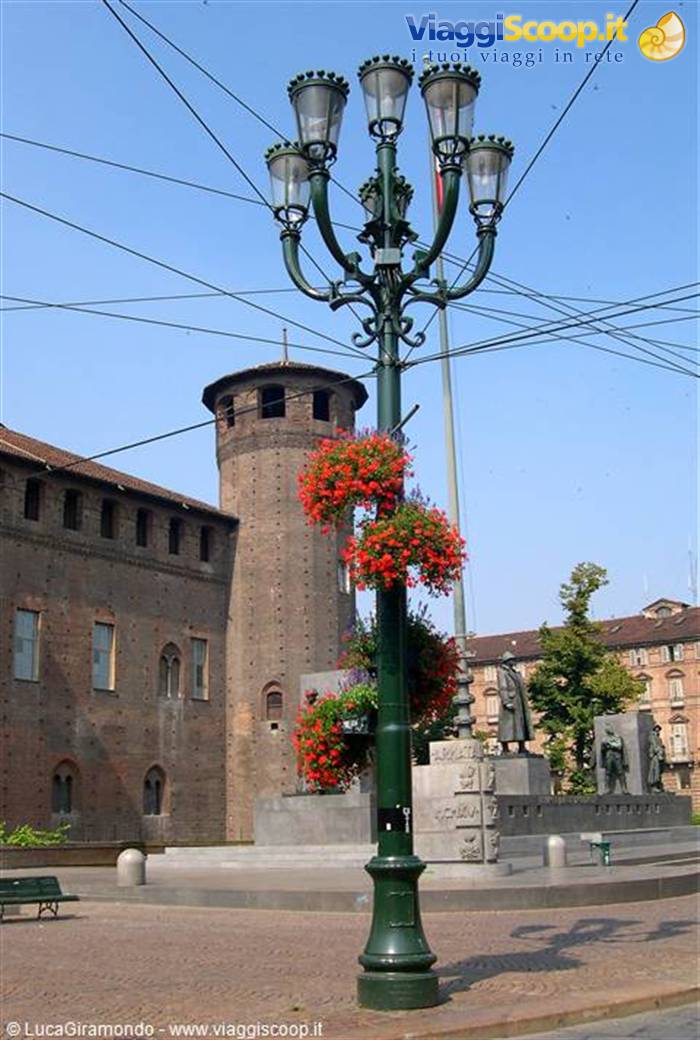
Piazza Castello - Palazzo Madama
Day 38 Sep 2006
PART ONE
During the night all hell broke loose: thunder, lightning and a river of water that came down from the sky... In the morning, when we look out the window, everything is gray and typically autumnal, so we laze a bit longer than we should between the sheets, but shortly after 8:00 am we get up and at 9:30 am we set off leaving the campsite, while, above an increasingly thin cloud layer, the sun shines timidly. We get on bus number 56 and head toward the historic center of Turin. We pass Piazza Castello and arrive near the Porta Susa railway station... There we get off and on foot reach, a short distance away, the Pietro Micca Museum.
This singular exhibition was created in 1961 to commemorate the historic French siege of Turin in 1706, but above all to remember its hero par excellence, that Pietro Micca, soldier-miner, who for his deeds usually remains imprinted in the school memory of everyone... ours included, naturally. In a handful of rooms are collected geographical maps and relics dating back to the era and a passionate guide illustrates to us with enthusiasm all the phases of the battle, but it is underground that the visit becomes extremely interesting: one walks through numerous "countermine" tunnels, built by the Piedmontese to defend the city, and one can see the staircase on which Pietro Micca made his heroic gesture sacrificing himself to counter the enemy, all accompanied by some suggestive film clips and special effects, still being tested, but very realistic.
After more than an hour we climb back up satisfied to the surface and walking along via Cernaia we move to the Maschio, the only building remaining of the old Citadel of Turin, to see the Historical Artillery Museum... but it's no longer there: in its place a documentary exhibition on the siege of 1706 has been set up, which, free but rather cloying, we quickly scan through, to resume as soon as possible our substantial program of visits. We walk along via Garibaldi, one of the longest pedestrian zones in Italy, and passing through the small but pretty Piazza Palazzo di Città, with the seventeenth-century Town Hall in the center, we arrive at Piazza Castello, always the historic and political fulcrum of the city, onto which numerous important buildings face. We begin with the Real Chiesa di S.
Lorenzo, which is about to close, and observe its octagonal interiors, designed, in Baroque style, by the architect Guarino Guarini, in the 17th century. On the way out we linger on Palazzo Madama, which stands in the center of the enormous quadrangular square: the ancient castle traces its origins all the way back to the Roman era and is a combination of architectural styles, from the purely military to the sumptuous Baroque facade, created by Filippo Juvarra in the eighteenth century... But what strikes most about Piazza Castello is certainly the great mass of the Royal Palace, preceded by a monumental cast-iron gate.
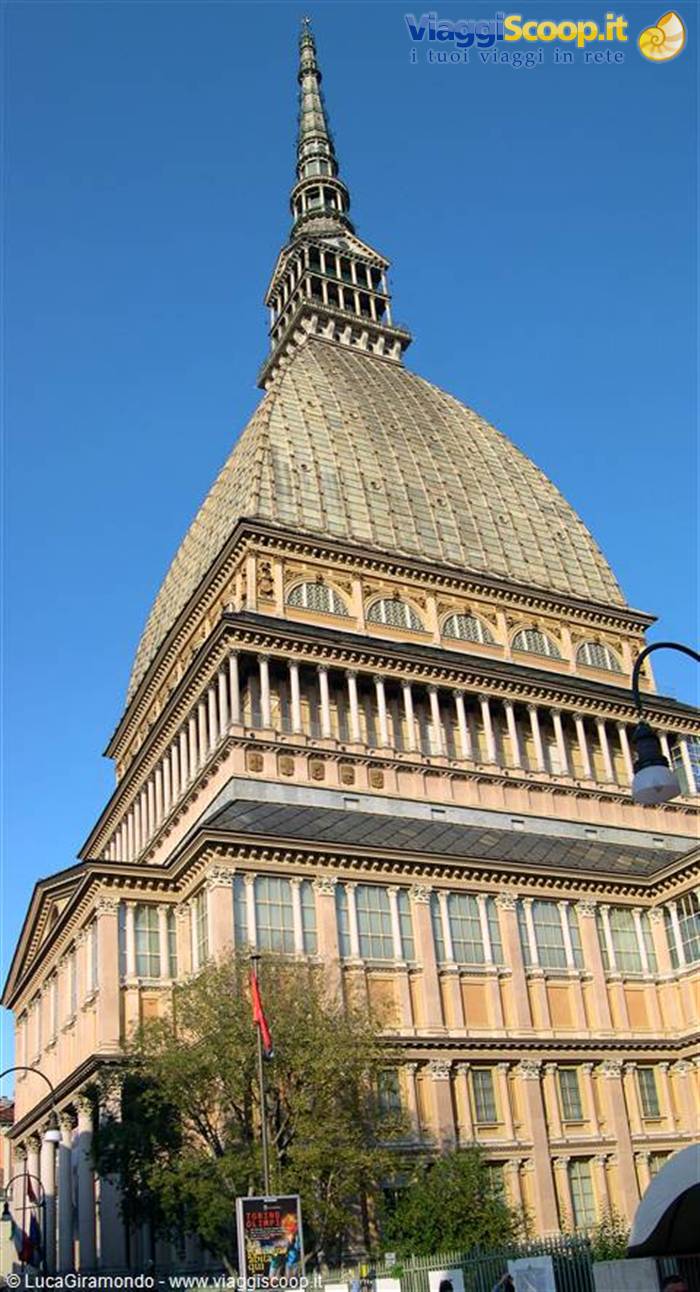
Mole Antonelliana
Day 48 Sep 2006
PART TWO
Noon has already passed for a while, but we don't give ourselves a break and try to fit in the opening hours of museums and monuments since, let's remember, we are still in Italy... The Royal Armory nearby, in fact, closes at 2:00 pm and doesn't reopen until tomorrow morning, so we rush to visit it... Among the most important collections of its kind in Europe it includes in particular an exceptional series of armor, arranged in an extraordinary setting, along the admirable Beaumont Gallery, designed by Filippo Juvarra and sumptuously painted by the artist from whom it takes its name.
Having "stolen" as usual a few photos we return to Piazza Castello and, having gone around Palazzo Madama to immortalize its oldest facade, we stop to have lunch with our sandwiches sitting on a bench, while shortly afterward the sun comes out forcefully and we have to flee in search of shade because of the sudden, unexpected great heat... The day, in fact, soon takes on typically summer characteristics and the sky, now wonderfully clear, contrasts with the light tones of the Royal Palace, creating incomparable perspectives. Determined to visit the Royal Palace precisely, we head toward the ticket office, but it is closed and reopens at 2:00 pm... There isn't much time left and we wait nearby, to then present ourselves in perfect time...
Contrary to all predictions the counter has instead opened slightly early and the 2:20 pm guided tour is already full, in fact there's only room in more than two hours!... A few curses escape me as we go out studying an alternative program of visits: we would like to see the Royal Gardens, but obviously they are closed for restoration, so we go, a few blocks away, to the Palatine Gate. A grandiose remnant of the Roman era, dating back to the 1st century AD, the Palatine Gate is one of the oldest monuments of Turin and rises impetuously, all in red bricks, near a grassy esplanade... once a defensive bulwark and today a proud reminder of the ancient origins of the city.
Staying on theme we move to also visit the nearby Museum of Antiquities, which was not planned, but which serves to pass the time, strolling pleasantly among interesting archaeological finds, to arrive at 3:00 pm, when the adjoining Cathedral will reopen its doors. A quick glance at what remains (truly little) of the Roman Theater and then here we are climbing the staircase of the most important religious building in Turin.
Built in Renaissance forms at the end of the fifteenth century, the Cathedral of the Piedmontese capital cannot be called a jewel of architecture and even the interiors are rather bare, but it is universally known for housing one of the most important relics of Christianity: that Holy Shroud, the object of endless studies and suppositions but, above all, that linen cloth in which for all believers Jesus Christ was wrapped after the crucifixion, leaving imprinted on the fabric the form of his face and of his whole body... The precious object of worship is however not always exposed to the public, in fact very rarely (the next time in 2025), so we stop with respect for a few moments in front of the chapel that houses it and then return to the open air.
A magnificent sun is still shining and we calmly head toward our appointment with the Royal Palace, which built in the second half of the 1600s was the official residence of the Savoy kings until 1865... The interiors are very beautiful: one climbs a monumental staircase and visits the sumptuous state rooms, wonderfully furnished by the most renowned court architects, among whom stands out Filippo Juvarra, brilliant designer also of the so-called Scala delle Forbici... One cannot however see all the rooms of the palace, in fact many are closed for restoration, but at least we would have wanted to film and photograph them... and naturally you can't!...
How obtuse we are in managing our artistic heritage! When we leave the Royal Palace it is already past 5:00 pm, our legs are now in pieces but we decide to see another thing, one of the symbols of Turin and certainly its tallest building: the Mole Antonelliana. We set off from Piazza Castello along Via Giuseppe Verdi and arrive at the foot of the imposing building, born in 1863, at the hand of the architect Alessandro Antonelli, as a synagogue and inaugurated in 1889, a year after the death of its designer, as the seat of the Museum of the Renaissance... For a long period, until 1930, with its 167.5 meters in height it was also the tallest masonry building in Europe. Today the Mole Antonelliana houses the National Cinema Museum, which we decide not to visit, but we are nevertheless intent on going up to its panoramic terrace.
We thus face a long line and thanks to a dizzying glass elevator we reach the 85 meters of the little temple positioned under the spire. From up there the panorama is grandiose and embraces the whole city and the surrounding mountains... One also sees, in the nearby Corso S. Maurizio, the curious building called "Fetta di Polenta", by the same designer, who evidently liked daring enterprises. Back with our feet firmly on the ground, now tired, we reach the nearby Via Po and having taken the bus we head in the direction of the campsite... Given however the poor public service toward our "lodging" there is still a good stretch of road to cover, on foot, all uphill and we arrive exhausted at our destination.
Before dinner, we thus grant ourselves a nice refreshing shower and then retire to the camper to rest, watch a bit of TV and meditate on how much beautiful we have seen today wandering around the historic center of Turin.
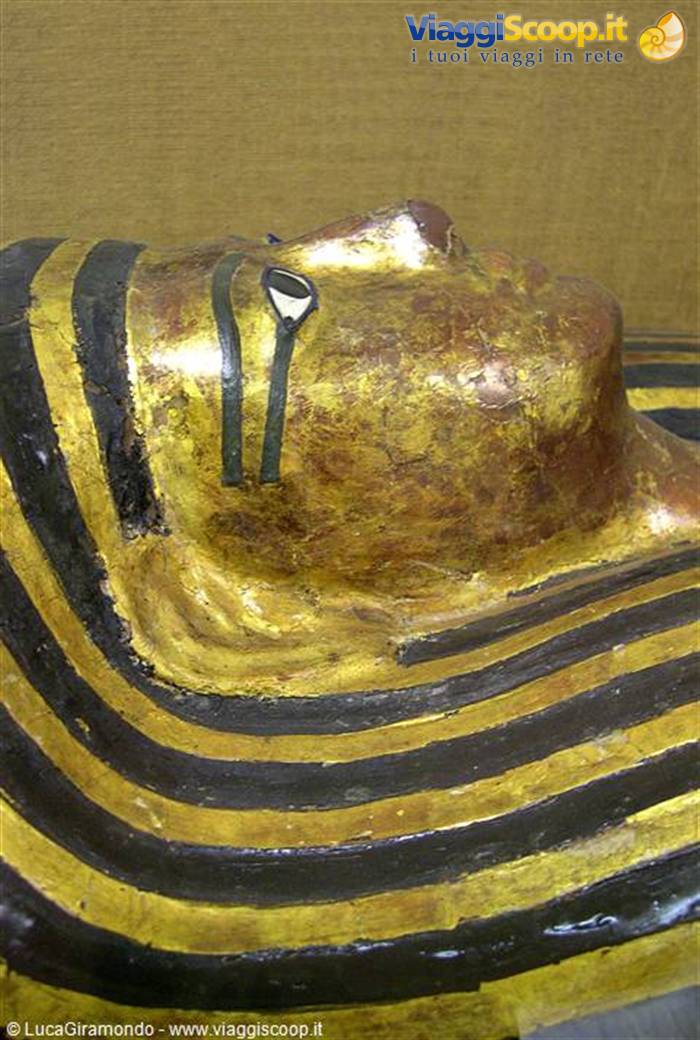
Egyptian Museum
Day 59 Sep 2006
Still clouds and gloom dominate Turin on this new day, but we don't lose heart and undaunted we set off again toward the city center. By bus we arrive at Piazza Castello and from there, in a few minutes on foot, we reach the famous Egyptian Museum, the main reason why we came to the Piedmontese capital... The extraordinary collection of finds housed in the rooms of this museum, in fact, is second in the world only to that of Cairo and stimulates our curiosity more than anything else. Begun by the Savoys in the 1700s, the collection was completed at the beginning of the twentieth century by the celebrated archaeologist Ernesto Schiapparelli, who successfully conducted several excavation campaigns along the Nile.
We thus immerse ourselves among hieroglyphs, funerary steles and tombstones, statuettes and amulets, stupendous sarcophagi and unsettling mummies (human and animal), astounding papyri in excellent state of preservation and tombs complete with furnishings... It is a real pleasure to observe the astonishing series of finds, moreover one can also take photographs (without flash, rightly so), as it should be everywhere, and I literally unleash myself... Absolutely extraordinary then, at the end of the museum route, is the statuary section, with various and imposing representations of pharaohs and deities made of sandstone, granite or black basanite. Having enthusiastically finished the visit we don't leave the building, however, since the sun is missing, and we decide to take a quick look also at the adjoining Sabauda Gallery, despite our declared ignorance of painting...
We still find a way to spend pleasantly another hour, so on the way out... miracle!... Through the white blanket of clouds filters some auspicious ray of sun. Noon has already passed for a while and we go to have lunch with our sandwiches in the very central Piazza S. Carlo... The most beautiful square in Turin presents a harmonious architectural appearance, conferred on it in the seventeenth century by the architect Carlo di Castellamonte, and on the short side, to the southwest, it is characterized by the curious twin churches of S. Cristina and S. Carlo, currently under restoration and wrapped in unsightly scaffolding...
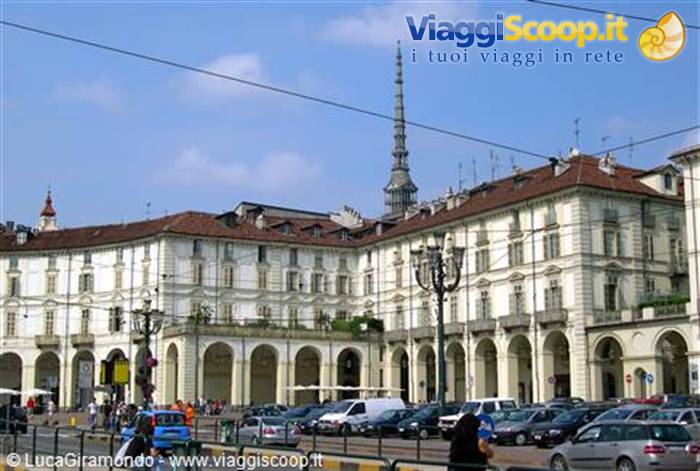
It is the most animated open space of the city, where the fans of the mythical Juventus habitually converge upon the victory of every trophy, and the place where today the celebration for the hundred years of the glorious Lancia car company is being held, with beautiful vintage cars on display... in some way the worthy introduction to one of the visits planned for the afternoon. While the sun wins its daily battle we walk back toward Piazza Castello and stop to photograph the beautiful Palazzo Carignano, historic seat of the first Italian Parliament and currently of the Museum of the Renaissance, which however we decide not to see. In the facing Piazza Carlo Alberto today a small flea market is being held, which we observe briefly before crossing the scenographic Galleria Subalpina that brings us right alongside Palazzo Madama.
Making use of public transport we reach the vast Piazza Vittorio Veneto and from there, with a short walk, the so-called Murazzi, on the banks of the Po, from where at 3:00 pm we set sail aboard the vessel Valentino. We sail on the first river of Italy, here still young, and skimming the Valentino Gardens (the largest green space in Turin) we continue further south to the Park of Italia 61... There we get off and on foot reach the National Automobile Museum, opened in 1960 and unique of its kind: a beautiful collection of vintage and sports cars, including Schumacher's Ferrari and that of the late Gilles Villeneuve... a splendid experience, more than dutiful, in the Italian capital of four wheels.
Having spent more than an hour in the world of motors, by bus we return toward the center and stop at the Valentino Park which, created in the mid-nineteenth century, is one of the first Italian urban parks and a true green lung of Turin. We are now exhausted, but we see the Rock Garden, the Medieval Village (a fake, built in 1884 on the occasion of an international exhibition) and the Valentino Castle, built in the 16th century as a riverside villa and subsequently transformed into a residence... Today it houses instead the faculty of architecture and cannot be visited, so we content ourselves with observing, through the gate, the monumental facade with the great courtyard of honor.
It is almost 6:00 pm and, having noticed an advertising sign, I inquire by telephone about the so-called Villa della Regina, just reopened after a long period of restoration, but all the visits (exclusively guided) are booked until October!... Obviously we give up and head toward the campsite, resigned to covering the last devastating uphill stretch on foot... but in the end, with pride and contrary to what happened to the French, we can affirm that we have almost conquered Turin and we retire inside the camper to rest, in anticipation of the last glimpse of visits scheduled for tomorrow morning.
Piazza Vittorio Veneto
Day 610 Sep 2006
The alarm is unhurried on this last day of a short but interesting vacation... We have breakfast while on TV the Malaysian Motorcycling Grand Prix is being broadcast (with a peremptory victory by Valentino Rossi!), then we leave the Villa Rey campsite in the camper. We go down to the banks of the Po and following it we reach the very first outskirts of Turin, at Sassi, from where the rack railway to the Basilica of Superga departs. We find a parking spot for our bulky vehicle and inquire about the train, which won't leave before 11:00 am... Nevertheless we decide to wait, because the climb of the hill this way appears to us much more intriguing than done on wheels...
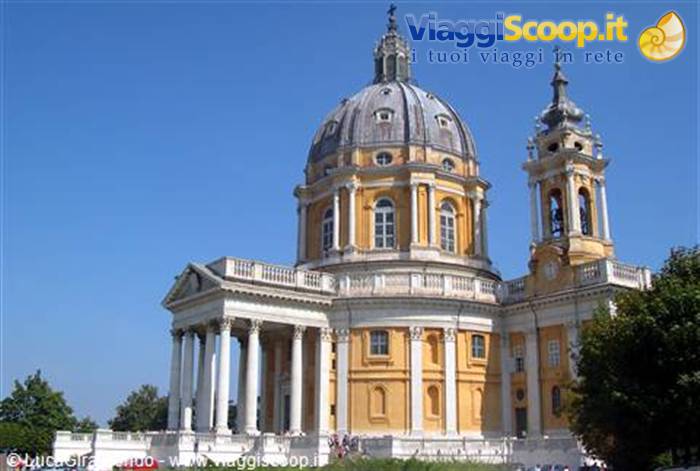
Indeed at the appointed time we go up, meter after meter, among beautiful panoramas of the city, up to the celebrated religious building, which for various reasons can be defined as one of the symbols of the Piedmontese capital, erected at the beginning of the eighteenth century, as an ex-voto, by King Victor Amadeus II, on a design by Filippo Juvarra. As soon as we arrive we book the visit to the Royal Tombs then, having gone around the Basilica at the back, we go to see the commemorative plaque of the Grande Torino tragedy, which occurred in this place on May 4, 1949: the plane of the football team then champion of Italy, in which also played ten of the eleven of the national team, crashed with no survivors, during the landing phase, on the hill of Superga, causing a grief still perceptible today among all the fans of Toro and of every true sports enthusiast of the Bel Paese.
As soon as the Sunday mass is over we also explore the interiors of the Basilica, made in Baroque style, and on the way out, in perfect time (at 12:15 pm) we present ourselves for the visit to the Royal Tombs: in the underground, in fact, are buried all the descendants of the House of Savoy, from 1731 to the Unification of Italy, with in the center of the tomb the monumental tomb of King Charles Albert... A guide accompanied us speaking continuously for 45 minutes, telling us stories and anecdotes of every member of the royal house, making pleasant as well as interesting the macabre parade. Having finished the visit to the underground we climb the 130 steps that lead to the base of the dome... from up there the panorama is beautiful, but the thick haze doesn't allow one to make out much and the silhouette of the Alps that surround Turin has remained only a memory seen on a postcard.
At 1:30 pm we get back on the rack railway and, leaving behind also the Basilica of Superga, we soon regain the banks of the Po where we find the camper again, so, given the hour, we have lunch and immediately afterward we kick off the return journey. We leave Turin at 2:55 pm and having covered the whole A21 at 4:50 pm we are at Piacenza. We take the A1 and, without encountering obstacles, at 6:15 pm we are at Bologna. The A14 also flows smoothly, while in the direction opposite to ours, returning from the sea, there are long tailbacks, so five minutes before 7:00 pm we leave the motorway at Forlì and after the routine operations at 7:25 pm we happily close the brief Piedmontese experience in front of the gate of our home.
It was a very interesting trip and rich in history: from cars to the ancient Romans, but above all from the Savoy kings to the Egyptian pharaohs and, absurdly, only with a question mark did we leave Turin (the splendid and surprising Turin)... but in what period did King Ramses of Savoy reign?...


0 reader comments