Another Friday departure, in spite of those who claim it brings bad luck: last time, less than two months ago, on the same day of the week, we took off for the States and everything went wonderfully well... on that occasion we visited places of extraordinary beauty and now it won't be easy to find something that measures up... Let's not despair though, our dear old Italy hardly ever disappoints expectations, especially when it comes to sea and history, the fundamental elements of this trip we're about to take in the Cilento. It's already dark when, having finished sorting out the camper, we leave home, at 21:53, accompanied by the little one's enthusiasm, who always particularly enjoys this kind of vacation.
We get on the highway at Forlì only to exit right after, at Cesena, then taking the E45 towards Rome: the superstrada, in the Apennine stretch, is uneven and full of potholes, nothing short of a disaster... a real disgrace and probably, given its importance, one of the worst roads in Italy. Around 23:00, having passed the Verghereto pass, we enter Tuscany and a little later Umbria: Sabrina and Federico put on their pajamas and go to sleep, with midnight striking near Perugia.
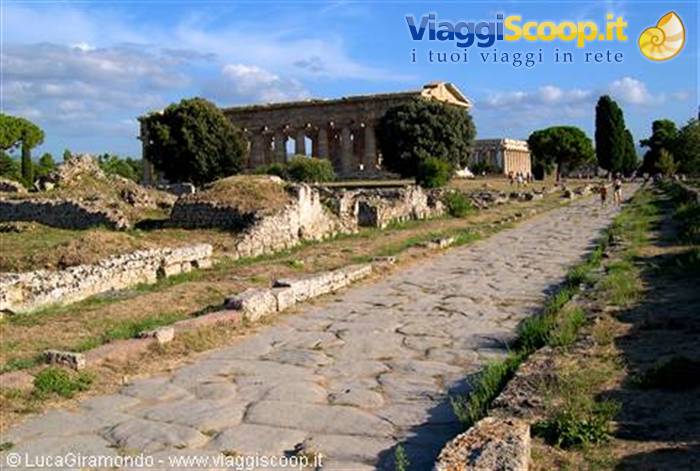
Paestum: the Sacred Way
Day 221 Aug 2004
I continue, in the company of the radio, along the E45 and at a certain point I can't help but notice the exit for a place that, who knows by what trick of fate, is called Bastardo... and I don't dare try to guess the name of its inhabitants... Shortly after, at 1:15, I stop to sleep, a few kilometers off the superstrada, near Narni. It doesn't take long for day to break again, so, after a quick breakfast, at 9:00 we're already on the road and a little later, having passed the Orte toll booth, on the highway. We proceed quickly, heading south, on the A1, while in the opposite direction there's quite a queue, mainly because of those who, unlike us, have already finished their vacations. Around 10:00 we leave the turnoff for Rome on our right and after a few kilometers we pass, driving through a service area, a strange checkpoint.
Obviously we're not the ones being sought and we can continue to follow, in complete tranquillity, our road toward southern Italy. Sabrina doesn't miss the chance to take a nap while Federico passes the time counting the fuel brands along the route, so, after a stop to refuel, at 12:00, near Caserta, we also leave the road to Naples on our right and, taking the A30, we arrive, around 13:00, at the Salerno barrier... Due to the heavy traffic it takes us a while to get through it, but in the end we also take the A3 (the infamous Salerno - Reggio Calabria) and arrive, after a few dozen kilometers, at the Battipaglia junction. At this point all we have to do is follow the Strada Statale 18 in the direction of the sea, but it's quite busy and we get stuck in traffic, taking much longer than expected.
It's gotten late and we're all rather tired and hungry, but we have to hold on because the finish line is really close... in fact, at 14:05, we enter the authorized camper parking area of Paestum and, finally, we can have lunch. In the afternoon we set off on foot to visit the famous archaeological area of Paestum. It was the Greeks, around 600 BC, who founded in this flat area, near the mouth of the Sele river, a city they called Poseidonia, in honor of the god of the sea.
The settlement, defended by mighty walls (the most imposing and best preserved of antiquity), reinforced with four gates at the cardinal points, thanks to its fortunate geographical position, quickly reached a remarkable degree of wealth and consequent artistic and cultural fervor that culminated, within about a century, in the construction of three splendid Doric temples: an unparalleled legacy of the entire Greek civilization. The magnificence of this colony soon aroused conquest ambitions in the Lucanians, an Italic population from the interior, who occupied it around 400 BC, changing its name to Paistom. In the meantime, however, quite another power was expanding along the entire peninsula, and who else but Rome, naturally.
Having become the undisputed master of these regions after the war against Pyrrhus, in 273 BC, the capital city founded a colony there under its dependence and gave the place the name Paestum. The Romans enriched the settlement with great buildings and Paestum prospered until the late empire, when due to the changed political needs of the capital, turned toward the east, the city began to fall into an irreversible crisis that led, over the centuries, to depopulation, also due to the migration of inhabitants to the nearby hills. After being abandoned, Paestum was not spoken of again for hundreds and hundreds of years, even though its temples always stood solemn among the dense vegetation and clearly visible from the sea.
It was the interest of eighteenth-century painters, poets and artists in ancient cultures that reawakened interest in the place, especially when they included the ancient vestiges of Paestum in the so-called "Grand Tour", which spread its fame throughout Europe. Since then, diligent work has been done to preserve the ancient stones and today we can observe them, expertly restored, in all their millennial magnificence. We pass through the colossal walls of the site and appear, on our left, beyond a fence, the unmistakable silhouettes of the temples. To buy tickets, however, we have to reach the archaeological museum and, for convenience, we decide to start the visit right from there.
Inaugurated with its first rooms in 1952, the museum has, over time, expanded and today houses a very interesting collection of Greek and Roman objects, coming from Paestum and the neighboring archaeological areas. Federico's proven passion for museums helps us a great deal and at a leisurely pace we can observe the precious finds, among which stand out the wonderful Lucanian tomb stones from the 4th century BC (in particular the so-called "Tomb of the Diver"). Strengthened by the experience gained among the museum rooms, we then tackle the exploration of the archaeological site, starting from the building known as the Temple of Ceres which, built at the end of the 6th century BC, turns out to be the smallest of the three, with 13 columns on the long sides and 6 on the short ones, but stands out scenographically, detached from the others, with its high pediments...
and is particularly photogenic, for us as well as for a newlywed couple, who decided to use it as a backdrop for their photo shoot. Walking along the evocative Via Sacra, which still boasts, for long stretches, its original paving, and passing through the ancient Forum, we then reach the wonderful Temple of Neptune (or of Poseidon), the newest, dating back to the mid-5th century BC, the best preserved and naturally the most beautiful, with 16 columns along its length and 6 across its width: a masterpiece of antiquity and one of the most significant examples of a Doric temple in all of Magna Graecia. Beside it stands the oldest building, constructed between 540 and 530 BC, called the Basilica, which with a colonnade of 18 by 9 is also the largest of the entire complex.
We remain, ecstatic, observing the temples which, in plain view on the esplanade, exude history from every stone, arousing indescribable emotions, and we almost don't realize that the site's closing time is now near. We're among the last to leave the gate, with some figs in hand, innocently "stolen" for Federico, who is crazy about them, from a tree located within the boundaries of the archaeological area, and back at the camper we get on our bicycles to reach the sea, which is no more than a kilometer away. A strong wind is blowing and the beach is battered by big waves... we hope it improves by Monday, when we'll dedicate ourselves entirely to beach life.
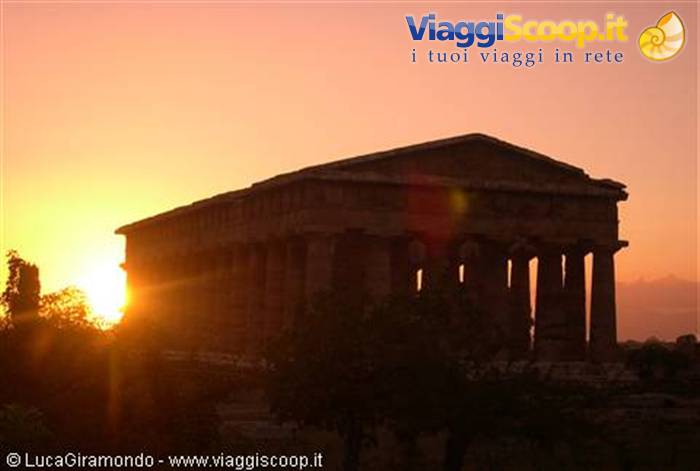
On the way back, pedaling in complete tranquillity, we go around the cyclopean walls of Paestum and unhurriedly regain the rest area where we're parked, to head, shortly after, to immortalize the temples in the magical light of sunset... But it's not over, because after dinner we return to observe them, after various ordeals and coinciding with the guided tours, illuminated in the warm and sparkling Cilento night, before retiring, tired from the intense but unforgettable day, among the narrow walls of the camper to enjoy our well-deserved rest.
Sunset at Paestum
Day 322 Aug 2004
We get up calmly and leave the ruins of Paestum behind us, following the Strada Statale number 106, which ventures inland: for today too we won't go to the sea, thus avoiding, as much as possible, local tourism and the nerve-wracking crowds of the weekend. We pass through the remote villages of Roccaspide and Bellosguardo, which although only a few dozen kilometers from the coast already seem, from there, light years away, though not as much as the ghost village of Roscigno Vecchio... Driving along a narrow country track we reach with the camper the square of this worn and crumbling hamlet, abandoned by its inhabitants at the beginning of the last century due to threatening landslides. Since those times, not even too distant, the village has been as if crystallized, restoring to the eyes of us visitors an almost unreal atmosphere.
We stroll for a while along its rickety streets, flanked by half-ruined buildings, which transmit, among other things, a good dose of sadness: lately a certain interest has reawakened in the place, but the fate of most of the buildings seems irremediably sealed. Strengthened by this new experience we resume our journey which first takes us through the new settlement of Roscigno, then over a pass at almost a thousand meters of altitude, before descending, one curve after another, to the so-called Vallo di Diano, a narrow strip of plain that corresponds to the bottom of a very ancient lake.
Here we enter the Salerno - Reggio Calabria, which we follow for a few kilometers northward, until we exit, following the signs, for the locality of Petrosa, where the underground cavities of the same name are found, also known as the "Grotte dell'Angelo", known since antiquity but visitable, albeit only minimally, only since 1932 and currently among the most interesting hypogea, from a tourist point of view, in all of southern Italy. We buy tickets for the 13:00 guided tour and since there isn't enough time to have lunch before departure, we improvise a small snack, so, right on time, we present ourselves at the entrance gate. The cave, which has an overall development of about three kilometers, is basically made up of three parallel branches, of which two are visitable and a third, the southernmost, completely occupied by a watercourse, which then gushes outside from the main branch.
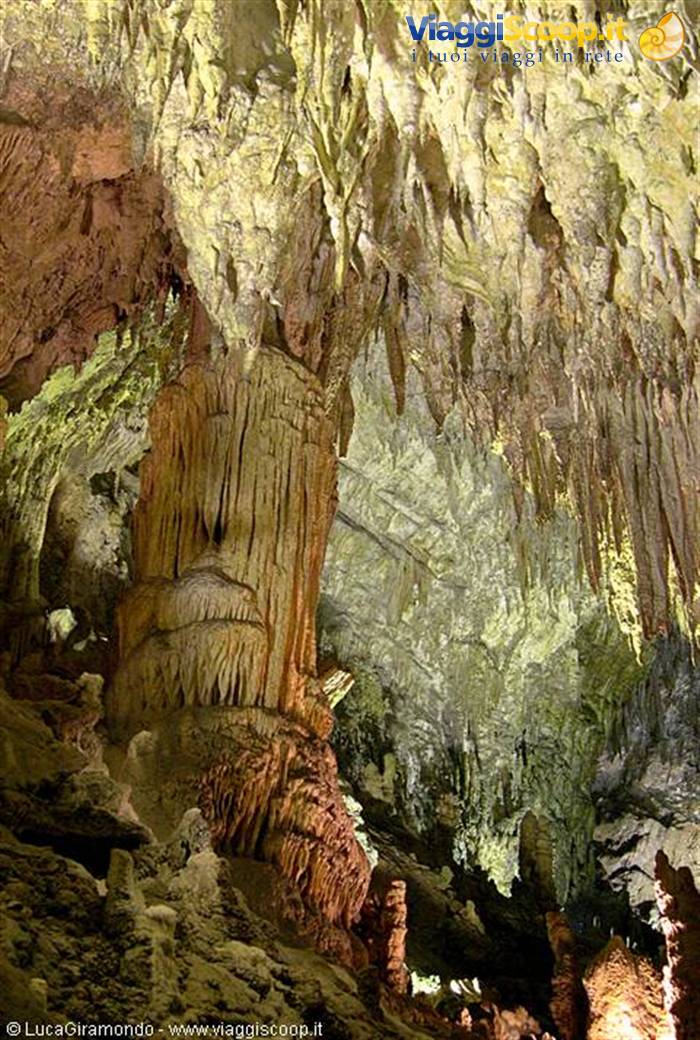
Since a dam was built years ago at the entrance of the cavity, the first part of the hypogeum is completely flooded and can only be passed with the help of a boat... We travel this first evocative stretch in semi-darkness and in the muffled silence classic of these places, passing among other things next to the spot chosen, by the famous horror director Dario Argento, as a natural set to shoot some scenes of the film "The Phantom of the Opera" and we reach the strange pier where one disembarks to tackle the visit of the more traditional part of these caves. There are fantastic stalactites and stalagmites, candid but above all "alive", with the constant ticking of water, falling from the ceiling, that accompanies us throughout the whole route.
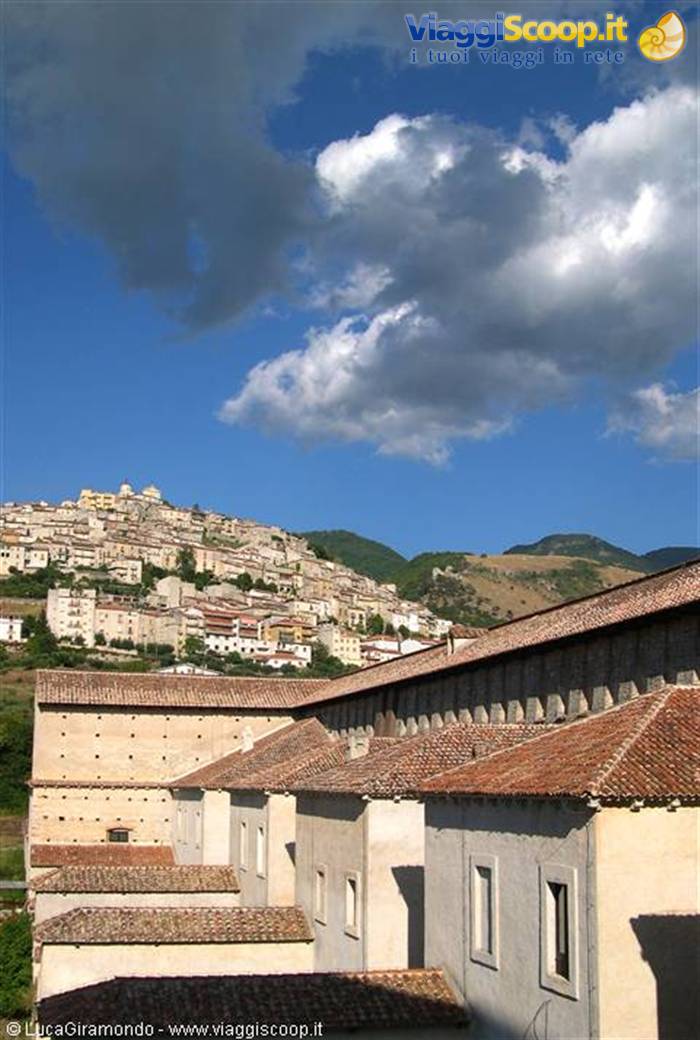
We thus arrive at what is called the "Hall of the Sponges", surely the most beautiful, and then we regain the exit following an alternative path that winds among bizarre concretions. After more than an hour we return to the sunlight: we're all satisfied with the experience just lived, but Federico, who always enjoys this kind of visit, is particularly so. Having finally had lunch, we resume our journey along the A3 highway, which we follow for another short stretch, but heading south, until the exit for the locality of Padula. The settlement in question is perched on the first heights of the Monti della Maddalena and is known because at its feet lies the famous Certosa di San Lorenzo, one of the largest monasteries in the world and among those of greatest interest in Europe, for architectural magnificence and abundance of artistic treasures.
It was the Norman Tommaso Sanseverino, lord of the Vallo di Diano, in 1306 who donated (for political reasons) the building to the Carthusian order, which, strong in their influence, brought it, over time, to a high degree of wealth and prestige. After a period of disgrace under the domination of Napoleon Bonaparte's France, the Certosa flourished again, but the ancient magnificence remained only a nostalgic memory and there was immediately a new, progressive decline that led, in 1866, to the suppression of the monastery. In 1882 the whole complex was declared a National Monument, but only a hundred years later did the restorations begin thanks to which, today, we can observe, recovered to their ancient splendor, the old spaces with their wonderful works of art, the fruit of centuries of history of the entire region.
We wander at length among the courtyards, the cloisters and the interiors of the great religious complex. Some chapels are very beautiful, in which refined decorations stand out, the Great Cloister, which with its twelve thousand square meters is among the largest in the world, and the wonderful elliptical two-ramp staircase, contained in an octagonal tower, from whose large openings there are exceptional views over the town and the surrounding hills. It's almost 18:00 when we also conclude this beautiful visit and resume our itinerary toward southern Italy. We take the A3 again and, having crossed the border between Campania and Basilicata, at the Lagonegro exit we begin to descend in the direction of the sea.
When, finally, we sight the Tyrrhenian coast we enter Calabria, pass the localities of Praia a Mare and San Nicola Arcella, and arrive in the town of Scalea, a tourist center built at the foot of the old and scenic village, which stands out, perched on a small hill, a short distance from the sea. In the cheerful Calabrian town, however, it's not possible to stop for the night, so we head back toward San Nicola Arcella and descend to an inlet along a winding road, but we don't find a spot that suits us. Meanwhile time passes inexorably and the sun sets, masterfully lighting up the waves of the Tyrrhenian Sea... It's almost dark when, finally, we find a parking lot with other campers a short distance from Praia a Mare, near the Isola di Dino, and there we stop, concluding a beautiful and interesting day, rich in historical and naturalistic insights.
Grotte dell'Angelo
Day 423 Aug 2004
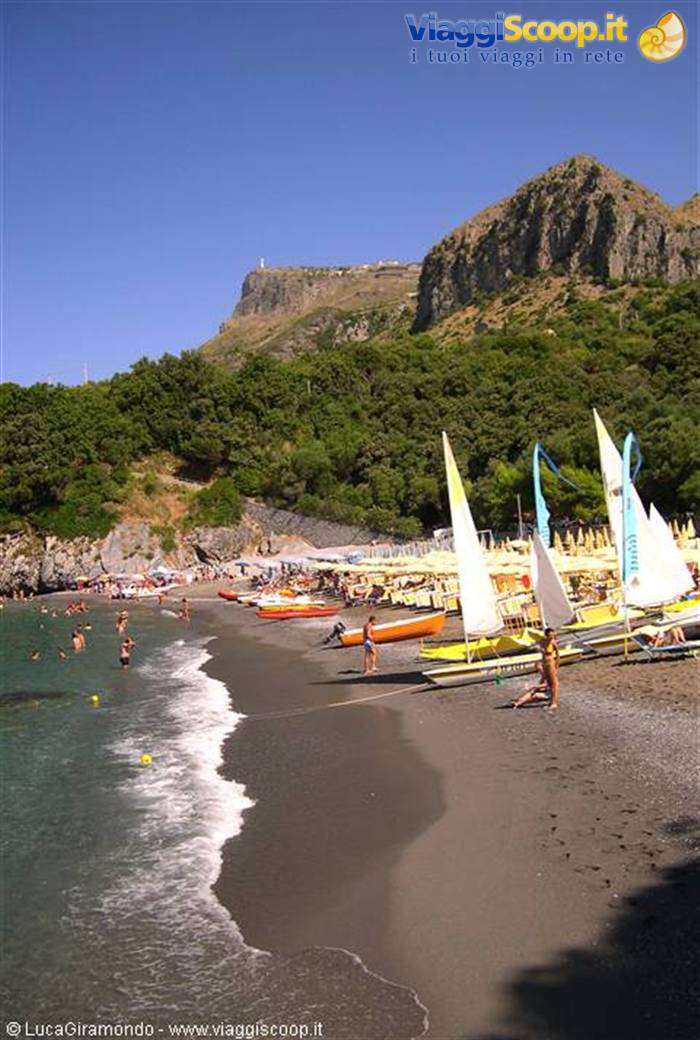
This morning we don't have to drive at all, because we're already in the place where we intend to spend the whole day, so we get out of bed without haste and treat ourselves to a peaceful breakfast. Right after, more out of laziness than necessity, we move with the camper to the parking lot facing the Isola di Dino and go to the beach. The sandy shore, of gray sand and dark pebbles, isn't the best one could wish for and the gloomy seabed doesn't enhance the blue of the sea, but we have to make do. We set up the beach umbrella a few meters from the water's edge and, while Sabrina and Federico devote themselves to beach life, I go in search of a bakery and a piece of bread... I return after having walked a few kilometers and, overheated, I throw myself into the water in the company of the little one.
The great silhouette of the Isola di Dino, only a few dozen meters from the shore, constantly looms over us and characterizes all the views in the direction of the sea, until it completely captures our attention. Shortly before noon, in fact, we decide to take part in a boat excursion around the island's perimeter, dotted, among other things, with some interesting caves. We board the vessel directly from the beach, a very short distance from our umbrella, and set off facing what from the shore seems only the circuit of an enormous rock, whose circumference instead measures a good seven kilometers! The flat rocky island, owned by the Agnelli family, hosts an exclusive tourist village, whose guests will certainly be forced to bathe in the pool, given the total lack of beaches...
What isn't lacking, however, are the caves (nice ones), which we visit in the concluding part of the tour: in particular the very classic Grotta Azzurra (looking carefully at the map of the area, with this name, you can practically find one in every municipality along the coast) and the Grotta del Leone. Having finished the brief boat trip we return to the beach, which in the meantime has filled up beyond belief, and after a refreshing swim we retire inside the camper to have lunch... but we don't stay there long and soon we find ourselves under our umbrella, facing the Tyrrhenian Sea which, thank God, is no longer the one from a couple of days ago and now breaks placidly on the water's edge.
We stay reveling, between one swim and another, in this place until evening, when the sun, in its continuous advance toward the east, disappears behind the Isola di Dino: then the beach empties and we can finally "breathe". It's useless, the crowding of the Italian coasts in the summer months is, unfortunately, a bitter rent we cannot escape, so, a little later, the sun setting brushing the severe silhouette of the island and setting the sky behind it ablaze, in the silence of the now semi-deserted sandy shore, becomes the most genuine memory of this first day at the sea on the southern borders of the Cilento...
It's with this thought in mind that we leave the beach and, after carrying out the loading and unloading operations at a nearby campsite (which charges handsomely for it!), we go to stop for the night, in the company of other campers, in the same parking lot as last night, on the outskirts of Praia a Mare.
Padula Charterhouse
Day 524 Aug 2004
Intending to leave the Isola di Dino and Praia a Mare we set off, following the coastal road, in a northerly direction, but we can't get out of the town because between it and the Strada Statale runs the railway line, whose underpasses are all too low for our camper. We're thus forced to head back south, considerably lengthening the route and, above all, losing a lot of precious time. More than an hour after departure we finally take the Statale number 18, following which, soon, we leave Calabria behind to enter Basilicata. The coast immediately becomes high and the strip of asphalt begins to run rather far from the sea, so, at a certain point, we start descending, along a secondary road, in the direction of the Spiaggia di Macarro.
In this way we reach a parking lot, where we leave the vehicle, and on foot we head toward the sandy shore, about which, even from home, I had good references. The inlet, in fact, is set among high rock walls and offers a good view, even in the distance over the statue of the Redeemer of Maratea, which dominates (Rio de Janeiro style) this stretch of the Lucanian coastline. The sand and therefore the seabed here too are dark, naturally at the expense of the sea, which would be decent in terms of clarity, but which unfortunately doesn't stand out as it should. We take a few swims and stay at the Spiaggia di Macarro until almost 14:00 when, having put all our things back in order, we return to the camper to have lunch.
Refreshed, after a first part of the day all in all positive, we resume our itinerary along this portion of the Tyrrhenian coast which, having passed the settlement of Maratea with its Marina, becomes particularly rugged and, at times, spectacular. We're looking for a beach where to spend the rest of the afternoon and along the way we notice some small bays set among the rocks, but they're difficult to access and, above all, offer no possibility of stopping, especially for a vehicle the size of a camper. We have no choice but to continue until where the coastal profile becomes gentler: we thus re-enter Campanian territory, at Sapri, right in the center of the Gulf of Policastro...
but here the beaches don't satisfy us and, having also discarded the seemingly depressed area of the mouth of the Bussento river, we start climbing along the road that, passing through the interior, reaches the famous locality of Marina di Camerota. We tackle the route, which winds among the Cilento coastal hills, with a bit of apprehension due to a sign warning about transit through a small settlement, with height and width limits very similar to ours, but we successfully overcome the obstacle (without too many centimeters to spare) and in the end we arrive unscathed at the long-awaited destination. We're now in the late afternoon when we take the road, very narrow and full of parked cars, that leads to the main beach of Marina di Camerota, that of Lentiscelle.
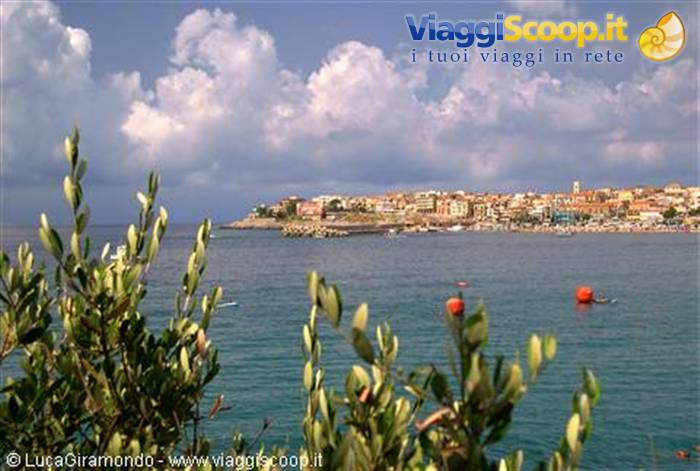
We move like an elephant in a china shop and, after a slight touch with the side of the camper, we remain damnably stuck and manage to extricate ourselves only after quite some time, when, finally, we find a gap in the traffic and a spot for our bulky vehicle. All of this naturally generated some tension, but we can still afford a couple more hours of relaxation on the beach and little by little good humor returns... so, while Federico plays at the water's edge and finds new friends, I go to the nearby beach establishment to get information about tomorrow's boat excursion... then it's up to the sun to brighten the last glimpses of this day, setting wonderfully on our right, behind the promontory on which the town of Marina di Camerota stands scenographically perched, which, kindly, will host us in this warm late-August night.
Dino Island
Day 625 Aug 2004
Today too is a splendid day: nothing better could be wished for in view of the awaited boat excursion along the coast of Marina di Camerota. We're at the Spiaggia di Lentiscelle and I've agreed with Franco, the lifeguard of the nearby beach establishment, about the boat, departing from the nearby tourist port, which should come pick us up, so, after breakfast, I go to my very own trusted man... Having heard my requests Franco, who talks to me as if we'd known each other forever, dials a number on his cell phone and exchanges a few jokes in the local dialect with the other end: a quarter of an hour later, as if by magic, a vessel of the Cooperativa Cilento Mare shows up, which will accompany us on the trip along the coast south of the town. The stretch of coastline in question, accessible only by sea, is rocky, rugged and extremely uneven.
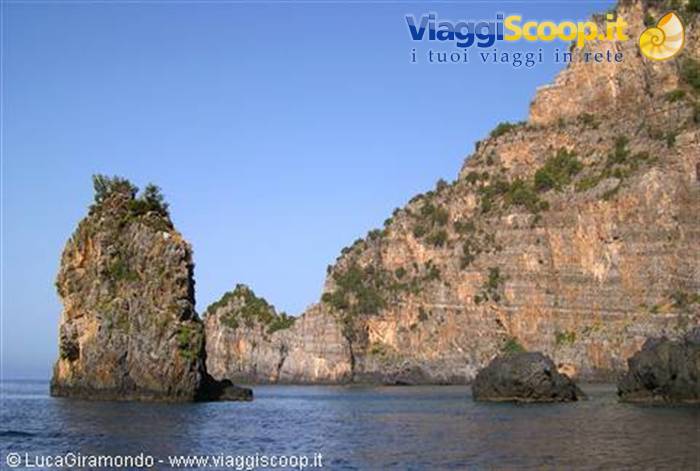
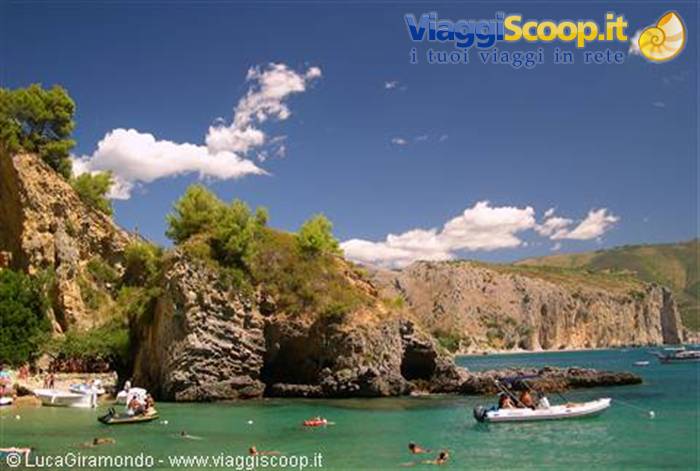
We thus visit, in sequence, Baia Fortuna, with its inevitable Grotta Azzurra, the spectacular Cala Monte di Luna, characterized by the presence of a colossal sea stack, the beautiful Spiaggia del Pozzallo and that of Cala Bianca, then, rounding the Capo di Punta Iscoleti, we enter the Gulf of Policastro... and here it's a real shame that the classic Mediterranean haze considerably limits visibility, because from this point you'd clearly distinguish three regions: Campania, Basilicata and Calabria.
This doesn't prevent us, however, from reaching Porto Infreschi, the jewel in the crown of the Cilento coast, which, characterized by the so-called Grotta del Toro and the presence of the small Chapel of San Lorenzo in addition to the ruined Torre del Frontone, owes its name to the coolness of the spring waters present, or to the clay extracted in Roman times for the manufacture of terracotta objects (the place was called, at the time, Anphorisca). The tiny beach, however, despite the still early hour, is already overcrowded (as well as a small disappointment) and fortunately our "navigation officer" lands us, for the rest of the day, at the more attractive and spacious Cala del Pozzallo.
Named so because of the presence, nearby, of some freshwater wells, the beach has a shoreline made up of mostly light-colored pebbles, which finally highlight the transparency of the sea and, although the presence of bathers progressively increases in the central hours of the day, the place is sufficiently wild and satisfies us amply... thus earning, fully deservedly, the palm of best seaside spot on this trip in the Cilento. Strengthened by these considerations we don't miss the chance and pull the inflatable mattress out of the backpack to enjoy, in its company, countless and very pleasant swims, until the time of the expected packed lunch. Pampered by the splendid sea of Cala del Pozzallo we pleasantly spend the first hours of the afternoon too, observing among other things some kids who dive, recklessly, from the high cliffs that flank the inlet...
and time inevitably flies, so in the blink of an eye it's 16:30, the expected time for the return. The boat of the Cooperativa Cilento Mare shows up on time and shortly before 17:00 sets sail bound for Marina di Camerota: it retraces a good stretch of coast and leaves us where it had picked us up in the morning, at the Spiaggia di Lentiscelle. We still have a few hours of warm sun left and we stop at the water's edge, in this way Federico finds the little friends from the day before and spends some time playing with them, while little by little the warm colors of sunset arrive... It's divine now: almost all the bathers have left and the lapping of the waves provides the background to the last moments of a beautiful day, with plenty of quality sea and a good dose of well-deserved relaxation.
The shadows of evening descend on the Spiaggia di Lentiscelle and we retire inside the camper to have dinner with a good pizza (incredible the difference in price compared to northern Italy!) and to listen, on the radio, to the Athens Olympics, with the hope that some Italian athlete will win a medal and with the certainty of finding, in a few days, Marina di Camerota on the hypothetical podium of this vacation.
Macarro Beach
Day 726 Aug 2004
The long and useless wandering of two days ago in search of a beach and a place suitable for stopping, in the stretch of coast between Maratea and the Gulf of Policastro, has given us a day's advantage over the normal course of the itinerary, so, having ascertained the good qualities of the beach and the sea of Marina di Camerota, we decide to spend an entire day on the spot in the name of the most complete relaxation. We get up very calmly and then go carve out our corner of the Tyrrhenian Sea in the southernmost part of the Spiaggia di Lentiscelle, where the sandy shore then gives way to the high cliffs. In the spot where we've settled, at the foot of the cliffs, shade still predominates, but the sun will arrive soon, even if in the sky today a few too many clouds are wandering...
Meanwhile, in the company of Federico, I go, following a short path, to the nearby Torre Saracena, and on the way back we enjoy a good swim in the transparent waters of Marina di Camerota. In the most absolute idleness the first part of the day thus slips away, until, now at noon, something suddenly changes in the air: the sea ripples and an annoying wind begins to blow. We unconsciously try not to give importance to it... maybe it'll be a storm nearby and soon everything will pass... Instead the waters get more and more agitated and when, around 14:00, we return to the camper for lunch we can't help but notice the beach already sparse with bathers compared to the morning. In the afternoon, almost as a token gesture, we return to the beach to defy the weather, with the sea that in the meantime has really gotten angry...
and fortunately it wasn't like this yesterday, during the boat excursion. Together with Federico I take a lively swim among the waves, while Sabrina sits on the shore, reading her book, wrapped in her beach towel, until the wind increases further in intensity and the clouds completely obscure the blue of the sky, then we too raise the white flag. We leave the Spiaggia di Lentiscelle, now half-deserted, and move, also out of necessity, to the equipped camper area nearby where, after carrying out the classic routine operations, we stop for dinner and for the night. In the evening we go out for a walk in the center of Marina di Camerota, with the loud voice of the sea, crashing on the rocks of the port, providing the background: it's a chaotic and excessively touristy little town, nothing exceptional... much better its coast and its natural beauties.
Monte di Luna Cove
Day 827 Aug 2004
We try to leave early, to avoid as much traffic as possible. In today's program, in fact, there's a big unknown: Palinuro. The well-known locality, the jewel in the crown of the Cilento coast, will certainly be invaded by hordes of tourists and our fundamental problem is that of finding a place (not light years from the center) to park seven "awkward" meters of camper! We cover the few kilometers of coast that divide Marina di Camerota from Palinuro and already before 9:00 we take the road that goes into the heart of the town: we come across a no-camper-transit sign, but I ignore it... we have to park, not camp! The road is narrow but traffic is still light, so we reach the small tourist port: our main goal is the Cala del Buon Dormire, located at the base of the cliffs of Capo Palinuro and, apparently, inaccessible by land.
In this regard we'd be inclined to take part in one of the many boat excursions that, passing by the famous Grotta... naturally... Azzurra and rounding the Cape, arrive at the small inlet, but there's a problem... We ask for information from a parking attendant (very kind) and we're told that today, given the rough sea, no boat will depart, but he also tells us, as I suspected, that the Cala del Buon Dormire, if you want, is also accessible by land: just follow the lighthouse road and descend, on foot, along a path near the Hotel Residence King... I point out to him, indicating the camper, that I don't have a small car, but he says there won't be any problems... and we trust him.
Even if a bit hesitant we embark on this adventure because, with the wind blowing from the northwest, the Cala, besides being beautiful, should also be one of the very few places with calm sea along the whole coastline... Meanwhile the road is good and we find parking right near the hotel. I ask for information from another reckless (and rickety) camper who's on the spot, but he's not even aware of the beach's existence, so I ask a customer of the King who tells me that to descend to the inlet you have to go right through the hotel... We don't lose heart and, loaded with everything needed for beach life, we pass through the gate of the tourist complex. Almost immediately we meet an attendant whom we ask to be allowed to pass: he kindly points out that the matter doesn't depend on him... but he indicates the right way and says he didn't see us.
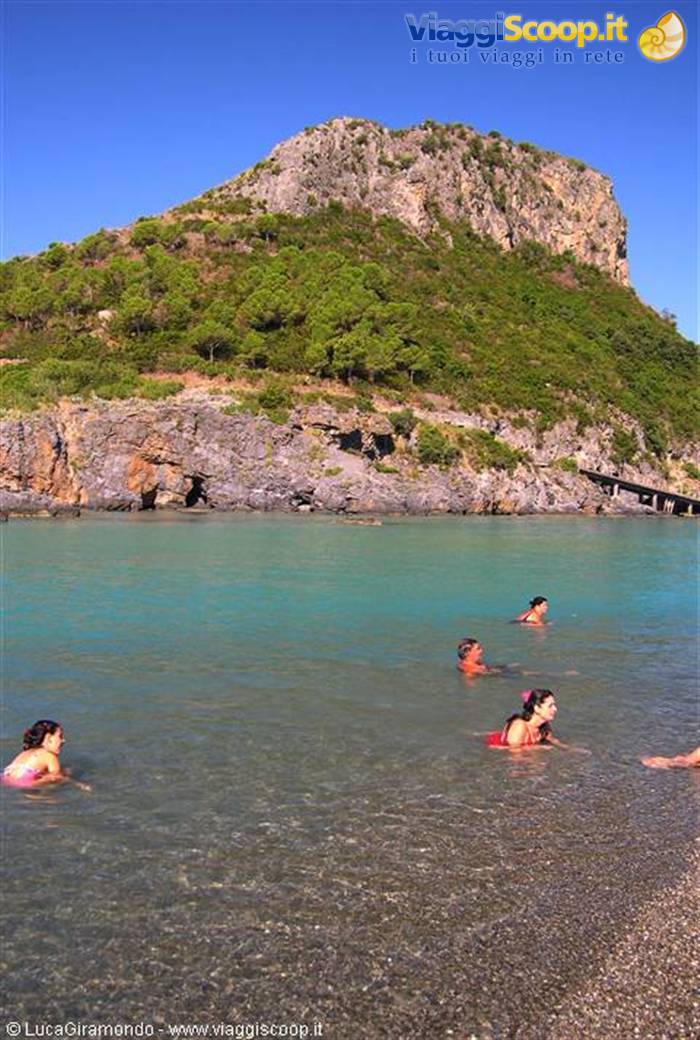
Casually we pass by the pool and begin to descend, among beautiful panoramic views, along the staircase that slopes clinging to the severe profile of the cliff. We thus come into view of the Cala del Buon Dormire, which is truly beautiful: a small jewel set in the coast of Capo Palinuro. We camp on the tiny sandy shore, half occupied by the umbrellas of the Hotel King, and, while Sabrina enjoys the warm rays of the sun, we pass the time exploring a nearby cave and taking long swims in the crystal-clear (and rather cold) waters of the bay. Federico makes friends with some children from Biella and we stay on the spot for lunch too, but, unfortunately, the high cliffs behind us mean that the sun gives way to shade already around 14:00...
We stay another hour or so and then head back along the return path, with Sabrina consumed by the worry of being discovered as an unwanted trespasser of the hotel. We calmly climb the 467 steps that bring us back to the Residence, pass by the pool and, calmly, just as we entered... we exit... mission accomplished!... indeed, splendid mission accomplished! Without encountering problems we also exit Palinuro and start following the coast northward, while the sea, which continues to crash forcefully on the water's edge, gives even more value to our furtive adventure. We thus pass the settlement of Ascea and arrive near the archaeological site of Velia. We have a little more than an hour to visit the ruins of this ancient city, founded in 540 BC by the Phocaeans, a population fleeing from Asia Minor following the Persian invasion.
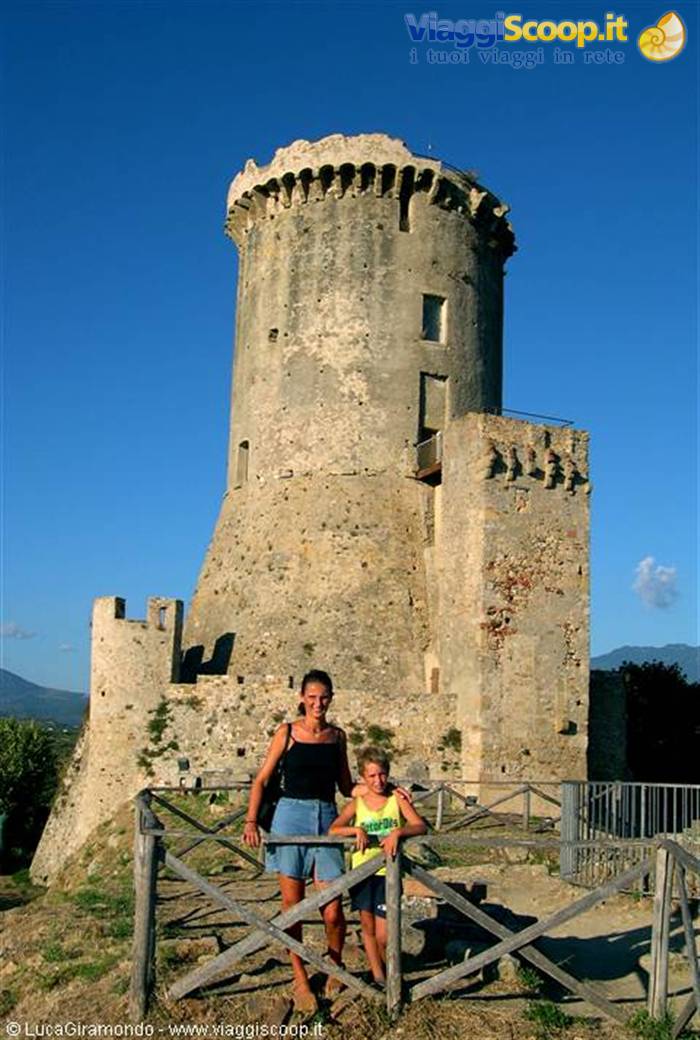
Initially called Elea, it became Velia under Roman domination and declined around the 5th century AD following devastating floods and barbarian invasions. The remains, not comparable to those of Paestum, are nonetheless interesting and in particular the splendid Porta Rosa and the Porta Marina stand out, as well as the Acropolis which, placed on a height, also includes some scenic medieval fortifications. We enjoy the place, immersed in greenery and perhaps a bit mistreated, in complete solitude, surrounded by the millennial silence of the stones and when we leave the custodians (perhaps a bit annoyed) close the gate of the site practically behind our backs. In search of
Marina di Camerota
Day 928 Aug 2004
It's the last day in the Cilento, but the itinerary has come to an end, in practice, yesterday evening with the arrival in Paestum. In the stretch of sea between Palinuro and the archaeological site we didn't find a beach that suited us... and we won't find one today either, on the flat coastline that reaches all the way to Salerno, but we'll try to make do... Meanwhile, when we set off, on our right, we can glimpse the Basilica with the magnificent Temple of Neptune beside it... and that's enough to put us in a good mood. Following the coastal road we turn off toward the sea shortly after the village of Laura and arrive at a small parking area located beside the Molo Sirena, a sort of beach establishment. One look at the beach makes us realize that the place, as far as beauty goes, certainly doesn't excel, but it's no worse than what we would find further on, so we decide to stop.
We plant the beach umbrella, which sinks easily into a soft sand that is particularly pleasant to the touch... we'll see about spending the day here and we'll try to adjust as much as possible to this sea... how shall I put it... of "B" grade, which at least, compared to yesterday, has calmed down considerably. The most beautiful thing around us are the wild lilies, which grow in bunches almost everywhere at the edge of the beach... To tell the truth the whole place wouldn't be bad if it weren't for the haze and for that water, more like a vegetable broth than anything else, with the pine forest behind us and the long expanse of sand bordered, on the left, by the mountainous profile of the Cilento coastline and, on the right, by the stern Amalfi coast, with the Island of Capri barely visible in the Mediterranean mist...
In this setting we take a few dips, more to beat the summer heat than anything else, then, around 1:00 PM, we go back to the camper to have lunch. We do everything with extreme calm, listen to some radio, with the ever-present Olympics, and shortly before 4:00 PM we head back to the beach to spend a few hours of complete relaxation, until the sun, setting masterfully over the stretch of sea in front of us, makes us realize that the time to go has come. We have dinner and then, at 8:55 PM, we begin the return journey, so, not even half an hour later, we get on the highway at Battipaglia... and after a few kilometers we're already stopped in a traffic jam! The traffic is heavy up to the Salerno toll barrier, then it flows more smoothly and at 10:30 PM, near Caserta, Sabrina and Federico go to sleep, leaving me in the company of the radio and the Olympic basketball final Italy-Argentina...
go Azzurri! At 11:20 PM, shortly after Cassino, I stop at a service area to refuel, while unfortunately Italy has to settle for silver... I get back on the road, sportingly a bit annoyed, I leave behind the exit for Frosinone and after a handful of kilometers midnight striking announces the beginning of a new day...
Buon Dormire Cove
Day 1029 Aug 2004
At the Rome south junction the hands of the clock show 12:15 AM and we proceed swiftly along the A1 up to the Orte exit... It's 1:07 AM when we start following the E45 and less than half an hour later we stop at Narni, in the same parking area as on the way there, so I can grant myself a few hours of well-deserved rest. At 9:25 AM, after a quick breakfast, we set off again and, clocking up kilometers, at 10:15 AM we pass near Perugia, continuing up the Tiber Valley. Later, due to (eternal) roadworks, we cross the Verghereto Pass going outside the superstrada and once back on it, in no time, we leave the Apennines behind us, so at 12:15 PM we're in Cesena and, taking the A14, a quarter of an hour later in Forlì.
After completing all the operations concerning the camper, in the designated equipped area (with Federico who, seized by the usual frenzy, crushes his foot under a heavy grate and ends up in the inevitable tears), at 12:50 PM we happily conclude, in front of our own gate, this trip too... Dear old Italy never disappoints and the Cilento is no exception, with the wonders of Paestum at the top of the list, but also with the sumptuous Certosa di Padula, the Grotte dell'Angelo and the beautiful beaches of Palinuro and Marina di Camerota... We had a good time wandering among these lands of Campania, but also of Lucania and Calabria, only one thing disturbed us in some way: after the order found on the recent American trip, the omnipresent, chaotic, Italian disorder has reappeared before our eyes...
but on reflection perhaps it's precisely this that makes us a people so extraordinarily creative and full of wonderful vitality.


1 reader comments
racconto bellissimo e dettagliato, foto superlative !!! complimenti