Also this year, God willing, the summer holidays have arrived and, in full harmony with the economic crisis, but also with the needs of our little Leo (three years old), we will stay in the Bel Paese and go, in a camper, to discover Sicily: the largest island in the Mediterranean, as well as the largest Italian region, with its over 25,000 square kilometers. After a torrid week of blazing sun, last night it rained, consequently the temperature has dropped considerably... and we don't mind that given the many kilometers to travel to reach our destination. We wake up early and, while Federico (now an adult) gives a hand with the final preparations, the little one is charged up to the max and by 8:30 he is already seated in his car seat ready to leave... Too bad there are still several things to sort out, which prevent us from setting off before 9:00...
On the plus side, after not even two kilometers he declares he is tired... then he looks with that slightly sly air and says: "I was joking!". Today, as far as traffic goes, it's a day of undeniable red alert, but everything proceeds as well as possible and around 10:00 we are already in Pesaro... Scratch that: half an hour later we are stopped in a queue and at Ancona Nord it's 11:40!... Now we are proceeding as fast as a sloth!... At Porto Sant'Elpidio in fact we face another traffic jam and shortly after, at 12:40, we stop at a service area to have lunch, while since this morning we have covered the miserable distance of about two hundred kilometers! We set off again after a little more than an hour, at 13:50, with the traffic seeming to be a bit more fluid, so at 14:40 we are in Pescara.
From here on the flow of vehicles can be considered normal, but Abruzzo, Molise and Puglia are endless and we take another three hours to reach Bari. Continuing to grind out kilometers we also conquer the end of the Adriatic Motorway, with the unpleasant outline of the vast industrial settlements of Taranto on the horizon, and from there we take to following the Ionic State Road, which unwinds parallel to the coast of Basilicata. In this way we also gain the first foothills of Calabria, while big clouds gather... and it even rains hard when, around 19:30, we arrive at the camper area of the town of Trebisacce, where we will spend this first night of the holiday.
Alcantara Gorge
Day 211 Aug 2013
At 8:40 the long journey toward Sicily resumes. We follow the Ionic State Road for a short stretch still and then head inland to pick up the course of the A3 Salerno-Reggio Calabria motorway. The main Calabrian artery, despite its terrible reputation, is flowing and a quarter of an hour before 10:00 we pass near Cosenza, then after a stop at the Rosarno Ovest service area to buy in advance the Caronte & Tourist ferry tickets, around 11:00 we are at Villa San Giovanni, with the coasts of Sicily in front of us and Leonardo galvanized by the idea of getting on the vessel that will make us land there. The wait fortunately is short, not so much for the stress of having to wait physically, as for the impatience of the little one, which would have been unbearable... The crossing then is equally brief and we disembark in Messina at 12:50.
We then take the A18 motorway in the direction of Catania and at the first service area we stop to have lunch. We set off again at 14:30 and less than an hour later we are at the Europarking camper area of Giardini Naxos. We wait for Leonardo to finish his afternoon nap and after a refreshing shower we dedicate ourselves to the first official visit of the trip: the one to the well-known town of Taormina. The most fashionable town in Sicily, of which it was even the capital in Byzantine times, is a delightful medieval village, nestled on the slopes of Monte Tauro, a very short distance from the coasts of the Ionian Sea, which offers one of the most evocative panoramas of the island: no wonder Goethe defined it "The greatest masterpiece of art and nature".
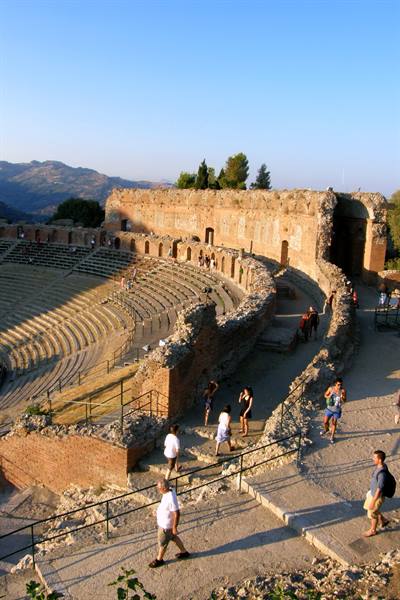
From the camper area we head, by bus, toward Taormina, but we leave a bit late, then, due to traffic, we take about half an hour to reach the terminus near the center, so we have to make a big dash to manage to visit the Greek Theater, the most important monument of the city, which closes its doors at 19:00. The bewitching construction was erected in the 3rd century BC facing the sea, in a magnificent panoramic position and, carved into the rock in the shape of a shell, it could hold up to four thousand spectators. We explore it step by step, trying to catch the best perspectives... too bad that with the sun now low on the horizon line everything is largely in shadow, and in that condition the happiest seems to be Leonardo who can anyway scamper up and down the ancient tiers. There's no denying it: the first visit was certainly not impeccable in its organization...
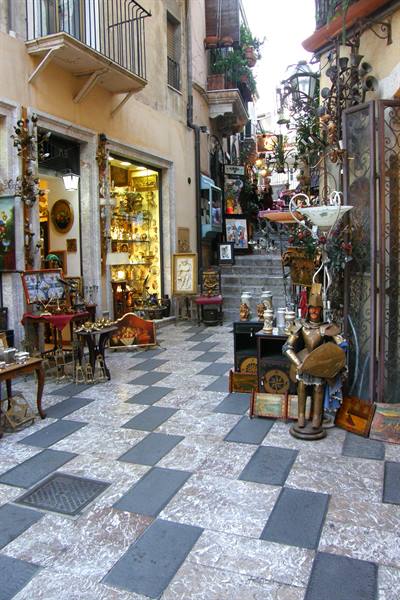
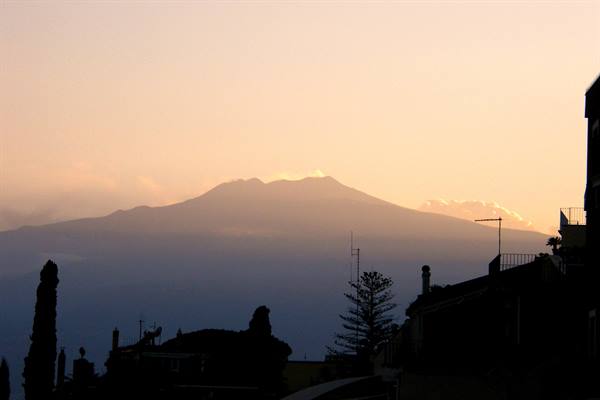
We must skip for lack of time the exploration of the Public Gardens, which would have been interesting, and we settle for following on a walk the beautiful Corso Umberto I, at this hour swarming with people, also very elegant in appearance. From the severe Palazzo Corvaja, with characteristic glimpses of the side alleys, among which the curious Vicolo Stretto (which so recalls Monopoly), where two people of average build would have trouble passing each other, we arrive at the panoramic Piazza IX Aprile, with a view of the imposing outline of Etna. From there we then continue to the charming little square of the cathedral, adorned by a beautiful baroque fountain...
in this way it becomes dinner time and following the advice of the Routard we go to the restaurant La Cisterna del Moro, from whose terrace you enjoy a beautiful view, and in that exclusive place we relax, cheered by good food, until the onset of darkness. Later, calmly, we retrace the Corso Umberto I and return to the bus terminus, then, with darkness now total, to Giardini Naxos and the camper area, concluding the first (partly) Sicilian day... not perfect, execution-wise, but all in all positive... starting tomorrow, though, we will try to organize ourselves better.
Etna: Silvestri Craters
Day 312 Aug 2013
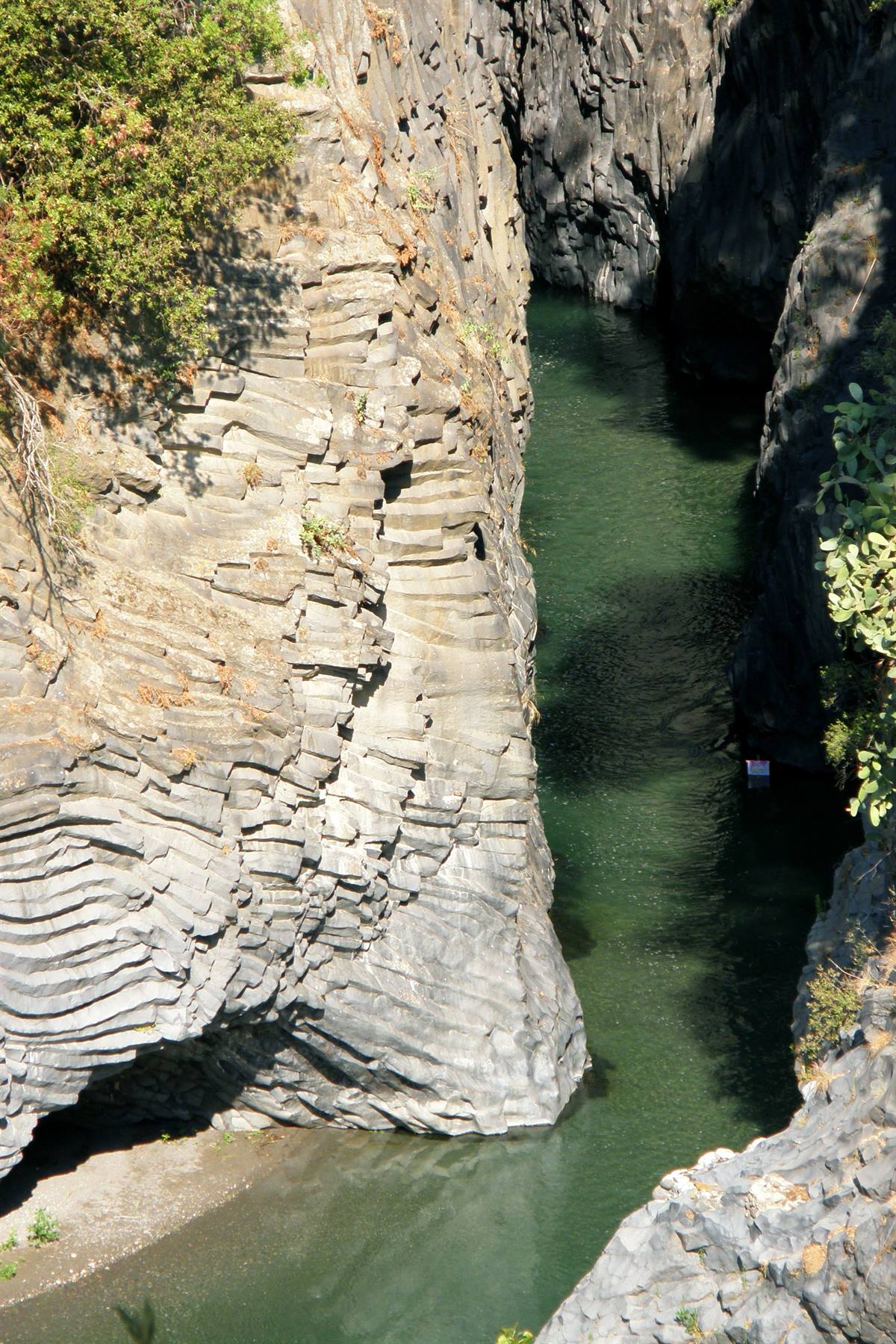
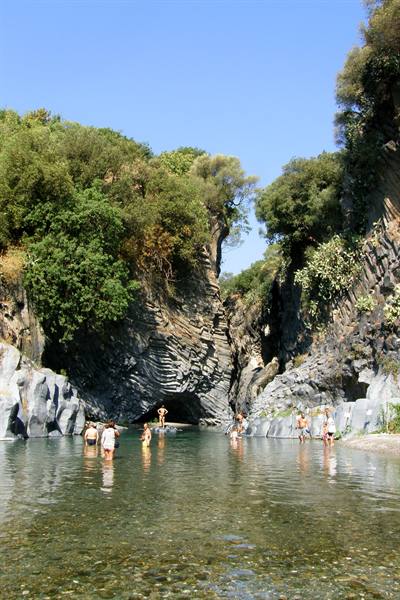
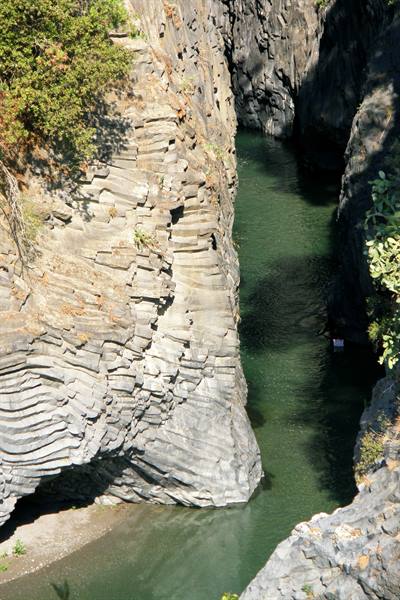
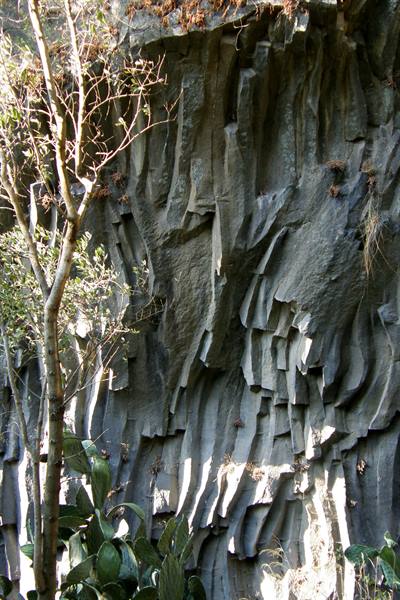
On waking we set off from Giardini Naxos following, inland, the N 185 road with the intention of going up the valley of the Alcantara river and going to visit the gorge of the same name. Shortly after 9:00 we thus arrive at the parking lot, near the town of Motta Camastra, from which one can access, on foot, the spectacular canyon carved by the stream over the millennia, among ancient lava flows that, on contact with water, solidified into marvelous basaltic formations with the so-called and characteristic "organ pipe" structure. The site could also be accessed for free, along a steep staircase that leads to the mouth of the gorge, but we prefer to pay a ticket that allows us first of all to follow the equipped Gorge Path, with numerous panoramic terraces over the rocky ravine and the roar of the waters that springs from it (truly a beautiful and easy experience)...
then to descend, with the aid of a convenient elevator, down to the riverbed and walk a short stretch on foot to take some suggestive photos, but the water, despite the season (in the height of summer), is freezing and we soon come out of it. Mid-morning we leave the Alcantara Gorge and return to Giardini Naxos, from where we then take the motorway in the direction of Catania, but we exit almost immediately, following the signs for the city of Acireale. In our march of approach to Etna, whose outline, more or less sharp, has been a constant of the landscape surrounding us since yesterday, we have decided to visit this town briefly, known more than anything for its churches and for the traditional theater of the Sicilian Puppets.
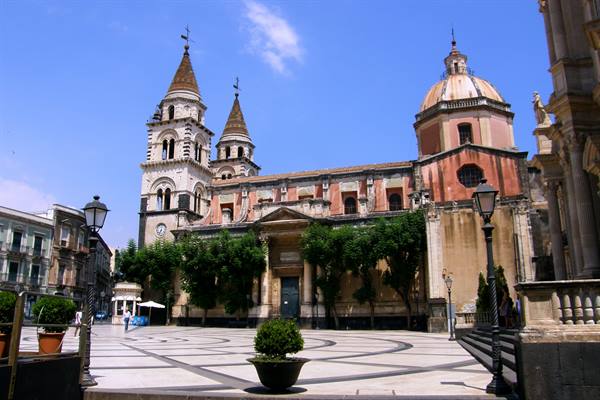
After various ordeals we manage to park our bulky vehicle near the center, close to Piazza Cappuccini, and immediately after, on foot, we head toward the most representative monuments. In a short time we reach Piazza Duomo, renovated in 2009, whose geometric designs of the marble and stone paving highlight the pink neo-Gothic facade of the cathedral, flanked by the white eighteenth-century basilica of Saints Peter and Paul... truly a beautiful overall picture. Too bad that we have to settle for observing it all only from the outside, because the religious buildings closed their doors at noon and will reopen only in mid-afternoon.
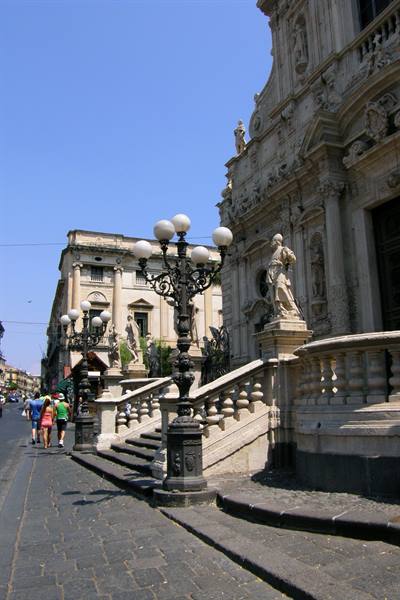
We take a few more steps along the Corso Vittorio Emanuele, observing among other things a historic and characteristic mini-newsstand all in wood, up to the beautiful baroque church of San Sebastiano, faced by ten valuable statues of prophets and biblical figures, and then we return to the camper to have lunch. While the little one sleeps we set off again. We pass near the Isole dei Ciclopi: some basaltic sea stacks that mythology holds to be the rocks thrown by Polyphemus, blinded, at Ulysses in flight... but we can't even stop for a photo and therefore we are forced to continue along the coast. Having reached the town of Aci Castello we begin, however, to head inland. We quickly gain altitude and take the Catania ring road, which we follow for a short stretch, before exiting in the direction of Nicolosi and Etna.
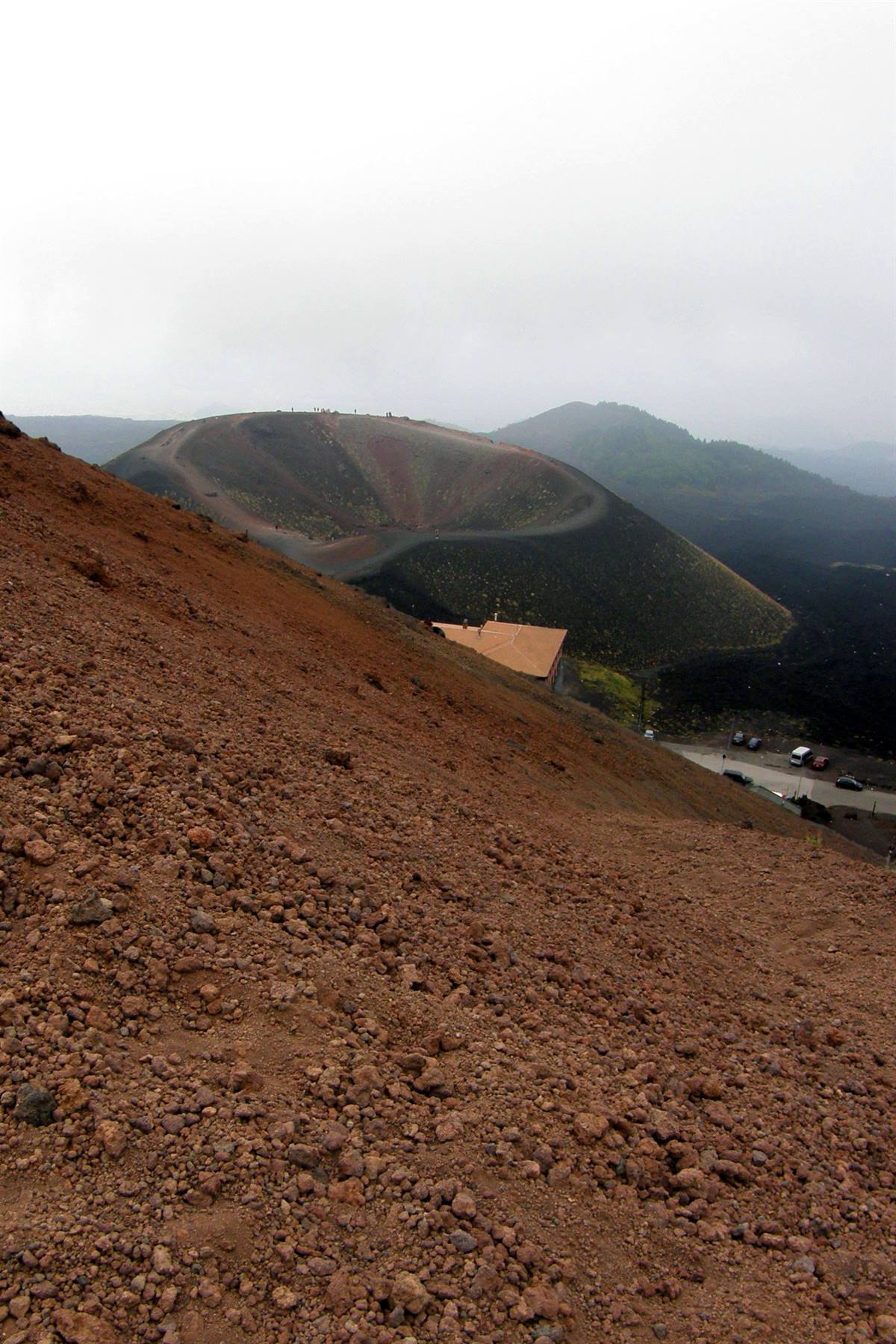
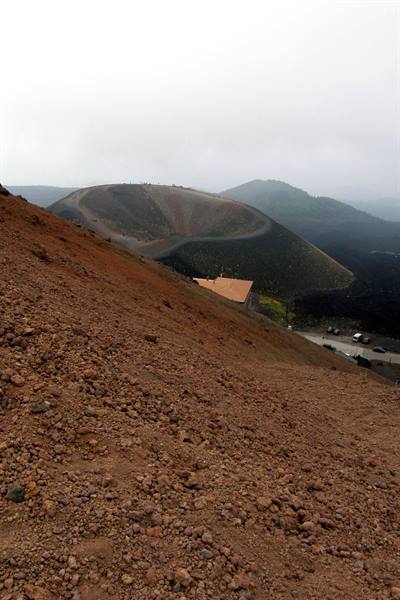
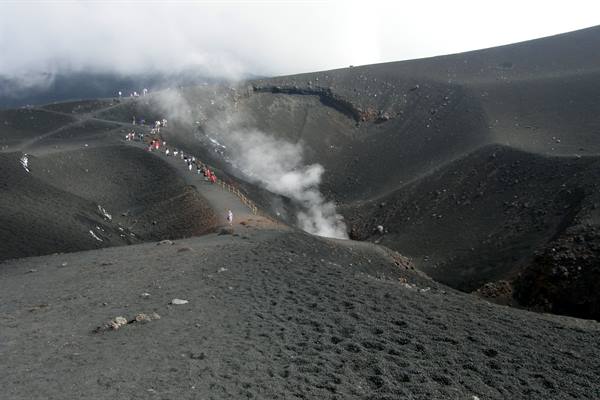
In front of us, now very clear, stands the outline of the largest volcano in Europe (with its about 3,340 meters in height), as well as among the most active on the planet, but also a place with which numerous mythological legends are associated: it was in fact, among other things, the home of Vulcan, god of fire, who forged there the weapons for Jupiter, king of the gods! As we climb, among increasingly gloomy landscapes and the strip of asphalt that crosses ancient lava flows, the sun goes, unfortunately, behind the clouds and at the Rifugio Sapienza, where the road ends, at an altitude of 1,910 meters, everything is in shadow and it is also quite cold. With the intention of passing the time as pleasantly as possible we nonetheless go, on foot, to visit the nearby Silvestri Craters, shaped by the eruption of 1892.
The volcanic formations in question are two and, to date absolutely inactive, they are, in their ease of access, an exhaustive example of the extreme environment that surrounds us. We climb with great effort onto the upper cone and once we reach the top the clouds completely invade us, to the detriment of the panorama, which wrapped in fog loses much of its interest... what a shame! We descend and return to the camper, while it also starts to drizzle... Tomorrow morning we should go up first by cable car and then with off-road vehicles almost to the summit of the great volcano, but if the weather conditions don't improve radically we would be forced, of necessity, to give it up... so all we can do is hope for good luck, since the forecast seems to be fairly uncertain.
Siracusa: Ear of Dionysius
Day 413 Aug 2013
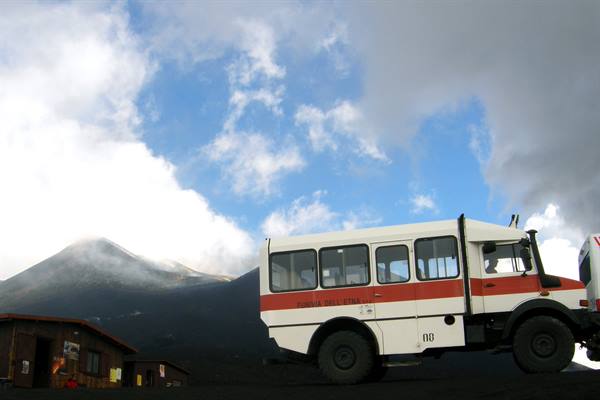
The sun's rays filter in auspiciously through the windows of the camper and, having cast a glance outside, I notice the summit of the volcano free of clouds, so we decide to take part in the excursion that will take us, at high altitude, almost to the top of Etna. Shortly after 8:30 we are already at the cable car ticket office, where we also buy the tickets for the 4x4 vehicles that will continue beyond the arrival of the lift (investing, among other things, also a hefty sum!), while a few little clouds are menacingly gathering near the summit. With Leonardo excited for the adventure awaiting him, shortly before 9:00 we get on one of the cable car cabins that will take us to an altitude of 2,600 meters. Having reached our destination we go out into the open air and amid general dismay we see hateful clouds advancing rapidly from everywhere...
so in a short time we find ourselves, in November, in the middle of the Po Valley and you can't see a hand in front of your nose! I let slip a few curses while we take our places on the off-road vehicles that will take us almost to 3,000 meters in altitude, at the foot of the main crater. We climb hairpin bends carved among old lapilli and in this way we gain the roof of our trip... Up here the clouds are thinner, but the sun is decidedly absent: it is quite cold and here and there there are still traces of snow now camouflaged in the surrounding environment. We take a walk among smoking vents and ground that, in some cases, burns a few centimeters under our feet... A beautiful experience, which would have been quite another thing during a clear day, but, alas, we have to settle... Chilled we regain the off-road vehicles and return to the cable car, then to the camper around 11:00...
Had the weather been nice we would have stayed a little longer in the vicinity, but the grayness doesn't invite it, so we set off immediately toward warmer and more welcoming places. We descend from that enormous cloud magnet that is Etna and in Nicolosi we find the sun again, then we take the A18 motorway southward and at the first service area, having just passed Catania, we stop to have lunch. In the early afternoon we set off again and a handful of minutes after 15:00 we arrive at the camper area of Via Von Platten in Syracuse... which, however, is no longer such and as (by municipal ordinance) it is only a parking lot, for the night we will have to move.
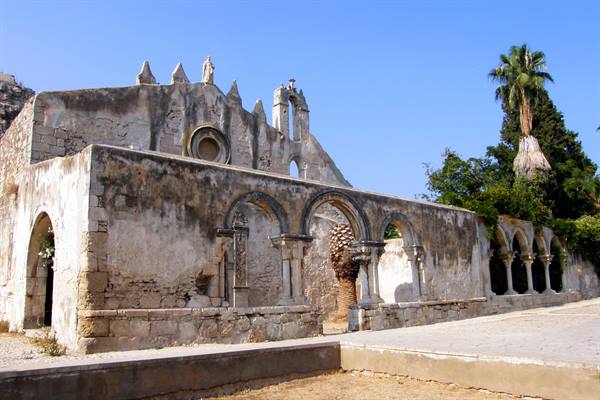
When the little one wakes from his afternoon nap we immediately dedicate ourselves to visiting the Neapolis district, which arose where the ancient Greek Polis was and therefore strewn with historic vestiges: Syracuse in fact (founded in 734 BC by colonists who came from Corinth) was, in its time, one of the richest and most important cities of the Hellenic world. We set off on foot and, passing alongside the modern Sanctuary of the Madonna delle Lacrime, a questionable hymn to reinforced concrete of the late 20th century, we reach the Church of San Giovanni Evangelista, of Byzantine origin, which was the first cathedral of the city, but which partly collapsed during the earthquake of 1693 never to be restored. The building, nonetheless evocative, is however famous, more than anything, for its catacombs.
First of all we explore, beneath the basilica, the Crypt of San Marciano: a hypogeum in which none other than the apostle Paul would have preached, then we access, with a guided tour, the Catacombs of San Giovanni which, for vastness, are second only to those of Rome and date back to the 4th century, testifying to the fundamental role of Syracuse in the spread of Christianity... We thus enjoy almost an hour of interesting explanations and intriguing scenarios, then we return to the open air (much warmer than that of the catacombs) and head in great haste toward the Neapolis Archaeological Park. In a wide area to the west of the city are concentrated all the major monuments of the Greek and Roman era of ancient Syracuse.
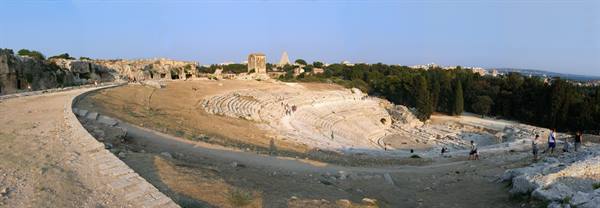
We pay the entrance ticket and, after a quick look at the remains of the great Altar of Hieron II (altar dedicated to public sacrifices), we go to see the beautiful Greek Theater: the largest in all of Sicily and one of the most imposing of the Hellenic world, which could hold up to fifteen thousand spectators. It dates back to the 5th century BC and its structure, facing the sea, is almost completely carved into the rock of the Colle Temenite. We wander for a while, up and down the ancient tiers, savoring the remarkable panorama that extends to the Ionian coast and then, in the immediate vicinity, we go to explore the so-called latomie. The latomie are old caves, born as stone quarries from which the material necessary for the construction of temples and palaces was extracted...
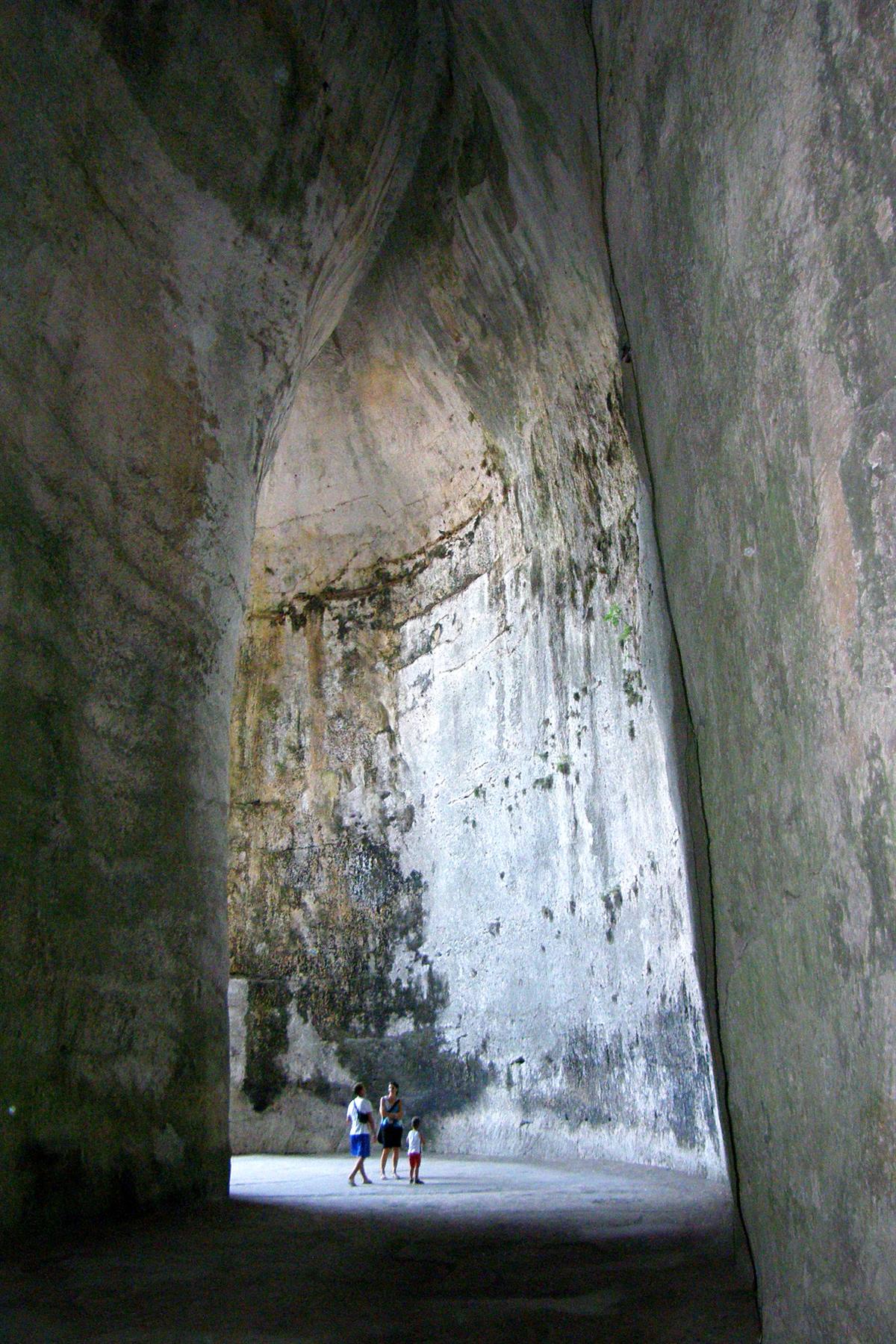
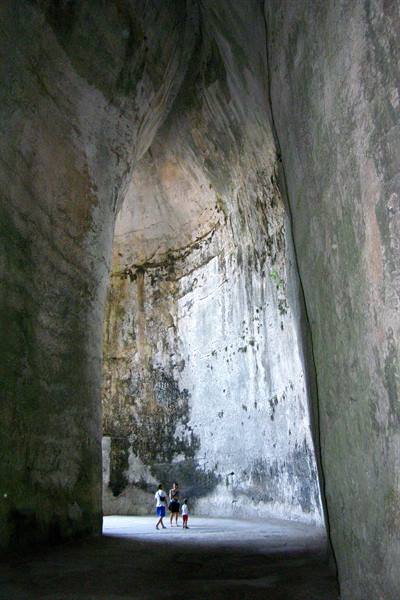
They were very numerous in the area of the archaeological site, so much so that the collapse of almost all the vaults, following various earthquakes, has created a vast depression, now rich in dense vegetation. Some latomie however resisted the destructive action of time and one, in particular, is still visitable and exceptionally known, nicknamed, for its shape and its singular acoustics, "The Ear of Dionysius". The artificial cavity in question (65 meters long and 23 high, where everything echoes) is a place of great suggestion and the origin of numerous legends. Still rapt by the sinuous and enigmatic Ear of Dionysius we head toward the exit of the Archaeological Park.
We stop to take a look at the rather modest remains of the Roman Amphitheater, the third largest in Italy after the Colosseum and the Arena of Verona, but quite another thing scenographically speaking, then we return to the camper, with the shadows of evening now very long under our feet. On the kind advice of the keeper of the former camper area of Via Von Platten we move for the night to a parking lot near the Island of Ortigia, which we will visit tomorrow morning, and in this way we conclude a not too fortunate day, especially in its first part... but we trust in decidedly better times.
Fontane Bianche
Day 514 Aug 2013
On foot we set off from the camper to go explore the Island of Ortigia, heart of Syracuse and a UNESCO World Heritage Site since 2005, with the traces of so many eras that have followed one another here, from the Greek to the Norman, from the Aragonese to the Baroque... We cross the Ponte Nuovo, which connects Ortigia to the rest of Sicily, and first of all we go to observe the bare ruins of the Temple of Apollo, the oldest Doric building in the region (dating back to the 6th century BC), which over time was transformed into a church, then into a mosque and again into a church, then incorporated, in the Spanish era, into a barracks...
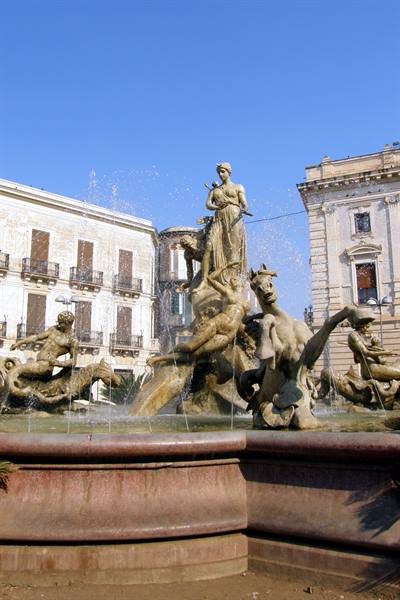
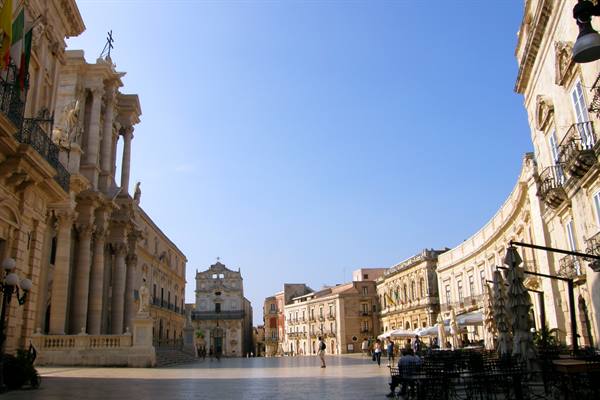
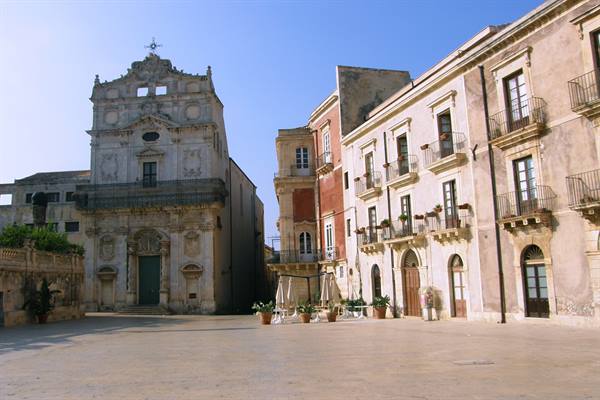
but the few remaining ruins certainly don't give it the glory it deserves! We then go ever more toward the city center and passing through the scenic Piazza Archimede, with the magnificent Fountain of Artemis at its center, surrounded by noble palaces, we arrive, walking along narrow and characteristic alleys, at the marvelous Piazza Duomo. Considered one of the most beautiful baroque squares in Italy, it has an almost continuous arched side of splendid palaces and the other straight, in which the rich facade of the Duomo stands out... and the Duomo itself, with its mixture of styles, is the most representative monument of Ortigia, because in its architectural elements the very history of the city is summed up.
The building was born as a Doric temple, dedicated to Athena, in the 5th century BC and the numerous columns, perfectly recognizable, set into the perimeter walls, bear witness to this. It was then transformed into a church during the Norman period, when the central nave was raised. The earthquake of 1693 did the rest, because the facade collapsed, which was rebuilt in the most exuberant Sicilian baroque. Once we have savored the delicious architectural cocktail of the Duomo we head toward the southern end of the square, where the admirable front of the Church of Santa Lucia stands out, and, continuing alongside the latter, we reach the seashore near the legendary Fonte Aretusa... Scenographically it is nothing transcendental, but this millennial freshwater spring that gushes a few meters from the coasts of the Ionian Sea is intriguing.
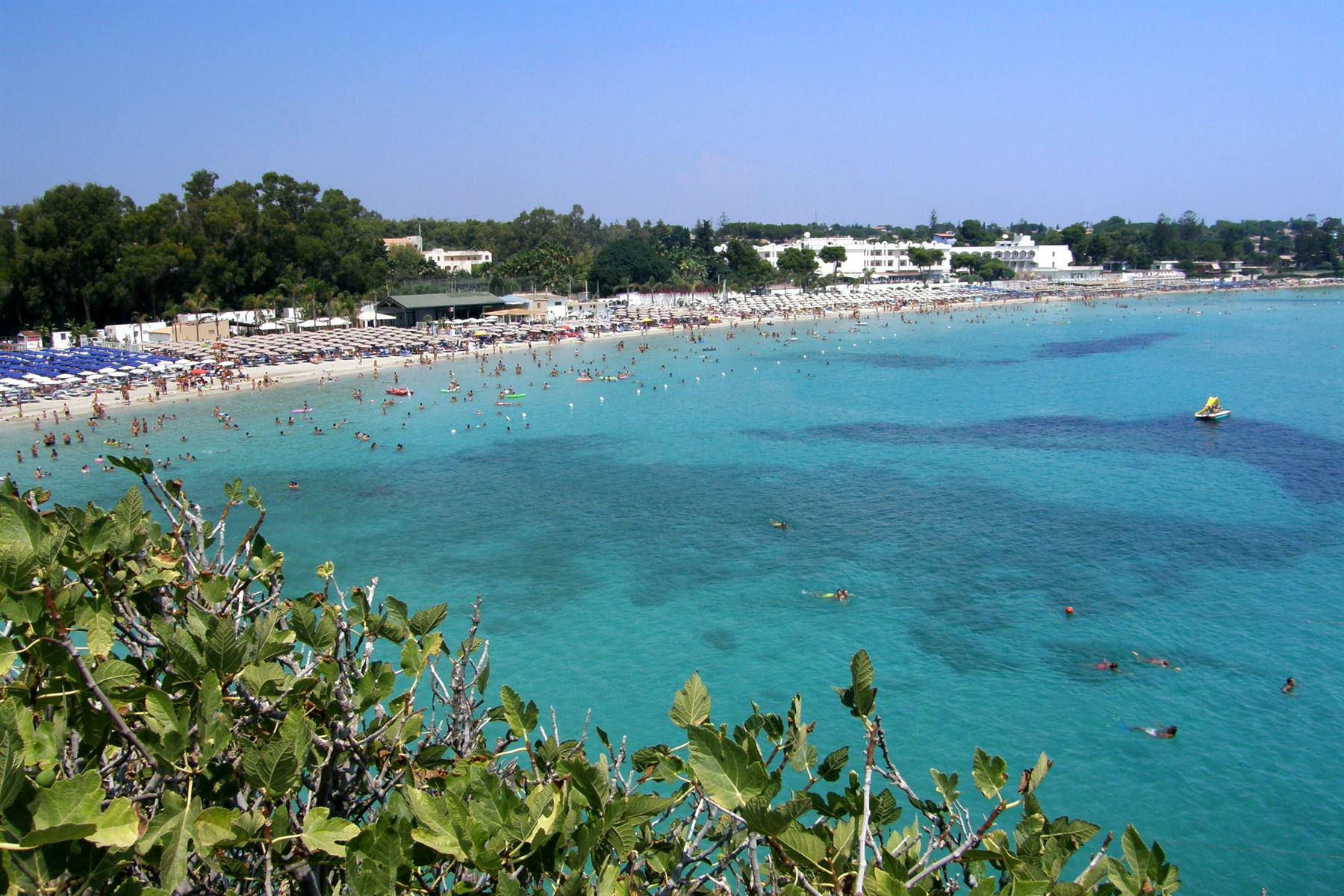
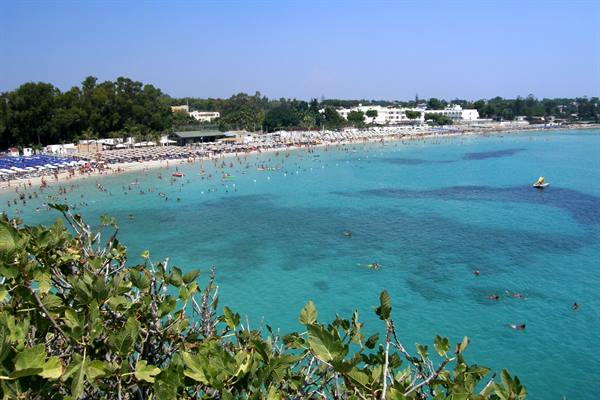
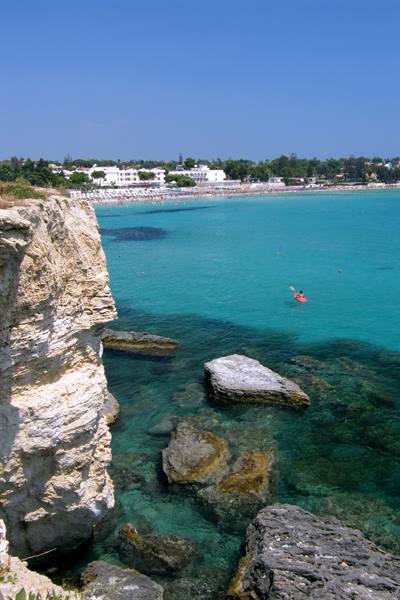
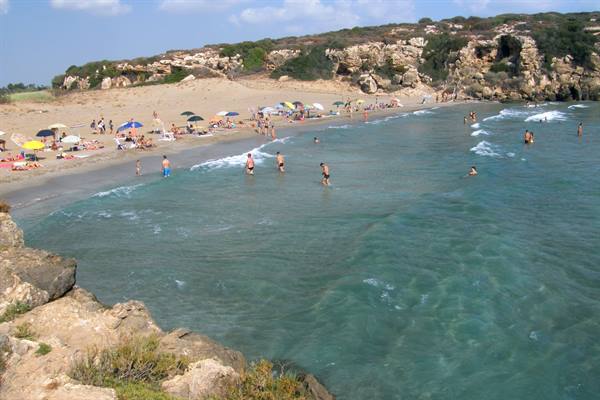
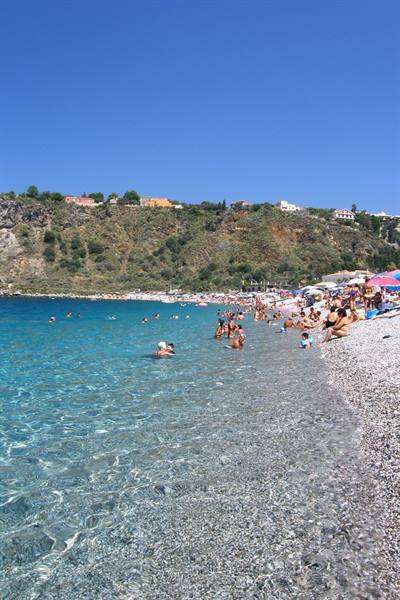
We also observe in the distance the severe outline of the Castello Maniace, a thirteenth-century fortress built by Frederick II on the extreme tip of the Island of Ortigia, and then we return to the camper, intending to find, in the surroundings, a beach where to spend the rest of the day. The goal is the bay of Fontane Bianche, located a handful of kilometers south of Syracuse, on which we have good reviews. We arrive there around 11:00 and find a spot in a vast parking lot, at the exit of the built-up area, which overlooks the beach directly. We settle our vehicle in the shade of the trees and immediately after we go, equipped with a beach umbrella, to take our places at the water's edge. The place is a bit crowded, but the water in front of us is beautiful and clear, so it deserves a bit of sacrifice...
and besides it's our first all-Sicilian seaside experience! I go to photograph the inlet from the neighboring cliffs and among stunning views with an almost Caribbean look I notice, in preparation, a sort of military arsenal of no small account: they are the launch ramps of the fireworks that this evening will greet Ferragosto. We take a very long, longed-for swim and then return to the camper to have lunch. In the afternoon we go again to the beautiful beach of Fontane Bianche and there, between playing with the sand and diving into the blue of the sea, we pleasantly while away the evening. Around 19:00 we regain the camper and for the night we move, by a few dozen kilometers, to the city of Noto, which we will visit tomorrow morning, and therefore to the Noto Parking rest area, so as to be able to make use of its convenient services.
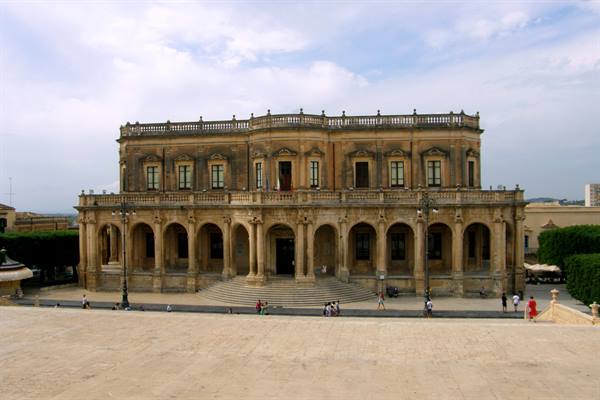
Noto: Palazzo Ducezio
Day 615 Aug 2013
Today, the festive day par excellence of the whole summer, we will try, against the trend, to avoid the beach, which will certainly be hyper-crowded... so we will dedicate ourselves entirely to art and, in particular, to baroque architecture. In this regard we will visit three towns, kingdom of this style and for this reason also included in the UNESCO World Heritage... Moreover for today (but it is certainly not an advantage) a lot of clouds are forecast in the sky. In fact, no sun filters through the windows of our traveling home when we wake up in the camper area of Noto, and it's a shame! By shuttle, made available free of charge, we nonetheless reach shortly after 9:30 the center of the town, founded in 1703 on Colle Meti, eight miles south-east of the pre-existing millennial city, destroyed by the terrible earthquake of 1693...
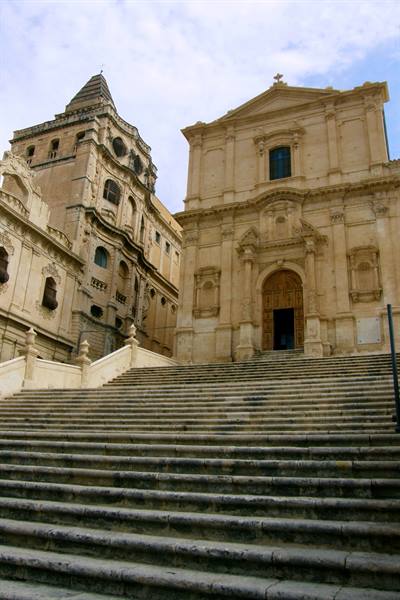
Here the architects of the time built one of the most extraordinary examples of late-baroque building layout, which has come down to us almost intact and, recently, perfectly restored. On foot we pass the Porta Reale, built in 1838 on the occasion of the arrival of Ferdinand II, king of the Two Sicilies, and from there we make our way into the very central Corso Vittorio Emanuele, flanked by the main monuments that have made the city of Noto famous throughout the world. First of all we observe the facade of the Church of San Francesco, erected in the early eighteenth century at the top of the ramps of a steep staircase, then, on the left, a little further on, that of Santa Chiara, a few decades more recent, which leads us before the spectacular Piazza Municipio.
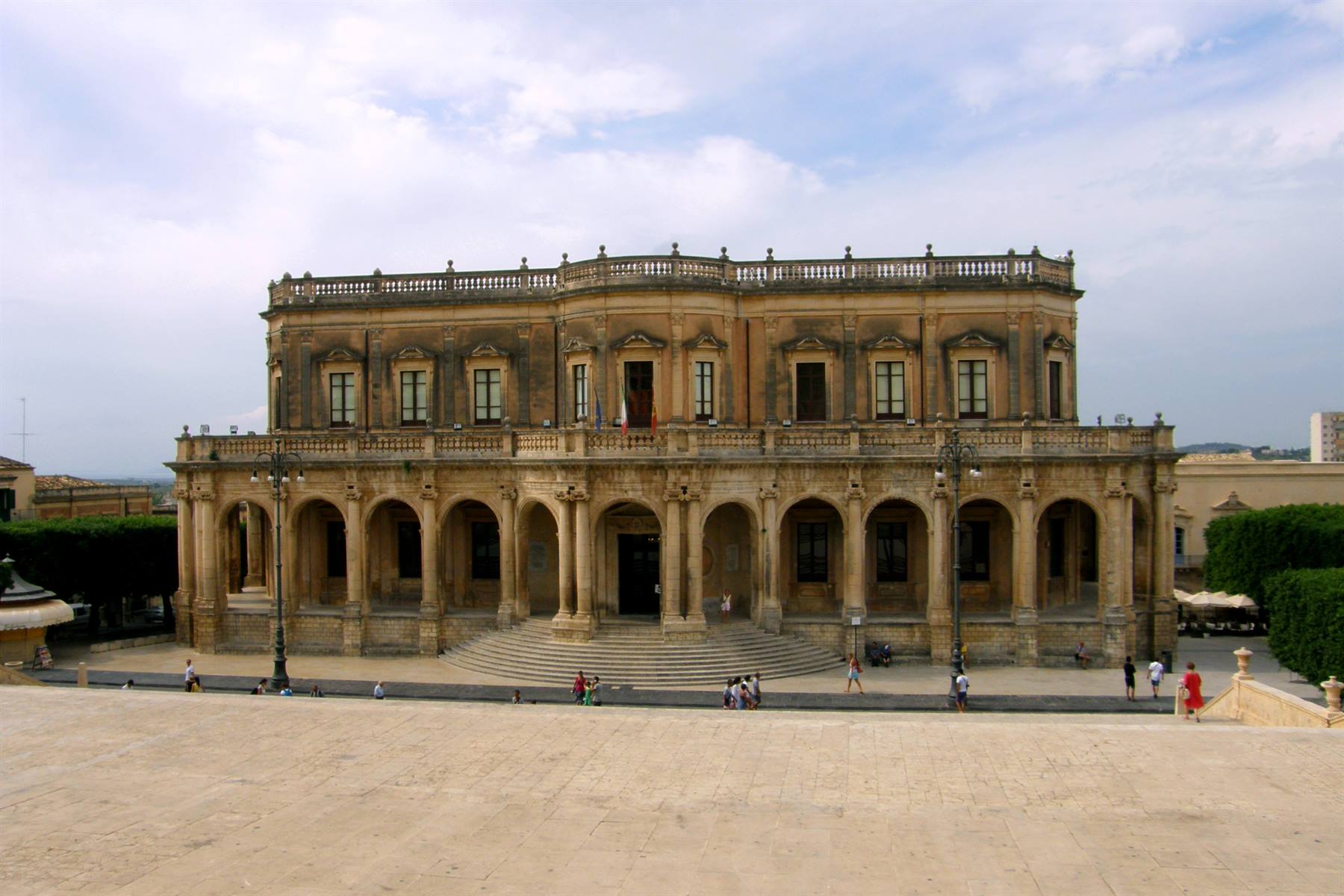
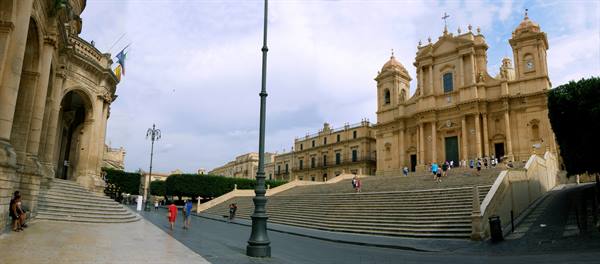
The urban space in question is truly evocative, dominated by the great staircase that leads to the eighteenth-century Cathedral of San Nicolò, with its exuberant front, which makes it one of the most admirable examples of Sicilian baroque. Beside it is then the more severe but interesting Monastery of San Salvatore and opposite the elegant Palazzo Ducezio, seat of the Town Hall. We immortalize the characteristic Via Nicolaci, all uphill and flanked by beautiful palaces, in which graceful baroque balconies stand out on stone brackets elaborated into fanciful figures, then, again on Corso Vittorio Emanuele, the concave facade of the Church of San Carlo Borromeo. In this way we arrive in front of the neoclassical Municipal Theater, while little Leo is already tired of observing things he still cannot understand.
His restlessness thus soon makes us give up further deepening the visiting route and we quickly drag ourselves toward the shuttle and the rest area, leaving in us a rather fleeting, though beautiful, recollection of the city of Noto. Having stocked up on fresh figs, thanks to the kindness of the lady of the camper area, immediately after we set off again... We travel along the Statale 115 and move, by a few dozen kilometers, to the town of Modica, another jewel of Sicilian baroque. Almost at noon we park (thanks also to the hyper-festive day) near the center and on foot we immediately set off to explore its most interesting places.
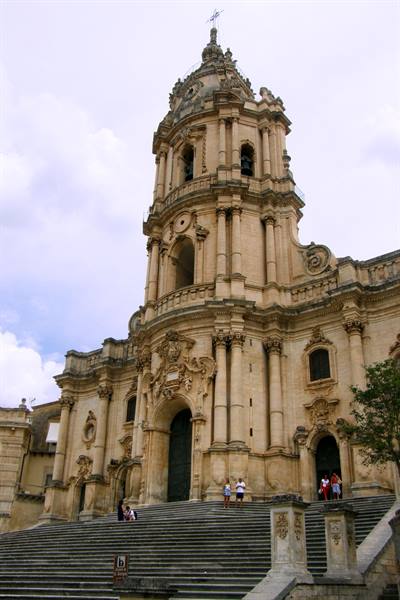
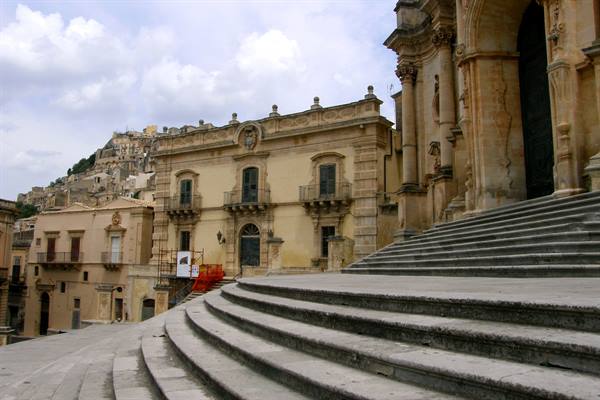
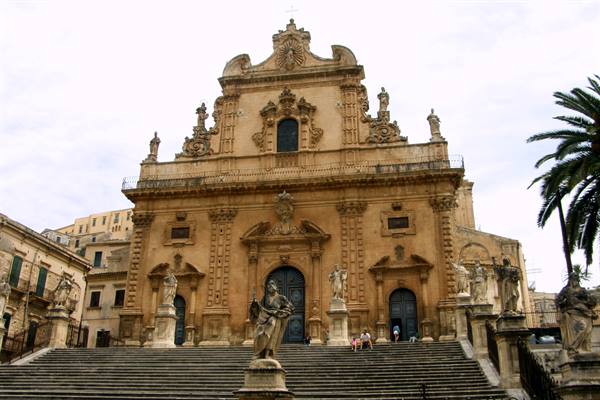
We go along the Corso Umberto I, the main artery of the town, and then go up the steep staircase that leads before the Cathedral of San Giorgio, rebuilt in baroque style between the end of the 18th and the beginning of the 19th century, with its splendid tower facade, in which five doors stand out, corresponding to the same number of naves... while unfortunately the sun is always absent. We visit the valuable religious building also inside and then begin to descend along narrow alleys, again, toward the lower part of the town. We pass alongside the simple birthplace of Salvatore Quasimodo, Nobel Prize for Literature in 1959, and reach the admirable Church of San Pietro, rebuilt after the earthquake of 1693 and preceded by a scenic staircase adorned with the statues of the twelve apostles.
Having also explored the attractive interiors of San Pietro we finally set off, along Corso Umberto I, toward the camper. We stop to buy, in a specialized shop, the famous chocolate of Modica and add three very delicious Sicilian cannoli to savor, given the now late hour, at the end of the imminent lunch. In the early afternoon the clouds increase further and amid lightning and thunder it also starts to rain, while Leo goes off to nap. We let Jupiter Pluvius vent his wrath and later we move, toward the coast, to the town of Scicli, where it has not rained yet, but the rumblings of the storm echo menacingly in the distance... On the little one's waking we dedicate ourselves to visiting the town, also famous for its architecture, which flourished masterfully after the "usual" earthquake of 1693...
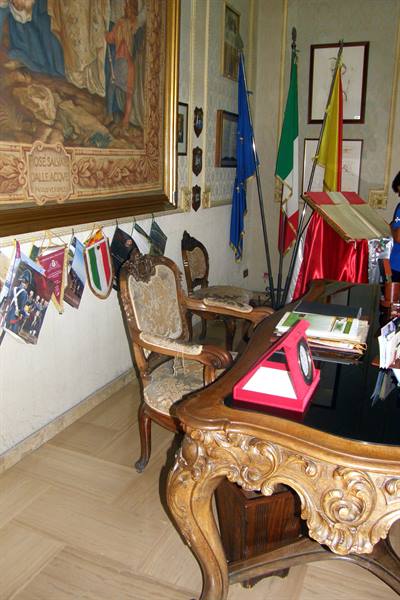
In a short time, on foot, we reach the center, which appears to us very well cared for and, in its small way, perhaps the best among those seen today. Beautiful is Via Penna: a hymn to baroque, including the Palazzo del Municipio, whose fame is also linked to the TV series "Inspector Montalbano", of which it has been the set several times. Inside it, in fact, we observe what in the film was the Prefect's room. We have a snack in Piazza Italia with a traditional granita and then, while a few drops of rain fall, we go before the exuberant Church of San Bartolomeo, then, walking through alleys, we arrive at the stupendous Palazzo Beneventano, whose facade is a triumph of baroque decorations, which makes it one of the best examples of the genre in all of Sicily.
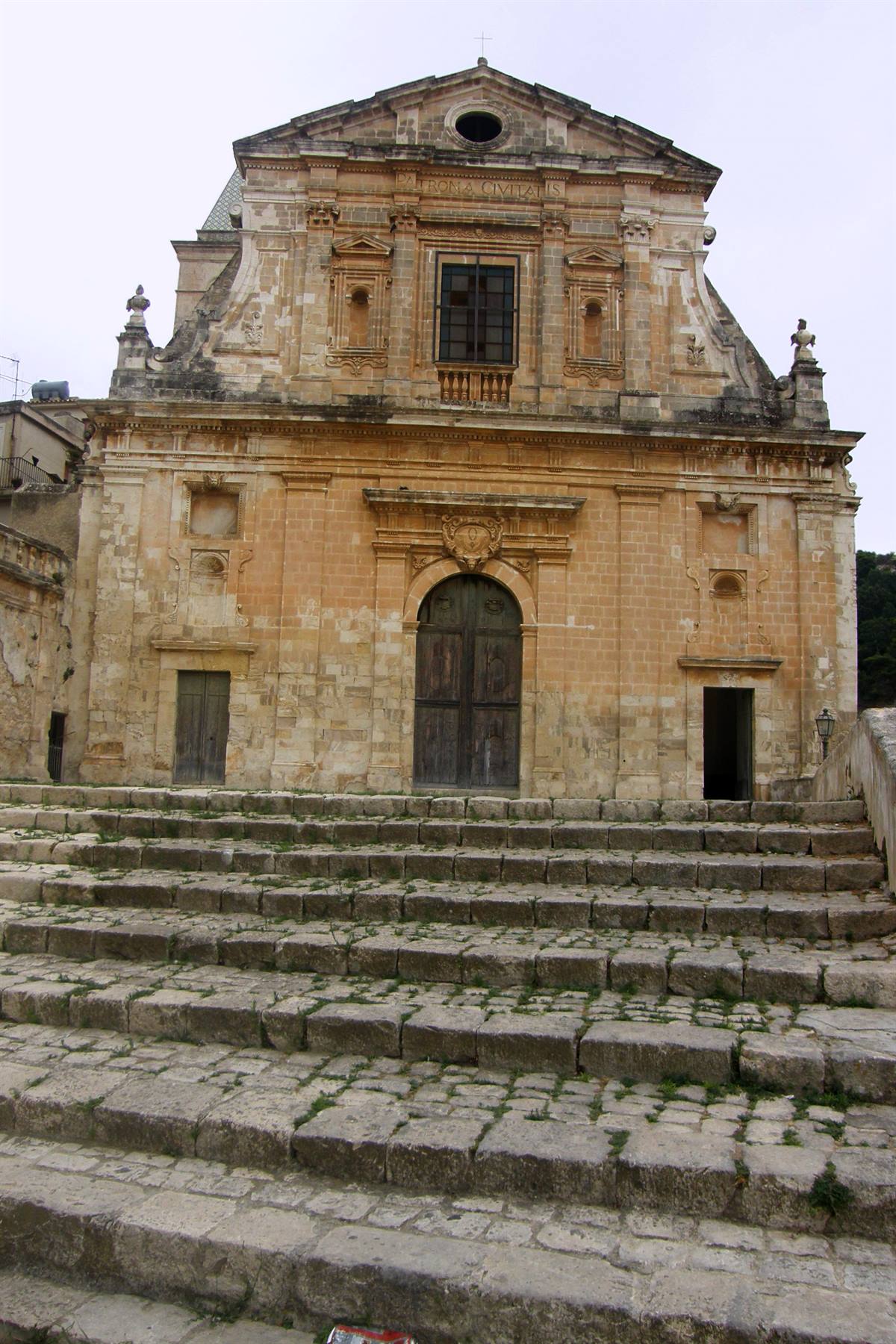
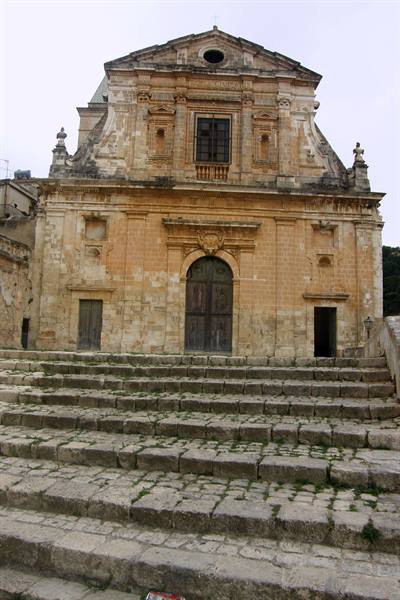
But it's not over yet because we pass in front of the interesting Former Convent of Carmelo and, following Via Santa Maria la Nova, we gain the short staircase facing the late-Renaissance facade of the Church of Santa Maria della Consolazione and from there, raising our gaze to the hill that dominates the town, we notice the imposing outline of the Church of San Matteo, founded by the Normans and today under restoration... But other religious buildings sprout here and there and their number in relation to the remaining buildings is truly incredible... The entire center of Scicli then is a veritable treasure chest of works of art and deserves all the attention of the case... too bad only for the weather and the consequent grayness today. At the end of the tour we regain the camper and set off immediately, because still more than an hour of road awaits us at the end of the leg.
From Scicli we land on the coast of the Mediterranean Sea, which we then follow eastward. Thus, near the town of Sampieri, we notice the remains of the Fornace Penna: a piece of industrial archaeology made famous, like other places nearby, by Inspector Montalbano. We don't waste too much time and from there we continue, retracing, shortly after, between the towns of Ispica and Rosolini, a stretch of road already traveled in the morning, then, on the motorway, we return to the Noto exit, but we don't go in the direction of the city, but south and therefore toward the Ionian coast. Having reached the vicinity of the Vendicari Oasis we venture along the dirt road that, according to directions, leads to the inlet of Cala Mosche... At the end of the narrow and dusty route there is a rest area for campers, where we go to stop when it is already past 20:00.
We have dinner, while in the sky an auspicious starry sky appears... and thank goodness, given that tomorrow a full-immersion all seaside awaits us.
Scicli: Santa Maria della Consolazione
Day 716 Aug 2013
On the morning of the first day of pure sea of the trip, fortunately, a beautiful sun shines and right after breakfast we set off, on foot, toward Cala Mosche, according to the directions in our possession one of the best beaches in the area, located in the heart of the Vendicari Oasis, a nature reserve established in 1984. From the parking lot to the inlet there is more than a kilometer to walk, through the Mediterranean scrub, with Leonardo who soon ends up on my shoulders, but in the end we come within sight of Cala Mosche and already from the top of the cliffs we cannot help but notice the conditions of the sea, which unfortunately is a bit rough. We settle on a beach already quite crowded, despite the hour certainly not late, and anyway a few meters from the shore, then we immediately run into the water, which even in the presence of waves appears beautiful and inviting.
We take a long swim among the restless waves, then I go exploring with mask and snorkel on the neighboring cliffs, then I accompany the little one back into the water to challenge the big waves, when from the north-west several threatening clouds appear, accompanied by thunder and lightning. The weather changes suddenly and soon the sky darkens... It was our intention to leave towels and beach umbrella on the beach for the afternoon, but already before noon we gather everything and head toward the camper under threat of rain... what bad luck! It doesn't pour, but a few drops of water nonetheless fall at lunchtime, then in the early afternoon the clouds open and as if by magic the sun shines again. No sooner do we rejoice and, in the name of maximum variability, when a little later we are about to return to the beach, from the west other threatening cloud bodies advance again...
but we don't let ourselves be intimidated and decide to go anyway. In the forced and hot August shade I nonetheless take, with Leonardo, a further and fun swim among the waves, then the solar disk, for the umpteenth time, peeks out through a break of clear sky and accompanies us until evening. At dusk we return to the rest area. We settle in and dressed in our best we go to dinner at the adjacent farmhouse... only to find, to our great surprise, that it is full... So we retrace our steps and, abandoning all pretense, we retreat into the camper, trying to somehow remedy the pangs of hunger. With this inglorious evening we thus complete the first week of the trip: certainly not one of the best I remember as far as good fortune goes... but we trust blindly in the next one.
Agrigento: Valley of the Temples
Day 817 Aug 2013
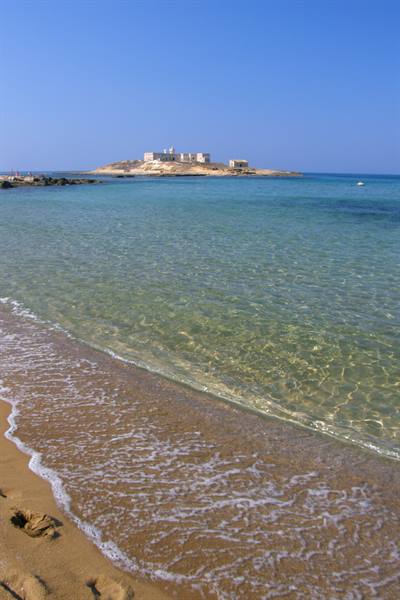
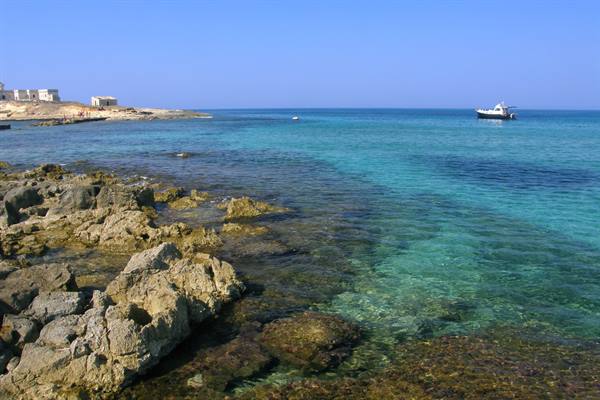
Hallelujah: the sky is completely clear of clouds and the forecast let us hope for the best! We get up quite early and immediately set off, so as to travel the narrow dirt road of Cala Mosche before the hordes of bathers begin to arrive en masse. Our intention, for this morning, is to move only about ten kilometers, near the town of Pachino, to the beach of Isola delle Correnti. Already before 8:30 we are in the parking lot adjacent to the beach and we are also the first to arrive there, so we can arrange our vehicle as we please and immediately after have breakfast. Calmly we then head toward the beach, which immediately appears beautiful and washed by finally calm and clear waters, in this way all the premises are there for a positive glimpse of seaside life... to Leonardo's happiness (a little less so for his seventeen-year-old brother).
We take sunbaths and swims in good sea, with in front of us the islet that gives the place its name and its now disused lighthouse: where the Ionian Sea and the Mediterranean Sea meet, as well as the southernmost point of our trip... and of all Italy, if one excludes the Pelagie Islands. Shortly before 13:00 we return to the camper to have lunch and immediately after we leave Isola delle Correnti, of which we will surely keep a good memory. While the little one sleeps we prepare to cover the longest leg on Sicilian soil: over two hundred kilometers of road, all ordinary. We pass
Agrigento: Valley of the Temples
Day 918 Aug 2013
It would cost ten euros per person for the shuttle from the rest area to the Valley of the Temples in Agrigento, so we decide to go by camper... then we'll come back to Lido Rossello. At 8:30 we are already leaving and half an hour later we are ready to explore the most important and famous archaeological site in all of Sicily, included in the UNESCO World Heritage List since November 1997. We park near the lower part and take a taxi to the entrance of the upper part, so we will visit everything downhill and halfway... no small thing given the presence of a small child in our ranks. In fact, what is improperly called the Valley of the Temples is actually a hill, on which the main monuments from the Hellenistic period of the ancient city of Akragas have been partially preserved, dating above all to the 5th century BC.
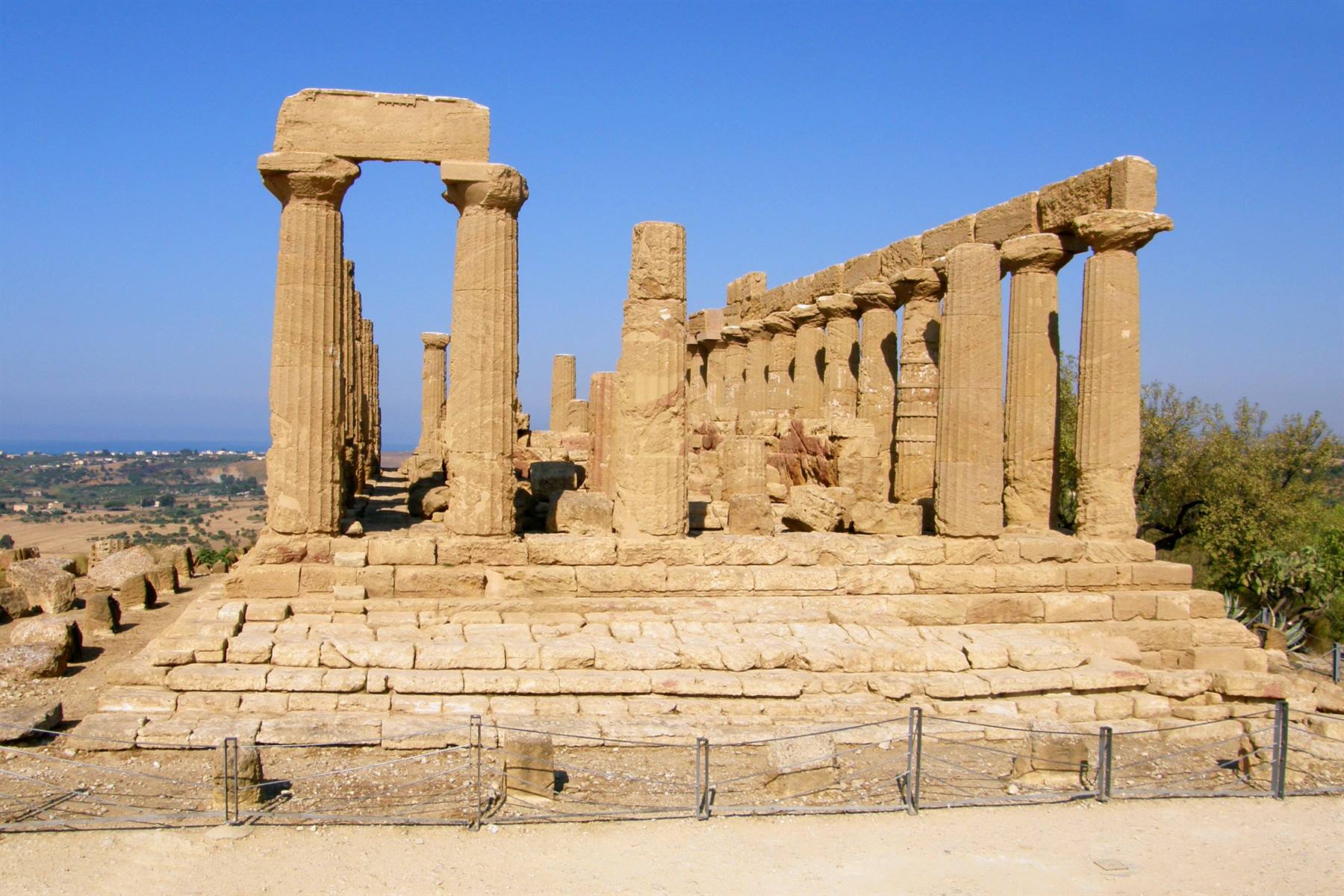
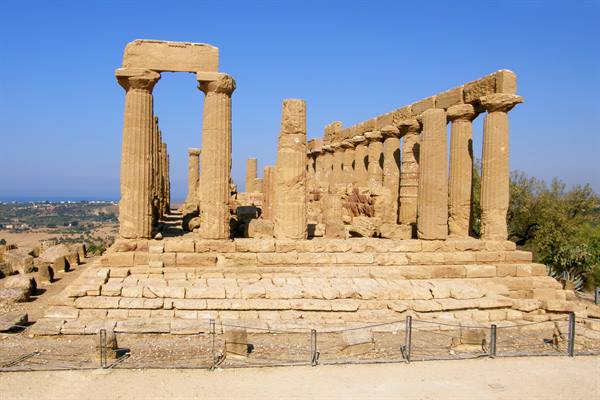
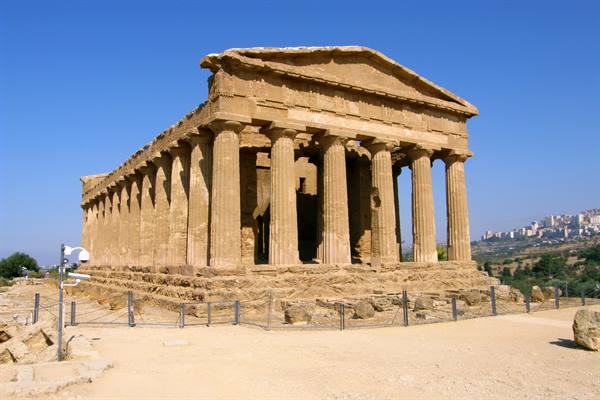
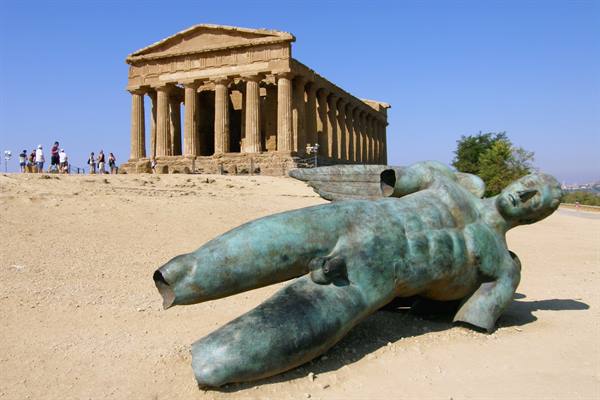
As soon as we enter, on the left, we observe the first temple of the series: that of Hera (or Juno), erected in Ionic style (like all those of the site) in the times of maximum splendor of the place, in the era of the tyrant Theron, with six columns on the short sides and thirteen on the long ones (hexastyle peripteros) and 38 in total, of which 25 remain (standing), which stand out magnificently against the intriguing landscape behind. From the Temple of Hera we then move, following a straight pedestrian path flanked by almond and olive trees, to the magnificent Temple of Concordia... the primary monument of the Valley, as it is classified as one of the three best-preserved temples in the entire Greek world.
Built a few years after the Temple of Hera, but with the same proportions and probably consecrated to Castor and Pollux, that of Concordia was saved from ruin because it was transformed into a Christian basilica in the 6th century AD, and then returned to its original forms in the 18th century... and its vestiges still proudly display themselves as a symbol of the purest and most original classical style. After taking the well-deserved photographic service we descend further down the hill and, accompanied by the unattractive view of the anonymous apartment blocks of the new Agrigento on our right, we pass by numerous early Christian tombs carved into the rock, to reach the presence of the evocative ruins of the Temple of Hercules.
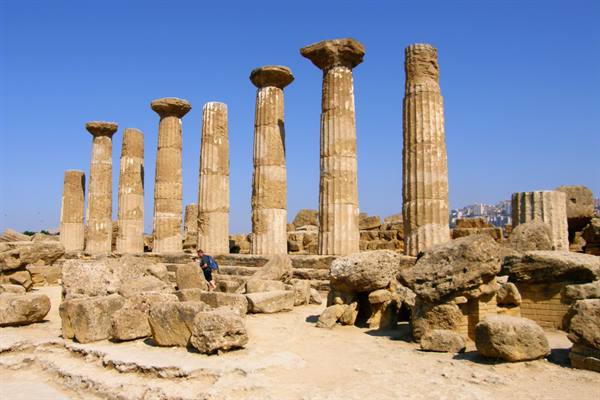
The oldest construction of the Valley of the Temples dates back to the end of the 6th century BC and presents a fascinating alignment of eight columns, raised in 1924, amid the chaos of the remaining vestiges. At this point we exit from the upper part of the site and, crossing a road, we enter the lower part, where, first of all, we observe what remains of the immense Temple of Zeus (or Olympian Jupiter). Of the largest construction of its kind in Sicily, and one of the most important in the Greek world, nothing remains standing, but the mere sight of the ruins is still grandiose and it is enough to trace any of the upper parts of a capital to realize the original majesty of the temple...
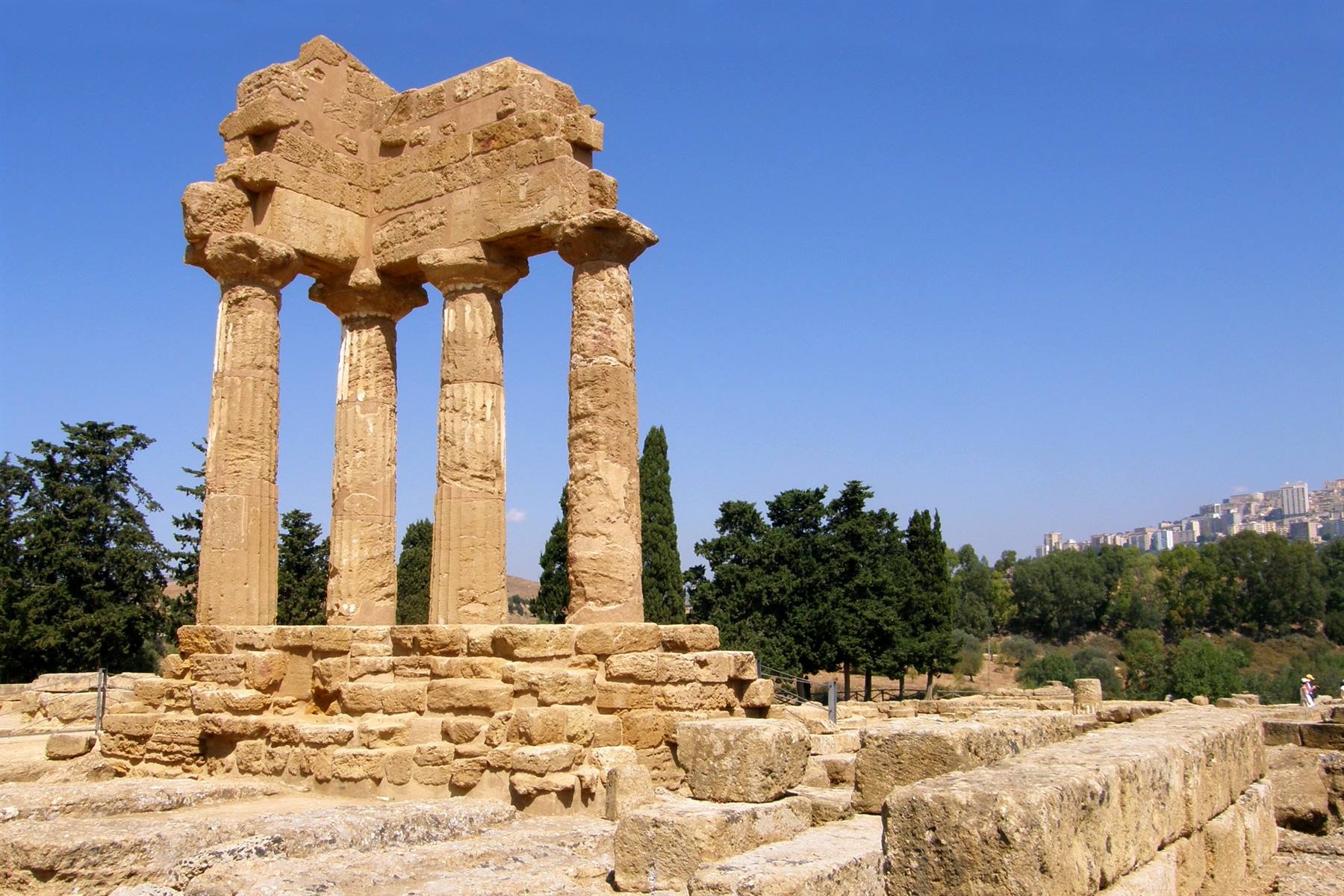
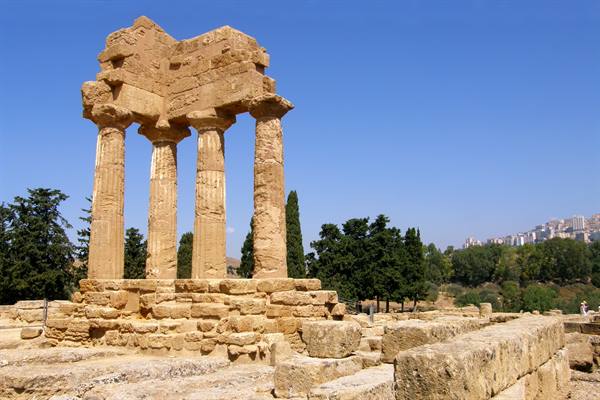
Moreover, one can also notice here and there the remains (or copies) of some telamons: colossal human figures (almost eight meters tall) that at the time also performed a load-bearing function of the structures, as well as a decorative one. Finally we contemplate the four corner columns (raised in the 19th century) of the Temple of the Dioscuri, which, despite their "smallness" have become the symbol of the city of Agrigento... then we return to the camper, aware of having explored an extraordinary testimony of the ancient world, and a place that alone can be worth the trip to Sicily. Immediately after we return towards the rest area of Lido Rossello, but this time we find ourselves stuck in traffic going towards the sea and it takes us almost an hour to reach our destination... just in time for lunch.
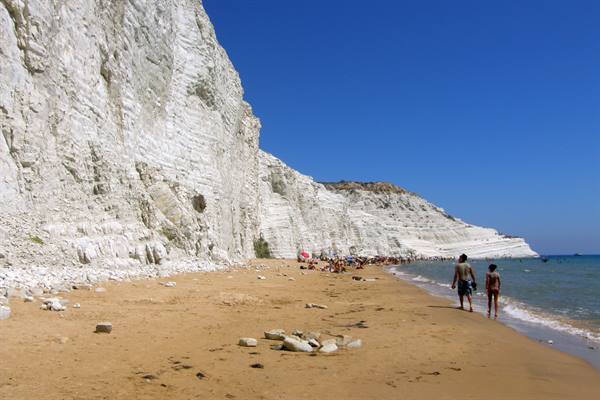
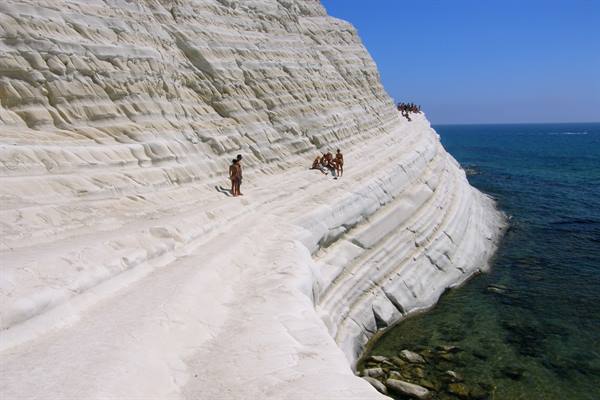
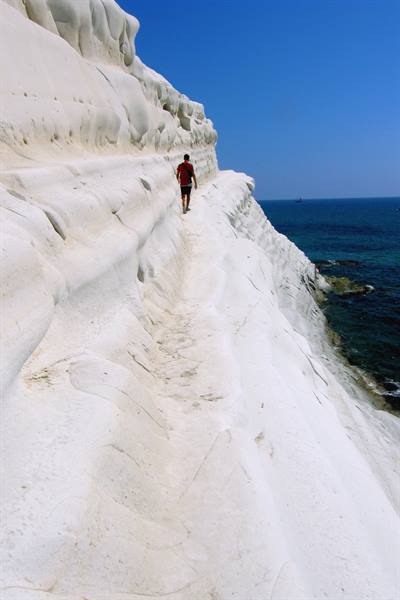
In the early afternoon, while Leo goes for a nap, with Federico I tackle the walk (about thirty minutes) that from Lido Rossello leads, along the coast, to the so-called Scala dei Turchi: a spectacular cliff (linked to the ancient Saracen raids) of calcareous nature (marl) and therefore very white, smoothed by atmospheric agents into enormous steps that descend vertiginously, but with harmonious and rounded shapes, towards the sea... The combination of primordial elements: rock, water and air (in the form of a very blue sky) are an extraordinary cocktail, so we can take all the necessary photos of the case and then return, satisfied, to the camper. When the little one wakes up we all walk together along a stretch of coastline in the direction of the Scala dei Turchi and under the high, very white cliffs we stop to spend the rest of the day, between a swim and a sandcastle.
In the evening we go out to dinner at the only pizzeria in the town, but it is a disaster, because we wait almost two hours before being served and when we leave it is already time to go to sleep... this, however, takes nothing away from the incomparable experiences of today.
Selinunte: Temple E
Day 1019 Aug 2013
After having consumed breakfast and completed all the routine operations regarding the camper we prepare to leave Lido Rossello and the nearby Scala dei Turchi: on the program there is a day of transfer, with two stops of a cultural nature at as many sites of historical interest. We go west, along the Strada Statale 115, which runs parallel to the coast, we pass the well-known built-up areas of Sciacca and Menfi, and by mid-morning we arrive in the parking lot of the Archaeological Park of Selinunte: one of the most important in Sicily and in the entire ancient Greek world.
Founded in the 7th century BC the city, which in the period of its maximum splendor seems to have had about eighty thousand inhabitants, was destroyed by the Carthaginians, in alliance with the nearby Segesta (which we will visit in the afternoon), and its vestiges, brought to light in the 19th century thanks to the excavations of two English archaeologists, are said to be grandiose. We pay the entrance ticket, in addition to that of the little train that will take us around the site (rather expensive but, given the presence of Leonardo, indispensable), and together with the little one, enthusiastic above all for the latter, we kick off the dancing. We begin with the lowest but most important hill, which houses the major temples, identified with letters, because the deities to whom they were consecrated are not clear.
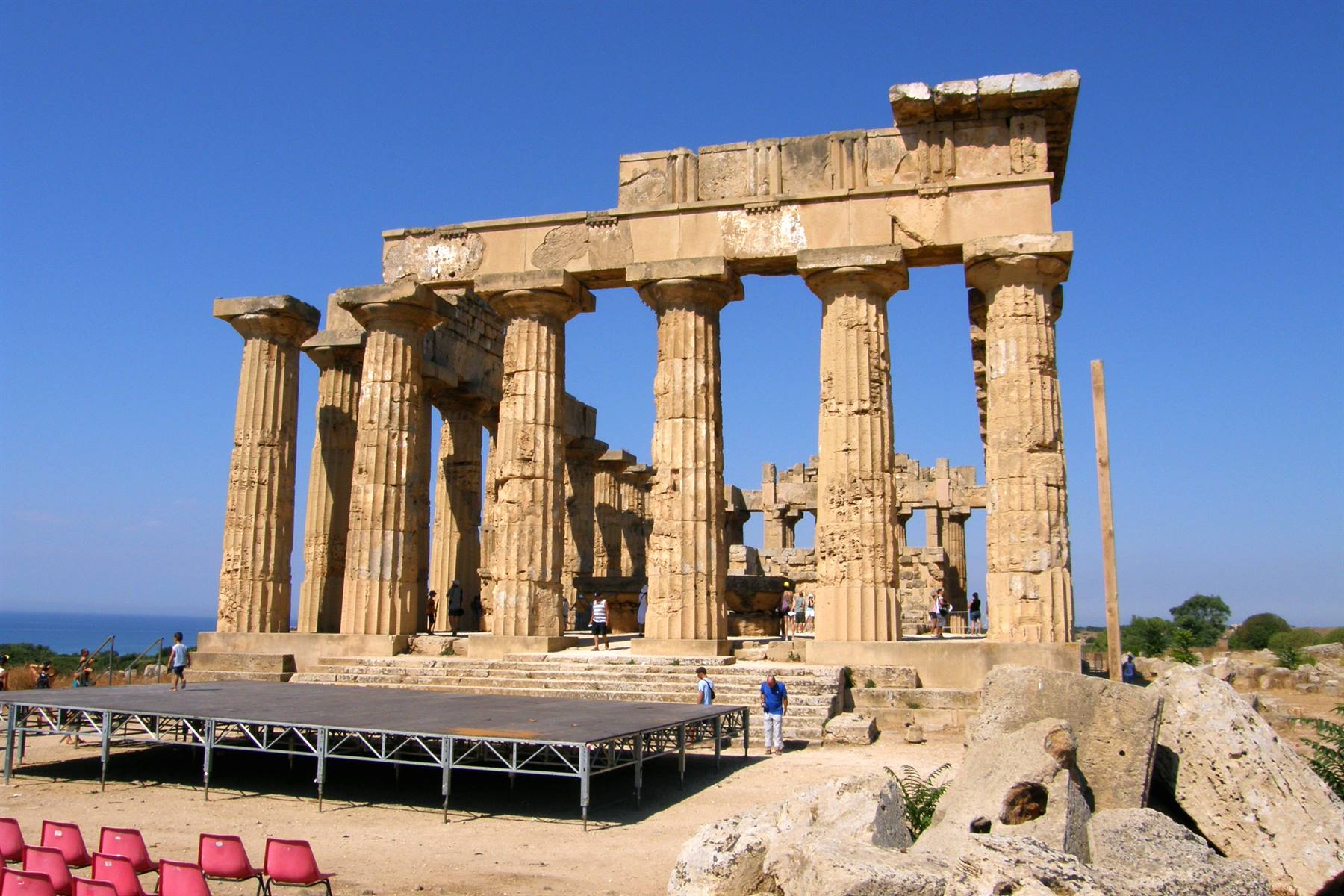
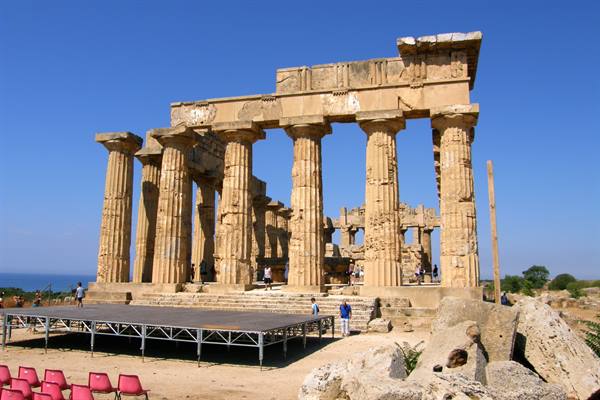
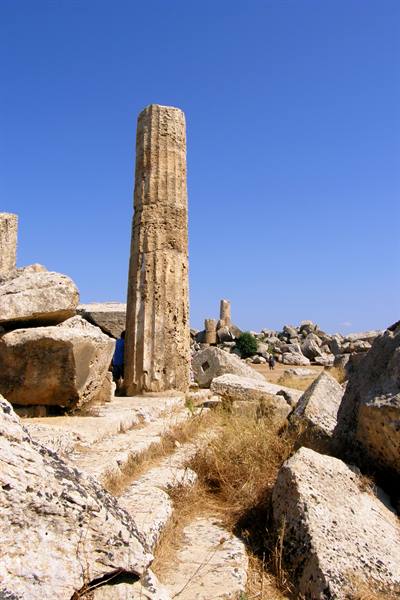
Temple E is certainly the most representative: probably dedicated to Hera it was rebuilt, in a perhaps questionable manner, in the sixties of the last century, and today it stands, impetuous, with its purest Doric style, in the suggestive surrounding panorama. In the vicinity the ruins of Temples F and G are also impressive: the first (dedicated to Athena or Dionysus) is the smallest and most damaged, but also the oldest, and the other, dating back to the 6th century BC, was one of the largest buildings of its kind in antiquity, probably named after Zeus, of which only one column remains standing (restored in 1836), 16 meters high and 3.5 in diameter. After the exploration of the temples in the lower part of the site we get back on the little train, which will take us to the upper part... or to what remains of it.
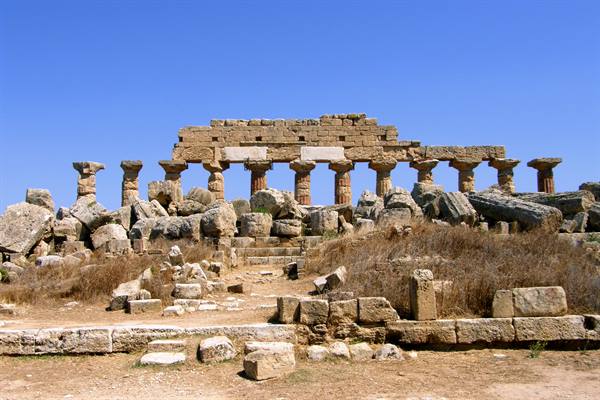
In fact, the ruins of the Acropolis are rather scanty, if we exclude the fourteen columns of Temple C (perhaps dedicated to Apollo), raised in 1925 and recently restored... Then, with the view that spans over the Mediterranean coast, we walk along the hill, crossed by two main arteries, in turn intersected by minor streets, which lead to a beautiful fortified gate, at the time the main access to the heart of the city. It is now midday when, delighted by a fresh granita, we again wait for the little train that will take us back to the entrance of the site, aware of having consumed yet another excellent experience of history in Sicilian land.
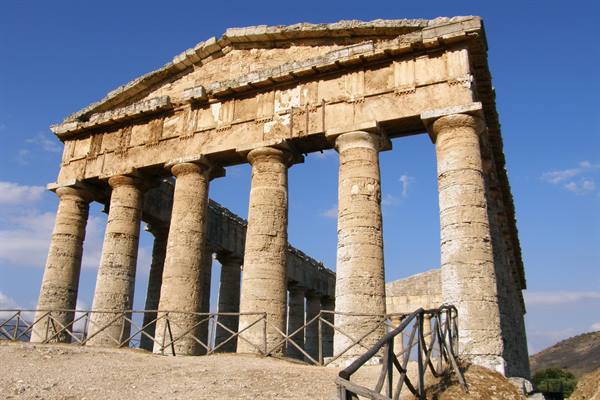
We have lunch in the parking lot of Selinunte then, while Leonardo sleeps, we take the road again and in less than an hour we reach the square in front of another important archaeological area: that of Segesta, perched on Monte Barbaro, in the interior of north-western Sicily. Of the epic city, eternal rival of Selinunte, almost nothing remains, except, miraculously intact, the temple and the theater, the latter, for its position, among the most suggestive of antiquity. Right from the theater, upon the little one's awakening, we begin our visit.
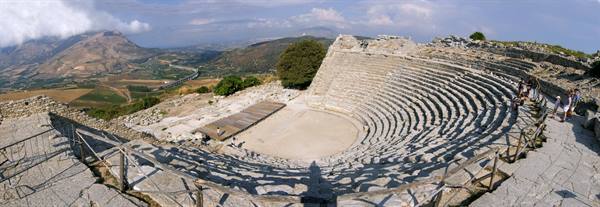
We thus purchase the tickets for the site and for the shuttle that will accompany us to the top of the hill and in no time at all we find ourselves scampering up and down the ancient tiers, dating back to the 3rd century BC, which could accommodate up to four thousand spectators, but also with the grandiose view that spans over the valley below... and over the sinuous viaduct of the A29 motorway, which runs in the direction of Trapani. Truly suggestive is the Theater of Segesta, in an excellent position and excellent state of preservation (thanks also to a very recent restoration)... but we don't waste time and immediately after we run to see the nearby temple, before it is swallowed by the shadow of the adjacent height.
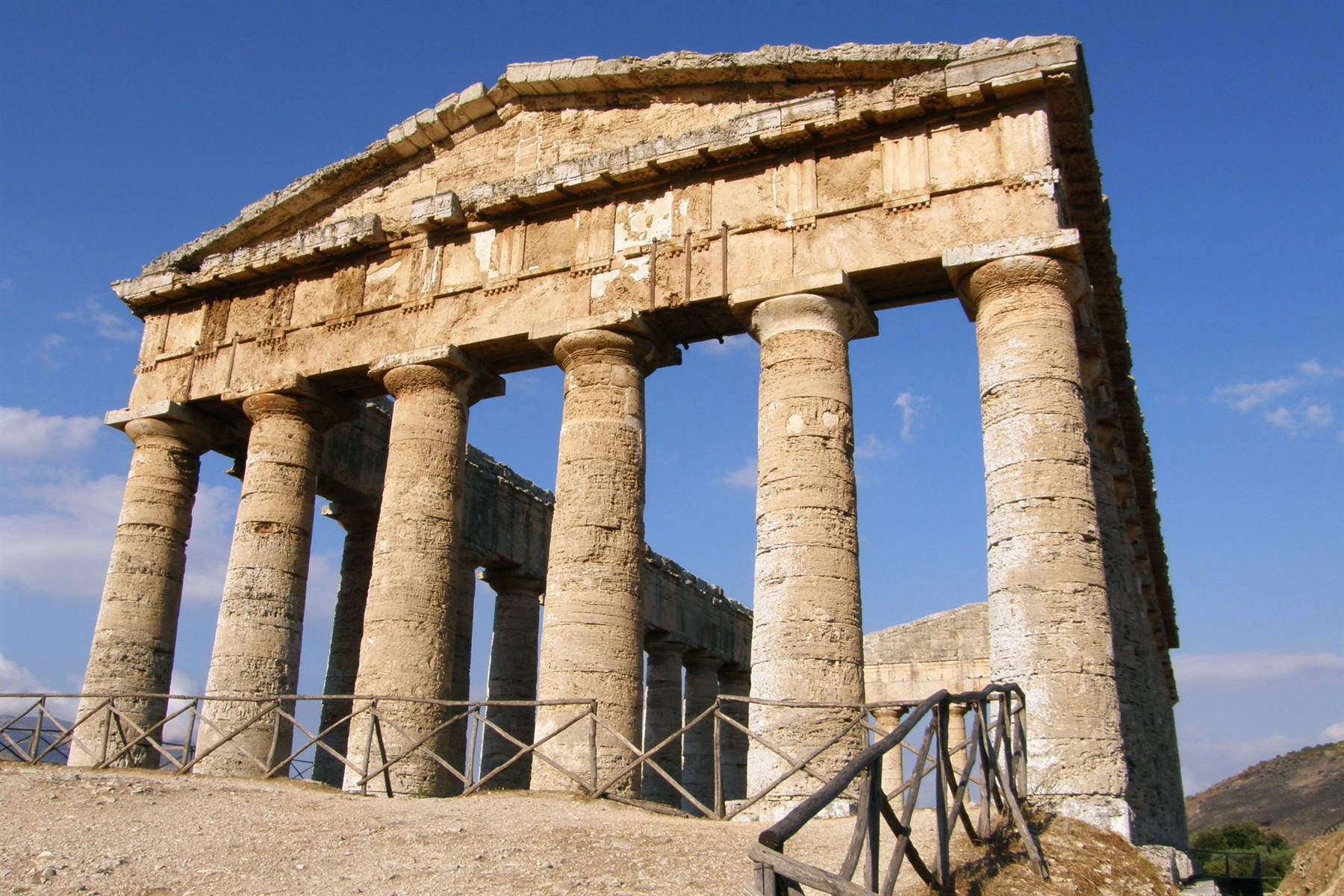
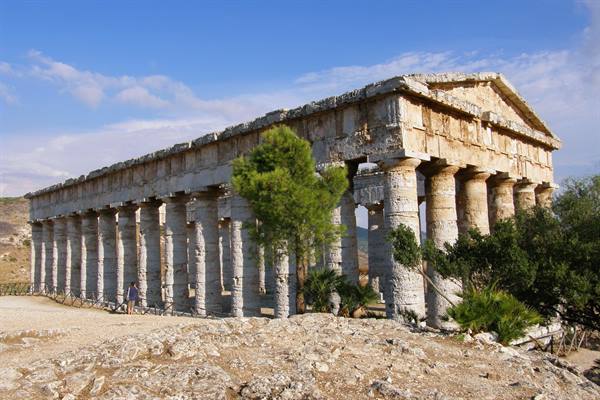
The Temple of Segesta too, built in purest Doric style at the end of the 5th century BC, is truly very beautiful, with its exceptional quadrilateral of columns, without fluting, which stands imposingly at the foot of the barren mountain that towers over it. In this way we conclude the exploration of one of the most important sites of Magna Graecia and subsequently we prepare to travel the last stretch of the stage, which will take us to the famous locality of San Vito Lo Capo. We go along the motorway towards Trapani, but we do not reach the center of the Sicilian provincial capital and we turn off a few kilometers before in a northerly direction. We notice, up high, on our left and among the clouds, the village of Erice, which we will visit the day after tomorrow, and from there we continue along the Statale 187...
Doing so, on minor roads, we come within sight of the sea and on the Gulf of Cofano, near Timpone, we enjoy a fiery sunset... Then, a handful of minutes later, we are in San Vito Lo Capo. We do not find a place in the rest area that we had planned and we have to settle for another one, further from the coast, but with a free shuttle service. It is 20:30 and by now it is dark. We have dinner, take a regenerating shower and then go to sleep... Tomorrow the weather seems to change radically, and on the program there is a day of an exclusively seaside nature... let's hope for the best, at least for the morning... Meanwhile we can enjoy the extraordinary memories of today, rich in history and charm, that only the millennial stones can convey.
Segesta: Temple
Day 1120 Aug 2013
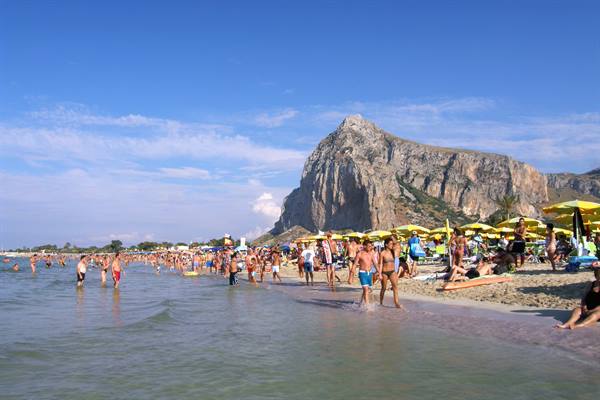
In San Vito Lo Capo there is supposed to be one of the most beautiful beaches in all of Sicily... which is why we'll be staying here full-time, from morning to evening. When we get up the sun is shining and with the shuttle from the rest area we get a ride to the seashore as early as possible. It's just past 9:00 when we set foot on the sand and, even at that hour, we struggle to find a good spot near the water to plant the beach umbrella, then we look around and, overshadowed by the almost Dolomite-like silhouette of Monte Monaco, which gives the landscape a vertical character, we immediately run to see the much-praised sea which, partly justified by a slight swell, at first glance doesn't excite us that much... in fact, I'd say we were definitely expecting better! Meanwhile a few clouds have appeared, but luckily the sky doesn't cloud over and the sun alternates with the shade...
so, between playing and swimming, we easily make it to midday. In the afternoon, defying the forecast, the sun is still shining, so we go back to the beach... but the sea is even uglier (it looks like a pond!), perhaps also because of the large number of bathers. A Sicilian, a regular at San Vito Lo Capo, confesses to us that he has never seen it in such conditions... It's bad luck: the biggest disappointment of the trip, even more so than Etna in the clouds! One way or another we make it to evening anyway and the time comes to head back to the camper. Later, in the distance, we clearly notice the lightning of a storm... Rain is forecast for tomorrow and all we can do is hope for another mistake, this time a rather big one, on the part of the meteorologists.
Erice
Day 1221 Aug 2013
During the night a strong storm hit us, but when we wake up, thank God, the sun is shining again. We leave the rest area and, to complete our visit of the area, we head south along the road that, through intriguing scenery, reaches the entrance of the Zingaro Nature Reserve, then we turn back and from San Vito Lo Capo we follow the signs for Trapani. Once in sight of the provincial capital we look for the departure point of the cable car that goes up to the town of Erice, which we had already noticed for a while towering over the surrounding landscape. We step into our cabin and, with the magnificent view that, despite the haze, stretches over the urban sprawl of Trapani and the Egadi Islands on the horizon, we climb to almost 751 meters of altitude at Erice... but it feels like we're climbing Etna, in fact on arrival we find ourselves in the clouds, and it's also quite cold.
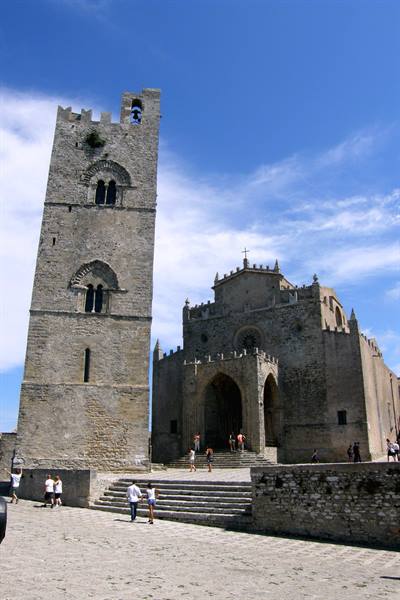
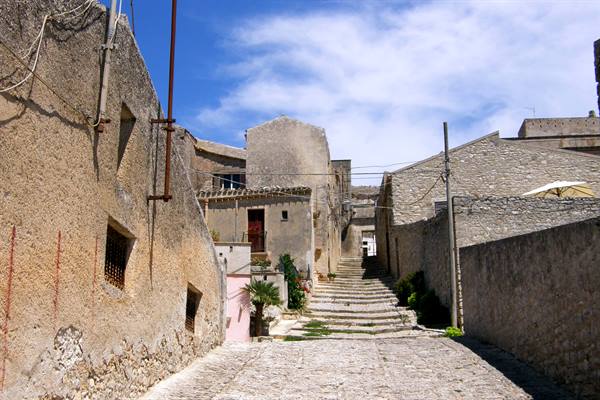
Erice, a splendid medieval village that has come down to us almost intact, was in reality, according to tradition, founded in the mists of time by the mythical Eryx, son of Venus and king of the Elymians, the people who then went on to lay the first stones of Segesta. Its current appearance, however, is owed to the Normans, who in the 12th century rebuilt the settlement and built a castle there. After passing through Porta Trapani, one of the three gateways through the mighty walls of the village, we immediately go to visit, in an autumnal atmosphere, the Duomo (or Mother Church), with its beautiful Gothic facade dating back to the 14th century, flanked by the severe bell tower, perhaps originally erected as a watchtower by Frederick of Aragon.
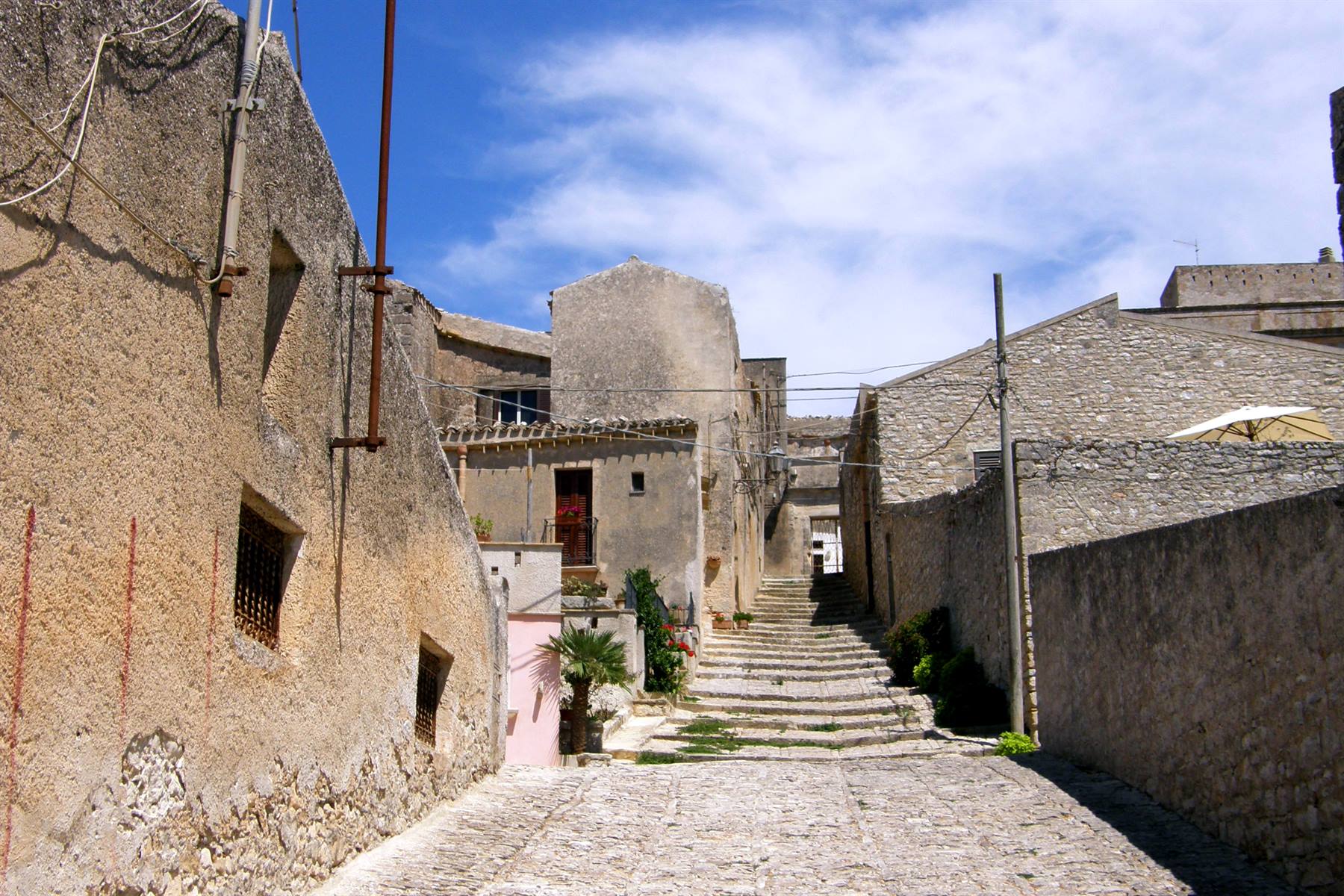
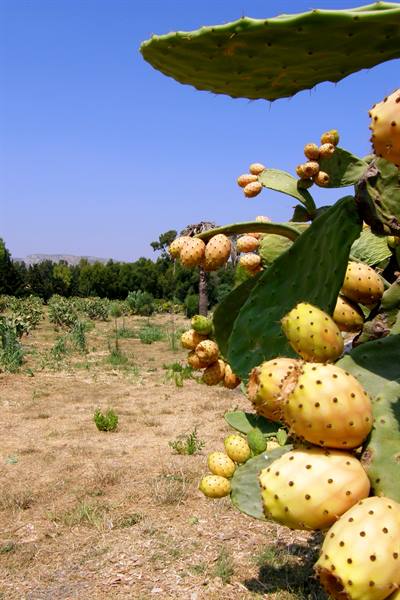
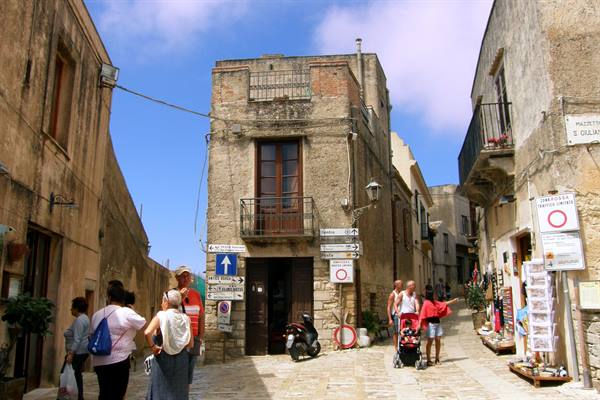
Right after, we walk uphill toward the very central Piazza Umberto I, and along the way we stop at a pastry shop to taste a "genovese": a typical Erice dessert, filled with delicious cream... and when we come out the sun finally peeks through the clouds. The town is truly a medieval gem, with alleys that are postcards, and we deliberately get lost among them for a while. We pass by the Church of San Giuliano, then we come in sight of that of San Giovanni Battista, located on the edge of the settlement with a magnificent view behind it that stretches as far as San Vito Lo Capo. Strolling along we then reach the so-called Castle of Venus (dating back to the 12th century), clinging to a rocky spur with extraordinary views, cheered by the warm caress of the sun, which has finally won its battle with the clouds and now floods everything with splendid light.
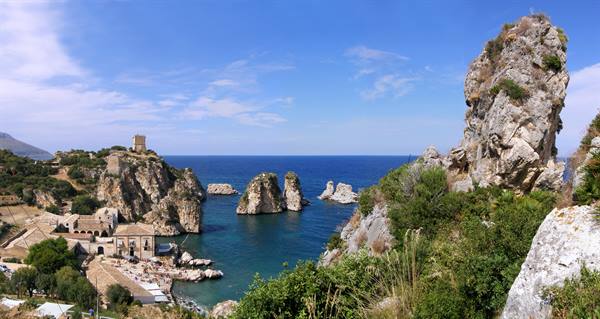
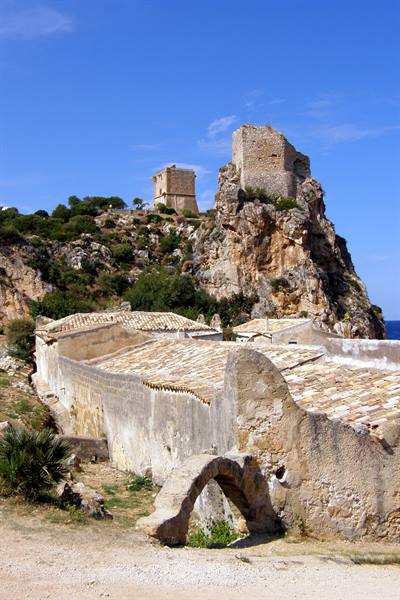
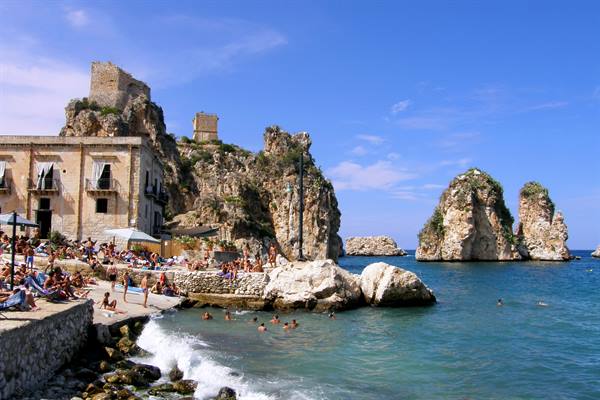
Finally we go back to photograph the Mother Church in another season and then with the cable car we return to sea level. We have lunch and right after we take the road, or rather, the highway: heading for Palermo... Toward the center of Sicily there are big rain-laden clouds, while the sun is still holding over us. So, once we reach the Castellammare del Golfo exit, we follow the signs for Scopello and a few minutes later we stop in the parking lot in front of the tuna fishery of the same name. The Tonnara di Scopello, one of the most important and oldest in all of the island, dates back to the 13th century and is located in a spectacular stretch of coast, characterized by some sea stacks, so scenic that it was also chosen as a natural set for filming a well-known Wind TV commercial, with the comedians Aldo, Giovanni and Giacomo.
The place is accessible for a fee and also offers an original swimming opportunity, but not suitable for a child... plus it's not really the right day, so we settle for observing it from the top of the neighboring cliffs, then we go to spend the rest of the afternoon in the nearby cove of Guidaloca, while the sun definitively retreats behind the clouds and in the distance you can clearly see it raining. The sea is rough and not very inviting, so we spend the evening playing with the stones that characterize the beach and then we go, for the night, to the Agricampeggio Scopello rest area. Later the weather calms down and a beautiful full moon appears in the sky... let's hope for the best, because tomorrow an entire day at the beach in the Zingaro Nature Reserve awaits us.
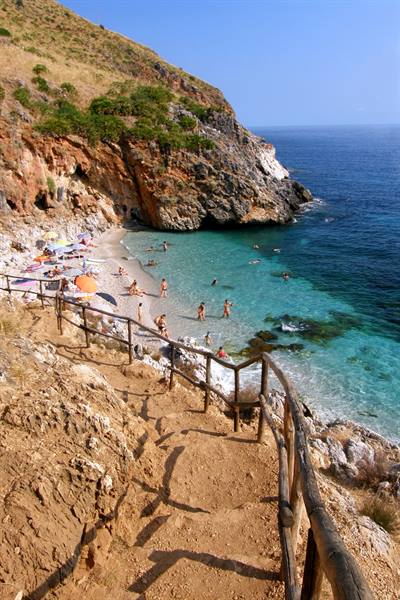
Zingaro Reserve: Cala Capreria
Day 1322 Aug 2013
There are a few clouds in the sky but they don't worry us too much... We put the sandwiches in the backpack and with the shuttle from the rest area we get a ride to the southern entrance of the Zingaro Nature Reserve, the first protected area of this kind in Sicily, established in 1981 at the end of numerous environmental initiatives aimed at preventing the construction of a coastal road that was supposed to reach San Vito Lo Capo from Scopello. On foot we pass the entrance, paying the required three euros, while the clouds have completely vanished, and immediately we go through a short tunnel, the only trace of the time when construction work on the road had begun, then we set off on the path that runs along the coast.
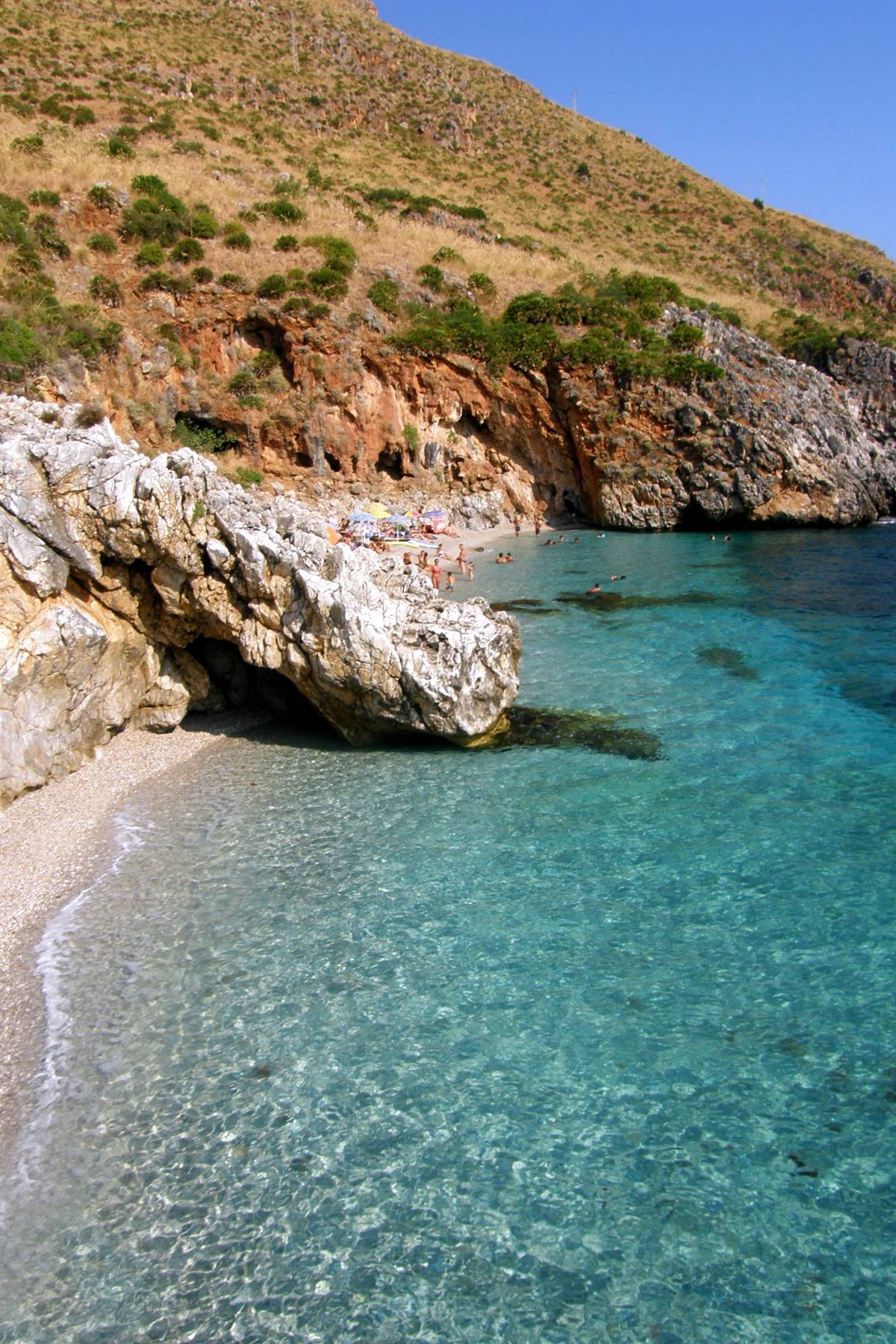
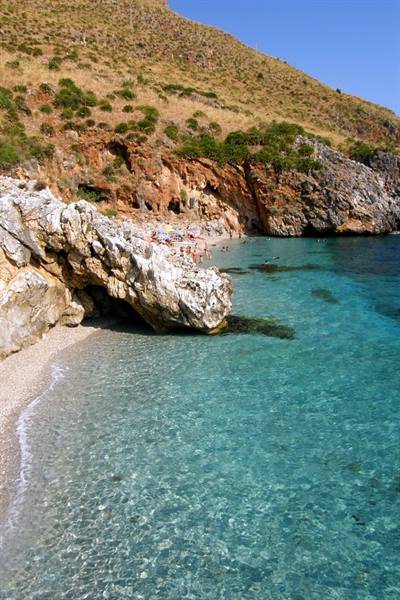
The route winds, through wild scenery, for about seven kilometers, up to the exit from the reserve toward San Vito Lo Capo, but we, given the presence of the little one, will settle for reaching only the first cove, that of Capreria, located less than a kilometer from the access gate. We arrive at the beach shortly after 9:00 and already from above we can admire its beauty: the sea today is calm and shows its best colors, in sharp contrast with the warmer ones of the surrounding cliffs and an incredibly clear sky... Despite the hour, however, the place is already quite crowded and we struggle to find space for the towels and our beach umbrella.
Just enough time to settle in and in no time at all we're basking in the crystal-clear waters of Cala Capreria, in a truly beautiful sea, like we would have expected to see in San Vito Lo Capo too! In no time it's midday and we have a packed lunch, while the people all around have become so thick that you can barely make out the stones of the beach... and a longing for the deserted Caribbean beaches comes over us. Later Leonardo brilliantly passes the test of napping by the sea (despite the crowd) and when he wakes up we all go to enjoy another swim. The wonders of the Zingaro, including the cove of Capreria, all have one peculiarity though: they face east, and the very high cliffs behind them mean they end up in the shade already before 5:00 PM... so at that hour we head toward the exit of the reserve.
From there we then call the shuttle, with which we return to the rest area and after a refreshing shower we take the road heading for Palermo. From Castellammare del Golfo we get on the A29, which runs along the coast near the Punta Raisi and Capacci airports, where we notice the memorial monument to the mafia massacre of the same name, in which, about twenty years ago, judge Falcone, his wife and their escort lost their lives. Shortly before 8:00 PM we make our entrance into Palermo... We struggle quite a bit, but in the end we find the Green Park: a rest area located almost in the very center, which will host us for the night... and from there, tomorrow morning, we'll set off to discover the Sicilian capital.
Monreale: Cathedral
Day 1423 Aug 2013
Last full day on Sicilian soil, entirely dedicated to Palermo, the main urban agglomeration of the island, which today has almost seven hundred thousand inhabitants, whose origins date back to the 8th century BC, in Phoenician times. We get up quite early so that we're already before 9:00 AM, near Piazza Indipendenza, at the Palazzo dei Normanni, easily reachable on foot from the Green Park... Excellent choice, because there's still no crowd and, in complete peace, we can enjoy the beauties of the old Royal Palace, which was initially an Arab fortress (in the 9th century), then remodeled and enlarged by the Norman kings and today, in part, is also the seat of the Sicilian Regional Assembly.
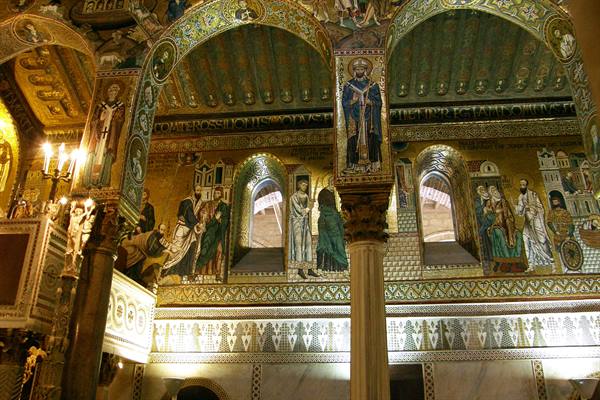
We immediately devote ourselves to the most famous part of the structure: the so-called Palatine Chapel, a true masterpiece of Arab-Norman art, begun by Roger II in 1132 as the court chapel, which houses stunning Byzantine mosaics on a gold background... We stay there for a while, literally enchanted and in silent contemplation, before such a wealth of decoration, and we even manage to take a few innocent photos (without flash), despite the incomprehensible ban. After the Palatine Chapel we explore the interesting royal apartments, including the hall that houses the current Regional Council, then the basement, where the oldest rooms of the complex are located, and finally we exit the building while tourists begin to pour in, more numerous.
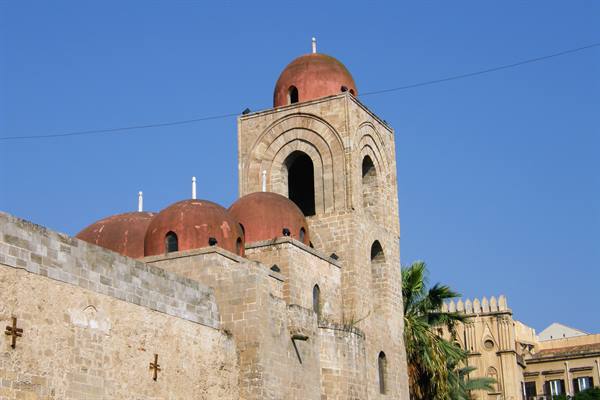
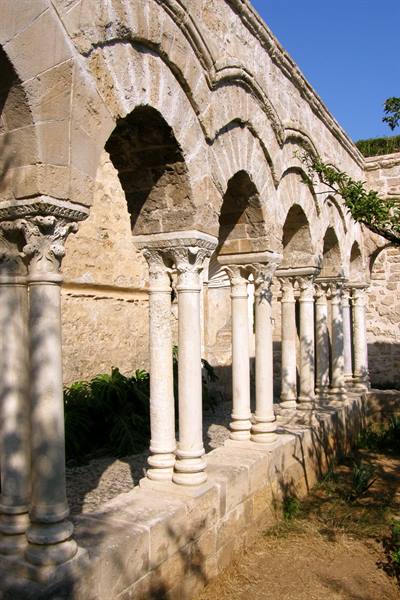
Nearby we also go to see what remains of the Church of San Giovanni degli Eremiti, dating back to the 12th century, with its five red Arab domes and the adjoining, fascinating cloister, then from Piazza Indipendenza we look for public transport to reach the town of Monreale, located on the hills behind Palermo. To reach the destination we would need to change lines, but the times are quite long, so for the last stretch we accept the unmissable offer of a taxi driver, who for a few euros takes us practically to the square in Monreale... His real purpose was then to lure us in for the return trip, but we, politely, decline the offer.
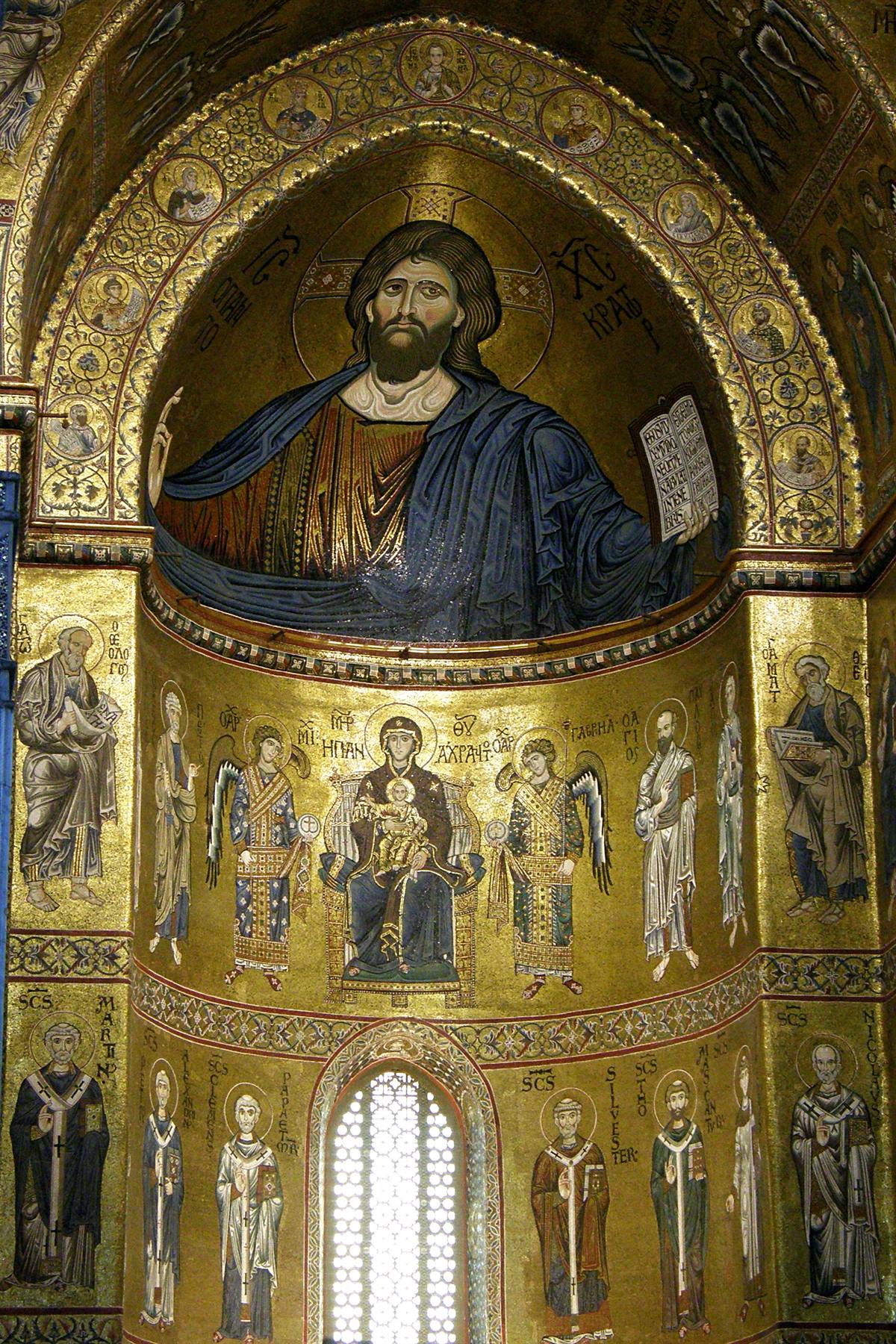
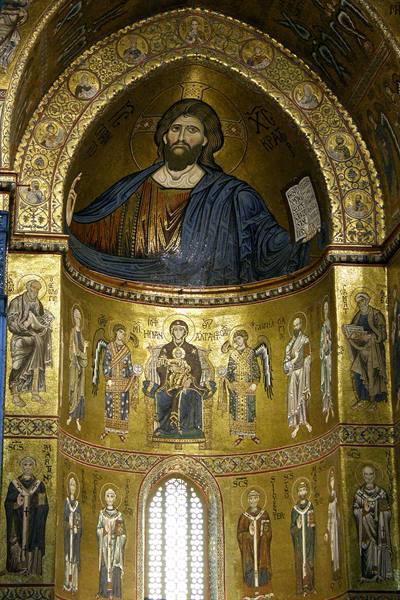
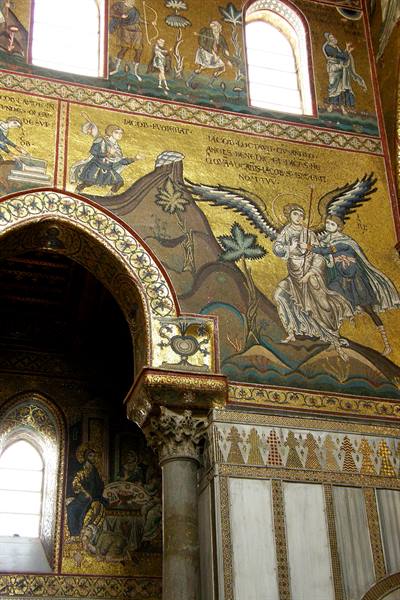
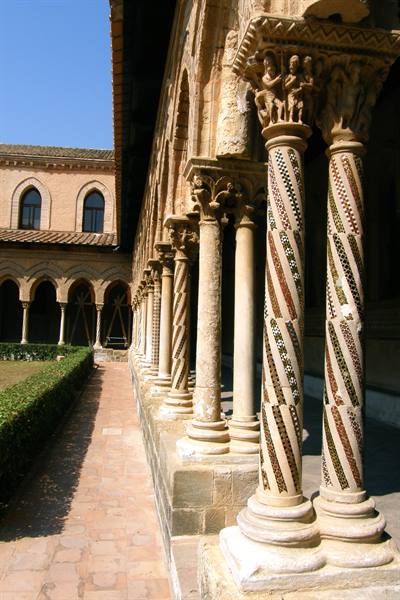
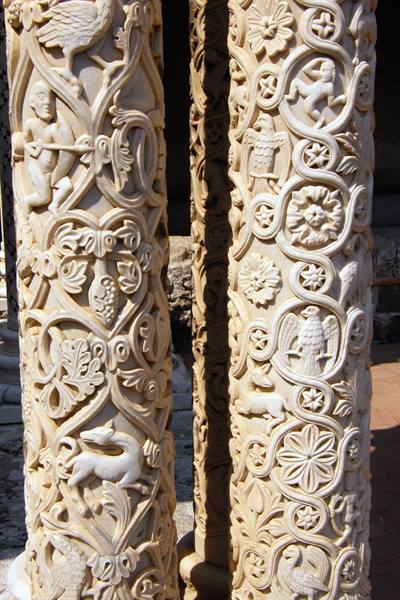
Monreale, a town that formed in the 13th century around a Benedictine abbey, which later became one of the largest archbishoprics on the island, is known above all for what is, today, its Cathedral, whose crazy opening hours forced us to interrupt, momentarily, our visit of Palermo. Just like the Palatine Chapel, the Cathedral of Monreale is one of the highest expressions of Arab-Norman art and, founded in 1172 by William II, it stands out for its wonderful gold-background mosaics, which extend over more than six hundred square meters, recounting episodes from the Old Testament. Beside the main religious building we then observe the splendid cloister, from the same era, surrounded by 228 columns with mosaic inlays or decorated with arabesques, topped by pointed arches, which create views of great suggestion.
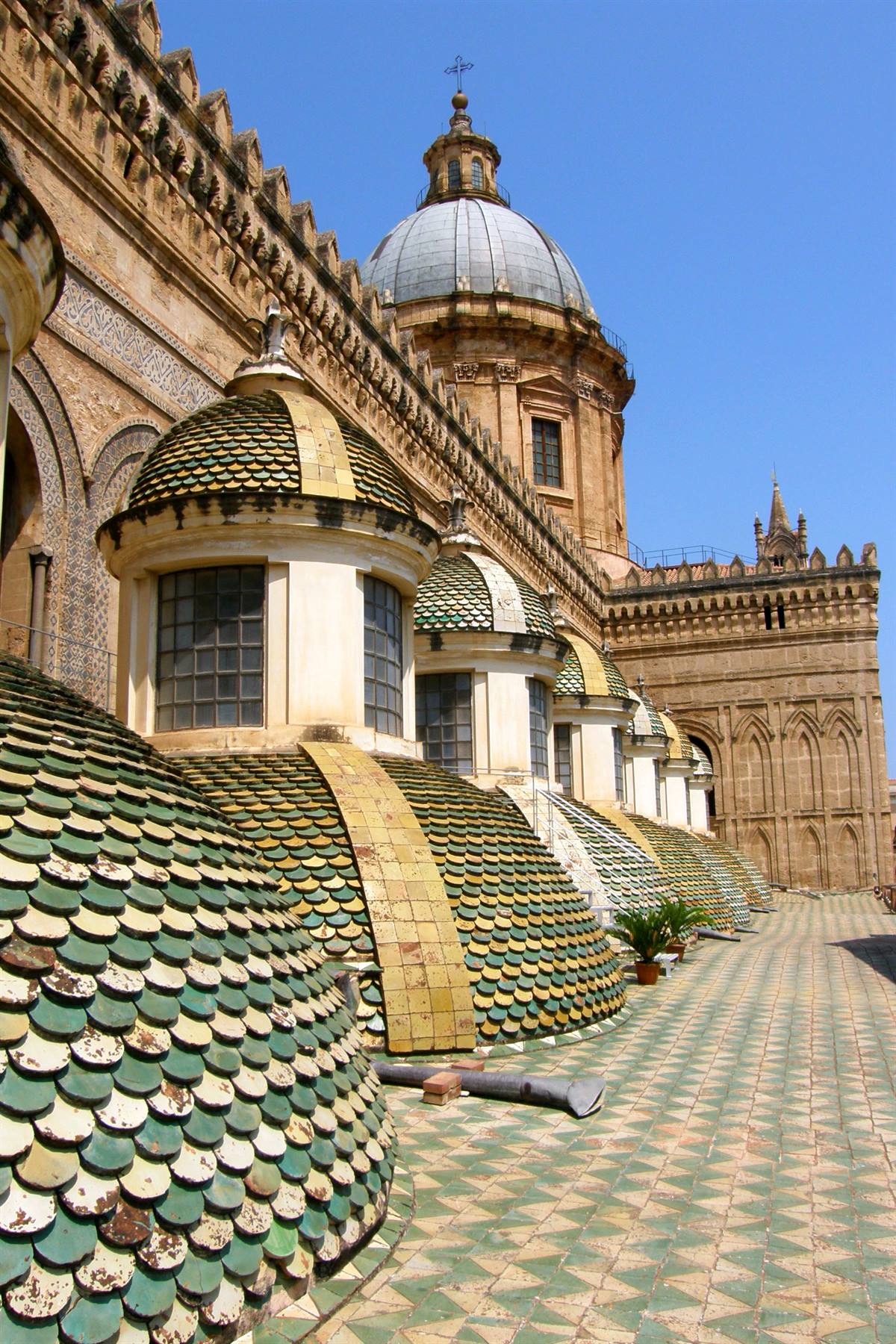
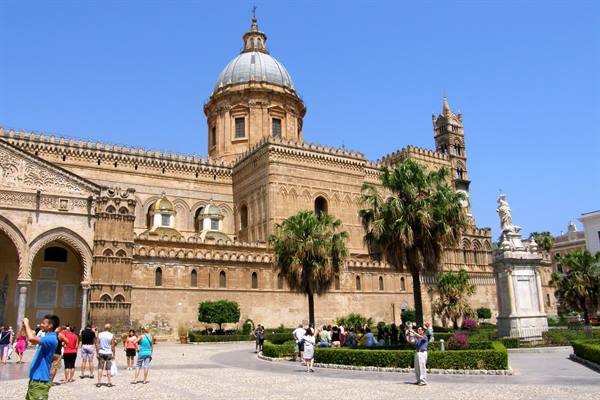
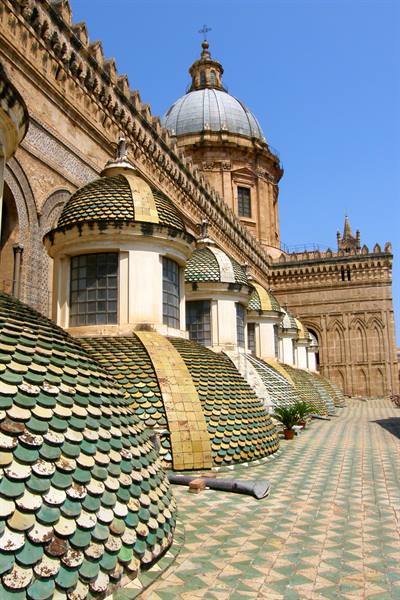
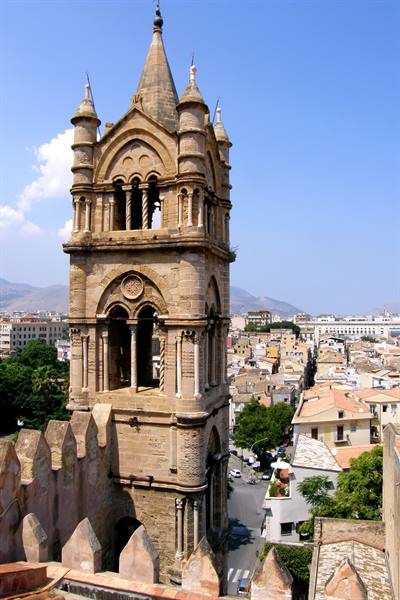
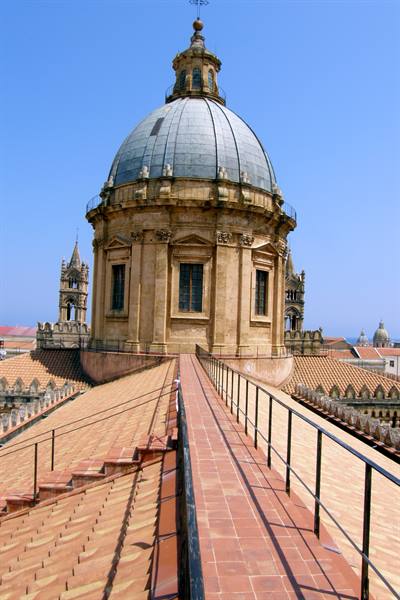
By public transport, around midday, we then return to Palermo and get off almost in front of its Cathedral... Majestic, of Arab-Norman origin but profoundly remodeled over the centuries, almost as if every ruler of the island had wanted to leave an indelible mark on it. We explore it down to the smallest details, starting from the royal Norman and Swabian tombs, moving on to the rich treasury and the crypt, containing sarcophagi of Roman origin, and reaching, with a guided tour, all the way up to the roof of the building, among fanciful domes and beautiful views over the city.
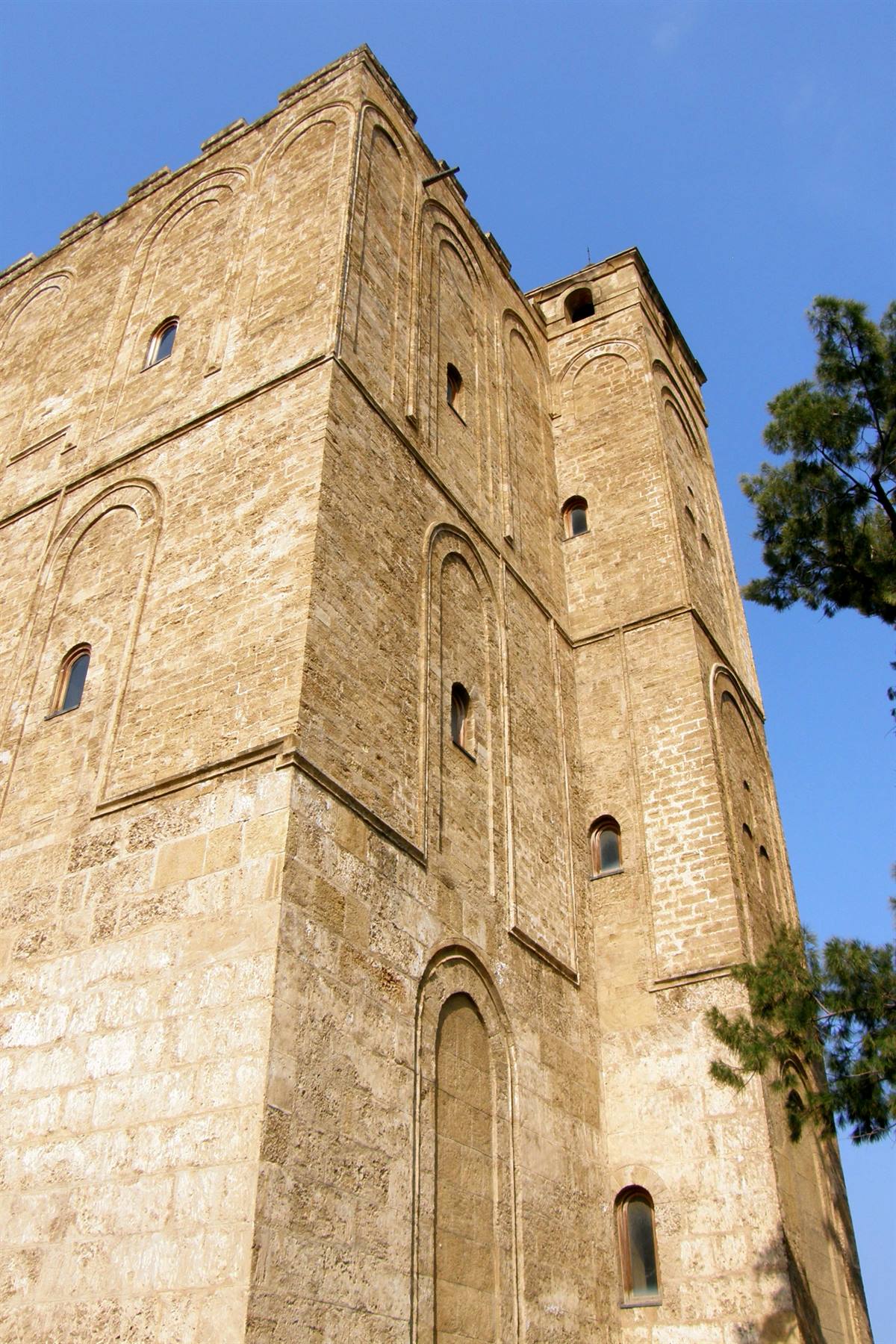
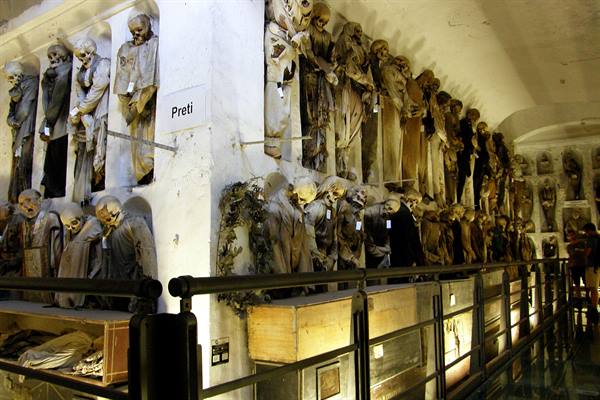
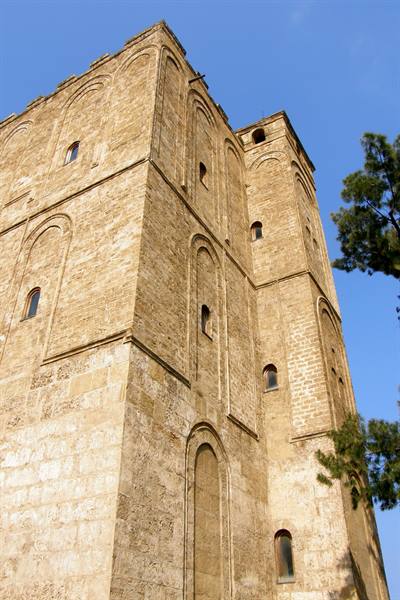
It's already well past 1:00 PM when we return to the camper to have lunch and later, while the little one is sleeping, in the company of Federico, I go to explore the eerie Catacombs of the Capuchins, where in the mid-19th century about eight thousand corpses were stowed and hung, embalmed with techniques used by the friars, still visible today, all in a row, along the walls of the underground chambers, creating an environment of extremely macabre taste, but also evocative. Having abandoned the afterlife and regained the sunlight, we take the opportunity to also go and photograph the nearby Zisa fortress-palace, a severe example of Norman architecture dating back to the end of the 12th century, then around 4:30 PM we're back at the camper to regroup the team and continue our visit of the center of Palermo.
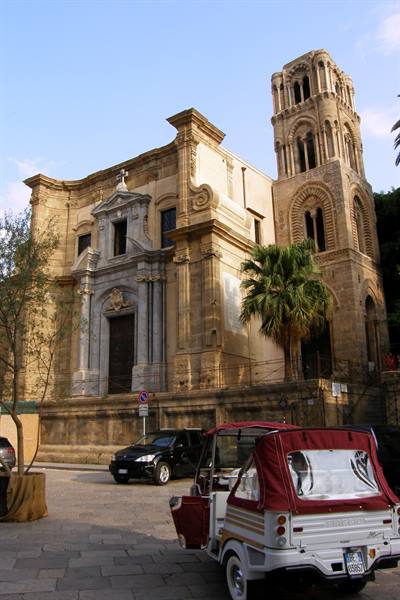
We waste some time waiting for a bus that, for who knows what reason, just doesn't come, then also thanks to the help of a bee-taxi, which particularly amused Leonardo, we reach the heart of the city, identified with Piazza Vigliena, commonly known as Quattro Canti. Here the two main arteries of Palermo intersect, which in the 17th century divided the city into four large districts, at whose corners stand as many monumental buildings with concave facades, enriched with Baroque decorations. From there, given the now late hour, we immediately rush to see La Martorana (or Church of Santa Maria dell'Ammiraglio), of Orthodox worship, dating back to the 12th century and studded with wonderful Byzantine mosaics...
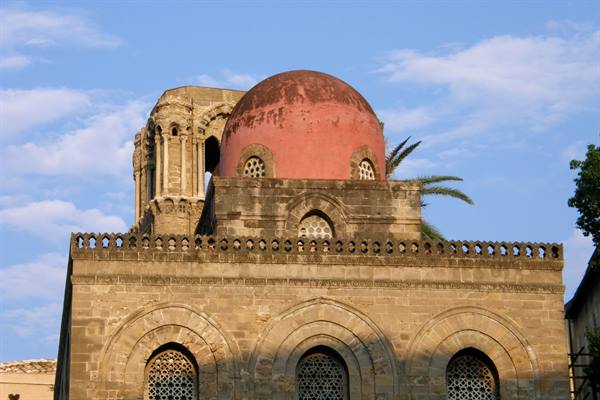
but inside a wedding is taking place and this doesn't allow us to visit it thoroughly, so we turn to the adjacent Church of San Cataldo, from the same era, but characterized by a more severe architecture and topped by three solemn red domes, in contrast with the monochrome of the walls below. The religious building closes at 6:00 PM and at the last minute we manage to explore its bare but evocative interiors, then we devote ourselves to the Church of Santa Caterina opposite, which, erected in the 16th century, presents inside a lavish Baroque decoration of stuccoes and polychrome inlays that cover every centimeter of wall... without a doubt one of the most beautiful buildings of its kind in the city.
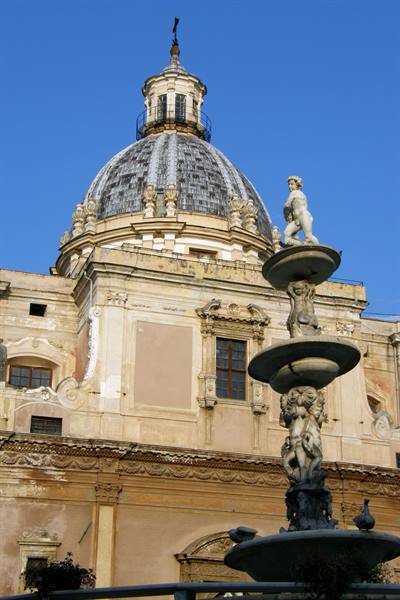
We then turn our attention to the photogenic Piazza Pretoria, with its 16th-century monumental fountain, animated by various marble figures and surrounded by interesting buildings, including the Town Hall (or Palazzo delle Aquile)... even though everything is now, irremediably, in the shadow of late afternoon. At this point we make a quick in-and-out trip to the Ballarò Market, considered the oldest in Palermo, but the place unsettles us a bit and soon we head back to the Green Park. So along the way we stop to buy panelle and cannoli for dinner, with the intention of fondly remembering this land, which we'll leave tomorrow.
Palermo: Cathedral
Day 1524 Aug 2013
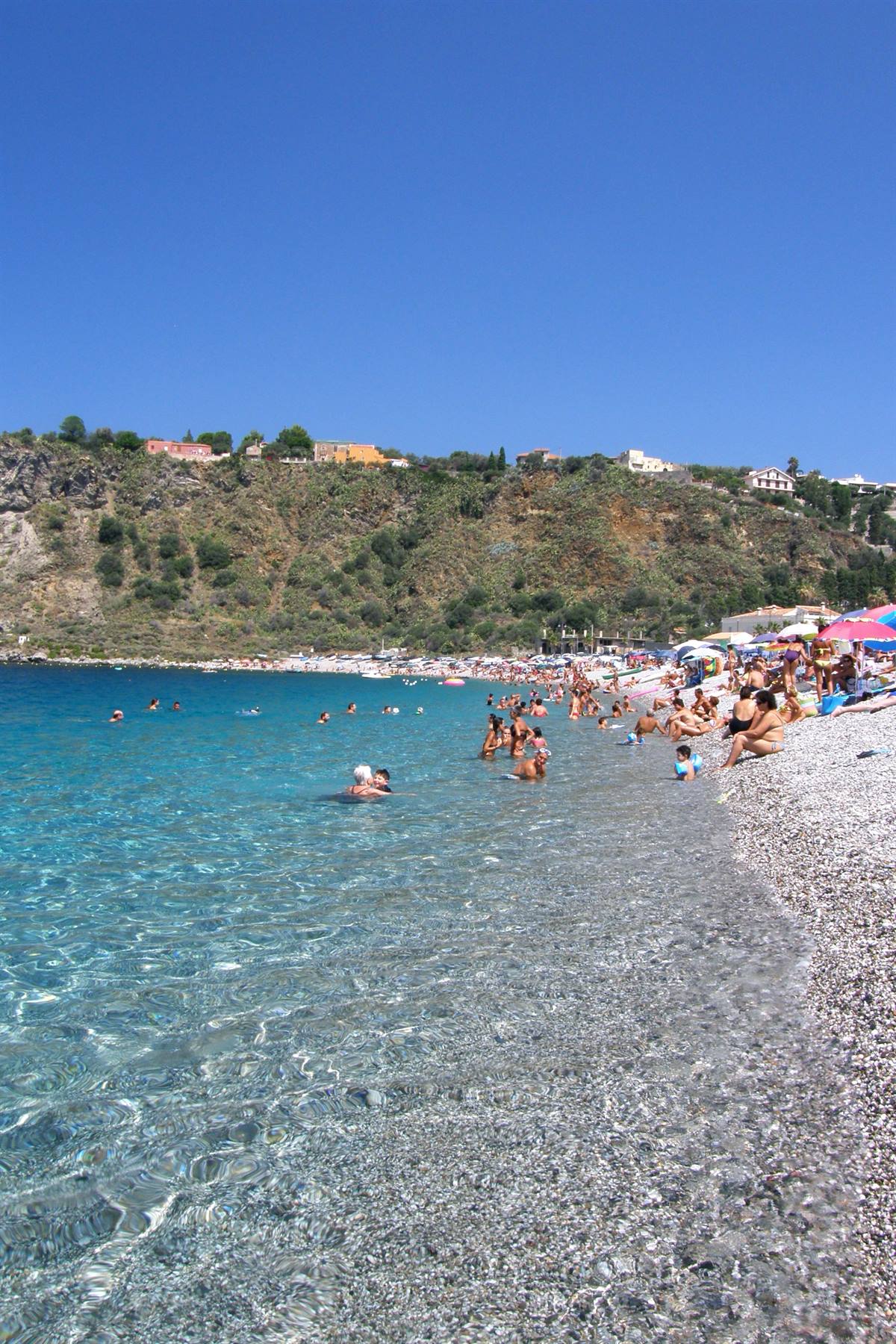
The long journey home begins slowly. Shortly after 8:00 we leave the rest area in Palermo and follow the signs for the highway, once on which we set off to travel practically the entire northern coast of the island, deliberately skipping, for lack of time, the interesting city of Cefalù. Around midday, however, we exit to go to the western shore of the town of Milazzo and take one last Sicilian swim before returning to the mainland. Milazzo is located on a curious peninsula jutting into the Tyrrhenian Sea, from which one sets sail for the Aeolian Islands, and it offers a long pebbly beach, about which I had excellent reports... and I have confirmation of it, in fact at its northern end we discover a stunning sea, in which to bask for a while... until lunchtime.
Five minutes before 2:00 PM, from the seafront of Via Toma in Milazzo, the real return journey begins and about half an hour later we're already off the highway, in Messina, following the signs for the port... but we're immediately in a queue! Today is a red-letter day for returning from vacations, so it takes us over two hours to board and at 4:45 PM, finally, we get on the Caronte & Tourist ferry, which about thirty minutes later drops us off at Villa San Giovanni, in Calabria... but after a few meters we're in line again along the link road that leads to the highway. So we decide to venture onto an alternative route, along the state road that runs north near the coast, but we find ourselves stuck in the center of the town of Scilla and its beach traffic, managing to get onto the highway only at 6:20 PM...
it's an odyssey! The traffic is now flowing, but we're way behind schedule, plus we have to face another slowdown for roadworks after Pizzo Calabro. Around 8:00 PM we stop for dinner, at a service area, shortly before Cosenza, and afterwards we get back on the road. Following the outward route in reverse, at 10:45 PM we reach Trebisacce, at the same rest area where we had stayed two weeks ago on our way to Sicily, and, all tired, we soon go to sleep.
Palermo: the Zisa
Day 1625 Aug 2013
We leave Trebisacce early, at 6:20, while Sabrina and Leonardo stay in bed... this way we'll make up for lost time and (maybe) shield ourselves from new queues. At 8:40 we're in Bari, including a stop for breakfast and waking up the whole family, then, an hour later, in Foggia. At 11:30 here we are passing along the A14 near Pescara... and shortly after in a queue for an accident. So near San Benedetto del Tronto we stop for lunch. At 2:30 PM we get back on the main road, which being fairly clear allows us to be in Ancona at 3:20 PM and half an hour later in Pesaro. We re-enter Romagna and at 4:20 PM, having passed the signs for Rimini Nord, we're stopped in a queue again. So we decide to exit at Valle del Rubicone and travel the last stretch on the Via Emilia. This way, after an obligatory stop for service operations, at 5:40 PM we conclude the trip in front of our home.
A little later we begin tidying up the camper, while the most beautiful images of Sicily run through our minds, a region rich in millennia-old history and stunning natural scenery, a crossroads of the Mediterranean and mythical "land of the three seas" (sometimes characterized by magnificent crystal-clear reflections)... the only flaw being the Italian August overcrowding.
0 reader comments