The countdown was interrupted just over twenty-four hours before departure, initially scheduled for 22 July, and we managed to move the ferry booking to today…The cause? A sudden flu attack, decidedly out of season, that struck the little one, so after a week from hell spent between doctors' offices and pharmacies, fortunately everything has passed and now we're ready and even more eager to enjoy our well-deserved summer holiday. In the morning, calmly and with Federico back in shape and beaming about the imminent departure, we finish sorting out the luggage…On the face of it there's a lot and it gives me some worry, but I manage to load it all into the rear boot of the car and at 11:30 we're all on board, about to face this new adventure.
Ten minutes after departure we join the motorway at Forlì heading south: the traffic is heavy, despite it being a weekday, but everything flows smoothly and after about an hour of travel we're at Pesaro. We carry on and a little later, at 12:45, we stop for a snack at a service station, near Fano. Just time to eat our cold pasta and a few minutes after 13:00 we're back on the road, to exit half an hour later in the direction of Ancona…Of the Marche capital we reach the port, from which we'll board for Greece and Patras: the goal, in fact, is to visit the Peloponnese, the southernmost of the Greek mainland regions, which was missing from the list of our travel experiences and which had long been on the list of possible destinations.
That strip of land stretching out like an open hand towards the centre of the Mediterranean has always intrigued us, and now here we are, ready to explore it and take in the historical and natural features it seems potentially able to offer us.
The enormous ship, "Olympic Champion", of the Greek company Anek that will carry us across, first the Adriatic Sea and then the Ionian, is already at anchor in the port of Ancona, and when we come before it they have us park in an adjoining square where the sun beats down relentlessly: the heat, on this late-July day, is infernal and the thermometer reads over thirty-six! With Federico I go to check-in and then return to Sabrina who, heroically, had stayed in the car waiting for us…The wait for boarding fortunately is short and around 15:00 we're already going aboard, where, having parked the vehicle on the lower decks, they assign us our ordinary inside triple for the night.
Back in the open air we settle at the bow on the edges of the pool and in the little one's company I treat myself to a refreshing dip, then, almost punctually, shortly after 16:00, the big ferry slips its moorings and pulls away from the shore… As soon as we're out to sea, with a foreign accent, I hear myself called over the microphone and summoned to the reception…I promptly make my way to the place, while I think I know what the reason might be…Indeed I find waiting for me Dimitri, a Greek character, a resident of Sparta, whom I met some time ago for work and who, I recently learned, happens to be returning to his homeland on our same ship…Having learned of the trip we're about to make in his parts, he's now going out of his way in every way to be hospitable, and to start with he's decided to have us change our anonymous inside cabin for an outside one with a sea view…I keep telling him
, as I have in recent days, that he needn't worry, but he, most kindly, insists and says we must go to his house and that he'll organise our whole holiday…Time will tell!…Meanwhile, he and his business partner Petro go off to sleep in the suite and we return to the side of the pool to enjoy the afternoon, with Federico constantly in the water the whole time. Later Sabrina also retreats to the cabin for a nap, while together with the little one I stay on deck until 19:30, with the sun rapidly setting towards the horizon line. For dinner, just to get into the mood, we eat "gyros-pita", then we meet Dimitri and after a long chat about our plans, now tired, we go off to sleep, also moving the hands of the clock to Greek time (an hour ahead), and in no time it's…
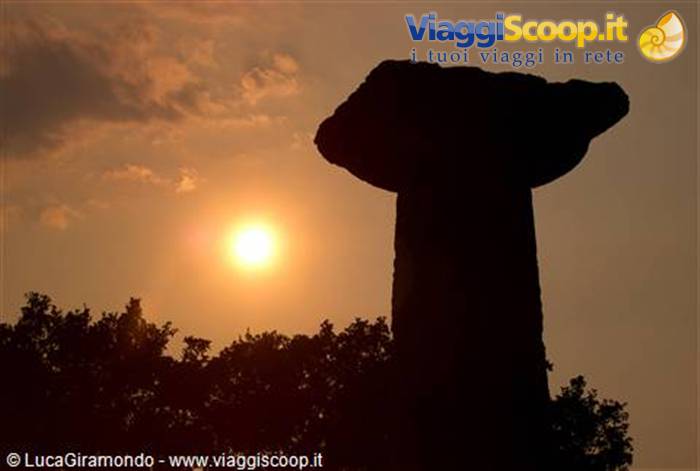
Sunset at Olympia
Day 227 Jul 2006
We slept very well in the air conditioning of the cabin…we made a stop at Igoumenitsa, in northern Greece, and practically didn't notice it: I open my eyes and it's already past 10:00 and we leave our nest almost an hour later. The ship glides over the waters of a completely flat Ionian Sea, while the Greek coasts come into view to the east: we recognise in fact the island of Lefkada, though the thick Mediterranean haze blurs its stern profile…A little later, on the opposite side of the route, Ithaca also appears, the legendary island of Ulysses and prelude to the Gulf of Patras, towards which we are swiftly sailing. At 14:00 sharp, perfectly on time (more Swiss than Greek!) we dock at the pier of the port of Patras: we say goodbye to Dimitri, whom I think we'll see again soon, and having disembarked we begin our adventure on the roads of the Peloponnese.
We head south, along the E55, which always runs distant from the coast: in fact the route is rather boring and only some folkloric, very colourful stalls, selling pumpkins of all shapes and sizes and watermelons, liven the situation up a bit. At Pyrgos we turn even more inland and around 16:00 we arrive at Olympia, a mythical place that stirs the imagination and the first significant stop of our journey. We find accommodation a short distance from the centre in the spartan (so to speak) Leonideos Guesthouse: we take the luggage to the room and immediately go down to devote ourselves to visiting ancient Olympia, or rather, what remains of it…Its history is universally known: in this place the Olympic games were held starting from 776 BC, and no fewer than 291 editions were contested.
All the cities of Hellas took part, and during the period of their holding (every four years) wars were even suspended and a special safe-conduct was offered to all participants…But the sporting ideal, the "spirit of Olympia", introduced into the modern Olympics by Baron Pierre de Coubertin, where "the important thing is not to win but to take part", was quite another thing in those times, and the Homeric line "Always to be the best and superior to others" fully expresses the ancient model of the athlete, which doesn't coincide with our vision of sport: on one side stood the winner, shining and unique like a god, on the other the mass of the losers, with no second or third places to be rewarded.
Today the excavations of Olympia are one of the most visited archaeological sites in all of Greece, and this not so much for the spectacular nature of the remains, but above all for the historical value of the place. We begin the visit from the adjoining museum, which collects the most significant finds from the site, in particular the splendid pediments of the Temple of Zeus and the marble statue known as the Hermes of Praxiteles, but also many other pieces that convey the idea of the ancient splendour of the place. Having left the air conditioning of the museum, we return to the suffocating heat outside and to the soundtrack that will probably accompany us throughout the journey: the incessant chirping of the cicadas.
While some odious clouds slightly darken the sky, we immerse ourselves among the mythical stones of Olympia: unfortunately not much remains…but you have to use a bit of imagination, and then the Palaestra, the Workshop of Phidias, the Temples of Hera and Zeus, the Stadium (with the starting line still imprinted on the ground) and the whole site, as if by enchantment, come to life and you seem to see the athletes, amid shouts of encouragement, competing in the most famous games in the world.
The clouds thin out, and so we wait, sitting on the embankment of the Stadium, until almost sunset, in a magical atmosphere, and only the guards' whistles bring us back to reality, announcing the imminent closure of the excavations…So little by little we leave, leaving behind us a little piece of the history of humanity… We happily make our way back to our little guesthouse, then, calmly, take a shower and go out for dinner to a taverna where a television broadcasts, the whole time, the opening ceremony of the Athens 2004 Olympic games…and in a finally pleasant, holiday atmosphere we spend the evening: after troubled events the journey has begun in the best possible way and we hope, fervently, it continues along the same lines…right to the end!
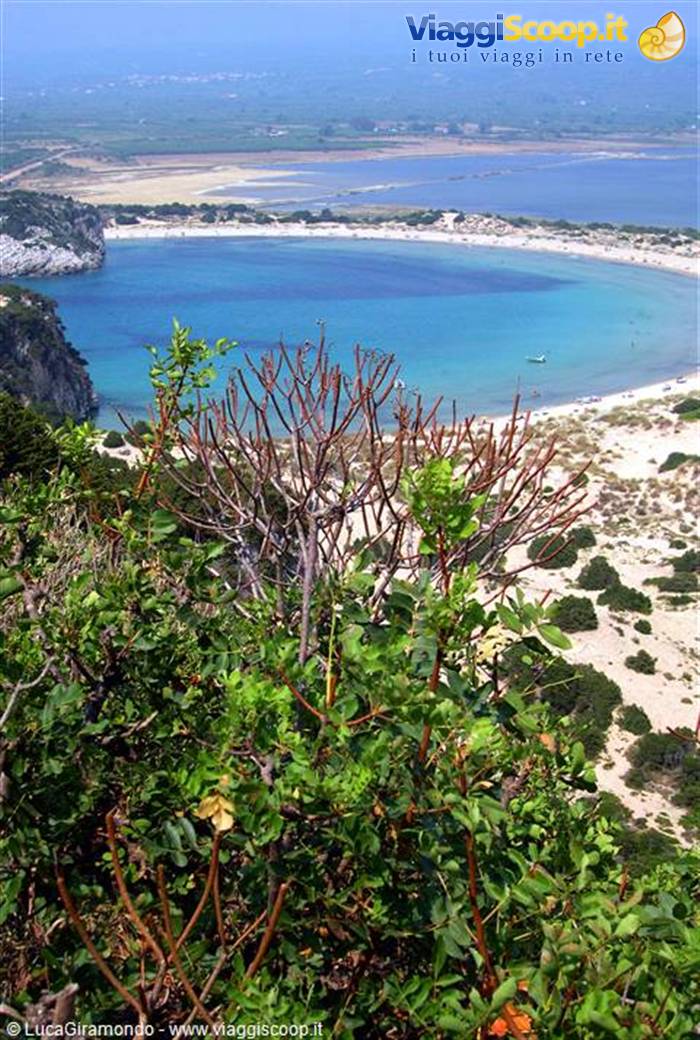
Voidokilia Bay
Day 328 Jul 2006
Although armed with good intentions, the first attempt to get up early can certainly not be called a success: the alarm goes off when it's not yet 7:00, but I postpone it to 7:30, then we laze about more than we should and don't leave the sheets before 8:00. We have breakfast in the guesthouse bar and, having loaded the luggage into the car, we set off for the day's stage: first of all we go to photograph the ancient Stadium of Olympia in the right light, which lies alongside the main road so there's no need to buy the ticket again, then we venture into the mountains, following the road that runs in the direction of the central Peloponnese.
We pass through remote villages like Kallithea and Andritsena, we also save a tortoise, which was crossing the carriageway at full "speed", and after an endless series of bends we arrive, at over 1000 metres of altitude, in sight of the Temple of Vasses, erected in 450 BC in honour of Apollo…It's one of the best preserved in all of Greece and in order to preserve and restore it, for some years now it has been, protected from the weather, under an enormous tent structure, well made and integrated into the harsh surrounding landscape.
Few tourists come up this far to see the temple and in the car park, besides ours, there's only one other car (from Modena, among other things)…all to the advantage of the atmosphere, naturally, so we can enjoy our encounter with the ancient columns, miraculously all still standing and almost entirely architraved, "disturbed" only by the incessant chirping of the cicadas. The uncomfortable road we travelled was thus rightly rewarded by the extremely interesting visit, after which there's nothing left but to face the long descent towards the sea…and having digested another few hundred bends we regain the coast near the town of Tholo.
Running alongside the Ionian again we speed south, while midday passes and a phone call from Dimitri also arrives, who is worried that everything is going well…I'd like to tell him that there are no problems and that we've travelled on our own in at least two other continents…but I'm
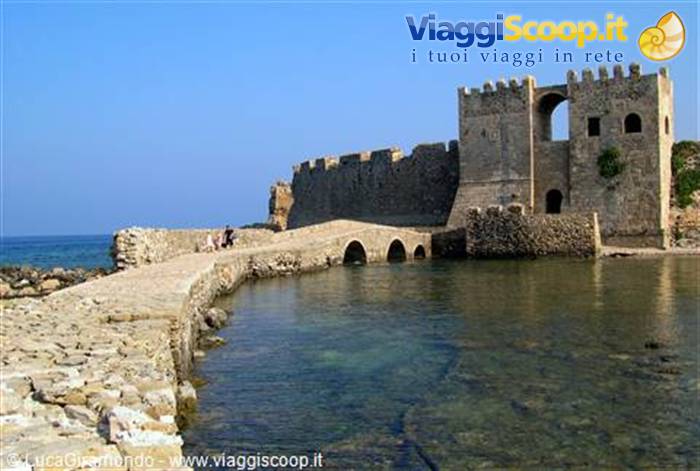
Fortress of Methoni
Day 429 Jul 2006
Today's travel program is focused exclusively on beach life and plans to spend both the morning and the afternoon at the beautiful Bay of Voidokilia, so after shopping and breakfast we set off along the few kilometers that separate us from the place. Just after 9:00 we're already past the dunes behind the beach and, having parked the car, we walk toward its southernmost end... It doesn't seem so but the route, loaded with everything we need to last until evening and with our sandals sinking into the sand, is quite long... but we come out victorious and, having planted the umbrella at a safe distance from our only neighbor, we immediately run into the water to enjoy a long and pleasant swim.
The whole day passes, in practice, in the most complete idleness, with the only commitment of seeking a bit of relief in the sea whenever, due to the heat, the body temperature rises slightly above the threshold of pleasant warmth... Indeed, a magnificent sun is shining and it's heavenly, even though as the hours pass the neighbors increase, going from one to several dozen, but the nerve-wracking crowding of Italian beaches seems light years away. Around 16:00 we break the "monotony" and with Federico I set off to climb the hill behind us, not all the way because it's very high (at the top are the remains of Paleo Kastro, a medieval-era fortress, built in various phases by Franks and Venetians, on the remains of a previous settlement, first Mycenaean and then Byzantine), but only about halfway, where the mythological Cave of Nestor is located.
From up there the panorama embraces the entire crescent of the Bay of Voidokilia (in Greek "ox belly") and would be very vast if it weren't characterized by an odious and thick haze that diminishes the outline of all the surrounding heights. We take a few photos anyway and then, on the way back, very hot, we go to seek some relief in the water, a very beautiful and transparent water... too bad only that the seabed, rather dark, doesn't bring out all its reflections. We laze on the beach at Voidokilia until, now cooked to perfection and almost evening, we return to Pylos: we tidy ourselves up properly and go out to eat good fish in a little restaurant by the sea, then relaxed by the tranquil and pleasant beach day, we return to our room to spend the last night in this nice town of Messenia, which has fully satisfied all our expectations.
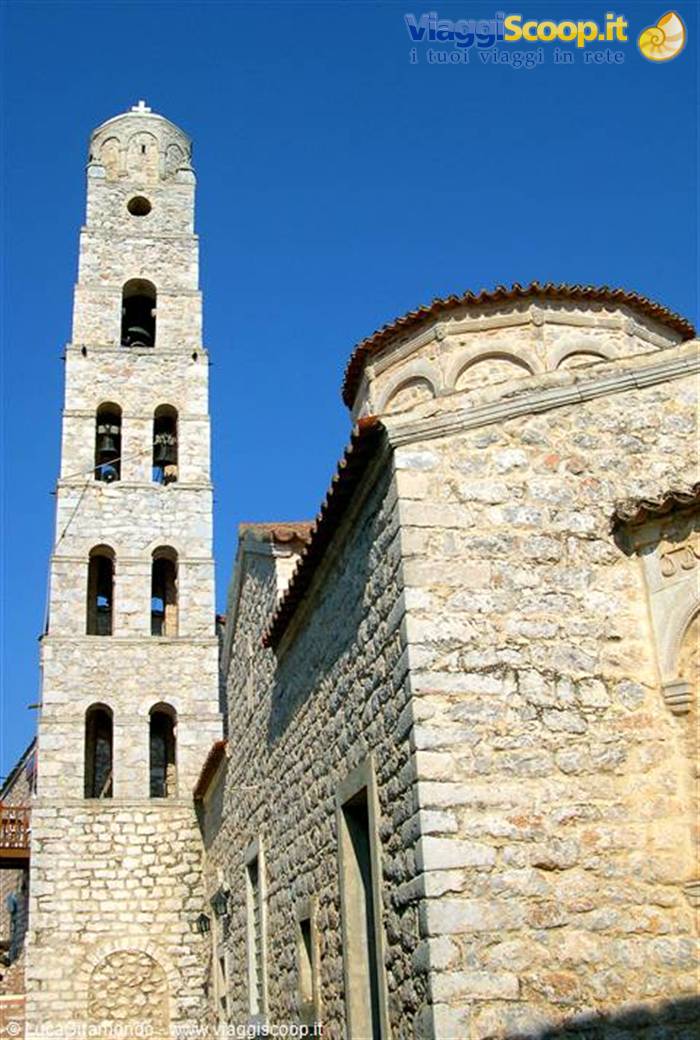
Areopoli
Day 530 Jul 2006
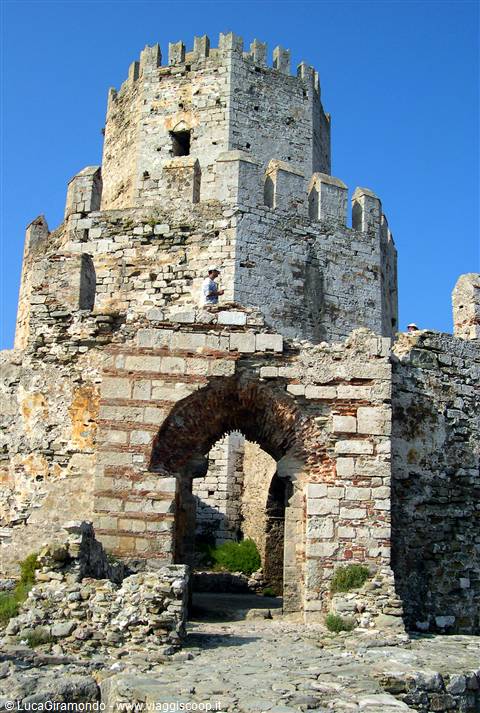
Shortly after 9:00, having loaded all the luggage into the car, we leave Pylos heading south. We cover a handful of kilometers and arrive, on the sea, at the town of Methoni, where we go to see the great Venetian fortress. The citadel of Methoni and, on the opposite side of the peninsula, that of Koroni were called, in their time, "the eyes of the Republic"... because they constituted, for the fleets departing from Venice, the support point for the main routes to the Levant, and their conquest by the Turkish army, in the 16th century, was a real blow to the commercial traffic of the Serenissima. The fortress of Methoni, which we are about to visit, is a colossal military work that occupies an entire promontory.
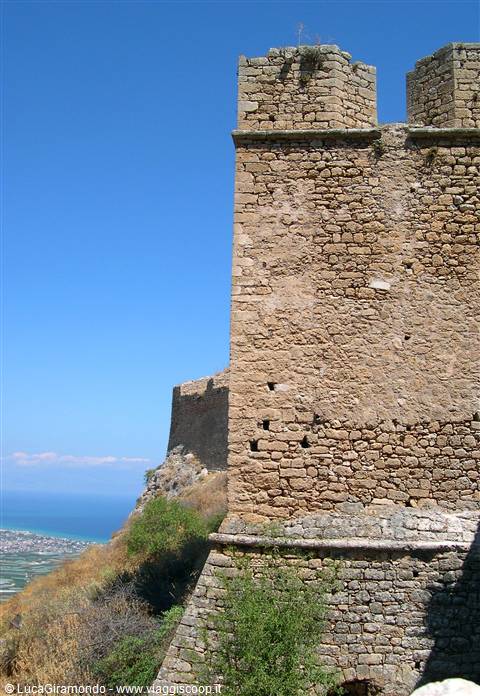
We access it by walking across the stone bridge that spans the ancient moat and by strolling we reach the sea at its most suggestive part, characterized by the octagonal Bourzi Tower, which rises, almost completely rebuilt by the Turks in the 1500s, to protect the port. The entire complex undoubtedly constitutes an important historical testimony and deserves a detailed visit, but it needs, before it's too late, a radical restoration; in fact the old walls show evident signs of collapse in several places and it would be a shame to leave them to their ill-fated destiny. During the visit, accompanied by a persistent smell of wild garlic with which the site is full, we absorb a good dose of heat and at the end we seek some relief in the car's air conditioning, while we resume our journey touching the southernmost tip of the first hypothetical finger of the Peloponnese.
We then pass through Koroni, of whose fortress little or nothing remains besides some stretches of the surrounding wall, and we go back up the peninsula northward, accompanied by the ringing of the cell phone and by the directions of our guardian angel Dimitri for the evening. Around noon we cross the anonymous city of Kalamata and from there we take the road that descends toward the ideal second finger. After leaving the coastal road behind after a few kilometers we climb toward the interior and, having tackled a small mountain pass, we stop for lunch in the shade on the sides of the roadway. Just the time to refresh ourselves and, having resumed the itinerary, at the end of a long descent, we return to the seashore in search of a beach where to spend the afternoon.
We try to make a stop at the rocky bay of Fonea, but it doesn't satisfy us and we continue to arrive, a little later, at the town of Stoupa, where the well-known beach of Kalogria is located... too well-known because, perhaps also thanks to the holiday, it's full beyond belief, but we find parking for the car and a little corner where to plant the umbrella, so we decide to stop. Due to the crowding Kalogria can't exactly be called a beautiful beach, but the sea is inviting enough (even though it's characterized by some icy currents) and the afternoon slips away quietly, while, as we learn from the Hellenic TV in a nearby bar, Michael Schumacher has won the German Grand Prix (forza Ferrari!). Around 18:30 we leave, not too sorry, the beach of Kalogria: from here there are still fifty kilometers of Greek road (about an hour) to cover before reaching our destination.
The ribbon of asphalt climbs, far from the coastline, at the foot of very high peaks and it's a real shame that there's haze because the panoramas would be extraordinary. The landscape, in fact, becomes extremely severe, with vegetation reduced to a minimum and the highest peaks wrapped in clouds... it's a strange scenario and it doesn't even feel like being in Greece. Charmed by the setting we continue along the road that begins to descend again toward the sea: we enter Laconia (Dimitri's region) and passing through a remote little village Sabrina notices a person at the edge of the roadway who signals us to slow down... I don't pay attention and continue... Shortly after a car overtakes us honking: I send it to hell and signal it to go on...
We thus reach the coast and, following Dimitri's recommendations, we start looking for the Porto Vitilo hotel, booked by him in our name and at his expense... We thus take a side road following the signs for Karavostasio... and the car that was honking shortly before stops in front of us, turning around to chase us, and shortly after catches up with us: it's a certain Gerogos, one of Dimitri's men, who was waiting for our arrival and who accompanies us to the hotel... Unbelievable! We thank Georgos, who immediately after vanishes, and we take possession of our room: the hotel is of high quality and our accommodation very nice... we still can't believe we're living a story like this... and I can't do anything but call Dimitri to praise him heartily.
We enjoy the situation and then go out for dinner in the nearby village of Neo Itilo: there we eat a wonderful sea bream by the sea, concluding a day that was mainly about traveling in the best possible way.
Vathia
Day 631 Jul 2006
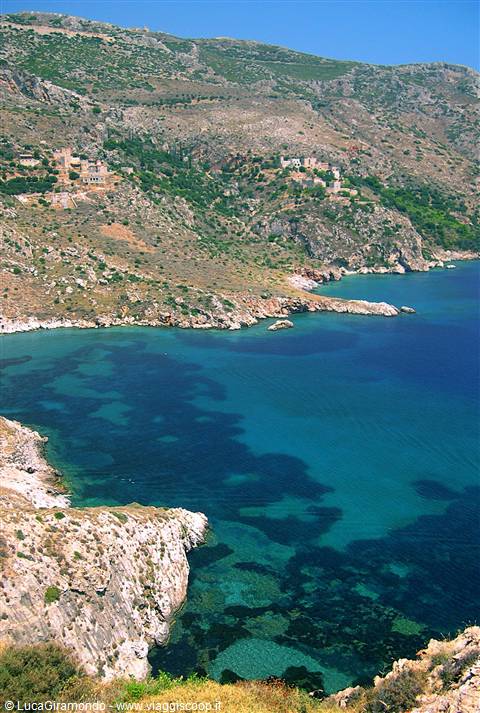
The awakening is sweet in the deep Bay of Limeni, where we are... we throw open the window onto the silence and peace of this magnificent place in the early hours of the morning. Actually we would have wanted to leave even earlier, but we're constrained by breakfast, offered by the hotel only from 8:30 onward, so we enjoy our princely awakening and then set off to discover the Mani. The Mani is the southernmost region of the Peloponnese and one of the most rugged in all of Greece, with mountains that exceed 1000 meters in height. Its people were known for their surly and combative character, and probably precisely because of their violent ardor they were called "Maniots" and their difficult land the Mani peninsula, both terms deriving from the Greek "mania", which means fury.
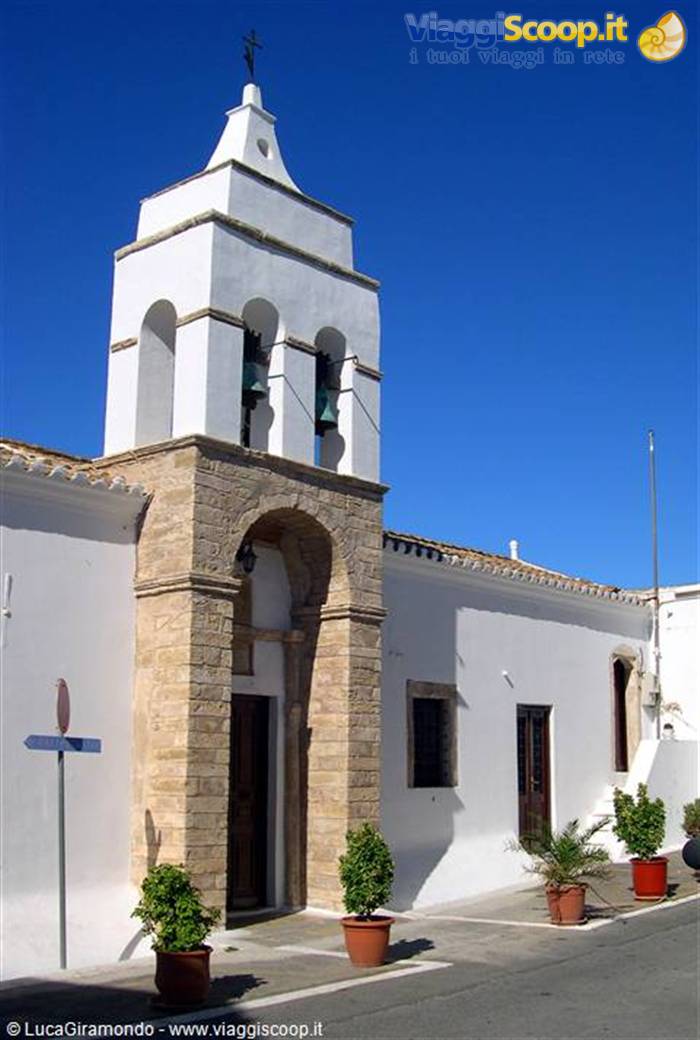
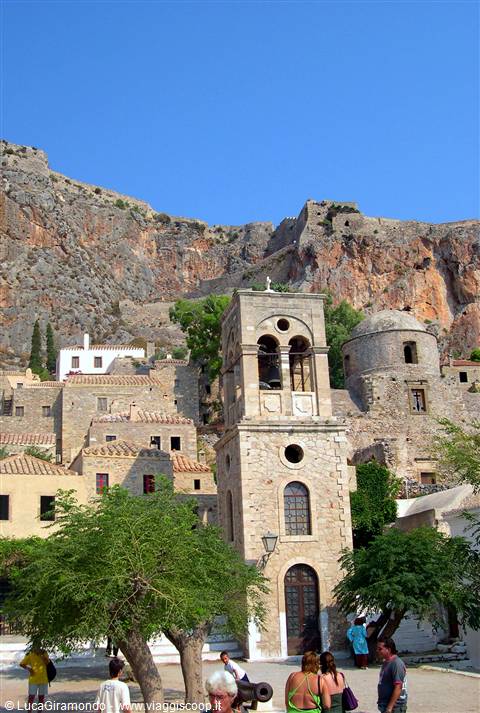
In light of all this, throughout history, no foreigner, whether Macedonian, Roman or Turk, was ever allowed to pass, and only starting from the 1800s, with the proclamation of Greek independence, did the peninsula open its doors; then, with the progressive depopulation of the countryside, it was transformed into a cluster of ghost villages of extraordinary charm. First we climb the narrow hairpin turns that lead to the town of Areopoli, the most populous in the region, where we stop to shop and enjoy a stroll through the characteristic historic center, where the 18th-century little church of Taxiarchis stands out, with its slender stone bell tower and richly decorated interior, then we move a little further south, almost to the seashore, to visit the Caves of Diros, said to be among the best in all of Greece.
We put on life jackets and, having descended into a cavern, we board a small boat with which we venture into a fantastic underground world made of water and wonderful concretions, "alive" and of a thousand colors. A boatman leads us by arm power, in about half an hour, for two kilometers through an intricate maze of canals and at the end we come out truly satisfied... and to think that we've seen so many caves in our travels, these however proved to be extremely original.
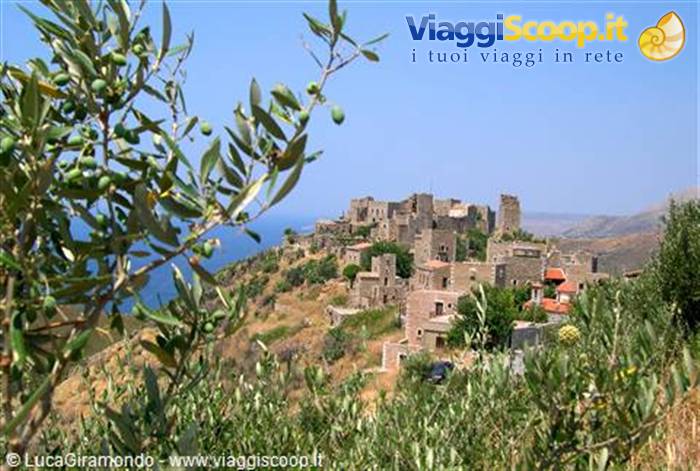
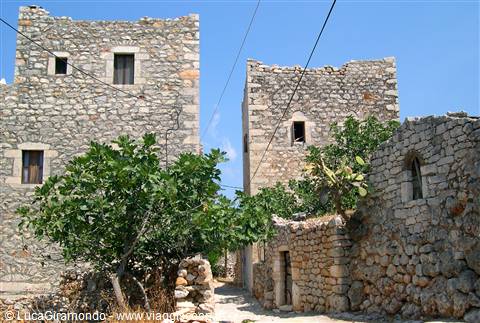
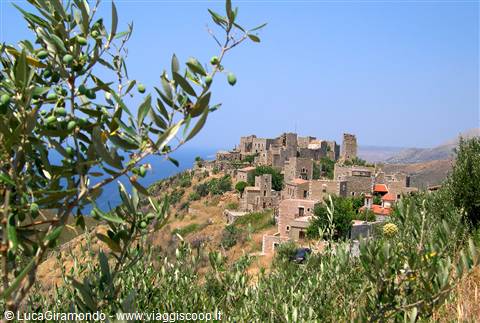
Having left the Caves of Diros we tackle the western coast of the Mani, always very suggestive, and after a brief stop to observe some nice donkeys roaming freely along the road, we descend to the tiny village of Mezapos, where there's a small bay with crystal-clear reflections, then, returning toward the harsh mountains, we visit the remote village of Kita, with its magnificent tower-houses (typical of the Mani) largely abandoned and in ruins. Following picturesque ups and downs we arrive again at the sea in the village of Gerolimenas and from there we climb one curve after another toward Vathia, the symbolic village of this rugged and at the same time extraordinary region.
In Vathia the tower-houses, built starting from the 15th century, are particularly numerous and concentrated on top of a scenic hill, set against a breathtaking landscape, always characterized, however, by an odious and thick haze. Having taken a few obligatory photos we move on and reach, crossing severe scenery, the harsh bay of Marmari, characterized by some dark sand beaches... We don't stop and shortly after we arrive at the lonely village of Porto Kagio: all around there are beautiful coves, but practically unreachable by land, while the town's beach leaves something to be desired... We then go back up the very steep road we took to get here and, back at Marmari, we take the narrow ribbon of asphalt that leads to Cape Tenaro. In a short time we reach, or rather, approach the southernmost point of the Peloponnese and of all continental Greece...
The road ends in a dirt parking lot right after passing a tiny cluster of houses: on the left there's a little harbor and on the right a small inlet, set among the rocks, with a pebble beach and an extraordinary sea. Someone has already camped but there's still room, so we carve out our corner of paradise and enjoy the unexpected marvel: in the water it feels like being in a pool and, together with Federico, I stay for a long time, between an innocent game and a swim with mask and snorkel. We spend the whole afternoon at the enchanting little beach of Cape Tenaro, until 18:30, when calmly we take the road back: we return to Marmari, then to Vathia and from there to the right in the direction of the eastern part of the Mani. The usual check-in call from Dimitri arrives, while we climb dizzying hairpin turns and pass, now in the evening shadows, the characteristic village of Lagia...
We then cover the whole coast, which is less suggestive than the western one, we brush past the village of Flomohori, which in the distance with its tall towers vaguely recalls San Giminiano, finally we cross the peninsula and, having reached Areopoli again, we close the loop and descend to the Porto Vitilo hotel when it's almost 20:30. We get ready quickly and go out for dinner again in Neo Itilo, by the sea, but at another taverna... We spend really little: 18.50 euros (for three!) and we close a splendid day, because the Mani with its wonders truly enthused us.
Mystras
Day 71 Aug 2006
We're almost sorry to leave the Porto Vitilo hotel, so well made and harmoniously set in the Bay of Limeni, but we have to... so we enjoy our pantagruelian breakfast and then set off for Sparta... Dimitri's city. We cross the Mani peninsula from west to east and reach the sea near the town of Ghitio, then from there we speed inland toward the mythological city of the Peloponnese. A handful of kilometers from Sparta I let Dimitri know we're about to arrive... he acknowledges it and a little later calls me back asking if we're being followed by a fire department vehicle... I look in the mirror and there really is one!... He tells me to let it pass and follow it because it will take us to his house... I'm stunned and almost by inertia I answer that it's fine, so the red car overtakes us and escorts us into the courtyard of our friend's house, in the center of Sparta!...
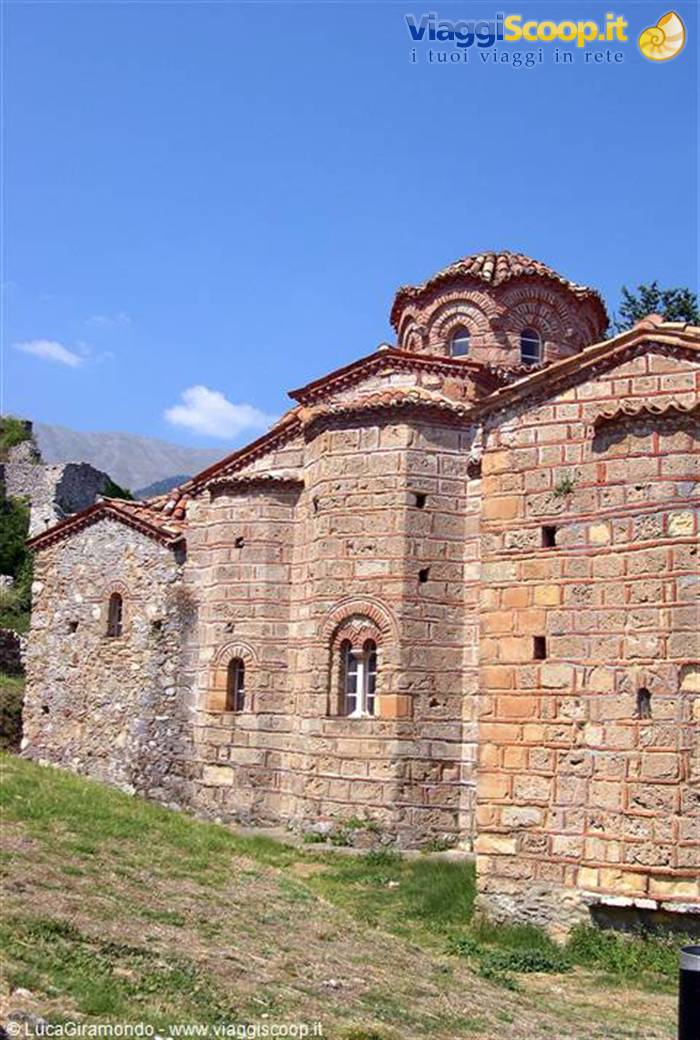
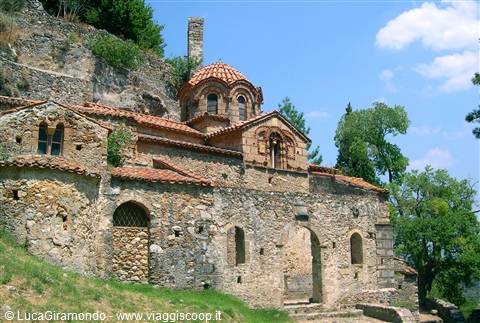
The door opens and out steps the ever-present Georgos, who says he met us purely by chance... and everything returns to more human dimensions. We go up to Dimitri's apartment, where he welcomes us with great warmth, then he gives us from his collection a precious "koboloi" in red coral (a kind of necklace that many Greeks hold in their hands as a simple pastime) and introduces us to his son Andreas, who speaks Italian and is tasked with showing us around the area. After the pleasantries we get back in the car and head to the outskirts of Sparta, to the heights where the ruins of Mystras are found, a citadel founded in 1249 by William of Villehardouin and falling into Byzantine hands in 1269 to become, under the rule of the Despots, the major cultural center of Greece. In 1460 it passed to the Turks and then, through changing fortunes, to the Venetians and again to the Turks...
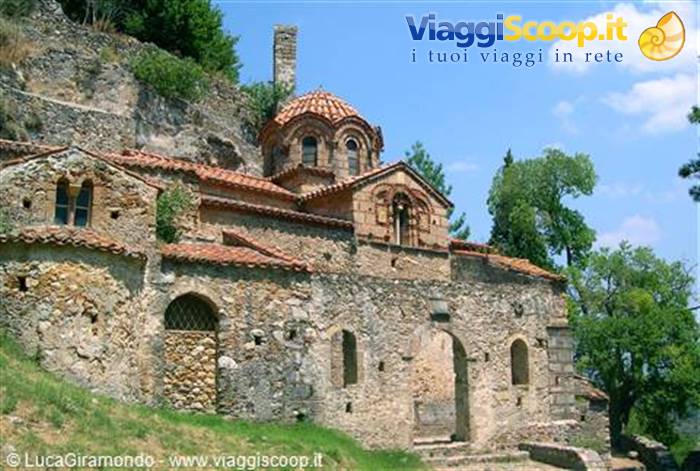
it was finally abandoned in the mid-nineteenth century with the creation of modern Sparta. Not much remains of the city that once counted over forty thousand inhabitants, but its evocative ruins, which cover almost the entire side of a hill, are today included in the UNESCO World Heritage and are a must-see stop when visiting the Peloponnese. The site has two entrances, so we leave our car near the lower one, then Andreas accompanies us to the higher part: this way we'll visit the place entirely downhill. We skip the Kastro, which is located even higher up, and begin descending along a rough path of cobblestones smoothed by time; we thus encounter the first of the Byzantine churches for which Mystras is famous: the semi-ruined Monastery of Aghia Sofia, built in 1350 as the church of the Palace...
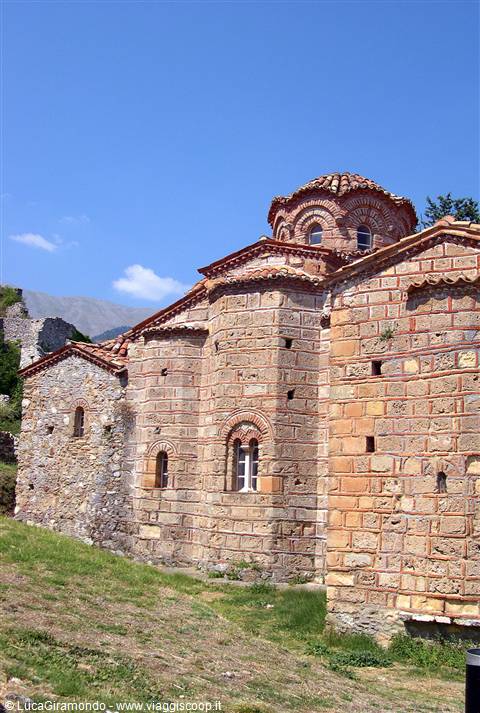
that is, the Palace of the Despots, an imposing building that occupies a large open space a little further downhill, currently under restoration and completely wrapped in scaffolding. Continuing the descent we pass the scenic Gate of Monemvassia and enter the so-called "lower town" to reach the stunning Monastery of Pandanassa, founded in 1428 and still kept by two nuns... The religious building, set in a dominant position, is characterized by the typical Byzantine domes and is a true jewel of its kind, as are its interiors, richly decorated though a bit gloomy. It's insanely hot, and besides, the time, close to noon, leaves no escape, but we keep descending, while it occurs to us what it would have been like if we'd also had to climb back up...
We thus also reach the Monastery of Perivleptos, unfortunately not in very good condition, but embellished inside by a valuable cycle of frescoes. From there we still have quite a stretch to reach the exit... We walk under the blazing sun surrounded by stones that ooze history, and two hours after the start of the descent we come within sight of the finish line. I also go to see the nearby and interesting Monastery of Metropolis, dating back to the late thirteenth century, but we deliberately skip, due to exhaustion, the one of Vrontohion, which would have required another twenty minutes of walking.
Extremely satisfied with the hard but very interesting visit to Mystras, we leave the site when it's already past 13:00, and once we've regained the regenerating air conditioning of the car, a little later we meet up again with our friend Andreas, who first takes us to drink something cold and then to the small city archaeological museum, which collects various artifacts, among them the bust of Leonidas, ancient king of Sparta. In the early afternoon, around 15:00, we finally go to lunch (the time is unusual for us, but around here it seems to be normal) and almost as if to make up for the "delay" we consume abundant portions of an infinity of typical Greek dishes, and in the end, having said goodbye to everyone and well fed, on Dimitri's directions we set off for the third finger of the Peloponnese, toward the town of Elea, where a hotel he booked for us is located.
In the late afternoon we arrive at the Elea Mare hotel, where we are welcomed with great affability: we leave our luggage in the room and immediately run off in search of a beach. We thus reach the nearby village of Plytra, where there's a stretch of sand bathed by a decent sea, and there we spend a couple of hours. By now it's evening and we return to the hotel, and given the abundant lunch, for dinner we settle for eating a gelato on the waterfront of Elea, closing another day of this increasingly incredible vacation.
Mystras
Day 82 Aug 2006
Exactly one week after departure we wake up at the Elea Mare hotel, with the sound of the waves breaking placidly on the shore... We have breakfast, load the luggage into the car and set off again: destination Monemvassia. We cross the entire peninsula and at the exit of a curve the stern silhouette appears before our eyes of what was rightly christened "The Gibraltar of Greece": an enormous spur of rock emerges from the sea to host one of the most incredible citadels of the Peloponnese.
Founded by the Byzantines, Monemvassia prospered under various dominions for several centuries, before falling into ruin under the yoke of the Turks, and seeing it today, even from a distance, it seems unbelievable that it once counted over fifty thousand inhabitants! After crossing in the car the very short bridge that connects the island to the mainland, we park along the road and already before 10:00 we are in front of the ancient entrance gate of the city. Once past the fortifications we find ourselves facing an alley, flanked by archaic buildings, onto which shops of every kind open, and we pleasantly stroll until we reach the old and scenic square, dominated by the characteristic domes of the Byzantine churches as well as by the view of the sea and the steep cliff behind it...
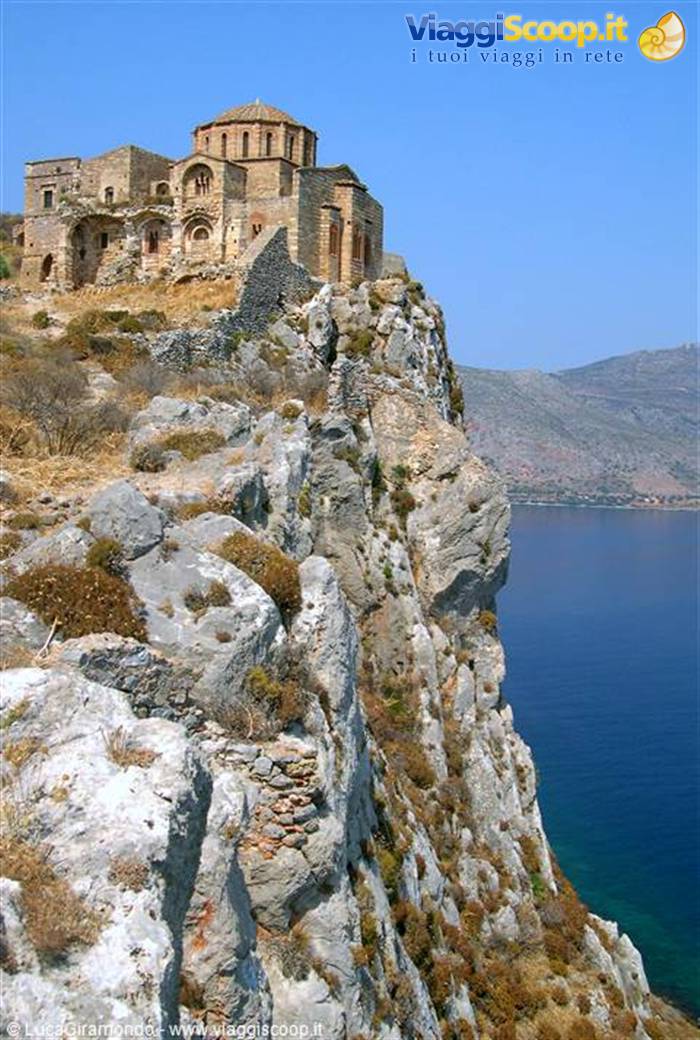
Still on foot we then reach the eastern edge of the village, walking along less touristy but still fascinating streets, immersed as they are in the time that here seems to have stopped. Back at the square we throw ourselves, with the heat that today is no joke, into the feat of climbing to the top of the rock: we thus scramble along the centuries-old path drenched in sweat, but in the end we gain the summit... Not much remains of the ancient upper city, only some bare ruins of dwellings and the church of Aghia Sofia, built in the thirteenth century according to Byzantine canons, but the latter alone is enough to justify the effort of the climb, for its spectacular location, clinging as it is to the sheer slope plummeting down to the sea.
We stay for a while observing, spellbound, the stupendous scenery, masterfully devised in partnership by nature and the human mind, until we're distracted by the ring of the cell phone and by Dimitri's voice, saying he's waiting for us at his house by the sea in Karavostasio, near Plytra... we thank him thus, for the umpteenth time, and arrange to meet in the early afternoon. We descend carefully along the path whose paving, made of stones, is shiny it is so smoothed by time, and return to the square of Monemvassia... We do some shopping (in particular the wine, for which the place is universally known) and then we exit the circuit of walls and leave behind us this beautiful and historic village, mirror of an era in which the Peloponnese was of primary importance in the commercial traffic of the Mediterranean.
We stop for lunch on the waterfront of Gefyra, the new Monemvassia, with the view that sweeps over the "Gibraltar of the Levant," and once we've taken the road on the mainland as soon as possible, a little after 13:00 we're already in Karavostasio. We follow the directions of our Greek friend and almost immediately we find him: his house in fact is in an extraordinary position, built no more than ten meters from the inviting beach of the village... Dimitri welcomes us beaming, in beachwear, and shows us our new accommodation: he has reserved for us nothing less than the entire top floor of his home, with a sea-view terrace... it all seems like a beautiful dream and yet it's reality! We can do nothing but accept the invitation, and once we've settled our things we go down to the courtyard, open a gate...
and we're on the beach, so we immediately enjoy, in pleasant company, a long swim and stay all afternoon in this place, bathed by blue and transparent waters, which if it hadn't been for Dimitri we would certainly have skipped and instead is absolutely worth this half-day of relaxation. By now it's evening and we really take just a moment to go up to the room: we take a shower and then go out in our friend's convertible, which first takes us to greet and meet loads of people (basically the whole town) and then takes us to dinner in the center of Plytra, where we eat excellent grouper... We linger with Dimitri until midnight and then, as in the fairy tale of Cinderella, we return before everything vanishes, while he goes back to enjoy the night because, as he says, for a Greek the evening has just begun...
Monemvassia
Day 93 Aug 2006
Waking up by the sea in Karavostasio is wonderful and the view that sweeps from the balcony over the bay gives a sense of infinite tranquility, so much so that the neurotic life of every day seems to belong to another dimension. We have breakfast while our "guardian angel" tries to book us the Saturday ferry to the island of Kythira, which apparently is only at 21:00... a bit late, but we'll manage somehow. We are guests, but free to follow our own itinerary, so we set off south in search of the island of Elafonissos, where the most beautiful beach in the entire Peloponnese is said to be. After about half an hour by car we reach Vinglafia, the fabled place from which the ferries to Elafonissos sail, and there we wait for the vessel, parked along the rough and lonely pier... We don't have to wait long and a quarter of an hour after our arrival we're already settled on board.
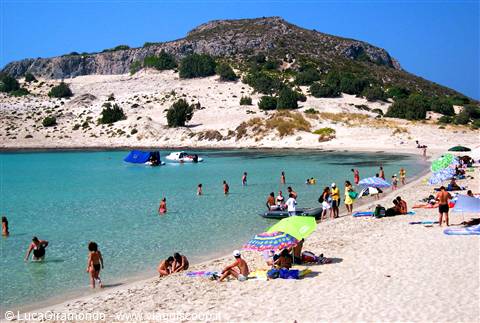
The crossing is very short, just over ten minutes, and already in the port we can't help but notice the characteristics of the water, which looks like crystal. Having disembarked at Elafonissos, a handkerchief of land of barely 18 square kilometers, we follow the signs to the left for Simos Beach and, leaving the car near a bar, around 11:00, we finally set foot in that little Mediterranean paradise... A long strip of light, soft sand, bathed by a stupendous sea in which all shades of blue dominate: a little piece of Caribbean Eden in southern Europe... The palms are missing, yes, and the landscape all around is barren and scorched by the sun, but more beautiful than this the sea cannot be!...
Word of someone who by now has seen many beaches worthy of that name! We settle our things a few meters from the water's edge and immediately run into the water to stay there for ages: we play and enjoy that wonderful fluid, which by the way also has a very pleasant temperature. Between one swim and another we also find time to have lunch, then Dimitri calls us and confirms the ferry for Saturday evening: this way we'll have half a day less to spend on Kythira and almost one more on the mainland... We'll figure out how to organize ourselves: "if worse comes to worst" there's always Elafonissos... By now in the evening the number of swims can no longer be counted and fortunately we can leave the beach without particular regret...
because we'll definitely be back! Once back on the mainland we calmly return to Karavostasio and in the evening we go out, in the company of our friend, to have dinner, with ouzo and traditional cuisine, by the sea in Plytra, closing an unforgettable day, spent on one of the most sublime beaches of the Mediterranean.
Plytra
Day 104 Aug 2006
Today too a magnificent sun shines in Karavostasio: we get up, as usual, a little before 8:00 (very early for a Greek!) and after the routine operations we once again take the road to Elafonissos. A little before 10:00 we're in Vinglafia, but we have to wait another half hour before getting on the ferry and facing that narrow arm of sea with extraordinary reflections... Shortly we come within sight of Elafonissos and of the white little church of Aghios Spyridonas, built as a sort of outpost at the entrance to the port. Once off the vessel we turn right, instead of left, and reach on the northern coast the beach of Panagias, less scenic than Simos, but with a sea of the same incredible colors...
and we'd stop there if it weren't that today a bothersome wind blows from the north, which advises us to turn our bow once again in the direction of yesterday's beach, theoretically more sheltered. Having completed almost the entire circumnavigation of the island, we recapture Simos Beach when it's by now 11:00, and, having occupied almost to the millimeter our spot on the water's edge, we immediately run into the water to consume the first long ritual swim. At noon we have lunch with our Lucullan sandwiches and after lounging for a bit, to further stretch our nerves, we treat ourselves to another interminable swim, thus, in the most reckless sweet idleness and with that enchanting sea before our eyes, we "manage" even today to make it to evening, while in the distance the stern silhouette of the island of Kythira can be glimpsed, where we'll go tomorrow.
This time rather sorry, we leave Simos Beach, which will fully deserve to enter our special hit parade of the most beautiful beaches, and having caught on the fly the 19:00 ferry, less than an hour later we're back in Karavostasio... We get ready calmly and then go out to spend the last evening in the company of Dimitri, who delights us with another excellent dinner based on grouper, on the waterfront of Plytra. Later we go to sleep while several people, with the collaboration of the fishermen, are busy trying to find us a place to stay on Kythira (tomorrow morning we'll know if they succeeded)... and after this it can reasonably be said that by now we're not only guests of Dimitri, but practically of the entire town...
Firi Ammos
Day 115 Aug 2006
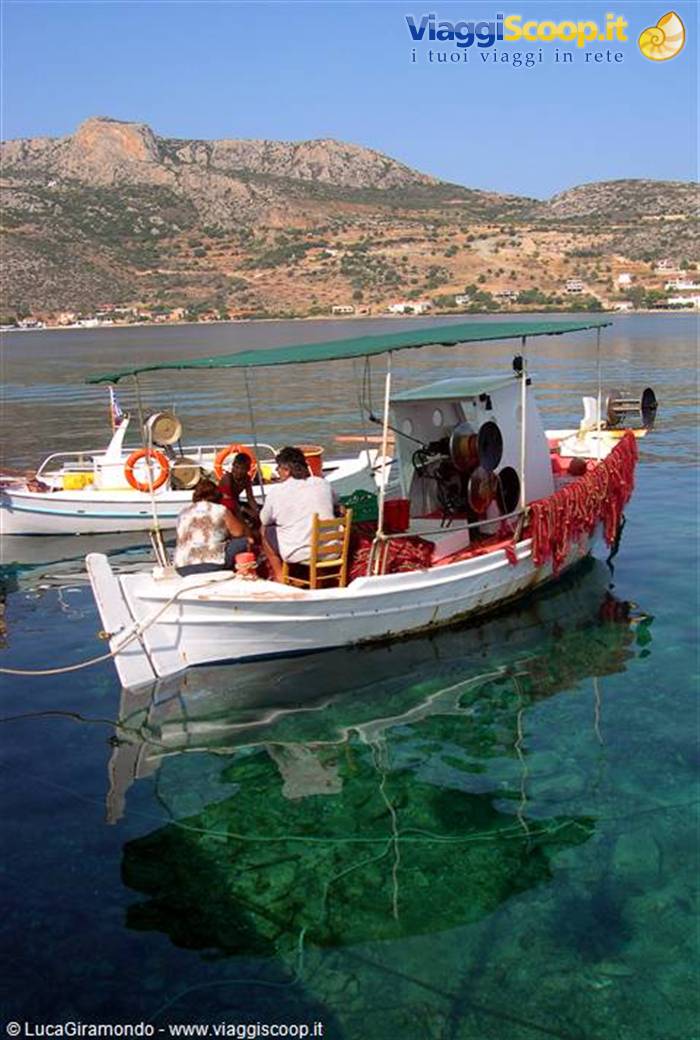
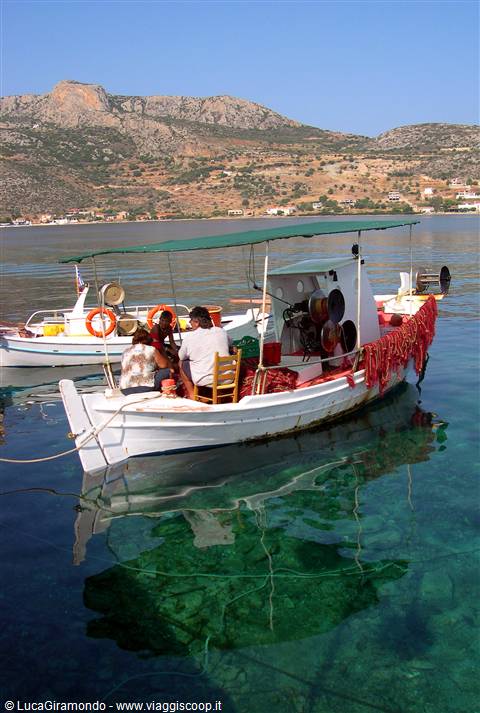
It's a transition day, which we decide to spend at Dimitri's house, waiting for the departure, in the late afternoon, for the island of Kythira, where apparently everything is fully booked, because they haven't yet managed to find us accommodation. After breakfast our friend takes us to the port to see the caiques returning from the night's fishing... unfortunately it wasn't a rich catch, but at least they brought home a nice swordfish... We stop to sip coffee in a bar near the pier, amid a thousand village stories, while the local police chief also arrives and together with Dimitri they try again to contact Kythira, because by now it seems to have become a matter of principle... so, almost at the end of the morning, they manage to book us two nights out of three (in different places)...
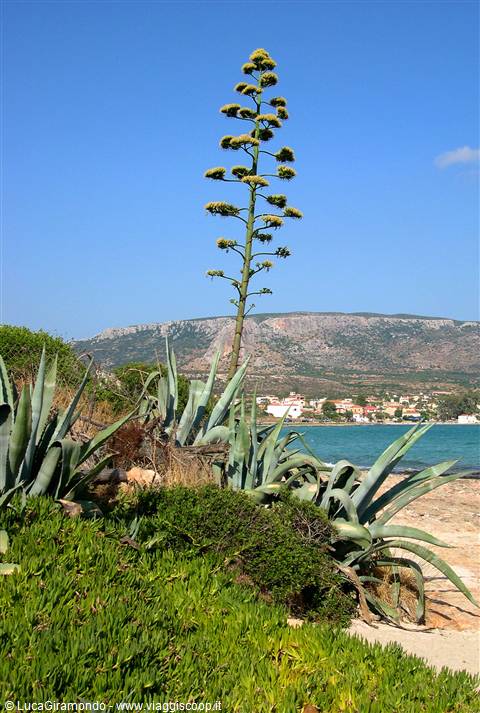
with a touch of disappointment on Federico's part, who was already hoping he'd have to pitch the tent, brought along precisely for emergencies. We don't despair because, despite everyone's apprehension, we're used to managing on our own, and having left the little port of Plytra, we go to the beach in Karavostasio where, after a nice swim, we go to lunch when it's almost 15:00 in a little place by the sea, then we spend the whole afternoon on the spot, characterized by a good sea and large agaves behind us. Past 18:00 we go up to the room to get ready for departure, and a little before 19:00 we warmly say goodbye to our friend Dimitri, whom, I believe, we'll see again in Italy. After half an hour on the road we're in Neapoli, a little south of Vinglafia, from where we'll embark for the island of Kythira.
We collect the tickets at the agency on the waterfront and wait seated at the table of a place on the pier facing the port, savoring a gelato (basically our dinner), while big clouds gather on the horizon and we hope they remain only a sporadic phenomenon. Past 20:00 the ferry arrives and a few minutes after 21:00, with all the cars embarked, we set sail... the sea is flat and, placidly plowing the Mediterranean night, in a little over an hour we land at Diakofti, on the eastern coast of the island of Kythira (or Kythira)...
In this strange land, extending over 262 square kilometers south of the Peloponnese, reaching out toward Crete and its Minoan civilization, geographically comprised in the Ionian islands but administratively tied to Athens, according to legend Aphrodite was born, Greek goddess of beauty, love and fertility, and perhaps also for this reason the place piqued our curiosity, even though it is often excluded from the traditional tourist itineraries of the region. We set off in the dark, but with a clarifying three-quarter moon overhead, in search of the village of Avlemonas, where according to Dimitri's directions we should find lodging... One curve after another we get there: we track down the Sotiris tavern, right next to a mini market, and there Signora Sofia, who was waiting for us, hands us the keys to our little room...
with only two beds, but by joining them it makes one nice big one that will host all three of us. Around 23:00 we're already settled in perfectly and there's also time for a short stroll through the village (cute), before going to sleep, in view of the first day discovering Kythira.
Kythira: Chora
Day 126 Aug 2006
We slept well even three of us, one next to the other... We get up and I ask Sofia if the room is available for the next two nights as well... I don't speak Greek and my English is bad, she only speaks Greek: it takes us a while to understand each other, also with the help of the mini market clerk, but in the end she has us move our luggage to an adjoining room with three beds and settles us there permanently... All that's left is to know why she didn't give it to us last night, but that's fine! We set off more relaxed for the day. We climb toward the center of the island and go north following a road that eventually turns to dirt, up to the ancient settlement of Palehora, once the capital and Byzantine enclave of the island, captured and destroyed by the hordes of Barbarossa's corsairs in 1537...
There's only us and the ruins in the silence, at the intersection point of two deep ravines, plus the perfect Byzantine architecture of the little church of Aghia Varvara, and for a moment we felt a bit like masters of a now lost world. Having taken the asphalt road again, this time we go south to turn off, almost at the middle of the island, toward the western coast and toward the village of Milopotamos. We pass through it, while numerous and unpleasant big clouds have appeared in the sky, and descend along a steep cart track to the cave of Aghia Sofia. Surrounded by vertiginous cliffs we walk to the entrance of the chasm, in which there's a Byzantine church with interesting paintings, but it's closed, even though the opening time (posted on the door) has already passed by twenty minutes.
Around us there's no one and after waiting a moment we decide to give up the visit, so we return to the car and, climbing back up along the road, we meet one coming down: maybe it's the one who has to open the cave... who knows... We continue climbing and, once we've regained the main road, we go even further south, toward Chora, the current capital of Kythira... The town is dominated by the scenic Venetian Kastro, but there's no sun and, awaiting better times for the visit, we continue toward the eastern coast, where instead there seems to be some. Our goal is Firi Ammos beach but we climb toward the mountains, instead of descending, we pass the little village of Kalamos and the track turns to dirt, but at least there are signs, albeit spartan ones.
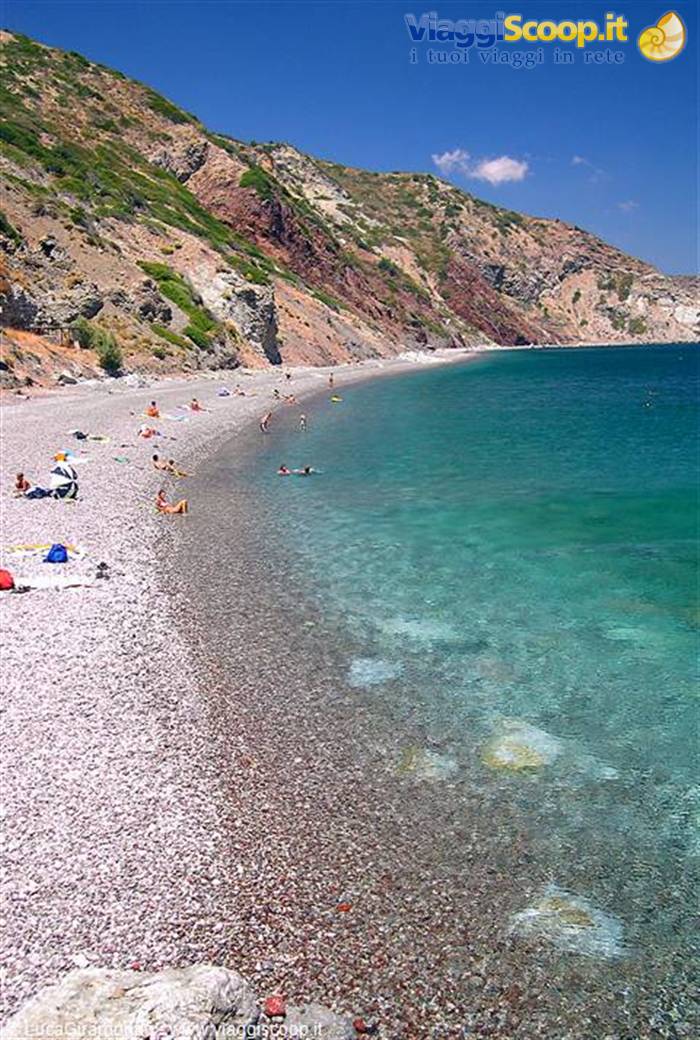
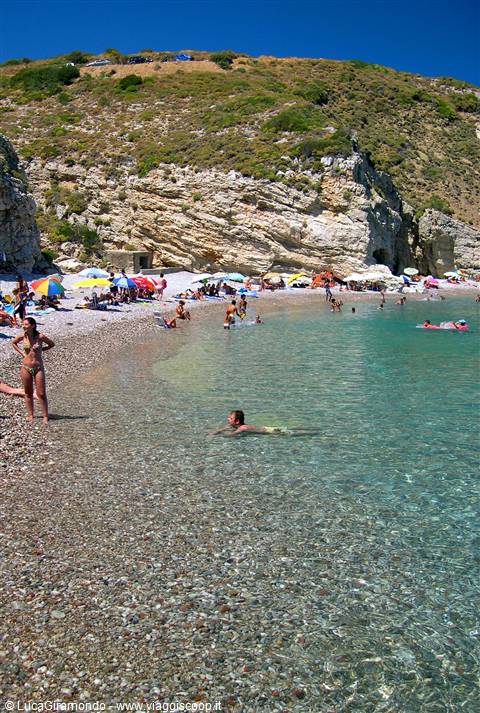
At a certain point, having crossed a sort of pass, the road (if a widened mule track can be called that) begins to plummet, at times in tight hairpin turns, and it's a bit frightening, but in the end we arrive safe and sound at Firi Ammos, where there are already three other vehicles. The beach is wide and of colored pebbles, as are the steep walls behind it, in vivid tones, tending toward red, interspersed with the intense green of the sparse Mediterranean scrub... the sea is crystal clear, the sky blue and the strong contrasts give life to a wonderful overall picture. At Firi Ammos (where later more people will also arrive) we spend several unforgettable hours, surrounded by an extraordinary environment, in an ancestral peace, far from everything and everyone, but so close to nature, which here still reigns supreme.
Around 17:00, reluctantly but a bit worried about the road to travel, we leave the beach and move, following also another short dirt track, to Chalki Beach, on the extreme south-eastern tip of the island: a beautiful cove, but not as much as that of Firi Ammos, despite the natural arch, which I climb up to photograph, set on the height to the right of the bay. We spend a couple of hours at Chalki Beach, until the shade completely invades it, then we return without hurry in the direction of Avlemonas and our lodging. In the evening we have dinner in a tavern in the center and then, drawn by the lights and the bustle, we go to see in the little port of the village where an entirely Greek festival is taking place, with souvlaki galore, a small band playing, and ordinary people dancing the traditional sirtaki...
this too a beautiful experience, the cherry on the cake of a wonderful day spent on Kythira.
Kapsali Bay
Day 137 Aug 2006
Avlemonas in the early morning, when all the inhabitants are still asleep, is delightful, wrapped as it is in an almost unreal silence. A beautiful sun is shining and at 8:30 we set off, heading for Chora, to visit the fortress that overlooks the town, built by the Venetians in the thirteenth century... For the most part it's in ruins, but within the mighty walls one comes across some Byzantine churches, among them one particularly characteristic and of a blinding white. Having devoted a good half hour to the capital and its typical views with an already vaguely Cycladic appearance, we return toward the eastern coast, crossing barren environments, scorched by the sun and battered by the wind, intriguing landscapes, made of stern mountains standing out against the intense blue of a sky that the Mediterranean haze confuses with the line of the sea.
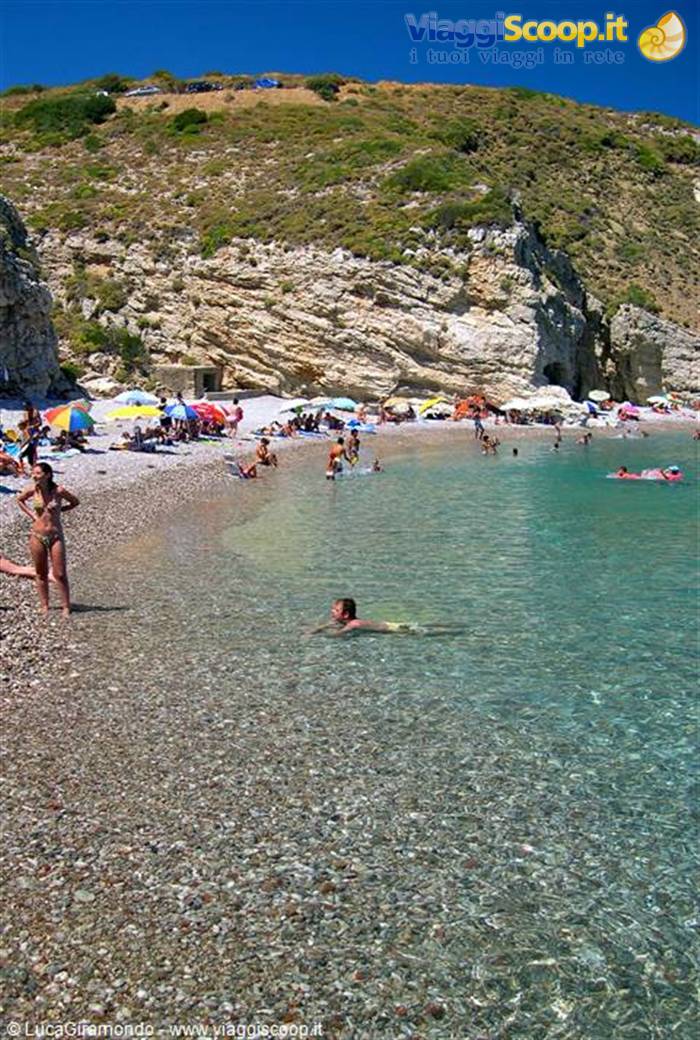
We're searching for the bay of Kapsali which, it's said, displays the most beautiful and famous beach of Kythira... The place may also enjoy a certain notoriety, but the road that comes down to it from above is the usual impervious dirt track. So we park the car on the edge of a precipice and look out over the inlet below, which at first glance immediately shows its bursting beauty: high cliffs of light-colored rock frame a crescent of rounded pebbles bathed by a splendid sea. We descend along a steep path and conquer our daily paradise, though, seen from below, as a beach Firi Ammos is perhaps more beautiful... which is certainly less crowded. We spend the whole morning at Kapsali Beach, enjoying fine moments of beach life, then in the second part of the day we set off again, also because the bay will inevitably be invaded by shade.
We move just a few kilometers, until we reach Diakofti, where we disembarked, while Dimitri calls us and says he's also booked us the last three nights in a hotel near Nafplio (as per the program)... He's crazy!... In the good sense, of course!... Absolutely crazy, in Diakofti, is instead the wind that blows hard and doesn't allow us to enjoy its beautiful, though somewhat sacrificed, beach, lapped by waters bluer than ever... We stop just over half an hour and then we're forced to flee because the grains of sand travel very fast and make the place practically unlivable, as well as Sabrina rather irritated. We go back to grinding out kilometers and go to the only area of the island (apart from the almost inaccessible western coast) where we hadn't yet been: in the town of Aghia Pelagia, by now at the extreme north.
From there we follow the coastal road south until we reach the beach of Firi Ammos, namesake of the one seen yesterday and even with some characteristics in common: the red rocks that frame it, but certainly less spectacular... There, fortunately, there's no wind and we can spend an hour there in complete peace. Around 20:00 we return to Avlemonas and later we go out for dinner at the Sotiris tavern, where we eat Greek worthily, then, after a short stroll through the streets of the center, we retire to our "apartments," closing a beautiful day, which, to be picky, was perhaps a bit too... windy.
Lakonia
Day 148 Aug 2006
Wake-up at the usual time, even though the program doesn't include any particular things to do: just catch the 11:00 ferry that will take us back to the mainland, but the morning hours are so pleasant, with that infinite feeling of peace they convey, that we don't want to miss them. At an almost pachydermic pace we have breakfast on the veranda, load the luggage into the car, pay Signora Sofia and leave Avlemonas, with a touch of nostalgia already at the first curve. We head toward Diakofti and then make a small detour to go up to the height where the white monastery of Aghia Moni is located...
and this morning it's truly worth it because yesterday's strong wind has swept away the haze and the panorama is vast, with the view sweeping over the coast of the Peloponnese and the island of Antikythera, a remote sliver of land and rock, inhabited by few souls, which lies halfway between Kythira and Crete! After the impromptu geography lesson we descend to Diakofti and stop to sip a Nescafé-frappé on the beach, where we fall in love with a little house that looks right onto the sand and fantasize a bit about buying it and renovating it as we please... Meanwhile the ferry arrives and, a bit reluctantly, we head off so as not to miss it.
Shortly after 11:00 the vessel pulls away from the pier and ideally we bid farewell to Kythira: we head out into open sea and watch it recede, while little by little Neapoli approaches, which we reach in a little over an hour of sailing (the route is very beautiful with the clear day!). Having reached dry land almost at lunchtime, we do a quick shopping and shortly after we consume our traditional sandwich along the road, in a shaded parking lot... We set off again in the early afternoon and in a short time we leave behind us, a bit melancholically on the left, in order, first the island of Elafonissos and then the bay of Plytra, today more beautiful than ever! Having gone back up the whole "third finger" of the Peloponnese, we venture into the mountains to go further east, under an exceptionally clear sky that reminds us a bit of that of the States...
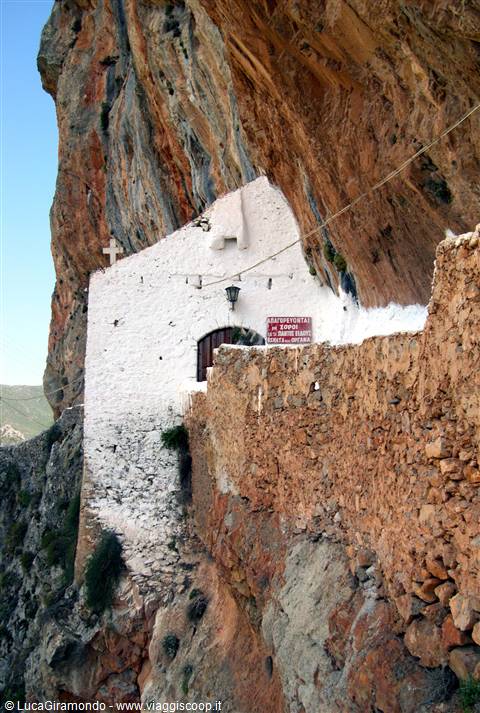
and the landscape is no joke either, with panoramas and colors at times exciting! We spot a fox and, having crossed a pass at over a thousand meters of altitude, we pass the village of Kosmas, characterized by very narrow streets, and descending we arrive at the monastery of Elona, scenically set into a sheer wall over the valley below... Unfortunately, though, in the afternoon it's in the shade and from a certain point of view we weren't too lucky, but we take some photos anyway and then set off again.
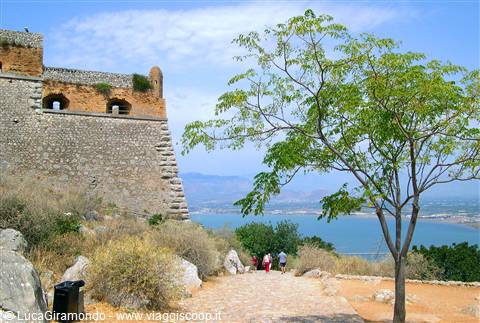
Having passed the town of Leonido, located at the foot of red rocky mountains, we reach the sea in what the Greeks call the Myrtoan Sea, straddling the Ionian and Aegean, and having gone back up the whole coast northward, around 18:00, we reach Nafplio, a city characterized by the imposing fortress of Palamidi, which we can't help but notice clinging to the rocky spur that overlooks the town. We don't stop and continue to the nearby town of Drepano, where our friend has booked us, for three nights, a room at the Eden Plaza hotel... We find the hotel just as, with incredible timing, Dimitri phones us to ask if everything is alright... perfect! Naturally!... At the reception we give the name of his trusted man (Timotheos) and the doors of our new room immediately swing open.
We go up to bring the suitcases and take a refreshing shower, then we go out for dinner in nearby Tolo, in a little restaurant by the sea, with the silvery reflection of the full moon on the water, concluding in the best way this beautiful stage... of pure transfer.
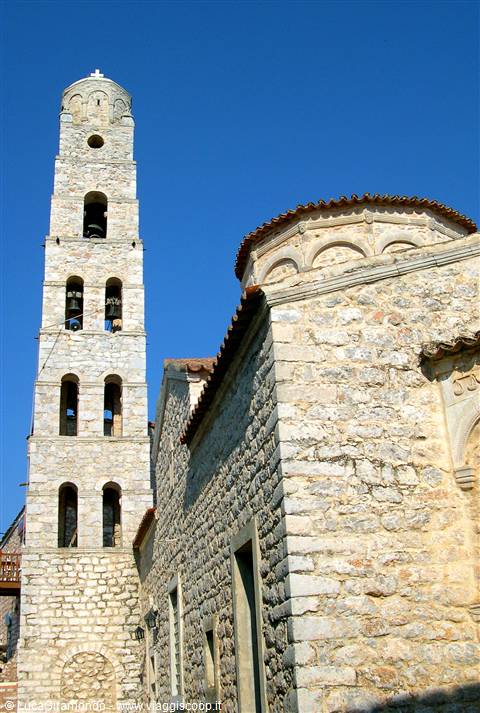
Church of Koimesis
Day 159 Aug 2006
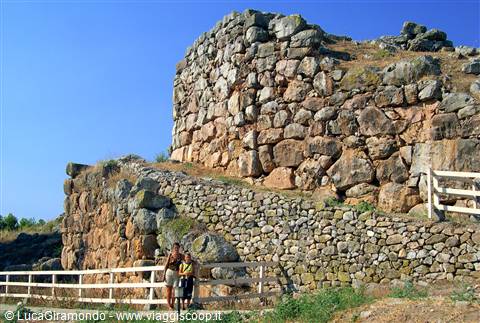
Today begins the two days (and a bit) of classical Greece, to worthily close the trip with history and mythology. The alarm is early and breakfast is immediately followed by departure, with the first stop just outside the outskirts of Nafplio to see the cyclopean walls of Tiryns. The site, inhabited since the third millennium B.C., prospered in the Mycenaean era, with the construction of the mighty walls around 1400 B.C., and declined about two hundred years later... Tiryns was also the homeland of Heracles, hero and demigod, who here performed his famous "twelve labors"... All this is only legend, but in this place one must really have toiled once to erect the impetuous mountain of boulders that still today, millennia later, dominates the plain of Argolis.
The ruins are clearly visible also from the highway, but intending anyway to visit them we struggle quite a bit to find the entrance, which in the end we find in the most illogical place, when by now we thought the place was closed... The great walls, eight meters high, almost as thick and formed of blocks that can exceed ten tons in weight, seen up close are even more impressive, and particularly suggestive are the so-called cryptoporticoes: tunnels formed by the perfect interlocking of the overhanging boulders. The visit to Tiryns, though interesting, is really short, so much so that in a little over half an hour we find ourselves at the exit, and as confirmation of the difficulties in finding the entrance, just outside, we meet two Greek tourists who, disoriented, ask us where it is, so we point it out to them and, satisfied, we resume our itinerary.
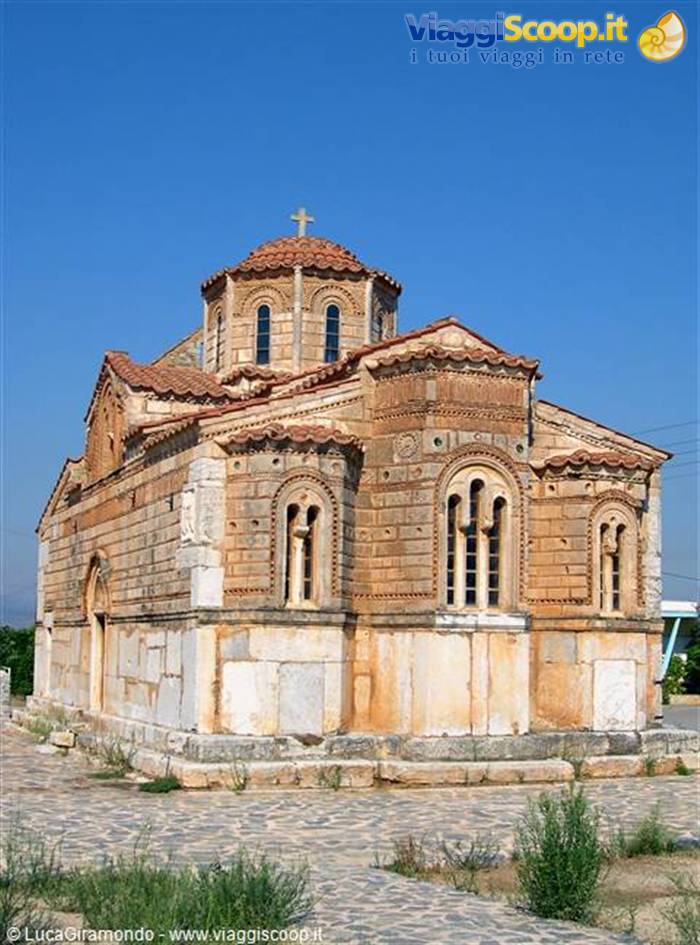
We move further north, passing through the town of Aghia Triada, where the beautiful Byzantine church of Koimesis is located, then we approach one of the best-known archaeological sites in all of Greece: that of Mycenae. The first settlement in this place dates back to the Bronze Age (around 2500 B.C.) but it's with the fall of the Minoan civilization, around 1400 B.C., that Mycenae experiences its period of greatest splendor... The name of the city is linked to the legends concerning its king, Agamemnon, and his deeds, as leader of the Greek war against Troy... In his absence his wife Clytemnestra becomes the lover of his nephew Aegisthus and with him kills Agamemnon on his return from Troy. The son Orestes then takes revenge by slaughtering Clytemnestra and Aegisthus, only to be condemned to wander all his life pursued by the Erinyes, to atone for the matricide...
In short, to all effects, a soap opera of other times! Having left the car in the large parking lot, already swarming with tourists, we first of all go to see the Acropolis, and so we're immediately shaken by a strong emotion at the sight of the famous "Lion Gate": a square opening (three meters per side) surmounted by a relief depicting two headless lions... We pass through it, and with it the cyclopean walls formed of rough limestone blocks for a maximum height of 17 meters and a thickness reaching eight, while a group of Russian visitors, intent on taking a veritable photo shoot, collects the insults of a French tourist who was waiting (along with yours truly) for the most opportune moment to immortalize, without too many strangers, the legendary gateway.
We thus arrive at the area of the Royal Tombs, formed by a suggestive double circle of vertical slabs driven into the ground to delimit a burial area dating back to 1600-1500 B.C., and from there we climb to the top of the hill, where the scanty ruins of the Palace are found. We then descend to the so-called "House of the Columns," at the northern edge of the site, near the dark staircase (the Postern) that leads with its 99 steps to the secret Cisterns of the Perseia Spring... but we have to give up the feat of conquering them due to the scant means of overcoming the almost complete darkness and the risk of ruinous as well as unseemly falls.
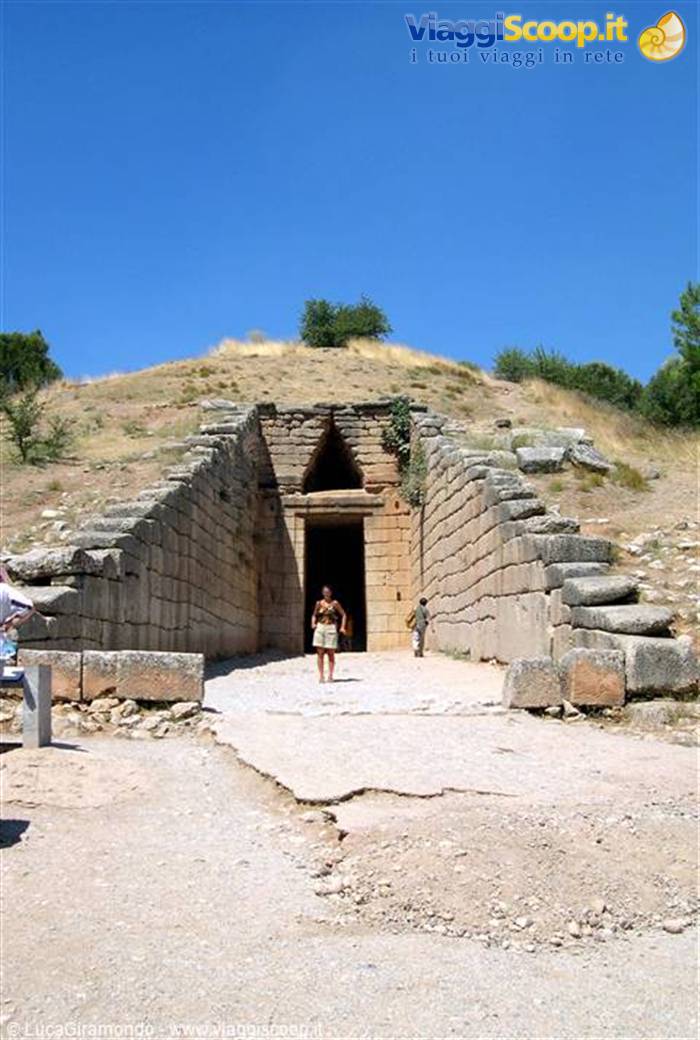
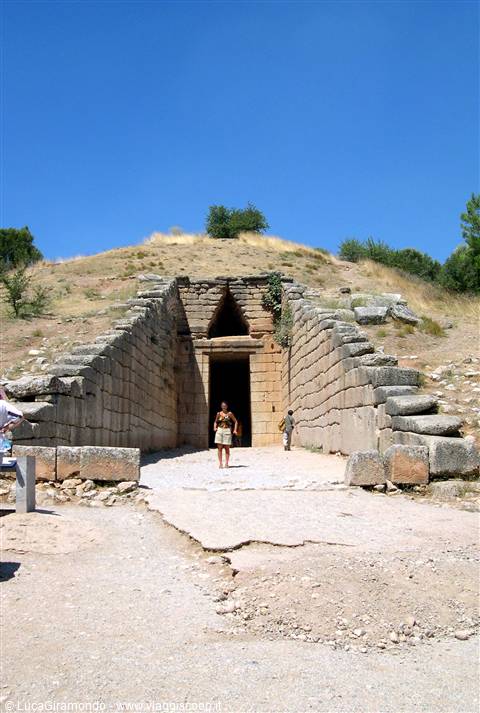
Returning toward the entrance we stop to see the interesting museum, rich in artifacts from the excavations, and an area strewn with tombs, among them the large, domed ones of Aegisthus (in bad condition) and of Clytemnestra (with reconstructed ceiling). Having definitively exited the Acropolis area, we cover a few hundred meters and make a stop, nearby, at the sumptuous tomb of Agamemnon (or Treasury of Atreus)... practically intact and very beautiful, a masterpiece of Mycenaean architecture dating back to the end of the fourteenth century B.C. It is preceded by a corridor dug into the hill, which reaches a colossal door... The interior is an impressive circular chamber more than thirteen meters high and covered by a perfect parabolic dome, while on one side a narrow passage leads into the burial chamber of the most famous king of Mycenae.
Full of history and mythology, almost at 13:00, we conclude the cultural visits, with the heat that's really beginning to be felt, advising us for the rest of the day to find a beach and some refreshment. We then return in the direction of the coast, passing the town of Argos, dominated by the imposing kastro built where an acropolis once stood, and having also left behind us the chaotic Nafplio, we head toward the coast of Tolo. With the wonderful inlets of Elafonissos and Kythira still in our eyes, stopping at the beach in this area isn't the best, characterized as it is by anonymous gray sand and a sea whose reflections are anything but crystal clear, but at least it serves to let us take a few restorative swims to get us pleasantly to evening and, consequently, to return to the Eden Plaza Hotel.
In the evening we go again to Nafplio and, after struggling quite a bit to find parking, we have dinner in the characteristic historic center, strewn with taverns and little shops: the place is cute, so we end up devoting a long walk to it too, and when we return to Drepano midnight has long since passed.
Mycenae
Day 1610 Aug 2006
It's the last day of the trip that we'll spend entirely in the Peloponnese: we get up fairly early and after the routine operations we set off toward the archaeological site of Epidaurus, which is about thirty kilometers from our hotel. We descend south along the coast and venture inland on secondary roads, intending to shorten the route, but we go the wrong way more than once and end up taking more time, so we arrive in the parking lot facing the place when it's almost 10:00. Epidaurus was once a seafaring city of some importance, an ally of Sparta, and was famous for its sanctuary, dedicated to the cult of Asclepius, which experienced its period of greatest splendor around the fourth century B.C., so, having paid the entrance ticket to the excavations, we immediately go to see what remains of it.
The construction that more than any other represents the site is without doubt the extraordinary Theater, the best preserved in all of Greece, wonderfully set in the environment that surrounds it and resting on the natural slopes of the hill that hosts it... It's still used for theatrical performances, boasting a cavea of 55 rows of steps that can hold up to 14,000 spectators, and is known above all for its perfect acoustics, so much so that visitors take turns at the center of the orchestra to recite, sing or simply drop a coin whose tinkling can be heard all the way to the last rows of the auditorium. We stay for a long time in contemplation before such a wonder of antiquity, then we go to take a look at the
Fortress of Palamidi
Day 1711 Aug 2006
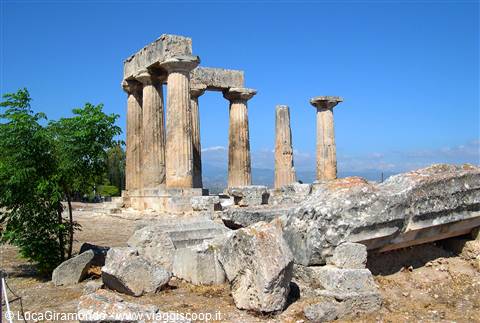
It's the scheduled date for departure from Greece, but we still have a good half day left to spend in the guise of tourists. Having loaded the luggage into the car we leave the hotel around 9:00 and, following the road north, we leave Nafplio behind us, with its imposing fortress, pass beside the cyclopean ruins of Tiryns and in the distance see again the mythological ones of Mycenae, to arrive about an hour after departure in view of Corinth and its archaeological excavations. The city between two lands (the Peloponnese and Att
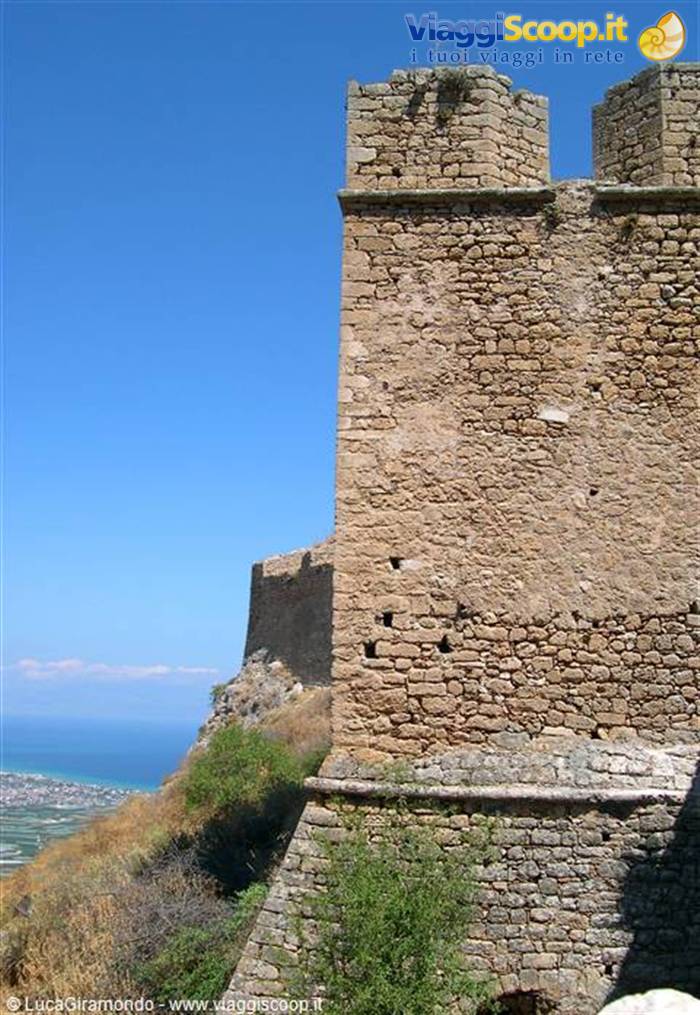
Acrocorinth
Day 1812 Aug 2006
After the longest and most rejuvenating sleep of the trip, we resurface from our cabin and go sit at the tables of the bar next to the pool. The sky is hazy, a biting wind is blowing, and we're already feeling so nostalgic for Greece... especially when, a little later, we head toward big rain-laden clouds. Around 12:30 we arrive in Ancona under a heavy downpour and depression takes hold of us, so much so that we'd like to stay on the ferry and turn back, but instead... A little later, on the highway, it's a real cloudburst: we proceed at thirty kilometers an hour, with the outside temperature at 17 degrees!!... It all seems like a bad dream! Under a threatening blanket of clouds at 2:30 pm we're stuck in a traffic jam in Cattolica. At a snail's pace we pass Rimini and after almost an hour we exit at Forlì, which looks like November 12, with the temperature at 16 degrees!...
Just a handful more kilometers and at 3:36 pm we happily conclude this trip too, in front of the gate of our home. Another splendid vacation spent in the land of Greece, with which we can now say we are hopelessly in love: beautiful sea, beautiful landscapes, awe-inspiring history, delightful Greek people, as always, but this time more than ever, because thanks to our friend Dimitri we can say that the one just concluded was a special vacation, our "Big, Fat Greek Vacation"...

















0 reader comments