Less than four months have passed since the end of the last trip to Saint Martin and Anguilla: two extraordinary slivers of land cast, along with many others, into the intense blue of the Caribbean Sea to form, as if by enchantment, the Lesser Antilles. So a little more than a hundred days have passed since then, including a crazy unusually rainy summer, and now we are ready to leave, in search of the sun, toward a region of the Mediterranean in some ways similar. A handful of islands, scattered in the Aegean Sea, form the Cyclades archipelago... and among the many, this time too, we have chosen two: Paros and Naxos. The days before departure were unusually calm: no attacks or plane disasters in the world and, above all, health seems to assist us positively.
It is 6:00 in the morning when the sound of the alarm clock echoes through the house and, still quite sleepy, we try to organize the last preparations. Soon it is 6:45 and the inevitable grandparents arrive to pick us up to accompany us to Bologna airport. At 6:52 we leave home, on board the camper, surrounded by an unusual summer fog that dissolves shortly after when, in Faenza, we enter the highway. The traffic is quite heavy, given the time and after all this is a critical day, considering the expected mass return from vacations... we instead are leaving and, fortunately, we don't encounter queues along the way, so at 7:30 we are in front of the entrance of Bologna's Marconi Airport, of which we have by now become regular visitors. We say goodbye to the grandparents and cross the door in tourist mode: with the cart loaded with suitcases and on top of the suitcases...
Federico, beaming more than ever. Our plane, a charter, seems to be on time, so we check in the luggage, stop to have a coffee, go through check-in and wait at gate number thirteen. Morale is high, and it is above all the little one's enthusiasm that gives us the right charge to face the discomforts of departure, so time passes quickly and shortly after 9:00 we also pass the last obstacle that separated us from the Boeing 737 of Macedonian Airlines. We board and, at 9:57, flight Mc 2366 lifts off with destination the island of Mykonos, from where we will then continue with a ferry that will take us, finally, to Paros. We gain altitude and climb above the clouds flying over the Apennine ridge heading south.
At a certain point we notice a large lake, probably Trasimeno, then the clouds thicken, take over and prevent us from seeing the land, which reappears only later when, just refreshed by a timely snack, we notice below us the coasts of Ionian Calabria, which we soon leave behind to face the space above the stretch of sea that separates Italy from Greece. In a short time the first Hellenic offshoots appear and in a parade, one after another, almost all the Ionian Islands file by: Cephalonia, Ithaca, Lefkada and Zakynthos, then we fly over the Peloponnese and enter the Aegean Sea to begin, shortly after, the descent toward Mykonos. We synchronize our watches to local time (one hour ahead of Italy) and at 13:01 we land on the small Cycladic island.
The hatch opens and we go out into the open air: the sun is out but the meltemi is blowing very hard, an annoying wind that, in summer, often makes itself felt in these parts. We collect, safe and sound, our luggage and at the airport exit we find the representative of Pianeta Terra (our tour operator for this trip), who has us get into a minibus with which we reach the port. The hydrofoil's departure is scheduled for 15:00: an overall bearable wait. Less bearable was learning that we would have to return, from Naxos, a day early on the way back, due to the connections between transfers and the flight, but we were aware of the possibility and, although upset, we accepted without protesting too much.
The wind is really blowing hard and, however much we manage to take shelter, the flying sand bothers us quite a bit, while we patiently wait for departure time, with the town of Mykonos before our eyes, which perhaps we expected to be more picturesque than it actually is, at least from this distance. Shortly after 15:00 the hydrofoil appears and docks and, given the bad sea conditions even inside the port, it struggles to stay attached to the pier to let us board, but then, in the open sea, it goes along fairly smoothly and we take the opportunity to doze off a bit, until, a few minutes after 16:00, we finally arrive in Paros.
The island, the third largest of the Cyclades (195 square kilometers), is practically in the heart of the archipelago and its capital, Parikia, where we disembark, is located in the center of the western coast and inside a deep bay, in which the wind blows, but more moderately than the infernal gusts of Mykonos. Here too we meet the representative of Pianeta Terra and, again, with the help of a minibus we reach the Paros Bay Hotel, located a short distance away, in a "windy position" on a small rocky promontory, where we will stay for the next seven nights. We request a rental car, which they will bring us around 19:00, then they hand us the keys to room number 59: small (very small) but cozy.
We put on our swimsuits and go to the edges of the pool to spend some time, so Federico takes a swim, but a very short one because the wind, which blows without respite, doesn't invite you to stay in the water and the sun, now close to the horizon line, no longer offers its contribution of warmth. In fact it is almost evening and I go to pick up the car: a flaming red Daewoo Matiz (license plate EMZ 1853), with which, later, we reach Parikia in search of a place where we can have dinner, since our hotel arrangement includes only overnight stay and breakfast.
We have gyros and souvlaki, two simple dishes of Greek cuisine, which we show we appreciate judging by the haste with which we clean our plates, then we take a walk in the town center, very characteristic, with narrow streets flanked by little shops and whitewashed houses, finally, after letting Federico have some fun for a while in a small playground, we return to the Paros Bay and finally we can rest, after the long and tiring day... while the wind continues, undaunted, to blow... let's just hope it calms down soon.
Paros - Kolybithres Beach
Day 226 Aug 2002
The alarm goes off at 7:30, but outside the window, beyond the shutters of our room, you can hear the wind whistling petulantly, which certainly doesn't invite us to get up promptly, so we end up going to have breakfast around 9:00, then, without hurry, we set off, on board our Matiz, to discover the island. We stop in Parikia to do some shopping, then we follow the coastal road that runs south, but almost immediately we leave it turning inland to climb the first hills. That's how we come across, by chance, the picturesque monastery of Christou Dassous, partly built recently, and we take the opportunity to visit it.
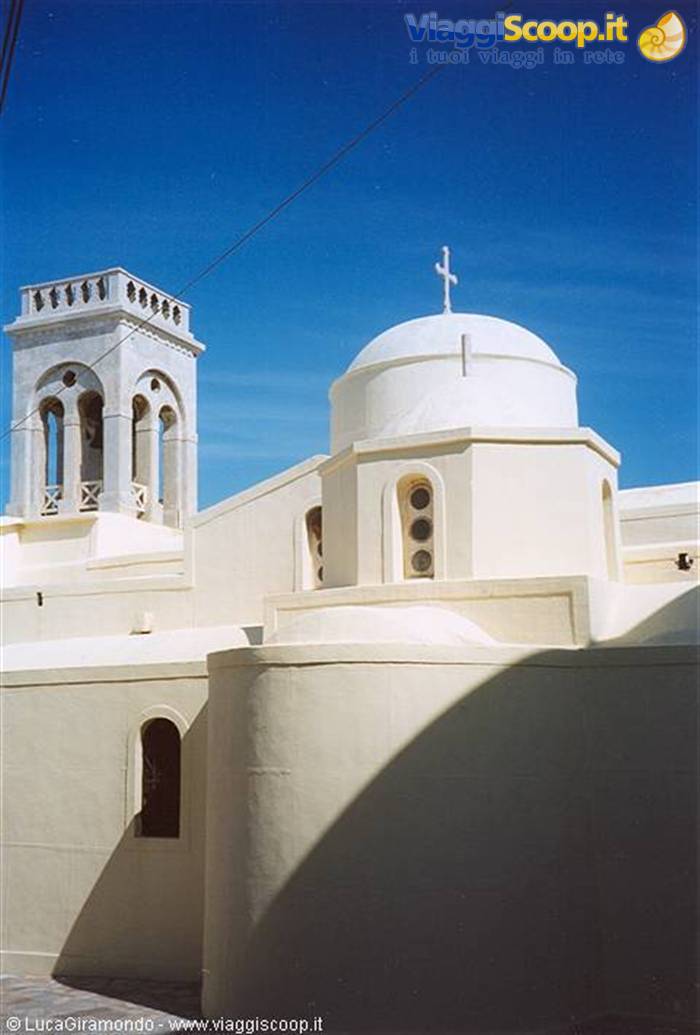
Its classic Cycladic architecture, made of domes and whitewashed walls, stands out masterfully against the arid surrounding landscape and the blue of the sky, so we take a few photos then go back to following the road that, after an infinity of curves and bumps, arrives at the small valley of Petaloudes. The area is the most lush and water-rich of the island and is known because, in summer, it is populated by an infinity of butterflies (lepidopterans to be exact), which in some cases completely cover the surrounding vegetation. We are now at the end of the season but, in several places the butterflies, which are nocturnal and therefore almost always stay in place, are truly numerous. The place is immersed in an unusual and very intricate patch of greenery, into which some rugged paths lead, which the little one has fun walking without stopping...
and the whole thing turns out to be a beautiful and interesting experience. We return to the car and begin to descend toward the sea, but without too many expectations: the wind is strong and I don't know if we will be able to find a sufficiently sheltered spot. We try to look for it along the southern coast, where perhaps there are greater chances, and we reach the town of Aliki, then we continue along a dirt road to Faranga beach. The small parking area nearby is full, evidently many others have had our same idea, and, in fact, here the wind blows with less intensity, even if the beach is not the best one could expect, but we have to make do and there we stop.
It is almost noon and, with Federico, I go exploring to the right of the beach: beyond a small rocky promontory we discover two other little beaches, nicer and more sheltered than the first, so we go to call Sabrina, move the "base camp" to the smaller of the two coves and immediately take a swim. The water is warm and beautiful even if, due to the seabed, it doesn't stand out that much, especially if you still have in your eyes the reflections of the Anguilla sea, which, however, we will have to try to forget, at least for the next two weeks. We have lunch and stay to enjoy Faranga beach, perhaps one of the few sheltered ones on the island, but later the wind rises further in intensity and comes to disturb us even in this place: the grains of sand shoot away at full speed and sting on the skin...
there is nothing left to do but go into the water to seek some relief, but we can't stay there the whole time, so we return to the beach to be targeted... and it's a real shame, because the place deserved to be experienced in another way. Around 18:00, however, the wind slows its course and the sun, which is slowly setting, with its warm light enhances the colors and highlights all the beauty of the cove. We look around and, objectively, we can consider ourselves satisfied with the spectacle, on which, however, soon the curtain of evening falls, inexorable... then we tidy up all our things and, calmly, return to the Paros Bay. We take a shower, this evening more indispensable than ever to remove all the sand we have on us, then we go out for dinner, while Federico seems to be showing the first symptoms of a cold...
We are terrified by the idea that he might get sick because of the wind, and it is perhaps for this reason that, distracted by the situation, in an attempt to park, I lightly hit another car, irony of fate Italian! I get out, together with the other driver, to assess any damage: fortunately nothing serious, so we get away with exchanging a few stern looks, then each on their own way. We have dinner eating fish in a taverna, then we take a walk through the historic center of Parikia, which never ceases to amaze us and at every step makes us discover new characteristic corners. We also see the so-called "Church of a hundred doors" (which we will return to visit more thoroughly in daylight), then we return to the hotel... while the wind, "needless to say", continues to blow with disarming obstinacy.
Paros - Naoussa
Day 327 Aug 2002
The unmistakable whistling you hear is still that of the wind, which doesn't invite us to get out from under the sheets, and on top of that, when we open the window, we can't help but notice a big cloud that, lingering over the center of the island, further darkens the landscape, already not brilliant due to the thick haze. Despite everything, we take courage and, after breakfast, set off towards the north of the island, pass Parikia and reach the small village of Naoussa, nestled at the bottom of a large bay where, in 1770, the Turkish fleet was moored, and was attacked by the Russian one. At that time Naoussa was the largest village on Paros, but after the battle it was Parikia that took the upper hand.
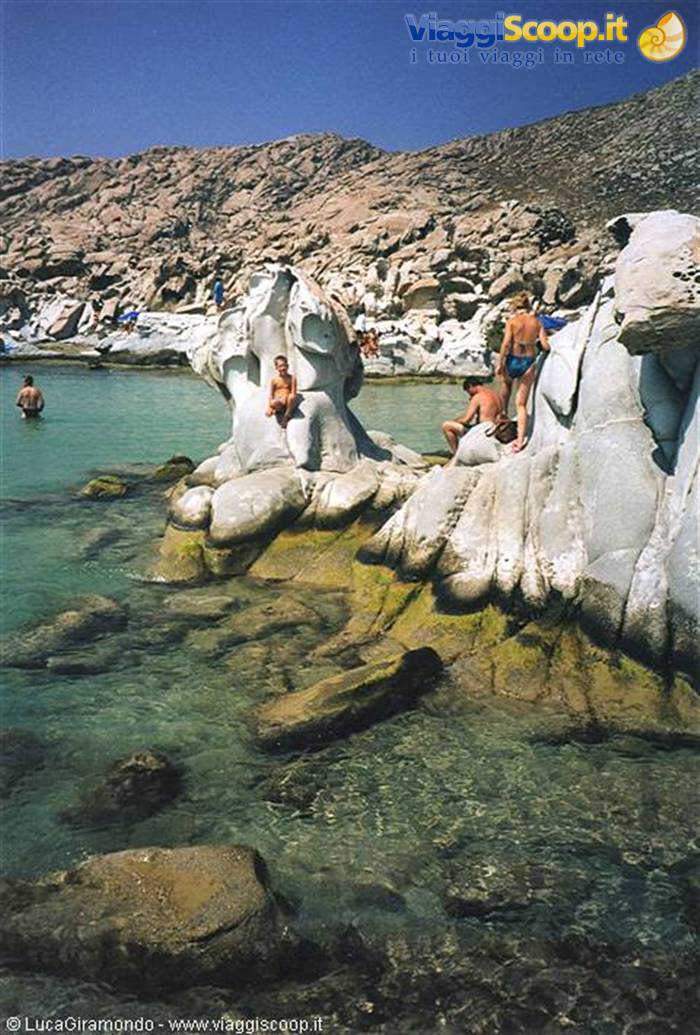
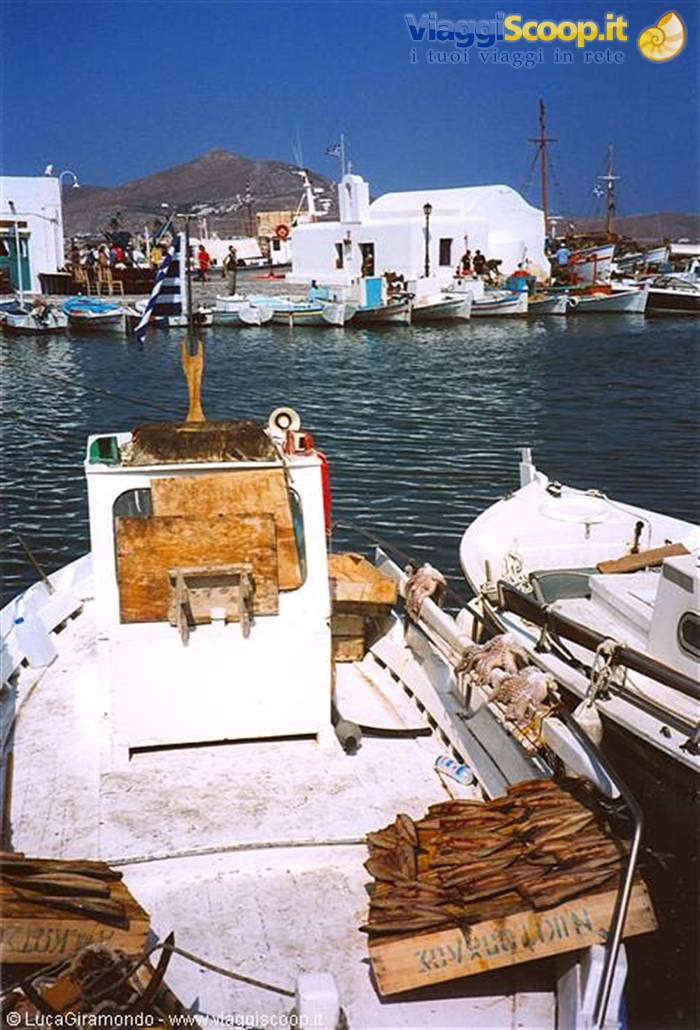
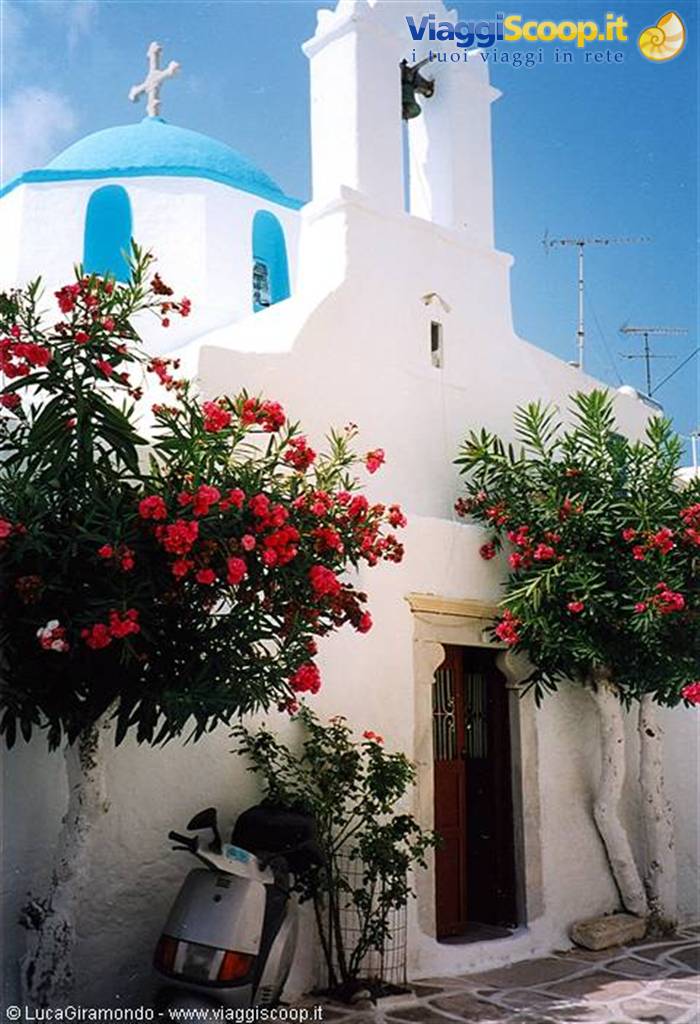
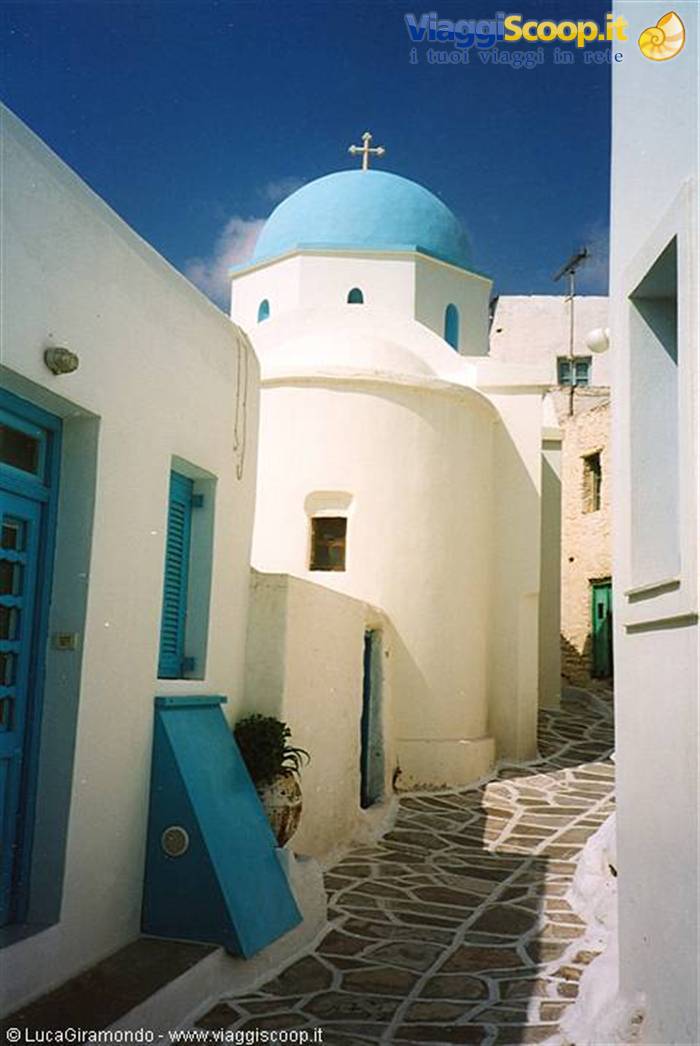
We park the car and, on foot, go to discover the most characteristic corners of the village, starting with the little harbor, delightful, with the typical fishermen's boats and the tavernas all around displaying, hanging, long rows of octopuses, not forgetting the narrow streets paved with whitewash and the ever-present little white churches, sometimes topped by the classic turquoise domes... so many exquisitely Cycladic vignettes, into which, lightheartedly, we immerse ourselves, spending a truly pleasant stretch of time, then we return to the car and set off again, this time in search of a beach as sheltered from the wind as possible. We follow the road that runs along the bay of Naoussa, towards its westernmost part, and reach the beach of Kolybithres, the most famous on Paros.
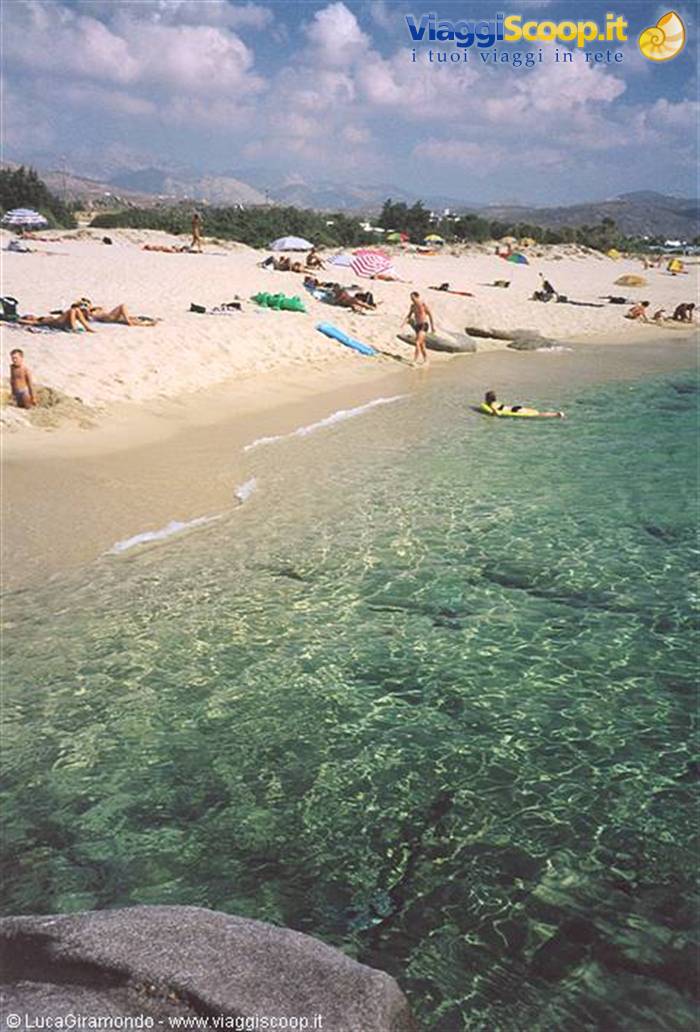
In reality it isn't a single beach, but a collection of sandy coves interspersed with large granite boulders eroded and smoothed by the wind, which vaguely recall the rock formations of Gallura, in Sardinia. Scenically it's a beautiful beach, there's no denying it, and on top of that the water is transparent and the gusts of wind are bearable. What is really annoying, though, is the presence of a beach club that occupies, practically, every inch of it, so much so that we can barely find the space needed to set down our things. That doesn't change the fact that we'll stay, in any case, for the rest of the day, indeed the place deserves all the attention it's due.
We are relatively far from the water's edge, so, with Federico, I go exploring along the coast: we "climb" the rocks and go down to see all the other coves, but we don't find any spot free of umbrellas and sunbeds, so we return to the starting point, treat ourselves to a swim and then have lunch. All in all we're comfortable and, in the early afternoon, even the wind seems to want to slow its course, though it immediately raises the perceived temperature and forces us, consequently, to go into the water in search of some relief. So we spend the rest of the afternoon pleasantly, until it's time to return to the Paros Bay.
That little strip of land, jutting westward, on which our hotel stands (we can't help but acknowledge it!), is probably one of the most exposed spots on the island, in fact the wind still blows there, indeed, later unfortunately it starts blowing again with some intensity across the whole region and when we go to dinner, at a pizzeria on the port of Parikia, we have to cover up because it's really cold with just a t-shirt on... Damn!...: "That's enough now, Aeolus!... this is certainly your kingdom, but listen to the prayers of three ordinary mortals who only ask to be able to enjoy their holiday period, indeed, you go on holiday too and get out, please, of our b...!"... this, at a certain point, I would have wanted to shout, but it's no use anyway... better to go to bed and keep hoping for good luck.
Paros - Parikia
Day 428 Aug 2002
The "prayer" addressed to the God of the winds did not produce the desired effects so, as usual, when the alarm goes off we don't find the desire to leap out of bed and we go to have breakfast well past 9:00. Around 10:00, by car, we leave the hotel and cover the short stretch of road that separates us from Parikia. Our intentions, in fact, are to visit the capital in the light of day. We park near the center and, first of all, we stop to see the historically most significant monument: the "Church of a Hundred Doors" (Ekatontapyliani, in Greek), which in fact has, windows included, "only" ninety-nine. Fortunately, since, according to legend, the discovery of the hundredth door would announce the end of the world (or, according to a more optimistic version, the return of Istanbul to Greece).
The religious building, the most important in the Cyclades, dates back, in its original core, to the 6th century, while what one visits today is a large complex made up of three adjacent constructions: the Basilica, in the shape of a Greek cross dedicated to the Virgin, the smaller and more intimate church of Aghios Nikolaos and the Baptistery. The garden, on the other hand, looks like an archaeological site, with capitals and fragments of statues piled up here and there. The whole complex, finally, is enclosed by a white and austere wall, a bit convent-like, which stands as a barrier between the church and the square in front. We visit every corner of it meticulously, then we go out and begin to stroll through the little streets of the historic center. Along the way we encounter characteristic corners and little churches, with the typically Cycladic dome, like that of SS.
Elena and Costantino, built at the top of the Kastro, the ancient Venetian fortress, of which some curious fragments of walls remain which, built with the famous marble of Paros, appear like a mosaic of Byzantine marbles, stumps of columns and pediments coming, probably, from the ancient temples of Apollo and Demeter, nearby. It was a visit truly rich in points of interest, which Federico also showed he appreciated, busy as he was taking photos with his new camera, and almost without realizing it we let the hands of the clock run well past midday. We return to the hotel to retrieve the little one's toys, which we had forgotten in the room, and set off on the usual search for a beach sheltered from the wind.
We follow the road that runs along the coastline to the far northern tip of the bay of Parikia and reach the beach of Krios, which has nothing exceptional about it, but is nice and, above all, is not battered by those infernal gusts of wind. We take a swim and then have lunch, while in front of us file by, one after another, the many ferries docking in the capital, coming from the most varied ports of the Aegean. Later, Federico and I reach, on foot, the actual tip, where there is a little church with a dome, turquoise of course, then we return to "base", and the little one starts playing with a Greek child... they don't understand each other in words, but playing with sand is a sort of universal language, which doesn't require translations.
The strange pair, however, is short-lived and after a while, unfortunately, the improvised little friend leaves, we on the other hand stay until almost 19:00, then, calmly, we return to the Paros Bay and get ready to go out for dinner. Truly an original dinner the one we treat ourselves to tonight, seated at a little table along the characteristic streets of Parikia: a melon (melon in English), which in reality was supposed to be a watermelon (water-melon), but which we order by mistake, hollowed out of its pulp and then filled with fruit and ice cream, which Federico throws himself into headfirst, leaving us, practically, only the "crumbs", then two grilled corn cobs that we eat while strolling lightheartedly through the center...
truly an excellent dinner! Meanwhile, hear ye, hear ye, the wind has practically stopped and, once back at the hotel, it almost seems too good to be true, lying in our beds, not to hear that hateful whistling anymore, so, more relaxed and blissful, we soon reach the world of dreams.
Andiparos - Soros Beach
Day 529 Aug 2002
Aeolus seems to have finally caught his breath and when we open the window we are met only by a light and pleasant breeze, so, more charged and motivated than usual, we go to have breakfast, then, after some routine shopping, we set off for the south of the island. We reach, near the tiny airport of Paros, the small village of Pounda, from where we board a ferry that, in a few minutes of sailing, lands us on the islet of Andiparos, just 11 kilometers long (for an area of about 35 square kilometers), the only inhabited one of the mini archipelago that extends southwest of Paros. The nine hundred inhabitants reside, almost all, in the single village (which bears the same name as the island), from which we set off to discover the territory.
In this case too we go south, following the road that runs along the coast, then we turn towards the center of the island and climb up into the mountains to visit the Spileo Stalaktition, a cave known since antiquity for its limestone concretions. Currently it is well lit and is traversed by means of a concrete staircase, but it hasn't always been like this. It was, in fact, one of the first to be visited by the pioneers of Greek tourism, among whom also Lord Byron and King Otto of Greece, who lowered themselves into it with the aid of a rope, behaving among other things like vandals and leaving their signature carved on the stalactites.
After them many others did the same and the concretions today are, unfortunately, almost all dead, but the place is equally evocative and we descend to the very bottom, about eighty meters deep relative to the entrance, covering all 355 rough steps that lead inside. It also turns out to be a fun adventure for the little one who, by now near the exit, says he is sorry that the visit is already over. We go out into the open air and descend from the mountains in search of a beach on the western side of the island, at Aghios Georgios, a small and remote cluster of houses located on a stretch of low coastline facing the islet of Despotiko, but the place doesn't satisfy us and we retrace our steps to the other side.
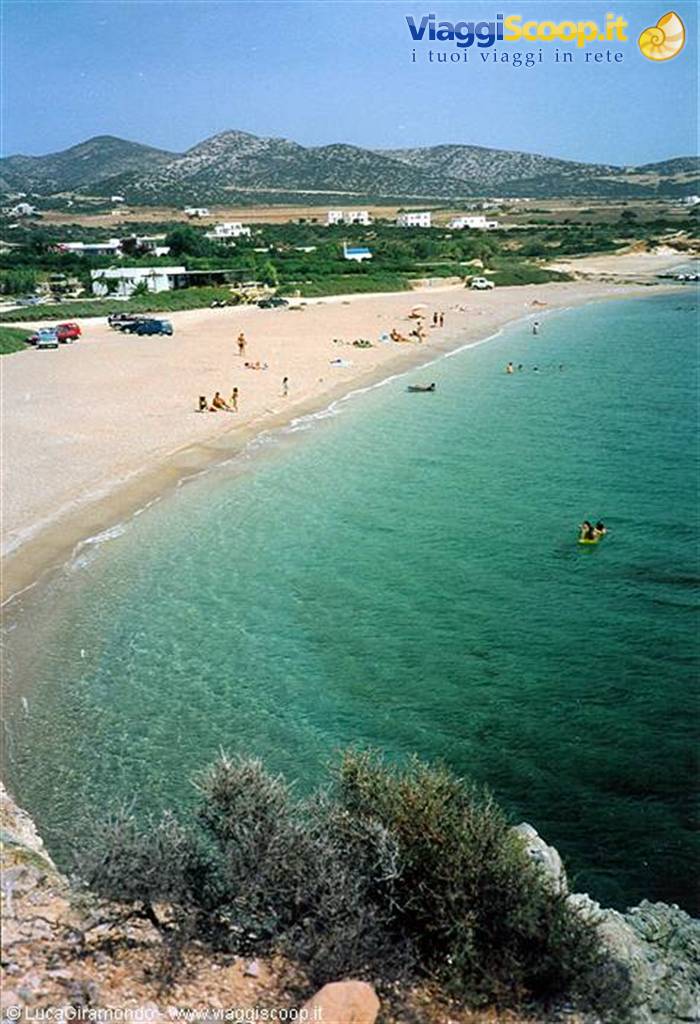
We spot a beach, that of Soros, but we continue along a dirt road towards the southernmost tip of Andiparos, only to give up shortly after when it becomes impassable for our Matiz... Beach-wise, so far, the island has been a small disappointment, and on top of that the sky has clouded over and the sun has almost disappeared. We turn back and stop at the beach of Soros, characterized by a pebble shoreline and, all in all, nice, indeed beautiful seen from above, with water of exceptional transparency, the best seen so far... so we treat ourselves to a nice swim and then have lunch. In the afternoon that inviting crystal-clear water and the almost total absence of wind invite us, finally, to pull out the inflatable mattress, with which we take another swim and play, to the delight of the little one, then we lie down on the towels to rest...
now it really is lovely, with the sky turned clear again and the sun pleasantly scorching on the skin. Around 18:00 we pack up, head towards the ferry, and an hour later we are at the Paros Bay Hotel. We go out for dinner and reach Naoussa, in fact we intend to eat fish, in a little restaurant, on its characteristic little harbor... and so we do: two prawns and a red-snapper grilled, very good, but also expensive for being in Greece (seventy euros). No matter, after all we're on holiday, and besides we normally spend much less. Having satisfied our palate we take a stroll through the little streets of the center, then we return to Parikia and then to the hotel, thus concluding a beautiful day.
Paros - Lefkes
Day 630 Aug 2002
Dead calm: not a breath of wind blows and the weather is splendid when we get up ready to tackle, with excellent prospects, another stage of our itinerary. We head, this time, towards the center of the island following the winding road that climbs, from Parikia, in the direction of a harsh and mountainous area, dominated by Mount Profitis Ilias (771 meters), the highest peak of Paros. Right after the village of Marathi we stop to see the ancient marble quarries, famous in the Hellenistic era for being the place of origin of the blocks with which the Parthenon of Athens was built, but at the same time they also provided the material for other famous works, among which the Venus de Milo, today in the Louvre in Paris.
We have a bit of trouble finding them, but in the end we spot the very steep tunnel that descends into the heart of the mountain, and, with Federico, I venture a few meters inside it, as far as the sunlight reaches: beyond us the gallery continues into total darkness and the cool replaces the infernal heat outside. It's evocative to think of those blocks of marble, made immortal by history, and, in absolute silence, we almost seem to see them passing, slowly, before our eyes, amid the imaginary shouts of the miners, extracted and hoisted who knows with what means from such a depth, but the illusion is brief and everything vanishes when we return to the open air and to reality. With a virtual leap back in time of a few thousand years we climb, once again aboard our Matiz and reach the nearby village of Lefkes, clinging to the slopes of Mount Profitis Ilias.
The town center, which we walk through on foot, is characteristic, though not as much as those of Parikia and Naoussa. Along its alleys some churches stand out, and, further out, the remains of a Byzantine road, which once connected Lefkes to the nearby Marpissa. At the edges of the ancient route we find some ripe figs, which Federico likes very much, and we take the opportunity for a little snack, then we return to the car and, following the current road, we arrive at Marpissa. The settlement is dominated by a hill on which stands the little church of Aghios Antonios, which we intend to visit, but the narrow strip of asphalt that climbs up the hill ends too soon and the heat doesn't invite us to trudge all the way to the top, so we give up, all the more so since midday has already passed, and we set off in search of a beach and a bit of refreshment.
We comb through almost all the shores of the southeastern coast and end up stopping at Golden Beach: a long sandy beach famous in the world of surfers, but today the wind isn't blowing and it's perfect for us too. It's not particularly scenic, but the water is very beautiful, so we immediately dive in and, for a long time, stay relaxing in that delicious fluid. We have lunch while to the west, towards the center of the island, several clouds gather, which in the early afternoon unfortunately obscure the sun, inevitably heading in that direction. Meanwhile, together with Federico, I build a castle... but the clouds, those mischievous ones, really seem anchored to the center of Paros... and time passes inexorably.
Nothing doing: we stay in the shade practically all afternoon, until almost 19:00, when, willingly or not, we leave, but then, on the way back, from a height, we observe a beautiful sunset over the jagged coast at our feet and over the island of Andiparos in the distance. For dinner we return to Parikia, where we have a small score to settle: two evenings ago, by mistake, we ate a melon filled with fruit and ice cream... delicious, mind you, but it was supposed to be a watermelon! So we return to the same place and, on the second try, we finally manage to dine on a very tasty water-melon, followed by the usual grilled corn cobs munched while strolling through the center... fantastic! Afterward, satisfied and happy, we return to the Paros Bay to go to bed, so as to avoid getting up, tomorrow morning, with our eyes still full of sleep, as has been happening, daily, for a while now.
Paros - Monastiri
Day 731 Aug 2002
It's the last day of the month and also the last we'll spend on Paros. The sun is out and a light breeze blows: as good as it gets in anticipation of a whole day to spend at the sea. We set off with our Matiz in the direction of Naoussa, we reach it and go past it following the road that runs along the coast towards the northeastern tip of the island. Our intentions are to go to the beach of Lageri, but the only road that arrives there seems to be private property, in fact it's closed by a gate complete with padlock. We ask for information but apparently there are no alternatives: either by sea or on foot, and we don't know exactly how far the sand is from the asphalted road, so we decide to go to the nearby inlet of Santa Maria.
The beach is a small sandy cove, partly occupied by a beach club, washed by a beautiful sea and characterized, on the horizon, by the stern outline of the island of Naxos, where we'll go tomorrow. There we stop and, after a little tragedy staged by the little one who insists on inflating the mattress by himself (too big for his abilities), we take a swim, which we can't, however, fully enjoy, given the presence, on the bottom, of some algae that don't thrill Sabrina and Federico. We spend a few hours at Santa Maria, then we have lunch and immediately get going to change beaches. We return towards Naoussa, we pass it again and go, this time, in the direction of the northwestern tip of Paros, we transit near Kolybithres and continue along the road that arrives, after a handful of kilometers, at the beach of Monastiri, so called because of the presence, indeed, of a monastery nearby.
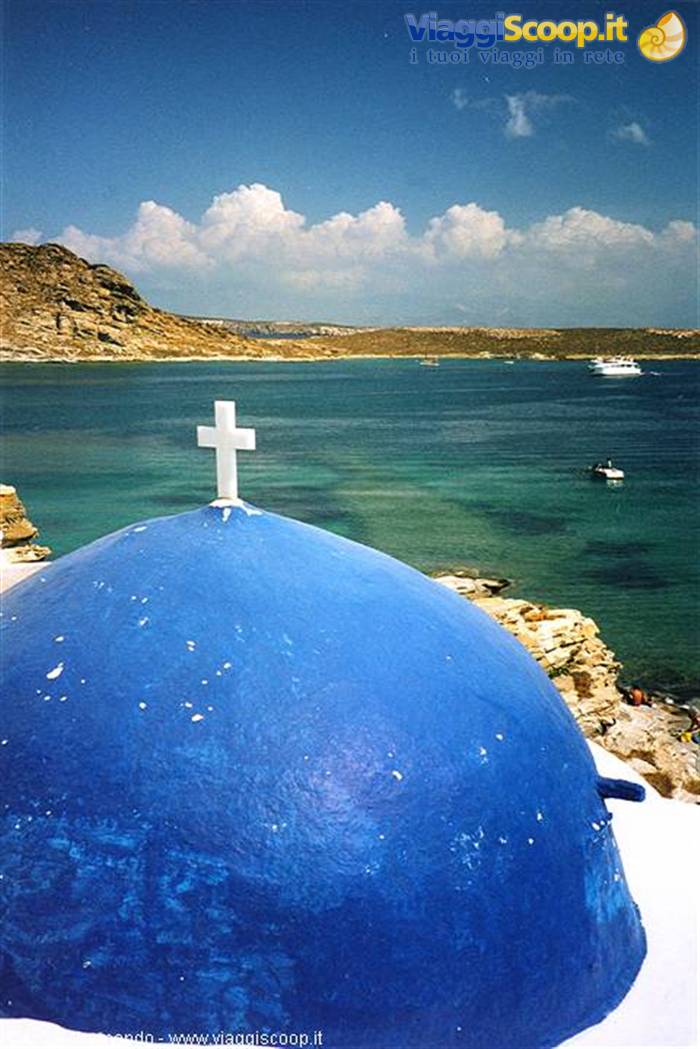
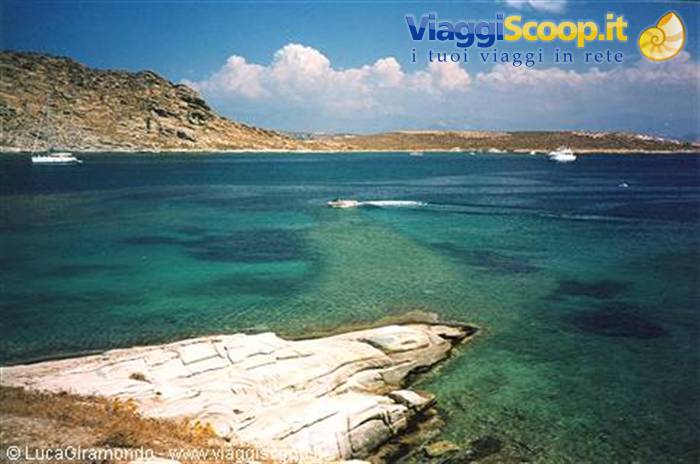
The place is a pearl of the Aegean and is set in an extraordinary environmental context, framed by harsh mountains that contrast with the intense blue of the sea. We immediately take a long swim in its crystal-clear waters, then, with Federico, I go onto the rocky promontory, where the religious building with the ever-present turquoise dome stands, to discover new corners and suggestive perspectives from which to take unforgettable photos: this is, without a doubt, the most beautiful seaside spot on Paros, with the little church dominating the scenic cove characterized by the white town of Naoussa, which stands out like a spot on the coast on the other side of the bay, and further in the distance the imposing outline of Naxos topped by big white clouds, only the usual beach club, however hidden at the bottom of the inlet, clashes with the wonderful surrounding landscape.
We spend, naturally, at Monastiri all the rest of the day, until the sun stops offering us its warm glow, then we tidy up our things, accompany Sabrina to see the monastery and then we make our way back to the hotel. Later we go out for the last dinner on Paros: like the first evening we eat soulaki and giros, then we take a short stroll through the center and stop at an internet-point to see what the weather conditions will be like in the coming days. It seems we'll have good and sunny weather until the end of the trip and so, more relieved, we return to the Paros Bay to start packing the suitcases, in view of the transfer to Naxos. Up to today it's been a nice holiday: we've been satisfied with Paros, from many points of view, and now we have serious reasons to believe that the next island won't disappoint our expectations either.
Paros - Monastiri
Day 81 Sep 2002
Operation Naxos gets underway when, calmly, we get up and go to have breakfast taking with us also the car keys, which we should hand back by 9:00, but at the appointed time no one shows up. We point this out at the hotel's front desk and, after a phone call, they inform us that no one has forgotten and they'll certainly come to collect it soon. Meanwhile we go to the room to sort out the last things, then, after finally leaving the car with its rightful owners, we go down to the réception with the suitcases. Punctually, at 10:30, the minibus arrives that will take us to the port, so we say goodbye to the Paros Bay Hotel and begin the transfer. Our ship (the Blu Star Paros) will set sail from the pier of Parikia at 11:50, more than an hour from now, but it's not a big problem to wait since the sky today is, more than anything, cloudy.
The ferry also arrives right on time: we board and, almost immediately, we set out to sea, while with Federico, as usual, I go exploring. The ship glides smoothly over the surface of the water and at 12:45, in the blink of an eye, we find ourselves in the port of Chora, the main town as well as the capital of Naxos, the largest island of the Cyclades, with its 428 (square) kilometers of surface and 148 of coastline. Land of myths and legends, as indeed every corner of Greece, Naxos, in antiquity, was the first island to abandon barter and adopt money in commercial exchanges. As soon as we disembark, here too, we get on a minibus that takes us, a few kilometers outside Chora, to the Lianos Village Hotel, where we'll stay for the next six nights.
They hand us the keys with the number 63 stamped on them and meanwhile we also ask to rent a new car, then we reach the room, which immediately appears spacious and cozy, a suite compared to the one on Paros, plus there's a television and a safe... but also lots of mosquitoes! We barricade ourselves in and begin the hunt which, judging by the marks on the walls, our predecessors also undertook, then we put on our beach gear and go to the pool, but the sun is absent and over the stretch of sea that separates Naxos from Paros there's even a storm raging. Later I go to pick up the car: a white Hunday Atos (license plate EME 3358), while the rain-laden clouds stay at a distance and Federico takes a swim in the pool, with the sun remaining overcast nonetheless.
Meanwhile I send a welcome SMS to our friends, Sabrina and Ivan, who have arrived on Mykonos to spend a week there: we'll perhaps see them next Saturday evening and certainly on the return flight. We decide to go for a drive, since we're motorized, so we stop by the room and when we come out the sun is shining, so we reach the nearby beach of Aghios Prokopis, made up of a fine gravel shoreline and washed by a beautiful sea. There we spend the whole afternoon, while the sky clears almost completely of clouds... and if this was supposed to be the day of bad weather... great!... nothing to object to! We stay at the beach until the sun disappears beyond the small mountain on our right, then we return to the Lianos Village and get ready to go out.
We have dinner in a taverna before taking a stroll through the characteristic little streets of Chora, then we return, in the dark, in search of the hotel. We find it and go to the room to watch a bit of television, after a seven-day abstinence.
Naxos - Chora (the Portara)
Day 92 Sep 2002
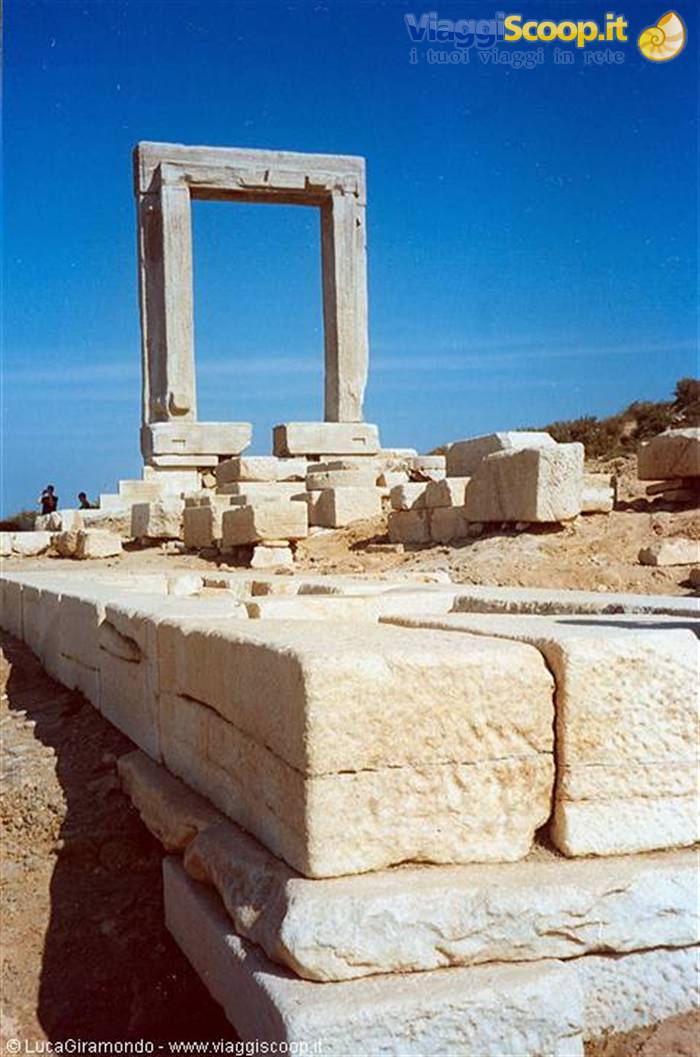
The day begins with a splendid breakfast in the open air: our hotel is, in fact, on a hill about a kilometer from the sea and the view over the Aegean that you enjoy from its balcony, in the morning quiet, is stupendous, only slightly dimmed by the ever-present haze. You can clearly see much of the southwestern coast of the island with in the background, barely marked, the outline of Ios and, to the right of the view, the far more distinct one of Paros. It's thanks to this sublime view that, shortly after, we go to begin, with renewed enthusiasm, the visit of Naxos, starting right from its capital: Chora. The town, which today has about seven thousand inhabitants, is of ancient origins and as evidence of this there is, on an island facing the settlement, a surreal and gigantic marble door, which seems to frame the sea.
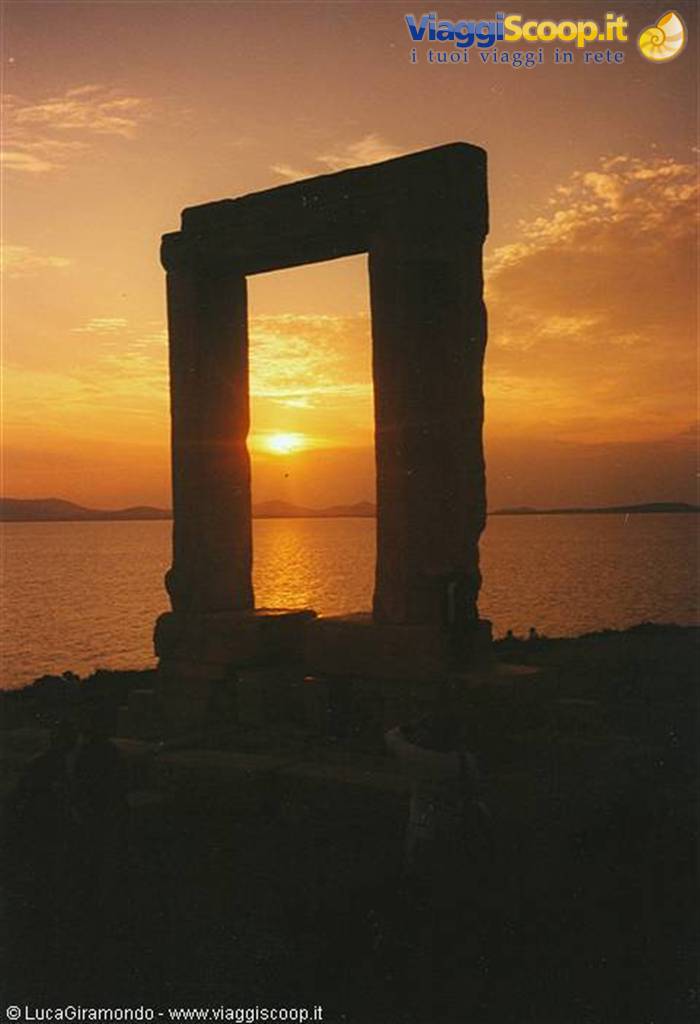
The so-called Portara, which is the symbol of Naxos, does not lead into a palace or an enclosed place because its walls are the breezes that come from the Aegean. This door and the fragments of marble around it are what remains of ancient Naxos and of its sanctuary dedicated to Apollo, built in the 6th century BC. Millennial rubble scattered on the islet of Palátia which we reach by following the short pedestrian road that connects it to the port (where, among other things, there is incredibly transparent water). The place is very evocative and charged with mysticism, indeed the usual legend is not lacking in this regard, according to which when Istanbul returns to Greece, miraculously, the doors of the temple will reappear (and if my memory doesn't fail me, at that same moment, the hundredth door of Ekatontapyliani on Paros should also be found!).
We stay for a while in contemplation enjoying the spectacle of those simple but fascinating ruins in the middle of the sea, then we leave the constructions of ancient Greece to devote ourselves to a poorer and more recent architecture, but not for this less interesting, we head, in fact, to visit the historic center of Chora, with its typically Cycladic appearance. The seaside atmosphere and the modern constructions of the long port are only the theatrical backdrop that hides the other Chora, a Venetian, Turkish, Byzantine casbah. Uphill little streets, arches, secret passages, covered alleys that look like tunnels and stairways that take us up, to the Kastro built seven centuries ago by Marco Sanudo, nephew of a Doge.
At that time there were thirteen towers, today only one remains, but, as a whole, the Kastro is a small medieval jewel, with some well-preserved churches, among which the Catholic Cathedral stands out which, among other things, preserves the longest icon in the world. In a building, located at the highest point of the city, there is also the tiny archaeological museum, but today is Monday and it's also a closing day, so we have to give it up, to the great disappointment of the little one (always fascinated by artifacts), to whom, however, we must say that it's closed for works, to avoid another long trudge up here in the coming days. We go down to the port following other narrow streets and conclude the visit of the center of Chora, which we liked, but not as much as that of Parikia.
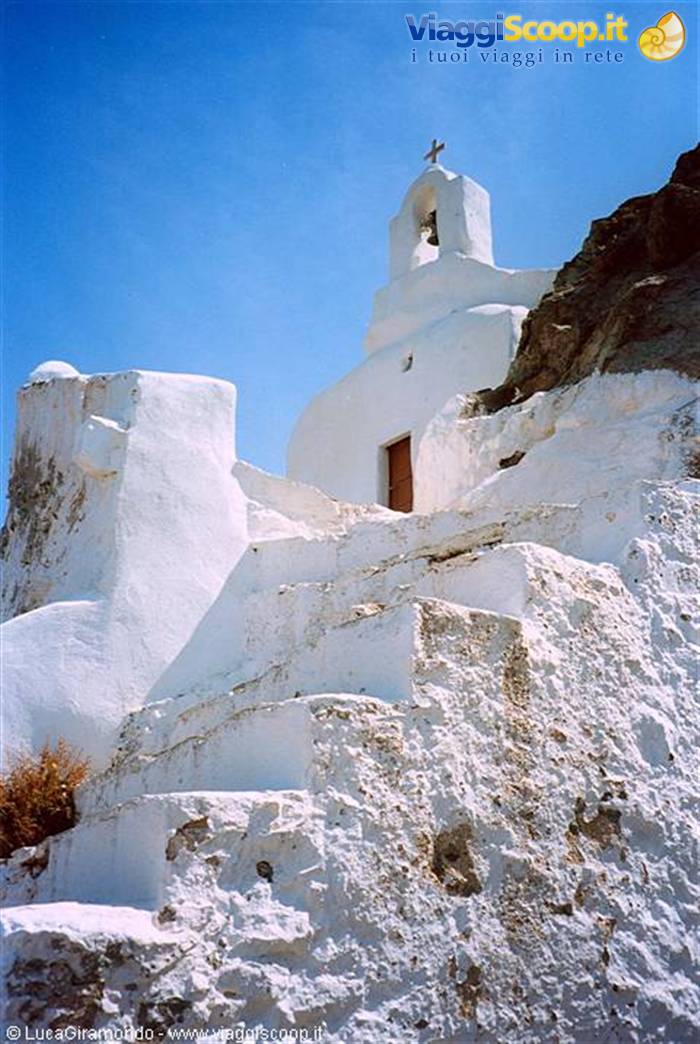
We get in the car and reach, a very short distance from the capital, the characteristic little church of Aghios Ioannis Theologos: tiny, very white, solitary and... simply beautiful, clinging as it is to the rock with its poor and essential architecture. To find it we had to ask for information at the hotel's réception, because it isn't marked on the tourist guides and the only clue in our possession was a photo downloaded from the internet, but in the end we found it and, naturally, photographed it as it deserved. It also cost us a bit of time, but it was worth it. After a wonderful feast of architectural beauties we devote ourselves to nature, which certainly won't want to be outdone and we hope will offer us an equally beautiful beach where to spend the rest of the day. We go south of Chora, to the stretch of coast where almost all the most renowned shores of Naxos are located.
We pass Aghios Prokopis, where our hotel is, and arrive at Aghia Anna, a small cluster of houses from which a dirt road departs that runs alongside a long and splendid stretch of sand. We stop at the point, in our opinion, the most wild and settle a few meters from the water, with high dunes behind us, very soft and light sand under our feet and in front of our eyes a crystal-clear sea and the outline of Paros which, who knows why, from Naxos is seen very clearly while, last week, the same view wasn't equally sharp with the roles reversed. We take a swim and have lunch, then we spend the whole afternoon in complete relaxation, until 18:00, when we return to the hotel and in haste and hurry we change to reach Chora before the sun sets, so as to be able to see it set right in the middle of the Portara.
A magnificent spectacle, which gives the place even more charm and mystery, staged masterfully by the celestial forces on a curtain set up impeccably by man and time. Only a few clouds, low on the horizon line, partly spoiled the party for us at the end. The shadows of evening quickly take over and it's still early to have dinner, so we stroll for a while along the long port of Chora, then we stop at a spaghetti restaurant and fill up on pasta, before returning to the Lianos Village and putting an end to a top-notch day.
Naxos - Chora
Day 103 Sep 2002
Tomorrow we'll visit the whole interior of the island and it will be, perhaps, the most demanding stage of the trip, that's why today we want to treat ourselves to a whole day of sea and relaxation. We sleep a little longer than usual then, after a hearty breakfast and a furtive grape harvest in the garden of our hotel, where succulent bunches of grapes grow, we venture along the southwestern coast of the island. We pass Aghios Prokopis and Aghia Anna and continue along a narrow and rough road that arrives, after a few but endless kilometers, at the nearby promontory of Mikri Vigla. On the side exposed to the north there is a beautiful beach, realm of the surfers because it's normally battered by the wind. Here the breeze, which in other places is pleasant, even today is stronger and doesn't invite us to stay.
We take a photo, while a shepherd passes by with his flock, then we get back in the car and reach the more sheltered side of the promontory, at whose feet a long beach develops, which would be beautiful if it weren't invaded by quite a few algae, arrived, probably, following a storm. Fortunately, walking up the coast on foot along its more rocky part, we find a magnificent little beach "family-sized", all for us, with a delicious sea and beautiful panoramic views all around. We arrange the towels and backpacks occupying, in practice, the entire inlet, then we take a swim and play catching some small fish, while time passes carrying with it the whole morning. After lunch we leave our very own corner of the Aegean and, by car, return further north, traveling back over the last stretch of road covered in the morning.
We stop at Plaka, a few kilometers before Aghia Anna: we park behind the dunes and reach the beach, which at this point is made up of very fine gravel and washed by the same splendid sea seen so far on Naxos (a notch above that of Paros, as indeed expected). Here too we take a swim, actually two... and the afternoon slips away peacefully. Shortly before 19:00 we return to the hotel and later, on the long port of Chora, we have dinner with some excellent lamb chops, then, after a short stroll, we put the little one to bed, since he appears particularly tired after a whole day spent playing with the sand and among the waves of the extraordinary seaside landscape of Naxos.
Naxos - Aghios Ioannis Theologos
Day 114 Sep 2002
So we set off for the day that is, perhaps, the most tiring of the trip: Naxos is rather large as an island, but its most beautiful beaches are concentrated in the southwestern part, which doesn't mean that it isn't nonetheless worth doing a full tour of it. We head towards the capital, then turn towards the heart of this harsh and, in part, wild land. In no time we find ourselves up high, dominating a considerable portion of coast, a pity only for the haze that always negatively characterizes every panoramic view. We pass the village of Filoti and turn right along a road that goes into the most impervious part of the island. We pass below the slopes of Mount Zeus, which with its 1010 meters of height is the highest peak of the Cyclades, and arrive, amid suggestive panoramas, at the ancient tower of Chimarou, which unfortunately is under restoration, where the strip of asphalt ends.
From here a dirt road continues for several kilometers to the wild and uninhabited southeastern coast, but it's not worth risking the mechanics of our Atos and we turn back along the same route to Filoti. The next stop takes us to Apíranthos, the capital of Naxiot folklore, famous for its fabrics, wine and the strange dialect that mixes Cretan and Byzantine idioms. The air up here is crisp: we are, in fact, at the highest point of our itinerary, among the so-called mountains of Phanaria, where vines prevail over olive trees and where, according to a local proverb, from the rocks doesn't gush water, but inebriating wine.
Apíranthos is also called the "marble village", for the wide use of this material in the construction of the houses and for its Paralìa, a characteristic paved street that we walk along without haste, until we reach a delightful little square, then we return to the car and begin the long descent towards the sea. After hundreds of curves we arrive at the northernmost tip of the island, where the village of Apollonas is located, on whose outskirts we stop to visit the Kouros of the same name. The object that bears this strange name is nothing other than an unfinished statue, located at the point where it was about to be carved and abandoned, probably following the ascertained poor quality of the material.
Roughly sketched in the rock there is an evocative warrior about ten meters long, who has been lying there, in that position, for at least 2600 years! At this point we set about closing the tourist tour of Naxos, descending south along the harsh and wild northwestern coast. We also try to go in search of a beach, so we go down to the inlet of Abram, but the area, normally very exposed to the meltemi, isn't particularly beautiful, the sea is rough and the shoreline is full of debris and algae. It's not worth stopping and we continue to go where the sea is more beautiful, even if it's late and the pangs of hunger are starting to make themselves felt.
We arrive at Chora and stop to take a look at its beach (Aghios Georgios), but it's too crowded for our tastes, so we continue to rack up kilometers and, shortly after, we find ourselves at Aghia Anna: there the sea is certainly beautiful and there's only the embarrassment of choice. We park the car near the dunes, then, on foot, we reach the tip on which stands the small religious building that gives the area its name and we settle where the rocks give way to the sand, then we finally have lunch. We spend what remains of the afternoon in complete relaxation: it's lovely, even if the wind blows a little more than usual... but it's better not to complain, remembering the meltemi of the first days. Meanwhile Federico makes friends with an Italian child (Elia), son of nudists, like himself, after all, and most of the people around us.
Shortly before 19:00, finally, while the sun, fiery, descends towards the dark outline of Paros, we leave the beach to return to the hotel. Tonight, for a change, we don't have dinner on the long port of Chora, but in a taverna at Aghia Anna, by the sea, with mousaka, pasticio and Greek cheese: a nice experience that however precludes us from the possibility of taking a stroll, so we soon find ourselves in the room... tired but happy, after a demanding day that has been able to offer us numerous points of interest, both historical and environmental.
Naxos - Chora (Sunset at the Portara)
Day 125 Sep 2002
The sky is slightly overcast, but we don't despair because the sun will certainly come, while in Italy, according to what they say on television, bad weather has been raging, of this crazy summer, practically since we left. While waiting for the clear weather we head towards the interior of the island and reach the village of Melanes, in whose surroundings you can see another Kouros: that of Flerio. We thus go into an atypical valley, with lush vegetation, and we find it right in the middle of an orchard, lying among the trees and with a broken leg. The statue, which depicts a young man (perhaps a deity, or a hero), is smaller and more refined than the one in Apollonas and, perhaps, less evocative but, all the same, interesting.
Once the short visit is over we return towards Chora and, shortly before the capital, we turn left taking a road that runs in the direction of the southern coast of Naxos. We pass through the village of Tripodes, where there are three windmills in a row on a hill, which would be beautiful if they weren't half-ruined, and we reach the sea near the locality of Aliko. In the area there should be some beaches and we go to see one: not bad, but not special either. So we go to the nearby Pirgaki, where there is a large stretch of sand: this too nothing special, indeed a small disappointment. We return to Aliko to go to the first beach and notice, a short distance away, parked along the road, on the other side of the small promontory, some cars. Intrigued we go to see: usually when there are people in a place it means it's worth it...
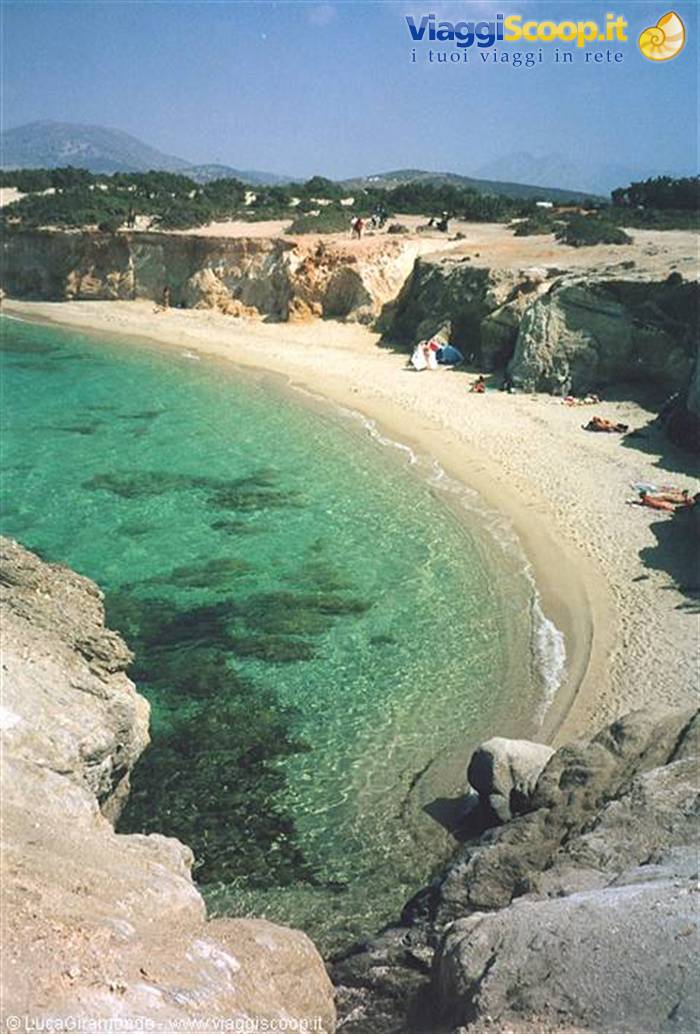
Indeed, hidden under the edge of the cliff, there is a magnificent beach, which seen from above is a real jewel, probably the most scenic seen so far on Naxos. We go down to leave the backpacks, then, with Federico, I go back up to take some photos: before our eyes a strip of light sand develops in an arc between the blue of the sea and the wall of reddish rock above, creating a picture
Naxos - Aghia Anna
Day 136 Sep 2002
Today, as we were told upon arrival, will be the last full day in Naxos, tomorrow, in fact, with almost twenty-four hours' notice, we will leave the island with destination Mykonos (where we will spend one night), and all this so as not to risk missing the plane that on Sunday will take us home. So we have in practice lost a day of vacation and, as if that were not enough, for tomorrow they have asked us to leave the room by 12:00, while departure is scheduled for 15:15. We would however like to use those three hours, since we paid for seven nights at the Lianos Village plus one, possibly, additional in Mykonos (which unfortunately became necessary), but at the reception they claim they were paid for only six nights.
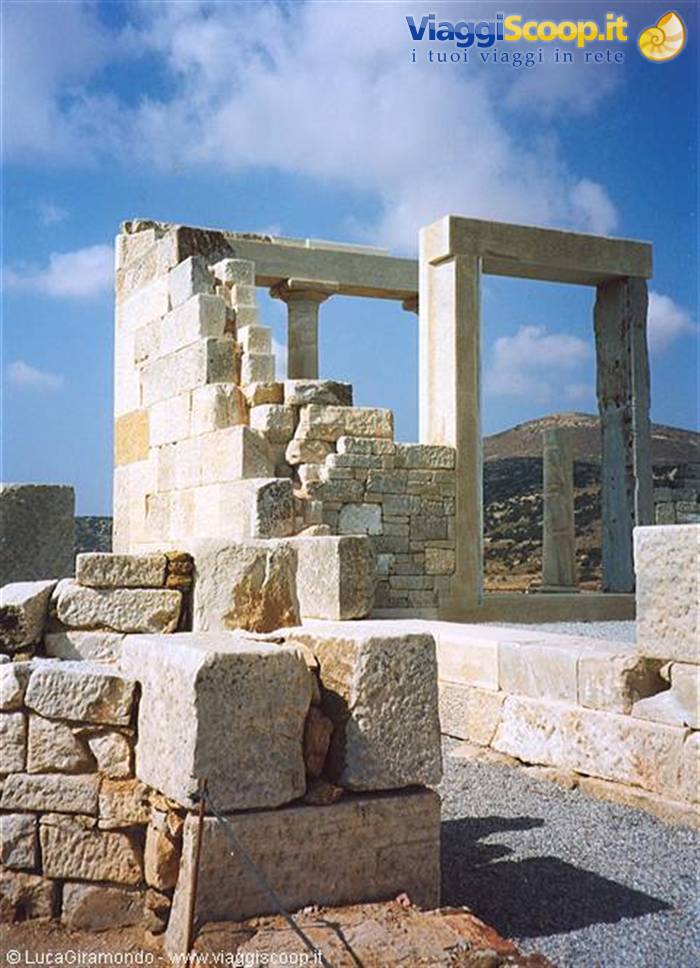
A small discussion thus arises: we ask for a statement certifying the number of nights actually paid, so as to request a refund once we get home, but they refuse it, telling us to address anything to the local tour operator. A bit annoyed, we leave, trying to overlook it and not to miss the opportunity to fully enjoy this last scrap of vacation. We set off again towards the interior of Naxos and make a stop, near the village of Ano Sangri, to visit the ruins of the Temple of Demeter, built, in Ionic style, in 530 BC, next to which also stands the tiny Byzantine chapel of Aghios Ioannis Yiroulas. Not much remains of the ancient construction, but a questionable reconstruction gives in part an idea of what it must have been. From Ano Sangri we then continue along a dirt road that ventures towards the south of the island and reach the sea near the locality of Agiassos.
It feels like having reached the end of the world: we are now at the end of the tourist season and a spooky little group of houses, scattered, stands near the semi-deserted and not very beautiful beach, but washed by a particularly transparent sea. We stop for a while and take a swim, while, in the distance, the outline of the island of Ios appears clearer than usual, then we have lunch, with many clouds passing over our heads, attracted, perhaps, by the high mountains behind us. In the early afternoon we set off again in search of a better spot: we drive a few hundred meters north and notice a small cove, more beautiful than the beach where we were... what a pity! We move on, passing first through Pirgaki and then through Aliko (where we were yesterday), to arrive in the tiny village of Kastraki, whose beach, beaten by the wind and by a rather rough sea, is a small disappointment.
We then decide to spend the last afternoon at Aghia Anna: there we are sure to find a beautiful sea, and the beach is so long that we have no problem finding a stretch still new for us. First we enjoy a very long swim, immersed in water with extraordinary reflections, then we let time pass in complete relaxation and in an instant it becomes evening. The sun disk sets inexorably, while we return to the hotel, highlighting the outline of the island of Paros, beyond the narrow stretch of sea, tonight very calm, that divides us.
We take a shower and go out for the last dinner in Naxos, not before however having stopped by the office of the local tour operator to collect the tickets for tomorrow's ferry, which we do not find because, meanwhile, they have been taken to the reception of the Lianos Village, so we take the opportunity to tell the story of the room and the nights paid for, but they tell us to contact the manager of Pianeta Terra in Mykonos... they do nothing but pass the ball to each other and it will be difficult, if not impossible, to get anything! It was only a matter of principle, after all the vacation went well and that is the important thing, so we do not despair and stop to eat a pizza, given that we do not feel like mousaka or soulaki, then we immediately return to the room to pack the suitcases, again... it is the second time and it certainly will not be the last.
Naxos - Aliko Beach
Day 147 Sep 2002
We get up earlier than usual to manage to go to the beach for at least a couple of hours, since, ultimately, we will have to leave the room by 12:00. Shortly after 8:00 we go to have breakfast and at 9:00 we are already at the beach of Aghios Prokopis, where we had been, for a few hours, also on the day of arrival in Naxos. It is a splendid day, without a cloud in the sky and with a very calm sea, so it is a real pleasure to dive into that wonderful water to have a last, unforgettable, swim. Meanwhile Federico is very happy to find the remains of a construction he had made, with stones, the first day and, taken by enthusiasm, wants to rebuild it exactly as it was. Two hours pass quickly and, without realizing it, we find ourselves at the hotel closing the suitcases, before leaving the room and returning the "keys of discord".
We also hand over the rental car and start waiting for departure time on the sunbeds at the edge of the pool. We refresh ourselves with a swim, with the stunning panorama that can be enjoyed from the balcony before our eyes, then we have lunch, we get dressed and it is time to go. The minibus even arrives early, so already before 15:00 we leave the Lianos Village and a quarter of an hour later we are at the port. The minute hand still has to complete a full turn before the ship arrives and we while away the time watching another one leave, then, finally, here is ours (the Blu Star Ithaki): we board and punctually set sail with destination Mykonos. We sail on a calm sea, almost dead calm, and after about an hour we disembark in the port that saw us leave exactly thirteen days ago.
There we find a minibus waiting for us, which takes us to the Paradise View Hotel, where we will spend one night, accommodated in room number 27. The structure is a bit spartan, but for the time we have to stay it is more than enough. We settle the luggage and go out to see, on foot, Paradise Beach, one of the most famous beaches of Mykonos: perhaps it was once beautiful, not today, disfigured as it is by numerous bathing establishments that blare music at full volume. We return to the hotel, take a shower, and by bus we reach the center of Mykonos, where we have arranged to meet our friends, Ivan and Sabrina. We meet them near the small port together with two other kids from Verona (Elena and Alberto) and all together we go to dinner in a tavern.
We tell each other the episodes and impressions regarding our respective vacations (they were for a few days in Mykonos and for a few others in Paros), then we take a walk, surrounded by numerous gays, of which the island is an undisputed capital. We walk along the alleys of the center, which are typical, but perhaps a bit too exploited for tourism, we pass by the characteristic Little Venice and then we go to the bus stop: it has gotten late and the next one will not leave before 24:00. We say goodbye to Ivan and Sabrina, whom we will see again tomorrow at the airport, while Federico appears tired and when we arrive in the room, shortly after midnight, in a few minutes he sleeps blissfully and we, at a short distance, follow him.
Naxos - Temple of Demeter
Day 158 Sep 2002
Even this vacation is inexorably drawing to a close: it's the last day and we try not to get out of bed too late, so as to still have a bit of time to spend in the hotel pool. In fact, at 8:00, we go for breakfast and half an hour later we are already stretched out on the loungers soaking up the last warm rays of the Cycladic sun. Federico dives into the water almost immediately, so as not to run the risk of losing any remaining minutes of swimming, while we strike up a chat with two gentlemen from Bologna... and it's disconcerting how quickly that little bit of remaining time passes. Shortly before 11:00 we go back to the room, sort out the last few things, put on our "civilian clothes" and leave, bags in hand.
We wait for the usual minibus, which arrives a few minutes after 11:30 and soon takes us to the airport, where we meet Ivan and Sabrina, with whom we will make the return journey. The airport of Mykonos is rather spartan: there is no board with departures and arrivals, there are no video terminals, there is no announcement to be heard and so we don't know whether our plane is on time or delayed. The only certainty is the queue in front of the counter above which it says "Bologna", so we check in our luggage, go through check-in and settle into the waiting room. It's almost time to leave and no plane has arrived yet, then, finally, one lands, but ours should be, as on the outbound journey, a Macedonian Airlines, and this one has Pegasus written on its side.
Time passes and no others land, so we get a strong suspicion that this really is our plane, given that no other departures are scheduled shortly. Indeed, almost an hour late, we board the Boeing 737 of Pegasus Airlines, probably a Turkish company, judging by the red flag with the crescent moon printed next to the boarding door. A few more moments and we lift off from the ground (on flight Oa 758682) with destination the island of Santorini, where we will make a brief technical stop before leaving again for Italy. About twenty minutes later we land on the Cycladic islet, however without flying over its famous caldera. All the passengers who had reached their destination get off except four who, rather naively, hadn't noticed and almost went back to Bologna, where they had departed from this morning.
After forty-five minutes of stopover (at 14:18) we leave again, once more without flying over the caldera... what a shame... that will mean that "we will be forced", in the future, to return to Santorini to see it! We gain altitude flying over, in order, first Ios, then the nearby Sikinos, then, later, the coasts of the Peloponnese and the island of Cephalonia with, in the distance, Lefkada, finally the Ionian Sea and, by now in sight of Italy, we turn the hands of the clock back by an hour. We climb back up the whole boot, from south to north, then we begin our descent, while on our right the Romagna Riviera is clearly visible, and we land, without problems, at Marconi airport in Bologna at 16:59. It takes us a while to collect the luggage, then, finally, we exit the arrivals gate and find, punctually, the grandparents waiting for us.
From Bologna to Forlì it doesn't take long, even if the motorists travelling in the opposite direction would disagree, given the long queues and the numerous slowdowns they have to face. For us, instead, everything goes smoothly: so we drop off Ivan and Sabrina at home, who thank us for the lift, and at 19:00 sharp we are in front of our own gate. We can only be satisfied with how the vacation went, after all it's hard to be disappointed by Greece and its affable inhabitants. The little one had never been there, but Sabrina and I had, two other times, and these islands (Paros and Naxos) have been a further confirmation of the extraordinary beauty of this land.


1 reader comments
mi daresti qualche consigli su locali e spiagge...abbiamo in mente di andare in Grecia x l'estate k viene...