After the (almost) magical nights of the Italian World Cup and the unforgettable eyes of Totò Schillaci, we are ready to face, in the company of my parents, but also of Pina and Agostino as a second crew, a presumptuous camper trip towards Greece: a country that is actually very close to us but that, in practice, seems to be light years away. Greece occupies the southernmost portion of the Balkan Peninsula and insinuates itself with numerous articulations into the eastern Mediterranean, between the Italian peninsula and the Anatolian one, and is accompanied by a procession of islands that emerge, for the most part, from the crystalline waters of the Aegean Sea. The country thus has a total surface area of 132,000 square kilometers and today has about ten million inhabitants. We set off in the evening, incredibly towards the north...
our intention, in fact, is to reach Greece by land, crossing Yugoslavia in its entirety. We take the road from Forlì with darkness now complete, trying in this way to avoid the hottest hours of the day, and head towards Ravenna. From there we then follow the Romea state road that reaches Mestre, then the A4 motorway to the gates of Trieste where, nearby, we make a stop and take the well-deserved rest in view of tomorrow's very long transfer.
Athens - Acropolis
Day 228 Jul 1990
In the early hours of the day we cross the Italian-Yugoslav border at Kozina and continue along the M12 road, so as to reach the city of Zagreb, also passing near Rijeka, better known to us Italians as Fiume. From Zagreb we take the M1, partly motorway and partly ordinary road, which after an infinity of kilometers and heavy traffic, due to the numerous Turkish immigrants returning home from Germany for the holidays, leads us past the capital Belgrade... But we do not stop and continue south to arrive, in the evening, almost in sight of the confederate state of Macedonia, near the city of Nis, where we stop for the night after over 1100 kilometers of desolate Yugoslavia.
Athens - Acropolis
Day 329 Jul 1990
We resume following the M1 road, thus arriving at the Greek border in the early morning... We cross it without problems and then begin to grind out kilometers along motorway number 1, practically the only one in the country, if motorway one can call a carriageway little wider than normal, with two-way traffic and two emergency lanes that are exploited as a matter of use and custom as slow lanes, but there is nothing better and thanks to this unusual ribbon of asphalt we arrive in the afternoon in sight of Athens! After almost two days and over two thousand kilometers here we are thus ready to make the first official visit of this trip. We are in the western outskirts of the capital at the Monastery of Daphni, one of the most significant monuments of Byzantine art in all of Greece.
Within a square-shaped wall enclosure lies the monastic complex, in which the church stands out, erected towards the end of the 11th century, abandoned at the beginning of the 19th century and restored in the last post-war period. As soon as we cross the door of the religious building, with its perfect Greek-cross structure inscribed in a square and large central dome, we cannot help but notice above our heads the splendid mosaics on a gold background, which constitute the most interesting and precious part of the entire building. The whole complex, however, favorably impressed us, especially for the characteristic environment in which it is set.
After the more than positive introductory visit we venture towards the center of Athens and soon we are attracted by the unmistakable and universally known outline of the Acropolis, so much so that for the night we stop in a parking lot located right at its feet, with a wonderful view of the thousand-year-old illuminated monuments... and after the very long journey across the Balkan Peninsula we can finally begin to enjoy the vacation in its truest aspects.
Athens - Theseion-Hephaisteion
Day 430 Jul 1990
In the morning we immediately dedicate ourselves to the visit of the National Archaeological Museum whose collection, begun in 1834, is one of the largest collections of testimonies of ancient Greek civilization and art. What is certainly one of the most famous museums in the world keeps us engaged for the entire first part of the day in an exciting way, because strolling among its spacious halls scattered with finds, ranging from prehistory to the Byzantine era, is like taking a journey through time across centuries of history of this extraordinary people. After an impressive parade of amphorae, jewels, tools, statues, frescoes and thousands of other objects from archaeological sites all over Greece we return, towards midday, once again to the open air... intoxicated with Hellenistic culture.
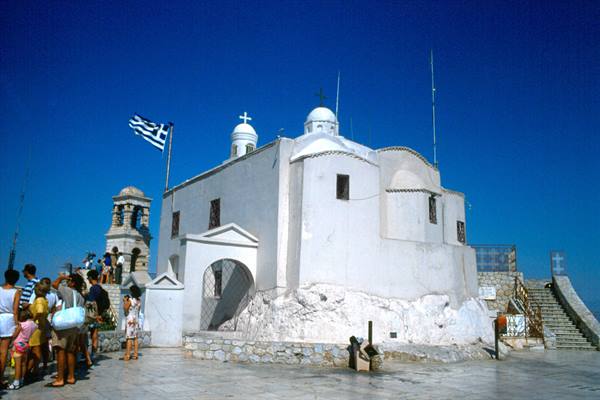
In the early afternoon, thanks to a funicular, we go up to Lycabettus, the highest hill in the capital, with its 277 meters, where the very white chapel of Agios Geórgios is also located and from where one enjoys the widest panorama over the city, with the view ranging over the incredible ocean of houses and buildings, but also over the U-shaped Stadium in which Baron De Coubertin had the first Olympics of the modern era held, in 1896. We conclude the day with a refreshing swim in the surprisingly transparent waters of the city beach, which among other things is half-deserted and therefore also incredibly relaxing.
Athens - Olympieion
Day 531 Jul 1990
In order to avoid as much as possible the heat of the blazing sun in the very early hours of the day we dedicate ourselves to the visit of the mythical Acropolis of Athens... This hill, 156 meters high, is a natural fortress whose flat-topped summit is precipitous on every side except for a short stretch, through which one can access the place where the ancient Greeks erected the most extraordinary monument to their civilization (the first human settlements on this site date back as far as 2800-2500 BC). Having passed the entrance we enter the so-called Propylaea, the monumental access route to the Acropolis, with its parade of Doric columns... then the grandiose overview of the Parthenon colonnade opens up before our eyes, unfortunately in partial restoration.
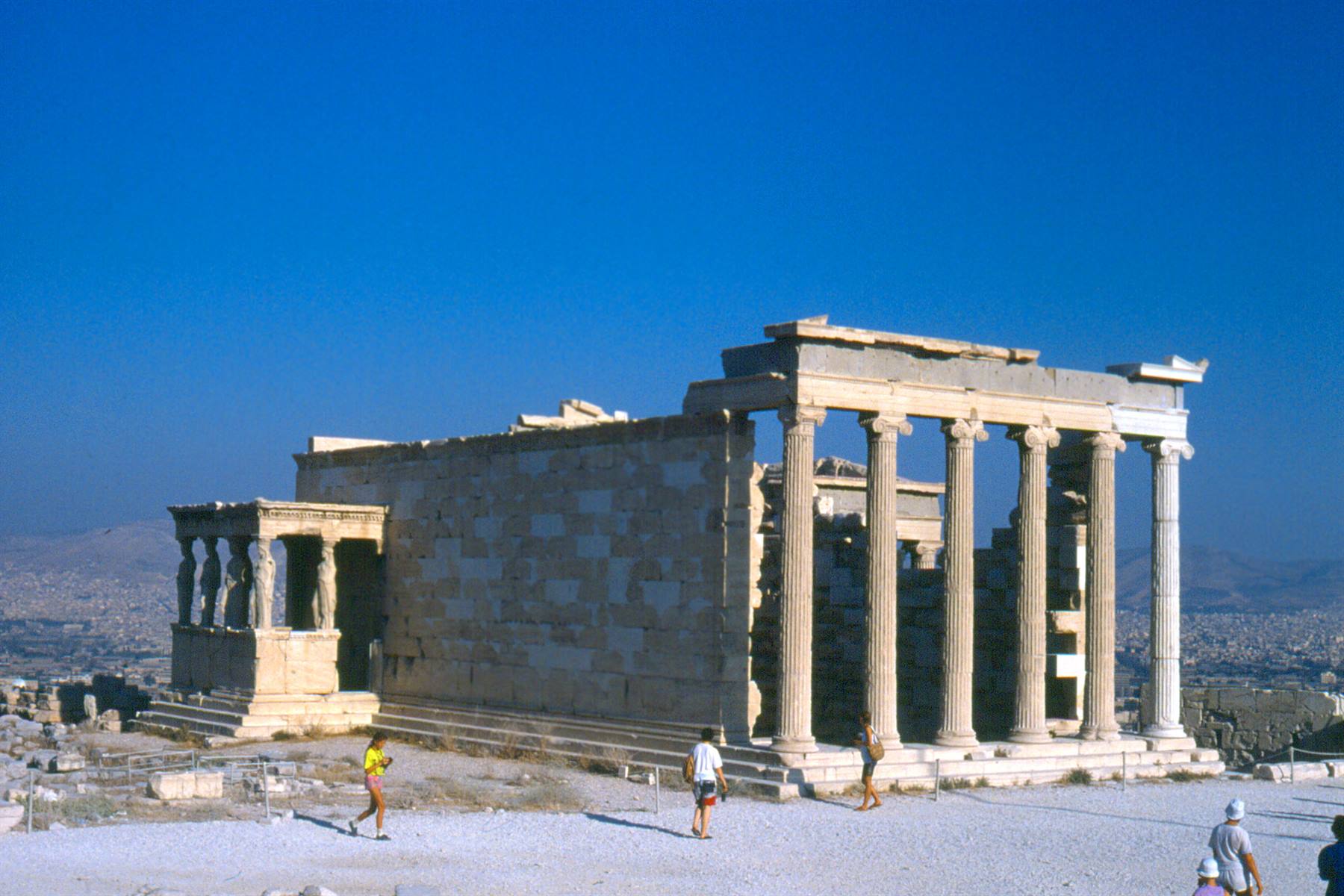
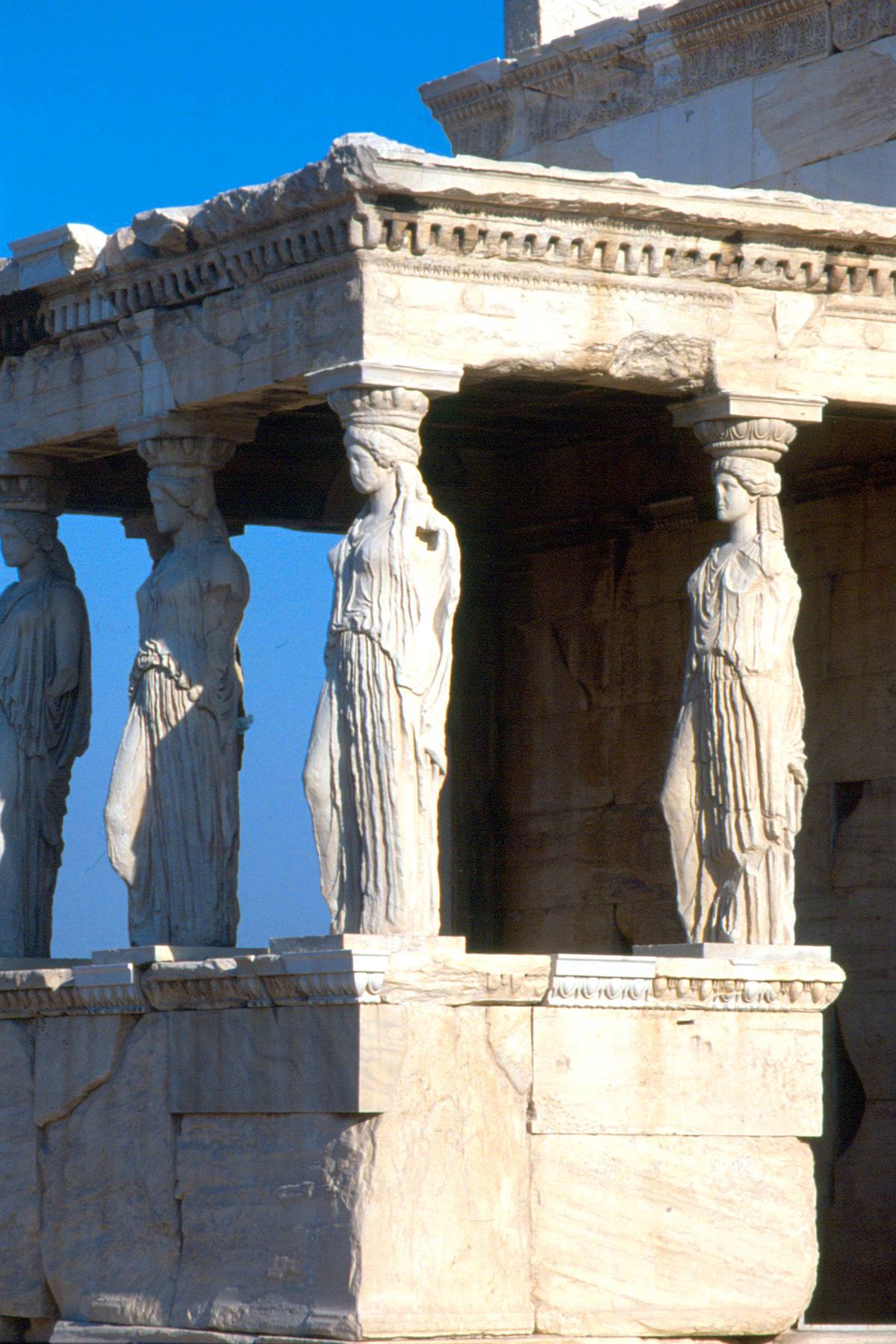
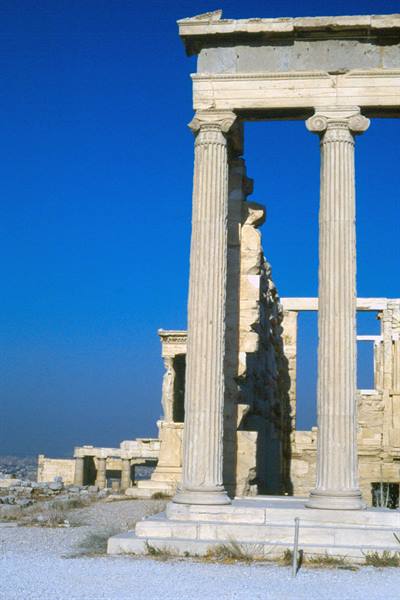
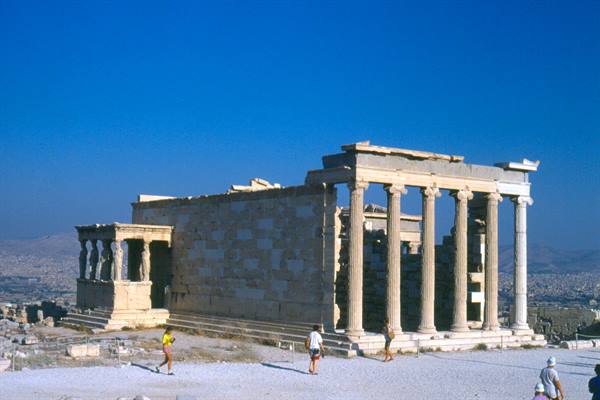
The greatest masterpiece of Greek art was erected between 447 and 432 BC and, in architectural terms, is an octastyle amphiprostyle Doric peripteros, that is a temple with eight columns on the fronts and seventeen on the sides, still in excellent condition and pulsating with magical vitality. Beside the Parthenon is the Erechtheion: among the noblest masterpieces of the Ionic style, completed in 406 BC on a design by the architect Filókles and universally known for its Portico of the Korai.
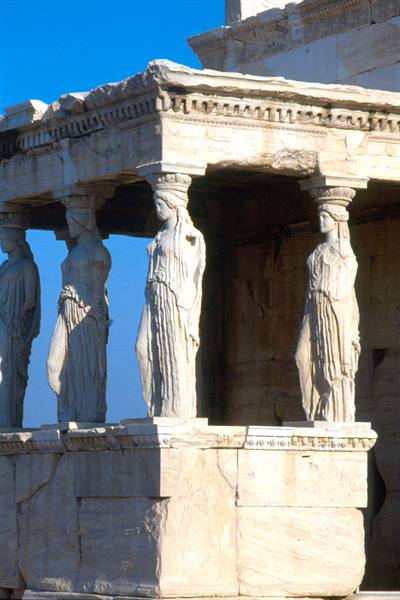
One of the most famous monuments in the world is a small loggia 2.60 meters high supported not by columns but by six stunning statues of sacred female figures, the so-called Caryatids (or Korai): the second from the left is a copy of the one kept in the British Museum in London, the others, also copies, are instead in the nearby Acropolis Museum, in order to preserve them from corrosion and atmospheric pollution. Having explored palm by palm the entire hill of the Acropolis we then descend to its feet, where there is a vast archaeological area that corresponds to the Agora, that is the ancient square of Athens, center of public and administrative life.
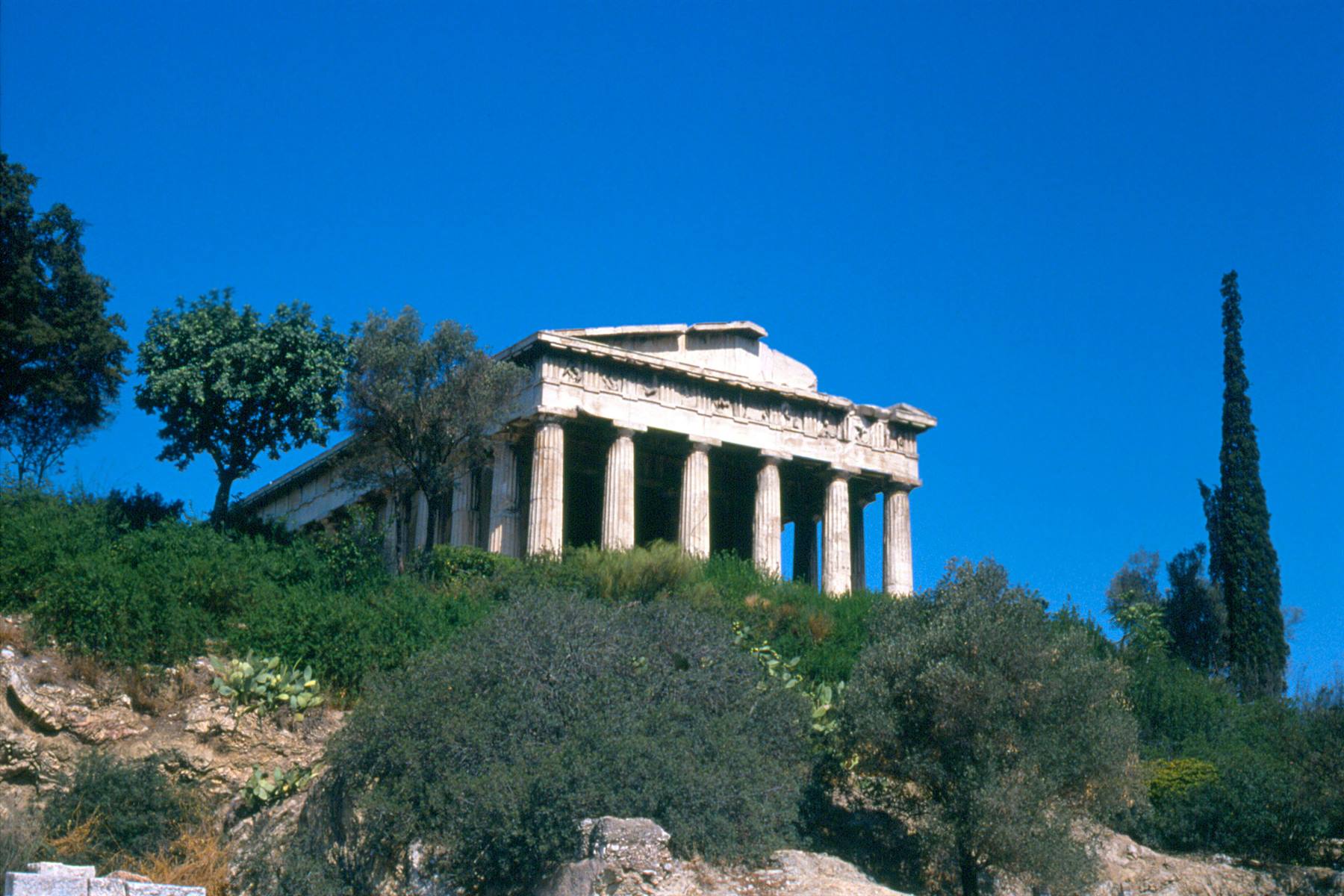
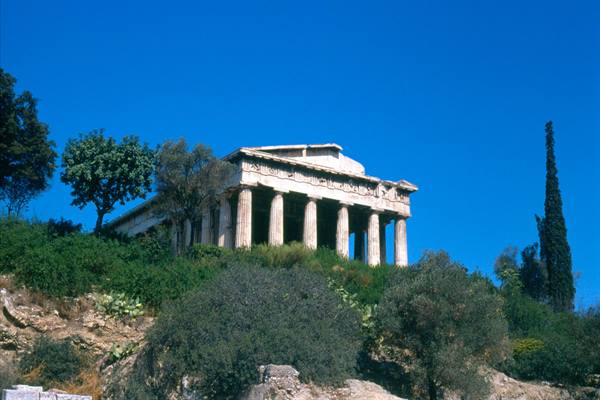
At the entrance we first of all notice the intrusive, characteristic Byzantine church of the Agii Apostoli, dating back to the 11th century, then, surrounded by significant but bare ruins we reach the Stoa of Attalos: a large portico, over one hundred meters long, faithfully reconstructed by the American archaeological school in the fifties, containing much of the material found in the excavations of the Agora. The most important monument of this site is, however, without a shadow of a doubt, the so-called Theseion Efaistiéion, which we reach with a short walk and which can be considered, to all effects, the best-preserved temple in the entire Greek world.
The construction, raised in the time of Pericles, between 449 and 425 BC, is a hexastyle peripteral Doric temple, with six columns on the fronts and thirteen on the sides, all original and perfectly intact, proudly displayed on a small hill dominating the archaeological area. In the evening, after yet another fill of culture, we conclude the very intense day with the exploration of the Plaka district, the oldest in the capital: a maze of narrow streets scattered with characteristic tavernas, typical night spots and picturesque shops overflowing with handicrafts... then tired we lie down, once again, in the presence of the exceptional view of the Acropolis, illuminated and rich in millennial charm.
Athens - Olympieion
Day 61 Aug 1990
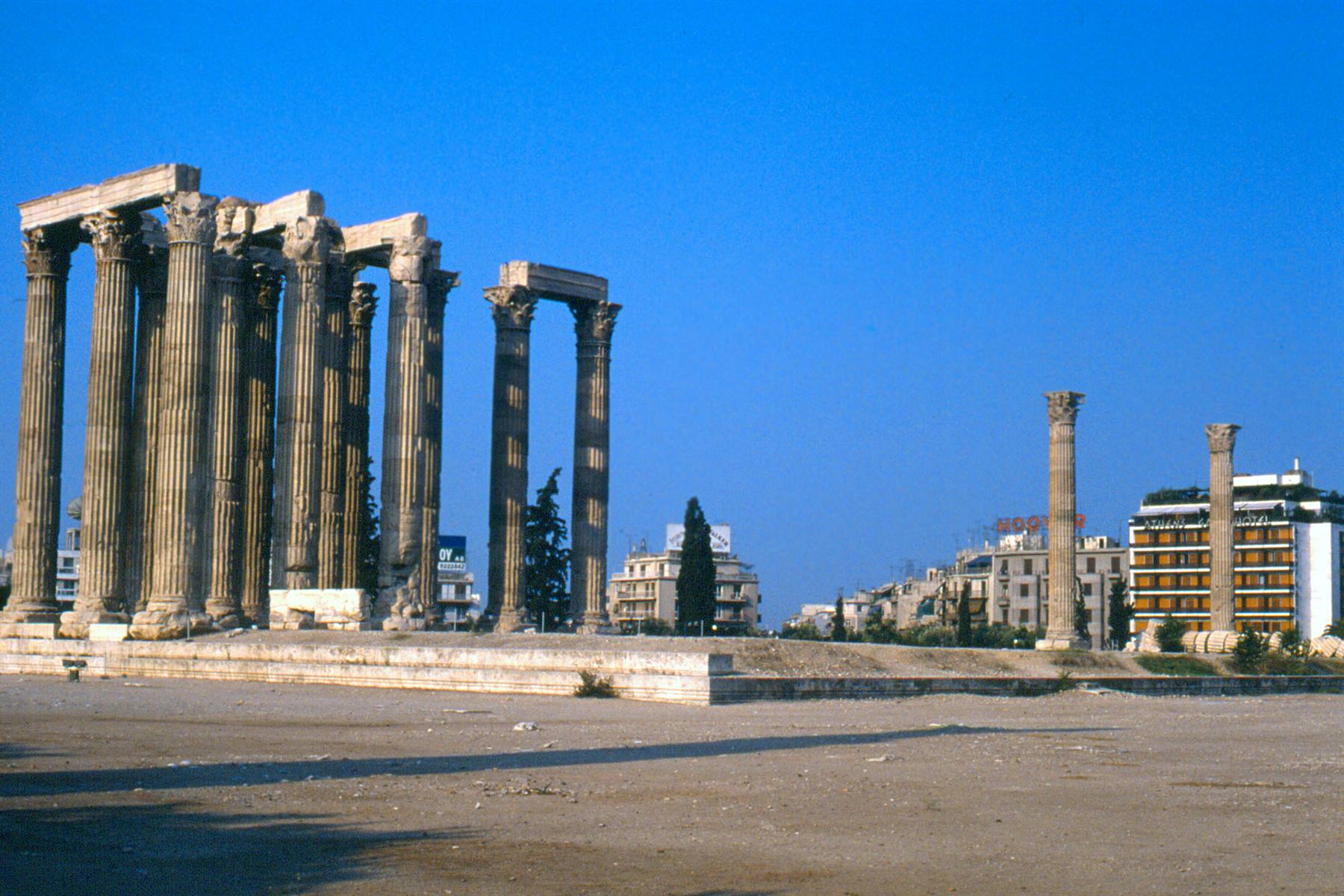
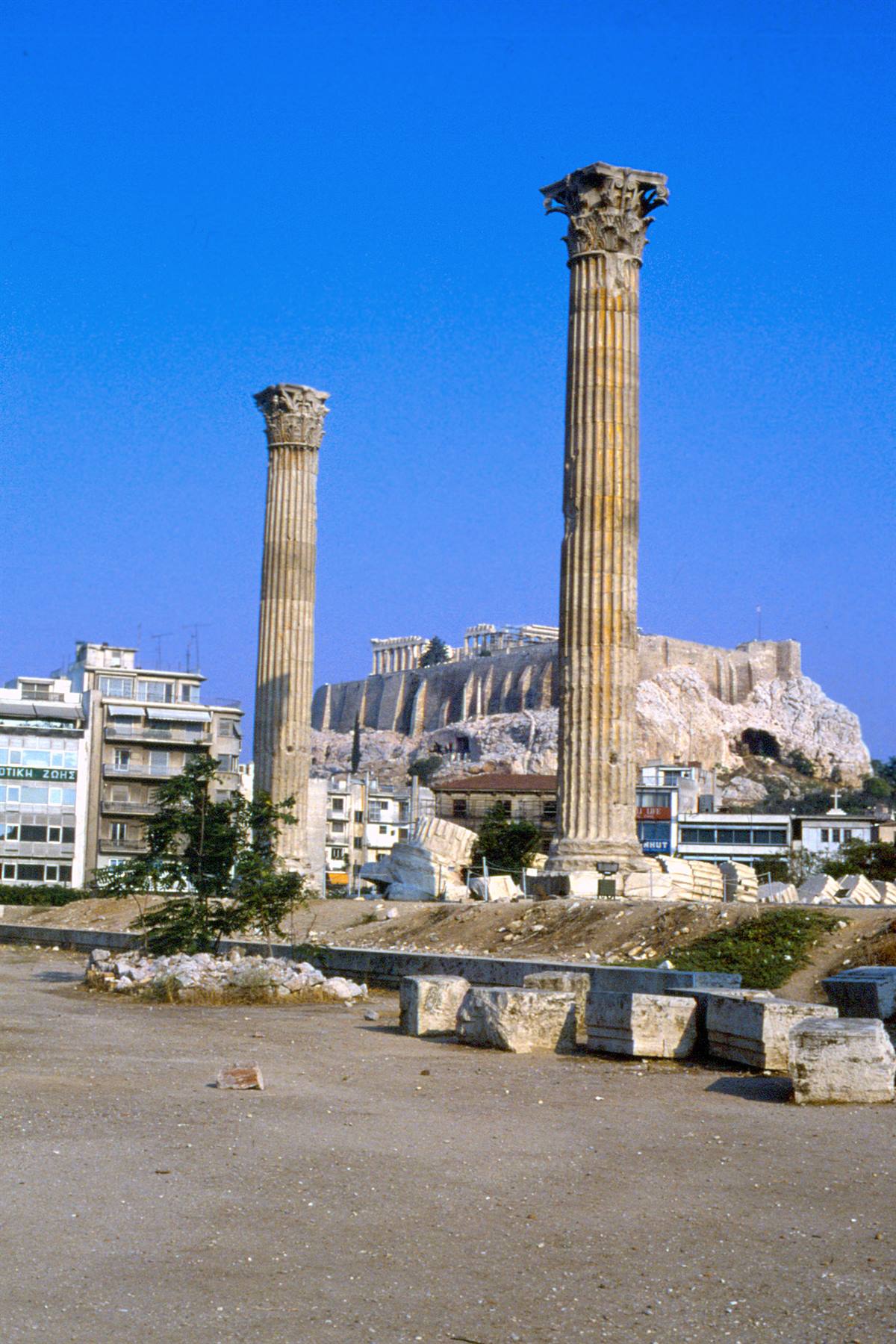
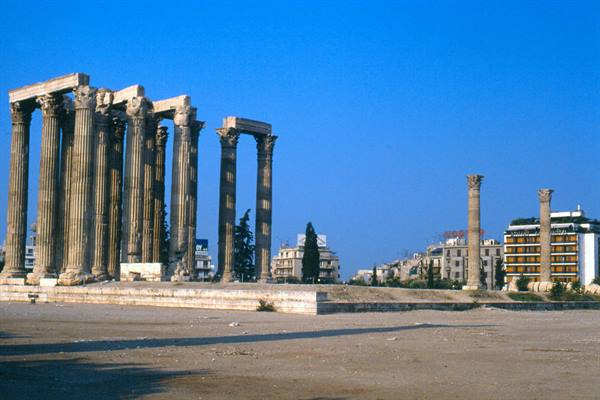
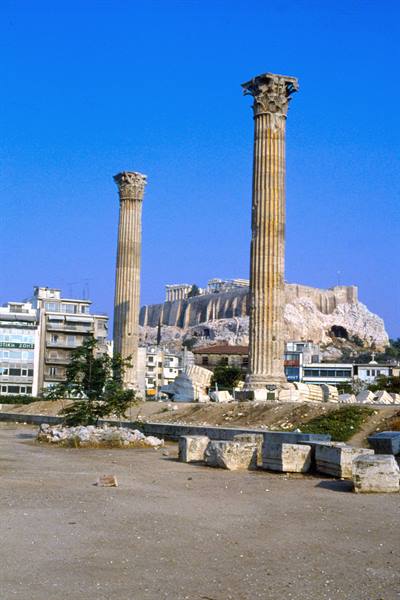
After a considerable tour de force: from the very long road to reach Athens, to the early rises to visit its most famous monuments, today we get out of bed with a little more calm, even if the day is destined to begin with the visit to another archaeological site. Our first goal this morning is, in fact, the temple of the Olympieion, or what remains of it. The largest building of its kind, in Corinthian style, of antiquity (107 meters by 41) was begun in honor of Olympian Zeus in the 6th century BC and several times left in a state of abandonment in the following periods. It was once surrounded by 104 gigantic columns (17.25 meters high) of Pentelic marble, but today only 13 remain with architraves at the south-east corner and two isolated at the south-west corner, plus one on the ground with disordered drums...
All this presents itself against the backdrop of a wonderful view of the Acropolis. The suggestive ruins of the Olympieion are in practice, for us, the last visit to the mythical Greek capital, after which we dedicate ourselves to the most complete seaside relaxation on its city beach... then, in the evening, we amuse ourselves through the streets of the Plaka, also tasting ouzo: a typical Greek liqueur based on anise.
Creta - Vai
Day 72 Aug 1990
The visit to Athens took up much less time than planned... so today we first take a walk in the sunlight through the Plaka, then go to the beach and in the afternoon we present ourselves at the port of Piraeus (the maritime port of the capital), from which in the evening, at 18:30, we will board a ferry of the Minoan Lines company, for the island of Crete.
Creta - Matala
Day 83 Aug 1990
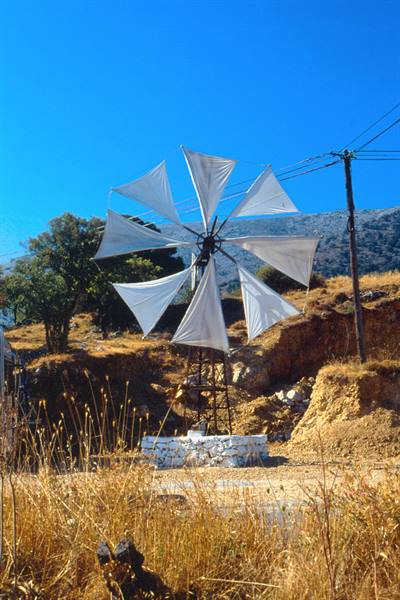
We ply the placid waves of the Aegean Sea throughout the night and after eleven and a half hours of navigation, in the early morning, we disembark in the port of the city of Iraklio. Crete, or Candia for the Venetians, who long dominated these lands, is the largest of the Greek islands and the fifth, by extension, in the Mediterranean: 257 kilometers in length by 61 in width and a surface area of 8305 square kilometers, on which today just over half a million people live permanently. We immediately venture along the northern coast and then deviate inland and climb through harsh scenery to the Lassithi Plateau: a fertile plain enclosed among high mountains, at over eight hundred meters of altitude, characterized by picturesque windmills, originally used to irrigate the fertile surrounding lands.
We thus arrive in the village of Psihró, from which with a short ascent, passable if desired even on donkey-back, we reach the Diktéo Andro: a steep cave adorned with some limestone formations, which we visit by candlelight, like pioneers of tourism, considered by the ancients the birthplace of Zeus... and excuse me if that's not enough! Leaving behind us the curious Lassithi Plateau we return to the sea near the locality of Aghios Nikolaus and from there we continue along the coast to the east of the island of Crete, we pass the town of Sitia and by evening we arrive near the famous beach of Vai, at the easternmost point of this land, where we spend the last hours of the day.
Crete - Phaistos
Day 94 Aug 1990
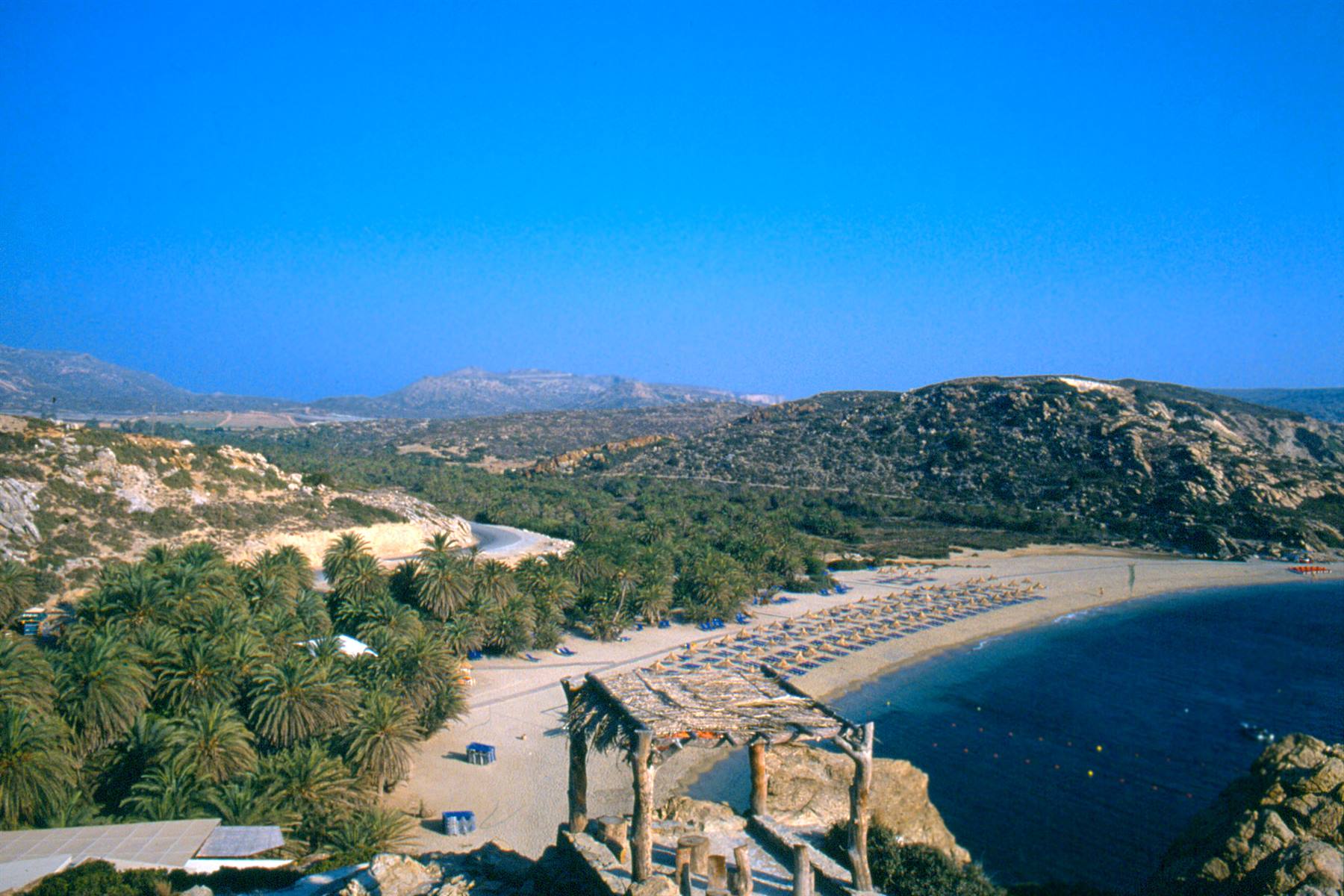
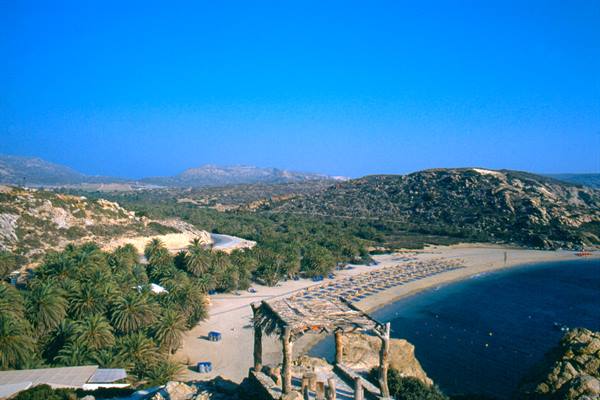
We dedicate the first hours of the morning to the beach of Vai, perhaps the only one in Europe to present a decidedly tropical appearance, thanks above all to the unusual forest of over five thousand palms that extends behind it. Legend has it that it was a band of pirates who transformed this place into an exotic palm grove, simply by spitting on the bare sand some date pits, fruit of providential snacks. The beach is a protected natural area and offers unforgettable views, but it is also a very crowded place and in view of the central hours of the day we prefer to move just a kilometer further north, near the tiny archaeological site of Itanos, where we find another inviting stretch of sand in which to relax.
In the late afternoon we take the road again and go south, we pass the town of Palekastro and arrive again at the sea, after an infinity of curves, in the remote bay of Kato Zakros... and in this locality, apparently at the edge of the known world, once the campers are settled for the night, we enjoy a fiery sunset.
Creta - Anogia
Day 105 Aug 1990
The inlet of Kato Zakros, however, offers us nothing more than the spectacle linked to the setting sun, so in the hours following the new dawn, we immediately get moving, also in consideration of today's stage, which involves a truly respectable mileage, along "Greek roads" strewn with pitfalls, but above all potholes, and with a very tortuous route. We retrace our steps to the village of Sitia and from there we take the ribbon of asphalt that leads in the direction of the southern coast of Crete. Having come in sight of the Libyan Sea, which bathes this side of the island, we follow the coastal road westward and, having passed the white city of Ierapetra, we stop for a refreshing swim in the crystalline waters of Nea Mirtos.
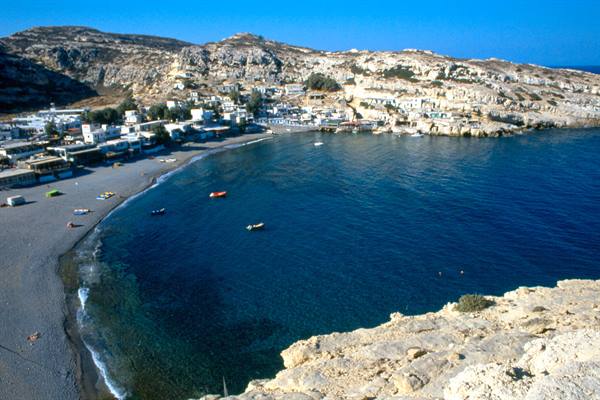
In the afternoon we venture a little inland, given the absence of a real coastal road in this area of the island, and following impervious routes, partly even unpaved, we cross characteristic villages, in which donkeys are still widely used as a means of locomotion, and by now in the evening we regain the sea, about halfway along the south coast of Crete, among high cliffs, in the scenic inlet of Matala, where we can enjoy another wonderful sunset, before the well-deserved rest.
Crete - Rethymno
Day 116 Aug 1990
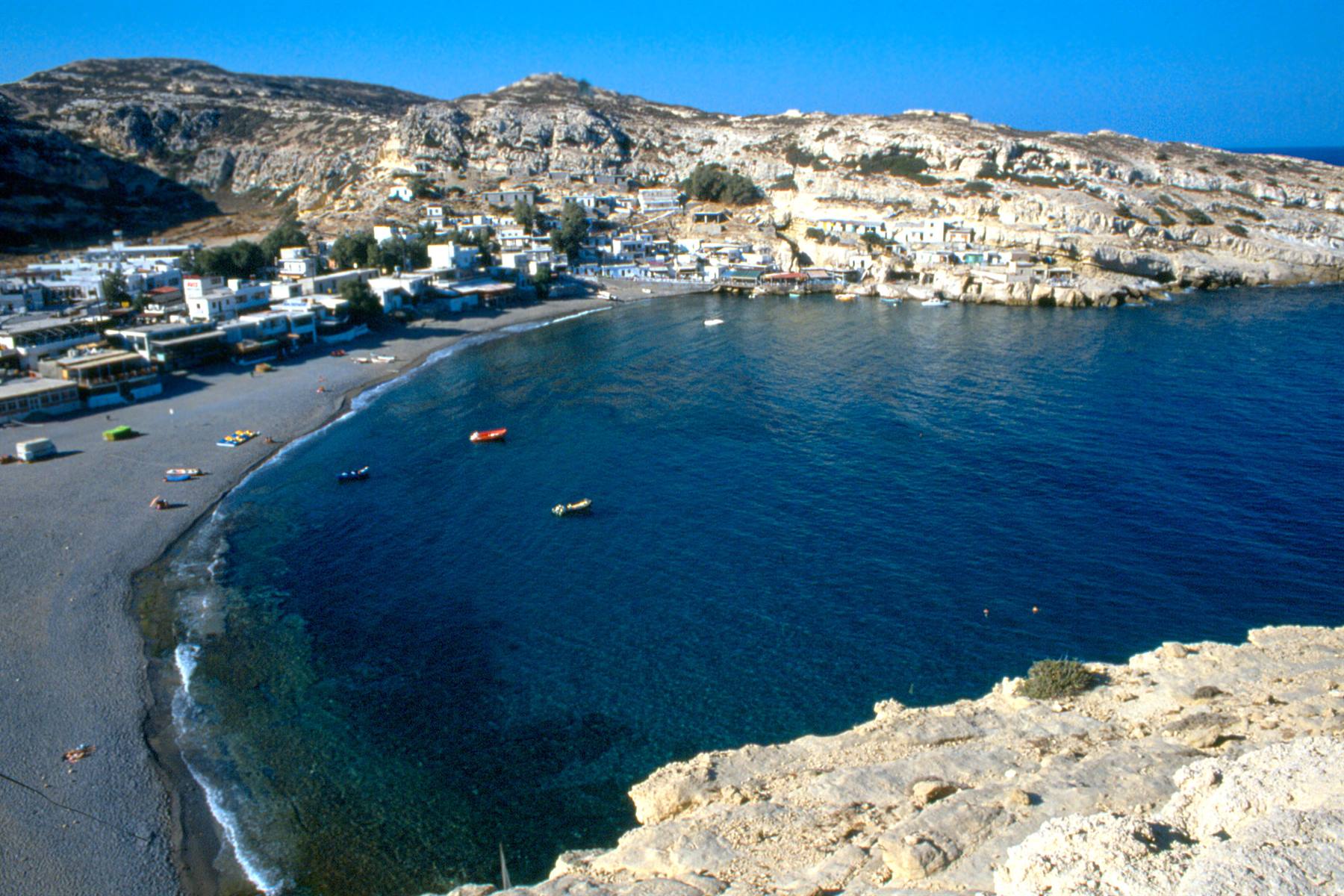
From the Minoan age to the Roman one the bay of Matala was used as a natural port, today instead it is a quiet fishing village set in a beautiful natural context... and right from there, on Monday 6 August, we begin another week in this extraordinary land. We are parked with the camper practically on the beach... a beautiful beach, which we enjoy in the first part of the day, not disdaining among other things the exploration of the high rocky wall that closes the bay to the north, scattered with crevices and numerous artificial caves used as troglodytic dwellings or as burial places in the Roman age. From the top of the cliffs we finally enjoy the beautiful panorama that rests on the entire inlet. A very few kilometers away from Matala, in the late morning we go to visit the archaeological excavations of Phaistos.
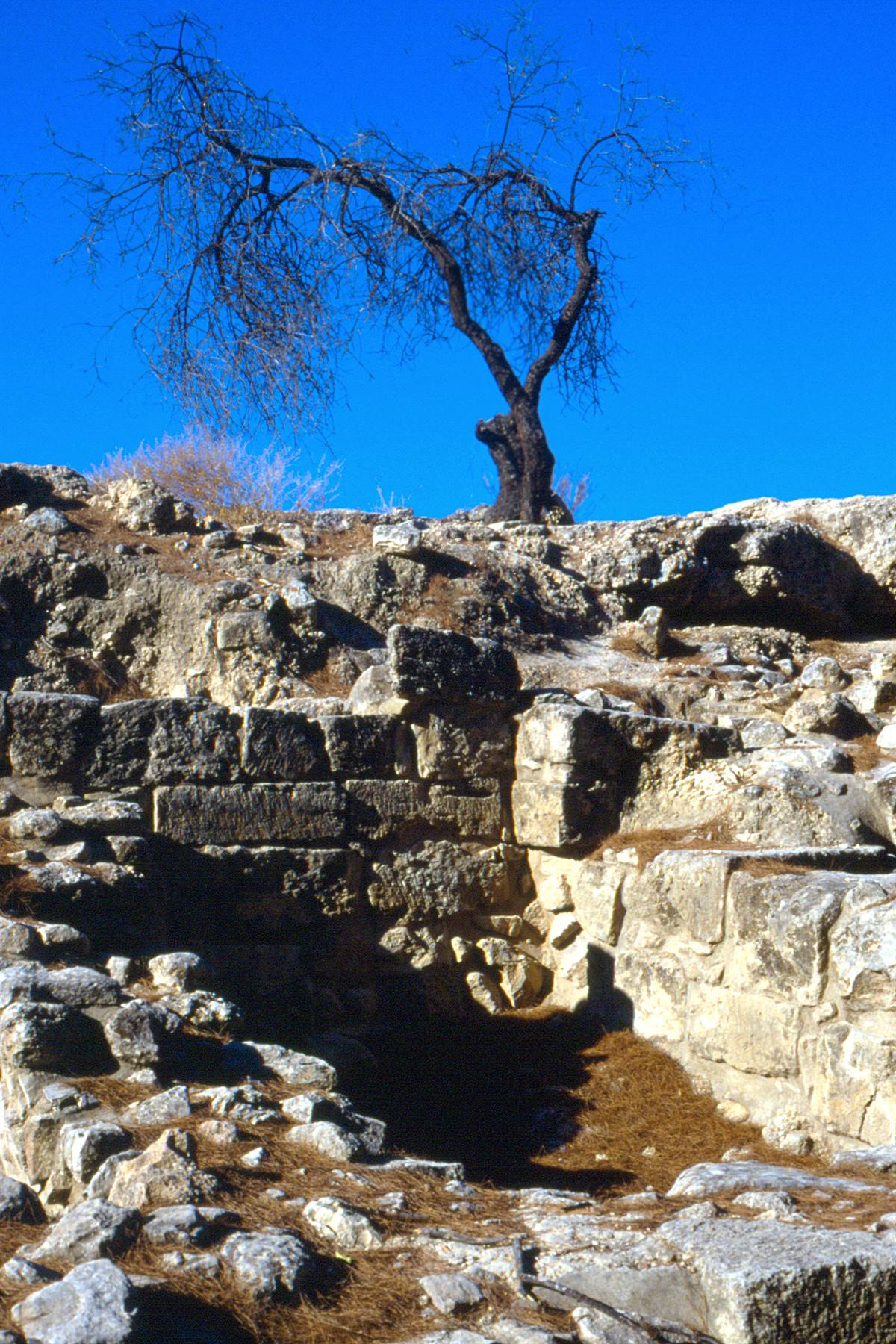
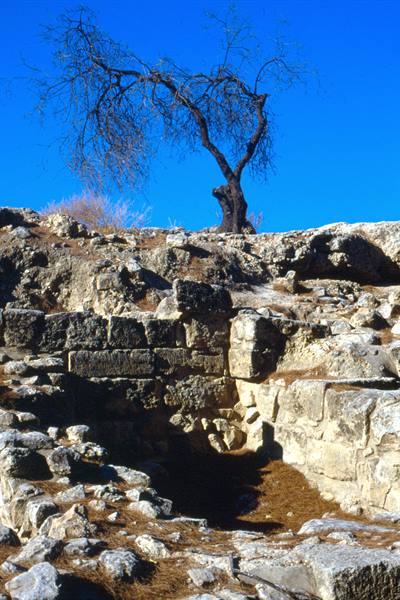
What is one of the most important centers of its kind on the island of Crete was inhabited from the Neolithic to the Byzantine era and manifested its period of maximum splendor in the Bronze Age, especially in the first half of the second millennium BC... today, however, not much remains: only the suggestive ruins of an immense palace to bear witness to the exceptional technical-organizational levels reached by the Minoan civilization. Having crossed the island again, this time from south to north, and having come in sight of Iraklio (where we disembarked three days ago) we return inland to gain the heights overlooking the Aegean coast, in which the town of Anogia is located...
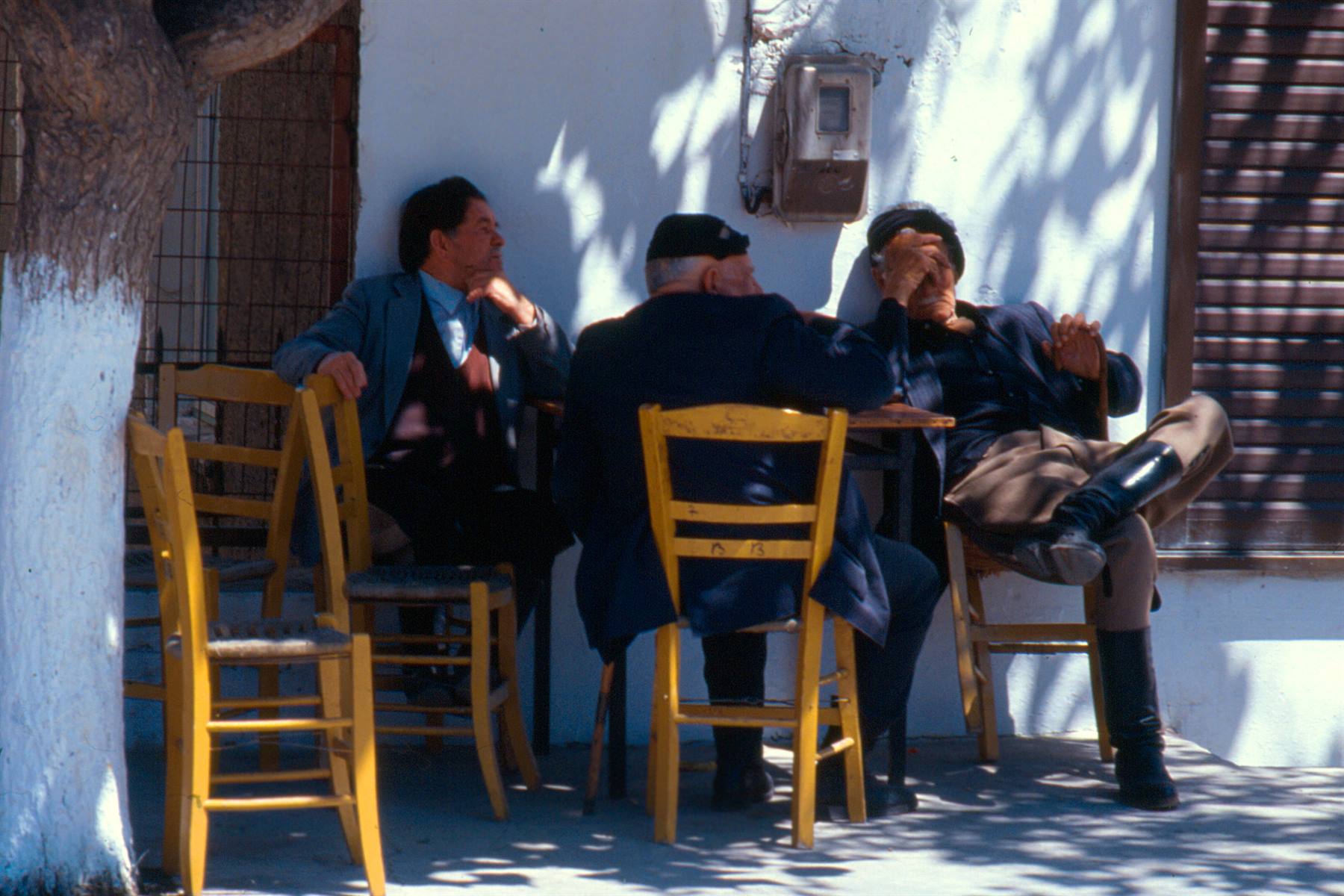
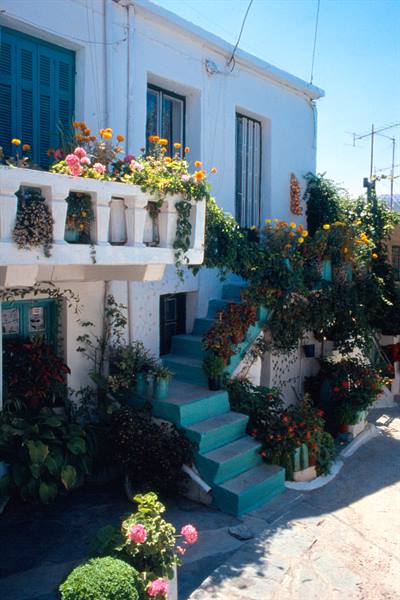
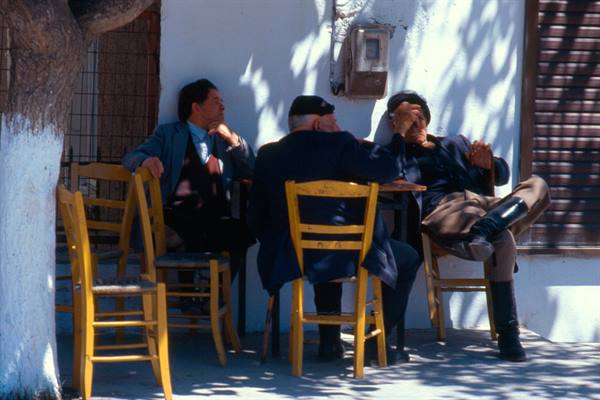
The settlement, located at about eight hundred meters of altitude, can perhaps be considered as the most characteristic of all Crete, rich as it is in narrow streets flanked by the classic whitewashed dwellings, with its inhabitants, who even today can be observed in traditional clothing, intent on carrying out ancient trades or simply idling in front of a typical taverna. From Anogia, now in the late afternoon, we descend again to the sea and in the locality of Bali, not exceptional from a seaside point of view, we spend the last hours of light and then the entire night.
Crete - Chania
Day 127 Aug 1990
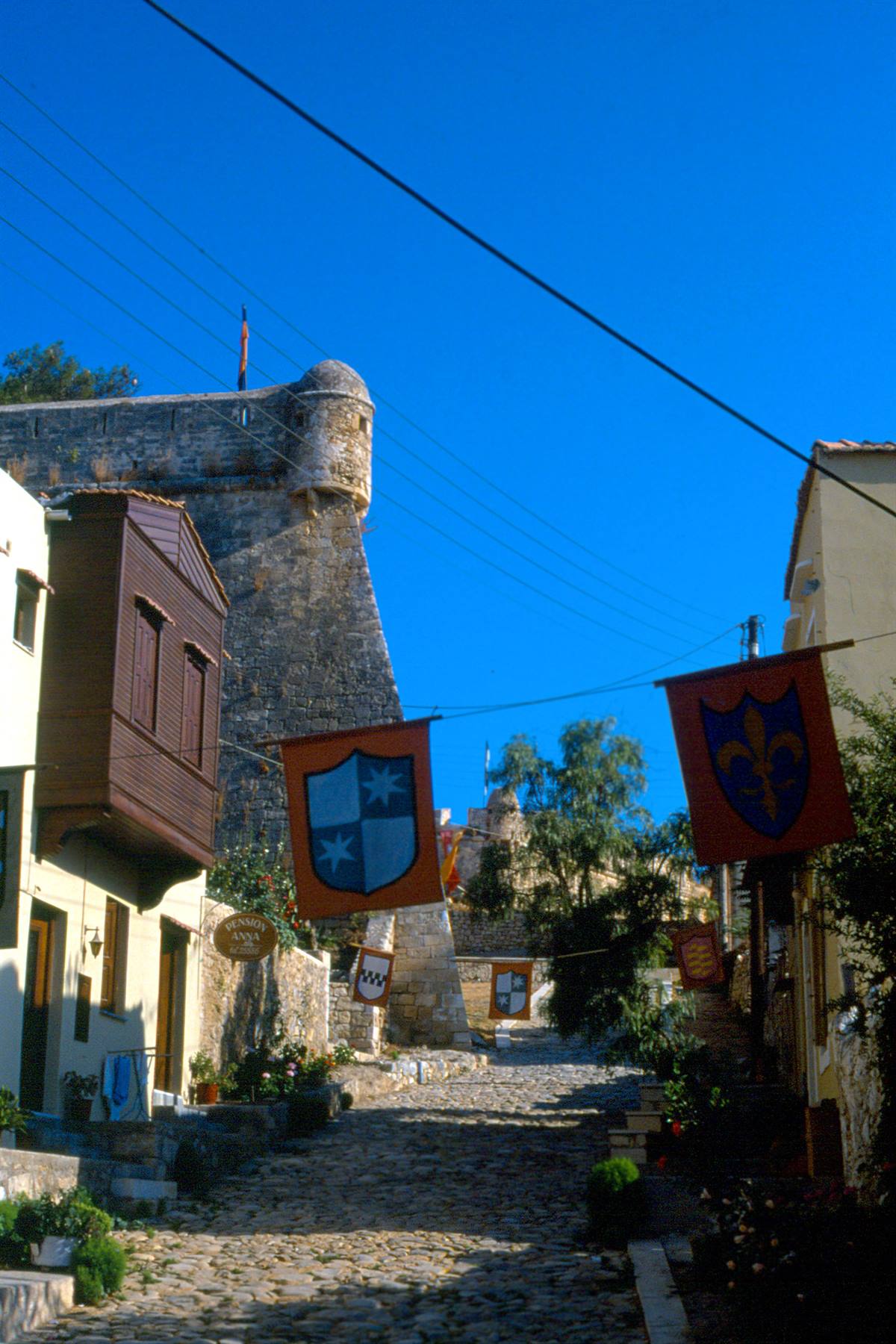
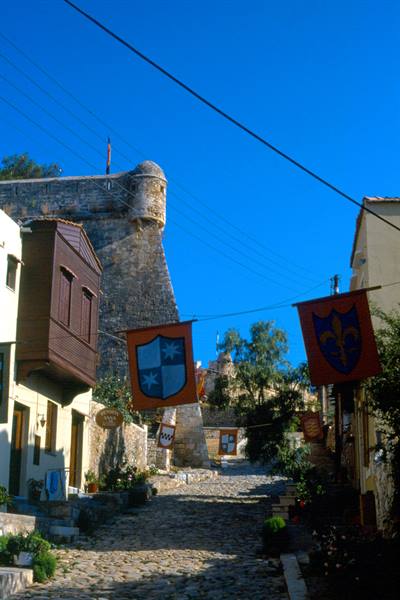
We leave behind us Bali (which has nothing to do with the famous Indonesian island, its namesake) and following the coastal road westward we arrive after a handful of kilometers in the town of Rethimno. The third urban agglomeration of the island was once a provincial capital, first under the Venetians, then under the Turks and of these two civilizations it still preserves various testimonies today... As soon as we enter the historic center, in fact, we cannot help but notice the tall minaret that stands beside the Venetian church of S. Maria, erected in 1890 during the rule of the crescent. Continuing in an intricate maze of narrow streets we reach the fortress that dominates the promontory to the north of the settlement, erected on behalf of the Serenissima, between 1573 and 1578, by the military engineer Sforza Pallavicini.
Having visited the mighty bastions, which enclose among other things the ruins of a church-mosque with an enormous dome, we take the road again and even before midday we approach the city of Hania, after Iraklio the most populous in Crete, but before entering the town we turn right, in the direction of the Akrotiri peninsula, to go and spend some time at the sea. Without having particular indications on the place we head along the gulf of Soudas and in doing so we pass a check-point, probably also entering a military zone... All this allows us to discover the beautiful bay of N. Souda, in which we spend a few unforgettable hours, enlivened by extraordinary transparent waters and by a fun canoe rented for the occasion.
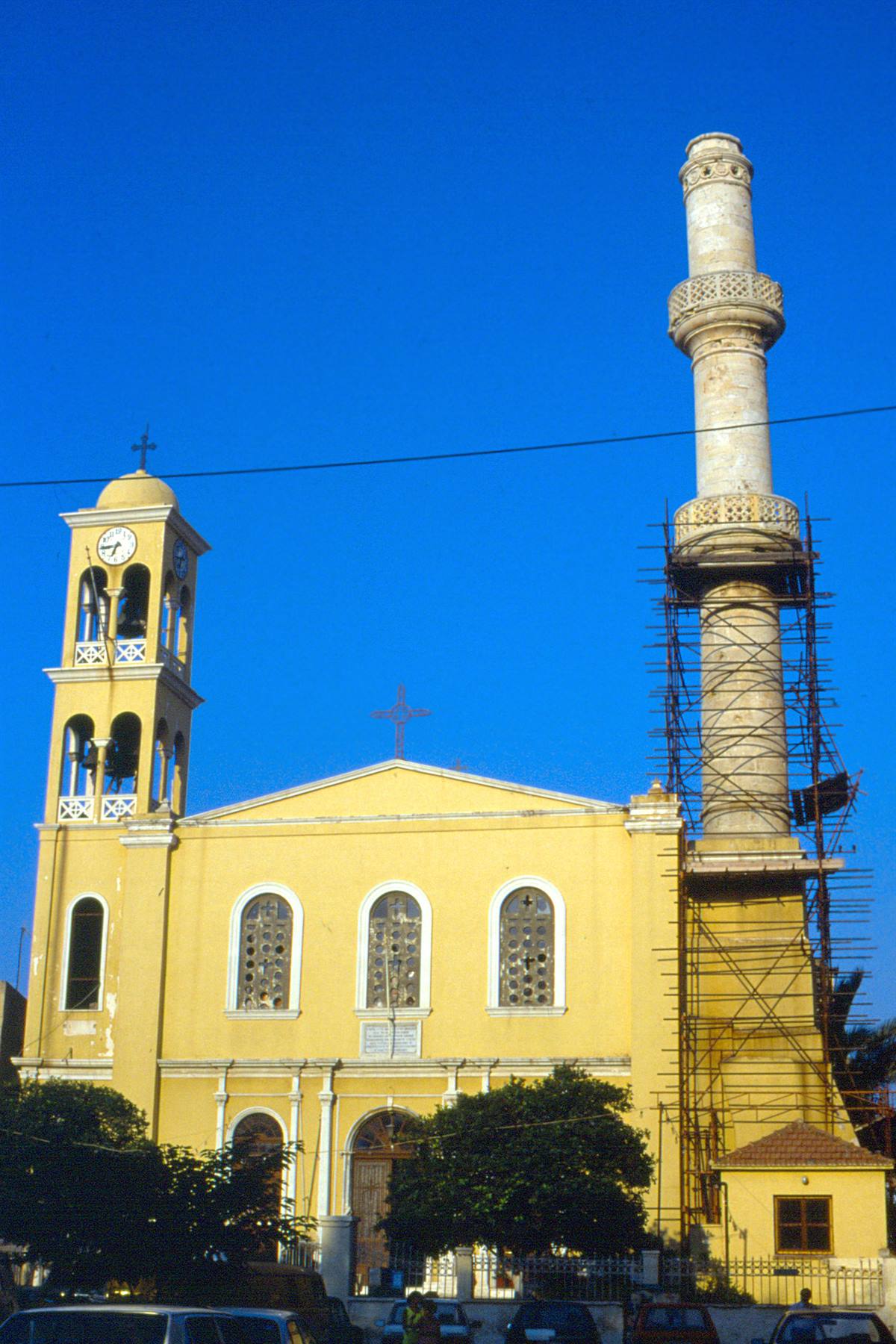
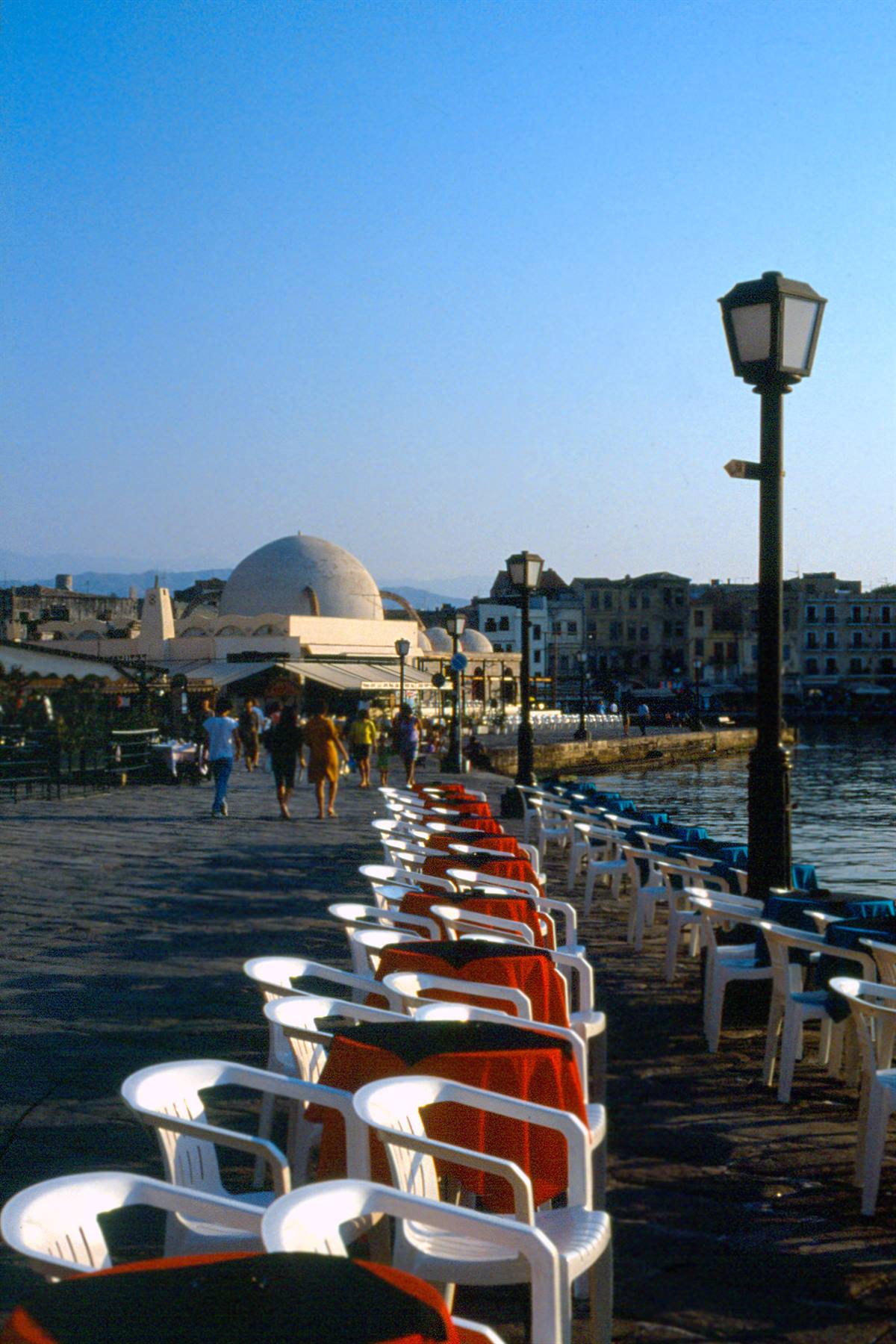
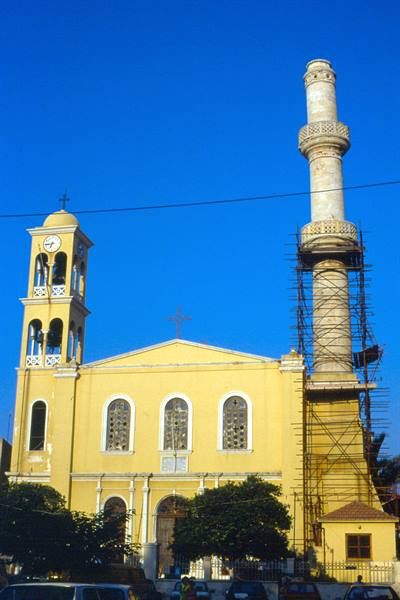
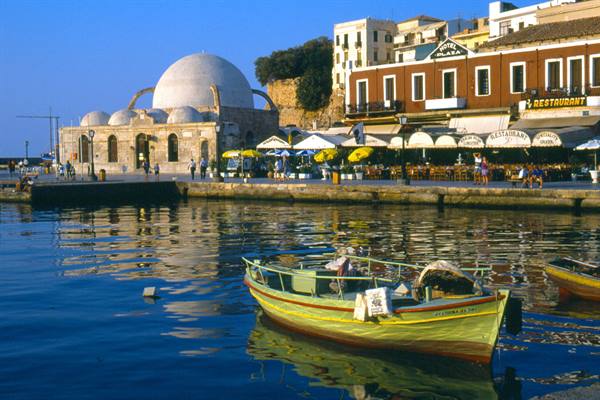
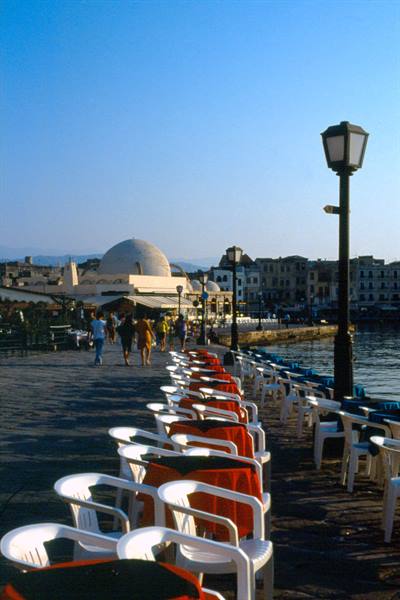
In the late afternoon we make our entrance into Hania (capital of the island when it was an independent state from 1898 to 1913, but also capital, until 1971), strongly marked by the Venetian dominion, which still characterizes its imprint, but in part also characterized by the Ottoman one... in fact its most significant monument is probably the curious church of Agios Nikolaos, perhaps the only one in Europe to possess, at the same time, a bell tower and a minaret! The most scenic part, however, is the area of the ancient Venetian port, where picturesque buildings face and characteristic narrow streets branch off, in which we wander carefree almost until sunset. Later we retire for the night in the immediate surroundings, not before, however, having gathered information and made the necessary reservations for the demanding day that will follow.
Crete - Chania
Day 138 Aug 1990
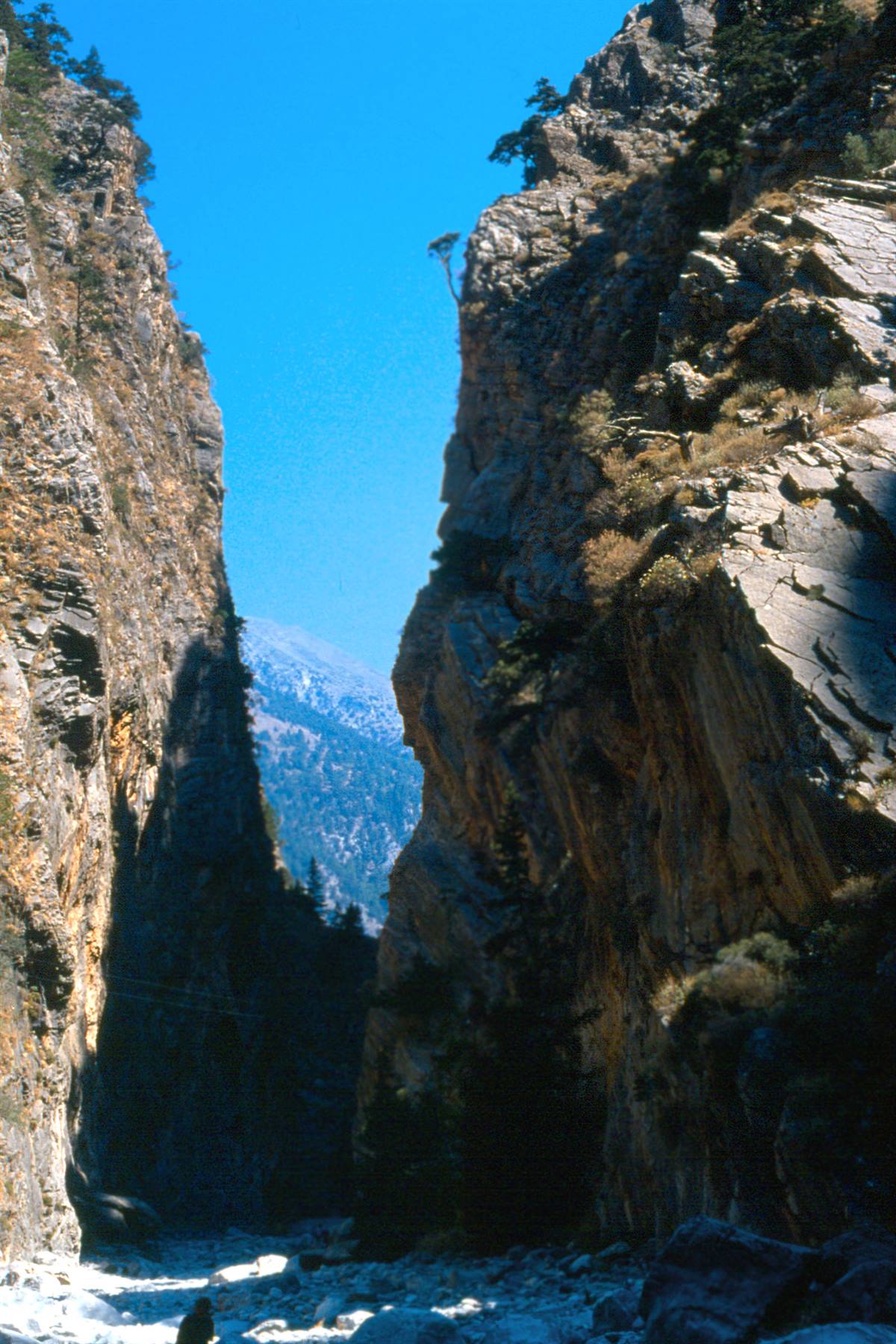
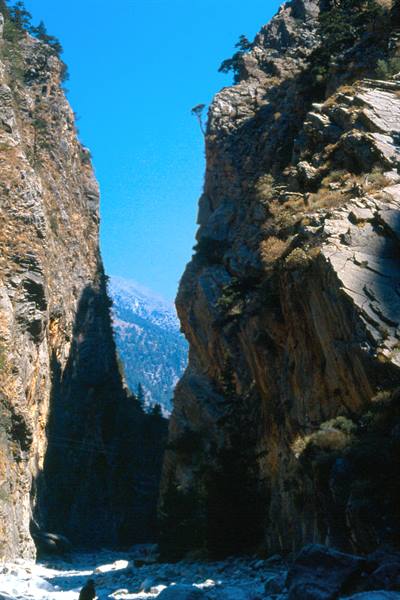
We get up very early, in total darkness, and shortly after 5:00 we set off from the bus station in Hania... The sun rises as our rumbling coach climbs, in the company of other hikers, toward the Lefka Ori mountains and the village of Omalos. After passing the latter we continue uphill to Xsilòskalo, where the road ends, at 1,227 meters above sea level... and from there we prepare to descend the Samaria Gorge, one of Crete's main natural attractions. An arrow marks the start of the 18-kilometer trail, which from here reaches the sea through a harsh and wild landscape, protected by Unesco as a World Heritage Site since 1962. We venture into a dizzying descent that, in practice, ends about a third of the way along, in the ghost village of Samaria, where a few donkeys await the laziest hikers and from where, in fact, the actual gorge begins.
We now walk along the bottom of a striking ravine, whose high rocky walls draw ever closer, until they reach a minimum distance of no more than four meters... then the stream bed (dry in this season) widens and flows placidly to the sea at the remote spot of Agia Roumeli, on the south coast of Crete. We are tired and treat ourselves to a refreshing and most welcome swim, then a boat takes us back to the 20th century at Hora Sfakion, a town where we once again find a strip of asphalt and a bus that, crossing back over the mountains, brings us triumphantly back into the city of Hania, where we spend another night of this beautiful Hellenic journey.
Crete - Samaria Gorge
Day 149 Aug 1990
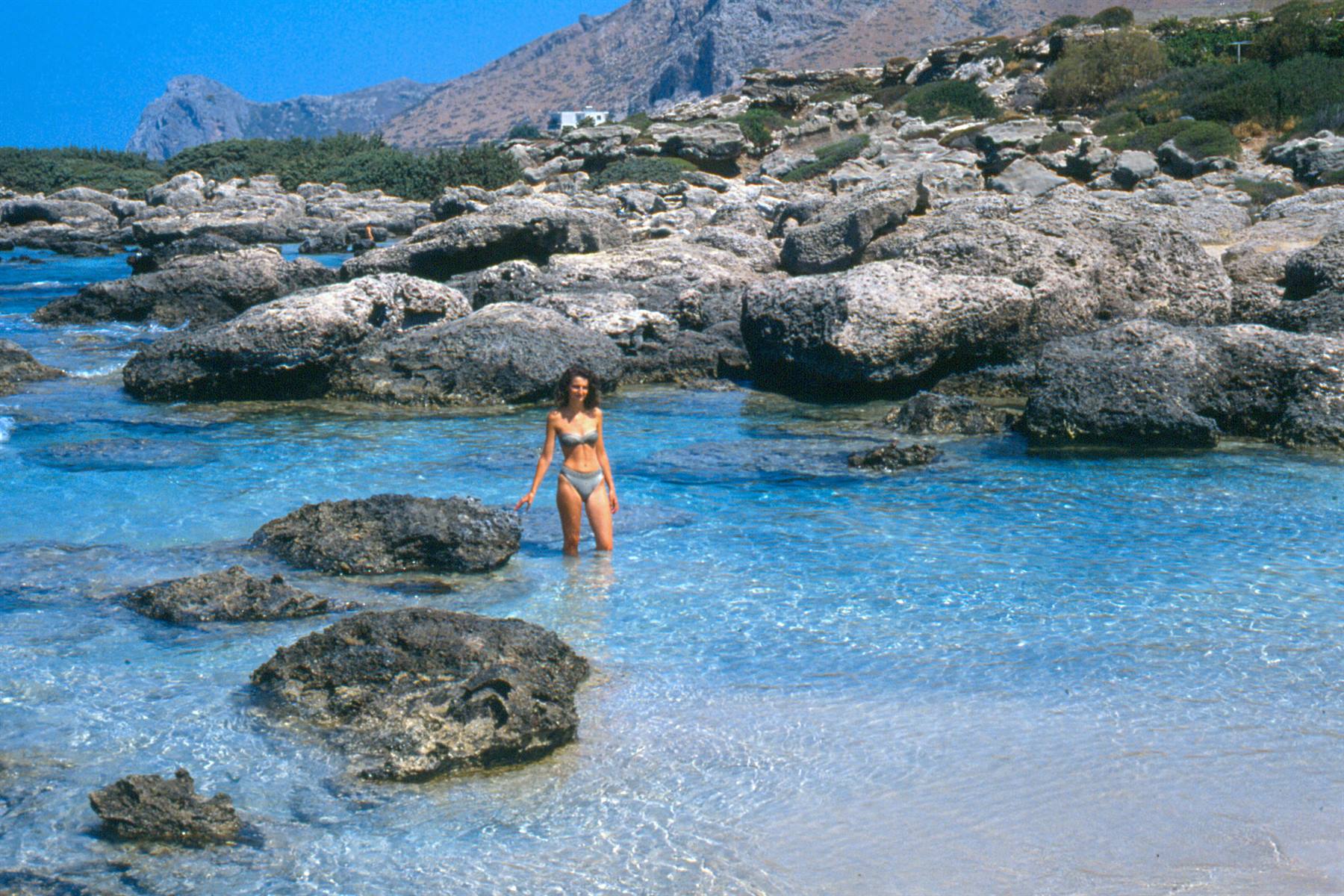
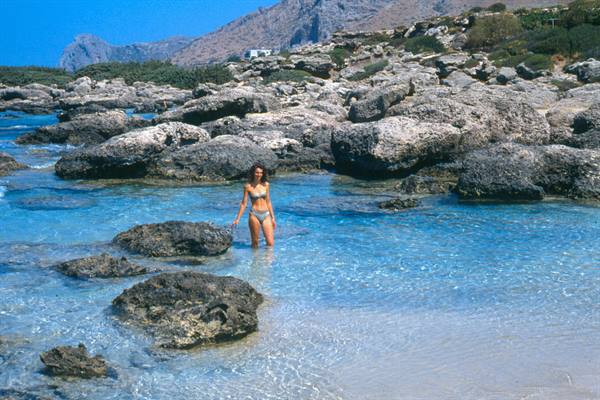
To recharge after the great effort devoted to the Samaria Gorge, today we move from Hania to almost the far northwestern tip of Crete, pass the village of Kasteli and descend to the sea, in Livadi Bay, at the tiny spot of Phalasarna... There we find a wide, half-deserted beach, battered by crashing waves, but also featuring small, calm coves, where we can spend some time in complete relaxation... the best one could ask for to find oneself again and regain the right enthusiasm. At Phalasarna the view toward the open sea faces west, so only after a beautiful sunset do we retreat inside our camper to await the new day.
Crete - Falasarna
Day 1510 Aug 1990
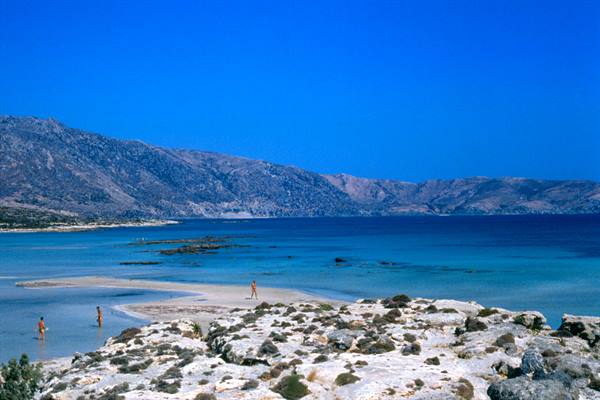
We venture toward the westernmost spur of Crete. The road unwinds south of Livadi Gulf, among rugged hills, then, after passing the small village of Vathi, it turns to dirt and, at times, terribly uneven... eighteen very long kilometers that produced countless curses, during which we asked ourselves more than once whether it was worth it, until we reached a remote place, far from any settlements and seemingly at the edge of the known world, identified on maps as Elafonisi, after the name of a tiny islet facing the coast. Having reached the long-awaited destination, we find several cars and a few campers parked on a stretch of driveable beach, so at first we are disappointed with the place, but later we have to change our minds.
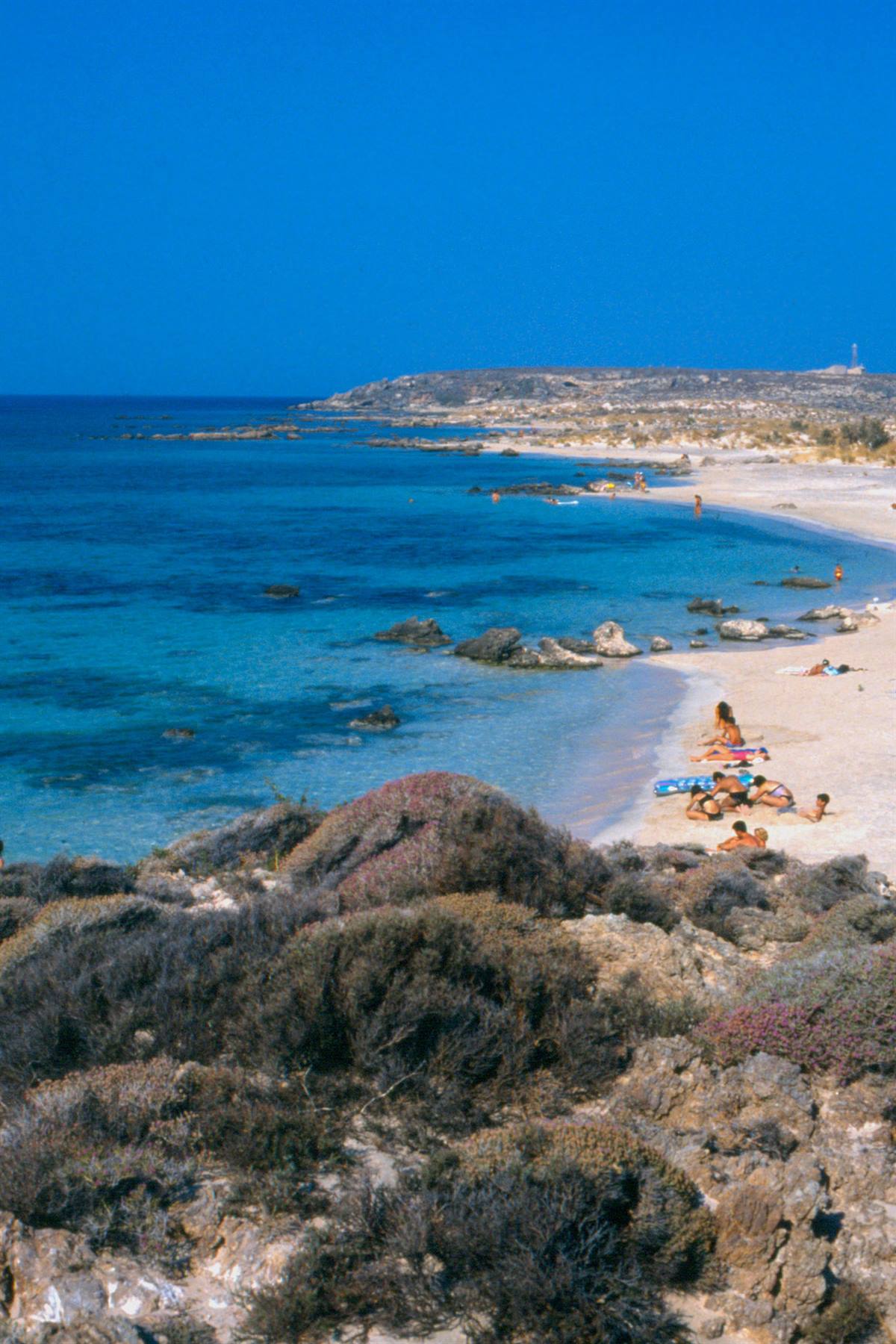
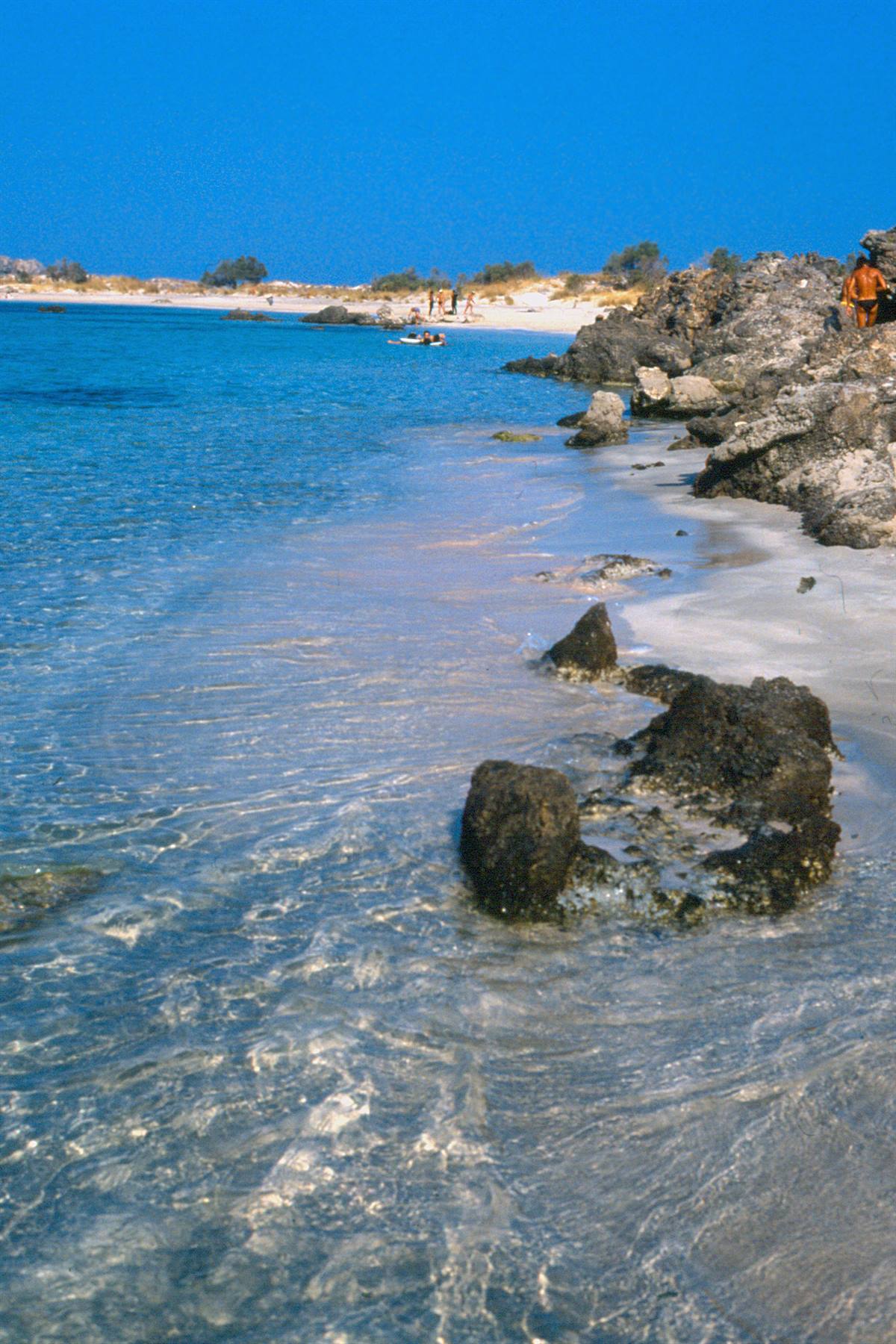
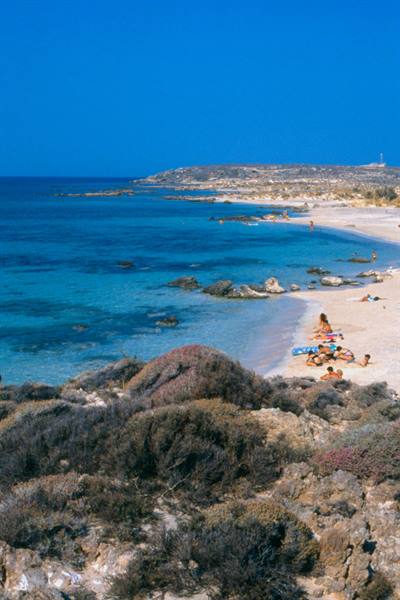
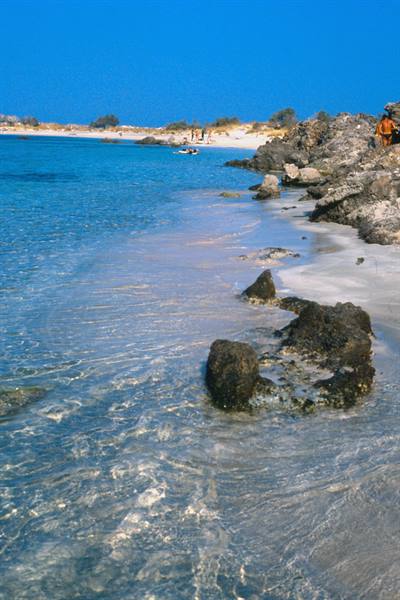
On foot we cross the shallow, narrow strip of sea that separates us from a flat and apparently insignificant strip of land, which instead turns out to be a true Mediterranean paradise... In a practically untouched environment there is a world made of dunes, rich in a flora all its own (with plenty of snow-white lilies) and full of a very special charm... but all this is only the backstage of what is, perhaps, one of the most beautiful beaches in Europe. The intense blue of the sea, the transparency of the water and the pink reflections of the sand make Elafonisi an extraordinarily beautiful place with a distinctly tropical feel, even though we have never been to the tropics...
At Elafonisi we naturally spend the whole day enjoying idyllic swims and with one fixed thought in mind: that the place may always remain as it is over time and that the devastation of a shameful tourist exploitation may never be carried out here... Night then falls and in an almost ancestral silence, after having eaten a little dinner based on very fresh fish in a small taverna (very home-style), we unconsciously realize that we have reached what will probably be the peak of the entire vacation.
Creta - Elafonisi
Day 1611 Aug 1990
Perhaps because of our innate passion for traveling, we do not like to spend more than a full day in the same place, but Elafonisi is so beautiful that, unanimously, we decide to make an exception... So today too we spend from the first to the last hour in what is, in every respect, a true seaside paradise!
Creta - Elafonisi
Day 1712 Aug 1990
Drunk on sun and splendid sea, in the morning we leave Elafonisi a little reluctantly and resume our itinerary... With those beautiful crystalline reflections still in our eyes, even the terrible eighteen kilometers of dirt road appear less uneven to us and without too much worry we regain the strip of asphalt. Because of Crete's rugged morphology and the lack of a coastal road along its southwestern profile, we are forced to return north to Hania and from there cross the island again to reach, now in the afternoon, the south, on the coastline facing the Libyan Sea, at the spot of Frangokastello.
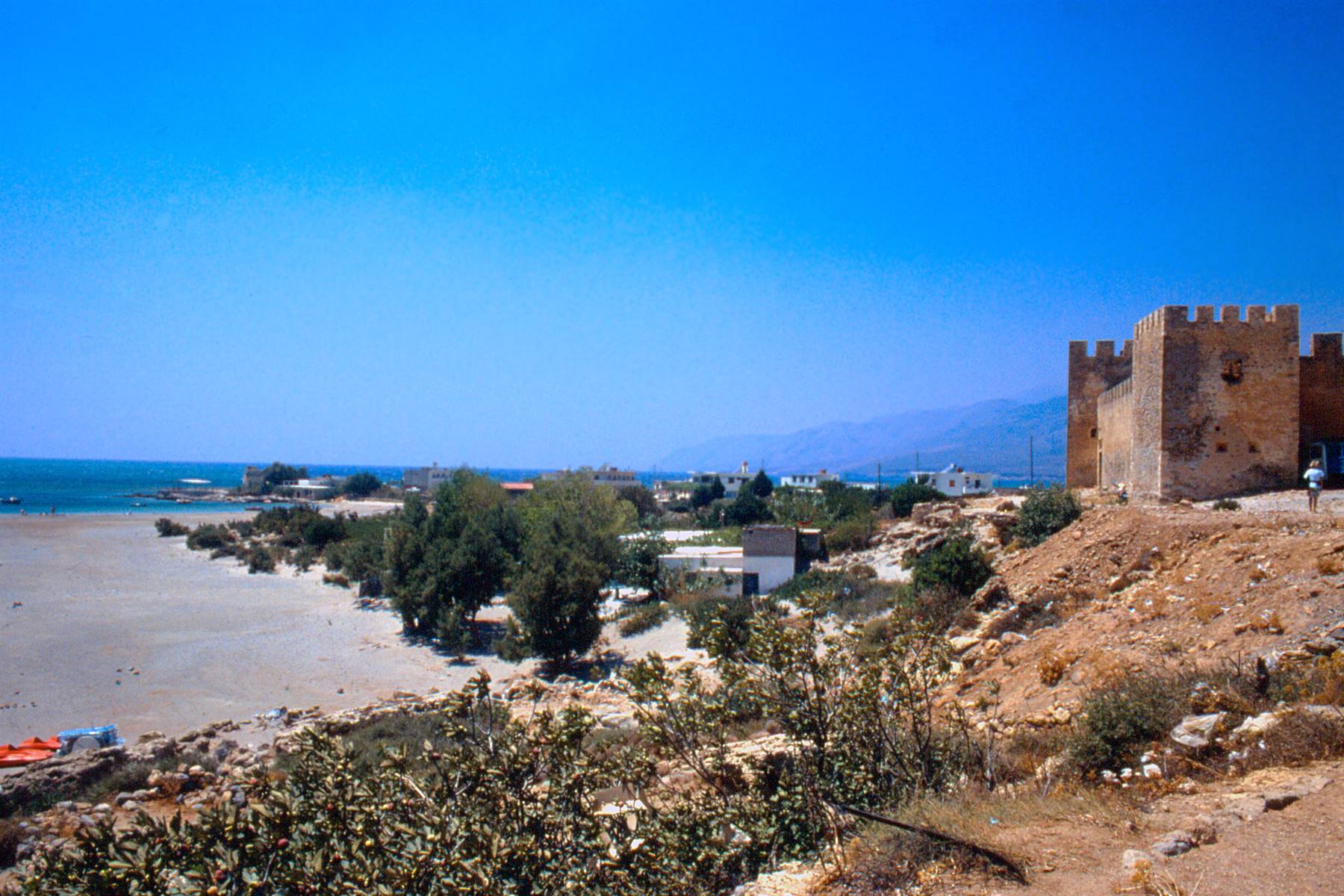
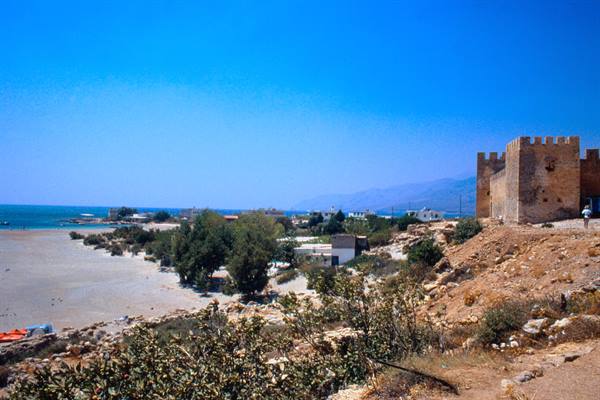
According to the guidebook, one of the most evocative places in Crete, Frangokastello is dominated by a stern 14th-century Venetian fortress that, still miraculously intact in its exterior appearance, with its crenellated towers, looks menacingly toward the sea as a bulwark against the siege of pirates (first) and the Ottomans (later). Beneath the castle walls there is also a beautiful beach, washed by blue and transparent waters, where we stop until evening... too bad only about the meltemi, an annoying wind that in this season often blows insistently from the sea.
Creta - Frangokastello
Day 1813 Aug 1990
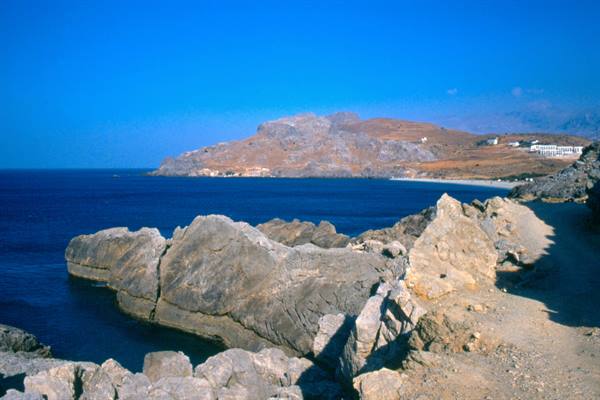
We move from Frangokastello, along the coast eastward, traveling at a safe distance from a particularly rugged shoreline, to then reach the sea, among intriguing cliffs, at the beautiful beach of Damioni. The sandy shore definitely deserves a stop and we spend practically the entire day there, even though the place is constantly battered by wind and the water, due to a spring or a particular current, is much colder than in other swimmable coves of Crete... Despite this, we enjoy, in complete relaxation, the appealing beach of Damioni, another pearl of this extraordinary Mediterranean island.
Crete - Crutalo
Day 1914 Aug 1990
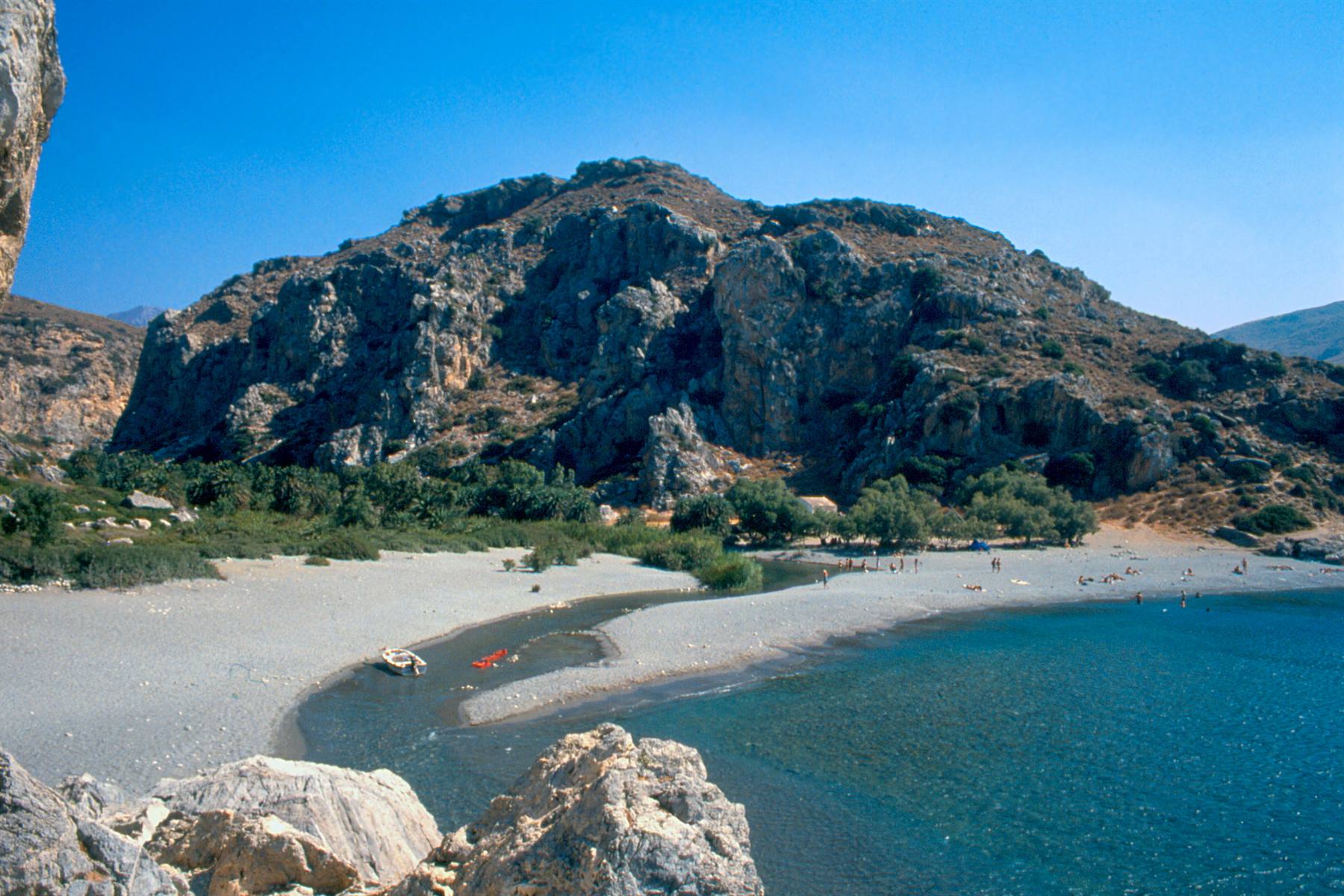
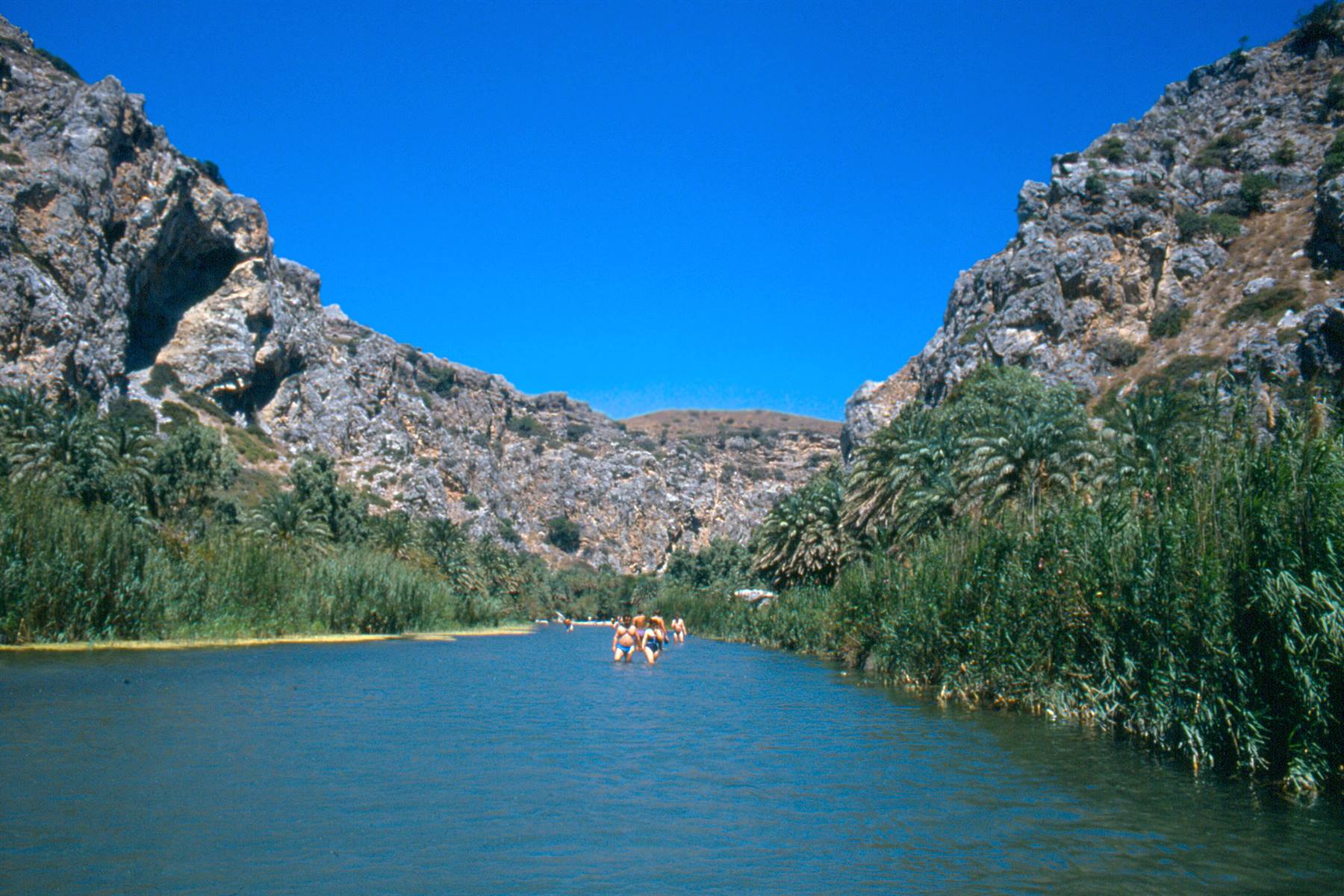
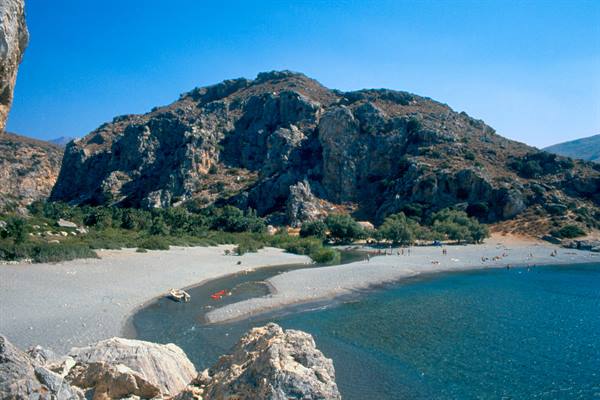
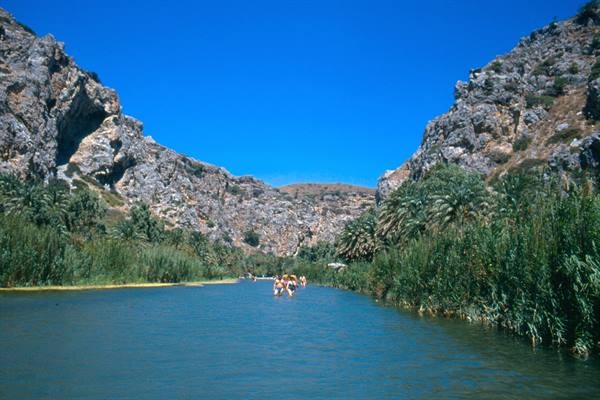
After spending the night at Damioni, in the morning we move again along the south coast of Crete, eastward, and once we reach the spot of Moni Preveli we start looking for the path that leads to the gorge and the spring of Crutalo, according to our information another natural wonder of the island. At first we go wrong, but then we take the right route which, seasoned with beautiful views, in about half an hour brings us to a beautiful beach of sand and pebbles formed at the mouth of a small river. Behind the beach a canyon opens up and we immediately venture into it... A true paradise if it were not for the lots of garbage left here and there by some thoughtless tourist.
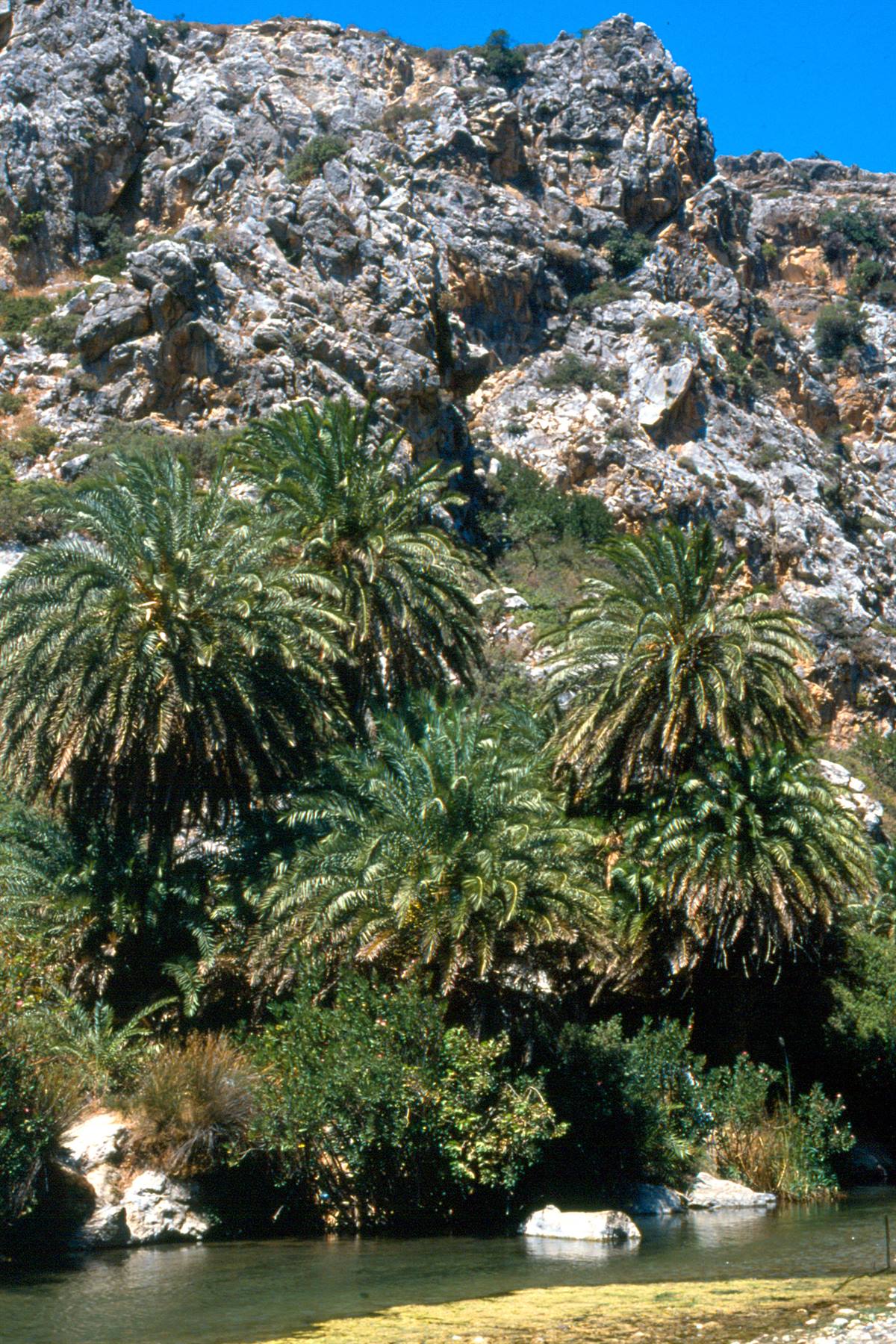
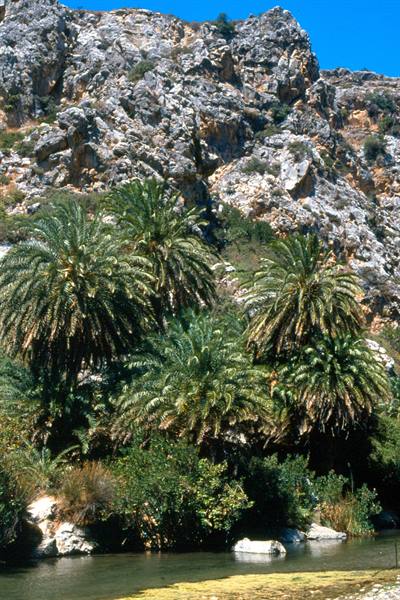
At first quite wide, the gorge welcomes the placid stream bed between two rows of palms and oleanders, then after a few hundred meters it narrows and becomes more rugged, with the water flowing among rounded rocks, forming everywhere small waterfalls and natural pools in which we briefly relax, letting ourselves be pampered, then we return to the seaside (where, among other things, a strange mushroom-shaped rock stands out) to spend the rest of the time available to us in peace.
Crete - Crutalo
Day 2015 Aug 1990
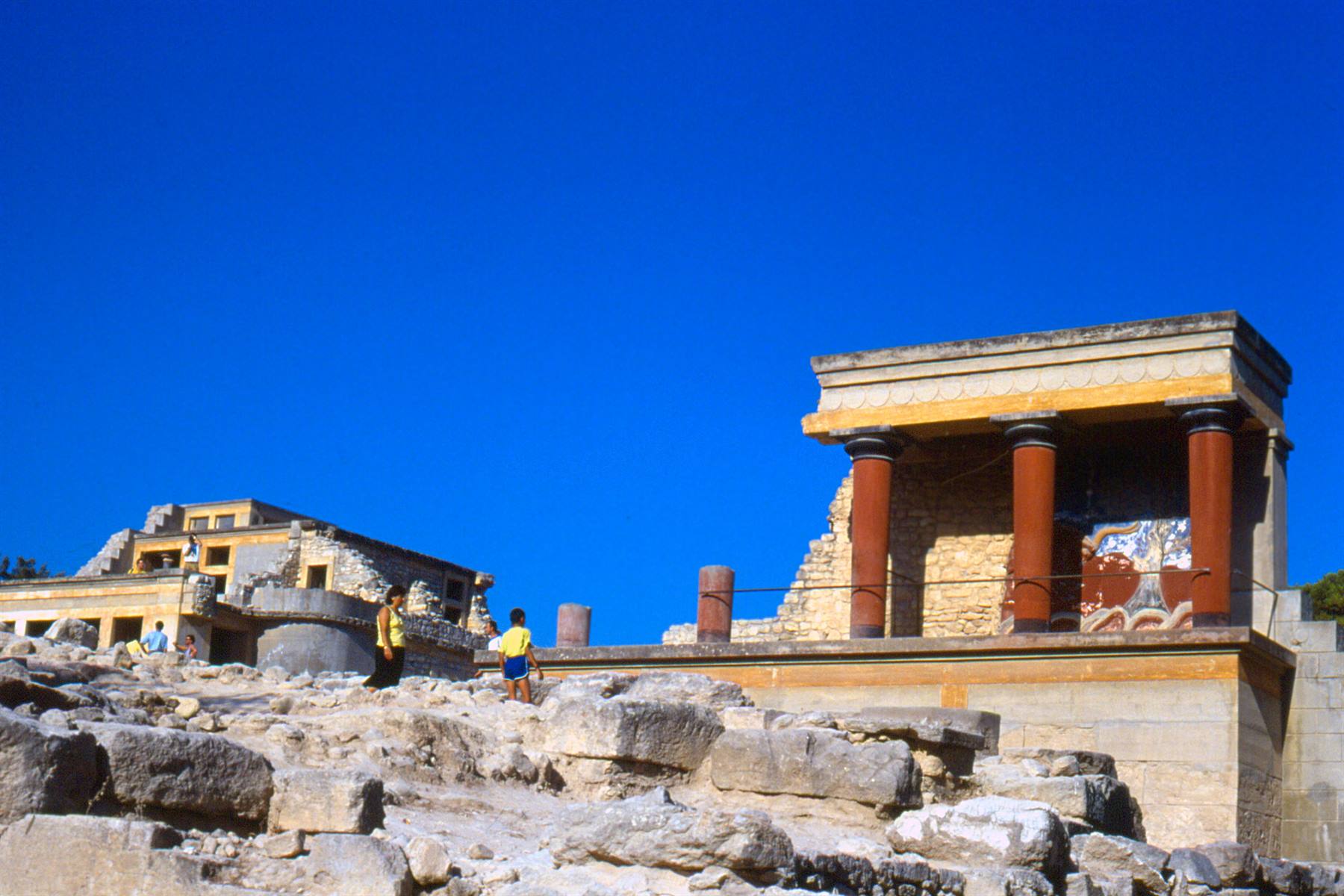
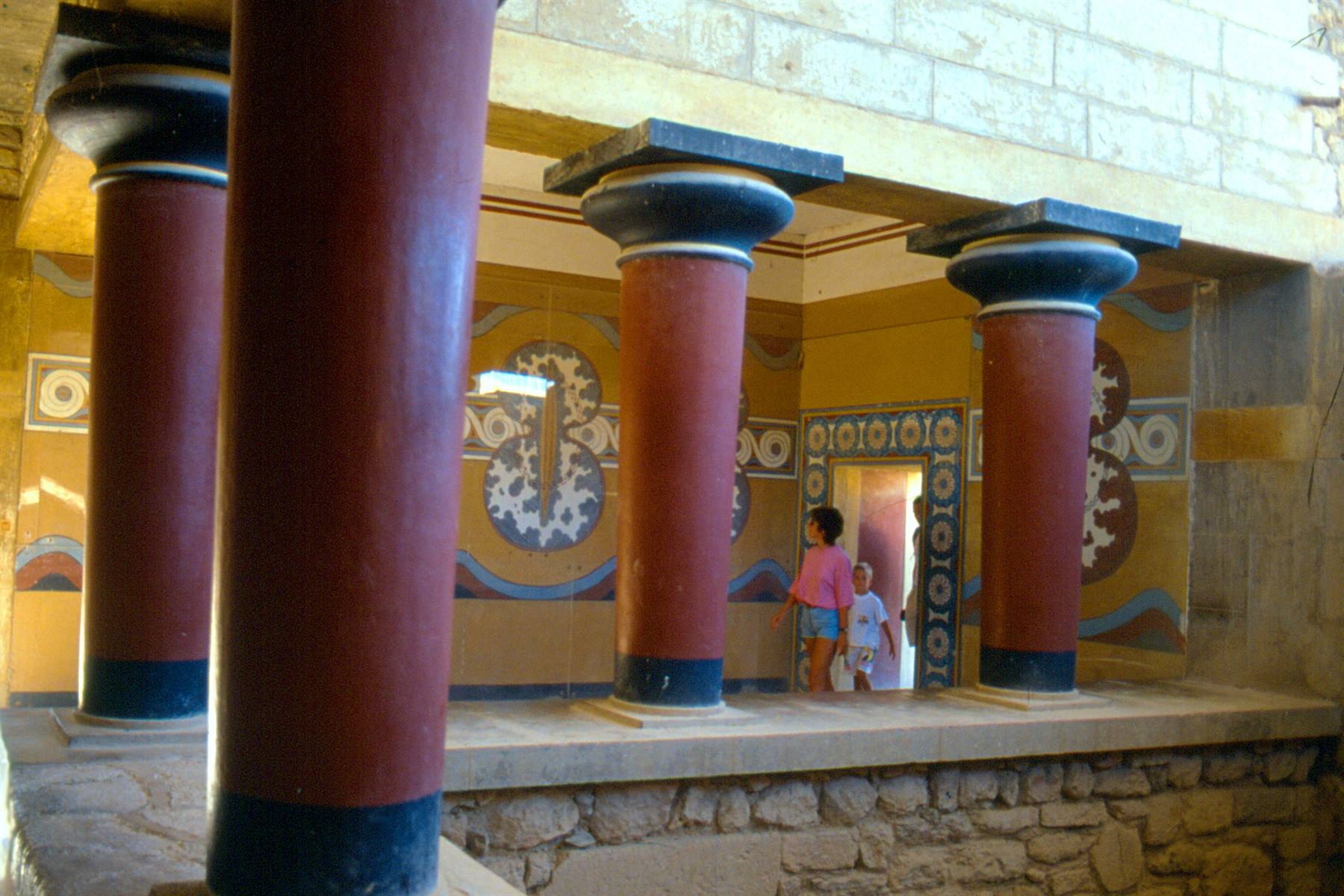
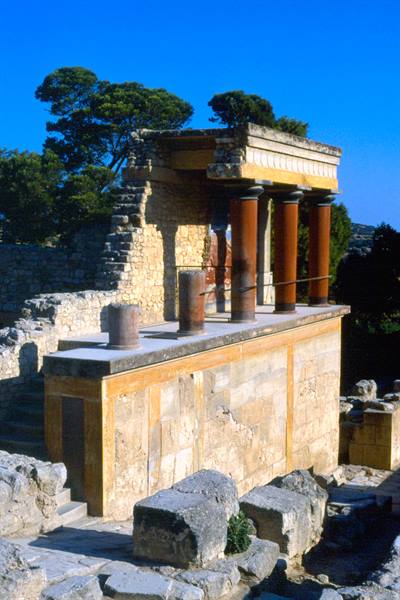
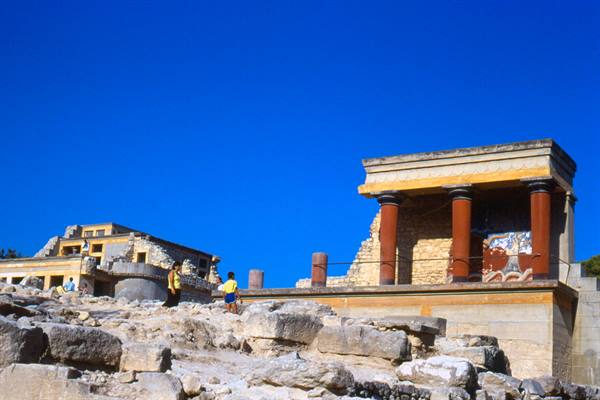
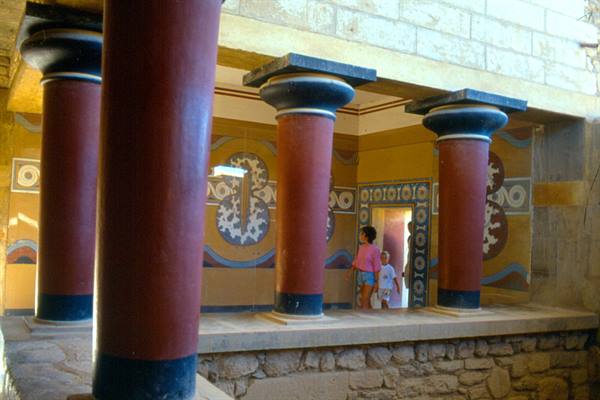
The quintessential summer holiday will also be our last day on the island of Crete. We return north and, once we reach Rethimno, we head east along the coastal highway to arrive, near the capital Iraklion, at Knossos, the island's main archaeological center. The ruins, brought to light in 1900 by the English archaeologist Sir Arthur Evans and partly faithfully reconstructed, are what remains of a great palace, inhabited since 2000 BC, in its time the political and administrative hub of the glorious Minoan civilization. The vast cluster of buildings extends over a hill to the left of the Katsambás stream and according to legend it was built, on behalf of the mythical King Minos, by Daedalus... The entire construction was, in fact, the so-called "labyrinth" into which the brave Theseus ventured to kill, with the help of the "thread of Ariadne," the fierce Minotaur.
Daedalus himself, together with his son Icarus, was then enclosed within the walls of the palace and together they attempted escape using the famous wings attached with wax... This according to Greek mythology, partly a product of human imagination, but there is a grain of truth, because the throne of Minos still makes a fine show of itself and can be considered in every respect the oldest (existing) throne in Europe! After wandering far and wide through the ancient remains, in the afternoon we move to Iraklio, the capital of Crete and main settlement with its more than one hundred thousand inhabitants, to go and see the very interesting Archaeological Museum, which preserves almost all of the finds unearthed at Knossos and at all the other sites on the island, thus playing a unique role in the world for the knowledge of the Minoan civilization.
Evening thus falls and for us the curtain practically closes on this extraordinary land; in fact, after a short wait we board the Minoan Lines ferry that at 20:30 casts off from the pier of Iraklion and sets sail for mainland Greece.
Crete - Crutalo
Day 2116 Aug 1990
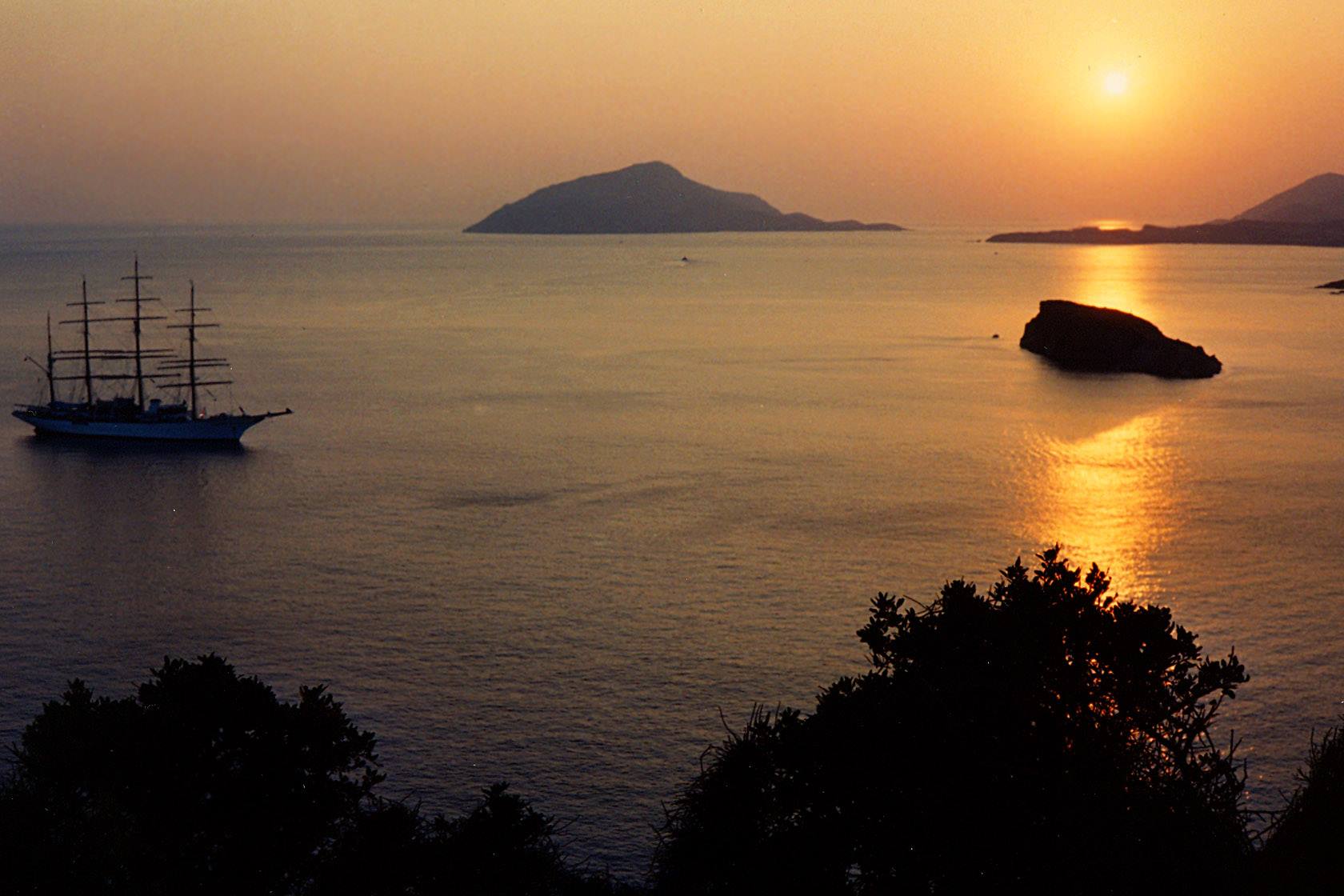
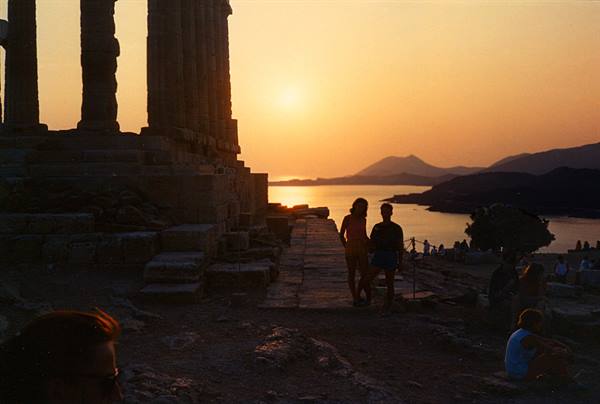
We sail through the night and in the early hours of the new day we disembark at the port of Piraeus... but we do not stop in the Greek capital and instead take the road that runs along the southwestern coast of Attica. On the way out of the metropolis we pass through crowded and hyper-touristy spots, then along the route we find quieter and more welcoming places again. We thus stop at the sea near Paleá Fókaia and there we spend a few hours in complete relaxation. In the late afternoon we set off again and reach Cape Sounion to visit the evocative ruins of the Temple of Poseidon... On this far tip of land the Athenians indeed built a famous sanctuary dedicated to the god of the sea.
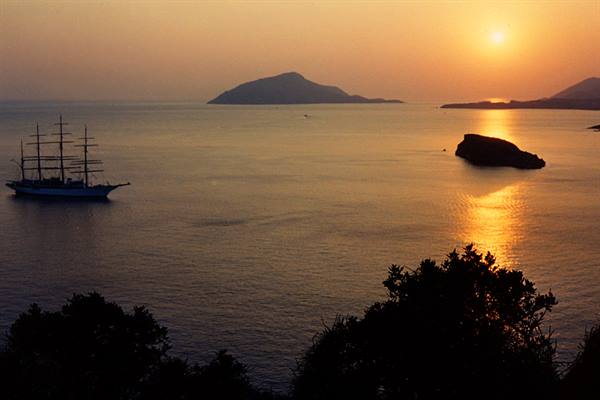
At the edge of a plateau, sixteen architraved Doric columns and two pillars of the cella rise intriguingly, survivors of the Temple of Poseidon, erected between 444 and 440 BC, replacing another one destroyed by the Persians. The whole thing stands against a grandiose panorama, particularly evocative at sunset... In fact, like us, many other tourists have come, at the end of the day, to enjoy the spectacle... truly breathtaking!
Crete - Knossos
Day 2217 Aug 1990
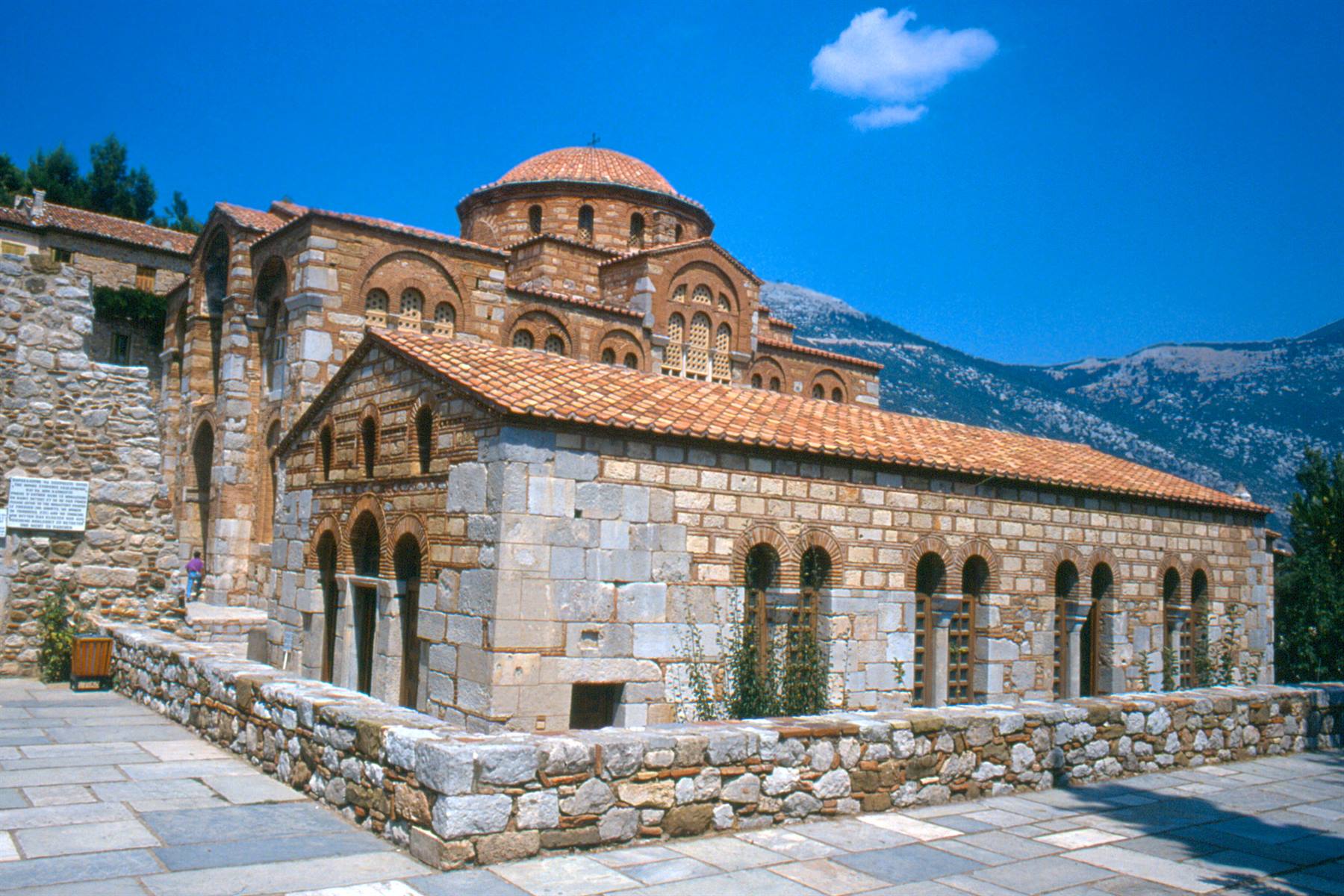
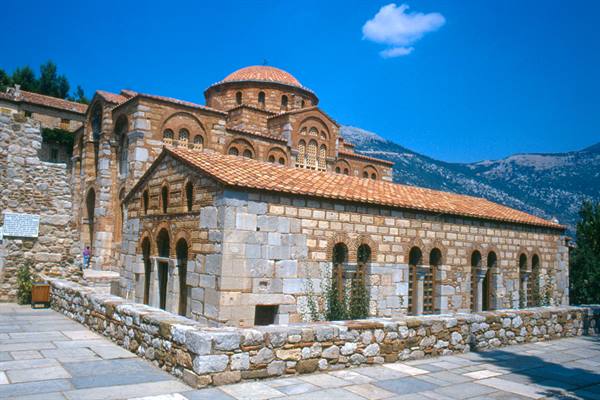
We leave Cape Sounion and go back up the Attica peninsula by way of the interior. We return toward Athens, skirting it on the east, and pass near Marathon, which brings to mind so many historical and sporting considerations, then take highway number 1 north. After a few dozen kilometers, near the town of Thíva, we begin following the strip of asphalt that leads in the direction of the deep Gulf of Corinth. Once we reach the spot of Distomo we follow the signs that lead us, almost at the foot of Mount Elikónas, to the Monastery of Ossios Loukas. What is considered one of the most important Byzantine monuments in Greece was erected in the 11th century, on the tomb of the holy hermit Luke the Stiriot, who died here in 953, and immediately became a pilgrimage destination. The monastery, enclosed by a wall, includes the Katholikon, the main church dedicated to St.
Luke, a perfect example of a Greek cross inscribed in a square with a large central dome and magnificent mosaics, and the Theotókos, the oldest religious building, dating back to the 10th century. From the courtyard we can enjoy beautiful and distinctive views of the complex, immersed in a desolate and extremely evocative environment, before setting off again and reaching, in the late afternoon, the parking area facing the archaeological site of Delphi.
Crete - Knossos
Day 2318 Aug 1990
In the morning we therefore prepare to visit one of the most famous and fascinating archaeological complexes in all of Greece, namely the Sanctuary of Apollo at Delphi. Considered sacred since the most ancient times, many cults were practiced in the place, up to that of Apollo, in fact, imported by the Cretans. Around the 7th century BC Delphi even became a pan-Hellenic sanctuary and oracle, triggering among other things numerous sacred wars, only to lose importance and fall definitively into ruin in the 4th century AD under Roman rule.
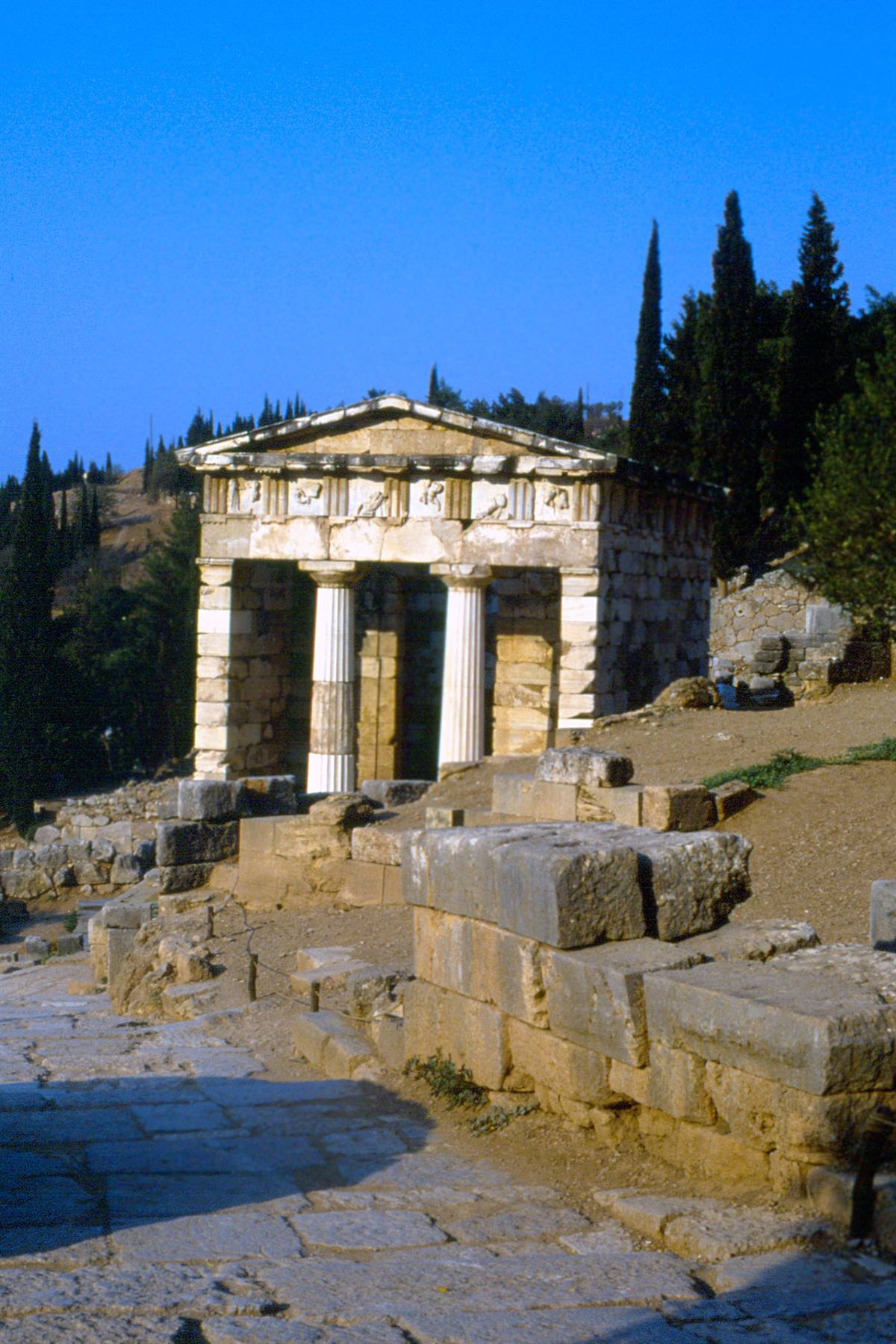
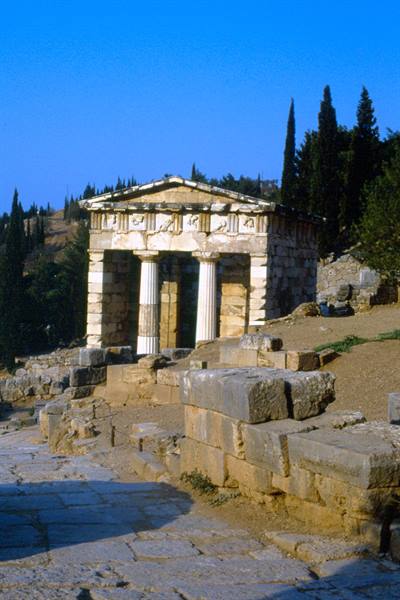
We enter the so-called Sacred Precinct through the main gate, located at the southeastern corner of the site, and go up along the paved Sacred Way, flanked by numerous ex-votos and various buildings, among which the magnificent Treasury of the Athenians stands out, a small Doric temple erected in its time with the spoils of Marathon and recently rebuilt with pieces that are almost all original. In this way we arrive at the plateau where the remains of six columns belonging to the original Temple of Apollo still stand today... Here, according to the ancients, the presence of the god manifested itself through the legendary oracle. A large theater, with a capacity of five thousand seats and carved out of the side of a slope, is located in the upper part of the complex and overlooks it.
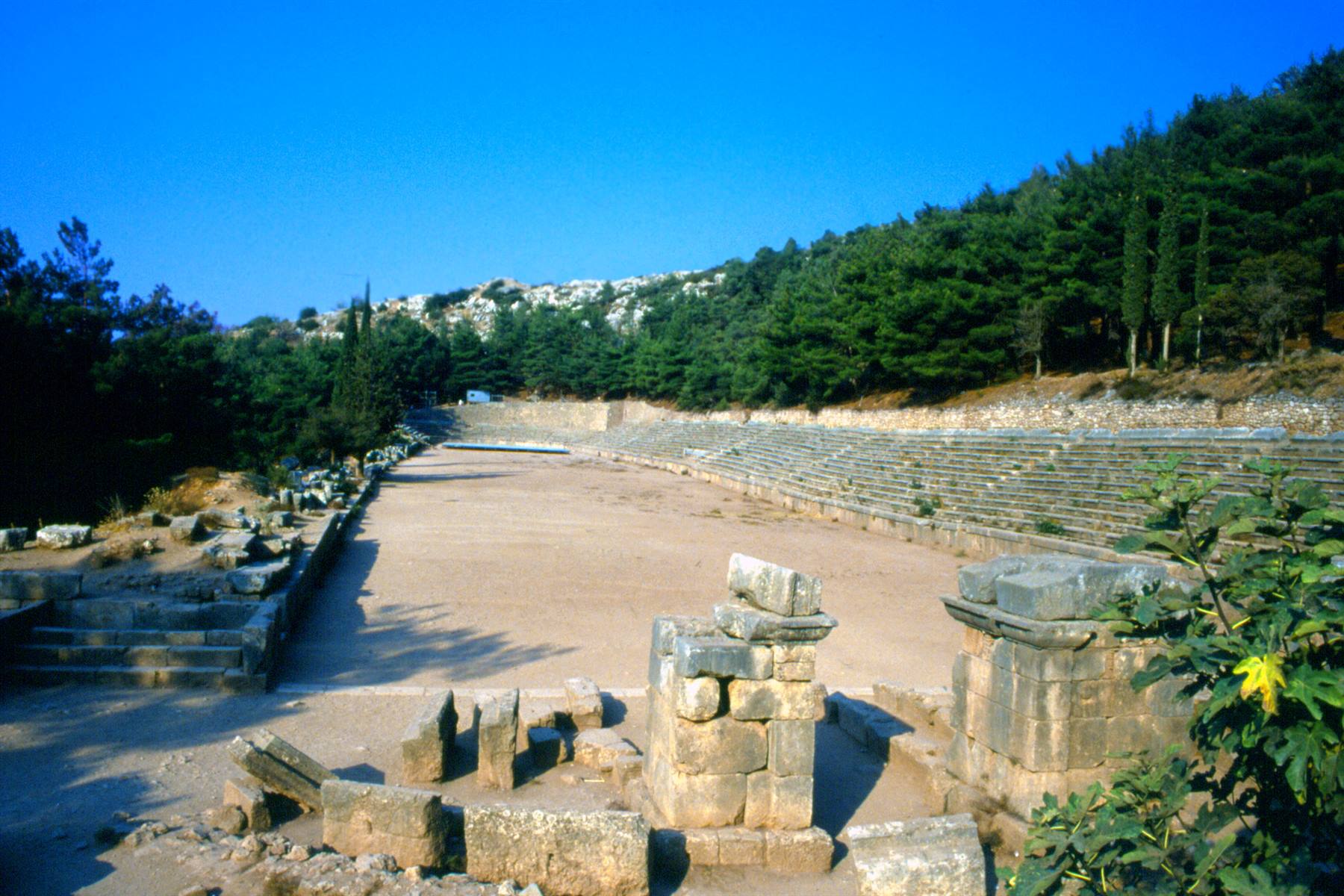
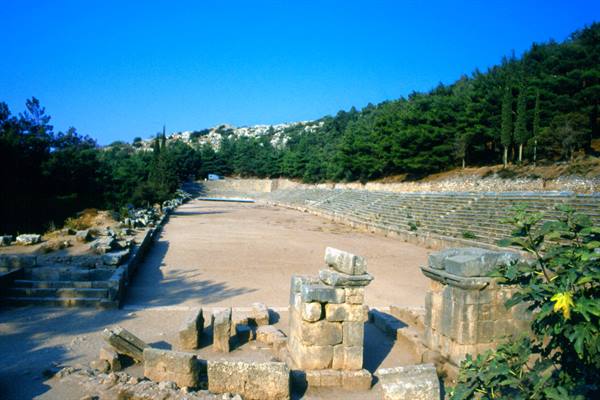
Still higher up, along a steep path through the woods, we climb to the plateau where the Stadium is located, begun in the 5th century BC and with a capacity of over seven thousand spectators, in which the starting lines, indelibly carved into the bare stone, are still clearly visible. All the most valuable finds unearthed in the area are kept in an adjacent museum to which we naturally devote ourselves at the end and as a completion of the visit. In the late morning we resume racking up kilometers. We go north along road number 27 and, crossing the plain very picturesquely called "sea of olive trees," because of the great number of these plants found there, we come almost to the sea at the spot of Lamia.
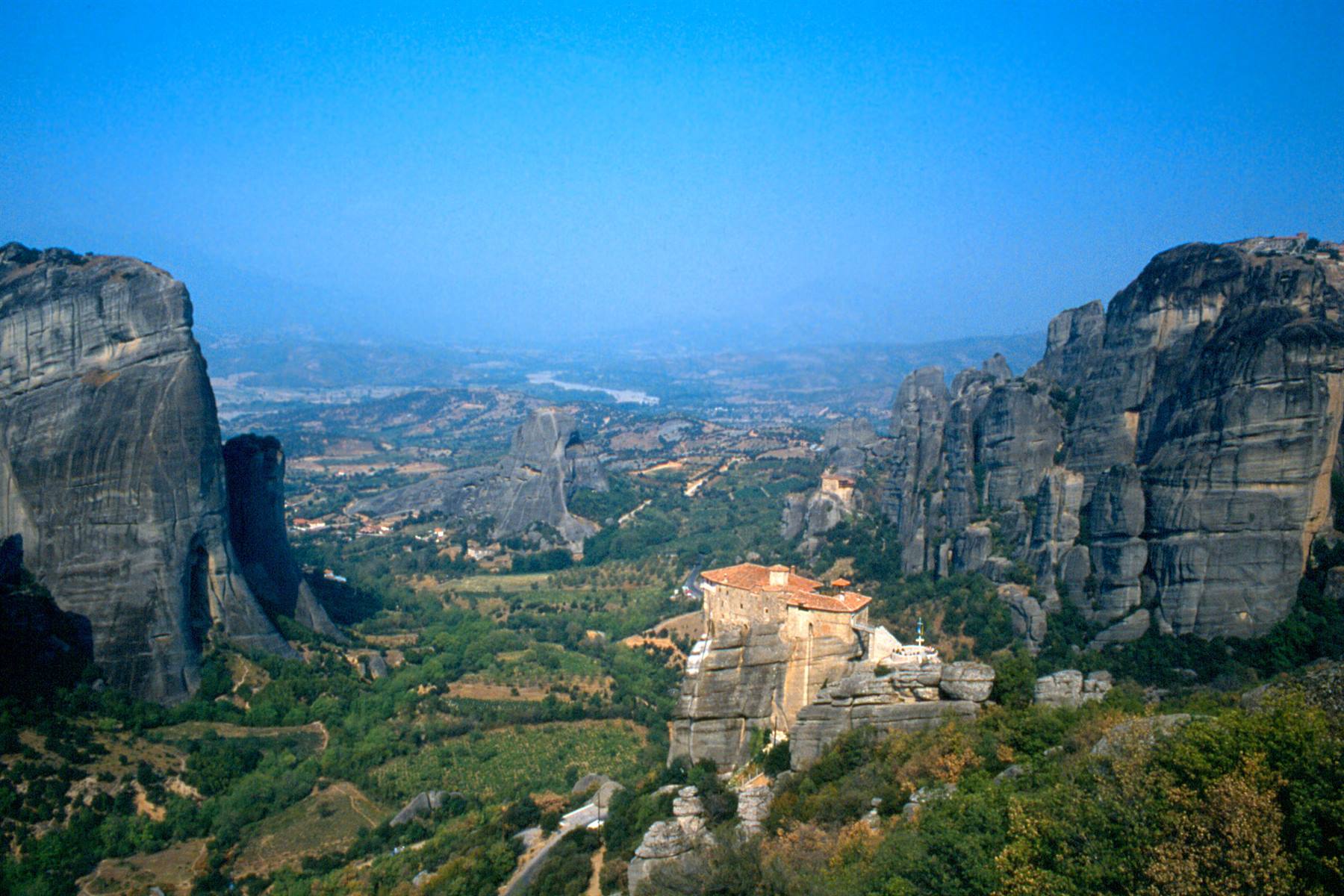
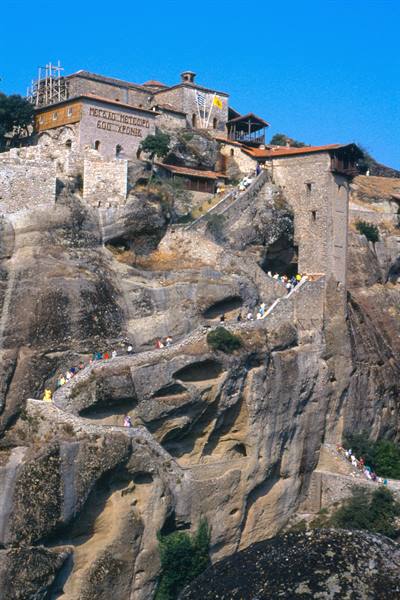
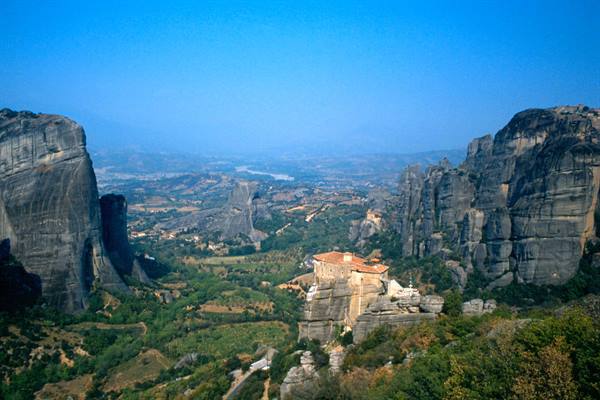
From there we proceed inland again, following roads number 3 and number 30, as far as Trikala, from where a handful of kilometers bring us to Kalambáka, at the foot of the famous Meteora. Particular corrosive phenomena of the sandstone, dating back about twenty-five million years, gave rise to gigantic rocks, with a sculptural shape, that rise like pillars (up to 400 meters high) over the plain of the Péneo river. The elevations, shaped by water and wind, in the years between the 11th and 16th centuries hosted numerous monasteries at their summits, some of which have survived to the present day... and they gave the place its name: Meteora means, in fact, monasteries in the air... We pass through the village of Kastráki, in the very heart of the region, with extraordinary views of the scenic rocks.
Along the road we leave behind some minor monasteries such as those of Agios Nikólaus Anapáfsas and Agia Roussánou and in the evening we arrive at the parking area facing the Megalo Metéoro, one of the most important religious complexes... in name and in fact!... and there we spend the night.
Attica - Cape Sounion
Day 2419 Aug 1990
We devote ourselves, first of all, to visiting the Megalo Metéoro... The convent, dedicated to the Transfiguration, was founded around 1380 and one goes up to it, unlike in the past, by means of a steep staircase... no longer thanks to the old hoist located in the so-called "tower of vrizoni," until a few decades ago the only means of access to the monastery. Through various gallery passages we then reach the church, in the shape of a Greek cross, with solemn frescoes inside... but it is above all the panorama enjoyed from the religious complex that leaves us literally open-mouthed. In the immediate vicinity we also explore the monastery of Varlaam, newer, since it dates back to the 16th century, but still very scenic and distinctive.
Continuing along the road that connects the main sites, we savor other extraordinary views of the inimitable rocky pinnacles and the daring constructions that have colonized them, then descend again to Kalambáka, where the show ends and one ideally comes back down to earth. At this point in the day we face a long transfer that takes us first to the city of Larissa, where we take highway number 1 north (thanks to which we regain the Aegean coast), then, grazing the urban area of Thessaloniki (which we will perhaps visit on another occasion), we come in sight of the Chalkidiki Peninsula. The peculiarity of the Chalkidiki Peninsula is that it is divided, in turn, into three smaller peninsulas: to the west that of Kassandra, to the east Mount Athos (a unique case in the world of a theocratic and inaccessible republic...
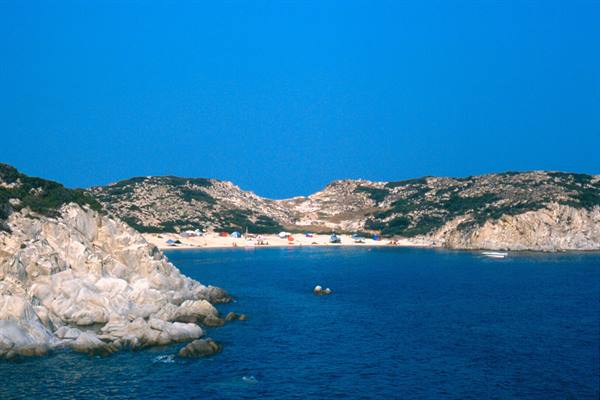
especially for women) and in the center that of Sithonia, toward which we are headed. In the evening we travel along the entire west coast of Sithonia and for the night we stop near its southernmost point.
Monastery of Hosios Loukas
Day 2520 Aug 1990
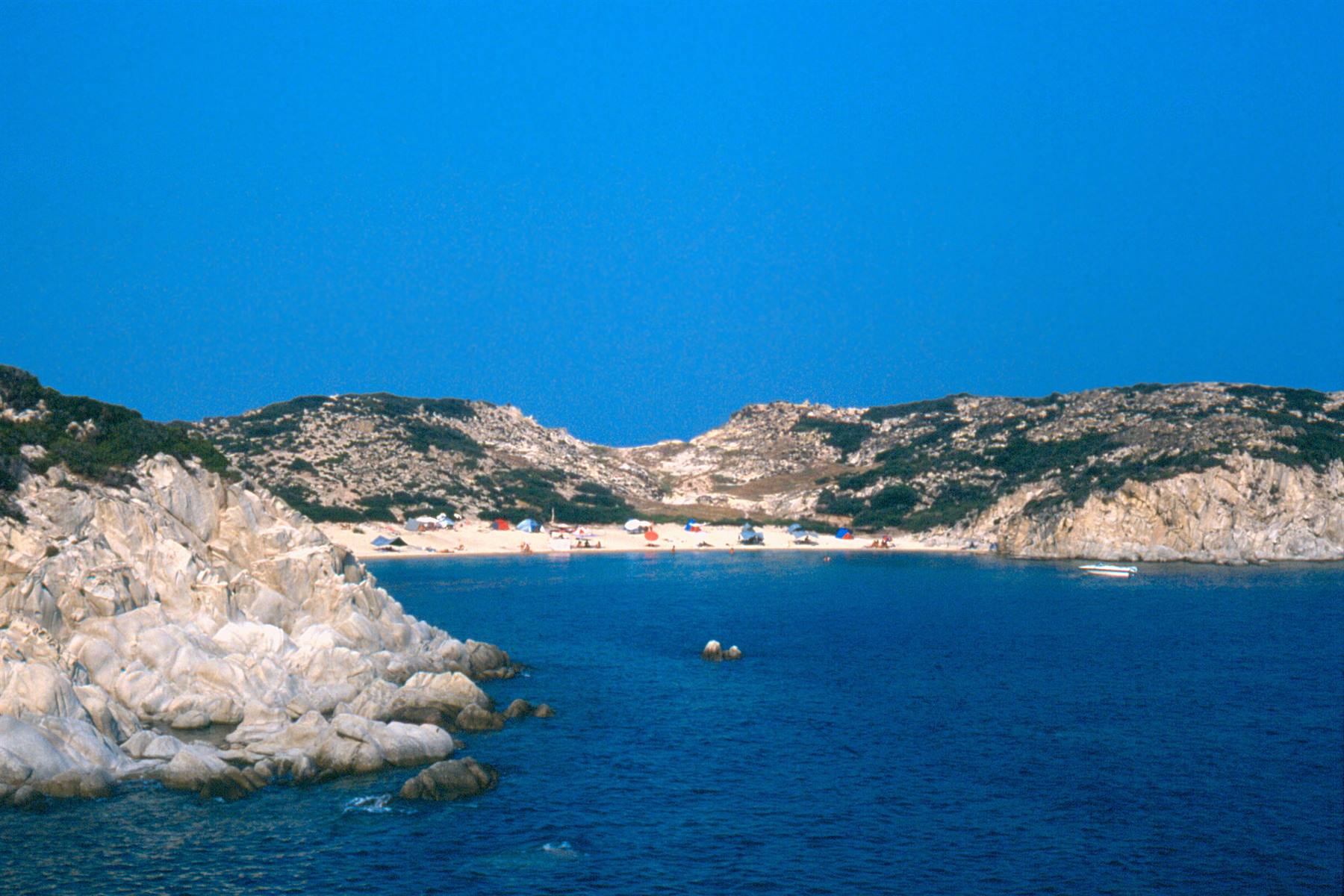
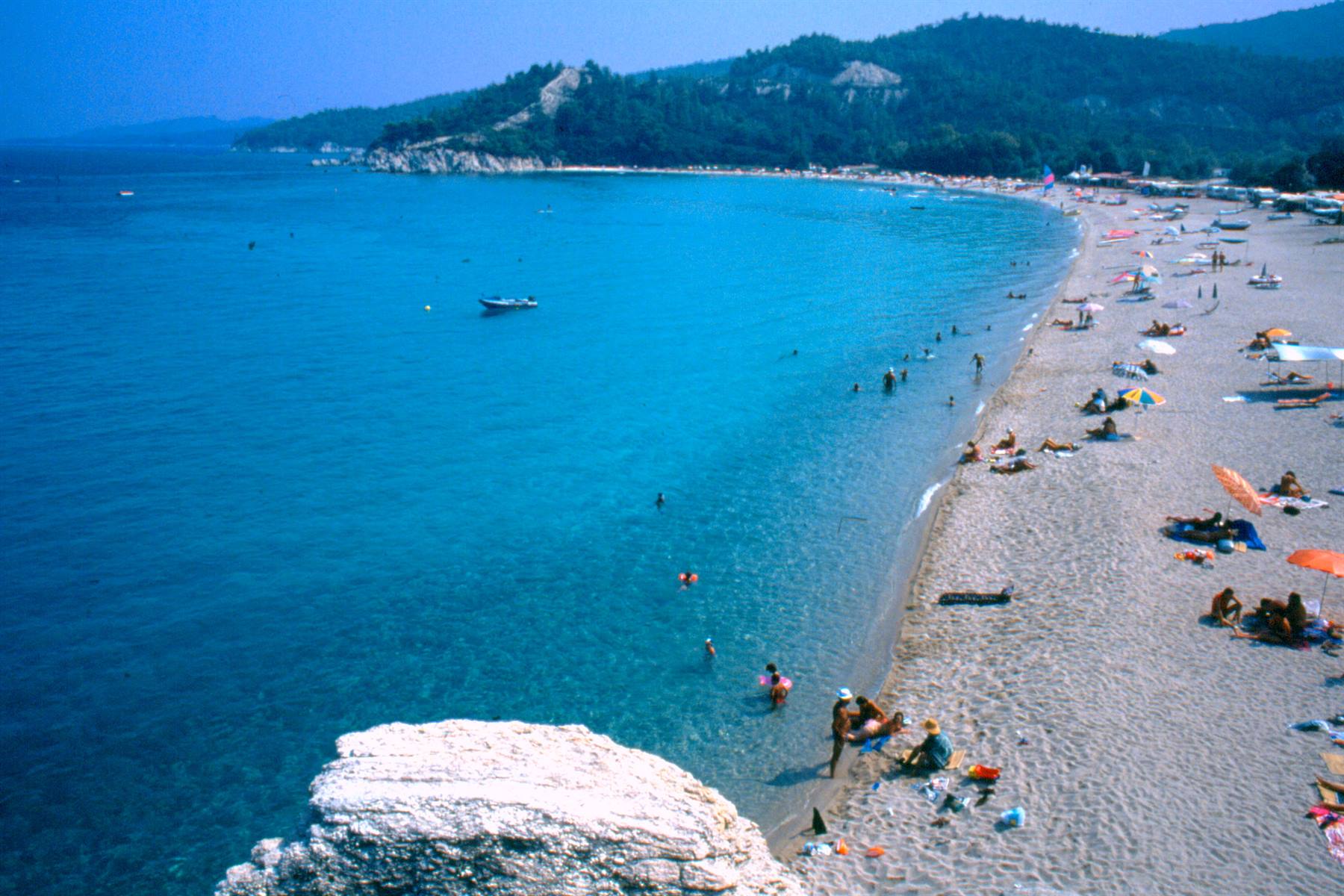
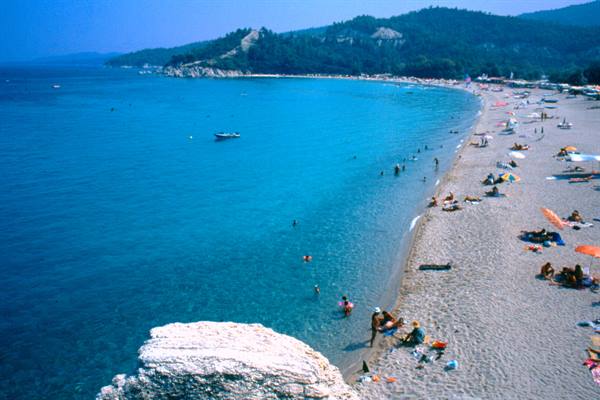
The Chalkidiki Peninsula, and in particular the Sithonia one, are known for the beauty of their coasts and the sea that bathes them, so, in search of a good dose of seaside relaxation, we stop at a nearby beach and, surrounded by a pleasant natural setting, we spend all the time at our disposal, until sunset.
Delphi
Day 2621 Aug 1990
We continue exploring Sithonia, travelling along its north-eastern coast. So we stop at the stunning bay of Armenistis... yet another opportunity to enjoy the blue Greek sea, with Mount Athos on the horizon, hidden in the haze of the Aegean, which makes it appear even more enigmatic than it actually is. The sun sets, bringing to an end another episode of this beautiful Greek holiday.
Delphi
Day 2722 Aug 1990
The dawn of a new day, on the other hand, announces to all of us the start of the very long journey back to Italy. We return to the area near Thessaloniki and from there we head north along highway number 1 to the border. To cross Yugoslavia we change the equivalent of two hundred thousand Italian lira into dinars and, given the unstoppable devaluation of that currency, they give us back two impressive bundles of banknotes, which make us feel like Scrooge McDuck for a few moments... but it's only an illusion destined to vanish quickly. Travelling on the M1 road we skirt the city of Skopje, pass through that of Nis and, in absolute monotony, in the evening we arrive near Belgrade, where we stop to rest.
Meteora
Day 2823 Aug 1990
Very early in the morning we resume grinding out kilometres along the country's main artery and, once past the capital, after several hours of travelling, we come in sight of Zagreb, the capital of Croatia, then, taking the M12, we first find the Adriatic Sea again at Fiume (Rijeka) and then our beloved Italy at Trieste, where we stop once again for the night.
Halkidiki - Sithonia
Day 2924 Aug 1990
So it's the last real day of this holiday, and so, travelling along roads and motorways that are more familiar to us and passing through Venice and Ravenna, in the early afternoon we are home again... This is how we put an end to a journey that was in some ways epic, with over six thousand kilometres covered, through regions not yet touched by mass tourism and in any case extraordinarily rich in history and natural beauty... Greece really thrilled us and certainly in the near future we will return within its borders to savour other aspects, no less interesting, and to visit other regions that we believe are just as beautiful... from every point of view!
0 reader comments